Frankenstein

Frankenstein

By Martin Powell & Patrick Olliffe (Malibu Graphics, Inc.)
ISBN: 0-944735-39-8

Mary Wollstonecroft Shelley’s gothic classic The Modern Prometheus was first published in 1818 and is probably one of the most influential novels of popular fiction ever written, and it is the book rather than the many cinematic interpretations that best informs this impressive lost graphic gem from 1990.

Originally released as a three issue miniseries from Eternity Comics, it followed the success of author Powell’s Sherlock Holmes pastiches Scarlet in Gaslight and A Case of Blind Fear (most recently collected by Moonstone in Sherlock Homes Mysteries Volume 1, ISBN: 978-0-97216-686-7), but rather than extrapolation he aimed for a more straightforward adaptation of the source material.

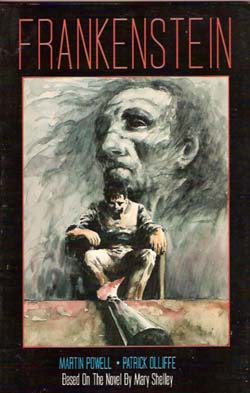
Although no true and faithful version yet exists – since most of the novel deals with the agonies, travails and travels of Victor Frankenstein and his interactions with his creation are relatively few (albeit torturous and telling) – this is an effective and often chilling interpretation made starkly memorable by Patrick Olliffe.

The Chiaroscuric art-in-transition of the young artist perfectly establishes a mood of tortured humanism, with resonances of Roy G. Krenkel and solid echoes of Berni Wrightson – but oddly not that latter’s own impressive treatment of Shelley’s text. Of the many, many versions of the tale, this ranks closest to the superb Mike Ploog version put out by Marvel in the early 1970’s (see Essential Monster of Frankenstein ISBN: 0-7851-1634-6).

This is not a replacement for the novel – so read that too – but a well-crafted addendum that deserves a larger audience. Oddly enough the Spanish already agree with me as editions in that language have been available for over a year now.

¿Que?

Script © 1990 Martin Powell. Artwork © 2006 Patrick Olliffe. All Rights Reserved.
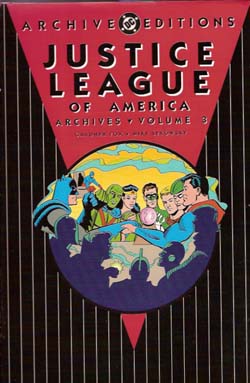
DC Archive: Justice League of America, Vol 3

DC Archive: Justice League of America, Vol 3

By Gardner Fox, Mike Sekowsky & Bernard Sachs (DC Comics)
ISBN: 1-56389-159-X

The third deluxe volume recounting the adventures of “The World’s Greatest Superheroes” begins with ‘Challenge of the Untouchable Aliens’ (Justice League of America #15, cover-dated November 1962), an exotic, doom-laden mystery which added some fresh texture to the formulaic plot of extra-dimensional invaders out for our destruction. Following that is the intellectual poser ‘The Cavern of Deadly Spheres’; a change-of-pace tale with a narrative hook that just wouldn’t be used on today’s oh-so-sophisticated audience, but which still has power to grip a reader.

‘Triumph of the Tornado Tyrant’ (#17) saw a sentient cyclone that had once battled the indomitable Adam Strange set up housekeeping on an desolate world to ponder the very nature of Good and Evil, before realising that it needed the help of the Justice League to reach a survivable conclusion. Teaser Alert: As well being a cracking yarn, this story is pivotal to the development of the android hero Red Tornado…

Issue #18 saw the team summoned to a subatomic civilisation by three planetary champions whose continued existence threatened to end the very world they were designed to protect. ‘Journey to the Micro-World’ found our heroes compelled to defeat opponents who were literally unbeatable. Another perplexing riddle was posed in ‘The Super-Exiles of Earth’ when unstoppable duplicates of the team go on a crime-spree with the result that the world’s governments are forced to banish the heroes into space.

‘The Mystery of Spaceman X’ is an interplanetary romp and a cunning brainteaser, with lots of action serving to whet the appetite for the genuine pivotal classic that follows.

‘Crisis on Earth-One’ (Justice League of America #21) and ‘Crisis on Earth-Two’ (#22) combine to become one of the most important stories in DC history and arguably in all American comics. When ‘Flash of Two Worlds’ introduced the concept of Infinite Earths and multiple heroes to the public, fan pressure began almost instantly to bring back the lost heroes of the “Golden Age”. The editorial powers-that-be were hesitant, though, fearing that too many heroes would be silly and unmanageable, or worse yet put readers off. If only they knew what we know now!

The plot sees a team-up of assorted villains from each Earth plundering at will and trapping our heroes in their own HQ. Temporarily helpless the JLA contrive a desperate plan to combine forces with the champions of a bygone era! It’s impossible for me to be totally objective about this saga. I was a drooling kid in short trousers when I first read this and the thrills haven’t diminished with this umpty-first re-reading. This is what superhero comics are all about!

This volume shows the very best of DC at the height of its creative output: Sheer fun and excitement to delight readers of any age and temperament.

© 1962, 1963, 1994 DC Comics. All Rights Reserved.

Batman: Lovers and Madmen

Batman: Lovers and Madmen

By Michael Green, Denys Cowan & John Floyd (DC Comics)
ISBN13: 978-1-84576-722-8

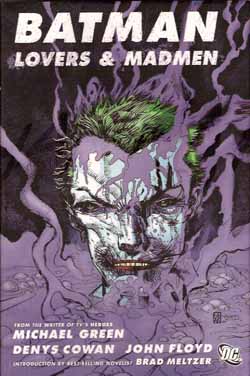
Apparently every writer wants a crack at the big guns and that seems to constitute rewriting the origin of a character every five minutes, so imagine my surprise that this re-re-re-working of the first meeting between Batman and the Joker reads so very well. Although I’ve complained about it often enough, a rethink on the relationship doesn’t have to be a desperate stunt or cheap trick.

Gotham City: Batman has prowled the night for only forty-two weeks but in that time has made a big impact. Crime is on the run and the obsessed hero allows himself the reward of falling in love with the vivacious and feisty Lorna Shore. In his hubris Batman imagines that he’s on top of his self-appointed mission and ready for anything. But Gotham has never before experienced a criminal like Jack…

Unlike previous origin tales such as the Red Hood (gentleman bandit of the 1950s) or the tragic victim of The Killing Joke, the man who will become the Joker is a cold, emotionless sociopath. This career criminal is already coldly crazy and the best Batman has ever faced. So when the outmatched and floundering hero makes a devil’s bargain with a gang-boss the events that lead to the birth of the Harlequin of Hate are his fault. And every death the Joker causes is forever Batman’s responsibility…

Screen Writer Michael Green has crafted a solid, compelling thriller that does much to delineate what the post-Infinite Crisis Batman will be. There are novel revelations and wonderfully intimate asides for long-time fans to appreciate. As ever the raw kinetic energy of Denys Cowan’s drawing adds penetrating edginess to the mix. If you have to reboot classic characters every so often, then this is the way to do it.

Top rate action and adventure, but continuity reactionaries and general nitpickers might want to wait for the eventual softcover release and leave themselves one less thing to bemoan.

© 2007 DC Comics. All Rights Reserved.

Batman: Dark Joker — The Wild

Batman Dark Joker
Batman: Dark Joker

By Doug Moench, Kelley Jones & John Beatty (DC Comics)
ISBN: 978-1-56389-111-5 (hardback) ISBN: 978-1563891403 (trade paperback)

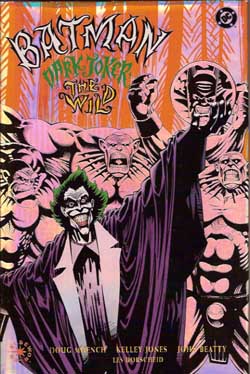
Released under the “Elseworlds” banner, where familiar properties are mixed with new or exotic genres outside regular continuities, this tale is a full-on traditional fantasy set in a feudal, mystic world of flying castles, wizards and monsters. Lilandra and Majister are sorcerers locked in a lifelong duel with an evil wizard. Sacrificing their lives and that of a baby they have mystically conjured, the pair create a fearsome beast that will eventually inflict their revenge on the terrifying Dark Joker and save the humans of the rural idyll known as The Wild.

But before the bat-winged monster can rescue innocent mankind from Dark Joker’s depredations, a beautiful, doomed woman named Saressa must tame the beast and teach it the humanity its tragic upbringing has deprived it of…

Although some of Jones and Beatty’s best artwork, this is not one of author Moench’s best scripts, managing somehow to be both heavy-handed and flimsy at the same time. The fantasy milieu is quite forced at times, his dialogue florid (even for Moench!) and the story seems unsure of its audience; injecting utterly unnecessary moments of gory excess into a solid plot that could with a little judicious pruning be quite recommendable for a younger readership.

Pretty but flawed, this is a book only really for the committed fan and collector.

© 1993 DC Comics. All Rights Reserved.

Andromeda Stories

Andromeda Stories 1

By Keiko Takemiya, story by Ryu Mitsuse (Vertical)
Book 1 ISBN: 978-1-932234-84-8, Book 2 ISBN: 978-1-932234-85-5, Book 3 ISBN: 978-1-934287-04-0

Keiko Takemiya is one of the most revered women working in Japanese comics. Her Kaze to Ki No Uta (an adaptation of Gilbert Cocteau’s The Poem of the Wind and the Trees) which appeared in 1976 is considered the first ever Shounen-ai (young men’s love strip) and the progenitor of that entire genre. Born in 1950, she sold her first work in 1968, working in not just romance and girl’s stories but also science fiction in a grand and epic manner.

This brief series from 1980-1982 has some overtones of Fred Saberhagen’s Berserker novels, and tells the epic generational tale of humanity’s struggle against encroaching and relentless mechanisation by sentient machines programmed to domesticate and protect Man from all threats – especially himself.

Andromeda Stories 2

On the idyllic and spiritual world of Astria, Cosmoralian Prince Ithaca is preparing to marry Princess Lilia when an irresistible mechanical invasion force arrives, programmed to overwhelm and eradicate organic life.

Despite heroic opposition The Enemy inexorably assimilates the human population, and Lilia is forced to flee with her newborn son Prince Jimsa to the desert wastes. There he grows to young manhood surviving ravening wild beasts, bandits and grim adversity, sharpening the immense powers he has developed as the culminating point of three extremely special bloodlines.

And somewhere a twin sister he knows nothing about also matures…

Andromeda Stories 3

The third volume begins with the siblings eventual meeting, carries through to the final fate of Astria and goes on to encompass the intergalactic destiny of the entire human race.

Staggering in scope, this fantasy thriller has classical overtones (and a chilling metaphorical message picked up in James Cameron’s Terminator movie a few years later) delivered in an engagingly florid and poetic style. Working with prose science fiction legend Ryu Mitsuse, Takemiya blazed a trail with this tale and it’s a pleasure to finally see it in an accessible English edition.

© 2008 Keiko Takemiya. Translation © 2008 Magnolia Steele and Vertical, Inc. All Rights Reserved.

Superman: The Man of Steel, Volume 6

Superman: The Man of Steel, Volume 6

By various (DC Comics)
ISBN: 978-1-84576-440-1

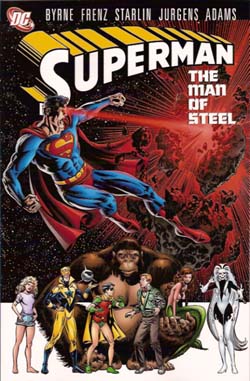
At long last the latest volume in this excellent series chronologically reprinting the post-Crisis on Infinite Earths Superman has been released, and reaches the landmark first anniversary of that brave renovation.

Featuring the creative efforts of John Byrne, Ron Frenz, Jim Starlin, Dan Jurgens, Art Adams, Dick Giordano, Brett Breeding, Steve Montano, Keith Williams, Roy Richardson and Karl Kesel, the book includes all three of the Annuals for 1987, Action Comics #595-595, Superman #12 and as a necessary bonus issue #23 of Booster Gold volume 1 – the concluding part of a cross over between the rival champions of Metropolis.

The magic kicks off with ‘Skeeter’, a vampire shocker guest-starring Batman written by Byrne and illustrated by Art Adams and Dick Giordano originally published in Action Comics Annual #1. Next is a poignant updating of a Silver Age classic. ‘Tears for Titano’ by Byrne, Frenz and Breeding first saw print in Superman Annual #1 and puts a modern spin on the tale of the giant chimp that menaced Metropolis.

The Adventures of Superman Annual #1 was the original home of ‘The Union’ by Jim Starlin, Jurgens and Steve Montano, wherein Superman is asked by Ronald Reagan and super-Fed Sarge Steel to find out what happened in the instant ghost-town of Trudeau, South Dakota. This edgy sci-fi shocker showed audiences that the new Man of Steel wasn’t the guaranteed winner he used to be, and set the scene for a momentous future confrontation with the monstrous Hfuhruhurr the Word-bringer.

‘All that Glisters’ (Byrne and Keith Williams) comes from Action Comics #594, a big battle team-up with Booster Gold that concluded in issue #23 of that hero’s own title. ‘Blind Obsession’, with art and story by Jurgens and Roy Richardson, is followed by the magical retelling of another classic Wayne Boring Superman tale.

‘Lost Love’ from Superman #12, by Byrne and Karl Kesel, recounts the tragic tale of Clark Kent’s brief affair with the mysterious Lori Lemaris, a unique girl he twice – that’s right – loved and lost, and the volume concludes with Action Comics #595. ‘The Ghost of Superman’ introduced the eerie Silver Banshee in a mystery team-up that I’m not going to spoil for you.

Against all current expectation the refitted Man of Tomorrow was a critical and commercial success. As one of the penitent curmudgeons who was proved wrong at the time, I can earnestly urge you not to make the same mistake. These are magically gripping and memorable comic gems that can be enjoyed over and over again. So the sooner you get these books the sooner you can start the thrill ride…

© 1987 DC Comics. All Rights Reserved.

Superman: Camelot Falls, Book 2 — The Weight of the World

Superman Camelot Falls

By Kurt Busiek, Carlos Pacheco & Jesus Merino (DC Comics)
ISBN: 978-1-84576-651-1

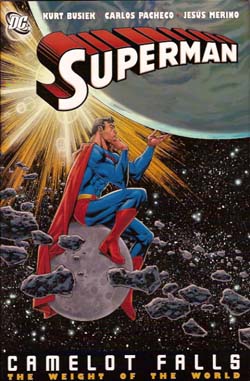
The concluding volume of the serial epic that ran intermittently in the monthly Superman comic is finally available, and although it is very impressive eye-candy I still question the fairness of two little books when the whole story could quite easily have fitted into one. In volume 1 (ISBN: 1-84576-434-X) the ancient Atlantean sorcerer Arion showed the Man of Steel a vision of the future where the hero’s continued defence of the planet inevitably lead to its destruction, and asked him to retire before that vision became horrendous reality.

In this volume (collecting Superman #662-664, 667 and Superman Annual #13) the Mage decides to force Superman’s decision.

Chockfull of guest-stars and featuring pertinent asides with the tragic Superman-analogue Subjekt 17, plus a pack of very young New Genesis truants and even old foe the Prankster, this is a very pretty adventure. But even although the final confrontation is visually spectacular, story-wise there’s nothing we haven’t seen before.

Shiny and simplistic, this is a pallid disappointment for fans with precious little to recommend it to the casual or new reader.

© 2007 DC Comics. All Rights Reserved.

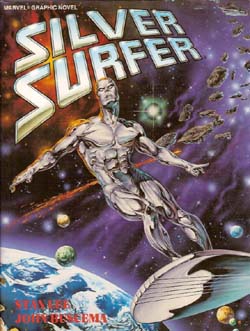
Silver Surfer: Judgement Day

A MARVEL GRAPHIC NOVEL

Silver Surfer: Judgement Day

By Stan Lee & John Buscema, with Tom DeFalco (Marvel)
ISBN: 0- 87135-427-6

Here’s a fine example of an all-too common problem in graphic novel production, in the form of a high class product that I can half-heartedly recommend – and no, I didn’t mistype that.

The Silver Surfer was always a pristine and iconic character when handled well – and sparingly – yet once he gained and sustained a regular comic book presence he became somewhat diminished; less… special. After a strong start his adventures became formulaic and even dull. In reworking the character for the modern market, a huge amount of the mystique that made the critically beloved but commercially disastrous Christ allegory from the Stars a 1960’s cause celebré was lost.

On paper a reuniting of Stan Lee and John Buscema on their most revered character collaboration must have seemed a win-win proposition, and the production values of a hardcover album with the most up to date repro and colouring techniques promised delights to warm even the most jaded fan’s heart. The artistic bravery of making each of the 62 pages one full panel of Buscema artwork was a fan-boy’s dream.

So why am I less than whole-heartedly enthusiastic?

Comics are a synthesis of art and story. When both are at their peak no other creative medium in the world can match them for imagination, delight and wonderment. John Buscema rose to the challenge, producing some of the best superhero drawing of his long and impressive career, ably assisted by the colouring of Max Scheele.

And the story sucked.

Even though plotted by Tom DeFalco and scripted by Stan Lee, the tale of the satanic tempter Mephisto’s seduction of Nova, the comely herald of the world-devouring Galactus, the self-sacrifice of the Surfer and the battle between the mystical Lord of Hell and Galactus, the ultimate Force of Science, should have been a high-point of sequential fiction.

But it isn’t. The dialogue is rushed, overblown, occasionally moronic and often downright embarrassing. But it is so very, very lovely to look at…

There’s the painful paradox. Every fan should have this book, but it might be best to find a copy translated into a language you can’t read…

A softcover edition (ISBN13: 978-0-87135-663-5) is also available.

© 1988 Marvel Entertainment Group/Marvel Characters, Inc. All Rights Reserved.

Penelope

Penelope

By Thelwell (Eyre Methuen)
ISBN: 978-0-41329-340-4

Norman Thelwell is one of our most beloved cartoonists – even though he sadly passed away in 2004. I was going to astound you with my knowledge here but frankly his work has always been its own best advocate, and if you want to know more about this brilliant creator – and see more of his work – you should crank up your search-engine of choice. I specifically recommend the official website (www.thelwell.org.uk/biography/biography.html) as well as Steve Holland’s excellent Bear Alley .

Thelwell’s superbly gentle cartooning combined Bigfoot abstractions with a keen and accurate eye for background detail, not just on the riding and countryside themes that made him a household name, but on all the myriad subjects he turned his canny eye and subtle brushstrokes to. His pictures are an immaculate condensation of everything warm yet charged and resonant about being Post-War, Baby-Booming British, without ever being parochial or provincial. His work has international implications and scope, neatly achieving that by presenting us to the world. There are 32 books of his work and any aficionado of humour could do much worse than own them all.

From 1950 when his gag-panel Chicko first began in the Eagle, and especially two years later with his first sale to Punch, he built a solid body of irresistible, seductive and always funny work. He appeared in innumerable magazines, comics and papers ranging from Men Only to Everybody’s Weekly. In 1957 Angels on Horseback, his first collection of published cartoons was released, and in 1961 he made the rare reverse trip by releasing a book of all-new cartoons that was subsequently serialised in the Sunday Express.

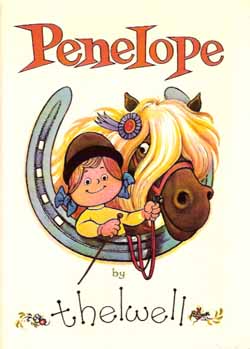
A Leg at Each Corner was a huge success and other books followed. Eventually this led to the strip collected in the book reviewed here. Thelwell’s short obnoxious muses originated in the field next door to his home, where roamed two shaggy ponies…

“Small and round and fat and of very uncertain temper” – apparently owned by “Two little girls about three feet high who could have done with losing a few ounces themselves….”

“As the children got near, the ponies would swing round and present their ample hindquarters and give a few lightning kicks which the children would side-step calmly as if they were avoiding the kitchen table, and they had the head-collars on those animals before they knew what was happening. I was astonished at how meekly they were led away; but they were planning vengeance – you could tell by their eyes.”

Penelope and her formidable steed Kipper ran – or at least reluctantly trotted – (sorry, I have no will-power or shame) through the pages of the Sunday Express where Thelwell toiled from 1962 to 1971. This wonderful book is readily available, as is the sequel Penelope Rides Again, and I trust that anyone with an ounce of decency and taste will treat themselves to the work of this master as soon as humanly possible.

© 1972 Norman Thelwell and Beaverbrook Newspapers Ltd.

Lobo: Portrait of a Bastich

Lobo: Portratit of a Bastich

By Keith Giffen, Alan Grant & Simon Bisley (DC Comics)
ISBN: 978-1-84576-889-8

The intergalactic bounty hunter was first seen in Omega Men #3 in 1982, and cropped up all over the DC universe, even becoming a mainstay of the popular L.E.G.I.O.N. series. He had his own monthly title for a few years as well as many miniseries and specials, and was a popular candidate for inter- and cross-company team-ups.

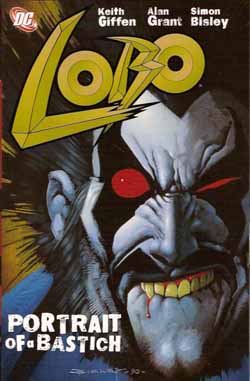
Lobo roughly translates as “he who devours your entrails and enjoys it”. This unstoppable, anarchic force-of-nature exploded in popularity in the decade that followed his premiere, despite being petty much a one trick pony and increasingly an exercise in outrageous graphic excess. He was exactly what a lot of fans wanted.

This new trade paperback collection reprints his the two breakthrough miniseries from 1990, the first of which details an unwelcome mission whilst indentured to the service of L.E.G.I.O.N., an intergalactic commercial police force run by Vril Dox, “son” of the villainous super-villain Brainiac.

Lobo always prided himself on being final survivor of his planet, but in ‘The Last Czarnian’ to his horror he finds that he missed someone when he slaughtered his entire race, that she’s his old grade-school teacher, and that moreover she’s written an unauthorized biography of the Main Man. Forbidden by his own honour-code from killing her, he must escort her to L.E.G.I.O.N. headquarters as all the nut-jobs in the universe pursue them, hell-bent on killing one or other of them.

“Lobo’s Back” from 1992 details his return to the private sector and how he dies trying to bring in the infamous Loo, the most dangerous being in the universe. What follows is an outrageous, darkly hilarious, blood-soaked spin on a venerable old tale (you’ve probably seen the Bugs Bunny cartoon classic) as Lobo makes himself persona non grata in the afterlife.

When both Heaven and Hell discover that the Main Man is too much to handle there’s only once place he go and that’s back here, but nobody said it had to be in his original body…

Brutally, blackly comedic, ironic, sardonic and manic, these tales for older readers aren’t to everybody’s taste, but Giffen and Grant’s sharp, wicked scripts gave Simon Bisley (assisted by Christian Alamy) scope for a multitude of breathtaking and memorable art sequences and sometimes just going wild can be as rewarding as the most intricately balanced craftwork and plot-building.

Pay yer money and take yer choice, ya feeb!.

© 1990, 1992, 2008 DC Comics. All Rights Reserved.