80 Glorious Years!


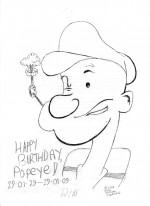
There are few comic characters that have entered world consciousness, but a grizzled, bluff, uneducated, visually impaired old seaman with a speech-impediment is possibly the most well known of that select bunch. Elzie Segar had been producing Thimble Theatre since December 19th, 1919, but when he introduced a coarse, brusque “Sailor Man” into the saga of Ham Gravy and Castor Oyl on January 29th, 1929 nobody suspected the heights that walk-on would reach…

HAPPY ANNIVERSARY POPEYE!

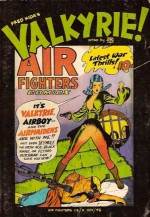
Fred Kida’s VALKYRIE!


By Fred Kida & various (Ken Pierce)
No ISBN

Airboy was one of the very best adventure strips of the Golden Age; one with a terrific pedigree and a profound legacy. Created for Hillman Periodicals by the brilliant Charles Biro (Steel Sterling, Crimebuster, the original Daredevil, the Little Wiseguys and the landmark genre prototype Crime Does Not Pay number among his many triumphs) it featured a plucky teen and his fabulous super-airplane, affectionately dubbed ‘Birdie’.

In his more than twelve years of publication the boy-hero tackled the Axis powers, crooks, aliens, monsters, demons and every possible permutation of sinister threat – even subversive giant rats and ants!. The gripping scripts, initially the work of Dick Wood, took the avenging aviator all over the world and pitted him against some of the most striking adversaries in comics.

The most notable of these was undoubtedly the conflicted Nazi Air Ace known as Valkyrie, who flew the killer skies with a squadron of lethal lovelies codenamed The Airmaidens.

Their first duel happened in Air Fighters Comics volume 2, #2 (November 1943), a full year after the hero’s debut, and featured art by up-and coming Fred Kida, twenty-three years old, utterly besotted with the work of Milton Caniff, and ably inked by Bill Quackenbush.

‘Airboy Meets Valkyrie’ found the lad based at an RAF base when a daring raid by the Airmaidens occurs. Following the planes home Airboy is captured and tortured but his stoic bravery inspires the warrior-women to defect…

This simple but evocative tale was followed in by a sequel in Air Fighters Comics volume 2, #7 (April, 1944). ‘The Death Lights’ with Kida in full artistic control, deals with a new Nazi beam weapon that Airboy fails to destroy. Captured once more he is rescued by the Airmaidens, now a crack allied fighter squadron.

They didn’t meet again until 1946 by when Air Fighters had changed its name to Airboy Comics. From volume 2, #12. ‘The Return of Misery’ features the ghostly spirit who claims the souls of downed airmen, imprisoning them in his eerie flying dungeon “the Airtomb”. Entranced by the monster Val is rescued by the valiant lad, but in the end no flyer ever escapes Misery…

‘An American Legend’ from Airboy Comics volume 3, #6 (July 1946) sees Kida growing fully into his own lush yet chiaroscuric style (this book is printed in black and white, which makes the art even bolder than the often muddy-coloured original comics). In this tale Airboy finds an old war buddy and Val has been brainwashed into committing crimes, leading him to end the villain responsible with typical military efficiency.

This slim tome concludes with the last Valkyrie tale of the period: a lacklustre script that was more concerned with the rise of “the Reds” than character or plot. It is notable however as an early experiment in crossover continuity. ‘The Wind of Battle’ (Airboy Comics volume 3, #12: January 1947) pitted Airboy and his occasional ally in battle against the “Asiatic” tyrant Black Tamerlane.

The story ended with the pair in the villain’s hypnotic clutches and the back-up star Skywolf (a feature of the comic since the Air Fighter days) was seconded to wrap up the saga in his own strip – a riotous action romp that dotted all the “i’s” and dotted all the “t’s”.

Airboy folded with volume 10, #4 (May 1953) and wasn’t seen in new material until Eclipse Comics revived the character and cast in 1986, and this little gem from that crusading guardian of Popular Culture Ken Pierce may well have been instrumental in that splendid return.

Although still readily available through online vendors and comic shops, the reproduction in this book is poor in places even if the quality and excitement shines through. It’s well overdue for a revamped re-release now that it can benefit from all the advances of modern print technology. I eagerly await such a volume especially if room can be found for all Kida’s efforts and not just the most sinister and sexy ones…
© 1982 Ken Pierce Inc. Subsequent © whoever owns the trademark now.

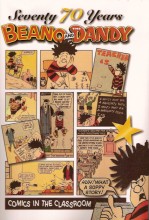
THE BEANO AND THE DANDY: COMICS IN THE CLASSROOM

beano-dandy-comics-in-the-classroom
By various (DC Thomson & Co)
ISBN: 978-1-84535-347-6

Released as part of the seventieth Anniversary celebrations of the comics company that has more than any other shaped the psyche of generations of children, this wonderful hardback compilation rightly glories in the incredible wealth of quality that has paraded through the flimsy pages of the Beano and the Dandy.

The book takes as its broad theme the antics of characters who have waged an incessant war against boredom and repression amidst the chalk-clouded, grubby corridors of school, risking corporal punishment, exhausted writing hands and ritual humiliation to keep us all amused and rebellious at heart.

Within these pages you will find cracking examples of Old Ma Murphy (by Alan Morley), Korky the Cat, Hooky’s Magic Bowler Hat (by the wonderful Chick Gordon), the Pocket Grandpas (both the 1940’s prose feature and the 1970’s strip drawn by Ron Spencer), Big Eggo, Miss Primm (Alan Morley again), Tough Nellie Duff (the Strong Arm School Marm), and Billy Butter the Brainy Goat.

More substantial offerings honour Biffo the Bear (by both Dudley D. Watkins and Leo Baxendale) and Dennis the Menace, Our Teacher’s a Walrus and Lord Snooty (both by the incredibly prolificWatkins), Winker Watson and the unforgettable Dirty Dick (both illustrated by the unique Eric Roberts).

Greedy Pigg, Mr Mutt and Jammy the Sammy were all by the indefatigable A.G. Martin whilst Baxendale’s immortal Bash Street Kids (which began its term as ‘When the Bell Rings’), Desperate Dan (by Watkins), Whacko! and Robin Hood’s Schooldays (by Spencer again) are well represented too; but it’s the tantalising glimpses of such minor celebrities as Dopey Dinah, Bamboo Town, and Keyhole Kate that I’d like to see more of sometime.

There’s a raft of bonus features such as an article on long-lost prose stories like Jimmy the Double Dunce, and Through Fire and Flood with Bobby Trent, a complete 8 page full-colour Bananaman strip from 1985 that was given away in schools and dentists, by John K. Geering and the unpublished final episode (#837 if you’re counting) of the Jocks and the Geordies from the Dandy.

This strip was never completed and is presented as unlettered black line art, with the artist’s script printed below: a fascinating insight for anybody seeking a career in the industry. In fact this book is a treasure trove for the aspiring pro as many strips are reproduced from original camera-ready artwork – with printers’ instructions, editor’s notes and even un-erased pencil lines on show – highly educational for those looking for secrets and details of “the process”.

Notwithstanding all that, the true magic of this collection is the brilliant art and stories by a host of talents that have literally made Britons who they are today, and bravo to DC Thomson for letting them out for a half-day to run amok once again.

© 2008 DC Thomson & Co. Ltd. All Rights Reserved.

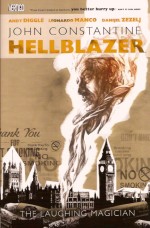
John Constantine, HELLBLAZER: THE LAUGHING MAGICIAN


By Andy Diggle, Leonardo Manco & Daniel Zezelj (Vertigo)
ISBN: 978-1-84576-881-2

Following directly on from the events of John Constantine, Hellblazer: Joyride (ISBN: 978-1-84576-775-4) this second collection of the unstoppable mystic trickster written by London’s Pride Andy Diggle re-presents issues #238-242 of the monthly Vertigo comic-book; comprising two chilling preludes and a visceral saga that sets up the series for a longer, even darker tale to follow.

Modern mystic Constantine is indulging in his downtime of choice: ciggies, booze and a hot date when he’s summoned by the ethereal Map, Patron god of London to rescue a trio of young thrill-seekers who have inadvertently slipped into the metaphysical hell of Shadow London. Grudgingly acquiescing, the sordid sorcerer forgets his own first principle “what are you really after?” to his eternal regret…

‘Smoke’ is illustrated by Daniel Zezelj, and is followed by ‘The Passage’ a prologue illustrated by Leonardo Manco (as is the rest of the volume) which introduces Mako, a War-Mage in devastated Darfur who’s hunting for the eponymous ‘Laughing Magician’. A Muti master (blackest blood magic), the deadly sorcerer is thwarted by an old wizard (last seen in John Constantine, Hellblazer: Original Sins (ISBN 1-84576-465-X) who sends a warning to Constantine by possessing an aid worker and dispatching him to Britain.

Magic is harsh and has no thought for innocence. The harrowing trip is just a taste of what is to come when Mako gets the right scent and follows all the way to London.

The trilogy of chapters that follows once again displays the callous superiority of comics’ greatest anti-hero as he finesses one threat against another, but the book ends without closure as his foes are now aligned against him and the trickster leaves his home turf to prepare himself for what’s still to come…

Andy Diggle has a powerful feel for and grasp of the idiosyncratic world of John Constantine. Blending Gangland, today’s news headlines, politics and the ghastly unknown, these dark pleasures are some of the most compelling stories in a series that has spanned more than twenty years and drawn the best work from a truly stellar cast of creators.

If you haven’t sampled the delights of Hellblazer you should climb aboard the ghost train and get chilled right away!

© 2008 DC Comics. All Rights Reserved.

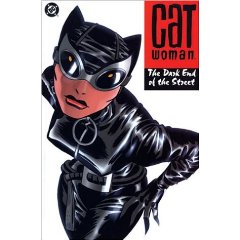
CATWOMAN: THE DARK END OF THE STREET


By Ed Brubaker, Darwyn Cooke, Cameron Stewart & Mike Allred (DC Comics)
ISBN13: 978-1-84023-567-8

Reinvigorated and transformed by her return to Gotham City and the shucking of her sleazy, buxom, “bad-Grrl” status, (See Selina’s Big Score ISBN: 1-84023-773-3 for the full details and another rollickin’ good read) Catwoman began a more socially conscious career as a vigilante; extending her own brand of succour to the shady denizens of Gotham City’s sleazy East End District. This book collects the back-up series that ran in Detective Comics #759-762 and the first four issues of her 2001 series (volume 2, I rather suspect you’d call it).

Technically a Slam Bradley story, the ‘Trail of the Catwoman’ serial by Ed Brubaker, Darwyn Cooke and Cameron Stewart sees the grizzled old private eye hired by the Mayor to find the legendary super-thief even though all evidence indicates that she’s dead. In true film noir tradition a convoluted trail leads to lots of sordid situations and hairsbreadth escapes for the world-weary gumshoe as he unravels her life, the tension increasing as he realizes he’s falling for a girl he’s never met and hunting her for the worst cutthroats in Gotham…

For greater clarity you should read Catwoman: Selina’s Big Score (ISBN: 1-84023-773-3) before continuing with this book which then picks up a few months later as Selina Kyle moves into the East End of Old Gotham and finds renewed meaning when she determines to stop a serial killer preying on prostitutes and street girls.

‘Anodyne’ by Brubaker, Cooke and Mike Allred, reintroduces Holly Robinson, first seen in Batman: Year One (ISBN 1-84576-158-8) and the follow-up Catwoman (1989) miniseries by Mindy Newell and JJ Birch (collected as Her Sister’s Keeper ISBN: 978-0-44639-366-9). Reunited, the old friends decide to solve the case that Gotham’s corrupt authorities won’t touch.

The transition from sleek, sexy cat-burglar to tarnished champion of the underclass is a masterpiece of slick storytelling, and the cutting-edge art from Cooke et al pushed this series to a level few could touch.

Even after all this time this is probably the best incarnation of Catwoman ever – and that’s including Eartha Kitt purring away in that outfit! Fans of caper movies, Noir thrillers and just plain fun-seekers should make this book their own forever.

© 2001, 2002 DC Comics. All Rights Reserved.

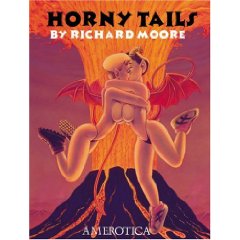
HORNY TAILS


By Richard Moore (Amerotica/NBM)
ISBN: 978-1-56163-275-6

I know I’ve enquired before but… Oi! How old are you?

The salacious and saucy have always had a place in the art and literature of mankind. We’re all monkeys at heart and the sexual act has always fascinated us, no matter how we deny or disguise it. Furthermore, the only real difference between erotica and pornography is purely a subjective and relativistic one, so I’m not going to waste space quibbling. This is a rude book so if you’re easily shockable go away now…

I won’t think any less of you.

Those still here and firmly clutching smelling salts, read on…

Richard Moore is the brilliant cartoonist who writes and draws the wonderful Boneyard – probably the funniest comic being produced today – and he’s also happy to extend that gift of graphic comedy to the controversial world of Adult Comics – a safe way of describing strips of a predominantly sexual nature.

I’m not defending the entire arena of sex comics: there’s material out there even I won’t look at, but let’s be honest here. Most grown-ups can tell the difference between harmless – or even enticing – fantasy and brutal misogyny masquerading as physical love, especially in a genre that can encompass everything from Debbie Does Dallas to John Willie’s Sweet Gwendoline. And don’t get me started on the cynically coy softcore creators…

Adult comics fall into three camps: Charming, Intellectual and Tawdry, and each devotee is cordially invited to stick to what he/she prefers and not judge the rest. Here Endeth the Sermon.

Horny Tails is a collection of short stories and rude pin-ups by a man who loves drawing good-looking humans and all aspects of fantasy (new term needed here: Elves, Dragons, Fairies etc. not French Maids and Uniforms… oh I don’t know though…) and regards consensual sex as natural and fun. These stories are collected from Radio Comix and Anthilll Comics, featuring established mythological charmers and favourite characters.

In Imps and Angels: Fire and Brimstone the metaphysical girls use their charms to recapture a rampant devil, the anthropomorphic stars of The Pound go for a very wild ride, whilst M’Lady goes for a romp in the woods in Don’t Tease and wins her heart’s desire in Magically Delicious.

The nanite-infected human weapon Tin God almost gets more than she bargained for and the eccentric stars of Far West experience a spiritual presence in Tasty Pretty. Finally The Return of Frankenstein is a classy, silly romance of consenting – if artificially created – adults and this book concludes with 15 pages of sexy, whimsical, funny pin-ups of naked ladies, mostly with animal tails and ears – hence the title of this tome.

Unashamedly raunchy, and gently beguiling, these aren’t stories with a great deal of narrative. That’s really not the point. These are wickedly beautiful, funny – because the best sex is – teaser tales that intend to entice and delight. If you can handle all that you probably should…
© 2001 Richard Moore. All Rights Reserved.

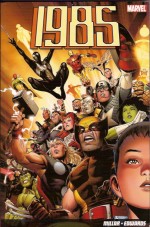
MARVEL: 1985


By Mark Millar & Tommy Lee Edwards (Marvel/Panini UK)
ISBN: 978-1-84653-406-5

There’s an old saying in our business that “the Golden Age of comics is ten” (or eight or eleven or… you get the picture). Simply stated it posits that there’s a perfect moment when dawning comprehension and sophistication meets childish wonderment and imagination head-on and whatever you’re reading at that time suddenly transcends Art, Entertainment, Every Thing: it becomes all-encompassing magic.

And no matter what, nothing that follows – cars, sex, extreme ironing – absolutely nothing can touch or tarnish or diminish that Road to Damascus moment.

Hold that thought and consider this collection of the 2008 miniseries from Mark Millar and Tommy Lee Edwards – two superb creators more commonly associated with the older end of the marketplace. In 1985 cynical young Toby Goodman is just getting seriously into comic-books. His local comic store has just turned him on to the maxi-series Marvel Super-Heroes: Secret Wars and the four-colour madness he’s increasingly drawn into acts as a welcome respite from his personal life.

His parents are getting divorced and he’s embarrassed that his cool dad can’t get his life together while the yuppie whiz-kid his mom’s living with seems to be an obnoxious “Mr Perfect.” The old ramshackle Wyncham House where his dad and that weird kid Clyde used to play and collect funny-books twenty years ago has been taken over by a strange bunch of oddballs. They offer Toby’s dad the pristine collection of comics in the cellar – left untouched since Clyde Wyncham was put in a sanatorium – but honest fellow that he is Jerry Goodman tells them to sell the stash to the comic store – just like you or I would…

And then things start to get weird. Toys that don’t exist start appearing. People dressed like Marvel Super-villains start appearing around the tiny town. A giant green monster who looks and talks like the Incredible Hulk catches Toby snooping…

This intriguing tale recounts what happens when a fantasy world invades our real one, and the everyday actions of comic life become gritty horror as all the villains of the Marvel Universe are brutally unleashed on a Small Town USA. As the carnage escalates only Toby knows what to do. Using a portal in Wyncham House the boy goes into the Marvel Universe to fetch the super-heroic cavalry…

This tale reads like a movie plot seeking to marry the way-out world of comics to our world, and has some pleasant echoes those Gardner Fox days of Infinite Earths as well as a flavour of Marvel’s own boldly innovative Nth Man series (by Larry Hama and Ron Wagner, from 1989-91 if you’re interested) and it won’t be to everybody’s taste, but if you’re a casual visitor or lapsed fan this well-executed yarn might tickle some old fancies.

© 2007, 2008 Marvel Entertainment, Inc. and its subsidiaries. All Rights Reserved. (A BRITISH EDITION BY PANINI UK LTD)

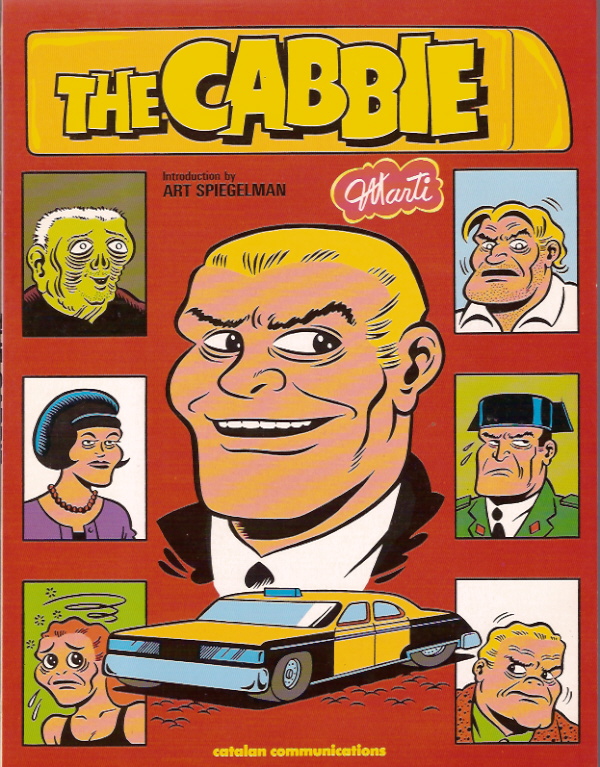
THE CABBIE

The Cabbie
By Marti Riera (Catalan Communications)
ISBN: 0-87416-042-1

Dick Tracy is one of the most well-known strips in the world and his contributions to the art form are many and indisputable. They occurred over many decades and the medium of graphic narrative grew up with it. Imagine the effect instant exposure – almost over exposure – to such an uncompromising, bombastic, iconic property on the artists of a nation where free-expression and creative autonomy was suppressed for generations.

That’s what happened when the death of General Franco (who held Spain in a fascistic time-warp from his victory in October 1936 until his death in November 1975) instantly opened-up and liberalized all aspects of Spanish life. As Art Spiegelman says in his introduction ‘decades of political and social repression gave way to a glorious eruption of creativity that allowed a full-fledged counterculture to come to life at just about the same time that America’s “Love Generation” gave way to what Tom Wolfe labeled the “Me Generation.”’

How odd yet fitting then that an American symbol of “the Establishment” so enchanted and captivated the young cartoonist Marti Riera that he assimilated every line and nuance to create this dark and angry homage concerning the tribulations of a seedy, desperate taxi-driver trapped in a vanished past and prey to a world at once free and dangerous, ungoverned and chaotic.

Driving the seedy part of town our hero picks up a high-rolling gambler who’s just won big, but his night goes horribly wrong when a knife-wielding thief hijacks the cab and robs his passenger. Luckily the Cabbie can handle himself and he quickly, brutally subdues the thug.

He’s a decent, hard-working man who lives with his ailing mother, humouring her talk of a mysterious inheritance, and allowing her to keep the embalmed cadaver of his father in the spare bedroom, but he’s tragically unaware that his citizen’s arrest will have terrible repercussions for them both.

When the son of the thief he captured is released from prison he immediately begins a grim campaign of retribution against the Cabbie that creates a maelstrom of tragedy, degradation and despair.

This is a harsh and uncompromising tale of escalating crime and uncaring punishments: bleakly cynical and populated with a cast of battered, desolate characters of increasingly degenerate desperation. Even the monsters are victims. But for all that the Cabbie is an incredibly compelling drama with strong allegorical overtones and brutally mesmerizing visuals. Any adult follower of the art form should be conversant with this superb work and hopefully a complete translated edition will emerge one day…
© 1987 Marti Riera. Introduction © 1987 Art Spiegleman. English language edition © 1987 Catalan Communications. All Rights Reserved.

UNCLE SCROOGE & DONALD DUCK Gladstone Comic Album Special #2


By Carl Barks (Gladstone)
ISBN: 0-944599-27-3

Carl Barks is one of the greatest storytellers America has ever produced, and was finally beginning to get the recognition he deserved when he died in 2000, a few months shy of his hundredth birthday.

His early life is well-documented elsewhere if you need detail, but briefly, Barks worked as a animator at Disney’s studio before quitting in 1942 to work in comics. With studio partner Jack Hannah he adapted a Bob Karp script for an unmade cartoon short into the comicbook Donald Duck Finds Pirate Gold which was published as Dell Four Color Comics Series II #9 in October of that year. Although not his first published comics work, it was the story that shaped the rest of his career.

Until the mid-1960s Barks worked in productive seclusion writing and drawing a vast collection of comedic adventure yarns for kids, creating a Duck Universe of characters such as Gladstone Gander (1948), the Beagle Boys (1951), Gyro Gearloose (1952), Flintheart Glomgold (1956), John D. Rockerduck (1961) and Magica De Spell (1961) to augment the stable of cartoon actors from the Disney Studio. His greatest creation was the crusty, paternalistic, money-mad bajillionaire Scrooge McDuck.

So magical were his creations that they actually influenced the animation output of the parent company itself, although his work was actually done for the licensing company Whitman/Dell/Gold Key, and not directly for Disney.

Throughout this period Barks was blissfully unaware that his work, uncredited by official dictat as was all the companys output, was nevertheless singled out by a rabid and discerning public as being by “the Good Duck Artist.” When some of his most dedicated fans finally tracked him down, his belated celebrity began. As well as only being fair it meant that an awful lot of great work was now able to be conscientiously reprinted, by an adoring and grateful band of well-intentioned aficionados.

Gladstone publishing began re-releasing classic Barks material, and a selection of other Disney comics work, in a variety of formats beginning in the 1980s and this album is one of my favourites.

In glorious oversized format it reprints Uncle Scrooge #5 (1954) wherein Donald and his nephews are bullied and bamboozled by the miserly mallard into finding the sunken city of Atlantis. It’s a stirring blend of timeless slapstick comedy and fanciful Boy’s Own adventure that entrances and captivates, and it supplemented by a couple of single-page gag strips that still deliver a chortle today.

These are followed by the contents of Donald Duck Four Color #256 from 1949. “Luck of the North” features another duel of wits and fortitude between the irascible Duck and his good-for-nothing but preternaturally lucky cousin Gladstone Gander, which leads to the pair going treasure hunting to Alaska: with Huey, Dewey and Louie in tow to keep the grown-ups from acting too childishly.

This is a epic yarn fit for Indiana Jones himself, full of action, hardship, fantastic discoveries and rip-roaring spectacle – all delivered in the mesmerising line style that so elevated Barks above his peers. Topped off with another gag-short from Donald Duck Four Color #178 (1947) this album perfectly shows why Barks is so revered and influential.

Thankfully even if you can’t find this particular volume, Barks’ work is now readily accessible through a number of publishers and outlets. So if you’ve never experienced captivating brand of magic, no matter what your age or temperament you can easily experience the wonder of what Will Eisner called “the Hans Christian Andersen of Comics.”

© The Walt Disney Company. All Rights Reserved.

THE HEART OF THE BEAST

Heart of the Beast
By Dean Motter, Judith Dupré & Sean Phillips (Vertigo)
ISBN: 1-56389-145-X

From the early days of DC’s Vertigo imprint comes this disturbing reworking – or more accurately contemporary sequel – to one of literature’s greatest stories of mystery and gothic imagination. Dean Motter is a creator with a singularly unique voice and style and his collaboration with Judith Dupré on this moody script adds a chilling edge to a fantasy which is suitably sub-titled “a love story”.

Released as an original hardcover graphic novel it tells of Sandra, who spends a fateful night tending bar at a New York Gallery opening paid for by the rich but creepy celebrity plastic surgeon Dr. Andrew Wright. Even in the supremely decadent world of the Art Glitterati the surgeon is infamous, with dubious connections to the high and mighty and the down and dirty.

So Sandra is surprised when she meets the beautiful, sensitive Victor, a poetic rose among crass, wealthy thorns. Despite herself she is drawn to the mysterious paragon who seems so much more than Dr. Wright’s factotum and dogsbody.

A man of many secrets, Victor is almost the ideal lover, but his devotion to the shadier side of the doctor’s dealings with gangsters and art forgers augers nothing but disaster for their budding relationship. Furthermore there is some hideous secret he is keeping from her – an obstacle not even the truest love can overcome…

I’ve tried to keep the origin of the source work as vague as possible here since the unfolding secret is well-handled and adds to the dawning horror of the situation. The love-story spirals to a tragic conclusion that echoes that of the classic novel, and the beguiling painted art of Sean Phillips heightens the mood, evoking the distant past and spotlighting the harsh modern world with equal skill.

This tale failed to find a large audience when first released, but it’s a solid story superbly told and I’m convinced it would do well if released today – especially in a more economical paperback edition.
© 1994 Dean Motter & Sean Phillips. All Rights Reserved.