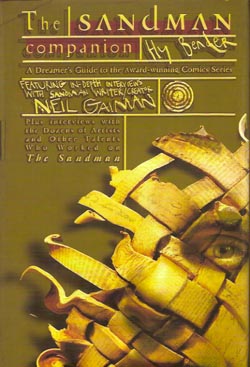
No Sandman fan’s life can be considered complete without this knowledgeable tome of interviews and commentary on the 10 graphic novel compilations that comprise the basic canon of Neil Gaiman’s groundbreaking re-imagining of the classic DC superhero.
This book features an issue-by-issue exploration of the text, a series overview, influences and backstory, explorations of symbolism and interviews with many of Gaiman’s artistic collaborators plus comments and appreciations from such celebrity fans as Peter Straub, Samuel R. Delaney, Tori Amos, Alan Moore, and Harlan Ellison. Liberally illustrated throughout, and including many pre-production sketches and proposal drawings, there is also a beautiful colour section of rare art and artefacts.
If you are the kind of reader who needs more than the book itself, this erudite and expansive book should be a delight and a revelation.
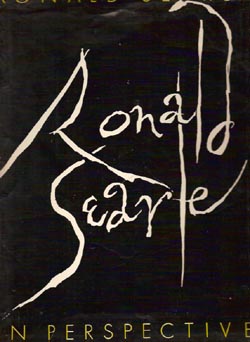
By Ronald Searle (New English Library)
ISBN: 0-450-06026-8
In a previous review of England’s greatest living artistic treasure (even though he has lived, worked and been properly appreciated in France for the last 25 years) I dwelt on his fantastic humorous qualities, and rightly so, because he is one of our greatest ever cartoonists and graphic satirists and the book in question was a collection of his early cartoons (Ronald Searle’s Golden Oldies1941-1961, ISBN: 0-85145-102-1). I didn’t spend too much time on his other achievements – and I’m still not going to – as his work should be seen and his thoughts and opinions should be understood in his chosen language: Art. At least he still has enough fans to fill the internet with all the information you could need, so go search-engining after you read this if you wish.
This collection traces Searle’s career pictorially from his 1930s art school days to the 1980s, by which time he was established – everywhere but here – as not only a cartoonist and satirist but as a film-maker, sculptor, designer, travel-writer and creator of fascinating reportage. This man is a capital “A†Artist in the manner of Picasso or Hockney, and Scarfe and Steadman notwithstanding, he is the last great British commentator to use cartooning and caricature as weapons of social change in the caustic manner of his heroes Hogarth, Gillray, Rowlandson, Cruikshank and the rest.
This volume includes selections from many previous collections and includes political illustration, war and travel drawings (including some moving pieces from his time as a prisoner of the Japanese in World War II), pure art-studies, nudes, medals he designed for the French Government, poster and paintings and of course, some of the most surreal, sardonic and grotesque funny pictures of the late 20th century.
Why his creations are so under-appreciated I do not know. Why this book is out of print: Ditto. That he will remain a relative unknown as yet another movie of his St Trinian’s girls gets all the headlines: Not if I can help it.
Anyone who considers themselves a devotee of the arts of graphic narrative should know of Searle’s work, not necessarily love – although how could you not? Just be aware of the tremendous debt we all owe to his vision, dedication and gifts.
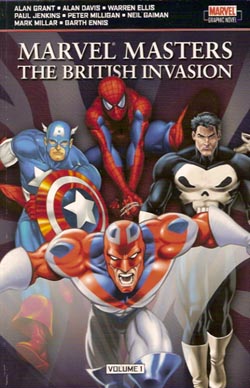
 By various (Panini Publishing UK)
ISBN13: 978-1-933160-68-9
The British Invasion was a term coined in the 1980s to describe the influx and influence of a band of creators (most with 2000AD or Warrior credentials) that began working in and revolutionising the American comic-book industry. In this context, however it’s simply a group of British creators selecting their personal favourite piece of Marvel work for collection in this book.
Writer Alan Grant chose ‘Blood on the Moors’, a Punisher tale he co-scripted with long-time collaborator John Wagner. Hauntingly illustrated by fellow Scot Cam Kennedy, it details in a great blend of action, mystery and humour the semi-supernatural exploits of another obsessive vengeance taker whose crusade intersects Franks Castle’s one man war on crime.
Alan Davis is famed as both artist and writer, and his selection is from Excalibur #61. ‘Truth and Consequence’ is a cosmic superhero romp featuring Rachel Summers in her incarnation of the celestial entity ‘The Phoenix’ battling with planet devouring Galactus only to discover the hideous truth of her own existence.
Warren Ellis is represented by one of his earliest tales for Marvel, from Hellstorm #15. ‘Cigarette Dawn’ sees the once ‘Son of Satan’ battle demons and expectations in an edgy, if perhaps dated tale illustrated by Leonardo Manco.
Peter Parker, Spider-Man volume 2, #35 provides the utterly charming ‘Heroes Don’t Cry’, written by Paul Jenkins and illustrated by Mark Buckingham & Wayne Faucher. If you already know the story you’ll understand why I refuse to say anything about this wonderful adventure other than you must read it if you haven’t. It really is that good.
Peter Milligan chose the moving and incisive character study ‘The Diaries of Edie Sawyer’ from X-Statix #10, illustrated by Philip Bond and Neil Gaiman picked the first issue of his miniseries 1602, which transposed key characters of the Marvel Universe to Elizabethan England, drawn by Andy Kubert and digitally painted by Richard Isanove.
Mark Millar selected ‘The Defenders’ from Ultimates 2, #6, a downbeat re-imagining of the Avengers, illustrated by Bryan Hitch, as his best moment, and the book concludes with the Punisher in a dark, brilliantly compelling look at Frank Castle’s childhood drawn by the legendary John Severin. ‘The Tyger’ is Garth Ennis at his absolute best, and this is a splendid conclusion to an interesting if somewhat inconsistent package, with the good heavily outweighing the not-so-hot.
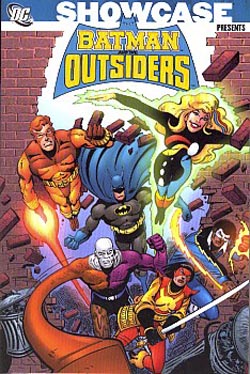
DC Showcase Presents: Batman and the Outsiders, Vol 1
By Mike W. Barr, Jim Aparo & various (DC Comics)
ISBN 10: 1-84576-669-5 ISBN 13: 978-1-84576-669-6
During the early 1980s the general trend of comics sales were in a downturn – although team-books were holding their own – and the major publishers were less concerned with experimentation than with consolidation. Many popular titles were augmented by spin-offs, a recurring tactic in publishing troughs.
Batman was the star of two and two half titles at the time, sharing World’s Finest Comics with Superman (until its cancellation in 1986) and with rotating guest-stars in The Brave and the Bold, as well as his regular spots in both Batman and Detective Comics. He was also a member of the Justice League of America. In July 1983 The Brave and the Bold was cancelled with issue #200 and in it was a preview of a new Bat-title. One month later Batman and the Outsiders debuted…
The basic premise was that the JLA was not fit for purpose; that too many problems were beyond their reach since they were hamstrung by international red tape and, by inference, too many laws. This volume collects issues #1-19, the first annual, that aforementioned preview and the New Teen Titans #37, which was the first part of a crossover between the two titles.
It all kicks off with a revolution in the European nation of Markovia (nebulously wedged into that vague bit between France, Belgium and Russia) and details a telling personal crisis when The Caped Crusader’s friend Lucius Fox goes missing in that war-torn country. As neither the US State Department nor his fellow superheroes will act, Batman takes matters into his own hands. He begins sniffing around only to discover that a number of other metahumans, some known to him and others new, are also sneaking about below the natives’ radar.
Markovia’s monarchy is threatened by an attempted coup, and is being countered by the King’s unorthodox hiring of Dr. Jace, a scientist who specialises in creating superpowers. When King Victor dies Prince Gregor is named successor whilst his brother Brion is charged with finding their sister Tara who has been missing since she underwent the Jace Process. To save his sister and his country, Brion submits to the same procedure. Meanwhile two more Americans are clandestinely entering the country…
Rex Mason, ‘Metamorpho’, is a chemical freak who can turn into any element, and he wants Jace to cure him, but Jefferson (‘Black Lightning’) Pierce is infiltrating as Batman’s ace-in-the-hole. Things go badly wrong when a ninja assassin kills the General Pierce is negotiating with, and he is blamed. Whilst attempting to rescue him Batman finds a young American girl in a bombed-out building who has fantastic light-based superpowers – and amnesia.
As Prince Brion emerges from Jace’s experimental chamber, the revolutionaries attack and not even his new gravity and volcano powers, plus the late arriving Metamorpho can stop them. Brion is shot dead and dumped in an unmarked grave whilst the Element Man joins Batman, who, encumbered by the girl, was also captured by the rebels. The heroes and Dr. Jace are the prisoners of the mysterious Baron Bedlam…
The second issue provides the mandatory origin and plans of the Baron, but while he’s talking the new heroes are mobilising. Like the legendary Antaeus, Brion (soon to be known as Geo-Force) is re-invigorated by contact with Earth and rises from his grave, whilst the girl (code-named Halo) is found by the ninja (‘Katana’) and together they invade the Baron’s HQ. Not to be outdone, the captive heroes break free and join forces with the newcomers to defeat the Baron, who now has powers of his own courtesy of the captive Jace.
As introductory stories goes this is above average, with plenty of threads laid for future development, and the tried and tested super-team formula (a few old and a few new heroes thrown together for a greater purpose) that worked so well with the ‘New X-Men’ and ‘New Teen Titans’ still proved an effective one. As always Barr is an adroit scripter and Jim Aparo, an artist who gave his all to a script, is in top form – and his skill is actually enhanced by the absence of colour in this bargain compendium.
Issue #3 began a long run of high-quality super-hero sagas with ‘Bitter Orange’ as the new team get acquainted and also stop a chemical terrorist with a hidden agenda. This is followed by that preview from The Brave and the Bold #200, a hostage crisis tale designed to tease, followed in turn by ‘One-Man Meltdown’ (Batman And The Outsiders #4) in which a radioactive villain from Batman’s past returns.
‘Death Warmed Over’ and ‘Cold Hands, Cold Heart’ tell the tale of The Cryonic Man, a villain who steals frozen body-parts and ‘The Hand That Rocks the Cradle’ is a sinister supernatural Christmas treat guest-starring possibly Aparo’s most fondly remembered character (most certainly for me) The Phantom Stranger. BATO #9 introduces a super-villain gang with ‘Enter: The Masters of Disaster!’ (the first half of a two-part tale) plus a back-up tale of Halo in ‘Battle For the Band’, written by Barr and illustrated by Bill Willingham and Mike DeCarlo. ‘The Execution of Black Lightning’ concludes the Masters of Disaster saga, and is illustrated by Steve Lightle and Sal Trapani.
Issue #11 begins ‘The Truth About Katana’ by exploring her past and the implications of her magic blade. ‘A Sword of Ancient Death!’ is by Barr and Aparo and continues with ‘To Love, Honour and Destroy’ which leads directly into #13’s impressive ‘In the Chill of the Night’, illustrated by Dan Day and Pablo Marcos, in which the desperate team must capture a dying and delusional Dark Knight.
The first Annual follows: ‘…Land Where Our Fathers Died…’ introduces a gang of ultra-patriots called the Force of July in a barbed epic written by Barr and illustrated by Jerome Moore, Alex Savuik, Jan Duursema and Rick Hoberg with Aparo on inks. This is followed by issue #14’s ‘Two by Two…’ with art by Willingham and Bill Anderson and #15’s ‘Going For the Gold’ (spectacularly illustrated by Trevor Von Eeden) a two-part thriller set at the 1984 Olympics.
‘The Truth About Halo’ begins and is inconclusively revealed in ‘…Goodbye…’ but the next two issues (#17-18) diverts to the desert for ‘We Are Dying, Egypt… Dying’ and ‘Who Wears the Crown of Ra?’ spotlighting Metamorpho, and the volume ends with another Christmas tale. ‘Who’s Afraid of the Big Red “Sâ€?’ is a powerful tale of date-rape and sexual bullying, which pits Geo-Force against Superman and in many ways is the best story in this book.
Although probably not flashy enough to cross the Fan-Barrier into mainstream popularity, this is a competent and highly readable series re-presented in an inexpensive and accessible way. An open minded new reader could do lots worse than try this example “fights’n’tights†fiction.
By Conrad Frost & Joseph Gual (A4 Publications)
ISBN: 0-946197-35-0
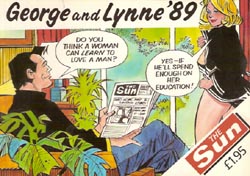
Comfortably middle-class, George and Lynne live on the river and have a great marriage. In brief daily instalments they deal with life’s little misfortunes and each others foibles, secure in the knowledge that nothing can ever go really wrong. And it doesn’t.
This is the comfortable comedy of the Terry and June set, with minor embarrassments and occasionally catty observations on the nature of “keeping up with the Joneses†replacing drama and conflict as narrative engines. They are fit, good looking and spend an incredible amount of time naked.
This strip collection definitely falls into the guilty pleasures category, with woefully lame gags and tired sexism counterbalanced by a gentle, natural married relationship idyllically portrayed in welcoming and accessible scripts, and illustrated by an absolute master of narrative drawing, and one especially adept at the unclad female form (I understand that many people like that sort of thing – I’m pretty sure I do…). I don’t know if Joseph Gual is the same artist that drew the James Bond Strip in Spain but I do know that he is very, very good at his job.
I can’t honestly recommend this strip to everybody, but if you love great drawing and don’t mind the odd bit of old-fashioned sexism this is a pretty and mostly inoffensive way to waste a few minutes.
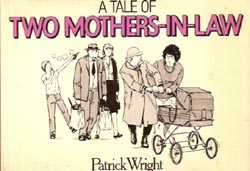
Patrick Wright is a cartoonist who is inexplicably not a household name. He’s been working for a couple of decades now, producing dark, savage, crushingly funny panels and strips for a variety of magazines such as Private Eye, and unlike most of his peers who fall into either the “good ideas/so-so art†or “great artist in need of a scripter†he can do it all and do it well.
His composition and economy of line, facial expressions, body-language and especially character designs are superb. This guy can really, really draw. And as I’ve said, his incisive observational skills combine with what I can only assume is a deep inner mean-streak to create brilliantly nasty cartoons that are the epitome of shared misery dusted with Schadenfreude. I’m pretty glad he hasn’t met me…
In such collections as Walkies, Worthless Pursuits, 101 Uses For John Major and Not Inconsiderable – The Life and Times of John Major his vented spleen has made me laugh very long and much too loud, and if you can find those, or better yet, this collection of beautifully illustrated thoughts on the “Eternal Struggleâ€, he’ll no doubt do the same for you. This is a chap sorely in need of a bumper 25 year retrospective book…
By Da-Mi Seomoon (TOKYOPOP)
ISBN: 978-1-59816-834-1
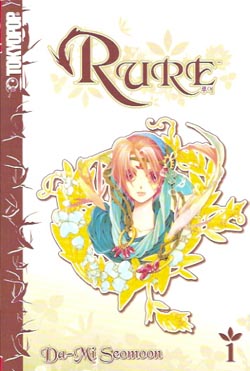
This top-notch fantasy tale is the story of two half-sisters whose already unconventional life takes an outlandish and possibly deadly turn…
Ha-Ru is a real golden child, popular, easygoing, good at sports but her sister Mi-Ru is darkly sullen and withdrawn. Ha-Ru also has the ability to see spirits and supernatural creatures, but she keeps that a secret from her fellow students. She is breezing through school when she is summoned home for a mysterious ceremony. Taking her close friends Dong-Uk Lee and Joon-Hee, she and Mi-Ru travel to ‘The Last Island’ to reveal that she is in fact the heir of the family which owns the island and everything on it.
This matriarchal nation reveres Ha-Ru, practically worshipping her, but when a faction of the ruling family try to manipulate Mi-Ru into usurping control the bitter girl runs away, attempting to throw herself off a cliff. Ha-Ru gives chase but only catches her as they plunge towards the sea…
They wake up on an alien world, a feudal desert with three moons, and dragons, and rough warriors who think nothing of making slaves of any strangers they find…
This is an above average fantasy tale, with more texture than the norm, some solid laughs to balance the action and genuinely interesting plot threads. Da-Mi Seomoon’s art is stylish and innovative, especially the photo-collage pages, and the characters are well-rounded. The volume does end on a cliff-hanger though, so you’ll probably want to have the next one handy before you start.
By Johnny Hart (CheckerBPG)
ISBN: 978-1-905239-63-4
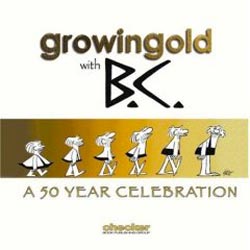
In 1958, for some inexplicable reason, caveman jokes were everywhere in magazines. And yet General Electric draughtsman and wannabe cartoonist Johnny Hart couldn’t sell a single one. He also wanted to create a syndicated newspaper strip but couldn’t think of an idea. And then one of his co-workers said one not do one about Cavemen?
B.C. is an every day kind of guy but he has some odd and interesting friends. All of them are based on actual people, life-long friends of Hart’s, and their reminiscences are a charming and poignant insight into the life of one of the most revered and successful cartoonists of modern times.
With a decade by decade selection of the best of the strips, supplemented by a list of its many awards, and packed with photographs and observations, this is a delightful commemoration of a great and very funny strip.
Johnny Hart died during the finishing stages of this book’s creation, and this is undoubtedly the best way to celebrate his achievements. His legacy of brain-tickling, surreal lunacy will never date, and creative anachronism has never been better used to raise a smile or an eyebrow in this lush collection of timely and timeless fun.
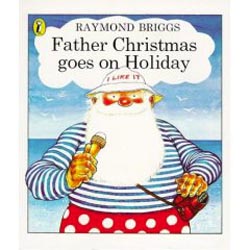
By Raymond Briggs (Picture Puffin)
ISBN 10: 0-14050-187-8 ISBN 13: 978-0-14050-187-2
Our industry seems to wilfully neglect this creator whose graphic narratives have reached more hearts and minds than X-Men or Judge Dredd ever will, but his works remain among the most powerful and important in the entire field.
In Father Christmas (ISBN 13: 978-0-14050-125-4) Briggs presented a marvellously crusty, utterly British character getting the job done, and he returned to the old fellow two years later in a much more whimsical mood.
In this 32 page sequel we find the old codger in a bit of a quandary. It’s time for his summer holidays and he doesn’t know where to go. It has to be hot. There should be good food, but nothing too fancy. No poncey, expensive hotels either, but not camping. And he doesn’t want to be recognised… And then it hits him. A touring holiday! By converting the sled into a camper van he can fly wherever he wants!
He starts off with France, which is beautiful but the food’s a little too posh – and costly, and that combined with campsite toilets… Well! It’s the last straw, though, when the kids find his reindeer and get suspicious, so it’s all aboard and off to Bonny Scotland!
This is much better, but there are still kids who recognise him, and it’s not exactly warm, so it’s away again to hot and sassy Las Vegas for some pampering before heading home, broke but refreshed, and ready again for that big night in December…
Despite being quite different in tone, the character of Father Christmas is still a warmly evocative reminder of times and persons sadly and slowly fading into history, but the real star of this book is Briggs amazingly versatile art; shifting from jolly cartoons to brilliantly powerful watercolour landscapes to sublime narrative sequences with dazzling ease. How many artists today (and tomorrow) got that first push of creative aspiration and desire from a gem like this?
This book is also available in a combined edition with its predecessor, Father Christmas.
By various (Panini Publishing UK)
ISBN: 978-1-905239-62-7
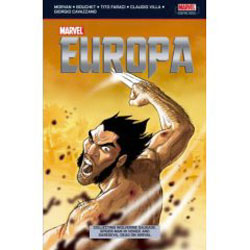
Comics are a truly international enterprise and these days creators from other lands are commonplace. This volume collects three one-shots by artists and writers who usually work in the more mainstream environs of European comics publishing.
Kicking off is ‘Wolverine: Saudade’ written by Jean-David Morvan and illustrated by Philippe Bouchet. Morvan has written more than 80 graphic novels and is the current writer of Spirou & Fantasio. He has previously worked with Bouchet on Nomad and Sillage. Their interpretation of Wolverine is, regrettably, not in the same league as that latter incredible Sci-fi epic. On “vacation†in Brazil, the invincible hero falls foul of a scurrilous faith-healer while rescuing some mutant street-orphans in a stylish but vacuous tale that could have benefited from a more dutiful editor catching some of the more glaring syntax and mistranslation glitches.
In a dark and brooding race against time, the Man Without Fear has to track down a murderous foe that he thought long dead, unaware that Captain America is also hunting the killer, armed with the knowledge that the slightest misstep could lead to the destruction of all time and space… Stunningly illustrated and brilliantly plotted the only flaw in an otherwise perfect adventure thriller is the painfully verbose and overwritten dialogue, a tendency mercifully curbed for the last – and best – tale collected here.
‘Spider-Man in Venice: The Secret of the Glass’ is also written by Tito Faraci, and gleefully, gloriously drawn by Giorgio Cavazzano. This artist also works for Italian Disney as well as Sergio Bonelli Editore, in a sort of cartoony, universally acceptable light style that blends powerfully subtle expressionism with a strong naturalistic line, for a beautiful, subversive mesmerising effect.
On assignment in Venice, Daily Bugle photographer Peter Parker stumbles across an ancient blood-hungry menace that has escaped a fiery glass tomb. A delightful crossing of Buffy the Vampire Slayer with Scooby-Doo, this is a rare gem in anybody’s language.
This intriguing collection of one-off adventures features popular Marvel properties in tales crafted by foreign creators. I’m not sure if that isn’t patronising or even racist – it’s certainly an unnecessary distinction in an industry with a huge history of using creators because of their ability (or perhaps affordability), rather than something as irrelevant as nationality, but the stories themselves are an intriguing mix of perspectives, and I’m forced to admit, there are cultural differences to be seen… All in all, an experiment worth repeating and a book worth having.