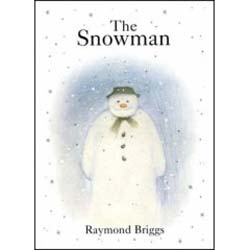
The Snowman — 20th Anniversary Edition

The Snowman — 20th Anniversary Edition

By Raymond Briggs (Hamish Hamilton)
ISBN 10: 0-24113-938-4 ISBN 13: 978-0-24113-938-7

This edition was released to commemorate twenty years since the release of the perennial children’s favourite in 1978, so with the 30th anniversary swiftly bearing down on us it’s a good time to re-examine this wonderful book, free of the huge ancillary industry that’s grown around it, strictly in terms of graphic narrative.

Despite being repackaged as numerous book spin-offs, the animated film and even a stage musical, The Snowman started as a slim (32 pages) picture book: A lyrical tale of forgotten winter joy. I can’t remember seeing enough snow to even confuse my cat (if you’ve never seen the pampered house-moggy’s first response to solid-seeming-cold- wet-white-stuff then you’ve never laughed so hard the cocoa came out of your nose) let alone coat the world in a clean blanket of wonder, but that’s what happens here.

This is a subtle and compelling story. A young boy awakens to a heavy snowfall. Dressing, he dashes outside and romps among the falling flakes. He spends all day building a snowman, and even when he he’s snugly back inside, he can’t stop looking at his magnificent creation. Happy and exhausted he goes to bed.

When everybody’s asleep he invites the now animate snowman indoors where they play, share a meal, and naturally, do the washing up when they’ve finished. Outside the skies are clear and the white flakes no longer fill the heavens. Having seen the boy’s world, the Snowman offers to show his own, and the pair soar aloft on a wondrous voyage over land and sea where the snows are falling still.

Returning home they say goodnight. The boy goes reluctantly back to bed and the frosty sentinel takes up his abandoned position in the garden. In the morning the boy dashes out, but only heartbreak and disappointment await, for the new morning has melted his midnight companion.

This truly beautiful tale is no cheery, mawkish fantasy; it is an examination of the intense nature of a child’s life and the poignancy of change. We never know if the adventure was simply a dream or an actuality, but the knowledge that such all-encompassing wonder is fleeting is a lesson we all learn as we grow. The ability to recapture such a lesson – both its joys and its pains – is a rare and awesome thing, and what a tribute to Raymond Brigg’s abilities that we don’t hate him for making us enjoy re-experiencing it.

Utterly wordless, in panels without dark borders and hard edges, Briggs spins a delicate web of magic. Using the child’s own creative tools of pencil and crayon he crafts lyrical pastel picture-poems that are truly evocative and spellbinding. Despite being co-opted by the Christmas Industry this isn’t merely a seasonal tale but a timeless one. There’s no Bright Red or Holly Green to dazzle and break this charm: Briggs, as always uses presentiment and understatement as his basic tools.

Our industry seems to wilfully neglect this creator whose graphic narratives have reached more hearts and minds than Spider-Man, The Spirit or Hellblazer ever will, yet his works remain among the most powerful and important in the entire field. The Snowman, despite my pompous pontificating, remains a work of sublime and simple universal beauty. Get it for your kids, get it for yourself, but when the cartoon comes on again this Christmas, don’t watch that, Read This.

© 1978 Raymond Briggs. All Rights Reserved.
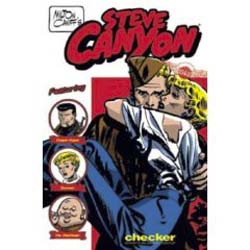
Milton Caniff’s Steve Canyon 1949

Milton Caniff's Steve Canyon 1949

By Milton Caniff (Checker Book Publishing Group)
ISBN 0-9710249-1-X

The third collection in the daily travails of Milton Caniff’s post-war aviation adventurer covers the period from February 8th 1949 until February 18th 1950, which those fine people at Checker have subdivided into three episodes for your convenience.

‘Operation Snowflower’ leads off the excitement and originally ran (seven days a week, mind) until May 18th. It opens with Canyon and crew anxiously awaiting news of Happy Easter and the unscrupulous Cheetah who were last seen falling out of Canyon’s plane. However the arrival of ruthless millionairess Copper Calhoon soon distracts them all as she informs them that she now also owns the company which Canyon is working for.

As the post-revolutionary Chinese Republic began to flex its muscles in the build-up to the Korean War, the ever-contemporary Caniff began weaving the snippets of research and speculative news items he scrupulously collected into the grand story unfolding on his drawing board. Ever the patriot, his opinions and pro-“Free World” stance gives some of these strips a somewhat parochial if not outright jingoistic flavour, but as with all fiction viewed through the lens of time passed, context is everything.

Unlike his unpopular stance on Vietnam two decades later, this was not an issue that divided America. However the public and officials of the USA treated Communists and “Pinkos” within their own borders, the Red Menace of Russia and China was real, immediate, and actively working against Western Interests. The real talking point here is not the extent of a creator’s percieved paranoia, but rather the restraint which Caniff showed within his strip compared to what was going on in the world outside it.

Calhoon has Canyon flying uranium ores out of the rugged mountain country, and Red agents are agitating to get the raw materials for their own arms programs. The sabotage and unrest they’ve instigated have made the task dangerous and nearly impossible. As all the hard-bitten pilots continue their task Calhoon pressgangs young Reed Kimberly into becoming a companion for the locals’ mysterious ruler – “the Crag Hag”. Keeping the natives on-side is vital and the reluctant lad is nervous about his diplomatic role, but unbeknownst to all, the fearsome sounding Empress is actually a beautiful young teenager named Snow Flower, hungry to hear about the fabulous land of America, and desperate to see anyone her own age – especially boys!

The situation grows progressively worse as the Communist-backed rebels tighten their encirclement of the capital city of Damma. The fall is a foregone conclusion and Calhoon is making her escape plans whilst her men continue their ore flights out. As the city falls she is wounded, forcing Steve to fly her to safety on the last plane out. The Princess, Reed and the imposing Soldier-of-Fortune Dogie Hogan are forced to flee on foot, in a cracking sequence, pursued by the victorious and vicious rebels. When Canyon flies a rescue mission, only the heartbroken Kimberly awaits him. Snow Flower and Hogan have returned to the mountains to organise a resistance movement to fight the Communists.

‘Dragonflies’ follows, originally running from May 19th to October 9th. Steve and the recuperating Reed are cooling their heels, fretting about their total lack of cash or work, when the larger-than-life author and lecturer Romulus Brandywine commissions Steve to fly him around the highly volatile region on a research trip, accompanied by his secretary, the sassy and capable Summer Smith.

Whilst en route from India to the China coast their plane is forced down by Communist rebels, but after much intrigue and action they escape to become part of an anti-communist Foreign Legion of Pilots fighting a holding action against the seemingly unstoppable Red Hordes: The Dragonfly Squadron of the Western Chinese faction.

As if the ongoing conflict trapping the valiant fliers were not enough grief, Steve and Summer’s mutual attraction causes friction amongst the men, but when the hero finds himself once again in a last ditch siege, there’s a pleasant surprise in store as Happy Easter turns up, leading a division of anti-Red cavalry to – temporarily – save the day.

‘Teammates’ began on October 10th 1949 and ran well into 1950 (although this book concludes with February 18th instalment). It introduces a possible rival and definite complication with the unwanted arrival of a new flier at the temporarily reprieved airbase. Doe Redwood is an air-ace who flew half-way around the world to join the fight, in a brand-new top-of-the-line fighter plane, infinitely superior to the crates the veterans use. But she’s a woman and therefore trouble…

No sooner has the dust settled from the traditional culture-clash, battle-of-the-sexes than Steve and Doe have to go undercover into Communist-held territory to liberate vitally needed parts and supplies. However the mission goes spectacularly wrong when they encounter and old friend and foe – svelte Soviet Submarine commander Captain Akoola – and her ward Convoy…

Exotic, frenetic, full of traditional values and as always, captivating in both word and picture, this is another old-fashioned, unreconstructed delight. Caniff was the master of the daily strip drama and he always will be.

© 2004, Checker Book Publishing Group, an authorized collection of works
© Ester Parsons Caniff Estate 1949, 1950. All characters and distinctive likenesses thereof are trademarks of the Ester Parsons Caniff Estate. All Rights Reserved.

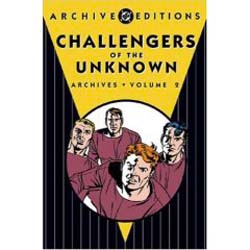
Challengers of the Unknown, Vol 2

DC ARCHIVE EDITION

Challengers of the Unknown, Vol 2

By Jack Kirby & various (DC Comics)
ISBN 1-4012-0153-9

This second, final collection of Jack Kirby’s groundbreaking mystery/adventure concept sees the first fantastic foursome crush villains and monsters, voyage to distant worlds, exotic lands and even crack the time-barrier. The Challengers would follow the Kirby model until cancellation in 1970, but due to a dispute with Editor Jack Schiff the writer/artist resigned at the height of his powers, so this volume only reprints issues #3 – 8 (August/September 1958 – June/July 1959). The series was continued by writers France “Ed” Herron, Dave Wood, Bill Finger plus others and drawn for almost its entire initial run by the superb and criminally underrated Bob Brown.

We kick off with the eerie ‘Secret of the Sorcerer’s Mirror’ with wife Roz and Marvin Stein again inking his mesmerising drawings, as the team pursue a band of criminals whose magic looking glass can locate deadly ancient weapons, but the most intriguing tale for fans and historians is undoubtedly ‘The Menace of the Invincible Challenger’ wherein team strongman Rock Davis is rocketed into space only to crash back to Earth with strange, uncanny powers.

For years the obvious similarities of this group – and especially this adventure – to the origin of Marvel’s Fantastic Four (FF #1 was out in November 1961) have fuelled speculation. In all honesty I simply don’t care. They’re both similar and different but equally enjoyable so read both. In fact, read them all.

With the fourth issue the series becomes artistically perfect as the sheer brilliance of Wally Wood’s inking elevated the art to unparalleled heights. The scintillant sheen and limpid depth of Wood’s brushwork fostered an abiding authenticity in even the most outrageous of Kirby’s designs and the result was breathtaking. ‘The Wizard of Time’ is a full length masterpiece as a series of bizarre robberies leads the team to a scientist with a time-machine. By visiting oracles of the past he has found a path to the far future. When he gets there he’s going to rob it blind unless the Challengers can stop him.

‘The Riddle of the Star-Stone’ is a contemporary full-length thriller. An archaeologist’s assistant uncovers an alien tablet which will bestow various super-powers when different gems are inserted into it. The exotic locales and non-stop spectacular action are intoxicating, but Kirby’s solid characterisation and ingenious writing are what make this such a compelling read.

Dave Wood returns to script #6’s first story. ‘Captives of the Space Circus’ sees the boys kidnapped from Earth to perform in a interplanetary show, but the evil ringmaster is swiftly outfoxed and the team returns for Ed Herron’s mystic saga ‘The Sorceress of Forbidden Valley’, wherein June Robbins becomes an amnesiac puppet in a power struggle between a fugitive gangster and a ruthless feudal potentate.

There are also two stories in #7. Herron scripted both the relatively straightforward alien-safari tale ‘The Beasts From Planet 9’ and the much more intriguing ‘Isle of No Return’ where the team have to defeat a scientific bandit before his shrinking ray leaves them permanently mouse-sized. Issue #8 is a magnificent finale to a superb run as Kirby and Wally Wood go out in style in two gripping spectaculars (both of which introduced menaces who would return to bedevil the team in future tales).

‘The Man Who Stole the Future’ by Dave Wood, Kirby and the unrelated Wally Wood, introduces Drabny – a mastermind who steals mystic artefacts and takes over a small country before the team defeats him. This is a tale of spectacular battles and uncharacteristic, if welcome, comedy, but the real gem is the science fiction tour-de-force ‘Prisoners of the Robot Planet’, with art by the Kirby and Wood, but for which the writer is regrettably unknown. Petitioned by a desperate alien, the team travels to his distant world to liberate the population from bondage to their own robotic servants, who have risen in revolt under the command of the fearsome automaton, Kra.

These are classic adventures, told in a classical manner. Kirby developed a brilliantly feasible concept with which to work and heroically archetypical characters in cool pilot Ace Morgan, indomitable strongman Rocky Davis, intellectual aquanaut Prof. Haley and daredevil acrobat Red Ryan. He then manipulated an astounding blend of genres to display their talents and courage in unforgettable exploits that informed every team comic that followed and certainly influenced his successive and landmark triumphs with Stan Lee.

But above and beyond all that, his Challengers of the Unknown run is sheer escapist wonderment, that no fan of the medium should miss.

© 1958, 1959 DC Comics. All Rights Reserved.

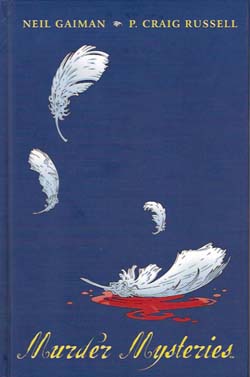
Neil Gaiman’s Murder Mysteries

Neil Gaiman's <i>Murder Mysteries</i>

By Neil Gaiman & P. Craig Russell (Dark Horse Books)
ISBN: 1-84023-521-7

Adapted from a radio play script, this is an intriguing, if slow, introspective parable. A British guy in Los Angeles, reeling from culture shock, meets a bum who tells him a story. As the bum speaks the man is mesmerised by the eerie echoes of his own existence. The bum is actually an ex-angel and recounts a tale of the Silver City…

After God created the Angels, but before he made us or the world, the sexless winged paragons – each with their own appointed role – were still finishing up the details of Creation. The bum was once Raguel: The Vengeance of the Lord, and he spent his life waiting. Eventually Lucifer came to him. A new thing had happened, something unique. An Angel had been killed. Deliberately.

This engrossing tale-within-a-tale, a murder-mystery, detective tale and supernatural fantasy, has a languid lyrical quality devoid of tension or drama, but nonetheless is an engrossing diversion, technically perfect, gently compelling. The clean, lovely art by P. Craig Russell is some of the best he has ever created.

If you can appreciate beauty for its own sake and suspend your need for drama and angst, this is a fascinating example of the power of style over content.

Text © 2002 Neil Gaiman.
Adaptation & illustrations © 2002 P. Craig Russell All Rights Reserved.

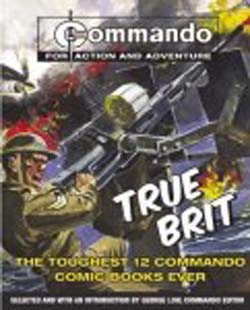
Commando: True Brit

Commando True Brit

By various (Carlton Books)
ISBN: 978-1-84442-121-3

DC Thomson is probably the most influential comics publisher in British history. The Beano and Dandy revolutionised children’s comedy comics, the newspaper strips Oor Wullie and The Broons (both created by the legendary Dudley D. Watkins) have become a genetic marker for Scottishness and the uniquely British “ordinary hero” grew from the prose-packed pages of Adventure, Rover, Wizard, Skipper and Hotspur.

In 1961 the company launched a half-sized title called Commando. Broadly the size of a paperback book, it had 68 pages per issue and an average of two panels a page. Each issue told a complete war story (usually of World War I or II – although all theatres of conflict have featured since) and told tasteful yet gripping stories of valour and heroism in stark black and white dramas which came charged with grit and authenticity. The full painted covers made them look more like novels than comics and they were a huge and instant success. They’re still being published at the rate of eight every month.

This volume collects an even dozen of these mini-epics, selected by series editor George Low, and although much of the collection’s marketing concentrates on the nostalgic element by exhorting the reader to remember dashing about the playground shouting “Achtung” or “Donner und Blitzen” and saluting like Storm-troopers, these tales – subtitled “The Toughest 12 Commando Books Ever” are fine and compelling examples of comic storytelling.

Because of company policy these tales are all uncredited, (and I’d rather not prove my vast ignorance by guessing who did what), so you’ll have to be content with the work itself, although the many fan-sites should be able to provide information for the dedicated researcher. So if you’re looking for a more British comics experience, well-written and wonderfully illustrated, check out ‘Guns on the Peak’, ‘The Fighting Few’, ‘Bright Blade of Courage’, ‘The Haunted Jungle’, ‘Tiger in the Tail’, ‘The Specialists’, ‘Mighty Midget’, ‘VLR: Very Long Range’, ‘Flak Fever’, ‘Fight or Die!’, ‘Fearless Freddy’ and ‘Another Tight Spot…’ in this brilliant compilation.

Let’s make it as traditional as watching The Great Escape on a bank holiday.

™ & © 2006 DC Thomson & Co. Ltd. All Rights Reserved.

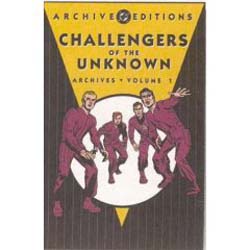
Challengers of the Unknown

DC ARCHIVE EDITION VOLUME 1

Challengers of the Unknown

By Jack Kirby & various (DC Comics)
ISBN 1-56389-997-3

Jack Kirby was – and still is – probably the most important single influence in the history of American comic books. There are quite rightly millions of words written about what the man has done and meant, and you should read those if you are at all interested in our medium. I’m going to add as few words as possible to that superabundance whilst I review two of the best ever compilations of his work.

When the comic industry suffered a collapse in the mid 1950’s, Kirby returned briefly to DC Comics where he worked on mystery tales and the Green Arrow while preparing the newspaper strip Sky Masters of the Space Force. He also created for Showcase (a try-out title that launched the careers of many DC mainstays) the first super-team of the Silver Age of comics.

The Challengers of the Unknown were four ordinary mortals; heroic adventurers and explorers who walked away unscathed from a terrible plane crash. Already obviously what we now call “adrenaline junkies”, they decide that since they are all living on borrowed time, they will dedicate what remains of their lives to testing themselves and fate. They will risk their lives for knowledge and naturally, justice.

The series launched with ‘The Secrets of the Sorcerer’s Box!’ (Showcase #6, dated January /February 1957 – which meant it came out in time for Christmas 1956) Kirby and scripter Dave Wood, plus inkers Marvin Stein and Jack’s wife Roz crafted a spectacular epic as the doom-chasers are hired by the duplicitous magician Morelian to open an ancient container holding otherworldly secrets and powers.

The story roars along with all the tension and wonder of the B-movie thrillers it emulates and Kirby’s awesome drawing resonates with power and dynamism, which doesn’t let up for the sequel, a science fiction drama caused when an alliance of Nazi technologies and American criminality unleashes a terrible robotic monster. ‘Ultivac is Loose!’ introduced the beautiful and capable boffin Dr June Robbins, who became the fifth Challenger at a time when most comic females had returned to a subsidiary status in that so-conservative era.

The team didn’t reappear until Showcase #11 (November/December 1957) in the alien invasion adventure ‘The Day the Earth Blew Up’, with the superb Bruno Premiani inking a taut doomsday chiller that keeps readers on the edge of their seats even today, and by the time of their last Showcase issue (#12, January /February 1958) they had secured their own title. The mystic threat posed by ‘The Menace of the Ancient Vials’ was defused by the usual blend of daredevil heroics and ingenuity (with the wonderful inking of George Klein adding subtle clarity to the tale of an international criminal who steals an ancient weapons cache that threatens the entire world if misused), but the biggest buzz would come two months later with the first issue of their own magazine.

The first issue was written and drawn by Kirby, with Stein on inks, and presented two complete stories plus an iconic introductory page that would become almost a signature icon for the team. ‘The Man Who Tampered with Infinity’ pitted the heroes against a renegade scientist whose cavalier dabblings loosed dreadful monsters from the beyond onto our defenceless planet and the team were actually abducted by aliens in ‘The Human Pets’.

The same creators were responsible for the two stories which conclude this volume. ‘The Traitorous Challenger’ is a monster mystery, with June returning only to sabotage a mission in the Australian Outback, whilst ‘The Monster Maker’ finds the team seemingly helpless against a criminal who can conjure solid and animate objects out of his thoughts.

In an era bowdlerised by draconian censorship Jack Kirby managed to create tension, fear, and thunderous excitement with his fantastic creativity. This glorious and lavish book is a worthy tribute to his matchless abilities and one of his most fascinating and enjoyable concepts.

© 1957, 1958 DC Comics. All Rights Reserved.

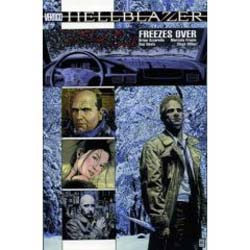
Hellblazer: Freezes Over

Hellblazer: Freezes Over

By Brian Azzarello, Marcelo Frusin, Guy Davis & Steve Dillon (Vertigo)
ISBN 1-84023-531-4

Brian Azzarello continues his blending of Noir and urban horror in this collection of tales reprinted from issues #157-163 of the monthly comic from DC’s Vertigo imprint, and as usual in his world, the human heart is still the nastiest place of all.

Making his way across the American hinterlands after the unsettling events in the hillbilly hellhole of Doglick (Good Intentions – ISBN: 1-84023-433-4), Machiavellian magician Constantine walks into a bar and finds Agent Turro, the Fed who sprung him from prison (Hard Time ISBN: 1-84023-255-2). Their loaded conversation determines Constantine’s next destination. The Scouse of Mystery is headed for a showdown in Highwater (ISBN: 1-84023-861-5) but for the most part he fades into the background of this sharp shaggy dog story of dark suspense as three guilty bar-flies steal the show, waiting for an inexorable doom to find them. ‘…And Buried’ is by Azzarello and Steve Dillon, a powerful exercise in diversion and suggestion that acts as set-up and prologue for the tense main feature.

‘Freezes Over’ is a tale of claustrophobic bondage. A bunch of ordinary folks are trapped in a diner by heavy snows and just pass the time until the weather clears. The idle chatter softens as a young family staggers in, though, as nobody wants to upset their little girls. In this weather, nobody’s able to drive, so when the scary Englishmen walks in the nervous patrons are pretty spooked. But he’s the least of their problems…

There’s a car in the parking lot. In it is a corpse, with a four-foot long icicle driven through his chest. The panic that ensues is not that of a simple murder though. This wilderness country has a legendary heritage. ‘The Iceman’ is a mythical bogeyman who has legendarily killed and vanished over the years. Is he real after all, or is the problem just a common or garden psychopath?

The final nail in this cold coffin comes in the shape of three hard desperate men who have their own secret, which they’re prepared to protect with guns even as their boss is slowly bleeding to death…

Marcelo Frusin draws a moody, tense time-bomb of a tale, and similarities to Archie Mayo’s classic 1936 movie masterpiece The Petrified Forest aside, this cold concoction is an edgy delight even without the supernatural overtones that keep the reader guessing until the very end.

The volume concludes with an exhilarating look into the punk-rock days of young Johnny Constantine, courtesy of Azzarello and Guy Davis. ‘Lapdogs and Englishmen’ is a frantic flashback to London at the end of the 1970s. John and his nearly-men band-mates from “Mucous Membrane” become involved with a crazy American millionaire who wants a clock that can predict the future. For the young, drunk and stupid kids, the caper seems like a doddle, but the sinister undercurrent that pervades the scene escapes all the participants, and the real key to the future is safe where no one wants to look… until it’s too late. This pacy, poignant two-parter is loaded with revelation and foreboding, making it by far the best thing in this book.

The horror and power in this volume is all derived from the various deadly effects of anticipation. Azzarello used his run on Hellblazer to dissect the working principles of the graphic horror narrative and thus moved it beyond the simple clichés of goblins and beasties. Hellblazer is one of the best graphic series in print. If you’re not a fan you should give it a try and thus become one.

© 2001 DC Comics. All Rights Reserved.

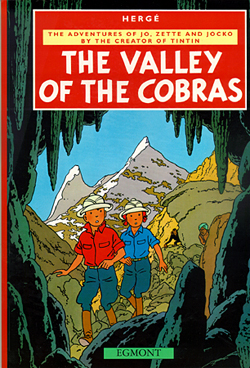
The Adventures of Jo, Zette & Jocko

THE VALLEY OF THE COBRAS

Valley of the Cobras

By Hergé, translated by Leslie Lonsdale-Cooper & Michael Turner (Egmont UK)
ISBN 13: 978-1-4052-1244-1

The last completed adventure of the adventurous and capable Legrand family came out in the 1950’s, when Hergé was at the peak of his creative powers. Although he found the concept a difficult one to work with, devoid of the opportunities for satire or social commentary, the wholesome adventurism of this series – created at the request of a Catholic priest – still provides thrilling and funny entertainment for kids of all ages. Father Courtois, the director of the French weekly newspaper Coeurs Vaillants (‘Valiant Hearts’) wanted an inspirational serial to promote family values and this is just what Hergé delivered – albeit at tremendously infrequent intervals.

Whilst vacationing in the Alps, the children Jo and Zette inadvertently fall foul of the whimsical and capricious Maharajah of Gopal, who is infuriated that they are better skiers than he. Matters worsen when Jo accidentally hits the Maharajah with a snowball.

The spoiled, rich bully’s appalling behaviour escalates until eventually their father Jacques administers a long overdue spanking to the middle-aged potentate which completely changes his attitude. The much friendlier Maharajah engages the engineer to construct a bridge across the fabled Valley of the Cobras that divides his mountainous kingdom. As the family embark for the sub-continent all are unaware that the villainous Prime Minister of Gopal has colluded with a greedy Fakir to sabotage the project…

Begun in 1939 but shelved for nearly two decades, this is a light exuberant adventure, full of thrills and packed with laughs, executed with the captivating artistry that has made Tintin a global phenomenon. This is a book any child will adore.

© 1957, 2007 Editions Casterman, Paris& Tournai. All Rights Reserved.
English text © 1986, 2005 Egmont UK Limited. All Rights Reserved.

How to Draw and Sell Comic Strips

Wondering, “WHAT SHALL I GET HIM FOR CHRISTMAS?”

How to Draw and Sell Comic Strips

By Alan McKenzie (Titan Books)
ISBN: 1-84576-076-X

The latest edition of this excellent How To… is totally revamped for the digital age and computer-literate creator, whilst never forgetting that everything, Everything, EVERYTHING starts with the basics.

Sub-titled Content, Layout, Style, Colour and Presentation, this volume takes the reader through easy to assimilate stages with equal attention paid to fundamental principles such as page size and proportion and exacting details like which software and programs produce the best value for your budget.

Beginning with a brief history of comics, the book covers basic elements (equipment, workspace, format, covers, figures, motion and perspective), storytelling (script, pacing, format, breakdowns and layouts with samples), drawing the story (penciling, characters, design, expression and posture, background and composition, inking, marks and textures), lettering and colour (the full course from rulers and brushes to the latest digital techniques), and selling your work.

This last chapter is perhaps the most useful, drawing as it does on the author’s decades of experience as both freelance writer and as editor of magazines as varied as Starburst and 2000AD. Lavishly illustrated throughout, with many of the accompanying pictures purpose-created by long-time collaborator Steve Parkhouse, this book is a must-have companion for aspiring creators who know this is a serious, skilled – and technical – Business, and not a soft option for the lazy or indolent dreamer.

© 2005 Quarto Publishing Inc. All Rights Reserved.

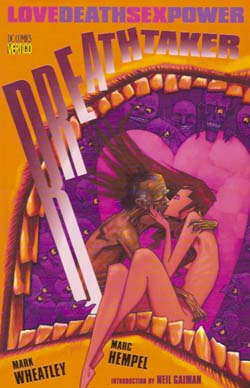
Breathtaker

Breathtaker

By Mark Wheatley & Marc Hempel (Vertigo)
ISBN 1-56389-163-8

This lost classic from the early days of the Vertigo imprint is still one of their best and most innovative. The always excellent Wheatley and Hempel here relate a tale of love and horror in a dazzling variety of novel narrative and graphic techniques, but never let the experimentation obscure the storytelling as they explore the remarkable life of Chase Darrow, a girl with a big secret.

This pretty but unremarkable lass is, literally, irresistible to men, and deeply unhappy with the situation. She’s simply not the kind of girl to take advantage of her quirky attractiveness, and besides, if she becomes physically intimate with anyone, her body draws all the life-energy out of them. If she isn’t very careful they will swiftly age and die.

So compelling is she however, that even knowing the risks men willingly sacrifice themselves for her – and to her. Moreover her growing need for them – both physically and emotionally, is driving her to the brink of suicide. When her latest flame burns out too publicly to conceal, she is forced to flee, pursued by the US Government (which knows more about her origins than she does) in the form of their manufactured and heavily merchandised Public Superhero “The Man”.

Her pursuit, capture and escape are fast-paced and thrilling, but the real meat of the tale is the superb characterisation of the many and various fully rounded participants. How this insurmountable dilemma spirals to a logical and powerful conclusion is a adult fan’s delight – this thoughtful drama has lots of nudity and sex so if you’re easily offended don’t read it – and a lot of what you’re reading now owes thanks to this ground breaking series.

With edged barbs at spin-doctors, the media, Government intrusion and a thoroughly modern take on love and life, this cynical, savvy, blackly comic satire is compelling, thrilling and deeply moving. Those who first read it as a four part mini-series might be interested to discover that the creators revised the original, perhaps obscurist ending for this compilation. A great treat for modern lovers.

© 1990 Mark Wheatley and Marc Hempel. All Rights Reserved.