The Authority: Human on the Inside

The Authority: Human on the Inside

By John Ridley & Ben Oliver (Wildstorm/DC Comics)
ISBN 1-84023-926-3

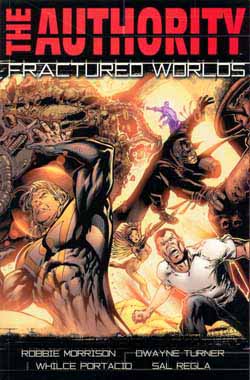
This all-new story of the comic world’s most “Take Charge” super group sees them as de facto rulers of the world tackling twin crises as the American President they have ousted instigates a bizarre plan for vengeance just as the world, and our heroes, succumb to a global wave of psychological depression.

Naturally there’s shedloads of lavishly illustrated carnage – on both large and personal scales – and the requisite adult language and behaviour abound, but still there’s something missing here.

Artist Ben Oliver delivers sensitive drawing which is technically superb but somehow fails to engage the viewer, whilst the script from novelist and movie veteran John Ridley is frankly uninspired and a touch derivative – which is quite a disappointment from the man who wrote the screenplay for the wonderfully edgy anti-war film Three Kings. Perhaps it’s simply passion for the subject that’s absent.

Whatever the problem, I hope we see more work from them either individually or paired again, perhaps on a Vertigo project which inclines more to sensitivity and mood rather than hyper-cosmic Thud and Blunder.

© 2004 WildStorm Productions, an imprint of DC Comics. All rights reserved.

Transformers: Way of the Warrior

Transformers: Way of the Warrior 

By Simon Furman & Various (Titan Books)
ISBN: 1-84576-059-X

This Transformers collection in Titan Book’s Black and White digest format is packed with stories that originally saw print in the British weekly of the 1980s and 1990s, featuring the scripting of Honorary Mechanoid Simon Furman and a veritable host of home grown talent, most of which moved on to greater, trans-Atlantic things once they’d proved themselves drawing heads with sharp corners on them.

Jeff Anderson, Simon Coleby, Stuart ‘Staz’ Johnson, Peter Knifton, Dan Reed, Geoff Senior, John Stokes and Lee Sullivan, aided and abetted by inkers Stephen Baskerville, Michael Eve, Tim Perkins and Pete Venters illustrate the extended tale of Carnivac, a Decepticon defector who joins with the benevolent Autobot Skids only to become the quarry of The Mayhem Attack Squad, who have been tasked with hunting them down and teaching them the real meaning of betrayal.

These are immensely enjoyable, entry-level comics, originally published in Marvel UK’s Transformers #219-222, 229, 237-239, 272-274, 282-283 and 249-250 and still capable of enthralling the young at heart.

© 2005 Hasbro. All Rights Reserved.

Transformers: Second Generation

Transformers: Second Generation 

By Simon Furman, & various (Titan Books)
ISBN: 1-84023-935-2

This compilation of Marvel UK’s Transformers franchise features another grab-bag selection from a variety of British creators moments before they were famous – or at least lured away to America by the promise of loose bucks and big women – or something like that.

First up is the extended story line from issues 59-65 that introduced – at the behest of licensor Hasbro UK- the “New Teams” – a new line of toys that needed plugging – under the creative auspices of writer Simon Furman and artists Barry Kitson, Will Simpson, John Stokes and Jeff Anderson.

Rounding out the volume is a trio of seasonal tales from Furman, Anderson, Ian Rimmer, Andy Wildman, Dan Reed and Stephen Baskerville with a moodier, almost melancholic feel as opposed to the punch-up histrionics of the regular stories. It should be noted that although a toy and cartoon show tie-in, the weekly British comic, when not reprinting US Marvel stories seemed to pitch their material at a slightly older – if not necessarily more mature readership. All in all, not a bad read, but not to everyone’s taste.

© 2005 Hasbro. All Rights Reserved.

Thunderbolt Jaxon

Thunderbolt Jaxon 

By Dave Gibbons & John Higgins (WildStorm)
ISBN 1-84576-491-9

This intriguing revival of one of the more outré strip heroes of British Comics sees a bunch of kids dig up some pre-Christian relics in a church-yard only to find themselves embroiled in the long-postponed last battle of Ragnarok.

Blending ancient feuds, warring religions, bad parenting and criminal-gang rivalry, this wonderful, moody romp zips along as any origin tale should, feeling more like an Alan Garner tale (and why hasn’t anybody ever adapted any of his splendid stories to graphic form?) than a regular comic. The beautiful art of John Higgins weaves its own spell to enthral, perfectly suiting the tripped down, terse script from Dave Gibbons.

This is possibly the best of the Anglo-American refits to emerge from the teaming of DC and IPC, a good solid piece of fantastic eye-candy that should win some new fans for an old brand.

© 2006, 2007 IPC Media Limited & DC Comics. All Rights Reserved.

The Goon: Nothin’ But Misery

The Goon: Nothin' But Misery 

By Eric Powell (Dark Horse Books)
ISBN: 1-56971-988-5

Before Dark Horse picked up The Goon, Eric Powell self-published a number of issues of this splendidly eccentric retro-feature, and these are presented here (mostly) in colour for the first time. Lord knows how long he’d been working on the thing prior to publication because this is one of those rare Athenaic occasions when the creation springs forth fully formed without the usual noodging and twiddling that customarily occurs as a strip progresses until it settles into a stride.

The Goon is a hulking, two-fisted brawler just getting along as best he can in the seamy underbelly of the city. He and his pal Franky do jobs for the reclusive gang-boss Labrazio, work their own scams when they can and look after their friends. They also hate zombies.

This makes for a pretty eventful life since Labrazio’s biggest rival is The Nameless Man, an immortal witch-priest whose army of the undead keeps trying to escape from their rightful bastion on Lonely Street to take over the whole city.

This spectacular pop-culture spoof is thrill-a-minute crazy as these not-so-Wise (but extremely tough) Guys tackle flesh-eaters, Cthuluistic hell-shamblers, twisted ghosts and every type of thug and monster armed with nothing more than fists, gats, dirty vests and attitude, all in the name of an easy life.

Powell is a sharp, economical writer with a great ear for period dialogue and a truly surreal sense of humour. This is supplemented by the ability to draw like a cross between Jack Kirby and Wally Wood. Wonderful, wonderful stuff.

™ & © 2003 Eric Powell. All Rights Reserved.

Spider-Girl: Avenging Allies

Spider-Girl: Avenging Allies 

By Tom DeFalco, Pat Olliffe & Al Williamson with Sal Buscema (Marvel)
ISBN: 0-7851-1658-3

The third volume of the collected adventures of the alternate Earth daughter of the Amazing Spider-Man picks up where we left off as May “Mayday” Parker keeps on attacking that learning curve on the way to becoming a proper superhero like her dad.

This time as well as handling the hassles of High School and the seemingly perpetual fights with other super-do-gooders (such as Darkdevil, Stinger and the new Avengers) she encounters her first extended plot-line as Very Bad Villain Kaine enters the murky corners of her life, waiting for just the right moment to leap out and become her ultimate nemesis. There are also angst-attacks and so-so baddies a-plenty, just in case you were anticipating a qualitative sea-change in approach from long-time creators DeFalco and Olliffe.

This wants so very much to be a “return to Marvel Greatness” but it too often feels forced and silly. And yet the comic book from which these stories are collected (issues #12-16 and the 1999 annual in this case) is one of the longest running of Marvel’s latter-day publications so it must have found some kind of appreciative audience.

© 1999, 2000, 2005 Marvel Characters, Inc. All Rights Reserved.

Spider-Girl: Like Father, Like Daughter

Spider-Girl 2: Like Father, Like Daughter 

By Tom DeFalco, Pat Olliffe & Al Williamson (Marvel Comics)
ISBN: 0-7851-1657-8

The second pocket paperback volume featuring the daughter of Spider-Man carries on the teen-angster adventures (reprinting issues #6-11 of those titles set in the pocket universe – known as M2 – of titles starring the offspring of mainstream characters such as The Avengers and Fantastic Four).

May “Mayday” Parker is the child of Peter and Mary Jane Parker. Her super powers develop whilst she’s still in High-School, although she is much less a nerd than her father ever was. I suspect modern kids aren’t so ready to admit their alienation issues, and besides, reading comic books is enough nerdiness for anyone to admit to. Every month she fights someone and worries what her parents and peers think of her. That’s pretty much it.

As just another title for fans to buy that’s all it needs to be, but for a graphic collection you would hope for a little more for your money, even if it’s just a little thematic shape to the book – like a complete story-arc. I can’t see any one except a follower of the series wanting the album, and they’ve already got the stories. How sad is that?

Writer DeFalco continues to rehash the adolescent trauma shtick of those hallowed – and successful – Lee/Ditko days as May eventually wins the grudging acquiescence of her parental units to become a super-hero (heroine? – is that still an acceptable term?), whilst dealing with classroom politics and the rest of the second generation Marvel Offspring. With appearances by the likes of Nova, Darkdevil, Ladyhawk (no, not Michelle Pfeiffer, although I’m not sure she wouldn’t be preferable), and the Fantastic Five, there are the requisite cameos, crossovers and guest stars. This time though, there is the ever-inevitable team-up with her dad, both the M2 version, and by the miracle of trans-dimensional time-travel, “our” Spider-Man, during his first encounter with the robotic Spider-Slayer.

Artist Pat Olliffe’s work is very easy on the eye, especially supplemented by the inking of the legendary Al Williamson, and the hell that has always been school days is possibly an evergreen theme for comics readers, but this is woefully mediocre fare. Whilst DeFalco may be giving it his all, it’s pretty unpalatable to wade through what feels like a cynical attempt to defend a Trademark and by default recapture the glory days from a corporation unaware, unconnected and oblivious to the passion that once made Marvel great.

© 1999 & 2004 Marvel Characters Inc. All Rights Reserved.

JLA: Syndicate Rules

JLA: Syndicate Rules

By Kurt Busiek, Ron Garney & Dan Green (DC Comics)
ISBN 1-84576-127-8

The temptation with big bunches of super-heroes is to lob them into colossal, world-crunching extended mega-epics. It gives everyone a chance to shine and doesn’t diminish their god-like stature when they actually have to work for their inevitable victory. After a while, however, there is a tendency to suffer a kind of Armageddon burn-out.

Collecting issues #107-114 of the monthly comicbook and JLA Secret Files 2004 Syndicate Rules is not a bad saga, as such things go, but it really would benefit from a little softness and reflection in places. When this kind of epic was primarily aimed at a juvenile audience there was undoubtedly a genuine frisson whenever the world/universe/multiverse was imperilled, and could only be fixed by twenty or more buff men and women hitting each other. I suspect that was largely due to most of them being generally indistinguishable in terms of ideology and motivation.

Nowadays it’s imperative that each component steroid-case gets a mandated period of angsty, characterisational strutting, preferably whilst punching something. It’s all just too much.

Case in point: The Crime Syndicate of Amerika – evil antimatter counterparts of the JLA (see JLA: Earth 2 – ISBN 1-84023-169-6) – rule their own world and are bored. They attack the just-as-evil Weaponers of Qward, a super-scientific if moribund galactic Rogue Culture, and are just on the verge of defeating them when a Cosmic Burp rewrites the fabric of the Cosmos in such a way that they can now safely assault our own plus-matter heroes of the JLA.

This has been previously unwise not because of the old blowing-up-on-contact problem usually associated with antimatter but due rather to a cosmic codicil that gave an unbeatable home-ground advantage to whichever team was fighting in its own dimension.

Now that this off-side rule has been removed the Syndicators elect to forget Qward so as to impersonate and destroy their heroic doppelgangers on our Earth. The Qwardians, battered and ticked off, obviously want revenge, and so they decant an old universe-destroying doomsday machine and set off to destroy our Earth – not the Syndicators.

This mix is further enhanced by the now obligatory dissent and distrust among our heroes – you choose exactly who yours are – an infant universe that the JLA are baby-sitting and a sub-dimensional electro-planar realm inhabited by a single – or not – electronic organism.

Unbelievably, the story is not absolutely incomprehensible. Ron Garney works wonders with a cast that includes practically every DC hero, lots of alien civilisations and a crew of villains that are all-but perfect duplicates disguised as the major protagonists. It’s simply that sometimes putting everything into an epic shouldn’t literally be that. Usually one kitchen sink should suffice.

And perhaps temper all that testosterone with a little Prozac, perhaps?

© 2004, 2005 DC Comics. All Rights Reserved.

Marvel Masterworks: Golden Age Human Torch

Marvel Masterworks: Golden Age Human Torch 

By Carl Burgos, Bill Everett & others (Marvel)
ISBN: 0-7851-1624-9

Marvel Comics have taken a very long time to get into producing expensive hardbound volumes reprinting their earliest comic adventures. Sadly this collection of the first four solo outings for one of Timely/Marvel’s Holy Trinity is solid and expensive proof why. That’s a harsh thing to say and I must personally admit that there was a lot of material here that I have been waiting most of my life to read. I am however a complete comic nut. I have every issue of Bomba, the Jungle Boy and Man From Atlantis and I only need one issue of Superman’s Girlfriend, Lois Lane for a complete set. I am not a new, casual – or possibly even wholly discriminating – punter.

During the early Golden Age, novel ideas and sheer exuberance could take you far, and as the alternative escapes for most kids were severely limited, it just wasn’t that hard to make a go of it as a comic book publisher. Combine that with a creative work-force that kept being drafted, and it’s clear to see why declining standards of story and art didn’t greatly affect month to month sales during World War II, but promptly started a cascade-decline in super-hero strips almost as soon as GI boots hit US soil again.

For reasons too complicated to cover here, Human Torch #2 was the first issue to star the flammable android hero, and introduced his own fiery side-kick, Toro, The Flaming Kid! Carl Burgos takes the credit for that, and the Sub-Mariner tale is by Bill Everett, but the remaining strips, The Falcon, Microman, Mantor the Magician and the Fiery Mask range from poor to just plain sad. The next issue is actually fairly impressive, with an ambitious 40 page Torch epic which sees Toro seduced by Nazism, and a 20 page Sub-Mariner crossover (anticipating Marvel’s successful policy of the 1960s onward).

By the third issue much of the work is obviously being ghosted to a greater or lesser degree. The Torch takes way too long solving the ‘Mystery of the Disappearing Criminals’, but Everett is still very much in evidence as the Sub-Mariner takes ten beautiful pages to save an Alaskan village from plague, blizzards, an onrushing glacier and incendiary bombs in a genuine forgotten classic. Lacklustre Captain America knock-off The Patriot shambles through a tale of Bundist (that’s German American Nazi sympathizers to you, youngster) saboteurs to close the issue.

That line-up maintains in the last issue reprinted here as the fiery stars combat a mad scientist named Doc Smart in ‘The March of Death’, Sub-Mariner and guest-star the Angel fight zombies in ‘Blitzkrieg of the Living Dead’ (cruelly attributed to Bill Everett, but clearly not by him) and the Patriot tracks down a Nazi who kills by playing the violin.

I’m happy to have this book, warts and all. I can’t honestly say that any one not a life-long Marvel fan would agree and I’m damn sure none of us are content with a $50+ price-tag. Its value is almost purely historical and this history just isn’t worth all that.

© 1940, 1941, 2003 Marvel Characters, Inc. All Rights Reserved.

Liling-Po, Vol 1

Liling-Po, Vol 1 

By Ako Yutenji (Tokyopop)
ISBN: 1-59532-519-0

The eponymous anti-hero of this series is the greatest thief in the World, and his capture is a major achievement. So what possible crisis could induce the government to release him? When arrested he had in his possession the legendary and mystical “Eight Great Treasures” which the authorities gratefully reclaimed. Now after a mere three months in prison, the Treasures have once again been stolen and Liling-Po is possibly the only person who can find them again.

For reasons of his own, the master thief accepts the proposition and eagerly prepares for the near-impossible task ahead of him. Naturally, as a professional thief, Po cannot be trusted, and in an effort to ensure that the Poacher keeps to his new role of Game-keeper, he is assigned two assistants, a scholar – Mei-Toku – and a warrior, Bu-Cho, with whom he must wander the medieval landscape, ever seeking and encountering new villains and old friends, whilst trying to accommodate his own new secret agenda. This volume contains not only the origin adventure but also the tale of the first two Treasures, a necklace and a piece of artwork.

The theme of secrets and subterfuge is thoroughly explored as the various characters, all initially hostile to each other, are forced to bond to further their quest, although whether there will ever be full trust or friendship between them is always doubtful when the goal is the ownership of objects that can grant a persons every wish.

The characters are all introspective, moody, determined and disturbingly, preternaturally beautiful in the manner of heroes in Shojo (or story for girls) manga, and often this wistful androgyny intrudes into the basic story-telling, whilst another minor quibble is the sheer amount of art-work obscuring word-bubbles in this book, not a thing I ever expected to say about a manga tale.

All in all, though this is an enjoyable, if slow-paced tale that combines crime-caper, historical adventure and buddy yarn to good effect.

© 1997, 2005 Ako Yutenji.
English script © 2005 Tokyopop Inc. All Rights Reserved.