DC’s Greatest Imaginary Stories


By Otto Binder, Bill Finger, Jerry Siegel, John Broome, Leo Dorfman, Edmond Hamilton, Jim Shooter, C.C. Beck, Dick Sprang, Kurt Schaffenberger, Curt Swan, Carmine Infantino, Bob Kane & various (DC Comics)
ISBN: 978-1-4012-0534-8 (TPB)

This book includes Discriminatory Content produced in less enlightened times.

Win’s Christmas Gift Recommendation: Purely Addictive Comics Madness… 9/10

Alan Moore’s infamous epigram notwithstanding, not all comics tales are “Imaginary Stories”.

When DC Editor Mort Weisinger was expanding the Superman continuity and building the legend, he realised that each new tale was an event that added to a nigh-sacred canon: that what was written and drawn mattered to the readers. But, as a big concept guy, he wasn’t going to let that aggregated “history” stifle a good idea, nor would he allow his eager yet sophisticated audience to endure clichéd deus ex machina cop-outs to mar the sheer enjoyment of a captivating concept. The mantra known to every baby-boomer fan was “Not a Dream! Not a Hoax! Not a Robot!” boldly emblazoned on covers depicting scenes that couldn’t possibly be true… as a way of exploring non-continuity deviations, plots and scenarios devised at a time when editors believed entertainment trumped consistency and knew that every comic read was somebody’s first… or potentially last.

This jolly little compilation – long overdue for revival and expansion – celebrates the time when whimsy and imagination were king but somewhat stretches the point by leading with a fanciful tale of the World’s Mightiest Mortal. Courtesy of Otto Binder & CC Beck, ‘Captain Marvel and the Atomic War’ (Captain Marvel Adventures #66, October 1946) actually hoaxes the public through a demonstration of how the world might end in the new era of Nuclear Proliferation.

‘The Second Life of Batman’ (Bill Finger, Dick Sprang & Charles Paris in Batman #127, October 1959) doesn’t really fit the strict definition either, but the tale of a device that predicts how Bruce Wayne’s life would have run if his parents had not been killed is superb and engaging all the same. In contrast, ‘Mr. and Mrs. Clark (Superman) Kent!’ (Jerry Siegel & brilliant Kurt Schaffenberger) was the first of an occasional series that began in Superman’s Girlfriend Lois Lane #19 (August 1960). Far more apropos, it depicts the laughter and tears that might result if the plucky news-hen secretly marries the Man of Steel.

From an era uncomfortably parochial and patronising to women, there’s actually plenty of genuine heart and understanding in this tale and a minimum of snide sniping about “silly, empty-headed girls”…

Eventually the concepts became so bold that Imaginary Stories could command book-length status. ‘Lex Luthor, Hero!’ (Superman #149, November 1961) by Siegel, Curt Swan & Sheldon Moldoff details the mad scientist’s greatest master-plan and ultimate victory in a tale as powerful now as it ever was. In many ways this is what the whole concept was made for! No prizes for guessing what ‘Jimmy Olsen Marries Supergirl!’ (Superman’s Pal Jimmy Olsen #57, December 1961) is about, but the story is truly a charming delight, beautifully realized by Siegel, Swan & Stan Kaye.

Once more stretching a point ‘The Origin of Flash’s Masked Identity!’ (John Broome, Carmine Infantino & Joe Giella in The Flash# 128, May 1962) although highly entertaining, is more an enthusiastic day-dream than alternate reality and, I suspect, is added to bring variety to the mix – as is the intriguing ‘Batman’s New Secret Identity’ (Batman #151, November 1961, by Finger, Bob Kane & Paris).

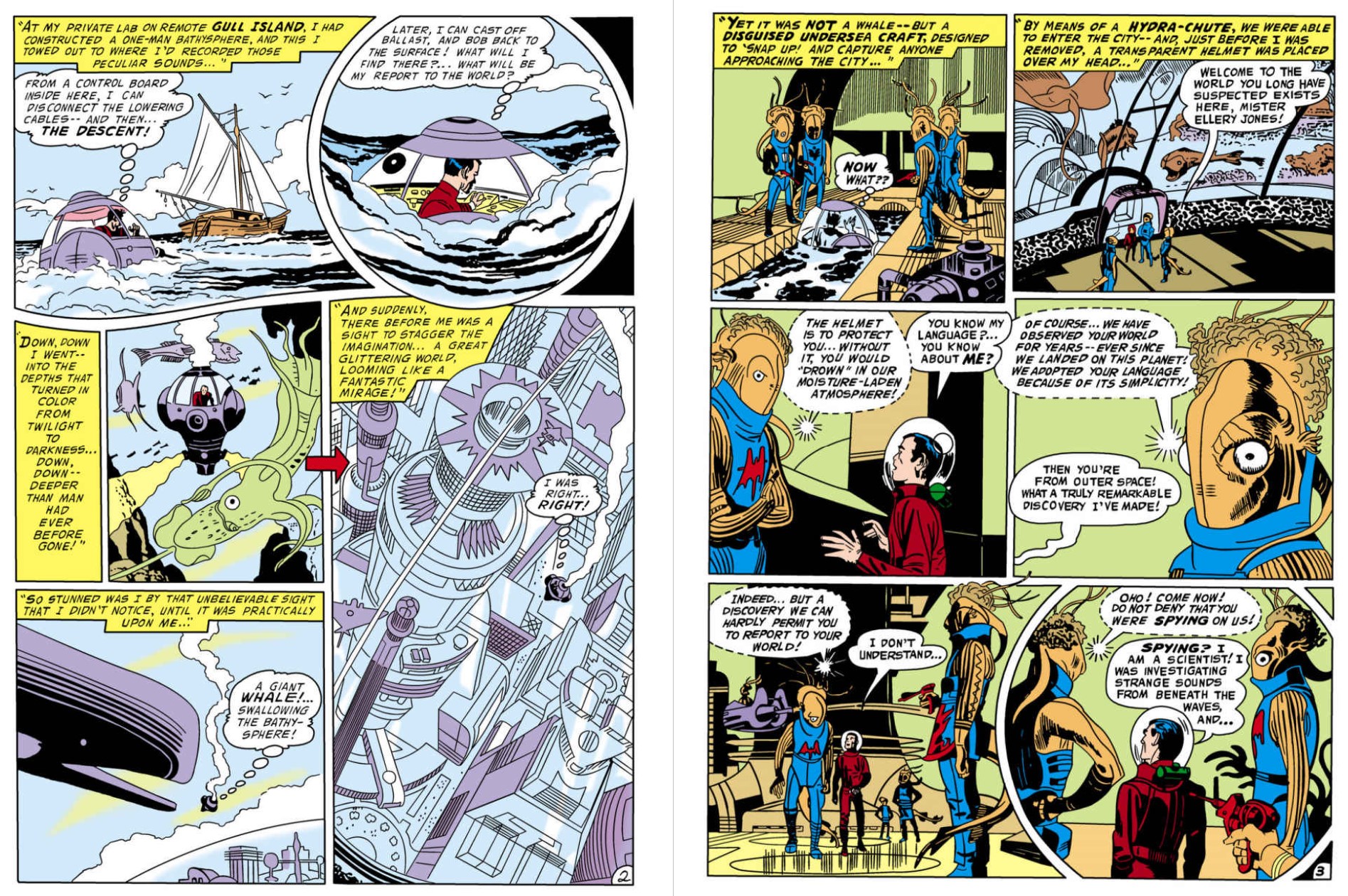
‘The Amazing Story of Superman-Red and Superman-Blue!’ (Superman #162, July 1963) is possibly the most influential tale of this entire subgenre. Written by Leo Dorfman with art from Swan & George Klein, this startling utopian classic was so well-received that decades later it still influences and flavours Superman continuity. The plot involves the Action Ace being divided into two equal wonder men who promptly solve all universal problems and even the love rivalry between Lois Lane and Lana Lang!

Siegel & Schaffenberger’s ‘The Three Wives of Superman!’ is an enchanting tragedy of missed chances from SGLL #51 (August 1964) clearing the palate for ‘The Fantastic Story of Superman’s Sons’ (by Edmond Hamilton, Swan & Klein in Superman #166, November 1964): a solid thriller built on a tragic premise (what if only one of Superman’s children inherited his powers?), and this bright and breezy book closes with the stirring, hard-hitting ‘Superman and Batman… Brothers!’, wherein orphaned Bruce Wayne is adopted by the Kents, but cannot escape a destiny of tragedy and darkness. Written by Jim Shooter, with art from Swan & Klein for World’s Finest Comics #172 (cover-dated December 1967) this moody thriller in many ways signalled the end of carefree days and the beginning of a grittier, more cohesive DC universe for a less whimsical, fan-based audience.

This collection is a glorious slice of fancy, augmented by an informative introduction from columnist Craig Shutt, bolstered with mini-cover reproductions of many tales that tragically never made it into the collection, but I do have one minor quibble: No other type of tale was more dependent on an eye-catching, conceptually intriguing cover, so why couldn’t those belonging to these collected classics have been included here, too?

Surely, it’s time for a re-issue in either print or digital format with all those arresting covers included. Yes, it is… and don’t call me Shirley.
© 1946, 1959-1964, 1967, 2005 DC Comics. All Rights Reserved.

Today in 1900 Chester Gould was born. No help from me here, deduct who he was.

Happy birthday British arts icon Rian Hughes, arrived today in 1963, joined three years after by Jill Thompson and Guy Davis. Them also you should seek out here or in their own books…

Incredible Hulk Epic Collection volume 1: Man or Monster? (1962-1964)


By Stan Lee, Jack Kirby, Steve Ditko, Paul Reinman, Dick Ayers, George Roussos, Chic Stone & various (MARVEL)
ISBN: 978-0-7851-9600-6 (TPB/Digital edition)

This book includes Discriminatory Content produced in less enlightened times.

Win’s Christmas Gift Recommendation: Timeless Monster Madness Masterpieces… 10/10

We all still like superheroes right? Here’s a bunch of yarns thou shouldst not miss…

Chronologically collecting the Jade Juggernaut’s earliest appearances, this titanic tome (available as a hefty paperback and relatively weightless digital edition) gathers Incredible Hulk #1-6; Fantastic Four #2 & 25-26; Avengers #1-3 & 5, Amazing Spider-Man #14; Tales to Astonish #59 and an unforgettable clash with Thor from Journey into Mystery #112: cumulatively spanning early 1962 to the end of 1964.

The Incredible Hulk was new-born Marvel’s second new superhero title, despite Henry Pym technically debuting earlier in a one-off yarn from Tales to Astonish #27 (January 1962). However, Hank didn’t become a costumed hero until the autumn, by which time Ol’ Greenskin was not-so-firmly established.

The Hulk smashed right into his own bi-monthly comic and, after some classic romps by Young Marvel’s finest creators, crashed right out again. After six issues the series was cancelled and Lee retrenched, making the Gruff Green Giant a perennial guest-star in other titles until such time as they could restart the drama in their new “Split-Book” format in TtA where Ant/Giant-Man was rapidly proving to be a character who had outlived his time.

Cover-dated May 1962, Incredible Hulk #1 finds puny atomic scientist Bruce Banner sequestered on a secret military base in the desert, perpetually bullied by bombastic boss General “Thunderbolt” Ross, even as the clock counts down to the World’s first Gamma Bomb test.

Besotted with Ross’s daughter Betty, Banner endures the General’s constant jibes as the timer ticks on and tension increases, but at the final moment the boffin sees a teenager lollygagging at Ground Zero. As he frantically rushes to the site to drag the boy away, unknown to all, the assistant he’s entrusted to delay the countdown has an agenda of his own…

Rick Jones is a wayward but good-hearted kid. After initial resistance he lets himself be pushed into a safety trench, but just as Banner prepares to join him The Bomb detonates…

Somehow surviving the blast, Banner and the boy are secured by soldiers, but that evening as the sun sets the scientist undergoes a monstrous transformation. He grows larger; his skin turns a stony grey…

In six simple pages that’s how it all starts, and no matter what any number of TV or movie reworkings or comicbook retcons and psycho-babble re-evaluations would have you believe that’s still the best and most primal take on the origin. A good man, an unobtainable girl, a foolish kid, an unknown enemy and the horrible power of destructive science unchecked…

Written by Stan Lee, drawn by Jack Kirby with inking by Paul Reinman, ‘The Coming of the Hulk’ barrels along as the man-monster & Jones are kidnapped by Banner’s Soviet counterpart The Gargoyle for a rousing round of espionage and Commie-busting. He soon sees the (green) light, though…

In the second issue the plot concerns invading aliens, and the Banner/Jones relationship settles into a traumatic nightly ordeal where the good doctor transforms and is locked into an escape-proof cell whilst the boy stands watch helplessly. Neither ever considers telling the government of their predicament…

‘The Terror of the Toad Men’ is formulaic but viscerally, visually captivating as Steve Ditko inks Kirby; imparting a genuinely eerie sense of unease to the artwork. Incidentally, this is the story where the Hulk inexplicably changed to his more accustomed Green persona…

Although back-written years later as a continuing mutation, the plain truth is that grey tones caused all manner of problems for production colourists so it was arbitrarily changed to the simple and more traditional colour of monsters.

The third issue presented a departure in format as chaptered epics gave way to complete short stories. Dick Ayers inked Kirby in the transitional ‘Banished to Outer Space’ which radically altered the relationship of Jones and the rage-beast, with the story thus far reprised in 3-page vignette ‘The Origin of the Hulk’. Marvel mainstay of villainy the Circus of Crime debuts at the end in ‘The Ringmaster’ whilst in #4 The Hulk goes on an urban rampage for first tale ‘The Monster and the Machine’ prior to aliens and Commies combining in second escapade ‘The Gladiator from Outer Space!’

The Incredible Hulk #5 is a joyous classic of Kirby action, introducing immortal despot Tyrannus and his underworld empire in ‘The Beauty and the Beast!’, after which those pesky Commies came in for another pasting when the Jolly Green freedom-fighter crushes the invasion of Lhasa in ‘The Hordes of General Fang!’

Lee grasped early on the commercial impact of cross-pollination and – presumably aware of disappointing sales – inserted the Green Gargantuan into his top selling title next. Fantastic Four #12 (March 1963) featured an early crossover as the team were asked to help the US army capture ‘The Incredible Hulk’: a tale from Lee, Kirby & Ayers packed with intrigue, action and bitter irony. It begins with a series of spectacularly destructive sabotage incidents putting the heroes on the trail of a monster when they should have been looking at spies… Despite the sheer verve and bravura of these simplistic classics – some of the greatest, most rewarding comics nonsense ever produced – the Hulk series was not doing well. Kirby moved on to more appreciated arenas and Steve Ditko stepped up to handle art chores for #6: another full-length epic and an extremely engaging one.

‘The Incredible Hulk Vs the Metal Master’ has astounding action, slyly subtle sub-plots and a thinking man’s resolution, but nonetheless the title died with the issue, also dated March. Another comic debuted that month and offered a lifeline to the floundering Emerald Outcast. ‘The Coming of the Avengers’ offers one of the cannier origin tales in comics. Instead of starting at a zero point and acting as if the reader knew nothing, creators Lee, Kirby & Ayers assumed interested parties had at least a passing familiarity with Marvel’s other titles, and wasted little time or energy on introductions in the premiere issue.

In Asgard Loki, god of evil, is imprisoned on a dank islet but still craves vengeance on his step-brother Thor. Observing Earth, the villain sees the monstrous Hulk and engineers a situation wherein the man-brute goes on a rampage, hoping to trick the Thunder God into battling the bludgeoning brute. When sidekick Rick Jones radios the Fantastic Four for assistance, Loki diverts the transmission so they cannot hear it and expects his mischief to quickly blossom. However, other heroes pick up the SOS – namely Iron Man, Ant-Man & the Wasp – and as the costumed champions converge on the desert in search of the Hulk, they realize something’s amiss…

This terse and compelling yarn is Lee & Kirby at their absolute best, and one of the greatest stories of the Silver Age, here promptly followed by ‘The Space Phantom’ (Lee, Kirby & Reinman): another unforgettable epic, in which an alien shape-stealer almost destroys the group from within. The tale ends with the volatile Hulk quitting the team only to return in #3 as a villain in partnership with ‘Sub-Mariner!’: a globetrotting romp delivering high energy thrills and one of the best battle scenes in comics history.

Three months later, Fantastic Four #25 featured a cataclysmic clash that had young heads spinning in 1964… and pretty much ever since. Inked by George Roussos, ‘The Hulk Vs The Thing’ and concluding saga ‘The Avengers Take Over!’ in FF #26 offered a fast-paced, all-out Battle Royale as the disgruntled man-monster comes to New York in search of sidekick Rick, with only an injury-wracked FF in the way of his destructive rampage.

A definitive moment in the character development of The Thing, the action accelerates and amplifies when a rather stiff-necked, officious Avengers team horns in claiming jurisdictional rights on “Bob” Banner and his Jaded Alter Ego. This tale is plagued with pesky continuity errors which would haunt Lee for decades, but notwithstanding the bloopers, this is one of Marvel’s key moments and still a vivid, vital read.

Over in Avengers #5, ‘The Invasion of the Lava Men!’ (Lee, Kirby & Reinman) resulted in another incredible romp as Earth’s Mightiest battled superheated, superhuman subterraneans and a lethally radioactive mutating mountain with the unwilling assistance of the Hulk. It would be his last appearance there for many months…

However, the next cameo came in Amazing Spider-Man #14 (July 1964): an absolute milestone as a hidden criminal mastermind debuted; manipulating a Hollywood studio into making a movie about the wall-crawler. Even with guest-star opponents such as the Enforcers the Incredible Hulk steals all the limelight in ‘The Grotesque Adventure of the Green Goblin’ (Lee & Ditko) which is only otherwise notable for introducing Spider-Man’s most perfidious and flamboyant enemy (sarcasm alert!).

The second stage of the man-brute’s career was about to take off and Tales to Astonish #59 (September) offered a pulse-pounding prologue as ‘Enter: The Hulk!’ (Lee, Ayers & Reinman) sees the Avengers inadvertently provoking Giant-Man to hunt down the Green Goliath. Although The Human Top devilishly engineered that blockbusting battle, Lee was the real mastermind, as with the next issue The Hulk debuted in his own series – and on the covers – whilst Giant-Man’s adventures shrank back to a dozen or so pages.

This wonderfully economical compendium of classic wonders closes with the lead story from Journey into Mystery #112 (January 1965). ‘The Mighty Thor Battles the Incredible Hulk!’ is a glorious gift to all those fans who can’t help but ask “Who’s stronger?”

Arguably Kirby & Chic Stone’s finest artistic moment together, it details the private duel between these two super-humans that occurred during the free-for-all between Earth’s Mightiest, Sub-Mariner and Ol’ Greenskin back in Avengers #3. The sheer raw power of that tale is a perfect exemplar of what makes the Hulk work (and one that inspired that fight in the Thor: Ragnarok movie) and would be an ideal place to close proceedings.

Happily, however, fans and art lovers can enjoy further treats in the form of assorted House Ads; original artwork by Kirby & Ditko; a gallery of classic Kirby covers modified by painter Dean White (originally seen on assorted Marvel Masterworks editions) plus reproduced Essentials collection and Omnibus covers by Bruce Timm and Alex Ross…

Hulk Smash! He always was and with material like this he always will be.
© 1962, 1963, 1964, 1965, 2016 Marvel Characters, Inc. All rights reserved.

Today in 1923 the magnificently quirky Mike Sekowsky was born. We all know about his Justice League, Adam Strange, Metal Men and Inhumans stuff but have you seen Diana Prince, Wonder Woman volume 1?

Bone Broth


By Alex Taylor (SelfMadeHero)
ISBN: 978-1-91422-432-4 (TPB)

Win’s Christmas Gift Recommendation: Tasty Treats for Comics Fan-Addicts… 9/10

Here’s a quick, short review of a big, utterly fulfilling, extremely entertaining new confection from queer visual artist Alex Taylor. Winner of the First Graphic Novel Award for 2023, Bone Broth is set in contemporary London – literally underneath the arches! – and compellingly addresses modern living via the oldest traditions of mystery thriller writing…

Ash ia young transmaculine artist who almost nearly properly grown up. All that’s missing is to make enough money to pay rent, buy supplies and secure the meds supporting still- ongoing surgeries. That ideal opportunity knocks when crusty old coot/ramen sensei Bug adds the weedy-seeming new guy to the remarkable staff at his traditional noodle bar.

That highly popular haven of exotic eats and affordable takeouts is located off a dingy alley with trains roaring and clattering above at all times. It reminds me of Brixton, but of course, other rail lines, vibrant cross-cultural districts and eateries are available…

Business is brisk and Ash gets acquainted with floor maneger Honey, Sock, Blue, and burly Japanese broth-engineer Creamy – who philosophically monitors and stirs the industrial scale tonkotsu that is basis of all the dishes – whilst scrambling to learn the ropes. The work is intense, fast, complicated, relentless and – just like in any specialist enteprise (like a comic shop for instance ) – sticky, clammy, cloying and jampacked with weirdoes individualists on both sides of the till.

Nevertheless, Ash is immediatly part of the family, trading history and opinions, sharing moments and learning to live with the miasmic funk of entire pig carcasses perpetually becoming soup 24/7. It’s the kind of toil that quickly builds bonds that feel decades old so it’s no wonder everybody kicks back for celebratory drinks occaiosnally. Like the End-of-Year staff do when Bug drinks so much that he just goes to sleep on the floor and everybody took selfies with him.

Of course, Bug wasn’t unconcious and they all have to try and make rational decisions whilst being that drunk. Deleting recents posts is easy and logical but voting to lose the sensei in the body-rending broth doesn’t seem like such a great idea now…

Draped in biological hues and mired in literally organic imagery, Bone Broth’s motifs accentuate an unfolding comedy of errors: deftly mirroring the surgical progress of changing gender whilst reflecting on whatever beneficial butchery is involved in resculpting and crafting a human form with secret knowledge is exposed to those willing to look and think instead of react and revolt. This is a tale that some people will never countenance and that’s sad for them, because its also great stuff demanding second helpings…

Wryly subversive, tantalisingly warming and definitely NOT for little kids, this potent parable is seasoned with buddy film tropes and garnished with a delicious twist that will hit the spot for anyone with a taste for the out-of-the-ordinary fodder. Also included are a heartfelt ‘Thanks’ section and look at the artist’s ‘Process’ to deliver a multi-layered trifle you’d be fool to turn your nose up at.
Text and images © 2025 Alex Taylor. All rights reserved.

Today in 1951 Bob Smith (Super Friends, Superman, Plastic Man, Archie Comics) was born, as was Northampton’s Finest Alan Moore two years later. In 1985 Bill Watterson’s enfant terrible et big buddy Calvin and Hobbes launched. 1991 today saw UK comics stalwart Reg Parlett leave us. All of these optical miracles should be scrutinised at great length, so please go do that…

Yoko Tsuno volume 7 – The Curious Trio


By Roger Leloup (Cinebook)
ISBN: 978-1-84918-127-3 (PB Album)

This book includes Discriminatory Content produced in less enlightened times.

Win’s Christmas Gift Recommendation: Rollercoaster, Role Model Wonderment for All… 8/10

Today in 1933 master craftsman and raconteur Roger Leloup was born. Bon anniversaire and many more, mate…

On September 24th 1970, “electronics engineer” Yoko Tsuno began her troubleshooting career as an indomitable intellectual adventurer. Her debut in Le Journal de Spirou came in “Marcinelle style” 8 page short ‘Hold-up en hi-fi’, and although she is still delighting readers and making new fans today, for a while it looked as if she wasn’t going anywhere soon. Thankfully, her astonishing, astoundingly accessible exploits were revised as she quickly evolved into a paragon of peril: helming pseudo-realistic fantasies numbering amongst the most intoxicating, absorbing and broad-ranging comics thrillers ever created. Her globe-girdling mystery cases and space-&-time-spanning epics are the brainchild of Belgian maestro Roger Leloup. He launched his own solo career in 1953 whilst working as studio assistant and technical artist on Hergé’s Adventures of Tintin.

Compellingly told, sublimely imaginative and – no matter how implausible the premise of any individual yarn – always firmly grounded in hyper-authentic settings underpinned by solidly constructed, unshakably believable technology and unswerving scientific principles, Leloup’s illustrated escapades were at the vanguard of a wave of strips revolutionising European comics. Early in the journey, he switched from loose cartooning to mesmerising, nigh-photo realistic illustration that has become a series signature. The long-overdue sea-change in gender roles and stereotyping he led heralded a torrent of clever, competent, brave, formidable women taking their rightful places as heroic protagonists, not romantic lures. That consequently elevated Continental comics in the process. Such endeavours are as engaging and empowering now as they ever were, none more so than the travails of masterful Miss Tsuno.

Her first outings (oft-aforementioned, STILL unavailable Hold-up en hi-fi, and co-sequels La belle et la bête and Cap 351) were mere introductory vignettes prior to epic authenticity taking a grip in 1971 when the unflappable problem solver met valiant but lesser (male) pals Pol and Vic. Instantly hitting her stride in premier full-length saga Le trio de l’étrange (LJdS’s May 13th edition), from then on, Yoko’s efforts encompassed explosive exploits in exotic corners of our world, spy and crime capers, time-travelling jaunts and sinister deep-space sagas such as this one. There are 31 bande dessinée albums to date, with 21 translated into English thus far, albeit – and ironically – none available as digital books…

The series has a complex history in English. Comcat previously released a few adventures – sadly, poorly translated and adapted – before British-based Cinebook acquired the franchise and opened a comprehensive and entrancing sequence in 2007 with 1976’s (seventh) saga On the Edge of Life.

Translated as The Curious Trio, Le trio de l’étrange was actually the 7th chronicle released by Cinebook and opens in a busy TV studio at midnight (back when actual humans pushed, pulled and focussed the clunky paraphernalia). Young Director Vic Van Steen loses his rag with best pal Pol Paris for falling asleep on his camera. Later, still smarting from another fractious tiff, the pair walk home past a deserted construction site and witness what looks like an elegantly brilliant burglary…

The quietly flamboyant break-in is, in fact, a pre-arranged test by sleekly capable freelance Japanese electrical engineer Yoko Tsuno. She’s been hired by a major company to test their new security. After apologising for nearly ruining her trial with well-intentioned interference, the lads invite the enigmatic tech-bod to join their film crew as sound engineer on a proposed outside shoot.

The gig is to explore flooded caves for a documentary and before the week ends the new friends are hauling equipment to a spectacular cavern, keen to work out the technical details. No sooner do they begin, however, than something goes terribly wrong and the trio are dragged deep underground by irresistible, swirling waters…

From here the achingly realistic, rationalist strip takes a huge leap into the uncanny as their subterranean submersion dumps them into a huge metal-shod vault where they are seized by blue-skinned humanoids. The colossal complex is of incredible size, and the captives are bundled into a fantastic vessel which runs on rails via magnetic levitation. Driven even deeper underground, a handy translation helmet enables the only friendly-seeming stranger to explain. She is Khany and her race, the Vineans, have been sleeping deep beneath the Earth for almost half a million years.

However, since recently awakening, internecine strife has disrupted the colonists’ lives. Ambitious militaristic martinet Karpan constantly manoeuvres to seize power from vast electronic complex The Centre, which regulates the lives of the awakened colonists. The humans’ first meeting with the blustering bully does not go well. When he attempts to beat Khany, martial artist Yoko delivers a humiliating and well-deserved thrashing…

Infuriated, Karpan tries to disintegrate them but is pulled away by security forces. As the newcomers resume their voyage to The Centre, he secretly follows their magneto-carrier, resolved to destroy them. With the maglev ship hurtling to unimaginable depths, Khany introduces the humans to a stowaway – her young daughter Poky – while relating the astounding tale of the Vinean escape from planetary doom and two-million-light-year trip to Earth. Accustomed to subterranean living, on arrival the Vineans hollowed out a mountain and dug down even further.

The history lesson is interrupted by Karpan’s murderous attack, which is thwarted by Yoko’s quick thinking and her companions’ near-insane bravery…

Eventually, after another, far subtler murder attempt, the damaged magneto-carrier reaches its destination and the astonished visitors are brought before a stupendous computer to plead their case and expose Karpan’s indiscretions. The vast calculator controls every aspect of the colony’s life and will deliver judgement on the human invaders’ ultimate fate. After mind-scanning Yoko The Centre’s pronouncement is dire: the strangers must be placed in eternal hibernation…

When Pol plays his long-hidden trump card and threatens to destroy the machine with a stolen disintegrator, diplomatic Khany proposes a solution; suggesting simply waiting until they can all confront still-absent Karpan. Yoko is still deeply suspicious and not convinced Karpan is responsible for every attempt on their lives. That “night”, while Yoko rests, Poky sneaks into her habitation chamber and takes her on an illicit tour of the underside and innards of the impossibly huge complex. The jaunt verifies the engineer’s suspicions with a ghastly revelation. What they expose is a horrific threat not just to the Vineans – Karpan included – but to every human on the surface of Earth…

The eerie mystery then explodes into spectacular action and a third act finale worthy of any  Bond blockbuster as Tsuno’s dramatic duel with an incredible malign menace settles the fate of two species…

Absorbing, rocket-paced and captivatingly combining tense suspense with bombastic thrills, spills & chills, this is a terrific introduction to a world of rationalist mystery and humanist imagination with one of the most unsung female action heroes of all… and one you’ve waited far too long to meet…
Original edition © Dupuis, 1979 by Roger Leloup. All rights reserved. English translation 2012 © Cinebook Ltd.

Today in 1916 DC Golden/Silver age and newspaper strip scripter Alvin Schwartz was born, followed 11 years later by Belgian author Maurice Rosy, whose art direction made Spirou what it is.

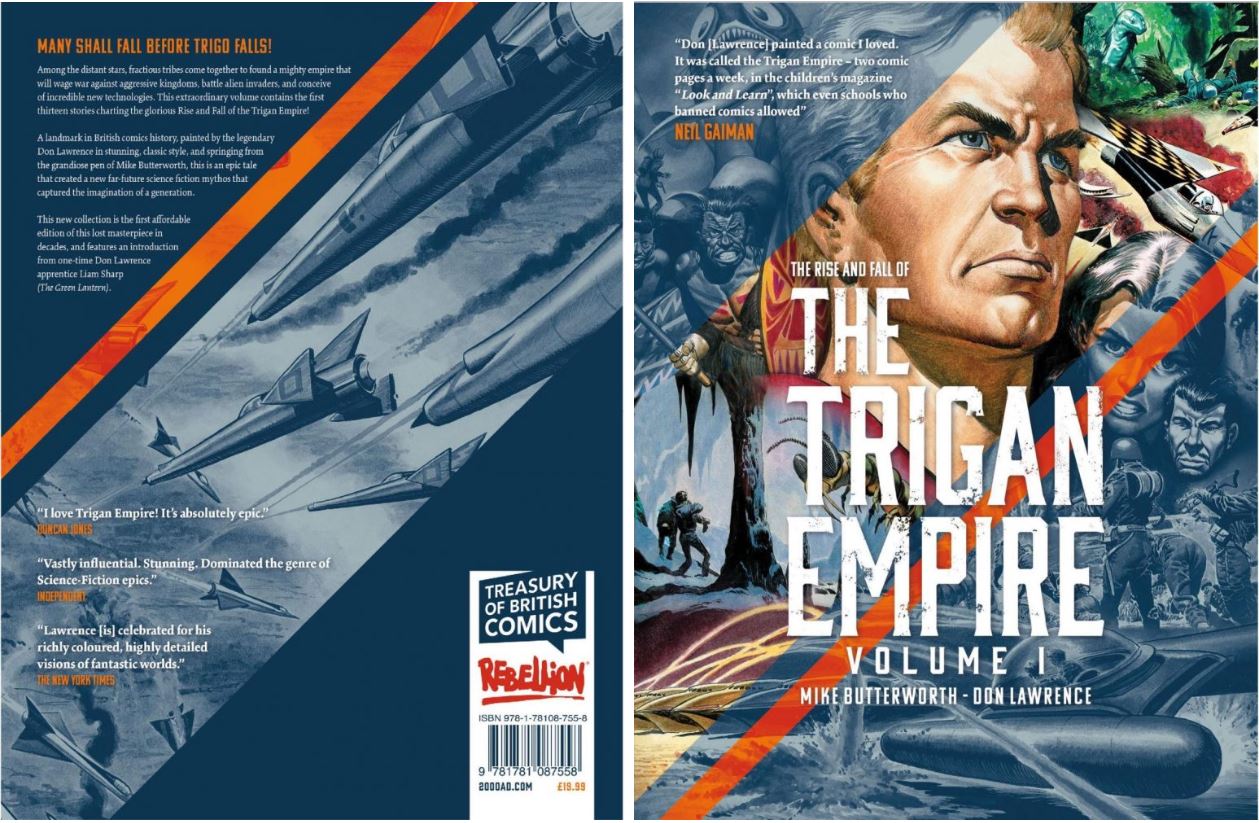
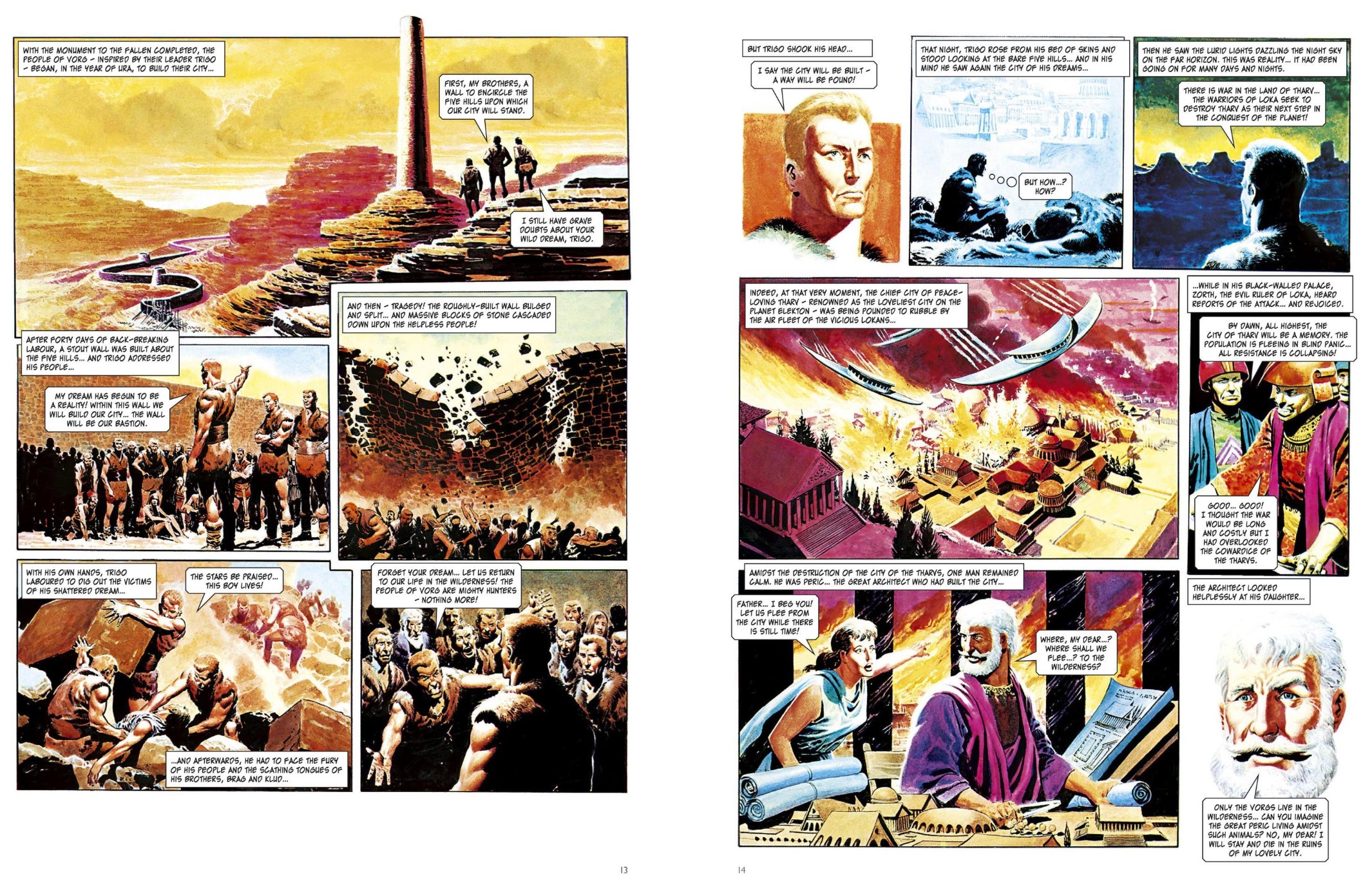
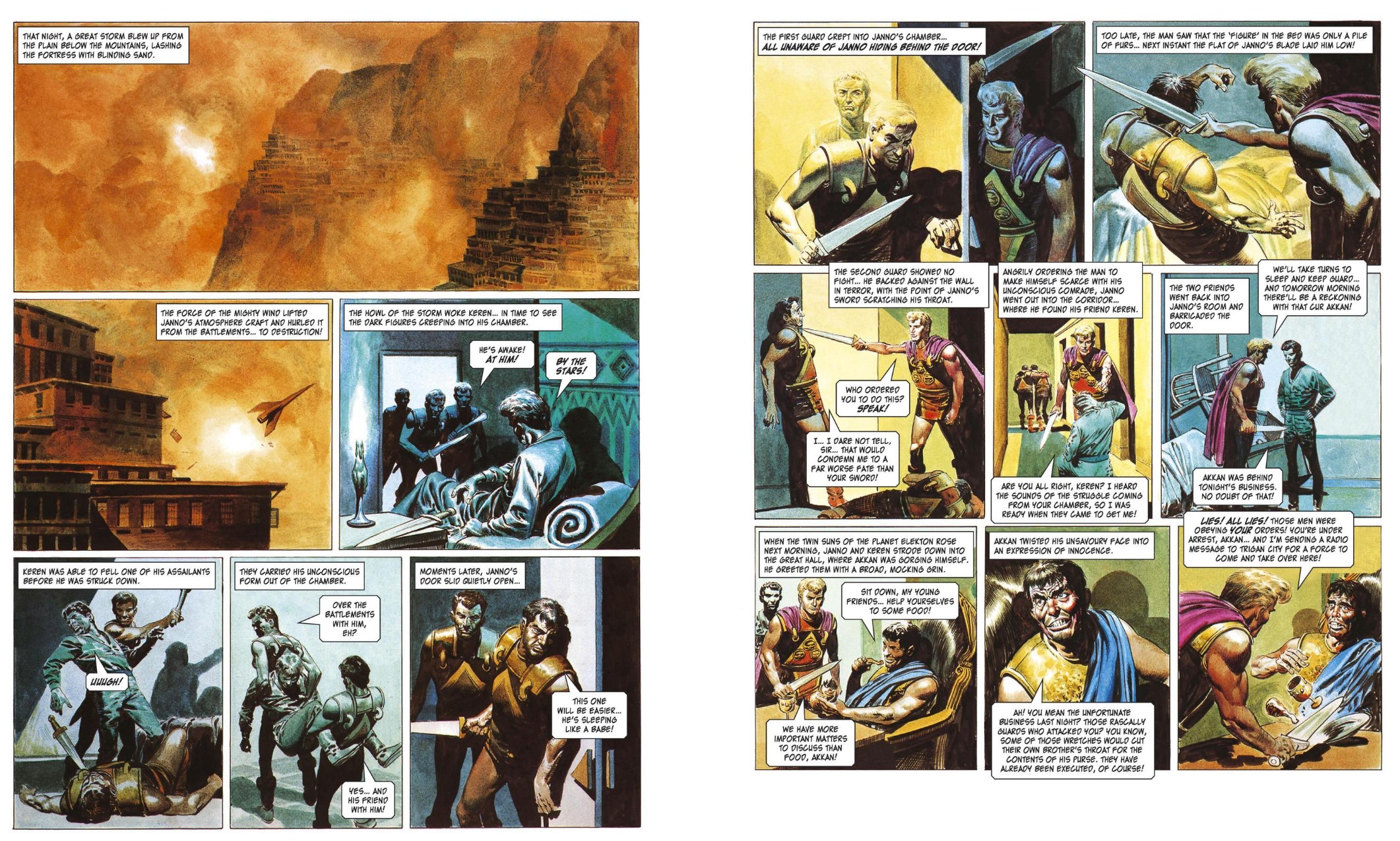
In 1928 Don Lawrence was born. You can go look back at his Trigan Empire stuff, but why not also enjoy Maroc the Mighty like we just did…

The Legend of Desperate Dan – 60 Years of Classic Cartoon Art


By Dudley D. Watkins, with Charles Grigg, Ken Harrison & various (DC Thomson & Co)
ISBN: 978-0-85116-657-5 (tabloid HB)

This book includes Discriminatory Content produced in less enlightened times.

It needs to be said. Scotland is an ancient and proud nation steeped in unique history, character and culture, and one that has enriched the entire world. That having been said, they all seem to have a rather odd and frequently disturbing fascination with the notion of cowboys…

A timeless case in point is an icon of action and hilarity who began life as a mere half-page feature in the very first issue of The Dandy. The rowdy roughneck (and chin, and chest and…) was first seen fleeing town on December 4th 1937, but has since mellowed, found a family and settled down, He’s still the Strongest Man on Earth and always in trouble because he doesn’t know his own strength…

As seen in the eponymous opening historical section of this colossal tome, ‘The Legend of Desperate Dan’ predates Superman’s debut and owes more to Elzie Segar’s maritime masterpiece Popeye (as seen back then in Thimble Theatre) by way of a countless stampede of Saturday morning movie two-reelers. However Desperate Dan didn’t roam too long on the range and swiftly garnered a family including formidable Aunt Aggie, super-tough nephew Danny, niece Katey, the hard-pressed Mayor, Sheriff and so forth… and lots of put-upon, shell-shocked neighbours usually caught in the catastrophic aftermath of Dan’s latest efforts to help…

Like so many of DC Thompson’s most memorable stars, the Big Guy was the brainchild of Dudley D. Watkins (1907-1969) at his most imaginative and culturally adroit. A tireless and prolific illustrator equally adept at comedy, adventure, educational and drama storytelling, Watkins’ style more than any other shaped the pre and especially postwar look and form of the Scottish publishing giant’s comics output. Yes, the company AND the cowboy…

Watkins started life in Manchester and Nottingham as an artistic prodigy prior to entering Glasgow College of Art in 1924. Before long he was advised to get a job at expanding, Dundee-based Thomson’s, where a 6-month trial period illustrating prose “Boys’ Papers” stories led to comic strip specials and some original cartoon creations. Percy Vere and His Trying Tricks and Wandering Willie, The Wily Explorer made him the only contender for both lead strips in a bold new project conceived by Robert Duncan Low (1895-1980). Managing Editor of Children’s Publication. Between 1921 – 1933, Low launched the company’s “Big Five” story papers for boys: Adventure, The Rover, The Wizard, The Skipper and The Hotspur. In 1936, he created the “Fun Section”: a landmark 8-page comic strip supplement for national newspaper The Sunday Post. This illustrated accessory – prototype and blueprint for every comic the company subsequently released – was launched on 8th March. From the outset, The Broons and Oor Wullie were the uncontested headliners… and both illustrated by Watkins. The other features included Chic Gordon’s Auchentogle, Allan Morley’s Nero and Zero, Nosey Parker and others. These pioneering comics laid the groundwork for the company’s next great leap. In December 1937 Low launched DC Thomson’s first weekly all-picture strip comic, The Dandy. Amidst the serried rank of funsters was a half-page western gag strip. It related the riotous outrages of a mean desperado dubbed Dan…

Dan was extremely popular and in 1939 briefly enjoyed taking up 75% of a page before expanding onto the star status of a full one. Famously, Dandy editor Alber Barnes – who hired Watkins and was the comic’s boss until 1982 – was the model for that unmissable chin. Almost everything else was made up…

This collation offers a wealth of strips, beginning with those calamity-stuffed half-pagers, filled with mighty gaffes, massive consumption and appalling comedic animal cruelty, all preceding the inevitable war contributions as the officially neutral US citizen kept finding ways to bugger up Hitler and Goebbels’ plans for Britain. Another cautionary note: back then smoking tobacco was MANLY, so Dan did it in vast and generally competitive amounts. Be warned and wary…

Monochrome trips about eating, fighting, shaving, Dan’s Girlfriend Lizzie, eating, fighting some more and getting even pause for a colour featurette on ‘The Dandy Monster Comic’ as Dan hoved further westward into Books and Annuals before the strips concentrate on the ‘War years’ with Cactusville slowly morphing in all but name into a fair-sized Scottish town as Dan inflicted ever more outlandish punishments on the weary, wary Wehrmacht…

Feature on firsts follows with ‘Desperate Dan’ shouting out to his ever expanding cast, after which post-war tales encompass a momentous trip to the North Pole; jobs; cow pie; sweet rationing; clothing for the bigger man; bank robbers; cow pie; how feeble modern buildings are; toothache for tough guys and how meat rationing impacts on the mightiest appetite ever known. Once again it’s some pretty hard sledding for us wimpy modern animal-lovers…

Covers, strips and other treats from the Christmas tomes explore Dan’s unstoppable progress and includes a spread on ‘Back Covers on Annuals’ – the cowboy’s sole province from 1954 to 1965 – before segueing into a 1950s selection as Britain, Empire & Commonwealth and Dandy underwent dramatic revision and change…

The Watkins-limned prose yarn ‘Two Desperate Tiddley-Winkers’ leads to more fifties fun with Dan no longer in any way intentionally dangerous in strips covering the star’s invulnerable hair & bristles, coal mining in the High Street; cow pie; and Dan’s utterly unique pedal bike (take one steamroller and three parts tractor…) before closing on a momentous moment of history as Dan voyages to London to see the Queen’s coronation as originally published in Dandy dated June 6th 1953…

‘The Desperate Dan Song’ – sorry, just words & pictures so you’ll need to wrangle up your own tune – leads into more strips with enhanced roles for Danny & Katey, prior to the Sixties revivals opening with ‘Annual features’ including a glance at Dan’s primordial forebear Desprit Jake.

With contemporary strips coming thick & fast the fun is closely followed by two-colour Annual larks involving li’l Dan’s photo-day at ‘Cactusville School’ whilst – happily mining a fresh seam – ‘Desperate Dan’s Schooldays’ (as illustrated by Charles Grigg and first published in the Desperate Dan Annual 1979) gives readers another bucket of whimsical back-story from the big man boyhood as the end approaches.

In 1984, the Biggest Yin made it to the front – and back – of the weekly Dandy covers, displacing Grigg’s Korky the Cat after five straight decades. Here a full colour spread celebrates an anniversary year with a quartet (octet?) of images shouting out fifty years of Desperate astonishment wonder before we unsaddle for the moment with final modern colour feature ‘The Hobbies of Desperate Dan’ as seen in the 1994 Dandy Annual and showing what the term “extreme sports” really means…

Timeless, hilarious and not nearly as tame as you thought, Desperate Dan is a pure paradigm of our lengthy comics glory – and disregard for other people’s culture. Here is a book that – if you’re properly braced and forewarned – will delight and warm your secret, stifled cartoon coloniser’s heart.
© D.C. Thomson & Co Ltd 1997.

Today in 1913 Golden Age artist Charles (Spy Smasher, et al) Sultan was born. In 1943, Metabarons artist Juan Giménez was born. You might also want to peek at A Matter of Time, before celebrating that in 1962 Darwyn Cooke (DC: The New Frontier, Batman: Ego, Parker) joined us for far too short a time.

Fearless Fosdick


By Al Capp (Kitchen Sink Press)
ISBN: 978-0-87816-108-9 (TPB)

This book includes Discriminatory Content produced in less enlightened times. This book also contains Discriminatory Content included for satirical and comedic effect.

Al Capp’s Li’l Abner is rightly considered one of the greatest comic strips ever created, a devastatingly satirical, superbly illustrated, downright brilliant comedic masterwork which lampooned anything and everything America held dear and literally reshaped their popular culture. Generations of readers took Capp’s outrageous inventions and graphic invectives to their hearts. Many of the strips best lines and terms entered the language, as did the role-reversing college bacchanal known as Sadie Hawkins Day. Some fictional shticks even became licensed and therefore “real” – just Google “Shmoo” and “Kickapoo Joy-juice” to see what I mean.

Apart from the satirical and funny bits you can say pretty much the same about Chester Gould’s legendary lawman Dick Tracy – a landmark creation which has influenced all popular fiction, not simply comics. Baroque villains, outrageous crimes and fiendish death-traps have pollinated the work of numerous strips, shows and movies since then, but the indomitable Tracy’s studied use – and startlingly accurate predictions – of crime fighting technology and techniques gave the world a taste of cop thrillers, police procedurals and forensic mysteries such as CSI decades before our current fascination took hold.

In August 1942 Alfred Gerald Caplin, as he didn’t prefer to be known, took a studied potshot at the cartooning game, joyously biting the hand that fed him (grudgingly and far from enough) when he introduced a frantic, barbed parody of Tracy into Li’l Abner.

As depicted by cartoonist-within-a-cartoon “Lester Gooch”, Fearless Fosdick was a deadpan, compulsively honest, straight-laced cop who worked for a pittance in a corrupt, venal crime-plagued city, controlled by shifty, ungrateful authorities – i.e. typical bosses. Fosdick slavishly followed the exact letter of the law, if not the spirit: always over-reacting, and often shooting litterbugs or Jaywalkers whilst letting bandits and murderers escape.

The extended gag began as a sly poke at strip cartoonists and syndicates whom Capp portrayed as slavering maniacs and befuddled psychotics manipulated by ruthless, shameless, rapacious exploiters. It became so popular on its own admittedly bizarre merits that Fosdick’s sporadic appearances quickly generated licensed toys and games, a TV puppet show and a phenomenally popular advertising deal for Wildroot Cream-Oil hair tonic.

The hard-hitting, obtuse he-man hero was impulsive Abner’s “Ideel” and whenever the crime-crusher appeared as a strip within the strip, the big goof aped his behaviour to outlandish degree. When Fosdick married as part of a bizarre plot, Abner finally capitulated to devoted girlfriend Daisy Mae’s matrimonial aspirations and “married up” too… even though he didn’t really want to!

Fosdick made the jump to comic books when edited reprints of the strip appeared from Toby Press, and a promotional comic – ‘Fearless Fosdick and the Case of the Red Feather’ – followed. Thus in 1956 Simon and Shuster published Al Capp’s Fearless Fosdick: His Life and Deaths which forms the basis of the classy Kitchen Sink softcover under review here.

Prefaced with an absorbing and informative introduction by award-winning crime and comics writer Max Allan Collins – who took over Dick Tracy when Gould retired – this outrageous tome relates five of the very best felonious fiascos and forensic farces beginning with ‘Introducing: AnyFace!’ from 1947, wherein Abner is hired to protect cartoonist Lester Gooch as he crafts the tale of a crook with a plastic face. The fiend is un-catchable since he can mimic anybody, constantly fooling Fosdick into shooting the wrong guy. Eventually the cop starts killing people pre-emptively – just in case – but in the “real” world as Abner gets more engrossed in the serial, Gooch, always as bonkers as a bag of badgers (because only certified loons create comics strips), is suddenly cured, casting the conclusion into desperate doubt! Confused? Good: that’s the point!

From 1950 comes ‘The Case of the Poisoned Beans’ in which madman Elmer Schlmpf randomly contaminates a tin of “Old Faithful” – the city’s most popular brand of beans. So popular are they that most shops and restaurants refuse to take them off sale and the populace won’t stop buying them. As no panic ensues and indifference rages, Fosdick begins shooting citizens who won’t stop eating the beans. Better a safe, clean police bullet than a nasty case of poison…

‘Sidney the Crooked Parrot’ (1953) was once Fosdick’s faithful pet, but living with the obsessive do-gooder turned the bird into a vengeance-crazed criminal genius. Cunningly causing Fearless to lose his job, the bird then organises a campaign of terror, but even humiliated, derelict and starving, the unswerving righteousness of the super-cop finds a way to triumph…

‘The Case of the Atom Bum’ (1951) finds the dapper detective helpless to halt depredations of a radioactive hobo who robs with impunity since the slightest wound might cause him to detonate like a thermonuclear bomb. Forced to ignore and even – shudder!! – abet the ne’er-do-well, Fosdick is going even more insane with frustrated justice – and then he snaps!

This manic monochrome monument to the Bad Old Days concludes with 1948’s utterly surreal ‘Case of the Chippendale Chair’, which begins only after certifiably cured and sane Lester Gooch is kidnapped by thugs working for the syndicate who torture him until he is crazy enough to produce Fearless Fosdick cartoons once more…

Once more demented, Gooch sets to delivering a startling saga of murder, theft and general scofflawing to sate the nation’s desire for graphic gang-busting with a new mastermind ravaging the palaces of the rich. Who can possibly be behind such brilliant crimes? (The clue is in the title…) and as Fosdick ineptly yet unerringly closes in on the culprit, collateral casualties mount. Still, isn’t justice worth a few sacrifices?

Madcap, cynical and hilariously ultra-violent, these eccentric yarns are credited with inspiring Harvey Kurtzman to create Mad comic books and the magazine it became. Capp’s creations clearly shaped decades of American comics comedy. Fosdick kept on turning up until 1972, leavening all the hillbilly high-jinks, satire and social commentary and defanging Capp’s increasingly reactionary stance and declining popularity with healthy, recreational slapstick slaughter, justifiable homicides and anticipatory cold-case clean-up. Moreover, if you’re British, you will see quite a few antecedents of our own utterly rational and reasonable supercop Judge Dredd

If you have a taste for over-the-top hilarity and stunning draughtsmanship this is a book you must track down. Consider it a constabulary duty to be done…
Strip material © 1947, 1949, 1950, 1951, 1990 Capp Enterprises, Inc. Introduction © 1990 Max Allan Collins. Entire Contents © 1990 Kitchen Sink Press, Inc.

Today in 1907, the first Mutt and Jeff strips by Bud Fisher were published. We already told you that in Forever Nuts: The Early Years of Mutt & Jeff (Classic Screwball Strips). In 1915 Green Lantern originator Martin Nodell was born, whilst comics presence, writer, editor and The Beat blogger Heidi MacDonald joined us in 1961, as did comics colour artist Lee Loughridge (Batman Adventures, Stumptown) in 1969.

I Hate Fairyland volume 1: Madly Ever After


By Skottie Young, Jean-Francois Beaulieu, Blambot®’s Nate Piekos & various (Image Comics)
ISBN: 978-1-63215-685-3 (TPB/Figital edition)

This book contains Discriminatory Content included for comedic effect.

Win’s Christmas Gift Recommendation: Sugar & Spice & Everything Nicely Reimagined… 10/10

It feels like we haven’t had a good laugh in ages. Oh wait, here’s one now…

We grow up with fairytales all around us. They’re part of the fabric of our lives. Some people generally outgrow them whilst others take them to heart and make them an intrinsic aspect of their lives…

Have you met Skottie Young?

He’s a guy with feet firmly planted in both camps and well able to alternatively embrace the enchantment of imagination and give it a hilariously cynical mean-spirited drubbing at the same time. Hopefully you’ll have seen his glorious, multi-award-winning interpretation of Baum’s Oz books produced by Marvel and his spectacular run on Rocket Raccoon (and Groot!); or perhaps just his gut-bustingly funny baby superhero covers. Maybe you’re aware of his collaboration with Neal Gaiman on Fortunately the Milk?

If not, there’s so much more in store for you after enjoying this particular slice of vintage mirthful mayhem…

I Hate Fairyland is a truly cathartic little gem: a mind-buggering romp of deliciously wicked simplicity and one I heartily recommend as a palate-cleanser for anyone overdosing on cotton candy, wands and glitter, or spandex and slicked-back pecs.

Once upon a time little Gertrude wished she could visit the wonderful world of magic and joyous laughter. Her wish was inexplicably granted and she met happy shiny people: fairies, elves, giants, talking animals and animated trees, rocks, stars, suns and moons; Gert just loved them all…

Resplendent Queen Cloudia made her an Official Guest of Fairyland and invited her to play a game. When she wanted to go back to her own world the bedazzled six-year-old simply had to find a magic key and open the door to the realm of reality. The fabulous Fairy Queen even gave Gertrude a quaintly talking bug as guide and helpmeet, plus a magic map of all the Known Lands…

That was 27 years ago and although Gert’s body has not aged a day her mind certainly has. It’s also gotten pretty pissed-off at the interminable insufferable task and just wants it all to end.

Of course, as an Official Guest of Fairyland Gert can’t die and has taken to expressing her monumental frustration in acts of staggering violence and brutal excess as she continues hunting for that fluffer-hugging key…

With no other choice, Gert and dissolute bug Larrigon Wentsworth III toil ever onward in search of the way home, regularly enduring horrific – but non-fatal – injuries and taking out their spleen (and often other peoples’) on whoever gets in her way.

After all this time, however, Even Queen Cloudia has had enough. Sadly, she can’t do anything about it whilst Gert is “OFG” (Official Guest of Fairyland, keep up!): a privilege that simply cannot be revoked.

Subtle hints of vast rewards to barbarians and assassins and evil witches all prove worthless too. Between the protection spell and Gert’s own propensity for spectacular bloodletting, there’s nothing in the incredible kingdoms to stop her.

… And then someone has a really amazing idea. Why not invite another sweet little girl to Fairyland and offer her the same deal? When she finds the key, wins the game and goes back, Gert will lose her OFG status and they can be rid of her at last!

Of course, that all goes swimmingly, just like Cloudia hoped and everybody but Gert lives happily ever after.

No, it really, really doesn’t work out like that…

To Be Continued…

Collecting the first five issues of the Image Comic series from October 2015 – February 2016 by Young, colourist Jean-Francois Beaulieu and letterer Nate Piekos of Blambot®, this sublimely outrageous treat offers hilariously over-the-top cartoon violence and the most imaginative and inspired use of faux-profanity ever seen in comics.

This is an unmissable wakeup call for everybody whose kids want to be little princesses and proves once and for all that sweet little girls (and probably comics artists) are evil to the core if you push them too far…
© 2016 Skottie Young. All rights reserved.

Today in 1911, cartoonist Clarence Gray was born. Sadly, there isn’t much of his wonderful Brick Bradford strip around to review. Far more readily represented is Alberto Giolitti whose art can be seen on loads of licensed features books we’ve covered like Star Trek: Gold Key Archives volume 1, and who would be 102 today if he still lived…

In 1941 French star fantasist Caza was born, whilst Superman scribe Elliot S! Maggin joined us in 1950 and FF artist Carlos Pacheco was born in the same year they were: 1961…

Robot Archie and the World of the Future


By E. George Cowan, Ernest “Ted” Kearon, Davis Harwood, with Garry Leach, Geoff Campion & various (Rebellion Studios)
ISBN: 978-1-83786-554-3 (HB/Digital edition), 978-1-83786-626-7 (Webshop HB)

This book includes Discriminatory Content produced in less enlightened times.

Win’s Christmas Gift Recommendation: Timeless Fantasy Masterpiece for Young and Old Alike… 9/10

British comics have always enjoyed an extended love affair with what can only be described as “unconventional” (for which feel free to substitute “weird” or “creepy”) heroes. So many stars and notional role models of our serials and strips have been outrageous or just plain “off”: self-righteous voyeur/vigilantes like Jason Hyde, sinister masterminds in the manner of The Dwarf or Black Max, arrogant former criminals like The Spider or outright racist overmen such as fearsome white ideologue Captain Hurricane

Joking aside, British comics are unlike any other kind: having to be seen to be believed and always enjoying – especially when “homaging” such uniquely American fare as costumed crimefighters – a touch of insouciant rebelliousness…

Until the 1980s, UK periodicals employed an anthological model, offering variety of genre, theme and character on a weekly (sometimes fortnightly) basis. Humour comics like The Beano were leavened by action-heroes like The Q-Bikes or General Jumbo whilst adventure papers like Smash, The Eagle, Hotspur or Valiant offered palate-cleansers The Cloak, Grimly Feendish, Mowser and sundry other titter-treats.

Prior to the advent of game changers Action, Misty and 2000AD, British comics seemingly fell into fairly ironclad categories. Back then, you had genial and/or fantastic preschool fantasy; licensed entertainment properties; action; adventure; war; school dramas; sports and straight comedy strands. Closer examination would confirm there was always a subversive merging, mixing undertone, especially in such antihero series as Dennis the Menace or our rather strained interpretation of superheroes. Just check out The Phantom Viking, Kelly’s Eye or early Steel Claw stories…

After post-war austerity, the 1950s ushered in revolution. With printing and paper restrictions gone, a steady stream of titles emerged from companies new and old, aimed at the many different levels of childish attainment from pre-school to young adult. When Hulton Press launched Eagle in April 1950, the very concept of what weeklies could be changed forever. That oversized prestige package with photogravure colour was exorbitantly expensive, however, and when venerable London-based publishing powerhouse Amalgamated Press retaliated, it was a far more economical affair. I’m assuming AP only waited so long before the first issue of Lion launched (cover-dated February 23rd 1952) to see if their flashy rival was going to last.

Just like Eagle, Lion mixed prose stories, features and comic strips. It even offered its own cover-featured space-farer in Captain Condor – Space Ship Pilot. Initially edited by Reg Eves, the title ran 1156 weekly issues until 18th May 1974 when it merged with sister-title Valiant. Along the way, in the tradition of Darwinian British publishing – which subsumed weaker-selling titles to keep popular strips going – in 1959 Lion absorbed Sun then Champion (1966) before swallowing Eagle in April 1969, before merging with Thunder in 1971. One of the country’s most popular and enduring adventure comics, the last vestiges of Lion only vanished in 1976 after Valiant’s amalgamation with Battle Picture Weekly.

Despite that demise, there were 30 Lion Annuals between 1953 & 1982, all benefitting from the UK’s lucrative Christmas market, combining a variety of original strips with topical and historical prose adventures; sports, science/general interest features; short humour strips and – increasingly from the 1970s – reformatted reprints from IPC/Fleetway’s back catalogue.

The Jungle Robot debuted in Lion’s first issue, created by incredibly prolific E. George Cowan (Ginger Nutt, The Spider, Saber, King of the Jungle, Smokeman/UFO Agent, Nick Jolly the Flying Highwayman, Paddy Payne, Girls’ Crystal Libraries) and drawn by Alan Philpott (The Deathless Men/V for Vengeance, Look-In, Klanky). It enthralled readers for a couple of months before abruptly vanishing with the August 9th issue.

Other than an appearance in the 1955 Lion Annual, that was it until January 19th 1957 when the mechanical marvel was revived and revised by Cowan & A. Forbes prior to veteran artist Ernest “Ted” Kearon (Spot the Clue with Zip Nolan, The Day the World Drowned, Steel Commando and DC Thomson’s Morgyn the Mighty). He signed on in 1958 and soldiered on for most of the next 17-ish years. This time the mighty mouthed mechanoid became one of the most popular and well-remembered heroes of the British scene, successfully syndicated all across Europe and around the world. Hopefully this second compilation of later material will be soon supplemented by earlier annals …

Reprinting stories from 18th January 1969 to 18th October 1969, plus yarns from Lion Annual 1971 and Lion Holiday Special 1980 these latterday adventures of explorer/ troubleshooters Ted Ritchie, Ken Dale and arrogant, smug, self-absorbed yet paternally benevolent super-robot Robot Archie resume and take an even more outrageous turn here.

The former Jungle Robot was for a very long time the greatest achievement of Ted’s inventor uncle Professor C. R. Ritchie. Partnered with him/it the lads battled monsters & aliens, foiled crooks and faced disasters. Then the Prof left them The Castle. This inhabitable two-storey faux chess piece could take them anywhere in history and even into the future… and inevitably the boastful ‘bot commandeers it and discovers the wonders and perils of all spacetime…

After joining a peasant’s revolt in the 14th century, and ending an alien invasion in the 21st, they fetched up fully lost and out of control in 18th century England to face Highwaymen and corrupt judges, pirates and more. Now at the mercy of raging chronal currents, the wanderers arrive thousands of years into Earth’s menacing tomorrows to find a paradise run by genetically pacifistic humans who look like wise children. This promised land is serviced by billions of mechanical servants but ‘Robot Archie in the World of the Future’ (by Cowan & Kearon for Lion 18th January to 26th April 1969) coincides with another extraterrestrial landgrab.

With barbarous conquerors the Krull resolved to possess and use up the world, it falls to Ted, Ken and especially super-general Archie to protect what humanity has become, retrain billions of robots into an army and repel the invaders. Of course, with no organised military or armaments, their arsenal of liberty must come from museums… as do the hands-on tactics the metal commander-in-chief inflicts on the aliens. These sorties have never been seen before and the Krull have no idea how to counter then…

After a ferocious struggle Earth is safe and free again, albeit forever changed, and the time trio take off on the hope of finding their home era again. The next landing initially seems to satisfy them – a lush island with recognisable architecture and normal looking people. Sadly, a series of unexplained events soon show otherwise…

Running from May 3rd to August 2nd, ‘Robot Archie and the Island of 1,000 Secrets’ pits the lads against ghostly phenomena, animated machinery, possessed animals and “hostile natives”, before a succession of hairsbreadth escapes expose the whole locale as a testing ground for some scurrilous aliens formerly beaten but now ready for a second round of malice and mayhem. Bombastic, bellicose Archie is more than happy to supply it…

After a protracted struggle that slips from mystery to sci fi fantasy, the intruders are defeated and humans liberated, with the restless nomads taking off again and landing in a pit of genuine horror…

Concluding around that year’s Remembrance Sunday commemorations ‘Robot Archie in No-Man’s Land’ ran from 9th August – 18th November 1969 and dropped the pals in the middle of a mud-drenched clash for a few feet of trench. In the clash Archie was damaged and went berserk whilst ununiformed Ted and Ken are instantly assessed as spies and arrested. In an age of technological breakthroughs the Germans, after being pounded and petrified by “the Steel Man”, concentrate all their efforts on capturing it, leading to massive and cathartic comics Hun-bashing (with Archie excelling on land at sea and in the air) before finally rescuing his human companions, un-impounding the Time Castle and taking off for fresh pastures and fewer explosions…

To Be Continued…

With epic covers by Geoff Campion & Garry Leach, the ‘Extras’ section of this mighty monument to weird fun begins with a brace of short complete tales from Lion Annual 1971 Special 1969 and Lion Holiday Special 1980 respectively. ‘Robot Archie – The Steel Giant’ by Kearon and an uncredited author finds the time-tossed trio in ancient Rome just as a usurper awaits three gladiator/assassins he’s hired sight unseen to kill Caesar. He can’t miss them, one of them is a veritable colossus who always wears full armour…

The general is cautious however and sets them tasks to prove their merit, but while they are acing those, the real hitmen arrive. Whoops!

Only a decade later, and three years into Fleetways’ revolution of UK comics, Archie was long gone and a figure of fond nostalgia. Thus he was cheekily revived for a team/up clash with a fellow veteran. Delivered by an unknown writer and Dave Harwood, ‘Robot Archie vs the Spider’ gave everybody what they wanted as the icons tried to beat the stuffings out of each other in a two-part saga that delivered on action but promised a continuation that never came…

The memory storm concludes with a too-short Covers Gallery and biographies.

Now part of Rebellion Publishing’s line of British Comics Classics, Robot Archie is a landmark of UK fantasy long overdue for revival. I hope not much time passes before we see all the old stories back again…
© 1969, 1970. 1980 & 2025 Rebellion Publishing IP Ltd. All Rights Reserved.

Today in 1887, British cartoonist George William Wakefield was born. You’ve never heard of him but he delighted your great grandparents with his Laurel and Hardy comics. In 1947, Doug Murray was born, whom we probably know best for writing The ‘Nam.

Today in 1977 saw the last published episode of Li’l Abner and in 1997, master Archie artist Samm Schwartz prat-falled (pratfell?) his way offstage for the last time.

In 2003, Flash co-creator and Golden Age stalwart Harry Lampert died. You don’t have to follow Now Read This, but you really, REALLY should read the comics we’re plugging here.

Little Nothings volumes 1-4: The Curse of the Umbrella, The Prisoner Syndrome, Uneasy Happiness, My Shadow in the Distance


By Lewis Trondheim, translated by Joe Johnson (NBM/ComicsLit)
ISBN: vol. 1: 978-1-56163-523-8 (Album PB), vol. 2: 978-1-56163-548-1 (Album PB),

vol. 3: 978-1-56163-576-4(Album PB), 978-1-56163-523-8 (Album PB),

I first became aware of Lewis Trondheim’s subtly enchanting vignettes in Fantagraphics’ Mome comics anthologies rather than through its internet presence and it’s a constant and utter delight for this old duffer (me, not him) to see this blend of cartoon philosophy, personal introspection, whimsical inquiry and foible-filled observations gathered into such handy tomes for constant re-reading. With over 100 books sporting his name (which isn’t actually Lewis Trondheim but Laurent Chabosy), the writer/artist/editor/educator is one of Europe’s most prolific comics creators: illustrating his own work, overseeing animated cartoons of such print successes as La Mouche (The Fly) and Kaput and Zösky or editing younger readers books (Dargaud’s series Shampooing).

His most famous works are global hits Les Formidables Aventures de Lapinot (translated as The Spiffy Adventures of McConey), Infinity 8, Ralph Azam and, with Joann Sfar, epic nested fantasy series Donjon as seen anglicised as Dungeon, Dungeon: Parade, Dungeon: Monstres, Dungeon: the Early Years et al. In his spare time he has written for satirical magazine Psikopat and provided scripts for the continent’s most popular artists, such as Fabrice Parme, Manu Larcenet, José Parrondo and Thierry Robin. Trondheim is, of course, a cartoonist of uncanny wit: piercing, gentle perspicacity, comforting affability and self-deprecating empathy, and prefers to control scrupulously what is known and said about him…

Some while ago the well-travelled graphic introvert began drawing a deliciously intimate cartoon blog wherein all the people Trondheim knows are rendered as anthropomorphised animals (with him a dowdy, parrot-beaked actor/director) which has been edited into a series of enchanting full-colour albums. Page after page of introspective, whimsical, querulous and enticingly intriguing reportage has emerged since.

Volume 1 – The Curse of the Umbrella – features ruminations on gardening and possessing a vegetable death-touch; introduces his family; examines a love-hate relationship with technology and computer games, also covering the dramas of becoming first time cat-owners at an advanced (human) age. Similarly scrutinised are hypochondria and the internet’s impact as an enabler of such recurs, as also work-processes for the self-employed, snacks, keeping fit, memory, death, bird-poop, the weather and travel to comics events in exotic locations such as the Reunion Islands and Edinburgh.

The daily bulletins explore little events and really big themes and there are also purely visual moments that you just have to see to appreciate and get…

In second volume The Prisoner Syndrome, the cascade of cartoon delights continues with more of the same whilst adding summer beach madness, floating with the fishes, exploring volcanoes, ecology and hotel wastefulness, comic convention memory (so different from the regular kind). There’s animal antics, travel, energy-saving, visiting Africa, Guadeloupe, Romania and London, the differences between men and women, global political crises and the heartbreaking helplessness and inevitable consequences of seeing your pet die.

Third stanza Uneasy Happiness sees our absurdly bird-faced gentleman amicably nit-picking and further musing his way through the life of an old and successful comic creator: travelling to conventions, making stories and dealing with the distressingly peculiar modern world, especially focusing on his increasing hoarding proclivities, concerns over his creative and financial legacy, mice in the bookshelves and packing…

The ruminations and anti-dramas regularly range from his inability to de-clutter (every comic maven’s weakness!), toilet etiquette (public and private), gadgets, marriage, parenthood, the actual science in TV shows, how mad are cats, brilliant ideas that come when you’re asleep, computers (again and still!), and getting old, all interspersed with reactions to the many wonderful places he has visited on the comics convention circuit (Venice, Portugal, Fiji, Australia and others in this volume alone).

My Shadow in the Distance was the fourth Little Nothings accumulation of deliciously rendered watercolour epigrams…

This collection focuses heavily on Trondheim’s global peregrinations – with and without his family – to such far-flung places as Iceland, America (for an extended and hilariously unsettling family vacation spanning New York to Las Vegas), Quebec & Canada, Germany, Prague, Madrid, Italy, Corsica, Argentina, Ushuaia, Antarctica and Africa, with all attendant joys and night-terrors such voyages engender for him.

As ever, the auteur highlights the ways in which humans vary whilst remaining intrinsically similar – although only my own German forebears could possibly have devised such a brilliant method of enhancing and yet sanitising men’s urinal experiences…

Trondheim also finds time and space to ponder the inevitable decline in quality of movie sequels; roaming credit-card charges; his health, travel etiquette and preparation; the pitfalls of snacking; airports everywhere; the urge to eavesdrop; varying quality of hotels; weather & climate; forgetfulness; comics conventions; fans & professionals; personal space & getting old; skiing holidays; making your own music and what cats are good for before concluding with an extended if rather grotesque episode covering nasal polyp surgery and his inevitable overreaction to it…

All genteelly re-coloured for book publication, Little Nothings is easily one of the most comforting, compelling biographical comics series ever created: gently contemplative, subtly pleasing and ineffably something no fan of any advanced or significant vintage would care to miss. I once more strongly suggest that if you need a little non-theological, un-theosophical yet hilariously existential spiritual refreshment you take advantage of these visual bon mots toot da sweet and with the utmost alacrity…
© 2009-2010 Trondheim. English translation © 2010, 2011 NBM. All Rights Reserved.

Today in 1934, Batman, Phantom and Aquaman artist Don Newton was born. In 1977 landmark UK comic Action was controversially cancelled. In 2003 US artist John Tartaglione died. He was a solid journeyman best know now for his inking during the 1960s and 1970s but he was good at his job and should be lauded for it. Go Google or scroll about on this blog for more.

Red Baron volumes 1- 3: The Machine Gunner’s Ball, Rain of Blood & Dungeons and Dragons


By Pierre Veys & Carlos Puerta, translated by Mark Bence (Cinebook)
ISBN:  978-1-84918-203-4 (Machine Gunner’s Ball Album PB),
978-1-84918-211-9 (Rain of Blood Album PB),
978-1-84918-252-2 (Dungeons & Dragons Album PB)

With the passage of more than a century and as those involved have all passed on, the Great War has notionally become an historical conflict. That means for many forms of media – especially film and television – it’s become demi-semi-fictional and can be employed as a useful tool to tackle other themes and tropes. It’s something comics have done for years…

There have been some astounding comics stories about the Great War. Pat Mills & Joe Colquhoun’s Charley’s War still tops the list for me – with Tardi’s It Was the War of the Trenches! & Goddamn This War! – holding hard on its heels, but the centennial conflict has generated plenty more thought-provoking sagas for us all to savour.

One particularly beautiful, strangely intriguing fictionalised fantasy – which began in 2012 as Baron rouge: Le Bal des Mitrailleuses – takes a fascinating step into the bizarre with an inspired tale in faux-autobiographic mode, as described by air ace and military man-into-myth Manfred von Richthofen. Scripted with great style and Spartan simplicity by prolific bande dessinée writer Pierre Veys (Achille Talon, Adamson, Baker Street, Boule et Bill/UK, les Chevaliers du Fiel), the drama is stunningly illustrated by advertising artist and veteran comics painter Carlos Puerta (Los Archivos de Hazel Loch, Aeróstatas, Tierra de Nadie, Eustaquio, Les Contes de la Perdition) in a staggeringly potent photo-realistic style.

The action begins with ‘Chivalry’ as the infamous Red Baron pursues his latest target through lush countryside and historical landmarks of the Front. Forcing the British Spad XIII to the fields below, the handsome Hun is just in time to see the light fade from his foe’s eyes forever.

The sight gives him indescribable, ineffable pleasure…

As he returns to the skies, Von Richthofen’s mind drifts back a decade to his time in Berlin’s Military Academy and how his expertise in the gymnasium made him a target of the rich Junker scions who clustered around spoiled, vicious Prince Friedrich. Already despised and disdained, the proud, cocky young man happily embarrassed the Prince and walked into the changing rooms fully expecting a beating…

Then, for the first time, his “power” manifested. Believing himself able to somehow read the minds of his attackers, Manfred viciously trounced them all and provoked a dread in his would-be tormentors that carried him safely to graduation. Talking the strange event over with his pal Willy, Von Richthofen deduced it is the taste of true danger that triggers his gift. He later tests the theory: heading for the worst part of town to provoke the peasants and rabble. However, he never questioned how or why such savage exercise of brutal violence made him feel so indescribably happy…

When the war began, former cavalry officer Manfred had further proof of his talent when he casually acted on a vague impulse and avoided lethal shelling from a threat he could neither see nor anticipate. Soon after, he joined the Fliegertruppen (Imperial German Flying Corps) as gunner in a two-man reconnaissance craft and learned that to the men in the trenches below, one nation’s planes were as dangerous as the other’s… and they all needed to be shot at…

Thanks to a whirling propeller, he also painfully realised he was not beyond harm: a fact that was reiterated when he and pilot Georg were suddenly attacked by a French aircraft and he found himself in his first dogfight over the scenic Belgian landscape…

To be Continued…

Red Baron volume 2: Rain of Blood
The gripping thriller daringly continues in second no-nonsense instalment Baron rouge: Pluie de sang which debuted Continentally in 2013. Here, the illuminating inner ruminations resume their fascinating, faux-autobiographic course as notionally described by the titular flier, in the established, staggeringly potent photo-realistic style.

In the first volume young military student Manfred discovered an uncanny psychic gift: when endangered he could read opponents’ intentions and counteract every attack. Immediate peril seemingly triggered his gift which he subsequently tested by heading for the worst part of town to provoke and pummel the peasants and rabble. Manfred never questioned how or why the savage exercise of brutal violence – especially killing – made him feel so good…

A cavalry officer when the conflict kicked off, he sought and always found further proof of his talent but could never convince his sole confidante, even after transferring to the Imperial German Flying Corps. The saga picks up here as Von Richthofen barely survives his first taste of sky-borne dogfighting and immediately resolves to learn how to properly fly. Never again will he trust his life to someone else’s piloting skills…

Sadly, he is very far from being a natural pilot. Only hard work and persistence allow him to qualify as a flier. Even after his first kill, he cannot stop his privileged, elitist comrades laughing at his pitiful landings…

Things start to change after he modifies his two-man Albatross C.111 so that he can fire in the direction of his flight, rather than just behind or to the sides. Now a self-propelled machine-gun, Von Richthofen returns to the skies and scores a delicious hit on a hapless British pilot. Days later his joy increases when Willy is assigned to his squadron.

Sharing the spoils of occupation life, von Richthofen relates his earliest war exploits as a cavalryman pushing east into Russia. A grisly escapade with a single Uhlan against a company of Cossacks is again greeted with tolerant disbelief, and Willy is only mildly surprised by the callous indifference Manfred displays when recalling how he hanged some monks whilst moving through Belgium to the Western Front. Now, the affronted boaster is determined to prove his powers are real, and opportunity comes when they come across enlisted men indulging in a boxing match.

Lieutenant von Richthofen orders them to let him join in: facing down hulking brute Stoph, German national champion before hostilities started. As Willy watches his slightly-built school chum easily avoid every lethal blow before slowly and methodically taking his opponent apart, he finally believes.

He also begins to feel fear…

To be Concluded…

Red Baron volume 3: Dungeons and Dragons
Launching in 2015, Baron rouge: Donjons et Dragons marches steadfastly to the finish of this fantastic fascinating, faux-tobiography related from the horseman’s mouth, in a beguiling album.

Having followed the peril-packed path to success of a psychotic psychic psycho-killer who found his niche in the Great War by perseverance and practice, and by perfecting his trade tools, found his final fate. Now a self-propelled gun, Von Richthofen mastered the skies…

The story recommences here with Manfred utterly revelling in murderously destructive excesses of his new killing proficiency. His successes bring him and wingman Willy to the attention of national hero and top air ace Oswald Boelcke, who invites him to join his new fighter squadron…

Manfred’s gory glee is only barely dimmed by the discovery that among his new comrades is old school archenemy Prince Friedrich who – complete with new coterie of sycophantic hangers-on – vows vengeance for past indiscretions…

Manfred’s gift for slaughter continues to grow, especially after being assigned a string of increasingly more efficient flying machines. However, after a close call against a calmly methodical British pilot, von Richthofen realises a way to enhance his psychic advantage in the air and paints his ships blazing scarlet to unsettle and terrify airborne opponents…

Less easily handled is Friedrich and his gang. Thanks to his gift, Manfred knows they intend to murder him and takes swift, merciless and pre-emptive action to end their threat. However, even after ruthlessly eliminating his notional comrades, the Red Baron’s problems do not end despite his daring and bravado: prompting a bravura daily performance of sang-froid seeing him triumph over every burgeoning horror and mechanical innovation of the War To End All Wars: tanks, submarines and even naval destroyers…

A net of evidence is closing around Manfred and despite his insouciance, the hunter-killer feels something is coming on the sunny morning he joins the flight to escort a Zeppelin safely home. Of course, his arrogant overconfident cockiness proves to be his ultimate downfall that day…

A sharp and shocking blend of staggering beauty and distressingly visceral violence, The Red Baron is a strange brew of traditional war story and horror yarn mixing epic combat action with enthralling suspense. The concept of the notorious knight of the clouds as psychic psycho-killer is not one many purists will be happy with, but the conceit is executed with superb conviction and the illustration is both potently authentic and gloriously lovely.

A decidedly different combat concoction: one jaded war lovers should definitely dabble with.
Original edition © Zephyr Editions 2012, 2014 by Veys & Puerta. All rights reserved. English translation 2014, 2015 © Cinebook Ltd.

Today in 1942 we lost pioneering cartoonist Billy de Beck, creator of Barney Google and Snuffy Smith. However, one year later Dave Cockrum was born, and look what he went on to do. On a less famous but equally entertaining note, in 1969 James A Owen was born and you can and should assess his classic Starchild: Awakenings.