What Am I Going To Do Without You?


By Patt Kelley (Top Shelf Digital)
No ISBN. A Digital Exclusive (2012)

We live not just in the End Days but also truly Fortean Times. That’s artfully demonstrated and perfectly embodied in this forgotten gem from Patt Kelley (Fedor, Scout, And Then There Was Nothing, What’s for Breakfast?) who here pokes gently with a soft stick the sore subjects of love, loss, loneliness, mortality and embracing enforced change…

A dozen years ago in his debut graphic novel Kelley captivatingly mixed small town small mindedness with a look at enduring relationships and dawning independence played against a backdrop of the world turned upside down…

When little kids discover a dead dinosaur (an apatosaurus, if you’re asking) in the woods it soon escalates into a full-on media circus with gawkers, reporters and chancers invading a little piece of hamlet heaven we’re all programmed to crave. The news sensation doesn’t really affect Jeanie, who’s more concerned with stopping her moronic provincial classmates – especially Kaylee and her God-fearing Mean Girls – picking on her because she’s the only goth in high school. Typically though, her miracle-hungry mom goes crazy and drags the rebel sophisticate into the building gossip frenzy.

Across town, Flo and her husband Murray get some bad news when the doctor reveals what’s causing his persistent cough. Flo is facing the rest of her life alone and asks herself a question she doesn’t want answered…

When Kaylee starts spiteful Satanic rumours about Jeanie it’s not long before the faculty jump on board to ostracise the nonconformist weird kid, but the authorities’ disposal of the dead dino is what’s really gripping the parochial townsfolk. Even rapidly-declining Murray is blown away by the big lizard story. Hubby seems pretty accepting of his own imminent extinction, and just won’t shut up about what Flo should do once he’s out of the picture…

Everywhere strangers start talking to each other, moved by the incredible once-in-a-lifetime event, but Kaylee is gleefully punishing proudly unrepentant voluntary outsider Jeanie… until another unique one-in-a-billion happenstance settles that confrontation. It’s only the start of more strange encounters and freak accidents that Flo is oblivious to. For now Murray is all the world to her…

As chaos increasingly unfolds peaks and finally fades, the inevitable comes and many players confront their fears and reconcile regrets where they can. In the aftermath, widow Flo tries to adjust and on a whim heads for those woods where the dinosaur died and happens on one last once-in-a-lifetime meeting…

Slowly building and beguilingly understated, the interplay of little lives Kelly unpicks and puts under the microscope here form a mosaic of overwhelming emotion, wedding pedestrian and universally shared aspects of human existence with the reminder that there is wonder everywhere if you just look. So why don’t you?
What Am I Going To Do Without You? © & ™ Patt Kelley. All Rights Reserved.

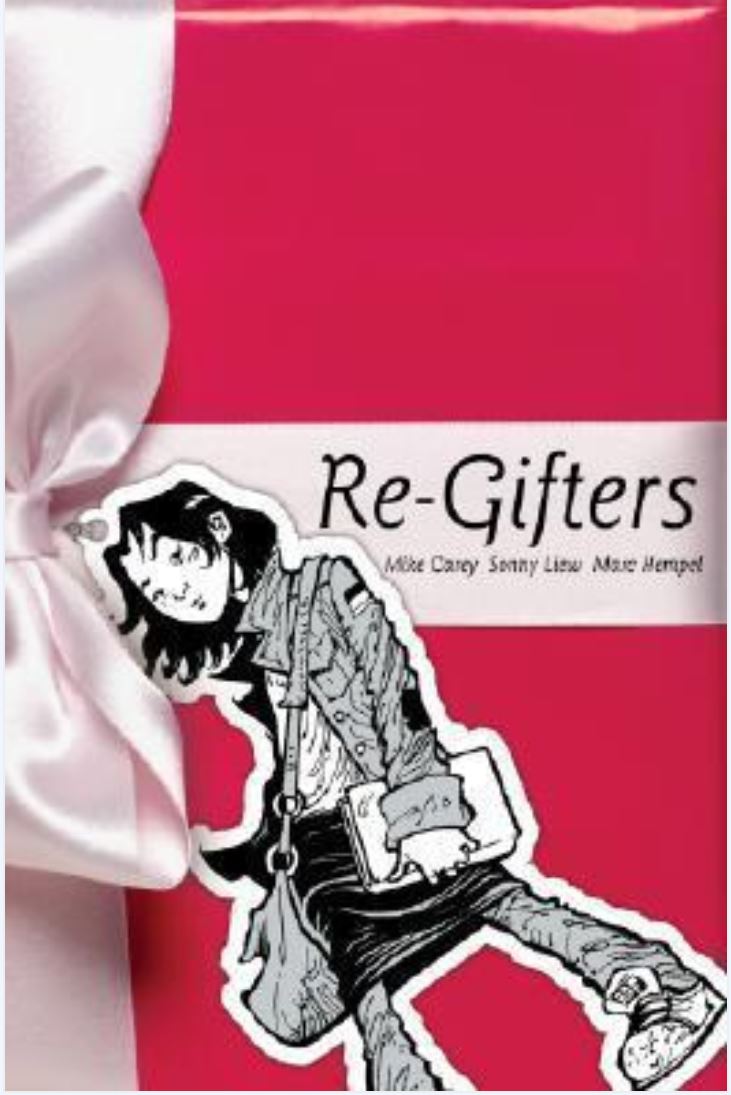
Re-Gifters


By Mike Carey, Sonny Liew, Marc Hempel & various (Vertigo/Minx)
ISBN: 978-1-4012-0371-9 (Minx) 978-1-84576-579-8 (Titan Books edition)

In 2007 DC comics began a bold experiment in building new markets: creating the Minx imprint. It was dedicated to producing comics material for the teen/young adult audience – especially the ever-elusive girl readership – that had embraced translated manga material, momentous global comics successes such as Maus and Persepolis and those abundant and prolific fantasy serials which produced such pop phenomena as Roswell High, Twilight and even Harry Potter. Sadly after only a dozen immensely impressive and decidedly different graphic novels Minx shut up shop in October 2008, markedly NOT citing publishing partner Random House’s failure to get the books onto the appropriate shelves of major bookstore chains as the reason.

Nevertheless the books that were published are still out there and most of them are well worth tracking down – either in the US originals or British editions published by Titan Books.

My particular favourite remains the second release, a magnificently beguiling and engaging monochrome, cross-cultural romantic martial arts melange by writer Mike Carey (X-Men Legacy, Lucifer, Hellblazer, Crossing Midnight) and artists Sonny Liew (Malinky Robot, The Shadow Hero, Wonderland, Sense and Sensibility, Doctor Fate) & Marc Hempel (Blood of Dracula, Mars, Jonny Quest, The Sandman, Breathtaker).

The all-star trio’s gloriously offbeat and upbeat Vertigo miniseries My Faith in Frankie is generally regarded as prototype for the Minx model, and that quirky quixotic vivacity is in full flower in this tale of feisty yet desperately dutiful Korean-American teen Jen “Dixie” Dik Seong who channels her suppressed aggression into hapkido and her blossoming crush on hunky Adam into daydreaming, clumsiness and humiliating imbecility…

A total klutz in real life, Dixie is a demon in martial arts combat, but as her best friend and dojo-mate Avril is keenly aware, the flummoxed lass’s poor head is stuck in the clouds nowadays. It’s hard enough for Dixie to juggle school, her quick-fire temper, precious heritage and loving-but-generally clueless parents with burgeoning hormones and astoundingly annoying younger brothers piling on pressure without the added distraction of an infatuation with a rich, self-absorbed white boy who is also her only serious rival in the upcoming National Hapkido Tournament.

After a chance encounter with mouthy street punks and local bad boy Dillinger, Dixie blows all her savings and the Tournament entrance fee (which her father gave her) on an ancient warrior statue for Adam, sparking a huge fight with Avril but which also actually succeeds in getting the boy to notice her. So much so, in fact, that he wants her advice in getting snooty babe Megan to go out with him…

When Dixie discovers a business loan for her father from traditional Korean bankers depends on her performance in the tournament, the furious, lovelorn lass is forced to battle for a wild-card place in the event by joining a knockout “Street Sweep Competition” against half the kids in Los Angeles – including dire and dangerous Dillinger. Moreover, Adam has finally got into Megan’s good books – and other places – by re-gifting Dixie’s statue to the most popular girl in school…

Re-Gifters is a bright, witty, sublimely funny and intriguing coming of age comedy following all the rules of the romance genre but still able to inject a vast amount of novelty and character individuality into the mix: a perfect vehicle for attracting new young readers with no abiding interest in outlandish power-fantasies or vicarious vengeance-gratification.

Track this down for a genuinely different kind of comic book – but do it before some hack movie producer turns the tale into just another teen rom-com.
© 2007 Mike Carey, Sonny Liew & Marc Hempel. All rights reserved.

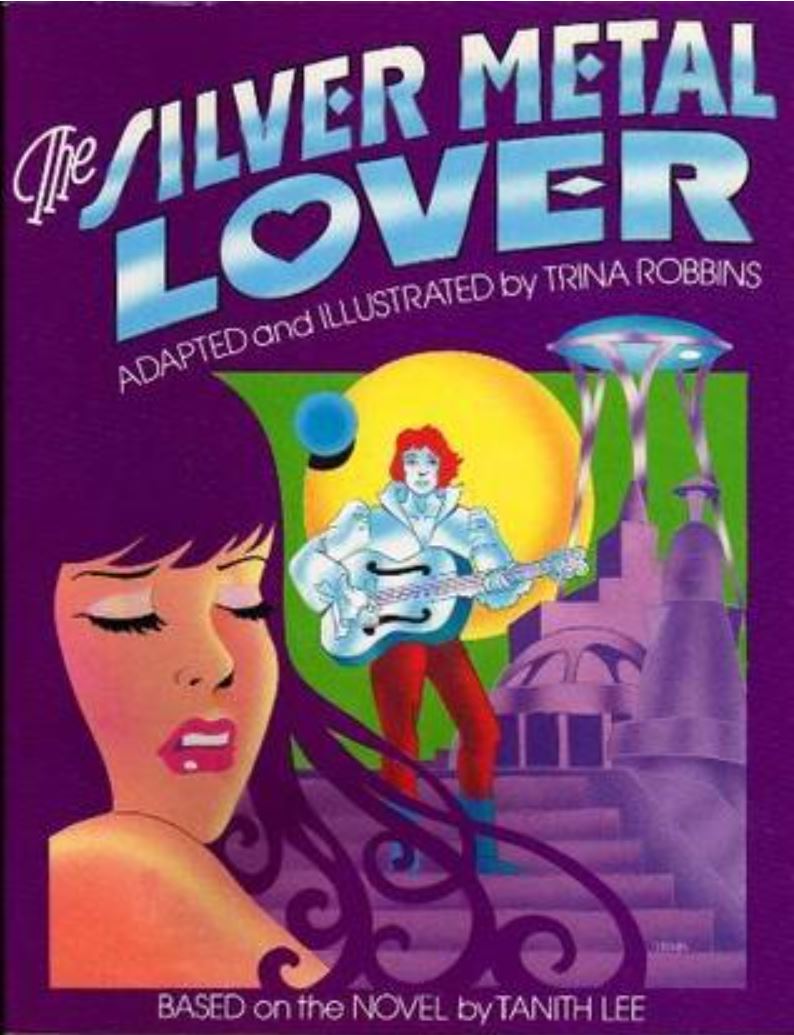
The Silver Metal Lover


By Tanith Lee, adapted by Trina Robbins (Harmony/Crown Books)
ISBN: 0-517-55853-X (Album PB)

In the 1980s, comics finally began fully filtering into the mainstream of American popular culture, helped in no small part by a few impressive adaptations of works of literary fantasy such as Michael Moorcock’s Elric or DC’s Science Fiction Graphic Novel line. In 1985 pioneering cartoonist, feminist, author and comics historian Trina Robbins (A Century of Women Cartoonists, It Ain’t Me, Babe Comix, Dope, The Legend of Wonder Woman, Choices: A Pro-Choice Benefit Comic Anthology for the National Organization for Women, Misty, Honey West) joined that small but proliferating throng with this deceptively powerful and effectively bittersweet romance adapted from Tanith Lee’s short tale about an earnest young girl in a spoiled, indolent world who discovers abiding love in the most unexpected of places….

In the far-flung, ferociously formal and crushingly civilised future everything is perfect – if you can afford it – but human nature has not evolved to match Mankind’s technological and sociological advancements. Plus ca change plus ca meme chose, right?

Jane has everything a 16-year old could want but is still unhappy. Her mother Demeta provides all she needs – except human warmth – whilst her six registered friends do their best to provide for her growing associative and societal needs. Of her carefully selected peer circle, Jane only actually likes flighty, melodramatic needily narcissistic Egyptia – whom Jane’s mother approves of but considers certifiably insane.

In this world people can live in the clouds if they want, with robots performing most manual toil and providing all those tedious but necessary services, but it’s far from paradise. Humans still get suspicious and bored with their chatty labour-saving devices and monumental Electronic Metals, Ltd strive constantly to improve their ubiquitous inventions…

One day Jane accompanies Egyptia to an audition where the fully made-up thespian is accosted by a rude man who mistakes her for a new android and persistently seeks to buy her.

Ruffled by the pushy lout’s manner, Jane’s attention is suddenly distracted by a beautiful metal minstrel busking in the plaza. The robot’s performance and his lovely song move and frighten Jane in way she cannot understand. When S.I.L.V.E.R. (Silver Ionized Locomotive Verisimulated Electronic Robot) affably introduces himself the flustered girl bolts, running for the relative security of the nearby home of sardonic friend Clovis, where the beautiful man-tart is in the process of dumping yet another lover.

He proves unsurprisingly unsympathetic to Jane’s confusion and distress, telling her to go home where, still inexplicably upset, she tries to talk the experience out with mother. Impatient as always, the matron simply enquires if Jane is masturbating enough before telling her to record whatever’s bothering her for mummy to deal with later…

Sulking in a bath, Jane is awoken from a sleep by ecstatic Egyptia who has passed her audition. Bubbling with glee the neophyte actress demands Jane join her at a big party, but whilst avoiding a persistent old letch creepily fixated on the fresh young thing, Jane stumbles again upon S.I.L.V.E.R. … and once more reacts histrionically to his singing.

As he profusely apologizes for the inexplicable distress he’s somehow caused her, Jane realizes the disturbing mechanical minstrel has been rented by Egyptia for quite another kind of performance later – a private and intimate one. With a gasp of surprise Jane finally understands what she’s feeling and kisses the alluring automaton before fleeing…

Her mother is as useless as ever. Whilst futilely attempting to explain her problem but failing even to catch Demeta’s full attention, Jane gives up and claims she’s in love with Clovis just to cause a shock. The next day the heartsick waif visits the offices of Electronic Metals, Ltd ostensibly to rent the droid of her dreams – as a minor she has to lie about her age – but is sickened when she finds him partially dissembled as techs try to track down an anomalous response in his systems…

Despondent, she is astonished when Machiavellian Clovis intervenes, renting S.I.L.V.E.R. for Egyptia and convincing the too, too-busy starlet to let Jane look after it for her…

Alone with the object of her affection, insecure Jane’s imagined affair quickly becomes earthily, libidinously real, but the honeymoon ends far too soon when Clovis informs her the rental period is over. Crippled by her burning love for the artificial Adonis, Jane begs her mother to buy him for her. When the coldly withholding guardian refuses, the obsessed child at last rebels…

When Demeta disappears on another of her interminable business trips, Jane sells her apartment’s contents, moves into the slums and desperately claims her dream lover with the ill-gotten gains…

Following a tragically brief transformative period of sheer uncompromised joy with her adored mechanical man, reality hits the happy couple hard when Demeta tracks Jane down and smugly applies financial pressure to force her wayward child to return. Undaunted, the pair become unlicensed street performers and grow even closer but as Jane grows in confidence and ability, and becomes fiercely independent, public opinion turns against the latest generation of far-too-human mechanical servants. When Electronic Metals recalls all its now hated products, the improper couple flee the city. However, the heartless auditors track them down and reclaim Jane’s Silver Metal Lover…

Lyrical and poetic, this is a grand old-fashioned tale of doomed love which still has a lot to say about transformation, growing up and walking your own path, with Trina Robbins’ idyllic and idealised cartooning deceptively disguising the heartbreaking savagery and brutal cruelty of the story to superb effect, making the tragedy even more potent.

Regrettably out of print for years, this is a comics experience long overdue for revival – perhaps in conjunction with new interpretations of the author’s later sequels to the saga of love against the odds…
Illustrations © 1985 Trina Robbins. Text © 1985 Tanith Lee. All rights reserved.

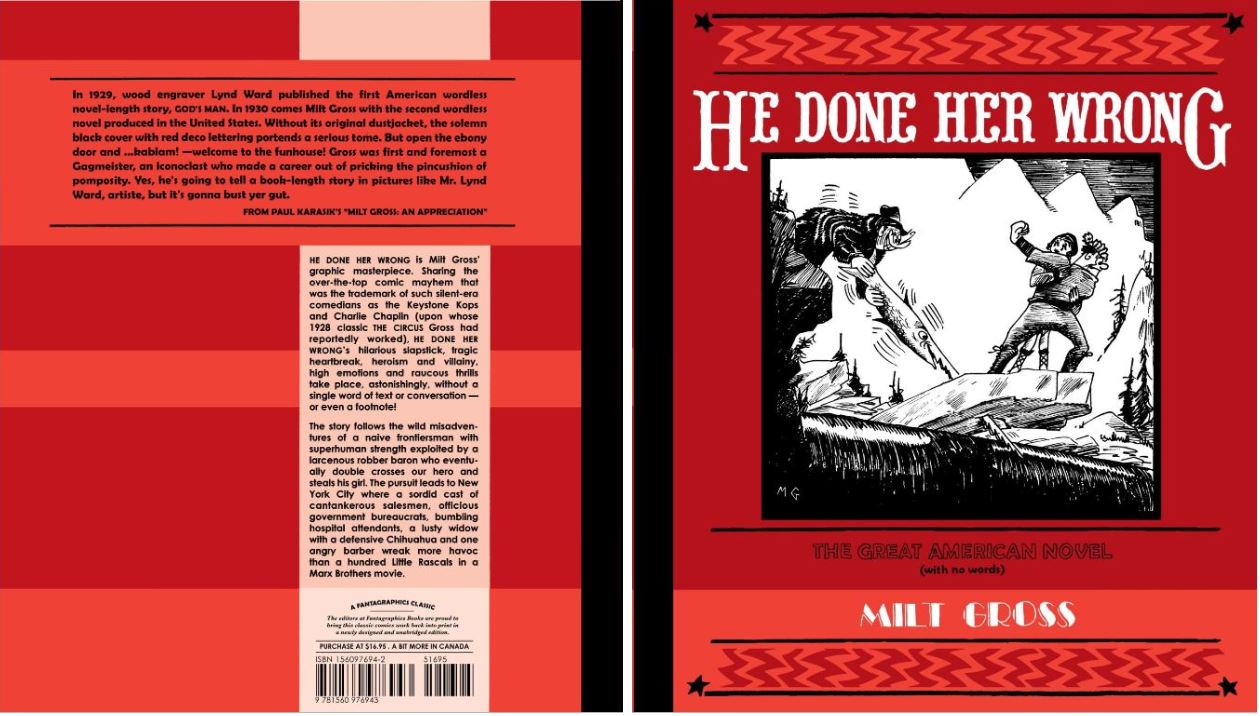
He Done Her Wrong


By Milt Gross (Fantagraphics Books)
ISBN: 978-1-56097-694-3 (TPB/Digital edition)

The power of comics comes not just from wedding text to image but also in the power of illustration. You can have comics without words but if you leave the letters and subtract the pictures what you have is just a book…

Bronx-born Milt Gross (March 4th 1895 – November 29th 1953) was a trailblazing pioneer in both cartooning and the wider arena of popular comedy, specialising in vernacular while refining and popularising Yiddish folk humour and slang into a certified American export to world culture: “Yinglish”. You should really look him up…

Gross was also an early adept in the animation field, bringing his cartoon characters to silent life in numerous short filler features for John R. Bray Studios, Universal and MGM. Far too few of his many books are in print now, but happily this astounding landmark is one of them and is even available digitally. He made his mark in comics, working for William Randolph Hearst’s newspaper chain on many syndicated strips including Banana Oil, Pete the Pooch, Dave’s Delicatessen, Count Screwloose from Tooloose, Babbling Brooks, Otto and Blotto, The Meanest Man, Draw Your Own Conclusion, I Did It and I’m Glad! And That’s My Pop! (which was promptly adapted into a popular radio show).

Released in 1930, He Done Her Wrong (The Great American Novel and Not a Word in It – No Music, Too) lampooned – and exploited – a notable trend of those troubled times: wordless novels. The woodcut-crafted parables derived from the German Expressionist art movement, offered (generally left-leaning) pictorial epigrams addressing social injustice. The first was Belgian Frans Masereel’s 25 Images of a Man’s Passion (1918), and American Lynd Ward followed suit 11 years later with God’s Man. Among many similar efforts they inspired (like Giacomo Patri’s White Collar) was Gross’ spoof of silent movie serials like The Perils of Pauline, pitched perfectly for pathos, bathos and pitiless hilarity…

A facsimile edition first released in 2005 by Fantagraphics, this edition is a completely unabridged restoration – which means the re-inclusion of some images, depictions and scenes that might appear a little controversial to modern sensibilities. It also offers a fascinating picture-packed Introduction by Craig Yoe (a devoted friend and patron of all comics vintage and fabulous) plus a closing Appreciation by eminent cartoonist, writer/editor Paul Karasik. What lies between them is a stunning masterclass in comedy staging, gag timing, timeless melodrama, delivered as a succession of wordless pantomimic pages. It all begins after a decent, hearty and trustworthy young woodsman, trapper and prospector falls in love with a virtuous barroom singer. True Love is thwarted by a dirty villain who swindles our hero and absconds to New York with his heartbroken, “abandoned” ingenue paramour.

As hero and victim both fall foul of the lures of the Big Bad City and vice unstoppably mounts in the woman’s benighted life, the Good Man overcomes all obstacles to find his darling: battling his way from the wilderness into far more savage civilisation where he will set things right no matter what the cost…

It all works out in the end of course, but only after an astoundingly convoluted course of action, buckets of tears, some well-earned vengeance and a little forgiveness… and plenty of near-misses and lethally close calls. That sounds like a great thriller – and it is – but Gross played it strictly for laughs, crafting a tale ranking with the best of his closest contemporary comedy peers: Charley Chaplin and Buster Keaton. He Done Her Wrong is a superb yarn and perfect picture into a world that only seems simpler and less complicated than today, and if you love classics stories and crave romance, you should “Dun’t Esk” and just buy it…
He Done Her Wrong © 2005 Fantagraphics Books. All rights reserved. Introduction © 2005 Craig Yoe. An Appreciation © 2005 Paul Karasik.

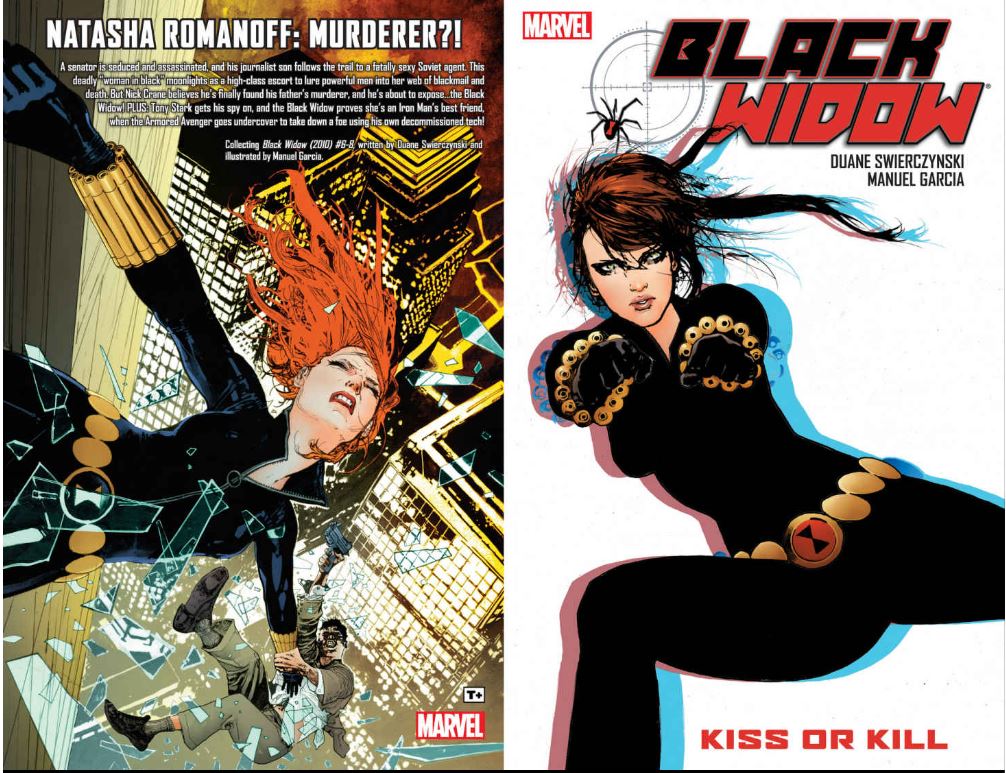
Black Widow: Kiss or Kill


By Duane Swierczynski, Joe Aherne, Manuel Garcia, Brian Ching, Lorenzo Ruggiero, Bit & various (MARVEL)
ISBN: 978-0-7851-4701-5 (TPB/Digital edition)

The Black Widow started life in 1964 as a svelte & sultry honey-trap Soviet Russian agent during Marvel’s early “Commie-busting” days. Natalia Romanova was subsequently redesigned as a super villain, falling for an assortment of Yankee superheroes – including Hawkeye and Daredevil – defecting and finally becoming an agent of S.H.I.E.L.D., freelance do-gooder and occasional leader of The Avengers.

Throughout her career she has been efficient, competent, deadly dangerous and somehow cursed to bring doom and disaster to her paramours. As her backstory evolved, it was revealed that she had undergone experimental Soviet procedures which had enhanced her physical capabilities and lengthened her lifespan, as well as assorted psychological processes which had messed up her mind and memories…

Always a fan favourite, the Widow only really hit the big time after featuring in the Iron Man, Captain America and Avengers movies, but for us unregenerate comics-addicts her print escapades have always offered a cool, sinister frisson of delight. This particular caper compilation (reprinting Black Widow volume 4 #6-8 spanning November 2010 to January 2011) was the second and final story arc of a short-lived series and includes a riotous team up tale from the Iron Man: Kiss & Kill 1-shot (August 2010).

The espionage excitement opens with the eponymous 3-chapter ‘Kiss or Kill’ by Duane Swierczynski (Birds of Prey, Cable, Deadpool), illustrated by Manuel Garcia, Lorenzo Ruggiero, Bit and colourist Jim Charalapidis, as idealistic young journalist and recently bereaved son Nick Crane finds himself the target of two mega-hot, ultra-lethal female super-spies in Houston’s club district.

Both of them say they want to save him but each seems far more intent on ending Nick’s life, and in between mercilessly fighting each other and hurtling across the city in a stampede of violent destruction, both have demanded that he name his privileged source…

Nick is inclined to believe the blonde called Fatale. After all, he has a surveillance tape of the redhead – Black Widow – with his father moments before he died…

When his senator dad was found with his brains all over a wall, Nick started digging and uncovered a pattern: a beautiful woman implicated in the deaths of numerous key political figures around the world. After a shattering battle across the city Natalia is the notional victor but isn’t ready when Nick turns a gun on her. She still goes easy on him and he wakes up some time utterly baffled and in Roanoke, Virginia. The Widow explains she’s on the trail of an organisation devoted to political assassination and using a double of her to commit their high profile crimes… but the angry young man clearly doesn’t believe her.

Further argument is curtailed by the sudden arrival of an extremely competent Rendition Team who remove them both to a secret US base in Poland. After a terrifying interval the Widow starts thinking her extreme scheme to get that name out of Nick might be working but that all goes to hell when a third force blasts in and re-abducts them.

Realising her own government liaison is playing for more than one side, the Widow blasts her way out, dragging Nick along. Soon they’re on the run with only her rapidly dwindling, increasingly untrustworthy freelance contacts to protect them. The escape has however almost convinced Nick to trust her with his source… but that moment passes when the latest iteration of the Crimson Dynamo and illusion-caster Fantasma derail the train they’re on…

Another explosive confrontation is abruptly cut short when Fatale arrives but rather than assassination she has alliance in mind. The mystery mastermind behind the killings and framing the Widow has stopped paying the killer blonde and thus needs to be taught a lesson about honouring commitments…

Now armed with details for Nick’s contact, they go after enigmatic “Sadko” but the shady operator seems to be one step ahead of them as usual. But only “seems”…

Rounding out this espionage extravaganza ‘Iron Widow’, written by Joe Aherne with art by Brian Ching and colourist Michael Atiyeh from Iron Man: Kiss & Kill, sees the Russian emigre give Avenging inventor Tony Stark a crash course in spycraft after a very special suit of Iron Man armour is stolen.

Fully schooled, the billionaire succeeds too well in locating his missing mech but falls into a trap set by sinister Sunset Bain and becomes a literal time-bomb pointed at the origin of The Avengers. Luckily Black Widow is on hand to prove skill, ingenuity and guts always trump mere overwhelming firepower…

A fast and furious, pell-mell, helter-skelter rollercoaster of high-octane intrigue and action, Kiss or Kill also includes a captivating collation of covers-&-variants by Daniel Acuna, J. Scott Campbell, Brian Stelfreeze, Ching & Chris Sotomayor and Stephane Perger, making this such a superb example of genre-blending Costumed Drama that you’d be thoroughly suspect and subject to scrutiny for neglecting it.
© 2010, 2011 Marvel Characters, Inc. All rights reserved.

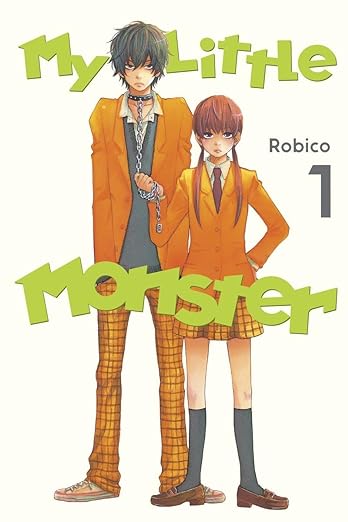
My Little Monster volume 1


By Robico, translated by Joshua Weeks (Kodansha Comics USA)
ISBN: 978-1-61262-597-3 (Tank?bon PB/Digital edition)

Solidly appealing to lovers of traditional Shoujo (“girls’ comics”) comes a grand and sassy tale of Right Girl, Right Time, Wrong Boy from enigmatic mangaka Robico, dealing with the thorny topic of wasteful distractions at school…

Tonari no Kaibutsu-kun or ‘The Monster Sitting Beside Me’ debuted in Dessert Magazine in 2008 with the first of a dozen volumes released a year later. The serial ran until June 2013 and spawned a highly successful anime adaptation.

Shizuku Mizutani is a schoolgirl determined to succeed. Throughout her entire scholastic career only one person has ever gotten higher grades than her – and she’s still obsessively burned up about it – but otherwise she’s solidly, comfortably set her sights on exceptional achievement and a great job. Absolutely nothing’s going to force her off her well-planned, carefully projected course. Her teen travails begin in ‘My Classmate Yoshida-kun’ where she explains how she’s never seen the boy who sits next to her. He got into a fight on his first day and hasn’t come to school since. That was three years ago…

Now, for some incomprehensible reason, the ideal student is stuck delivering printouts to the epic absconder as a “favour” (you can say “bribe”) to teacher Saeko-Sensei. Shizuku finds him in a sleazy games arcade where he regularly hangs out. She wasn’t expecting much, but Haru Yoshida fails to live up to even her lowest expectations.

He’s a veritable wild boy: manic, ill-mannered, actively extremely rude and his associates are little better than thugs and gangsters. He even attacks her, accusing her of spying on him. All those school rumours must be true: how he hospitalised three upperclassmen and was suspended…

Ice satisfactorily broken, Saeko-sensei pushes her star pupil to lure the wayward boy back to school (the suspension being long-expired) but when the rebel starts regularly attending, tongues begin to wag. Haru then arbitrarily decides they’re friends and follows Shizuku everywhere…

She’s never been more angry or frustrated. He’s always there, distracting her, getting in the way of her ideal future. She can’t stop thinking about him…

Following a brace of humorous of mini-strips – ‘I was Running as Fast as I Could!’ and ‘Spot-Billed Duck’ – the School Daze resume with ‘I Don’t Hate You’ as the apparently imprinted malcontent continues appearing everywhere she goes and captivatingly showing his softer, fragile side. Sadly, he’s painfully gullible and falls for many embarrassing pranks from his classmates …which he responds to with devastating violence. Soon Haru has gained an enticing, irresistibly dangerous bad boy reputation…

He also starts noticing other girls, but why should Shizuku care about that? She’s far more upset to learn that he was the mystery student who beat her test scores and that even after three years of lapsed education, he’s (probably!) still smarter than her!! Now for some reason, she’s finding it impossible to bear down and study, the only thing she used to be good at… And then Haru kisses her… but decides they can still be friends anyway…

Micro strips ‘Because She’s a Lady’ and ‘It’s Hard Not to Say It’, precedes the main event which resumes with ‘Weird’, wherein the wild boy displays the attention span of a mayfly. Adopting and then palming off a chicken on his newfound friends or tutoring vacuous Asako Natsune so she can avoid going to Afterschool Classes instead of partying are bad enough, but most significantly Haru utterly ignores this major change in their own relationship, and even that they have one at all…

Two small interludes with ‘Natsume and Haru’ lead into the final chapter as Shizuku is forced to admit to herself how much Haru has changed her life. However, when she finally confesses just how much she likes the annoying, confusing oaf, all he can say in response is that she’s not a ‘Nuisance’

To Be Continued…

Wrapping things up are two final cartoon vignettes ‘Just as Short’ and ‘That Guy’, plus a Comment from the author and a section of handy Translation notes.

Sweet, cruel and silly by turns, this delightful coming of age comedy brims with those crucial, critical moments that stay with you for decades after high school ends, smartly leavened with charming characters and situations superbly illustrated by a master of her genre. Not everyone’s cup of tea but sheer poetry for we who remember love can – and should – be fun.
© 2009 Robico. English translation © 2014 Robico. All rights reserved.

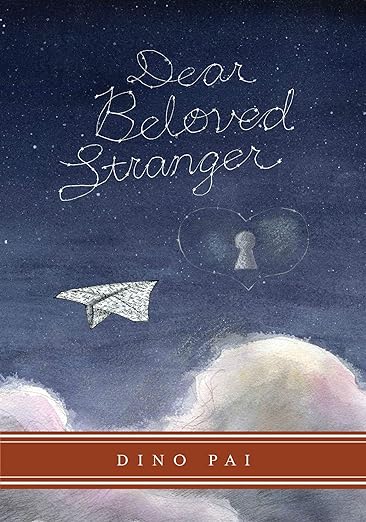
Dear Beloved Stranger


By Dino Pai (Urban-Fairy Tales/Top Shelf Productions)
ISBN: 978-1-60309-271-5 (TPB)

The search for love is a primal drive in almost every human being, but so are the equally obsessive, transcendent passions to find one’s station in the world and accomplish great deeds. What happens when none of those quests seem to be progressing or, even worse, when they seem to be implacably at odds?

In 2013 this stunning, Xeric Award-winning debut comic tale addressed just such thorny issues in an intimate, candid and introspective manner. Solitary, intense, dedicated Dino has just finished art school and ponders where his now directionless life is heading next. His search for work and zeal for aesthetic creation hasn’t left much time for a social life so he developed a novel coping mechanism. Moreover, now that he’s truly on his own, inspiration also seems to have died…

Somewhere “Out There” is a soulmate: “His Girl”, patiently waiting to be found. Until that happens, Dino writes notes sharing his life, thoughts and dreams, folds them into paper airplanes and trusts the breeze and fate to take them to where they need to be…

One directionless day when he’s restocking drawing supplies, he finds former classmate Cathy temping at the art store while she saves up for fashion school. The chance encounter makes him realise everyone is progressing but him and Dino resolves to try harder to make and enact choices.

… And somewhere across the city, Cindy finds a crumpled-up paper plane in the street…

He meets Cathy again at an art show and her casually spoken neutral words somehow inspire him. Returning home, Dino stares at the picture of the beautiful Japanese pop star on his wall and starts to create a story: a comic book tale of a boy’s journey…

It starts with a siren song calling him. He hears and climbs through a keyhole, following ever-onwards through strange, perilous and uncanny regions. Along the way are friendly animals who help him survive unnatural perils.

As the work laboriously nears completion it completely consumes him, but still, somehow, whenever Dino leaves his room and re-enters the real world, Cathy is there and slowly, inevitably his two existences drift together.

Crafted in a dazzling variety of styles, techniques and media, Dear Beloved Stranger superbly captures that all-consuming hunger for the indefinable something every frustrated lover feels must be out there somewhere: translating that debilitating absence into a candid examination every person in search of human completion has ever endured.

Sweet, sharp, sour and ultimately enlightening, this is a story for all lovers, would-be lovers and lovers of what might be.
© 2013 Shih-Mu Dino Pai. All rights reserved.

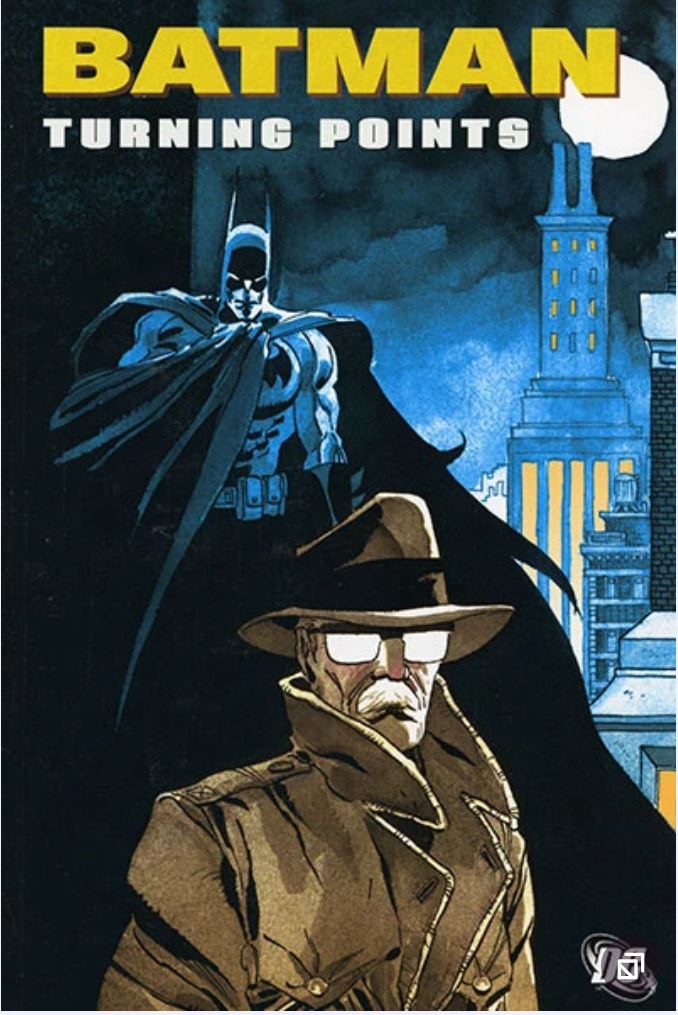
Batman: Turning Points


By Greg Rucka, Ed Brubaker, Chuck Dixon, Steve Lieber, Joe Giella, Dick Giordano, Bob Smith, Brent Anderson, Paul Pope, Claude St. Aubin & various (DC Comics)
ISBN: 978-1-4012-1360-2 (TPB)

When Superman debuted in Action Comics #1, the only still-the-same-today supporting character was Lois Lane. When “The Bat-Man” premiered a year later in Detective Comics #27 (cover-date May 1939 but on sale from March 30th), the only other person you might recognise was Police Commissioner Gordon. Make of this what you will…

Over the 85 years of Batman’s existence, almost as important as the partnership between the Dark Knight and assorted Boy Wonders has been a bizarrely offbeat symbiotic relationship between those costumed vigilantes and Gotham City’s top cop James Gordon.

This collection – inexplicably one of very few Batman books unavailable in digital formats – compiles five individual pastiches released as 2001 miniseries Turning Points. Here, readers see significant moments in the development of that shadowy alliance produced primarily for long-term aficionados in tribute to key eras in Batman’s career by veteran artists and (then) new wave creators.

It all begins with Greg Rucka & Steve Lieber’s ‘Uneasy Allies’, set in the days – and visual style – of the mysterious vigilante’s stormy debut in Frank Miller & Dave Mazzuchelli’s exemplary Batman: Year One. Police Captain Gordon is still the only honest cop on a corrupt and brutally gung-ho force, reeling from the shock of his wife divorcing him. When bereaved, heartsick and crazed college professor Hale Corbett takes an entire wedding hostage, Gotham’s SWAT team commander is champing at the bit to storm in and rack up the body-count, whereas wanted felon The Batman offers Gordon a slim hope of ending the siege without loss of life.

All the masked nut-case wants in return is a sympathetic ear at the GCPD…

A clandestine working relationship established, …And Then There Were… Three?’ (by Ed Brubaker & Joe Giella – who drew many of 1960s stories and Batman’s newspaper strip) celebrate the era of TV’s “Batmania”. About a year after their first meeting, reports of a garishly garbed boy assistant to Batman begin filtering in. As deadly psychopath Mr. Freeze rampages through the city, Gordon demands to why the now-tolerated Caped Crusader is recklessly endangering a child.

In a rowdy romp packed with past icons like giant props and gaudy villains, a decidedly deadly outcome forces the cop to see and realise the true nature of Batman and Robin’s relationship…

Brubaker, Dick Giordano & Bob Smith set ‘Casualties of War’ in the bleak aftermath following the death of second Robin Jason Todd, the crippling of Barbara (Batgirl) Gordon and the torture of her father, at the bone-white hands of The Joker. A solitary, driven Dark Knight haunts streets and allies, ceaselessly crushing criminals with brutal callousness, whilst sinister serial killer The Garbage Man prowls unchallenged…

When wheelchair-bound Barbara fails in her attempted intervention to calm a Batman pushing himself to breaking-point, it takes a rooftop heart-to-heart with recently promoted Commissioner Gordon to finally crack the manhunter’s shell and begin the healing process…

Chuck Dixon & Brent Anderson step in years later when, as a result of a strategically systematic attack by would-be crime-lord Bane, an exhausted and broken Batman is replaced by another, darker champion. Set during the Knightfall publishing event, ‘The Ultimate Betrayal’ describes the moment Gordon realises his enigmatic ally has become a remorseless machine/exterminating angel hunting criminals with no regard to life anymore. If only third Robin Tim Drake could have told him that the man behind the cowl – and claws and razor-armour – is actually Azrael: hereditary and murderously programmed living weapon of an ancient Christian warrior-cult…

Rucka, Paul Pope & Claude St. Aubin bring the journey full circle in ‘Comrades in Arms’ wherein a mysterious stranger and his family hit Gotham on a mission to find Gordon and Batman, just as the Commissioner introduces his destined successor Michael Akins to the Major Crimes Unit. Word on the street is the Russian mob are planning a huge retaliatory strike and every cop is waiting for the hammer to fall when Hale Corbett walks back into GCPD HQ, demanding to see Gordon and the masked manhunter who changed his life many years ago…

Filtered through gritty modern sensibilities but still able to revere past glories and Batman’s softer sides, this thoroughly readable collection includes a cover gallery by artistic all-stars Javier Pulido, Ty Templeton, Joe Kubert, Howard Chaykin, Pope & Tim Sale, and offers a gripping thrill ride for newcomers and veterans alike.
© 2001, 2007 DC Comics. All Rights Reserved.

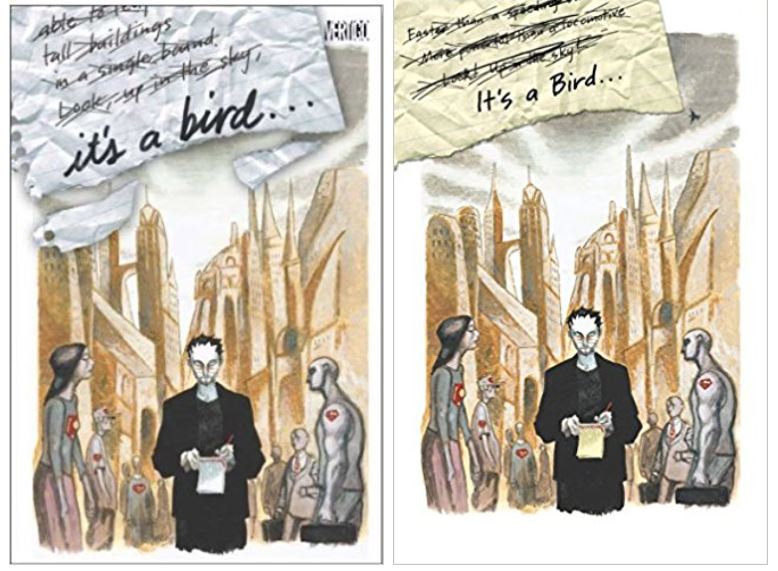
It’s a Bird…


By Steven T. Seagle, Teddy Kristiansen & various (Vertigo)
ISBN: 978-1-4012-0109-8 (HB) 987-1-4012-7288-3 (TPB)

Since his debut in June 1938, Superman has proven to be many things to billions of people, to the point of even changing their lives and shaping their actions. It’s a Bird… was first released in 2004, offering a departure from typical Superman graphic novel fare with author Steven T. Seagle working through his understandable creator-angst about writing the ongoing adventures of the Man of Steel without simply rehashing what has gone before.

Seagle (whose other comics work includes Uncanny X-Men, Sandman Mystery Theatre, Big Hero 6 and Genius, and is part of TV cartoon creation collective Man of Action) actually scripted Superman #190-200 – published between April 2003 and February 2004. The intriguing, demi-therapeutic exercise revealed in this slim and beguiling pictorial introspection deals with the author’s misgivings about contributing to the canon of an eternally unfolding legend.

However, underpinning what might so easily become a self-gratifying ego-stroke is a subtle undercurrent of savvy verity that struck a chord with many fellow industry professionals and insightful consumers as the professional writer finally found themes he needed to explore to be satisfied with his commission.

Let’s be honest here, every comic fan, indeed every twitcher and hobbyist, looks for a way to present and explain their particular passion to the “real” or perhaps “civilian” world and not feel like an imbecile in the process…

Employing barely One Degree of Separation, “Steve” is a writer working through some emotional baggage. He is still coming to terms with his family’s gradual but inescapable disintegration – mental, physical and spiritual – from hereditary genetic disease Huntington’s Disease (Chorea, as was).

In everyday life, his father has gone missing, and his mom and partner are making the “let’s have kids” noises whilst Steve is helplessly waiting for a hammer to fall regarding his own potential prognosis with a condition that cannot be beaten…

He never wanted to write comics – even though he’s successful at it – and now his editor wants him to write Superman. Steve has never had any feeling for the character or the medium and his damned editor just keeps on and on and on about…

You get the picture?

It’s a Bird… is slow and lyrical in its deconstructive self-absorption as Steve – eventually – makes his choices, whilst Teddy (The Sandman, The Dreaming, Grendel Tales, Genius) Kristiansen’s range of enticing drawing styles provides an eye-catching display of sensitivity and versatility – one which won him the 2005 Eisner Award for Best Painter/Multimedia Artist (Interior). If you feel the urge to go beyond panel borders of your private obsession, this one is well worth a look, and a book demanding a digital rerelease ASAP.
© 2004, 2017 DC Comics. All Rights Reserved.

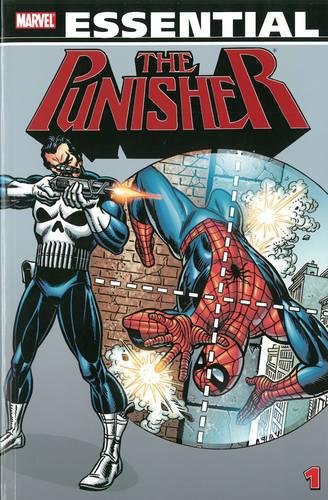
Essential Punisher volume 1


By Gerry Conway, Archie Goodwin, Len Wein, Mike W. Barr, Marv Wolfman, Dennis O’Neil, Roger McKenzie, Frank Miller, Bill Mantlo, Stephen Grant, Jo Duffy, Ross Andru, Tony DeZuniga, Frank Springer, Keith Pollard, Al Milgrom, Greg LaRocque, Mike Zeck, Mike Vosburg & various (MARVEL)
ISBN: 978-0-8571-2375-0 (TPB)

Debuting in 1974 and despite being one of the industry’s biggest hits from the mid-1980s onwards, the obsessed vengeance-taker known as The Punisher was always an unlikely and uncomfortable star for comic books. His methods were excessively violent and usually permanent. It’s intriguing to note that unlike most heroes who debuted as villains (Black Widow or Wolverine come to mind) the Punisher actually became more ruthless, immoral, anti-social and murderous, not less. The Punisher never toned down or cleaned up his act – the buying public simply shifted its communal perspective.

He was created by Gerry Conway, John Romita Sr. and Ross Andru: a (necessarily) toned down, muted response to increasingly popular prose anti-heroes like Don Pendleton’s Mack Bolan: the Executioner and a bloody tide of fictive Viet Nam vets returned from South East Asia who all turned their training and talents to wiping out organised crime in the early 1970s. The story goes that Marvel’s bosses were reluctant to give The Punisher a starring vehicle in the mainstream colour comic-book line, feeling the character’s very nature made him a bad guy, not a good one. Other than the two magazine stories and the miniseries which closes this volume, Frank Castle was not supposed to be the star or even particularly admirable to the impressionable readership.

Therefore these early appearances could disappoint die-hard fans even though they are the formative tales of his success. Perhaps it’s best to remember and accept that when not actually the villain in the tales he was at best a controversial guest and worrisome co-star…

Boy, how times do change.

He was first seen as a villain/patsy in Amazing Spider-Man #129 (cover-dated February 1974 but actually on sale from 30th October 1973 – so even in terms of his anniversary, Castle apparently “jumped the gun” (I’m so weak!). He repeatedly returned thereafter until getting his shot at the big time – just not in newsstand publications but in Marvel’s monochrome, mature magazine line. This initial Essential compilation gathers all those tentative stabs and guest-shots from February 1974 through to the breakthrough 1986 miniseries which really got the ball rolling. These include Amazing Spider-Man #129, 134-135, 162-163, 174-175, 201-202; Amazing Spider-Man Annual #15; Giant-Size Spider-Man #4; Marvel Preview #2; Marvel Super-Action #1; Captain America #241; Daredevil #182-184; Peter Parker, The Spectacular Spider-Man #81-83 and The Punisher #1-5, but many die-hard modern fans may be disappointed in the relative lack of brutality, carnage and even face time contained herein. Just keep in mind that for the greater part of these early appearances the skull-shirted slayer was at best a visitor and usually the villain du jour…

The first case in this mammoth monochrome war journal comes from ASM #129, introducing not only the renegade gunslinger but also nefarious manic mastermind The Jackal in ‘The Punisher Strikes Twice!’ Scripted by Conway, and illustrated by Ross Andru, Frank Giacoia & Dave Hunt, it reveals how a mystery lone gunman is duped by manipulative Professor Miles Warren into hunting the wallcrawler who was wrongly implicated in the deaths of police captain George Stacy and his daughter Gwen and currently a suspect in the death of Norman Osborn. Here he is subsequently set up by The Jackal for the murder of the Punisher’s gunmaker before clearing the air and going their own ways…

The much-misunderstood champions of the oppressed crossed paths again in Amazing Spider-Man #134-135 when a South American bandit – intended to be his oppressive regime’s Captain America – attempts to pillage a Manhattan tour boat in ‘Danger is a Man Named… Tarantula!’ Once again unwilling allies, Spidey and the Punisher’s trails cross when the duo dutifully dismantle the villain’s schemes during a ‘Shoot-Out in Central Park!’

The Punisher played a more central role in Giant-Size Spider-Man #4 (April 1975) when the webslinger forces himself into one of the sinister shootist’s cases in ‘To Sow the Seeds of Death’s Day!’ when ruthless arms dealer Moses Magnum began testing a deadly chemical weapon on randomly kidnapped victims. Tracking down the vile monster in ‘Attack of the War Machine!’, the reluctant allies found themselves infiltrating his ‘Death-Camp at the Edge of the World!’ before seeing summary justice dispensed more by fate than intent…

John Romita Senior’s original concept pencil sketch of The Punisher from 1973 is followed by the vigilante’s first solo role – in black-&-white magazine Marvel Preview #2 (August 1975) – wherein Conway & Tony DeZuñiga pronounced a ‘Death Sentence’ on some of Castle’s old army buddies. They had been tricked into becoming assassins by a millionaire madman who wanted to take over America, as the gritty yarn at last revealed the tragic reasons for The Punisher’s unending mission of vengeance.

Highly decorated Marine Castle saw his wife and children gunned down in Central Park after the carefree picnickers stumbled into a mob hit. When the killers turned on the helpless witnesses, only Castle survived. Recovering in hospital, the bereft warrior dedicated his life to eradicating criminals everywhere. Following a stunning Punisher and Dominic Fortune pin-up by Howard Chaykin, Archie Goodwin, DeZuñiga & Rico Rival’s ‘Accounts Settled… Accounts Due!’ – from Marvel Super Action #1 (January 1976) – draws another matured-themed plot to a close as Castle finally tracks down the gunsels who carried out the shooting and the Dons who ordered it, only to find his bloody vengeance hasn’t eased his heart or dulled his thirst for personal justice…

Castle was reduced to a bit-player in Amazing Spider-Man #162-163 (October & November 1976 by Len Wein Andru & Mike Esposito), as the newly relaunched X-Men were sales-boosted via a guest-clash with the webspinner in ‘…And the Nightcrawler Came Prowling, Prowling’. Here Spider-Man jumps to wrong conclusion when a sniper shoots a reveller at Coney Island and by the time Nightcrawler has explained himself (in the tried-&-true Marvel manner of fighting the star to a standstill) old skull-shirt has turned up to take them both on. Soon however, mutual foe Jigsaw is exposed as the true assassin in concluding episode ‘Let the Punisher Fit the Crime!’

Inked by DeZuñiga & Jim Mooney, November 1977’s ASM #174 declared ‘The Hitman’s Back in Town!’ with Castle hunting a costumed assassin hired to rub out J. Jonah Jameson, but experiencing unusual reticence since the killer is an old army pal who had saved his life in Vietnam. Nevertheless the tale ends in fatality at the ‘Big Apple Battleground!’ in #175.

Captain America #241 (January 1980, by Mike W. Barr, Frank Springer & Pablo Marcos) was a fill in benefitting from the Frank Miller effect – he drew the cover – as ‘Fear Grows in Brooklyn’ depicted the Sentinel of Liberty getting in the way of Castle’s latest mission and refusing to allow The Punisher to go free. Cap wasn’t on hand stop him escaping police custody and Amazing Spider-Man #201-202 (February & March 1980) by Marv Wolfman, Keith Pollard & Mooney. ‘Man-Hunt!’ and ‘One For Those Long Gone!’ reveal how Castle almost uncovers Peter Parker‘s big secret whilst relentlessly stalking a mob boss responsible for the death of a kid who had saved Castle’s life…

Amazing Spider-Man Annual #15 (1981 by Dennis O’Neil, Miller & Klaus Janson) is putatively the genesis of the antihero in his proper form. ‘Spider-Man: Threat or Menace?’ sees maniac fugitive Castle back in the Big Apple and lethally embroiled in a deadly scheme by Doctor Octopus to poison five million New Yorkers. Soon both Parker and his colourful alter-ego are trapped dead-centre of a terrifying battle of ruthless wills in a tense and clever suspense thriller, highlighting and recapturing the moody mastery of Steve Ditko’s heyday.

The Miller connection continued in three landmark issues of Daredevil (#182-184, May-July 1982) which ideally embody everything that made The Punisher a momentous, unmissable, “must-read” character…

It is presaged by an untitled excerpt by Miller & Janson from ‘She’s Alive’ – wherein Castle is extracted from prison by a government spook to stop a shipment of drugs the authorities can’t touch. Meanwhile a shattered Matt Murdock is failing to cope with the murder of his first love Elektra. Of course, once Castle has stopped the drugs and killed the gangsters, The Punisher refuses to go back to jail…

The story proper begins in ‘Child’s Play’ – with Roger McKenzie lending a scripting hand – and deals with school kids using drugs. It was originally begun by McKenzie & Miller but shelved for a year, before being reworked into a stunningly powerful, unsettling tale once Miller & Janson assumed full creative chores on Daredevil. When Murdock visits a high school he is a helpless witness to a little girl high on “Angel Dust” going berserk, attacking staff and pupils before throwing herself out of a third floor window The appalled hero vows to find the dealers and encounters her bereaved and distraught younger brother Billy, determined to exact his own vengeance, and later coldly calculating Castle who has the same idea and far more experience…

The hunt leads inexorably to a certain street pusher and DD, Billy and The Punisher all find their target at the same time. After a spectacular battle a thoroughly beaten Daredevil has Billy, a bullet-ridden corpse and a smoking gun…

The kid is innocent – and so, this time at least, is Castle – and after Murdock proves it in court, the investigation resumes with the focus falling on drug boss Hogman. When DD’s super-hearing confirms the gangster’s claims of innocence, Murdock successfully defends the vile dealer, only to have the exonerated slimeball gloatingly admit to having committed the murder after all! Horrified, shocked, betrayed and resolved to enforce justice, DD finds a connection to a highly-placed member of the school faculty deeply involved with the drug lord in concluding chapter ‘Good Guys Wear Red’, but it’s far too late: Castle and Billy have both decided to end the matter Hogman’s way…

Scripted by Bill Mantlo and illustrated by Al Milgrom & Mooney, Peter Parker, The Spectacular Spider-Man #81-83 (August-October 1983) opens with ‘Stalkers in the Shadows’ as an increasingly crazed Punisher goes after misdemeanour malefactors with the same murderous zeal previously reserved for killers and worse. Spider-Man meanwhile, has his hands full with teen vigilantes Cloak and Dagger who have graduated from tackling street drug pushers to go after Wilson Fisk, The Kingpin of crime.

‘Crime & Punishment!’ sees Castle applying lethal force indiscriminately all over town, culminating in his own crazed attack on Fisk… who beats him to a pulp. Illustrated by Greg LaRoque & Mooney the saga ends with ‘Delusions’ as The Punisher goes on trial and is found to have been dosed with psychosis-inducing drugs…

In 1984 Marvel gave way to the inevitable and commissioned a Punisher miniseries, although writer Steven Grant and penciller Mike Zeck apparently had an uphill struggle convincing editors to let the grim, gun-crazed maniac loose in the shiny world where little kids might fixate on a dangerous role model – and their parents might get all over-protective, litigious and (skull) shirty. A year later the creators finally got the green-light and a 5-issue miniseries – running from January to May – turned the industry on its head. There was indeed plenty of controversy to go around, especially as the tale featured a “hero” who had lots of illicit sex and killed his enemies in cold blood. Also causing problems for censorious eyes were the suicide of one of the major characters and the murder of innocent children. Doesn’t it make you proud to realise how far we’ve since come?

The company mitigated the potential fall-out with the most lacklustre PR campaign in history, but not telling anybody about The Punisher (AKA Circle of Blood) didn’t stop the series becoming a runaway, barnstorming success. The rest is history. Two years later as the graphic novel market was becoming established and with Frank Castle one of the biggest draws in comics (sorry, I’m such a child sometimes), that contentious series was released as a complete book and it remains one of the very best of all his many exploits.

Here, rendered even more stark and uncompromising in gritty moody monochrome, the action begins in ‘Circle of Blood’ as Castle is locked in Ryker’s Island prison where every inmate is queuing up to kill him. Within hours he has turned the tables and terrified the General Population, but knows both old foe Jigsaw and the last of the great mob “Godfathers” have special plans for him…

When a mass breakout frees all the cons, Castle brutally steps in. For this the warden allows his escape and offers him membership in The Trust: an organisation of “right-minded, law-abiding citizens” who approve of his crusade. Castle also learns he’s being stalked by Tony Massera, a good man who thought he had escaped the influences of his crime-family…

Tony must kill Castle to avenge his father – one of Punisher’s many gory successes – but only after the streets have been swept clean of scum like his own relations. ‘Back to the War’ finds Punisher on the streets again, hunting scum, armed and supplied by the Trust… but still not a part of their organisation. After an abortive attempt to blow up The Kingpin, Castle is saved by the enigmatic Angel, and begins a loveless liaison with her. With everybody mistakenly believing the master of New York’s underworld dead, bloody gang-war erupts with greedy sub-bosses all trying to claim the top spot, but by the events of ‘Slaughterday’, Castle realises too many innocents are getting caught in the crossfires.

He also discovers in ‘Final Solution’ that the Trust have their own national agenda as hit men and brainwashed criminals dressed in his costume swarm the streets, executing mobsters and fanning the flames. All the Trust’s plans for this “Punishment Squad” and the country are uncovered in blockbusting conclusion ‘Final Solution Part 2’, when all the pieces fall into place and the surviving players reveal their true allegiances. In a classy final chapter mysteriously completed by the highly underrated Jo Duffy& Mike Vosburg, from Grant’s original plot, The Punisher takes charge in his inimitable manner, leaving God and the cops to sort out the paperwork. We can only speculate as to why the originators fell away at the last hurdle, but I’m pretty sure those same reluctant editors played some part in it all…

This economical Essential edition comes with a plethora of pin-ups, concluding with comprehensive information pages culled from the Marvel Universe Handbook.

These superb, morally ambiguous if not actually ethically challenging dramas never cease to thrill and amaze, and have been reprinted a number of times. Whichever version suits your inclinations and wallet, if you love action, cherish costumed comics adventure and crave the occasional dose of gratuitous personal justice, this one should be at the top of your “Most Wanted” list.
© 1974, 1975, 1976, 1977, 1980, 1981, 1982, 1983, 1986, 2011 Marvel Characters, Inc. All rights reserved.