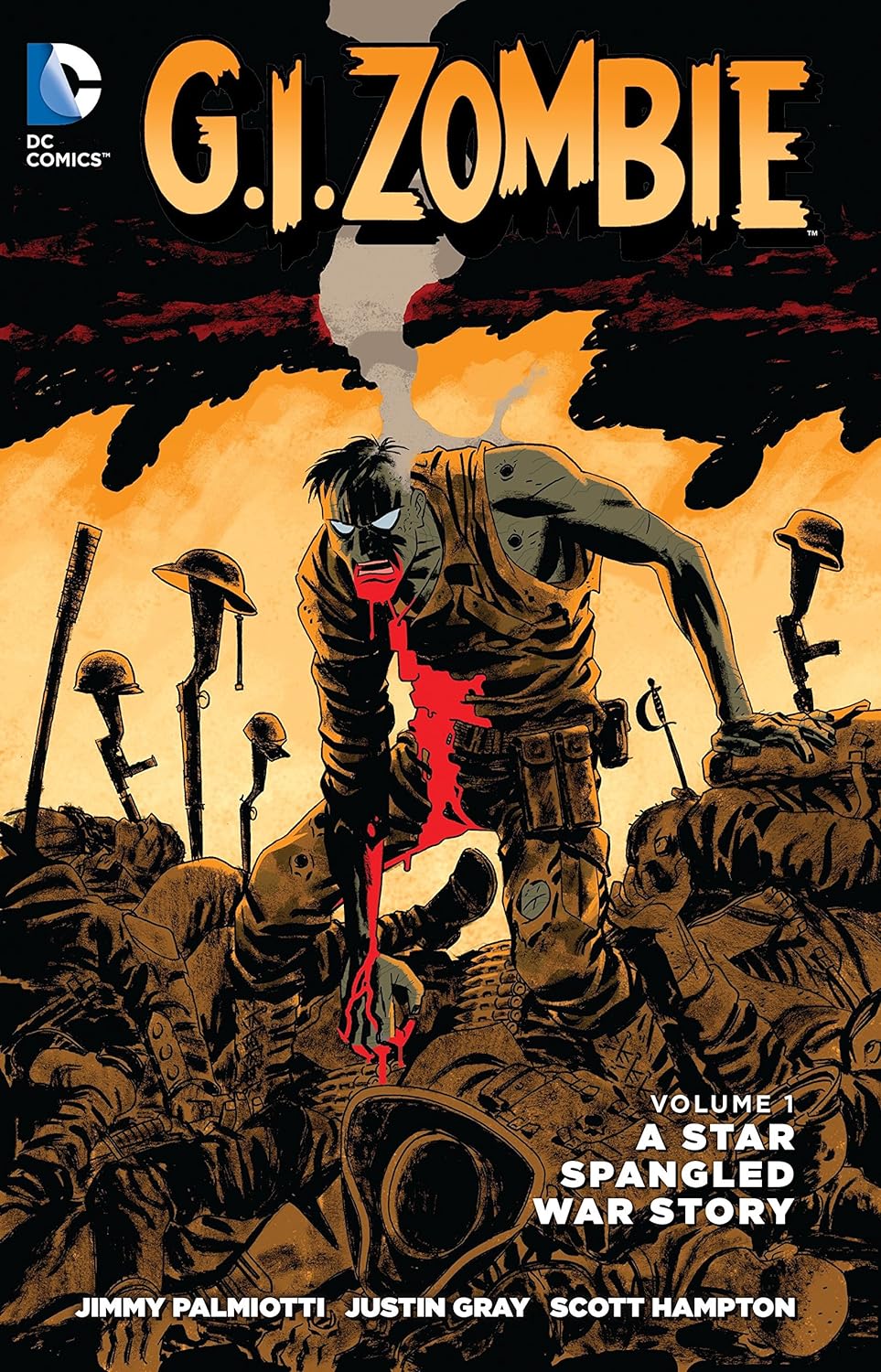
G.I. Zombie – A Star-Spangled War Story


By Justin Grey, Jimmy Palmiotti, Scott Hampton & various (DC Comics)
ISBN: 978-1-4012-5487-2 (TPB)

When DC rebooted their entire continuity with the New 52 in 2011, most reader and critical attention was focussed on big-name costumed stars. However, the move also allowed creators to revisit older genre titles from those eras when superheroes were not the only fruit.

A number of venerable war titles and stars were revisited and re-imagined (even iconic and presumed-sacrosanct Sgt. Rock) and many novel ideas and treatments were created – although largely ignored by the audiences they were intended to attract.

One of the most appealing, fashionably intriguing and well-realised appeared in a revitalised Star Spangled War Stories, outrageously blending the global war on terror, then-current socio-political disaffection and Earth’s ongoing fascination with the walking dead to spawn a spectacular, tongue-in-cheek blockbuster romp tailor-made for TV or movies.

Perhaps that was the point all along…

Written by Justin Grey & Jimmy Palmiotti and illustrated by Scott Hampton, the serialised saga from SSWS volume 2 #1-8 spanned cover-dates September 2014 to May 2015 and was collected into one riotous read, albeit augmented by a smart little epilogue culled from Star Spangled War Stories: Future’s End #1 (September 2014).

The premise is deliciously simple and sublimely subversive. Soldier Jared Kabe has been the Republic’s most secret weapon for decades: an unkillable agent infallibly serving the nation in secret through most of its wars and so many of its unpublicised black-ops counter-strikes against America’s implacable enemies.

And just so we’re on the same page here, he’s unkillable because he’s already dead…

When not battling on numerous officially sanctioned war fronts, this perfect operative has tackled pervasive social ills such as drug cartels and human traffickers, and it’s just this kind of simple mission which leads to an unlife-changing moment as his commanding officer/ handler Codename: Gravedigger pairs him with maverick – but still breathing – agent Carmen King.

They were only supposed to infiltrate a biker gang militia, but the case takes on a life of its own when the smelly redneck nut-jobs buy medium-range missiles and a deadly bio-agent to use on Washington DC.

After an astounding amount of cathartic bloodshed, Carmen is soon deep undercover, playing house with a slick madman running a clandestine organisation of would-be world conquerors. Jared meantime strives to prevent the strike on the government. He succeeds by bringing the missile down in unlucky Sutterville, Tennessee, only to discover to his horror that he has a personal connection to the payload and must face a horrific ‘Small Town Welcome’

As Jared and Special Forces units struggle to contain a spreading contagion, Carmen is deep underground in a sybaritic paradise housing an enclave of wealthy fanatics in Utah. Everyone is eager to remake the world to their specifications, but even whilst playing along with the head loon, she has one eye on the citadel’s labs and armoury and the other on her ‘Exit Strategy’

Southern crisis contained, Kabe rushes to rendezvous with King, selecting a uniquely undead methodology to enter the subterranean fortress: one offering ‘Door-to-Door Delivery’, but the head paranoid panics and chooses to abandon his base and acolytes in the ‘The Living Desert’. Taking Carmen and a few select, trusted individuals, he flees to San Francisco after first employing his private nuclear option…

‘Two the Hard Way’ sees Jared survive the detonation – and another bio-bomb outbreak – before heading for the coast where Carmen’s cover has been blown and she is attempting to blast her way out.

With the disclosure of Kabe’s past connections to the madmen-in-charge, ‘The Final Countdown’ begins with the G.I. Zombie, Carmen and a dedicated cadre of special agents invading a locked-down fortress determined to prevent the “City by the Bay” becoming another glowing toxic crater…

The main event magnificently completed, there’s a little extra treat for readers: ‘United States of the Dead’ appeared in Star Spangled War Stories: Future’s End #1, part of a company-wide publishing event set “five years from now”. It reveals how a zombie bio-agent has been used to infect Gotham City with Kabe and Co. in play to stop the rot to save the world…

With cover and variants by Dave Johnson, Howard Porter and the late, great and much-missed Darwyn Cooke, this is a fabulous high-velocity action adventure: fast paced, devastatingly action packed and simply dripping with sharply mordant black comedy moments. G.I. Zombie is the kind of graphic extravaganza you use to convert folks who hate comics. Are you ready to be turned?
© 2014, 2015 DC Comics. All Rights Reserved.

The Wilderness Collection


By Claire Scully (Avery Hill)
ISBN: 978-1-910395-74-5- (HB)

Win’s Christmas Gift Recommendation: Know Your Place… 9/10

The most wondrous thing about comics is their sheer versality. In terms of narrative, exposition, mood-setting and information dissemination, nothing comes close, and the range of visualisations span near-abstract construction to hyper-realism. If the end-consumer is particularly receptive, the author can even dial back on narrative or plot or characterisation and let a succession of carefully-applied images make a story unique to each reader. It’s like jazz for your head and before your very eyes…

In all the most telling ways, we’re still monkeys clinging to rocks: we can’t help but respond viscerally to our environment: cowed or elated by stony heights, drawn to and pacified by pools and gardens, inexplicably moved to fear or joy by forests. It’s in our blood and bones: nobody stands on a mountaintop or looks down into the Grand Canyon and says “meh”…

Wherever we are, the landscapes in our heads still unfold before or curl back on us. We may have left the caves and trees and sunlit shores, but we now mimic those ancient sanctuary havens in our dwellings. We climb high and burrow deep and our architecture has visceral, compulsive, instinctive power over us.

Walk by a Victorian school, across a Roman viaduct or study the oppressive, aggressive triumphalism of Nazi-built buildings or battle emplacements – we’re all still part of the wild with Nature in our veins and bones. Just don’t stand too long near towering desert mile-spires or vertical palaces based on knickknacks or vegetables or sex-toys…

When someone really talented and truly invested channels such primal responses, the fires of creativity can push right into the hindbrain to our inner primitive. The Wilderness Collection does that. A timely amalgamation of three earlier rambles through realities – Internal Wilderness, Desolation Wilderness and Outer Wilderness – the sequenced images comprise a hardback handbook of purely and sublimely visual triggers: experiences enhanced by the rough tactile textures of the card they are printed on. This is the culmination of a project examining the relationship between Landscape and Memory.

The first steps come in nocturnal shades of blue as Internal Wilderness presents “a journal of a sequence of events occurring over a period of time and location in space” before the ceaseless peregrination reaches the warm reds, oranges, browns and fading greens of the Desolation Wilderness which depicts “a sequence of events occurring over a period of time in the search for a location in space”.

Careful now, you are nearing a stopping point if not an end, as Outer Wilderness explores the wildest places on the route: “a sequence of events occurring over an unimaginable period of time in the vastness of space” – melding animal, mineral and vegetable in a manner reminiscent of Basil Wolverton in his visionary, inspirational element….

Creator Claire Scully has inscribed and sequenced compelling scenes of rocks and trees and waters and skies and other things less definable, across different seasons and times of day in such a fashion that you must look and pause and ponder.

This is a graphic missile targeting recollection and imagination; one that hits with serenely devastating impact.

If you are still human or at least a primate looking for challenge, this will make you think: you won’t be able to help yourself…
© 2019 Claire Scully. All rights reserved.

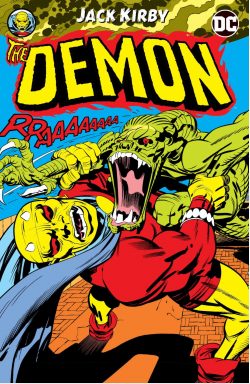
The Demon by Jack Kirby


By Jack Kirby & Mike Royer & various (DC Comics)
ISBN: 978-1-4012-7718-5 (HB/Digital edition)

Jack “King” Kirby shaped the very nature of comics narrative. A compulsive storyteller, Jack was an astute, spiritual man who had lived through poverty, gangsterism, the Depression and World War II. He had seen Post-War optimism, Cold War paranoia, political cynicism and the birth and death of peace-seeking counter-cultures. He was open-minded and utterly wedded to the making of comics stories on every imaginable subject.

He began at the top of his game, galvanising the comicbook scene from its earliest days with long-term creative partner Joe Simon: creating Blue Bolt, drawing Captain Marvel and adding lustre to Timely comics with creations such as Red Raven, Hurricane, Captain America and The Young Allies.

In 1942 Simon & Kirby moved to National/DC and hit even more stellar highs with The Boy Commandos, Newsboy Legion, Manhunter and The Sandman before the call of duty saw them inducted into the American military.

On returning from World War II, they reunited and formed a creative studio working primarily for the Crestwood/Prize publishing outfit where they invented the entire genre of Romance comics. Amongst that dynamic duo’s other concoctions for Prize was a noir-ish, psychologically underpinned supernatural anthology Black Magic and its short-lived but fascinating companion title Strange World of Your Dreams.

All their titles eschewed traditional gory, heavy-handed morality plays and simplistic cautionary tales for deeper, stranger fare, and until the EC comics line hit their peak were far and away the best and most mature titles on the market.

Kirby understood the fundamentals of pleasing his audience and always strived diligently to combat the appalling state of prejudice about the comics medium – especially from industry insiders and professionals who despised the “kiddies world” they felt trapped in.

When the 1950s anti-comics comics witch hunt devastated the industry, Simon & Kirby parted ways. Jack went back to DC briefly and created newspaper strip Sky Masters of the Space Force before partnering with Stan Lee at the remains of Timely Comics to create the monolith of stars we know as Marvel.

After more than a decade there he felt increasingly stifled and side-lined and in 1970 accepted an offer of complete creative freedom at DC. The jump resulted in a root and branch redefinition of superheroes in his quartet of interlinked Fourth World series.

After those controversial, grandiose groundbreaking titles were cancelled Kirby looked for other concepts to stimulate his vast creativity and still appeal to an increasingly fickle market. General interest in the Supernatural was rising, with books and movies exploring the unknown in gripping and stylish new ways, and the Comics Code Authority had already released its censorious choke-hold on mystery and horror titles, thereby saving the entire industry from implosion when the superhero boom of the 1960s fizzled away.

At DC’s suggestion, Kirby had already briefly returned to his supernatural experimentation in a superb but poorly received and largely undistributed monochrome magazine. Spirit World launched in the summer of 1971, but as before, editorial cowardice and back-sliding scuppered the project before it could get going. You can see what might have been in a collected edition re-presenting the sole published issue and material from a second, unreleased sequel in Jack Kirby’s Spirit World

With most of his ideas misunderstood, ignored or side-lined by the company Kirby opted for more traditional fare. Never truly defeated though, he cannily blended his belief in the marketability of the mystic unknown with flamboyant super-heroics to create another unique and lasting mainstay for the DC universe: one that lesser talents would make a pivotal figure of the company’s continuity.

This compilation gathers the entire eerie 16-issue run from August/September 1972 through January 1974 and opens with a fulsome Introduction detailing how The Demon came to be from Kirby’s then-assistant Mark Evanier before the astounding adventures begin…

Inked by Mike Royer, The Demon #1 introduces a howling, leaping monstrosity (famously modelled after a 1939 sequence from Hal Foster’s Arthurian epic Prince Valiant) battling beside its master Merlin as Camelot dies in flames: a cataclysmic casualty of the rapacious greed of sorceress Morgaine Le Fey.

Out of that apocalyptic destruction, a man arises and wanders off into the mists of history…

In our contemporary world (or at least the last quarter of the 20th century) demonologist and paranormal investigator Jason Blood has a near-death experience with an aged collector of illicit arcana. This culminates in a hideous nightmare about a demonic being and the last stand of Camelot. He has no idea that Le Fey is still alive and has sinister plans for him…

And in distant Moldavia, strange things are stirring in crumbling Castle Branek, wherein lies hidden the lost Tomb of Merlin…

Blood is wealthy, reclusive and partially amnesiac, but one night he agrees to host a small dinner party, entertaining acquaintances Harry Mathews, psychic UN diplomat Randu Singh, his wife Gomali and their flighty young friend Glenda Mark. The soiree does not go well.

Firstly, there is the painful small talk, and the sorcerous surveillance of Le Fey, but the real problems start when an animated stone giant arrives to “invite” Blood to visit Castle Branek. This shattering voyage leads to Merlin’s last resting place but just as Blood thinks he may find some answers to his enigmatic past, Le Fey pounces. Suddenly he starts to change, transforming into the horrific beast of his dreams…

Issue #2 – ‘My Tomb in Castle Branek!’ – opens with wary villagers observing a terrific battle between a yellow monster and Le Fey’s forces, but when the Demon is defeated and Blood arrested, only the telepathic influence of Randu in America can help him. Le Fey is old, dying, and needs Merlin’s grimoire, the Eternity Book, to extend her life.

Thus, she manipulates Blood – who has existed for centuries unaware that Merlin’s hellish Attack Dog the Demon Etrigan is chained inside him – to regain his memories and awaken the slumbering master mage. It looks like the last mistake she will ever make…

Kirby’s tried and trusted approach was always to pepper high concepts throughout blazing, breakneck action, and #3 was one the most imaginative yet. ‘The Reincarnators’ finds Blood back in the USA, aware at last of his tormented history, and with a small but devoted circle of friends. Adapting to a less lonely life, he soon encounters a cult able to physically regress people to a prior life – and use those time-lost beings to commit murder…

The Demon #4-5 comprise one single exploit, wherein a simple witch and her macabre patron capture the reawakened, semi-divine Merlin. ‘The Creature from Beyond’ and ‘Merlin’s Word’s … Demon’s Wrath!’ introduced cute little monkey Kamara the Fear-Monster (later used with devastating effect by Alan Moore in Saga of the Swamp Thing #26-27) and features another startling “Kirby-Kritter” – Somnambula, the Dream-Beast

It seems odd in these blasé modern times but The Demon was a controversial book in its day – cited as providing the first post-Comics Code depiction of Hell and one where problems were regularly solved with sudden, extreme violence.

‘The Howler!’ in issue #6 is a truly spooky yarn with Blood hunting a primal entity of rage and brutal terror that transforms its victims into murderous lycanthropic killers, whilst #7 debuts a spiteful, malevolent young fugitive from a mystical otherplace.

‘Witchboy’ Klarion and his cat-familiar Teekl were utterly evil little sociopaths in a time where all comicbook politicians were honest, cops only shot to wound and “bad” kids were only misunderstood: another Kirby first…

An extended epic, ‘Phantom of the Sewers’ skilfully combines movie and late-night TV horror motifs in the dark and tragic tale of actor Farley Fairfax, cursed by the witch he once spurned. Unfortunately, Glenda Mark is the spitting image of the departed Galatea, and when, decades later, the demented thespian kidnaps her (in ‘Whatever Happened to Farley Fairfax?!!’) to raise the curse, it could only end in a flurry of destruction, death, consumed souls and ‘The Thing That Screams’…

This 3-part thriller is followed by another multi-part masterpiece (The Demon #11-13). ‘Baron von Evilstein’ is a powerful parable about worth and appearance featuring the ultimate mad scientist and the tragic, misunderstood monster he so casually builds. It’s a truth that bears repeating: ugly doesn’t equal bad…

Despite all Kirby’s best efforts The Demon was not a monster hit – unlike his science-fiction disaster drama Kamandi – and by #14 it’s clear that the book was in its last days. Not because the sheer pace of imagination, excitement and passion diminished – far from it – but because the well-considered, mood-drenched stories were suddenly replaced by rocket-fast eldritch romps populated with returning villains.

First back was Klarion the Witchboy who creates a ‘Deadly Doppelganger’ to replace Jason Blood and kill his friends in #14-15, before the series – and this wonderful treasury of wicked delights – ended in a climactic showdown with the ‘Immortal Enemy’ Morgaine Le Fey…

Kirby carried on with Kamandi, returned to The Sandman, explored WWII in The Losers and created the magnificent Omac: One Man Army Corps, but still could not achieve the all-important sales the company demanded. Eventually he returned to Marvel and new challenges such as Black Panther, Captain America, 2001: A Space Odyssey, Devil Dinosaur, Machine Man and especially The Eternals.

As always in these wondrously economical collections it should be noted that the book comes stuffed with un-inked pencilled pages and roughs in bonus feature ‘The Art of Jack Kirby’, and Evanier’s fascinating, informative Introduction is, as ever, a fact-fan’s delight.

Jack Kirby was and is unique and uncompromising: his words and pictures are an unparalleled, hearts-and-minds grabbing delight no comics lover could resist. If you’re not a fan or simply not prepared to see for yourself what all the fuss has been about then no words of mine will change your mind.

That doesn’t alter the fact that Kirby’s work from 1937 to his death in 1994 shaped the entire American comics scene and indeed the entire comics planet – affecting the lives of billions of readers and thousands of creators in all areas of artistic endeavour for generations and still winning new fans and apostles every day, from the young and naive to the most cerebral of intellectuals. His work is instantly accessible, irresistibly visceral, deceptively deep and simultaneously mythic and human.

He is the King and time has shown that the star of this book is one of his most potent legacies.
© 1972, 1973, 1974, 2017 DC Comics. All Rights Reserved.

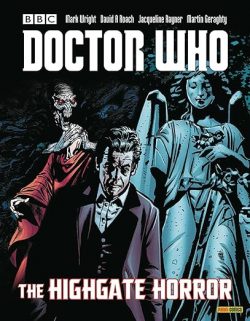
Doctor who Graphic Novel #23: The Highgate Horror


By Mark Wright, Jonathan Morris, Steve Lyons, Roger Langridge, Jacqueline Rayner, Scott Gray, David A. Roach, Mike Collins, John Ross, Adrian Salmon, Martin Geraghty, Dave Gibbons, John Ridgway, Dan McDaid & various (Panini Comics)
ISBN: 978-1-84653-749-3 (TPB)

Somewhere in time, it’s always that moment just before the TV got turned on and the Time Lord was born. This year is the 60th Anniversary of Doctor Who. Here’s another Timey-Wimey treat to celebrate a unique TV and comics institution in a periodical manner …

The British love comic strips, adore “characters” and are addicted to celebrity. The history of our homegrown graphic narratives includes an astounding number of comedians, Variety stars and television actors: such disparate legends as Charlie Chaplin, Arthur Askey, Charlie Drake and so many more I’ve long forgotten and you’ve likely never heard of.

As much adored and adapted were actual shows and properties like Ace of Wands, Timeslip, Supercar, Pinky and Perky, The Clangers and countless more. If folk watched or listened, an enterprising publisher made printed spectacles of them. Hugely popular anthology comics like Radio Fun, Film Fun, TV Fun, Look-In, TV Comic, TV Tornado, and Countdown readily and regularly translated our light entertainment favourites into pictorial joy every week, and it was a pretty poor star or show that couldn’t parley the day job into a licensed strip property…

Doctor Who debuted on black-&-white televisions across Britain on November 23rd 1963 with the opening episode of ‘An Unearthly Child’. Mere months later, in 1964 a decades-long association with TV Comic began: issue #674 heralding the initial instalment of ‘The Klepton Parasites’ by an unknown author with the art attributed to illustrator Neville Main.

On 11th October 1979, Marvel’s UK subsidiary launched Doctor Who Weekly. Turning monthly magazine in September 1980 (#44) it’s been with us – via various iterations – ever since. All proving the Time Lord is a comic star of impressive pedigree, not to be trifled with.

Panini’s UK division ensured the immortality of the comics feature by collecting all strips of every Time Lord Regeneration in a uniform series of over-sized graphic albums – although we’re still waiting for digital versions. Each time tome focused on a particular incarnation of the deathless wanderer, with this one gathering stories originally published in Doctor Who Magazine #484 and #489-500. Spanning March 2015 to July 2016; they star Peter Capaldi’s irascible old chrononaut the Twelfth Doctor and saucy sidekick/Impossible Girl Clara Oswald in action across the universe and every Elsewhen imaginable.

The adventures of the Grumpy Gallifreyan are – as always – described and delineated by a rapidly rotating roster of British creators who also provide a treasure-trove of background information in the Commentary section at the back. These comprise story-by-story history, background and insights from authors and illustrators, supplemented by scads of sketches, roughs, designs, production art and photos.

None of which is relevant if all you want is a darn good read. Thankfully, all imagineers involved have completed the ultimate task of any artisan – to produce engaging, thrilling, fun work which can be enjoyed equally by the callowest of neophytes and most slavishly dedicated and opinionated fans imaginable.

That feast of fun – coloured throughout by James Offredi and lettered by multi-talented Roger Langridge – opens with Mark Wright, Mike Collins & David A. Roach’s ‘Space Invaders!’ as The Doctor and Clara fetch up at an orbiting storage facility just as the owners start their latest sell-off of unclaimed items. Typically, the time-travellers are not quite quick enough to stop avid bargain-hunters opening a container of just hatched planet-eating monster eggs…

Following smart social satire is a multi-part action romp. ‘Spirits of the Jungle’ – by Jonathan Morris & John Ross – finds our stars joining an extraction mission to recover lethal intelligent weapons-tech before apparently walking into trap on a planet where the forests have their own definition of World Wide Web…

Gothic horror and vintage thrills permeate Wright, Roach & Collins’ superb chiller ‘The Highgate Horror’ wherein Clara, her immortal straight man and neophyte Companion Jess Collins experience the 1970s London cemetery by hunting vampires and satanic covens and encounter a race of ancient predators who want far worse than mere blood…

As conceived and realised by Steve Lyons & Adrian Salmon, ‘The Dragon Lord’ was a radical activist attempting to save magnificent saurians from human fun-seekers killing them for sport on a medieval-themed fantasy resort world. However, by the time our turbulent troubleshooters turn up, things have turned decidedly lethal and it looks like nobody is getting out alive…

Roger Langridge then offers an all-him treat as Harry Houdini sends out a distress call and his old chum The Doctor dutifully answers. Sometimes even fakers and charlatans have power and really resent being de-bunked by upstart human escapologists playing in the ‘Theatre of the Mind’

A new time-bending miscreant debuts in Jacqueline Rayner, Martin Geraghty & Roach’s epic tale of persecution and justice when temporal prankster Miss Chief infiltrates Clara’s workspace. After causing havoc at Coal Hill School, said trickster drops Miss Oswald in the vicious clutches of Witchfinder General Matthew Hopkins, leaving The Doctor to either participate in a time duel or somehow search the whole 17th century for his missing school ma’am in a ‘Witch Hunt’ with potentially fatal and final consequences…

Our temporal tintinnabulations conclude with a splendidly appropriate anniversary party get-together of old friends – and foes – that will delight lifelong devotees without bewildering or baffling newbies or casual readers.

Written by editor Scott Gray, ‘The Stockbridge Showdown’ returns the Time Lord to the alien-beleaguered British village just as cosmic corporate conqueror Josiah W. Dogbolter thinks he’s finally leveraged the keys to time itself.

As the universe nears a shocking “Going Out of Business” sale, the wily Gallifreyan and many allies from the past 500 issues unite to teach the richest man in creation the paucity of his resources and the lesson of his life in a tale crafted by artists past and current, including Dave Gibbons, Langridge, Salmon, Dan McDaid, Ross, Collins, John Ridgway, Geraghty and Roach.

Another marvellous chronicle for casual comics readers, this is also an unmissable shelf-addition for dedicated fans of the show and a perfect opportunity to cross-promote our art-form to anyone minded to give comics a proper go.
All Doctor Who material © BBCtv. Doctor Who, the Tardis and all logos are trademarks of the British Broadcasting Corporation and used under licence. Licensed by BBC Worldwide. Tardis image © BBC 1963. Daleks © Terry Nation. All commentaries © 2016 their respective authors. Published 2013 by Panini UK Ltd. All rights reserved.

Scared to Death volumes 1 & 2: The Vampire From the Marshes & Malevolence and Mandrake


By Mauricet & Vanholme, with Lee Oaks: colours by Laurent Carpentier and translated by Luke Spear (Cinebook)
ISBN: 978- 1-905460-47-2 (Album PB Vampire) 978- 1-905460-77-9 (Album PB Mandrake)

There’s a grand old tradition of scaring, empowering and entertaining kids through carefully crafted horror stories with junior protagonists, and this occasional series is one of the better modern examples.

Conceived and executed by Belgian journalist Virgine Vanholme and youthful-yet-seasoned illustrator Alain Mauricet, the Mort de Trouille series of graphic albums was launched by Casterman in 2000 resulting in five further sinister sorties until everything paused in 2004.

Whilst I’ve not been able to find out much about the author, the artist is well travelled, having worked for CrossGen, Image and DC as well as on a wide variety of features in Europe. He’s also been in David Lloyd’s magnificently wonderful digital delight Aces Weekly.

Born in 1967, Mauricet inherited the comic bug from his parents and, after studying at the Academy of Fine Arts under legendary creator Eddy Paape, began his own career aged 20: another recruit for major magazine Le Journal de Spirou. From spot cartoons he graduated to strips, creating superhero parody Cosmic Patrouille with Jean-Louis Janssens and Les Rastafioles with Sergio Salma. Following the aforementioned stateside sojourn he resumed his Franco-Belgian efforts with the strip under review here, as well as basketball comedy Basket Dunk (with Christophe Cazanove) and Boulard (with Erroc) and others.

A resident of Brussels, he also designs for computer games whilst working on a more personal graphic enterprise entitled Une Bien Belle Nuance de Rouge and in latter days worked for DC on Superman and Batman. In 2021 he released Porchery – On n’attrape pas les cochons avec des saucisses.

Back in early 2000, though, he was detailing the first of a sequence of spooky yarns starring studious Robin Lavigne and boisterous, overly-imaginative Max Mornet: a couple of lads with an infallible instinct for ferreting out the weird and uncanny. Cinebook translated Mort de Trouille: Le vampire des Marais in 2008: inviting British, Antipodean and American kids to solve the mystery of The Vampire from the Marshes, which began when the boys first snuck a peek at forensic scientist Dr. Lavigne‘s locked files…

The well-travelled medic has been called in to examine a body found in rural Deadwater Swamp: a corpse stinking of booze, drained of blood and completely covered in hundreds of tiny triangular bite marks. His son Robin and especially horror-story obsessed Max are fascinated by the case. The latter envisions all manner of ghastly and vivid vampiric scenarios, despite his more prosaic pal’s protestations. All too soon the lads are invading the (still “potential”) crime scene, recording their own findings and suppositions. They are pretty freaked out when they find a strangely slaughtered bird and completely terrified when they disturb a poacher who chases them away with murderous curses. Unbeknownst to all involved, their prying has also alerted and disturbed a clan of far more dangerous and unnatural creatures…

Soon the boys are being shadowed by an uncanny, cloaked figure. He/she/it even breaks into the Lavigne home: striving to preserve anonymity and ancient secrets from the eyes of prying, violent mankind. However, when it is noisily disturbed as it closes in on the boys, they can only thank their lucky stars that the household cat is such a noisy and vicious beast when stepped upon…

Events peak to a cursed crescendo next day after Max falls into his own hastily dug vampire trap and is taken by the noisome Nosferatu. Whilst Robin anxiously and urgently searches for his missing friend, Max is learning the tragic secret history of the bloodsuckers.

His oddly ambivalent abductor is Janus who seems rather reluctant to bleed him as a proper vampire should. The creature has, however, no problem leaving him – and freshly captured Robin when he stumbles upon them – to drown in a deep well…

Next morning, Dr. Lavigne and the cops are frantically but methodically searching the swamp for the missing boys, but only find them thanks to some unknown person leaving Max’s camera on the rim of a well…

As the frightened lads are pulled to safety, Robin’s dad questions them and goes ballistic on learning they’ve been looking through his confidential files. He also utterly trashes their ridiculous theory of vampire killers, patiently explaining the true and rational – if exceedingly grim and grisly – cause of death of the drunk in the swamp.

Chastened but undaunted and sharing an incredible secret no adults will ever believe, the boys are taken home whilst deep in the wooded mire an ancient family of incredible beings pulls up stakes and moves restlessly on to who knows where…


With additional art assistance from Lee Oaks, the schoolboy spook-chasers resurfaced in Scared to Death volume 2: Malevolence and Mandrake. Scholarly Robin and rowdy, horror-fan Max are still chasing every implausible rumour and probing unknowns but becoming increasing dependent – though they’d never admit it – on the wit and bravery of Robin’s brilliant little sister Sophie Lavigne

Cinebook’s second translated selection was actually the third Franco-Belgian chiller chronicle Mort de Trouille: Maléfice et mandragora: suitably set around All Hallows Eve and posing uniquely terrifying problems for the young trouble-magnets…

It begins a little before the much-anticipated night, with Elizabeth Simon Secondary School abuzz with worries over missing student Thomas and the seemingly simultaneous arrival of oddly-attractive, exotic transfer student Emma Corpescu. She comes from Romania and Max is strangely antipathic to her at first. That soon changes, though…

Robin also feels a bit off as the newcomer blatantly insinuates herself into their lives, paying particular attention to Max. Soon, so-savvy Sophie is paying closer attention. Far more so than the idiot boys do…

She’s wise to do so: Emma is soon revealed as an ancient shapeshifting sorceress named Malevolence, who steals the youth of boys to restore her own life force… and to – one day – resurrect her properly dead sister Mandrake

After doing desperate research online, Sophie arms herself with anti-witch tricks and gadgets and – after discovering the incredible fate of Thomas – eventually convinces her incredulous brother to stalk the wicked enchanter to her lair in Deadwater Swamp and rescue the now officially-missing Max. The poor oaf has fully succumbed to Emma’s wiles and now resides in her lair, transformed into the same uncanny form as Thomas was…

Arriving just in time, the rescuers are set for an incredible clash of wills and powers – especially Sophie, who’s borrowed a few supernatural forces for the ordeal…

Of course, good triumphs in the end, but can such seductive evil truly die?

Deliciously delivered in the manner of Goosebumps and Scooby-Doo – if not Stranger Things – these superb slices of spooky fun work classic kids’ horror tropes and style to enthral and enchant everyone who has suffered from “father knows best” syndrome and loves tall tales with devilish twists. Seamlessly mixing fear with hilarity to enthral and enchant all generations equally, these tales should be resuurected and completed for all of us in need of scary relaxation.
Original edition © Casterman, 2000 and 2003 by Mauricet & Vanholme. English translation © 2008 by Cinebook Ltd.

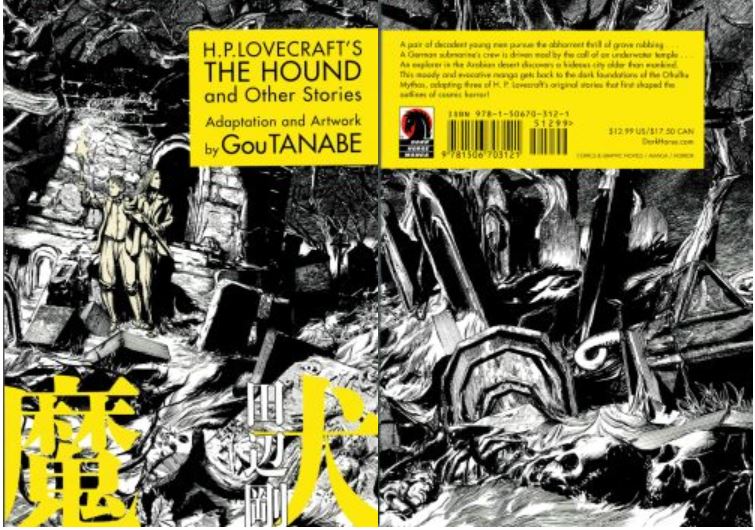
H.P. Lovecraft’s The Hound and Other Stories


Adapted by Gou Tanabe, translated by Zack Davisson (Dark Horse)
ISBN: 978-1-50670-312-1 (Tankobon paperback/Digital edition)

If you’re one of those people who’s never read a manga tale, or who’s been tempted but discouraged by the terrifying number of volumes these tales can run to, here’s a delicious feast of fantasy fables complete in one book revealing all that’s best about comics from the East in one darkly digestible big gulp.

Most manga can be characterised by a fast, raucous, even occasionally choppy style and manner of delivery but this volume of emphatically eerie adaptations is atmospheric, suitably scary and marvellously moody: just as you’d hope when recreating classic tales by the undisputed master of supernatural terror…

Howard Phillips Lovecraft was frail, troubled and remarkably ill-starred. Born August 20th 1890, he was truly afflicted with a hunger to write, but only achieved any degree of success after his death in March 1937 – following a life of desperate penury – from complications of intestinal cancer. Once he was gone, his literary star ascended, with posthumous publications making him a household name who changed the face of fiction forever.

His stories have deeply affected generations all over the world. One person particularly moved is international literary specialist Gou Tanabe who has previously adapted the works of Maxim Gorky and Anton Chekov to manga form.

Perfectly capturing the relentlessly oppressive and inescapably sombre sense of approaching fatality permeating most of Lovecraft’s potent prose, ‘The Temple’ was written in 1920 and first published 5 years later in the September issue of Weird Tales. The adaptor’s mildly updated version (migrated from WWI to WWII) originated in esteemed anthology magazine COMIC BEAM in March and April 2009: detailing the depredations of U-Boat U-29 and the doomed fools who man her.

After a particularly rewarding campaign, German Navy Commander Karl Heinrich Graf von Altberg-Ehrenstein and his officers are taking the night air when they notice a dead British mariner gripping the sub’s handrail. Whilst trying to unlock the mariner’s death grip and eject the corpse, one of them salvages an ancient artefact – a small carved head – and pockets it.

From that moment, their voyage is damned…

Soon, madness and mishap grip the vessel. Death decimates the crew and inexorably the survivors drift ever deeper into depths both physical and metaphorical. When only one remains, he finds the U-boat drawn to a fantastic city and magnificent temple sunken beneath the waves. It is filled with statuary like the little head in his pocket…

Just as he raises his pistol to end the horror, the shattered sole survivor sees shining lights in the sunken edifice…

Lovecraft penned ‘The Hound’ in September 1922 and Weird Tales published it in 1924. Gou Tanabe’s chilling interpretation debuted in July 2014 in the online edition of Comic Walker. The tale is grim, grisly, exquisitely decadent and supremely shocking, detailing the extravagant excess of English gentleman grave-robbers and diabolist magical parvenus St. John and our unnamed narrator.

Bored and indolent, they renew their sordid, blasphemous hobby in a Dutch boneyard, exhuming an arcane trinket from a grave sealed for half a millennium and reap a ghastly bounty after liberating a vengeful howling horror…

After its first foray into the material world, the surviving dabbler attempts every stratagem to escape or expiate the beast, and finds some things have no use for apologies or reparations…

Concluding this first (hopefully of many) Lovecraft treasure trove is another export from Comic Walker (August 2014 this time).

‘The Nameless City’ was written in January 1921 and published 10 months later in The Wolverine. Tapping into the contemporary vogue for arcane exploratory adventure as also favoured by the likes of literary horrorist brethren Seabury Quinn, Clark Ashton Smith, and latterly August Derleth and Robert E. Howard, here Lovecraft shares the story of an itinerant western wanderer (think Indiana Jones without no sense of humour or chance in Hell) who survives Arabian deserts only to stumble upon a previously unsuspected deserted conurbation suddenly exposed by the roaring eternal winds.

Genned-up on local legends, the explorer cannot resist entering the vast metropolis. However, as he plunges deeper within, he finds thousands of boxes like a legion of coffins and realises the occupants are far from human. They may not even be dead…

Enthralling, understated and astoundingly effective, these classic tales have been reverently adapted and packaged in an inexpensive, digest-sized monochrome paperback that will delight avowed aficionados and beguile terror-loving newcomers alike.

© 2014 Gou Tanabe. All rights reserved. This English-language edition © 2017 Dark Horse Comics, Inc.

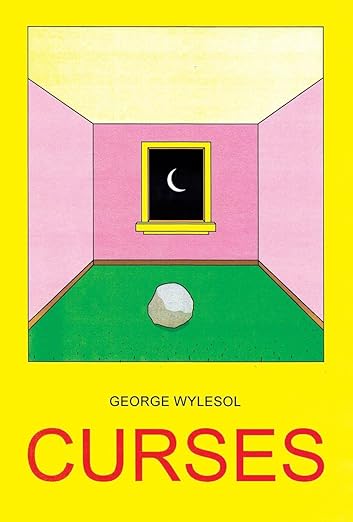
Curses – A collection of short comics


By George Wylesol (Avery Hill Publishing)
ISBN: 978-1-910395-75-2 (TPB)

Baltimore-based George Wylesol (Internet Crusader, 2120) is a cartoonist with lots to say and extraordinarily intriguing ways of doing so. His oeuvre channels avowed fascinations – old computer kit and livery; anxiety; a culture of graphic inundation, pervasive iconography; the nostalgic power of commercial branding and signage plus a general interest in plebian Days Gone By. Drawings of these he melds into chilling affirmations of his faith in the narrative power of milieu and environment as opposed to characters. He’s also pretty big on scaring the pants off folk…

That is especially the case in this latest tome: a retro-modernist glimpse over the shoulder at past shorter tales. This vibrant volume gathers novella Ghosts from 2017 and a section of short comics created between 2015 and 2021 uniformly exploiting his garishly macabre peccadilloes, opening with a devil’s dozen depicted as the ‘Comprehensive List of Curses’: part of a sporadic sequence of stand-alone (or are they?) images peppered throughout the pages.

Breakthrough tale ‘Ghosts’ details a worker sharing experiences wandering in a complex of tunnels under a hospital, after which 2015’s ‘The Rabbit’ macabrely plucks heartstrings (you can see them if you look) in a tale of odd relationships…

Computer game inspired ‘Castle Maker’ seductively and inevitably leads to a powerful exploration of ‘Porn’ that is nothing like you could possibly expect.

Talking heads spouting ‘Cheese’ and worse bring us a ‘List of Cursed Entities’ before ‘Worthless’ pushes the limits of visual reportage and conceptual condemnation. More far-from-random images offer a reset button as prelude to a visit to realtor purgatory via the ‘Open House’ after which ‘The Loser’ displays another way to fail yet win…

Bombarded by fresh pictorial asides, we pause to consider the void in ‘Untitled’ before a sequence of entwined episodes commences, tracing the saga of ‘The Cursed Lover’.

Set in the ghastly, internal-organ-obsessed municipality of Zujojhidi – as governed by drab routine and television prophets – Ghoul is struggling with school and his job at the meat factory. Everything changes once a stranger shows him a spirit hidden under his cloak. From that moment, Ghoul’s existence changes forever and for the worst…

Can the interest of young Mercey – whose attentions he is blithely oblivious to – divert the doomed kid from the inexorable path to apocalypse and oblivion?

Deftly manipulating realities and landscaping the liminal spaces at the boundaries of peripheral vision, Wylesol reshapes forms and formula to carve out chilling, potent suspense sagas unlike anything you’ve ever seen. Genuinely disturbing in the manner of the best psychological dramas, with plenty of scary moments and distressingly eerie characters, the coldly diagrammatical illustration and workplace-bright colour palette adds immensely to the overall aura of unease.

Compelling and compulsive, these eerie evocations are aimed right at you. Whether you duck, dodge or dive in says all you need to know of yourself and proves nothing is what it seems. This is a wild ride not to be missed.
© George Wylesol 2023. All rights reserved.

Chronicles of Fear – Tales of Woe


By Nathalie Tierce (Indigo Raven)
ISBN: 978-1-7341874-5-8 (PB)

Win’s Christmas Gift Recommendation: Cruel Truths for Crazy Days… 9/10

Allying words to pictures is an ancient, potent and – when done right – irresistibly evocative communications tool: one that can simultaneously tickle like a feather, cut like a scalpel and hit like a steam-hammer. As such, repeated visits to a particular piece of work will even generate different responses depending on the recipient’s mood. If you’re a multi-disciplined, muti-media artist like Nathalie Tierce, fresh challenges must be a hard thing to find, but rewards for successfully breaking new ground are worth the effort… and the viewer’s full attention.

Tierce is a valued and veteran creator across a spectrum of media, triumphing in film and stage production for everyone from the BBC to Disney and Tim Burton to Martin Scorsese. She has crafted music performance designs for Andrew Lloyd Webber and The Rolling Stones, all the while generating a wealth of gallery art, painted commissions and latterly, graphic narratives such as Fairy Tale Remnants and Pulling Weeds From a Cactus Garden.

Perpetually busy, she still finds time to stop and stare; thankfully, human-watching is frequently its own reward, sparking tomes like this slim, enthrallingly revelatory package forensically dissecting human nature in terms of cultural landmarks as scourged by the inescapable mountain of terrors large, small, general and intensely personal.

On show in this portable night gallery are stunning paintings in a range of media, rendered in many styles and manners whilst channelling the artist’s own fear-mongering childhood entertainer-influences. These include Edward Gorey, Maurice Sendak, Heinrich Hoffman (Der Struwwelpeter) and other dark fairy tales, as well as compellingly mature comic creators such as Aline Kominsky Crumb & R. Crumb, Will Eisner and Claire Bretecher.

The artworks explore shades of anxiety, alienation, frustration, longing, disappointment, despondency, hopelessness, instant gratification, loss of confidence, purposelessness, racism, toxic masculinity, neurosis, death and loneliness by suborning cultural touchstones like Popeye, Donald Duck and other Disney icons, mass-media mavens like Bowie and King Kong, beloved childhood toys and even modern lifestyle guru Homer Simpson.

Bracketed by revelatory insights and sharing context in Introduction and Biography, the pictorial allegories When Shock and Horror Collide, Forest Nymph, Capitolina and the Dubious Superhero, The Genie and the Swimmer, Bad Fishing Trip, Slapstick Brawl, Undateable, Crazy Rooster Man, Strange Leader, My Favorite Aliens, The Queen of Hearts Goes Shopping, Acrobat, Fear of Death, Running, What Killed the Dodo?, The Bore, 3am, Pussy Cat, Barfly, Alice in Waitingland (my absolute personal favourite!), Beginning and End, Rascal Dog, Spiraling, Lonely Soldier, Homer Gone Bad, Jittery and utterly appalling endpiece Bathtime, connecting forensic social observation with everyday paranoias we all experience. The result is a mad melange of bêtes noire and unsettled icons du jour, with each condemnatory visual judgement deftly wedded to frankly terrifying texts encapsulating contemporary crisis points, delivered as edgy epigrams and barbed odes.

Chronicles of Fear – Tales of Woe is a mordantly mature message of mirth-masked ministrations exposing the dark underbellies we’re all desperately sucking in and praying no one notices.

A perfect dalliance for thinking bipeds at the end of civilisation, aimed at victims of human nature with a sharp eye and unforgiving temperament – and surely, isn’t that all of us?
© 2023 Indigo Raven. © 2023 Nathalie Tierce. All rights reserved.

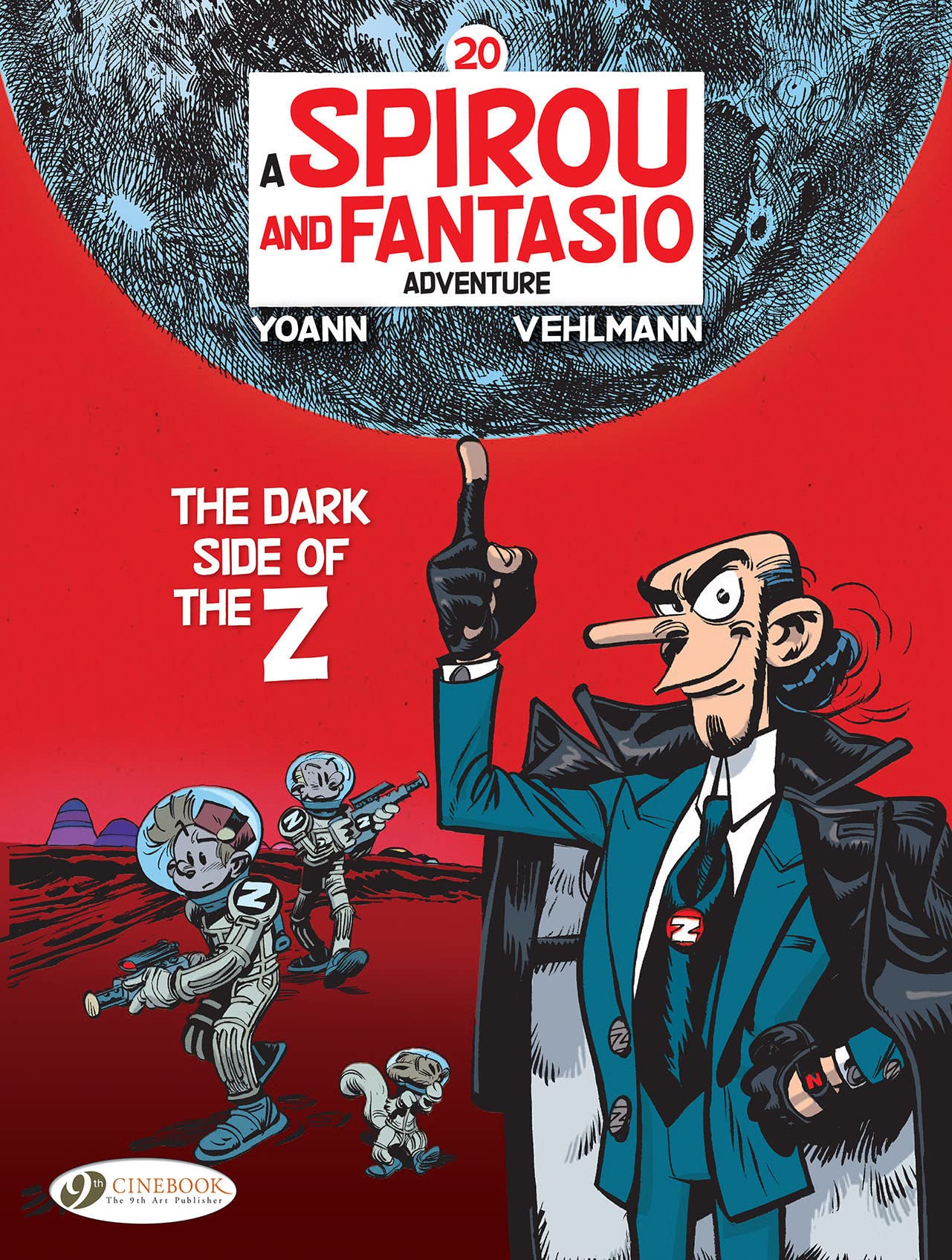
A Spirou and Fantasio Adventure volume 20: The Dark Side of the Z


By Fabien Vehlmann & Yoann, designed by Fred Blanchard, colored by Hubert & translated by Jerome Saincantin (Cinebook)
ISBN: 978-1-80044-103-3 (Album PB/Digital edition)

Boyish hero Spirou (which translates as both “squirrel” and “mischievous” in the Walloon language) was created by French cartoonist Françoise Robert Velter AKA Rob-Vel. This was before the Second World War for Belgian publisher Éditions Dupuis in response to the phenomenal success of Hergé’s Tintin at rival outfit Casterman.

Soon-to-be legendary weekly comic Le Journal de Spirou launched on April 21st 1938 with a rival red-headed lad as lead feature in an anthology which bears his name to this day. The eponymous hero was a plucky bellboy/lift operator employed in the Moustique Hotel – a sly reference to the publisher’s premier periodical Le Moustique. His improbable adventures with pet squirrel Spip gradually evolved into far-reaching, surreal comedy dramas.

Spirou and his chums have helmed the magazine for most of its life, with a cohort of truly impressive creators carrying on Velter’s work, beginning with his wife Blanche “Davine” Dumoulin who took over the strip when her husband enlisted in 1939. She was assisted by Belgian artist Luc Lafnet until 1943, when Dupuis purchased all rights to the property, after which comic-strip prodigy Joseph Gillain (Jijé) took the helm. In 1946, his assistant André Franquin assumed the creative reins: gradually ditching the well-seasoned short gag vignettes format in favour of epic adventure serials. He also expanded the cast, introducing a broad band of engaging regulars and eventually creating phenomenally popular magic animal Marsupilami.

Franquin was followed by Jean-Claude Fournier who updated the feature over nine stirring adventures tapping into the rebellious, relevant zeitgeist of the times: offering tales of environmental concern, nuclear energy, drug cartels and repressive regimes.

By the 1980s, however, the series seemed outdated and lacking direction, so three separate creative teams alternated on it. Eventually overhauled and revitalised by Philippe Vandevelde (writing as Tome) and artist Jean-Richard Geurts – AKA Janry – adapting, referencing and in many ways returned to the beloved Franquin era, the strip found its second wind.

Their sterling efforts revived the floundering feature’s fortunes, generating 14 wonderful albums between 1984 and 1998. As the strip diversified into parallel strands (Spirou’s Childhood/Little Spirou and Guest-Creator Specials A Spirou Story By…), the team on the core feature were succeeded by Jean-David Morvan & José-Luis Munuera. Then Yoann & Vehlmann took over the never-ending procession of amazing adventures…

Multi-award-winning French comics author Fabien Vehlman was born in 1972, began his comics career in 1996 and has been favourably likened to René Goscinny. He’s probably still best known for Green Manor (illustrated by Denis Bodart), Seven Psychopaths with Sean Phillips, Seuls (drawn by Bruno Gazzotti and available in English as Alone), Wondertown with Benoit Feroumont and Isle of 1000,000 Graves with Jason.

Yoann Chivard was born in October 1971 and was drawing non-stop by age five. With qualifications in Plastic Arts and a degree in Communication from the Academy of Fine Arts in Angers, he became a poster advertising artist whilst just dabbling in comics. His creations include Phil Kaos and Dark Boris for British Indie publications Deadline and Inkling, Toto l’Ornithorynque, Nini Rezergoude, La Voleuse de Pere-Fauteuil, Ether Glister and Bob Marone and he has contributed to Trondheim & Sfar’s Donjon.

In 2006, Yoann was the first artist to produce a Spirou et Fantasio one shot Special. It was scripted by Vehlmann…

Cinebook have been publishing Spirou & Fantasio’s exploits since 2009, alternating between the various superb reinterpretations of Franquin and earlier efforts from the great man himself.

When Jijé handed Franquin the strip part-way through Spirou et la maison préfabriqué (LJdS #427, June 20th 1946), the new guy ran with it. Over two decades he enlarged the scope and horizons until it became purely his own. Almost every week fans would meet startling new characters like loyal comrade and rival Fantasio or crackpot inventor and Merlin of mushroom mechanics Pacôme Hégésippe Adélard Ladislas de ChampignacThe Count of Champignac

Spirou and Fantasio became globe-trotting journalists, travelling to dangerously exotic places, uncovering crimes, exploring the fantastic and clashing with a coterie of exotic arch-enemies such as Fantasio’s deranged and wicked cousin Zantafio and that maddest of scientists, Zorglub.

This old school chum and implacable rival of Champignac is an outrageous Bond-movie-tinged villain constantly targeting the Count. A brilliant engineer, his incredible machines are far less dangerous than his mind-controlling “Zorglwave” and his apparently unshakable hunger to conquer Earth and dominate the solar system from a base on the Moon…

This tale – originally in 2011 La face cachée du Z – opens with our happily argumentative chums repairing the collaterally damaged Champignac chateau yet again. Exhausted, they go to indoors to sleep… and wake up in a horrific and tawdry casino resort. Compounding the shocks are weird, painfully unpredictable tricks of gravity, as it’s apparently built only for the super-rich and on the moon!

Worst of all, explaining the transition is smugly sanctimonious old enemy Zorglub…

Still agonisingly hungry for his rival’s approval, the evil genius blathers on about his triumphs and his Great Masterwork since last seen (in volume 18’s Attack of the Zordolts): escaping from dirty, dying Earth to the stars with hot Swedish science students Astrid and Lena. Now they’ve gone off together, leaving the science troll to carve out his interplanetary empire alone.

At least, he would be, if certain funding shortfalls hadn’t forced him into bed with One-percenters who think his citadel could be the most exclusive resort off Earth…

Zorglub still needs to be the virtuous Architect of Humanity’s Future, but the people he has are nothing like the ones he wants: bold Fantasio, ingenious Spirou and brilliant ethically pristine Pacôme de Champignac…

That’s why – for the most logical and moral reasons – he drugged and abducted them…

Without question, the lunar outpost is a technological wonder, with advances and advantages even the kidnapped admire, but the beloved holy Science is being increasingly sidelined, for bigger and better gambling rooms, ski slopes, surfing beaches, sports complexes, nature sideshows and glitzy restaurants.

It does not go down well when Spirou points out that Zorglub could have cleaned up and saved Earth for less money and effort…

Further debate is forestalled when a solar flare is announced and Spirou refuses to join everyone else in radiation-shielded shelters until he recovers his wandering wild pal Spip. Locked out, our hero spectacularly finds a way to survive the cosmic storm, but it’s not for a while that we realise it’s come at a severe mutagenic cost…

The pauper lad’s suicide run across the resort’s attractions was televised and has made him a minor celebrity amongst the movie stars like Blythe Prejlowieky (who soon seduces the kid for her own shocking purposes!), overly-competitive sporting gods like Mike Adibox, faceless money-moguls and flagrantly ostentatious oligarchs such as Igor. Not so much impressed as cautious is the investors’ appointed fixer and ultimate mercenary Poppy Bronco. He’s recognized something in the survivor that bodes badly for all…

The sun starts setting on the project after Champignac chides Zorglub for the worthlessness of his achievements and surrendering of his principled dreams. It coincides with a series of potentially lethal sabotage attempts and – defined by true devotion to their precious skins – the one-percenters commandeer the transport back to Earth, with only few such as Blyth and Igor choosing to stay behind with the peons and paid staff…

Finally rid of his annoying paymasters, Zorglub then executes his long-term plans but is completely unprepared for what happens to Spirou when the lunar night begins. Bronco isn’t though and organises a monster-hunt through the abandoned resort and across the moon…

The outcome is tense, gripping unexpected and so very To Be Continued.

Rocket-paced, action-packed, compellingly convoluted and with just the right blend of perfectly blending helter-skelter excitement and sheer daftness, The Dark Side of the Z is a terrific witty romp to delight devotees of easy-going adventure, drawn with beguiling style and seductive energy. This is pure cartoon gold, truly deserving of reaching the widest audience possible.
Original edition © Dupuis, 2011 by Vehlmann & Yoann. All rights reserved. English translation 2023 © Cinebook Ltd.

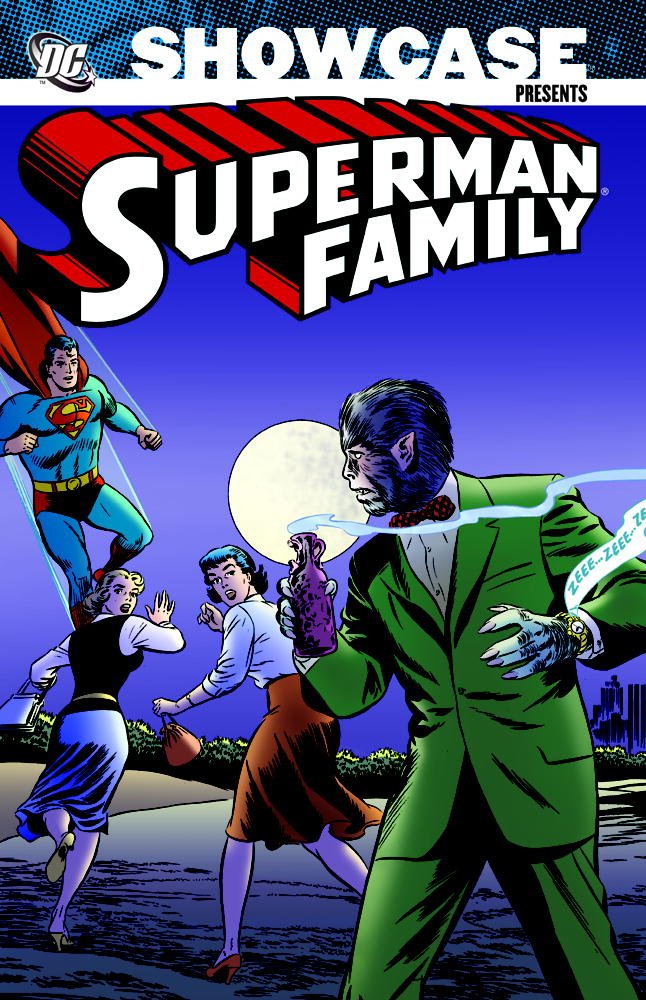
Showcase Presents Superman Family volume 3


By Otto Binder, Robert Bernstein, Jerry Siegel, Alvin Schwartz, Bill Finger, Curt Swan, Kurt Schaffenberger, Wayne Boring, Dick Sprang, Al Plastino, Stan Kaye, Ray Burnley, John Forte, George Klein, John Giunta & various (DC Comics)
ISBN: 978-1-84576-812-6 (TPB)

When the groundbreaking Man of Steel debuted in Action Comics #1 (June 1938) he was instantly the centre of attention, but even then the need for a solid supporting cast was apparent and wisely tailored for. Glamorous daredevil girl reporter Lois Lane premiered beside Clark Kent and was a constant companion and foil from the outset.

Although unnamed, a plucky red-headed, be-freckled kid started working for Clark and Lois from Action Comics #6 (November 1938) onwards. His name was used in Superman #13 (November-December 1941), having already been revealed as Jimmy Olsen due to being a major player on The Adventures of Superman radio show from its debut (April 15th 1940).

As somebody the same age as the target audience for the hero to explain stuff to (all for the listeners’ benefit), he was the closest thing to a sidekick the Action Ace ever needed…

When the similarly titled television show launched in the autumn of 1952 – preceded a year earlier by landmark B-movie Superman and the Mole Men – it was another immediate sensation and National Periodicals began cautiously and judiciously expanding their revitalised franchise with new characters and titles.

During the 1950s/early 1960s, being different in America was a Very Bad Thing. Conformity was sacrosanct, even in comicbooks, and everybody and everything was meant to keep to its assigned and intended role: for the Superman family and cast, that meant a highly strictured code of conduct and parameters. Daily Planet Editor Perry White was a stern, shouty elder statesman with a heart of gold, Cub Reporter Jimmy was a brave and impulsive, unseasoned fool – with a heart of gold – with Lois brash, nosy, impetuous and unscrupulous in her obsession to marry Superman although she too was – deep down – another possessor of an Auric aorta. Moreover, although Clark was a Man in a Man’s World, his hidden alter ego meant that he must never act like one…

Yet somehow even with these mandates in place the talented writers and artists assigned to produce their wholesomely uncanny exploits managed to craft tales both beguiling and breathtakingly memorable – and usually as funny as they were exciting.

First to fill a solo title were the gloriously charming, light-hearted escapades of that rash, capable but callow photographer and “cub reporter”. Superman’s Pal Jimmy Olsen #1 launched in 1954 with a September-October cover date, the first spin-off star of the Caped Kryptonian’s rapidly expanding multi-media entourage.

As the decade progressed the oh-so-cautious Editors tentatively extended the franchise in 1957 just as the Silver Age of Comics was getting underway, and it seemed that there might be a fresh and sustainable appetite for costumed heroes and their unique brand of spectacular shenanigans. Try-out title Showcase, which had already launched The Flash (#4) and Challengers of the Unknown (#6), followed up with a brace of issues entitled Superman’s Girl Friend Lois Lane in #9 and 10, before swiftly awarding the “plucky news-hen” a series of her own; in actuality her second, since for a brief while in the mid-1940s she had held a regular solo-spot in Superman.

At this time Superman’s Girlfriend, Lois Lane was one of precious few titles with a female lead and – in the context of today – one that gives many 21st century fans a few uncontrollable qualms of conscience. Within the confines of her series the valiant and capable working woman careered crazily from man-hungry, unscrupulous schemer through ditzy simpleton to indomitable and brilliant hero – often all in the same issue – as the exigencies of entertaining children under the strictures of the Comics Code all too often played up the period’s astonishingly misogynistic attitudes.

The comic was clearly intended to appeal to the family demographic that made I Love Lucy a national phenomenon and Doris Day a ditzy latter day saint, so many stories were played for laughs in that same patriarchal, parochial manner; a “gosh, aren’t women funny?” tone that appals me today – but not as much as the fact that I still love them to bits.

It helps that they’re mostly illustrated by the wonderfully whimsical Kurt Schaffenberger.

Jimmy fared little better: a bright, brave but naive kid making his own way in the world, he was often butt of cruel jokes and impossible circumstances; undervalued and humiliatingly tasked in a variety of slapstick adventures and strange transformations.

This third cunningly conjoined chronologically complete compendium collects the affable, all-ages tales from Superman’s Pal Jimmy Olsen #35-44, March 1959-April 1960 and Superman’s Girlfriend, Lois Lane #8-16, April 1959-April 1960. It commences with the Man of Steel’s Go-To Guy in three tales drawn by the wonderful Curt Swan.

Probably fuelled by television (syndicated reruns kept the Superman family at the forefront of childish viewing habits) Jimmy’s comic was highly popular for over two decades, blending action, adventure, wacky comedy, fantasy and science fiction in the gently addictive, self-deprecating manner scripter Otto Binder had perfected in the 1940s and early 1950s at Fawcett Comics on the magnificent original Captain Marvel (you can call him Shazam!).

As the feature progressed, one of the most popular plot-themes (and most fondly remembered and referenced today by most Baby-Boomer fans) was the unlucky lad’s appalling talent for being warped, mutated and physically manipulated by fate, aliens and even his friends…

Superman’s Pal Jimmy Olsen #35 (March 1959) opened with ‘The Menace of Superman’s Fan Mail!’, by Binder & Swan, inked by Stan Kaye. Here, the cub reporter undertakes to answer the mountain of missives for the Man of Steel: inadvertently supplying a crook with an almost foolproof method of murdering the Metropolis Marvel.

The remaining tales are inked by Ray Burnley, beginning with a rather disingenuous yarn seeing the kid repeatedly causing trouble by wearing a futuristic suit of mechanised super-armour which only made him look like ‘The Robot Jimmy Olsen!’, whilst in ‘Superman’s Enemy!’ the devoted dope overnight turns into a despicable, hero-hating wretch. However, as a veritable plague of altered behaviour afflicts Clark Kent’s friends, the Action Ace soon discerns an underlying pattern…

Superman’s Girlfriend, Lois Lane #8 (April 1959) opened with Alvin Schwartz & Kurt Schaffenberger’s ‘The Superwoman of Metropolis’, heavy-handedly turning the tables on our heroine when she develops incredible abilities and took on a costumed identity, and was instantly plagued by a suspicious Clark determined to expose her secret.

‘The Ugly Superman!’ dealt with a costumed wrestler who fell for Lois, giving the Caped Kryptonian another chance for some pretty unpleasant Super-teasing. It was written by Robert Bernstein, who unlike me can use the tenor of the times as his excuse, and pleasingly ameliorated by Schaffenberger delivering another hilarious dose of OTT comedic drama illustration. Following is a far less disturbing fantasy romp: ‘Queen for a Day!’ (Bernstein, Wayne Boring & Stan Kaye) found Lois and Clark shipwrecked on an island of Amazons with the plucky lady mistaken for their long-prophesied royal saviour…

Jimmy Olsen #36 began with Binder, Swan & Burnley’s ‘Super-Senor’s Pal!’, with the boy South of the Border in the banana republic of Peccador helping a local rebel fight the dictators by masquerading as a Latino Man of Steel. Kaye inked the momentous debut of ‘Lois Lane’s Sister!’, introducing perky “air-hostess” Lucy as romantic foil and occasionally attainable inamorata for the kid, in a smart, funny tale of hapless puppy love. With Burnley inks the final tale details the cub reporter’s accidental time-trip to Krypton and ‘How Jimmy Olsen First met Superman!’

Although we all think of Siegel & Shuster’s iconic creation as the epitome of comicbook creation, the truth is that very soon after his launch Superman became a multimedia star and far more people have seen or heard the Man of Steel than have ever read him – and yes, that does include the globally syndicated newspaper strip which ran from 1939 to 1966. By the time his 20th anniversary rolled around he had been a regular on radio, starred in a series of astounding animated cartoons and two movies, and just ended his first smash live-action television serial. In his future were many more, a stage musical, a stellar movie career and almost seamless succession of TV cartoons beginning with The New Adventures of Superman in 1966 and continuing ever since. Even Krypto got in on the small-screen act…

Thus it’s no wonder tales from this Silver Age period should be draped in gaudily wholesome trappings of Tinseltown – even more so than most of celebrity-obsessed America. It didn’t hurt that editor Whitney Ellsworth was a part-time screenwriter, script editor and producer as well as National/DC’s Hollywood point man.

The Man of Tomorrow’s TV presence influenced much of Lois Lane #9: a celebrity-soaked issue scripted by Bernstein which began with artists Dick Sprang & John Forte detailing how performer Pat Boone (who just-coincidentally had his own licensed DC comic at that time) almost exposed Earth’s greatest secret in ‘Superman’s Mystery Song!’

The Silver Screen connection continued in the Schaffenberger-limned ‘The Most Hated Girl in Metropolis’, wherein Lois is framed for exposing that self-same super-secret as a ruse to get her to Hollywood for her own unsuspected This is Your Life special. That issue ended with a welcome return to fantasy/comedy as Schaffenberger introduces a lost valley of leftover dinosaurs and puny caveman Blog‘Lois Lane’s Stone-Age Suitor’

In JO #37 Bill Finger, Swan & John Forte reveal the incredible truth about multi-powered Mysterio in the case of ‘Superman’s Super-Rival’, whilst Binder, Swan & Kaye expose the difficulties of frivolous Lucy Lane having ‘The Jimmy Olsen Signal Watch!’: a timepiece that kept the boy on a constant electronic leash…

This issue closes with a cunning caper wherein resident crackpot genius Professor Phineas Potter concocts a serum enabling Jimmy to reprise his many malleable antics and tangled troublemaking as ‘The Elastic Lad of Metropolis!’ (Binder, Swan & George Klein) – and almost exposing Superman’s secret identity into the bargain.

Records from the period are sadly incomplete but Bernstein probably wrote each tale in Lois Lane #10, beginning with Schaffenberger-limned classic ‘The Cry-Baby of Metropolis’, as Lois – terrified of losing her looks – exposes herself to a youth ray and temporarily turns into a baby, much to the amusement of Superman and arch-rival Lana Lang

Schaffenberger also illustrated ‘Lois Lane’s Romeo!’ with the constantly spurned reporter finally giving up on her extraterrestrial beau. Typically, she’s then romanced by a slick, romantic European who’s was also a conniving, crooked conman. She rebounds in top crime-busting form for ‘Lois Lane’s Super-Seance!’ (Boring & Kaye): apparently endowed with psychic sight, but actually pulling the wool over the eyes of superstitious crooks.

Superman’s Pal Jimmy Olsen #38 also tapped TV connection as the lad becomes ‘The MC of the Midnight Scare Theatre!’ (Bernstein, Swan & Forte): uncovering an incredible mystery after his hoary, hokey stage act apparently scares four viewers to death…

Although by the same creators, the broad humour of ‘Jimmy Olsen’s Wedding! to Lucy has a far less ingenious explanation, but at least ‘Olsen’s Super-Supper!’ (Bernstein, Swan & John Giunta) wraps up on a high as the impecunious kid enters an eating contest and allows shady operators to try an experimental appetite-increasing ray on him. Of course, the mad scientists have an ulterior, criminal motive…

A plane crash and head wound transform Lois into a fur-bikinied wild woman in #11 of her own magazine, but – even after being rescued by Superman – ‘The Leopard Girl of the Jungle!’ (Finger & Schaffenberger) has one last task to valiantly undertake. Anonymously authored ‘The Tricks of Lois Lane!’ finds the restored reporter up to her old tricks to expose Clark as Superman, whilst ‘Lois Lane’s Super-Perfume!’ (Bernstein) seems able to turn any man into a love-slave – until the Man of Steel exposes criminal scammers behind it…

Binder, Swan & Forte crafted all of Jimmy Olsen #39, beginning with the lad stuck on another world and quickly seen as ‘The Super-Lad of Space!’, after which, back in Metropolis, his ill-considered antics lose and win and lose him again a fortune in ‘The Million Dollar Mistakes!’ Lastly, ‘Jimmy Olsen’s Super-Signals!’ see him misplace his Superman-summoning watch and forced to spectacularly improvise every time he gets into trouble…

Bernstein wrote LL #12, beginning with two Schaffenberger specials: ‘The Mermaid of Metropolis’ in which an accident dooms Lois to life underwater beside Sea King Aquaman, until Superman cures her piscoid condition, whilst in ‘The Girl Atlas!’ Lana sneakily turns herself into a super-powerhouse to corral the Man of Steel and learns what sneaky means when Lois strikes back…

Al Plastino rendered ‘Lois Lane Loves Clark Kent!’, as the reporter, believing she has incontrovertible proof of Superman’s secret, starts a campaign to entrap her unknowing colleague in wedlock…

Swan & Forte illustrated all of JO #40, beginning with Binder’s ‘The Invisible Life of Jimmy Olsen’ as our hapless chum is enmired in all manner of mischief after a gift from his best pal unexpectedly leaves him unseen but not trouble-free. ‘Jimmy Olsen, Supergirl’s Pal!’ sees the reporter temporarily struck blind, just as a crook with a grudge tries to kill him. With Superman out of touch, the Caped Kryptonian’s secret weapon Supergirl (at this time a newly-arrived, hidden trainee no one except cousin Kal-El and Krypto know of) rushes to the rescue, only to have the feisty lad disbelieve and dispute her very existence.

Bernstein then exposes ‘Jimmy Olsen, Juvenile Delinquent!’ as he goes undercover to break up a street gang and discovers Perry White’s own son is a member…

Bernstein & Schaffenberger led in Lois’ 13th issue, hilariously ‘Introducing… Lois Lane’s Parents!’ Superman had offered her a lift home to the farm of Sam and Ella Lane for a family reunion, but thanks to a concatenation of circumstances, local gossip and super-politeness, the Man of Steel quickly finds himself peer-pressure-press-ganged into a wedding.

Fair Warning: this contains Lois’ first nude scene as a proud father gets out baby albums…

From the same creative team – and in a brilliant pastiche of My Fair Lady‘Alias Lois Lane!’ see the indomitable inquirer undercover as sketchy floozie Sadie Blodgett in a plan to snap candid shots of a movie star. It all goes south when “Sadie” is “hired” by crooks to impersonate Superman’s girlfriend in an assassination plot bound to fail!

Next, Finger, Boring & Kaye disclose ‘The Shocking Secret of Lois Lane!’ following a tragically implausible incident forcing the journalist to cover her disfigured head in a lead-lined steel box. Thankfully, the Action Ace is around to deduce what’s really going on…

Superman’s Pal Jimmy Olsen #41 opened with Bernstein, Swan & Forte’s ‘The Human Octopus!’, highlighting the lad’s negligent idiocy as he impetuously eats alien fruit and grows six more arms. However, the true effect of the space spud is far more devious…

Binder & Kaye joined Swan for ‘The Robot Reporter!’, with Jimmy using an automaton provided by Superman to do his job as he recuperates from a damaged ankle. Nonetheless, he manages to get into trouble from the comfort of his apartment. Thanks to stupid showing off, he’s then mistaken for a master fencer and catapulted into a Ruritanian adventure as ‘Jimmy Olsen, the Boy Swordsman!’ (Binder, Swan & Forte).

Binder & Schaffenberger opened LL #14 with ‘Three Nights in the Fortress of Solitude!’ as conniving journalist has contrived to isolate herself with Superman long enough to prove how much he needs a woman in his life, only to suffer one disaster after another…

Bernstein scripted ‘Lois Lane’s Soldier Sweetheart!’, revealing her warm and generous side as she helps a lonely GI attain his greatest desire. Jerry Siegel then returned to the character he created (and based on his own wife!) using still-secret Supergirl to catastrophically play cupid in ‘Lois Lane’s Secret Romance!’

Jimmy Olsen #42 started with uncredited story ‘The Big Superman Movie!’ (art by Swan & Forte), wherein the star-struck kid consults on a major motion picture. He would far rather have played himself, much to Lucy’s amusement, but ultimately the sharp apprentice journalist has the last word – and laugh. Bernstein was back for ‘Perry White, Cub Reporter!’ which has Editor and junior trading places, with power only apparently going straight to Olsen’s head, after which ‘Jimmy the Genie!’ sees something similar occur when boy reporter and magical sprite exchange roles in a clever thriller illustrated by Swan & Giunta.

Superman’s Girlfriend, Lois Lane #15 featured a landmark mystery in ‘The Super-Family of Steel!’ (Binder & Schaffenberger) which seemingly sees Lois attain her every dream. She and her Kryptonian Crimebuster first become ‘Super-Husband and Wife’, with ‘The Bride Gets Super-Powers’ as a consequence. They even have a brace of super-kids before the astounding ‘Secret of the Super-Family’ is revealed…

In Superman’s Pal #43 TV show 77 Sunset Strip got a name-check as ‘Jimmy Olsen’s Four Fads!’ (Swan & Kaye) finds the kid attempting to create a teen trend to impress Lucy, whilst as ‘Phantom Fingers Olsen!’ (Boring & Kaye) he infiltrates a gang of murderous thieves, before being adopted by ‘Jimmy Olsen’s Private Monster!’ (Siegel, Swan & Forte). After causing no end of embarrassment in Metropolis, the bizarre beast takes Jim to his home dimension where even greater shocks await…

The book’s final Superman’s Girlfriend, Lois Lane is #16 (April 1960) opening with ‘Lois Lane’s Signal-Watch’ with Schaffenberger art on (possibly) a Siegel script. Here the Man of Steel learns to regret ever giving a woman who clearly has no idea what “emergency” means a device to summon him at any moment of day or night…

That slice of scurrilous 1950s propaganda is inexplicably balanced by a brilliant murder thriller displaying all Lois’ resilience and fortitude as she infiltrates and solves (Bernstein’s) ‘The Mystery of Skull Island’, before Siegel authors another cruel dark tragedy wherein Superman tries to cure Lois’ nosy impulses – by tricking his own girlfriend into believing she has a death stare in ‘The Kryptonite Girl!’ Of course, as all couples know, such power develops naturally not long after the honeymoon…

I love these stories, but sometime words just fail me.

Superman’s Pal Jimmy Olsen #44 completes this third monochrome monolith, starting with Halloween-styled tale ‘The Wolf-Man of Metropolis!’ (Binder, Swan & Kaye) by blending horror, mystery and heart-warming charm in a mini-classic which sees the boy cursed to hairy moon madness. Desperate for surcease his only hope is a willing maiden to cure him with a kiss. That’s followed by Siegel, Swan & Forte’s ‘Jimmy’s Leprechaun Pal!’, a magical imp who made life hell for the cub until human ingenuity outwitted magical pranksterism, after which Bernstein, Swan & Kaye crafted possibly the strangest and most disturbing yarn in this compilation as the boy went undercover as a sexy showgirl to get close to gangster Big Monte in ‘Miss Jimmy Olsen!’

As well as containing some of the most delightful episodes of the pre angst-drenched, cosmically catastrophic DC, these fun, thrilling, deeply peculiar and yes, often potentially offensive stories also perfectly capture the changing tone and tastes which reshaped comics from the safe 1950s to the seditious, rebellious 1970s, all the while keeping to the prime directive of the industry – “keep them entertained and keep them wanting more”.

Despite my good-natured cavils from my high horse here in the 21st century (or “the End of Days” as they’re more commonly known), I think these stories have a huge amount to offer funnybook fun-seekers. I strongly urge you to check them out.
© 1959, 1960, 2009 DC Comics. All Rights Reserved.