Orwell


By Pierre Christin & Sébastien Verdier, with André Juillard, Olivier Balez, Manu Larcenet, Blutch, Isabelle Merlet, Juanjo Guarnido, Enki Bilal & more: translated by Edward Gauvin (SelfMadeHero)
ISBN: 978-1-910593-87-5 (TPB/Digital edition)

Capping what has been an already appalling month for planet Earth, (belated) news just reached us that we have lost two more of comics’ most prodigious and influential talents. You’re all busy and so am I, but we can’t let this go unremarked, so here’s a quick reminder in review form of what we can no longer enjoy and why Pierre Christin will be so missed.

We all have our heroes. One whom I apparently share with another of my most admired and revered favourites is Eric Arthur Blair, who you may know as George Orwell.

One of the most significant literary, societal, cultural and political figures of the 20th century, Orwell is also a particular fascination of comics icon Pierre Christin, co-creator of epically barbed, venerable sci fi masterpiece Valerian and Laureline. Born in Saint-Mandé on July 27th 1938, Christin studied political science at the Sorbonne and Paris Institute of Political Studies, and became a professor of French Literature at the University of Utah, Salt Lake City, before penning his first barbed comics script (Le Rhum du Punch for Pilote) in 1966. Academia’s loss was literature’s gain and his stellar works have enriched us all. Christin died On October 3rd 2024.

The inveterate scholar investigator and raconteur was also – and primarily – a seditiously canny political commentator in his own right – as seen in such thought-provoking pictorial subversions as The Town That Didn’t Exist, The Black Order and The Hunting Party. He began this particular piece of literary reportage after completing a personal project investigating the world’s various functioning – if not necessarily functional – Communist regimes…

Also a writer to his core, Eric Blair was a true and ardent democratic socialist: author, critic, essayist and unflinching observer of humanity saddled with a loathing of privilege and an inescapably, embarrassingly obvious upper-class education. Blair was a solitary individual who loved people, and an angry humanist vehemently opposed to greed, stupidity, extremism, totalitarianism and oppression (equally from the Left, Right and Religious alike). He fought for his ideals during the Spanish Civil War and loathed Stalin, Hitler and probably his own and all other national leaders with equanimous passion.

The complex man’s fascinating private life is brilliantly and addictively detailed in Orwell: Old Etonian, copper, prole, dandy, militiaman, journalist, rebel, novelist, eccentric, socialist, patriot, gardener, hermit, visionary: Christin’s compelling graphic biography and appreciation primarily illustrated by Sébastien Verdier (Ultimate Agency; Le marathon de Safia; Zodiaque) with additional visual contributions from André Juillard, Olivier Balez, Manu Larcenet, Blutch, Juanjo Guarnido, Enki Bilal, colourist Isabelle Merlet and more.

Sagely divided into ‘Orwell Before Orwell’, ‘Blair Invents Orwell’ and ‘Orwellian Orwell’, with an assessment of the world ‘After Orwell’, the narrative messaging and potent documentary depictions are bolstered with adapted snatches from Orwell’s groundbreaking stories and non-fiction, plus plenty of quotes taken from the cultural witness/prophet’s diaries.

Moving, revelatory, potent and supplemented by a methodological Afterword from Christin, this is a captivating graphic triumph no fan of graphic biography or devotee of the only man to provably predict the future should be without.
Orwell © DARGAUD 2019, by Christin, Verdier. All rights reserved. English translation © 2021 SelfMadeHero.

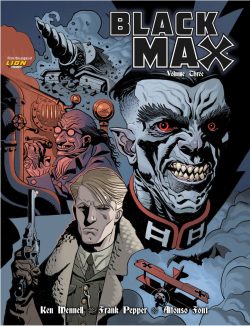
Black Max volume 3


By Frank S. Pepper, Ken Mennell, Alfonso Font & various (Rebellion Studios)
ISBN: 978-1-83786-102-6 (TPB/Digital edition)

This book includes Discriminatory Content produced in less enlightened times.

Win’s Christmas Gift Recommendation: Astoundingly Eerie Air Ace Action… 8/10

It’s time for another sortie down memory lane for us oldsters and, hopefully a frolic down a new, untrodden path for fans of the fantastic in search of a traditionally quirky British comics experience. This compelling compilation is another stunning nostalgia-punch from Rebellion’s superb, ever-expanding Treasury of British Comics, concluding the exotic, esoteric episodic exploits of seminal shocker Black Max: another darkly sparkling gem from our crown jewels of weird kids’ comics… and yes, there’s a strong argument that the readers were as wild and whacko as the strips we loved…

This sinister selection delivers the last gasps of the unsavoury war criminal of the skies, and includes rare-for-the-era crossover with another strip star. Black Max debuted in the first issue of Thunder and more than ran the distance: surviving cancelation and merger, soaring on into Lion & Thunder which finally gave up the ghost mid-decade. This third volume carries the last wave of those stories, covering 15th January to October 21st 1972 with the aviation excitement augmented by a brace of longer yarns taken from Thunder Annual 1974.

The series was typical of the manner in which weekly comics functioned back then: devised by screenwriter, veteran editor and prolific scripter Ken Mennell (Cursitor Doom, Steel Claw, The Spider and many more), with the first episode limned by the company’s star turn for mood and mystery, Eric Bradbury (Invasion, The Black Crow, Cursitor Doom, House of Dolman, Hookjaw and dozens more). The whole kit and kaboodle was then handed off to another team to sink or swim with, which they did until 1973: a pretty respectable run for any British comic feature…

In many ways, the attrition rate of British strips bore remarkable similarities to WWI casualty figures, but this serial was well-starred. The assigned follow-up writer was Frank S. Pepper. who began his legendary comics career in 1926. By 1970, he had clocked up many major successes including Dan Dare, Rockfist Rogan, Captain Condor, Jet-Ace Logan and Roy of the Rovers to name but a very, very few. Series illustrator Alfonso Font was a 10-year veteran – mostly for overseas publications – when he succeeded Bradbury. Based in Spain, Font had worked not just for Odhams/Fleetway but on strips for US outfits Warren and Skywald and continental classics such as Historias Negras (Dark Stories), Jon Rohner, Carmen Bond, Bri D’Alban, Tex Willer, Dylan Dog, Clark & Kubrick: Spiritualists Inc., Taxi, Héloise de Montfort and more…

Episodic by nature and generally delivered in sharp, spartan 3-page bursts, by the time of these trench warfare and skyborne tales, the premise and key characters were firmly established and Pepper & Font were growing bolder and more experimental…

In 1917, Germany and her allies were slowly losing the Great War. In the Bavarian schloss of Baron Maximilien von Klorr, the grotesque but brilliant scientist/fighter ace devised a horrific way to tip the scales back in favour of his homeland. His extremely ancient family had, for millennia, enjoyed an almost affinity with bats, and the current scion had bred giant predatory versions he controlled by various means – including magic amulets and telepathy. These flew beside him to terrify and slaughter the hated English. Initially, they had been a secret weapon used sparingly, but by this juncture allied soldiers and aviators knew well this other form of death from the skies…

His schemes were imperilled and countered on a weekly basis by young British pilot Tim Wilson. Originally a performer in a peacetime flying circus, the doughty lad was possibly the best acrobatic aviator on the Western Front and his constant clashes with von Klorr and the colossal chiropterans constantly frustrated the manic monster master…

Now, with Wilson’s superiors fully aware of the fearsome bioweapons, and thanks to the peasant’s constant interference, the Baron devotes an astonishing amount of time and effort to killing the English fighter ace… when not butchering Allied fliers and ground troops in vast numbers.

The odds seemed to shift once von Klorr began mass-producing his monsters, but Wilson eventually gained the upper hand: driving “Black Max” out of his castle HQ and into a hidden facility where the vile villain retrenched and made bigger, better terrors…

As lengthy, multi-part serials became the standard, the human fliers’ private duel expanded to include many veteran English Aces, infiltrating traitors into the Royal Flying Corps, brainwashing and torturing prisoners, steering zeppelins on civilian raids, and kidnapping British animal scientist Professor Dutton to improve the strength of his killer beasts…

Always, however, the Baron is foiled by his inability to ignore or avoid Wilson: a mistake that scuttles his grand schemes and costs him dearly…

Down but never out, the Baron returns to successful strategies and familiar killing fields, but suffers another reversal when Wilson discovers his current laboratory base. With only one giant bat left and his resources exhausted, Von Klorr relocates to a deserted aerodrome to consider his options and is shocked to receive a message from his grandfather. The terrifying patriarch of the “bat clan” has knowledge spanning millennia and reveals he has unearthed an ancient potion to recreate the “great Kingbat!”

Thanks to more timely interference from Tim, the killer beast attacks both German and British lines, necessitating an unprecedented alliance of the sworn enemies. Wilson is completely ready for von Klorr to betray him, but is still taken unawares when the moment comes as they kill the rampaging terror…

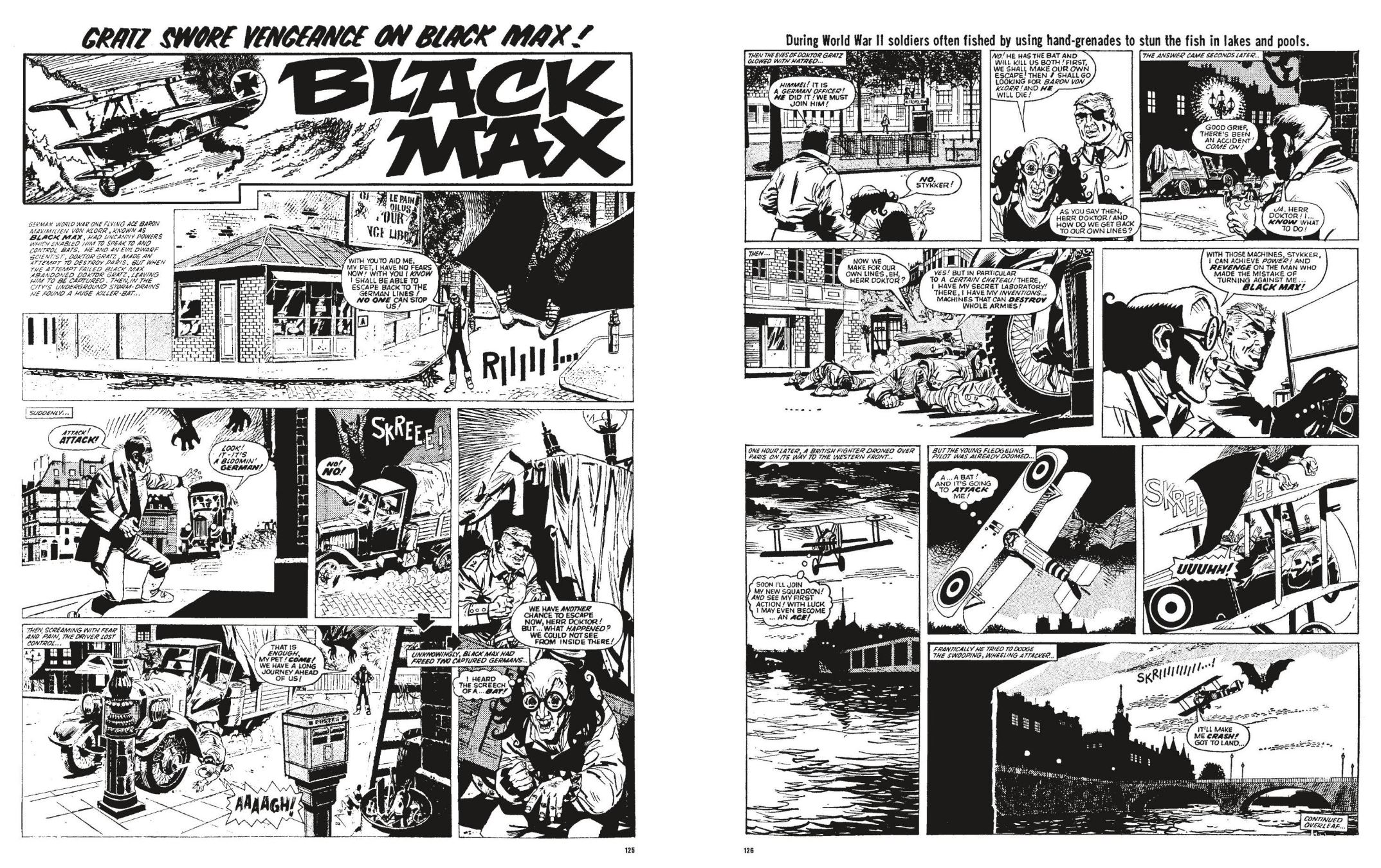
Here and now, it’s mere weeks after the crisis, and business as usual in the skies over Europe. As brave men shoot at each other, Von Klorr is almost court-martialled by his own leaders, but responds by secretly unleashing his last killer bat in defiance of the generals. It leads to a shocking meeting with another German freak and outcast every bit as nefarious and deranged as the Baron. Doktor Gratz is a towering intellect and supergenius in a warped, stunted body as proved by the mighty mole machine he travels under the earth in and the whirlwind weapon he uses to smash ships from the sky. He hates the British too and knows a fellow fiend when he sees one…

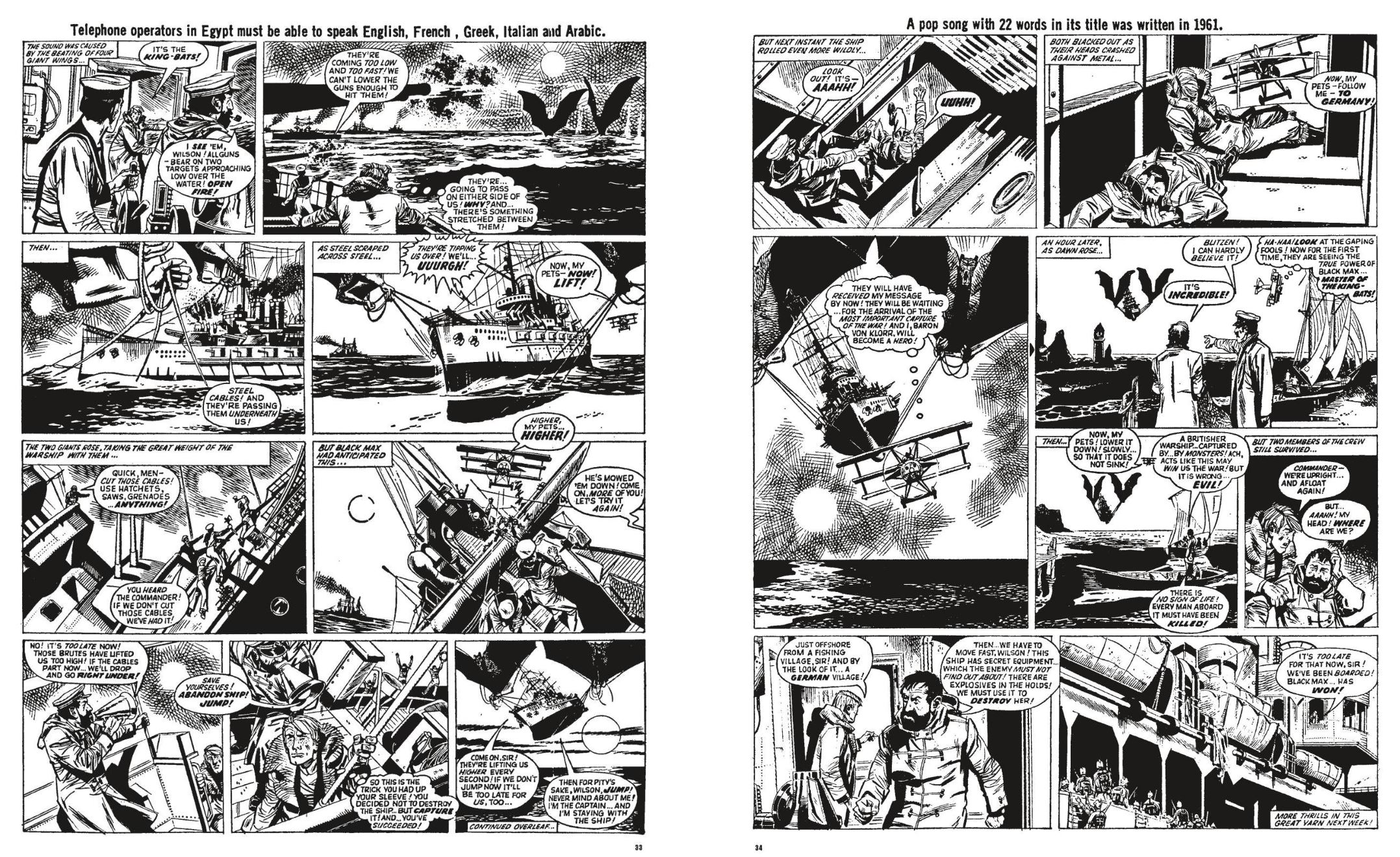
Soon they are attacking the allies and making a real dent, but Herr Doktor is keeping secrets from his partner. Sadly for them, Wilson is dogging their trail and prevents Gratz gaining his true objective, whilst exposing his perfidy to the furious Baron. The upshot is a sundered alliance, but Von Klorr does regain the trust of the generals which he uses – with his grandfather’s aid – to unleash more colossal Kingbats. His scheme is incredible in its audacity: employing the monsters to sink a British naval flotilla, capture an entire experimental battleship and imprison its crew…

Once again, it’s Wilson to the rescue, infiltrating a German internment camp to spring the sailors before leading the cruiser’s recovery in the face of the very worst the Kingbats can do. Von Klorr, meanwhile, has found even more uncanny allies in the form of an ancient race of subterranean bat-men dwelling unsuspected under the French countryside. These he controls with an amulet, but the sentient horrors are more than happy to kill humans…

Nearby, opportunistic Doktor Gratz reemerges and negotiates a truce with the Baron in anticipation of killing more enemy soldiers. Soon the macabre coalition is pushing back the Allied advance and all looks very bleak, but Wilson has a plan…

Defeated again and in retreat, Black Max and Gratz launch a new terror weapon – sinister “ghost planes” – but once more their subtle trickery is exposed, but not before the human devils unleash an assassination plot against French leaders and attack Paris in force with a legion of flying monsters. The build-up of months climaxes with relentless pursuit as the Germans abandon all schemes in a vengeful effort to kill the British flier, but as chaos mounts they reach too far…

In a rare event the series came to a fitting conclusion here and although the Baron was declared dead, Gratz did very well out of these walk-on appearances: he won his own spin-off series once Black Max ended. Uncomfortably entitled Secrets of the Demon Dwarf, it ran in Lion from October 28th 1972 to March 17th 1973 (plus annual and specials) as the mad scientist accidentally stranded himself in the 1970s and sought revenge for losing two World Wars and presumably just the one World Cup. Font did some of most expressive and inventive work on the feature, but I suspect Rebellion won’t be archiving this series any time soon…

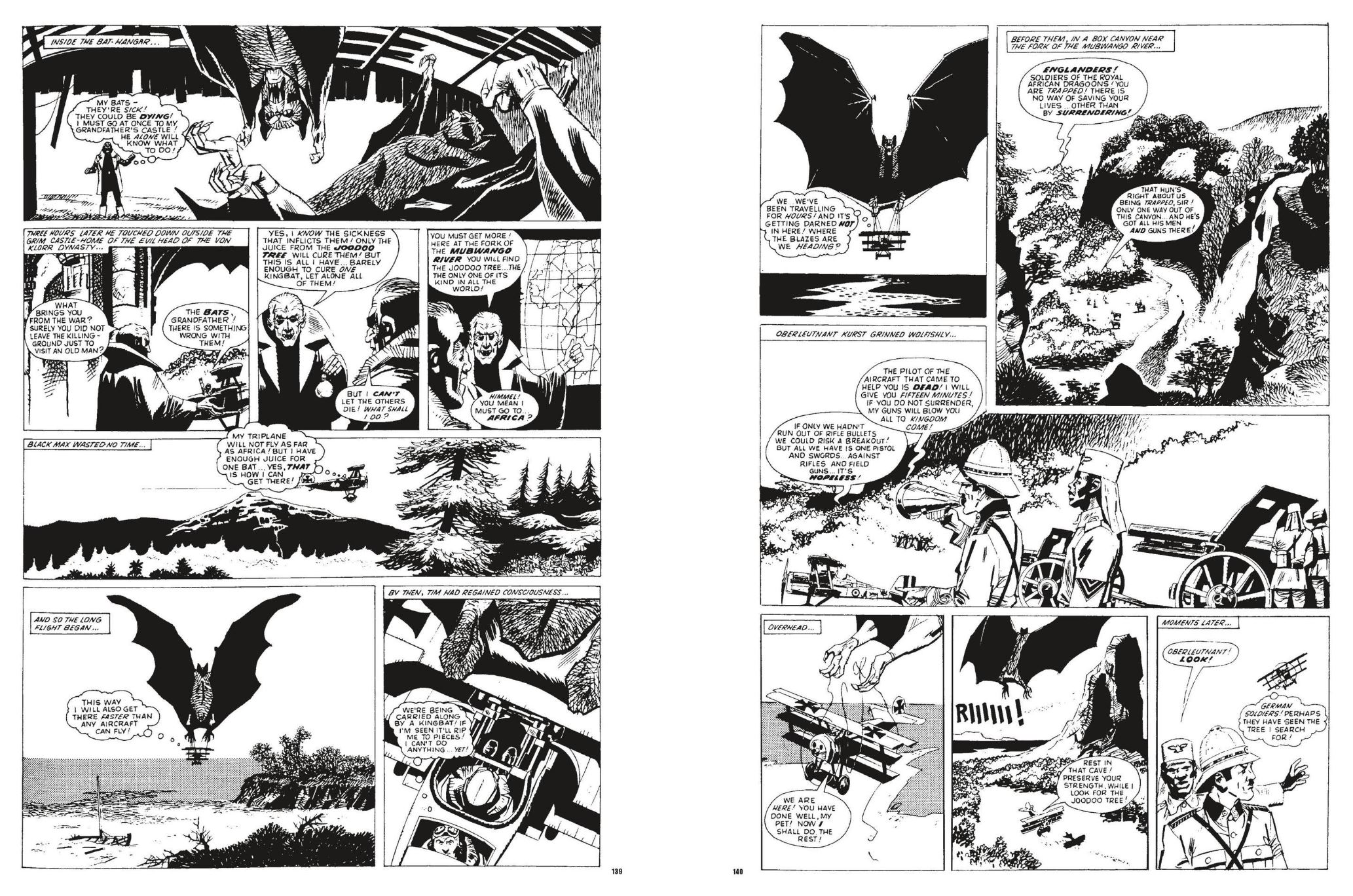
As previously stated, this closing collection also includes two complete adventures from Thunder Annual 1974: one in prose and illustrated by an artist unknown and a final furious comics foray. The text tale saw Von Klorr visiting a Serbian castle to bolster failing Austrian forces only to fail due to Tim Wilson, whilst the final flight sees the true Brit following the Baron to Africa in search of ingredients to make a potion that might save his dying Kingbats from a dire disease…

These strip shockers are amongst the most memorable and enjoyable exploits in British comics: smart, scary and beautifully rendered. This a superb example of war horror that deserves to be revived and revered.
© 1972, 1973 & 2024 Rebellion Publishing IP Ltd. Black Max and all related characters, their distinctive likenesses and related elements are ™ Rebellion Publishing Ltd. All Rights Reserved.

Gary Gianni’s MonsterMen and Other Scary Stories


By Gary Gianni with William Hope Hodgson, Robert E Howard, Clark Ashton Smith, Percival Landon: lettered by Sean Konnot & Todd Klein (Dark Horse Books)
ISBN: 978-1-50670-480-7 (TPB) eISBN: 978-1-50670-481-4

This book includes some Discriminatory Content included for dramatic effect.

The tradition of extraordinary individuals banding together or even acting individually to confront night terrors and supernatural predators probably extends further back than even Gilgamesh or Beowulf. However, it really came to the fore once bards and skalds were rendered obsolete by cheap printing, mass literacy and pulp publishing. Action, crime, weird science and the supernatural all became strange bedfellows in service to monthly (sometimes fortnightly) blood-&-thunder adventures, with the best of the bunch still sneaking out the odd exploit nearly a century later…

The sublime stuff of legend in both story and illustrations has beguiled many a latecomer (Chaykin, Steranko, Wrightson and Kaluta first come to mind) but the absolute doyen of those that followed is Gary Gianni. Born in the Windy City in 1954, he graduated from the Chicago Academy of Fine Arts in 1976 and subsequently worked as a courtroom sketch artist, in network television and as an illustrator for the Chicago Tribune before breaking into comics with modern Classics Illustrated adaptations of Tales of O. Henry and 20,000 Leagues under the Sea.

This led him to Dark Horse Comics’ licensed titles with stints on The Shadow and Indiana Jones (…and the Shrine of the Sea Devil), with other strip work including Tarzan, Tom Strong and Batman. In 2004 he replaced John Cullen Murphy, becoming the third official artist on Prince Valiant, limning the epic Sunday feature until March 25th 2012. His book illustration work includes Savage Tales of Solomon Kane, Bran Mak Morn: The Last King, George R.R. Martin’s A Song of Ice and Fire prequel A Knight of the Seven Kingdoms, Ray Bradbury’s Nefertiti-Tut Express and Michael Chabon’s Gentlemen of the Road.

Always busy and much in demand, Gianni nevertheless managed to create a number of linked serial sorties concerning a mystery-solving ghostbusters, most of which originally appeared in the back of Hellboy titles (specifically Hellboy Christmas Special, Wake the Dead, The Wild Hunt #5-6, Almost Colossus), plus a solo one-shot The MonsterMen: The Skull and the Snowman. The other material filling this scare package all come from The Dark Horse Book of Monsters; the Dead; Hauntings & Witchcraft

Set in the golden-hued yet shadowy environs of America’s pulp past, the tales are witty, elegant thematic pastiches of rip-roaring thriller-chiller masterworks – including early Batman yarns – and are preceded by a whimsical ‘Foreword by Gary Gianni’ and effusive ‘Introduction by Michael Chabon’.

The far too few exploits of The MonsterMen open with ‘Silent as the Grave’ as first seen in Hellboy: Wake the Dead #1-5, revealing a secret organisation who insert themselves in weird events such as the disappearance of actress Julia Adler, strange murder of her lover and inexplicable appearance of ghost images on the latest rushes of maverick director Larry St. George. Doggedly pursued by savvy reporter Sunset Lane, the famed movie maven has a dark unpleasant personal pestilence, but uses it for good, like battling occult whacko monster-wrangler Crulk beside sartorial nightmare/immortal mystic warrior monk Benedict(us) of the Venerable Guild of Corpus Monstrum. The pair are almost insufficient when the fiendish forces behind the plot go on the attack.

Almost…

A shorter, lighter yarn follows in ‘Autopsy in B-Flat’ (Hellboy: Almost Colossus#1-2) as, whilst laboriously exhuming a suspect, Benedict is regaled by an old exploit of his comrade: a tropical island mystery involving monstrous, seductive creatures and pirates who can’t stay dead, that nearly proves his distracting end during the current case…

‘A Gift for the Wicked’ (Hellboy Christmas Special) finds the odd couple cleaning an old dark house of unwanted tenants at the supposedly happiest time of the year – albeit with a little festive assistance – before ‘The Skull and the Snowman’ sees Sunset Lane despatched from a Tibetan Lamasery, carrying a cursed object to the Corpus Monstrum, just as Crulk returns to bedevil Benedict, begging aid to escape marauding Puttyfoons dogging his misshapen steps…

As reality goes wild and the modern metropolis roils under ancient satanic scourgings, all parties converge on the skull (still trying to get out of Tibet) and the power it promises. The quest draws out a legion of terrors and concludes with shocking revelations about two of the world’s most infamous monsters…

The comics cavorting concludes with a staggeringly eccentric and beautiful horror romp as ‘O Sinner Beneath Us’ (Hellboy: The Wild Hunt #5-6) channels Little Nemo in Slumberland in a classic unearthly child tale, with new recruits Sunset and Crulk taking pole positions for a wild chase for the salvation of innocence and retrieval of the ghastly Mustacchio Demoniac…

The Other Scary Stories section of this timeless terror tome offers classic pulp horror prose spectacularly illustrated and illuminated by Gianni, opening with a masterful vignette by William Hope Hodgson as ‘The Gateway of the Monster’ details the crushing fears and tragic outcomes generated by a haunted room in an English country house… and what celebrated spirit photographer Carnacki the Ghost Breaker must endure to end the appalling threat it poses…

It’s followed by the author’s stand-alone nautical tale ‘A Tropical Horror’, detailing the last voyage of the SS Glen Doon out of Melbourne, relentlessly and systematically stripped of its crew by a sea thing both ravenous and pitiless.

Wry, sardonic humour infuses a seductive tale of a powerful woman who takes what she wants in Clark Ashton Smith’s Mother of Toads’, before Robert E. Howard’s horror western ‘Old Garfield’s Heart’ proves he wasn’t all about bulging thews and swinging swords. He could mix a mood as well as any horror master and inspire some potent illustration too…

Wrapping up the bedtime reading is one last period ghost story of haunted houses and murderous rooms imaginatively illuminated, as ‘Thurnley Abbey’ by Percival Landon, all sealed down with a lavishly illumined ‘Biography’.

Madcap, frenzied, skilfully constructed and just plain fun, MonsterMen and Other Scary Stories is stuffed with astounding imagery, packed with incidental iniquities such as zombie cowboys, squid corsairs, abominable snowmen, spectral skulls, movie phantoms, dark dragons and flabby flying demons, all delivered in snippets of smartly nostalgic nonsense. This is kids’ stuff for adults and there’s simply not enough of it, so get what there is while you can, fright fans!
Gary Gianni’s MonsterMen and Other Scary Stories™ © 1996, 1997, 1999, 2003, 2004, 2005, 2006, 2009, 2012, 2017 Gary Gianni. Introduction © 2012, 2017 Michael Chabon. All rights reserved. All other material ™, © or ® respective holders and owners.

The Phantom – the complete newspaper dailies: volume Three 1939-1940


By Lee Falk, Ray Moore & Wilson McCoy: introduction by Mike Bullock (Hermes Press)
ISBN: 1-932563-61-X (HB/Digital edition)

This book includes Discriminatory Content produced in less enlightened times.

Born Leon Harrison Gross, Lee Falk created the Ghost Who Walks at the request of his King Features Syndicate employers who were already making history, public headway and loads of money with his first strip sensation Mandrake the Magician. Although technically not the first ever costumed champion in comics, The Phantom became the prototype paladin to wear a skin-tight body-stocking and the first to have a mask with opaque eye-slits…

The generational champion debuted on February 17th 1936, in an extended sequence pitting him against an ancient global confederation of pirates. Falk wrote and drew the daily strip for the first two weeks before handing over illustration to artist Ray Moore. The spectacular and hugely influential Sunday feature began in May 1939.

For such a long-lived, influential series, in terms of compendia or graphic collections, “the Ghost Who Walks” was quite poorly served in the English language market (except in the Antipodes, where he has always been accorded the status of a pop culture god). Many companies have sought to collect strips from one of the longest continually running adventure serials in publishing history, but in no systematic or chronological order and never with any sustained success. That has been rectified recently by archival specialists Hermes Press who launched curated collections in 2010 which have made almost all the various canonical iterations accessible to the devoted.

This third landscape Dailies edition is currently only available digitally. Released in 2011, its pages are stuffed with sumptuous visual goodies like panel and logo close-ups, covers and lots of original art and opens with ‘Introduction: The Phantom and I’: a memories-rich text feature stuffed with sumptuous visual goodies from author/musician and uber-fan Mike Bullock before the vintage blood-&-thunder fun begins with exotic thriller ‘The Mysterious Girl’ (originally running Mondays to Saturdays, May 8th to September 2nd 1939).

Roaming Alexandria in plainclothes, the Ghost Who Walks interrupts a brutal abduction, but the jewel-bedecked victim doesn’t want his help or even to talk about it. Persistent and curious, The Phantom investigates further and learns she is currently amnesiac; terrified and being stalked by sleezy Count Pharos, who claims to be her guardian. When the rogue convinces “Miss Banks” to take a sea voyage with him, the Phantom and his faithful wolf Devil join the jaunt. Before long the heroes are apparently lost at sea, before the memory-afflicted maiden is also disappeared. Hard to kill, The Phantom trails the Count and finds a second abducted prisoner. Young Baron Marshall Dufresne is Pharos’ real ward and his imprisonment and wealth are what really concern the villain, particularly as the lad loves a girl named Merle and is prepared to sign a suicide note leaving everything to Pharos in return for her safety.

Of course, all those sneaky plans come unstuck once the Phantom decides to step in and stop the plot, but not before almost dying in many shocking ways as Pharos and his hulking henchman Red flee with the Phantom in spectacular hot pursuit, The chase ends in justice and Merle’s memories – and reputation – restored. Fast-paced, packed with peril and introducing a truly unique character in the bulky shape of Hannah – a fight-loving domestic servant who is The Phantom’s physical equal in fisticuffs – this epic exploit is sublimely frenetic fun, and segues seamlessly into ‘The Golden Circle’ (September 4th 1939 to January 20th 1940) as the hero’s true love resurfaces. Wealthy American adventurer Diane Palmer was made a nervous wreck by her time with The Phantom and has, for many months, believed him dead. Her doctors advised the masked man to go along with the sham for her sake…

The recuperating heiress has been unsuccessfully wooed by airman Lieutenant Byron, but when the Phantom checks in and finds her still pining for him, checks out again. The example inspires the pilot, who cables the hero to tell him Diana has agreed to become Mrs. Byron…

Enraged and jealous the hero returns to the hospital but finds her already gone. After dealing with Byron, The Phantom chases, catches and re-bonds with Diana. Sadly, that only generates a truly insurmountable problem as Diana’s snooty mother declares the masked peasant unworthy of her daughter. They can only wed if he gets a real job…

Chained to generations of duty and by his vow to oppose evil, the lovers are seemingly parted forever, and soon after in France the heartbroken hero is targeted by a mother/daughter con team and framed for murder. His frantic escape exposes another all-woman criminal gang plundering the world and The Phantom barely escapes the many traps and tribulations of the insidious organization The Golden Circle…

With war in Europe and the epic battle against the Circle ended, the subplot of Diana returns as Mama Palmer finally admits that all the men she’s pushed at her distraught daughter have not passed muster. Running from January 22nd to July 27th) ‘The Seahorse’ sees the dowager advertise for a suitable son-in-law with the result that Diana is feted, charmed, courted and ultimately kidnapped by scurrilous Count Danton. Naturally, The Phantom is not far away, but is he solely motivated by jealousy or does the fact that Danton is the foremost and deadliest enemy agent in the western hemisphere impact the hero’s incredible actions in winning her back?

Crucially, will clearing Diana of espionage charges and accusations of treason make The Phantom a more eligible suitor in Mama’s eyes?

This volume concludes with ‘The Game of Alvar’ (July 27th
to December 14th 1940) as the reunited lovers enjoy a little downtime together… but only until they stumble onto a canny smuggling operation and Dian is targeted by a deadly assassin running a private murder-island. Naturally the Ghost Who Walks rushes to her aid, but the sinister Mr. Alvar has the entire police force and civil authorities on his payroll. Ultimately, this time it’s Diana who takes up arms, saves the day and restores honourable government to the oppressed, even if The Phantom does latterly land a blow or two…

The saga pauses for now with a few more images taken from The Phantom Big Little Books – another treat long overdue for resurrection.

Stuffed with chases, cruises, air and submarine clashes, assorted fights, torture, action antics, daredevil stunts and many a misapprehension – police and government authorities clearly having a hard time believing a pistol-packing masked man with a pet wolf might not be a bad egg – this is sheer gripping pulp-era excitement that still packs a punch and many sly laughs.
© 2011 King Features Syndicate, Inc.: ® Hearst Holdings, Inc.; reprinted with permission. All rights reserved.

The A-Z of Marvel Monsters


By Jack Kirby, Dick Ayers, Stan Lee, Larry Lieber & various (Marvel)
ISBN: 978-1-3029-0863-8 (HB/Digital edition)

Win’s Christmas Gift Recommendation: Fan Smash! … 9/10

This book includes Discriminatory Content produced in less enlightened times.

To dyed-in-the-wool comic book fanboys there’s a much beloved period in history when a frankly daft and woefully formulaic trend produced utter, joyous magic. We look back on it now and see only the magnificent art, or talk with loving derision of the crazy (and frequently onomatopoeic) names, but deep down we can’t shake the exuberant thrill inside or the frisson of emotion that occurs when we see or even think of them.

Before Jack Kirby & Stan Lee brought superheroes back to Marvel Comics, the company was on its last legs. Locked into a woefully disadvantageous distribution deal, the company’s output was limited to some sixteen genre titles. But there was hope…

The outside, mainstream, world was currently gripped in an atomic B-movie monster craze, so Lee, Kirby and Steve Ditko dutifully capitalised on it in their anthology mystery titles Journey into Mystery, Strange Tales, Tales to Astonish and Tales of Suspense. In an unending procession of brief inspirational novelettes, dauntless or canny or just plain outsider humans outsmarted a succession of bizarre aliens, mad scientists, an occasional ghost or sorcerer (this was, after all, the heyday of the Comics Code Authority when any depiction of the supernatural was BAD) and a horde of outrageous beasties in a torrent of wonders best described by the catchphrase “monsters-in-underpants.”

Simplistic, moralistic, visually experimental yet reassuringly predictable in narrative, these Outer Limits-style yarns were – and still are – the epitome of sheer unrelenting fun with no redeeming social context required. Marvel have increasingly celebrated that fact in recent years (even folding most of the yarns into their modern multiversal continuity) and – over the course of one month – commissioned a line of 26 “Kirby Monster” variant covers for their periodical releases, all lovingly crafted by a number of top names to highlight the treasured contribution of beasties, things and what-nots…

This volume gathers those images in a handy hardcover primer (and eBook edition) whilst gloriously gilding the lily with a splendid selection of a few of the original mini-epics as created from those pre-Marvel Age masterpieces. The short sharp surprise is suitably augmented by ‘Jack Kirby, Atlas Comics & Monsters!’: a 1994 Introduction from the King himself.

The next bit’s another shopping-list moment, so if you want to skip ahead a little, I shouldn’t be at all surprised…

Augmented by the original cover of each diabolical debut, the worshipful A to Z art-section opens with Erica Henderson’s reinterpretation of ‘The Awesome Android!’ (as first seen in Fantastic Four #15) and rapidly follows up ‘The Blip!’ by Simon Bisley, and ‘The Crawling Creature!’, delineated by Maguerite Sauvage. An extreme late entry in the Kirby-Kritter Circus, ‘Devil Dinosaur!’ launched in his own title in 1978 and his moody reprise from Matthew Wilson is followed by Jeff Lemire’s take on ‘Elektro!’ and ‘Fin Fang Foom!’ – first seen in Strange Tales #89, and rendered here by Walter Simonson & Laura Martin.

Michael & Laura Allred depict latter-day cellulose celluloid star ‘Groot!’ (originating in Tales to Astonish #13), before Francesco Francavilla highlights ‘The Hypno-Creature!’, Paolo Rivera revisits Fantastic Four #24’s weird menace ‘The Infant Terrible!’ and Glenn Fabry regales us with an Asgardian god battling ‘The Jinni Devil!’ in a scene that didn’t make it into 1967’s Thor #137…

Dave Johnson details a key point in the life of ‘Kraa the Unhuman!’ before John Cassaday & Matthew Wilson illuminate the depredations of ‘Lo-Karr, Bringer of Doom!’, after which Geof Darrow whisks us back to Thor #154 to meet again amalgamated atrocity ‘Mangog!’

Kirby’s astounding 1976 Eternals series produced many incredible images, with Paul Pope & Shay Plummer selecting 2,000 feet tall Space God ‘Nezarr the Calculator!’ to set the pulses racing, whilst Mike del Mundo plumps for Strange Tales #90’s ‘Orrgo!’ and James Stokoe recalls Strange Tales of the Unusual #1 (December 1956)’s forgotten fiend ‘Poker Face!’

Recurring FF foe ‘The Quonian!’ first appeared in Fantastic Four #97 and wows again here thanks to Christian Ward, after which Eric Powell previews ‘Rommbu!’ and Tradd Moore pits Ant-Man against Tales to Astonish #39 terror ‘The Scarlet Beetle!’ before Chris Bachalo & Tim Townsend show us the power of ‘Thorr!’ Chris Samnee & Wilson expose the fervent ferocity of Journey into Mystery #63’s undersea goliath ‘Ulvar!’ and Arthur Adams & Chris Sotomayor hark back to Tales to Astonish #17 to focus on ‘Vandoom’s Monster’ after which one last FF antagonist features as Cliff Chiang reveals ‘The Wrecker’s Robot!’ as seen in Fantastic Four #12.

Wrapping up this astounding alphabet are Dan Brereton’s rendition of ‘Xemnu!’ and Phil Noto’s depiction of ‘The Yeti!’ who battled Kirby’s Black Panther in #5 before Tony Moore & John Rauch hilariously conclude the countdown with alien outlaw ‘Zetora’.

Okay. Maybe a few of those spooky stalwarts might have been from a later era and star in superhero sagas, but the influence and intent was clearly seen throughout and just sets the tone for the Kirby-crafted fearsome fantasy-fest that follow…

The family-friendly monster mash – featuring scripts by Lee and Larry Lieber with Dick Ayers inking – opens with ‘I Learned the Dread Secret of The Blip!’ (Tales to Astonish #15, January 1961) wherein an openminded radar operator attempts to assist a stranded alien energy being. ‘I Dared to Battle the Crawling Creature!’ comes from TtA #22 (August 1961) as a scrawny High School nerd travels into the bowels of the Earth to face a primitive predator, whilst an aging electronicist creates and eventually counters would-be computerised conqueror ‘Elektro! He Held the World in his Iron Grip!’ (Tales of Suspense #19, January 1961).

The hideous Hypno-Creature harried a very human hero in extra-dimensional invasion epic ‘I Entered the Dimension of Doom!’ (ToS #23, November 1961) whilst facing hulking atomic victim ‘Kraa the Unhuman!’ (ToS #18, June 1961) proves the making of a timid American teacher…

A sunken stone head on a Pacific Island proved to be big trouble when explorers awakened ancient alien invaders in ‘Here Comes… Thorr the Unbelievable’ (Tales to Astonish #16, February 1961) and the origins of Defenders villain Xemnu the Titan are exposed in ‘I Was a Slave of the Living Hulk!’ (Journey into Mystery #62, November 1960) whilst one hapless human proves to be the perfect hideout for extraterrestrial fugitive Zetora in ‘The Martian Who Stole My Body!’, as seen in JiM #57 (March 1960).

Foolish, fabulous, thrill-packed, utterly intoxicating and unforgettable, these are fun-filled tales no puny human could possibly resist.
© 1956-1961, 2017 Marvel Characters Inc. All rights reserved.

Mandrake the Magician: Fred Fredericks Sundays volume 1 – The Meeting of Mandrake and Lothar


By Lee Falk & Fred Fredericks (Titan Books)
ISBN: 978-1-78276-692-6 (HB/Digital edition)

This book includes Discriminatory Content produced during less enlightened times.

Time for another Birthday briefing as we exploit the month of mystery and imagination to celebrate 90 glorious years for another Golden Age stalwart…

Regarded by many as comics’ first superhero, Mandrake the Magician debuted as a daily newspaper strip on 11th June 1934 – although creator Lee Falk had sold the strip almost a decade previously. Initially drawing it too, Falk replaced himself as soon as feasible, allowing the early wonderment to materialise through the effective understatement of sublimely solid draughtsman Phil Davis. An instant hit, Mandrake was quickly supplemented by a full-colour Sunday companion page from February 3rd 1935.

Falk – as 19-year-old college student Leon Harrison Gross – had sold the strip to King Features Syndicate years earlier, but asked the monolithic company to let him finish his studies before dedicating himself to it full time. Schooling done, the 23-year-old born raconteur settled into his life’s work, entertaining millions with astounding tales. Falk also created the first costumed superhero in moodily magnificent generational manhunter The Phantom, going on to spawn an entire comic book subgenre with his first creation. Most Golden Age publishers boasted at least one (and usually many) nattily attired wizards in their gaudily-garbed pantheons: all roaming the world(s) making miracles and crushing injustice with varying degrees of stage legerdemain or actual sorcery.

Characters like Mr. Mystic, Ibis the Invincible, Sargon the Sorcerer, and an assortment of  the Magician”’s like Zatara, Zanzibar, Kardak proliferated ad infinitum: all borrowing heavily and shamelessly from the uncanny exploits of the elegant, enigmatic man of mystery gracing the world’s newspapers and magazines. In the Antipodes, Mandrake was a suave and stalwart regular of Australian Women’s Weekly and became a cherished icon of adventure in the UK, Australia, Italy, Brazil, Germany, Spain, France, Turkey and across Scandinavia: a major star of page and screen, pervading every aspect of global consciousness.

Over many decades he has been a star of radio, movie chapter-serials, a theatrical play, television and animation (as part of series Defenders of the Earth). With that has come the usual merchandising bonanza of games, toys (including magic trick kits), books, comics and more…

Falk worked on Mandrake and “The Ghost who Walks” until his death in 1999 (even on his deathbed, he was laying out one last story), but also found a few quiet moments to become a renowned playwright, theatre producer and impresario, as well as an inveterate world-traveller. After drawing those first few strips Falk united with sublimely polished cartoonist Phil Davis, whose sleekly understated renditions took the daily strip, and especially the expansive full-page Sunday pages (collected in companion volume The Hidden Kingdom of Murderers), to unparalleled heights of sophistication. Davis’ steadfast, assured realism was the perfect tool to render the Magician’s mounting catalogue of spectacular miracles. Soon the Magician was a major star of page & screen, pervading all aspects of global consciousness as hinted at in a furore of fact features and massed memorabilia treats, beginning with introductory essay ‘The Real Mandrake the Magician’. This discusses real-life stage magician Leon Mandrake – who shared the evocative sobriquet in the mid-20th century – as revealed courtesy of his son Lon. Next on the bill is an appreciation of Davis’ inspired replacement as illustrator, in ‘Fred Fredericks – My Mandrake Artist’ by Andreas Erikson, with incisive exploration of Harold “Fred” Fredericks, who took over art production when Davis died and who ultimately assumed full creative duties when Falk himself passed on in 1999. This briefing covers that his tenure and includes his prodigious pre- and post-Mandrake comics work.

Those in the know are well aware that Mandrake was educated at the fabled College of Magic in Tibet, thereafter becoming a suave globe-trotting troubleshooter. Always and everywhere he was accompanied by African partner-in-crimefighting Lothar and, from early on, capable companion (eventually, in 1997, bride) Princess Narda of Cockaigne. Together they solved mysteries and fought evil. Those exploits took the close-knit team literally everywhere, and the strips section of this luxury monochrome landscape hardback opens on ‘Traveler’s Tale’ which ran from March 21st to August 22nd 1965 and saw the last episodes illustrated by Davis, before his death in 1964 from a heart attack.

The saga sees Mandrake in the arctic, where iceberg-watching leads to the recovery of an apparent alien in a survival capsule. A physical and mental marvel, while slowly awakening Opolo deduces not just the English language but also that he’s been in hibernation for 60,000 years. He goes on to reveal that he’s actually from Earth, albeit part of a space-faring race that preceded Homo Sapiens. He’s also pining for his estranged true love Adrana, and Mandrake is happy to help him find her and the long buried civilisation they both came from and are the last survivors of…

Incredibly, along the way, the magician also solves an ancient murder mystery and plays cupid to the reunited survivors, before seeing them abandon their birthworld for the stars…

Always well in tune with contemporary zeitgeists – like sci fi and spy fi – Falk dipped into the growing well of supervillains monopolizing book shelves and airwaves by next reviving Mandrake’s personal arch-nemesis as ‘The Cobra Returns’ (August 29th 1965 – April 3rd 1966). The sinister savant was once Mandrake’s tutor at The College of Magic and here begins a globally destabilising assassination spree, provoking crime busting agency Inter-Intel to call in the Magician and his crew to consult. Sadly, the ploy only makes the perfidious plotter turn his full murderous attentions on our heroes, in an escalating series of attacks that ultimately end in a spectacular showdown and apparent end of the evil one…

With global stability secured, organised crime goes wild, and the miracle trio are kept busy helping the good guys crack down on mobsters in ‘The Underworld vs. Inter-Intel’ (April 10th – August 7th 1966), after which ‘The Astro Pirates’ (August 14th – December 25th 1966) highlights a modern spin on an old racket…

When bold bandits begin holding up airliners in the stratosphere they foolishly pick a jet carrying Narda, and a fully-engaged Mandrake and Lothar spare no effort to end the sinister sky-jinks, after which – inspired by the “Great Northeast Blackout” of November 5th 1965 – Falk & Fredericks fill us in on ‘The Blackout Caper’ (January 1st – April 23rd 1967), as a mad scientist teams up with mobsters to use darkness and chaos to get rich quick and fulfil even nastier nuclear ambitions but underestimate the power of the mighty magician…

Fredericks was a liberal and civil rights proponent, and had for months been subtly changing the “happy, loyal native” appearance of the African globetrotter to match the acts and character Falk had been crafting for years. The process was completed with a reboot of their first adventure together spanning April 30th – September 24th. ‘The Meeting of Mandrake and Lothar’ relates how the practically superhuman prince of reclusive kingdom “the 12 Nations” joins Mandrake in stopping crazed fugitive Mad Dog Dill, before abdicating all monarchical responsibilities to fight evil everywhere. However, returning to the present, shocks abound as Lothar agrees to helm his people’s transition to democracy by becoming their president, just as Mandrake and Narda are targeted by a manic gambler turned master-villain.

‘The Game of Chance’ (October 1st 1967 – February 11th 1968) soon sees Lothar return to aid in the comeuppance of devious blackmailer, kidnapper and influence-peddler Baron Chance and, prior to a resurgence of full-on fantasy, returns in ‘Invasion of the Babu’ (February 18th – July 21st 1968). No stranger to space adventure, Mandrake and Co are best friends with Magnon and Carola, Emperor and Empress of the Central Galaxy and benign rulers of one million worlds. The humans were there when the potentates had their baby Nardraka, and, as dutiful “godparents”, pull out all the stops when the toddler princess is abducted by barbaric invaders the Baboos.

Sadly for them, the apelike alien aggressors make a string of mistakes, beginning with hiding the hostage on even more barbaric Earth, continuing with trying to outsmart Mandrake and closing with believing Nardraka is “just” a stupid little female…

With one crisis resolved, Mandrake barely survives the renewed attentions of the Baron as ‘Second Chance’ (July 28th – November 3rd 1968) sees the magician and Inter-Intel hunt the murderous malefactor to his hidden island fortress and strike a major blow against organised crime, after which ‘The All or Nothing Hunt’ (November 10th 1968 – March 30th 1969), heralds the arrival of alien gamblers Alpha and Beta, who have made the mage their next obsession. Hiding a planet-eradicating bomb on Earth, the wagerers expect the wonder wizard to traverse the globe, deciphering clues to deactivate it. Of course, the extraterrestrials don’t play fair, but Mandrake isn’t playing at all…

No good deed goes unpunished, however, and ‘The Galactic Rumble’ (April 6th – September 7th 1969) reveals that Alpha and Beta are intergalactic crime lords with millions of thugs now indulging in an intergalactic gang war Magnon’s military and peacekeepers are helpless to stop. Isn’t it time to call in some consultants with the know-how to fight them on their own terms?

Yes it is, and not even exploding stars and marauding star dragons can long slow them down…

Ending the show are ‘The Fred Fredericks Mandrake the Magician Complete Sunday Checklist (1965-2002)’, plus full biographies of Fred Fredericks and Lee Falk. This thrilling tome offers exotic locales, thrilling action, bold belly laughs, cunning crime action and sheer wonder in equal measure. Paramount taleteller Falk instinctively knew from the start that the secret of success was strong and, crucially, recurring villains to test and challenge his heroes, and make Mandrake an unmissable treat for every strip addict. These stories have lost none of their impact and only need you reading them to concoct a perfect cure for the 21st century glums.
Mandrake the Magician © 2018 King Features Syndicate. All Rights Reserved. All other material © 2018 the respective authors or owners.

Superman: The Silver Age Dailies volume 3 – 1963-1966


By Jerry Siegel & Wayne Boring (IDW Publishing/Library of American Comics)
ISBN: 978-1-6134-0179-4 (HB)

his book includes Discriminatory Content produced during less enlightened times.

The American comic book industry – if it existed at all – would be utterly unrecognisable without Superman. Jerry Siegel & Joe Shuster’s unprecedented invention was fervidly adopted by a desperate and joy-starved generation and quite literally gave birth to a genre if not an actual art form. Spawning an army of imitators and variations within three years of his 1938 debut, the intoxicating blend of breakneck, breathtaking action and wish-fulfilment which epitomised the early Man of Steel grew to encompass cops-&-robbers crimebusting, socially reforming dramas, sci fi fantasy, whimsical comedy and, once the war in Europe and the East sucked in America, patriotic relevance for a host of gods, heroes and monsters, all dedicated to profit through exuberant, eye-popping excess and vigorous dashing derring-do.

From the outset, in comic book terms Superman was master of the world. Moreover, whilst transforming the shape of the fledgling funnybook biz, the Man of Tomorrow irresistibly expanded into all areas of the entertainment media. Although we all think of the Cleveland boys’ iconic invention as epitome and acme of comics creation, the truth is that very soon after his springtime debut in Action Comics #1 the Man of Steel was a fictional multimedia monolith in the same league as Popeye, Tarzan, Sherlock Holmes and Mickey Mouse.

We parochial and possessive comics fans too often regard our purest and most powerful icons in purely graphic narrative terms, but the likes of Batman, Spider-Man, X-Men, Avengers and their hyperkinetic kind long ago outgrew their four-colour origins and are now fully mythologized modern media creatures instantly familiar in mass markets, across all platforms and age ranges…

Far more people have seen and heard the Man of Steel than have ever read his comic books. His globally syndicated newspaper strips alone were enjoyed by countless millions, and by the time his 20th anniversary rolled around, at the very start of what we know as the Silver Age of Comics, he had been a thrice-weekly radio serial star, headlined a series of astounding animated cartoons, become a novel attraction (written by George Lowther) and helmed two films and his first smash, 8-season live-action television show. He was a perennial sure-fire success for toy, game, puzzle and apparel manufacturers and in his future were even more shows (Superboy, Lois & Clark, Smallville, Superman & Lois), a stage musical, franchise of blockbuster movies and almost seamless succession of games, bubble gum cards and TV cartoons. These started with The New Adventures of Superman in 1966 and have continued ever since. Even superdog Krypto got in on the small-screen act…

Although pretty much a spent force these days, for the majority of the previous century the newspaper comic strip was the Holy Grail that all American cartoonists and graphic narrative storytellers hungered for. Syndicated across the country – and often the planet – it was seen by millions, if not billions, of readers and generally accepted as a more mature and sophisticated form of literature than comic-books. It also paid better.

And rightly so: some of the most enduring and entertaining characters and concepts of all time were created to lure readers from one particular paper to another and many of them grew to be part of a global culture. Mutt and Jeff, Flash Gordon, Dick Tracy, Buck Rogers, Charlie Brown and so many more escaped their humble tawdry newsprint origins to become meta-real: existing in the minds of earthlings from Albuquerque to Zanzibar. Most still do…

The daily Superman newspaper comic strip launched on 16th January 1939, supplemented by a full-colour Sunday page from November 5th of that year. Originally crafted by luminaries like Siegel & Shuster and their studio (Paul Cassidy, Leo Nowak, Dennis Neville, John Sikela, Ed Dobrotka, Paul J. Lauretta & Wayne Boring), the mammoth task required the additional talents of Jack Burnley and writers like Whitney Ellsworth, Jack Schiff & Alvin Schwartz. The McClure Syndicate feature ran continuously until May 1966, appearing at its peak, in over 300 daily and 90 Sunday newspapers; a combined readership of more than 20 million. Eventually, Win Mortimer and Curt Swan joined the unflagging Boring & Stan Kaye whilst Bill Finger and Siegel provided stories, telling serial tales largely divorced from comic book continuity throughout years when superheroes were scarcely seen.

Then in 1956 Julie Schwartz kicked off the Silver Age with a new Flash in Showcase #4 and before long costumed crusaders began returning en masse to thrill a new generation. As the trend grew, many publishers began to cautiously dabble with the mystery man tradition and Superman’s newspaper strip began to slowly adapt: drawing closer to the revolution on the comicbook pages. As Jet-Age gave way to Space-Age, the Last Son of Krypton was a comfortably familiar icon of domestic America: particularly in the constantly evolving, ever-more dramatic and imaginative comic book stories which had received such a terrific creative boost when superheroes began to proliferate once more. The franchise had been cautiously expanding since 1954 and by 1961 Superman was seen not only in Golden Age survivors Action Comics, Superman, Adventure Comics, World’s Finest Comics and Superboy, but also in Superman’s Pal Jimmy Olsen, Superman’s Girlfriend Lois Lane and Justice League of America. Such increased attention naturally filtered through to the more widely-read newspaper strip and resulted in a rather strange and commercially sound evolution…

This third and final  hardback collection (encompassing November 25th 1963 to its end on April 9th 1966) opens with a detailed Introduction from Sidney Friedfertig, disclosing the provenance of the strips; how and why Siegel was tasked with repurposing recently used and soon to be published scripts from comic books; making them into daily 3-and-4 panel black-&-white continuities for an apparently more sophisticated, discerning newspaper audience.

It also offers a much-needed appreciation of the author’s unique gifts and contributions…

If you’re a veteran comic book fan, don’t be fooled: the tales “retold” here might seem familiar but they are not rehashes: they’re variations and deviations on an idea for audiences seen as completely separate from the kids who bought comic books. Even if you are familiar with the traditional source material, the serialised yarns here will read as brand new, especially as they are gloriously illustrated by Wayne Boring at the peak of his illustrative powers.

After a few years away from the feature, Boring had returned to replace his replacement Curt Swan at the end of 1961, regaining the position of premiere Superman illustrator to see the series to its demise. Moreover, as the strip drew to a close many strip adaptations began appearing prior to the “debut” appearances in the comics. As an added bonus, the covers of the issues these adapted stories came from have been included as a full, nostalgia-inducing colour gallery…

Siegel & Boring’s astounding everyday entertainments recommence with Episode #145, ‘The Great Baroni’ (November 25th to September 14th 1963), revealing how the Caped Kryptonian helps an aging stage conjuror regain his confidence and prowess. It’s based on a tale by Siegel & Al Plastino from Superboy #107 (which had a September 1963 cover-date).

‘The Man Who Stole Superman’s Secret Life’ (December 16th 1963 to 1st February 1964 as first seen in Superman #169, May 1964, by Siegel & Plastino) was a popularly demanded sequel to the story where the Man of Tomorrow lost his memory and powers, but fell in love.

When his Kryptonian abilities returned he returned to his regular life, unaware that he had left heartbroken Sally Selwyn behind. She thought her adored Jim White had died…

Now as Clark investigates a crook who is a perfect double for Superman, he stumbles into Sally and a potentially devastating problem…

Episode #147 – February 3rd to March 9th – saw the impossible come true as ‘Lex Luthor, Daily Planet Editor’ (by Leo Dorfman, Swan & George Klein from Superman #168 April 1964) reveals how the criminal genius flees to 1906 and lands the job of running a prestigious San Francisco newspaper – until a certain Man of Tomorrow tracks him down…

March 9th saw Clark, Jimmy Olsen and Lois Lane begin ‘The Death March’ (originally an Edmond Hamilton & Plastino tale from Jimmy Olsen #76, April 1964): an historical recreation turned agonisingly real after boss Perry White seemingly has a breakdown. Of course, all is not as it seems…

‘The Superman of 800 Years Ago’ has a lengthy pedigree. It ran in newspapers from April 6th to May 18th but was adapted from an unattributed, George Papp illustrated story, ‘The Superboy of 800 Years Ago’. That debuted in Superboy #113 (June 1964), and was in turn based upon an earlier story limned by Swan & Creig Flessel from Superboy #17 at the end of 1951. Here a robotic Superman double is unearthed at a castle in Ruritanian kingdom Vulcania, so our inquisitive hero time-travels back to the source to find oppressed people and a very familiar inventor. Suitably scotching the plans of a usurping scoundrel, he leaves a clockwork champion to defend democracy in the postage stamp feudal fiefdom…

‘Superman’s Sacrifice’ was the 150th daily strip sequence, running from May 18th to June 20th (adapted from a Dorfman & Plastino thriller first seen in Superman #171, August 1964). Here the Man of Steel is blackmailed by advanced alien gambling addicts Rokk and Sorban, who want to wager on whether Superman will kill an innocent. If he doesn’t, they will obliterate Earth. The callous extraterrestrials seem to have all the bases covered and, even when the Metropolis Marvel thinks he’s outsmarted them, the wicked wagerers have an ace in the hole…

It’s followed by another tale from the same issue wherein Hamilton & Plastino first described ‘The Nightmare Ordeal of Superman’ (June 22nd – July 25th) wherein the Action Ace voyages to another solar system just as its power-bestowing yellow sun novas into red. Deprived of his mighty powers, our hero must survive a primitive world, light-years from home; battling cavemen and monsters until rescue comes in a most unlikely fashion…

The author of ‘Lois Lane’s Love Trap’ was unattributed, but the tale was drawn by Kurt Schaffenberger when seen in Superman’s Girlfriend Lois Lane # 52 (October 1964). As reinterpreted here by Siegel& Boring (July 27th to August 22nd) however, it tells how Lois and Clark travel to the rural backwoods to play doctor and cupid for diffident lovers, after which August 24th to October 10th depicts ‘Clark Kent’s Incredible Delusions’ (seen in comic books in Superman #174, January 1965 by Hamilton, Swan, Plastino & Klein).

Incredible incidents begin after a visitor to the Daily Planet casually reveals he is secretly Superman. Not only does he have the powers and costume, but Clark cannot summon his own abilities to challenge the newcomer. Can Kent have been hallucinating for years? The real answer is far more complex and confusing…

A tip of the hat to a popular TV show follows as a deranged actor trapped in a gangster role kidnaps Lois and her journalistic rival, determined to prove her companion is a mobster and ‘The “Untouchable” Clark Kent’ (October 12th – November 7th): a smart caper transformed by Siegel from a yarn by Dorfman, Swan & Klein in Superman #173 November 1964.

‘The Coward of Steel’ (Siegel & Plastino, Action Comics #322, March 1965) ran November 9th to December 19th, revealing how Superman’s pipsqueak act becomes all-consuming actuality after aliens ambush the hero with a fear ray.

The year changed as Lois went undercover to catch a killer in ‘The Fingergirl of Death’ (Superman’s Girlfriend Lois Lane # 55 by Otto Binder & Schaffenberger; February 1965), reinterpreted here by Siegel & Boring from December 21st 1964 to January 23rd.

‘Clark Kent in the Big House’ – January 25th to March 6th – by Binder & Plastino was seen in Action #323 April 1965 and saw Clark in a similar situation: covertly infiltrating a prison to get the goods on an inmate. Sadly, once he’s there the warden has an accident and nobody seems to recognise Kent as anything other than a crook getting his just deserts…

There was more of the same in ‘The Goofy Superman’ (March 8th to April 12th, taken from Robert Bernstein & Plastino’s tale from August 1963’s Superman #163). This time though, Red Kryptonite briefly makes Clark certifiably insane. After he is committed and gets better, he sticks around to clear up a few malpractices and injustices at the asylum before heading home. A different K meteor causes extremely selective amnesia ‘When Superman Lost His Memory’ (from April 14th to May 22nd and originally by Dorfman, Swan & Klein from Superman #178 July 1965). This time the mystified Man of Steel must track down his own forgotten alter ego…

‘Superman’s Hands of Doom’ was the 160th strip saga, running May 24th through June 26th, as adapted from a Dorfman & Plastino thriller in Action #328 (September 1965). It detailed the cruelly convoluted plans of big-shot crook Mr. Gimmick who tries to turn Superman into an atomic booby trap primed to obliterate Metropolis, after which a scheming new reporter uses dirty tricks to make her mark at the Planet, landing ‘The Super Scoops of Morna Vine’ (June 28th– August 21st) through duplicity, spying, cheating and worse in a sobering tear-jerker first conceived and executed by Dorfman, Swan & Klein in Superman #181, November 1965.

The comic book version of ‘The New Lives of Superman’ – by Siegel, Swan & Klein – didn’t appear until Superman #182 in January 1966, but the Boring version (such an unfair name for a brilliant artist!) ran in papers from August 23rd – October 16th 1965: detailing how Clark has an accident which would leave any other man permanently blind. Not being ordinary, Superman had to find another secret identity and hilariously tries out being a butler and disc jockey before finding a way for Clark to return to reporting…

Something like the truly bizarre ‘Lois Lane’s Anti-Superman Campaign’ was seen in SGLL #55 (Dorfman & Schaffenberger, January 1966). As reinterpreted by Siegel & Boring for an adult readership from October 18th to December 18th, the stunts produced for the Senatorial race between her and Superman are wild and whacky (and could never happen in real American politics, No Sirree Bob Roberts!), even if 5th Dimensional pest Mr. Mxyzptlk is behind it all. (and wouldn’t that be a comforting reason for the last year of campaigning…)

Running December 20th 1965 through January 8th 1966, as adapted from a Dorfman & Pete Costanza thriller in Superman #185 (which eventually saw full-colour print in April 1966), ‘Superman’s Achilles Heel’ offers a slick conundrum as the Man of Might must wear a steel box on his hand after losing his invulnerability in one small area of his Kryptonian anatomy. The entire underworld tries to get past that shield, but nobody really thinks the problem through…

The end of the hallowed strip series was fast approaching, but it was business as usual for Siegel & Boring who exposed over January 10th through February 26th ‘The Two Ghosts of Superman’ (Binder & Plastino from Superman #186, May 1966) as our hero goes after crafty criminal charlatan Mr. Seer. Fanatical fans might be keen to see the cameo here from up-&-coming TV superstar Batman before the curtain comes down…

The era ended with another mystery. ‘From Riches to Rags’ (Dorfman & Plastino from Action Comics #337, May 1966) has Superman compulsively acting out a number of embarrassing roles – from rich man to poor man to beggar-man and so forth. Spanning February 28th to April 9th, it sees a hero at a complete loss until his super-memory kicked in and recalled a moment long ago when a toddler looked up into the night sky…

Superman: The Silver Age Dailies 1963-1966 is the last of three huge (305 x 236 mm), lavish, high-end hardback collections starring the Man of Steel and a welcome addition to the superb commemorative series of Library of American Comics which has preserved and re-presented in luxurious splendour such landmark strips as Li’l Abner, Tarzan, Rip Kirby, Polly and her Pals and many of the abovementioned cartoon icons. If you love the era or just crave simpler stories from less angst-wracked times these yarns are great comics reading, and this is a book you simply must have…
Superman ™ & © 2014 DC Comics. All Rights Reserved.

Superman – The Silver Age Dailies volume 2:1961-1963


By Jerry Siegel, Wayne Boring, Curt Swan & Stan Kaye with Otto Binder, Leo Dorfman, Edmond Hamilton, Bill Finger & Robert Bernstein (IDW Publishing Library of American Comics)
ISBN: 978-1-6137-7923-1 (HB)

This book includes Discriminatory Content produced in less enlightened times.

The American comic book industry – if it existed at all – would be an utterly unrecognisable thing without Superman. Jerry Siegel & Joe Shuster’s unprecedented invention was fervidly adopted by a desperate and joy-starved generation and quite literally gave birth to a genre if not an actual art form. Spawning an army of imitators and variations within three years of his 1938 debut, the intoxicating blend of breakneck, breathtaking action and wish-fulfilment which epitomised the early Man of Steel grew to encompass cops-&-robbers crimebusting, socially reforming dramas, sci fi fantasy, whimsical comedy and, once the war in Europe and the East sucked in America, patriotic relevance for a host of gods, heroes and monsters, all dedicated to profit through exuberant, eye-popping excess and vigorous dashing derring-do.

From the outset, in comic book terms Superman was master of the world. Moreover, whilst transforming the shape of the fledgling funnybook biz, the Man of Tomorrow irresistibly expanded into all areas of the entertainment media. Although we all think of the Cleveland boys’ iconic invention as epitome and acme of comics creation, the truth is that very soon after his springtime debut in Action Comics #1 the Man of Steel was a fictional multimedia monolith in the same league as Popeye, Tarzan, Sherlock Holmes and Mickey Mouse.

We parochial and possessive comics fans too often regard our purest and most powerful icons in purely graphic narrative terms, but the likes of Batman, Spider-Man, X-Men, Avengers and their hyperkinetic kind long ago outgrew their four-colour origins and are now fully mythologized modern media creatures instantly familiar in mass markets, across all platforms and age ranges…

Far more people have seen and heard the Man of Steel than have ever read his comic books. His globally syndicated newspaper strips alone were enjoyed by countless millions, and by the time his 20th anniversary rolled around, at the very start of what we know as the Silver Age of Comics, he had been a thrice-weekly radio serial star, headlined a series of astounding animated cartoons, become a novel attraction (written by George Lowther) and helmed two films and his first smash, 8-season live-action television show. He was a perennial sure-fire success for toy, game, puzzle and apparel manufacturers and in his future were even more shows (Superboy, Lois & Clark, Smallville, Superman & Lois), a stage musical, franchise of blockbuster movies and almost seamless succession of games, bubble gum cards and TV cartoons. These started with The New Adventures of Superman in 1966 and have continued ever since. Even superdog Krypto got in on the small-screen act…

Although pretty much a spent force these days, for the majority of the previous century the newspaper comic strip was the Holy Grail that all American cartoonists and graphic narrative storytellers hungered for. Syndicated across the country – and often the planet – it was seen by millions, if not billions, of readers and generally accepted as a more mature and sophisticated form of literature than comic-books. It also paid better.

And rightly so: some of the most enduring and entertaining characters and concepts of all time were created to lure readers from one particular paper to another and many of them grew to be part of a global culture. Mutt and Jeff, Flash Gordon, Dick Tracy, Buck Rogers, Charlie Brown and so many more escaped their humble tawdry newsprint origins to become meta-real: existing in the minds of earthlings from Albuquerque to Zanzibar. Most still do…

So it was always something of a risky double-edged sword when a comicbook character became so popular that it swam against the tide (after all, weren’t the funny-books invented just to reprint the strips in cheap accessible form?) to became a genuinely mass-entertainment syndicated serial strip. Superman was the first original comic book character to make that leap – about six months after he burst out of Action Comics – but only a few successfully followed. Wonder Woman, Batman (eventually) and groundbreaking teen icon Archie Andrews made the jump in the 1940s and only a handful like Spider-Man, Howard the Duck and Conan the Barbarian have done so since.

The daily Superman newspaper comic strip launched on 16th January 1939, supplemented by a full-colour Sunday page from November 5th of that year. Originally crafted by luminaries like Siegel & Shuster and their studio (Paul Cassidy, Leo Nowak, Dennis Neville, John Sikela, Ed Dobrotka, Paul J. Lauretta & Wayne Boring), the mammoth task required the additional talents of Jack Burnley and writers like Whitney Ellsworth, Jack Schiff & Alvin Schwartz. The McClure Syndicate feature ran continuously until May 1966, appearing at its peak, in over 300 daily and 90 Sunday newspapers – a combined readership of more than 20 million. Eventually, Win Mortimer and Curt Swan joined the unflagging Boring & Stan Kaye whilst Bill Finger and Siegel provided stories, telling serial tales largely divorced from comic book continuity throughout years when superheroes were scarcely seen.

Then in 1956 Julie Schwartz kicked off the Silver Age with a new Flash in Showcase #4 and before long costumed crusaders began returning en masse to thrill a new generation. As the trend grew, many publishers began to cautiously dabble with the mystery man tradition and Superman’s newspaper strip began to slowly adapt: drawing closer to the revolution on the comicbook pages. As Jet-Age gave way to Space-Age, the Last Son of Krypton was a comfortably familiar icon of domestic America: particularly in the constantly evolving, ever-more dramatic and imaginative comic book stories which had received such a terrific creative boost when superheroes began to proliferate once more. The franchise had been cautiously expanding since 1954 and by 1961 Superman was seen not only in Golden Age survivors Action Comics, Superman, Adventure Comics, World’s Finest Comics and Superboy, but also in Superman’s Pal Jimmy Olsen, Superman’s Girlfriend Lois Lane and Justice League of America. Such increased attention naturally filtered through to the more widely-read newspaper strip and resulted in a rather strange and commercially sound evolution…

This second expansive hardback collection (spanning August 1961 to November 1963) opens with a detailed Introduction from Sidney Friedfertig, explaining the provenance of the strips; how and why Jerry Siegel was tasked with retuning recently published yarns from comic books; making them into daily 3-&-4 panel black-&-white continuities for an apparently more sophisticated and discerning newspaper audience. This frequently required major rewrites, subtle changes in plot, direction and tone and – on occasion – merging more than one funnybook story into a seamless new exploit to excite and amuse sensible, mature grown-ups.

If you’re a veteran fan, don’t be fooled: the tales retold here might seem familiar, but they are not simple rehashes: they’re variations and deviations on an idea for a readership perceived as completely separate from kids’ comics. Even if you are familiar with the original source material, the adventures here will read as brand new, especially as they’re gloriously illustrated by Boring (with a little occasional assistance from Swan) at the very peak of his artistic powers. After years away from the feature Boring had replaced his replacement Swan at the end of 1961, regaining his position as premiere Superman strip illustrator to see the series to its eventual conclusion. As an added bonus the covers of the issues the adapted stories came from have been included as a full, nostalgia-inducing colour gallery…

The astounding everyday entertainments by Siegel & Boring commence with Episode #123 from August 14th to September 16th, 1961 revealing how meek Clark Kent mysteriously excels as a policeman whilst wearing a legendary old cop’s lucky tin star in ‘The Super Luck of Badge 77!’: based on one of the same name by Otto Binder & Al Plastino from Superman #133 (November 1959). Running in papers from September 18th to 5th November and first seen in Superman #126 (January 1959 by Binder, Boring & Stan Kaye) ‘Superman’s Hunt for Clark Kent’ details how a Kryptonite mishap deprives the hero of his memories, leaving him lost in Metropolis and trying to ferret out the secret of his other identity, before Episode #125 – November 6th to December 23rd – finds a restored Clark as ‘The Reporter of Steel’ (once a Binder, Boring & Kaye yarn from Action Comics #257, October 1959), wherein Lex Luthor very publicly inflicts the mild-mannered journalist with unwanted superpowers, setting Lois Lane off on another quest to prove her colleague is actually a Caped Kryptonian.

‘The 20th Century Achilles’ ran from Christmas Day 1961 through January 20th 1962, adapted from an Edmond Hamilton, Curt Swan & Kaye thriller in Superman #148 (October 1961). It detailed how a cunning crook holds the city hostage to his apparent magical invulnerability whilst ‘The Man No Prison Could Hold’ (January 22nd – February 24th by Finger, Boring & Kaye from Action Comics #248, in January 1959) sees Clark and Jimmy Olsen captured by a Nazi war criminal using slave labour to construct a mighty vengeance weapon. Unbeknownst to all, the Man of Steel has good reason to foil every escape attempt and stay locked up…

An old-fashioned hard lesson informs the Kryptonian Crimebuster’s short, sharp shock treatment of ‘The Three Tough Teenagers’ (February 26th to March 31st and based on a Siegel & Plastino collaboration contemporaneously appearing in Superman #151 (February 1962)). Perhaps the headline-grabbing nature of youth in revolt was too immediate to resist? Usually timing discrepancies in publication dates could be explained by the fact that submitted comic book yarns often appeared months after completion, but here it feels like neither iteration of the franchise was willing to surrender sales-garnering topicality…

Swan illustrated portions of the Siegel/Boring strip version of ‘The Day Superman Broke the Law’ (2nd to 28th April), derived from the original by Finger & Plastino in Superman #153, May 1962. Here, the hero falls foul of a corrupt city councilman rewriting ordinances to hamper him, after which the Kryptonian became ‘The Man with the Zero Eyes’ (30th April to June 2nd from an uncredited tale in Superman #117, November 1957 and first limned by Plastino) as a space virus causes super-freezing rays to uncontrollably erupt from his eyes.

Spanning 4th – 23rd June, ‘Lois Lane’s Revenge on Superman’ grew out of a comedy tale by Siegel, Swan & George Klein in Superman’s Girlfriend Lois Lane #32 (April 1962). For adults, however, there’s a dark edge apparent as the frustrated journalist revels in humiliating her ideal man when a magic potion turns him into a baby…

‘When Superman Defended his Arch-Enemy’ – published from 25th June to August 4th as adapted from Action Comics #292 (September 1962 by writer unknown & Plastino) – sees the Metropolis Marvel acting as defence Counsel for ungrateful mad scientist Luthor after the fleeing maniac dismantles a sentient mechanoid on a world of machine intelligences…

Daily from 6th August to September 8th,‘Lois Lane’s Other Life’ retold Siegel, Swan & Klein’s tale from Superman’s Girlfriend Lois Lane #35 (August 1962) as the dauntless reporter changes her appearance to go undercover but subsequently loses her memory, after which ‘The Feud Between Superman and Clark Kent’ – September 10th to 27th October, and originally crafted by Hamilton & Plastino for Action Comics #292, with a cover-date of October 1962) depicts the two halves of the hero separated by Red Kryptonite. Sadly, the goodness and nobility are all in the merely human Clark part and he must avoid his merciless alternative fraction’s murderous clutches until the effect wears off…

First conceived by Siegel, Swan & Klein (in Superman’s Girlfriend Lois Lane #38, January 1963), ‘The Invisible Lois Lane’ was more comedy than drama, but here filled newspaper pages between October 29th and December 1st as the undetectable investigator quickly sees her quarry switch from Clark to Superman. It takes super-ingenuity to convince her otherwise…

‘The Man Who Hunted Superman’ (December 3rd 1962 to January 19th 1963) originally appeared as Leo Dorfman & George Papp’s Boy of Steel blockbuster ‘The Man Who Hunted Superboy’ in Adventure Comics #303 (December 1962), finding Clark subbing for a prince in a Ruritanian kingdom, complete with adoring and compliant princess bride, until the Action Ace could topple a highly-placed usurper and save the kingdom. Then ‘Superman Goes to War’ (January 21st to February 23rd, initiated by Hamilton, Swan & Klein in Superman #161, May 1963) as Lois and Clark visit a film-set sponsored by the US military and are inadvertently caught up in a real, but unconventional, alien invasion…

From February 25th to April 20th Red K stripped our hero of his powers, leaving ‘The Mortal Superman’ forced to fake it due to an unavoidable prior engagement in a terse reinterpretation of the Dorfman & Plastino yarn seen in Superman #160, April 1963. The Man of Steel, for good and sound patriotic reasons, allows himself to be locked up for the alleged murder of Clark Kent in ‘The Trial of Superman’ (22nd April -May 25th), seen later in its original format as Hamilton & Plastino’s thriller in Action Comics #301, June 1963.

Hardworking, obsessive editor Perry White loses his memory and falls into the clutches of criminals who use his investigative instincts to uncover Earth’s greatest secret in ‘The Man who Betrayed Superman’s Identity’ between 27th May and July 6th (adapted from Dorfman, Swan & Klein’s suspenseful romp in Action Comics #297, February 1963) whilst, with adult sensibilities fully addressed, genuine tragedy and pathos pushes Siegel & Boring’s reworking of ‘The Sweetheart that Superman Forgot’ – running 8th July to August 17th – to the heady heights of pure melodrama as Superman loses his powers, memories, and use of his legs; but meets, falls in love and loses a girl who only wants him for himself. In one of the most adult of stories of his canon, the hero recovers his astounding gifts and faculties but has no notion of what he’s lost and who waits for him forever alone: a depth of emotion the author could only dream of approaching in the Plastino-illustrated original version appearing in Superman #165 (November 1963).

Painfully locked into un-PC, sexist comedy tropes of the era, from August 19th to September 14th comes ‘Superman, Please Marry Me’ wherein a novelty record of Lois purportedly begging her ideal man to give in makes the reporter’s life a living hell in a “tweaked-for-married-readers” yarn based on Siegel, Swan & Klein’s ‘The Superman-Lois Hit Record’ in Superman’s Girlfriend Lois Lane #45 (November 1963). From the same issue, ‘Dear Dr. Cupid’ by Siegel & Kurt Schaffenberger is a light-hearted turn running from September 14th to October 12th detailing how the “news-hen’s” surprising and unsuspected gift for doling out advice as an Agony Auntie leads to a series of disturbing gifts from an unexpected admirer…

The epic escapades conclude with October 14th -November 23rd 1963’s ‘The Great Superman Impersonation’ (based on Robert Bernstein & Plastino’s Action Comics #306, November 1963) with Clark kidnapped by foreign agents who pass him off as the Man of Tomorrow to facilitate the takeover of a Central American republic: big mistake, especially as Superman is in a playful mood…

Superman: – The Silver Age Dailies 1961-1963 is the second of three huge (305 x 236 mm), lavish, high-end hardback collections starring the Action Ace and a welcome addition to the superb commemorative series of Library of American Comics which has preserved and re-presented in luxurious splendour such landmark strips as Li’l Abner, Tarzan, Rip Kirby, Polly and her Pals and many of the abovementioned cartoon icons.

If you love the era, these stories are great comics reading, and this is a book you simply must have – especially as there’s still no sign of any digital editions yet.
Superman ™ & © 2014 DC Comics. All Rights Reserved.

The Adventures of Captain Pugwash: Best Pirate Jokes


By Ian D. Rylett & Ian Hillyard (Red Fox/Random House)
ISBN: 978-1-862-30793-3 (PB)

The problem with pirates is that they don’t know when enough’s enough, so here’s another review to reconnoitre: tangentially celebrating the greatest buccaneer of all…

John Ryan was an artist and storyteller who straddled three distinct disciplines of graphic narrative, with equal qualitative if not financial success.

Born in Edinburgh on March 4th 1921, Ryan was the son of a diplomat, served during WWII in Burma and India and – after attending the Regent Street Polytechnic (1946-48) – took up a post as assistant Art Master at Harrow School from 1948 to 1955. It was during this time that he began contributing strips to Fulton Press publications, in the company’s glossy distaff alternative Girl, but most especially to the pages of legendary “boys’ paper” The Eagle.

On April 14th 1950, Britain’s grey, post-war gloom was partially lifted with the premier issue of a new comic which literally shone with light and colour. Soon, avid excited boys (and girls!) were understandably enraptured with the gloss and dazzle of Dan Dare, Pilot of the Future: the charismatic star-turn venerated to this day and licensed media stars like PC 49

The Eagle was a tabloid-sized paper with full-colour inserts alternating with text and a range of various other comic features. “Tabloid” is a big page and you can get a lot of material onto each one. Deep within, on the bottom third of a monochrome page was an 8-panel strip entitled Captain Pugwash – The story of a Bad Buccaneer and the many Sticky Ends which nearly befell him. Ryan’s quirky, spiky style also lent itself to the numerous spot illustrations required throughout the comic every week.

Pugwash, his harridan (sorry, not my word) of a wife and the useless, lazy crew of the Black Pig ran (or more accurately capered and fell about) until issue #19 when the feature disappeared. This was no real hardship for Ryan who had been writing and illustrating Harris Tweed – Extra Special Agent as a full-page (tabloid, remember, an average of twenty panels a page, per week!) from Eagle #16 onwards (and there’s a lost star and canon well worth revisiting sometime soon). Super sleuth Tweed ran as a page for three years until 1953 when it dropped to a half-page strip and was repositioned as a purely comedic venture…

In 1956 the indefatigable old sea-dog (I mean old Horatio Pugwash but it could so easily be Ryan) made the jump to children’s picture books. He was an unceasing story-peddler with a big family, but somehow also found time to be head cartoonist at The Catholic Herald for forty years.

A Pirate Story was first published by Bodley Head before switching to children’s publishing specialist Puffin for further editions and more adventures. It was the first of a vast (sorry, got away with meself again there!) run of kids’ books on a numerous subjects. Pugwash himself starred in 21 tomes: there were a dozen books based on the animated TV series Ark Stories, plus Sir Prancelot and many more creations. Ryan worked whenever he wanted to in the comics world and eventually his books and strips began to cross-pollinate.

The primary Pugwash is very traditional in format with blocks of text and single illustrations to illuminate a particular moment. But by the publication of Pugwash the Smuggler (1982) entire sequences were lavishly painted comic strips, with as many as eight panels per page, and including word balloons. A fitting circularity to his interlocking careers and a nice treat for us old-fashioned comic drones.

When A Pirate Story was released in 1957 the BBC pounced on the hot property, commissioning Ryan to produce 5-minute episodes: 86 in all from 1957 to 1968 and later reformatted in full colour and rebroadcast in 1976. In the budding arena of 1950s animated television cartoons, Ryan developed a new system for producing cheap, high quality animations to a tight deadline. He began with Pugwash, keeping the adventure milieu, but replaced shrewish wife with a tried-&-true boy assistant. Tom the Cabin Boy is the only capable member of a crew which included such visual archetypes as Willy, Barnabas and Master Mate (fat, thin, tall and all dim), instantly affirming to the rapt, young audience that grown-ups are fools and kids do, in fact, rule.

For eight years Ryan simultaneously drew a weekly Captain Pugwash strip for The Radio Times, going on to produce a number of other animated series including “latch-key” pals Mary, Mungo and Midge, The Friendly Giant and the aforementioned Sir Prancelot. There were also adaptations of his many other children’s books and in 1997 Pugwash was rebooted in an all-new CGI animated TV series.

The first book – A Pirate Story – sets the scene with a delightful clown’s romp as the so-very-motley crew of the Black Pig sail in search of buried treasure, only to fall into a cunning trap set by the truly nasty corsair Cut-Throat Jake. Luckily, Tom is as smart as his shipmates and Captain are not…

A 2008 edition of A Pirate Story from Frances Lincoln Children’s Books came with a free audio CD, and just in case I’ve tempted you beyond endurance here’s a full list of the good (ish) Captain’s exploits that you should make it your remaining life’s work to unearth…

There’s Captain Pugwash: A Pirate Story (1957), Pugwash Aloft (1960), Pugwash and the Ghost Ship (1962), Pugwash in the Pacific (1963), Pugwash and the Sea Monster (1976), Captain Pugwash and the Ruby (1976), Captain Pugwash and the Treasure Chest (1976), Captain Pugwash and the New Ship (1976), Captain Pugwash and the Elephant (1976), The Captain Pugwash Cartoon Book (1977), Pugwash and the Buried Treasure (1980), Pugwash the Smuggler (1982), Captain Pugwash and the Fancy Dress Party (1982), Captain Pugwash and the Mutiny (1982), Pugwash and the Wreckers (1984), Pugwash and the Midnight Feast (1984), The Battle of Bunkum Bay (1985), The Quest of the Golden Handshake (1985), The Secret of the San Fiasco (1985), Captain Pugwash and the Pigwig (1991) and Captain Pugwash and the Huge Reward (1991). These are all pearls beyond price and a true treasure of graphic excellence, so if you feel tempted to go all “Pirate Pokémon”, feel free to get ‘em all….

Although currently, cruelly out of print, Pugwash’s canon (the only sort this band of rapscallions can be trusted with) are widely available through online vendors and should be a prize you set your hearts on acquiring.

As you might expect, such success breeds ancillary projects, and cleaving close to the wind whilst running in the master’s wake is this minor mirthquake no sassy brat could possibly resist. Compiled by Ian D. Rylett and copiously illustrated by Ian Hillyard in stark monochrome, it’s a fairly standard cartoon joke book as beloved by generations of youngsters and loathed beyond endurance by parents, guardians, older siblings and every other adult whose patience is proven quite exhaustible. It’s the book your teacher confiscates in class but never returns at the end of term…

Divided into themed chapters ‘The Captain’s Crackers’, ‘Jakes’ Jests’, ‘Blundering Bucaneers, Hysterics in the Harbour’, ‘Fishy Funnies’ and ‘All Aboard’, the level of wit is almost lethal in its predictability and vintage (Q: why did the irate sailor go for a pee? A: he wanted to be a pirate.) but the relentless pace and remorseless progression are actually irresistible in delivery.

With the world crashing down around us and the water levels inexorably rising, we don’t have that much to laugh at, so why don’t you go and find something to take your minds off the chaos to come? Your kids will thank you and if you’ve any life left in your old and weary soul, you will too…
Pugwash books © 1957-2009 John Ryan and (presumably) the Estate of John Ryan. All rights reserved. Best Pirate Jokes © Britt-Allcroft (Development Ltd) Limited 2000. All rights worldwide Britt-Allcroft (Development Ltd) Limited.

And in case you were wondering…

This book includes Discriminatory Content produced in less enlightened times.

Batman: Silver Age Dailies and Sundays 1968 – 1969


By Whitney Ellsworth, Joe Giella, Al Plastino & various (IDW)
ISBN: 987-1-63140-121-3 (HB)

This book includes Discriminatory Content produced in less enlightened times.

For more than seven decades in America the newspaper comic strip was the Holy Grail cartoonists and graphic-narrative storytellers hungered for. Syndicated across the country and often the planet, winning millions of readers and accepted (in most places) as a more mature and sophisticated form of literature than comic-books, it also paid better, with the greatest rewards and accolades being reserved for the full-colour Sunday page. So it was always something of a poisoned chalice when a comic book character became so popular that it swam against the tide (after all weren’t the funny-books invented just to reprint strips in cheap, accessible form?) and became a syndicated serial strip. Superman, Wonder Woman and Archie Andrews made the jump soon after their debuts and many features have done so since.

Due to war-time complications, the first newspaper Batman and Robin strip was slow getting its shot, but when the Dynamic Duo finally hit the Funny Pages the feature quickly proved to be one of the best-regarded, highest quality examples of the trend, both in Daily and Sunday formats. Yet somehow the strip never achieved the circulation it deserved, even though the Sundays were eventually given a new lease of life when DC began issuing vintage stories in the 1960s for Batman 80-page Giants and Annuals. The exceedingly high-quality all-purpose adventures were ideal short stories and added an extra cachet of exoticism for young readers already captivated by simply seeing tales of their heroes that were positively ancient and redolent of History with a capital “H”.

Such was not the case in the mid-1960s when, for a relatively brief moment, mankind went bananas for superheroes in general and most especially went “Bat-Mad”…

The Silver Age of comic books revolutionised a creatively moribund medium cosily snoozing in unchallenging complacency, bringing a modicum of sophistication to the returning genre of masked mystery men. For quite some time changes instigated by Julius Schwartz in Showcase #4 (October 1956) had rippled out in the last years of that decade, affecting all of National/DC Comics’ superhero characters but had generally bypassed The Gotham Gangbuster. Fans buying Batman, Detective Comics, World’s Finest Comics and latterly Justice League of America would read adventures that in look and tone were largely unchanged from the safely anodyne fantasies that had transformed a Dark Knight Detective into a mystery-solving, alien-fighting costumed Boy Scout just as the 1940s turned into the 1950s.

By the end of 1963, however, Schwartz having, either personally or by example, revived and revitalised the majority of DC’s line (and by extension and imitation, the entire industry) with his reinvention of the Superhero, was asked to work his magic with the creatively stalled and near-cancellation Caped Crusaders. Installing his go-to team of creators, the Editor stripped down the accumulated luggage and rebooted the core-concept. Down – and usually out – went the outlandish villains, aliens and weird-transformation tales in favour of a coolly modern concentration on crime and detection.

Even the art-style underwent a sleek streamlining and rationalisation. The most apparent change to us kids was a yellow circle around the Bat-symbol but, far more importantly, the stories had changed. A subtle aura of genuine menace had crept back in.

At the same time Hollywood was in production of a television series based on Batman and, through the sheer karmic insanity that permeates the universe, the studio executives were basing their interpretation not upon the “New Look Batman” currently enthralling readers but the rather the addictively daft material DC was emphatically turning its editorial back on.

The Batman TV show premiered on January 12th 1966 and ran for three seasons of 120 episodes, usually airing twice weekly in the first two. It was a monumental, world-wide hit and sparked a wave of trendy imitation. Resulting media hysteria and fan frenzy generated an insane amount of Bat-awareness, no end of spin-offs and merchandise – including a movie – and introduced us all to the phenomenon of overkill. No matter how much we might squeal and froth about it, to a huge portion of this planet’s population Batman is always going to be that “Zap! Biff! Pow!” buffoonish costumed Boy Scout…

“Batmania” exploded across Earth and – almost as quickly – became toxic and vanished, but at its height led to the creation of a fresh newspaper strip incarnation. That strip was a huge syndication success and even reached fuddy-duddy Britain, not in our papers and journals but as the cover feature of weekly comic Smash! (from issue #20 onwards).

The TV show ended in March, 1968. As it foundered and faded away, global fascination with “camp” superheroes – and no, the term had nothing to do with sexual orientation no matter what you and Mel Brooks might think – burst as quickly as it had boomed. The Caped Crusader was left with a hard core of dedicated fans and followers who now wanted their hero back…

However, from the time when the Gotham Guardians could do no wrong comes a second superb compilation re-presenting the bright and breezy, sometimes zany cartoon classics of Batman with Robin the Boy Wonder, augmented by a wealth of background material, topped up with oodles of unseen scenes and background detail to delight the most ardent Baby-boomer nostalgia-freak. The fun-fest opens with more informative, picture-packed, candidly cool revelations from comics historian Joe Desris in ‘A History of the Batman and Robin Newspaper Strip: Part 2’: stuffed with behind-the-scenes set photos, communications between principal players like Bob Kane and the Producers, clippings, glorious unpublished pencils from strip illustrator Joe Giella as well as newspaper promotional materials, followed by pictorial essays on ‘Newspaper Strip Trivia’ and ‘Batman/Superman Crossovers’, more unpublished or censored strips and a note on the eclectic sources used to compile this collection before the comics cavorting continue…

Dailies and Sundays were scripted by former DC editor (and the company’s Hollywood liaison) Whitney Ellsworth and initially illustrated by Kane’s long-term art collaborator Sheldon Moldoff, before inker Giella was tapped by the studio to produce a slicker, streamlined modern look – usually as penciller but ALWAYS as embellisher. Since the feature was a 7-day-a-week job, Giella often called in comic book buddies to help lay-out and draw the strip; luminaries like Carmine Infantino, Bob Powell, Werner Roth, Curt Swan and others.

In those days, monochrome Dailies and full-colour Sundays were mostly offered as separate packages and continuity strips often ran different stories for each. For Batman the strip started out that way, but by the time of the stories in this volume had switched to unified 7-day storylines.

Riding a wave and feeling ambitious, Ellsworth & Giella had started their longest saga yet in July 1967, combining the tales of ‘Shivering Blue Max’ with ‘“Pretty Boy” Floy and Flo’, wherein a perpetually hypothermic criminal pilot accidentally downed the Batcopter and erroneously claimed the underworld’s million dollar bounty on Batman and Robin.

Our heroes were not dead, but the crash caused the Batman to lose his memory and, whilst Robin and faithful manservant Alfred sought to remedy his affliction, Max had collected his prize and jetted off for sunnier climes. With Batman missing, neophyte crimebuster Batgirl then tracked down the heroes – incidentally learning their secret identities – and was instrumental in restoring him to action… if not quite his fully-functioning faculties.

However, when underworld paymaster BG (Big) Trubble heard the heroes had returned, he quite understandably wanted his money back, forcing already-broke Max back to Gotham where he gullibly fell foul of Pretty Boy whilst that hip young gunsel and twin sister Flo were enacting a murderous scam to fleece a horoscope-addicted millionaire…

The tale picks up here on January 1st 1968 with Batman held at gunpoint, patiently trying to convince supremely suggestible, wealthy whale Tyrone Koom he is not there to assassinate him as the tycoon’s new astrologer Madame Zodiac (AKA Flo Floy) was insisting she had foreseen. When her minted dupe proves incapable of murder, Flo/Zodiac takes matters into her own hands by knocking out the mighty manhunter, but despite all her and her brother’s arguments, the millionaire cannot be convinced to pull the trigger…

Instead, befuddled Koom – still thinking the masked marvel wants him dead – has Batman bundled off to an isolated island where a fully-automated, exotic palace of wonders will act as the Caped Crusader’s impregnable prison for the remainder of his life. With the hero as good as dead Pretty Boy & Flo plan to claim BG’s million dollar bounty, but have not reckoned on Blue Max horning in…

When the pilot collides with Robin (tracking his senior partner by Bat-Radio) the erstwhile enemies reluctantly join forces but cannot prevent Batman’s banishment. Moreover, in the frantic melee, the Boy Wonder suffers a broken leg. Meanwhile, lost in an endless ocean, Batman slowly adjusts to life of enforced luxury on palatial penitentiary island Xanadu, unaware that life at home has become vastly more complicated for Robin and Alfred. Not only do they believe the Cowled Crimebuster dead but Max has ferreted out their secret identities and blackmailed them into cooperating in his vengeance scheme against Pretty Boy. Max plans to prevent the young thug collecting the reward by impersonating Batman…

Events spiral to a grim climax when Max finally confronts his criminal enemies and Koom realises he’s been played for a fool. The dupe’s guilt-fuelled final vengeance ends all the villains at once, but not before Pretty Boy presses a destruct button that will cause Xanadu to obliterate itself in an atomic explosion.

Thankfully Superman and especially Sea King Aquaman have been mobilised to help find the missing Masked Manhunter but the countdown – although slow – is unstoppable…

During this sequence the severely overworked Giella bowed out and a veteran Superman illustrator took over the pitiless illustration schedule. Alfred John “Al” Plastino was a prodigious artist with a stellar career. He had been active in the early days of comic books, with credits including Captain America and Dynamic Man before serving in the US Army. His design talents were quickly recognised and he was seconded to Grumman Aerospace, The National Inventors Council and latterly The Pentagon, to design war posters and field manuals for the Adjutant General’s office.

In 1948 Plastino joined DC and quickly became one of Superman’s key artists. He drew many landmark stories and – with writer Otto Binder – created Brainiac, Supergirl and The Legion of Super-Heroes. From 1960-1969 he ghosted the syndicated Superman newspaper strip and whilst still drawing Batman, also took over Ferd’nand in 1970, drawing it until his retirement in 1989. He was extremely versatile and apparently tireless. In 1982-1983 he drew Nancy Sundays after creator Ernie Bushmiller passed away and was controversially hired by United Media to produce fill-in episodes of Peanuts when Charles Schulz was in dispute with the company. Al Plastino died in 2013.

With a new policy of introducing guest stars from DC’s pantheon, Plastino was the ideal artist successor and as the assembled champions desperately sought to find and save their missing comrade, a new tone of straight dramatic adventure largely superseded the campy comedy shenanigans of the TV series.

The search for Batman had been continually hampered by the Man of Steel’s strange weakness and loss of powers, but now that the Gotham Gangbusters were reunited they concentrated their efforts on finding out why. The deductive trail soon led to bone fide mad scientist ‘Diabolical Professor Zinkk’ (originally running March 19th to August 6th) and saw the Dynamic Duo tracking down a mercenary maniac who had found a way to broadcast Kryptonite waves and was oh-so-slowly killing Superman for a big payout from Metropolis’ mobsters…

This is a cunningly convoluted, beautifully realised and supremely suspenseful tale with the clock ticking down on a deranged and dying Metropolis Marvel as Batman & Robin hunt rogue radio-physicist Zoltan Zinkk to divine the method by which he brings low Earth’s greatest defender. It culminates in a savage, spectacular and truly explosive showdown before the World’s Finest heroes finally triumph…

Another tense thriller then sees Aquaman return to share the spotlight, beginning with determined “dolly-bird” Penelope Candy perpetually plaguing news outlets and even pestering the Gotham Police Department in a tireless quest to be put in touch with Batman. The man in question is blithely unaware: Bruce Wayne is dealing with a small personal problem. In his infinite wisdom he intends for Robin to temporarily retire whilst young Dick Grayson completes a proper education! To that end has engaged a new tutor for the strongly-protesting Boy Wonder…

With that all acrimoniously settled, the Caped Crimebuster roars out into the night and is filmed falling to his doom in a river trying to save apparently suicidal Penny Candy…

At first the heartbroken sidekick doesn’t know Batman is still alive but has actually been drawn into a Byzantine scheme devised by Penny to find her missing father. Oceanographer Archimedes Candy disappeared after working with Aquaman on a serum allowing humans to live beneath the sea. Penny is certain someone has abducted the researcher and, after Batman contacts Robin, they have the junior crimebuster send out a radio alert for the Sea King, before impatiently trying the potion together. ‘Breathing Underwater’ (August 7th – December 15th), they set off on a sub-sea search for the missing sea scientist…

Of course Penny’s fears of foul play are justified and before long she and Batman are reunited with Dr. Candy. Sadly, that’s as captives of nefarious international smuggler Cap’n Wolf and they are nearly done to death by being abandoned on a mountain in the airy atmosphere they can no longer breathe before Aquaman arrives to settle matters.

Even as Batman makes his way home, the next adventure has started. Gangster fugitive Killer Killey devised the world’s most perfect hiding place and in ‘I Want Bruce Wayne’s Identity!’ (December 15th 1968 – May 30th 1969) abducts the mild-mannered millionaire so a crooked plastic surgeon can swap their faces and fingerprints. The scheme is hugely helped by the fact that Dick has been packed off on a world cruise with tutor Mr. Murphy and his daughter Gazelle whilst Alfred has used accumulated vacation time for an extended visit to England.

When Killer captures Bruce and discovers he also has Batman, the mobster is truly exultant. However the plan goes awry as the victim escapes the death-trap which should have resulted in the authorities finding “Killey’s” drowned body, and the subsequent relocation into Wayne Manor becomes a fraught affair.

Perhaps the villain would be less troubled if he knew that although alive, the real Wayne has once again lost his memory…

Moreover, unbeknownst to anyone, neophyte crimebuster Batgirl already knows Batman’s other identity, and her suspicions are aroused by the state of the mansion and behaviour of Bruce and his new girlfriend…

As events escalate and spiral out of control, Killer – still safely hidden behind Wayne’s face – starts to crack: stupidly antagonising the one person he thought he could always rely on…

This volume’s comics cavortings end with the opening shots of ‘My Campaign to Ruin Bruce Wayne’ (which ran from May 31st – December 25th 1969) but as only seven days of that tale unfold in this volume I think we’ll leave that for the next volume and simply say…

To Be Continued, Bat-Fans…

The stories in this compendium reveal how gentler, stranger times and an editorial policy focusing as much on broad humour as Batman’s reputation as a crime-fighter swiftly returned to all-out action/adventure once Batmania gave way to global overload and ennui. That was bad for the strip at the time but happily resulted in some truly wonderful yarns for die-hard fans of the comic book Caped Crusader. If you’re of a certain age or open to timeless thrills, spills & chills this a truly stunning collection well worth your attention.

Batman: Silver Age Dailies and Sundays 1968-1969 was the second in a set of huge (305 x 236 mm) lavish, high-end hardback collections starring the Dynamic Duo/Trio (and pals!), and a welcome addition to the superb commemorative series of Library of American Comics which has preserved and re-presented in luxurious splendour such landmark strips as Li’l Abner, Tarzan, Little Orphan Annie, Terry and the Pirates, Bringing Up Father, Rip Kirby, Polly and her Pals and many other immortal cartoon icons.

If you love the era, the medium or even just graphic narrative, these are great comics reading, and this is a book you simply must have.

… And maybe one day the compilers will get around to making them all available in digital edition too…
© 2014 DC Comics. All rights reserved. Batman and all related characters and elements ™ & © DC Comics.