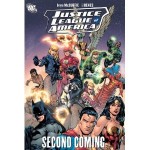
Justice League of America: Second Coming


By Dwayne McDuffie, Ed Benes & various (DC Comics)
ISBN: 978-1-84856-253-0

By the time of the stories in this collection (issues #22-26 of the most recent incarnation of the World’s Greatest Superhero team) writer Dwayne McDuffie has his feet comfortably under the table and begins to play with the secondary characters that always offer the most narrative opportunity in such large congregations of major and minor stars.

Beginning with ‘The Widening Gyre’, illustrated by Ed Benes, he also cleans up some of the longer-running plot threads as the Red Tornado finally gets a new body, after months of inhabiting the JLA computers after being destroyed by the killer android Amazo (see Justice League of America: the Tornado’s Path). Sadly, whilst his relationship with his human wife and child looks set to resume, the tempestuous affair between Red Arrow and Hawkgirl is rapidly spinning out of control and beast-empowered heroine Vixen has finally come clean to her team-mates about her out-of-control abilities, Amazo reveals he is neither gone nor forgotten…

Once more assuming control of the Tornado’s new body in ‘Things Fall Apart’ the parasitic automaton resumes its programmed task of destroying the JLA, but as it again crashes to defeat in ‘The Blood-Dimmed Tide’ (this chapter illustrated by Alan Goldman, Prentis Rollins, Rodney Ramos & Derek Fridolfs), Vixen and guest-star Animal Man realise that something is terribly amiss with their powers, origins and even reality itself…

‘The Best Lack All Conviction’ (with art from Benes, Doug Mahnke, Darick Robertson, Shane Davis, Ian Churchill, Ivan Reis, Christian Alamy, Rob Stull, & Joe Prado) finds one faction of the team tracking down Amazo’s creator whilst the other half are drawn into a reality-warping battle with the trickster god Kwaku Anansi. The mythical creator of all stories claims to have designed Vixen (and Animal Man’s) abilities, and now forces the malfunctioning warrior into curing her current maladies – even if she has to die in the process.

With her comrades re-imagined into a plethora of disturbing alternate incarnations Vixen battles to overcome her own failings and rescue “the Real World” from a creature utterly beyond good and evil, and with a particularly unpleasant method of teaching salutary lessons in the climactic ‘Spiritus Mundi’, a impressive and quirky conclusion from McDuffie and Benes that proves that you don’t need A-List stars to tell great stories…

Sleek, glossy, action-packed and leavened with great characterisation and sharp one-liners, the JLA‘s continuing adventures are still among the very best modern superhero sagas around. If you’re not a fan yet, reading these books will swiftly and permanently alter that reality…

© 2008, 2009 DC Comics. All Rights Reserved.

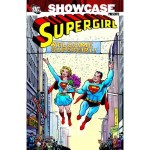
Showcase Presents Supergirl volume 2


By Jerry Siegel, Leo Dorfman, Jim Mooney & various (DC Comics)
ISBN: 978-1-84856-055-0

Superhero comics don’t often do whimsical and thrilling anymore. They especially don’t do short or self-contained. The modern narrative drive concentrates on extended spectacle, major devastation and relentless terror and trauma. It also helps if you’re a hero who has come back from the dead once or twice or wear a combat thong and thigh boots…

Although there’s nothing intrinsically wrong with that, sometimes the palate just craves a different flavour. Once this continued cosmic cataclysm was the exception not the rule, and this second enchanting black and white compendium of the early career of Superman’s cousin Kara Zor-El of Argo City happily displays why.

After a few intriguing test-runs Supergirl began as a future star of the expanding Superman pocket universe in Action Comics #252 (May 1959). Superman’s cousin Kara had been born on a city-sized fragment of Krypton, hurled intact into space when the planet exploded. Eventually Argo City turned to Kryptonite like the rest of the detonated world’s debris, and her dying parents, observing Earth through their scopes, sent their daughter to safety as they perished. Landing on Earth, she met Superman who created the identity of Linda Lee and hid her in an orphanage in small town Midvale whilst she learned of her new world and powers in secrecy and safety.

This second collection, encompassing all the Girl of Steel’s adventures from the back of Action Comics #283 (December 1961) to #321 (February 1965), finds the young heroine still in training, her very existence kept secret from the general public and living with adoptive parents Fred and Edna Danvers – who are also completely unaware that the orphan they have recently adopted is a Kryptonian super-being.

The accent on these stories generally revolves around problem-solving, identity-preserving and loneliness, with both good taste and the Comics Code ensuring that readers weren’t traumatised by unsavoury or excessively violent tales. Such plots, akin to situation comedies, often pertained, as in the first story represented here: ‘The Six Red “K” Perils of Supergirl!’, by Jerry Siegel and regular artist Jim Mooney.

Peculiar transformations were a mainstay of 1960s comics, and although a post-modern interpretation might discern some metaphor for puberty or girls “becoming” women, I rather suspect the true answer can be found in the author’s love of comedy and an editorial belief that fighting was unladylike. Red Kryptonite, a cosmically altered isotope of the radioactive element left when Krypton exploded, caused temporary physical and sometimes mental mutations in the survivors of that doomed world – a godsend to writers in need of a challenging visual element when writing characters with the power to drop-kick planets…

Here the wonder-stuff generates a circus of horrors, transforming Supergirl into a werewolf, shrinking her to microscopic size and making her fat (I’m not going to say a single word…).

The drama continued in the next instalment, ‘The Strange Bodies of Supergirl!’ wherein she grew a second head, gained death-ray vision (ostensibly!) and changed into a mermaid. This daffy holdover to simpler times presaged a big change in the Maid of Might’s status as with the next issue her parents learned her true origins and her existence was revealed to the world in the two-part saga ‘The World’s Greatest Heroine!’ and ‘The Infinite Monster!’ both appearing in issue #285, as Supergirl became the darling of the universe: openly saving the planet and finally getting the credit for it.

Action #286 pitted her against her cousin’s greatest foe in ‘The Death of Luthor!’, whilst ‘Supergirl’s Greatest Challenge!’ saw her visit the Legion of Super-Heroes (quibblers be warned: initially their far-future era was the 21st century. It was quietly retrofitted to a thousand years from “now” after the tales in this volume) and save the Earth from invasion. She also met the telepathic descendent of her cat Streaky. His name was Whizzy (I could have left that out but chose not to – once more for smug, comedic effect…).

‘The Man who Made Supergirl Cry!’ signaled the beginning of Leo Dorfman’s run as scripter. Little is known about this prolific writer, other than he also worked under the name Geoff Brown, producing quality material continuously from the Golden Age until his death in 1974. In this tight little thriller Phantom Zone villains took control of Supergirl’s new dad in a plot to escape their ethereal dungeon dimension, whilst #289’s ‘Superman’s Super-Courtship!’ is something of a classic, as the Girl of Steel scoured the universe for an ideal mate for her cousin. Charming at the time, modern sensibilities might quail at the conclusion that his perfect mate was just like Supergirl herself, but older…

‘Supergirl’s Super Boy-Friends!’ saw both human Dick Malverne and Atlantean mer-boy Jerro catch super-powers after kissing her (I’m again saying nothing here) whilst she didn’t actually become ‘The Bride of Mr. Mxyzptlk!’ when the fifth dimensional prankster transferred his unwanted attentions to her in Action #291.

An extended storyline began in the next issue when the girl got a new “pet”. ‘The Super-Steed of Steel!’ was a beautiful white horse who helped her stave off an alien invasion, but the creature had a bizarre and mysterious past, revealed in ‘The Secret Origin of Supergirl’s Super-Horse!’, and a resolution of sorts was reached in ‘The Mutiny of Super-Horse’.

A new cast member joined the series in ‘The Girl with the X-Ray Mind!’, a psychic with a shocking connection to the Superman Family, and her secrets were further revealed in ‘The Girl who was Supergirl’s Double!’ It was the beginning of an extraordinarily tense and epic continued storyline that featured Phantom Zone villains, Luthor, Supergirl’s arch enemy Lesla Lar, the destruction of Atlantis and genuine thrills and excitement. Earth was threatened by ‘The Forbidden Weapons of Krypton!’ and it took ‘The Super-Powers of Lex Luthor!’ to finally save the day.

Action #299 returned to whimsical normality with ‘The Fantastic Secret of Superbaby II!’, and the anniversary 300th issue featured ‘The Return of Super-Horse!’: another multi-part tale that revealed ‘The Secret Identity of Super-Horse!’ in #301, only to suffer ‘The Day Super-Horse went Wild!’ in the next episode.

By this time Supergirl was featured on every second Action Comics cover, and was regularly breaking into the lead Superman story. All those covers, by art dream-team Curt Swan and George Klein are collected herein, as is their Dorfman-scripted Man of Steel tale ‘The Monster from Krypton!’ from #303, with Supergirl having to battle her Red K transformed cousin. Sadly the art is misattributed to Mooney in the credits, but he actually did draw the moving tragedy of ‘Supergirl’s Big Brother!’ for his regular second-feature in that issue.

Supergirl got a new arch-enemy in ‘The Maid of Menace!’ but Black Flame was not as problematic as ‘The Girl Who hated Supergirl!’ (again solely credited to Mooney but I’m pretty sure its at least part-inked by John Forte). Action #306 was a pure mystery thriller as Girl of Steel became ‘The Maid of Doom!‘ whilst ‘Supergirl’s Wedding Day!’ almost proved that no girl can resist a manly man… almost!

‘The Super-Tot from Nowhere!’ proved to be a most difficult adventure in babysitting and #309’s ‘The Untold Story of Argo City!’ began another long saga revealing the true fate of Kara’s Kryptonian mum and dad, whilst ‘Supergirl’s Rival Parents!’ saw her having to chose between them and her Earth family.

More equine revelations came on ‘The Day Super-Horse Became Human!’ whilst eerie coincidence was examined in ‘The Fantastic Menace of the “LL’s”.’ ‘Lena Thorul, Jungle Princess!’ brought the troubled psychic back into the Girl of Steel’s so-complicated life, and the soap opera screws began really tightening when parent trouble resumed in ‘Supergirl’s Tragic Ordeal!’

It was the start of another wicked plot, continued in ‘The Menace of Supergirl’s Mother!’ and concluded in ‘Supergirl’s Choice of Doom!’, but the heroine’s problems were only beginning. In Action #317, Luthor’s latest scheme resulted in ‘The Great Supergirl Double-Cross!’, after which her life changed forever when ‘Supergirl Goes to College!’

Now nominally on her own at sedate Stanhope College, the dramas of catty rival and suspicious sorority sisters were added to identity preserving, boy-chasing and superhero-ing, but first she had to prove she wasn’t ‘The Super-Cheat!’ to keep her place at university. ‘The Man Who Broke Supergirl’s Heart!’ was not only a cad but an alien one, and this volume finishes on an emotional high with #321’s ‘The Enemy Supergirl!’ stuffed with intrigue, imposters and even coma-patients…

Throughout this four-odd year period Kara of Krypton underwent more changes than most of her confreres had in twenty years, as the editors sought to find a niche the buying public could resonate with, but for all that these stories remain exciting, ingenious and utterly bemusing. Possibly the last time a female super-character’s sexual allure and sales potential wasn’t freely and gratuitously exploited, these tales are a link and window to a far less crass time and display one of the few strong female characters that parents can still happily share with their youngest girl children. I’m certainly not embarrassed to let any women see this book, unlike any “Bad-Girl” book you could possibly name.

© 1961-1964, 2008 DC Comics. All Rights Reserved.

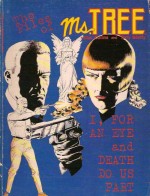
The Files of Ms. Tree volume 1: I, For an Eye and Death Do Us Part


By Max Collins & Terry Beatty (Aardvark-Vanaheim)
ISBN: 0-919359-05-1

Despite being one of the most popular genres in literature and the fact that most fiction books are bought and read by women, Private Eye crime stories are desperately short of female protagonists. Marry that with the observation that “gum-shoe” comics are also as rare as hen’s teeth and it’s a wonder that a series such as Ms. Tree ever got off the drawing board.

The secret – as always – is quality.

The black widow of detective fiction first appeared in 1981 as a serial in the groundbreaking black-and-white anthology comic Eclipse Magazine, along with a number of other quirky alternatives to the East Coast superheroes that had a stranglehold on American comics in the 1970s and early 1980s. Besides such gems as Sax Rohmer’s ‘Dope’ (adapted by Trina Robbins), Steve Englehart and Marshal Rogers’ ‘I Am Coyote’, Don McGregor & Gene Colan’s ‘Ragamuffins’, B.C. Boyer’s wonderful ‘Masked Man’ and a host of other gems from the industry’s finest, Max Allan Collins, crime novelist and new writer of the venerable Dick Tracy newspaper strip, with young humour cartoonist Terry Beatty introduced a cold, calculating and genuinely fierce avenger who put new gloss on the hallowed imagery and plot of the hard-bitten, hard-boiled shamus avenging a murdered partner…

She was one of the first features to win a solo title, Ms. Tree’s Thrilling Detective Stories which became simply Ms. Tree with the fourth issue. Although the marketplace was not friendly to such a radical concept the series ran for 50 issues, and 2 specials, from three publishers (Eclipse, Aardvark-Vanaheim and Renegade Press) before finally dying in 1989. Gone but not quickly forgotten she was promptly revived as a DC comic in 1990 for another 10 giant-sized issues as Ms. Tree Quarterly/ Ms. Tree Special; three more blood-soaked, mayhem-packed, morally challenging years of pure magic.

Astonishingly, as far as I know there are no contemporary collections of her exploits – despite Collins’ status as a prolific and best-selling author of both graphic novels (Road to Perdition, CSI, and prose sequences featuring his crime-creations Nathan Heller, Quarry, Nolan, Mallory and a veritable pantheon of others).

In 2007 Collins released a classy prose novel, “Deadly Beloved” about his troubled troubleshooter, but thus far the Files of Ms. Tree volumes are the only place to find the collected exploits of this superb crime-stopper.

The first volume I, For an Eye and Death Do Us Part gathers the introductory tale from Eclipse Magazine #1-6 (May 1981-July 1982) and the first story-arc from Ms. Tree’s Thrilling Detective Stories #1-3 (August-December 1982), two chilling tales of regret and revenge, perfectly delivered as fair-play mystery tales. You might not be able to extract your own retribution, but if you’re smart enough you can solve the clues as fast as our heroine does…

In ‘I, For an Eye’ we briefly meet Mike Tree, a true icon of the detective profession: hard, tough, sharp and fair: an ex-cop who set up for himself and did well. At the peak of career he met Mike Friday, a feisty, clever, pistol-packing, two-fisted dame who quickly moved from secretary to full partner. They fell in love…

On their wedding night her husband was gunned down and the new Mrs. Tree set out to find his killer. Assuming control over their detective agency she used part of the staff to keep the business going but placed her husband’s… her… best people onto finding out why her man died. Together they uncovered a web of corruption and lies which included the fact that she was not the first Mrs. Tree. Mike had a previous wife and a son who’s painfully like his departed dad…

Gritty, witty and darkly relentless this tale of corruption and twisted friendship set the pace for all the ensuing adventures; a brilliant odyssey which peels like an onion, always showing that there’s still more to uncover…

Even after finding Mike’s killer and delivering the traditional vengeance in great style, the investigation revealed a higher mastermind behind it all, in the shape of mob boss Dominic Muerta, and the second tale ‘Death Do Us Part’ deals with the repercussions of Ms. Tree’s crusade against that psychotic grandee’s operations.

The unrelenting death and misery has taken its toll on the traumatised widow: she is in therapy but when that doesn’t work she takes a holiday to a distant honeymoon resort. She even finds a new lover. However when the newlyweds in the next cabin are murdered by a hit-man Tree realises that she is trapped on a path that can only lead to more death…

Adult, astute, and enchantingly challenging, this second drama is full of plot twists and clever set-pieces that will charm and enthrall crime fans of every persuasion and the art by Beatty is a sheer revelation. Static and informative, remorselessly matter-of-fact and deadly in its cold efficiency – a quality which might be off-putting to some but which so perfectly matches the persona of its pitiless star that I can’t imagine any other style working at all.

This volume, released in 1984, is stuffed with behind-the-scenes extras and commentary from both creators, including a colour cover gallery, and as an added bonus, an original illustrated prose short-story ‘Red Light’, a terse thriller that perfectly supplements the grim mood of the book.

Despite the tragic scenarios, ruthless characterisations and high body-count, this is a clever, funny affair steeped in the lore of detective fiction, stuffed with in-jokes for the cognoscenti (such as the unspoken conceit that the heroine Mike Friday is the daughter of legendary TV cop Joe “Dragnet” Friday) and dripping in the truly magical gratification factor that shows complete scum finally get what’s coming to them…

Ms. Tree is the closest thing the American market has ever produced to challenge our own Queen of Adventure Modesty Blaise: how they can let her languish in graphic obscurity is a greater crime than any described in this compelling classic collection. Hunt it down for your pleasure and pray somebody has the great good sense to bring back Ms. Tree.
© 1980, 1981, 1982, 1983, 1984 Max Collins and Terry Beatty. All Rights Reserved.

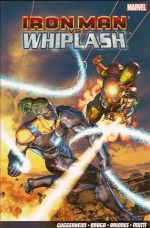
Iron Man Vs. Whiplash


By Marc Guggenheim, Brannon Bragga, Briones & Steve Mutti (Marvel/Panini UK)
ISBN: 978-1-84653-460-8

In the mainstream Marvel universe the citizenry are recovering from an interminable series of major catastrophes such as the Civil War and a Secret Invasion by shape-shifting Skrulls. In this heady age of confusion technical wizard and billionaire weapon-smith Tony Stark has been revealed to the world as the armour-clad superhero Iron Man.

After a similarly-armoured invader destroys a village full of Russian dissidents in a high-tech bloodbath captured on Stark-constructed satellites and seen around the world, the bewildered inventor finds himself on trial for crimes against humanity. Accused of acting as a mercenary for the Russian government Stark has been perfectly framed. Found guilty, he is to be interned for life when lucky disaster strikes.

The village of Volstok was full of discredited scientists and anti-Putin agitators when the Iron assassin struck, and one of them managed to fatally damage the attacker. This survivor used the fragments to create his own armoured energy weapons, and crazed by a need for revenge, goes after Stark as the deadly Whiplash.

In prison, Stark has been busy. Knowing he can’t prove his innocence from behind bars he has constructed a ramshackle suit of armour from odds and ends he has scrounged or stolen. When the vengeance hungry Whiplash attacks, Stark seizes his chance and escapes after an inconclusive clash with the Russian.

With his faithful assistant Pepper in tow Stark goes on the run, ferreting out the hideous secret of the men who destroyed his reputation, but even cleared of the crime he has made an implacable enemy in Whiplash, who holds his inventions, if not his actions, as responsible as the Russian government for the Volstok massacre.

This simple, uncomplicated action-yarn is a palatable piece of eye-candy, capably concocted by scripters Marc Guggenheim and TV writer/producer Brannon Braga (Star Trek, Threshold, 24, Flash Forward), enticingly realised by artists Phillippe Briones & Andrea Muti and colourist Matt Milla. Originally released as a four-issue miniseries, this book happily falls into a category of accessibility that will please fans of the film franchise who don’t want or need to bone up on Iron Man’s near fifty year publishing history.

Fast and furious fun and frolics with an iron-clad satisfaction guarantee…
™ and © 2010 Marvel Entertainment LCC and its subsidiaries. All Rights Reserved. A British edition released by Panini UK Ltd.

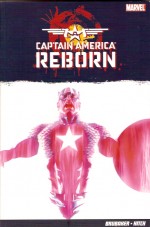
Captain America Reborn


By Ed Brubaker, Bryan Hitch, Alex Ross, Paul Dini & various (Marvel/Panini UK)

ISBN: 978-1-84653-440-9
Captain America was created by Joe Simon and Jack Kirby at the end of 1940, and launched in his own title (Captain America Comics, #1 cover-dated March 1941) with overwhelming success. He was the absolute and undisputed star of Timely (Marvel’s early predecessor) Comics’ “Big Three” – the other two being the Human Torch and the Sub-Mariner – and one of the first to fall from popularity at the end of the Golden Age.

When the Korean War and Communist aggression dominated the American psyche in the early 1950s he was briefly revived – as were the Torch and Sub-Mariner – in 1953 before sinking once more into obscurity until a resurgent Marvel Comics once more brought him back in Avengers #4. It was March 1964 and the Vietnam conflict was just beginning to pervade the minds of the American public…

This time he stuck around, first taking over the Avengers, then winning his own series and title. He waxed and waned through the most turbulent period of social change in US history but always struggled to find an ideological place and stable footing in the modern world. Eventually, whilst another morally suspect war raged in the real world, during the Marvel event known as Civil War he became a rebel and was assassinated on the steps of a Federal Courthouse.

Nobody really believed he was dead.

Marvel’s extended publicity stunt came to a dramatic close with the inevitable return of the original Star-Spangled Avenger in an impressive and highly readable – if necessarily convoluted – tale from Ed Brubaker, Bryan Hitch and Butch Guice, released as the six-issue miniseries Captain America Reborn, but before that, years of cross-company plot threads and side-stories came to a formidable close in the anniversary issue Captain America #600. All those wide-ranging, far-flung bits and bobs are gathered together for your convenience in this classy tome.

The action starts with an impressive potted biography ‘Origin’ by Alex Ross, Paul Dini and Todd Klein (which first appeared in Captain America: Red, White and Blue, September 2002) after which Brubaker, scripts ‘One Year Later’ (Captain America #600) for Guice, Howard Chaykin, Rafael Albuquerque, David Aja and Mitch Breitweiser to illustrate, summing up the heroes origins, career and impact on the world up to his “death”, whereupon his long-dead sidekick Bucky (surprise, surprise!) took over the role…

With all the dominoes in place the moment is ripe for the true hero’s return – and since his mind and body have been lost in time all the while there’s a glorious opportunity to examine some key moments in the old soldier’s decades-long history as the Avengers, Nick Fury, Dr. Doom, Sub-Mariner, Norman (Green Goblin) Osborn and the undying Red Skull all seek to manipulate his return for their own ends. Incisive, clever, all-encompassing and beautifully realised by Hitch and Guice Captain America Reborn is a grand example of the Deus ex Machina revival as only comics can produce it.

Overcoming all odds Cap is back: but now that he is what’s to become of him?

This impressive and entertaining book also includes a fan’s dream of added value inducements: an article by surviving original creator Joe Simon, a “Reborn” variant cover gallery (20 different covers for six issues!) and a far-too small but incredibly impressive complete reproduction of every Cap cover since March 1941, as well as a few surprise extras.

If you are a fan of the superhero genre this is a thoroughly enjoyable recap and reboot that proves that new and old can work together; let’s hope the new old Captain America can find enough of an audience to keep him occupied…
™ and © 2010 Marvel Entertainment LCC and its subsidiaries. All Rights Reserved. A British edition released by Panini UK Ltd.

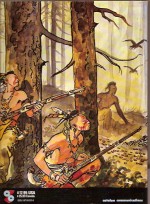
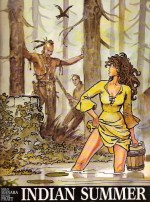
Indian Summer


By Milo Manara & Hugo Pratt, translated by Jeff Lisle (Catalan Communications)
ISBN: 0-87416-030-2-8

Hugo Eugenio Pratt (June 15th 1927 – August 20th 1995) was one of the world’s paramount comics creators, and his inventions since ‘Ace of Spades’ (whilst still a student at the Venice Academy of Fine Arts) in 1945 were both many and varied. His most famous character, based in large part on his own exotic early life, is the mercurial soldier - perhaps sailor would be more accurate – of fortune, Corto Maltese.

After working in both Argentinean and English comics for years Pratt returned to Italy in the 1960s. In 1967 he produced a number of series for the monthly comic Sgt. Kirk. In addition to the Western lead character, he created a pirate strip Capitan Cormorand, the detective strip Lucky Star O’Hara, and a moody South Seas adventure called Una Ballata del Mare Salato (A Ballad of the Salty Sea). The magazine folded in 1970, but Pratt took one of Ballata‘s characters to the French weekly, Pif, before eventually settling into the legendary Belgian comic Tintin. Corto Maltese proved as much a Wild Rover in reality as in his historic and eventful career.

However a storyteller of such vast capabilities as Pratt was ever-restless, and as well as writing and illustrating his own tales he has written for other giants of the industry. In 1983 he crafted a steamy tale of sexual tension and social prejudice set in the New England colonies in the days before the Salem Witch Trials.

Tutto ricominciò con un’estate Indiana (released and known as Indian Summer – although a more appropriate and illustrative translation would be “All things begin again with an Indian Summer”) was brought to stunning pictorial life by fellow Italian graphic raconteur Milo Manara.

Maurilio Manara (born September 12th 1945) is best known for his wry, controversial erotica – but that’s more an indicator of the English-speaking comics market than any artistic obsession; an intellectual, whimsical craftsman with a dazzling array of artistic skills ranging from architecture, product design, painting and of course an elegant, refined, clear-clean line style with pen and ink.

He studied painting and architecture before becoming a comic artist in 1969, beginning with the Fumetti Neri series Genius, worked on the magazine Terror and in 1971 began his erotic career illustrating Francisco Rubino’s Jolanda de Almaviva. In 1975 his first major work Lo Scimmiotto (‘The Ape‘ – a reworking of the Chinese tales of the Monkey King) was released.

By the end of the decade he was working for the Franco-Belgian markets where he is still regarded as a first-rank creator. It was while working for Charlie Mensuel, Pilote and L’Écho des savanes that he created his signature series HP and Giuseppe Bergman – which saw print in A Suivre. The “HP” of the title is his good friend Hugo Pratt…

New England in the 17th century: the Puritan village of New Canaan slowly grows in placid, if uneasy, co-existence with the natives who have fished and hunted these coastal regions for centuries. When young Shevah Black is raped by two young Indians, outcast Abner Lewis kills them both. Taking the “ruined” girl back to his mother’s cottage in the woods the girl meets the entire family – mother Abigail, siblings Jeremiah, Elijah and Phyllis – a whole brood of damned sinners banished by her uncle the Reverend Pilgrim Black.

The mother was once a servant in the Black household, but has lived in the woods for twenty years, ever since Pilgrim Black’s father raped her. When Abigail fell pregnant she was cast out for her sin. Her face bears a sinner’s brand. Aided by the Indians the mother built a cabin, and over the years had three further children. Her progeny are all wild creatures of nature; healthy, vital and with many close ties both to the natives (from choice) and the truly decadent Black family (by sordid, unwelcome history).

Now blood has spilled and passions are roused: none of those ties can prevent a bloodbath, and as the day progresses many dark secrets come to light as the intolerance, hypocrisy and raw, thwarted lust of the upstanding Christians leads to an inexorable clash with the Indians – by far the most sensible and decent individuals in the place – with the pitifully isolated, ostracized and alienated Lewis clan stuck in middle and betrayed by both…

Beautiful, disturbing and utterly compelling, this thoroughly adult examination of sexual tension, attitudinal eugenics and destructive, tragic love is played out against the seductive heat and primitive glories of a natural, plentiful paradise which only needs its residents to act more like beasts and less like humans to achieve a perfect tranquility. Sadly, every Eden has serpents and here there are three: religion, custom and pride…

Pratt’s passion for historical research is displayed by the graphic afterword in which he not only cites his extensive sources – including a link to Nathaniel Hawthorne’s classic novel The Scarlet Letter – but adds some fascinating insights and speculations on the fates of the survivors of New Canaan massacre…

Although there is a 1994 NBM edition readily available I’m reviewing from my 1986 Catalan copy principally because I own that one, but also because the Catalan copy has a magnificent four-page foldout watercolour cover (which I couldn’t fit onto my scanner no matter how I tried) and some pretty amazing sketches and watercolour studies gracing Javier Coma’s insightful introduction.

This is a classic tale of humanity frailty, haunting, dark and startlingly lovely. Whatever version you find, you must read this superb story.
© 1986 Milo Manara & Hugo Pratt. English language edition © 1986 Catalan Communications. All Rights Reserved.

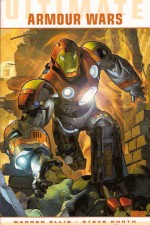
Ultimate Armour Wars


By Warren Ellis & Steve Kurth (Marvel/Panini UK)
ISBN: 978-1-84653-441-6

The Marvel Ultimates project began in 2000 with a thoroughly modernizing refit of key characters and concepts to bring them into line with contemporary “ki-dults” – perceived to be a separate buying public to we baby-boomers and our declining descendents who seemed content to stick with the various efforts that sprang from the fantastic talents of Kirby, Ditko and Lee. Eventually this streamlined new universe became as crowded and continuity-constricted as its predecessor and in 2008 the cleansing publishing event “Ultimatum” culminated in a reign of terror which apparently (this is comics, after all) killed three dozen odd heroes and villains and millions of ordinary mortals.

Although a huge seller (in contemporary terms, at least) the saga was largely trashed by the fans who bought it, and the ongoing new “Ultimatum Comics” line is quietly back-pedalling on its declared intentions…

The key and era-ending event was a colossal tsunami that drowned the superhero-heavy island of Manhattan and this post-tidal wave collection (assembling issues #1-4 of the miniseries Ultimate Comics Armor War – and yes, it has been spelled differently for this British Edition) picks up the story of the survivors as well as the new world readjusting to their altered state.

Young Tony Stark is a tech-genius weapon-smith – and amiable drunk – from a family of armaments manufacturers. When the wave hit, his greatest treasure was lost in his state-of-the-art Manhattan Corporate HQ. A public figure in his trademarked Iron Man war-suit, he is down to his last few million bucks and sifting through the wreckage of his building when a cybernetic super-thief called The Ghost steals his precious strongbox, and would have killed the billionaire brat if not for the intervention of Justine Hammer, daughter of Stark’s greatest enemy: a girl dying from her father’s abusive attempts to giver her marketable super-powers.

Wearing a suit painfully similar to the Iron Man suit the Ghost vanishes, leaving Stark with the realisation that his technology has been pirated and sold to unscrupulous monsters. Although spoiled and dissolute even Stark can’t drink enough to wash away all the blood his inventions could spill if he doesn’t take control back…

With Justine in tow he follows the bloody trail, finding and neutralising all illicit incidences of his armour from malevolent arms dealer Dr. Faustus to deviant Balkan mad scientist Bram Velsing to the ever-OTT Metropolitan Police Force (who use their Stark-based tin-suits to quell political protest and civil disobedience… same as it ever was…)

Eventually the trail leads to the shocking mastermind behind the plot, with plenty of twisty-turny revelations in store – or not, depending on how astute you are, how much attention you’ve been paying and of course on whether you’ve read the original tale this was based on (see the graphic novel Iron Man: the Armor Wars as well as our review of same).

Visually stunning (True Brits especially will revel in the spectacular battle in the skies over London) thanks to artist Steve Kurth and the colouring magic of Guru EFX, Warren Ellis’s tale is sharp and witty, if fairly predictable: heavy on attitude and action, and over almost too quickly, leaving the reader genuinely hungry for more…

Once removed from the market hype and frantic, relentless immediacy of the sales arena there’s a chance to reassess these tales on merit alone, and given such a opportunity you’d be foolish not to take a good hard look at this solid, accessible superhero yarn.
™ and © 2010 Marvel Entertainment LCC and its subsidiaries. All Rights Reserved. A British edition released by Panini UK Ltd

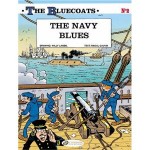
The Bluecoats volume 2: The Navy Blues


By Willy Lambil & Raoul Cauvin, translated by Erica Jeffrey (Cinebook)
ISBN: 978-905460-82-3

The glamour of the American Experience has fascinated Europeans virtually since the actual days of owlhoots and gunfighters. Hergé was a devotee, and the spectrum of memorable comics ranges from Italy’s Tex Willer to such French and Belgian classics as Blueberry and Lucky Luke, and even colonial dramas such as Pioneers of the New World or Milo Manara and Hugo Pratt’s Indian Summer.

‘Les Tuniques Bleues’ or The Bluecoats began at the end of the 1960s, created by Louis “Salvé” Salvérius and Raoul Colvin – who has written every best-selling volume since. The strip was created to replace Lucky Luke when the laconic gunslinger defected from weekly anthology Spirou to rival comic Pilote, and his replacement swiftly became one of the most popular bande dessinée series on the Continent.

Salvé was a cartoonist of the Gallic big-foot/big-nose humour style and when he died suddenly in 1972 his replacement, Willy “Lambil” Lambillotte slowly adopted a more realistic – although still comedic – illustrative manner. Lambil is Belgian, born in 1936, and after studying Fine Art, joined the publishing giant Dupuis as a letterer in 1952.

Writer Raoul Cauvin is also Belgian, born in 1938 and before joining Dupuis’ animation department in 1960 studied Lithography. He soon discovered his true calling – comedy writing – beginning his glittering and prolific career at Spirou. In addition to Bluecoats he has written more than 22 other long-running, award winning series including ‘Cédric’, ‘Les Femmes en Blanc’ and ‘Agent 212’ – more than 240 separate albums. Bluecoats alone has sold more than 15 million copies.

The stars of the series are Sergeant Cornelius Chesterfied and Corporal Blutch, a pair of worthy fools in the manner of Laurel and Hardy: two hapless and ill-starred US cavalrymen posted to the wild frontier.

The original format was single-page gags about an Indian-plagued Wild West fort, but with the second volume ‘Du Nord au Sud’ (‘North and South‘) the sad-sack soldiers went back East to fight in the American Civil War (this tale was rewritten in the 18th album ‘Blue rétro’ to describe how the chumps were drafted into the military during the war). All subsequent adventures, although ranging far beyond America and taking in a lot of genuine and thoroughly researched history, are set within the Secession conflict.

Blutch is your average whinging little man in the street: work-shy, reluctant, mouthy and especially critical of the army and its inept commanders. Ducking, diving, even deserting whenever he can, he’s you or me – except sometimes he’s quite smart and heroic if no other easier option is available. Chesterfield is a big burly man, a career soldier, who has bought into all the patriotism and eprit-de-corp. He is brave, never shirks his duty and wants to be a hero. He also loves his cynical little pal. They quarrel like a married couple, fight like brothers and simply cannot agree on the point and purpose of the horrendous war they are trapped in…

The Navy Blues, second book in this translated series is actually the seventh French volume ‘Les Bleus de la marine’, and finds the lads as usual in the midst of a terrible battle. However, when Blutch is wounded, his cavalry commanders prefer to save his horse rather than aid the fallen soldier, and Chesterfield finds all his cherished dreams of camaraderie and loyalty ebbing away.

Disillusioned, he demands a transfer to the infantry and with the never happy Blutch beside him tries to adapt to his lowered status. Sadly Chesterfield discovers that officers are the same everywhere and stupidity and cupidity are rife throughout the armed forces. A progression of calamitous transfers eventually finds the pair in the Union Navy at a time of intriguing technological advancement, playing an unfortunately ill-omened part in the development of both Submarines and armoured battleships. As always their misadventures result in pain, humiliation and not a few explosions…

The secret of ‘Les Tuniques Bleues’ success…? This is a hugely amusing anti-war saga targeting young and less cynical audiences. Historically authentic, always in good taste despite its uncompromising portrayal of violence, the attitudes expressed by the down-to-earth pair never make battle anything but arrant folly and like the hilarious yet insanely tragic war-memoirs of Spike Milligan these are comedic tales whose very humour makes the occasional moments of shocking verity doubly powerful and hard-hitting.

Fun, informative, beautifully realised and eminently readable, Bluecoats is the sort of war-story that appeals to best, not worst, of the human spirit.

© Dupuis 1975 by Lambil & Cauvin. English edition © 2008 Cinebook Ltd. All Rights Reserved.

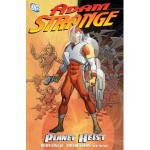
Adam Strange: Planet Heist


By Andy Diggle, Pascal Ferry & Dave McCaig (DC Comics)
ISBN: 9787-1-4012-0727-4

As the Silver Age began in the late 1950s, reintroducing costumed superheroes to markets overflowing with cops and cowboys and cosmic invaders, Showcase #17 (cover-dated November-December 1958) launched a true hero for the space-age in a feature entitled ‘Adventures on Other Worlds’. An instant success, it debuted as the lead in Mystery in Space #53, enchanting and enthralling a generation of thrill-starved kids under the title Adam Strange.

Strange was an Terran archaeologist who, whilst fleeing from enraged natives in Peru, jumped a 25ft chasm only to be hit by a stray teleport beam from a planet orbiting Alpha Centauri. He materialised on another world, filled with monsters, fabulous civilisations and was rescued by a beautiful woman named Alanna.

Rann was a world of constant danger: non-stop peril for which brains, not brawn, were the best solution, but Strange was only able to stay on the atomic-war scarred planet for as long as it took the teleporting Zeta Beam radiation to dissipate, whence he would fade away to reappear on Earth until the next beam struck. He found true love with Alanna and unparalleled adventure (see Showcase Presents Adam Strange vol.1) but the universe seemed determined to keep them apart.

After years of travail and turmoil Adam finally relocated permanently to Rann, but his new homeworld grew no less dangerous…

This sharp, compelling rollercoaster ride (collecting the eight issue miniseries which acted as a prequel and introduction to the many story-strands that formed the Infinite Crisis mega-event) finds the once-archaeologist back on Earth to wrap up his affairs. However just when he is ready to depart the Zeta beam never arrives…

After months of increasingly desperate research his Justice League contacts reveal that Rann is gone: while he packed trinkets and underwear a supernova wiped out everything he ever knew and loved…

Desolate and off the rails his life goes swiftly down until he is attacked by alien bounty hunters. In the wake of the resultant destruction he knows something is amiss, and the only logical conclusion must be that Rann still exists…

This is a breakneck-paced science fiction conspiracy-mystery that finally revives the rational, intellectual hero fans haven’t seen since the end of the Julie Schwartz days: an indomitable fighter who thinks things out as he roars through the universe, accused of destroying the very world he seeks, meeting – and usually pursued by – a legion of DC’s outer space icons such as Vril Dox, the Thanagarians, Omega Men and Dark Stars, as well as an unexpected surprise über-villain…

Deducing a greater threat to all reality, avoiding the guns of a billion bloodthirsty foes and the machinations of many malignant masterminds, Adam Strange fights to regain his family and world and in so doing unravels a plot that will shake the very stars…

Bombast aside, this is a superb thriller that rockets along, draped in DC’s convoluted history and continuity, but somehow still fresh and streamlined enough to entertain the most clueless neophyte and seasoned canon-feeder equally. Andy Diggle and Pascal Ferry have crafted a brilliant tale that only falters on the last page, and only then because the solution leads inexorably to another book.

This is well worth any fan of fantastic fiction’s time and attention, but be warned: for final resolutions you’ll probably also need to read Rann-Thanagar War and Infinite Crisis…

© 2004, 2005 DC Comics.  All Rights Reserved.
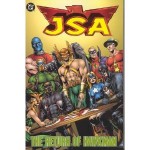
JSA: volume 3 The Return of Hawkman


By David S. Goyer, Geoff Johns & various (DC Comics)
ISBN 1-84023-628-0

The third collection of the revered, revived and very legendary Justice Society of America continued the crusade to resurrect or re-induct all the classic big names by reviving the biggest name and most visually arresting of the original team: Hawkman.

However, before that epic unfolds this volume (reprinting issues #16-26 of the monthly comic and portions of JSA Secret Files #1) kicks off with a triumphant extended return engagement for some old foes with ‘Injustice Be Done’. The first chapter ‘Divide and Conquer’ (illustrated by Stephen Sadowski and Michael Bair) finds an expanded Injustice Society in possession of the heroes’ most intimate secrets, ambushing them whilst they’re off guard with significant success.

In ‘Cold Comfort’ mastermind Johnny Sorrow reveals his plans as the heroes begin their fight back, and we see his horrific origins in ‘Sorrow’s Story’ (with additional art Steve Yeowell), before the World goes to Hell with ‘Into the Labyrinth’ (extra inks by Keith Champagne) and the ghostly Spectre returns to save the day.

And spectacularly fails…

The saga concludes in cataclysmic fashion with ‘Godspeed’ as Black Adam and Jakeem, the heir of genie-wielding Johnny Thunder join the team, but not before Jay Garrick the veteran Flash is lost in time and space…

Compelling as it was the entire saga was just a set-up for the eponymous ‘Return of Hawkman’ which I’ll get to after this necessary diversion…

Hawkman is one of the oldest and most revered heroes in comic-books, premiering in Flash Comics #1 (January 1940), created by Gardner Fox and Dennis Neville, although the most celebrated artists to have drawn the Winged Wonder are Sheldon Moldoff and Joe Kubert, whilst a young Robert Kanigher was justly proud of his later run as writer.

Carter Hall was a playboy archaeologist until he uncovered a crystal knife that unlocked his memories. He realised that once he was Prince Khufu of ancient Egypt, and that he and his lover Shiera had been murdered by High Priest Hath-Set. Moreover with his returned memories came the knowledge that his love and his kicker were also nearby.

Using the restored knowledge of his past life he fashioned a costume and flying harness, hunting his killer as the Hawkman. Once his aim had been achieved he and Shiera maintained their “Mystery-Man” roles to fight modern crime and tyranny with weapons of the past.

Disappearing at the end of the Golden Age they were revived by Julie Schwartz’s crack creative team in the early 1960s (see Showcase Presents Hawkman volume 1 for further details), and after a long career involving numerous revamps and retcons  the Pinioned Paladin “died” during the Zero Hour crisis.

Now the lost Jay Garrick awakens in old Egypt greeted by a pantheon of that era’s superheroes. Nabu, the Lord of Order who created Doctor Fate, the original incarnation of Black Adam and Khufu himself reveal the true origins of Hawkman whilst in the 21st century the JLA‘s heavenly hero Zauriel tells the modern Hawkgirl just who and what she really is in ‘Guardian Angels’.

The epic further unfolds as a major connection to the alien Hawkworld of Thanagar is clarified and explored in ‘Lost Friends’ and as Garrick returns to his home time Hawkgirl is abducted to the aforementioned Thanagar by its last survivors, desperate to thwart the schemes of the insane death-demon Onimar Synn who has turned the entire planet into a zombie charnel house.

As the JSA frantically follow their abducted member to distant Polaris in ‘Ascension’ Carter Hall makes his dramatic return from beyond and saves the day in typical fashion before leading the team to magnificent victory in the concluding ‘Seven Devils’.

Illustrated by Buzz, Rags Morales, Sadowski, Bair, David Meikis and Paul Neary, this latest return not only led to Hawkman regaining his own title (more graphic novel magic to review soonest!) but also stands as one of the most cosmic and grand-scaled of all the JSA‘s adventures.

Complex, enticing, thrilling and full of the biggest sort of superhero hi-jinks, if costume drama is your meat, this book should be your prey…

© 2001, 2002 DC Comics.  All Rights Reserved.