
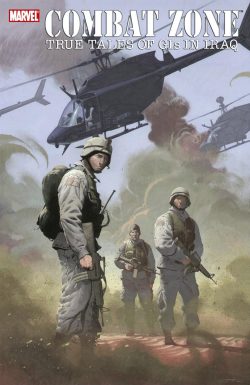
By Karl Zinsmeister, Dan Jurgens & Sandu Florea (Marvel Comics)
ISBN: 978-0-7851-1516-8 (TPB)
This book includes Discriminatory Content produced in less enlightened times.
As someone brilliant just said, what is it about the USA and countries that start with Ira….
It’s always good to see a company venture outside its self-constructed ghetto of Proprietary Characters, rather than endlessly re-hash names it’s already trademarked, and doubly so when it is to venture into genres that it has previously abandoned. Sadly, in some cases the question then becomes one of seeking new markets as opposed to simply looking for new resources to exploit. Comics have had a long and chequered history when it comes to militarism, ideological witch-hunting and band-wagon hopping.
Combat Zone features “real-life accounts” of US combatants in the 2003-2004 Iraq War, although – as you’d expect – “some incidents have been combined to make for a more condensed read”, and of course names have been changed to protect, etc. etc.
Writer Zinsmeister was an embedded reporter during the conflict so I’m sure the events are as true as he saw them but the overall feeling after reading the book was one of tedious detachment. Maybe modern military life is one of immense boredom, spent talking to buddies and telling everyone how cool your ordnance is, interlaced with the occasional skirmish, but if such is the case it shouldn’t be in a drama-oriented comic book.
It’s hard not to compare this with the excellent Real War Stories produced in the late 1980s by Eclipse or even such personal visions as Sam Glanzman’s many collections or Don Lomax’s gruelling, compelling and, above all, informative Viet Nam Journal, perhaps because all of these take the part, and the authorial voice, of the ordinary soldier, and there is an implicit understanding that, though necessary, the job at hand is neither easy or fun. Even Robert Kanigher’s Sgt. Rock tales had greater verisimilitude than what’s on offer here.
In Combat Zone even when a character eventually dies, the response is so anodyne that we know nobody really cares. There is more than the hint of the Press Release about it. Often it feels like the entire comic has passed through the same Pentagon ‘fact-checker’ that news reports do. A far cry, then, from Real War Stories #1, which a previous US government actually attempted to suppress.
On a purely dramatic level, the problem is one of heroic stature. When two desperate guys give their lives in a dramatic, doomed attempt to stop an onslaught of high-tech juggernauts from crushing their homeland, with nothing more than an old pick-up truck and a machine gun, those ought to be the heroes, not the bad guys!
There’s nothing but platitudes in each character’s mouth here to show the reader how justified the war might be, and no mention of the disastrous early days of allied blunders or numerous friendly fire incidents. ‘Those didn’t happen where I might see them’ is not an excuse in a documentary which has been subjectively edited “to make for a more condensed read”. You don’t get to pick and choose between Dramatic Authenticity and Journalistic Veracity at will, and not expect a few hits for it. Unless you are the incumbent administration, of course.
With lacklustre art masquerading as realism from comic super-star Dan Jurgens adding to the overall dullness of the mix (is it me or are all US soldiers darned good looking fellers?) the overall response to this was and remains one of disappointment. It felt as if the neither the creators nor the characters were in the least bit emotionally engaged. I certainly wasn’t. And I can’t wait to see what any legitimate comic publisher will do with the ongoing fracas under the sun…
© 2005 Marvel Characters Inc. All Rights Reserved.
Today in 2012, the Royal Mail issued stamps celebrating British comics landmarks The Beano, Dandy, Eagle, Topper, Roy of the Rovers, Bunty, Buster, Twinkle, Valiant and 2000 AD.
Tomorrow in 1895 was born real life comics villain Dr. Fredric Wertham: pop psychologist and figurehead of anti-comics witch hunts in the 1950s.
In 1922 Out Our Way debuted, care of J. R. Williams, and a bunch of births began in 1925 with The Phantom artist Bill Lignante, Italy’s Giancarlo (Martin Mystère) Alessandrini in 1950 and our very own David Hine (Sticky Fingers, Mambo, Silent War, The Bulletproof Coffin, District M, Spawn) in 1956
We lost Spanish comics pioneer Ramón Cilla in 1937, America’s Nervy Nat cartoonist Arthur Lewis in 1957 and Norwegian Anders Bjørgaard, renderer of Jens von Bustenskjold in 1967.