Black Widow Epic Collection volume 1: Beware the Black Widow (1964-1971)


By Stan Lee, Don Rico & Don Heck, Roy Thomas, Gary Friedrich, Mimi Gold, Gerry Conway, Jack Kirby, John Buscema, John Romita, Gene Colan, Bill Everett, Chic Stone, Dick Ayers, George Roussos, Vince Colletta, Jim Mooney, John Verpoorten, Sal Buscema, Jack Abel & various (MARVEL)
ISBN: 978-1-3029-2126-2 (TPB/Digital edition)

This book includes Discriminatory Content produced in less enlightened times.

Natasha Romanoff (sometimes Natalia Romanova) is a Soviet Russian spy who came in from the cold and stuck around to become one of Marvel’s earliest female stars. The Black Widow started life as a svelte, sultry honeytrap during Marvel’s early “Commie-busting” days, targeting Tony Stark and battling Iron Man in her debut (Tales of Suspense #52, cover-dated April, 1964 and on sale from January 10th). She was subsequently redesigned as a torrid, tights-&-tech supervillain before defecting to the USA, and romantically entwining with an assortment of Yankee superheroes – including Hawkeye and Daredevil – before finally enlisting as an agent of S.H.I.E.L.D., setting up as a freelance do-gooder and joining and ultimately leading The Avengers.

Throughout her career she has always been considered ultra-efficient, coldly competent, deadly dangerous and somehow cursed to bring doom and disaster to her paramours. As her backstory evolved, it was revealed that Natasha had undergone experimental processes which enhanced her physical capabilities and lengthened her lifespan, as well as enduring assorted psychological procedures which had messed up her mind and memories.

Traditionally a minor fan favourite, the Widow only really hit the big time after Marvel’s Movie franchise was established, but for us unregenerate comics-addicts her print escapades have always offered a cool, sinister frisson of delight. This expansive l compilation gathers the contents of Tales of Suspense #52-53, 57, 60, 64; Avengers #29-30, 36-37, 43-44; Amazing Spider-Man #86; Amazing Adventures 1-8 and Daredevil #81, plus pertinent excerpts from Avengers #16, 32-33, 38-39, 41-42, 45-47, 57, 63-63 & 76, cumulatively spanning April 1964 through November 1971.
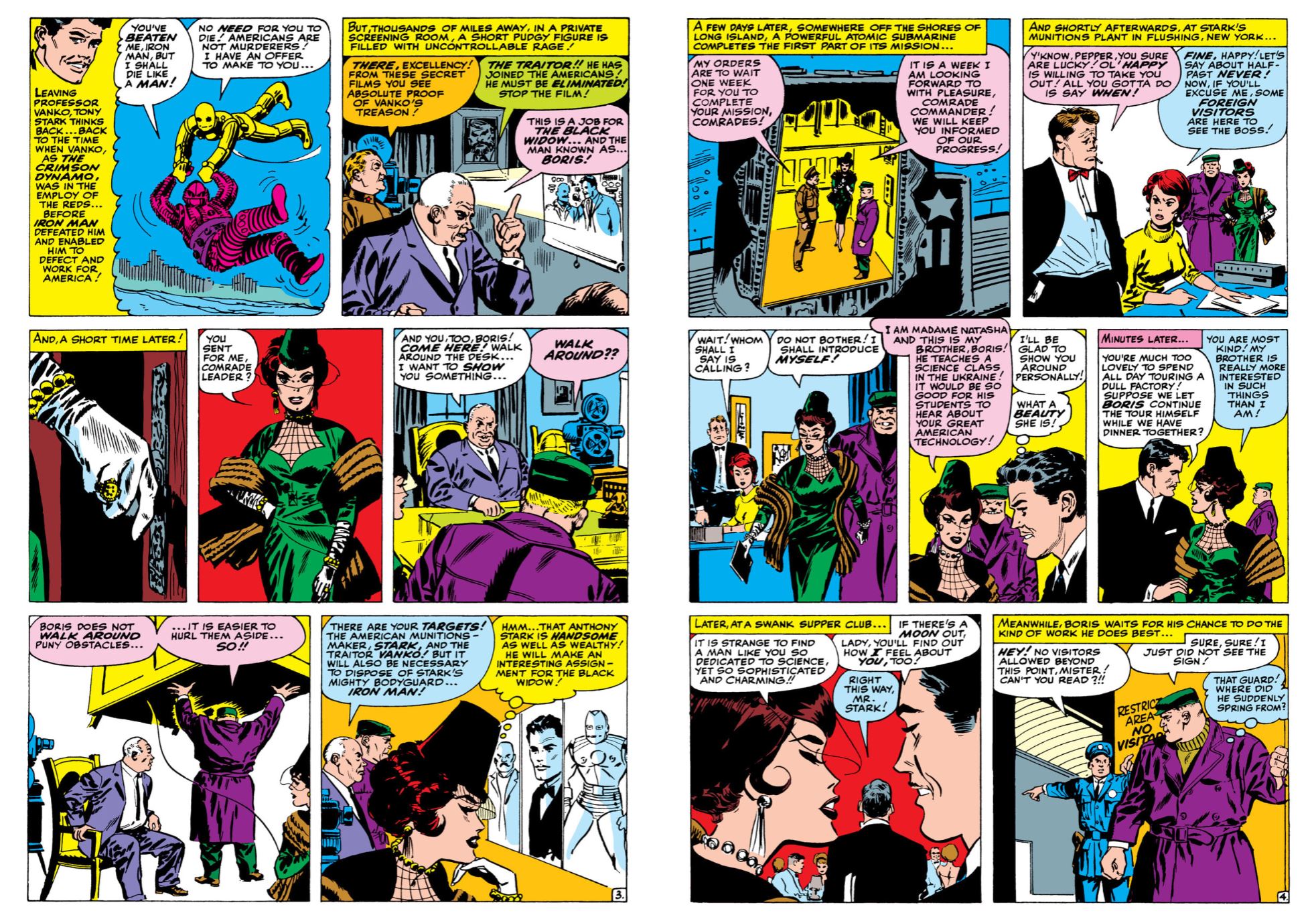
The action opens as a sexy Soviet operative Natasha and her hulking sidekick Boris (yes, I know: simpler times) are despatched to destroy recent defector and top-ranking electronics boffin Anton Vanko and his new Yankee protectors Tony Stark and Iron Man. ‘The Crimson Dynamo Strikes Again!’ (drawn by Don Heck and scripted, like the next issue, by “N. Kurok” – actually veteran creator Don Rico) sees the hero quickly dispose of the armoured Russian heavy while underestimating the far greater threat of the insidious Femme Fatale.

With Tales of Suspense #53, she became a headliner. In ‘The Black Widow Strikes Again!’ Natasha steals Stark’s anti-gravity ray yet ultimately fails in her sabotage mission, fleeing Russian retribution until resurfacing in ToS #57.

Black Widow returned to beguile disgruntled budding superhero ‘Hawkeye, The Marksman!’ (Stan Lee & Heck) into attacking the Golden Avenger in #57, with no appreciable effect. Tales of Suspense #60 featured an extended plotline with Stark’s “disappearance” leading to Iron Man being ‘Suspected of Murder!’. Capitalizing on the chaos, lovestruck Hawkeye and the Widow strike again, but another failure leads to her being recaptured by Russian agents and sentenced to re-education…
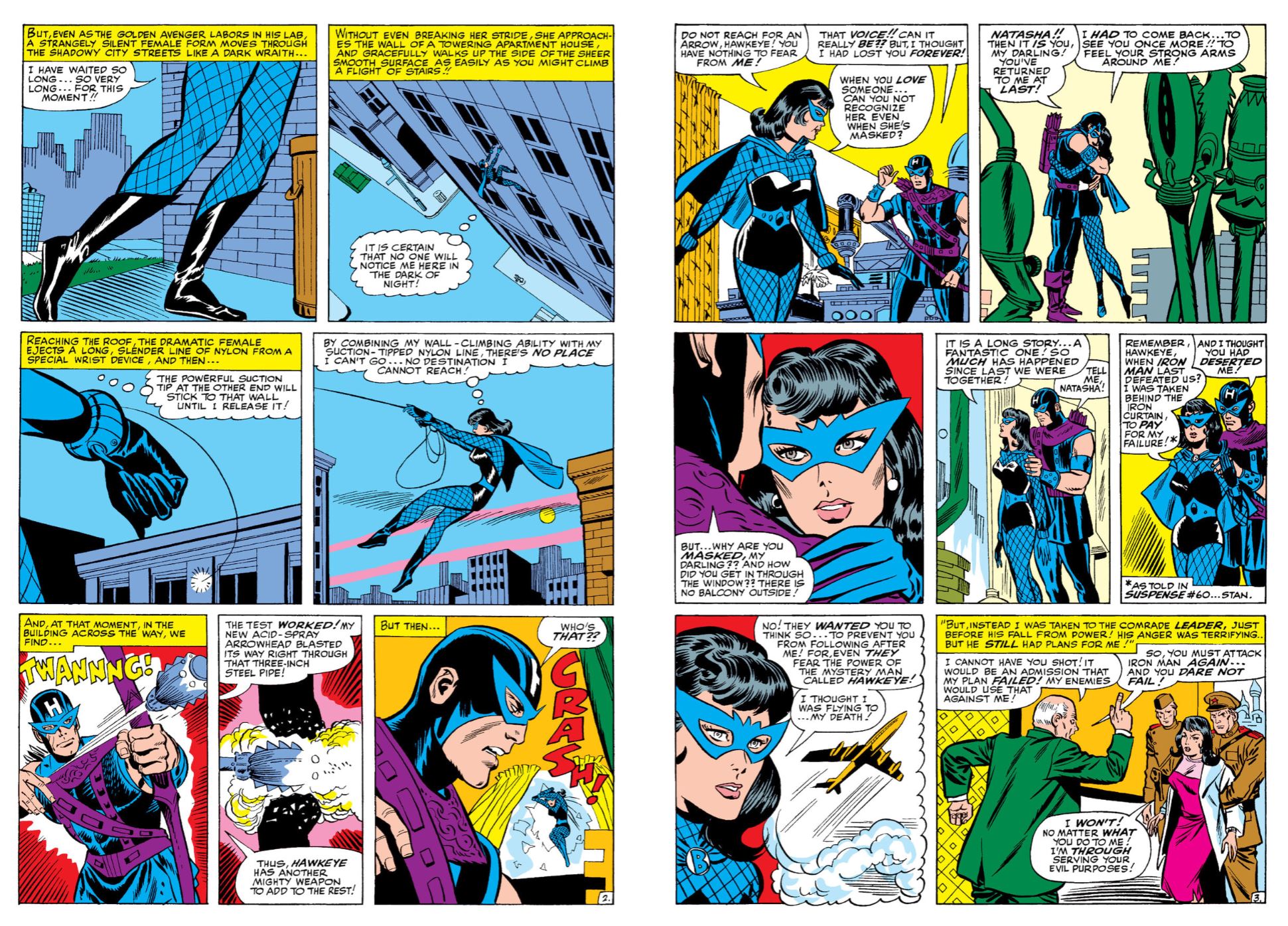
Abruptly transformed from fur-draped seductress into a gadget-laden costumed villain, she returned in #64’s ‘Hawkeye and the New Black Widow Strike Again!’ (Lee, Heck & Chic Stone). Her failure led to big changes, as pages from Avengers #16 here depict her punishment and Hawkeye’s reformation and induction into the superteam. Jump forward more than a year and Avengers #29 as Quicksilver and The Scarlet Witch prepare to retire: returning to Europe to reinvigorate their fading powers even as ‘This Power Unleashed!’ brings back Hawkeye’s lost love as a brainwashed nemesis resolved to destroy the team.

Recruiting old foes Power Man and The Swordsman as cannon-fodder, The Widow is foiled by her own incompletely-submerged feelings for Hawkeye, after which ‘Frenzy in a Far-Off Land!’ observes dispirited colossus Henry Pym embroiled in a futuristic civil war amongst a lost South American civilisation while a temporary détente between archer and inamorata seems set to fail…

Extracts from Avengers #32-33 (with Heck providing raw, gritty inks over his own pencils in ‘The Sign of the Serpent!’ and concluding chapter ‘To Smash a Serpent!’) sees her own recovery begin as Natasha independently infiltrates a racist secret society before joining the Avengers to destroy the hatemongering snakes.

Her international credentials are exploited when long-missing Scarlet Witch and Quicksilver return, heralding an alien invasion of the Balkans in (Avengers #36-37’s) ‘The Ultroids Attack!’ and ‘To Conquer a Colossus!’. Newly cured, programming-free and reformed, Natasha is the crucial factor in repelling an extraterrestrial invasion: a sinister, merciless Black Widow whose willingness to apply lethal force ultimately saves the day and the Earth…

Extracts from Avengers #38, 39, 41 & 42 detail how she then forsakes her newfound heroic reputation to go undercover for S.H.I.E.L.D.: infiltrating a Communist Chinese super-weapon facility as a supposed Soviet agent. In #43’s complete tale ‘Color him…the Red Guardian!’ (Roy Thomas, John Buscema & George Roussos) her origins and reason for the title “widow” are exposed before – reacting to a world-threatening superweapon – the Avengers storm in for the fight of their lives as the saga climaxes in ‘The Valiant Also Die!’ (Vince Colletta inks): a blistering all-out clash to save humanity from mental conquest…

The fracturing relationship between Hawkeye and the Widow plays out in snippets from Avengers #45-47, #63 and 64 as her growing ties to Nick Fury lead to an heartbreaking split with the Amazing Archer in #76 and the prospect of a new beginning for the Russian renegade. It comes in Amazing Spider-Man #86 as ‘Beware… the Black Widow!’ affords John Romita & Jim Mooney a chance to redesign, redefine and relaunch the super-spy in an enjoyable if formulaic Lee-scripted misunderstanding/clash-of-heroes yarn with an ailing webspinner never really endangered. The entire episode was actually a promotion for the Widow’s own soon-to-debut solo series.
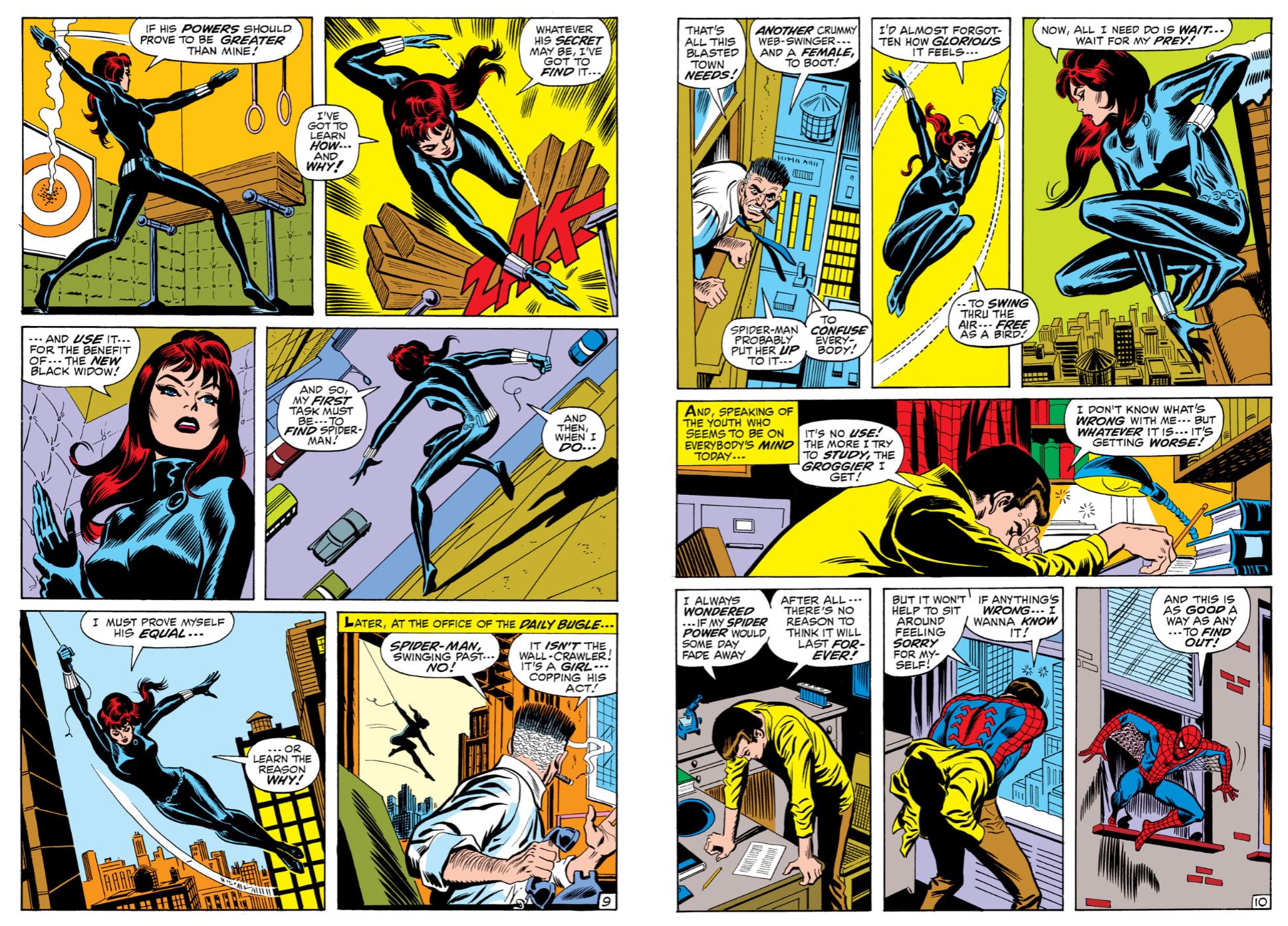
Black Widow’s first solo series appeared in “split-book” Amazing Adventures #1-8: mini-epics paying dues the superspy’s contemporary influences: Modesty Blaise and Emma Peel (that lass from the other Avengers). It all begins with ‘Then Came… The Black Widow’ (AA #1, August 1970, by Gary Friedrich, John Buscema & John Verpoorten) as Natasha emerges from self-imposed retirement to be a socially-aware crusader defending low-income citizens from thugs and loan sharks. One charitable act leads her to help activists ‘The Young Warriors!’ as their attempts to build a centre for underprivileged kids in Spanish Harlem are countered by crooked, drug-dealing property speculators…

Gene Colan & Bill Everett assume art duties from #3’s ‘The Widow and the Militants!’ with her actions and communist past drawing hostile media attention, more criminal attacks and ultimately precipitate an inner-city siege, before the ‘Deadlock’ (scripted by Mimi Gold) comes to a shocking end…
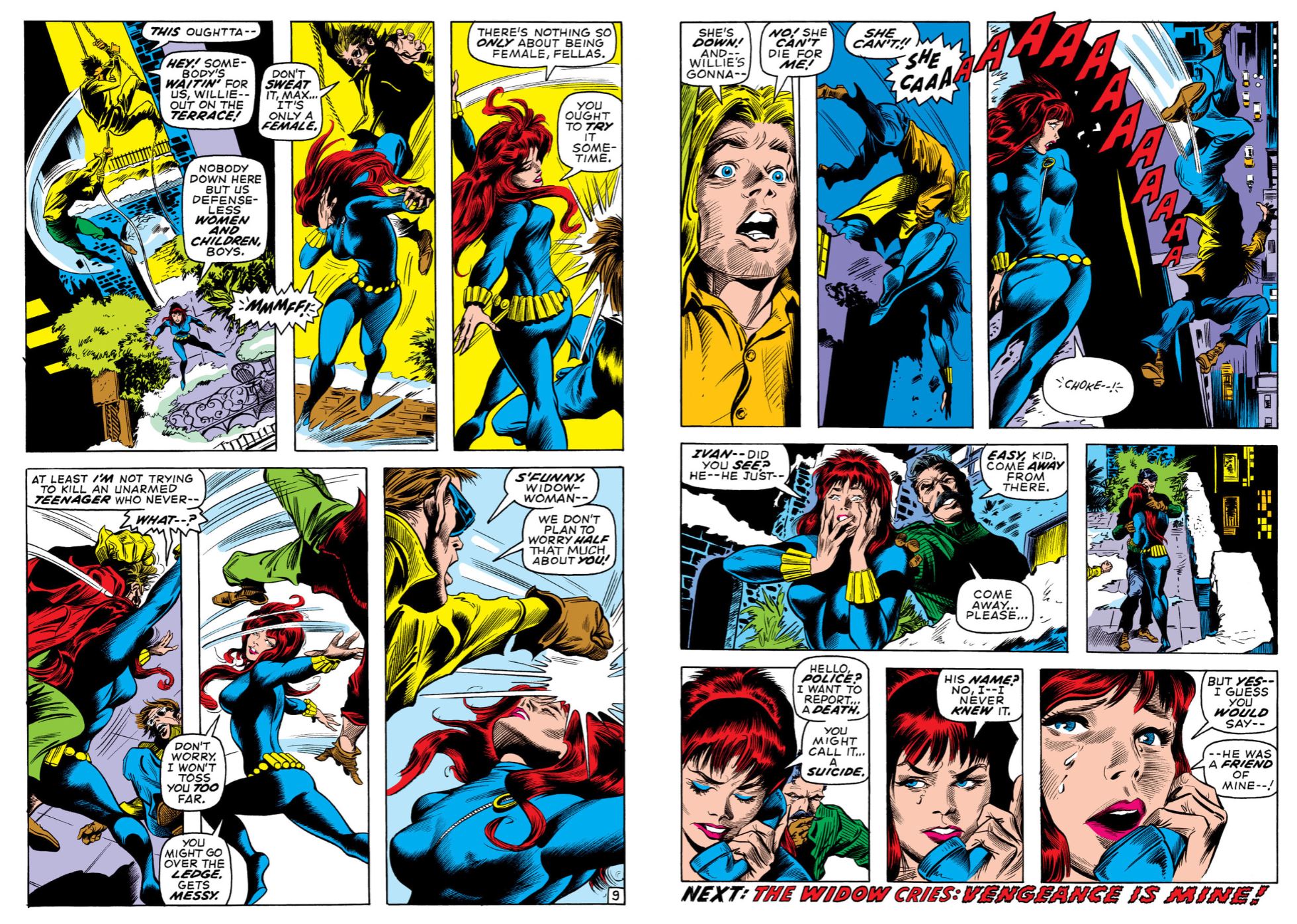
Roy Thomas steps in for a bleakly potent Christmas yarn as ‘…And to All a Good Night’ sees Natasha and faithful retainer/father figure Ivan meet and fail a desperate young man, only to be dragged into a horrific scheme by deranged cult leader The Astrologer who plans to hold the city’s hospitals to ransom in ‘Blood Will Tell!’ (art by Heck & Sal Buscema). Convinced she is cursed to do more harm than good, the tragic adventurer nevertheless inflicts ‘The Sting of the Widow!’ (Gerry Conway, Heck & Everett) on her ruthless prey and his child soldiers, after which the series wraps up in rushed manner with a haphazard duel against Russian-hating super-patriot Watchlord in the Thomas-scripted ‘How Shall I Kill Thee? Let Me Count the Ways!’

The formative tales conclude here with ‘And Death is a Woman Called Widow’ (Daredevil #81, by Conway, Colan & Jack Abel), which sees infamous defector Natasha Romanoff burst onto the scene to save the Man Without Fear from ubiquitous manipulator Mr. Kline and deadly predator The Owl, consequently exposing the manipulative mastermind behind most of DD and the Widow’s recent woes and tribulations…

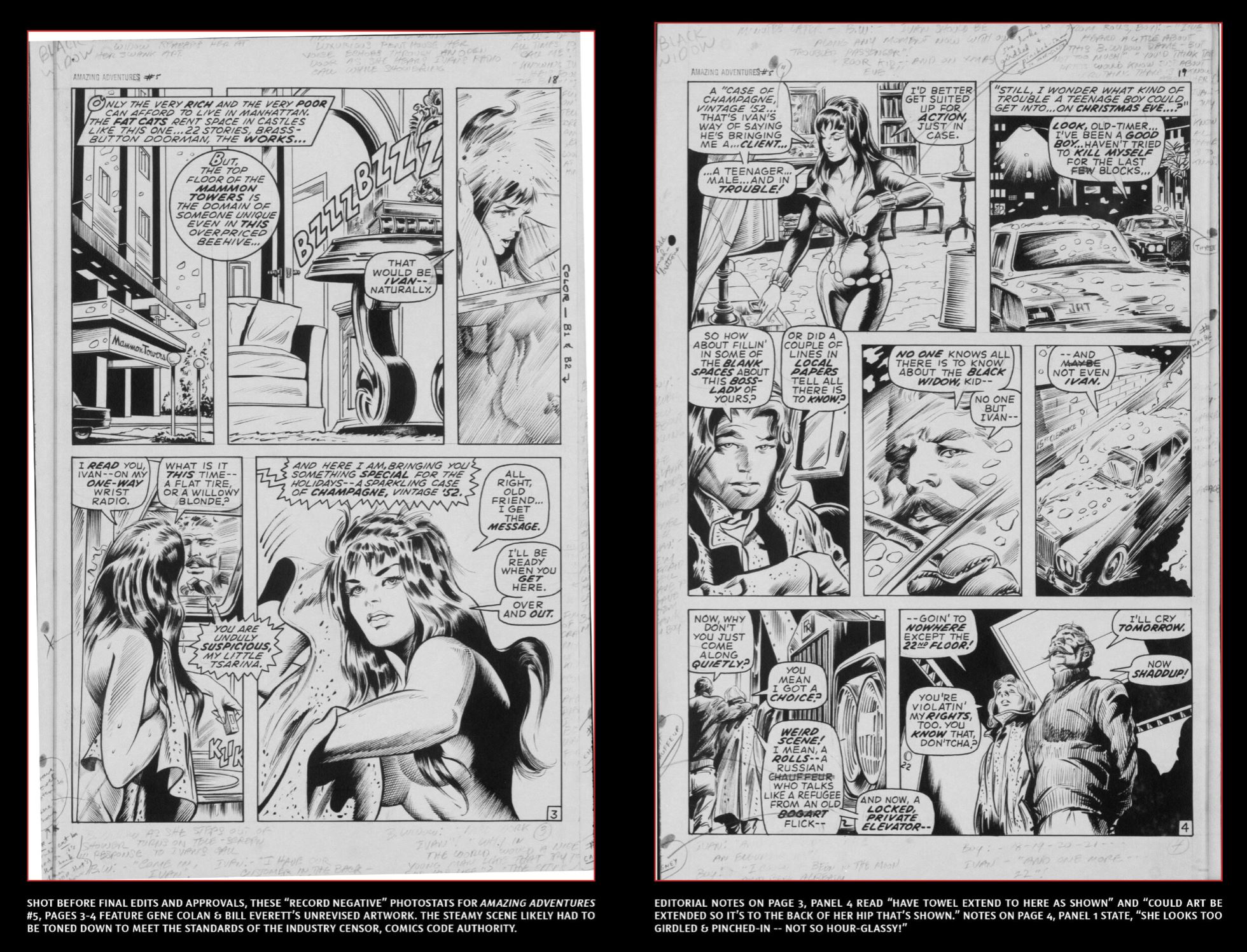
Rounding out the comics experience here are bonus pages including a stunning Black Widow pinup by Bill Everett; house ads and a huge gallery of original art pages by John Buscema, Verpoorten, Heck, Colan & Everett – including restored artworks edited for overly-salacious content that apparently revealed a little too much of the sexy spy, before being toned down for eventual publication.
These beautifully limned yarns might still occasionally jar with their earnest stridency and dated attitudes, but the narrative energy and sheer exuberant excitement of the adventures are compelling delights no action fan will care to miss…
© 2020 MARVEL.

Today in 1928 Archie and Little Archie writer/artist Bob Bolling was born. Others birthday boys include French auteur André Juillard (Les Sept Vies de l’Épervier, Arno, Chasseurs d’or, Blake and Mortimer) in 1948 and Puerto Rican American George Pérez (everything, but especially Crisis on Infinite Earths, Wonder Woman, New Teen Titans, Avengers, Justice League of America, Fantastic Four, Superman, Black Widow and more) came along in 1954.
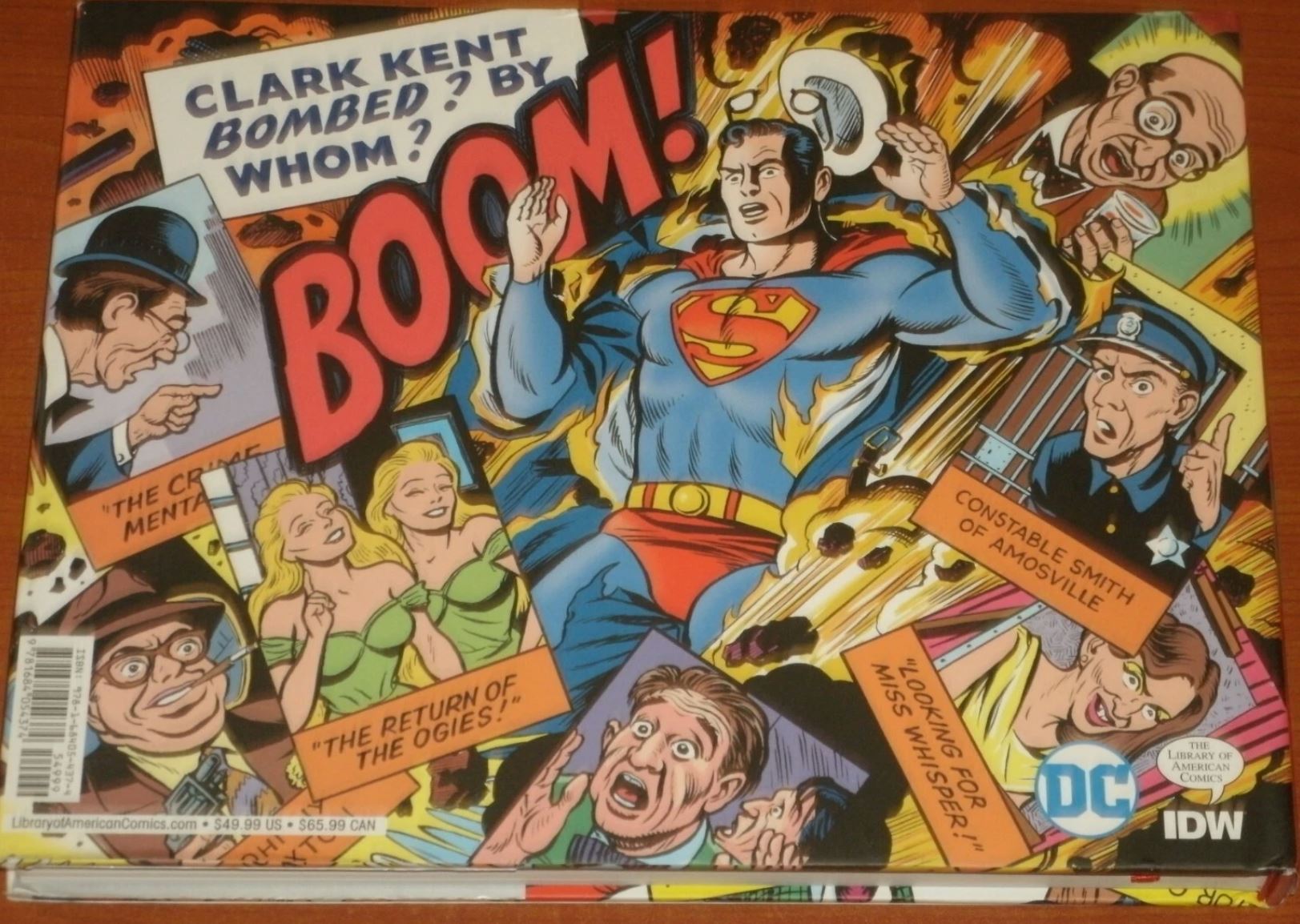
The Shazam! Archives volume 1


By Bill Parker, C. C. Beck & Pete Costanza with various (DC Comics)
ISBN: 978-1-56389-053-6 (HB)

This book includes Discriminatory Content produced in less enlightened times.

At their most impressive, superhero comics combine the gravitas of mythology with all the sheer fun and exuberance of a child’s first rollercoaster ride. The perfect example of this is the original happy-go-lucky hero we can’t call Captain Marvel anymore.

First seen in late December 1939, Whiz Comics (#2 – there was no #1) cashed in on the comic book sales phenomenon of Superman; the big red riot eventually won his name after narrowly missing being Captain Flash or Captain Thunder. He was the brainchild of Bill Parker & Charles Clarence Beck, initially dispensing the same kind of summary rough justice as his contemporaries. However, the character soon distanced himself from the pack – Man of Steel included – by employing and enjoying an increasingly light, surreal and comedic touch, which made him the bestselling comics character in America. Ultimately, he proved that he could beat everybody but copyright lawyers; during his years of enforced inactivity the trademarked name passed to a number of other publishers before settling at Marvel Comics and they are never, never, never letting go. You can check out and compare their cinematic blockbuster version with the DC Extended Universe’s Shazam! flick too…

Publishing house Fawcett had first gained prominence through an immensely well-received magazine for WWI veterans entitled Captain Billy’s Whiz-Bang, before branching out into books and general interest magazines. Their most successful publication – at least until the Good Captain hit his stride – was the ubiquitous boy’s building bible Mechanix Illustrated and, as the comic book decade unfolded, the scientific and engineering discipline and “can-do” demeanour underpinning MI suffused and informed both art and plots of the Marvel Family titles.

As previously stated, the big guy was created by writer/editor Bill Parker and brilliant young artist Charles Clarence Beck who, with his assistant Pete Costanza, handled most of the art on the series throughout its stellar run. Other writers included William Woolfolk, Rod Reed, Ed “France” Herron, Joe Simon, Jack Kirby, Joe Millard, Manley Wade Wellman and fabulously prolific Otto Binder.

Before eventually evolving his own amiable personality, the Captain was a serious, bluff and rather characterless powerhouse, whilst his juvenile alter ego was the true star: a Horatio Alger archetype of impoverished, boldly self-reliant, resourceful youth overcoming impossible odds through gumption, grit and sheer determination…

Homeless orphan and good kid Billy Batson is selected by an ancient wizard to be given the powers of six gods and heroes to battle injustice. He transforms from scrawny precocious kid to brawny (adult) hero Captain Marvel by speaking aloud the wizard’s name – an acronym for six legendary divine patrons: Solomon, Hercules, Atlas, Zeus, Achilles and Mercury.

This magnificent full-colour, deluxe hardback compendium re-presents Captain Marvel’s first 15 exploits from Whiz Comics #2 to 15 (February 1940 to March 1941). There was no #1, two issue #5’s and two editions in March (but I’ll try to explain all that as we go along), with joy, verve and invention paramount in this particular knock-off crusader; one of a countless number imitators and descendants to cash in on the sales phenomenon of Superman…

Author, journalist and fan Richard A. Lupoff covers in great detail the torturous beginnings of the feature in his Foreword before the magic proper starts with a priceless glimpse at the hero’s seemingly-accursed design stage. To establish copyright, publishers used to legally register truncated black-&-white facsimile editions – dubbed “Ash-can Editions” – in advance of their launch issues. For magazine publisher Fawcett, production of their first comic book proved an aggravating process as this registration twice uncovered costly snags which forced the editors to redesign both character and publication.

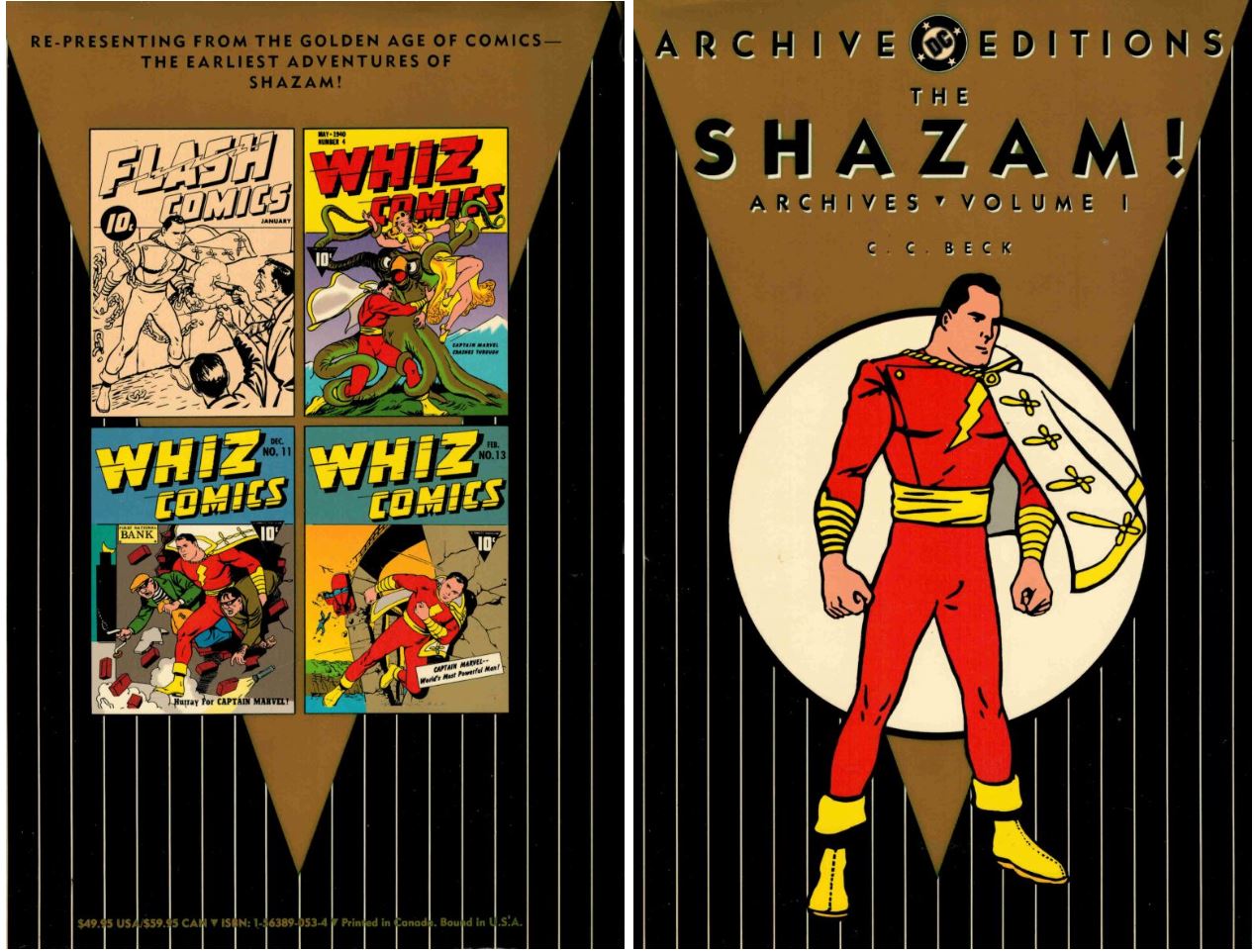
Contained herein are cover reproductions of Flash Comics #1 starring Captain Thunder (obliviously scheduled for release mere days after DC’s own Flash Comics title hit the stands), and Thrill Comics #1 which repeated the accident just as Standard’s Thrilling Comics launched. Also on view is monochrome art for the first half of the story of “Captain Thunder” which would eventually be re-lettered and released as the lead in anthology title Whiz Comics #2, finally safely released cover-dated February 1940. Like many Golden Age series, the stories collected here never had individual titles, and DC’s compilers have cleverly elected to use the original comics’ strap-lines or cover blurbs to differentiate the tales…

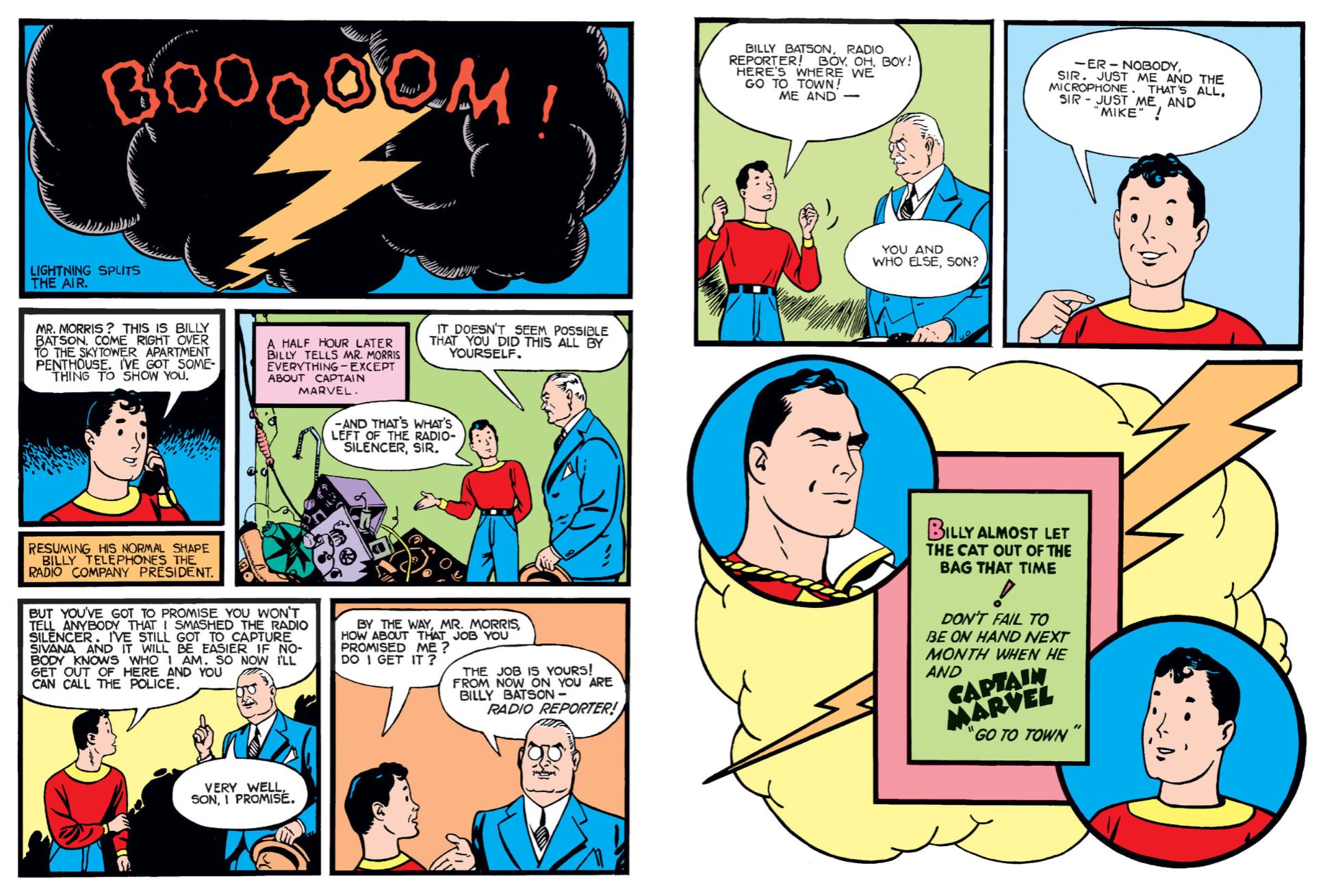
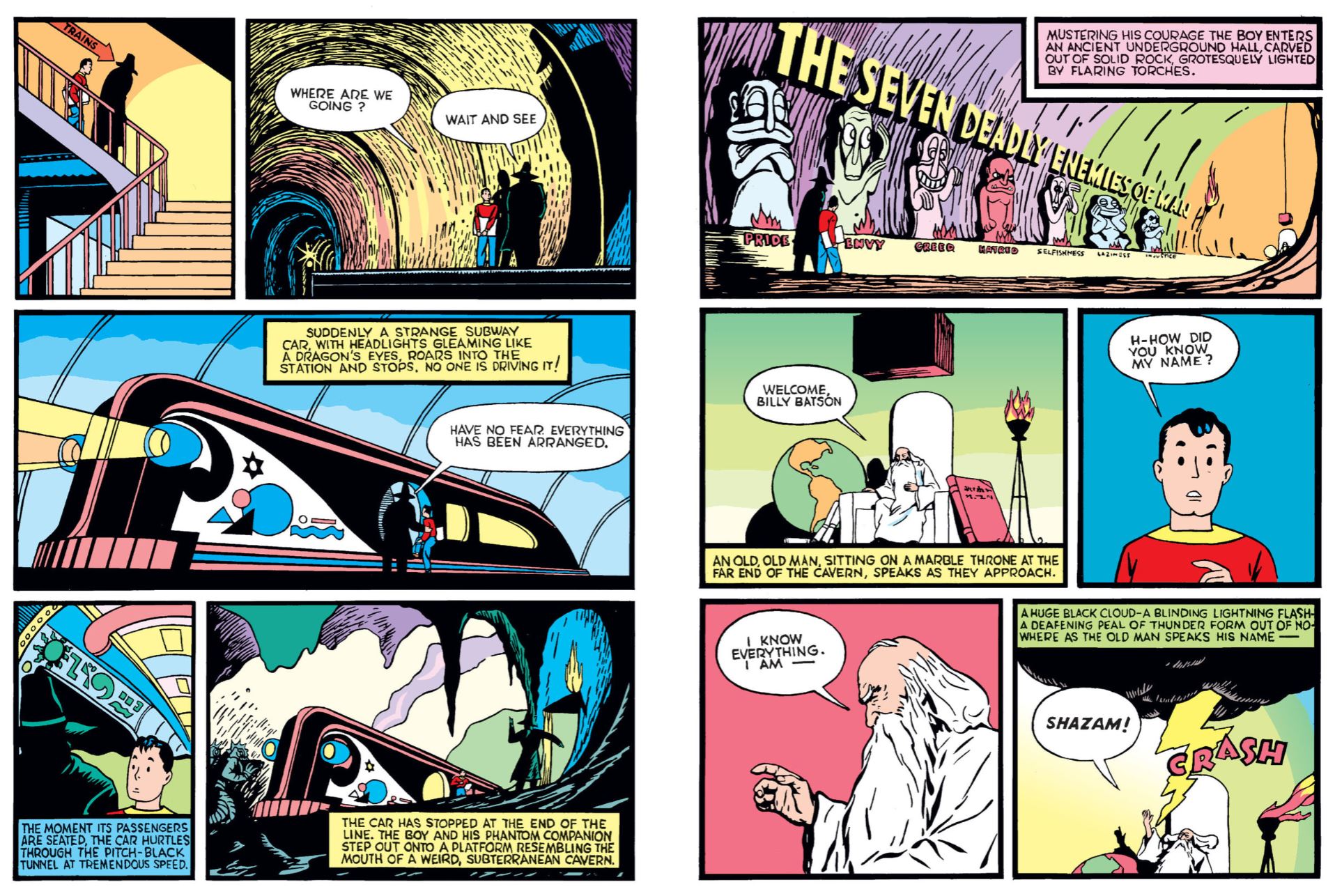
‘Gangway for Captain Marvel!’ – drawn in a style reminiscent of early Hergé – finds homeless orphan newsboy Billy Batson lured into an abandoned subway tunnel to a meeting with infinitely ancient wizard Shazam. At the end of a long life confronting evil, the white-bearded figure grants the lad the powers and signature gifts of six gods and heroes; bidding him to continue the good fight.

In 13 delightfully clean and simple pages Billy gets his powers, has his secret origin revealed (he’s actually heir to a fortune embezzled by his crooked uncle Ebenezer Batson), wins a job as a roaming radio reporter for Amalgamated Broadcasting and defeats the demonic schemes of criminal science maniac Doctor Thaddeus Bodog Sivana, who is holding the airwaves of America hostage. The mighty, taciturn and not yet invulnerable Marvel is only sparingly used to do the heavy lifting. It is sheer comic book poetry…

The March issue had no cover number but was listed as #3 in the indicia and featured ‘The Return of Sivana’ as the insane inventor unleashes a mercenary army equipped with his super-weapons upon the nation, attempting to become Emperor of America. His plan is duly thwarted by Billy acting as a war correspondent, and the mighty muscles of Marvel…

The third (April-dated) Whiz Comics had “Number 3” on the cover but was designated #4 inside and proudly proclaimed ‘Make Way for Captain Marvel!’ before boldly leaping into full science fiction mode as Billy is shanghaied to Venus in Sivana’s mighty rocketship. The boy is forced to reveal his amazing secret to the demented inventor whilst battling incredible monsters and giant frog-men dubbed “Glompers”, with the magnificently guileless and gallant Marvel seemingly helpless against the savant’s seductive new ally – Queen Beautia – as that deadly duo prepare to invade Earth.

Only seemingly though…

‘Captain Marvel Crashes Through’ (#4 on the cover, but #5 inside) details how bewitching Beautia, aided by Sivana’s technology, runs for President. However, the sinister siren has a soft heart, and when Billy is captured (and encounters the first of a multitude of diabolically clever gadgets designed to stop him saying his magic word), she frees him, thus falling foul of the gangsters who were backing her. Happily, Captain Marvel is there to save the day…

An inexplicable crime-wave shakes the country in ‘Captain Marvel Scores Again!’ (the wild numbers game finally ends here as there’s a #5 on the cover and the same inside) as a different sinister scientist uses a ray to turn children into thieves. Even Billy is not immune…

‘Captain Marvel and the Circus of Death’ (July 1940) sees Sivana return with fantastic Venusian dino-monsters which our Good Captain is hard-pressed to handle. Incidentally, this was the first issue where the Big Red Cheese is seen definitely flying as opposed to leaping – something Superman is not acknowledged as doing until late 1941. It means nothing, I’m just saying emulation goes both ways…

For ‘Captain Marvel and the Squadron of Doom’, young Billy travels to the North Pole for a radio story and discovers a secret organisation thawing out frozen cavemen to act as their army of conquest, after which he and his mature magical avatar foil a murderous spiritualist causing mass-drownings to bolster his reputation and fortune in ‘Saved by Captain Marvel!’

Whiz #9’s ‘Captain Marvel on the Job!’ finds man & boy foiling a revolution, recovering foreign crown jewels and flummoxing a madman with a shrinking ray, after which Sivana and Beautia return in ‘Captain Marvel Battles the Winged Death’: a blistering yarn involving espionage and America’s latest secret weapon. In this tale, the Empress of Venus finally reforms, becoming a solid American citizen…

‘Hurrah for Captain Marvel!’ finds Batson investigating college hazing and corrupt sporting events whilst in #12 (January 1941), the World War looms large as “Gnatzi” maritime outrages bring Billy to London where he uncovers the spy responsible for sinking refugee ships in ‘Captain Marvel Rides the Engine of Doom!’

‘Captain Marvel – World’s Most Powerful Man!’ then features Sivana’s latest atrocity as the madman disrupts hockey matches, blitzes banks and incapacitates the US army with a formula that turns men into babies. Even Billy isn’t immune, but at least Beautia is there to help him…

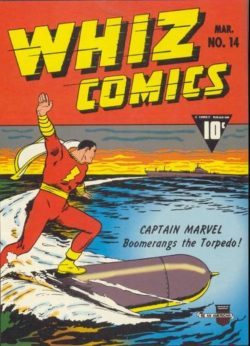
War was looking increasingly unavoidable and many superheroes jumped the gun to start fighting before the US officially entered the fray. ‘Captain Marvel Boomerangs the Torpedo!’ is a superb patriotic cover for Whiz #14 (March 1941) even though the actual story involves Sivana’s capture and subsequent discovery of a thought process which allows him to walk through walls – and cell bars. Luckily, the World’s Mightiest Mortal also possesses the Wisdom of Solomon and deduces a solution to the unstoppable menace…

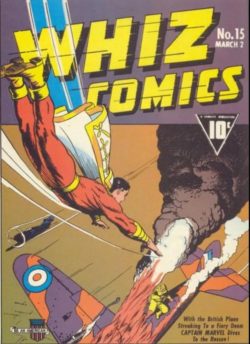
This superb collection concludes after another stirring cover ‘With the British Plane Streaking to a Fiery Doom, Captain Marvel Dives to the Rescue!’ (#15 and also cover-dated March), fronting an unrelated adventure which reveals the astounding and tragic origin of Dr. Sivana, his unbelievable connection to Beautia, and also introduces her brother Magnificus – almost as mighty a fighter as Marvel – after Billy is kidnapped and trapped once more on Venus…

DC/National Periodical Publications had filed suit against Fawcett for copyright infringement as soon as Whiz Comics #2 was released. The companies slugged it out in court until 1953, when, with the sales of superhero comics decimated by changing tastes, Captain Marvel’s publishers decided to capitulate. The name lay unclaimed until 1967 when M.F. Enterprises released six issues of an unrelated android hero before folding. Marvel Comics finally secured rights to the name in 1968.

DC eventually acquired Fawcett’s comic book properties and characters and in 1973 revived the Good Captain for a new generation, gambling that his unique charm would work another sales miracle during one of comics’ periodic downturns. Retitled Shazam! due to the incontestable power of lawyers and copyright legislation, the revived heroic ideal enjoyed mixed success before being subsumed into the company’s vast stable of characters…

Nevertheless, the first Captain Marvel is a true icon of American comic history and a brilliantly conceived superhero for all ages. This titanic tome only scratches the surface of the canon of delights produced over the near 90 years of his tumultuous existence, and is an ideal exemplar introduction to the world of adventure comics: one that will appeal to readers of any age and temperament.
© 1940, 1941, 1992 DC Comics. All Rights Reserved.

Today in 1867, French artist, cartoonist, creator and designer of Bibendum (the Michelin man) O’Galop AKA Marius Rossillon was born. He shares birthday with Charles ClarenceC.C.Beck (Captain Marvel/Billy Batson, Spy Smasher, Fatman, the Human Flying Saucer) in 1910; mega-letterer Ray Holloway in 1920; strip cartoonist/animator Paul Gringle (Rural Delivery, Out Our Way) in 1922, Charlton comics art mainstay Rocke Mastroserio in 1927 and Dutch creator Jan Kruis (Jan, Jans en de Kinderen) in 1933.

Events include Ken Reid’s final Jonah strip in The Beano this day in 1963 – although the strip was revived in The Dandy 30 years later – and last of Gus Edson & Irwin Hasen’s newspaper feature Dondi in 1986, with Tom Batiuk/Chuck Ayers’ strip Crankshaft debuting one year later.

Today in 1846 Swiss satirist and the world’s first true comics creator – Rodolphe Töpffer (Histoire de Mr. Vieux Bois/The Adventures of Obadiah Oldbuck) – died, as did Shoe and Pluggers cartoonist Jeff MacNelly in 2000, and the mighty, massively influential cartoonist, historian and publisher Jack Edward Jackson AKA Jaxon (Rip Off Press co-founder; crafter of God Nose, Los Tejanos, Comanche Moon, The Secret of San Saba, The Alamo: An Epic Told from Both Sides and dozens more) in 2006.

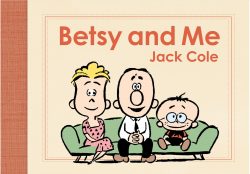
Betsy and Me


By Jack Cole & Dwight Parks, with R.C. Harvey (Fantagraphics Books)
ISBN: 978-156097-878-7 (TPB/Digital edition)

This book includes Discriminatory Content produced in less enlightened times. This book also includes Discriminatory Content added for comedic effect.

Jack Cole was one of the most uniquely gifted talents of American comics’ Golden Age. Before moving into mature magazine and gag markets he originated landmark tales in horror, true crime, war, adventure and especially superhero comic books, where his incredible humour-hero Plastic Man remains an unsurpassed benchmark of screwball costumed hi-jinks: frequently copied but never equalled. It was a glittering career of distinction which Cole was clearly embarrassed by and unhappy with.

Without doubt – and despite his other triumphal comics innovations such as The Comet, Silver Streak, Daredevil, The Claw, Death Patrol, Midnight, Quicksilver, The Barker, and a uniquely twisted and phenomenally popular take on the crime and horror genres – Cole’s greatest contribution and lasting creation was the zany Malleable Marvel who (with indispensable sidekick/gadfly Woozy Winks) quickly grew from a minor back-up character into one of the most memorable and popular heroes of the era.

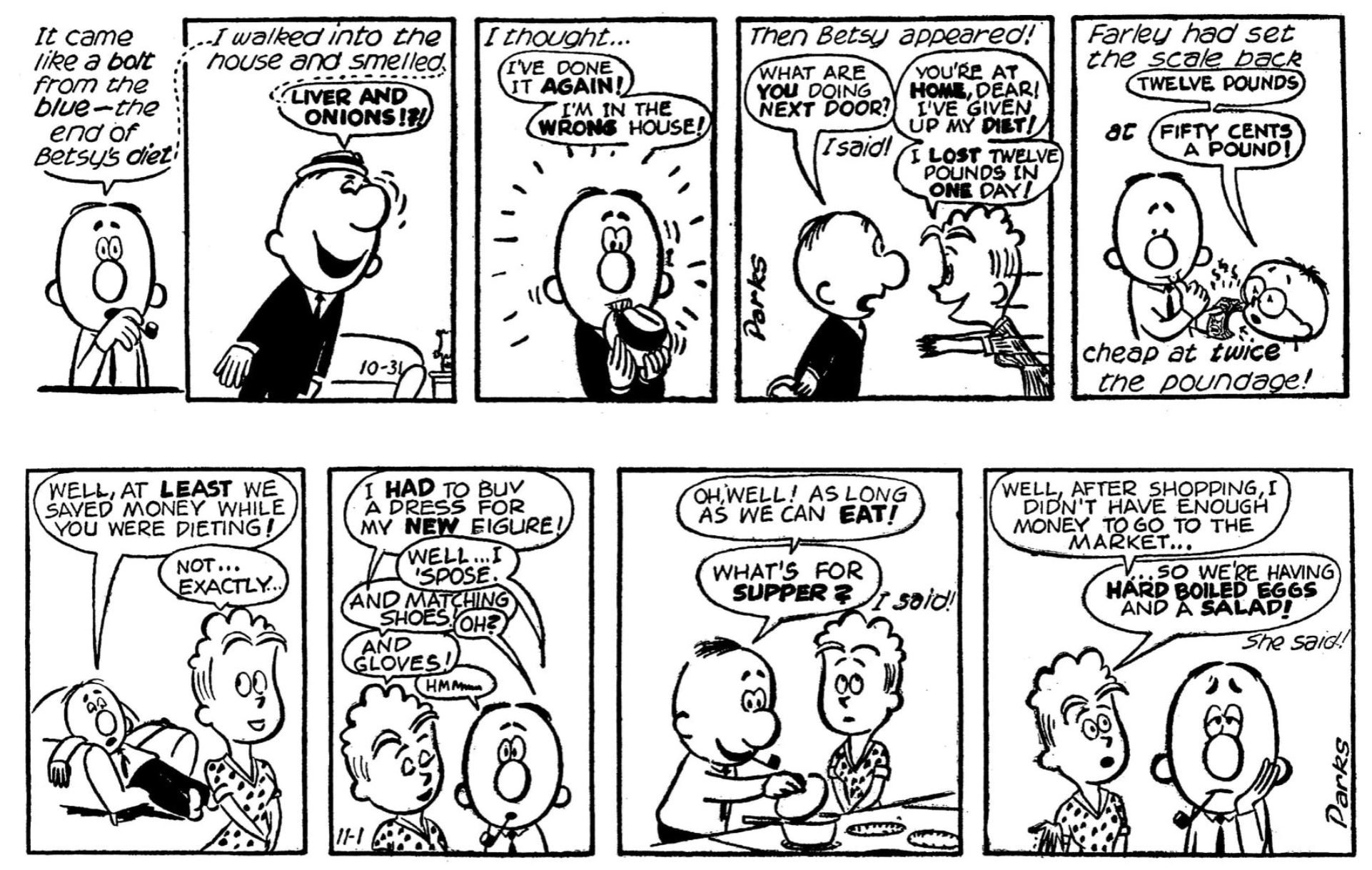
In 1954 Cole quit comics for the lucrative and prestigious field of magazine cartooning, and swiftly became a household name when his brilliant watercolour gags and stunningly saucy pictures began regularly running in Playboy from its fifth issue. Cole eventually moved into the lofty realms of newspaper strips and, in 1958, achieved a life-long ambition by launching a syndicated newspaper strip, the domestic comedy Betsy and Me, which began publication on Monday May 26th.

Something about reaching the cartoonist’s Promised Land clearly did not meet with the infamously private Cole’s expectations and, on August 13th 1958, at the peak of his prowess and success, he took his own life. The reasons – although much speculated upon ever since – remain unknown.

The strip was handed to commercial cartoonist Dwight Parks who continued it until an editorial decision was made to end it. The last daily was published on Saturday, December 27th. That great loss to the future of the industry and artform has for years clouded a greater truth: whatever his demons, Cole was a master of comedy and narrative art in all its forms and Betsy and Me was, in its own niche, every bit as great as his glamour illustration and comic book endeavours.

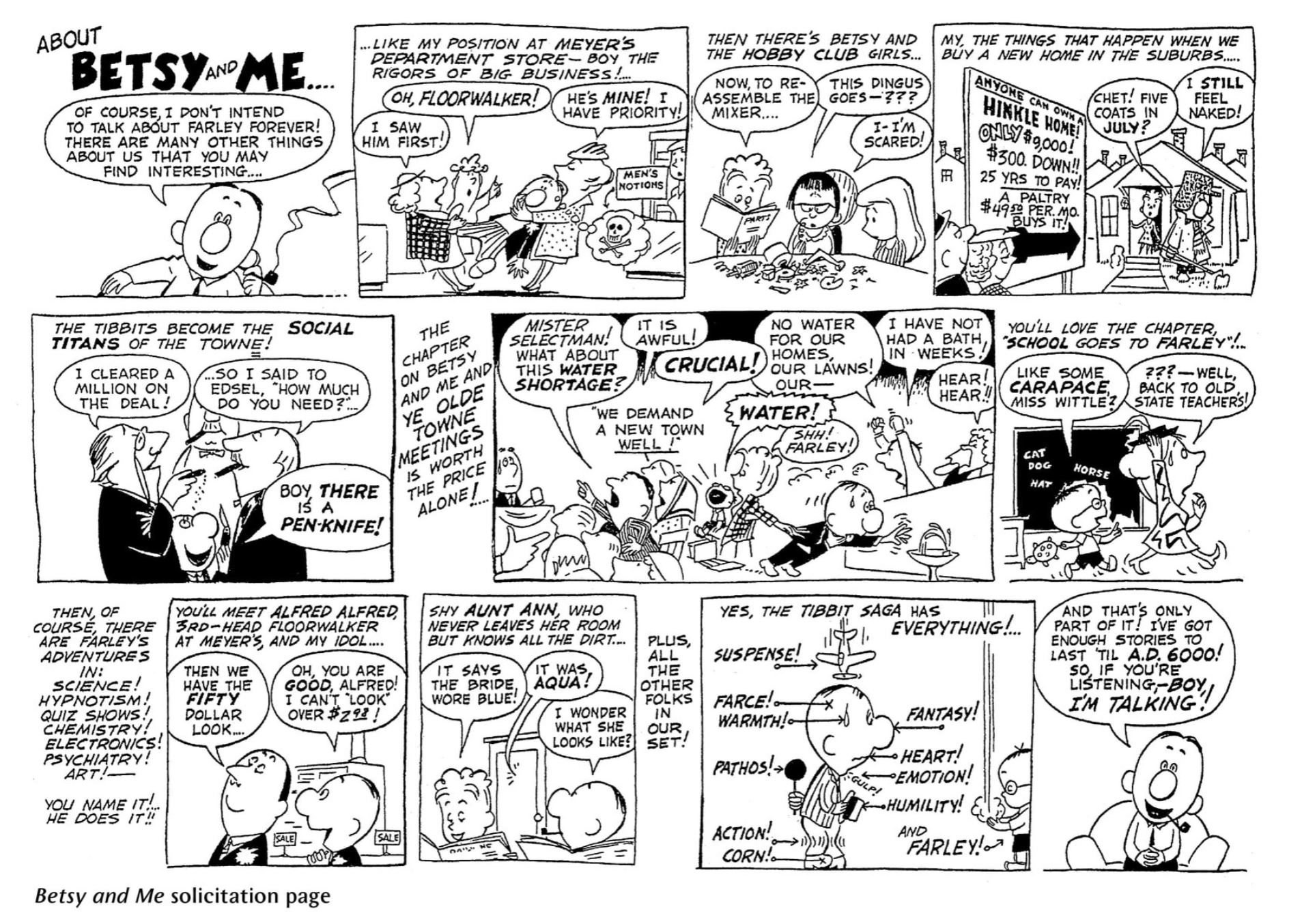
This mostly monochrome tome collects those long-lost newspaper sorties in a welcoming package which begins with the captivating solicitation page designed to entice new papers to buy the strip. Then biography, history, context and analysis come courtesy of historian R. C. Harvey’s introductory essay ‘The Last of Jack Cole: His Life and Art and Why They Both Ended with Betsy and Me. The heavily illustrated article also offers possible insights into Cole’s motivations, state of mind and possible reasons for suicide, before this superb collection of what should have been Cole’s greatest legacy opens…

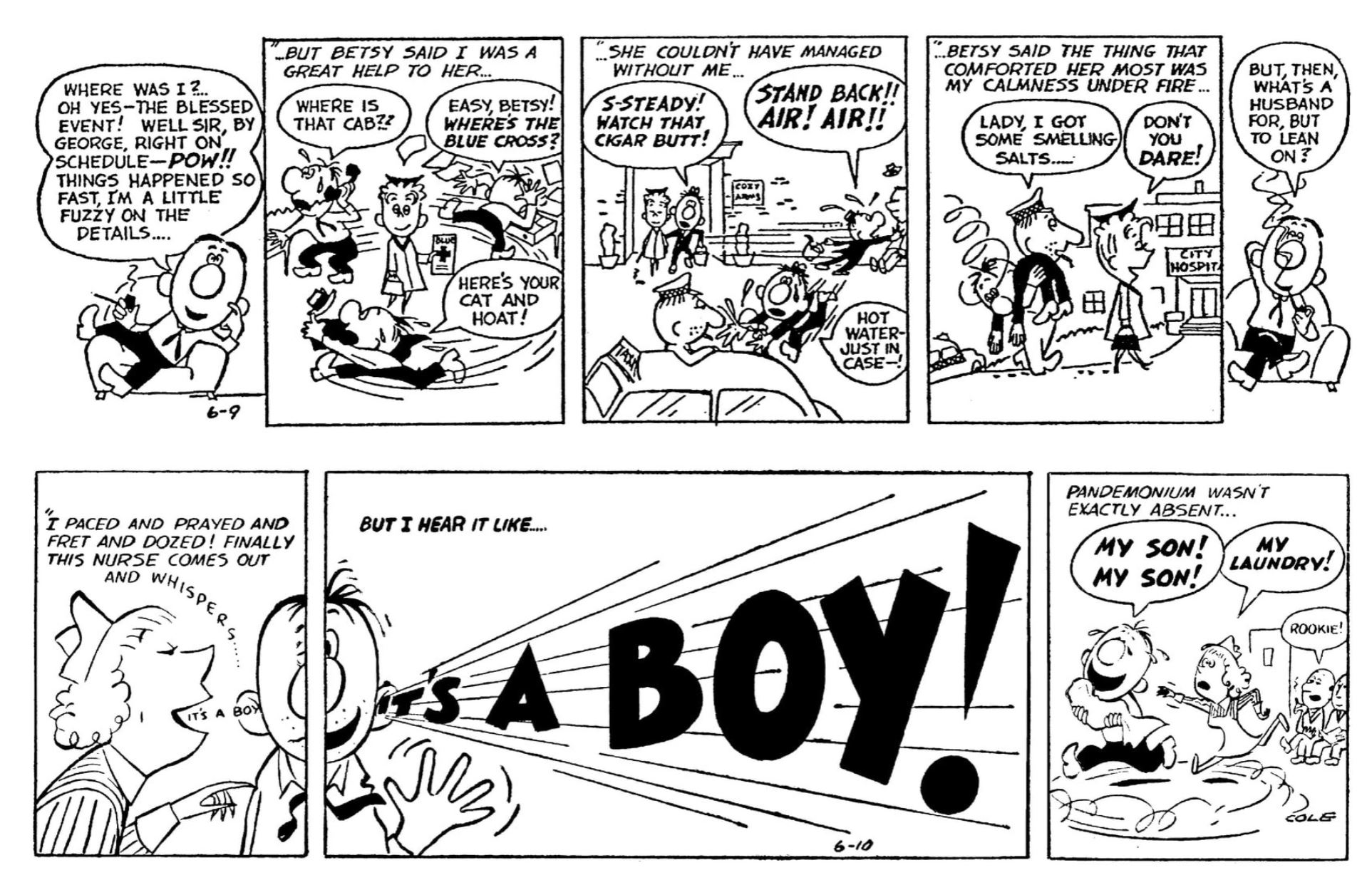
Utilising a stripped-down minimalist style that was the astute acme of its time, this domestic comedy is recounted as a fireside tale by homely working stiff Chester B. Tibbit. He recalls and reminisces with unseen readers who daily learn of his romancing of and marriage to Betsy; his downtrodden life as a floorwalker at the Meyers department store and plodding climb up the ladder of middle class aspiration.

The move from apartment to house, the trepidatious purchase of consumer benchmarks such as white goods and even an automobile (in the most generous sense of the term), and the inevitable addition of a child are all gradually covered in a manner most wry and deliciously sardonic. All the laughs stem from an old cartoonist’s trick: the rose-tinted self-deluding narrative says one thing whilst the pictures tell the grim, sordid truth, even when Chester can’t see it himself…

His admired and adored bosses are bullying martinets, his friends are shallow, fair-weather self-servers, Betsy isn’t a quiet, obedient little woman and his son is…

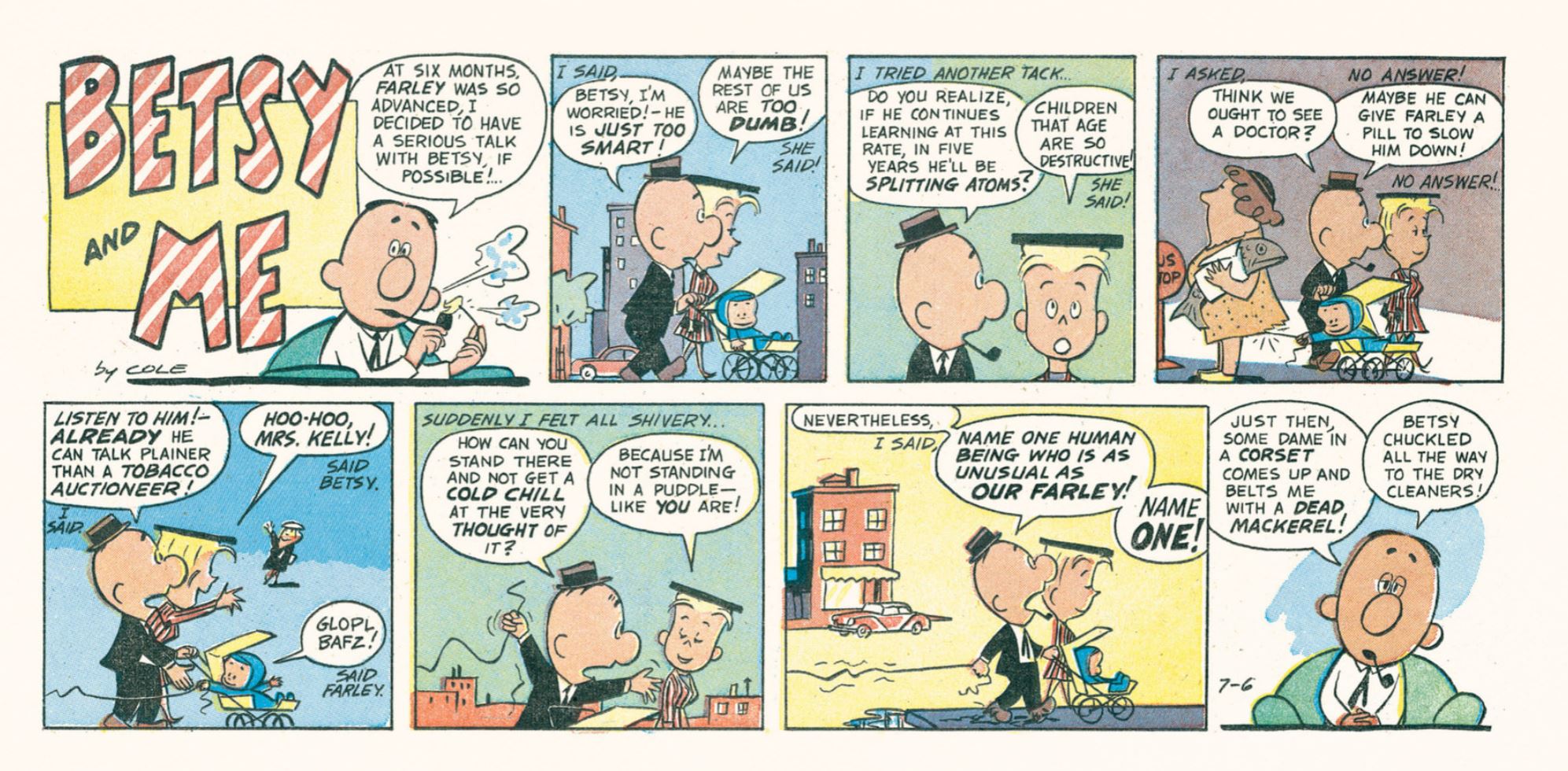
Well, the truth is that infant Farley actually is a genius: rude, brusque, impatient and utterly beyond the intellectual capabilities of his terrified, long-suffering parents. Even from his earliest moments in the crib the kid is the smartest one in the house – and that includes financially and emotionally…

The strips follow the traditional developmental path of courtship, marriage, home-making and child-rearing but always Cole’s needle-sharp social observations and uncontrollable whimsy are seditiously at work. At Meyers’ the infant blackmails his father’s superiors so they stop picking on the little nebbish and when Farley starts school he organises a student revolt…

The toddler even masters judo to protect his bewildered guardians from marauding criminals and spars continually with mooching, predatory Gus, a confirmed bachelor always hanging around Betsy with attentions that are clear to everyone but Chester…

Over the summer of 1958 Betsy and Me steadily grew in quality, scope and popularity. When Cole died on August 13th he had submitted strips for a full month ahead. His last daily ran on September 7th and the final Sunday on September 21st.

Dwight Parks took over and whereas the pared-down artistic style remained, the uneasy edgy satire was lost in favour of more domestic comfortable themes – such as the new house being a broken-down money pit, interfering neighbours, kindergarten woes, dieting and “keeping up with the Joneses”- the stuff of contemporary TV sitcoms like I Love Lucy

Critics have debated ever since Cole’s passing about whether, given time, Betsy and Me (or even a successor strip) would have cemented the brilliant raconteur as a master of all forms of graphic narrative, or whether he had finally overreached himself. We’ll never know, but at least you can read what remains and judge for yourself.

… And you really should.
© 2007 Fantagraphics Books. Text © 2007 R. C. Harvey.

Today in 1915, EC all-star “GhastlyGraham Ingels was born, as was Polish comics star Henryk Chmielewski AKA “Papcio Chmiel” (Tytus, Romek i A’Tomek); cartoonist/editor/educator Barb Rausch (Barbie, The Desert Peach, Omaha the Cat Dancer, Disney Studios, Neil the Horse) in 1941; writer/editor/artist Larry Hama (Wolverine, G.I. Joe, Bucky O’Hare, Nth Man) in 1949: artist/animator Rick Hoberg (Tarzan, Star Wars, Eternity Smith, Green Arrow) in 1952 and Mark Schultz (Superman, Xenozoic Tales) in 1955.

In 1958 today we lost astounding illustrator Joe Maneely (Ghost Breakers, Super Magician Comics, Black Knight, Yellow Claw, Atlas genres shorts) and in 2003 French artist Georges Pichard (Blanche Épiphanie, Ténébrax, Submerman, Ceux–là).

Golden Age Captain America Marvel Masterworks volume 2


By Joe Simon & Jack Kirby, Stan Lee, Charles Nicholas, Syd Shores, Al Avison, Al Gabriele, Harry Fisk, Ken Bald, Bill Ward and various (Marvel Comics)
ISBN: 978-0-7851-2228-9 (HB), 978-1-3025-0560-8 (Digital edition)

This book includes Discriminatory Content produced in less enlightened times.

Captain America was devised at the end of 1940 and boldly launched in his own monthly title from Timely – the company’s unofficial trading designation – with none of the customary cautious shilly-shallying. Owner Pulp publisher turned comic book empresario Martin Goodman always knew the value of striking while irons were hot…

The first issue was cover-dated March 1941 and became an instant monster, blockbuster smash-hit. Overnight Cap was the absolute and undisputed star of Timely’s “Big Three” – the other two being The Human Torch & Sub-Mariner. He was also one of the very first to plummet from popularity at the end of the Golden Age. These days – excluding, perhaps, some far-too-few Bill Everett-crafted Sub-Mariner yarns – the huge war-years popularity of the other two just doesn’t translate into a good read for modern consumers.

In comparison to their contemporary rivals and industry leaders at Quality, Fawcett, National/All American and Dell, or Will Eisner’s The Spirit newspaper insert, the standard of most Timely periodicals was woefully lacklustre in both story and, most tellingly, art. That they survived and prospered is a Marvel mystery, but a clue might lie in the sheer exuberant venom of their racial stereotypes and heady fervour of jingoism at a time when the USA was becoming involved in the greatest war in global history. Nevertheless, the first ten Captain America Comics are indisputably the most high-quality comics in the fledgling company’s history and I can’t help but wonder what might have been had National (neé DC) been wise enough to hire Simon & Kirby before they were famous, instead of after that pivotal first year?

Of course, we’ll never know and although the team supreme did jump to the majors after a year, their visual dynamic became the mandated aspirational style for super-hero comics at the company they left. Moreover, their patriotic creation became a flagship icon for them and the industry. Truth be told. however, the groundbreaking and exceptionally high-quality material from Joe Simon & Jack Kirby is not really the lure here – the real gold nuggets for us old sods and comics veterans are the rare back-up features overseen by the star duo and crafted by their small pool of talented up-&-comers.

Although unattributed assistants included at various times Reed Crandall, Syd Shores, Alex Schomburg, Mort Meskin, Chu Hing, Charles Nicholas, Gustav Schrotter, George Klein, C.A. Winter, Fred Bell and many more, working on main course and filler features such as Hurricane, the God of Speed and Tuk, Caveboy: strips barely remembered today yet still brimming with the first enthusiastic efforts of creative legends in waiting.

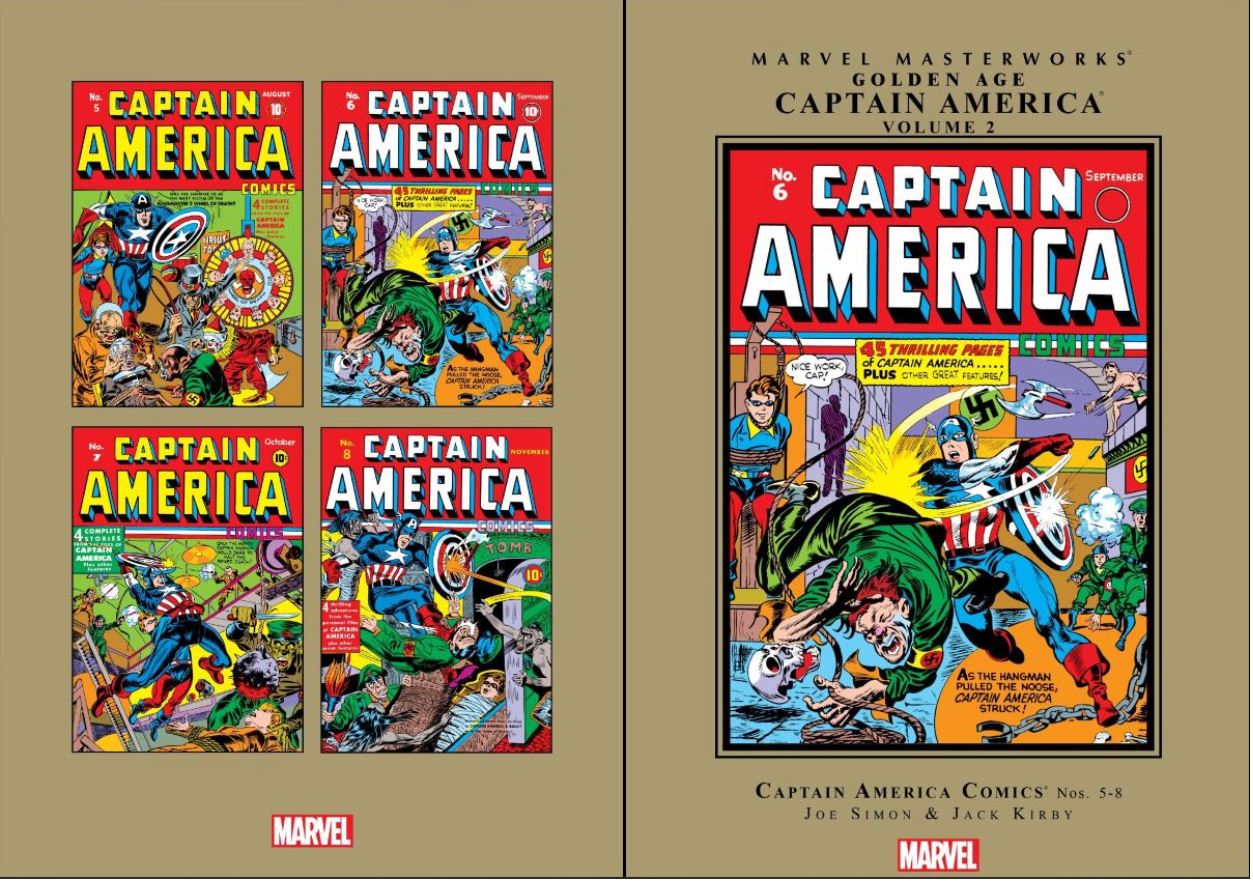
This lavish hardback volume (available in a digital edition) reprints original Star-Spangled blockbusters Captain America Comics #5-8 (spanning August to November 1941) and also provides a fascinating insight into the fly-by-night nature of publishing during those get-rich-quick days in an Introduction from Gerard Jones, after which the astounding action resumes…

After scrawny, enfeebled young patriot Steve Rogers is continually rejected by the US Army, he is recruited by the Secret Service. In an effort to counter a wave of Nazi-sympathizing espionage and sabotage, the passionate young man was tapped to join a clandestine experimental project to create physically perfect super-soldiers. However, when a Nazi agent infiltrated the labs and murdered its key scientist, Rogers became its only successful graduate and transitioned into America’s not-so-secret weapon and very public patriotic symbol.

Despatched undercover as a simple army private, he soon encountered headstrong, orphaned Army Brat James Buchanan Barnes who became his sidekick and costumed confidante “Bucky”. In the period when America was still officially non-combatant, Rogers and his sidekick were stationed at East Coast army base Camp Lehigh, but still manage to find plenty of crime to crush and evil to eradicate.

In Simon & Kirby’s ‘Captain America and the Ringmaster of Death’ the arrival of a circus leads to the deaths of General Blaine and Defense Commissioner Newsome in suspicious circumstances. Before long, both the masked heroes and government agent Betty Ross reach the same conclusion: all the acts and freaks are Nazi operatives sabotaging the nation’s security through murder… but not for much longer…

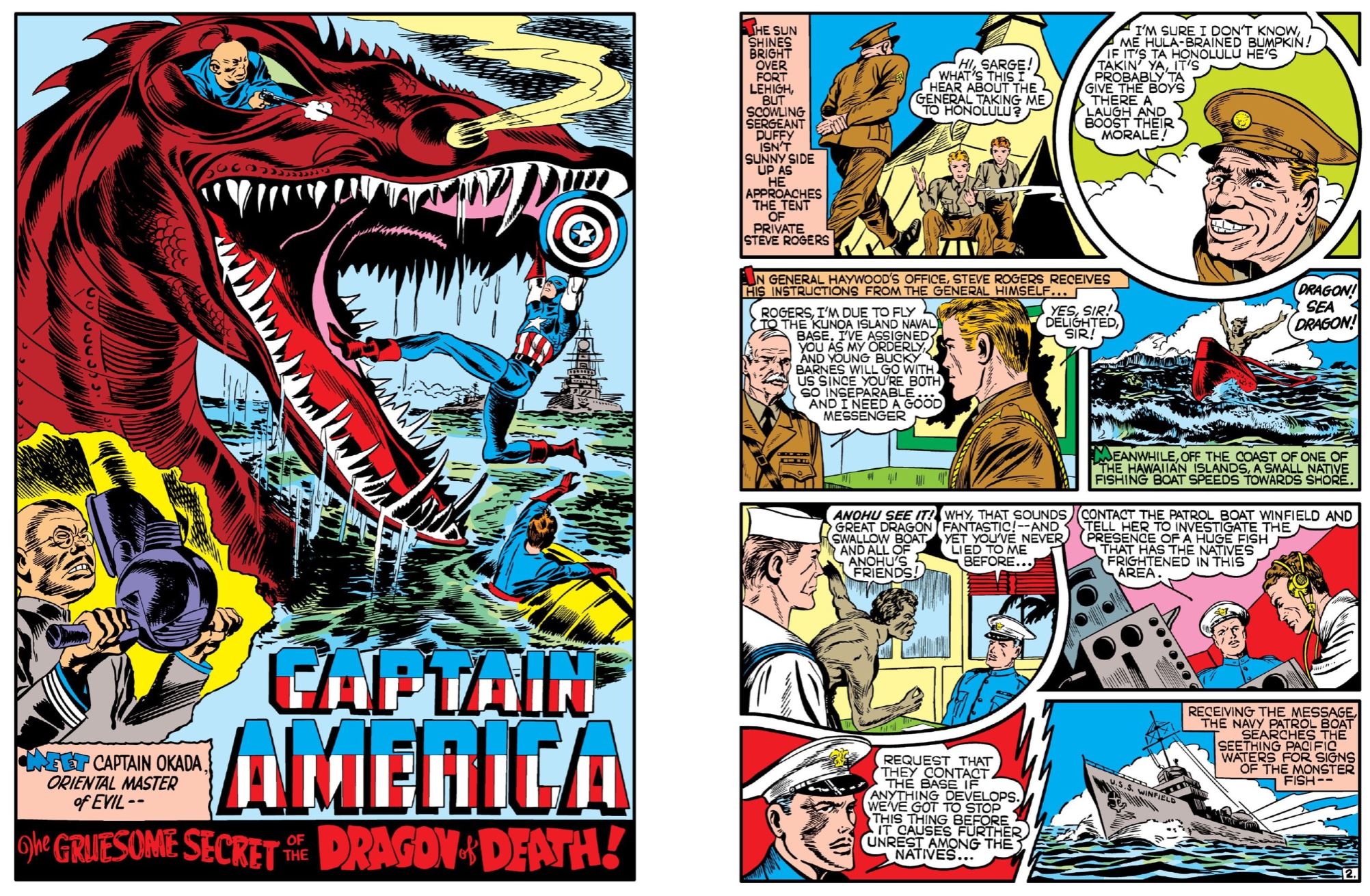
Japan was still neutral too, so although visually their forces – especially spies – were also unmistakeably ever-present, the eastern arm of the Axis alliance (the other two being Germany and Italy, history fans) were still being referred to as “sinister Orientals” and “Asiatic aggressor nations”. Even so, when Steve & Bucky accompany new commander General Haywood to the US Pacific base of Kunoa, readers knew who was really behind ‘The Gruesome Secret of the Dragon of Death!’ and revelled in seeing the heroes scupper the most spectacular secret weapon yet aimed at the forces of freedom…

Back in the USA, the hard-hitting Star-Spangled Stalwarts then rescue decent, law-abiding German-Americans terrorised by the ‘Killers of the Bund’ who were determined to create a deadly Fifth Column inside America’s heartland. Following a rousing ad for a newly minted Captain America’s Sentinels of Liberty society, a glorified infomercial for the club comes in the form of prose adventure ‘Captain America and the Ruby Robbers’ scripted by Stan Lee with spot art by S&K, after which our Patriotic Pair save a downed volunteer American flyer held prisoner on a former French Island now administered by the collaborating Vichy government.

‘Captain America and… The Terror That Was Devil’s Island’ offers action-drenched melodrama plucked from the contemporaneous Hollywood movie mill and referencing films like 1937’s The Life of Emile Zola, 1939’s Devil’s Island and perhaps even 1941’s I Was a Prisoner on Devil’s Island and served to show that infamy and cruelty could not long subdue any valiant American heart…

Joining the list of supporting features, the equally relevant if improbable adventures of ‘Headline Hunter, Foreign Correspondent’ began with this issue. Credited to Stan Lee (Goodman’s nephew and major domo Stanley Lieber) & Harry Fisk, these shorts find US journalist Jerry Hunter sent to Blitz-blighted London to report on the European war, only to become the story after uncovering a traitor in the corridors of power…

Sporting only a title page by Simon & Kirby, primeval wonder ‘Tuk, Cave Boy’ bows out in a final example of “Weird Stories from the Dark Ages” as he saves his mentor Tanir from marauding beast-men and ends forever the depredations of brutal tyrant Bongo, before seasoned pro Charles Nicholas (nee Wojtkowski) assumes art chores on ‘Hurricane, Master of Speed’. Hurricane was the earthbound son of thunder god Thor (no relation to the 1960s version): a brisk reworking and sequel to Kirby’s ‘Mercury in the 20th Century’ from Red Raven Comics #1 (cover-dated August 1940), and here intercedes in a diabolical plot to destabilise the economy by flooding US banks with counterfeit currency.

CAC #6 carried a September 1941 cover-date and opens with a classic murder spree thriller as ‘Captain America Battles the Camera Fiend and his Darts of Doom’ in a frantic bid to prevent the theft of Britain’s Crown Jewels. Timely were never subtle in terms of jingoistic (we’d say appallingly racist) depictions, and even the normally reserved Simon & Kirby let themselves go in ‘Meet the Fang, the Arch Fiend of the Orient’ as Cap & Bucky challenge the full insidious might of the Tongs of San Francisco’s China Town to save kidnapped Chinese dignitaries from a master torturer…

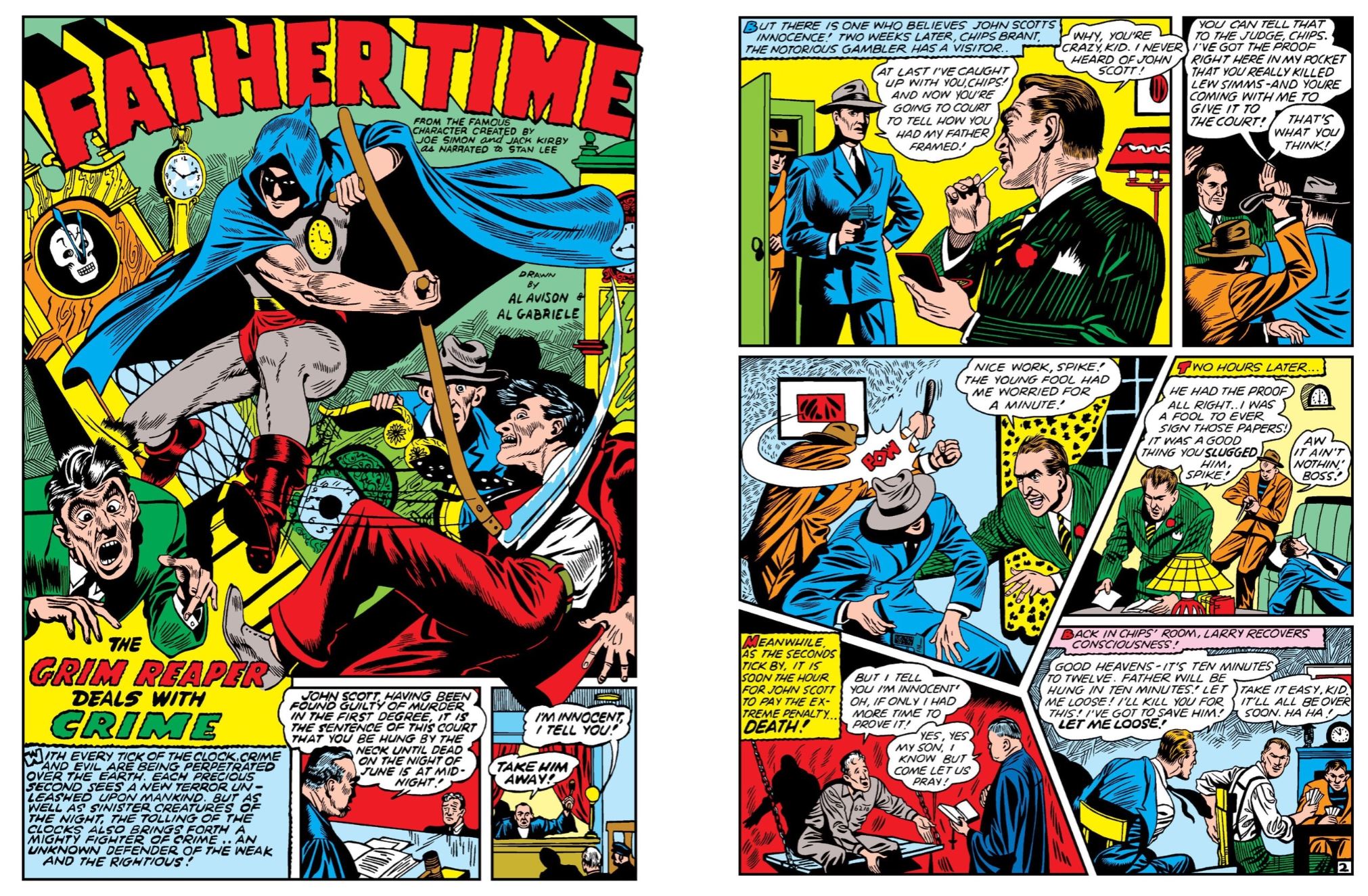
Another new feature followed: scripted by Lee and illustrated by Al Avison & Al Gabriele, ‘Father Time: The Grim Reaper Deals with Crime’ details how Larry Scott learned his father had been framed for murder and through heroic efforts exposed the true culprits… but was seconds too late to save his sire from the noose. Resolved that time should no longer be on the side of criminals and killers, Larry devised a ghastly outfit and – wielding a scythe – brought his dad’s persecutors to justice. They would be only the first in Father Time’s crusade…

Simon & Kirby’s art and stories were becoming increasingly bold and innovative. ‘The Strange Case of Captain America and the Hangman Who Killed Doctor Vardoff’ reveals a diabolical game of “Ten Little Indians” as suspects perish one by one whilst the superheroes attempt to catch a ruthless killer and retrieve a stolen experimental super-silk invention. Lee and an unknown artist then offer another thinly-veiled prose plug for the Sentinels of Liberty club as Cap and Bucky lay a ‘Trap for a Traitor’, after which Headline Hunter, Foreign Correspondent ‘Battles the Engine of Destruction’ (Lee & Fisk) and exposes an aristocratic English fascist building Nazi terror weapons in his British factories.

Following further Sentinels of Liberty club news and puzzle pages ‘Hurricane, Master of Speed’ closes the issue, crushing a murder plot in his own boarding house with art courtesy of Charles Nicholas.

CAC #7 is a stunning comic milestone that leads with iconic clash ‘Captain America in the Case of the Red Skull and the Whistling Death’. With Steve & Bucky ordered to participate in a Vaudeville-themed troop show at Camp Lehigh, the Nazi super-assassin stalks the city, slaughtering his old cronies and US military experts with a mysterious sound weapon. The fiend’s big mistake is leaving the shadows and arrogantly turning his attention to Cap…

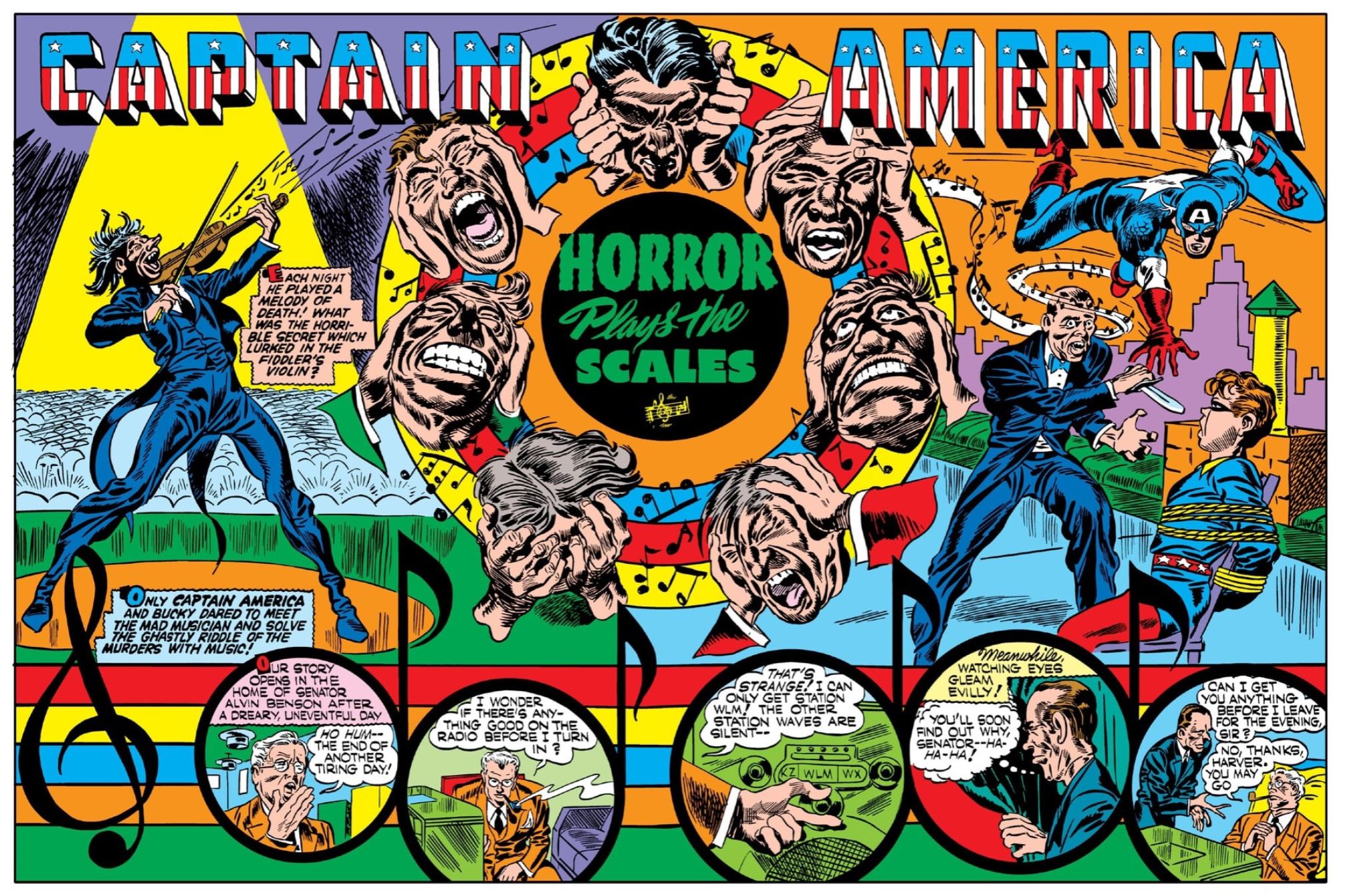
‘The Case of the Baseball Murders: Death Loads the Bases’ seemingly offers a change of pace but Steve’s sporting relaxation turns into more work when a masked maniac starts knocking off his team’s star players before Lee’s prose novelette provides ‘A Message from Captain America’ which introduces his fellow heroes Jerry Hunter, Hurricane and Father Time before S&K strip feature ‘Horror Plays the Scales’ pits the Red, White & Blue Bravos against a murdering musician knocking off anti-Nazi politicians.

Ken Bald & Bill Ward introduce a comedy foil for Hurricane as ‘Justice Laughs Last’ sees the speedster adopt portly shopkeeper Speedy Scriggles after protection racketeers target the feisty fool. Headline Hunter (Lee & Fisk) then clears an Englishman accused of murdering an American film star and reveals a Nazi plot to disrupt Anglo-US relations, as Father Time’s ‘Race Against Doom’ (Lee, Al Avison & Al Gabriele) saves another innocent patsy from taking the fall for a crooked DA and his mob-boss paymaster. The issue closes with more puzzles and patriotic pronouncements from Cap & Bucky to all their fee-paying Sentinels…

Cover-dated November 1941, Captain America Comics #8 was released months before the Pearl Harbor atrocity catapulted the USA into official war so contents might have compiled as early as June or July. Thus it opens with another gripping crime conundrum – ‘The Strange Mystery of the Ruby of the Nile and Its Heritage of Horror’ – which sees the heroes assisting Betty Ross in safeguarding a fabulous antique jewel, but seemingly helpless to prevents its archaeologist excavators being butchered by a marauding phantasm.

The impending conflagration does inform ‘Murder Stalks the Maneuvers’ when a Nazi infiltrator attends war games and uses the opportunity to trick the soldiers into destroying each other with live ammo, whilst Headline Hunter, Foreign Correspondent remains in the thick of it facing ‘The Strange Riddle of the Plague of Death’ (Lee & Fisk). This time he saves London (and the Home Counties) from a strange sickness spread by bread…

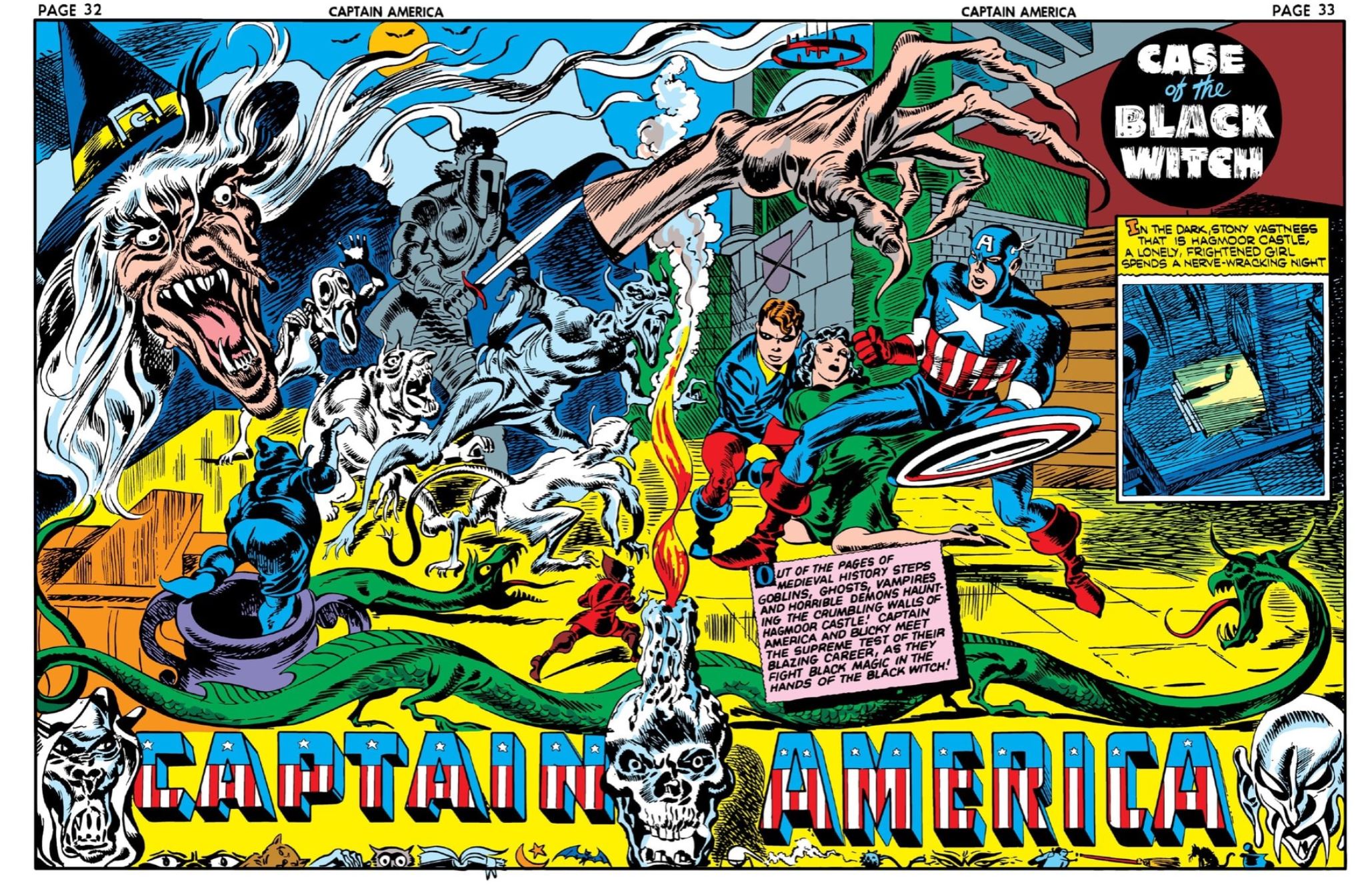
After more Sentinel propaganda and absorbing puzzles, Simon & Kirby’s ‘Case of the Black Witch’ has Cap & Bucky shielding a young woman’s inheritance before clashing with a sinister sorceress and the worst horrors hell could conceive of.

Nicholas returns to Hurricane as the Master of Speed and his new pal shut down a crooked ‘Carnival of Crime’, after which Lee & an unsung illustrator promote in prose a new Timely title as ‘The Young Allies Strike a Blow for Justice’. Please be warned: the treatment here of “Negro” character Whitewash – a full partner in the heroic team – is every bit as dated, contentious and potentially offensive as that era’s representations of other races, so kudos to the editors for bravely leaving the story untouched and unedited. Closing on a bombastic high, Father Time then deals harshly with robbers who use bank strongrooms to asphyxiate witnesses in ‘Vault of Doom!’

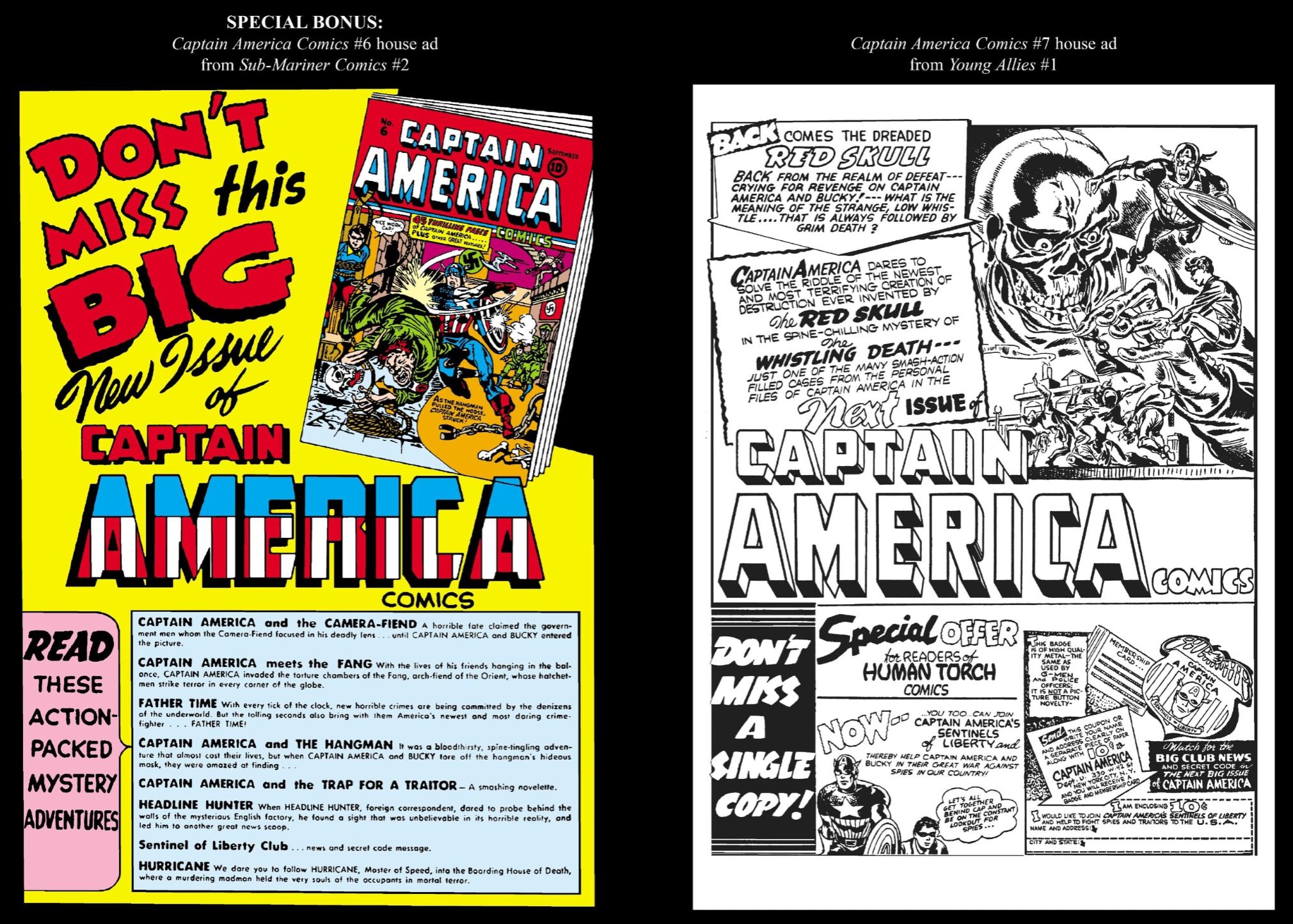
An added and very welcome bonus for fans is the inclusion of some absolutely beguiling house-ads for other titles, contents pages, Sentinels of Liberty club bulletins and assorted ephemera…

Although lagging far behind DC and despite, in many ways having a much shallower Golden Age well to draw from, it’s commendable that Marvel has overcome understandable initial reluctance about its earliest output in these masterworks – even if they’re only potentially of interest to the likes of sad old folk like me. However, with this particular tome at least, the House of Ideas has a book that will always stand shoulder to shoulder with the very best that the Golden Age of Comics could offer.
© 2018 Marvel Characters, Inc. All rights reserved.

Pioneering Italian comics creator Sandro Angiolini (Isabella) was born today in 1920, sharing the date with Belgian Maurice Maréchal (Prudence Petipas) in 1922 and American cartoonist Tom K. Ryan (Tumbleweeds) in 1926, and – one year later – Le Journal de Spirou stalwart creator Peter Spier (Sophie).

We lost Katzenjammer Kids artist Joe Musial in 1977; Timely/Atlas/Marvel Comics founder Martin Goodman in 1992; Golden and Silver Age comic book everyman Manny Stallman (Young Robin Hood, Big Town, Raven) in 1997, with this century this day marking the passings of Kate Worley (Omaha the Cat Dancer) in 2004 and French creator and co-founder of Pilote Jean-René Le Moing – AKA “Bulbul” – (Le Chevalier Emerik, Peter Pat) in 2012.

In 1932 Clifford McBride’s Napoleon and Uncle Elby premiered; and in 1959 The Beano debuted Leo Baxendale’s The Three Bears, UK whilst weekly Cor!! launched today in 1970 and Steve Gerber & Gene Colan’s newspaper strip version of Howard the Duck took flight in 1977.

Sorry, no posting today. Instead why not read or re-read our coverage of Persepolis – The Story of a Childhood & Persepolis 2 – The Story of a Return and ponder what a huge loss the death of Marjane Satrapi (announced yesterday) is to us all.

Born today in 1905, Wayne Boring was inescapably typecast as the 1940s-1950s Superman artist, and shared his birthday with Vin Sullivan who limned and edited Action Comics #1. He arrived on his planet in 1911 whilst occasional Superman inker Frank Chiaremonte was born today in 1942. Today in 1970 artist Matthew Clark (Amazing Spider-Man, Wonder Woman, Doom Patrol) was born. He also has illustrated the Man of Tomorrow…

Pottsy, Bozo Blimp and Willie Doodle  cartoonist Jay Irving died on this date in 1970 and the date is remarkable for events such as the first episode of Warren Tufts’ magnificent Lance in 1955; the publication of Amazing Fantasy #15 in 1962; the last episode of Stan Lynde’s glorious strip Latigo in 1983 and, in 1987, the live performance/re-enactment of Peter Parker’s wedding to Mary Jane Watson at Shea Stadium, Queens.

Stay


By Lewis Trondheim & Hubert Chevillard, translated & edited by Mike Kennedy (Magnetic Press)
ISBN: 978-1-54930-771-3 (HB/Digital edition)

Until so very recently, comics in the English-speaking world were largely comedy or genre adventure, with a small but vital niche of breakthrough biography, autobiography and reportage such as Maus, Palestine, The End of the F**king World and Persepolis. What we have never had, and still largely don’t have, is an equivalent to general fiction and drama/melodrama.

That’s not so in Europe, where a literal “anything goes” attitude has always accommodated human-scaled slice of life stories that depict ordinary people in the quiet as well as extraordinary moments. Think of such comics as the sequential narrative equivalent of watching mainstream broadcast TV. In the UK that would be BBC 1, 2 (and maybe 4); ITV1 and Channels 4 or 5. But in comics even that resource offers a vast variety, and in Euro Comics it isn’t hard to find almost impossible genres thriving. For example, there’s a wealth of superb material just about going on holiday…

That’s not really a fair comparison for Americans, but quite frankly, your TV networks are a hellhole of your own devising; although we are proudly debasing our system to match yours. Still, it’s a miracle that you have generated so many great shows and programmes over the decades and it’s also why I keep banging on about comics. In them, there are always infinite worlds and possibilities…

So, now that our own Powers-That-Be (hopeless, whoever you vote for) have arranged it so that it’s now all-but-impossible for any UK-based folk to pop across and have une petite vacance in Europe unless immune to passports and able to teleport, over there organized timewasting and energy-restoration is still an inescapable right, and they have some fabulous tales about taking a simple break. This is arguably one of the best you’ll ever read…

A sublime example of everything I’m talking about, this is Lewis Trondheim & Hubert Chevillard’s Je vais rester. Translated by Magnetic Comics as Stay, it challenges all the commercial pressures I’ve alluded to above: an intriguing, engaging drama in both print and byte-sized versions for me to recommend and you to fall in love with. It also means that if you’re stuck in road, rail or airport queues you can download it after getting bored with me…

With north of 100 books bearing his pen-name (his secret identity is actually Laurent Chabosy), writer/artist/editor/animator/educator Lewis Trondheim is one of Europe’s most prolific comics creators: illustrating his own work; overseeing cartoon adaptations of earlier successes like La Mouche (The Fly) and Kaput and Zösky or editing young-readers book series Shampooing for Dargaud.

His most famous tales are such global hits as Les Formidables Aventures de Lapinot (seen in English as The Spiffy Adventures of McConey); the Donjon series of nested fantasy epics (co-created with Joann Sfar and translated as conjoined sagas Dungeon: Parade, Dungeon: Monstres and Dungeon: the Early Years); comedy fable Ralph Azham and his utterly beguiling cartoon diaries collected as Little Nothings.

In his spare time – and when not girdling the globe from convention to symposium to festival – the dourly shy and neurotically introspective savant wrote for satirical magazine Psikopat and provided scripts for many of the continent’s most popular artists such as Fabrice Parme (Le Roi Catastrophe, Vénézia), Manu Larcenet (Les Cosmonautes du futur), José Parrondo (Allez Raconte and Papa Raconte) and Thierry Robin (Petit Père Noël).

Ostensibly retired but still going strong, Trondheim is a cartoonist of uncanny wit, outrageous imagination, piercing perspicacity, comforting affability and self-deprecating empathy who prefers to scrupulously control what is known and said about him…

I must admit that, at this moment, from all his vast canon, STAY is probably my absolute favourite…

Born in Angers in 1962, Hubert Chevillard (Le Pont dans la Vase, Corcal, Terra Incognita, Le Facteur, Pavillon Rouge, Donald’s Happiest Adventures) is a French cartoonist who studied animation at the Gobelins School and School of Fine Arts in Angoulême. He worked at Walt Disney Animation France’s Montreuil Studious for almost a decade before switching to comics as illustrator of Didier Crisse’s Luuna. He thereafter branched out and carried on, scripting his own stuff whilst remaining an in-demand artist for others…

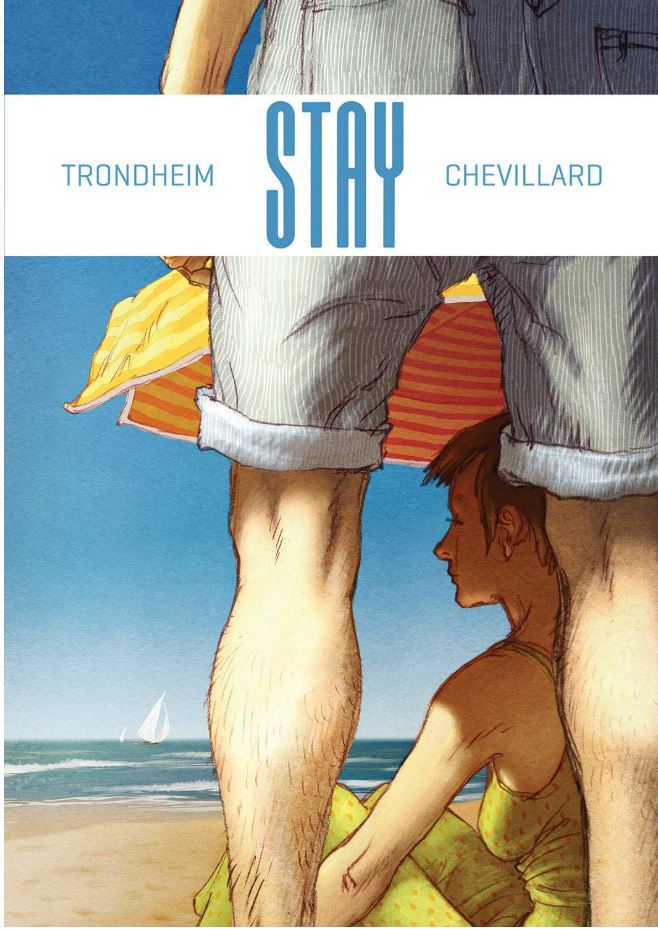
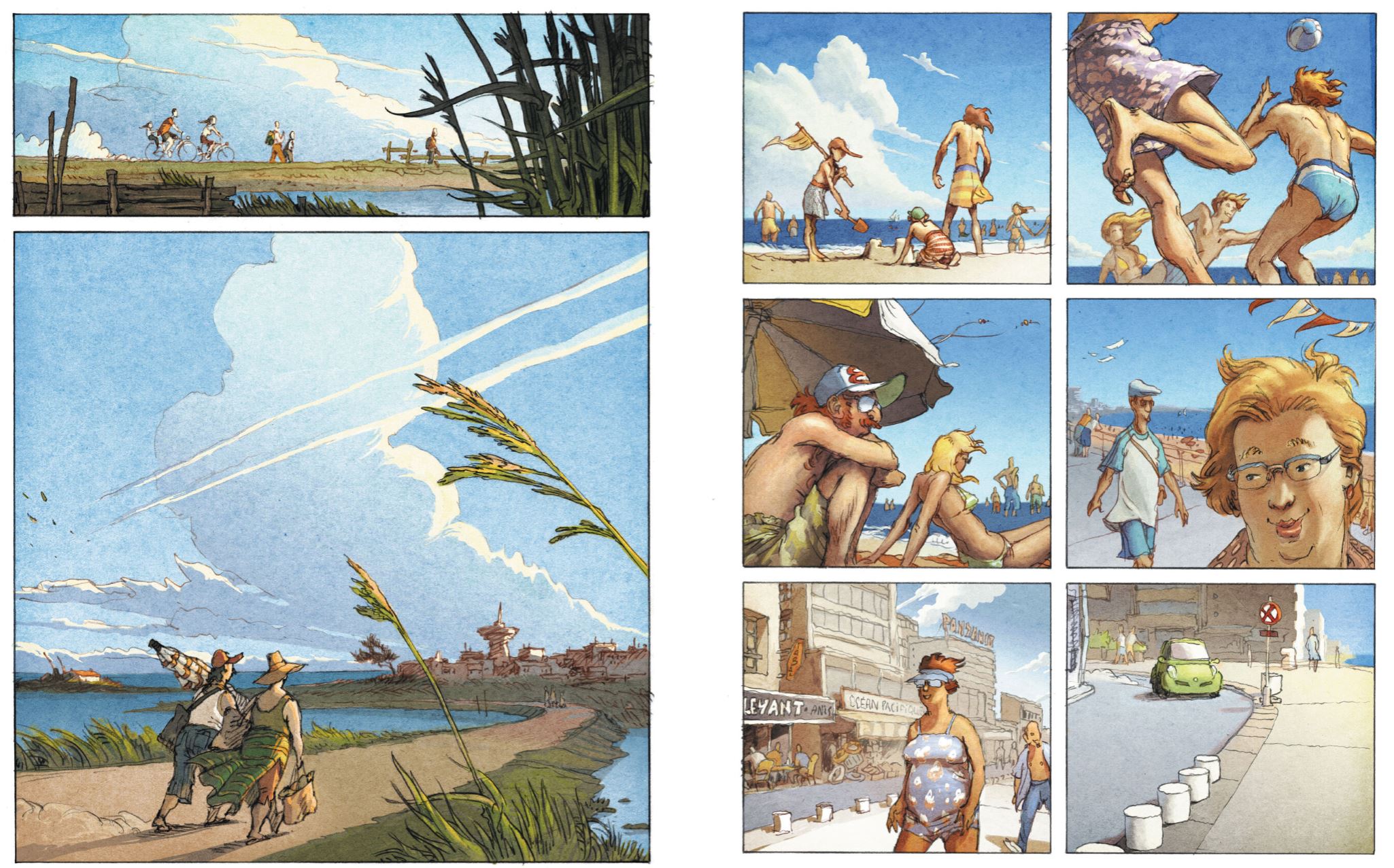
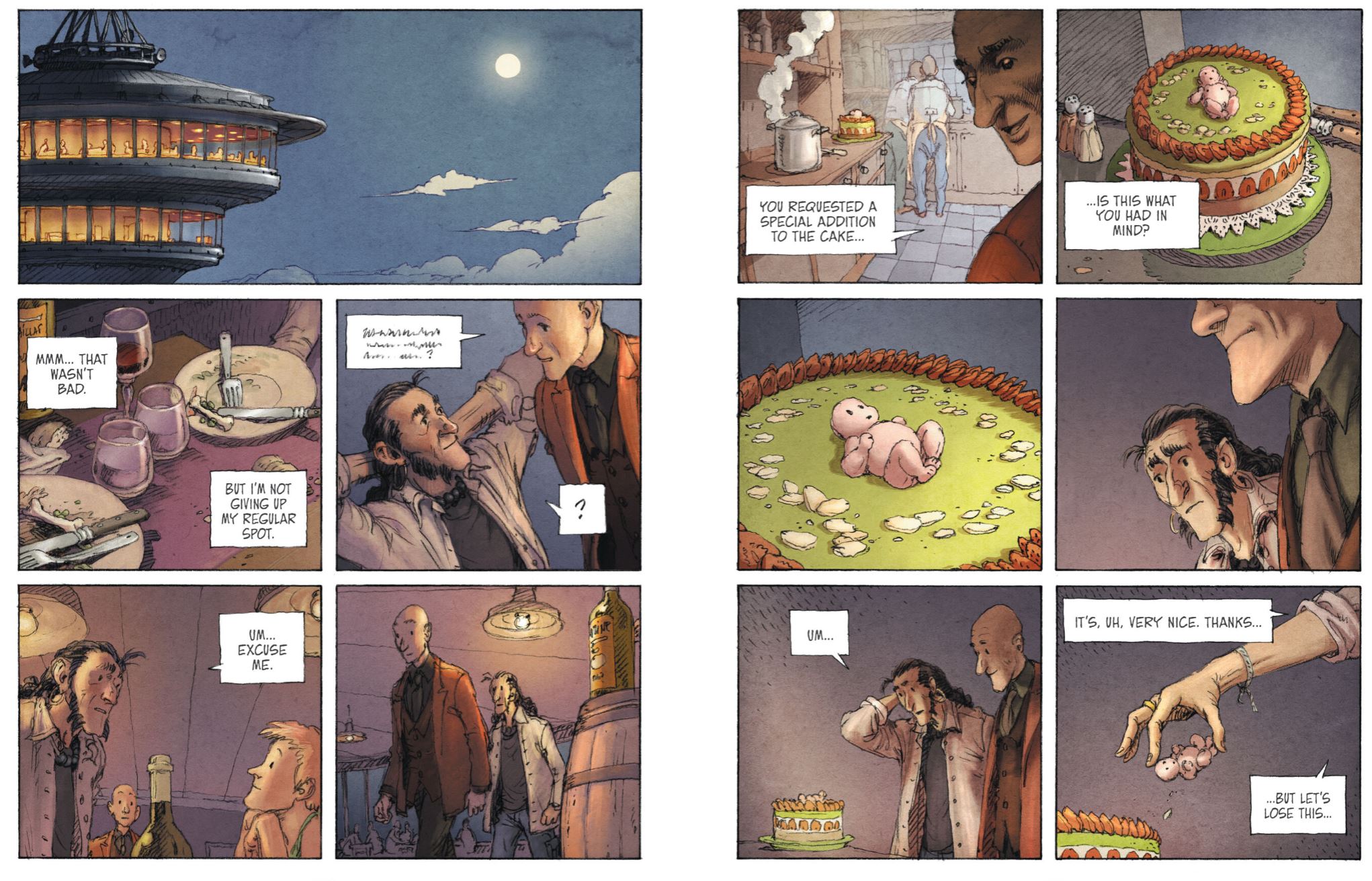
Here his softly endearing images paint us a picture of idyllic summer holidays at the seaside for affianced couple Roland Matturet and Fabienne Guillardin. For their trip to the South of France, he has meticulously (it’s his way) planned everything and paid for it all in advance as a build-up to asking her a certain question. Sadly, the entire sunny escapade is cut short – as is Roland himself – when a bizarre accident leaves Fabienne instantly and utterly alone in a strange but welcoming resort of happy strangers…

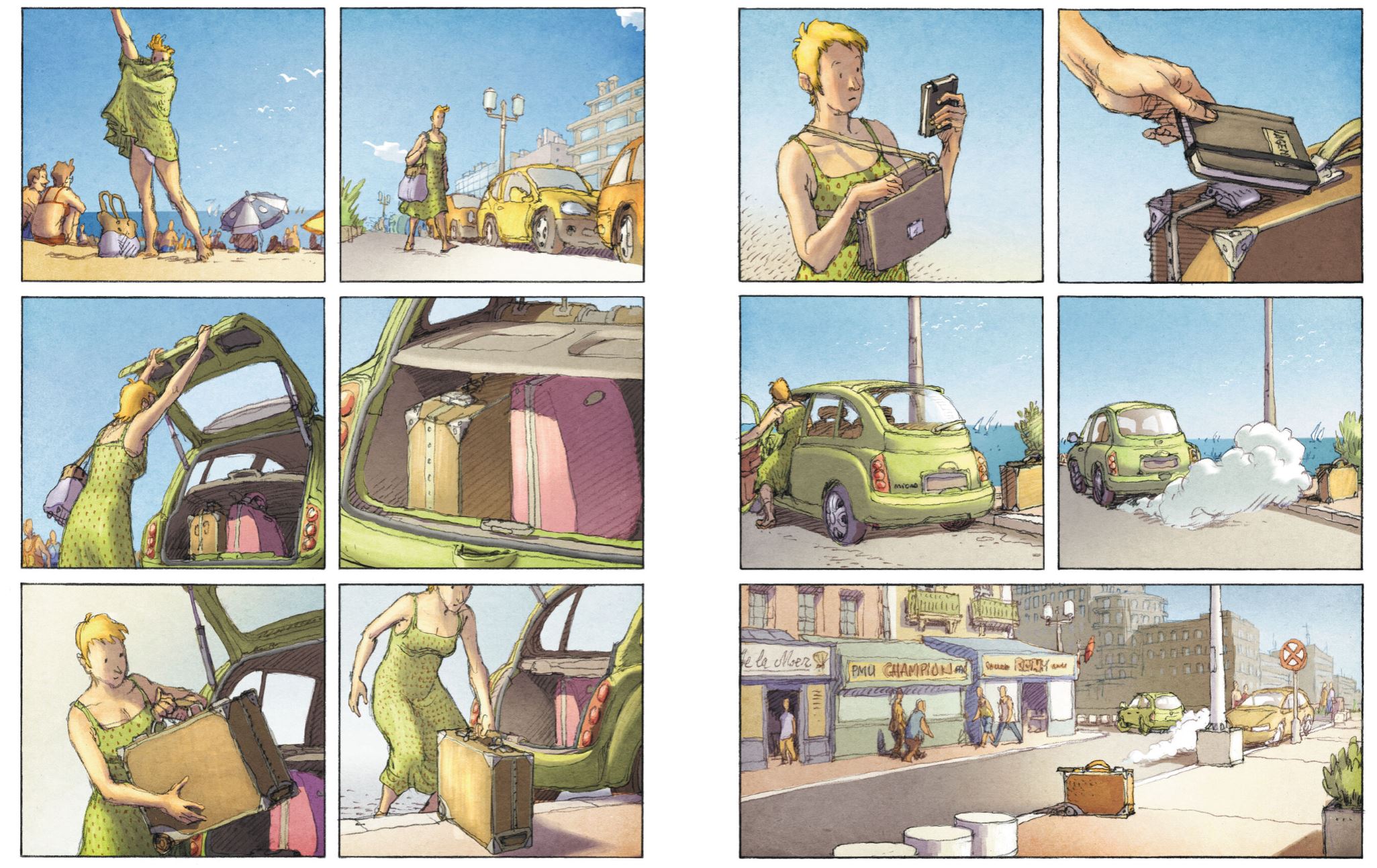
Shocked and stunned, but still posthumously guided by Roland’s notebook itinerary, Fabienne seems to pause inside. Not even informing the families of the change in circumstance, she roams like a ghost, sampling all the prepaid amenities, diligently attending to Roland’s checklist of events… and gradually reinventing herself.

Avoiding all past connections and her current situation, she savours being unknown, alone, and not yet bereaved: pondering the ramifications in her pensive way, as she grudgingly befriends eccentric, exotic and quixotic local Paco… a man unlike any she has ever met before.

With no idea how she feels about anything, Fabienne allows herself to be intrigued as Roland’s hold on her diminishes and fades away…

What’s next…?

Lyrical, laconic, blackly comic and engagingly demure, this gleefully morbid, platonic holiday non-romance unfolds with a minimum of verbiage and powerfully understated silent visuals: exploring life and death, addressing denial, avoidance and coping mechanisms through a soft-focussed lens of friendships in adversity and those ever-present, never-acted upon holiday impulses…

Vacations are built of never-seized moments of seductive might-have-beens and affable strangers, channelled here in astonishingly compelling episodes that make the mundane magical, and encapsulating those brief spells of transient opportunity that comprise such “holidays of a lifetime”. This is tale of woe and wonder writ small, and all the more perfect because of it.
Stay published 2019 by The Lion Forge, LLC. © 2019 The Lion Forge, LLC. Originally published in France as Je vais rester, scenario by Lewis Trondheim, illustrations by Hubert Chevillard © Rue de Sevres, Paris 2018. All rights reserved.

Today in 1951 Wendy (Elfquest) Pini was born, as was inker Josef Rubinstein in 1958, but the date also marks the loss of artist and back-stage comics boffin Sol Brodsky in 1984 and premier cartoonist Dik Browne (Hägar the Horrible, Hi and Lois, The Tracy Twins) in 1989.

Today in 1938, Britain’s Daily Mirror launched Bernard Graddon’s long running Just Jake strip, and Keiji Nakazawa’s epic Barefoot Gen began in 1973. In 1988 Steve Canyon parked the jet for the last time and in 1994 the initial Alternative Press Expo opened in San Jose, CA.

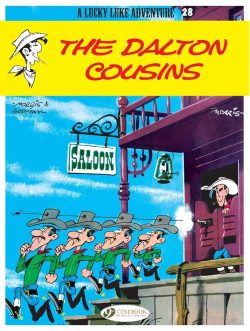
Lucky Luke Vol 28 The Dalton Cousins


By Morris & Goscinny, translated by Luke Spear (Cinebook)
ISBN: 978-1-84918-076-4 (Album PB/Digital edition)

This book includes Discriminatory Content produced in less enlightened times. This book also includes Discriminatory Content added for comedic effect.

Created by Belgian animator, illustrator and cartoonist Maurice de Bévère (AKA “Morris”), Lucky Luke debuted in the summer of 1946, initially riding out in Le Journal de Spirou summer sans title or banner, and only in the French-language edition. The Lone Rider’s official launch came in Christmas Annual L’Almanach Spirou 1947, before beginning his first official serial – ‘Arizona 1880’ – in December 7th 1946’s multinational weekly issue.

Doughty, dashing, dependable cowboy “good guy” Lucky is a rangy, implacably even-tempered do-gooder able to “draw faster than his own shadow”. He amiably ambles around the mythic Old West, having light-hearted adventures on his petulant and rather sarcastic wonder-horse Jolly Jumper. For 80 years (Joyeux anniversaire, Mon Brave!), his exploits have made him a top-ranking global comic character, filling more than 90 individual albums and spin-off series like Kid Lucky and Ran-Tan-Plan, with sales upwards of 300 million copies in 30 languages. That renown translated into a mountain of merchandise, toys, games, animated cartoons, TV shows and live-action movies and even commemorative exhibitions. No theme park yet, but you never know…

Lucky’s global dominance resulted from a decades-long, 45 volume collaboration with superstar scripter René Goscinny, spanning Des rails sur la Prairie/Rails on the Prairie beginning August 25th 1955 to La Ballade des Dalton et autres histoires/The Ballad Of The Daltons And Other Stories in 1986. On Goscinny’s death, Morris worked on alone again before recruiting others, to form a posse of legacy creators including Lo Hartog van Banda, Achdé & Laurent Gerra, Xavier Fauche, Benacquista & Pennac, Jean Léturgie, Jacques Pessis and more, all taking their own shots at the venerable vigilante. Morris soldiered on singly and with these successors before his own passing in 2001, having drawn fully 70 adventures, plus numerous sidebar and spin-off sagebrush sagas.

His grande idée draws on western history as much as movie mythology, regularly meeting historical figures as well as even odder fictional folk in tales drawn from key themes of classic cowboy mythology – as well as some uniquely European notions or interpretations such as seen here. As previously hinted, our six-gun star is not averse to being a figure of political change and Weapon of Mass Satire, but here spoofs his own antecedents and venerated movie schtick for a delicious drive down memory lane…

Goscinny had started scripting Lucky uncredited in 1955. Morris had taken nearly a decade to fill nine albums with affectionate sagebrush parody, action and Lucky Laughs, but now, with Goscinny as regular wordsmith, Luke would attain dizzying heights of super swift superstardom, commencing with Des rails sur la Prairie (Rails on the Prairie), and following up with Lucky Luke contre Joss Jamon, (Vs. Joss Jamon) before – still anonymously – delivering a true landmark with the next storyline.

The Dalton Cousins was first enjoyed in LJdS #992 – 1013 (April 18th to September 12th 1957): a manic mirth-fest for which Goscinny performed a much-demanded act of necromancy by resurrecting a quartet of killers Lucky had already permanently dealt with, but whom readers want not dead but alive…

Serially published back in December 1954 Hors-la-loi became Morris’ 6th full album and included a strip which saw our hero meet and beat Emmett, Bill, Grat & Bob Dalton: real life badmen who had plagued the actual west during the 1890s. On those funny pages from simpler times, Lucky was hired by railroad companies to end the depredations of the desperados who had been imported into the strip, but given a comedic, yet still vicious spin. A cat & mouse chase across the wildest of wests saw Luke constantly frustrated by close calls and narrow escapes in superbly gripping movie set-pieces until, inevitably, justice claimed the killers. At the close, Morris had Lucky end the gang forever, but they and the story itself were insanely popular with fans. These owlhoots were comedy gold and ideal foils, so eventually they returned in the form of their own cousins…

From the reader response to that tale eventually came this aforementioned revival, as Goscinny’s third collaboration. When this iteration of the appalling Dalton Brothers – now and forever after Averell, Jack, William & devious, slyly psychotic, tyrannical, diminutive brother Joe – showed up, the course of the strip altered forever…

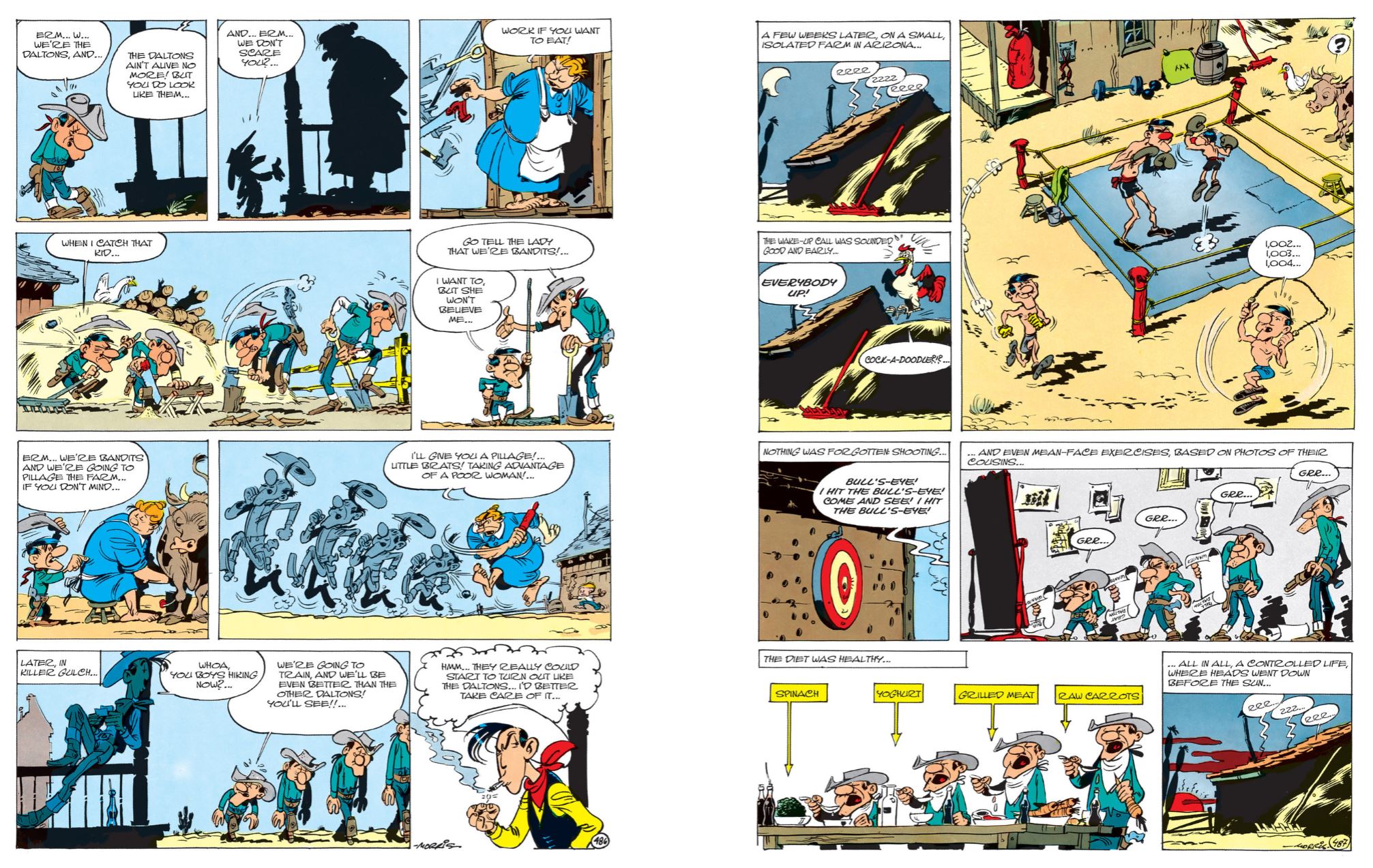
It opens on a remote farm in Arizona where four brothers mourn the loss of murderous bandits they resemble and are related to. They know they aren’t nearly good enough to fill the dead men’s boots or kill their killer… but they are willing to try their hardest to change all that. The replacement Daltons’ first attempt to settle the score is frankly embarrassing, but fortune and persistence gradually harden and hone them. They even at one stage have the heroic happy wanderer train them up to “match fitness”…

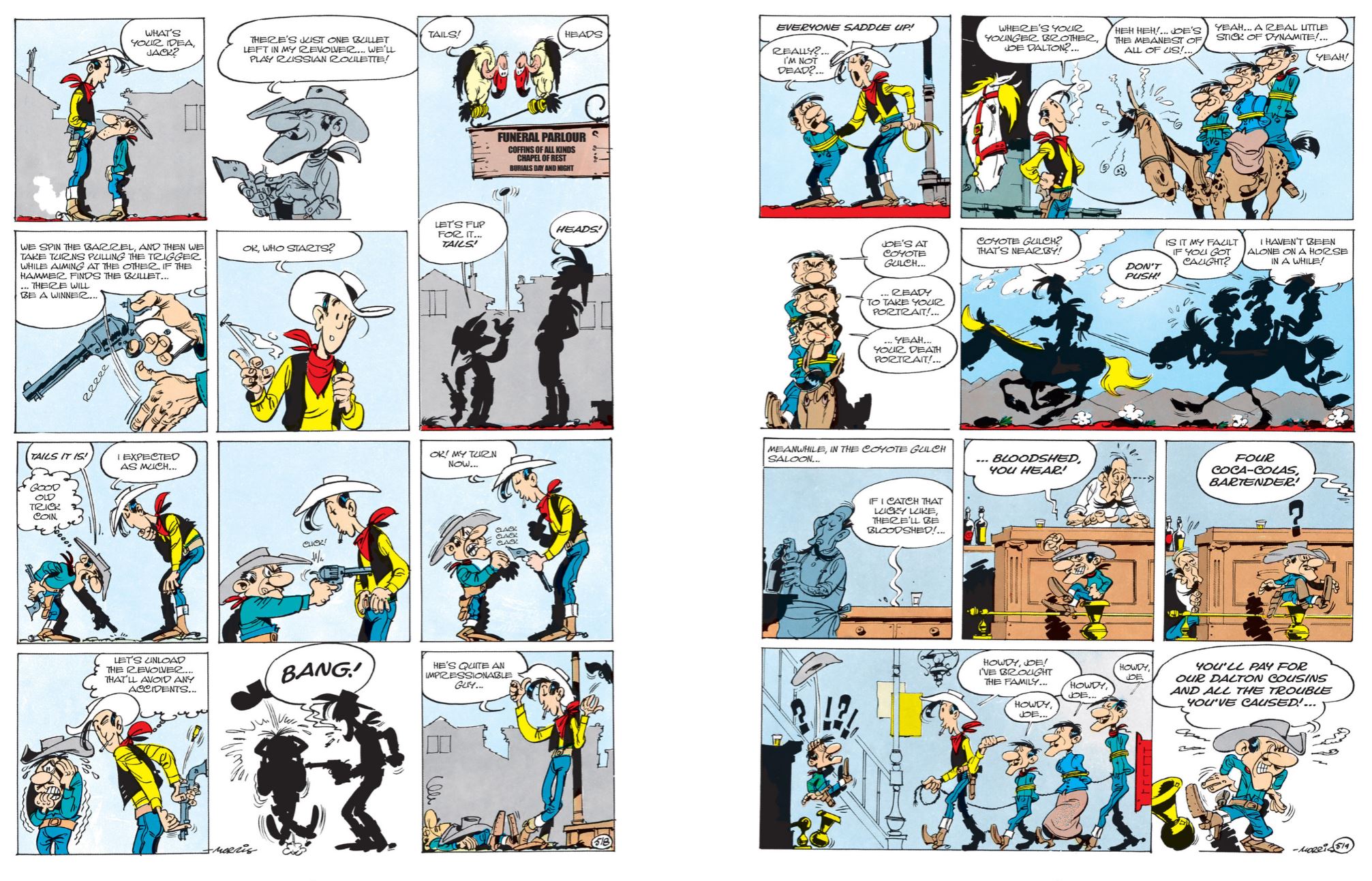
Ultimately, however, after they besiege a town and regularly succeed in theft and terrorism, Lucky is forced to take action before they become as great a menace as their dearly departed favourites ever were, but sadly, leaves it too late and is forced to resort to tricky tactics and even dividing to conquer. It’s either that or be hunted down like a dog: a role he’s just not suited for…

As much thriller as comedy romp, this yarn proved how crucial great villains are to any hero and started a western showdown that fruitfully persists and thrives to this day. These tall-to-small tales are perfect for kids with a smidgen of historical perspective and social understanding, although the action and slapstick situations are no more contentious than any Laurel and Hardy film – perfectly understandable as Morris was a huge fan of the duo. These formative forays are a grand old hoot in the tradition of Destry Rides Again or Support Your Local Sheriff, superbly executed by master storytellers, and a wonderful introduction to a unique genre for anyone who might well have missed the romantic allure of the Wild West that never was…
© Dargaud Editeur Paris 1971 by Goscinny and Morris. © Lucky Comics. English translation © 2010 Cinebook Ltd.

Today in 1913, artist Tom Gill (The Lone Ranger, Bonanza, Red Warrior) was born, sharing his birthday with DC’s hyper-prolific colourists Jerry Serpe (1919) and Bob LeRose (1921). The date also saw the debut of Russell Stamm’s strip Invisible Scarlett O’Neil in 1940 and the deaths of the great Syd Shores (Captain America, Black Rider, Blonde Phantom, The Westerner) in 1973; Ozzie cartoonist Syd (Fatty Finn) Nicholls in 1977 and Industry-shaking innovator Bill Gaines (EC Comics, Mad Magazine) in 1992.

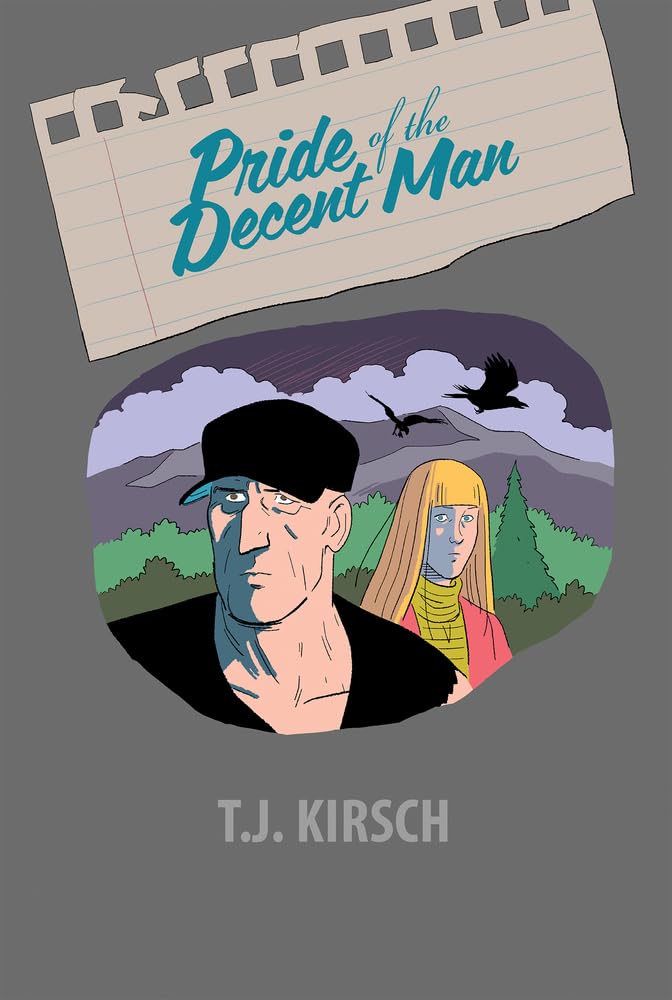
Pride of The Decent Man


By T.J. Kirsch (NBM)
ISBN: 978-1-68112-120-8 (HB/Digital edition)

Although far too many folk still generally believe graphic novels dominated by smutty horror, frenetic, all-out adventure and outrageous high drama (often cloaked in weird metal, leather, rubber or plastic outfits) the truth is that the medium is simply a potently effective, but relatively inexpensive method of telling all sorts of stories in unified words and pictures.

That means the heroes aren’t always larger than life. Sometimes, in their own minds antagonists and protagonists are barely life-sized at all…

T.J. Kirsch started out as a colourist at Archie Comics, before creating his own comics for Oni Press (Lost and Found) and Image (Outlaw Territory) and branching out into book illustration (She Died in Terrebonne with Kevin Church and So Buttons beside Jonathan Baylis).

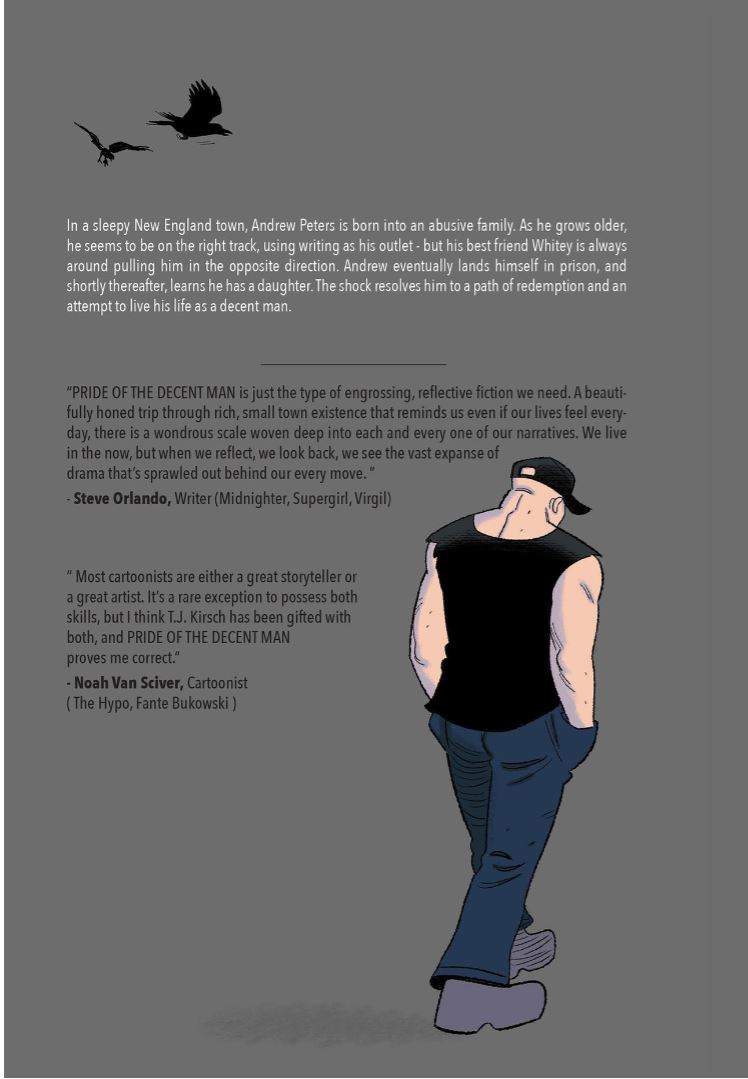
In this compact (235 x 156 mm) full-colour hardback (also available as an eBook), he skilfully demonstrates his own grasp of compelling visual storytelling in a seductively sedate, powerfully evocative and poignantly human-scaled fable of a guy with no hope and all the odds stacked against him from the get-go…

In the hind-end of New England, Andrew Peters is back in the old home town after time served in prison. He had escaped from an abusive home the way most kids do, falling in with the wrong crowd. Andy was always thoughtful and contemplative and moved himself beyond beatings and daily frustrations by keeping journals.

Andy loved to write, and after he got caught trying to rob the local Safe-Mart he had plenty of opportunity. Girlfriend Jess vanished about the time constant crony Whitey talked Andy into pulling the job with him, but Whitey’s dad had connections and only Peters went away.

Now he’s back and just coasting, but everything changes when he thinks he sees Jess. It is, in fact, the daughter Andy never knew he had…

Now utterly determined to do better and BE better, Andy resolves to start his life over, but even in the sleepiest of towns and armed with the best of intentions, sins of the past can exert an irresistible pressure…

Sleek, simple and seemingly straightforward, Pride of the Decent Man offers a thoughtful and totally immersive glimpse of a life both remarkable and inescapably pedestrian: a reflection on common humanity and day-to-day existence with all the lethal pitfalls they conceal and joys they promise.

A superbly enticing and sublimely rewarding slice of modern fiction that should quench the thirst of all ‘mature’ comic fans in need of more than just a flash of nipple and sprinkle of salty language in their reading matter, here is a real story of authentic people in extraordinary circumstances.

Pride of the Decent Man is the kind of tale diehard fans need to show civilians who don’t “get” comics. Sit them down, put Bob Seger’s “Mainstreet” or some early Springsteen on the headphones and let them see what it can be all about…
© 2017 T.J. Kirsch. All rights reserved

Today in 1895 Jimmy Swinnerton’s landmark strip The Little Bears began. On a related note, on this date in 1902 the world’s longest running strip syndicate Newspaper Enterprise Association (NEA) began doing business, and in 1940 Will Eisner’s The Spirit supplement launched, whilst Harry J. Tuthill’s The Bungle Family/Home Sweet Home ended today in 1945.

Today in 1918 Millie the Model & Patsy Walker creator Ruth Atkinson was born, as was Australian cartoonist Michael Leunig (Vasco Pyjama) in 1945; educator/historian/screen producer/comics writer Michael E. Uslan (Swamp Thing, Batman) in 1951; author publisher Joe Gentile (Moonstone Books) in 1963 and Danish comics creator (A Seagull’s Life, Disney’s assorted Duck comics) Flemming Andersen in 1968.

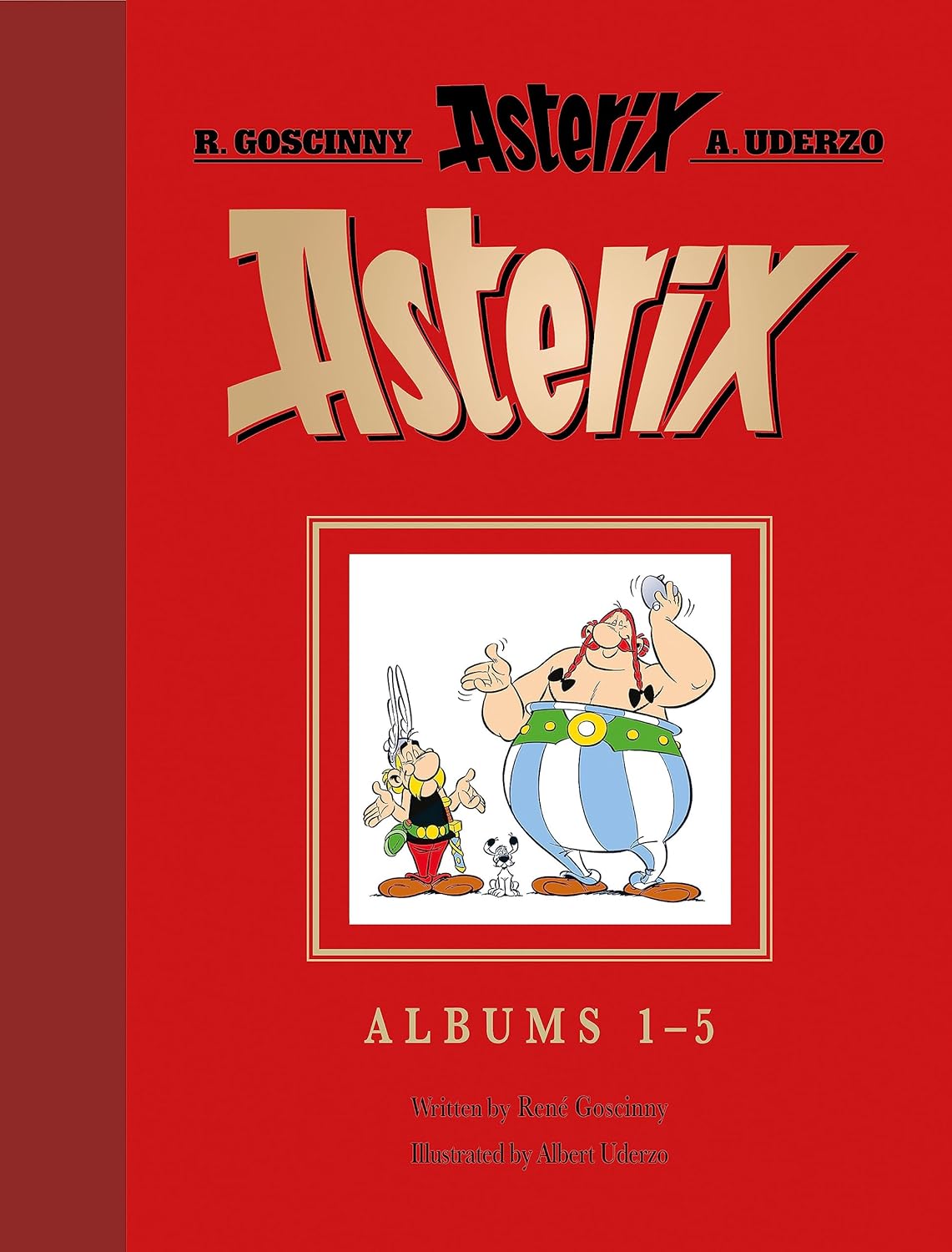
Asterix Gift Edition: Albums 1-5: Asterix the Gaul, Asterix and the Golden Sickle, Asterix and the Goths, Asterix the Gladiator, Asterix and the Banquet


By René Goscinny & Albert Uderzo. translated by Anthea Bell & Derek Hockridge (Sphere)
ISBN: 978-1-40872-831-4 (HB)

This book includes Discriminatory Content produced in less enlightened times. This book includes Discriminatory Content included for comedic effect.

Asterix the Gaul is probably France’s greatest literary export. The feisty, wily little warrior who fought the iniquities and viewed the myriad wonders of Julius Caesar’s Roman Empire with brains, bravery and (whenever necessary) a magical potion imbuing the imbiber with incredible strength, speed and vitality, is the go-to reference all we non-Gallic gallants resort to when we think of France.

The diminutive, doughty, daring darling was created at the close of the 1950s by two of our artform’s greatest masters, with his first official appearance being on October 29th in Pilote #1, even though he had actually debuted in a pre-release teaser – or “pilot” – weeks earlier. On this date in fact. Joyeux anniversaire, mon petit brave!

René Goscinny was arguably the most prolific – and remains one of the most read – writers of comic strips the world has ever known. Born in Paris in 1926, he grew up in Argentina where his father taught mathematics. From an early age René showed artistic promise. He studied fine arts and graduated in 1942. Three years later, while working as junior illustrator at an ad agency, his uncle invited him to stay in America, where he worked as a translator. After National Service in France, he returned to the States and settled in Brooklyn, pursuing an artistic career and becoming, in 1948, an assistant in a small studio which included Harvey Kurtzman, Will Elder, Jack Davis & John Severin, as well as European giants-in-waiting Joseph Gillain (Jijé) and Maurice de Bévère (Morris) with whom from 1955-1977 Goscinny produced 46 volumes of Lucky Luke.

Goscinny also met Georges Troisfontaines, head of World Press Agency, the company that provided comics for Le Journal de Spirou. After contributing scripts to Belles Histoires de l’Oncle Paul and Jerry Spring, Goscinny was promoted to head of World Press’ Paris office. Here he met his ultimate creative collaborator Albert Uderzo. In his spare time (!), René also created Sylvie and Alain et Christine with Martial Durand (“Martial”) and Fanfan et Polo, drawn by Dino Attanasio. In 1955, Goscinny, Uderzo, Charlier & Jean Hébrad formed independent syndicate Édifrance/Édipresse, creating magazines for business and general industry like Clairon for the factory union and Pistolin for a chocolate factory. With Uderzo, René spawned Bill Blanchart, Pistolet and Benjamin et Benjamine, whilst illustrating his own scripts for Le Capitaine Bibobu.

Under nom-de-plume Agostini, he wrote Le Petit Nicholas (drawn by Jean-Jacques Sempé), and in 1956 began an association with revolutionary periodical Le Journal de Tintin, writing for various illustrators including Attanasio (Signor Spagetti); Bob De Moor (Monsieur Tric); Maréchal (Prudence Petitpas); Berck (Strapontin); Globule le Martien and Alphonse with Tibet; as well as Modeste et Pompon for André Franquin, and with Uderzo the fabulously funny adventures of inimitable Indian brave Oumpah-Pah. Goscinny also wrote for magazines Paris-Flirt and Vaillant. In 1959, Édifrance/Édipresse launched Pilote and René went into overdrive. The first issue featured re-launched versions of Le Petit Nicolas, Jehan Pistolet/Jehan Soupolet, original serials Jacquot le Mousse and Tromblon et Bottaclou (drawn by Godard), plus a little something called Astérix le gaulois: incontrovertibly the greatest achievement of his partnership with Uderzo.

When Georges Dargaud bought Pilote in 1960, Goscinny became Editor-in-Chief, still making time to add new series Les Divagations de Monsieur Sait-Tout (with Martial); La Potachologie Illustré (Cabu); Les Dingodossiers (Gotlib) and La Forêt de Chênebeau (Mic Delinx). He also wrote frequently for television, but never stopped creating strips like Les Aventures du Calife Haroun el Poussah (for Record and illustrated by Swedish artist Jean Tabary). A minor success, it was re-tooled as Iznogoud when it transferred to Pilote. Goscinny died far too young, in November 1977.

Alberto Aleandro Uderzo was born on April 25th 1927, in Fismes on the Marne, a child of Italian immigrants. As a boy reading Mickey Mouse in Le Pétit Parisien, he showed artistic flair from an early age. Alberto became a French citizen at age seven and dreamed of being an aircraft mechanic, but at 13 became an apprentice of the Paris Publishing Society, learning design, typography, calligraphy and photo retouching. When WWII came, he spent time with farming relatives in Brittany, joining his father’s furniture-making business. Brittany beguiled Uderzo: when a location for Asterix’s idyllic village was being decided upon, the region was the only choice…

In France’s post-war rebuilding, Uderzo returned to Paris to become a successful illustrator in the country’s burgeoning comics industry. His first published work – a pastiche of Aesop’s Fables – appeared in Junior and, in 1945, he was introduced to industry giant Edmond- Françoise Calvo (The Beast is Dead). Young Uderzo’s subsequent creations included indomitable eccentric Clopinard, Belloy, l’Invulnérable, Prince Rollin and Arys Buck. He illustrated novels, worked in animation, as a journalist, as illustrator for France Dimanche and devised vertical comic strip ‘Le Crime ne Paie pas’ for France-Soir. In 1950, he drew a few episodes of the franchised European version of Fawcett’s Captain Marvel Jr. in Bravo!

Another inveterate traveller, he met Goscinny in 1951. Soon fast friends, they decided to work together at the new Paris office of Belgian Publishing giant World Press. Their first collaboration was in November of that year; a feature piece on savoir vivre (how to live right or “gracious living”) for women’s weekly Bonnes Soirée, after which an avalanche of strips and serials poured forth.

Jehan Pistolet and Luc Junior were devised for La Libre Junior and they produced a comedy Western starring a very Red (but not so American) Indian who evolved into Oumpah-Pah. In 1955, with the birth of Édifrance/Édipresse, Uderzo drew Bill Blanchart for La Libre Junior, replacing Christian Godard on Benjamin et Benjamine before, in 1957 adding Charlier’s Clairette to his bulging portfolio. The following year, he made his Tintin debut, as Oumpah-Pah finally found a home and rapturous audience. Uderzo also drew Poussin et Poussif, La Famille Moutonet and La Famille Cokalane. When Pilote launched in October 1959, Uderzo was its major creative force, limning Charlier’s Tanguy et Laverdure and a comedy historical strip about Romans…

Although Asterix was a massive hit from the start, Uderzo continued with Charlier on Michel Tanguy, (subsequently Les Aventures de Tanguy et Laverdure), but soon after that first comedy history was collected in a single volume as Astérix le gaulois in 1961, it was clear the series would demand most of his time – especially as the incredible Goscinny never seemed to require rest or run out of ideas (after the writer’s death, the publication rate of Asterix tales dropped from two per year to one volume every 3-to-5).

By 1967, Asterix occupied all Uderzo’s time and attention. In 1974 the partners formed Idéfix Studios to fully exploit their inimitable creation, and when Goscinny passed away three years later, Uderzo had to be convinced to continue the adventures as writer and artist. Happily, he gave in and produced a further 10 tomes before retiring in 2009. According to UNESCO’s Index Translationum, Uderzo is the 10th most-often translated French-language author in the world and 3rd most-translated French language comics author – right behind his old mate René and the grand master Hergé.

So what’s it all about?

Like all the best entertainments the premise works on two levels: as action-packed comedic romps of sneaky and bullying baddies coming a-cropper for younger readers and as pun-filled, sly and witty satire for older, wiser heads, transformed here by the brilliantly light touch of master translators Anthea Bell & Derek Hockridge (who played no small part in making the indomitable little Gaul so very palatable to the English tongue).

Originally seen in Pilote #1-38 (29th October 1959 – 4th July 1960, with the first page appearing a week earlier in a promotional issue #0 distributed from June 1st 1959), the story is set in the year 50 BC (never BCE!) on the outermost tip of Uderzo’s beloved Brittany coast. Here a small village of redoubtable warriors and their families frustrate every effort of the immense but not so irresistible Roman Empire to complete the conquest of Gaul.

Unable to defeat these Horatian hold-outs, the Empire resorts to a policy of containment, leaving the little seaside hamlet hemmed in by heavily fortified permanent garrisons – Totorum, Aquarium, Laudanum and Compendium. The Gauls don’t care: they daily defy the world’s greatest military machine by just going about their everyday affairs, protected by a magic potion provided by the resident druid and the shrewd wits of a rather diminutive dynamo and his simplistic best friend…

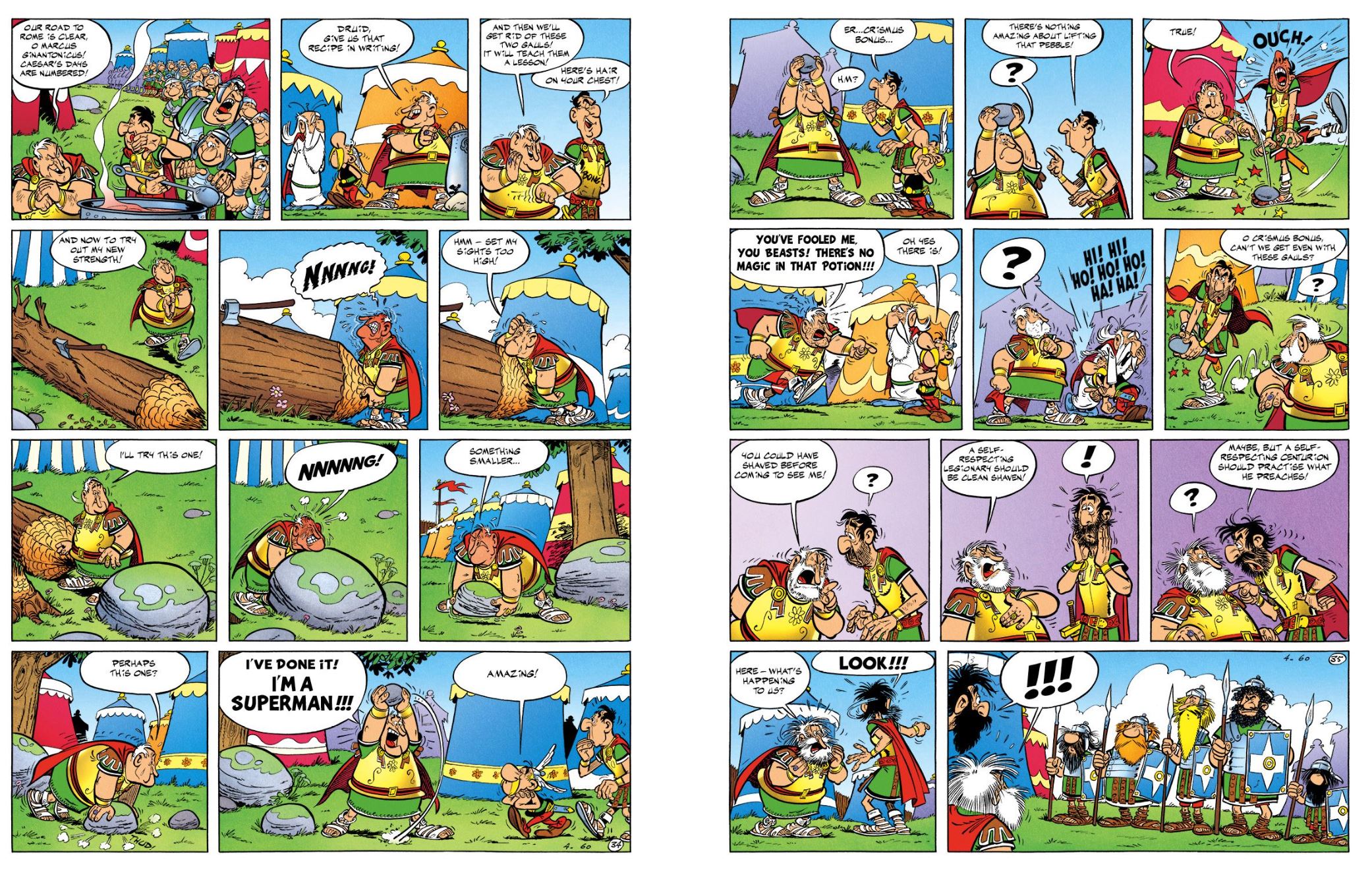
In Asterix the Gaul, this immaculate comedy-drama scenario is hilariously demonstrated when Centurion Crismus Bonus – fed up with his soldiers being casually beaten up by the fiercely free pre-Frenchmen – sends reluctant spy Caligula Minus to ferret out the secret of their incredible strength. The affable insurgents take the infiltrator in and, soon dosed up with potion, the perfidious Roman escapes with the answer – if not the formula itself…

Soon after, wise, wily Druid Getafix is captured by the invaders and the village seems doomed, but crafty Asterix is on the case. Breaking into Compendium and resolved to teach the Romans a lesson, he drives them crazy for ages by resisting all efforts at bribery and coercion, until abruptly wizard and warrior seemingly capitulate. They make the Romans a magic potion – but not the one the rapacious oppressors were hoping for…

Although comparatively raw and unpolished, the good-natured, adventurous humour and sheer energy of the yarn barrels along, delivering barrages of puns, oodles of insane situations and loads of low-trauma slapstick action, all marvellously rendered in Uderzo’s seductively stylish bigfoot art-style. From the second saga on, the unique and expanding cast would encroach on events, especially the unique and expanded, show-stealing sidekick Obelix – who had fallen into a vat of potion as a baby – and became a genial, permanently superhuman, eternally hungry foil to our little wise guy…

Asterix and the Golden Sickle originally unfolded in Pilote #42-74, recounting disastrous consequences after Getafix loses his ceremonial precious metal blade just as the grand Annual Conference of Gaulish Druids is beginning. Since time is passing and no ordinary replacement will suffice to cut ingredients for magic potion, Asterix offers to go all the way to Lutetia (you can call it Paris if you want) to find another one.

Since Obelix has a cousin there – Metallurgix the Smith – he volunteers for the trip too and the punning pair are swiftly away, barely stopping to teach assorted bandits the errors of their pilfering ways, but still finding a little time to visit many roadside inns and taverns serving traditional roast boar. There is concurrently a crisis in Lutetia: a mysterious gang is stealing all the Golden Sickles and forcing prices up. The Druid community is deeply distressed and, more worrying still, master sickle-maker Metallurgix has gone missing too. When Asterix and Obelix investigate the dastardly doings in their own bombastic manner they discover a nefarious plot that seems to go all the way to the office of the local Roman Prefect…

The early creative experiment was quickly crystallizing into a supremely winning format of ongoing weekly episodes slowly building into complete readily divisible adventures. The next epic cemented the strip’s status as a popular icon of Gallic excellence.

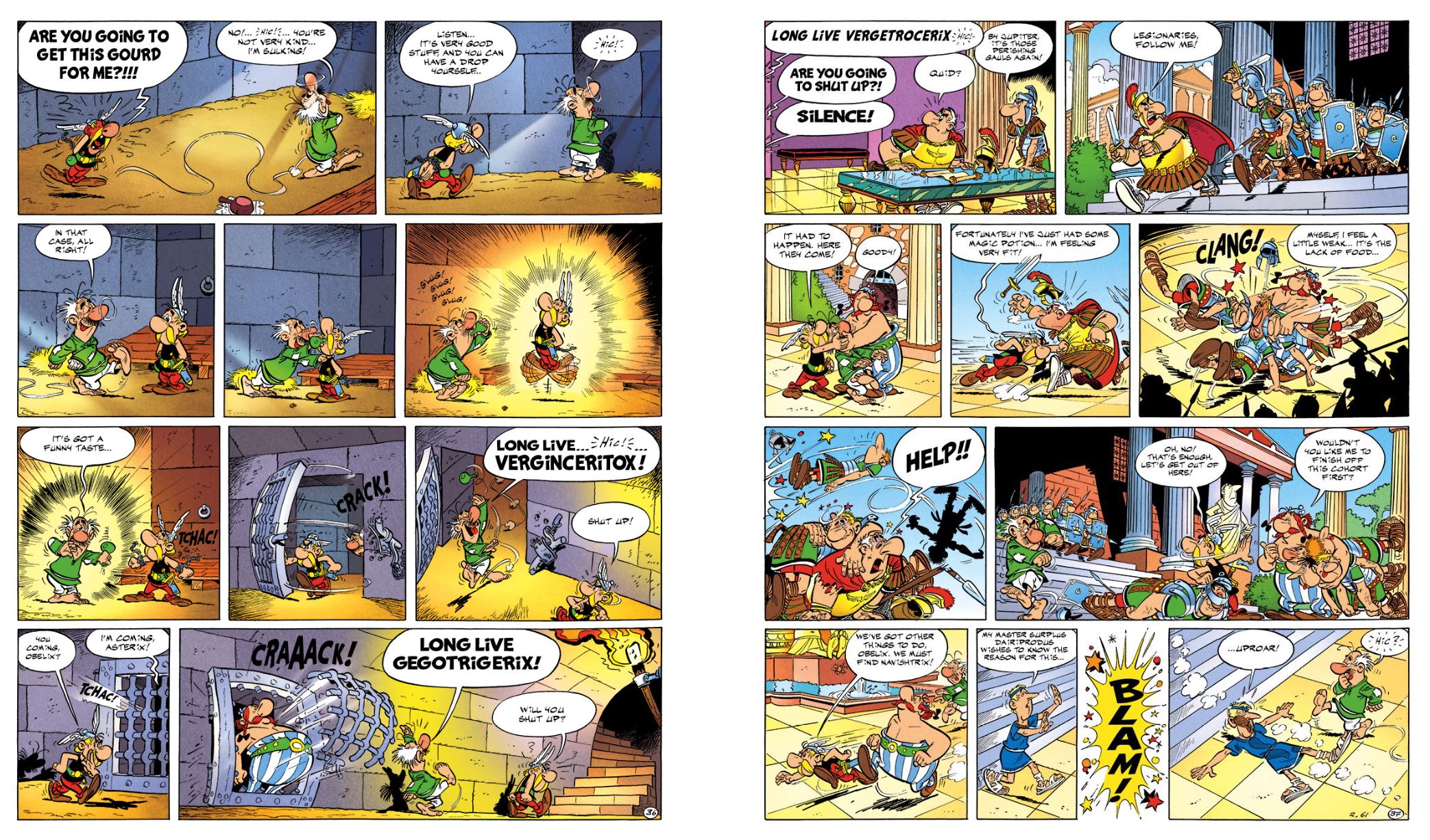
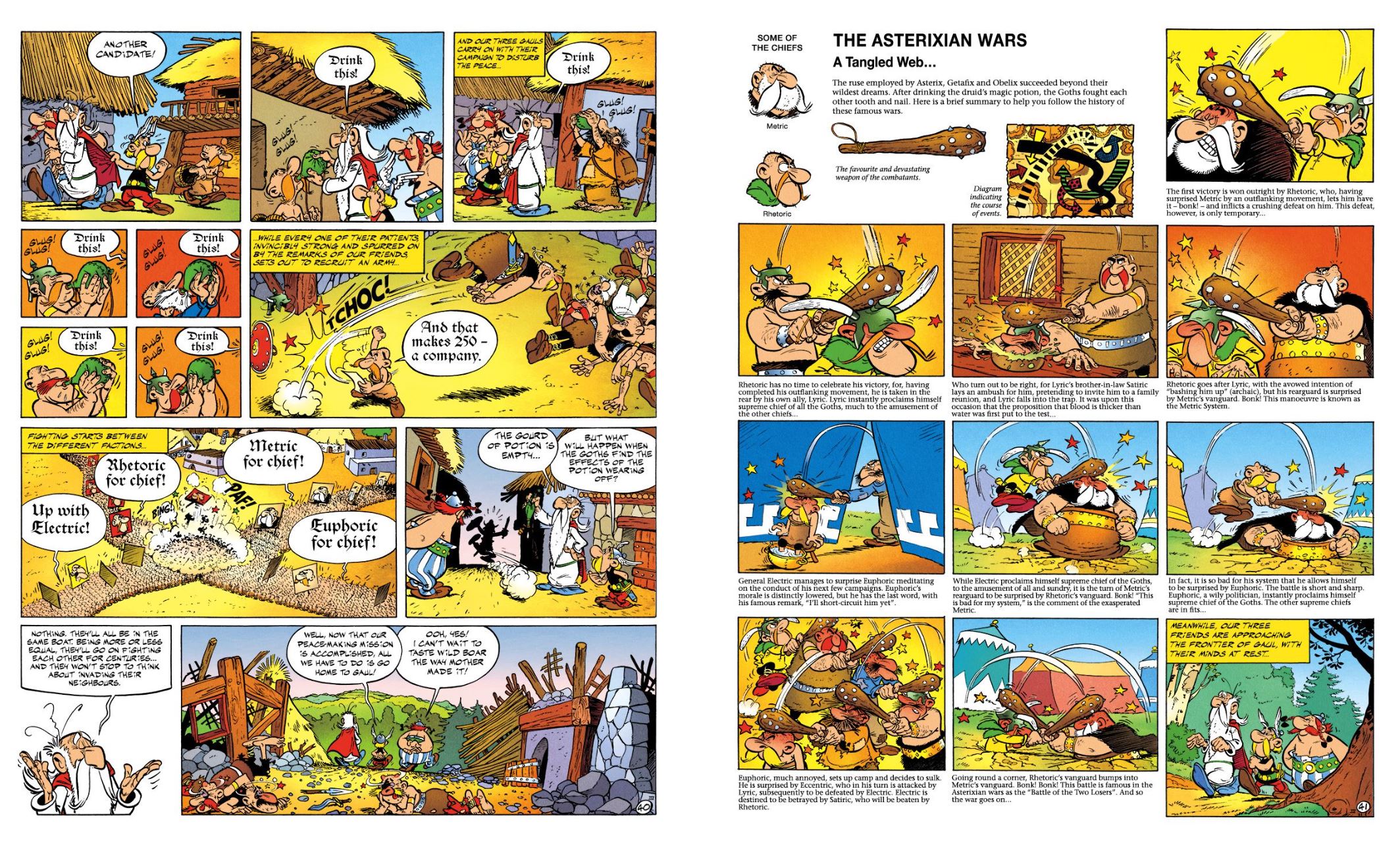
Asterix and the Goths ran from 1962-1963 and followed a dangling plot-thread of the Druid Conference as Getafix, brand new sickle in hand, sets off for the Forest of the Carnutes to compete. However, on Gaul’s Eastern border savage Goths – fierce barbarians who remain unconquered despite the might of the Empire – have crossed into pacified Roman territory. These hairy louts are intent on capturing the mightiest Druid and turning his magic against the rule of Julius Caesar

Although non-Druids aren’t barred from the forest, Asterix & Obelix had accompanied Getafix to its edge, and as the Conference competition round ends in victory for him and his power-potion, the Goths strike, abducting the old boy in his moment of triumph. Alerted by fellow Druid Prefix, our heroic duo track the kidnappers, but are mistaken for Visigoths by Roman patrols, allowing the Goths to cross the border into Germania. Although Romans are no threat, they can be a time-wasting hindrance, so Asterix & Obelix disguise themselves as Romans to invade the Barbarian lands…

By now well-used to being held prisoner, Getafix is making himself a real nuisance to his bellicose captors and a genuine threat to the wellbeing of his long-suffering Goth-appointed translator. Thus when Asterix & Obelix are captured dressed as Goths, they concoct a cunning plan to end the ever-present threat of Gothic invasion – a scheme that continues successfully for almost two thousand years…

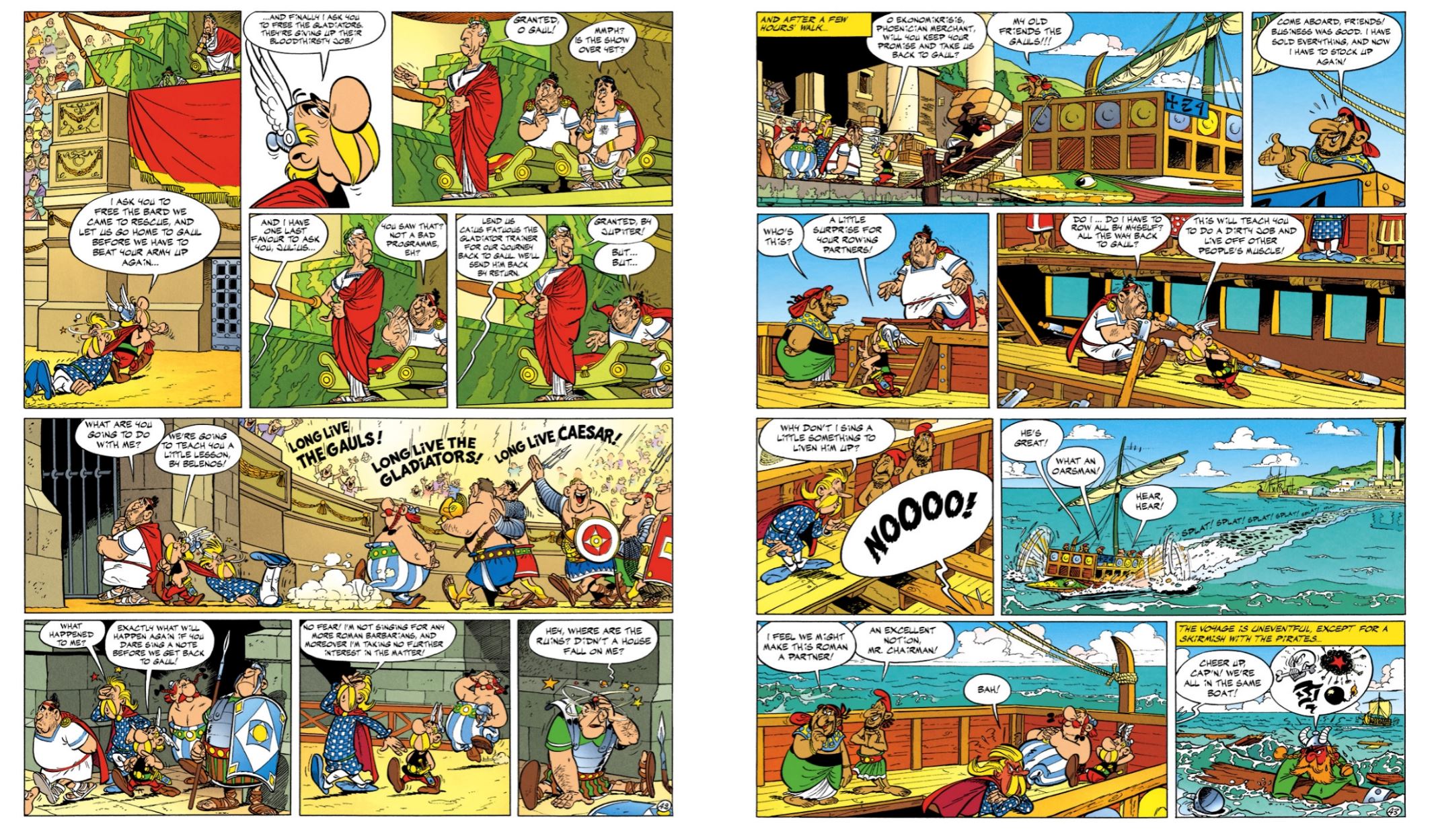
Asterix the Gladiator ran across Pilote #126 to 168 (1963) with the canny rebel and increasingly show-stealing pal despatched to the heart of the Roman Empire on an ill-conceived mission of mercy. When Prefect Odius Asparagus seeks to give Julius Caesar a unique gift, he decides upon one of the indomitable Gauls giving his occupying forces such a hard time. Thus, he has village Bard Cacofonix abducted and bundled off to Rome. Although in two minds about losing the raucous harpist, pride wins out and the villagers mount a rescue attempt, but after thrashing the Romans again they discover that their lost comrade is already en route for the Eternal City…

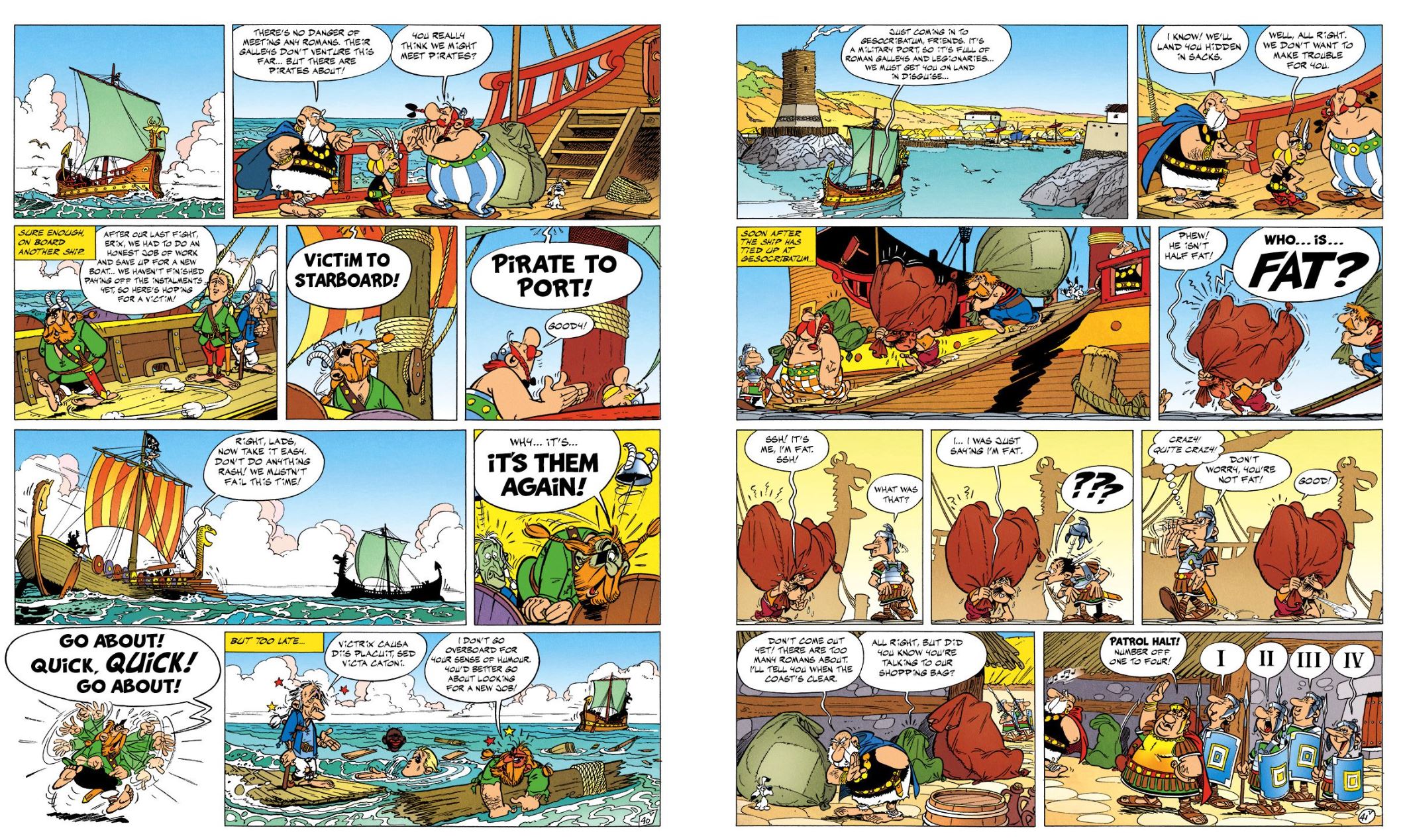
Assigned to retrieve the missing musician, Asterix & Obelix hitch a ride on a Phoenician galley operated under a bold new business plan by captain/general manager Ekonomikrisis. On the way to Italy the boys first encounter a band of pirates who would become frequent guest-stars and perennial gadflies. The pirates were a creative in-joke between the close-knit comics community: Barbe-Rouge/Redbeard was a buccaneering strip created by Charlier & Victor Hubinon also appearing in Pilote at the time.

As Asterix & Obelix make friends among the cosmopolitan Roman crowds, Caesar has already received his latest present. Underwhelmed by his new Bard, the Emperor re-gifts Cacofonix to the Circus Maximus, to be thrown to the lions just as his chief of Gladiators Caius Fatuous is “talent-spotting” two incredibly tough strangers who would make ideal arena fighters…

Since it’s the best way to get to Cacofonix, our heroes join the Imperial Gladiatorial school; promptly introducing a little Gallic intransigence to the tightly disciplined proceedings. When the great day arrives, the lions get the shock of their lives and the entertainment-starved citizens of Rome experience a show they will never forget…

As always, the good-natured, comedic situations and sheer finesse of the yarn rattles along, delivering barrages of puns, oodles of insane situations and loads of low-trauma slapstick action, marvellously rendered in Uderzo’s expansive, authentic and continually improving big-foot art-style.

Asterix and the Banquet comes from Pilote #172-213 (also 1963), inspired by the Tour de France cycle race. After being continually humiliated by the intractable Gauls coming and going as they please, Roman Inspector General Overanxius instigates a policy of exclusion, building a colossal wall around the little village, determined to shut them off from their country and the world. Modern world leaders might get a clue from this book, here – if they read books. Even books with pictures…

Incensed, Asterix bets the smug Prefect that Gauls can go as and wherever they please and to prove it invites the Romans to a magnificent feast where they can sample fresh culinary delights from various regions. Breaking out of the stockade and through the barricades, A & O gather produce from as far afield as Rotomagus (Rouen); Lutetia (Paris, where they also picked up a determined little mutt who would eventually become a star cast-member); Camaracum (Cambrai) and Durocortorum (Rheims), whilst easily evading or overcoming the assembled patrols and legions of man-hunting soldiers. However, the heroes don’t reckon on the corrupting power of the huge – and growing – bounty on their heads and some Gauls are apparently more greedy than patriotic…

Even with Asterix held captive and all the might of the Empire ranged against them, Gaulish honour is upheld and Overanxius, after some spectacular fights, chases and close calls, is made to eat his words (and a few choice Gallic morsels) in this delightful, bombastic and exceedingly clever celebration of pride and whimsy.

Astérix is one of the most popular comics in the world, translated into 111 languages, with a host of animated and live-action movies, games and even his own theme park (Parc Astérix, near Paris). Approaching 400 million copies of 41 Asterix books and spin-off volumes have been sold worldwide, making Goscinny & Uderzo France’s bestselling international authors. This is sublime, supremely enjoyable comics storytelling and you’d be as Crazy as the Romans not to increase those statistics by finally getting around to acquiring your own copies of this fabulous, frolicsome French Folly. This collection is a great way to enjoy that legacy of legends but be aware that – weighing over a kilo – you might want to top up on magic potion before picking it up…
© 1961-1965 Goscinny/Uderzo. Revised English translation © 2004 Hachette. All rights reserved.

Today in 1907, Disney animator/Gold Key artist & scripter George Waiss (Uncle Scrooge, Donald Duck, Junior Woodchucks, Looney Tunes, Porky Pig) was born, followed in 1919 by Argentinean Golden Age artist Arturo Cazeneuve (Seven Soldiers of Victory, Newsboy Legion, Blue Beetle).

Despite ushering in the age of Immortal Asterix this day in 1959, we lost cartoonist/writer/artist and creator of Millie the Model Ruth Atkinson in 1997 and pioneering strip cartoonist Martha B.MartyLinks (Emmy Lou, Bobby Sox) in 2008.

Superman: The Golden Age Dailies 1947 to 1949 (volume 3)


By Alvin Schwartz, Wayne Boring, Jack Schiff, Win Mortimer & various (IDW/Library of American Comics)
ISBN: 978-1-68405- (HB)

This book includes Discriminatory Content produced in less enlightened times.

The American comic book industry – if it still existed at all – would be utterly unrecognisable without Superman. Jerry Siegel & Joe Shuster’s unprecedented invention was first fervidly adopted by a desperate and joy-starved generation, and gave birth to a genre if not an actual art form. Spawning an army of imitators and variations within three years of his 1938 debut, the intoxicating blend of breakneck, breathtaking action and wish-fulfilment epitomising the early Man of Steel grew to encompass cops-&-robbers crimebusting, socially reforming dramas, sci fi fantasy, whimsical comedy and, once the war in Europe and the East sucked in America, patriotic relevance for a host of gods, heroes and monsters, all dedicated to profit through exuberant, eye-popping excess and vigorous, dashing derring-do.

From the outset, in comic book terms Superman was master of the world. Moreover, whilst transforming the shape of the fledgling funnybook biz, the Man of Tomorrow irresistibly expanded into all areas of the entertainment media. Although we all think of the Cleveland boys’ iconic invention as epitome and acme of comics creation, the truth is that very soon after his springtime debut in Action Comics #1 the Man of Steel was a fictional multimedia monolith in the same league as Popeye, Tarzan, Sherlock Holmes and Mickey Mouse. We parochial and possessive comics fans too often regard our purest and most powerful icons in purely graphic narrative terms, but the likes of Batman, Spider-Man, Avengers and their hyperkinetic kind long ago outgrew four-colour origins to become fully mythologized modern media creatures familiar in mass markets, across all platforms and age ranges…

In the last century and even more so in this one, far more people have seen and heard the Man of Steel than have ever read his comic books. These globally syndicated newspaper strips alone were enjoyed by countless millions, and by the time his 20th anniversary rolled around, at the very start of what we call the Silver Age of Comics, he had been a thrice-weekly radio serial star, headlined 17 astounding animated cartoons, become a novel attraction (written by George Lowther) and – by the time of the last stories in this tome – had helmed two feature films. He had then seamlessly segued into the next Big Thing: television. Soon his first (of 8) smash-hit live-action tv seasons would start his next great media conquest, making Superman a perennial sure-fire success for toys, games, food, and puzzle and apparel manufacturers all over the planet.

Although pretty much a spent force these days, for the majority of the last century the newspaper comic strip was the Holy Grail all American cartoonists and graphic narrative storytellers hungered for. Syndicated across the country (and frequently the world) a strip feature could be seen by millions if not billions of readers and was generally accepted as a more mature and sophisticated form of literature than comic books. It also – at the start! – paid better, and rightly so. Some of the most enduring, entertaining characters and concepts of all time were devised to lure readers from one particular paper to another and many of the best became cornerstones of a shared global culture. People across the Earth had a communal context thanks to thrilling to the same comics; and Mutt and Jeff, Buck Rogers, Dick Tracy, Flash Gordon, Charlie Brown and so many more escaped humble, tawdry newsprint origins to become meta-real: existing in the minds of earthlings from Albuquerque to Zanzibar. Most still do…

The daily Superman newspaper strip launched on 16th January 1939, swiftly augmented by a full-colour Sunday page from November 5th of that year. Originally crafted by Siegel & Shuster and their studio (Paul Cassidy, Leo Nowak, Dennis Neville, John Sikela, Ed Dobrotka, Paul J. Lauretta & crucially Wayne Boring), the mammoth task soon required additional talents like strip veteran Jack Burnley and writers including Whitney Ellsworth, Jack Schiff & Alvin Schwartz. The McClure Syndicate feature ran continuously until May 1966, appearing, at its peak, in over 300 daily and 90 Sunday newspapers: a combined average readership of more than 20 million. Eventually, Win Mortimer & Curt Swan joined the unflagging Boring & Stan Kaye, whilst Bill Finger and Siegel also provided stories, telling serial tales largely divorced from comic book continuity throughout years when superheroes were scarcely seen.

This third volume of the Library of American Comics collection continues the prodigious and formidable reprint program begun in the Sterling/Kitchen Sink softcover editions which ceased production in 1999. All of that material – and these books too – are long overdue for re-release and digital editions. Here, however, WWII is well and truly over and the decidedly different demands of peacetime and reconstruction have given way to an era of hectic prosperity, but still see our hero and his regular cast tested and beset by domestically endangering perils and conundrums only a Man of Steel could handle…

We open with another Introduction by Sidney Friefertig, discussing the changes from conflict to reconstruction and detailing why and how poet-turned-thriller writer Alvin Schwartz (1916-2011) became the key writer of the feature as well as sharing contextual, behind-the-scenes moments before our cosy but never-ending battle resumes.

These sequences came six days a week, comprising episodes #47-61, pages #2595 through 3338, and publication dates April 28 1947 to September 3rd 1949. With the material credited to Schwartz (Batman, Wonder Woman, Aquaman, Tomahawk, Newsboy Legion, Slam Bradley, House of Mystery, A Date With Judy, Buzzy, Bizarro) and the sole pictorial province of illustrator Wayne Boring, the compilation kicks off with and a bizarre “manhunt” to solve the dilemma of ‘Who is Miss Whisper?

Running in strips #2595-2654 as seen between April 28th to July 5th 1947, the story depicts mounting frenzy in Metropolis after lonely millionaire at sea Jonathan Dexter experiences a crossed radio line and catches a brief snippet of conversation with a distant voice. Instantly falling inescapably in love with a person he cannot and probably will never see, he is despondent until he remembers how rich he is…

Thus when, Cinderella-style, the heartsore plutocrat uses the Daily Planet to publicise his plight and swears to endow the mystery maid with all his worldly goods, the entire female population goes crazy. Everybody loves a doomed romance but some seek to con him, some attempt to bamboozle or even supplant his absent inamorata and some – gangsters led by cunning rogue Wishbone – seek to replace Miss Whisper with a voice impersonating ringer. Clark Kent and Lois Lane are drawn to the story and Superman promises to help after the rich guy promises to pay a million to deserving charities but even after finding her, the Man of Tomorrow can’t make the quiet quarry want to marry the spoiled rich, groom-to-be…

Nevertheless, because it’s a fairy tale writ large, love does find a way…

Crafted for daily doses, these Superman snippets are torturous, convoluted and often seemingly divert in tangents to indulge in seemingly pointless but epically spectacular super-feats (such as razing an entire forest to make a really, Really big billboard). These are to pad out increasingly formulaic plots and emphasise the “Super” in the hero but also counterpoint the ongoing social commentary and essentially domestic tribulations of familiar and warmly appreciated entertainment characters being constantly put through their paces. That’s clearly seen as greed and venality abound in the next arc as Superman reels under the manic idiocies generated by ordinary people in mounting frenzy once news leaks out that the Man of Steel has agreed to safeguard humanity’s greatest desire made manifest.

Running from July 7th to September 27th, the sorry tale of ‘The Youth Serum’ (strips #2665-2732) sees chemist Dr. Ogilvie unwisely entrust his age-defeating miracle mixture to shady promoter Willie Poster who triggers a literal stampede of the vain, vainglorious and outright villainous who will do anything to roll back a few years… including bribery, fraud, theft and kidnapping Daily Planet staff to compel the Man of Steel to hand over the rejuvenation juice…

With the multi-million daily readership reckoned to be at least 50% female, encroaching domesticity was a regular plot standby but Alvin Schwartz proved able to tweak the situation in unusual ways. For ‘The Marriage Gamble’ (#2733- 2768; September 29th to November 8th) he enfolds Lois & Clark in a criminal caper wherein crooked – and ultimately near-murderous – loan sharks seek vengeance on a professional gambler by rigging a bet that one of their on-the-hook client/victims can be made to marry the first women he sees. Thanks to poor timing and fate the intended marriage material is inadvertently delayed by Lois, and helpless desperate sap Joe Deems’ unsuspecting bride-to-be becomes a certain feisty journalist…

There’s no escaping his fate – it’s death or Lois – but the mobsters have utterly underestimated Lane’s instincts and the determination of Joe’s actual fiancée Dotty… as well as Superman’s covert intervention…

Who’s chasing who is the key to next serial saga ‘The Perfect Woman’ (#2769-2828, November 10th1947 – January 17th 1948) as super-rich, supremely smart, ultra-fit and staggeringly beautiful heiress Olivia Hill finally reaches marrying age and decrees that the Man of Tomorrow is the only one worthy of her. Of course, Lois has other ideas and also senses a huge scoop as the terrified Superman struggles to escape a girl prepared to risk her own life and reputation to get her way…

Backed by money and privilege, wilful scheming rich kid Olivia seems unstoppable. All our hero’s efforts to avoid her cunning matrimonial traps come to naught as she employs fair means and foul to land the most eligible bachelor on Earth, but events take truly dark turn when master of media manipulation Hill meets ruthless gangsters who don’t play games by her rules…

Evil and mystery dominate in next exploit ’The Crime Mentalist’ (#2829-2936, January 19th – March 20th) as a shy, lonely, mild mannered bank teller survives a street incident and develops the power to psychically tune in on thieves and killers about to commit heinous acts. The cops are instantly suspicious of poor Edgar Jenkins and Clark is concerned for his safety, as Edgar apparently can’t stop himself uncovering crimes. He even exposes the venality of the learned doctors examining him and eventually Superman is forced to act as permanent bodyguard. Events come to ahead when the nation’s top crime bosses engage ruthless femme fatale Dotty Storm to vamp, distract and eliminate the nervous ninny. It works too, despite Jenkins’ gifts. He knows she’s evil but she’s also so very pretty and attentive and perhaps he can convert her from her wicked ways…

Pure whimsy and trenchant social satire manifest with ‘The Return of the Ogies’ (#2883-2936, March 22nd – May 22nd 1948) as the invisible fairy pranksters again bedevil Clark and Superman. However their escalating campaign to annoy the Metropolis Marvel – such as seeking to tell everyone his secret identity – goes weirdly awry after they lose that invisibility and become extremely popular figures perpetually pestered by the public. It looks like even Superman cannot solve this problem, but then…

After being denied a journalism award because everybody knows that the Man of Steel does all the heavy lifting in her stories, the City’s top reporter swears off male interference and undertakes a canny campaign of crimebusting and scandal-exposing in ‘Lois Lane’s Solo Adventures’. Spanning May 24th to July 3rd, strips #2937-2972 reveal just how brave and competent Lois can be on her own, especially after one piece makes a furious enemy of spoiled debutante Kim West. The brat’s idea of redress involves having two mob bosses vying for her exclusive attentions taking out contracts on the “Lane Dame”, but she’s less sanguine about her own devoted butler also trying to murder the journalist. This time Superman does not come to her assistance as the drama expands into murder and both mobs of rank-&-file thugs rebel, seeking to kill West and Lois to avoid a gang war and return to business…

With Lane back at the top of her game and even notional friends with Kim, focus switches to her rival for ‘The Millionaire Ex-Reporter Clark Kent’ (July 5th – August 14th, strips #2973-3008).

After suddenly and unwelcomely winning a fortune, Kent must act like a normal guy and quit his job just to preserve his secret identity. Moreover, all efforts to lose the wealth by acting like a rich idiot only increase it and make him the target of enterprising heiress Kim who has blown through all her own money and needs a pliable husband with plenty…

She doesn’t see Lois as serious competition but still ends up unsatisfied and unwed, before Clark goes broke, gets back to the Planet and almost meets his doom from ‘Enthor’s Paralyzing Ray’ (August 16th – October 16th; strips #3009-3062). Long before Luthor, Metropolis was terrorised by a criminal scientist who immediately quit when Superman appeared. Now having served his time, doddery figure of fun Enthor renews his malevolent career after discovering a gadget that makes the Man of Tomorrow comatose. With a beguiling romantic subplot and conclusion channelling the movie White Heat the shorter action yarn segued into a straightforward mystery as the aftereffects of Enthor’s weapon triggered ‘Clark’s Memory Lapse’ (October 18th – December 25th; #3063-3122). With bizarre reports coming, Superman is forced to reconstruct a fugue moment when the reporter apparently assaulted, abducted and held hostage an innocent man. Diligent investigation and the odd super stunt soon prove bank official Fred Camper is anything but, and that Clark was just being a hero…

It’s back to more traditional fare when Clark’s old pal Ed invents ‘The Super Elixir’ (#3123-3176; December 27th 1948 – February 26th; 1949) and gets Kent to drink it. Now publicly and officially superpowered, Clark is pursued by wannabees and crooks alike as he seeks ways to keep his friend’s family safe amidst a storm of attention and stunts that somehow incredibly peak with the reporter seemingly wresting Superman for charity and begging for a solution that will allow him to return to his quiet anonymous life…

Running from February 28th to April 23rd ‘Superman, Jailbird’ (strips #3177 – 3224) saw Canadian James Winslow “Win” Mortimer take over the illustration ushering in an era of greater whimsy and accessible comedy underpinnings. The initial outing found Superman breaking speeding laws in rural Amosville and arrested by an overly officious police constable. His thirty day jail sentence turns into a unique form of community service when gamblers try to make the hamlet the next Las Vegas, after which ‘Lois ’s Secret Identity’ (April 25th – June 25th, #3225-3278) sees her lose her Planet position and become a radio personality. Unable to abandon print, she dons a disguise and replaces herself as new ace reporter Lily Loring, competing with Kent and both her selves even as she’s targeted by murderous mobster Johnny Braxton seeking to silence one and all of her…

After accidentally injuring a bystander, Clark Kent pinch-hits for the wounded man, taking on his (then) rather-rare job in ‘Superman, Male Escort’ (June 27th – August 13th; #3279-3320. With my own super power working full out to resist that straight line (sooo mmmany jokes!) but blandly state that this sequence finds the Man of Steel soon helping lonely ladies, provoking yet another Metropolis mob of matrons and maidens demanding their moment with the miracle man, unaware that an actual mobster’s moll has plans to secure his exclusive services. Thankfully, Lois is there to make sure that doesn’t happen…

The collection and – more or less – the Golden Age era ends here with short sequence ‘Reenacting Superman’s Greatest Feats’ from August 15th to September 3rd 1949 (#3321-3238) as the Action Ace reconstructs his last month of rescues and stunts in the hopes of jogging the addled memories of literal absent-minded Professor Flagg and enabling him to recover sections of a misremembered formula. Of course, word associations and recall don’t always work according to plan…

These yarns offer timeless wonders and mesmerising excitement for lovers of action and fantasy. The raw-boned early Superman is beyond compare and if you can handle the warts of the era or just crave simpler stories from less angst-wracked times, the adventures gathered here are ideal comics reading, and this a book you simply must see.

© 2019 DC Comics. All rights reserved. Superman and all related names, characters and elements are ™ DC Comics.

Today in 1872, English cartoonist and genteelly warped brainbox W. Heath Robinson was born, with Allen Bert Christman (The Sandman, Scorchy Smith) arriving in 1915 and Dutch comics master Cees van de Weert (Ben Busy, Marco Polo) turning up in 1917.

Underground commix legend Gilbert Shelton was born in 1940, and scripter, journalist , critic & historian David Anthony Kraft came along in 1952. Artist/playwright Dean Haspiel (Billy Dogma, The Quitter)was born in 1967 and graphic auteur Adrian Tomine (Optic Nerve, Sleepwalk and Other Stories, Killing and Dying).