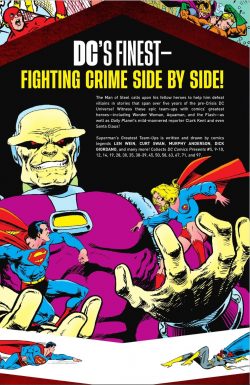
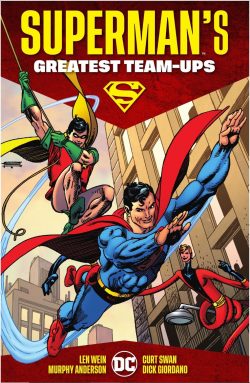
Superman’s Greatest Team-Ups


By Mike W. Barr, Cary Bates, E. Nelson Bridwell, Gary Cohn, Gerry Conway, Steve Englehart, Steve Gerber, Paul Levitz, Dan Mishkin, Denny O’Neil, Martin Pasko, Len Wein, Murphy Anderson, Rich Buckler, Dick Dillin, Don Heck, Alex Saviuk, Jim Starlin, Joe Staton, Curt Swan, Rick Veitch & various (DC Comics)
ISBN: 978-1-7795-0486-9 (HB/Digital edition)

From the moment a kid first sees his second superhero, the only thing they wants is to see how the new gaudy gladiator stacks up against the first one. From the earliest days of the comics industry (and according to DC Comics Presents editor Julie Schwartz it was the same with the pulps and dime novels that preceded it) we’ve wanted our idols to meet, associate, battle together – and if you follow the Timely/Marvel model, that means against each other – far more than we want to see them trounce their archenemies in a united front…

The concept of team-up books – an established star pairing or battling (usually both) with less well-selling company characters – was far from new when DC awarded their then-biggest gun. DCCP was launched in the publicity-drenched weeks preceding the release of Superman: The Movie: a regular arena to have adventures with other stars of their firmament, just as the Gotham Guardian had been doing since the mid-1960s in The Brave and the Bold.

In truth, the Action Ace had already enjoyed the serial sharing experience once before, when World’s Finest Comics briefly ejected the Caped Crusader and Superman battled beside a coterie of heroes including Flash, Robin, Wonder Woman, Teen Titans, Hawkman, Green Arrow, Dr. Fate and others (issues #198-214; November 1970 to October/November 1972) before the original status quo was re-established.

This is something of a companion volume to the previously published Adventures of Superman: José Luis García-López volume 1, in that it also publishes team-ups from DC Comics Presents, but these are stories he didn’t illustrate. Instead. a host of talented individuals devised fun, thrilling and even amusing adventures represented here by material from DCCP #5, 9-10, 12, 14, 19, 28, 30, 35, 38-39, 45, 50, 58, 63, 67, 71 and 97, spanning January 1979 to September 1986. The stories are augmented by covers by Ross Andru, Dick Giordano, Dick Dillin, Jim Starlin, Rich Buckler, Steve Mitchell, George Pérez, Frank Giacoia, Gil Kane, Ernie Colón, José Luis García-López, Eduardo Barreto, Rick Veitch & Bob Smith.

We begin with Sea King Aquaman who is embroiled in ‘The War of the Undersea Cities’ (by Len Wein, Paul Levitz & Murphy Anderson) when his subjects re-open ancient hostilities with the mer-folk of undersea neighbour Tritonis, home of Superman’s old college girlfriend Lori Lemaris. Fortunately, cooler heads prevail when Ocean Master is revealed to be meddling in their sub-sea politics…

Next, Marty Pasko, Joe Staton & Jack Abel expose the ‘Invasion of the Ice People!’ (#9, May 1979) wherein Wonder Woman assists in repelling an attack by malign disembodied intellects before a 2-part tale commences with ‘The Miracle Man of Easy Company’ (Cary Bates, Staton & Abel, #10, June)…

When a super-bomb blasts Superman back to World War II it results in a momentous meeting with indomitable everyman soldier Sgt. Rock and a battle that changes the course of the war.

Cover-dated August 1979, DCCP #12 offered a duel between the Action Ace and New God Mister Miracle in ‘Winner Take Metropolis’ – by Steve Englehart, Buckler & Giordano before Levitz finishes a time-travel epic not actually included here. That ambitious continued epic saw the Legion of Super-Heroes stop Superman saving a little boy from alien abduction to preserve the integrity of the time-line. It didn’t help that the lad was Jon Ross, son of Clark Kent’s oldest friend and most trusted confidante…

Deranged by loss, Pete Ross here risks the destruction of all reality by enlisting the aid of Superboy to battle his older self in ‘Judge, Jury… and No Justice!’ (Levitz, Dillin & Giordano from October 1979 cover-dated DCCP #14, whilst March 1980 saw Batgirl help solve eerie mystery ‘Who Haunts This House?’ (by Dennis O’Neil, Staton & Frank Chiaramonte) before we catapult to #28 and the concluding chapter of a cosmic epic which involved Green Lantern, Martian Manhunter J’onn J’onzz, and the debut of intergalactic brute Mongul.

Here the aftermath of the affair sees Supergirl join her Kryptonian cousin in scouring the cosmos for the vanished tyrant and ancient doom weapon ‘Warworld!’ (Wein, Jim Starlin & Romeo Tanghal). Unfortunately, once they found it, Mongul unleashed all its resources to destroy his annoying adversaries and in the resultant cataclysm the mobile gun-planet was demolished. The resultant detonation blasted Kara Zor-El literally out of existence…

Issue #30 (February 1981) saw Black Canary plagued by nightmares starring her deceased husband, but upon closer investigation Superman proved that diabolical Dr. Destiny was behind ‘A Dream of Demons!’, whilst some semblance of sanity returned in #35 (July) as Superman and Man-Bat hunted for ‘The Metamorphosis Machine!’ (Pasko, Swan & Vince Colletta) which might save chiropterist Kirk Langstrom‘s baby daughter from death. All they had to do was beat murderous maniac Atomic Skull and his minions to the device…

DC Comics Presents #38 (October) united Man of Steel and Fastest Man Alive as an extra-dimensional tyrant attempted to foment a high velocity war between Earth’s fastest heroes in ‘Stop the World – I Want to Get Off Go Home!’ (Pasko & Don Heck), after which #39 catapulted Superman into the weirdest case of his career as he and Plastic Man trailed ‘The Thing That Goes Woof in the Night!’ (Pasko, Staton & Smith) to a Toymakers Convention where third-rate super-villains Fliptop and Dollface were trying to rob freshly reformed, barely recovering maniac Toyman…

Firestorm the Nuclear Man stole the show in #45 (May 1982) as Gerry Conway, Buckler & Smith teamed him and Superman against terrorist Kriss-Kross – who took over the nation’s electronic military defences to implement ‘The Chaos Network’.

The anniversary DC Comics Presents #50 (October) features ‘When You Wish Upon a Planetoid!’ by Dan Mishkin, Gary Cohn, Swan & Kurt Schaffenberger, which saw a cosmic calamity split Superman and Clark Kent into separate entities…

Courtesy of Mike W. Barr, Swan & Dave Hunt, Robin and Elongated Man joined the Action Ace in #58 (June 1983) to foil devious tech-savvy bandits employing ‘The Deadly Touch of the Intangibles’ after which overnight sensation Amethyst, Princess of Gemworld and the Man of Steel battled debase extradimensional tyrant Black Opal in #63 (November 1983).

Scripted by Mishkin & Cohn, ‘Worlds to Conquer!’ was illustrated by Alex Saviuk, Colón, Smith & Gary Martin, capitalising on the contemporary fad for fantasy, with an Earth-raised magical alien princess helping save humanity from roaming space-warps, super-criminals and her personal pantheon of mystic miscreants…

Cover-dated March 1984, DCCP #67 proffered traditional seasonal fare from Wein, E. Nelson Bridwell and veteran Superman dream team Swan & Anderson. ‘Twas the Fright Before Christmas!’ finds maniacal original Toyman Winslow Schott seeking to sabotage festivities and a debilitated Man of Tomorrow teaming with a hairy bearded guy in a red suit…

Hunt substituted for Anderson in #71’s ‘The Mark of Bizarro!’ (July 1984) as Superman joins his zany doppelganger to save square planet Htrae and embattled Earth from a bizarro version of power-parasite Amazo. Ultimately, it comes down to Bizarro employing his wits to win!…

We close with the final story in DC Comics Presents‘ run.

In 1986 DC celebrated its 50th year with the groundbreaking Crisis on Infinite Earths: radically overhauling its convoluted multiversal continuity and starting afresh. In the aftermath of making many planes into one singular universe, all Superman titles were cancelled or suspended pending a back-to-basics reboot courtesy of John Byrne. The process allowed opportunity for a number of very special farewells to the old mythology…

One of the most intriguing and challenging came in the last issue (#97, September 1986) wherein Steve Gerber, Rick Veitch & Smith offered a creepy adieu to many of Superman’s greatest foes in ‘Phantom Zone: the Final Chapter’…

Tracing Jor-El‘s discovery of the Phantom Zone through to the imminent end of the multiverse, this dark yarn built on Gerber’s potent miniseries The Phantom Zone, revealing the dread region of nothingness was in fact the sentient echo of a dead universe which had always regarded the creatures deposited within it as irritants and agonising intruders.

Now, as cosmic carnage reigned, Aethyr, served by Kryptonian mage Thul-Kar, caused the destruction of Bizarro World Htrae and deification/corruption of Fifth Dimensional pest Mr. Mxyzptlk, as well as the subsequent crashing of Krypton’s Argo City on Metropolis.

As a result, General Zod and his fellow immaterial inmates were liberated to wreak havoc upon Earth – but only until the now-crystalline pocket dimension merged with and absorbed the felons before implausibly abandoning Superman to face his uncertain future as the very Last Son of Krypton…

Designed as introductions to lesser-known DC stars, these tales are wonderfully accessible to newcomers and readers unfamiliar with burdensome continuity. They provide an ideal jumping on point for anybody who just wants a few moments of easy comic book fun and thrills.

These short, pithy adventures were and remain a perfect shop window for DC’s fascinating catalogue of characters and creators. DC Comics Presents delivered a breadth and variety of self-contained and satisfying entertainments ranging from the merely excellent to utterly indispensable. This book is a perfect introduction to the DC Universe for every kid of any age and another delightful slice of captivating Costumed Dramas from simpler, more inviting times…
© 1979, 1980, 1981, 1982, 1983, 1984, 1986, 2021 DC Comics. All Rights Reserved.

David Bowie in Comics


By Thierry Lamy & Nicolas Finet; illustrated by Bast, Martin Trystam, Thomas Gilbert, Marcello Quintanilha, Christelle Pécout, Jérémie Royer, Nicolas Pitz, Monsieur Iou, Christopher, Claire Fauvel, Léonie Bischoff, Joël Alessandra, Samuel Figuière & various: translated by Christopher Pope (NBM)
ISBN: 978-1-68112-298-4 (HB) eISBN: 978-1-68112-299-1

In recent years graphic biographies have become a major component of publishers’ output. This one – originally released on the continent in 2020 – will appeal to a far larger mainstream audience than comics usually reach: unlocking some secrets of someone with many identities; a musician and performer who changed popular culture and modern society and an agent provocateur ushering in a digital age…

Gathered in this fetching account are context-providing photo-enhanced essays bookending individual comics sections. Each chronological article and attendant comics vignette is written by French author/comics scripter Thierry Lamy and author, filmmaker, journalist, publisher, educator and music documentarian Nicolas Finet – who has worked in comics for three decades, generating a bucketload of reference works like Mississippi Ramblin’ and Forever Woodstock).

In this vivid exploration of a one-man cultural revolution, they are supported by an army of illustrators crafting vividly vibrant strips, beginning with ‘The 1950s: Plastic Saxophone’. An introductory text briefing leads to a comic strip nativity scene limned by Martin Trystam, as David Robert Jones is born in post-war Brixton on January 8th 1947. What follows traces his middle class boyhood in Bromley, South London, introduction to music and science fiction by his tragic step-brother Terry, and how his new dad got the little “spaceboy” his first instrument and lessons…

Following a context-packed essay on the birth of Rock ‘n’ Roll, Thomas Gilbert illustrates ‘1962: A Unique Gaze’ as schoolboy David and classmate/best friend George Underwood clash over a girl, inadvertently gifting the future star with his signature look. Another text piece – on the star’s appearance and early relationships – segues into ‘1962-1966: First Bands’, with Marcello Quintanilha delineating how music obsessed Jones and Underwood pursue their dream in a succession of blues bands (The Hooker Brothers, The Konrads, King Bees and others) and cut their first single. Following further text and photo details on those heady days, Christelle Pécout’s strip ‘1966: When David Jones Became David Bowie’ heralds the moment everything changed…

An essay on personal reinvention moves the story along to when Bowie studied with theatrical legend Lindsay Kemp, visualised by Jérémie Royer in ‘1969: Ground Control to Major Tom’ and highlighting the role the first Moon Landing played in Bowie’s breakout hit. A feature on the influence of Stanley Kubrick’s 2001: A Space Odyssey closes one era as Nicolas Pitz illustrates the meeting of Bowie and his new inspirational inamorata Angela Barnett in ‘1969-1971: Angie’. Her freewheeling lifestyle and attitudes would liberate her eventual husband and drive his rise, as seen in a prose feature and Monsieur Iou’s strip ‘1972: Top of the Pops: The Birth of a Legend’…

Bowie early realised the power of image tied to story and his first musical alter ego is examined in ‘1972-1973: An Alien Named Ziggy Stardust’, courtesy of Christopher, after which Claire Fauvel details the growth of the major musical theoretician behind the stage performer. ‘1972-1973: Bowie the Producer: Lou Reed & Iggy Pop’ sees David save the careers of two fading American icons and gain friends who will save him in his troubled years to come…

Having cycled through two performer personalities – Ziggy and Aladdin Sane – Bowie endured creative ennui and branched out into theatre, as seen in Léonie Bischoff’s ‘1974: A Hint of Science Fiction’. When his proposed adaptation of Orwell’s 1984 foundered, Bowie reinvented key elements for his Diamond Dogs show before the Quintanilha strip ‘1975: Turning to Soul: Young Americans’ outlines the next step in the musician’s mercurial career. Christelle Pécout’s comics contribution reveals how drug abuse and legal struggles with his embezzling manager left Bowie burned out and ready for another reinvention in ‘1976: The Thin White Duke’…

With this chapter’s essay concentrating on Bowie’s role in Nick Roeg’s film The Man Who Fell to Earth, Christopher’s encore art act ‘1976-1979: A Date with Berlin’ focusses on relocation to West Germany at the height of Cold War tensions and creation of a landmark series of albums comprising “The Berlin Trilogy”.

Discussions of minimalism and masterpieces are complemented by Monsieur Iou’s cartoon coverage of the performer’s golden years as ‘1980-1984: The Global Icon: Let’s Dance’ detail Broadway acting triumphs and collaboration with Funk genius Nile Rodgers. Always with his mismatched eyes on the future, Bowie was the first mega-star to grasp the potential of a new phenomenon. MTV’s launch shifted his focus to musical videos and his status grew even more…

Illustrated by Joël Alessandra, ‘1983: Bowie in Film: Merry Christmas Mr. Lawrence’ explores his astounding performance and heralds his gradual move away from pop stardom towards musical exploration and personal experimentation. Trystam returns for ‘1989-1992: Forever Innovating: Bowie and Tin Machine’…

By then, Bowie’s car-crash home life had steadied and Samuel Figuière shares the happiest times as the music man finds his true life partner in ‘1992: Iman’, after which Alessandra illustrates ‘1992-1999: Experiments in Genre’ as Bowie increasingly explored digital technology (in 1997, he released the first digital music single for fans to download) before Figuière visually catalogues ‘2004-2014: Quiet’ as the star’s progressively poor health ends his performing career…

The story ends with one final essay appreciation, supplementing Pitz’s fantasy montage ‘2014-2016: The Last Dance’ commemorating the last work and The End of All The Songs…

A human agent of social change, David Bowie made sublime music, offered groundbreaking and pioneering advocacy of the barely post-natal internet and provided an example for generations of confused kids seeking to fit their own personally perceived oddities into a binary world that never really existed except in the minds of a few hidebound religious bigots.

In so many ways, he inspired and reshaped people on the margins and did so by example. Always aware of what could be, he even patterned the way modern social media and eCommerce evolved. He also made life extraordinary and much of that is captured here.

Also equipped with a Discography, Filmography, Sitography and Recommended Reading list, David Bowie in Comics is an astoundingly readable and beautifully rendered treasure for comics and music fans alike: one to resonate with anybody who loves to listen and look. It can’t actually play you the songs, but you can read it while listening to them on your aural medium of choice, so everything’s Hunky Dory,

© 2020 Petit as Petit. © 2022 NBM for the English translation.
David Bowie in Comics is scheduled for UK release June 16th 2022 and is available for pre-order now. For more information and other great reads see http://www.nbmpub.com/

Most NBM books are also available in digital formats.

Thor: For Asgard


By Robert Rodi, Simone Bianchi & various (MARVEL)
ISBN: 978-0-7851-4445-8 (HB/Digital edition) 978-1-84653-482-9 (TPB Marvel/Panini UK)

In his anniversary year and with another motion picture interpretation of Marvel’s Thor eagerly anticipated, it appropriate to remember his roots and that there’s plenty for established fans and freshly-interested parties to grapple with in book form. Here’s one that might tickle the fancy of older readers…

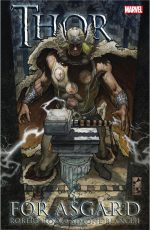
In an effective and beautiful re-imagining by Robert Rodi, illustrated with astounding imagination and beauty by Simone Bianchi (assisted by Andrea Silvestri and colourist Simone Peruzzi), the long dreaded Twilight of the Gods has begun and cracks are beginning to show in the heroic façade of the noble and mighty Asgardians…

Reprinting a six-issue miniseries published in 2010 under the Marvel Knights imprint, our saga opens in the second icy year of the dread Fimbulwinter, with shining god Balder long dead, all-father Odin long missing and Thor as long-suffering Regent.

A better warrior than ruler, the Thunderer leads an embattled, increasingly contentious and disgruntled populace in punitive forays against old enemies such as the Frost Giants. All around them, former vassal states are stretching long unused muscles and airing old grievances whilst the unhappy ruler’s two closest advisors are at constant odds with each other…

With the snowy streets of Asgard awash with resentment, if not outright sedition, Idunn informs the out-of-his-depth Storm Lord that the Golden Apples – source of Asgardian immortality – are almost gone and with Spring and Summer banished, no more will grow.

Asgard’s enemies are gathering, led by a secret mastermind, Odin’s mysterious mission has gone awry and, in the gleaming city, mutterings have become desperate, traitorous acts. With even Valhalla – glorious Hall of the Dead – threatened, and now murder in the streets, Thor needs all his powers to help him, but even his faithful magic mallet has betrayed him: it has been long indeed since the Prince of Asgard was worthy enough to wield the Hammer of the Gods…

With chaos and destruction from every faction and direction, can hard-pressed Thor hold things together, or is the truly heroic action letting Ragnarok come and starting afresh amid the ruins…?

Bleak, subtly allegorical and utterly enchanting, this moody epic of endings and new beginnings is a powerful tale of a deftly different pantheon that will delight newcomers to the character but possibly irritate long-term Marvelites. Moreover, by ending on a foreboding note – completists should take heed – the tale is not completely done yet and more may follow…

The moody, sexy, and uncompromisingly violent tale is augmented in this 2019 re-release by a ‘Spotlight’ addendum, featuring stills from the movies and heavily-illustrated background feature ‘For Asgard!’ by historian Mike Conroy, covering author Rodi’s other Thor sagas (The Deviant Saga, Thor & Loki: Blood Brothers and Astonishing Thor). This volume is also still readily available in a British released edition from Marvel/Panini UK.
© 2019 MARVEL.

Trent volume 4: The Valley of Fear


By Rodolphe & Léo, coloured by Marie-Paule Alluard, translated by Jerome Saincantin (Cinebook)
ISBN: 978-1-84918-394-9 (Album PB/Digital edition)

Continental audiences have an abiding fascination with the mythologised American experience, whether it be the Big Sky Wild West or later eras of crime-riddled, gangster-fuelled dramas. They also have a vested historical interest in the northernmost parts of the New World which has resulted in some pretty cool graphic extravaganzas if comics are your entertainment drug of choice…

Born in Rio de Janeiro on December 13th 1944, Léo is actually Brazilian artist and storyteller Luiz Eduardo de Oliveira Filho. After attaining a degree in mechanical engineering from Puerto Alegre in 1968, he was a government employee for three years, until forced to flee the country because of his political views. While a military dictatorship ran Brazil, he lived in Chile and Argentina before illegally returning to his homeland in 1974.

To survive, he worked as a designer and graphic artist in Sao Paulo whilst creating his first comics art for O Bicho magazine. In 1981 he migrated to Paris, pursuing a career in Bande Dessinée, and found work with Pilote and L’Echo des Savanes as well as more advertising and graphics fare. His big break came when Jean-Claude Forest invited him to draw stories for Okapi, leading to regular illustration work for Bayard Presse.

In 1988 Léo began his long association with scripter and scenarist Rodolphe D. Jacquette – AKA Rodolphe. The prolific, celebrated writing partner had been a giant of comics since the 1970s: a Literature graduate who transitioned from teaching and running libraries to creating poetry and writing criticism, novels, biographies, children’s stories and music journalism.

After meeting Jacques Lob in 1975, Jacquette expanded his portfolio: writing for a vast number of strip artists in magazines ranging from Pilote and Circus to À Suivre and Métal Hurlant. Amongst his most successful endeavours are Raffini (with Ferrandez) and L’Autre Monde (Florence Magnin), but his triumphs in all genres and age ranges are too numerous to list here.

In 1991 “Rodolphe” began working with Léo on a period adventure of the “far north”. Taciturn, introspective, bleakly philosophical and driven Royal Canadian Mounted Police sergeant Philip Trent premiered in L’Homme Mort, forging a lonely path through the 19th century Dominion generating eight tempestuous, hard-bitten, love-benighted albums between then and 2000. Their creative collaboration prompted later fantasy classic Kenya and its spin-offs Centaurus and Porte de Brazenac.

Cast very much in the classic mould perfected by Jack London and John Buchan, Trent is a man of few words, deep thoughts and unyielding principles who gets the job done whilst stifling emotional turmoil boiling deep within him: the very embodiment of the phrase “still waters run deep”…

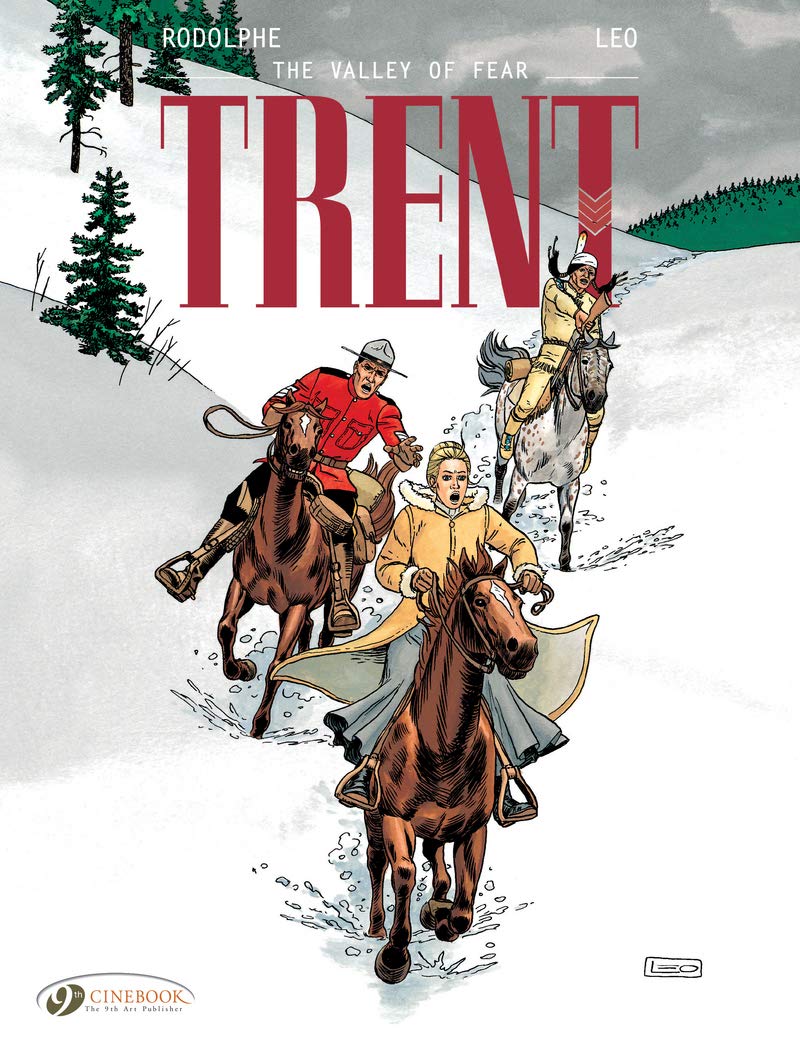
As La Vallée de la peur, this fourth saga comes from 1995, with the solitary sentinel of justice and his faithful hound “Dog” initially absent from the scene. Instead, we see rail engineer George Petterson arriving at desolate shanty town White Pass and Rail Camp Seven. Here, navvies are laboriously hacking their way through a mountain, advancing the iron line inch by frozen inch.

It’s a strangely unsettling set-up, as Petterson finds when he moves into the cabin of the man he’s replacing as site manager. There’s an atmosphere of surly secrecy and every window of his new home has been nailed shut…

The first inclination of real trouble brewing comes as George tries to stop native labourers quitting. After two whites were injured and one of their own killed in tunnel accidents, they refuse to stay and be killed by “Hoppo”. The locals know it’s the work of a “demon-bear”, but the engineers will only admit to ordinary, natural problems and mock the silly superstitions. Nevertheless, when night falls they all bolt their doors. Every cabin has its windows nailed shut…

The account closes with reports of more accidents and problems as Mrs. Petterson completes her request to the RCMP to send someone to White Pass, which has been silent and out of touch for many days now…

Trent is assigned the mission and it’s a painful shock to meet again the woman he knows as Agnes. Years ago he had saved her – but not her beloved brother – and was given a clear invitation from her that he never acted upon. Eventually, he made his decision, travelling all the way to Providence with marriage in mind, only to learn that his Miss St. Yves had reached her own conclusion years previously…

Now she stubbornly accompanies him into unknown danger at White Pass. She is resolved to find her missing husband and Trent is wracked with indecision and other darker emotions he refuses to acknowledge…

Travelling to Fraser by train, the rescue party switches to horseback and picks up Trent’s occasional partner Mokashi. The First Nations scout also knows Agnes of old, and has his own reasons for leaving the comforts of family and civilisation, despite having already learned that Hoppo haunts Camp Seven…

After crossing the snowy beautiful wilderness – rendered as always by Leo with staggering craft and force – the riders arrive in a desolate Camp Seven with no sign of life. Seemingly abandoned, the cabins which once held more than fifty men are cold and empty, but it’s not long before Mokashi uncovers some of the former inhabitants…

As they batten down for the night in a reasonably defensible shack, the rescuers are keenly aware of eerie silence punctuated by erratic bursts of animal noise. Eventually sleep comes… until the implacable Mountie and Mokashi are roused by the sounds of an intruder furtively seeking entry…

When Trent investigates, he is ambushed by a beast out of his maddest nightmares. Barely escaping with his life, his frantic flight brings him to an even greater horror – George Petterson, more dead than alive and apparently the only survivor of a supernatural atrocity…

As dawn comes, Agnes is reunited with her husband and the lawmen begin the task of tracking what can only be an exceptionally clever and cunning beast. Trent, however, cannot shake the notion that he heard it speak as it shrugged off his rifle shots…

Tension mounts as both romantic triangle and murderous rampage bloodily converge, but even after the Mountie solves one mystery and the evacuation of George Petterson begins, there is more heartbreak and loss to come before civilisation reclaims them. And as ever, Trent is left to struggle with his solitary thoughts, loss and loneliness…

Another beguilingly introspective voyage of internal discovery, where environment and locales are as much lead characters as hero and villain, The Valley of Fear delivers mystery, epic scope, sinister suspense, action and poignant drama in a compelling concoction to satisfy any fan of widescreen cinematic crime fiction or grandiose western.
Original edition © Dargaud Editeur Paris 1993 by Rodolphe & Léo. All rights reserved. English translation © 2017 Cinebook Ltd.

Black Knight volume 1


By Kai Tsurugi (TokyoPop)
ISBN: 978-1-59816-522-7 (TPB)

So, it’s Pride Month and not all comics are about genocide or racial slaughter. Here’s a lost gem long overdue for another run in the sun – or at least a new English language revival on paper or in digital form…

Japan’s vast comics industry is formally sub-divided into discrete categories to avoid dithering and confusion. This is a fine historical example of a Yaoi story – a romanticised fantasy relationship drama starring beautiful young men in love. The genre was devised for female audiences: like Shounen-Ai (stories of two young men, but with more erotic content) although very mild – to the point of chaste gentility – by that standard.

As Kuro no Kishi, the serial first appeared from August 2003-October 2005 in Magazine Be x Boy, before filling 4 subsequent tankōbon tomes. These were translated via TokyoPop’s Blu Manga imprint and released between July 2006 and February 2009. There’s no English language digital editions that I know of, but the physical copies are still readily available.

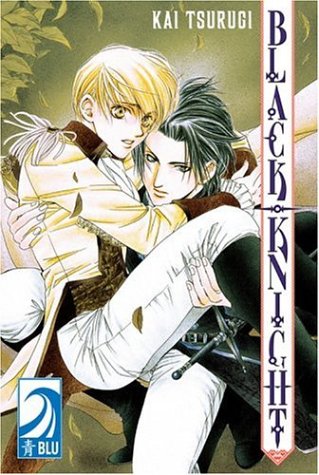
This lyrical, sexually explicit fantasy opens by introducing wayward hero Zeke O’Brien: a trainee mercenary of lower class origins who rises to the rank of Black Knight by saving the life of a lovely young Prince targeted for assassination by the hidden enemies of the King of Aran.

When the royal neophyte is assigned to train as a Black Knight, Zeke thwarts every attempt to murder the elfin Prince Chris, but falls hopelessly in love with his charge. He is delighted to discover the feeling is mutual and furtively, frequently, passionately reciprocated. However, the King’s enemies are many and the trials for the young lovers are only just beginning in this splendidly Ruritanian Romance of intrigue and melodrama.

Lavish, ostentatious, beautifully illustrated and inoffensively charming, this initial volume carries an additional, modern tale of boy-on-boy romance that might upset some readers, but not for obvious reasons.

‘Deadly Sin’ tells of the intimate (and naturally, graphically explicit) affair between a young priest (a son of IRA terrorists who subsequently murdered the SAS killers of his parents) and an athlete/poet he meets on holiday. Despite being well written and drawn, this type of material is bound to offend devoutly Christian, sectarian and/or conservative sorts (note the small ‘c’) so if you are the type hanging around waiting to be outraged, please save us all some grief and don’t read it.
© 2003 Kai Tsurugi. English text © 2006 BLU Inc. All rights reserved.

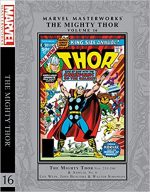
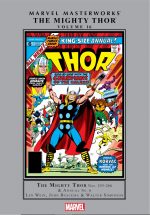
Thor Marvel Masterworks volume 16


By Len Wein, Roger Stern, John Buscema, Walter Simonson, Tony DeZuñiga, Sal Buscema & various (MARVEL)
ISBN: 978-1-3029-0358-9 (HB/Digital edition)

Once upon a time, disabled physician Donald Blake took a vacation in Norway, only to stumble into an alien invasion. Trapped in a cave, he found an ancient walking stick which, when struck against the ground, turned him into the Norse God of Thunder! Within moments, he was defending the weak and smiting the wicked.

Months swiftly passed, with the Lord of Storms tackling rapacious extraterrestrials, Commie dictators, costumed crazies and cheap thugs, but these soon gave way to a vast kaleidoscope of fantastic worlds and incredible, mythic menaces, usually tackled with an ever-changing cast of stalwart immortal warriors at his side…

Whilst the ever-expanding Marvel Universe had grown ever-more interconnected as it matured through its first decade, with characters literally tripping over each other in New York City, the Asgardian heritage of Thor and the soaring imagination of Jack Kirby had most often drawn the Thunder God away from mortal realms into stunning, unique landscapes and scenarios.

However, by the time of this power-packed compendium, the King was long gone and in fact enacting his Second Coming – technically third, but definitely Second Return to the House of (mostly his) Ideas – and only echoes of his groundbreaking presence remained. John Buscema had visually made the Thunder God his own over the interceding years, whilst a succession of scripters had struggled with varying success to recapture the epic scope of Kirby’s vision and Stan Lee’s off-kilter but comfortingly compelling faux-Shakespearean verbiage…

Spanning January-December 1977, this power-packed compilation re-presents The Mighty Thor #255-266 and Annual #6, and leads with ‘Over the Rainbow Bridge’: an engaging Introduction intriguingly illustrated  from involved illustrator and eventual redeemer of the Thor franchise – Walter Simonson.

The action opens behind the Kirby cover for Thor #255, as Len Wein & Tony DeZuñiga launch a new epic interstellar adventure in ‘Lo, the Quest Begins!’ Previously, embattled Asgard survived invasion only to learn their divine Liege Lord Odin had gone missing. Now, having exhausted every avenue of location available, Thor is compelled to search the galaxies, prompted by vague hints from all-knowing spirit Mimir of a distant destination – the Doomsday Star…

Boarding spacefaring dragonship Starjammer, Thor, Lady Sif, and Warriors Three Fandral, Hogun and Volstagg set (solar) sail, leaving a beleaguered Eternal Realm under the stewardship of Balder the Brave and his dark inamorata Karnilla the Norn Queen. However, before they even leave local space, the seekers encounter – and battle – malign aliens marooned ever since they initially fought the Storm Lord in his debut adventure…

A classic case of Marvel Misunderstanding occurs in #256 as the voyagers encounter an ancient and colossal colony ship populated by the last survivors of a civilisation that died from over-exploiting their environment. As the Asgardians are joined by Rigellian Recorder Memorax, the slowly-fading Levianons reveal how their poverty and resource-blighted existence has been further threatened by an invasive beast who takes the elderly like a ‘Lurker in the Dark!’ (Wein, John Buscema & DeZuñiga).

When the hideous Sporr also abducts recently wounded Sif, enraged Thor leads a savage counter-assault that sparks incomprehensible tragedy in concluding chapter ‘Death, Thou Shalt Die!’

Another mineral-based miscreant resurfaces in #258. ‘If the Stars be Made of Stone!’ sees the Starjammer attacked by space pirates inexplicably led by human super-villain – and early Thor foe – the Grey Gargoyle. The job is not one he wants, but as the unwilling captain conspires with the beaten-&-enslaved Asgardians for a chance to see again the Green Hills of Earth, their plot is exposed by fanatical second-in command Fee-Lon.

The brutal usurper is a truly ferocious brigand, but ultimately fights in vain to end the gods’ ‘Escape into Oblivion!’

Meanwhile in Asgard, Balder and Karnilla have been resisting an invasion helmed by arch-traitors Enchantress and Executioner. As Walter Simonson signs on beside Wein & DeZuñiga from #260, that subplot expands and intensifies even as ‘The Vicious and the Valiant’ sees the interstellar questors finally locate the Doomsday Star and falter before ‘The Wall Around the World!’ (inked by Ernie Chan).

The terrifying global construct is comprised of the power-drained husks of dead gods, but determinedly pushing on, the seekers discover Odin has been captured and slowly diminished by the energy-leeching Soul-Survivors whose civilisation subsists on stolen divine power. As they valiantly strive to save their sovereign, the Asgardians learn to their cost that ‘Even an Immortal Can Die!’ (#262, illustrated by Simonson & DeZuñiga).

Thankfully, ‘Holocaust and Homecoming!’ proves Odin is both wily and mighty as the heroes’ ferocious clash and inevitable victory results in a weary and wounded pantheon returning to Asgard to find it taken over by Loki and his cohort of treacherous allies.

With Odin in a coma – and ultimately abducted again – a covert civil war erupts between the returned champions and the city Loki has subverted. ‘Thou Shalt Have No Other Gods Before Me!’ sees a sinister scheme exposed, but not before Loki unleashes ultimate weapon The Destroyer against his step-brother in #265’s ‘When Falls the God of Thunder…!’ (inked by Joe Sinnott). As before, it’s not long before Loki loses control of his ultimate sanction…

Once again, everything hinges on the power and determination of Thor and his valiant resistance to chaos. In #266’s ‘…So Falls the Realm Eternal!’, Wein, Simonson & DeZuñiga show the Thunderer at his indomitable best, keeping Loki at bay and off kilter until the Warriors Three rescue and revive an extremely unhappy All-Father…

This saga presaged a change of focus that we’ll cover in the next volume but before then the epic entertainment concludes with ‘Thunder in the 31st Century!’ by Roger Stern, Sal Buscema & Klaus Janson from Thor Annual #6 (December 1977).

A riot of time-busting mayhem, it commences with Mighty Thor plucked from contemporary Manhattan: accidentally summoned to the time period of the original/future (time travel tenses suck!) Guardians of the Galaxy by a cyborg maniac named Korvac.

The legendary god-warrior briefly joins Vance Astro, Charlie 27, Yondu, Nikki, Martinex and Starhawk to bombastically battle super-powered aliens and thwart the sinister cyborg’s scheme to become master of the universe. At the conclusion, Thor returns to his own place and time, unaware how Korvac will reshape the destiny of reality itself in coming months…

To Be Continued…

Augmenting this volume is a blockbusting original art gallery, offering 21 pages of sketches, layouts, pencils and fully inked covers, splash and story-pages by Kirby & John Verpoorten, Buscema, DeZuñiga, Simonson, Joe Sinnott &Ernie Chan: a true treat for every art lover.

The tales gathered here may lack the sheer punch and verve of the early years but fans of ferocious Fights ‘n’ Tights fantasy will find this tome still stuffed with intrigue and action, magnificently rendered by artists who, whilst not possessing Kirby’s vaulting visionary passion, were every inch his equal in craft and dedication. In Thor’s anniversary year, this a definite and decidedly engaging must-read for all fans of the character and the genre.
© 2017 Marvel Characters, Inc. All rights reserved.

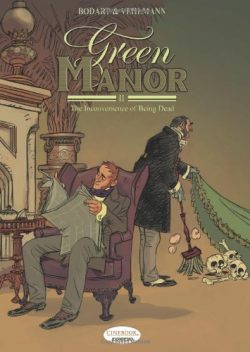
Green Manor volumes 1 & 2: Assassins and Gentleman & The Inconvenience of Being Dead


By Bodart & Vehlmann, translated by Elaine Kemp and Luke Spear (Cinebook Expresso)
ISBN: 978-1-905460-53-3 (vol. 1 Album PB) 978-1-905460-64-9 (vol. 2 Album PB)

Shared preconceptions are a wonderful toy to play with if you are a narrative creator – or reviewer. For instance, the French are generally considered more passionate than us reserved Brits (I wonder if that’s still the case?) and always eager to dole out grandiose appellations and epithets about creators, but at least they’re very seldom wrong in their acclamations.

Here’s a little Continental whimsy exploring the notion…

Fabien Vehlmann was only born in 1972 yet his prodigious canon of work (published from 1998 to the present) has earned him the soubriquet of “the Goscinny of the 21st Century”.

Vehlmann entered the world in Mont-de-Marsan and grew up in Savoie, studying business management before taking a job with a theatre group. In 1996, after entering a writing contest in Le Journal de Spirou, he caught the comics bug and two years later published – with illustrative collaborator Denis Bodart – a quirky, mordantly dark and gleefully sophisticated portmanteau period crime comedy entitled Green Manor.

The episodic, blackly funny tribute to the seamy underside of Victoriana appeared only sporadically until 2005 (and was revived in 2011), whilst the author spread his wings with a swathe of other features such as Wondertown (art by Benoit Feroumont) and the hugely popular children’s thriller Seuls (with artist Bruno Gazzotti and translated after far too long as the Alone series) before undertaking a high-profile stint on veteran all-ages adventure strip Spirou and Fantasio.

Vehlmann has continued to craft enticing and engaging tales for kids (Samedi et Dimanche) but is equally adept on more mature fare like IAN and Sept psychopaths (with Sean Phillips). He even briefly drew his own strip Bob le Cowboy

His partner in crime on Green Manor was Denis Bodart, who studied at the Saint Luc academy in Brussels before taking up teaching. He soon resorted to a life in comics, debuting in 1985 with Saint-Germaine des Morts (scripted by Streng) for publishing house Dupuis.

Three years later he co-created – with writer Yann (Yannick Le Pennetier) – Célestin Speculoos for Circus and Nicotine Goudron for l’Écho des Savanes, whilst acting as a jobbing freelance comics artist with work regularly appearing in Le Journal de Spirou and elsewhere.

Following his highly acclaimed turn here (beginning with Assassins et gentleman), he moved on to succeed Jean-Maire Beuriot as artist of Casterman’s prestigious Amours Fragiles.

The premise of the mystery story is both deliciously simple and wickedly palatable. As this book opens in the infamous Bethlehem Psychiatric Hospital in 1899, eminent Dr. Thorne is attempting to interview the inmate known as Thomas Below.

A domestic in a Gentleman’s Club for his entire life, the poor unfortunate became violently delusional mere days before retirement. Now as Thorne questions the madman deep in the bowels of “Bedlam”, the savant realises the sorry soul before him believes he is Green Manor incarnate. He has certainly been privy to all that strange place’s secrets, surprises and hushed-up scandals. Hesitantly at first, Below begins telling tales of rich, powerful and ostensibly honourable men at their most excessive and unbearable,,,

What follows is a macabre menu of short tales linked by proximity and tone, beginning with ‘Delicious Shivers’, wherein a roomful of The Great and the Good gathered around aged patriarch Dr. Byron on an October night in 1879. The respected physician posed an intriguing challenge to the assemblage: can there be a murder without a victim or a murderer?

Most of the men present had dark hearts and cunning minds and Sir Foswell rose to the challenge with his story of a noted aristocrat who erased an unwise early marriage and “disappeared” his unwanted bride by dint of bloodshed, money and influence.

Inspector Darcroft then related a case whereby there was no discernible murderer although the victim was most certainly gunned down at close range…

As the heated banter built, events took a very dark turn once Byron informed them that he had personally caused such an impossible crime to be committed. To the shocked silence of the throng he described how the administration of an extremely slow-acting poison in the drinks of some, many or all of those gathered might or might not kill an unspecified number of them at some unguessable time in the future…

Of course he might just have been jesting to win a point, but nobody went home complacently that night…

‘Post-Scriptum’ described the lethal intellectual duel between dashing young Detective Johnson and aged Sir Alfred Montgomery in August 1882, after the latter defied the policeman to stop him killing a young woman. The rules of the competition are quite strict and the noble believes he has succeeded in committing a perfect crime, but although the noble correctly considers himself a cunning planner his character judgement leaves much to be desired…

Weary and frustrated police Inspector Gray‘s decades-long hunt for a serial killer ended in shock and castigation when he arrived at an astounding conclusion one gloomy night at the Club in September 1882. That worthy’s too-late grasp of an impossible ‘Modus Operandi’ subsequently led to glorious triumph, but also a most surprising outcome and response from a fellow clubman and confidante…

The most baroque and arcane yarn involves another intellectual game and imaginative wager placed in March 1893, when two connoisseurs of crime determined to commit the most artful murder of all time. Their target would be none other than author and criminologist Sir Arthur Conan Doyle, and to make things interesting the offending weapon could only be ’21 Halberds’

In April 1872 Lord Denton invited young artist Eric Kaye into the Green Manor Club to repair a damaged painting by the great lost genius Jason Sutter. However, the dazzled dauber became obsessed with the story behind the austere family portrait – especially a tragic, beautiful daughter who suddenly vanished from history – depicted in ‘Sutter 1801’, and his fervent enquiries led to the resolution of a decades-old mystery, murder most foul and eventual banishment as his only reward.

Proud and undaunted, Kaye patiently devised a most exquisite vengeance…

The catalogue of upper class skulduggery concludes with ‘The Ballad of Dr. Thompson’ and a most arcane and uncanny murder mystery which begins in 1878, as great friends Professor Ballard and Thompson bid each other a drunken goodnight on the club steps. Only one of them makes it home safely…

When the other’s corpse is found stuffed into a grandfather clock police investigations soon lead to the most insane of conclusions…

Wry, witty, wickedly funny and sublimely entertaining, Assassins and Gentlemen offers a superbly rewarding peek at High Society and low morals as seen from across the Channel and over eventful decades, which will delight and astound lovers of clever crime fiction and classy comics confabulations – and there’s even better to follow…


Sequel release The Inconvenience of Being Dead is a double-length compact Cinebook edition, and like its predecessor is sadly unavailable in English digital formats. However, it does deliver the final pair of original volumes – De l’inconvenient d’Atre mort and Fantaisies meurtriares – which saw Green Manor’s continual catalogue of High Society crime, calumny, depravity and outrage lead to an inevitable sorry conclusion…

The premise is deliciously simple and wickedly palatable. As seen in the first collection, prominent alienist Dr. Thorne has become obsessed with Thomas Below, currently incarcerated in the infamous Bethlehem Psychiatric Hospital.

Thorne resumes the unconventional interviews in 1899 as the savant is dragged from his bed to attend Below once again. This time the need is most urgent. The old retainer has escaped, broken into a house and taken a family hostage. Hesitantly the healer makes his approach and engages the affable maniac in conversation. All too readily Below begins telling more tales of rich, powerful and ostensibly honourable men at their most excessive and unbearable…

The macabre menu of skits and sketches opens with ‘Child’s Play’ from March 1871 wherein cruel Lord Virgil observed and was incensed by a passive, gentle servant with the patience of Job. The noble’s instantly resolved instinct was to turn the saint into a murdering thing of evil.

Admitting to possession of a foolproof, infallible and much-proved method of killing-by-proxy to a roomful of The Great and the Good gathered around, Virgil determined to drive good-natured George into eternally debasing and damning himself by using the system to save himself from torment. Sadly, one man’s torment is another man’s test of faith, and good old George is far from the predictable peasant he appears…

In 1885, dilettante supernaturalist Joseph Sharp returned from Prague following a fruitless shopping trip for magical spells and objects, only to find his best friend Mark Abbott languishing under the force of a family curse. However, detailed investigation of ‘The Mark of the Beast’ and a ghastly family secret in a crypt only proved once again that the unknown has very little force or impact when measured against a mother’s hate, the infinite patience of the tormented and a victim’s fevered imagination…

One night in 1876, Lord Justice Sherman realised he had condemned an innocent man to death, even though not a single shred of evidence existed to confirm his opinion. With one night remaining to save his man, the elderly jurist took to the streets of London to find the true culprit and succeeded, utterly unaware that the malefactor involved had already taken vengeance for the judge’s noble act in advance of its completion and Sherman’s ‘Last Wishes’

In 1897 bombastic, belligerent General Miller gloated at the Club. He had at last come into possession of the fabled Spear of Longinus. The military martinet had no fear of the legends and many deaths laid upon the artefact or ‘The Centurion’s Shadow’, but was beguiled by its repute as a tool to make great men all-conquering.

Nevertheless, he was soon one more corpse attributed to the talisman – and not the last – until a pair of the Club’s armchair investigators applied learning and logic: exposing a deadly trap constructed by one of history’s greatest thinkers… albeit, just a little too late…

With the hostage crisis coming to end, Below shares his most shocking epigram as ‘Voodoo Night’ finds the gathered gentlemen – over cigars and brandy – casually dissecting a juicy murder one evening in December 1870. With irreconcilable facts and impossible assumptions heatedly flying about, soon only absurdity or the supernatural are left as answers to the mystery of the slaying of boorish lout Lord Killian. However, in another room, the genteel conversation of the closeted Ladies married to the assemblage of tobacco-smoking idiots soon reveals a so-simple truth…

The last legends of the Club were gathered up in appendix Murderous Fancies, with the increasingly obsessed Thorne receiving word that Below has passed away. Briefly thinking himself free at last, it is with mixed feeling that the doctor takes custody of the illegible scrawls of the troubled retainer and wearily, warily dares to decipher them…

‘Endgame’ relates an incident from June 1871 when the Club was driven to distraction by the will of recently paralysed Lord Wyatt. It was in the form of a nonsense riddle, and the first to solve it would win all Wyatt’s prodigious wealth…

At the same time, the executor secretly consulted with pioneering dementia expert Dr. Sheffer over the mental state of his master. The aristocrat claimed his parlous condition was the result of a murder attempt, and this riddle might well be a trap to catch the assailant. Sheffer knew better but soon had every reason to regret his rather rash conclusions…

‘A Small Crime Serenade’ found an aged, innocuous gentleman in garrulous mood one night in 1867, sharing with a dutiful Club servant his great gift and passion: a life-long ability to get away with murder. Sadly, his boast of capping his career with one final killing was derailed by a most unanticipated event.

In 1827, talk at Green Manor was of only one matter: the recent demise of a radical libertarian poet. Especially fervent was young devotee Dr. Daniel Ballantyne who promptly fell for a cruel prank when the Club grandees purportedly offered him a chance to autopsy the body and look ‘In the Head of William Blake’. They had arranged that what he saw would be like nothing he had ever experienced…

Ballantyne disappeared that night, and in the cold light of day an inexorable campaign of terror began as the japesters were slowly driven mad by notes threatening vengeance from the “Tygers of Wrath”…

In lighter vein, ‘Fight to the Finish’ related how a brace of bored big game hunters invented an imaginative game in May 1859. Their aim was to determine who exactly was the absolute best. The prey was to be each other but – although the rules of the competition were strict and fair – as the days progressed it seemed that neither Lord Bennett nor Lord Turner were as able or as gentlemanly as they claimed…

The dead man’s tales ended with a chilling homily from 1872 wherein the cream of Society discussed the strange case of Lord Sanders who had blighted his own financial empire and destroyed his greedy heirs by cruelly and carefully tying the purse-strings of their inheritances.

The dominating oligarch had left a vast list of tasks for his four children to fulfil in ‘The Testament’: far too many for any person or persons to complete before getting their undeserving hands on his ill-gotten gains. Of course, even he could not predict how and where greed and frustration could take a desperate man…

And with that final story shared, Below no longer plagued the good doctor’s days, but his influence remained long after he was gone…

Mordant, imaginative, darkly wry and cruelly rewarding, The Inconvenience of Being Dead confirms our most heartfelt suspicions about the pointlessly privileged and inexplicably esteemed, damning them all as useless, venal and worse: A class apart that we could all do without, but a perfect target for all the disdain we can wring from them with rich black comedy and classy comics confabulations like these.
Original editions © Dupuis 2005 by Vehlmann & Bodart. All rights reserved. English translations 2008 by Cinebook Ltd.

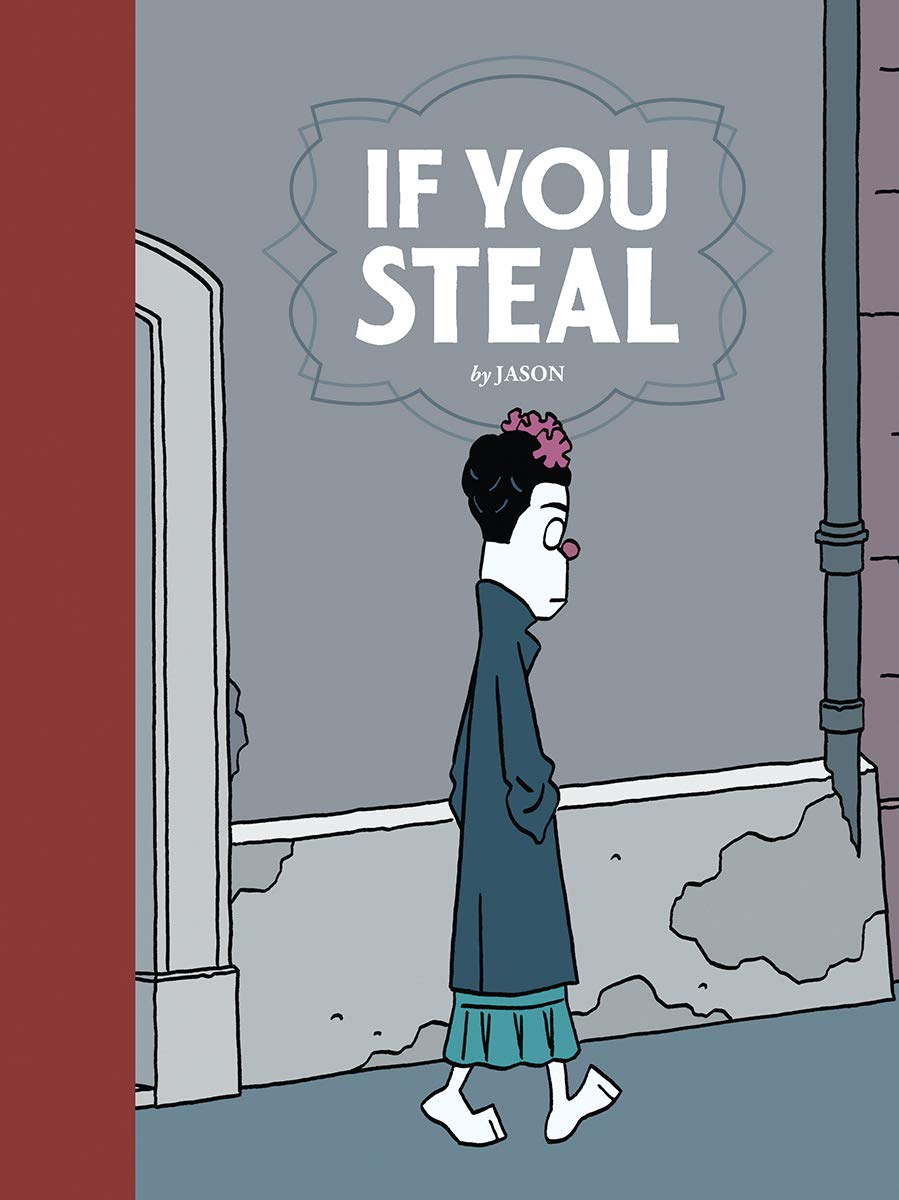
If You Steal


By Jason (Fantagraphics Books)
ISBN: 978-1-60699-854-0 (HB/Digital edition)

Jason is secretly John Arne Saeterrøy: born in Molde, Norway in 1965 and an international cartoon superstar since 1995 when his first graphic novel Lomma full ay regn (Pocket Full of Rain) won that year’s Sproing Award (Norway’s biggest comics prize). He won another Sproing in 2001 for series Mjau Mjau and in 2002 turned almost exclusively to producing graphic novels.

A global star among cartoon cognoscenti, he has received major awards from all over the planet. Jason’s work always jumps directly into a reader’s brain and heart, utilising the beastly and unnatural to gently pose eternal questions about basic human needs in a softly relentless quest for answers. That you don’t ever notice the deep stuff because of the clever gags and safe, familiar “funny-animal” characters should indicate just how good a cartoonist he is…

The stylised artwork is delivered in formalised page layouts rendered in a minimalist evolution of Hergé’s Claire Ligne style: solid blacks, thick outlines and settings of seductive simplicity; augmented by a deft and subtle use of flat colour which enhances his hard, moody, suspenseful and utterly engrossing Cinema-inspired world.

The superbly understated art acts in concert with his dead-on, deadpan pastiche repertoire of scenarios which dredge deep from our shared experience of old film noir classics, horror and sci fi B-movies and other visual motifs which transcend time and culture, and the result is narrative dynamite.

This compilation collects eleven short yarns and opens with the eponymous and eerie ‘If You Steal’, wherein cheap thug Paul perpetually risks everything – including the one person who keeps him feeling alive – in search of quick cash: only to lose it all in the end, after which ‘Karma Chameleon’ sees a small desert community dealing with the discovery of a giant, carnivorous and extremely predatory lizard which nobody seems able to see. Good thing masturbation-obsessed boffin Dr. Howard Jones and his long-suffering daughter Julia are in town…

The deliciously wry and whimsically absurdist Samuel Beckett spoof ‘Waiting for Bardot’ then segues neatly into a dashing mystery of masked derring-do as ‘Lorena Velazquez’ eventually tires of waiting for her ideal man to finish off a necessarily interminable and horrific army of villains prior to doling out a maiden’s traditional rewards, before a fugitive murderer narrates his own paranoia-fuelled downfall after his ‘New Face’ briefly tempts him with love and the never-to-be-achieved promise of peace and safety…

A series of six faux horror comics covers combines to relate the trials of chilling romances in ‘Moondance’. The classic fear theme extends into a rip-roaring battle against the undead in ‘Night of the Vampire Hunter’ and ‘Polly Wants a Cracker’ follows the other unique career path of artistic legend/assassin-for-hire Frida Kahlo.

A junkie musician pushes his luck against some very bad guys because ‘The Thrill is Gone’ after which ‘Ask Not’ takes a trawl through history from Stonehenge in 2583 BC to Salon de Provence in 1554 AD (courtesy of Nostradamus) to 1960s Cuba, revealing the truth behind the assassination of JFK and Abraham Lincoln and what parts Lee Harvey Oswald and Jack Ruby actually played in that millennial plot: a parallel worlds yarn like no other…

The book ends with a stunning, deeply moving graphic examination of dementia which is both chilling and oddly-heart-warming as aging Emma deals with the scary creatures who keep taking away the names of things in ‘Nothing’: proving once more that behind innocuous-seeming cartoons and contemporary fairy tale trappings Jason’s work is loaded with potent questions…

If You Steal resonates with Jason’s favourite themes and shines with his visual dexterity and skewed sensibilities. disclosing a decidedly different slant on secrets and obsessions. Primal art supplemented by sparse and spartan “hardboiled Private Eye” dialogue, enhanced to a macabre degree by solid drawing and skilled use of silence and moment, all utilised with devastating economy, affords the same quality of cold, bleak yet perfectly harnessed stillness which makes Scandinavian TV dramas such compelling, addictive fare.

These comic tales are strictly for adults, yet allow us all to look at the world through wide-open young eyes. They never, however, sugar-coat what’s there to see…
If You Steal is © 2015 Jason. All rights reserved.

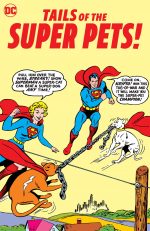
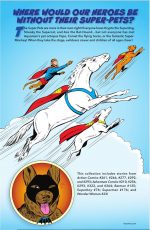
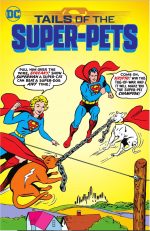
Tails of the Super-Pets


By Jerry Siegel, Robert Bernstein, Otto Binder, Leo Dorfman, Bill Finger, Edmond Hamilton, William Moulton Marston, Jim Shooter, Curt Swan, Jim Mooney, Pete Costanza, John Forte, Ramona Fradon, Sheldon Moldoff, George Papp, Harry G. Peter, Sy Barry, Stan Kaye, George Klein, Charles Paris & various (DC Comics)
ISBN: 978-1779513397 (TPB/Digital edition)

Once upon a time, comics embraced whimsy as much as angst, spectacle, sex and violence – so much so, that superheroes had pets for partners. Now there’s a movie about super-pets. You don’t have to like the notion, but plenty of us do.

Once upon another time, in the far future, a band of super-powered kids from dozens of alien civilisations took inspiration from the legend of the greatest champion of all time and formed a club of heroes. One day, those Children of Tomorrow came back in time and invited that legend to join them…

That’s how the tomorrow teen superstars started, courtesy of writer Otto Binder and artist Al Plastino in early 1958. The monumental assemblage’s popularity waxed and waned over decades and they were regularly reimagined and rebooted, but that core dream of empowered children was evergreen and proliferated. As their fame grew, the squad diversified, adding a Legion Espionage Squad, an evil Legion of Super-Villains, a Legion of Substitute Heroes ad infinitum…

DC had long exploited the attractions of bestial stars of fang and claw. Many Golden Age heroes had animal assistants and allies (like Dr. Mid-Nite‘s owl Hooty, Airwave‘s parrot Static and canine champions Elmo (Doll Man), and Thor (the Dan Richards Manhunter) among too many to mention. Streak the Wonder Dog actually ousted the original Green Lantern from his own comic book.

In the 1950s, Rex the Wonder Dog had his own long-running, astonishingly daft but beautifully illustrated title, with the majority of issues also featuring beloved hairy gumshoe Detective Chimp. Moreover, every newly-popular western star (and a few war heroes) who took the place of the declining superhero population had weaponised dogs, birds and especially horses to aid and augment their crusades for justice.

However, not all mystery men and women faded away. Wonder Woman and Batman and Robin weathered the hostile environment, and the Superman franchise grew exponentially -thanks to a hit movie, landmark TV series and continued radio and newspaper presence.

…And one day someone at National/DC said, “you what else kids like? Animals…”

That led to a slow trickle of empowered animals popping up across the Kryptonian end of DC’s landscape, and a few other incidental animal antics in the lives of many superheroes who survived on the coattails of the “Trinity” – particularly Aquaman (who’s cruelly underrepresented here, since his whole schtick was underwater “stupid pet tricks”…)

If you are a purist, there’s a lot you won’t like here – not the stories: those are still immaculately conceived and delivered, but the running order (not chronological, leading to some jarring moments, especially for Supergirl who seemingly goes from orphan to adopted back to the institution), and possibly the fact that – technically – many of the critters romping here were not in the actual Legion of Super-Pets (or in fact the forthcoming movie, which remakes the brilliant beasts into a “League”). I guess that just means we can look forward to a 75-year Celebration archival edition just for Krypto in 2025….

Here Endeth the Lesson: let’s talk about fun now.

What we do have on offer today is a joyously bright and bold compendium of charming adventure and repercussion-free thrills comprising mad moments from Action Comics #261, 266, 277, 292, 293, Adventure Comics #210, 256, 293, 322, 364, Batman #125, Superboy #76, Superman #176 and Wonder Woman #23, spanning 1947-1968 and adorned where applicable with covers by Curt, Swan with Stan Kaye & George Klein and H.G. Peter.

I’ve rambled on and indulged myself because there’s no introduction or context-delivering text so you can start well-briefed with the truly delightful Supergirl short from Action Comics #277 (June 1961) Crafted by Jerry Siegel & Jim Mooney, ‘The Battle of the Super-Pets!’ finds her cat Streaky typically envious of attention the teenager pays to sneaky ingratiating mutt Krypto. When Superman suggests they compete for her attentions to prove who’s best (no, really!), they choose the most unlucky locale for their arena…

That’s followed by Siegel & Mooney’s debut tail (sorry, not sorry) from Action Comics #261 (February 1960) which introduces the homeless earth stray, revealing how Streaky becomes, at irregular intervals ‘Supergirl’s Super-Pet!’…

The next tale is where we should have started as Adventure Comics #210 (March 1955) introduces ‘The Super-Dog from Krypton!’

After the Man of Tomorrow had made his mark as Earth’s premier champion, his originators took a long look and reasoned that a very different tone could offer a fresh look. What would it be like for a fun-loving lad who could do literally anything?

The answer came as Jerry Siegel & Joe Shuster – after years of agitating the publisher – unleashed the concept of Superboy: fleshing out doomed Krypton, Kal-El‘s early years, foster parents and a childhood full of fun and incident. The experiment was a huge hit and the lad swiftly bounced into the lead slot of Adventure Comics and – in 1949 – his own title: living a life forever set 20 years behind his adult counterpart.

Encountering crooks, monsters, aliens, other super kids, school woes and the suspicions of girl-next-door Lana Lang, Superboy enjoyed an eventful, wonderful life which only got better in Adventure Comics #210 (March 1955), as Otto Binder, Swan & Sy Barry introduced a waywardly mischievous and dangerously playful canine companion who had survived Krypton’s doom due to a freak accident. Krypto had been Kal-El’s pet on Krypton and used by Jor-El in desperation as a test animal for the space rocket he was building.

The dog’s miraculous arrival on Earth after years heralded a wave of survivors from the dead world over the latter part of the decade: all making Superboy feel less lonely and unique. Every boy needs a dog…

One of those latter additions debuted in Superboy #76, (December 1958) wherein by Binder & George Papp introduced ‘The Super Monkey from Krypton!’: one of Jor-El’s lab animals who had escaped and hidden in the baby’s spaceship. Hey, the world was ending: who had time to police lab specimens?

Dubbed “Beppo”, the super-monkey spent months in Earth’s jungles before accidentally finding Smallville and making life uncomfortable for toddler Clark Kent…

Set after she had been adopted and become a public hero rather than clandestine secret weapon, Action Comics #292 and 293 (September & October 1963) saw Supergirl acquire a mysterious new animal accomplice in the first two chapters of a trilogy by Leo Dorfman & Mooney. The extended storyline began when the typical (albeit invulnerable) teen got a new “pet”. ‘The Super-Steed of Steel!’ was a beautiful white horse who helped her stave off an alien invasion, but the creature had a bizarre and mysterious past, revealed in ‘The Secret Origin of Supergirl’s Super-Horse!’ as his being a magically transformed centaur from ancient Greece. Sadly, the resolution of this this tryptic (‘The Mutiny of Super-Horse’) is not included here…

Briefly digressing, what follows is a short saga of a non-powered animal marvel as Batman #125 (August 1959) details ‘The Secret Life of Bat-Hound!’ by Bill Finger, Sheldon Moldoff & Charles Paris. For no reason I could possibly speculate upon, Ace the Bat-Hound debuted in Batman #92 (June 1955), by Bill Finger, Sheldon Moldoff & Charles Paris: a distinctive German shepherd temporally adopted by Bruce Wayne when John Wilker (Ace’s owner) was abducted. A skilled tracker with distinctive facial markings, the pooch inserted himself into the case repeatedly, forcing the Dynamic Duo to mask him up whilst they sought his abducted master and foiled a criminal plot. Like Krypto, Ace reappeared intermittently until Wayne stopped borrowing him and just adopted the amazing mutt.

Here, the original creative team have Ace narrate how that adoption happened in ‘The Secret Life of Bat-Hound’ (Batman #125, August 1959), and include his crucial part in capturing the nefarious gold-obsessed Midas Gang…

William Moulton Marston & Harry G. Peter convey us to Princess Diana’s childhood as Wonder Woman #23 (June 1947) reveals – via home movies of her seventh birthday – how mighty space-hopping marsupials migrated to Paradise Island and changed Amazon battle tactics forever in ‘Wonder Woman and the Coming of the Kangas!’ after which Adventure Comics #256 (January 1959) details  ‘The Ordeal of Aquaman’ as he is trapped in a desert and saved from dehydrating doom by his faithful octopus Topo in a smartly inventive yarn from Robert Bernstein & Ramona Fradon.

The Supergirl tale in Action Comics #266 (July 1960, by Siegel, & Mooney) sees ‘The World’s Mightiest Cat!’ Streaky inadvertently contribute to the isolation of an orphan boy with a reputation for tall tales before Krypto and the Maid of Might make everything right whilst Adventure Comics #293 (February 1962) delivers a gripping landmark thriller from Siegel, Swan & George Klein.

‘The Legion of Super-Traitors’ posits human Legionnaires abruptly turning evil, prompting Saturn Girl to recruit a Legion of Super-Pets comprising Krypto, Streaky, Beppo and Comet to save the world from mind-controlling alien brains in floating glass jars – and yes, I typed all that with a reasonably straight face…

After the human Legion won their own regular series, the animal brigade were ratified and rewarded with their own branch, and Adventure Comics #322 (July 1964, by Edmond Hamilton, John Forte & Moldoff) saw them expand their roster in ‘The Super-Tests of the Super-Pets!’: a sheer bonkers slice of fun-filled futurism wherein the animal companions were left to guard Earth as the biped players pursued the elusive Time Trapper.

When Chameleon Boy‘s shapeshifting (and fully sapient) pet Proty II applied to join the bestial bunch, they gave him a series of extremely difficult qualification tasks …which they breezed through…

A long-neglected tale follows as ‘The Revenge of the Super-Pets!’ (Superman #176, April 1965 by Dorfman, Swan & Klein) sees the a beast brood join the Human of Steel in a time travel jaunt that solves a legal mystery and explains how the growth of modern animal rights began!

Wrapping up with a more dramatic romp from Adventure Comics #364 (January 1968), ‘The Revolt of the Super-Pets!’ is by Jim Shooter & Pete Costanza: a gripping two-parter that depicts how the crafty rulers of planet Thanl attempted to seduce animal adventurers Krypto, Streaky, Beppo, Comet and amorphous telepathic blob Proty II from their rightful – subordinate – positions with sweet words and palatial new homes.

Of course, the aliens had a cunning scheme in play, but failed to realise these were not dumb animals…

Brilliantly reviving the beguiling innocence of the Silver Age for new, fun-seeking generations, this article of animalistic arcana is an unadulterated frolic to stir the elderly like me and enchant the newest DC disciples. Fetch!
© 1947, 1955, 1958, 1959, 1960, 1961, 1962, 1964, 1965, 1968, 2022 DC Comics. All Rights Reserved.
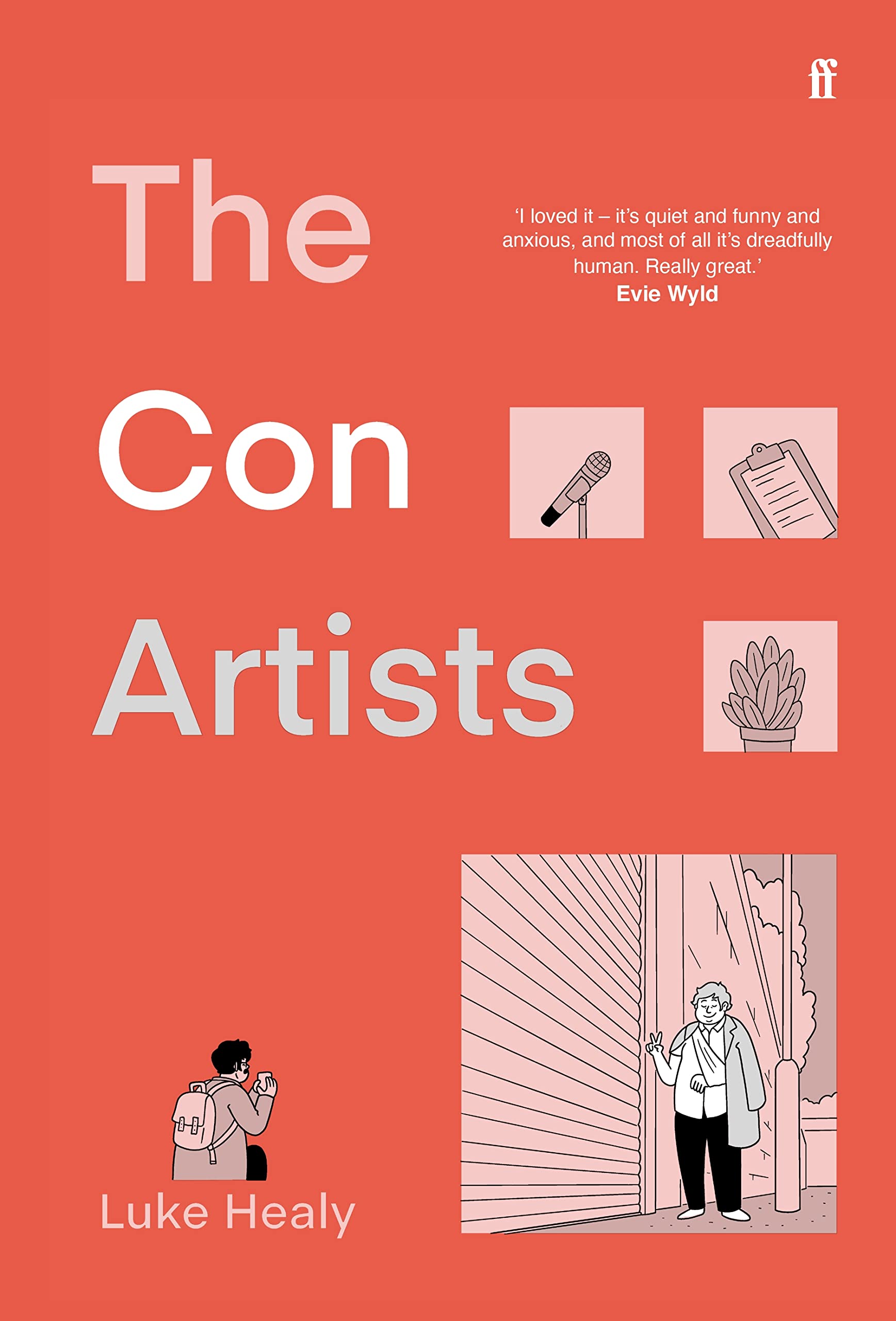
The Con Artists


By Luke Healy (Faber)
ISBN: 978-1-91274-008-6 (HB)

In modern times, Stand-up Comedians don’t tell jokes. These days, they are perspicacious social observers, wry cultural commentators and introspective self-examiners, exposing themselves on painfully primal and crushingly candid levels to make points of modern philosophy, or about politics, the world and the human condition. Well, at least the ones I watch do…

As such, their own lives constitute the raw fuel of their craft and product of their efforts. In that respect they mirror that brand of cartoonists such as Jeffrey Brown (Clumsy, Unlikely, Every Girl is the End of the World for Me), Tillie Walden (I Love this Part, Spinning, A City Inside), Leslie Stein (Eye of the Majestic Creature), Marjane Satrapi (Persepolis) or Harvey Pekar (American Splendor) and R. Crumb (My Troubles with Women). Here, that level of studied, curated introspection and revelation have resulted in a very modern exploration of ambition and trust…

Luke Healy studied journalism, graduated from Dublin University and earned an MFA in Cartooning from the Center for Cartoon Studies (Vermont, USA). His previous published work – such as Americana, Permanent Press and How to Survive in the North – have been awarded prizes and acclaim, and he’s also done gallery shows. His comics for VICE, The Nib, A24, Medium, Nobrow and Avery Hill are really good and he likes exposing himself to ridicule on stage. He has combined all that trauma, weltschmerz and experience into this tale exploring basic big stuff like life, friends, friends who aren’t honest and how to keep your head above emotional water.

Frank is a Stand-Up guy. He’s ambitious, London-based Irish, gay, formerly Catholic (as much as any of us can ever escape the early programming), clinically anxious and helplessly honest. With best mate Ro, he plans to storm it at the Edinburgh Festival before going on to conquer the world of Comedy. He’s getting treatment for self-diagnosed, presumed personal problems but always building for the big day. Suddenly, everything changes after a childhood mate – his best one – calls in a panic. There’s been an accident…

Giorgio was out and proud back at school in Ireland when Frank was still an anguished ball of denial, dragged down by Catholic guilt and repression. His example gave Frank strength and they’ve been buds ever since – although, it must be said, not particularly close or constant ones, even though they both now live in London…

Now there’s been an event and Giorgio is unable to cope on his own. He needs someone to move in and take care of him. You know; simple stuff like feeding and changing him and keeping him stocked in the booze and cigarettes he’s been forbidden to consume with his medication…

Initially willing, Frank obliges, but as days turn into weeks, he sees his own life stall and his plans evaporate into Giorgio’s subtly unforceful, blandly adamant demands and begins to suspect something really isn’t right. Tension exacerbates his own clinical anxiety issues, but while he seeks help, Giorgio brushes off every overture suggesting a change in his self-destructive course.

It all really goes south after Frank finds out how his old pal is making money these days…

However, as he tries to navigate his car crash relationships, Frank knows he’s been made – on every level – an accomplice in Giorgio’s schemes and must now reassess himself for his own safety and sanity… and realises that a life of dishonesty is contagious…

Frank hints that he too tells us what he wants us to know, even while “sharing” the minutiae of his intimately platonic relationship with childhood amigo Giorgio: reluctantly carrying his “best friend” through a moment of extended crisis, aiding him in what turns out to be shockingly unwelcome acts and coming away feeling he’s just been the charmer’s first and longest-serving victim and patsy..

Throughout, capital “H” Honesty is key here. Who is lying to Frank and crucially, How, Where, When and Why is Frank lying to himself? Is he doing things we know we shouldn’t or is it just his conditioned response to Giorgio? Is Giorgio being cunningly manipulative rather than simply secretive?

Deftly playing with the fourth wall and directly engaging his audience at most inopportune moments, the narrator’s linear scenario is intercut with moments from painful past and present stage performances, whilst direct interventions with the reader as cartoon actor “Frank” serve to examine the chains of childhood friendships and contemporary relationships. The laughs are good but it’s clear how life is lived for cartoon actor Frank, and for people like him Love and Trust don’t always go together…

Enticingly introspective and painfully familiar to anyone who ever had a mate who was more Trouble than Worth, The Con Artists is no joke, but is unmissable reading.

© Luke Healy, 2022. All rights reserved.
The Con Artists will be published on June 2nd  2022 and is available for pre-order now.