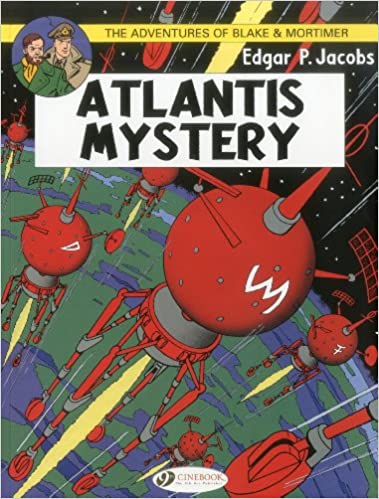
The Adventures of Blake and Mortimer: Atlantis Mystery


By Edgar P. Jacobs, translated by Jerome Saincantin (Cinebook)
ISBN: 978-1-84918-107-5 (PB Album)

When I was a little kid, the nuns at the convent constantly banged on about reading. The cornerstone of all knowledge, it would also transport one to any place or time, depending on the quality of the book, they reckoned.

Loath though I am to agree with those terrifying, bullying-yet-scholarly penguins – about anything – that lesson stuck and it’s still true. Even in lockdown, no place or time on Earth or beyond is outside the realm of an extensive library and book collection. It also pleases me to use their philosophy to promote comics: a little delayed payback for all the great stuff they confiscated over the years…

If we’re talking wonderment and imagination delivered with potent veracity and graphic credibility there’s no better source material than master raconteur Edgar P. Jacobs. Over painstaking decades he pitted his distinguished duo of Scientific Adventurers Professor Philip Mortimer and Captain Francis Blake against a wide variety of perils and menaces in stunning action thrillers which blended science fiction, detective mysteries and supernatural thrillers in the same timeless Ligne Claire style which had done so much to make intrepid boy reporter Tintin a global sensation.

The strip debuted in Le Journal de Tintin #1 (26th September 1946): an international anthology comic with editions in Belgium, France and Holland. The magazine was edited by Hergé, with his eponymous star ably supplemented by a host of new heroes and features for the modern age, and Jacobs’ efforts were a welcome delight there until his death in 1987. Since then diverse hands have continued the casebook and expanded the series’ horizons. A 22nd adventure is scheduled for release in 2022…

L’enigme de l’Atlantide was Jacobs’ fourth electrifying exploit starring the peerless pair: originally serialised from March 30th 1955 to May 30th 1956, and subsequently collected in a single chronicle as the seventh drama-drenched adventure album.

The stunning secret history saga became the 12th translated release from UK-based Cinebook, and opens here with vacationing Intelligence operative Francis Blake arriving in the Azores. His journey to idyllic island Sao Miguel is at the urgent request of devoted comrade-in-peril Philip Mortimer, currently engaged in exploring deep caves in his ceaseless search for new knowledge. From the moment he lands, the British Agent is under constant scrutiny by mysterious gangsters and no sooner does he join his old friend than petty acts of vandalism and outright sabotage begin to occur, making their return to Mortimer’s home a living nightmare. Unbeknownst to the pair, whilst they are distracted, a mysterious intruder searches the Professor’s palatial lodgings only to be blasted by an even more fantastic figure with a ray-gun…

The delayed detectives only arrive in time to observe an astounding escape, leaving the frustrated bellicose boffin to explain how he has apparently discovered a new mineral of incredible potential in the vast cave system far below the surface of the island. He suggests it might be the wonder metal described by Plato as “Orichalcum”: the most prized element of the fabled Atlanteans…

Undeterred by the break-in, the bold Brits lay plans to further evaluate Mortimer’s mammoth cavern, and before long a small but dedicated team are scrambling through daunting crevices to terrifying depths in search of more mystery. The “mad English” are no longer the main topic of conversation on the island, however: everybody else is glued to newspaper reports of flying saucer sightings…

Heartened by their fortuitous return to obscurity and utterly unaware that one of their team has been replaced by a deadly old enemy, the valiant subterranean explorers struggle on against formidable and oppressive odds underground, but when the Professor’s Geiger Counter begins to react wildly and they recover a huge chunk of the mystery mineral, the saboteur makes his move.

As a sudden storm threatens to wash the entire expedition away, the infiltrator intercepts warnings from the surface, swipes the samples and – cutting the rope ladders – abandons Blake and Mortimer to their deaths…

His big mistake is pausing to gloat. A well-aimed rock hurled by the Secret Serviceman seemingly seals the scoundrel’s fate too…

Unable to go back, the plucky duo chance everything on following a subterranean river under the island in the vanishingly small hope of finding an exit. Instead, after an astounding under-earth odyssey, what they discover is mercilessly marauding pterodactyls and a fantastically advanced civilisation of super-scientists…

Soon the pair are recuperating in the vast bastion of Poseidopolis – thriving last outpost of legendary Atlantis. They are befriended by young noble Prince Icarus who happily shares the epic true history of Ancient Earth and his still space-faring nation with them, secure in the knowledge that they will never leave the subterranean metropolis for as long as they live…

Unfortunately, with their customary impeccable timing, the British bravos have arrived just as the city’s most trusted civil servant Magon attempts to usurp the hereditary rulers’ millennia of unchallenged power. All too soon, the surface-worlders are embroiled in a shattering civil war at the earth’s core.

Not only is the entire kingdom of noble Lord Basileus at stake, but the schemer and his allies also have designs upon the Atlanteans’ outer space dominions and the hapless, ignorant surface nations in between…

Packed with astounding action, double-doses of dastardly duplicity and captivatingly depicting the cataclysmic end of a fabulous secret civilisation, this is one of the Distinguished Duo’s most glorious exploits and one no lover of lost world yarns should miss.

Addictive and fantastic in the truest tradition of pulp sci-fi and Boys’ Own Adventures, the annals of Blake and Mortimer are the very epitome of dogged heroic determination; the natural successors to such heroic icons as Professor Challenger, Bulldog Drummond and Richard Hannay: infallibly delivering grand, old-fashioned Blood-&-Thunder thrills and spills in timeless fashion and with mesmerising visual punch. Any kid able to suspend modern mores and cultural disbelief (call it alternate earth history or bakelite-punk if you want) can and will experience the adventure of their lives…

This Cinebook edition – available in paperback and digital formats – also includes tantalising excerpts from companion albums The Curse of the 30 Pieces of Silver and The Strange Encounter, plus a short biographical feature and chronological publication chart of Jacobs’ and his successors’ efforts to offer further proof that The Adventures of Blake and Mortimer is a series no comics fan can do without…
Original edition © Editions Blake & Mortimer/Studio Jacobs (Dargaud-Lombard S. A.) 1988 by E.P. Jacobs. All rights reserved. English translation © 2011 Cinebook Ltd.
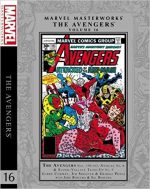
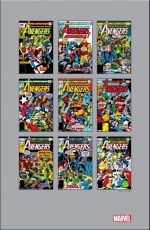
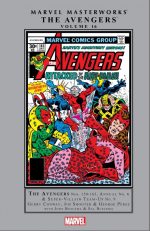
Avengers Marvel Masterworks volume 16

By Steve Englehart, Gerry Conway, Jim Shooter, Scott Edelman, Bill Mantlo, Stan Lee, George Pérez, John Buscema, Sal Buscema, Herb Trimpe, Sal Trapani, Don Heck, George Tuska, Jack Kirby & various (Marvel)
ISBN: 978-0-7851-9542-9 (HB)

The Avengers have always proved that putting all one’s star eggs in a single basket pays off big-time: even when all Marvel’s classic all-stars such as Thor, Captain America and Iron Man are absent, it merely allows the team’s lesser lights to shine more brightly.

Of course, all the founding stars were regularly featured due to the rotating, open door policy, which means that every issue includes somebody’s fave-rave – and the boldly grand-scale impressive stories and artwork are no hindrance either. With the team now global icons, let’s look again at the stories which form the foundation of that pre-eminence.

Re-presenting Avengers #150-163, Avengers Annual #6 and Super-Villain Team-Up #9 (spanning August 1976 to September 1977), these stories again see the team in transition. That was a much a result of creative upheaval as narrative exigency – as explained in Gerry Conway’s Introduction When Chaos was King – detailing a time of editorial turbulence at Marvel. Times were changing for the company which would soon become a plaything for relentless corporate forces…

In the simple world of goodies and baddies, however, #150 saw an official changing of the guard in ‘Avengers Assemble’ by Steve Englehart, George Pérez, John Tartaglione & Duffy Vohland. The anniversary epic was supplemented part-way through by half of ‘The Old Order Changeth!’ (reprinted from Avengers #16 by Stan Lee, Jack Kirby & Dick Ayers) as it settled the membership drive question begun way back in #137. It made way for new scripter Conway in #151 whose ‘At Last: The Decision’ (with additional scripting by Jim Shooter & Englehart and art from Pérez & Tartaglione) set the group off on new, less cosmic adventures.

No sooner had the long-delayed announcement been made, though, than a mysterious crate disgorges the long-dead body of Wonder Man who shockingly shambles to his feet and accuses the stunned android Vision of stealing his mind…

Long ago, Simon Williams had been turned into a human powerhouse by arch-villain Baron Zemo and used as a Trojan horse to infiltrate the team. He eventually turned on his monstrous creator, giving his life to redeem himself. After he was buried, Williams’ brain patterns were used to provide an operating system for The Vision, inadvertently creating a unique human personality for the cold thing of plastic, wires and metal…

In #152 ‘Nightmare in New Orleans!’ kicks the simmering saga into high gear as the team start hunting for Wonder Man’s grave robber/re-animator, in a tale by Conway, John Buscema & Joe Sinnott which soon finds the team facing voodoo lord Black Talon in New Orleans…

‘Home is the Hero!’ then reintroduces 1940 Marvel sensation Bob Frank (AKA former Invader The Whizzer). In a tragic tale of desperation, the aged speedster seeks the heroes’ help before he is seemingly possessed and attacks the team…

Avengers Annual #6 reveals why, and answers all the meandering mysteries, wrapping up the storyline with ‘No Final Victory’ (illustrated by Pérez, Mike Esposito, Tartaglione & Vohland), as a conspiracy involving the Serpent-helmed Living Laser, Whizzer’s government-abducted mutant son Nuklo and rogue US Army General Pollock almost succeeds in conquering California, if not America – at least until the resurgent Avengers lay down the law…

Also included in the annual – and here – is by Scott Edelman & Herb Trimpe’s ‘Night Vision’: a stirring solo story of the Android Avenger battling super swift psychopath Whirlwind.

In Avengers #154, Conway, Pérez & Pablo Marcos begin a blockbuster battle bonanza which was in part a crossover with Super-Villain Team-Up. That series followed the uneasy coalition of Dr. Doom and Namor the Sub-Mariner, and this initial chapter ‘When Strikes Attuma?’ finds the Vision captured by subsea barbarian Attuma even as Earth’s Mightiest Heroes are ambushed and defeated by the warlord’s augmented Atlantean thrall Tyrak the Treacherous. The scheme is simple enough: use the enslaved surface champions as cannon fodder in an assault against Namor…

At this time, US Secretary of State Henry Kissinger had recently signed a non-aggression pact with the Dictator of Latveria, with Doom subsequently blackmailing the Sub-Mariner into serving as his unwilling ally. One American vigilante observed no such legal or diplomatic niceties. The Shroud thought he had freed the Atlantean from his vow by “killing” Doom, but the villain had survived the assault: rescued and secretly imprisoned by Sub-Mariner’s cousin Namorita and alien girlfriend Tamara under the misguided apprehension that they could force the Metal-shod Monarch into helping Atlantis and their lost Prince.

Simple, no?

SVT-U #9 expanded on the epic encounter with the heroes now ‘Pawns of Attuma’ (scripted by Bill Mantlo, with art by Jim Shooter & Sal Trapani). As the Avengers are unleashed upon the Atlanteans, they discover Doom is now in charge and easily able to thwart their half-hearted assault. In Avengers #155 (Conway Pérez & Marcos), the beaten heroes are abjectly enslaved, leaving only confused, despondent and battle-crazed Namor ‘To Stand Alone!’ Before long, though, he is joined by lone stragglers the Beast, Whizzer and Wonder Man to hunt down the triumphant barbarian sea lord.

The epic conclusion comes in ‘The Private War of Doctor Doom!’ (Avengers #156, by Shooter, illustrated by Sal Buscema & Marcos) wherein the liberated and furious heroes join forces to crush Attuma whilst simultaneously preventing Doom from turning the situation to his own world-conquering advantage…

A change of pace begins in #157 as kA Ghost of Stone!’ (Conway, Don Heck & Marcos) addresses a long-unresolved mystery. As seen in the Avengers/Defenders war, the Black Knight‘s body had been petrified whilst his soul was trapped in the 12th century, but now a strange force reanimates the statue and sets it upon the weary heroes, after which ‘When Avengers Clash!!’ (Shooter, Sal Buscema & Marcos) sees the revived, restored, compos mentis and now fully-recovered Wonder Man clash with an impossibly jealous Vision over the Scarlet Witch.

That Wanda loves the android Avenger is seemingly forgotten as his “borrowed” brain patterns fixate on the logical assumption that eventually his flesh-and-blood wife will gravitate to a “normal” man with his personality rather than stay married to a mere mobile mechanism…

Domestic tantrums are quickly laid aside when the entire team – plus late arrivals Black Panther and Thor) battle research scientist Frank Hall following a lab-accident which grants him complete control over the forces of gravity…

Apparently unstoppable, Graviton almost destroys New York in #159 as the ‘Siege by Stealth and Storm!’ (Shooter, Sal B & Marcos) results in a savage clash and the unbeatable villain defeating himself…

Avengers #160 spotlights Eric Williams, the deranged Grim Reaper. With portentous hints of a hidden backer and his dead brother seemingly returned, he conducts ‘…The Trial!’ (Shooter, Pérez & Marcos) to see whether Wonder Man or the Vision is the “true” Simon Williams… but doesn’t like the answer he gets…

The next issue extends the sub-plot as ‘Beware the Ant-Man’ finds the team attacked by a frenzied Henry Pym, whose mind has somehow regressed to mere days after the Avengers first formed. The crazed hero has allied with the homicidal robot he no longer remembers creating and is unwittingly helping it build ‘The Bride of Ultron!’ (#162): pitifully oblivious that for the almost completed Jocasta to live his own wife Janet has to die…

At the close, the Avengers believe they have finally destroyed the murderous mechanoid, but yet again they are wrong…

This classic collection of costumed clashes closes with Shooter, George Tuska & Marcos’ stand-alone tale ‘The Demi-God Must Die!’, wherein mythological maniac Typhon returns to capture the team. Despite forcing Iron Man to attack Hercules to save his imperilled Avenging comrades – and even after lots of spectacular smashing – the scheme naturally fails and the World’s Mightiest are triumphant again…

Available in hardback and digital iterations, and supplemented by contemporary House Ads and an original art gallery by Pérez and John Buscema, this archival tome and this type of heroic adventure might not be to every reader’s taste but these – and the truly epic yarns that followed – set the tone for fantastic Fights ‘n’ Tights dramas for decades to come and can still boggle the mind and take the breath away, even here in the quietly isolated and no less dangerous 21st century…

No lovers of Costumed Dramas can afford to ignore this superbly bombastic book, and fans who think themselves above superhero stories might also be pleasantly surprised…
© 1976, 1977 2016 Marvel Characters, Inc. All rights reserved.

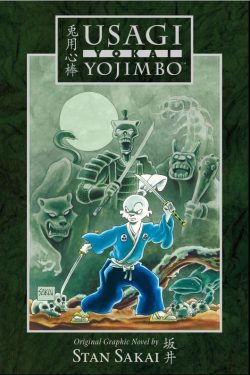
Usagi Yojmbo: Yokai


By Stan Sakai (Dark Horse)
ISBN: 978-1-59582-362-5 (HB)

One of the very best and most adaptable survivors of the 1980s black-&-white comic book explosion/implosion is a truly bizarre and wonderful synthesis of historical Japanese samurai fiction and anthropomorphic animal adventure, as well as a perfect example of the versatility and strengths of a creator-owned character.

Usagi Yojimbo (which translates as “rabbit bodyguard”) first appeared as a background character in multi-talented Stan Sakai’s peripatetic anthropomorphic comedy feature The Adventures of Nilson Groundthumper and Hermy, which launched in 1984’s furry ‘n’ fuzzy folk anthology Albedo Anthropomorphics #1. The shaggy samurai subsequently appeared there on his own terms, as well as in Amazing Heroes, Furrlough and the Munden’s Bar back-up strips in Grimjack. The Lepine Legend also appeared in Albedo #2-4, The Doomsday Squad #3 and seven issues of Critters (#1, 3, 6-7, 10-11 and 14) before leaping into his own series…

Sakai is almost as widely-travelled and far-ranging as his signature creation. He was born in 1953 in Kyoto, Japan before the family emigrated to Hawaii in 1955. He attended University of Hawaii, graduating with a BA in Fine Arts, and pursued further studies at Pasadena’s Art Center College of Design after moving to California.

His first comics work was as a letterer, most famously for the inimitable Groo the Wanderer, before his nimble pens and brushes – coupled with a love of Japanese history and legend and hearty interest in the filmic works of Akira Kurosawa and his peers – combined to turn a proposed story about a historical human hero into one of the most enticing and impressive – and astoundingly authentic – fantasy sagas of all time.

The deliciously rambling and expansive period fantasy series is nominally set in a world of sentient animals and specifically references the Edo Period of Feudal Japan (how did we cloth-eared Westerners ever get “Japan” from Nihon” anyway?) as well as classic cultural icons as varied as Lone Wolf and Cub, Zatoichi and even Godzilla, by way of detailing the exploits of Ronin (masterless, wandering freelance Samurai) Miyamoto Usagi, whose fate is to be drawn constantly into a plethora of incredible situations.

And yes, he’s a rabbit – a brave, sentimental, indomitable, gentle, long-suffering, honourable, conscientious and heroic bunny who cannot turn down any request for help…
The Sublime Swordsbun has changed publishers a few times but has been in continuous publication since 1987 – with dozens of graphic novel collections to date – and has guest-starred in numerous other series, such as Teenage Mutant Ninja Turtles and its TV incarnation. There are high-end collectibles, art prints, computer games and RPGs, a spin-off sci fi comics serial and lots of toys, and he even almost made it into his own small-screen show, but there’s still time yet and fashions can revive as quickly as they die out…

Sakai and his creation have won numerous awards both within the Comics community and amongst the greater reading public and in 2009 Dark Horse Comics commissioned an all-new, fully painted Silver Anniversary tale to celebrate 25 stunning years, which allowed the creator to hone his considerable skills with watercolours…

Yokai is a generic term that translates (as required) as ghosts, phantoms, spirits or even strange, otherworldly apparitions, all of whom hold a peculiarly eclectic place in Japanese folklore, being simultaneously mischievous and helpful, malevolent and miraculously beneficial. Generally, they have animal heads or are amalgams of diverse objects or body parts…

This scintillating scary story occurs over one night – an Oborozuki-Yo (“Night of the Hazy Moon”) – when Yokai are particularly restless, and this is a tale that grippingly explores the Japanese equivalent of our Halloween as the noble, gloom-shrouded Rabbit Ronin wanders lonely roads in search of a bite to eat and a place to sleep.

Seeing a light in the nearby woods, Miyamoto leaves the path, hoping to find a welcoming peasant hearth for the evening but is harassed by a taunting Kitsune (trickster-fox spirit) and becomes lost. Soon, however, he hears sobbing and is drawn to a weeping noblewoman…

The lovely distressed lady is Fujimoto Harumi whose pilgrimage to a temple was disrupted when a Kitsune stole her young daughter Hanako away. Pleading with the wisely reluctant Ronin, the lady convinces the wayfarer to plunge deeper into the wild woods to rescue the lost girl, leading to an epic series of contests against a horde of fantastic hostile creatures. The valiant warrior almost succumbs until he is unexpectedly saved by an old comrade, the mystic demon-queller Sasuke…

It seems that this very evening is the dreaded Hyakki Yako, “Night Parade of a Hundred Demons”, when haunts and horrors of the netherworld form a procession into the world of people, seeking to subjugate all mortals. They simply need a living soul to lead them, a final sacrifice to light their way here…

Terrified for the stolen waif, Ronin and devil-slayer engage with an army of horrific, shape-shifting, fire-spitting, tentacle-wielding monstrosities to save an innocent and the entire world, but there are forces in play that the rapidly-tiring Miyamoto is painfully unaware of, and without the luck of the gods and the tragedy of an old friend, all will be inescapably lost…

Fast-paced yet lyrical, funny, thrilling and stuffed with spooky, all-ages action and excitement, Yokai is a magical tribute to and celebration of the long-lived Lepus’ nigh-universal irresistible appeal that will delight devotees and make converts of the most hardened hater of “funny animal” stories. This petite but power-packed chronicle – available in sturdy hardback and ethereal digital editions – also contains a fascinating behind-the-scenes look at how the artist created the stunning visuals in ‘The Real Magic Behind Yokai: an interview with Stan Sakai’ that will further beguile any prospective creators and cartooning hopefuls in the audience.

Sheer comicbook poetry, this is book to revisit time and time again…
Text and illustrations © 2009 Stan Sakai. All rights reserved.

Bigby Bear Book One


By Philippe Coudray, translated by Miceal Ogriefa (BiG/Humanoids)
ISBN: 978-1-59465-806-8(HB)

Bordeaux-born in March 1960, writer, photographer and illustrator Philippe Coudray specialises in cartoons and books for children. Working with his brother Jean-Luc, he co-crafted the Drôles sequence of books and comics series Théocrite.

Howevwr, Philippe conceived and executed his signature creation L’Ours Barnabé – the philosophically absurdist ruminations of an artistic bear and his woodland companions all on his own…

When not crafting kids’ comics or surreal otherworldly gags (such as Loin de Tout) Philippe writes articles and such like for magazines such as Capsule Cosmique, Psikopat, Perlin and Fripounet as well as books such as Guide to Hidden Animals: Treatise on Cryptozoology. His works have been used by the government to combat illiteracy in France and translated into many languages; none more so than L’Ours Barnabé which has appeared in Japan, China, Germany Sweden, and twice in America. The first time was as Benjamin Bear (twice nominated for Eisner Awards and winning China’s 2012-2013 Panda Prize) and latterly here as the beguiling and frequently beguiled Bigby…

As much children’s storybook – although having no narrative structure and relying on episodic vignettes to deliver charming and visually challenging puzzles and riddles – as graphic novel, these collected strips feature an affably gentle bruin living wild and honing his artistic skills in a bucolic forest and mountain idyll, observing the world and pondering big questions in a surreal and often absurdist daze.

Visual tricks and double-takes abound as he and his rabbit chum encounter other animals and aliens, ignore the laws of the universe, carve, sculpt, paint, compose, garden and wander for the sheer joy of creativity. Subtly posing questions to make youngsters think – about art, science, psychology, mathematics, ecology and much more – Coudray never misses an opportunity to share a solid laugh with his readers and reinforce his message that life would be great if we all just mellowed out and got along with each other.

He’s also more than happy to pepper the strips with the occasional telling moment of social commentary if the chance arises…

Genteel fun, bemusing whimsy and enchanting illustration cloaking a supremely inclusive philosophy of curiosity, enquiry and cohabitation, Bigby Bear is a delightful example of how to enjoy life and crucial reading for young and old alike. Get the digital edition immediately before backing it up with the wonderfully tactile, sturdy hardback your kids will want to paw and peer at over and over again…
© 2012-2018 La Boîte à Bulles and Philippe Coudray. All rights reserved.

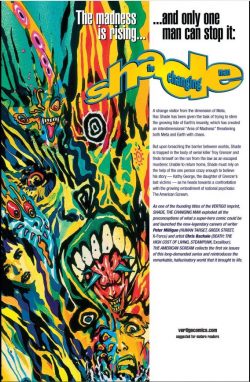
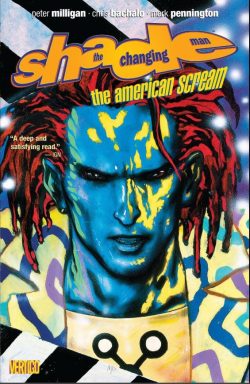
Shade, the Changing Man volume: The American Scream


By Peter Milligan, Chris Bachalo, Mark Pennington & various (DC/Vertigo)
ISBN: 978-1-4012-0046-6 (TPB)

Even before DC hived off its “Mature Readers” sophisticated horror/hero series to become the backbone of the self-sustaining Vertigo line in 1993, the company had begun to differentiate between standard all-ages superhero sagas, new stand-alone concepts such as Gilgamesh II, Skreemer, Haywire or World Without End and edgy, off-the-wall, quasi-costumed fantasy and supernatural suspense titles as Doom Patrol, Black Orchid, Animal Man, Sandman, Hellblazer and Swamp Thing. Perhaps the most radical and challenging was a darkly psychedelic reworking of Steve Ditko’s lost masterpiece of modern paranoia Shade the Changing Man.

In the original 1977 mainstream series Rac Shade was a secret observer from the other-dimensional Meta-Zone. Framed for terrorism and sedition, he went rogue; using untried stolen technology to combat a wave of insanity that emanated from “the Area of Madness” within the Zero-Zone separating his world from ours. Said madness threatened both universes and Shade was resolved to stop it, despite the best efforts of sinister self-serving forces from Earth and Meta determined to destroy him.

When Peter Milligan, Chris Bachalo & Mark Pennington began to rework the character, much of Ditko’s original concept remained but was brutally tweaked for the far more cynical and worldly readers of the Blank Generation…

This collection – available in old-fashioned trade paperback and almost otherworldly digital formats – re-presents the first six issues of the new Shade from July to December 1990 and begins by introducing deeply disturbed Kathy George, patiently awaiting the final sanction on spree-killer Troy Grenzer.

Years previously, the unrepentant psycho-killer butchered her parents – and almost her too – and when her black boyfriend tackled the knife-wielding manic the Louisiana police shot her saviour instead of the white assailant…

Now in the final hours before Grenzer finally sits in the electric chair on ‘Execution Day’, Kathy is experiencing wild hallucinations. That’s nothing new: following the deaths of everyone she’d ever loved, Kathy was committed to an asylum until her inheritance ran out. Then she was released, apparently “too poor to be crazy” anymore.

Becoming a thief and a grifter, she wandered America until a radio report informed her Grenzer was about to be put to death. Inexplicably, Kathy found herself heading back to Louisiana…
On Death Row, things aren’t going according to plan. Bizarre lights, strange visions and electrical phenomena interrupt the execution and, as a fantastic reality-warping explosion occurs, Grenzer’s body vanishes…

On a hillside overlooking the prison, Kathy is pursued by an animated electric chair and Grenzer materialises in her car – only he claims not to be the serial killer but Rac Shade: a secret agent from another dimension who left his own body in an otherworldly Area of Madness to mentally occupy the now-vacant corpse of the serial killer.

It isn’t the craziest thing Kathy has ever heard, and even if it isn’t true, at least she has a chance to personally kill the man who destroyed her life…

As the drive away together, insane things keep happening. Shade explains that his transition to Earth caused a rupture in the fabric of the universes – a trauma in Reality…

Slowly acclimatising, Shade explains his original body is clad in experimental technology and his “M-Vest” connects his subconscious to the chaos of the Madness zone. His job was to come here and stop a plague of materialised insanity threatening both worlds, but now he’s actually given it easier access to ours…

After a climactic struggle with her own ghosts and traumas, Kathy reluctantly agrees to help the semi-amnesiac Shade in his mission.

Meanwhile at a Mental Hospital, uncanny events culminate in a ghastly reordering of people and matter itself: a horrific nigh-sentient phenomenon dubbed “the American Scream” breaks through from somewhere else and threatens all life and rationality on Earth. With casual daydreams, flights of fantasy and vicious whims increasingly given substance and solidity, the government – well aware of the crisis – dispatched Federal Agents Stringer and Conner to investigate…

The quest proper begins as the fugitives from justice troll through the hinterlands of American Culture and its Collective Unconscious, ending up in Dallas where obsessed author Duane Trilby, determined to discover ‘Who Shot JFK?’, finds himself conversing with the tarnished martyr himself. As the murdered president returns to the scene of the crime, the city starts to literally unravel, with a giant idolatrous bust of the victim bursting through the tarmac of Dealey Plaza, incessantly screaming for answers…

The chaos affects Shade, as the last vestiges of Grenzer’s personality repossess the body they share, determined to at last add Kathy to his tally of victims, even as Agents Stringer and Conner – convinced she is connected to Grenzer’s abrupt disappearance from his own execution – follow her to Texas. With madness rampant, Shade and Kathy are drawn into Trilby’s materialisation of events, becoming JFK and Jackie, inexorably heading toward death in that open-topped car…

The measured insanity escalates in ‘All the President’s Assassins!’ as Trilby saves Shade/JFK and slowly reveals his own personal tragedy: one which drove him to solve an impossible conundrum and avoid an agonising admission…

All the while, the Metan’s consciousness is being dragged into a succession of traumatised participants before realising he must defeat this outbreak of the American Scream quickly or surely fragment and die…

Escaping into his own past on Meta in ‘Mad, Bad and Dangerous to Know’, Shade physically re-experiences his early life, whilst in Dallas Stringer and Conner apprehend Kathy.

A lovelorn, impressionable poet, young dropout Rac Shade was tricked into becoming an agent and sent to Earth because it was apparently the source of devastating waves of insanity plaguing Meta, but en route he was sucked into the Area of Madness, meeting the American Scream face to face…

Falling back to Earth, Rac frees Kathy and they flee, arriving in Los Angeles in time to struggle with the dark underbelly of the film industry as it comes to murderous, sadistic life and starts stalking the stars and moguls who create the vicious yet glorious land of dreams. First singled out are the cast and crew of in-production zombie epic Hollywood Monsters, who endure shame and career destruction as impossible film-clips of their deepest secrets and darkest transgressions manifest. Soon after, mutilations and deaths begin, before a psychedelic crescendo is reached in ‘Hollywood Babble On II’ with Shade and Kathy fighting their way through a physically-realised and highly biased history of Tinsel Town triumphs and travesties, before finally seizing control of the noxious narrative and beating the Madness at its own game…

Sporting a stunning cover gallery by Brendan McCarthy, this terrifying tome is darkly ironic and blackly comedic, whilst gripping and dripping with razor-edged social commentary. Shade, the Changing Man added a sparkling brew of sardonic wit to the horror and action staples of the medium and remains one of the most challenging and intriguing series in comics history. Check it out.
© 1990, 2003, 2009 DC Comics. All Rights Reserved.

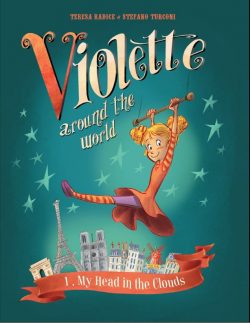
Violette around the world volume 1: My Head in the Clouds

By Teresa Radice & Stefano Turconi, translated by Terrence Chamberlain (EuroComics/IDW) ISBN: 978-1-68405-188-5 (HB Album) eISBN: 978-1-68406-411-3

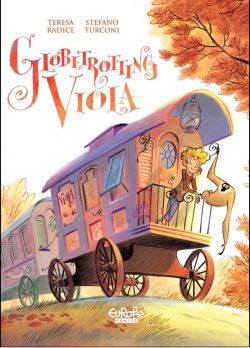
Globetrotting Viola volume 1: Treasure Everywhere!
By Teresa Radice & Stefano Turconi, translated by Terrence Chamberlain (Europe Comics – Digital Only) No ISBN

There’s never been a more fruitful time for comics and graphic novels than today but the digital revolution has thrown up a few confusing moments for dithery old guard reviewers like me. Here’s a perfect case in point.

Europe comics is a collective syndicate of continental publishers from numerous countries collaboratively releasing the best of European material in translated digital formats. They also act as agents, so many of their digital releases eventually end up as physical books for English-language publishers like NBM, IDW and Cinebook.

Quite rightly, these publishers also have their own digital editions, and naturally these feature small variations and deviations in the final product. All in all, however, it’s no big deal. There is no “correct” edition and the art and story reman fundamentally the same. You pays yer money and takes yer choice…

In this instance I bought and reviewed both, so could you, if you so pleased…

Scripted by Teresa Radice and painted by Stefano Turconi – a prolific Italian husband-&- wife team who have co-created many books for varying ages of kids, such as Mickey and the Great Sea of Sand, The Forbidden Harbour and the Orlando Curioso series – this award-winning historical romp from 2013 follows the life of a young circus girl in very memorable times…

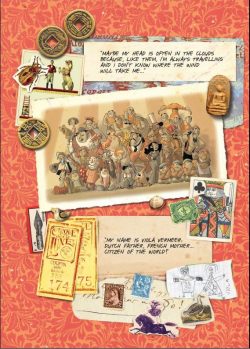
Alternatively dubbed Violette or Viola Vermeer, our young star – daughter of a cannonball woman and an insect trainer – is a fourth-generation performer of the Cirque de la Lune, currently chafing under the strictures of having to attend a draconian school for ladies in fin de siècle Paris.

She would far rather be travelling the land with her friends and family, and her scholastic inattention – and love of animals – keeps landing her in hot water with the stuffy schoolmarms of the posh institution she’s trapped in…

Her life takes an interesting and life-changing turn after meeting an itinerant painter named Henri. She ends up trailing him all over the metropolis, trying to return a lost sketchbook to the absent-minded dauber. The quest takes her all over the City of Lights and into places I am not going far more educational than her usual classroom: even to the resplendently scandalous Moulin Rouge, resulting in her downtrodden attitude being replaced by a new zest for living and a brand-new sense of adventure and purpose…

A breezy, light-hearted coming of age tale about diversity and acceptance set in a glamourous historical wonderland, this superb yarn also includes loads of captivating extra art by Turconi and a potted biography of Henri de Toulouse-Lautrec to aide amusement and elucidation…
Globetrotting Viola: Treasure Everywhere! © 2016 TUNUÉ (Tunué s.r.l.) – Teresa Radice & Stefano Turconi
Violette around the world: My Head in the Clouds text and illustrations © 2013 Teresa Radice & Stefano Turconi – Tunué. All rights reserved.

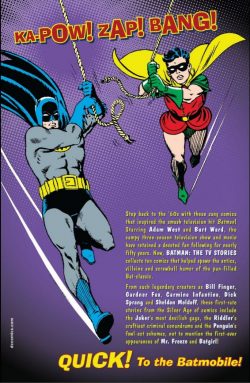
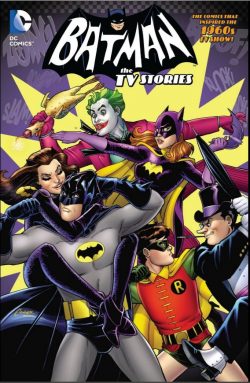
Batman: The TV Stories

By Bill Finger, David Vern Reed, France Herron, Dave Wood, Gardner Fox, John Broome, Dick Sprang, Lew Sayre Schwartz, Sheldon Moldoff, Charles Paris, Carmine Infantino, Joe Giella, Sid Greene, Bob Kane & various (DC Comics)
ISBN: 978-1-4012-4495-8 (TPB)

Debuting a year after Superman, “The Bat-Man” (and latterly Robin, the Boy Wonder – who celebrates his 80th anniversary this month) cemented National Comics – AKA DC – as the market and genre leader of the nascent comicbook industry and epitome of swashbuckling derring-do. Batman bloomed at this time and the impetus enabled him to endure and survive the decline of superheroes at the end of the 1940s.

By the end of 1963, Julius Schwartz having – either personally or by example – revived and revitalised DC’s costumed champion line-up – and by extension the entire industry – with his modernization of the superhero, was asked to work his magic with the creatively stalled and nigh-moribund Caped Crusaders.

Bringing his usual team of top-notch creators with him, the editor stripped down the core-concept, downplaying all the ETs, outlandish villains and daft transformation tales that had sustained the no-longer dark knight, bringing a cool modern take to the capture of criminals whilst overseeing a streamlining rationalisation of the art style itself.

The most apparent change to us kids was a yellow circle around the Bat-symbol but, far more importantly, the stories also changed. A subtle aura of genuine menace had crept back in…

At the same time, Hollywood was preparing to produce a television series based on the Caped Crusaders and, through the sheer karmic insanity that permeates the universe, the producers were basing their interpretation upon the addictively daft material the publishers had turned their Editorial backs on, not the “New Look Batman” that was enthralling the readers.

The TV show premiered on January 12th 1966 and ran for 3 seasons (120 episodes in total), airing twice weekly for its first two seasons. It was a monumental world-wide hit and sparked a wave of trendy imitation. The resulting media hysteria and fan frenzy generated an insane amount of Bat-awareness, no end of spin-offs and merchandise – including a still-fabulously watchable movie – while introducing us all to the phenomenon of overkill.

“Batmania” exploded across the world and then as almost as quickly became toxic and vanished. To this day, no matter how much we might squeal and foam about it, or what has occurred since in terms of comics, games or movies, to a huge portion of this planet’s population Batman is always going to be that “Zap! Biff! Pow!” costumed buffoon…

And what’s wrong with that?

Still adored by a large portion of the fans – as evidenced by Batman ’66: a splendid recent series of tales crafted in the style of the show – this collection gathers comics stories spanning 1948 and 1966, which inspired episodes of the TV phenomenon. Available in paperback and digitally, the titanic treats are prefaced by ‘Holy —-! (Choose any word that begins with an “S”)’, an Introduction by Bat-movie producer Michael Uslan, adding context before the wonderment commences with ‘The Riddler’ by Bill Finger, Dick Sprang & Charles Paris.

Detective Comics #140, October 1948 revealed how cheating carnival con-man Edward Nigma took an obsession with puzzles to perilous extremes: becoming a costumed criminal to match wits with the brilliant Batman in a contest that threatened to set the entire city ablaze.

From Batman #53 (June/July 1949), ‘A Hairpin, A Hoe, A Hacksaw, A Hole in the Ground’ came courtesy of Finger, Lew Sayre Schwartz, Bob Kane & Paris, detailing how The Joker resolved to prove to the world that he was the greatest clown in history. His research was a big problem for Gotham…

The Harlequin of Hate played an encore in Batman #73 (October/November 1952 as David Vern Reed, Sprang & Paris’ ‘The Joker’s Utility Belt’ saw the Dynamic Duo temporarily stymied when the crime clown devised his own uniquely perverse iteration of the heroes’ greatest weapon and accessory…

‘The Mad Hatter of Gotham City’ – by Finger, Sheldon Moldoff & Paris – debuted in Detective Comics #230 (April 1956): a chapeau-obsessed collector and thief whose greatest ambition is to possess Batman’s cowl, after which Dave Wood, Moldoff & Paris expose ‘The Ice Crimes of Mr. Zero’ (Batman #121, February 1959), wherein a scientist turns to crime after his experiments afflict him with a condition that will kill him if his temperature rises above freezing point. Although cured in this yarn, the villain would return taking the name Mr. Freeze in later appearances…

Skipping ahead to the Schwartz-era, Batman #169 (February 1965) highlights wily, bird-themed bad-man The Penguin who contrives to make the Caped Crusaders his unwilling ‘Partners in Plunder!’ in a crafty caper conceived by France Herron, Moldoff & Joe Giella, before another archfoe resurfaces in ‘The Remarkable Ruse of the Riddler’ by Gardner Fox, Moldoff & Giella.

After an absence of decades, the Prince of Puzzlers returned to bamboozle Batman (#171, May 1965) in a clever book-length mystery which did much to catapult the previously forgotten villain to the first rank of Bat-Baddies.

His main rival had never really gone away but also got an upgrade in (generally harmless) insanity, as typified by ‘The Joker’s Comedy Capers!’ from Detective Comics #341, July 1965. Here John Broome, Carmine Infantino & Giella revealed how envy apparently inspired the Mountebank of Menace to emulate classic cinema comedians in bold crimes. As usual all was not what it seemed and a killer punchline was waiting for all involved…

Broome, Moldoff & Giella then posed ‘Batman’s Inescapable Doom-Trap’ in Detective Comics #346 (December 1965), highlighting the Caped Crimebuster’s escapology skills as a magician-turned-thief alpha-tests his latest stage-stunt on the unwilling, unwitting hero…

The TV series eventually required a new star to boost ratings: a female hero who would become a mainstay of the comics and who stylishly closes this compilation…

A different BatgirlBetty Kane, teenaged niece of the 1950s Batwoman – was already a nearly-forgotten comics fixture but for reasons far too complex and irrelevant to mention was conveniently ignored to make room for a new, empowered woman in the fresh tradition of Emma Peel, Honey West and the Girl from U.N.C.L.E. She was considered pretty hot too, which was always a plus for television back then…

‘The Million Dollar Debut of Batgirl’ launched a hip and capable new iteration designed to soar in the Swinging Sixties. DC had plenty of notice of her screen launch and took pains to establish her long before the third season began on September 14th 1967.

Cover-dated January 1967 – so actually on sale at the end of 1966 – Detective Comics #359 left the comicbook premiere to Gardner Fox and art team supreme Infantino & Sid Greene, who produced a ripping yarn introducing mousy librarian Barbara Gordon, daughter of the venerable Police Commissioner, into the superhero limelight. Thus, by the time the show aired, she was already well-established among comics fans at least….

The tale itself reveals how secretly capable Babs (a shy, retiring kung fu expert, dressed in a masquerade bat-costume) accidentally foils the kidnapping of Bruce Wayne by deadly extortionist Killer Moth. Whereas her TV analogue fought the Penguin on the small screen, her print origin features the no less ludicrous but at least visually forbidding super-thug in a clever yarn that still stands up today.

Touted as “the comics that inspired the 1960s TV show!” this is a delicious slice of Fights ‘n’ Tights ephemera, free of angst or excess baggage: a comics rollercoaster packed with fun and adventure for all ages and the ideal remedy for the Lockdown Blues.
© 1948, 1949, 1952, 1956, 1959, 1965, 1967, 2013 DC Comics. All Rights Reserved.

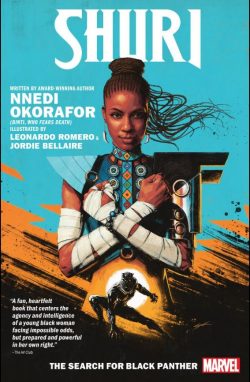
Shuri volume 1: The Search for Black Panther


By Nnedi Okorafor, Leonardo Romero, Jordie Bellaire, VC’s Joe Sabino & various (Marvel)
ISBN: 978-1-3029-1523-0 (TPB)

Lauded as the first black superhero in American comics and one of the first to carry his own series, the Black Panther‘s popularity and fortunes have waxed and waned since the 1960s when he first attacked the FF (Fantastic Four #52; cover-dated July 1966) as part of an extended plan to gain vengeance on the murderer of his father.

T’Challa, son of T’Chaka was revealed as an African monarch whose hidden kingdom was the only source of a vibration-absorbing alien metal upon which the country’s immense wealth was founded. Those mineral riches – derived from a fallen meteor which struck the continent in lost antiquity – had turned his country into a technological wonderland.

The tribal wealth had long been guarded by a hereditary feline champion deriving physical advantages from secret ceremonies and a mysterious heart-shaped herb that ensured the generational dominance of the nation’s warrior Panther Cult.

In recent years, Vibranium made the country a target for increasing subversion and incursion. After one all-out attack by Doctor Doom – culminating in the Iron Dictator seizing control of Wakanda – T’Challa was forced to render all Vibranium on Earth inert, defeating the invader but leaving his own homeland broken and economically shattered.

During that cataclysmic clash T’Challa’s flighty, spoiled brat half-sister Shuri took on the mantle of Black Panther, becoming the clan and country’s new champion whilst her predecessor struggled with the disaster he had deliberately caused and recuperated from near-fatal injuries.

Despite initially being rejected by the divine Panther Spirit, Shuri proved a dedicated and ingenious protector, serving with honour until she perished defending the nation from alien invader Thanos. When T’Challa resumed his position as warrior-king, one of his earliest tasks was resurrecting his sister. She had passed into the Djalia (Wakanda’s spiritual Plane of Memories) where she absorbed the entire history of the nation from ascended Elders. On her return to physicality, she gained mighty new powers as the Ascended Future…

Now – thanks to the equally formidable magic of a bravura role in a blockbuster movie – a slightly reimagined Shuri stars in her own series, blending established comics mythology with the fresh characterisation of a spunky, savvy youthful super-scientist.

Written by multi award-winning fantasy author Nnedimma Nkemdili “Nnedi” Okorafor (Binti, Who Fears Death, Lagoon, Broken Places & Outer Spaces, Black Panther: Long Live the King, Venomverse War Stories) and illustrated by Leonardo Romero (Hawkeye, Captain America, Doctor Strange), this first collection – gathering #1-5 of Shuri (spanning December 2018-April 2019 and available as a trade paperback or digitally) – finds Wakanda in turmoil.

In the aftermath of the nation’s first (official) manned space mission, King T’Challa is ‘Gone’, leaving Shuri to initially revel in the sheer joy and freedom of technological creation. However, the pressures of her family position always bedevil her. If it’s not frequent overtures from a mystery hacker she’s befriended and dubbed Muti or the constant chidings of the Ancestral Spirits who connect her to the Djalia, it’s her unwelcome invitation to join a secret society of women who have covertly steered and safeguarded Wakanda for generations…

The Sisters of the Elephant’s Trunk have a cherished goal: despite the nation recently becoming a constitutional monarchy, they want Shuri to step up in T’Challa’s absence and be the country’s spiritual leader … a new Black Panther…

Her answer in ‘The Baobab Tree’ pleases no one, but she has no time for second thoughts as sister-in-law Storm comes to her with news that T’Challa is now lost in space. The crisis is further compounded after Queen Mother Ramonda also vanishes. When Shuri resorts to spiritual means of locating her missing family, the ritual accidentally catapults her astral personality across the universe and into the vegetable body of a Guardian of the Galaxy…

Trapped but never helpless, Shuri’s brains save the alien heroes from dire peril and a deadly energy-eating bug in ,Groot Boom’, but her return to Earth brings more trouble as the energy-insectoid follows to cause chaos in ‘Timbuktu’ – thanks in large part to the machinations of opportunist supervillain Moses Magnum…

With catastrophe all around and the planet in deadly peril, Shuri calls in a favour and Iron Man responds to assist in preventing ‘The End of the Earth’ but ultimately Shuri knows that the call of the Panther cult must be answered no matter what she wants…

To Be Continued…

Featuring a superb variant covers gallery by Skottie Young, Carlos Pacheco, Rafael Fonteriz & Rachel Martin, Jamal Campbell, Travis Charest, John Tyler Christopher, Afua Richardson plus a Movie photo cover and character designs by Romero, this is a fast-moving, funny and supremely inventive romp: a splendidly fresh take on female superheroics that is compulsive reading for any fan of tight continuity, breathtaking action and smart characterisation as well as everyone who fell in love with the super-smart young woman who stole every scene in the Black Panther movie. What are you waiting for?
© 2019 MARVEL. All rights reserved.

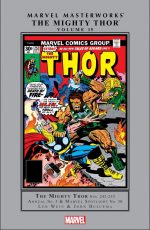
Thor Marvel Masterworks volume 15

By Len Wein, David Anthony Kraft, Steve Englehart, John Buscema, Pablo Marcos & various (Marvel)
ISBN: 978-0-7851-9919-9 (HB)

Once upon a time, disabled doctor Donald Blake took a vacation in Norway only to stumble into an alien invasion. Trapped in a cave, he found an ancient walking stick which, when struck against the ground, turned him into the Norse God of Thunder! Within moments he was defending the weak and smiting the wicked.

Months swiftly passed with the Lord of Storms tackling rapacious extraterrestrials, Commie dictators, costumed crazies and cheap thugs, but these soon gave way to a vast kaleidoscope of fantastic worlds and incredible, mythic menaces, usually tackled with an ever-changing cast of stalwart immortal warriors at his side…

Whilst the ever-expanding Marvel Universe had grown ever-more interconnected as it matured through its first decade, with characters literally tripping over each other in New York City, the Asgardian heritage of Thor and the soaring imagination of Jack Kirby had most often drawn the Thunder God away from mortal realms into stunning, unique landscapes and scenarios.

However, by the time of this power-packed compendium, the King was long gone and was in fact readying himself to return to the House of (mostly his) Ideas, and only echoes of his groundbreaking presence remained. John Buscema had visually made the Thunder God his own, whilst a succession of scripters struggled to recapture the epic scope of Kirby’s vision and Stan Lee’s off-kilter but comfortingly compelling faux-Shakespearean verbiage…

This power-packed hardback and digital compilation gathers the contents of Thor #242-254, Annual #5 and Marvel Spotlight #30 spanning December 1975 through December 1976, and leads with a forthright Introduction from writer/editor Len Wein on his assumption of the title.

After a rapid, round-robin flurry of writers who detailed how lordly Odin went missing and was found and freed from bondage to a pantheon of Egyptian gods, a semblance of creative stability resumed with #242 as Wein joined John Buscema & Joe Sinnott to commence their tenure with epic time travel tale ‘When the Servitor Commands!’

In the 20th century, the colossal all-conquering construct scoops up Thor, his lover Jane Foster (mystically imbued with the life force of goddess Sif) and visiting Asgardians Fandral the Dashing, Voluminous Volstagg and Hogun the Grim at the behest of despotic chrononaut – and old enemy – Zarrko the Tomorrow Man…

The time tyrant claims to be on the side of the angels this time: looking for heroes to help stop a trio of entropic entities travelling back from the end of eternity, callously destroying all life as they go. Although suspicious, the assembled crusaders agree to help stop< ‘Turmoil in the Time Stream!’ caused by the uncanny Time-Twisters…

Clashes with vagrant monsters and warriors plucked from other eras barely slows the heroes, but neither do they hinder the widdershins progress of the Armageddon entities in ‘This is the Way the World Ends!’ However, by the time the voyagers discover ‘The Temple at the End of Time!’ which originally spawned the Time-Twisters and end the crisis before it began, Zarrko has already reverted to type and tried to betray them… much to his own regret…

A rematch between Thunder God and extraterrestrial Flaming Fury sparks up in #246 as ‘The Fury of Firelord!’ follows the unworldly alien’s meeting with a lovely witch working for Latin American rebel and would-be tin pot dictator El Lobo. Whilst Thor heads south to stop a civil war, in Asgard his boon companion Balder comes to a staggering conclusion: Odin may be back in body but his spirit is still ailing. In fact, the All-Father might well be completely insane…

When Thor also succumbs to sinister gypsy enchantments and ‘The Flame and the Hammer!’ unite to crush the feeble democracy of Costa Verde, once again vibrant valiant Jane is there to save the day…

An out-of-chronology break follows as the 30th issue of try-out title Marvel Spotlight delivers a tale of the Warriors Three. In ‘A Night on the Town!’ (by Wein, Buscema & Sinnott) Fandral, Volstagg and Hogun are drawn into a tale of love on the rocks when their Manhattan carousal is interrupted by a woman’s suicide attempt. Her call for help soon impels the heroic trio to save her fiancé from a life of crime and leads to action, adventure and ultimately matrimony…

Back in Thor #248, ‘There Shall Come… Revolution!’ (inked by Tony DeZuñiga) starts the build-up to anniversary issue #250 with the earthbound Asgardians called back to the Realm Eternal by bold Balder whose battered body is living proof that Odin has become a brutal, vicious tyrant. The rebellion builds in kThe Throne and the Fury!’ (by Wein, Buscema & DeZuñiga, and featuring the first of a series of covers by returning Jack Kirby) as Thor and Company batter their way into the godly citadel. As the heroes seek to ally with old enemy Karnilla the Norn Queen, amidst the madness, Jane assumes the form of Sif just in time to join in a potential universe-shattering battle as Odin is proved an imposter and defeated in ‘If Asgard Should Perish…!’

In the aftermath – AKA #251 – the search for the true All-Father takes Thor into the underworld to see if Odin is dead. Despite cataclysmic combat against the legions of the dead, ‘To Hela and Back’ proves a frustrating waste of time, barely ameliorated by a new clue in #252. ‘A Dragon at the Gates!’, by Wein, Buscema & DeZuñiga, sees the Thunderer undertake a quest for knowledge that draws him into another brutal battle with ultimate troll Ulik which concludes in the next issue with ‘Chaos in the Kingdom of the Trolls’ and seeming defeat for the Prince of Asgard…

These issues also include a return for venerable back-up series Tales of Asgard, Home of the Mighty Norse Gods: a saga of Thor’s boyhood by David Anthony Kraft & Pablo Marcos wherein the young warrior learns the value of restraint and self-reliance while learning how to wield Mjolnir in The Weapon and the Warrior!

Thor’s hunt for his father will be continued in the next Masterworks volume but this one holds still more action and drama in the form of Mighty Thor Annual #5 which depicted ‘War of the Gods!’

Crafted by Steve Englehart, Buscema & DeZuñiga, it opens with the origin of Asgard’s gods and explains the geographical limitations of pantheons and worship before adolescent Thor is drawn by his earthly worshippers into battle with a pantheon he never knew of.

As the territorial clash between Norsemen and invading Greeks escalates, Asgardians and Hellenics fight to the death but aloof Odin and Zeus know a secret that makes all the bloodshed simultaneously pointless and crucial…

This peek into the underpinnings of the ever-expanding Marvel cosmology is followed by the cover of Mighty Thor #254 (which reprinted #159, due to another deadline crisis) and concludes with Kirby’s wraparound cover for Marvel Treasury Edition #10 (which collected the original Mangog saga from Thor #154-157), house ads, original pre-correction cover art for #253 and a gallery of Buscema art pages.
The tales gathered here may lack the sheer punch and verve of the early years but fans of ferocious Fights ‘n’ Tights fantasy will find this tome still stuffed with intrigue and action, magnificently rendered by artists who, whilst not possessing Kirby’s vaulting visionary passion, were every inch his equal in craft and dedication, making this a must-read for all fans of the character and the genre.
©1975, 1976, 2016 Marvel Characters, Inc. All rights reserved.

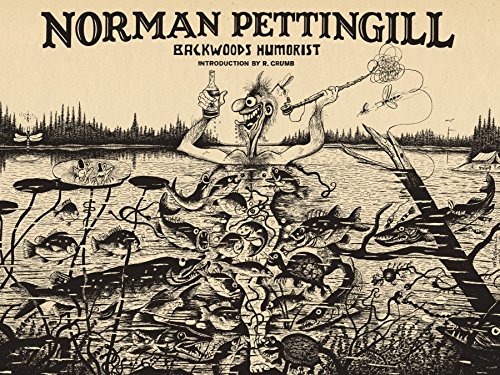
Norman Pettingill: Backwoods Humorist


By Norman Pettingill, edited by Gary Groth, with an introduction by Robert Crumb (Fantagraphics Books)
ISBN: 978-1-60699-319-4 (HB)

Laugh and the world laughs with you. Sulk in your house and you’re on your own, mate. Here’s another comedy treat you can enjoy via assorted digital means, or if you prefer you can support the local economy by buying a hardback copy and waiting… and waiting… and waiting…

It’s a big planet and there are many places to hide an artistic prodigy. That’s never been more capably proved than in the case of Norman Pettingill, a lost hero of the workaday craft aesthetic who lived and died in Wisconsin, revelling in a backwoods life lived off the land. He supported his family with personalised cartoons, jobbing art such as postcards and commercial signage, commissioned illustrations and through simply stunning personal works: mostly natural scenes and reportage of the hunting and fishing community he lived in.
Pettingill worked in seclusion (and we all know what that’s like now, don’t we?) until his incredibly intense, ribald and frenetic postcard art was discovered by Robert Crumb who immediately reprinted them in his Underground Commix magazine Weirdo.

These over-sized scenes were multi-layered, packed with hundreds of characters acting in micro-scenes and grotesquely raw and vulgar: like Hieronymus Bosch, Pieter Bruegel (the Elder), Basil Wolverton and Leo Baxendale working all on the same page.

This superb book, rough and rustic – with a wooden front cover for the hardback version – tells the life-story of this truly driven artist; who could no more stop drawing than breathe underwater. Self-taught and clearly besotted with the creative process, Pettingill was not afraid to fill a page with copious extras, and the work gathered here, collected by the John Michael Kohler Arts Center (conservators of folk art of the American mid-west) shows a true original equally at home drawing pictures to pay bills and making masterpieces because he couldn’t stop himself.

On view are astoundingly frantic, charmingly gruesome postcard tableaux, featuring hunters, boozers and what we’d call hillbillies, but Pettingill knew them as the folk next door, as well as more intimate creations: family collages, entrancing pen-&-ink studies of beasts and birds he lived amongst – and hunted. There are even doodles he adorned the envelopes of letters with.

His surreal, bawdy, raw concoctions mirrored and presaged the graphic license and social freedoms of the 1960s counterculture (although he really started his own artistic journey twenty years earlier), but even though his fans today include such iconoclastic cartoonists as Crumb and Johnny Ryan, Pettingill’s appeal is far wider than simple grist for us doodle-pushers.

With his fondly cynical, wry observation and piercingly incisive eye, Norman Pettingill became a societal camera onto a time and place in rural – and even wild – America that we seldom see nowadays: an honest raconteur, part of a tradition that includes and spans the fierce and gentle ranges from Garrison Keillor’s elegiac (and positively provincial) Lake Wobegon tales to the razor-edged self-examination of Southern kinfolk and mid-west archetypes typified by the gagsters of the Blue Collar Comedy Tour: a purely American humour by and for the ordinary guy.

This retrospective of Pettingill’s art presents more than a hundred of his most telling monochrome pieces and will appeal to cartoon-lovers and people watchers equally.
© 2010 Fantagraphics Books. Individual contributions © 2010 their authors. Unless otherwise noted all photography and art © 2010 John Michael Kohler Arts Center. Art from the collections of Glenn Bray, R. Crumb & Jim Pink © 2010 the estate of Norman Pettingill.