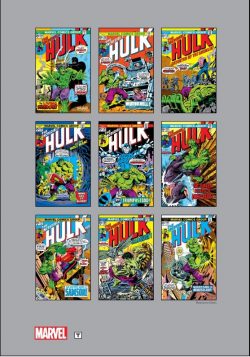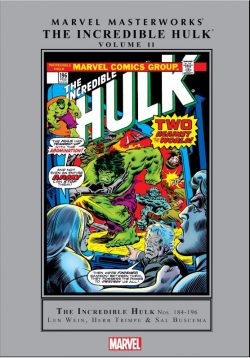
Incredible Hulk Marvel Masterworks volume 10


By Len Wein, Roy Thomas, Gerry Conway, Steve Englehart, Tony Isabella, Herb Trimpe & various (Marvel)
ISBN: 978-0-7851-9596-2 (HB)

During the 1970s the Incredible Hulk settled into a comfortable – if spectacularly destructive – pattern. A globe-trotting, monster-mashing plot formula saw tragic Bruce Banner hiding and seeking cures for his gamma-transformative curse, alternately aided or hunted by prospective father-in-law US General Thaddeus “Thunderbolt” Ross and his daughter – the scientist’s unobtainable inamorata – Betty, with a non-stop procession of guest-star heroes and villains providing the battle du jour.

Herb Trimpe had made the character his own, displaying a penchant for explosive action and an unparalleled facility for drawing technology – especially honking great ordnance and vehicles. Beginning with Roy Thomas – unofficial custodian of Marvel’s burgeoning shared-universe continuity – a string of skilful scripters effectively played the afflicted Jekyll/Hyde card for maximum angst and ironic heartbreak as the Jade Juggernaut became a pillar of Marvel’s growing pantheon.

This chronologically-curated hardback and eBook compendium re-presents issues #171-183, encompassing cover-dates January 1974 to January 1975, and begins with a brace of revelatory Introductions from then Editor-in-Chief Roy Thomas and returning scripter Len Wein on the creation of a certain mutant Canadian…

Before that debut, however, the drama commences with excessive bombast but no appreciable fanfare as ‘Revenge!’ (by Gerry Conway – from a Steve Englehart plot – with art by Trimpe & Jack Abel) finds the Green Goliath a stowaway on a plane back to military Mecca Hulkbuster Base. The jet carries a new Project: Greenskin commanding officer. Spit-&-polish Colonel John D. Armbruster has taken over from the politically sidelined Thunderbolt Ross….

The camp is eerily deserted and the reason soon becomes clear as bludgeoning brutes Abomination and The Rhino attack the new arrivals. Having subdued the entire garrison, they plan on detonating the base’s gamma-bomb self-destruct device but are utterly unprepared for the Hulk’s irascible intervention…

Roy Thomas plotted Tony Isabella’s script for #172 wherein the Hulk – captured by the ungrateful soldiers he saved – is hurled into another dimension, allowing a mystic menace to inadvertently escape. ‘And Canst Thou Slay… The Juggernaut?’ reveals that even that magically augmented menace cannot resist our favourite monster’s might and features a telling cameo by the X-Men, after which Thomas scripts all-Trimpe art-fest ‘Anybody Out There Remember… The Cobalt Man?’, wherein another old X-adversary – Ralph Roberts – picks up the Jade Giant at sea before sailing his research vessel into a nuclear test explosion…

Dying of radiation exposure, the deranged technologist then determines to demonstrate atomic bombs are bad to a callous, uncaring world by detonating one over Sydney in Doomsday… Down Under’ (Conway, Thomas, Trimpe & Abel). The second clash with the azure-armoured Cobalt Man results in a blistering battle in the stratosphere, a cataclysmic explosion and Hulk crashing to earth far, far away as a ‘Man-Brute in the Hidden Land!’ (#175, Thomas, Trimpe & Abel)…

Here a typically short-tempered encounter with the Uncanny Inhumans and devastating duel with silent super-monarch Black Bolt, after the usual collateral carnage, ends with the gamma gladiator hurtling to the far side of the sun in a rocket-ship for a date with allegory if not destiny.

During the early 1970s a throwaway Fantastic Four character dubbed Him was transubstantiated into a modern interpretation of the Christ myth and placed on a world far more like our own than the Earth of Marvel’s universe.

That troubled globe was codified as Counter-Earth and upon it messianic Adam Warlock battled a Satan-analogue known as the Man-Beast. Hulk had briefly visited once before and now he crashed there again to complete the allegorical epic beginning with ‘Crisis on Counter-Earth!’ by Conway, Trimpe & Abel.

Since the Hulk’s departure, Man-Beast and his animalistic minions (all spawned by godlike genetic meddler The High Evolutionary) had become America’s President and Cabinet. Moving decisively, they had finally captured Warlock and led humanity to the brink of extinction, leaving the would-be messiah’s disciples in utter confusion.

Now with the nation in foment, the Hulk’s shattering return gives Warlock’s faithful flock an opportunity to save their saviour in ‘Peril of the Plural Planet!’ but the foray badly misfires and Warlock is captured. Publicly crucified at the behest of the people, humanity’s last hope perishes…

Meanwhile on true-Earth, Ross and Armbruster discover trusted comrade (and Ross’ son-in-law) Major Glenn Talbot has escaped from a top security Soviet prison and is making his triumphant way back to the USA…

The quasi-religious experience concludes with ‘Triumph on Terra-Two’ (Conway, Isabella, Trimpe & Abel) as the dead prophet resurrects whilst Hulk is waging his last battle against Man-Beast just in time to deliver a cosmic coup de grace before ascending from Counter-Earth to the beckoning stars…

Incredible Hulk #179 signalled a long-overdue thematic reboot as Len Wein signed on as writer/editor with strong ideas on how to put some dramatic impact back into the feature. It began with ‘Re-enter: The Missing Link’, as the Jade Juggernaut loses patience during his return trip and bursts out of his borrowed spaceship just as America’s military defences shoot it down.

He crashes to earth in the mining district of Appalachia and, reverting to befuddled Bruce Banner, is adopted by the dirt-poor Bradford family. They have a habit of taking in strays and have already welcomed a strange, huge yet gentle being they’ve named Lincoln.

As time passes Banner recognises the creature as a former Hulk foe known as the Missing Link. The colossal brute is neither evil nor violent (unless provoked) but is lethally radioactive, and the fugitive physicist faces the dilemma of having to break up a perfect happy family before they all die.

The Link, of course, refuses to cooperate or go quietly…

Next comes the most momentous story in Hulk history which starts with ‘And the Wind Howls… Wendigo!’ (#180, October 1974, Wein, Trimpe & Abel). Here the Green Giant gallivants across the Canadian Border and encounters a witch attempting to cure her brother of a curse which has transformed him into a rampaging cannibalistic monster.

Unfortunately, that cure means Hulk must become a Wendigo in his stead…

It is while the Great Green and Weird White monsters are fighting that mutant megastar Wolverine first appears – in the very last panel – and that’s what leads into the savage fist, fang and claw fest that follows.

‘And Now… The Wolverine!’ captivatingly concludes the saga as the Maple nation’s top-secret super-agent is unleashed upon both the Emerald Goliath and man-eating Wendigo in an action-stuffed romp teeming with triumph, tragedy and lots of slashing and hitting. The rest is history…

Back south of the border, Major Talbot has been reunited with his wife and family and is eagerly expecting a meeting with President Ford as ‘Between Hammer and Anvil!’ (with Trimpe taking sole charge of the art chores) finds the ever-isolated Hulk meeting and losing a true friend in jolly hobo Crackerjack Jackson.

The über-action portion of the tale comes from two escaped convicts who despise each other but are forced to endure togetherness because of an alien chain which shackles them whilst imparting overwhelming physical power. It’s not, nearly enough, however, enough to stop a fighting-mad, heartbroken Hulk…

This catastrophic compilation concludes with the return of electrical vampire and life-stealer ZZZAX in ‘Fury at 50,000 Volts!’: wrecking a new life Banner surreptitiously starts carving out for himself in Chicago…

To Be Continued…

This superbly cathartic tome also reproduces John Romita’s first design sketches for Wolverine, a page of original art from the debut and house ads for the issue, as well as covers and frontispieces by John Byrne & Abel and Trimpe from later Hulk/Wolverine reprint collections.

The Incredible Hulk is one of the most well-known comic characters on Earth, and these stories, as much as the movies, cartoons, TV shows, games, toys and action figures, are the reason why. For an uncomplicated, honestly vicarious and cathartic experience of Might literally making Right, you can’t do better than these yarns.
© 1974, 1975, 2016 Marvel Characters, Inc. All rights reserved.

Henry Speaks for Himself


By John Liney, edited by David Tosh (Fantagraphics Books)
ISBN: 978-1-60699-733-8 (TPB)

Created by veteran cartoonist Carl Anderson as a silent, pantomimic gag-panel first seen on March 19th 1932, Henry was one of the most venerated and long-lived of American newspaper comics strips.  It was developed for The Saturday Evening Post before being picked up by legendary strip advocate and propounder William Randolph Hearst.  He brought it and the then-69 year old Anderson to his King Features Syndicate in 1934. The first comic strip appeared on December 17th with a full colour Sunday half-page following on March 10th 1935.

The Saturday Evening Post had to content itself with a new feature entitled Little Lulu by Marjorie Henderson Buell. I wonder how that worked out…?

Being a man of advanced years, Anderson employed Don Trachte to assist with the Sundays whilst John J. Liney performed the same role for the Monday to Saturday black and white iteration. This continued until 1942 when arthritis forced Anderson to retire. Trachte and Liney became de facto creators of the feature – although the originator’s name remained on the masthead for the next two decades.

Liney (1912-1982) had started as a staff cartoonist on the Philadelphia Evening Ledger and began selling gag ideas to Anderson in 1936 before landing the full-time assistant’s job. After assuming the illustrator’s role in 1942 he took over sole writing responsibilities for the daily in 1945, continuing Henry until 1979 when he finally retired.

His own name had been adorning the strip since 1970.

Liney was also a passionate teacher and educator on comics and cartooning, with a position at Temple University. Nevertheless, he still found time to write and draw a comicbook iteration of the mute and merry masterpiece from 1946 to 1961.

Major licensing monolith Western Publishing/Dell Comics had been successfully producing comicbooks starring animation characters, film icons and strip heroes since the mid 1930s, and when they launched Henry – first in Four Color Comics #122 and #155 (October 1946 and July 1947) and then in his own 65 issue title from January 1948 – they successfully argued for a radical change in the boy’s make-up.

The newspaper strip had always been a timeless, nostalgia-fuelled, happily humour-heavy panoply of gags and slapstick situations wherein the frankly weird-looking little bald kid romped and pranked in complete silence, with superb cartooning delivering all the communication nuance the vast international audience needed.

Now however, with children seen as the sole consumers, the powers-that-be felt that the little mutant should be able to speak and make himself understood. Liney easily rose to the challenge and produced a sublime run of jolly, wild, weird and often utterly surreal endlessly inventive adventures – some approaching “Stream-of-Consciousness” progressions that perfectly captured the ephemeral nature of kids’ concentration. He also introduced a captivating supporting cast to augment the boy, and his appealingly unattractive, forthright and two-fisted inamorata Henrietta.

This splendid softcover (and ebook) collection gathers some of the very best longer tales from the comicbook run in the resplendent flat primary colours that are so evocative of simpler – if not better – days and begins after a heartfelt reminiscence in the Foreword by Kim Deitch, after which Editor, compiler and devotee David Tosh outlines the history of the character and his creators in ‘Henry – the Funniest Living American’.

He then goes on to explain ‘The Dell Years’ before offering some informative ‘Notes on the Stories’.

The magical story portion of this collection is liberally interspersed with stunning cover reproductions; all impressively returning to the quiet lad’s silent comedy gag roots, a brace of which precede a beautiful double-page spread detailing the vast and varied cast Liney added to mix.

Then from issue #7 (June, 1949) we find ‘Henry is Thinking Out Loud!’ as the boy keeps his non-existent mouth shut and explores the medium of first person narrative, inner monologues and thought-balloons whilst getting into mischief looking for odd jobs to do…

October’s edition, Henry #9, introduced the good-natured, cool but increasingly put-upon Officer Yako in ‘You Can’t Beat the Man on the Beat!’ in an escalating succession of brushes with the law, bullies, prospective clients and darling Henrietta.

That bald boy still hadn’t actually uttered a sound, but by #14 (August 1950) he had found his voice, much to the amusement of his layabout Uncle (he never had a name) who eavesdropped on the assorted kids comparing their ‘Funny Dreams’.

After a quartet of covers Henry #16 (December 1950) found Liney playing with words as ‘Rhyme Without Reason’ found all the characters afflicted with doggerel, meter, couplets and all forms poetic with Liney even drawing himself into the madcap procession of japes and jests, whilst ‘A Slice of Ham’ from issue #22 (December 1951) cleverly riffed on Henry’s ambitions to impress Henrietta by becoming an actor. This yarn includes a wealth of Liney caricatures of screen immortals such as Chaplin, Gable, Sinatra and more, whilst introducing a potential rival for Henry’s affections in cousin Gilda…

In #24 (April 1952) Henry ‘Peeks into the Future’ by outrageously pondering on his possible careers as an adult, before plunging into Flintstone or Alley Oop territory – complete with cave city and dinosaurs – as a result of studying too hard for a history test in ‘The Stone Age Story’ from issues #29, February 1953.

After four more clever funny covers, growing up again featured heavily with ‘Choosing Your Career’ (#45, March 1956) as the little fool road-tested a job as a home-made cab driver and accidentally slipped into law enforcement by capturing a bandit.

In #48 (December 1956) Henry attended a fancy dress party and became ‘The Boy in the Iron Mask’, and this completely charming compilation closes by reprising that sojourn in the Stone Age with #49 (March 1957)’s ‘Rock and Roll’…

Concluding the comedy capers is fond personal reminiscence ‘Henry and Me’ by David Tosh; a man justifiably delighted to be able to share his passion with us and hopefully proud that this book gloriously recaptures some of the simple straightforward sheer joy that could be found in comicbooks of yore.

Henry Speaks for Himself is fun, frolicsome and fabulously captivating all-ages cartooning that will enthral anyone with kids or who has the soul of one.
Henry Speaks for Himself © 2014 Fantagraphics Books Inc. All comics and drawings © 2014 King Features, Inc. All other material © its respective creators. This book was produced in cooperation with Heritage Auctions.

Gomer Goof volume 2: It’s a Van Goof!


By André Franquin, Jidéhem & Delporte, translated by Jerome Saincantin (Cinebook)
ISBN: 978-1-84918-365-9 (PB Album)

Like so much in Franco-Belgian comics, it all started with Le Journal de Spirou. The magazine had debuted on April 2nd 1938, with its engaging lead strip created by Rob-Vel (François Robert Velter). In 1943 publishing giant Dupuis purchased all rights to the comic and its titular star, after which comic-strip prodigy Joseph Gillain (“Jijé”) took the helm.

In 1946 Jijé’s assistant André Franquin assumed the creative reins, gradually side-lining the previously-established short gag vignettes in favour of extended adventure serials. He introduced a broad, engaging cast of regulars; creating phenomenally popular magic animal Marsupilami (first seen in Spirou et les héritiers in 1952 and eventually a spin-off star of screen, plush toy store, console games and albums in his own right) to the mix.

Franquin continued crafting increasingly fantastic tales and absorbing Spirou sagas until his resignation in 1969. During that period the creator was deeply involved in the production of the weekly Spirou comic

Franquin was born in Etterbeek, Belgium on January 3rd 1924. Drawing from an early age, the lad only began formal art training at École Saint-Luc in 1943. When the war forced the school’s closure a year later, he found work at Compagnie Belge d’Animation in Brussels where he met Maurice de Bévère (AKA Lucky Luke creator “Morris”), Pierre Culliford (Peyo, creator of The Smurfs and Benny Breakiron) and Eddy Paape (Valhardi, Luc Orient).

In 1945 all but Peyo signed on with Dupuis, and Franquin began his career as a jobbing cartoonist/illustrator, producing covers for Le Moustique and scouting magazine Plein Jeu. During those early days, Franquin and Morris were being tutored by Jijé, who was the main illustrator at Spirou. He turned the youngsters and fellow neophyte Willy Maltaite (AKA “Will” – Tif et Tondu, Isabelle, Le jardin des désirs) into a smoothly functioning creative bullpen known as La bande des quatre or “Gang of Four”. They later reshaped and revolutionised Belgian comics with their prolific and engaging “Marcinelle school” style of graphic storytelling…

Jijé handed Franquin all responsibilities for the flagship strip part-way through Spirou et la maison préfabriquée (Spirou #427, June 20th 1946). He ran with it for the next two decades; enlarging the scope and horizons of the feature until it became purely his own. Almost every week fans would meet startling new characters such as comrade/rival Fantasio or crackpot inventor and Merlin of mushroom mechanics the Count of Champignac.

Spirou &Fantasio became globe-trotting journalists, travelling to exotic places, uncovering crimes, exploring the fantastic and clashing with a coterie of exotic arch-enemies. However, throughout all that time Fantasio was still a full-fledged reporter for Le Journal de Spirou and had to pop into the office all the time.

Sadly, lurking there was an accident-prone, big-headed junior in charge of minor jobs and dogs-bodying. His name was Gaston Lagaffe…

There’s a long history of fictitiously personalising the mysterious creatives and all those arcane processes they indulge in to make our favourite comics, whether its Stan Lee’s Marvel Bullpen or DC Thomson’s lugubrious Editor and underlings at the Beano and Dandy. Let me assure you that it’s a truly international practise and the occasional asides on text pages featuring well-meaning foul-up/office gofer Gaston – who debuted in #985, February 28th 1957 – grew to be one of the most popular and perennial components of the comic.

I’d argue, however, that current iteration Gomer Goof (his name is taken from an earlier, abortive attempt to introduce the character to American audiences) is an unnecessary step. The quintessentially Franco-Belgian tone and humour doesn’t translate particularly well (la gaffe translates as “the blunder”) and contributes nothing here. When the big idiot surprisingly appeared in a 1970s Thunderbirds annual as part of an earlier syndication attempt, he was rechristened Cranky Franky. Perhaps they should have kept the original title…

In terms of entertainment schtick and delivery, older readers will certainly recognise beats of Jacques Tati and timeless elements of well-meaning self-delusion British readers will recognise from Some Mothers Do Have ‘Em or Mr Bean. It’s slapstick, paralysing puns, pomposity lampooned and no good deed going noticed, rewarded or unpunished…

This second album-sized paperback compilation (available also in digital formats) consists of half-page shorts, longer cartoon strips and comedic text story “reports” from the comic’s editorial page as well as ultimately full episodes of madcap buffoonery.

As previously stated, Gomer is employed (let’s not dignify or mis-categorise what he does as “work”) at the Spirou offices, reporting to go-getting hero journalist Fantasio and generally ignoring the minor design jobs like paste-up and reading readers’ letters (the official reason why fans requests and suggestions are never answered…) he’s paid to handle.

He’s lazy, opinionated, forgetful and eternally hungry and his most manic moments stem from cutting corners or stashing and illicitly consuming contraband food in the office…

These characteristics frequently lead to clashes with police officer Longsnoot and fireman Captain Morwater, but the office oaf remains eternally easy-going and incorrigible. Only two questions are really important here: why does Fantasio keep giving him one last chance, and what can gentle, lovelorn Miss Jeanne possible see in the interfering, self-opinionated idiot?

Originally released in 1968 as sixth volume Gaston – Des gaffes et des dégâts, the translated chaos (available in paperback and digital formats) commences with a quartet of short, sharp two-tier episodes involving Gomer’s office innovations and war of nerves with Longsnoot, before the first illustrated text “report” from the comic’s editorial page details a catastrophe in glass in ‘Whistle While You Work’.

A second, entitled ‘Letter from the Countryside’ shares space with a calamitous seaside excursion and selection of rural escapades turned camping Armageddon…

Prose missive ‘Gomer Writes Us’ (on the joys of go-karting) leads to a ‘Conversation on a Street Corner’ and details on a new kind of music in ‘Honky-honk copper’, after which computer-assisted design is proved to be one more thing Gomer must never attempt in ‘Chorus and Bridge’…

The remainder of the volume is all picture strip pandemonium as the imbecile’s attempts at rooftop cookery lead to aviation disasters, projectile peril, standoffs on staircases and a unique form of petty theft…

Rallying and racing capture his mayfly attention-span, but a hunt for a new vehicle never succeeds and Gomer always returns to his appallingly decrepit and dilapidated Fiat 509 auto(barely)mobile, but the fool is set in his ways and even doctors can’t fix or remove him…

However, somebody rational really should have foreseen what the slacker was capable of when he brought in a chemistry set…

Far better enjoyed than précised or described, these strips allowed Franquin and fellow scenarists Yvan Delporte and Jidéhem (in reality, Jean De Mesmaeker: his analogue is a regular in the strips as an explosively irate and unfortunate foil for the Goof) to flex their whimsical muscles and even subversively sneak in some satirical support for their beliefs in pacifism and environmentalism, but at their core the gags remain supreme examples of all-ages comedy: wholesome, barbed, daft and incrementally funnier with every re-reading.

What’s stopping you from Goofing off?
© Dupuis, Dargaud-Lombard s.a. 2017 by Franquin. All rights reserved. English translation © 2017 Cinebook Ltd.

Bent


By Dave Cooper (Fantagraphics Books)
ISBN: 978-1-60699-378-1 (HB)

Every so often I tend to stray a little from my accustomed comfort zone and regulation hunting grounds: moving beyond narrative art into broader realms of imagination. In that vein, here’s a little item available in hardback and digital formats that promises all of that and more. Whilst not sequential art the enticing yet profoundly disturbing images contained herein are certainly full of technical craft and intense imagination; and moreover, the chillingly subversive pictures tell stories the way no thousand words ever could… by boring straight into your brain and making themselves uncomfortably at home.

Dave Cooper was born in November 1967 in Nova Scotia, before relocating – presumably with adult guardians of some sort – to Ottawa when he was nine. A few years later, he was swept up in the massive mid-1980s Independent comics Boom & Bust that generated great and wonderful series such as Teenage Mutant Ninja Turtles, Puma Blues, Flaming Carrot and Silent Invasion, as well as lots of awful couldn’t die fast enough stuff. Young Cooper toiled for schlockmeister Barry Blair on numerous Aircel Comics titles and doesn’t like to talk about it much now…

Thoroughly “blooded”, his real career began in the 1990’s at Fantagraphics, creating challenging underground comix styled material like Suckle, Weasel and graphic novel Ripple amongst other strips. In 2007, as Hector Mumbly, he published his first kid’s book Bagel’s Lucky Hat.

By 2002 he had transformed into an acclaimed oil painter with international gallery shows and awards and ended the decade as a creator/designer of animated kids TV shows such as Pig Goat Banana Cricket (with Johnny Ryan for Nickelodeon) and The Bagel and Betty Show (Teletoon/BBC) as well as short film for adults The Absence of Eddy Table. He’s still painting and is now a Director of the Saw Gallery.

A sequence of Cooper’s darker, violently sinister and most sexually surreal paintings is assembled in this pictorially grotesque catalogue of forbidden delights, preceded by effusive Introduction ‘Bent and Free’ from Guillermo del Toro.

The illustrative technique is sheer, Impressionistic welcoming seduction, but the content is deranged, deformed and disturbingly gelid: all soft contours, glossy surfaces and childhood dreams, offering human forms distorted and reformed by Lovecraftian physics and biology. It’s a uniquely horrid beauty and one that, once seen, is so very hard to forget…

As well as fully-realised paintings, the book also features pencil & pen sketches and working drawings offering a glimpse into the mind and process of a one-of-a-kind talent.

If you crave images that push every envelope, track down this macabre tome…
© 2010 Dave Cooper. All rights reserved.

Invincible Iron Man Epic Collection volume 3 1968-1970: The Man Who Killed Tony Stark


By Archie Goodwin, George Tuska, Johnny Craig & various (Marvel)
ISBN: 978-1-3029-1630-5 (TPB)

Marvel’s rise to dominance of the American comicbook industry really took hold in 1968 when most of their characters finally got their own titles. Prior to that – and due to a highly restrictive distribution deal – the company was contractually tied to a limit of 16 publications per month.

To circumvent this drawback, Marvel developed “split-books” with two solo features per publication, such as Tales of Suspense wherein Iron Man was joined by Captain America with #59 (cover-dated November 1964).

When the division came, the armoured Avenger started afresh with a “Collectors’ Item First Issue” – after a shared one-shot with the Sub-Mariner that rationalised divergent schedules – with Cap retaining the numbering of the original title: thus his “premiering” in number #100, while the Steel-Shod Avenger got a first issue at last….

Tony Stark is the acceptable face of 1960s Capitalism; a glamorous millionaire-industrialist and inventor. He is also a benevolent all-conquering hero when clad in the ultra high-tech armour of his alter-ego, Iron Man.

Created in the aftermath of the Cuban Missile Crisis and at a time when “Red-baiting” and “Commie-bashing” were American national obsessions (just like now), the emergence of a brilliant new Thomas Edison, using Yankee ingenuity and invention to safeguard and better the World, seemed inevitable.

Combine the then-sacrosanct belief that technology and commerce could solve any problem with the universal imagery of noble knights battling evil and the concept behind the Golden Avenger seems an infallibly successful proposition. Of course, it helps that all that money and gadgetry is great fun and very, very cool…

With an Iron Clad promise of stunning adventure and suspenseful drama, this iconic trade paperback (and digital) chronological compendium covers Iron Man #2-24, spanning June 1968 – April 1970, and features a creative dream sequence as master scripter Archie Goodwin worked with EC legend Johnny Craig and Golden Age veteran George Tuska.

A bold new era began with Invincible Iron Man #2. Long-established illustrator Gene Colan had moved on and, with ‘The Day of the Demolisher!’, the slick understated mastery of Craig adds a sheen of terrifying authenticity to proceedings. His first job was a cracker, since Goodwin introduces Janice Cord as a new romantic interest for the playboy inventor. The problem thwarting true love is a monolithic killer robot built by her deranged father and the start of a running plot-thread examining the effects of the munitions business and the nature of those inventors who work for it…

Goodwin & Craig then bring back Stark’s old bodyguard Happy Hogan to help rebuild the now-obsolete Iron Man armour before consequently devolving him back into a monstrous super-strong menace in ‘My Friend, My Foe… the Freak!’ for #3; surpassing themselves one issue later by retooling a long-forgotten Soviet super-villain into a major threat in ‘Unconquered is the Unicorn!’

This particular ultra-enhanced maniac is dying from his own powers and believes Tony would be able – if not initially willing – to fix him…

With Iron Man #5, another venerated veteran from the industry’s dawn joined the creative team. George Tuska – who had worked on huge hits such as the original (Fawcett) Captain Marvel and Crime Does Not Pay, plus newspaper strips such as The Spirit and Buck Rogers – would illustrate the majority of Iron Man’s adventures over the decade and become synonymous with the Armoured Avenger…

With Craig adding his solid dependable inks, ‘Frenzy in a Far-Flung Future!’ is an intriguing time-paradox tale wherein Stark is kidnapped by the last survivors of humanity. They are determined to kill him before he can build the super-computer that eradicated mankind. Did somebody say “Terminator”…?

A super-dense (by which I mean strong and heavy) Cuban Commie threat then returned – but not for long – in ‘Vengeance… Cries the Crusher!’

Next, a sinister scheme started way back in Tales of Suspense #97 finally bears brutal – and for preppie S.H.I.E.L.D. agent Jasper Sitwell (assigned as Stark’s security advisor) – painful fruit in 2-part thriller ‘The Maggia Strikes!’ and ‘A Duel Must End!’, as old Daredevil foe the Gladiator leads a savage attack on Stark’s factory, friends and would-be new love…

The saga also reveals the tragic history of mystery woman Whitney Frost and lays the seeds of her evolution into one of Iron Man’s most implacable foes…

A daring 3-part saga follows as ultimate oriental arch-fiend The Mandarin resurfaces with a cunning plan and the certain conviction that Stark and Iron Man are the same person… Beginning with an apparent Incredible Hulk guest-shot in #9’s ‘…There Lives a Green Goliath!’ and proceeding through the revelatory and explosive Nick Fury team-up ‘Once More… The Mandarin!’, the epic climaxes in spectacular “saves-the-day” fashion as our hero is ‘Unmasked!’

This epic from Goodwin, Tuska & Craig offers astounding thrills and potent drama with plenty of devious twists, just as the first inklings of the social upheaval America was experiencing began to seep into Marvel’s publications.

As the core audience started to grow into the Flower Power generation, future tales would take arch-capitalist weapon-smith Stark in many unexpected and often peculiar directions. All of a sudden maybe that money and fancy gadgetry weren’t quite so fun or cool anymore…?

The sterling run of science-flavoured dramas resumes with the introduction of a new sinister super-foe in #12 as ‘The Coming of the Controller’ sees a twisted genius using the stolen life-energy of enslaved citizens to power a cybernetic exo-skeleton.

Along the way, he and his brother embezzle the fortune of Stark’s girlfriend Janice Cord to pay for it all. Of course, Iron Man is ready and able to overcome the scheming maniac, tensely culminating in cataclysmic clash ‘Captives of the Controller!’, wherein the mind-bending terror attempts to extend his mesmeric, parasitic sway over the entire populace of New York City…

IM#14 revealed that ‘The Night Phantom Walks!’, with Goodwin craftily paying tribute to Craig’s past history drawing EC’s landmark horror comics. Here the artist pencilled and inked the story of a zombie-monster prowling a Caribbean island and destroying Stark Industry installations. As well as being a terse, moody thriller, this story marks the first indications of a different attitude, as the menace’s ecologically-inspired reign of terror includes some pretty fair arguments about the downsides of “Progress” and rapacious globalisation…

With Craig again inking, Tuska returned with #15 and ‘Said the Unicorn to the Ghost…!’ The demented former superspy allies himself with Fantastic Four foe Red Ghost in a desperate last-ditch bid to find a remedy for his drastically shortened life-span.

Attempting to kidnap Stark, the Ghost betrays the Unicorn and retrenches to an African Cosmic Ray research facility in concluding instalment ‘Of Beasts and Men!’, where it takes a fraught alliance of hero and villain to thwart the phantom mastermind’s ill-conceived plans…

A suspenseful extended epic kicked off in Iron Man #17 when an advanced android designed to protect Stark’s secret identity achieves sinister sentience and sneakily replaces him.

‘The Beginning of the End!’ also introduces enigmatic Madame Masque and her malevolent master Midas, who plans to take control of America’s greatest technology company…

Dispossessed and on the run, Stark is abducted and reluctantly aligns with Masque and Midas to reclaim his identity, only to suffer a fatal heart attack in ‘Even Heroes Die!’ (guest-starring the Avengers), before a ground-breaking transplant – still practically science fiction in those distant days – gives him renewed hope in ‘What Price Life?’

When the ruthlessly opportunistic Midas instantly strikes again, the mysterious Madame Masque switches sides and all hell breaks loose…

The X-Men‘s dimensionally displaced alien nemesis attacks the restored and recuperating hero in ‘Who Serves Lucifer?’ (inked by Joe Gaudioso – AKA moonlighting Mike Esposito) before being rudely returned to his personal dungeon dimension, after which African-American boxer Eddie March briefly becomes a new Iron Man in #21’s ‘The Replacement!’ Stark – free from the heart-stimulating chest-plate which had preserved his life for years – is understandably tempted into a life without strife, but unfortunately, and unknown to all, Eddie has a little health problem of his own…

When Soviet-sponsored armoured archenemy Titanium Man resurfaces, it’s in conjunction – if not union – with another former Cold War warrior in the form of a newly-upgraded Crimson Dynamo in #22’s chilling classic confrontation ‘From this Conflict… Death!’

With a loved one murdered, vengeance-crazed Iron Man goes ballistic in innovative action-thriller ‘The Man Who Killed Tony Stark!!‘ before ultimately finding solace in the open arms of Madame Masque.

Ending this compilation in classic style, Johnny Craig returns to fully illustrate a superb mythological monster-mash in ‘My Son… The Minotaur!’

The galvanised wonderment is supplemented with a sublime selection of Tuska and Craig original art pages and covers to wrap up this collection with the Golden Gladiator being politically repositioned at a time when Marvel solidly set itself up at the vanguard of a rapidly changing America increasingly at war with itself – so, no change there then…

This is a fantastic period in the Golden Gladiator’s career and one that perfectly encapsulates the changes Marvel and America went through: seen through some of the best and most memorable efforts of a simply stellar band of creators.
© 1968, 1969, 1970, 2019 Marvel. All rights reserved.

Superman the Man of Steel Volume 3


By John Byrne, Marv Wolfman, Jerry Ordway & various (DC Comics)
ISBN: 978-1-4012-0246-0 (TPB)

In 1985, when DC Comics decided to rationalise and reconstruct their continuity with Crisis on Infinite Earths, they used the event to regenerate their key properties at the same time. The biggest gun they had was Superman and it’s hard to argue that change came none too soon.

The big guy was in a bit of a slump, but he’d weathered those before. So how could a major makeover be anything but a pathetic marketing ploy that would alienate the real fans for a few Johnny-come-latelies who would jump ship as soon as the next fad surfaced? The popular wisdom amongst fans was that this new Superman was going to suck.

They couldn’t have been more wrong.

Superman titles were cancelled or suspended for three months, and yes, that did make the real-world media sit-up and take notice of the character for the first time in decades. But there was method in the corporate madness.

Beginning with 6-part miniseries Man of Steel – written and drawn by mainstream superstar John Byrne and inked by venerated veteran Dick Giordano – the experiment was a huge and instant success. So much so, that when it was first collected as a stand-alone graphic novel in the 1980s, it became one of the industry’s premiere break-out hits. From his overwhelming re-inception the character returned to his suspended comicbook homes with the addition of a third monthly title premiering that same month.

Superman, Adventures of Superman, and Action Comics (which became a fan-pleasing team-up book guest-starring other heroes of the DC Universe) were instant best-sellers. So successful was the relaunch that by the early 1990’s Superman would be able to sustain four monthly titles as well as Specials, Annuals, guest shots and his semi-regular appearances in titles such as Justice League.

It was quite a turnaround from the earlier heydays of the Man of Steel when editors were frantic about not over-exposing their biggest gun.

With Byrne’s controversial reboot now a solid hit, the collaborative teams tasked with ensuring his continued success really hit their stride with the tales collected in this third volume.

From April to June 1987 and re-presenting Superman #4-6, Action #587-589 and Adventures of Superman #427-429 in paperback and digital formats, the wonderment is preceded by an Introduction from writer/artist Jerry Ordway before the drama kicks off with an all-out battle against deranged gunman ‘Bloodsport!’ courtesy of Byrne and inker Karl Kesel. The merciless shooter is more than just crazy, however: some hidden genius has given him the ability to manifest wonder weapons from nothing and he never runs out of ammo… Marv Wolfman & Jerry Ordway concentrated on longer, more suspenseful tales. Adventures of Superman #427-428) take the Man of Tomorrow on a punishing visit to the rogue state of Qurac and an encounter with a hidden race of alien telepaths called the Circle, in a visceral and beautiful tale of un-realpolitik. ‘Mind Games’ and ‘Personal Best’ combine a much more relevant, realistic slant with lots of character sub-plots featuring assorted staff and family staff of the Daily Planet after which Byrne in Action Comics manufactures spectacle, thrills and instant gratification reader appeal.

‘Cityscape!’, in #587, teams the Metropolis Marvel with Jack Kirby’s Etrigan the Demon as sorceress Morgaine Le Fay attempts to gain immortality by warping time itself…

‘The Mummy Strikes’ and ‘The Last Five Hundred’ (Byrne & Kesel, Superman #5-6) then introduce the first hint of potential romance between the Man of Steel and Wonder Woman, before Lois Lane and Clark Kent are embroiled in an extraterrestrial invasion drama that started half a million years ago and feature rogue robots and antediluvian bodysnatchers.

In ‘Old Ties’ (Superman #6) Wolfman & Ordway reveal the catastrophic results of the Circle transferring their expansionist attentions to Metropolis, before this collection concludes with a cosmic saga from Action Comics #588-589 wherein Byrne & Giordano team the Caped Kryptonian with Hawkman and Hawkwoman in ‘All Wars Must End’, an epic battle against malign Thanagarian invaders, permitting Arisia , Salaak, Kilowog, Katma Tui and other luminaries of the Green Lantern Corps to meet and rescue the star-lost Superman in ‘Green on Green’ before uniting to eliminate an unstoppable planet-eating beast.

The back-to-basics approach lured many readers to – and back to – the Superman franchise, but the sheer quality of the stories and art are what convinced them to stay. Such cracking, clear-cut superhero exploits are a high point in the Action Ace’s decades-long career, and these chronological-release collections are certainly the easiest way to enjoy one of the most impressive reinventions of the ultimate comic-book icon.
© 1987, 2004 DC Comics. All Rights Reserved.
Cave Girls of the Lost World,


By Richard Sala (Fantagraphics Books Digital Exclusive)
No ISBN: ASIN: B07H487P65

Richard Sala is a lauded and much-deserving darling of the Literary Comics movement (if such a thing exists), blending beloved pop culture artefacts and conventions – particularly cheesy comics and old horror films – with a hypnotically effective ability to tell a graphic tale. His compelling pictorial sagas appeal greatly to kids of all ages.

He grew up in Chicago and Arizona before earning a Masters Degree in Fine Arts. Soon after beginning a career as an illustrator he rediscovered his early love of comicbooks and icons of popular mass culture, such as cop shows and horror movies. He’s never looked back…

The release of potentially metafictional and self-published Night Drive in 1984 led to appearances in legendary 1980s anthologies Raw and Blab! and animated adaptations of the series on Liquid Television.

His work is welcomingly atmospheric, dryly ironic, wittily quirky and mordantly funny; indulgently celebrating childhood terrors, gangsters, bizarre events, monsters and manic mysteries, through iconic lead characters as girl sleuth Judy Drood and the glorious trenchant storybook investigator Peculia: to date the most well-known and utilised of his gratifyingly large repertory of characters.

Sala’s art is a joltingly jolly – if macabre – joy to behold and has also shone on many out-industry projects such as his work with Lemony Snickett, The Residents and even – albeit posthumously – Jack Kerouac; illustrating the author’s outrageous Doctor Sax and The Great World Snake. At the moment he’s devoting time to extended mystery webcomics Super-Enigmatix and The Cardinal. Oh, and this…

A (thus far) digital only release, Cave Girls of the Lost World is a marriage of text blocks and full-page illustrations cheekily referencing 1960s dinosaur cheesecake themes (as seen in One Million Years BC or When Dinosaurs Ruled the Earth) with the plucky bonhomie of schoolgirls novels and comics of the same era. Think of The Four Marys in Conan Doyle’s Lost World and channelling the funnier parts of William Golding’s Lord of the Flies…

Actually, no, don’t. Think of very fetching cartoons heaving with gleeful irony…

The saga unfolds in four chapters as a young boy wanders a beach and finds a message in a bottle. It is a diary detailing the extraordinary fate which befell 30 female college applicants whose plane crashed onto a strange plateau where giant saurians, extinct precursor races of mankind and vegetable horrors still thrived and relates how the castaways learned to kill or perish…

Fans of Super-Enigmatix will be delighted to discover that some of the characters from that unfolding drama play a crucial part here, too…

    Beguiling, clever, and staggeringly engaging, this yarn blends nostalgic escapism with the childish frisson of children scaring themselves silly under the bedcovers at night and will leave every unrepentant fantasy fan hungry for more…
    Cave Girls of the Lost World © 2018 Richard Sala. This edition © 2018 Fantagraphics Books, Inc. All rights reserved.

Captain Marvel Marvel Masterworks volume 3


By Jim Starlin, Gerry Conway, Marv Wolfman, Mike Friedrich, Steve Englehart, Wayne Boring, Al Milgrom, & various (Marvel)
ISBN: 978-0-7851-3016-1 (HB)

In 1968, upstart Marvel was in the ascendant. Their sales were rapidly overtaking industry leaders National/DC and Gold Key Comics and, having secured a new distributor which would allow them to expand their list of titles exponentially, the company was about to undertake a creative expansion of unparalleled proportions.

Once each individual star of “twin-books” Tales of Suspense, Tales to Astonish and Strange Tales was awarded their own title, the House of Ideas just kept on going. In progress was a publishing plan which sought to take conceptual possession of the word “Marvel” through both reprint series like Marvel Tales, Marvel Collector’s Items Classics and Marvel Super-Heroes. Eventually, showcase titles such as Marvel Premiere, Marvel Spotlight and Marvel Feature also proudly trumpeted the name, so another dead-cert idea was to publish an actual hero named for the company – and preferably one with some ready-made cachet and pedigree as well.

After the infamous DC/Fawcett copyright court case of the 1940s-1950s, the prestigious designation Captain Marvel disappeared from newsstands. In 1967, during the “Camp” craze superhero boom generated by the Batman TV series, publisher MLF secured rights to the name and produced a number of giant-sized comics featuring an intelligent robot able to divide his body into segments and shoot lasers from his eyes.

Quirky, charming and devised by the legendary Carl Burgos (creator of the Golden Age Human Torch), the series nevertheless failed to attract a large following in that flamboyantly flooded marketplace and on its demise the name was quickly snapped up by Marvel Comics Group.

Marvel Super-Heroes was a brand new title: it had been reconfigured from double-sized reprint title Fantasy Masterpieces, which comprised vintage monster-mystery tales and Golden Age Timely Comics classics, but with the twelfth issue it added a showcase section for characters without homes such as Medusa, Ka-Zar, Black Knight and Doctor Doom, plus new concepts like Guardians of the Galaxy and Phantom Eagle to try out in all-new stories.

To start the ball rolling, the title headlined an alien spy sent to Earth from the Kree Galaxy. He held a Captain’s rank and his name was Mar-Vell.

After two appearances, Captain Marvel catapulted straight into his own title and began a rather hit-and-miss career, battling spies, aliens, costumed cut-ups such as Sub-Mariner, Mad Thinker and Iron Man. Most frequently however he clashed with elements of his own rapaciously colonialist race – such as imperial investigative powerhouse Ronan the Accuser – all the while slowly switching allegiances from the militaristic Kree to the noble, freedom-loving denizens of Earth.

Disguised as NASA scientist Walter Lawson, he infiltrated a US airbase and grew closer to security chief Carol Danvers, gradually going native even as he was constantly scrutinised by his ominously orbiting commanding officer Colonel Yon-Rogg – Mar-Vell’s ruthless rival for the love of the teeming starship’s medical officer Una…

The impossible situation came to a head when Mar-Vell gave his life to save the empire from overthrow from within. As a reward, colossal hive-mind the Supreme Intelligence inextricably bonded the expiring warrior with voice-of-a-generation and professional side-kick Rick Jones who – just like Billy Batson (the naïve lad who turned into the original Fawcett Captain Marvel by shouting “Shazam!”) – switched places with a mighty adult hero whenever danger loomed.

By striking a pair of ancient, wrist worn “Nega-bands” together they could temporarily trade atoms: one active in our universe whilst the other floated, a ghostly untouchable, ineffectual voyeur to events glimpsed from the ghastly anti-matter Negative Zone.

The Captain was an alien lost on Earth, a defector from the militaristic Kree who fought for humanity three hours at a time, atomically chained to Rick by mysterious wristbands which enabled them to share the same space in our universe, but whenever one was active here the other was trapped in a terrifying isolated antimatter hell…

The book was cancelled soon after that… only to return some more!

A series which would not die, Captain Marvel returned again in the summer of 1972 for another shot at stardom and intellectual property rights security.

This third stellar Masterworks compilation (spanning September 1972 to July 1974 whilst gathering Captain Marvel #21-33 plus a pivotal crossover appearances from Iron Man #55) finds him at his best and worst as mediocre tales by veteran creators were brushed aside and the hero was overnight transfigured by the talents of a very talented newcomer, making the directionless Kree Warrior briefly the most popular and acclaimed title in Marvel’s firmament.

Following another comprehensively contextualising reminiscence in Roy Thomas’ Introduction, it all begins rather inauspiciously with Captain Marvel #22 wherein scripter Gerry Conway and artists Wayne Boring & Frank Giacoia reintroduce the cosmic crusader. ‘To Live Again!’ sees Mar-Vell still bonded to Rick by the uncanny Nega-bands, having languished in the Negative Zone for a seeming eternity. Jones had been trying to carve out a rock star career and relationship with new love Lou-Ann, but eventually his own body betrays him and the Kree Captain is expelled back into our reality…

Luckily, Lou-Ann’s uncle Benjamin Savannah is a radical scientist on hand to help Rick’s transition, but as the returned Marvel unsteadily flies off, across town another boffin is rapidly mutating from atomic victim to nuclear threat and #23 (by Marv Wolfman, Boring & Frank McLaughlin) sees the Kree Warrior calamitously clash with rampaging maniac Megaton, resulting in ‘Death at the End of the World!’.

Wolfman, Boring & Ernie Chan then deal ‘Death in High Places!’ as Rick is targeted by lethal Madame Synn and felonious cyborg Dr. Mynde. They need Mar-Vell to help them plunder the Pentagon…

After seemingly running in place, perpetually one step ahead of cancellation (folding many times, but always quickly resurrected – presumably to secure that all important trademark name), the Captain was handed to a newcomer named Jim Starlin who was left alone to get on with it…

With many of his friends and fellow neophytes he began laying seeds (particularly in Iron Man and Daredevil) for a saga that would in many ways become as well regarded as Jack Kirby’s epochal Fourth World Trilogy which it emulated.

However, the “Thanos War”, despite superficial similarities, soon developed into a uniquely modern experience. And what it lacked in grandeur it made up for with sheer energy and enthusiasm.

The first inkling came in Iron Man #55 (February 1973) with Mike Friedrich scripting Starlin’s opening gambit in a cosmic epic that changed the nature of Marvel itself. ‘Beware The… Blood Brothers!’(inked by Mike Esposito) introduces haunted humanoid powerhouse Drax the Destroyer, trapped by extraterrestrial invader Thanos under the Nevada desert and in dire need of rescue. That comes when the Armoured Avenger blazes in, answering a mysterious SOS…

A month later in Captain Marvel #25, Friedrich, Starlin, & Chic Stone unleashed ‘A Taste of Madness!’ and the alien outcast’s fortunes changed forever.

When Mar-Vell is ambushed by a pack of extraterrestrials, he is forced to admit that his powers are in decline. Unaware that an unseen foe is counting on that, Rick manifests and checks in with Dr. Savannah, only to find himself accused by his beloved Lou-Ann of the scientist’s murder.

Hauled off to jail, Rick brings in Mar-Vell who is confronted by a veritable legion of old foes before deducing who in fact his true enemies are…

Issue #26 sees Rick free of police custody and confronting Lou-Ann over her seeming ‘Betrayal!’ (Starlin, Friedrich & Dave Cockrum). Soon, however, he and Mar-Vell realise they are the targets of psychological warfare: the girl is being mind-controlled whilst Super Skrull and his hidden “Masterlord” are manipulating them and others in search of a lost secret…

When a subsequent scheme to have Mar-Vell kill The Thing spectacularly fails, Thanos takes personal charge. The Titan is hungry for conquest and wants Rick because his subconscious conceals the location of an irresistible ultimate weapon.

Rick awakes to find himself ‘Trapped on Titan!’ (Pablo Marcos inks) but does not realise the villain has already extracted the location of a reality-altering Cosmic Cube from him. Rescued by Thanos’ father Mentor and brother Eros, the horrified lad sees first-hand the extent of genocide the death-loving monster has inflicted upon his own birthworld and summons Captain Marvel to wreak vengeance…

Meanwhile on Earth, still-enslaved Lou-Ann has gone to warn the Mighty Avengers and summarily collapsed. By the time Mar-Vell arrives in #28 she lies near death. Inked by Dan Green, ‘When Titans Collide!’ reveals another plank of Thanos’ plan. As the heroes are picked off by psychic parasite The Controller, Mar-Vell is assaulted by bizarre visions of an incredible ancient being. Fatally distracted, he becomes the massive mind-leech’s final victim…

Al Milgrom inks ‘Metamorphosis!’ as the Kree captain’s connection to Rick is severed and he is transported to an otherworldly locale where an 8-billion year old being named Eon reveals the origins of life whilst overseeing the abductee’s forced evolution into the ultimate warrior: a universal champion gifted with the subtly irresistible power of Cosmic Awareness…

Returned to Earth and reconnected to his frantic atomic counterpart, the newly-appointed “Protector of the Universe” goes after The Controller, thrashing the monumentally powerful parasite in a devastating display of skill countering super-strength in #30’s ‘…To Be Free from Control!’

Much of this saga occurs in other titles and for the full picture you will need to hunt down more comprehensive compilations but here and now, the story continues in Captain Marvel #31 with ‘The Beginning of the End!’ (inked by Green & Milgrom) wherein the Avengers – in a gathering of last resort – are joined by psionic priestess Moondragon and Drax – one of the Titan’s many victims resurrected by supernal forces to destroy Thanos…

The Titan has been revealed as a lover of the personification of Death and he wants to give her Earth as a betrothal present. To that end, he uses the Cosmic Cube to turn himself into ‘Thanos the Insane God!’ (Green) and with a thought captures all opposition to his reign. However, his insane arrogance leaves the cosmically aware Mar-Vell with a chance to undo every change; brilliantly outmanoeuvring and defeating ‘The God Himself!’ (inks by Klaus Janson)…

With the universe saved, this volume of cosmic conflict and stellar spectacle concludes with a choice selection of bonus bits, beginning with a comprehensive cutaway ‘Map of Titan’ from Captain Marvel #27, original artwork and covers and endpieces from 1980s reprint series The Life of Captain Marvel.

The Good Captain has never claimed to be the company’s most popular or successful character and some of the material collected here is frankly rather poor. However, the good stuff is amongst the very best the company has produced in its entire history. If you want to see how good superhero comics can be, you’ll just have to take the rough with the smooth and who knows… you might see something that will blow your mind…
© 1972, 1973, 1974, 2017 Marvel Characters, Inc. All rights reserved.

Persepolis – The Story of a Childhood and Persepolis 2 – the Story of a Return


By Marjane Satrapi translated by Anjali Singh (Jonathan Cape/Vintage)
ISBN: 978-0-22406-440-8 (volume 1 HB); 978-0-22407-440-7 (volume 2 HB); 978-0-0-9952-399-4 (TPB)

No comics celebration of non-fictional women could be complete without acknowledging Marjane Satrapi’s astounding breakout memoirs, so let’s revisit her Persepolis books (also available in a complete paperback edition released to coincide with an animated movie of the tale)…

The imagery of a child, their unrefined stylings and shaded remembrances all possess captivating power to enthral adults. Marjane Satrapi grew up during the Fundamentalist revolution that toppled the Shah of Iran and replaced him with an Islamic theocracy.

For cartoon reminiscence Persepolis – The Story of a Childhood, she opted to relate key incidents from her life with the stark direct drawings and sharp, unleavened voice and perceptions of the young girl she was. This simple, direct reportage owes as much to Anne Frank as Art Spiegleman whilst she relates the incidents that shaped her life and her identity as a free-thinking female in a society that increasing frowned on that sort of thing…

Persepolis is the kind of graphic novel that casual and intellectual readers love, focusing on the content of the message and decrying or at best ignoring the technical skill and craft of the medium that conveys it. Yet graphic narrative is as much an art form of craft and thought as it is the dustbin of sophomoric genre stereotypes that many critics relegate it to. Satrapi created a work that is powerful and engaging, but in a sorry twist of reality, it is one that comics fans, and not the general public, still have to be convinced to read.

In the sequel Persepolis – The Story of a Return, the primitivist reminiscences of a girl whose childhood spanned the fall of the Shah and the rise of Iran’s Fundamentalist theocracy, Satrapi continues sharing her personal history, but now concentrates more fully on the little girl growing into a woman.

This idiosyncratic maturation unfortunately acts to somewhat diminish the power of simple, unvarnished observation that was such a devastating lens into the political iniquities that shaped her life, but does transform the author into a fully concrete person, as many of her experiences more closely mirror those of an audience which hasn’t grown up under a cloud of physical, political, spiritual and sexual oppression.

The story recommences in 1984 where 15-year old Marjane is sent to Vienna to (ostensibly) pursue an education. In distressingly short order, the all-but-asylum-seeker is rapidly bounced from home to home: billeted with Nuns; distanced acquaintances of her family; a bed-sit in the house of an apparent madwoman and eventually is reduced to living on the streets, in a catastrophic spiral of decline before returning to Iran in four years later. It is now 1988.

Her observations on the admittedly outré counter-culture European students, and her own actions as she grows to full womanhood seem to indicate that even the most excessive and extreme past experience can still offer a dangerously seductive nostalgia when faced with the bizarre concept of too much freedom too soon.

When she returns to her homeland, her adult life under the regime of the Ayatollah is still a surprisingly less-than-total condemnation than we westerners and our agenda-slanted news media would probably expect. The book concludes with her decision to move permanently to Europe in 1994…

The burgeoning field of autobiographical graphic novels is a valuable outreach resource for an industry desperately seeking to entice new audiences to convert to our product. As long as subject matter doesn’t overpower content and style, and we can offer examples such as Persepolis to the seekers, we should be making real headway.
© Marjane Satrapi 2004. Translation © 2004 Anjali Singh.

Billie Holiday


By José Muñoz & Carlos Sampayo, translated by Katy MacRae, Robert Boyd & Kim Thompson (NBM)
ISBN: 978-1-68112-093-5 (HB)

Argentinian José Antonio Muñoz was born on July 10th 1942 in Buenos Aires and studied at the prestigious Escuela Panamericana de Arte de Buenos Aires, under comics geniuses Hugo Pratt and Alberto Breccia. He then joined the prolific and prestigious Francisco Solano Lopez studio at the age of 18. Soon his work was appearing in Hora Cero and Frontera Extra whilst he ghosted episodes of the legendary serial Ernie Pike for his old tutor Pratt.

Through the Argentine-based Solano Lopez outfit, he began working on material for British publishing giant Amalgamated Press/IPC, but had no real feeling for the material he was producing. Moreover, like so many others, he was increasingly uncomfortable living in his homeland. Eventually, he was compelled to leave Argentina (in December 1972) as the military junta tightened its totalitarian grip on the country and clamped down on free expression and the arts, as well as all forms of overt or covert dissent.

Moving to England, Spain and later Italy, Muñoz met again fellow émigré and creative soul-mate Carlos Sampayo in Barcelona in 1974 and convinced the poet, music critic, copywriter and author to try his hand at comics. The result was the stunning expressionistic noir Private Detective masterpiece of loss and regret Alack Sinner…

Born in 1943, the poet Sampayo grew up with all the same formative experiences as his artistic comrade and, after a similar dispiriting start (he’d tried writing and being a literary editor before resigning himself to work in advertising), moved to Spain in 1972.

The pair were first introduced in 1971 when mutual friend Oscar Zarate left Argentina in the forefront of the creative exodus sparked by the rise of “the Colonels”…

Urgently urged by mentor Hugo Pratt to “do something of your own”, the pair started producing the grimly gritty adventures of an ex-New York cop-turned-shamus haunting the shadows of the world’s greatest, darkest city, and encountering the bleak underbelly of the metropolis and all the outcasts, exiles and scum thrown together at its margins.

Alack Sinner debuted in experimental Italian anthology Alter Linus, was picked up by Belgian giant Casterman (for A Suivre) and compiled in a number of albums across the continent. The feature was set solidly in history, confronting issues of prejudice, bigotry and corruption head-on through shocking words and imagery. In one of their stories Sinner played merely a bit part as the pages examined the life and times and fate of one of the most ill-starred women in the history of Jazz and modern America.

And that’s where this powerfully moving biography finds us…

Originally translated and published by Fantagraphics in the early 1990s, NBM’s Billie Holiday takes us into the heart and soul of the doomed and self-destructive nightingale whose incredible voice was all-but-lost to the world for decades before kinder, more evolved ears of all colours rescued her works from oblivion…

This epic hardcover – and digital – volume examines her life and influence through the eyes of distant observers and opens with essay ‘Billie Holiday: Don’t Explain’ by Francis Marmande, which provides a fact and photo-packed biographical appreciation of the singer in her heyday.

Eleanora Holiday – also known as Billie and “Lady Day” – was born April 7th 1915, and died July 17th 1959. In between those dates she won many fans and earned tons of money, but it never bought her acceptance in a world where black skin provoked revulsion, cruelty and smug superiority. It didn’t even buy her protection from New York cops who considered her a prostitute made good, an uppity subhuman who never knew her place…

Billie lost money as quickly as she earned it: to unscrupulous friends and management, or corrupt officials, although most of it was frittered away by the succession of cheating, brutal men she was perpetually drawn to and whom she could never resist…

A short, stark story of graphic flair offering many powerful full-page images, the tale begins in 1989 as a journalist is assigned to write a feature piece commemorating the thirtieth anniversary of a Jazz singer. He’s never heard of Billie Holiday but is good at his job and starts digging.

He reads about a poor black girl raped as a child and forced into child prostitution who almost escaped that trap by singing. She became successful, but never dodged the traps and pitfalls of her life: booze, drugs, sleazy men, manipulative bosses and a seeming hunger for conflict. Even so, the way she sang was uniquely hers and changed lives forever. She called herself Billie and always performed with a flower in her hair…

For a while the great and good came to watch and hear her and other jazz greats such as Louis Armstrong and Lester Young, whose gifts gave them limited entry to the privileged life, but never acceptance.

This intensely personal interpretation is less a biography and more a heartfelt paean of appreciation, channelling and exploring the hard, harsh tone of those troubled times where talented, dogged souls fought for recognition and survival in a world determined to exploit and consume them. In that respect, no one was more exploited than Lady Day…

Also included here, ‘Jazz Sessions’ offers a stunning gallery of 12 stark, chiaroscuric and powerfully evocative images based on scenes from Holiday’s short, stark life and dedication to the freedom of the musical form of Blues and Jazz that she graced and transformed through her vocalisations.

Moving, angry and sad, this tale holds the singer up to the light and must be read. Just remember, there’s no Happy Ever After here…
© 1991 Casterman All rights reserved. © 2017 NBM for the English version