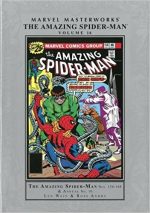
Amazing Spider-Man Masterworks volume 15


By Gerry Conway, Len Wein, Archie Goodwin, Ross Andru, Gil Kane, Sal Buscema & various (Marvel)
ISBN: 978-0-7851-6631-3

After a shaky start in 1962 The Amazing Spider-Man quickly rebounded, rapidly proving a sensation with kids of all ages and rivalling the creative powerhouse of Lee & Kirby’s Fantastic Four. Soon the quirky, charming, action-packed comicbook soap-opera would become the model for an entire generation of younger heroes elbowing aside the staid, (relatively) old costumed-crimebusters of previous publications.

Previously: Peter Parker was a smart yet alienated kid bitten by a radioactive spider during a school science trip. Discovering astonishing arachnid abilities – which he augmented with his own natural chemistry, physics and engineering genius – the kid did what any lonely, geeky nerd would do with such newfound prowess: he tried to cash in for girls, fame and money.

Making a costume to hide his identity in case he made a fool of himself, Parker became a minor media celebrity – and a criminally self-important one. To his eternal regret, when a thief fled past him one night he didn’t lift a finger to stop him, only to find when he returned home that his guardian uncle Ben Parker had been murdered.

Crazed with a need for vengeance, Peter hunted the assailant who had made his beloved Aunt May a widow and killed the only father he had ever known, finding, to his horror, that it was the self-same felon he had neglected to stop. His irresponsibility had resulted in the death of the man who raised him, and the traumatised boy swore to forevermore use his powers to help others…

Since that night the Wondrous Wallcrawler has tirelessly battled miscreants, monsters and madmen, with a fickle, ungrateful public usually baying for his blood even as he perpetually saves them.

The Amazing Spider-Man was always a comicbook that matured with – or perhaps just slightly ahead of – its fan-base, and this 15th exceptionally enthralling full-colour compendium of chronological web-spinning adventures confirms that notion as the World’s Most Misunderstood Hero survives one of the most macabre and Byzantine vengeance plots ever conceived. Further backing up the thought is author Gerry Conway’s farewell Introduction – ‘All Things Must Pass’ – which candidly revealed why after killing Peter’s one true love the editors and especially publisher moved heaven and earth to bring her back…

With the material in this sturdy Hardcover compilation (and latterly eBook) Stan Lee’s hand-picked successor Conway moved on after reaching a creative plateau giving way to fresh authorial guide Len Wein. However, scripts continued to blend contemporary issues (which of course often feel quite outdated from here in the 21st century) with soap opera subplots to keep older readers glued to the series as the outrageous adventure and bombastic battle sequences beguiled the youngsters.

Thematically, there’s further decline in the use of traditional crimes and gangsters, as super-science, outlandish villains and monsters took centre stage, but the most sensational advance was an insidious scheme which would reshape the nature of the web-spinner’s adventures for decades to come…

For all that, the wallcrawler was still indisputably mainstream comics’ voice of youth; defining being a teenager for young readers of the 1970s, tackling incredible hardships, fantastic foes and the most pedestrian and debilitating of frustrations.

High School nerd Peter Parker had grown up and gone to college. Because of his guilt-fuelled double-life he struggled there too, developed a stress ulcer but found true love with policeman’s daughter Gwen Stacy…

This volume – spanning April 1975 to April 1976 – re-presents Amazing Spider-Man #143-155, Annual #10 and opens with Amazing Spider-Man #143 ‘…And the Wind Cries: Cyclone!’ (Conway Ross Andru, Frank Giacoia & Dave Hunt).

Peter Parker is in Paris to deliver a ransom and save kidnapped publisher J. Jonah Jameson but soon calls in his arachnid alter ego to deal with a hyper-fast French super-villain. The story is fairly run-of-the-mill but the real kicker comes from an overly-fond farewell expressed by “casual chum” Mary Jane Watson: a kiss that finally shifts traumatised, depressed Peter’s thoughts from his beloved, recently murdered Gwen…

The creative team capitalised on the situation when Pete returns to New York and his – rather extraordinary – daily travails as #144 launched ‘The Delusion Conspiracy’, whilst #145 focuses on a baffled girl’s confusion and terror at everyone’s reactions when she comes home and the entire world screams ‘Gwen Stacy is Alive …and, Well…?!’

With Gwen somehow resurrected and Peter on the edge of a breakdown, Aunt May is hospitalised just in time for another old foe to strike again in ‘Scorpion… Where is Thy Sting?’, but the real kick in the tale is irrefutable scientific and medical reports proving the increasingly bewildered Miss Stacy is not an impostor but the genuine article…

In Spider-Man #147 Peter finds some answers as further tests prove Gwen is actually a true human clone (remember, this was new and cutting-edge stuff in 1975) but all too soon he’s distracted by another foe bad-guy with a grudge and hungry to prove ‘The Tarantula is a Very Deadly Beast’ (illustrated by Andru, Esposito & Hunt).

It’s all part of a convoluted and utterly Byzantine revenge scheme conceived by a malign old enemy. When the hero is ambushed by a mesmerised Gwen at the behest of the archfiend, ‘Jackal, Jackal, Who’s Got the Jackal?’ (art by Andru, Mike Esposito & Hunt) at last discloses some shocking truths about one of Peter’s most trusted friends before the Delusion Conspiracy explosively concludes with #149’s ‘Even if I Live, I Die!’ (Andru & Esposito).

Learning that he and Gwen had been covertly cloned by their biology teacher Miles Warren, the Amazing Arachnid has to defeat his alchemical double in a grim, no-holds-barred identity-duel, with neither sure who’s the real McCoy. The battle eventually results in the copy’s death… maybe…, perhaps… probably…

That moment of doubt over who actually fell informs anniversary issue Amazing Spider-Man #150, as Archie Goodwin, Gil Kane, Esposito & Giacoia take the hero down memory lane and up against a brigade of old antagonists to decide whether ‘Spider-Man… or Spider-Clone?’ survived that final fight, before debuting regular scripter Len Wein joins Andru & John Romita Sr. to launch a new era of adventure…

After disposing of his duplicate’s corpse in an incineration plant, Spider-Man finds time to let Peter reconnect with his long-neglected friends. However, a jolly party is soon disrupted as blackouts triggered by a super-menace lead the wallcrawler down into the sewers for a ‘Skirmish Beneath the Streets!’, resulting in our hero almost drowning and nearly being ‘Shattered by the Shocker!’(Esposito & Giacoia inks) in a conclusive and decisive return engagement…

A moving change-of-pace tale then finds a blackmailed former football star giving his all to save a child in ‘The Longest Hundred Yards!’ (Andru & Esposito) but it is left to Spider-Man to make the computer-crook culprits pay, after which #154 reveals ‘The Sandman Always Strikes Twice!’ (art by Sal Buscema & Esposito) – albeit with little lasting effect – until devious murder-mystery ‘Whodunnit!’ (Buscema & Esposito again) cunningly links three seemingly unconnected cases in a masterful “Big Reveal”…

This copious compendium then concludes with some contemporary house ads, an editorial explanation of the original “Clone Saga” and biographies. Despite some qualifications this is a superb selection starring an increasingly relevant teen icon and symbol. Spider-Man was and still is a crucial part of many youngsters’ existences: living a life as close to theirs as social mores and the good taste allow.

Blending cultural veracity with glorious art and making a dramatic virtue of the confusion, awkwardness and sense of powerlessness most of the readership experienced daily resulted in an irresistibly intoxicating read, delivered in addictive prime time melodrama moments, but none of that would be relevant if the stories weren’t so compellingly entertaining.

This action-packed collection comprises one of the most momentous periods in Spider-Man’s astounding life and is one every Fights ‘n’ Tights fanatic should see…
© 1975, 1976, 2011, 2015 Marvel Characters, Inc. All rights reserved.

Nine Lives to Live – A Classic Felix Celebration


By Otto Messmer, edited by David Gerstein (Fantagraphics Books)
ISBN: 978-1-56097-308-9

It might surprise you to know, but funny kitties actually pre-date the internet.

Felix is a hilarious, antic-enjoying talking cat of ancient vintage. He was created by Otto Messmer for the Pat Sullivan animation studio in 1915 and was an overnight global hit. Those moving picture cartoons led to a long supplementary career as a newspaper strip, as well as a plethora of merchandisable products in many other media.

Messmer wrote and drew the Sunday strip – which first premiered in London papers – before the feature finally launched in the USA on August 19th 1923. As Messmer’s employer and boss, Sullivan re-inked those initial strips, signed them, and then took all the credit for both strips and even the cartoons, which Messmer carried on directing until 1931.

Otto quietly toiled on, producing Sunday pages and daily strips for decades. In 1955, his assistant Joe Oriolo took over the creative duties and simultaneously began a campaign to return the credit for Felix’s invention and exploits to the true originator. It wasn’t until the 1960s that shy, loyal, brilliant Otto Messmer finally admitted what most of the industry had known for years…

As the cat evolved through successive movie shorts – and eventually numerous TV appearances – an additional and ever-expanding paraphernalia of mad professors, clunky robots and the cat’s legendary magic Bag of Tricks gradually became icons of Felix’s magical world, but most of that is the stuff of a later time and – hopefully – another volume.

The early work collected here comes from the halcyon 1920’s and displays a profoundly different kind of whimsy.

Fast-paced slapstick, fantastic invention and, yes, a few images and gags that might arch the collective metaphorical eyebrow of our more enlightened times; these are the strips that caught the world’s imagination nearly a century ago.

This was a time when even the modern citizens of America and Great Britain were social primitives compared to us – or at least so I’d like to think.

The imagination and wonderment of George Herriman’s Krazy Kat and Cliff Sterrett’s Polly and her Pals – both so similar to Felix in style, tone and execution – got the same responses from their contemporary readership and with the same sole intent: To make the customer laugh.

Our modern tendency to casually label as racist or sexist any such historical incidence in popular art-forms, whilst ignoring the same “sins” in High Art, is the worst kind of aesthetic bigotry, is usually prompted by an opportunistic bias and really truly ticks me off.

Why not use those incensed sensibilities and attendant publicity squalls to confront the still-present injustices and inequalities so many people are still enduring rather than take a cheap shot at a bygone, less enlightened world when most creators had no conception of the potential ramifications of their efforts?

Sorry about that, but the point remains that the history of our artform is always going to be curtailed and covert if we are not allowed the same “conditional discharge” afforded to film, ballet, opera, painting or novels. When was the last time anybody demanded that Oliver Twist was banned or shunned because of its depiction of one Jew?

These days the rush to label things racist, sexist or any other “ist” actually shuts down debate before anything can be achieved to fix or even address the problem…

None of which alter the fact that Felix the Cat is a brilliant and important comic strip by an unsung genius. The wonderful work collected here – which includes hundreds of rowdily phantasmagorical Daily and Sunday strips plus comprehensive biography, filmography and TV videography sections – perfectly encapsulate the wonder, universal charm and rapid-fire, surreal gags that enchanted generations and will still delight and enthrall youngsters of all ages.
© 1996 O.G. Publishing Corp.

Sensation Comics Featuring Wonder Woman volume 2


By Michael Jelenic, Adam P. Knave, Alex De Campi, Amy Chu, James Tynion IV, Heather Nuhfer, Lauren Beukes, Cecil Castelucci, Sara Ryan, Aaron Lopresti, Drew Johnson, Matthew Dow Smith, Ray Snyder, Neil Googe, Bernard Chang, Noelle Stevenson, Ryan Benjamin, Mike Maihack, Chris Sprouse & Karl Story, Christian Duce & various (DC Comics)
ISBN: 978-1-4012-5862-7

The Princess of Paradise Island originally debuted as a special feature in All Star Comics #8 (December 1941), conceived by psychologist and polygraph pioneer William Moulton Marston and illustrated by Harry G. Peter, in a calculated attempt to offer girls a positive and forceful role model and, on forward-thinking Editor M.C. Gaines’ part, to sell more funnybooks to girls.

Wonder Woman then catapulted into her own series and the cover-spot of new anthology title Sensation Comics one month later.

An instant hit, the Amazing Amazon won her own eponymous supplemental title a few months later, cover-dated summer 1942…

Once upon a time on a hidden island of immortal super-women, American aviator Steve Trevor of US Army Intelligence crashed to Earth. Near death, he was nursed back to health by young, impressionable Princess Diana.

Fearful of her besotted child’s growing obsession with the creature from a long-forgotten and madly violent world, Diana’s mother Queen Hippolyte revealed the hidden history of the Amazons: how they were seduced and betrayed by men but rescued by the goddess Aphrodite on condition they forever isolate themselves from the mortal world and devote their eternal lives to becoming ideal, perfect creatures.

However, with the planet in crisis, goddesses Athena and Aphrodite instructed Hippolyte to send an Amazon back with the American to fight for global freedom and liberty. Although forbidden to compete, closeted, cosseted Diana clandestinely overcame all other candidates to become their emissary: Wonder Woman.

On arriving in the Land of the Free she purchased the identity and credentials of lovelorn Army nurse Diana Prince, which elegantly allowed the unregistered immigrant to stay close to Steve whilst enabling the heartsick care-worker to join her own fiancé in South America.

The new Diana soon gained a position with Army Intelligence as secretary to General Darnell, further ensuring she would always be able to watch over her beloved. She little suspected that, although the painfully shallow Steve only had eyes for the dazzling Amazon superwoman, the General had fallen for the mousy but supremely competent Lieutenant Prince…

That set up enabled the Star-Spangled Siren to weather the vicissitudes of the notoriously transient comicbook marketplace and survive the end of the Golden Age of costumed heroes beside Superman, Batman and a few lucky hangers-on who inhabited the backs of their titles.

She soldiered on well into the Silver Age revival under the canny auspices of Robert Kanigher, Ross Andru & Mike Esposito, but by 1968 superhero comics were in decline again and publishers sought new ways to keep audiences interested as tastes – and American society – changed.

Back then, the entire industry depended on newsstand sales and if you weren’t popular, you died.

Jack Miller, Denny O’Neill & Mike Sekowsky stepped up with a radical depowering and made comicbook history with the only female superhero to still have her own title in that marketplace. Eventually however, merely mortal trouble-shooter gave way to a reinvigorated Amazing Amazon who battled declining sales (thanks to a TV-inspired boost) until DC’s groundbreaking Crisis on Infinite Earths after which she was once again fundamentally reimagined.

Minor tweaks in her continuity accommodated different creators’ tenures until 2011 when DC rebooted their entire comics line again and Wonder Woman once more underwent a drastic, fan-infuriating root-and-branch refit.

Possibly to mitigate the fallout the publishers okayed a number of fall-back options such as this intriguing package…

Sensation Comics Featuring Wonder Woman began as “digital first” series appearing online before (months later) collecting a number of chapters into every issue of a new standard comicbook. Crafted by a fluctuating roster of artists and writers, the contents highlighted every previous era and incarnation of the character – and even a few wildly innovative alternative visions – offering a wide variety of thrilling, engaging and sincerely fun-filled moments to remember.

The comicbook iteration was enough of a success to warrant its own series of trade paperback compilations which – in the fullness of time and nature of circularity – gained their own digital avatars as eBooks too.

This second full-colour paperback collection collects Sensation Comics Featuring Wonder Woman #6-10 (March-July 2015) and offers another legion of talent and multitude of different visions, beginning with ‘Generations’ by Michael Jelenic & Drew Johnson wherein an annual odyssey to find the perfect gift for Amazon Queen – and forbidding mother – Hippolyta leads Diana into battle with mythical monsters, an old arch enemy and her own drive to over-achieve…

‘Not Included’ by Adam P. Knave & Matthew Dow Smith then pairs the Princess of Paradise Island with Apokolyptian New God Big Barda against the evil super-science and robotic hordes of The Brain and M’sieu Mallah, after which a decidedly different take by Alex De Campi & Neil Googe finds Wonder Woman coming to the rescue of a commercial space station above the Second Rock from the Sun in ‘Venus Rising’…

Amy Chu & Bernard Chang go out-world to celebrate the concept of Wonder Woman in ‘Rescue Angel’ as soldiers pinned down in Afghanistan are saved by Lt. Angel Santiago. The wounded woman warrior then claims her outstanding actions under fire are the result of a vision from her beloved comicbooks…

Spectacular action and sinister skulduggery informs Heather Nuhfer & Ryan Benjamin’s clash between the Amazing Amazon and Lex Luthor, who proves that ‘Sabotage is in the Stars’ when the Indian government’s space program starts impacting Lexcorp’s projected profits…

James Tynion IV & Noelle Stevenson introduce feisty teen Riley as guide to a culture-shocked young Diana in ‘Wonder World’. As they bond over stupid boys and cheesy beachside entertainments, the girls are blithely unaware that the Princess’ Amazon bodyguards are frantically searching for their AWOL charge…

‘The Problem with Cats’ by Lauren Beukes & Mike Maihack takes a light-hearted look at sisterhood and the rivalry between Wonder Woman and the Cheetah… or is it all in the over-active imagination of frustrated. grounded little African girl Zozo…?

When Daily Planet journalist Lois Lane is ordered to interview Wonder Woman, the ice is only broken after an monster invasion leads to a splendid ‘Girl’s Day Out’ courtesy of Cecil Castelucci, Chris Sprouse & Karl Story whilst Sara Ryan & Christian Duce reveal a timely intervention that saves the life and emotional stability of ‘VIP’ pop star Esperanza…

Aaron Lopresti then wraps up this parade of pulse-pounding peril and cavalcade of insightful episodes with a brutal dragon-slaying clash. ‘Casualties of War’ shows Diana’s abiding reluctance to engage in battle but how sometimes there is no other choice…

Augmented by a spectacular covers-&-variants gallery from Paul Davey, Shane Davis, Michelle & Alex Sinclair, Ben Caldwell & Francesco Francavilla, this is another scintillating snapshot of the astounding variety of visions Wonder Woman has inspired in her decades of existence, and one to delight fans old and new alike.
© 2015 DC Comics. All Rights Reserved.

Mondo Erotica – the Art of Roberto Baldazzini


By Roberto Baldazzini, edited and translated by Nicola D’Agostino & Serena Di Virgilio (Korero Press)
ISBN: 978-0-99333-743-7

Please pay careful attention: this art book contains stories and images of an explicit nature, specifically designed for adult consumption, as well as the kind of vulgar language most kids are fluent in by the age of eight.

If the thought of it all offends you, read no further and don’t buy the book. The rest of us can peacefully enjoy some of the most groundbreaking cartoon and gallery art ever created, without you.

Tomorrow I’ll write about something more socially acceptable, with mindless violence and big explosions, so come back then.

Roberto Baldazzini is an Italian illustrator, comics and mainstream artist whose works are deeply personal, immensely passionate and startlingly evocative. As such they have often been controversial. This electrifying hardcover compiles strips, commissions and gallery pieces created over the last three decades.

In colour and monochrome, this stunning retrospective of gloriously designed and delineated imagery recapitulates a true master’s fascinations: beautiful women, Pop Art, the golden age of cinema, Art Nouveau and those rare creatures who inhabit the borders and fringes of human sexuality…

This superb and long-overdue collection gathers and translates a mere smattering of his beguiling strip work and intoxicating covers – although any is more than welcome – but also includes a vast selection of the artist’s magnificent exotic and erotic paintings and drawings.

Following Nicola D’Agostino’s informative Foreword – citing influences such as Italian photonovels, fashion magazines, Hollywood and the comics trinity of Hal Foster, Alex Raymond and Hergé – we can metaphorically meet the craftsman himself through a candid, thoughtful and pulchritudinously picture-packed ‘Interview with Roberto Baldazzini’ before the extremely graphic narratives commence.

Baldazzini first started making waves in 1984 with period thriller Stella Norris, a feature he continued until 1992. Expanding his horizons, he began appearing in prestigious international magazines such as Glamour, Blue, Diva, Penthouse Comix and Geisha and from 1995 began concentrating almost exclusively on erotic comics whilst garnering a global reputation for his exquisitely explicit Ligne Claire-styled paintings. Even though his gallery status was constantly growing, he never stopped crafting comic strips…

Delivered in stark and meticulous monochrome, ‘The Ring’ is set at a glitzy party in 1950s Hollywood and deconstructively scrutinises a supposed theft and proposed seduction from the individual viewpoints of the participants: untouchable, predatory and promiscuous star ‘Mrs. Marjorie Dobrovsky’, rising, scheming starlet ‘Miss Phoebe Costello’ and secretive, over-attentive maid ‘Miss Rebecca’…

‘Macao’ then describes the seamier side of Tinseltown as Stella Norris’ “evil twin” Greta explores the debauched lifestyle of a celluloid porn star in the era of black and white films and attitudes…

‘Divas, Dommes and Lost Girls’ focuses on some of the artist’s other signature characters; colourfully exploring select snippets of material from Baldazzini babes such as ‘Stella Norris’, ‘Chiara Rosenberg’ and ‘The Orphan’ before ‘Scene of the Crime’ reprints an astounding monochrome strip created in conjunction with Studio Sottsass for a 1988 architectural exhibition in Milan.

The content and themes of the artist’s work always pushed social boundaries: increasingly highlighting gender anomalies, bondage rites and fetishism. ‘Baldazzini’s Fantasies’ features one of his most challenging, controversial and funny pieces – a deliriously silly Who’s Whose of genitalia – after which ‘Seduction and Pain, Malice and Innocence’ opens a catalogue of his most exotic and esoteric eidolons. Broken down into mini-chapters we can see the many forms of ‘Sultrane’, assorted illustrations made for 18th century French classic Histoire de Dom Bougre, Portier des Chatreux in ‘Saturnino’ plus a stunning series of visions inspired by Aubrey Beardsley’s renditions of ‘Salome’…

The extreme limits of fantasy and pleasure are then scrupulously detailed in images from ‘The Castle of Pain’ before plasticised product ‘Ines’ cavorts for the delectation of her clients…

A commission for architecture magazine Terrazzo, ‘Hotel Majestic’ again proves that location is as much a component of death and seduction as human nature, whilst Baldazzini’s ‘Exotic and Incredible Creatures’ segues into an examination of the artist’s most seditious tales and creations – the transgender, transsexual and trans-comfort zone depiction of the protagonists, antagonists and victims who inhabit tales of ‘Trans/Est’ and ‘Casa HowHard’.

The show closes with a fetishist’s dream as ‘The Education of Angela’ finds the star of Casa HowHard back in her singularly exclusive college and suffering strict discipline for her wayward nature…

Supplemented by a full list of Roberto Baldazzini’s Awards and Exhibitions plus a complete Bibliography to date, this tome also strives to keep the whimsy-factor high, and many of the stars are depicted as naked cut-out paper dolls, complete with suitably unsuitable outfits… This long-past-due celebration of a truly unique artistic pioneer is both beautiful and shocking, but also something no mature-minded devotee of graphic excellence should miss.
© 2017 Korero Press Limited. All rights reserved.

Mondo Erotica will be released on August 1st 2017 and is available for pre-order now.

Defenders Masterworks volume 1


By Roy Thomas, Steve Englehart, Sal Buscema, Ross Andru & various (Marvel)
ISBN: 978-0-7851-3044-4 (HC)

Last of the big star conglomerate super-groups, the Defenders would eventually count amongst its membership almost every hero – and a few villains – in the Marvel Universe. No surprise there then, as initially they were composed of the company’s bad-boy antiheroes: misunderstood, outcast and often actually dangerous to know.

For Marvel, the outsider super-group must have seemed a conceptual inevitability – once they’d finally published it. Apart from Spider-Man and Daredevil all their superstars regularly teamed up in various mob-handed assemblages and, in the wake of the Defenders’ success, even more super-teams comprising pre-existing characters were rapidly mustered. These included the Champions, Invaders, New Warriors and so on – but none of them had any really Very Big Guns…

For kids – of any and all ages – there is a positively primal fascination with brute strength and feeling dangerous, which surely goes some way towards explaining the perennial interest in angry tough guys who break stuff as best exemplified by Prince Namor, the Sub-Mariner and the Incredible Hulk. When you add the mystery and magic of Doctor Strange, the recipe for thrills, spills and chills becomes simply irresistible…

Although the genesis of the team may have derived from their status as publicly distrusted but well-selling “villains”, originator Roy Thomas shares his own recollections and deeper ruminations in an informative Introduction which namechecks a pivotal continued experimental crossover which didn’t make the cut in this sterling and sturdy hardcover (and eBook) compendium.

I only mention it as the sinister antagonists of those tales play a crucial role in the later stories that do appear here; namely Sub-Mariner #34-35, Marvel Feature #1-3 and Defenders #1-6, spanning February 1971 through June 1973…

So, for fuller enjoyment, you might want to track down Dr. Strange #183(November 1969), Sub-Mariner #22 (February 1970) and Incredible Hulk #126 (April 1970) – Essential Defenders volume 1 has those plus all these and much more, but only in stark monochrome reproduction – which collectively detailed how ancient necromantic threat the Undying Ones returned to bedevil Earth…

An elder race of demons hungry to reconquer humanity, they clashed with Stephen Strange, but as his series unexpectedly ended with that issue the story went nowhere until the Sub-Mariner #22 brought the Prince of Atlantis into the mix. A sterling tale of sacrifice in which the Master of the Mystic Arts seemingly died holding the gates of Hell shut with the Undying Ones pent behind them then concluded on an upbeat note in Incredible Hulk #126, after a New England cult dispatched helpless Bruce Banner to the nether realms in an attempt to undo Strange’s heroic gesture.

Luckily cultist Barbara Norris had last-minute second thoughts and her own sacrifice freed the mystic, seemingly ending the threat of the Undying Ones forever. At the end of that issue Strange retired, forsaking magic, although he was back before too long as the fates – and fickle reading tastes – called him back to duty.

The Defenders’ story officially begins here with Sub-Mariner #34-35 of his own title (February and March 1971). The Prince of Atlantis had become an early advocate of the ecology movement, and here he took the next step in their evolution by fractiously recruiting Hulk and the Silver Surfer to help him destroy an American Nuclear Weather-Control station.

In ‘Titans Three’ and the concluding ‘Confrontation’ (by Thomas, Sal Buscema & Jim Mooney) the always-misunderstood trio battled a despotic dictator’s forces, the US Army, UN defence forces and the mighty Avengers to prevent the malfunctioning station from accidentally vaporising half the planet…

With that debacle smoothed over life resumed its usual frenetic pace for the Hulk and Namor until giant-sized try-out comic Marvel Feature #1 (December 1971) presented ‘The Day of the Defenders!’ wherein a mysteriously returned Dr. Strange recruited the Avenging Son and the Jade Giant to help him stop the deathbed doom of crazed super-mind Yandroth.

Determined to not go gently into the dark, the Scientist Supreme had built an Omegatron weapon programmed to obliterate the Earth as soon as Yandroth’s heart stopped beating and only the brute strength of the misunderstood misanthropes could possibly stop it…

Naturally the fiend hadn’t told the whole truth but the day was saved – or at least postponed – in a canny classic from Thomas, Ross Andru & Bill Everett.

Clearly and immediately destined for great things, the astounding antiheroes returned in Marvel Feature #2 (March 1972) with Sal Buscema replacing Everett as inker for late Halloween treat ‘Nightmare on Bald Mountain!’

By capturing arch-foe Dr. Strange, extra-dimensional dark lord Dormammu sought to invade our realm through a portal in Vermont, only to be savagely beaten back by the mage’s surly sometime comrades, whilst in #3 (June 1972) Thomas, Andru & Everett reunited to revive an old Lee/Kirby “furry underpants” monster in ‘A Titan Walks Among Us!’

Xemnu the Titan was an alien super-telepath seeking to repopulate his desolate homeworld by stealing America’s children until thrashed by the Defenders, but older fans recognised him as the cover-hogging star of Journey into Mystery #62 (November 1960) where he acted as a road-test for a later Marvel star in a short tale entitled ‘I Was a Slave of the Living Hulk!’…

An assured hit, The Defenders exploded swiftly into their own title (cover-dated August 1972), to begin a bold and offbeat run of reluctant adventures scripted by super-team wunderkind Steve Englehart. As a group of eclectic associates occasionally called together to save the world (albeit on a miraculously monotonous monthly basis) they were billed as a “non-team” – whatever that is – but it didn’t affect the quality of their super-heroic shenanigans.

With Sal Buscema as regular penciller an epic adventure ensued with ‘I Slay by the Stars!’ (inked by Giacoia) as sorcerer Necrodamus attempted to sacrifice Namor and free those pesky Undying Ones; a mission that promptly led to conflict with an old ally in ‘The Secret of the Silver Surfer!’ (inked by John Verpoorten) before concluding in the Jim Mooney-inked ‘Four Against the Gods!’

Here the Defenders took the war to the dimensional dungeon of the Undying Ones and rescued the long-imprisoned and now utterly insane Barbara Norris.

Clearly a fan of large casts and extended epics, Englehart added a fighting female to the non-team with ‘The New Defender!’ (inked by new regular Frank McLaughlin) as Asgardians exiles Enchantress and Executioner embroiled the antiheroes in their long-running and lethal love-spat. The fallout included bringing the Black Knight briefly into the mix and turning Barbara into the latest incarnation of Feminist Fury (these were far less enlightened days) The Valkyrie.

Defenders #5 began a long-running plot thread that would have major repercussions for the Marvel Universe. The denouement of the previous tale had left the Black Knight an ensorcelled, immobile stone statue, and, as Strange and Co. searched for a cure, the long defused Omegatron suddenly resumed its countdown to global annihilation in ‘World Without End?’

This initial collection then concludes with the increasingly isolationist Silver Surfer momentarily “rejoining” in #6 to share ‘The Dreams of Death!’ as new lightweight magic menace Cyrus Black attacked, and was as rapidly repulsed…

After a spiffy team pin-up by Sal Buscema, a revelatory Afterword by Steve Englehart segues into a brief bonus feature including unpublished cover art, contemporary house ads and creator biographies.

For a brief while The Defenders would be one of the best and weirdest superhero comics in the business, but to get there you really need to observe this unruly, uncomfortable selection of misfit heroes in their salad days here. At least the fact that their widespread and far-reaching origins are still so eminently entertaining should be both a relief and delight.

Go on, Enjoy, Pilgrim… the best is yet to come…
© 1970, 1971, 1972, 1973, 2009, 2016 Marvel Characters, Inc. All rights reserved.

Eagle Classics: Riders of the Range


By Charles Chilton, Jack Daniel & Frank Humphris (Hawk Books)
ISBN: 978-0-94824-827-6

In the 1950s Cowboys and Indians ruled the hearts and minds of the First World public. Westerns were the most popular subject of books, films and comics in Britain, America and most of Europe. The new medium of television screened both recycled cowboy B-movies and eventually serials and series especially created for the stay-at-home aficionado.

Some examples were pretty good and became acknowledged as art – as is always the way with popular culture once it gains a few decades and the polished veneer of fond nostalgia – whilst most others faded from memory, cherished only by the hopelessly past-imprisoned and fannishly-driven.

One entertainment arena I didn’t list was radio: a medium ideal for creating spectacular scenarios and dreamscapes on a low budget. However, the BBC (the sole British radio broadcaster of the post-war period) even managed a halfway decent Western/musical show called Riders of the Range. It was written by producer/director Charles Chilton and ran from 1949 until 1953, six series in total.

At the height of its popularity Riders was adapted as a comic strip in Eagle, which already featured the strip exploits of the immensely successful radio star P.C. 49. The hugely successful weekly anthology magazine had already trialled one cowboy strip – Seth and Shorty – but promptly dropped it. With a popular show to bolster it the pictorial Riders of the Range began as a full-colour page in the first Eagle Christmas edition (December 22nd 1950; volume 1, No. 37) and ran continuously until 1962, surviving the demise of its radio parent and becoming the longest-running western strip in British comics history. In all that time it only ever had three artists.

The first was Jack Daniel, an almost abstract stylist in his designs who worked in bold (almost primitive) lines, but whose colour-palette was years ahead of his time. Crude and scratchy-seeming, his western scenarios were subversive and subliminal in impact. He had previously worked on the newspaper strip Kit Conquest. His “European” style of illustration was notoriously unpopular with Editor Marcus Morris and apparently led to the illustrator’s replacement…

Author Chilton had a deep and abiding fascination with the West and often wrote adventures that interwove with actual historical events, such as ‘The Cochise Affair’ included in this splendid oversized paperback collection. It was the second adventure and had heroic Jeff Arnold and sidekick Luke branding cattle for their “6T6” ranch near the Arizona border when they find a raided homestead.

A distraught, wounded mother begs for help and reveals that Indians have stolen her little boy. Taking her to Fort Buchanan, Arnold becomes embroiled in a bitter battle of wills between Chief Cochise and Acting Cavalry Commander Lieutenant George N. Bascom. The lean sparse scripts are subtly engaging and Daniel’s unique design and colour sense – although perhaps at odds with the more naturalistic realism of the rest of Eagle‘s drama strips – make this a hugely enjoyable lost gem.

Angus Scott took over from Daniel with ‘Border Bandits’ (September 7th 1951), but was not a popular or comfortable fit and departed after less than a year. With only a single page of his art reprinted here, it’s perhaps fairest to move on to the artist most closely associated with the strip.

Frank Humphris was a godsend. His artwork was lush, vibrant and full-bodied. He was also as fascinated with the West as Chilton himself and brought every inch of that passion to the tales. From July 1952 and for the next decade Chilton and Humphris (with a few one-off and Christmas Annual contributions from Jesús Blasco, Giorgio Bellavitis and Roland Davies) crafted a thrilling and even educational western saga that is fondly remembered to this day. His tenure is represented here by ‘The War with the Sioux’…

In 1875 gold was discovered in the Black Hills of Dakota and the resultant rush of prospectors resulted in the Cavalry being dispatched to protect them from the incensed Indians. Hired as intermediaries and scouts, Jeff and Luke are increasingly helpless as the situation worsens, resulting in the massacre at Little Big Horn. There have many tales woven into this epochal event, but the patriotically dispassionate creativity of two Britons have united here to craft one of the most beautiful and memorable…

The day of the cowboys’ dominance has faded now but the power of great stories well told has not. Although still relatively easy to find in second hand shops or online, this is a series and a book worthy of a more extensive revival, and well worthy of being resurrected at least as a digital edition. Let’s hope someone with the power to do something about it agrees with me. We’d all be winners then…
Riders of the Range © 1990 Fleetway Publications. Compilation © 1990 Hawk Books.

Yoko Tsuno volume 11: The Three Suns of Vinea


By Roger Leloup translated by Jerome Saincantin (Cinebook)
ISBN: 978-1-84918-302-4

Indomitable intellectual adventurer Yoko Tsuno debuted in Spirou in September 1970 and is still delighting regular readers and making new fans to this day. Her astounding, all-action, excessively accessible exploits are amongst the most intoxicating, absorbing and broad-ranging comics thrillers ever created.

The globe-girdling, space-&-time-spanning episodic epics starring the slim, slight Japanese technologist-investigator were devised by monumentally multi-talented Belgian maestro Roger Leloup who began his own solo career after working as a studio assistant on Herge’s Adventures of Tintin.

Compellingly told, superbly imaginative and – no matter how implausible the premise of any individual yarn – always solidly grounded in hyper-realistic settings underpinned by authentic, unshakably believable technology and scientific principles, Leloup’s illustrated escapades were the vanguard of a wave of strips that changed the face of European comics in the mid-1970s.

That long-overdue revolution featured the rise of competent, clever and brave female protagonists, all taking their places as heroic ideals beside the boys and uniformly elevating Continental comics in the process. Happily, most of their exploits are as timelessly engaging and potently empowering now as they ever were, and none more so than the trials and tribulations of Yoko Tsuno.

Her very first outings (the still unavailable Hold-up en hi-fi, La belle et la bête and Cap 351) were simple introductory vignettes before the superbly capable electrical engineer and her valiant if less able male comrades Pol Paris and Vic Van Steen properly hit their stride with premier full-length saga Le trio de l’étrange in 1971 with Spirou‘s May 13th issue…

Yoko’s exploits generally alternate between explosive exploits in exotic corners of our world, time-travelling jaunts and sinister deep-space sagas – such as this one – with the secretive, disaster-prone alien colonists from planet Vinea.

There have been 27 European albums to date, with another eagerly anticipated for 2017…

Today’s tale was originally serialised in 1975 (Spirou #1932-1953) and collected a year later as 11th album Les Trois soleils de Vinéa. It appears here nearly 40 years later through Cinebook as The Three Suns of Vinea: a captivatingly intergalactic romp of mystery and redemption in equal measure…

It begins with Yoko, Vic and frivolous cameraman pal Pol impatiently awaiting an increasingly rare meeting with an old friend. Her name is Khany and her race, the Vineans, had been hibernating in the Earth for almost half a million years until meeting the curious trio on their first adventure together…

After freeing them from robotic tyranny the humans had helped the survivors rebuild their lost sciences and now a new milestone has been reached. The Vineans are preparing to return to their own system, to see if the dying homeworld they fled two million years ago still exists.

Moreover, there’s room on the experimental scout-ship for three enquiring humans…

All too soon – in strictly scientific, relativistic terms – the explorers are witnessing marvels and miracles as Khany and her comrades discover their binary star-system has stabilised from the stellar catastrophe which threatened to eradicate them so long ago. Miraculously, even their planet of origin survives – albeit in a fantastically altered state…

Emboldened, the astounded cosmonauts survey cosmically-beleaguered Vinea and discover indigenous life still exists. Sadly, the debased primitives are in the thrall of an electronic overlord much like the one that dominated Khany’s people under Earth, but Yoko and her comrades know how to deal with that.

All that’s needed is courage, determination, luck and an ally on the inside…

And when the mighty struggle is over and the war won, Yoko has two more fantastic surprises for her beloved alien companions…

Expansive, suspenseful and phenomenally engaging, this enthralling “Big Sky” sci fi romp roars along with the same kind of wide-eyed astronomical wonderment that made 1950s Dan Dare stories such unmissable entertainment. Packed with thrills and revelation, the story also delivers a powerfully moving denouement, again affirming Yoko Tsuno as a top flight troubleshooter, at home in all manner of scenarios and easily able to hold her own against any fantasy superstar you can name.

As ever the greatest asset in these breathtaking tales is the astonishingly authentic and staggeringly detailed draughtsmanship and storytelling, which superbly benefits from Leloup’s diligent research and meticulous attention to detail.

The Three Suns of Vinea is an epic speculative spectacle to delight and amaze any devotee of Neil R. Jones’ Professor Jameson stories, E. E. Smith’s Lensman novels or the mind-boggling technological treats of Larry Niven as well as any wonder-depleted kid for whom the sky is still no limit…
Original edition © Dupuis, 1976 by Roger Leloup. All rights reserved. English translation 2016 © Cinebook Ltd.

Superman: The Golden Age volume 3


By Jerry Siegel & Joe Shuster, Wayne Boring, Jack Burnley, Paul Cassidy, Ed Dobrotka, Don Komisarow, Leo Nowak, Fred Ray, John Sikela & various (DC Comics)
ISBN: 978-1-4012-7089-6

As his latest record-breaking anniversary rapidly approaches, the popularity of Superman is on the climb again. The American comicbook industry – if it existed at all by now – would have been an utterly unrecognisable thing without The Man of Steel. His unprecedented invention and adoption by a desperate and joy-starved generation gave birth to an entire genre if not an actual art form.

Moreover, with moviegoers anticipating fresh cinematic revelations in the upcoming Justice League blockbuster, expect a wealth of book releases celebrating the serried past of the heroic universe’s ultimate immigrant.

Imitation is the most honest compliment and can be profitable too. Superman triggered an inconceivable army of imitators and variations and, within three years of his Summer 1938 debut, the intoxicating blend of action and social wish-fulfilment which hallmarked the early Action Ace had grown to encompass cops-and-robbers crime-busting, socially reforming dramas, science fiction, fantasy, whimsical comedy and, once the war in Europe and the East finally involved America, patriotic relevance for a host of gods, heroes and monsters, all dedicated to profit through exuberant, eye-popping excess and vigorous dashing derring-do.

In comicbook terms at least, Superman was master of the world. He had already utterly changed the shape of the fledgling industry by the time of these tales. There was a successful newspaper strip, foreign and overseas syndication and the Fleischer studio was producing some of the most expensive – and best – animated cartoons ever conceived.

Thankfully the quality of the source material was increasing with every four-colour release, and the energy and enthusiasm of Jerry Siegel and Joe Shuster had infected the burgeoning studio that grew around them to cope with the relentless demand.

This latest addition to the splendid Golden Age/Silver Age strand of DC reprint compendia presents more of an epochal run of raw, unpolished but viscerally vibrant stories by Siegel, Shuster and the sterling crew of their ever-expanding “Superman Studio” who were setting the funnybook world on fire: crude, rough, uncontrollable wish-fulfilling, cathartically exuberant exploits of a righteous and superior man dealing out summary justice equally to social malcontents, exploitative capitalists, thugs and ne’er-do-wells that initially captured the imagination of a generation.

This third remastered paperback collection (also available digitally) of the Man of Tomorrow’s earliest exploits – reprinted in the order they first appeared – covers the still largely innocent, carefree period between January and September 1941: encompassing Action Comics #32-40, Superman #8-11 and solo-adventures from World’s Best Comics #1 and World’s Finest Comics #2 (an oversized anthology title where he shared cover-stardom with Batman and Robin). As always, every comic appearance is preceded by the original cover illustration, another fine bunch of graphic masterpieces from Paul Cassidy, Wayne Boring and Fred Ray.

Although Siegel & Shuster had very much settled into the character by now, the latter was increasingly involved with the Superman newspaper strip. Even so, the buzz of success still fired them both and innovation still sparkled amidst the exuberance.

Written entirely by Seigel this incredible panorama of torrid tales opens with ‘The Gambling Rackets of Metropolis’ from Action Comics #32.

Like many stories of the time there was no original title and it’s been designated as such simply to make my job a little easier, as Superman crushes an illicit High Society gambling operation that has wormed its nefarious ay into the loftiest echelons of Government, a typical Jerry Siegel social drama magnificently illustrated by the great Jack Burnley.

Superman #8 (January/February 1941) was another spectacular and varied compendium containing four big adventures ranging from fantastic fantasy in ‘The Giants of Professor Zee’ (illustrated by Paul Cassidy); topical suspense in spotlighting ‘The Fifth Column’ (Wayne Boring & Don Komisarow); common criminality in ‘The Carnival Crooks’ (Cassidy) and concluding with an increasingly rare comic-book outing for Joe Shuster – inked by Boring – in the cover-featured ‘Perrone and the Drug Gang’, wherein the Metropolis Marvel battled doped-up thugs and the corrupt lawyers who controlled them.

Action Comics#33 and 34 are both Burnley extravaganzas wherein Superman goes north to discover ‘Something Amiss at the Lumber Camp’, before heading to coal country to save ‘The Beautiful Young Heiress’; both superbly enticing character-plays with plenty of scope for super-stunts to thrill the gasping fans.

Superman #9 (March/April 1941) was another four-star thriller with all the art credited to Cassidy. ‘The Phony Pacifists’ is an espionage thriller capitalising on increasing US tensions over “the European War”, ‘Joe Gatson, Racketeer’ recounts the sorry end of a hot-shot blackmailer and kidnapper, ‘Mystery in Swasey Swamp’ combines eerie rural events with ruthless spies whilst the self-explanatory ‘Jackson’s Murder Ring’ pits the Caped Kryptonian against an ingenious gang of commercial assassins.

The success of the annual World’s Fair premium comic-books had convinced National/DC editors that an over-sized anthology of their characters, with Superman and Batman prominently featured, would be a worthwhile proposition even at the exorbitant price of 15¢ (most 64-page titles retailed for 10¢ and would do so until the 1960s).

At 96 pages, World’s Best Comics #1 debuted with a Spring 1941 cover-date, before transforming into the venerable World’s Finest Comics from issue #2 onwards. From that landmark one-and-only edition comes gripping disaster thriller ‘Superman vs. the Rainmaker’, illustrated by Cassidy, after which Action Comics#35 headlines a human-interest tale with startling repercussions in ‘The Guybart Gold Mine’, and Superman is mightily stretched to cope with the awesome threat of ‘The Enemy Invasion’: a canny and foreboding taste of things to come if – or rather, when – America entered World War II.

Superman #10 (May/June 1941) opens with ‘The Invisible Luthor’ (illustrated by Leo Nowak), ‘The Talent Agency Fraud’ (ditto), ‘The Spy Ring of Righab Bey’ and ‘The Dukalia Spy Ring’ (both by Boring & Shuster), topical and exotic themes of suspense as America was still at this time still officially neutral in the “European War.”

Action Comics #37 (June 1941) returned to tales of graft, crime and social injustice in ‘Commissioner Kent’ (Cassidy art) as the Man of Steel’s timid alter-ego is forced to run for the job of top cop in Metropolis, before World’s Finest Comics #2 (Summer 1941) unleashes Nowak & Cassidy’s ‘The Unknown X’; a fast-paced mystery of sinister murder-masterminds, whilst Action #38 provides a spectacular battle against a sinister hypnotist committing crimes through ‘Radio Control’ (Nowak & Ed Dobrotka)…

Superman #11 (July/August 1941) was an all Nowak affair, beginning with ‘Zimba’s Gold Badge Terrorists’, wherein thinly disguised Nazis “Blitzkrieg” America, after which “giant animals” go on a rampage in ‘The Corinthville Caper’. Seeking a cure for ‘The Yellow Plague’ takes Superman to the ends of the Earth whilst ‘The Plot of Count Bergac’ takes him back home to crush a band of High Society gangsters.

Horrific mad science creates ‘The Radioactive Man’ (Action #39, by Nowak & Shuster) whilst the concluding episode here from issue #40 featured ‘The Billionaire’s Daughter’ (John Sikela) wherein the mighty Man of Tomorrow needs all his wits to set straight a spoiled debutante…

Stories of corruption and social injustice gradually gave way to more spectacular fare, and with war in the news and clearly on the horizon, the tone and content of Superman’s adventures changed too: the scale and scope of the stunts became more important than the motive. The raw passion and sly wit still shone through in Siegel’s stories but as the world grew more dangerous the Man of Tomorrow simply had to become stronger and more flamboyant to deal with it all, with Shuster and his team consequently stretching and expanding the iconography for all imitators and successors to follow.

These Golden Age tales are priceless enjoyment at an absurdly affordable price. How can you possibly resist them?
© 1941, 2017 DC Comics. All Rights Reserved.

Garth: The Cloud of Balthus


By Jim Edgar & Frank Bellamy, with John Allard (Titan Books)
ISBN 10: 0-90761-034-X                   ISBN: 978-0-90761-034-2

British Superman Garth first appeared in the Daily Mirror on Saturday, July 24th 1943, the creation of professional cartoonist Steve Dowling and BBC radio producer Gordon Boshell, at the behest of the editor who wanted an adventure strip to complement their other comic strip features, Buck Ryan, Belinda Blue Eyes, Just Jake and immortal, morale-boosting Jane.

A blond giant and physical marvel, Garth washed up on an island shore and into the arms of a pretty girl, Gala, with no memory of who he was. Nonetheless he saved the entire populace from a brutal tyrant and a legend began. Boshell never had time to write the series, so Dowling, already producing the successful family strip The Ruggles, scripted Garth until a new writer could be found.

Don Freeman dumped the amnesia plot in ‘The Seven Ages of Garth’ (which ran from September 18th 1944 until January 20th 1946) by introducing imposing jack-of-all-sciences Professor Lumiere whose psychological experiments regressed the burly hero back through some past lives.

In the next tale ‘The Saga of Garth’ (January 22nd 1946 to July 20th 1946) his origin was revealed. As a child, he’d been found floating in a coracle off the Shetlands and adopted by a kindly old couple. When grown he became a Navy Captain until he was torpedoed off Tibet in 1943…

Freeman continued as writer until 1952 (‘Flight into the Future’ was his last tale), and was briefly replaced by script editor Hugh McClelland (who only wrote ‘Invasion From Space’) until Peter O’Donnell took over in February 1953 with ‘Warriors of Krull’.

He wrote 28 adventures until resigning in 1966 to devote more time to his own strip; something he called Modesty Blaise.

His place was taken by Jim Edgar; a short-story writer who also scripted such prestigious newspaper strips as Matt Marriott, Wes Slade and Gun Law.

Dowling retired in 1968 and his long-time assistant John Allard took over the strip until a suitable permanent artist could be found. Allard completed ten complete tales until Frank Bellamy began a legendary run with the 13th daily instalment of ‘Sundance’ (which ran from 28th June to 1 October 11th 1971).

Allard remained as background artist and assistant until Bellamy took full control during ‘The Orb of Trimandias’.

One thing Professor Lumiere had discovered and which gave this strip its distinctive appeal – even before the fantastic artwork of Bellamy elevated it to dizzying heights of graphic brilliance – was Garth’s involuntary ability to travel through time and re-experience past and future lives. This simple concept lent the strip an unfailing potential for exotic storylines and fantastic exploits, pushing it beyond its humble beginning as a British response to Siegel and Shuster’s American phenomenon Superman.

The tales in this criminally out of print monochrome tome begin with the aforementioned ‘Sundance’ as mighty Garth is sucked back to 1876 to relive his life as an officer of George Custer’s 7th Cavalry on the Eve of the Battle of the Little Big Horn.

The time-tossed titan has a brief but passionate love affair with Indian maiden Falling Leaf before dying valiantly for his beliefs and their love. It is an evocative, powerful tale that totally captures the bigotry, arrogance and futility of the White Man and the tragic demise of the Indian way of life…

Then eponymous epic ‘The Cloud of Balthus’ shows the open, simple elegance of the narrative concept in Garth. Whilst vacationing in the Caribbean our hero becomes embroiled in an espionage plot involving freelance super-spies and a US space station, but even that is mere prelude to fantastic adventure and deadly terrors when he and his delectable, double-dealing companion Lee Wan are abruptly abducted by nebulous energy beings in a taut, tension-fraught thriller.

‘The Orb of Trimandias’ plunges Garth back in time to the Venice of the Borgias, when he becomes again English Soldier-of-Fortune Lord Carthewan: a decent man battling an insane and all-powerful madman for the secret of a supernaturally potent holy relic. This gripping, exotic yarn is replete with flamboyant action, historical celebrities, sexy women and magnificently stirring locales. It’s a timeless treasure of adventure that has the added fillip of briefly reuniting Garth with his star-crossed true love, the ethereal Space Goddess Astra.

This lovely volume (long overdue for re-issue – at least in digital form if no other way is possible) concludes with a high-octane gothic horror story. ‘The Wolfman of Ausensee’ sees Garth as a rather reluctant companion of movie starlet Gloria Delmar on a shoot at the forbidding Austrian schloss (that’s a big ugly castle to you) of a playboy whose family was once cursed by witches.

Despite the title giving some of the game away, this is still a sharp and savvy spook-fest that ranks easily amongst the best Hammer Horror films, and just gets better with each rereading.

Garth is the quintessential British Action Hero – strong, smart, good-looking with a big heart and nose for trouble. His back-story gives him all of eternity and every genre to play in and the magnificent art of Frank Bellamy also made his too-brief tenure a stellar one.

Comic-strips seldom get this good, and even though this book and its sequel are still relatively easy to come by, it is still a crime and a mystery that all these wonderful tales have been out of print for so long.
© 1984 Mirror Group Newspapers. All rights reserved.

Hellboy volume 11: The Dead Bride and others


By Mike Mignola, Richard Corben, Kevin Nowlan, Scott Hampton, Dave Stewart & Clem Robins (Dark Horse Books)
ISBN: 978-1-59582-740-1

Towards the end of World War II an uncanny otherworldly baby was confiscated from Nazi cultists by American superhero The Torch of Liberty and a squad of US Rangers moments after his eldritch nativity on Earth. The good guys had interrupted a satanic ritual predicted by parapsychologist Professor Trevor Bruttenholm and his associates who were waiting for Hell to literally come to Earth…

The heroic assemblage was stationed at a ruined church in East Bromwich, England when the abominable infant with a huge stone right hand materialised in an infernal fireball. This “Hellboy” was subsequently raised by Bruttenholm, and grew into a mighty warrior engaged in fighting a never-ending secret war against the uncanny and supernatural. The Professor assiduously schooled and trained his happy-go-lucky foundling whilst forming and consolidating an organisation to destroy arcane and occult threats – the Bureau for Paranormal Research and Defense.

After years of such devoted intervention, education and warm human interaction, in 1952 the neophyte hero began hunting down agents of the malign unknown, from phantoms to monsters as lead agent for the BPRD. Hellboy rapidly became its top operative; the world’s most successful paranormal investigator…

As decades passed, Hellboy gleaned snatches of his origins and antecedents, learning he was a supposedly corrupted beast of dark portent: a demonic messiah destined to destroy the world and bring back ancient powers of evil.

It is a fate he despised and utterly rejected…

This eerily esoteric collection of tales concocted by Mike Mignola re-presents a selection of short stories as originally published on/in USAToday.com, Hellboy In Mexico, Hellboy: Double Feature of Evil, Hellboy: The Sleeping and the Dead #1-2, Hellboy: The Bride of Hell and Hellboy: Buster Oakley Gets His Wish, all between 2009 and 2011. These tales draw together many subtly scattered clues disseminated throughout his innumerable tempestuous exploits and contribute to more than fifteen years of slowly boiling magical suspense… as well as hinting at the incredible enigma of the horrific hero’s doom-drenched double destiny…

Following some informative commentary from Mignola the arcane action begins with ‘Hellboy in Mexico or, A Drunken Blur’, (May 2010) illustrated by Richard Corben with colourist Dave Stewart & letterer Clem Robins applying their own seamless contributions to the mix…

In 1982 Hellboy and amphibious ally Abe Sapien are winding down after a strenuous mission in Mexico. Looking for a quiet drink they amble into a ramshackle cantina and discover a sort of shrine comprising a Holy Virgin statue and hundreds of faded photos, posters and tickets for luchadors (masked wrestlers). One of them features Hellboy and three grinning, hooded grapplers…

Shocked and stunned, Hellboy’s mind drifts back to a drunken binge in 1956…

And thus unfolds an untold tale of sterling comradeship and collaborative chaos-crushing as the Demon Detective joins a trio of fun-loving masked brothers who combined their travels on the wrestling circuit with a spot of monster-hunting and devil-destroying, and how it all fell apart after young Esteban fell to the deadly embrace of vampiric bat-god Camazotz…

With the golden times over Hellboy went on an epic memory-eradicating booze-bender until months later BPRD agents found, dried out and brought home their errant top gun…

From Hellboy: Double Feature of Evil (November 2010) – and again illustrated by Corben – comes a brace of theatrically themed terrors. ‘Sullivan’s Reward’ sees Hellboy lured to a phantom-infested manse with a wicked reputation and corrupt mortal owner after which ‘The House of Sebek’ details the mystically inept lengths a horny Egyptology buff descends to in order to slake his lusts. Sadly for him, old crocodile gods never die but do get really ticked off when summoned for the wrong reasons…

A love of classic vampire yarns permeates the epic clash from ‘The Sleeping and the Dead’ #1-2 (December 2010-February 2011) as Scott Hampton, Stewart & Robbins render Mignola’s spooky saga of a nosferatu clan abiding for centuries in a sleepy Suffolk village until Hellboy visited England in 1966 and explosively cleaned house, hearth and home…

Corben returns to illustrate ‘The Bride of Hell’ (December 2009), wherein an American student vanishes in France in 1985. Sent to save her, Hellboy encounters deranged Satan-worshippers, fiends from the Pit and the ghosts of Knight Templar, and learns a small piece of lost history from the annals of the eternal war between Man and the Devil. Tragically, that lesson doesn’t include an appendix on the irresponsibility and unpredictability of human nature and the tale takes a sharp twist which leaves the hero bereft and defeated…

Created as a promotional piece for USA Today‘s website ‘Hellboy: The Whittier Legacy’ (by Mignola with Stewart & Robbins from October 2010) sees the Paranormal Paragon track down the last disgruntled by-blow (it means “illegitimate child”: can’t say my stuff isn’t educational or informative) of an infamous family of Rhode Island Occultists (no; not eye-doctors) determined to enjoy the power and knowledge of his true ancestors. Of course, the old pretender might have shared the heritage, but not the wisdom or foresight to leave well enough alone…

Wrapping up the perilous proceedings, ‘Buster Oakley Gets His Wish’ (April 2011) affords man of many gifts Kevin Nowlan an opportunity to display his mastery of art, colours and letters in a blackly hilarious romp set in Rooks County, Kansas in 1985. Buster was just a bored young farmboy until he performed that ritual from the witchcraft book he’d gotten hold of. Now as Hellboy investigates cow mutilations, he is confronted by weird aliens and teams up with a tragic bovine ally who wishes he’d never heard of the Unknown…

‘Hellboy Sketchbook’ then shares all the covers, story-layouts, doodles, roughs, models and designs; all fully annotated by contributors Nowlan, Corben, Hampton, editor Scott Allie and Mignola, to flesh out the fearsome thrills and chills experience.

Delivered as a succession of short, sharp shockers of beguiling power and ingenuity, this succulent slice of Hellboy’s irresistible history is a perfect example of comics storytelling at its very best: offering astounding supernatural spectacle, amazing arcane action and momentous mystical suspense – something every fear fan and adventure aficionado will enjoy.
™ and © 2009, 2010, 2011 Mike Mignola. Hellboy is ™ Mike Mignola. All rights reserved.