Clifton volume 5: Jade


By Rodrigue & de Groot, translated by Luke Spear (Cinebook)
ISBN: 978-1-905460-52-6 (Album PB/Digital edition)

This book includes Discriminatory Content produced in less enlightened times

An infallible agent of Her Majesty’s assorted security forces, Clifton was originally created by Raymond Macherot (Chaminou, Les croquillards, Chlorophylle, Sibylline) for Le Journal de Tintin. This Gallic-tinged doughty exemplar of Albion debuted in December 1959, just as a filmic 007 was about to set the world ablaze and get everyone hooked on spycraft. After three albums worth of strip material – all compiled and released in 1959-1960 – Macherot left Tintin for arch-rival Le Journal de Spirou, and his bombastic True Brit buffoon was benched.

Courtesy of Jo-El Azaza & Greg (AKA Michel Régnier), Le Journal de Tintin revived Cliftonat the height of the Swinging London scene and aforementioned spy-boom. Those strips were subsequently collected as Les lutins diaboliques in French and De duivelse dwergen for Dutch-speakers in 1969. Then it was back into retirement until 1971 when Greg, with artist Joseph Loeckx, took their shot, toiling on the feature until 1973 when Bob De Groot & illustrator Philippe “Turk” Liegeois fully regenerated the be-whiskered wonder.

They produced ten more tales after which, from 1984 on, artist Bernard Dumont (AKA Bédu) limned de Groot’s scripts before eventually assuming writing chores as well. The series concluded in 1995.

… But Never Say Never Again…

In keeping with its rather haphazard Modus Operandi and indomitably undying nature, the Clifton file reopened yet again in 2003, with De Groot & Michel Rodrigue handling four further adventures. Although the humorous visual vein was still heavily mined in these tales, the emphasis subtly shifted and action/adventure components were strongly emphasised…

Originally released in 2003, Jade was Rodrigue & De Groot’s first collaboration, signalling a fresh start with fans’ fave bits augmented by a stunning new partner for the old war-horse…

Bob de Groot was born in Brussels in 1941, to French and Dutch parents. As a young man he became art assistant to Maurice Tillieux on Félix, before creating his own short works for Pilote. A rising star in the 1960s, he drew spy serial 4×8 = 32 L’Agent Caméléon, where he encountered Philippe “Turk” Liegeois, and consequently began a slow transition from artist to writer. Together they created Archimède, Robin Dubois, and Léonard before eventually inheriting Macherot’s moribund Clifton.

In 1989 de Groot – with Jacques Landrain – devised Digitaline, a strong contender for the first comic created entirely on a computer, and co-created Doggyguard with Michel Rodrigue, even whilst prolifically working with the legendary Morris on both Lucky Luke and its canine comedy spin-off Rantanplan. He was still going strong with Léonard in Eppo, Pere Noël & Fils and Le Bar des acariens (both published by Glénat) until his death on 7th November 2023.

Michel Rodrigue really, really likes Rugby – the highly painful and exhilarating sport for boys and girls of all ages, not the market town in eastern Warwickshire. He was born in Lyon in 1961 and eventually pursued higher education at the National School of Fine Arts, where he also studied medieval archaeology. From 1983-85 he was part of the French Rugby team and in 1987 designed France’s mascot for the World Cup. He made his comics debut in 1984 with sports (guess which one) strip Mézydugnac in Midi Olympique. After illustrating an adaptation of Edmond Rostand’s Cyrano de Bergerac in 1986, he and collaborator Jean-Claude Vruble produced a volume of La Révolution Française, scripted by Patrick Cothias.

Rodrigue then joined Roger Brunel on Rugby en B.D., Du Monde dans la Coupe!, Concept, Le Rugby en Coupe and La Foot par la Bande. For Le Journal de Tintin, he drew Bom’s Les Conspirateurs and produced Rugbyman, official monthly of the French Rugby Federation, amongst a scrum of other strips. Along the way, he began scripting too, and after working with de Groot on Doggyguard joined him on the resurrected Clifton.

Rodrigue also remains astonishingly creatively occupied, working on Ly-Noock with André Chéret, Brèves de Rugby, La Grande Trambouille des Fées for René Hausmann, Les Damnés de la Route, Triple Galop, L’Équipe de Rêve, Futurama comics, Cubitus and spinoff Bidule (with Pierre Aucaigne), and many more…

Pompous, irascible Colonel Sir Harold Wilberforce Clifton is ex-RAF, a former officer with the Metropolitan Police Constabulary and recently retired from MI5. He has a great deal of difficulty dealing with being put out to pasture in rural Puddington and takes every opportunity to get back in the saddle, assisting the shambles in Government or needy individuals as an amateur sleuth whenever opportunity arises. He occupies his idle hours with as many good deeds as befit a man of his standing and service…

In his revived incarnation the balance between satirical comedy, blistering adventure and sinister intrigue is carefully judged and this re-introductory tale opens with the old soldier and his contentiously fiery, multi-talented housekeeper Mrs. Partridge preparing for a camping trip. Clifton is taking a local scout troop to Wales, but some last-minute minor catastrophes are testing his patience and turning the air blue with extremely imaginative invective. Unflappable Mrs. P is able to offset them all thanks to a family connection in the army surplus business, and soon the Colonel is ready to roll but plans change at the very last minute when a shadowy figure leaves a letter. That enigmatic messenger is painfully unaware that they are being carefully observed by another…

The message is in code, but once again la Partridge is up to the task, and Clifton adapts his plans. When the scouts board the lorry the colonel has secured, they learn that they are now heading for Devon…

Arriving at scenic Snooze-on-Pillow, Clifton gets his lads to set up camp, but is soon accosted by an unctuous stranger who takes him to meet an old enemy fallen upon ignominious times. Otto von Kartoffeln was one of Hitler’s greatest assets in the war, but now is a feeble wreck in an old folks’ home bullied by a monster of a nurse. He doesn’t just want to talk over old times, however. The shrunken but still repugnant old remnant wants to share the secret location of a submarine full of Nazi treasure.

Over tea, served by a rather attractive young lady, the old soldiers’ minds go back to their earliest encounters. The tale unfolds of a U-Boat once commanded by Kartoffeln which sank off Scotland at the end of the war. He would happily have left it there forever, if not for the fact that a gang of neo-Nazis are trying to recover it and start up the Fuhrer’s madness all over again…

The old men have no conception that their teapot is bugged and avid young ears are listening with shock and awe and something else…

All too soon, our restless old warrior hurtles northward: dodging bombs and ducking bullets beside an unlikely new partner. Determined on scotching a sinister plot, scuppering a vast submarine base and stopping the rise of the Fourth Reich, Clifton is aware that – as always – there are plots within plots, and amidst the frenetic death-defying action he has to keep one eye on his deadly foes and another on the people claiming to be allies…

Still, with nothing to lose and civilisation to save, Clifton naturally does his utmost…

Funny, fast and furiously action-packed, Jade gives our Old Soldier a subtle overhaul and fresh start in a cunningly-conceived adventure romp in the grandly daft Get Smart! and Austin Powers manner (with a smidge of Bullet Train in there for kids who won’t watch old stuff), sufficient to astound and delight blockbuster addicts whilst supplying a solid line in goofy gags for laughter-addicts of every age to enjoy.
Original edition © Les Editions du Lombard (Dargaud-Lombard SA) 2003 by Rodrigue & De Groot. English translation © 2008 Cinebook Ltd.

Golden Age Doctor Fate Archives volume 1


By Gardner F. Fox, Hal Sherman, Stan Aschmeier, Jon Chester Kozlak & various (DC Comics)
ISBN: 978-1-4012-1308-0 (HB)

This book includes Discriminatory Content produced in less enlightened times.

There are many comics anniversaries this year. The most significant will be rightly celebrated, but some are going to be unjustly ignored. As a feverish fanboy wedged firmly in the past, I’m still abusing my privileges to revisit another brilliant vintage book, criminally out of print and not slated for revival either physically or in digital formats…

One of the most interesting aspects of DC’s Golden Age superhero pantheon is just how much more they gripped the attention of writers and readers from succeeding generations, even if they didn’t set the world alight during their original “Glory Days”. So many relatively short-lived or genuinely second-string characters with a remarkably short shelf life through the formative years of the industry have, since the Silver Age which began in 1956, seldom been far from our attention: constantly revived, rebooted and resurrected. Some even make it onto the big and small screens…

One of the most revered, revisited and frequently revived is Doctor Fate, who first appeared in 1940, courtesy of writer Gardner F. Fox and the uniquely stylistic Howard Sherman. Although starting strong, Fate was another incredibly powerful man of mystery who failed to capture the imaginations of enough readers to build on the chimeric tone of the times. He underwent radical revision midway through his premier run, but with little effect. Dr. Fate lost his strip even before WWII ended. However, since his Silver Age revival, the good doctor has become a popular and resolute cornerstone of more than one DC Universe and he’s still going strong, albeit via some daringly radical forms.

In this magnificent graphic grimoire, following the historically informative and laudatory Foreword by big-time devotee fan/ Keeper of the Golden Age Flame Roy Thomas, this monumental 400-page full-colour deluxe hardback (representing the entirety of Doctor Fate’s run from More Fun Comics #55-98 (May 1940 to July/August 1944)) introduces the potentate of peril in a 6-page parable wherein he combats ‘The Menace of Wotan’.

For those simpler times, origins and motivations were far less important than plot and action, so this eerie yarn focuses on an eerie blue-skinned Mephistopheles’ scheme to assassinate comely yet enigmatic lady of leisure Inza Cramer and how her forceful golden-helmed protector thwarts the plot. Our hero deals harshly with the nefarious azure mage, barely mentioning in passing that Fate possesses all the lost knowledge and lore of ancient civilisations. That’s probably the biggest difference between the original and today’s Fate: back then, he was no sorcerer but an adept of forgotten science (a distinction cribbed from many Lovecraftian horror tales of the previous two decades of pulp fiction): a hair-splitting difference all but lost on the youthful readers.

Eighty-five years later (MFC #55 was on sale from March 29th 1940) we can enjoy again one of the most sophisticated relationships in comics. Fate’s soon-to-be-inseparable companion in peril – latterly Inza Nelson and Doctor Fate in her own right – was clearly also the thaumic troubleshooter’s paramour and disciple and an active player in all the action. However, she didn’t get to be the lead until the 1990s…

In #56 – which boasted the first of 11 cover spots for the Wielder of Old Wisdoms –‘The Search for Wotan’ sees Fate carry Inza up the Stairs of Judgement to Heaven, where they learn their foe is not dead but actually preparing to blow up Earth. Foiling the plan but unable to permanently despatch the big blue meanie, Fate is forced to bury his enemy alive at the centre of the world. Next issue revealed ‘The Fire Murders’ as certified doom-magnet Inza is targeted by mystic arsonist Mango the Mighty before her guardian Fate swiftly ends his campaign of terror, whilst in #58 a modern mage recovers ‘The Book of Thoth’ from its watery tomb, unleashing a wave of appalling, uncanny phenomena until the Blue-&-Gold Gladiator steps in. The self-appointed bulwark against wicked mysticism levitates out of his comfort zone in More Fun #59 to repel an invasion by ‘The People from Outer Space’ but is firmly back in occult territory one month later to destroy ‘The Little Men’ tasked to crush humanity by a mythic triumvirate of colossal Norns.

Behind #61’s striking Sherman cover, ‘Attack of the Nebula’ pits the Puissant Paladin against a cosmic cloud and wandering planetoid summoned by an Earthly madman to devastate Earth, before detailing the doctor derailing a deranged technologist’s robotic coup in #62’s ‘Menace of the Metal Men’ and saving Inza from petrification by ‘The Sorcerer’ in More Fun #63. Like many of Fox’s very best heroic series, Doctor Fate was actually a romantic partnership, with mysterious Inza (only after a number of surnames did she eventually settle on Cramer) acting as assistant, foil, and so very often, target of many macabre menaces. In #64 she and Fate – who still had no civilian identity – share a pleasure cruise to the Caribbean where a slumbering Mayan God of Evil wants to utilise her unique psychic talents in ‘The Mystery of Mayoor’.

Inza got a brief rest in #65 as Fate soloed in a bombastic battle to repel an invasion of America by ‘The Fish-Men of Nyarl-Amen’, but plays a starring role in the next episode as the Doctor exposes a sadistic crook seeking to drive his wealthy cousin to suicide by convincing her that she is ‘The Leopard Girl’

A year after his debut, More Fun Comics #67 (May 1941) at last revealed ‘The Origin of Doctor Fate’: depicting how in 1920, American boy Kent Nelson had accompanied his father Sven on an archaeological dig to Ur. Broaching a pre-Chaldean pyramid, the lad awakened a dormant half-million-year-old alien from the planet Cilia, as well as accidentally triggering security systems that kill his father. Out of gratitude and remorse, the being known as Nabu the Wise trained Kent for two decades, teaching him how to harness the hidden forces of the universe – levitation, telekinesis and the secrets of the atom – before sending him out into the world to battle those who used magic and science with evil intent.

That epic sequence only took up three pages, however, and the remainder of the instalment finds time and space for Fate & Inza to repel a ghostly incursion and convince Lord of the Dead Black Negal to stay away from the lands of the living…

Fate had graduated to 10-page tales and claimed the covers of More Fun #68-76, beginning a classic run of spectacular thrillers by firstly crushing a scientific slaughterer who had built an invisible killing field in ‘Murder in Baranga Marsh’, before gaining a deadly archenemy in #69 as deranged physicist Ian Karkull uses a ray to turn his gang into ‘The Shadow Killers’. In #70, the shadow master allies with Fate’s first foe as ‘Wotan and Karkull’ construct an arsenal of doomsday weapons in the arctic. They are still too weak to beat the Master of Cosmic Forces though, whereas rogue solar scientist Igorovich would have successfully blackmailed the entire planet with ‘The Great Drought’ had Inza not dramatically intervened.

With involvement in WWII now clearly inevitable, covers had increasingly become more martial and patriotic in nature, and with More Fun #72 (October 1941) Fate underwent an unexpected and radical change in nature. The full-face helmet was replaced with a gleaming metallic half hood and his powers were diminished. Moreover, the hero was no longer a cold, emotionless force of nature, but a passionate, lusty, two-fisted swashbuckler throwing more punches than pulses of eerie energy. His previous physical invulnerability was countered by revealing that his lungs were merely human and he could be drowned, poisoned or asphyxiated…

The quality and character of his opposition changed too. ‘The Forger’ pits him against a gang of conmen targeting Inza’s family and other farmers: altering intercepted bank documents to pull off cruel swindles. A far more rational and reasonable nemesis debuted in MF #73 when criminal mastermind ‘Mr. Who’ uses his body-morphing, forced-evolution “Solution Z” to perpetrate a series of sensational robberies.

Despite a rather brutal trouncing – and apparent death – the brute returned in #74 in ‘Mr. Who Lives Again’, with the sinister scientist employing his abilities to replace the City Mayor, whilst in #75 ‘The Battle Against Time’ finds Fate racing to locate the killer who framed Inza’s best friend for murder. Underworld chess master Michael Krugor manipulates people like pawns but ‘The King of Crime’ is himself overmatched and outplayed when he tries to use Inza against Fate, after which #77 saw a welcome – if brief – return to the grand old days as ‘Art for Crime’s Sake’ finds the Man of Mystery braving a magical world of monsters within an ancient Chinese painting to save young lovers eldritchly exiled by a greedy art dealer…

MF #78 details how clever bandits disguise themselves as statues of ‘The Wax Museum Killers’, whilst #79’s ‘The Deadly Designs of Mr. Who’ reveal how the metamorphic maniac attempts to impersonate and replace one of the richest men on Earth, before #80’s innovative felon ‘The Octopus’ turns a circus into his playground for High Society plunder. In More Fun #81, cunning crook The Clock exploits radio show ‘Hall of Lost Heirs’ to trawl for fresh victims and easy pickings prior to the next issue finding Fate exposing the schemes of stage magician/conman The Red Sage, who was offering ‘Luck for Sale!’

‘The Two Fates!’ sees fortune tellers using extortion and murder to bolster their rigged prognostications only to be stopped by the real deal and in #84, the energetic evil-buster braves ‘Crime’s Hobby House!’ to stop thieving special effects wizard Mordaunt Grimm using rich men’s own pastimes to rob them.

Clearly still floundering the series saw big changes for Kent Nelson with #85. Here the stereotyped society idler rapidly and implausibly qualifies as a surgeon and medical doctor, before embarking on a new career of service to humanity. Additionally, his supra-human alter ego ditches the golden cape to become an acrobatic and human – albeit still bulletproof – crimebuster exposing a greedy plastic surgeon helping crooks escape justice as ‘The Man Who Changed Faces!’

Medical themes predominated in these later tales. ‘The Man Who Wanted No Medals’ was a brilliant surgeon who feared a crushing youthful indiscretion would be exposed and #87’s ‘The Mystery of Room 406’ dealt with a hospital cubicle where even the healthiest patients always died. In ‘The Victim of Doctor Fate!’, Nelson suffers crippling self-doubt after failing to save a patient. These only fade after the surgeon’s diligent enquiries reveal the murderous hands of Mad Dog McBain secretly behind the untimely demise…

Charlatan soothsaying scoundrel Krishna Das is exposed by Fate & Inza in #89’s ‘The Case of the Crystal Crimes’, after which ‘The Case of the Healthy Patient!’ pits them against a fraudulent doctor and incurable hypochondriac. Using his chemical conjurations to shrink our hero to doll size in #91’s ‘The Man Who Belittled Fate!’, Mr. Who resurfaces, but is soundly sent packing and – whilst still in jail – the Thief of Time strikes again in More Fun #92 as ‘Fate Turns Back The Clock!’ Next issue, superbly efficient and underrated Hal Sherman ended his long association with the strip in ‘The Legend of Lucky Lane’, wherein an impossibly fortunate felon finally plays the odds once too often…

As the page-count dropped back to 6 pages, Stan Aschmeier illustrated the next two adventures, beginning with 94’s ‘The Destiny of Mr. Coffin!’ as Fate comes to the aid of a fatalistic old soul framed as a fence, whilst ‘Flame in the Night!’ sees a matchbox collector targeted by killers who think he knows too much…

With the end clearly in sight, Jon Chester Kozlak took over the art, beginning with More Fun #96’s ‘Forgotten Magic!’, wherein Fate’s supernal Chaldean sponsor is forced to remove the hero’s remaining superhuman abilities for a day – leaving Kent Nelson to save trapped miners and foil their swindling boss with nothing but wits and courage. The restored champion then exposes the spurious bad luck reputed to plague ‘Pharaoh’s Lamp!’ and ends/suspends his crime-crushing career in #98 by sorting out a case of mistaken identity when a young boy is confused with diminutive Stumpy Small AKA ‘The Bashful King of Crime!’

With the first age of superheroes coming to a close, the readership were developing new tastes. Fate’s costumed co-stars Green Arrow, Aquaman and Johnny Quick – along with debuting super-successful concept Superboy – all migrated to Adventure Comics, leaving More Fun as an anthology of cartoon comedy features. Initially dark, broodingly exotic and often genuinely spooky, Doctor Fate smoothly switched to the bombastic, boisterous, flamboyant and vividly exuberant post war Fights ‘n’ Tights style but couldn’t escape evolving times and trends. Here and forever, however, both halves of his early career can be seen as a lost treasure trove of pulse-pounding pulp drama, tense suspense, eerie enigmas, spectacular action and fabulous fun: one no lover of Costumed Dramas or sheer comics wonderment can afford to miss. Let’s hope the weird world of movies can pay us old comic geeks a dividend in a new edition sometime soon…
© 1940, 1941, 1942, 1943, 1944, 2007 DC Comics. All Rights Reserved.

Mighty Marvel Masterworks Presents volume 3 1963-1964: It Started on Yancy Street


By Stan Lee & Jack Kirby with George Roussos, Chic Stone, Sam Rosen, Art Simek & various (MARVEL)
ISBN: 978-1-3029-4907-5 (TPB/Digital edition)

This book includes Discriminatory Content produced in less enlightened times.

I’m partial to a bit of controversy so I’m going start off by saying that Fantastic Four #1 is the third most important Silver Age comic book ever, behind Showcase #4 – reintroducing The Flash in 1956 – and 1960’s The Brave and the Bold #28, which brought superhero teams back via the creation of The Justice League of America. Feel free to disagree…

After a troubled period at DC Comics (National Periodicals as it then was) and a creatively productive but disheartening time on the poisoned chalice of the Sky Masters newspaper strip, Jack Kirby settled into his job at the small outfit that used to be publishing powerhouse Timely/Atlas. There he generated mystery, monster, romance, war and western material for a market he suspected to be ultimately doomed. However, as always, he did the best job possible and that genre fare is now considered some of the best of its kind ever seen.

Nevertheless Kirby’s explosive imagination couldn’t be suppressed for long and when the JLA caught readers’ attention it gave him and writer/editor Stan Lee an opportunity to change the industry forever. According to popular myth, a golfing afternoon led to publisher Martin Goodman ordering nephew Stan to do a series about a group of super-characters like the JLA. The resulting team quickly took the fans by storm. It wasn’t the powers: they’d all been seen since the beginning of the medium. It wasn’t the costumes: they didn’t have any until the third issue.

It was Kirby’s compelling art and the fact that these characters weren’t anodyne cardboard cut-outs. In a real and recognizable location – New York City – imperfect, raw-nerved, touchy people banded together out of tragedy, disaster and necessity to face the incredible. In so many ways, The Challengers of the Unknown (Kirby’s prototype partners in peril for National/DC) laid all the groundwork for the wonders to come, but staid, hidebound editorial strictures there would never have allowed the undiluted energy of the concept to run all-but-unregulated.

Another milestone in the kid-friendly paperback/eBooks line of Mighty Marvel Masterworks, this full-colour pocket-sized compendium collects Fantastic Four #21-29 (spanning cover-dates December 1961 to August 1964) and shows how Stan & Jack cannily built on that early energy to consolidate the FF as the leading title and most innovative series of the era.

As ever the team are maverick scientist Reed Richards, his fiancée Sue Storm, their closest friend Ben Grimm and Sue’s teenaged brother Johnny: survivors of a private space-shot that went horribly wrong after Cosmic Rays penetrated their ship’s inadequate shielding and mutated them all. Richards’ body became elastic, Susan gained the power to turn invisible and her sibling could turn into living flame. Poor tragic Ben was reduced to a shambling, rocky super-strong freak of nature… Soon the FF was recognised as being like no other comic on the market and buyers responded to it avidly if not fanatically…

In late 1963, Sgt. Fury and his Howling Commandos was another solid newsstand hit for the young “House of Ideas.” Eventually its brusque and brutish star metamorphosed into Marvel’s answer to James Bond. Here, however, he’s a cunning world-weary CIA agent seeking the FF’s aid against a sinister, immigrant-hating racist supremacist demagogue called ‘The Hate-Monger’: a cracking yarn with a strong message, inked by comics veteran George Roussos, under the protective nom-de-plume George Bell.

By this juncture the FF were firmly established and Lee & Kirby well on the way to toppling DC/National Comics from a decades-held top spot through an engaging blend of brash, folksy and consciously contemporaneous sagas: mixing high concept, low comedy, trenchant melodrama and breathtaking action.

Unseen since the premiere issue, #22 heralded ‘The Return of the Mole Man!’ in another full-on monster-mashing fight-fest, chiefly notable for debuting Sue Storm’s new increased power-set. Her ability to project force fields of “invisible energy” also involved a power to reveal hidden things and make others invisible too: advances that would eventually make her one of the mightiest characters in Marvel’s pantheon – and not before time either…

FF #23 enacted ‘The Master Plan of Doctor Doom!’ by introducing his mediocre mercenary minions “the Terrible Trio” – Bull Brogin, Handsome Harry and Yogi Dakor – and the uncanny menace of “the Solar Wave” (which was enough to raise the hackles on my 5-year-old neck. Do I need to qualify that with: all of me was five, but only my neck had properly developed hackles back then?)…

‘The Infant Terrible!’ in #24’s is a classic case of sci fi paranoia and misunderstanding and a sterling yarn of inadvertent extragalactic menace and misplaced innocence, with a reality-warping space baby endangering Earth, and is followed by a 2-part tale truly emphasising the inherent difference between Lee & Kirby’s work and everybody else’s at that time.

Fantastic Four #25-26 offered a cataclysmic clash that had young heads spinning in 1964 and led directly to the Emerald Behemoth finally regaining a strip of his own. In ‘The Hulk vs The Thing’ and conclusion ‘The Avengers Take Over!’ a relentless, lightning-paced, all-out Battle Royale results when the disgruntled emerald man-monster returns to New York in search of side-kick Rick Jones, with only an injury-wracked FF in the way of his destructive rampage.

A definitive moment in The Thing’s character development, action ramps up to the max when a rather stiff-necked and officious Avengers team (Iron Man, Thor, Giant-Man, The Wasp and recently-defrosted Captain America) horn in, claiming jurisdictional rights on “Bob Banner and his Jaded alter ego. The tale is plagued with pesky continuity errors which would haunt Lee for decades, but – bloopers notwithstanding – is one of Marvel’s key moments and still a visceral, vital read today.

Stan & Jack had hit on a winning formula by including other stars in guest-shots – especially since readers could never anticipate if they would fight with or beside the home team. FF #27’s ‘The Search for Sub-Mariner!’ again saw the undersea antihero in amorous mood, and when he abducts Sue again, the boys call in Doctor Strange, Master of the Mystic Arts to locate them. Issue #28 delivered another terrific promotional infomercial team-up, but remains most notable (for me and many other fans) because of the man who replaced George Roussos as inker…

‘We Have to Fight the X-Men!’ sees the disparate super-squads in conflict due to the Mad Thinker and Puppet Master’s malign machinations, but the inclusion of Chic Stone – Kirby’s most simpatico and expressive inker – elevates the illustration to indescribable levels of beauty as the sinister savants briefly mind-control professor Charles Xavier and order him to set his students on the extremely surprised first family…

Closing this foray into the fantastic comes ‘It Started on Yancy Street!’ (FF #29) opening low-key and a little bit silly in the slum where Ben grew up, before the reappearance of the Red Ghost and his Super-Apes sees everything go wild and cosmic. The result is another meeting with the almighty Watcher, a blockbusting battle on the Moon, and the promise of bigger and even better to come…

To Be Continued…

Bolstered by all Kirby’s covers, this is a truly magnificent treat sharing pioneering tales that built a comics empire. The verve, imagination and sheer enthusiasm shines through and the wonder is there for you to share. If you’ve never thrilled to these spectacular sagas then this book of marvels is your best and most economical key to another world and time.
© 2023 MARVEL.

The Wendy Project


By Melissa Jane Osborne & Veronica Fish (Super Genius/Papercutz)
ISBN:978-1-62991-769-6 (TPB)

When does a favourite story or plot become an actual artefact of culture accessible to all? What separates last year’s fictional trope (dystopian future oppresses valiant outsider teen; alienated kid courted by supernatural lover; magic exists but the authorities have been covering it up; there are gangs of likable criminals in big cities and such like) from fundamental narrative memes that underpin all aspects of societal development (underprivileged hero overcomes great odds to win a birthright; loss of loved ones leads to path of vengeance; clever child becomes powerful adult by overcoming adversity; somewhere there exists someone who GETS me; if you just keep pushing you can possess a perfect ornamental helpmeet and you get the picture, no?)?

When you read a fantastic and gripping saga of mortal heroes valiantly slaying a marauding dragon, has the author accessed a rich and ancient cultural heritage or just swiped a scene from a currently in-vogue Tolkien tale?

In today’s likes-driven mass entertainment-monopolised world, certain classic stories – such as Romeo and Juliet, Alice in Wonderland, Cinderella, The Wizard of Oz – have been continually referenced, either overtly or surreptitiously, for numerous commercially sound reasons: assured consumer familiarity, brand awareness or simply that the originals were so masterful that we just don’t want them to end.

In 2015 Emet Comics released a beguilingly fresh riff on J. M. Barrie’s immortal paean to childhood Peter Pan, contrived by actress/writer Melissa Jane Osborne (Oma, Campus Crush) and illustrator Veronica Fish (Spider-Woman, Archie, Slam), marrying inescapably recognisable fantasy landmarks with elements of authentic family tragedy in an often distressing coming-of-age story. In 2017, rereleased via All-Ages and Young Adults graphic novel publisher Papercutz in the US with many foreign editions, The Wendy Project became one of the most beautiful and evocative releases of the year, A year later the book was added to the Yalsa Great Graphic Novels for Teens list.

The entire enchanting emotional rollercoaster ride was available in a sturdy hardcover and compact paperback edition but somehow failed to become a household name in its own right.

Let’s be straight here: this story is the flip side of the coin. The issue at hand is not a fantastic journey to a place of wonders but what happens to the family if children are lost…

One night in New England, 16-year old Wendy Davies is driving her younger brothers home when the car crashes into a lake. As she loses consciousness, the aghast older sister thinks she sees little Michael being carried off into the sky by a flying boy…

An investigation proceeds, but even after leaving hospital Wendy clings to her conviction that her brother is still alive. After all, the police still haven’t found his body. Middle sibling John is no help. He hasn’t spoken since the crash and Wendy just knows he shares her secret…

Deeply traumatised, Wendy’s parents move her to a new school where a therapist cajoles her into starting a journal of words and pictures to help process her grief. Wendy knows what she knows, however. The flying boy is real and has taken Michael, so she must find them and bring her brother home again. As days pass Wendy starts seeing many of the kids at her school in new yet familiar lights. Are they part of the plot to keep Michael from her?

And then, slowly but with escalating frequency and power, the two worlds of New England and Neverland begin to blend and merge…

Mimicking the style of Wendy’s own pencil, pen and crayon recollections and interpretations, Osborne’s “awfully big adventure” is rendered by Veronica Fish in mostly monochrome tones with emphatic, explosive bursts of radiant colour as the fantasy – or is that a greater reality? – intersects with her process of recuperation or acceptance. The conclusion is one no participant is ready for…

So, when is it acceptable and even necessary to stand on the shoulders of narrative giants and play with their magnificent toys? When you can burnish the legend by looking with fresh eyes, add lustre to the original canon and make new wonders for new and old readers. The Wendy Project does just that and is a book you must read.
© 2017 Emet Entertainment LLC. & Melissa Jane Osborne. All Rights Reserved.

Young, Talented… Exploited!


By Yatuu, translated by FNIC (Sloth Publishing)
ISBN: 978-1-908830-02-9 (TPB)

Much as we’d like to think otherwise, the world of work is pretty similar everywhere now and no longer possessed of purely national characteristics. These days we all slave under a universal system that sidesteps borders in the name of global corporate philosophy; it might even be ideology now! Thus, this stunning and still so very germane glimpse of one French woman’s frustrated struggle against modern employment practise is one that’s being repeated all over the planet every day. In this case however, Capitalism picked on the wrong person. Yatuu (Sasha, Génération mal logée!, Pas mon genre) has enough spark, gumption and talent to fight back and eventually turned a strident cartoon objection into a sparkling comics career…

When Cyndi Barbero graduated from college and began looking for a job, all she was offered were unpaid internships. Eventually, she took one, still believing the mantra everyone with a job repeated: “if you work hard enough they may offer a permanent position”…

The work-placement role ran its legally-mandated course and she was promptly replaced by another sucker. After the third time it happened she began to blog (www.yatuu.fr/en) about and sharing her experiences, venting her opinions on such a manifestly unfair system and derive a soupçon of justifiable payback…

Just in case you’re unaware: An Intern takes a position in a company to learn the ropes, develop good working habits and establish contacts that will make them more employable. The system used to work even though most kids ended up doing scut-work and never really learned anything useful. Such positions are unpaid and eventually most employers realised that they could get free low-grade temporary labourers and thereby cut their own running costs. Using, abusing and discarding the seemingly endless supply of optimistic hopefuls has become an accepted expense-control measure at most large businesses. Even employers who originally played fair had to change at some stage, because the exploitative tactics gave business rivals an unfair financial advantage…

In almost 45 years of fairly successful freelancing I met lots of interns – good, bad, indifferent and uncommitted – but after 1990 encountered only one large company where interns were paid – and that’s only because the old-fashioned, old-school CEO put his foot down and insisted. When he retired and the company was sold, the intern program quickly shifted to the new normal…

This subtly understated, over-the-top manga-styled, savagely comedic exposé tracks one exhilarated graduate’s progress from college to the world of no work through ‘At the End of the First Internship’ via ‘At the End of the Second Internship’ to ‘At the End of the Third Internship’ when even she began to smell a rat. Even that didn’t daunt her (much) and, after much soul-searching, she took her dream job at a major Ad Agency. At least it would have been, were she not the latest addition to a small army of interns expending their creative energies for insane zero hours, zero thanks, or acknowledgement and at their own financial expense.

From ‘Some Words Get Instant Reactions at Interviews’ through her ‘First Day’ – via vivid and memorable digressions on expected behaviour and hilariously familiar vignettes of types (I was an advertising freelancer and have actually gone drinking with many of these guys’ British cousins…) – to the accepted 7-days-a-week grind of ‘This Place is Great Because You Learn to Laugh on Cue’ and ‘Nothing Out of the Ordinary’, Yatuu grew accustomed to her voluntary slavery… although her barely-suppressed sense of rebellion was unquenchable.

Amongst so many short, pithy lessons compiled here we see and sympathise with ‘Intensive Training’, observe ‘The Pleasure of Feeling Useful’ and realise there’s ‘Nothing to Lose’, before an intriguing game of office ‘Dilemma’ explores whether to have lunch with the Employees or Interns and what to do if asked to do ‘Overtime’...

As much diary as educational alarm call, this beguiling collection reveals how the hapless ever-hopeful victim developed survival strategies – like finding a long-suffering workmate prepared to lend a floor, couch or bed for those frequent nights when the last train leaves before you do…

Mostly however, this addictive collection deals with the author’s personal responses to an untenable but inescapable situation for far too many young people: revealing insane episodes of exhaustion, despondency and work (but, tellingly not Job)-related stress, such as too many scary midnight cab rides home, constant nightmares and grinding daily insecurity.

What’s amazing is that it’s done with style, bravery and an astonishing degree of good-natured humour – especially when dealing with ‘The Idea Thief’, planning ‘Retaliation’ or perfecting ‘The Ultimate Revenge Technique!!!’

Originally collected as Moi, 20 ans, diplômée, motivée… exploitée!, Yatuu’s trenchant cartoon retaliations were published in English some years ago (so we’re long overdue for a new edition) and makes for fascinating reading. Although it really should be, you probably won’t find Young, Talented, Exploited! discussed in any school Careers lessons or part of any college Job seminar and it’s almost certainly banned from every employers’ Orientation and Training package, but that’s just a sign of how good it is.

Best get your own copy and be ready for the worst scams, indignities and excesses that the Exploiters and Bosses will try to spring on you. At least once you’ve paid for it you can be assured that it will deliver on its promise…
© 2013 Yatuu & 12bis. English translation and layout © 2013 Sloth Publishing, Ltd.

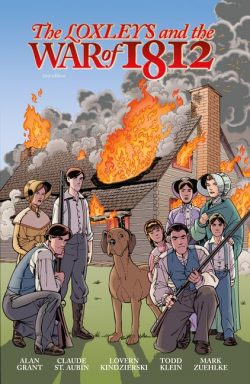
The Loxleys and the War of 1812 (second edition)


By Alan Grant, Claude St. Aubin, Lovern Kindzierski, Todd Klein & Mark Zuehlke (Renegade Arts Entertainment)
ISBN: 978-0-9921508-0-8 (HB)

People and other less dogmatically certain designations who’ve read my musings before know I’m loath to appear political and hold abso-frikkin-lutely no contentious opinions whatsoever. Uneven so, I just felt I should re-recommend an eminently entertaining historical looks from someplace place called Candida or canadia or something that nobody at all wants…

America has been in lots of wars since it won Independence from Britain 20 minutes ago. It has, in fact, started a goodly proportion of those conflicts, special military manoohvers and po-lice actions for less than noble reasons. To be fair, Britain’s far longer war record is no better, but most people here have never even heard of the brutal and frankly stupid conflict now known as The War of 1812. At least, that is until Tangerine PotUS started proving there was no law or rule he couldn’t break…

Somehow the patronised saint of ignorance has started a renaissance in research as all over everywhere, people hear something dumb or desperate and reach for a search engine or even a book…

Two centuries after the fact a small independent creative outfit called Renegade Arts Entertainment (initially Alexander Finbow, Alan Grant, Doug Bradley, John Finbow, Nick Wilson and Jennifer Taylor: originators of comics, audio books, movies, animation, prose and graphic novels, merchandise and games) put their heads together. The glorious result celebrated and commemorated the story of a forgotten clash of political intransigents and empire-building politicians via a pictorial tome for youngsters featuring and seen through the eyes of a multi-generational family caught up in the conflict.

The book won many prestigious awards and the narrative was adapted into an animated motion comic (with the assistance of Arcana Studios and the Department of Canadian Heritage), tablet and digital PDF iterations and numerous other online formats, as well as for a wealth of educational materials for use in conjunction with the piece. Much-missed author Alan Grant rewrote his comics saga as a prose novel and Oscar-nominated screen writer Tab Murphy remade the original story into both a screenplay and school play performed by students across Canada.

This updated, upgraded second edition is a stunning 175 page full-colour hardback tome partnering a powerfully enthralling graphic narrative with an abundance of fascinating extras. Packed with additional illustrations, Finbow’s background-packed Foreword and moving Acknowledgements page whet the appetite for a rollercoaster tale in ‘The Loxleys and the War of 1812’ according to writer Grant, illustrator Claude St. Aubin, colourist Lovern Kindzierski and letterer Todd Klein.

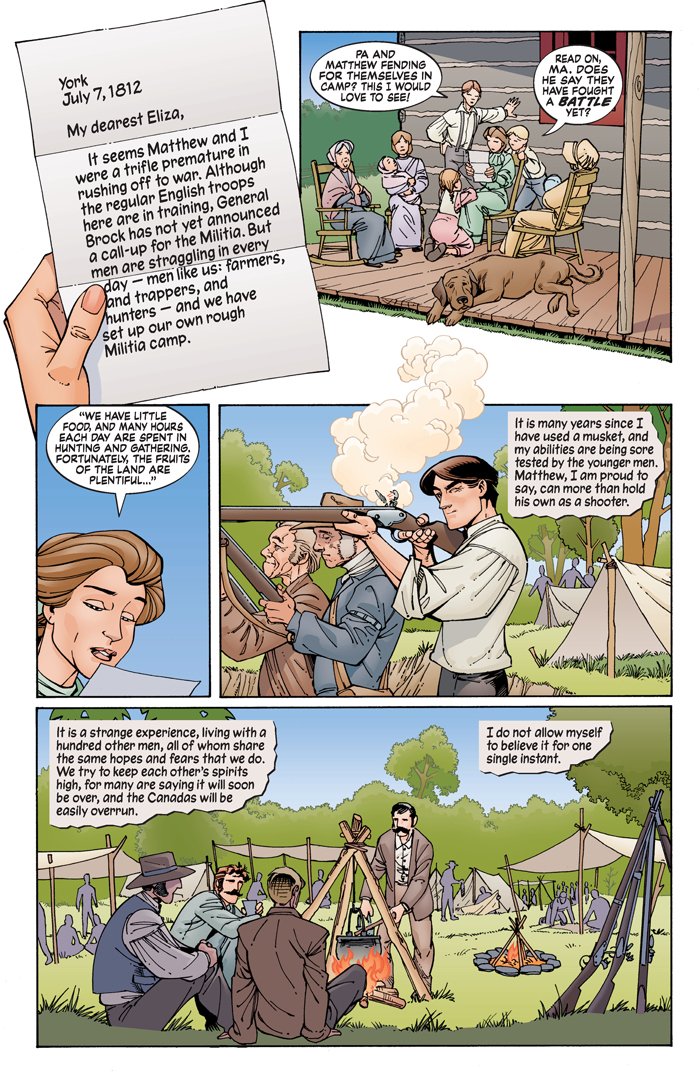
Matriarch Aurora Loxley is justifiably proud of her extended family; three generations living and working together to build a farm and a life in a welcoming land. Originally from Pennsylvania, she and her departed husband Abraham migrated to Canada after the War of Independence, heading to the far side of the Niagara River where their burgeoning clan prospered near the Canadian town of York. Extracts from her journal begin with the harvest of 1811 where hard-earned celebrations are only slightly marred by talk amongst the men of war with America. Britain is currently battling Napoleon all over the world and the Royal Navy has raided American ships and ports, impressing men they claim are British deserters to serve on their embattled vessels. The practise outrages their southern neighbours on the other side of the river, but many leaders in Washington DC act just as badly as the former regal masters they despise.

“War Hawks” in Congress are rapacious expansionists, wanting to wipe out the Indian peoples and believing it is their manifest destiny to rule the entire continent.

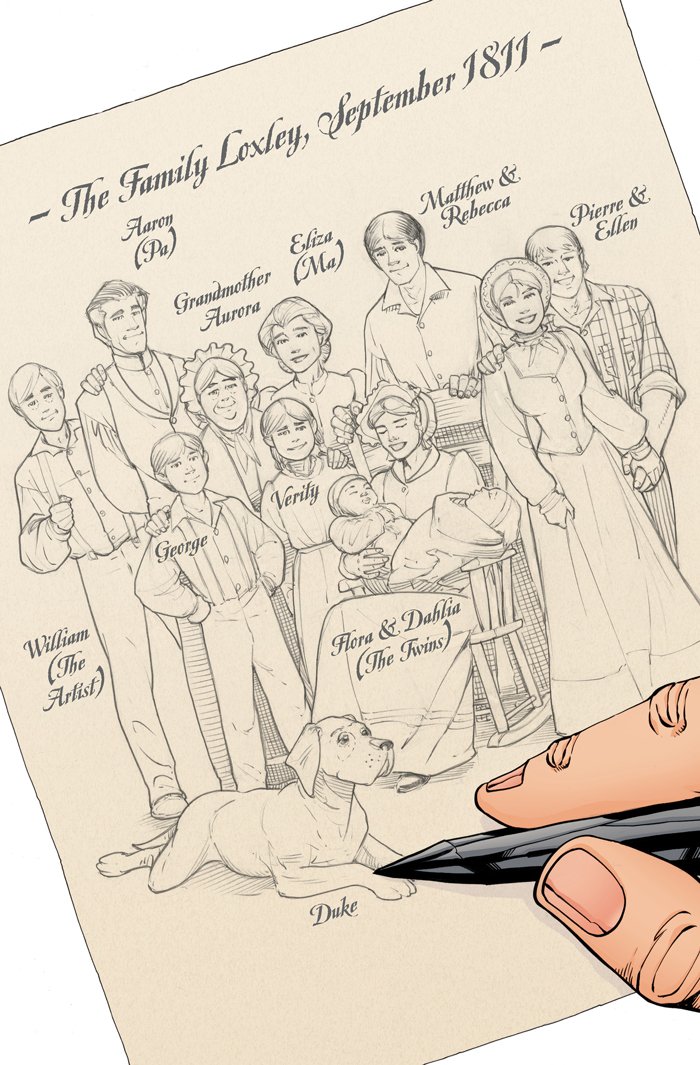
As the idle party talk continues frail William takes a moment to capture the entire family (a dozen happy souls and their dog Duke) in a pencil portrait that depicts their last time as a happy, united family…

Everything changes on the night of November 11th after the hospitable Loxleys invite a frantic messenger into their home. He brings news that the main settlement of visionary Chief Tecumseh’s “nation within a nation” has been destroyed by a force of Americans in a night of massacre. Tecumseh and his brother The Prophet have long worked to create a federation of disparate tribes united as a bulwark against American westward expansion. Now the Yankees have taken the opportunity to move north as well and intend to drive the British out of Canada…

And so begins a deeply moving, informative, even-handed and intensely exciting tale of ordinary people moved to defend themselves against greed and aggression, set against the backdrop of possibly the most ineptly handled, poorly executed war in history – but let’s give it time, eh?

Despite being born of common greed and ruthless ambition by a few and ignorance and intolerance by a multitude, the haphazard, cravenly executed conflict nonetheless bought misery and death to thousands of serving soldiers, sailors and militia volunteers on both sides and domestic atrocity to an uncounted number of innocent civilians over the following two years and eight months. Even America’s greatest triumph, one of pitifully few in their overcautious, criminally mismanaged string of campaigns, was a ludicrous farce. Despite being considered a stunning triumph and affirmation at the time, the Battle of New Orleans occurred weeks after the war officially ended and nobody except the dead, maimed and missing really cared…

As the Locksley family splinters, the story powerfully covers the role of militias on both sides – as well as the valiant French-speaking citizens we know as Quebeçois today – and examines the crucial part played by and eventual betrayal of the First Nations peoples. Also seen through innocent eyes are the machinations of the politicians on both sides and the aftermath of the war..

For old fuddy-duddies like me who like their facts and analysis printed on paper there’s historian Mark Zuehlke’s epic, fascinating and lavishly illustrated essay ‘The War of 1812: Historical Summary’ – preceded by a stunning painting of ‘The White House in Flames’ by John M. Burns – to enjoy before a range of follow-up features offer further information through ‘Creator Biographies’ and alluring details on the other strands of the project such as ‘The Loxleys and the War of 1812 School Play’ and ‘The Loxleys and the War of 1812 Novel by Alan Grant’ both of which include excerpted passages a piece on the ‘The Interactive iPad and Android Tablet app’ and a wealth of delightful ‘Initial Character Designs by Claude St. Aubin’.

Despite the panoply of interactive iterations listed above, this sterling and compulsively readable chronicle ably proves one of my most fervently held beliefs: the comics medium is the perfect means to marry learning with fun and a well-made graphic treatise is an unbeatable mode with which to Elucidate, Educate and Enjoy.

So buy this and do so…
The Loxleys and the War of 1812 © 2012 Renegade Arts Entertainment.

Bunny vs Monkey: The Whopping World of Puzzles!


By Jamie Smart, with Sammy Borras (David Fickling Books)
ISBN: 978-1-78845-350-9 (Digest HB)

Bunny vs Monkey has been the hairy/fuzzy backbone of The Phoenix since the very first issue back in 2012: recounting a madcap vendetta gripping animal arch-enemies in an idyllic arcadia masquerading as more-or-less mundane but critically endangered English woodlands.

Concocted with gleefully gentle mania by cartoonist, comics artist and novelist Jamie Smart (Fish Head Steve!; Looshkin; Max and Chaffy, Flember), his trendsetting, mindbending multi award-winning yarns have been wisely retooled as graphic albums available in digest editions such as this one.

The tail-biting tension and animal argy-bargy began yonks ago after an obnoxiously annoying little anthropoid plopped down in some serene British woodland, in the wake of a disastrous local space shot. Crashed down in Crinkle Woods, scant miles from his launch site, lab animal Monkey reckoned himself the rightful owner of a strange new world… despite every effort to dissuade him by reasonable, rational, sensible, genteel, contemplative forest resident Bunny. No amount of patience, propriety or good breeding on the part of the laid-back lepine could curtail, contain or control the incorrigible idiot ape.

A keen rivalry arose between them, as the ape intruder crudely made himself at home, and to this day Monkey remains a rude, noise-loving, chaos-creating, troublemaking lout intent on building his perfect “Monkeyopia” – with or without the aid of evil supergenius ally Skunky or their “henches” Metal Steve and Action Beaver. Problems are exacerbated by other unconventional Crinkle creatures, like Pig, Weenie, Ai, Lucky, Le Fox. Mad scientist Skunky’s intellect and cavalier attitude to life presents as a propensity for building extremely dangerous robots, Brobdingnagian bio-beasts and sundry other super-weapons…

Here the mundane multi-coloured – albeit rendered here in multifarious shades of mystifying monochrome tones – manic war of nerves and mega-munitions is pettishly paused for a session of traditional entertainment and activities as the entire cast amble ‘To the Woods’ and into a fun-filled framing comic tale. Exploring and ending up somewhere never seen before, our cuddly combatants mutually discover and take charge of a ramshackle and abandoned “lost” fun-fair. Their ingrained competitive lunacy sees all involved revive old rides but also -and this is where you come in – refit and revamp games and puzzles stalls, seeking to make it a holiday fun ride for all…

Cue a selection of character-themed quizzes, puzzles, tests of skill and imagination and other pen and paper activities, Part One of which focuses on reconditioned ‘Games Stalls’. We open with the titular attention-seeking simian lout. His odd-one-out conundrum ‘I am Monkey’ leads to self-explanatory ‘Bunny’s Cross Words’ and more esoteric wordplay in ‘Action Beaver’s Bibblesearch’, ‘Weenie’s Wall of Words’, and ‘Ai’s Speedy Wordswitches’ before naughty wordsearch ‘Monkey’s Too Rude!’ brings us to pencil-driven ‘Metal E.V.E.’s Hall of Mirrors’, ‘Spaces for Faces’ and ‘Embiggening for Beginners’

Riddles and enigmas abound next in ‘Codewords with Le Fox’ after which traversing the ‘Amazing Mud Maze’ will afford a pause to assess ‘Who Will Win? Only You Can Decide’ prior to Part Two commencing with ‘Costume Conundrums!’ and paper-folding foolishness for ‘Fortune-Telling Monkey’ and his ‘Laugh of Truth’ before ‘Bunny’s Would You Rather?’ poses challenging questions in advance of really AARRRRD! stuff in ‘Name That Pirate with Weenie and Pig’ and ‘Talk Like a Pirate’, before again asking ‘Who Will Succeed? Only you can decide!’

Part Three contains culinary calamities and chewy comestibles aplenty, all bedecking assorted ‘FoodStalls’. Learn how to deal with ‘Candyfloss Quiffs’ and identify ‘Weenie’s Cake a Difference’ whilst cowering in glee over ‘Cookery Corner: Wobbleberry Buns’. Having cooked but not burned, we wonder ‘What’s That Smell?’, ‘What’s That Noise?’ and ‘Who’s in the Loo?’ and reassess how ‘Only One Will Succeed!’ before Part Four brings us to a House of Horror uncovering Skunky’s private lab wherein lurks ‘Skunky’s Monster Maker’, ‘House of Horror’, and ‘The All-Seeing Eye!’

Should you need to take breath ‘Skudoku’ and ‘Badgoku’ are available as are ‘Metal E.V.E.’s Hints and Tips’ and ‘Skunky’s Number Puzzle’ just before a barrage of life-challenging decisions await those tackling adventure quiz ‘None of the Fun of the Fair’

The comic story resumes and concludes in traditional shocking vulgar fashion before the last survivors stagger up to the bit with all the ‘Answers’

Daft, compulsively addictive, dangerously read-out-loud-able and fearfully unputdownable, this cutting edge retro-treat is the perfect gift for anyone with crayons, paper and too many kids.
Text and illustrations © Fumboo Ltd. 2024. All rights reserved.

Bunny vs Monkey: The Whopping World of Puzzles! will be published on March 27th 2025 and is available for pre-order now.

Dolltopia


By Abby Denson (Green Candy Press)
ISBN: 978-1-931160-70-4 (TPB/Digital edition)

Not everybody is comfortable with whom they are and most of us don’t like to be assumed one thing when we’re another. Lulu/IPPY Award winner Abby Denson is a magically subversive cartoonist and journalist with such disparate notches in her belt as graphic novel Tough Love: High School Confidential (relating the Coming Out story of two suburban teens), lifestyle bibles Cool Tokyo Guide, Cool Japan Guide and The City Sweet Tooth: a culinary cartoon column about the New York desserts scene for L Magazine.

An educator (teaching at Museum of Comic and Cartoon Art, Eugene Lang College at The New School, Sophia University, Tokyo), her script credits run from Scooby Doo and Power Puff Girls to Spider-Man via Sabrina The Teenage Witch, Josie and the Pussycats, Disney Adventures and The Simpsons.

This entrancing shocking pink parable is an edgy, deceptively naivist fairy tale about gender, place and identity: making telling points in a clandestinely gentle manner via a swingeing attack and dissection of conformity…

Kitty Ballerina is a doll who escapes from The Factory, refusing to be what her makers tell her to be. During her escape she meets Army Jim, another maverick toy who refuses to conform. Together they make their way to the Promised Land of Dolltopia, where you can wear and look like and be whatever you want. With the comradeship and assistance of the cat Mr. M, fashion Divas Candy X and Candy O and slightly off-kilter, self-taught “plastic surgeon” the Doctor, the renegades make themselves at home and truly free…

However, freedom demands effort, vigilance and sacrifice. Some such recently emancipated individuals seem to crave their previous cultural indenture, and raids to liberate more dolls suffer when the apathetic conformists refuse to cast off their social shackles. However, the real threat comes when humans threaten to take away and destroy the hard-won oasis of security these disappointed rebels have strived so long and hard to win…

Charming and cleverly controversial, if perhaps a little heavy-handed at times (sometimes you need fireworks and two-by-fours just to get a mule’s attention!), this eclectic black, pink & white tome – complete with cut-out-&-dress paper dolls – is a winning and culturally crucial addition to the world of adult cartooning and the bigger one you can read it in. You’d be an idiot not to take a good long look – but of course you don’t have to be what I say you are…
© Abby Denson. All right reserved.

Limit Book 1


By Keiko Suenobu, translated by Mari Morimoto (Vertical)
ISBN: 978-1-93565-456-8 (TPB Tank?bon edition)

Travelling a little off the traditional Shōjo (“girl’s comic”) path, Limit is a marvellous thriller by Keiko Suenobu, brought to English-speakers by New York publisher Vertical. In Japan it ran from October 13th 2009 to September 13th 2011, ultimately filling six collected volumes.

Born in Kitakyushu, Fukuoka in March 1979, Suenobu graduated from the University of Tsukuba before beginning her creative career with the school romance Happy Tomorrow. She gravitated towards darker themes of conformity, social pressure and bullying in Vitamin and the moving, controversial and multi award-winning Raifu – translated as Life by TokyoPop in 2006 and later assumed by Kodansha for a20 volume run. This was followed by 2019’s ongoing It’s Over If You Fall.

In 2009 the author took her interest in social issues and the nastier side of school life to imaginative extremes when Limit began serialisation in Kodansha’s Bessatsu Friend. Dark and exceptionally grim, it’s another minor classic inexplicably out of print and hard to find but which will definitely appeal to a readership far beyond the general Shōjo target-market if it ever gets re-issued…

Mizuki Konno is lucky – and savvy – enough to fit with the “In-Crowd” at her all-girls school. Acceptably cute and suitably smart, she’s learned to make no waves and accept that the ways things work is the way things should be. The popular girls – like undisputed teen goddess Sakura Himezawa – make the rules, and the rest conform. It’s a simple matter of survival…

If you’re physically different or interested in odd things, like dumpy manga-fan/tarot reader Arisa Morishige, life can be hell. Only the strongest personalities, like bookish, decent and determinedly wound-tight non-conformist Chieko Kamiya have any chance of standing up to the constant pressure to comply, accept and keep your place in the hierarchy of ‘A Perfect World’

However, everything changes when Sakura’s class drive off for an extended visit to an Exchange Camp in the wilderness. Each class spends a week roughing it with nothing more than a communal scythe and their ever-present cell phones to hold back the horrors of nature, but with this last trip of the semester things go tragically wrong. High in the mountains the coach driver has a heart attack at the wheel and the vehicle, packed with excited girls and their harried teacher, plunges catastrophically into a wooded hidden valley.

Only five girls survive, and undisputed queen of the modern world Sakura isn’t one of them…

As Konno drags shell-shocked Haru Ichinose – Sakura’s subordinate and deeply devoted deputy, and utterly unable to function without her – out of the wreckage sometime later, she sees smoke from a fire. Tracking the signal they find middle-ranking Chikage Usui with her leg splinted and bandaged outside a cave. The wounded survivor has been saved and succoured by coldly efficient Kamiya, who has also scavenged everything potentially useful from the crash site.

At the back of the cave, Morishige sits inside a pentagram, casting the cards. Kamiya has brusquely taken charge, organising resources and outlining options until they can be found and rescued, but introspective Konno can barely grasp the strange situation and new rules of survival. Events take an even nastier turn when the Tarot reader suddenly explodes in jubilation, claiming her prayers have been answered and her tormentors all punished…

Indifferent, ambiguous pragmatist Konno is forced to confront a new world order in ‘The Strong vs. the Weak’, wherein increasingly unstable Morishige takes control. After panicking and unsuccessfully failing to climb out of the box valley, Konno returns to find bereft Haru attacking the former class pariah, but Morishige’s big and burly frame – which brought her such cruel treatment in school – is now the most valuable asset in this new hostile environment. Moreover, she has found that wickedly lethal scythe…

The new queen easily defeats her attacker and then regales the horrified girls with a litany of all the cruel acts she saw their perfect princesses constantly inflict upon each other during their wonderful school days. Haru is unable to accept the change of status and even refuses Konno’s overtures to become allies, just as ascendant Morishige casts the cards again and sees a future where only the strong will survive…

With food already running out, events spiral towards deadly conflict as Konno recalls better days that weren’t actually all that great, only to be dragged back to reality when Morishige decides to split the remaining rations four ways. The clearly unstable would-be witch has established her own social hierarchy with pragmatically compliant Kamiya as Royalty, Usui a Commoner and the roles of Servant and Slave still to be determined by her under ‘The Empress’ Rules’

Haru is provisionally Slave but since they don’t get food she must fight Konno to determine who gets the final privileged – and elevated – role of Servant… To the death, naturally…

To Be Continued…

Rather inaccurately likened to Michael Lehmann’s 1988 cult black comedy Heathers (although perhaps influenced by Koushun Takami’s novel Batoru Rowaiaru or Kinji Fukasaku’s filmic adaptation Battle Royale) Limit certainly derives much of its energising concepts from William Golding’s landmark Lord of the Flies. This bleak, viciously introspective and absolutely chilling tale marries lavish illustration to fearsome examination of what civilised folk consider acceptable behaviour and asks many entertainingly challenging questions.

This lost book – which also includes a charming glance at the author’s methodology in the mini-feature My Workroom – is printed in traditional Japanese right to left, back to front format, but surely we’re all used to that by now?
© 2012 Keiko Suenobu. All rights reserved.

Mimi and the Wolves volume 1


By Albaster Pizzo (Avery Hill Publishing)
ISBN: 978-1-91039-548-6 (HB/Digital edition)

Alabaster Pizzo is an animator and cartoonist who hails from New York, but makes her living in Los Angeles. A graduate of the School of Visual Arts, she’s been intermittently releasing episodes of an epic anthropomorphic post-modern fantasy since 2013. When not animating or storyboarding for major companies you or your kids are quite familiar with, she crafts her own comics such as Ralphie and Jeanie, Hellbound Lifestyle and more of the one under consideration here…

A trio of those early Mimi minicomics were lavishly compiled into a sturdy hardback monochrome tome by the astute powers-that-be of British publisher Avery Hill and comprise the opening salvo in a potent and hopefully long-running allegory for personal empowerment – as all the best fairy tales are…

Preceded by a handy and informative map of the bucolic Hilly City region and a roll call of the major characters, Mimi and The Wolves Act I ‘The Dream’ opens with enigmatic, voyeuristic magician Severine chiding her attendant spirits in snow-draped forests before herbalist Mimi goes gathering plants and herbs for the constructions, concoctions and confections she makes. Times are tough for her and partner Bobo, but they have each other, and good friends in the same boat, so the treehouse they live in is all they really need…

The couple spend a lot of time helping out old farmers Cato and Ceres. Shady Island Farm is getting to be too much for them, so trading toil for food is always a welcome standby option.

Thankfully, Saffron at the general store is always keen to trade for Mimi’s creations and the farm’s dwindling produce output, but the sensitive artisan is painfully aware that the unrelenting strain is getting the better of her fellow workers. Tough but happily idyllic, life would be perfect for Mimi… if only she wasn’t plagued by horrific dreams and terrifying nightmares…

Determined to get to the bottom of her traumas, Mimi distils a brew to provoke a lucid dream and is “rewarded” with an audience: a face-to-face confrontation with an apparent goddess calling herself the Holy Venus. This ethereal visitor tells her to seek out likeminded others and reveals to her a strange symbol by which she will know them. As spring turns to summer, the image obsesses Mimi, even becoming part of her artistic output, much to the growing discomfort and increasing resentment of Bobo. Ever-more distracted, Mimi forages deeper into the woods surrounding the village and one day comes face to face with a huge wolf…

For small woodland creatures like her and Bobo, these giant predators are a constant terror, but this one is different. His name is Ergot and he is a dedicated follower of Holy Venus. In Mimi he sees not lunch, but a fellow congregant. Before long she is invited to join his pack and share knowledge. Hungry for answers – and new experiences – the little artisan slowly falls under Ergot’s sway, and her life changes forever…

Act II ‘The Den’ was included in Best American Comics 2015 and reveals how life has treated Mimi since Bobo turned into an abusive controlling dick before she moved in with the wolves. Ergot and his mate Ivy have been sharing history and doctrine with her, but other than her former lover, Mimi still maintains contact with her other friends in Hilly City. That circle expands when Ceres and Cato take in wandering musician Kiko, and all but implodes when Mimi finally introduces them all to Ergot. Some prejudices are hardwired and cannot be placated or ameliorated…

Life becomes even more bewildering after meeting other wolfpacks. Cobalt, Copper and Opal are friendly enough – although they have unspoken problems with Ergot – but night-dark Nero and Galena live up to every scary stereotype city folk hold dear… and they seem to have an unsettling, unspecified interest in Mimi.

Events take a dark turn in Act III ‘The Howl’ after the revelation that constantly-observing Severine has a foreboding connection to the Holy Venus and is gradually enacting a complex plan. Mimi, however, has been fully inducted into the pack, but is blithely unaware that she is a highly desirable pawn in plans between rival groups who act more like cult families than simple kin. When Nero approaches her, Mimi is so terrified that she flees back to her city friends, but quickly returns to the lupine lair and agrees to attend a large gathering of packs.

… And in the unnoticed background, Kiko quietly observes all…

Joining the Howl is a huge mistake. Nero attacks Mimi and gives her to the Holy Venus as an offering and – although it’s possibly an induced hallucination – in the aftermath allegiances amongst the smaller packs are now twisted and shifted. When Ergot reverts to his true nature, the Goddess makes her move and Mimi comes into her true power…

One common notion of Paradises, Edens and Utopias is that they are always under imminent threat of ending. Life in the allegorical Hilly City and evergreen woods is a rural/small town ideal, but it’s never portrayed as immutable and stable. Amidst the cunning social echoes of Little House on the Prairie and The Waltons – as plain and simple rustic folk eke out a hard but generally rewarding life – comes an implicit awareness that things beyond the group are always disrupting and potentially harmful. Dissent is bad, change is bad, and we trust only ourselves are proven truisms, but they don’t mean a thing if the society harbours – and hinders – a rebel who needs to find their true self…

Bewitching and enticing, this magical mystery tour of self-discovery will charm and reward readers, so why not start your own quest for knowledge by joining this pack?
© Alabaster Pizzo. All rights reserved.