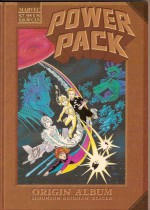
Power Pack Origin Album


By Louise Simonson, June Brigman & Bob Wiacek (Marvel)
ISBN: 0-87135-385-7             ISBN13: 978-0-87135-385-6

By the mid 1980s Marvel was far down a corporate growth-path and headed towards a period of truly dire product; lackluster, unimaginative, uninspired and woefully “safe”, but there was still some spirit of creative adventure to be found – and supported. A perfect example is this is the incredibly appetizing “fun-book” Power Pack which gave a bunch of super-powered kids a brief chance to shine in a world dominated by adults and where every super-powered kid had a grown-up somewhere calling the shots and saving the day…

High above Earth a sentient spaceship and its benevolent alien pilot were shot down whilst attempting to warn the world of impending doom. The aggressors were lizard-like marauders called Snarks determined to steal a new scientific principle discovered by physicist Dr. James Power, whilst the noble Kymellian Aefyre Whitemane sought to quash a secret that had nearly eradicated his own race…

At their isolated Virginia beach-house Power and his wife Margaret are kidnapped by the Snarks, but their four kids Alex, Julie, Jack and Katie, who had seen the Kymellian ship crash, were absent when the lizards attacked, and sheltered by the heroic Whitemane. He reveals that their father’s Anti-Matter energy converter can destroy worlds, but before he can save their parents he dies of his wounds.

The distraught and horrified kids discover they have inherited his fantastic abilities (one each) and with the assistance of Friday, the Kymellian’s “Smart-ship” the now super-powered pre-teens set out to save their parents – as well as the galaxy – and all before bed-time!

‘Power Play’, ‘Butterfingers’, ‘Kidnapped!‘ and ‘Rescue’, the first four issues of the monthly comic book (cover-dated August to November 1984) form a perfect modern fairytale, with classic goodies and baddies, rollicking thrills and adventure and most importantly brave and competent heroes who are still recognizably, perfectly realized children, not adults in all-but-name…

This charming thriller, first collected in 1988 was a rare, creatively unique high point in the company’s output (although it wasn’t long before the kids were subsumed into the greater mutant-teen morass of the X-Men franchise) and it still stands as a sensitive and positive example of plucky kids overcoming all odds to match Peter Pan, Swallows and Amazons, Huckleberry Finn or the very best of Baum’s Oz books.

Superbly observed, magically scripted and beautifully drawn this is a book that every comic loving parent will want their kids to read…
© 1988 Marvel Entertainment Group Inc. All Rights Reserved.

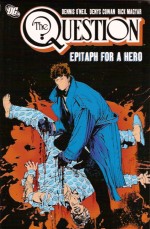
The Question Volume 3: Epitaph for a Hero


By Dennis O’Neil, Denys Cowan & Rick Magyar (DC Comics)
ISBN: 978-1-84576-996-3

In the “real” world, some solutions require careful Questions…

An ordinary man pushed to the edge by his obsessions, Vic Sage used his fists and a mask that made him look faceless to get answers (and justice) whenever normal journalistic methods failed – or whenever his own compulsive curiosity gripped him too tightly. After a few minor successes around the DC universe Sage got a TV reporting job in the town where he grew up.

This third collection (reprinting issues #13-18 of the highly regarded 1980s series) brings Sage into a thoroughly modern nightmare as he seeks to discover the foundations of patriotism, honour and glory and the roots of domestic terrorism in ‘Be All that you can Be…’ when a team operating on strict military principles carries out a series of murderous attacks on Army recruiting centres and personnel. The ace reporter tracks down the killers only to be captured and experience a harrowing example of their torturous training and a staggering example of their integrity in the concluding ‘Saving Face’.

The major portion of the Question’s adventures take place within the urban hell of Hub City, a ghastly analogue of blighted, Reagan-era Chicago, run by a merciless political machine and an utterly corrupt police force until Sage and the Question returned. His old girlfriend Myra Connelly had married the drunken puppet who is the Mayor and now as he dissolves into madness she is trying to win a mandate to run the city herself. Another unlikely champion is reformed and conflicted cop Izzy O’Toole, formerly the most corrupt lawman in “the Hub”.

‘Epitaph for a Hero’ further pushes the traditional boundaries and definitions of heroism when racist private detective Loomis McCarthy comes seeking to pool information on a spate of racially motivated murders during a tight fought election struggle between Myra and millionaire “old guard” patrician Royal Dinsmore. This startling mystery is not as cut-and-dried as it appears and presents some very unsettling facets for all concerned…

Izzy O’Toole continues his struggle for redemption in a brutal untitled confrontation with mythic underpinnings as illegal arms-dealers Butch and Sundance attempt to turn Hub into their own Hole-in-the-Wall (that was an impregnable hideout used by bandits in the old West), casting the grizzled old lawdog as a highly unlikely “Sheriff of Dodge City”.

The tale continues in ‘A Dream of Rorschach’ which tacitly acknowledges the debt owed to the groundbreaking Watchmen in the revival of the Question, as Sage reads the book and has a vision of and conversation with the iconic sociopath whilst flying to Seattle and a chilling showdown with Butch and Sundance as well as a highly suspicious and impatient Green Arrow in the concluding ‘Desperate Ground’.

Complex characters, a very mature depiction of the struggle between Good and Evil using Eastern philosophy and very human prowess to challenge crime, corruption, abuse, neglect and complacency would seem to be a recipe for heady but dull reading yet these stories and especially the mythic martial arts action delineated by Denys Cowan are gripping beyond belief and constantly challenge any and all preconceptions.

Combating Western dystopia with Eastern Thought and martial arts action is not a new concept but O’Neil’s focus on cultural and social problems rather than histrionic super-heroics make this series a truly philosophical work, and Cowan’s raw, edgy art imbues this darkly adult, powerfully sophisticated thriller with a maturity that is simply breathtaking.

The Question’s direct sales series was one of DC’s best efforts from a hugely creative period, and with a new hero wearing the faceless mask these days those tales form a perfect snapshot in comics history. Whether it fades to obscurity or becomes a popular, fabled and revered icon depends on you people: to make it the hit it always should have been all you have to do is obtain these superb trade paperback collections, and enjoy the magic…

© 1988, 2008 DC Comics. All Rights Reserved.

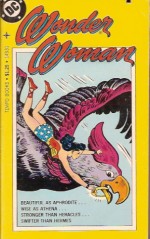
Wonder Woman


By “Charles Moulton” & HG Peter (DC Comics/Tempo Books)
ISBN: 0-448-14531-6-125

Here’s another delightful pocketful of memories in a much-missed (by me at least) format: resized strips as paperback books reprinting a selection of the best stories money could buy. Released in 1978 to capitalise on the popular TV series starring Linda Carter, this dandy little black and white paperback was part of a continuing drive by DC to get out of the down-market newsstands and place their characters regularly onto the shelves of bookstores.

Of course this was before they gave up trying to fit their major asset – visual impact – into a limited format and went the European route of albums with such spectacular results that you’re now reading one of many, many blogs dedicated to reviewing graphic novels, trade paperbacks and items of related interest.

And just in case you were wondering why periodical publishers kept trying?

At its best, a comics title could reach about a million unit sales through magazine vendor systems whilst a book – any book – had the potential of reaching four to twenty times that number…

This collection opens with a re-presentation of one of the Amazing Amazon’s earliest exploits with ‘Wonder Woman’s Lasso’ (1942), an engaging yarn of World War II in which the world’s premiere female costumed foe of injustice (written by controversial psychologist and creator William Moulton Marston) battled spies and sister Amazons to win a magical lariat that could compel and control anybody that fell within its coils.

Too much has been posited about the subtexts of bondage and subjugation in Marston’s tales – and frankly I don’t care what his intentions might have been – I’m more impressed with the skilful drama and incredible fantasy elements that are always wonderfully, intriguingly present: I mean, just where does the concept of giant battle kangaroos come from?

Moulton died in 1947 but his fellow creator, artist Harry G Peter, continued until 1958, although the heroine (one of only three costumed characters who maintained a star presence from the Golden to Silver Ages of comics: the other being Superman and Batman) found the outlandish tenor of her adventures considerably subdued under the editing and writing aegis of Robert Kanigher.

From 1955 ‘The Bird Who Revealed Wonder Woman’s Identity’ found her trying to preserve her secrets after a gabby Mynah bird overheard a revealing conversation to mimic, whilst ‘Wonder Woman’s Wedding Day’(1954) is a charming, traditional romp of wicked thugs and wily mad scientists.

Psychological warfare is the subject of 1953’s fascinating ‘The Secret Invasion’ – a plot by the nefarious Duke of Deception, whilst both ‘The Talking Tiara’ (1954) and the concluding entry ‘The Origin of the Amazon Plane’ (1955) reveal the hidden stories behind Princess Diana’s fabulous accessories in tales rife with dinosaurs, aliens, sea monsters and fantastic quests.

Wonder Woman is rightly revered as a focus of female strength, independence and empowerment, and the welcoming nostalgia and easy familiarity to these tales is a delight for all types of reader but the true value of these exploits is the incredible quality of entertainment they provide.

Although there are excellent and comprehensive collections of her earliest adventures the post-War years of the Amazon have been woefully neglected, and are long over due for some serious compilation attention. Until that time little gems like this are all we can turn to…
© 1978 DC Comics, Inc. All Rights Reserved.

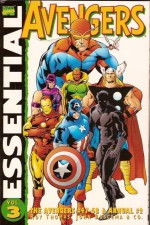
Essential Avengers volume 3


By Roy Thomas, John Buscema, Gene Colan, Barry Smith & various (Marvel)
ISBN: 978-0-7851-0787-3

Slightly slimmer than the usual phonebook sized tome, this third collection of the Mighty Avengers’ world-saving exploits (here reproducing in crisp, stylish black and white the contents of issues #47-68 of their monthly comic book and their second summer Annual) established Roy Thomas as a major creative force in comics and propelled John Buscema to the forefront of fan-favourite artists. These compelling yarns certainly enhanced the reputations of fellow art veteran Don Heck and Gene Colan and made the wider comics world critically aware of the potential of John’s brother Sal Buscema and original British Invader Barry Smith…

With the Avengers the unbeatable and venerable concept of putting all your star eggs in one basket always scored big dividends for Marvel even after the all-stars such as Thor and Iron Man were replaced and supplemented by lesser luminaries and Jack Kirby moved on to other Marvel assignments and other companies. With this third volume many of the founding stars regularly began showing up as a rotating, open door policy meant that almost every issue could feature somebody’s fave-rave, and the amazingly good stories and artwork were certainly no hindrance either.

Opening this fun-fest is ‘Magneto Walks the Earth!’ from Avengers #47 by writer Roy Thomas (who wrote all the stories contained here), illustrated by John Buscema and George Tuska wherein the master of magnetism returns from enforced exile in space to put his old gang together by recruiting mutant Avengers Quicksilver and the Scarlet Witch… whether they’re willing or otherwise…

Tuska assumes full art chores for the second chapter in this saga, ‘The Black Knight Lives Again!’ which introduced a brand new Marvel Superhero, whilst furthering a sub-plot featuring Hercules’ return to an abandoned Olympus and #49, (pencilled and inked by Buscema) concluded the Mutant trilogy with ‘Mine is the Power!’ clearing the decks for the 50th issue tussle as the team rejoins Hercules to restore Olympus by defeating the mythological menace of Typhon in ‘To Tame a Titan!’

Reduced to just Hawkeye, the Wasp and a powerless Goliath the Avengers found themselves ‘In the Clutches of the Collector!’ in #51 (illustrated by Buscema and Tuska), but the brief return of Iron Man and Thor swiftly saw the Master of Many Sizes regain his abilities in time to welcome new member Black Panther in the Vince Colletta inked ‘Death Calls for the Arch-Heroes’ which premiered obsessive super-psycho the Grim Reaper.

Next follows the slightly disconcerting cross-over/conclusion to an epic X-Men clash with Magneto from (issues #43-45) that dovetailed neatly into a grand Avengers/mutant face-off in the Buscema-Tuska limned ‘In Battle Joined!’ whilst issue #54 kicked off a mini-renaissance in quality and creativity with ‘…And Deliver Us from the Masters of Evil!’, which re-introduced the Black Knight and finally gave Avengers Butler a character and starring role, but this was simply a prelude to the second instalment which debuted the supremely Oedipal threat of the Robotic Ultron-5 in ‘Mayhem Over Manhattan!’ (inked by the superbly slick George Klein).

Captain America’s introduction to the 1960s got a spectacular reworking in Avengers #56 as ‘Death be not Proud!’ accidentally returned him and his comrades to the fateful night when Bucky died, which segued neatly into 1968’s Avengers Annual #2 (illustrated by Don Heck, Werner Roth and Vince Colletta). ‘…And Time, the Rushing River…’ found Cap, Black Panther, Goliath, Wasp and Hawkeye returned to a divergent present and compelled to battle the founding team of Iron Man, Thor, Hulk, Giant-Man and the Wasp to correct reality itself.

Buscema and Klein were back for the two-part introduction of possibly the most intriguing of all the team’s roster. ‘Behold… the Vision!’ and the concluding ‘Even an Android Can Cry’ retrofitted an old Simon and Kirby hero from the Golden Age – an extra-dimensional mystery-man – into a high-tech, eerie, amnesiac, artificial man with complete control of his mass and density, and played him as the ultimate outsider, lost and utterly alone in a world that could never, never understand him.

As the adventure and enigma unfolded it was revealed that the nameless Vision had been built by the relentless, remorseless robotic Ultron-5 to destroy the Avengers and especially his/its own creator Henry Pym. Furthermore the mechanical mastermind had used the brain pattern of deceased hero-Wonder Man (see Essential Avengers) as a cerebral template, which may have been a mistake since the synthetic man overruled his programming to help defeat his maniac maker.

Avengers #59 and 60, ‘The Name is Yellowjacket’ and ‘…Till Death do us Part!’ (the latter inked by Mike Esposito moonlighting as Mickey DeMeo) saw Goliath and the Wasp finally marry after the heroic Doctor Pym was seemingly replaced by a new insect-themed hero, with a horde of heroic guest-stars and the deadly Circus of Evil in attendance, followed in swift succession by yet another crossover conclusion.

‘Some Say the World Will End in Fire… Some Say in Ice!’ wrapped up a storyline from Doctor Strange #178 wherein a satanic cult unleashed Norse demons Surtur and Ymir to destroy the planet, and the guest-starring Black Knight hung around for ‘The Monarch and the Man-Ape!’ in Avengers #63; a brief and brutal exploration of African Avenger the Black Panther’s history and rivals.

The next issue began a three-part tale illustrated by Gene Colan whose lavish humanism was intriguingly at odds with the team’s usual art style. ‘And in this Corner… Goliath!’, ‘Like a Death Ray from the Sky!’ and ‘Mightier than the Sword?’ (the final chapter inked by Sam Grainger) was part of a broader tale; an early crossover experiment that intersected with both Sub-Mariner and Captain Marvel issues #14, as a coterie of cerebral second-string villains combined to conquer the world by stealth.

Within the Avengers portion of proceedings Hawkeye revealed his civilian identity and origins before forsaking his bow and trick-arrows, becoming a size-changing hero, and subsequently adopting the vacant name Goliath.

The last three issues reprinted here also form one story-arc, and gave new kid Barry Smith a chance to show just how good he was going to become.

In ‘Betrayal!’ (#66, inked by the legendary Syd Shores) the development of a new super metal, Adamantium, triggers a back-up program in the Vision who is compelled to reconstruct his destroyed creator, whilst in ‘We Stand at… Armageddon!’ (inked by Klein) Adamantium-reinforced Ultron-6 is moments away from world domination and the nuking of New York when a now truly independent Vision intercedes before the dramatic conclusion ‘…And We Battle for the Earth’ (with art from young Sal Buscema and Sam Grainger) sees the team, augmented by Thor and Iron Man, prove that the only answer to an unstoppable force is an unparalleled mind…

To compliment these staggeringly impressive adventures this book also includes ‘Avenjerks Assemble!’ by Thomas, John Buscema and Frank Giacoia: a short spoof from company humour mag Not Brand Echh, the five page full-team entry from the Official Handbook of the Marvel Universe and a beautiful terrific team pin-up.

As the halcyon creative days of Lee and Kirby drew to a close, Roy Thomas and John Buscema led the second wave of creators who built on and consolidated that burst of incredible imagineering into a logical, fully functioning story machine that so many others could add to. These terrific transitional tales are exciting and rewarding in their own right but also a pivotal step of the little company into the corporate colossus.

© 1967, 1968, 2001 Marvel Characters, Inc. All Rights Reserved.

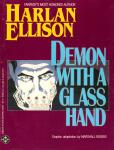
Demon With a Glass Hand – A DC Science Fiction Graphic Novel


By Harlan Ellison, adapted by Marshall Rogers (DC Comics)
ISBN: 0-930289-09-9

Long before comics got into the highly addictive habit of blending and braiding parallel stories and sharing universes science fiction authors such as Isaac Asimov, Robert Heinlein, Larry Niven and Harlan Ellison were blazing the trail. Ellison crafted an extended series of short stories and novellas into the gripping and influential War against the Kyben, even going so far as to break out of print media and into television; consequently garnering even greater fame and glory as well as the 1965 Writers Guild of America Award for Outstanding Script for a Television Anthology and the Georges Melies Fantasy Film Award (1972) for Outstanding Cinematic Achievement in Science Fiction Television.

Demon with a Glass Hand was written as a teleplay – the author’s second – for influential TV show The Outer Limits, premiering on 17th October 1964, and only later being adapted into a prose adventure. In 1986 the startlingly talented and much missed Marshall Rogers used the original, unedited first draft of the TV script to create a fantastically effective comics adaptation for the experimental DC Science Fiction Graphic Novel series.

Humanity’s battle against the Kyben lasted ten generations and involved all manner of technologies including time travel. Trent is a man with a mission and huge holes in his memory. Somewhere in his occluded mind is a vast secret: the location of the entire human race, hidden to prevent the invading Kyben from finding and destroying them. Instead of a right hand he has a crystal prosthetic that talks to him, but the glass computer cannot restore his memories until three of its missing fingers are recovered.

Dispatched to the dubious safety of the 20th century Trent has been followed by a horde of aliens determined to secure that fateful secret and they have taken over the skyscraper where those missing digits are secured…

Aided only by the apparently indigenous human Consuelo, Trent’s paranoiac battle is as much with himself as his foes. As he gradually ascends the doom-laden building to find answers he may not want, he finds fighting creatures painfully human and just as reluctant as he to be there almost more than he can bear but at least his mission will soon end…

Or will it? Demon with a Glass Hand is a masterpiece of tension-drenched drama, liberally spiced with explosive action, and the mythic denouement – in any medium of creative expression – has lost none of its impact over the years.

Classy and compelling this is a perfect companion to Ellison’s other Kyben War comic adaptations, collected as Night and the Enemy, and it must be every fan’s dream to hope that somewhere there’s a publisher prepared to gather all these gems into one definitive edition…
© 1986 The Kilimanjaro Corporation.  Illustrations © 1986 DC Comics Inc.  All Rights Reserved.

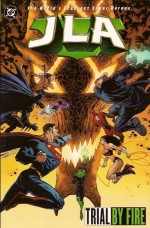
JLA: Trial By Fire NEW EXTENDED AND REVISED REVIEW


By Joe Kelly, Doug Mahnke and Tom Nguyen (DC Comics)
ISBN 1-84023-928-X

When the World’s Greatest Superheroes (see JLA: New World Order) were relaunched in 1997 the quality – and hype – were everything jaded fans could have asked for, but the glistening aura of “fresh and new” doesn’t last forever and by the time of these tales (seven years later and reprinting issues #84-89) the hard task of keeping the excitement levels stoked in a fan-base with a notoriously short attention-span was getting much harder.

Clean, clear-cut, high-concept tales had perforce given way to more involved, even convoluted storylines, and an increasing dependence on other series’ and characters’ continuity. A low point from the usually excellent Joe Kelly was this tale following the appearance of an alien telepathic presence that puts American President Lex Luthor into a brain-dead coma before assaulting the entire League.

Investigations lead to an alien incursion more than twenty thousand years ago when a monstrous presence was defeated at huge cost by a band of cavemen led by the League’s oldest foe, but it appears that the diabolical beast known as “The Burning” may not have died forever…

Going back even further in DC history it would appear that the Guardians of the Universe, immortal taskmasters of the Green Lantern Corps were involved in the creation of The Burning, and their implacable meddling may have been instrumental in the origins, rise and potential fall of one of Earth’s greatest heroes…

Plagued by cruelly debilitating visions and psychic assaults, as are a sizable portion of humanity, the heroes are desperately struggling as one of their own is possessed by the malevolent entity Fernus who is only seconds away from turning the entire world into a radioactive cinder. Can the JLA get their act together in time to prevent Armageddon? Of course they can… but not without paying a brutal, tragic price…

This is not a terrible tale: whole sections are exceptionally entertaining and the art is spectacular throughout. But it is too far-ranging and undisciplined; with so many strands to keep hold of that it loses cohesion every now and then and feels almost rushed in execution.

The JLA has a long history in all its incarnations of starting strong but losing focus, and particularly of coasting by on past glories for extended periods – and it was distressing to see such portents so soon. Luckily the New/Old Dog still had a few more tricks and a little life in it before the inevitable demise and reboot for the next generation after Final Crisis.

Worth a little of your time, but only if, and in the context of, reading the good stuff too…

© 2004 DC Comics. All right reserved.

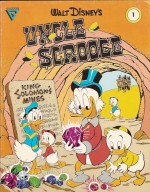
Walt Disney’s Uncle Scrooge in The Mines of King Solomon – Gladstone Comic Album #1


By Carl Barks & anonymous (Gladstone)
No ISBN

The greatest surprise about this magnificent slice of all-ages-adventure is just how long it took to make the blindingly obvious connection between the epitome of the American self-made man – okay, Duck – and the most ubiquitous legend of lost and illimitable wealth. ‘The Mines of King Solomon’ is magical mystery and exotic derring-do wrapped up in the author’s sly wit, uproarious slapstick and down-home, simple morality: in other words, pure Carl Barks.

One of the greatest storytellers America has ever produced, Barks’ early life is well-documented elsewhere if you need detail, but in brief, he started as a jobbing cartoonist, before joining Disney’s studio in 1935, toiling in-house as a animator before quitting in 1942 to work exclusively and anonymously in comic books.

Until the mid-1960s he worked in productive seclusion writing and drawing a vast array of comedic adventure yarns for kids, creating a Duck Universe of memorable – and highly bankable – characters like Gladstone Gander (1948), the Beagle Boys (1951), Gyro Gearloose (1952), and Magica De Spell (1961) to augment the stable of cartoon actors from the Disney Studio. His greatest creation was undoubtedly the crusty, energetic, paternalistic, money-mad gazillionaire Scrooge McDuck: the star of this show.

So potent were his creations that they fed back into Disney’s animation output itself, even though his brilliant comic work was done for the licensing company Dell/Gold Key, and not directly for the studio.

Throughout this period Barks was blissfully unaware that his work (uncredited by official policy as was all the company’s cartoon and comicbook output), was nevertheless singled out by a rabid and discerning public as being by “the Good Duck Artist.” When some of his most dedicated fans finally tracked him down, his belated celebrity began.

Gladstone Publishing began re-releasing Barks material – and a selection of other Disney comics strips – in the 1980s and this album is another one of the best. Whilst producing all that landmark innovative material Barks was just a working guy, generating covers, illustrating other people’s scripts when necessary (as here in the intriguing supplementary “team-up” with Grandma Duck) and contributing story and art to the burgeoning canon of Donald Duck and other Big Screen characters.

Printed in the large but increasingly scarce European oversized format (278mm x 223mm) this glorious gem reprints the contents of Uncle Scrooge #19 (1957) wherein the Mallard Magnate decides to personally check all his global money-making ventures, and dragoons Donald Duck and his nephews into tagging along to be his unpaid dogs-bodies.

At his glass factory in Sweden he discovers that the supply of sand has dried up, and Duck-of-Action that he is, flies straight to the Sinai desert to discover why. And thus begins an absorbing trek through epochs ancient and modern that leads, via bandits, beasts and general bedlam, to the uncovering of the most spectacular treasures of the ages…

Barks drew ‘Honey of a Hen’ for an unnamed scripter (from Four Color Comics #1010, better known as Grandma Duck’s Farm Friends, 1959) wherein the mighty Management Mogul fails to optimise productivity on the old biddy’s small-holding, but it’s all the great man himself for the remaining stories; two Scrooge single-page gag strips from Uncle Scrooge #19 and #21 and a painfully funny yarn from Walt Disney Comics and Stories #227 (1958), once again pitting the irascible Donald against his nephews in their most obnoxious mode as veteran know-it-alls of the Junior Woodchucks.

No one has ever bettered Barks at blending humour with drama and charm with action and even if you can’t find this particular volume, his work is now readily accessible through a number of publications and outlets. So if you’ve denied yourself his captivating brand of magic, no matter what your age or temperament you can easily experience the magic of the man Will Eisner called “the Hans Christian Andersen of Comics.”

You poor fools, what are you waiting for?

© 1987, 1959, 1958, 1957 The Walt Disney Company. All Rights Reserved.

The Medusa Chain


By Ernie Colon (DC Comics)
ISBN: 0-930289-00-5

Born in Puerto Rico in 1931 Ernie Colón is a tremendously undervalued and unsung maestro of the American comics industry whose work has been seen by generations of readers. Whether as artist, writer, colourist or editor his contributions have affected the youngest of comics consumers (Monster in My Pocket, Richie Rich and Casper the Friendly Ghost for Harvey Comics and his similar work on Marvel’s Star Comics imprint) to the most sophisticated connoisseur with strips such as his startling indie thriller Manimal.

His catalogue of “straight” comic-book work includes Battlestar Galactica, Damage Control and Doom 2099 for Marvel, Grim Ghost for Atlas/Seaboard, the fabulous  Arak, Son of Thunder, Amethyst: Princess of Gemworld, the Airboy revival for Eclipse, Magnus: Robot Fighter for Valiant and so very many others.

In 2006 with long-time Harvey Comics/Star collaborator Sid Jacobson he created a graphic novel of the 9/11 Commission Report entitled The 9/11 Report: a Graphic Adaptation. In August 2008, they released a 160-page follow-up: After 9/11: America’s War on Terror. Even now he’s still hard at work on the strip SpyCat which has appeared in Weekly World News since 2005.

During the first wave of experimental creativity that gripped the 1980s comics business he released this self-generated (even lettering and colouring it himself) science fiction thriller through DC’s ambitious, oversized Graphic Novels line. Intriguing, complex and multi-layered, it is the gritty tale of Chon Adams, a star-ship officer convicted of a dreadful crime, sentenced to a lifetime of penal servitude on a deep-space space cargo ship, and how he finds a kind of fulfilment in a situation most would describe as a living hell.

Flavoured by Alfred Bester’s The Stars My Destination (commonly known now as Tiger! Tiger!) by way of noir prison/chain-gang movies like George W. Hill’s The Big House this is a fascinating tale-within-a-tale as Chon’s “crime” is gradually revealed whilst he endures and survives against unbelievable odds in the depths of infinity gaining unlikely allies and a grain of self-respect…

Graphic, uncompromising and thoroughly compelling this classy tale careens from cynical depths of human depravity to heights of glorious high fantasy with ease: a true lost gem of that boldly exploratory 1980s comics boom, and a cracking read for any older SF fan.

And the one good thing – for you – about Colon’s relative obscurity is that copies of this gem – and his later Marvel graphic novel Ax – are still readily available through internet retailers at ridiculously low prices. Definitely one you really, really want…
© 1984 DC Comics. All Rights Reserved.

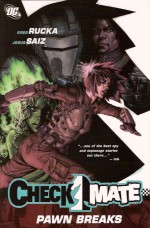
Checkmate: Pawn Breaks


By Greg Rucka, Jesus Saiz, Steve Scott & various (DC Comics)
ISBN:978-1-84576-603-0

In the aftermath of DC’s Infinite Crisis an international organisation to monitor and control meta-human affairs was developed, under the aegis of the United Nations Security Council. Originally an American agency, Checkmate had gone rogue under the telepathic influence of Maxwell Lord, and the new internationally sanctioned organisation is tasked with policing all nations, protecting them from metahuman dangers and terrorism, and also preventing “rogue” nations and regimes from weaponising their own paranormal resources.

This second tripwire-tight collection reprints issues #8-12 of the fondly remembered comic book, following as the organisation (composed of superheroes and traditional intelligence operatives) goes to absolutely outrageous lengths to place an undercover agent in the global death cult Kobra, courtesy of Greg Rucka, Jesus Saiz and Fernando Blanco.

‘Pawn 502’ is a superbly paranoid thriller with plenty of twists and turns and spellbinding action, cleverly plundering many dark and dusty corners of DC continuity for the delectation of long-term readers whilst skilfully keeping the newly initiated appraised. Crossover fans mighty like to know there’s a classy Shadowpact guest-shot included here.

Following is an intriguing tale that slips uncomfortably into the too-real world of South American death squads and rigged elections from writers Rucka, Nunzio DeFilippis and Christina Weir, pencillers Steve Scott and Cliff Richards, and inkers Nathan Messengill, Steve Bird and Art Thibert.

‘Corvahlo’ is a dark, sordid tale featuring ex-JLA-er Fire and Bat-baddie Bane which cleverly reveals that there’s a traitor in Checkmate and, as a team is sent to retrieve a witness to vote-rigging, that mystery Judas is planning to subvert or destroy the entire organisation if necessary…

This is a cool and engaging blend of genres, with the murky world of espionage coldly and logically grounding the high-flying gloss of costumed super-doers. Moody and addictive, but perhaps a little too dependent on a working knowledge of the DC universe, this is nevertheless a fabulous series of yarns for the older fan, and the spy-game milieu should guarantee a few converts from espionage devotees looking for a little something on the wild side…

© 2007 DC Comics. All Rights Reserved.

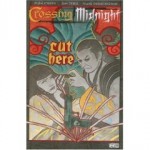
Crossing Midnight book 1: Cut Here


By Mike Carey, Jim Fern, Rob Hunter & Mark Pennington (Vertigo)
ISBN: 978-1-84576-666-5

The variety and power of mythology is the greatest gift of our convoluted collective history as a species and for the imaginative amongst us it works twice. As children we absorb tales of magic and love and heroism with open-mouthed, unblinking wonder and they become part of our day-to-day existence: “fairy-tale romance”, “evil stepmother”, “Prince Charming” and a hundred other phrases are part of a verbal short-hand we all share without thinking. And when we’re older we seek out modern rehashings of those tales in our preferred media of fictional entertainment.

What horror-movie can’t be reduced to Hansel and Gretel or Little Red Riding Hood, and which action blockbuster hasn’t got an indomitable Jack overcoming all obstacles? And Rom-Coms?: c’mon!

For some there are also tales from other cultures which can be ingested in pure form such as the various interpretations of China’s Monkey King (see Journey to the West, Monkey Subdues the White Bone Demon or Havoc in Heaven for example) or even the triumphant Fables revising our childhood landscape with all the scary, salacious bits restored…

And then there’s synthesis…

Lots of westerners are fascinated with the myths and culture of Japan, but scary storyteller Mike Carey has taken it to a captivating new level, blending elegant fantasy with contemporary horror stories and gangster cinema in this tale (comprising issues #1-5 of the much-missed Vertigo comic book) of a magical quest through the darkest parts of the modern lands of the Rising Sun.

Kai and Toshi Hara are twins born in Nagasaki, one either side of the Witching Hour, and that crucial time difference will forever blight their lives… Born seven minutes after midnight Toshi is no ordinary girl: bold, energetic and utterly immune to any and all harm from edges and points; no blade will touch; but her older brother seems painfully weak and mortal. Unknown to all when they were little kids they accidentally slipped into a spirit world, and although they came back their friend Saburo was never seen again.

Their loving parents have problems too. When father asks the wrong question about shipments at the office he falls foul of the Yakuza, and always Toshi is becoming more difficult, more rebellious…

One night when they are barely into their teens a figure appears in her room: Aratsu, celestial Lord of the Knives has come to claim her as his new servant, and unless she complies her family will suffer. Suddenly discovering his own supernatural ability Kai drives Aratsu away but he will return and if she goes it will be as if she never existed…

Seemingly helpless the twins are inexorably drawn into the world of the Kami, spirits and shadows real and hungry who shed no tears when their mortal pawns die in horrendous ways. As the real and unreal increasingly weave together Kai finds himself in the unusual role of protector, saving his father and rescuing Toshi from a life of immortal servitude and unending horror

Burt eventually Aratsu gets his way and Kai determines to get his sister back at all costs…

Carey, Fern, Hunter and Pennington have crafted a superb blend of legendary Nippon and modern Japan with dystopian culture clashes, childhood nightmares and gangster action swirling together in this compelling horror, mystery fairytale epic that almost defies categorisation. I define it as a book no adult fantasy fan should miss…
© 2007 Mike Carey and Jim Fern. All Rights Reserved.