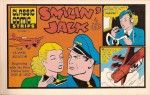
Smilin’ Jack: the Classic Aviator


By Zack Mosley (Classic Comic Strips)
No ISBN

Modern comics evolved from newspaper comic strips. These pictorial features were until relatively recently hugely popular with the public and highly valued by publishers who used them as an irresistible weapon to guarantee and increase circulation and profits.

It’s virtually impossible for us to understand the overwhelming power of the comic strip in America from the Great Depression to the end of World War II. With no television, broadcast radio far from universal and movie shows at best a weekly treat for most folk, household entertainment was mostly derived from the comic sections of daily and especially Sunday Newspapers. “The Funnies” were the most common recreation for millions who were well served by a fantastic variety and incredible quality.

From the very start humour was paramount; hence the terms “Funnies” and “Comics”, and from these gag and stunt beginnings came mutants and hybrids like Roy Crane’s Wash Tubbs. Comedic when it began in 1924, it gradually moved from mock-heroics to light-action and became a full-blown, rip-roaring adventure series with the introduction of ancestral he-man and prototype moody swashbuckler Captain Easy in 1929.

From there it wasn’t such a leap to full-on blockbusters like Tarzan (which began on January 7th 1929) and Buck Rogers (also January 7th 1929) – both adaptations of pre-existing prose properties, but the majority of drama strips that followed were original productions. The tidal-wave began in the early 1930s when an explosion of action and drama strips (tastefully tailored for a family audience and fondly recalled as “Thud and Blunder” yarns) were launched with astounding rapidity. Not just strips but entire genres were created in that decade which still impact on not just today’s comic-books but all our popular fiction. Still most common however were general feel-good humour strips with the occasional child-oriented fantasy.

Among the most popular of the new adventure genres was the Aviator serial. With air speed, distance and endurance records bring broken every day, travelling air-circuses barnstorming across rural America and real life heroes such as Charles Lindbergh and Amelia Earhart plastered all over the front pages it wasn’t difficult to grasp the potential of funny-pages analogues.

The first was Tailspin Tommy, by Glenn Chaffin and Hal Forrest, the story of boy pilot Tommy Tompkins, which ran from May 21st 1928 (almost exactly one year after Lindbergh’s epic flight in the Spirit of St. Louis) until 1942, swiftly followed by Lester J Maitland and Dick Calkins Skyroads and John Terry’s Scorchy Smith (see Scorchy Smith: Partners in Danger) 1930 -1961, as well as such late-arriving classics as Flyin’ Jenny, Buz Sawyer and even Steve Canyon.

Zack Mosley was an enterprising young cartoonist who assisted Calkins on both Skyroads and the legendary Buck Rogers (see Buck Rogers: the First 60 Years in the 25th Century). He was also a dedicated pilot and flying enthusiast, and when he heard that Captain Jor Patterson (influential editor of the Chicago Tribune) was taking lessons he swiftly pitched a series to the kingmaker of comic strips.

On the Wing debuted as a Sunday page on October 1st 1933, but the name never gelled and the series was re-titled Smilin’ Jack (apparently Moseley was surreptitiously known as “Smiling Zack” around the Tribune office), from the December 31st episode. The strip steadily gained interest and syndication subscribers and on June 15th 1936 was augmented by a daily strip.

Jack Martin was a nervous student pilot, and the series originally played safe by vacillating between comedy and hairsbreadth thrills as he and his fellow learner-pilots learned the ropes. Never a top-tier series it nevertheless always delivered terrific entertainment to the masses, moving with the times into a romance, war-feature, a crime thriller (complete with Dick Tracy style villains) and even a family soap. Moreover the strip progressed in real time and when it closed on 1st April 1973, Jack was a twice married air veteran with a grown son and a full cast of romantic dalliances in tow. It wasn’t lack of popularity that ended it either. Mosley at 67 years old wanted to spend his final years in the air, not at a drawing board…

This fabulous collection delivers a delightful selection of rousing romps, beginning with that name changing first episode from December 31st 1933, before concentrating on some classic sequences from the roaring thirties starring Jack, comedy foil Rufus Jimpson (a hill-Billy mechanic), eye-candy air hostess and love interest Dixie Lee (subject of an extended romantic triangle), Latin spitfire (the curvy sort not the fighter plane sort) Bonita Caliente and spies, thugs, imbecile passengers, South American revolutionaries and even a foreign Legion of the Skies with an eerily prescient stiff-necked Prussian flyer named Von Bosch whose type would soon be plastered all over the strips and comic books when WWII broke out

This kind of strip is, I suspect, an acquired taste today like Preston Sturges or George Cukor films, with a little bit of intellectual and historical concentration required, but the effort is certainly worth it, and if this kind of stuff is good enough for the likes of George Lucas and Steven Spielberg it’s perfectly good enough for you and me…
© 1989, 2009 Chicago Tribune Syndicate. All Rights Reserved. (I’m guessing here: if somebody else actually owns the rights let me know and I’ll happily amend the entry)
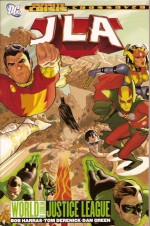
JLA: World Without a Justice League NEW REVISED AND EXTENDED REVIEW


By Bob Harras, Tom Derenick & Dan Green (DC Comics)
ISBN 1-84576-335-1

During the Identity Crisis it was revealed that not only did factions of the Justice League ignore Due Process and lobotomise (call it mind-wipe if you’re in a generous mood) some of their enemies, but when Batman objected he too had his brains scrambled by his own team-mates.

Torn apart, the League formally disbands just as the entire universe is on the verge of utter destruction. The repercussions of that betrayal poisons the relationships of these once staunch comrades, as does the revelation of an illicit affair between two of the heroes, so that when the remnants of the splintered super-hero team and a few former members more or less reunite to stop old foe the Key, they spend more time sniping at each other than dealing with the problem.

The villain has evolved from dedicated nuisance into a psionic mass-murderer, and further complicating the mess is the escape of one of the Original Seven Deadly Sins from its eternal captivity, adding to the level of destruction by inducing riots and insanity throughout the population of Gotham City. The final straw is loss of their most powerful assets halfway through the hunt as the resurrected Titan Donna Troy whisks a hastily cobbled together strike force into space to deal with the intergalactic ramifications of the Infinite Crisis.

One of the truly memorable incarnations of a venerable comics institution died with more of a whimper than a bang in this final collected story-arc (reprinting JLA #121-125) and for all the explosive action and “mano-a-mano” posturing, the result is a somewhat lacklustre postscript to a excellent series of super-hero adventures. The title was sadly lost in the huge shuffle of Infinite Crisis, and passed almost with few mourners.

Bob Harras, Tom Derenick and Dan Green did their best, but the heavy-handed shoehorning of the overweening Crisis segments destroyed the narrative flow, and any casual reader who just picks this book is just inviting a migraine if they haven’t read the other books too.

An inauspicious end to a great run, and poor use of some talented people and great characters but the “automatic rewind/reset” of Infinite Crisis and numerous ‘One Year Later’ relaunches (see 52 parts 1-4) soon made this a distant memory.

And of course, in comics, nothing stays dead for long…

© 2006 DC Comics. All Rights Reserved.

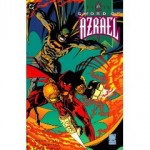
Batman: Sword of Azrael


By Dennis O’Neil, Joe Quesada & Kevin Nowlan (DC Comics)
ISBN: 978-1-56389-100-7

Almost a lost classic now, this impressive fast-paced romp (originally released as a four issue miniseries and teaser-prelude to the KnightFall comics publishing event) catapulted artist Joe Quesada (superbly inked by the incredible and far too rarely seen Kevin Nowlan) to the forefront of hot “name artists” after a relatively anonymous introduction to the industry as a colourist/penciller at Valiant Comics and illustrator on DC’s TSR licensed Spelljammer series and Question Quarterly.

Here given a full creative head he combines with Dennis O’Neil, probably the most efficiently prolific of modern Bat-scribes, to introduce a young medical student to the DC universe, but one with a centuries-old secret.

When international arms dealer Carlton LeHah embezzles millions of dollars from a hidden warrior-cult with origins dating back to the Crusades their avenging assassin Azrael tracks him down but is unprepared for the cutting edge weaponry Lehah has awaiting him.

Wounded unto death the Knight of St. Dumas activates his final resource: his own son. Programmed since birth, trained to kill and augmented by the implanted skills of uncounted deadly soldiers of a fanatical organization, the new Azrael goes hunting…

Meanwhile Bruce Wayne has been hunting the murderous forces loose in his city but he too is unprepared for Lehah who has since graduated to the next stage of a martial madness. Believing himself the physical avatar of the Demon Biis, he has been stalking the last cult-members, sowing death and destruction wherever he appears. When he captures Batman, faithful Alfred and the new Azrael are all that remains to prevent a global catastrophe…

Sharp, clever, hypnotically adrenaline-charged and strikingly illustrated, this mini-classic (only 112 pages including Archie Goodwin’s introduction, sketch pages and cover gallery) is about due for a 21st century upgrade, but if not there’s always your favourite comics vendor or internet retailer…
© 1989, 2008 DC Comics. All Rights Reserved.

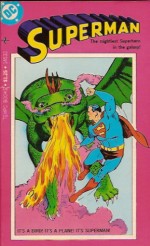
Superman – the Mightiest Superhero in the Galaxy!


By various (DC Comics/Tempo Books)
ISBN: 0-448-14532-4-125

Released in 1978 to coincide with and capitalise on the major motion picture starring Christopher Reeve, this dandy little black and white paperback was part of a continuing drive by DC to get out of the down-market newsstands and place their characters regularly onto the shelves of bookstores.

Comic books had always suffered low self-esteem when compared to “proper books” and even their newspaper strip cousins periodically took every opportunity to break out of the “kid’s stuff” ghetto – such as when the incredibly popular Superman radio show and animated cartoons of the 1940s resulted in the iconic Adventures of Superman novel by George F. Lowther in 1942 (coming soon! What I think about a really hard to find book from nearly seventy years ago!).

They achieved some success with the plethora of paperbacks that accompanied the 1960s “superhero/camp craze” which had every funny-book producer from Archie Comics to Tower Books churning out rapidly re-sized, monochrome editions of their wares, all-new material (See Dracula or Blackmark) and even prose novels such as Batman vs the Three Villains of Doom (also on my “to do” list!) and ever since then comics collections could be seen every so often in Waldenbooks or W.H. Smiths nestled between science fiction and movie novelisations.

Of course this was before they gave up trying to fit their only strengths into a limiting format and went the European route of albums/graphic novels/trade paperbacks – with spectacular success. And just in case you were wondering why they kept trying? At its best, a comics title could reach about a million unit sales through magazine vendor systems whilst a book – any book – had the potential of reaching four to twenty times that number…

The collection in question takes its content from the early 1960’s canon (when the book’s target audience would have been little kids themselves) showcasing a rather more sophisticated set of tales than you might expect, starting with a somewhat truncated ‘The Complete Story of Superman’s Life’ from 1961, illustrated by Al Plastino covering all the basics: death of Krypton, rocket to Earth, early life as Superboy, death of the Kents and moving to Metropolis, whilst ‘Superman’s Mermaid Sweetheart’ is a bittersweet sequel to the Man of Steel’s doomed college romance with the mermaid Lori Lemaris from 1959 illustrated by the legendary Wayne Boring.

Curt Swan drew the remaining three tales, a telling confirmation of his huge contribution to the mythology of the Man of Tomorrow, beginning with ‘Superman’s Greatest Secret’ (1961) one of the best secret identity preservation stories of the period – with a giant fire-breathing monster too – whilst the landmark ‘The Legion of Super-Villains’ from the same year is a stand-out thriller featuring Lex Luthor and the adult Legion of Super-heroes and the fun concludes with ‘When Superman Lost his Memory’ (1965) an excellent example of another favourite plot when our hero had to recover not only his lost identity but also his missing superpowers…

There is a nostalgia and comforting familiarity to these tales but the immense quality and talent of the artists and especially writers such as Jerry Siegel, Edmond Hamilton, Otto Binder, Leo Dorfman and all the rest. My own longstanding personal appreciation and regard for this kind of package stems from my own boyhood, when I discovered how perfectly such books fitted into a school blazer pocket…
© 1978 DC Comics, Inc. All Rights Reserved.

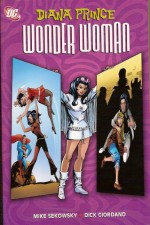
Diana Prince: Wonder Woman Volume 2


By Mike Sekowsky, Dick Giordano & various (DC Comics)
ISBN: 978-1-84576-900-0

Back for a second delicious helping of pop nostalgia and startling action is Diana Prince, erstwhile Amazon superhero, but for a brief moment a mortal woman with all the power and wit that entails – solving problems and fighting injustice with great style and incredible fashion-sense.

In 1968 superhero comics were in decline and publishers sought new ways to keep audience as tastes changed. Back then, the entire industry depended on newsstand sales, and if you weren’t popular, you died. Editor Jack Miller and Mike Sekowsky stepped up with a radical proposal and made a little bit of comic book history with the only female superhero then in the marketplace.

The superbly eccentric art of Sekowsky had been a DC mainstay for decades, and he had also scored big with fans at Gold Key with Man from Uncle and at Tower Comics’ T.H.U.N.D.E.R. Agents and war comic Fight The Enemy! His unique take on the Justice League of America had cemented its overwhelming success, and now he was stretching himself with a number of experimental, youth-market directed projects.

Tapping into the teen zeitgeist with the Easy Rider-like drama Jason’s Quest proved ultimately unsuccessful, but with the Metal Men and the hopelessly moribund Wonder Woman he had much greater impact. He would ultimately work the same magic with Supergirl.

When the Amazons were forced to leave our dimension, they took with them all their magic – including Wonder Woman’s powers and all her weapons … Now no more or less than human she decided to stay on Earth permanently, assuming her own secret identity of Diana Prince, dedicated to fighting injustice as a mortal. Blind Buddhist monk I Ching trained her as a martial artist, and she quickly became embroiled in the schemes of would-be world-conqueror Doctor Cyber. Her one true love Steve Trevor was branded a traitor and killed…

This volume (which collects issues #185-189 of her comic book, a guest shot from Superman’s Girlfriend Lois Lane #93 plus the first of two appearances in the Batman team-up vehicle Brave and the Bold #87) shows just how bold were those changes to the Amazing Amazon’s career. With young scripter Denny O’Neil moved to other projects Sekowsky took over the writing himself, surprising everyone with his savvy ear for dialogue and a refreshingly original take on the old conventions.

With apparently nothing to lose, the switch to espionage/adventurer in the fashionable footsteps of such popular TV characters as Emma Peel, The Girl from Uncle and Honey West, not to mention our own ultimate comic strip action-heroine Modesty Blaise, seemed like desperation, but clearly struck a chord with the public. Sekowsky opens this book with ‘Them!’ – one of the most original tales of the period, with few to match it written since.

Steeped heavily in the hippie counter-culture and Mod-fashion explosion, the New Wonder Woman had opened her own boutique and into it rushes a young girl seeking to escape three women who took her in and then made her their slave. Today this sort of psychological thriller is more recognisable, but in 1969 themes of bullying and peer abuse were utterly unknown in comic books, and this groundbreaking tale is uniquely informative: exploring other solutions than simply punching bad guys – although there’s enough of that so that the regular readers aren’t completely bewildered.

This is followed by ‘Morgana the Witch’, (WW #186) a spectacular flight of whimsy tapping into the then growing interest in the supernatural wherein a trio of teenaged girls with a talking frog (who was originally the boy friend of one of them) request help after accidentally summoning a powerful (and clearly bi-polar) sorceress to the 20th century.

Next is ‘The Superman-Wonder Woman Team!’ (by Robert Kanigher and Irv Novick from Superman’s Girlfriend Lois Lane #93), a less adventurous and unreconstructed yarn where the also socially evolving girl-reporter seeks to uncover the reason the ex-Amazon is making an ill-concealed play for her man, and a superbly tense thriller by Sekowsky and Giordano from Brave and the Bold #87 entitled ‘The Widow-Maker’, wherein the son of one of Batman’s foes tries to add to his tally of murders by luring the Caped Crusader into a rigged high performance car race.

The book concludes with a gripping three-part saga revealing some of I Ching’s past  and reintroducing the deadly Dr. Cyber before seamlessly transiting into an exotic Cold War thriller. In ‘Earthquaker’ and ‘Cyber’s Revenge’ Diana’s mentor is summoned by old friends to Hong Kong where he and his astonishing pupil happen upon a plan to blackmail the island with catastrophic artificial earthquakes, before attempting to smuggle an entire village out of Communist China in the delightfully epic ‘Red for Death’. The spectacle is broken up by a wonderful extra two page strip vignette ‘Crime does not Pay’ which brilliantly demonstrates the wit and economy of the medium

Comics are an art-form dictated by markets, driven by sales and influenced by fashion. For a brief moment all these factors coalesced to produce a compelling, engaging and utterly fabulous sequence of tales that are timelessly perfect and eternally fresh. And now you can read them whenever you feel the need for better times simply by opening these pages…

© 1969, 1970, 2008 DC Comics. All rights reserved.

Charley’s War volume 5: Return to the Front


By Pat Mills & Joe Colquhoun (Titan Books)
ISBN: 978-1-84576-769-9

The fifth instalment of Mills and Colquhoun’s astonishing comic strip condemnation of the Great War (and war-mongering in general) picks right up from the previous volume (Blue’s Story) as recuperating boy-soldier Charley Bourne settles his affairs in London before reluctantly returning to the terrifying trenches and insane warlords on both sides of No-Man’s Land, whose callous and inept tactics and strategies decimated an entire generation of Europe’s manhood.

Charley’s War, originally published in the weekly comic Battle (from #200, 6th January 1979 until October of 1986), tells the story of an underage East-Ender who lies about his age to enlist in the British Army setting out to fight the Hun in 1916. Writer Mills fully exercised his own political and creative agendas on the series and, as his own always informative commentary relates, was always amazed at what he got away with and what seeming trivialities his editors pulled him up on. Here for example, as the lad rejoins his unit in April 1917, just in time for the third Battle of Ypres, the creators was allowed to wallow in historical accuracy, and some intriguing gallows humour, capitalising on the lengthy build-up of troops which forced a long period on tedious inactivity upon the already bored soldiery.

Life in the trenches was notoriously hard and unremittingly dull… except for brief bursts of action which ended so many lives. By closely following the events of the war, powerful episodes featuring such insanity as a Cricket match played out whilst shells rained down, brutal forced marches that incapacitated already shattered “Tommies”, dedicated heroes destroying their own equipment and a dozen other daily insanities of the military mind are exposed with devastating effect.

The saga focuses far more on the characters than the fighting – although there is still plenty of harrowing action – and reveals to the readers (which at the time of original publication were presumed to boys between ages 9-13) that “our side” could be as unjust and monstrous as the “bad guys”.

Charley receives the dubious honour of being seconded a servant to the callous officer Captain Snell who thinks the war a terrific lark: thereby revealing an utterly different side to the conflict, and acts as the only voice of reason when the veterans of earlier conflicts take out their resentment on the new replacement troops – all conscripted, and commonly seen by the hardened survivors of early years as cowards and shirkers for not volunteering.

But although the horrors and madness and incessant waiting for the big show to begin are omnipresent, things do proceed: as the book closes Charley discovers that his unit has been posted to join an engineering detail short of manpower. The losses were caused by cave-ins and flooding, and Charley realises that his next job will be to complete a year-long project to tunnel under a vast ridge of solid rock and undermine the German Guns on the Messine Ridge. If they don’t get killed he and his comrades will be packing the explosives for the biggest explosion the world has ever experienced…

Brutal, dark, beautiful, instantly affecting and staggeringly informative, there has never been a series like Charley’s War: it is something future generations will scorn you for not reading…

© 2008 Egmont Magazines Ltd. All Rights Reserved.

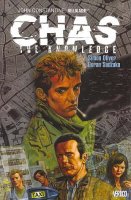
John Constantine, Hellblazer: Chas – The Knowledge


By Simon Oliver & Goran Sudzuka (Vertigo)
ISBN: 978-1-84856-140-3

It’s tough being a sidekick – especially when your guv’ner is the sardonic, ultra-cool laughing magician and arch-trickster John Constantine, and you’re just an over-the-hill granddad who drives a black cab in a London you recognise less and less every day. Your glory days are long gone – if there ever were any – and all you can look forward too is the big match, a few jars and not too much ear-ache from the dragon you married.

Chas Chandler (not the pop star) is probably Constantine’s oldest mate, at least this side of the grave, and his stolid, sensible “hit it don’t hex it” attitude has saved the street sorcerer from disaster on more than one occasion. His brushes with the unknown are mercifully limited but always terrifying (see for example “In Another Part of Hell” in Hellblazer: Rare Cuts) and he’s more than happy to keep it that way.

For such a man loyalty is sacrosanct and family worth dying – or killing – for.

Whilst his prospective son-in-law and a friend are researching “The Knowledge” one of them is involved in an accident that releases a spiteful demonic presence last seen during the Great Plague. This hateful spirit has nasty plans for London and quickly starts to enact them.

With Constantine pathetically unavailable Chas is forced to take action himself, aided by a few plucky cabbies and an extraordinarily tempting American lady he found in the back of his cab. Luckily this bloke at the pub, last guardian of the Secret History of Licensed Hackney Carriage Drivers, is on hand to explain the true meaning of The Knowledge: the mystic origin of the 320 routes all cabbies must learn before they qualify, and how the twenty-five thousand street names, esoteric stops and countless places of interest visited by tourists have kept our great metropolis safe and secure for four centuries…

More dramatic than terrifying, this is a cracking magical mystery (originally released as a 5 issue miniseries) with pitifully human heroes giving their all for just the right reasons; a delightful treat for jaded readers who might be in need of light refreshment before plunging back into the bleak and sordid cauldron of extreme, urban horror, but a terrific tale with which to break in prospective new fans.

© 2008, 2009 DC Comics. All Rights Reserved.

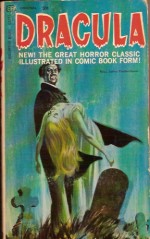
Dracula


Adapted by Otto Binder & Craig Tennis, art by Alden McWilliams (Ballantine Books)
No ISBN: U2271

You’re never to young to be exposed to the classics or scared out of your wits, and this delightful remnant from my own far-distant youth always brings back the gory, glory days of Bela Lugosi on TV and trying to sneak in to the latest Hammer Horror at the pictures (too young, not too cheap!) as well as such diverse treats as Famous Monsters of Filmland and other assorted illicit thrills that made we baby-boomers such terrific well-rounded, fully-socialised individuals.

At a time when scary movies, as well as Super-Spies, superheroes and comics in general, were all experiencing a popular revival, lots of strips made the jump to paperback format as publishers courted new markets. Along with lots of Mad collections, newspaper comic-strips, resized black and white comicbook reprints (such as High Camp Superheroes) and a host of other retreads, the occasional all-new item appeared.

One such is this delightfully forthright, faithful and respectful – if tension and terror free – adaptation of Bram Stoker’s gothic classic, adroitly encapsulated by comics and pulp sci fi legend Otto Binder (and Craig Tennis – of whom I know almost nothing other than he was a TV scripter) and drawn by the “deserves-to-be-legendary” Al McWilliams, a superb comics illustrator and draughtsman often confused with and nearly as good as his near-namesake Al Williamson.

The story is as you remember it; effective and pretty rather than beautiful and terrifying, but for a little seven year old it was a treasured item to be pored over, traced and adored, and today’s film fans might be enticed by Christopher Lee’s voluble introduction.

Even though it was reprinted by Manor Books in 1975, I suspect this isn’t the easiest of books to find, and to be completely honest the alternating portrait and landscape layouts make reading it a bit of a juggling act, but still and all I wish somebody somewhere would rescue this little gem from near obscurity. Any opportunistic publishers listening out there?
© 1966 Russ Jones Productions.

Giraffes in my Hair: a Rock ‘n’ Roll Life


By Bruce Paley & Carol Swain (Fantagraphics Books)
ISBN: 978-1-60669-162-6

Biographies are usually about interesting people and/or interesting times. Or at least famous ones. That makes this fascinating new book relating the incredible life-on-the-edge of ordinary hippie Bruce Paley an engrossing double-threat. Paley isn’t a superstar, he’s just a guy who turned 18 during the Summer of Love, bummed and scammed his way across America, saw some bands, met some girls, narrowly dodged the Draft and had a few memorable experiences along the way.

Captivatingly illustrated by Paley’s partner Carol Swain in her trademark monochrome line and textures style, we see his highs and lows: life as heroin addict, hookers and Black Panthers, getting by in crappy jobs, following the ever-changing music scene and even the rare brushes with real fame we’ve all experienced: in this case a short, intense friendship with doomed rock star Johnny Thunders.

Paley isn’t a particularly likable guy, but he and his life are real and human and worth recording – and this small saga of someone surviving some of our most turbulent times is a magical testament to creativity, durability and human adaptability. This is a captivating story and a brilliant use of our medium…

© 2009 Bruce Paley and Carol Swain. All rights Reserved.