Horizontal Collaboration


By Navie & Carole Maurel, translated by Margaret Morrison (Korero Press)
ISBN: 978-1-91274-001-7 (HB)

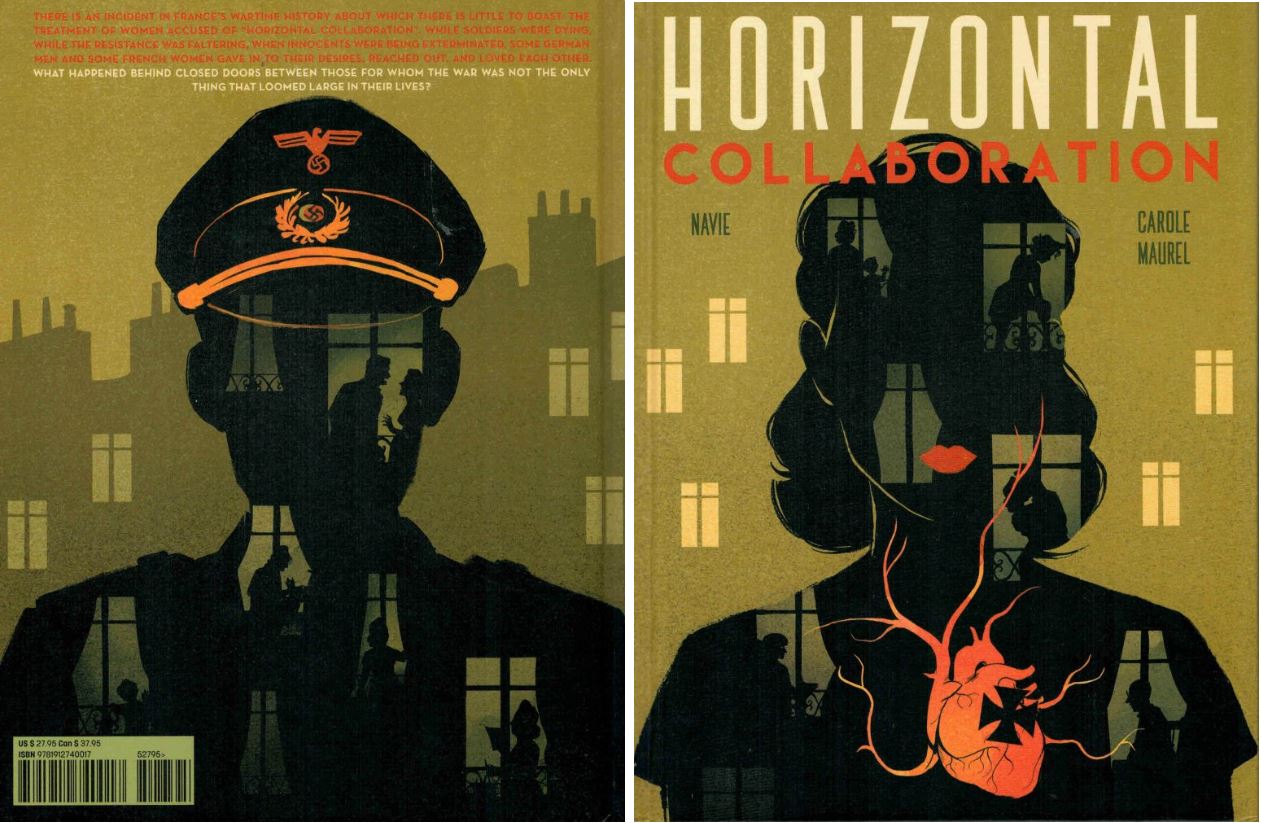
With its world-shaking reordering of society and all the consequent, still-felt repercussions World War II remains very much in people’s minds. This translated European tale is a potent counterpoint to the usual commemorative bombast, devoting much-delayed attention to the ever-dwindling last of “The Few”. Here, as well as the valiant men, we see acknowledgment of the nigh-universally disregarded contributions of women caught up in the conflict, not to mention unsung heroes of all nations who were drawn into the horror.

Horizontal Collaboration is not about heroes. It deals with people: civilians and fugitives, women and invading occupiers: the ones who are seldom celebrated but who also confronted the triumph of global darkness, all in their own small, unnoticed way…

France was taken by the Nazi war machine in 1940: occupied and partitioned on June 22nd, with the Germans holding the industrial north and central regions whilst Marshal Philippe Pétain’s puppet protectorate Régime de Vichy was allowed to govern the south and pacified colonies such as Algeria. When France was liberated in September 1944, a wave of retaliation began against those who “cooperated” with the conquerors in all ways great and small.

A sordid time of scores (real, imagined or fabricated) settled and cruel abuses arbitrarily inflicted on guilty and innocent alike plagued France for years afterwards. The most telling indignities were perpetrated upon women – wives, mothers, sisters or strangers – accused of fraternising with or giving comfort to the enemy. Such liaisons were called “Collaboration Horizontale” and even the most nebulous or unfounded accusation carried a heavy and immediate price…

Just about now, a grandmother listens to her granddaughter unload about her current amour and her mind drifts back to the war and a secret she has never shared with anyone…

In 1942, a large apartment house on Passage de la Bonne-Graine is filled with families, all dealing with the German conquerors in their own way. Despite the change in their fortunes, they have not found any way to overcome the petty grudges and ingrained social difficulties that have always kept them at odds with each other… even before war broke out.

Surly aged crone Madame Flament is rude to everyone. She spends all her time complaining or disappearing into the cellars to feed her cats. What secret is she really hiding?

Old Camille is deemed the man of the house, but he is gentle, ineffectual and blind: blithely letting life go on around him and apparently noticing nothing. His wife is the building’s concierge. Brusque matron Martine Andrae is a snooping busybody loudly championing decency and family values, but her home life is nothing to envy and her sharp tongue scores points off family, friends and foes indiscriminately. She despises the younger women and their families in the building, especially pretty Joséphine Borgeon who makes ends meet through her theatre act. Surely, everybody knows what she really does to survive?

Also viewed with suspicion is young mother Rose. Her husband Raymond has been taken away to work for the Nazis, so his friend and neighbour Leon – a gendarme – has been keeping a “friendly” eye on her, even though his own pregnant wife Judith keeps clumsily falling and hurting herself and certainly needs proper supervision…

Strangely boyish artist Simone keeps to herself as much as she can and – originally – there was also a Jewess called Sarah Ansburg and her little son. They somehow disappeared before the Germans could find them. That must be the reason Abwehr intelligence officer Mark Dinklebauer spends so much time in the building. It couldn’t possibly be that he has fallen in love with one of the occupants, or that this most forbidden of passions is dangerously, illegally reciprocated, can it?

Crafted with deft incisiveness by media writer and historian (Mademoiselle) Navie and rendered in a beguiling style (powerfully reminiscent of Will Eisner in his later years) by seasoned illustrator/author Carole Maurel (Luisa: Now & Then, Waves, L’apocalypse selon Magda), this is a meditative but uncompromising glance at ordinary lives under relentless pressure: an ensemble piece of human drama taking as its heart and centre point an unlikely flowering of true but doomed love…

Moving, beguiling and evocatively rewarding, Horizontal Collaboration is a beautiful tragedy and potent reminder that love takes no prisoners while enslaving all it touches.
© Editions Delcourt – 2017. All rights reserved.

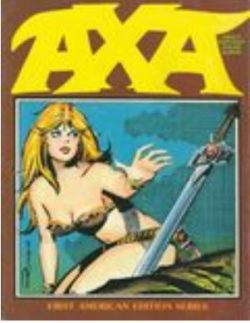
Axa Adult Fantasy Color Album


By Enrique “Enric” Badía Romero & Donne Avenell (Ken Pierce Books/Eclipse Comics)
ISBN: 0-912277-27-0 (TPB)

Born in 1930 Enrique “Enric” Badía Romero’s comics career began in his native Spain fifteen years later when he was apprenticed to popular creator Emilio Freixas. By 1949 – as “Badia” – he was drawing strips for Susy and other publications, and in 1953, launched his own magazine Alex, before going on to found publishers Ruiz Romero where he produced everything from westerns, sports, war stories and trading cards – mostly in conjunction with his brothers Jorge and Jordi. Their most memorable series were Cromos, Hombres de Lucha and Historia de la Guerra.

“Enric” began working for the higher-paying UK market in the 1960s, on strips such as ‘Cathy and Wendy’, ‘Isometrics’ and ‘Cassius Clay’ before successfully assuming drawing duties on the high-profile Modesty Blaise adventure-serial in 1970. He left in 1978 when an enticing new prospect appeared whilst he was simultaneously illustrating Modesty and Rahan with André Chéret for Franco-Belgian weekly Pif gadget. Even for the prolific artist something had to give…

Axa ran in The Sun Monday to Saturday from 14th July 1978 to her abrupt cancellation on November 16th 1986 – purportedly a victim of political and editorial intrigue which saw the strip cancelled in the middle of a story. Other than the First American Edition series from strip historian Ken Pierce and this colour collection, there has never been a definitive English language collection. It should be noted also that at the time of this book she was still being published with great success and to popular acclaim.

Back then in Britain it often appeared the only place where truly affirmative female role-models appeared to be taken seriously were cartoon sections, but even there the likes of Modesty Blaise, Danielle, Scarth, Amanda, Wicked Wanda and all the other capable ladies who walked all over the oppressor gender – both humorously and in straight adventure scenarios – lost clothes and shed undies repeatedly, continuously, frivolously and in the manner they always had…

Nobody complained (at least no one important or who was ever taken seriously): it was just tradition and the idiom of the medium… and besides, artists have always liked to draw bare-naked ladies as much as blokes liked to see them. It was even “educational” for the kiddies – who could buy any newspaper in any shop without interference, even if they couldn’t get into cinemas to view Staying Alive, Octopussy or Return of the Jedi without an accompanying adult…

Tough ’n’ sexy take-charge chicks (without clothes) were a comic-strip standard by the time the Star Wars phenomenon rekindled interest in science fiction, and the infallible old standby of scantily-clad, curvy amazons in post-apocalyptic realms never had greater sales-appeal than when The Sun – Britain’s sleaziest yet best-selling tabloid – hired Romero & Donne Avenell to produce a new fantasy feature for their already well-stacked cartoon section.

This beautifully illustrated but oddly out of kilter collection doesn’t bear much similarity in terms of tone or format to the (ostensibly) family-oriented daily strip, and features none of the regular supporting cast like long-suffering lover Matt or robotic companion Mark 10, which leads me to suspect it was created independently for a European market, perhaps as a Sunday page in Romero’s homeland or elsewhere where attitudes and mores were more liberal.

Certainly in the early 1980s Axa appeared in adult bande dessinée icon Charlie Mensuel (which reprinted many classic newspaper strips from around the world) and after that closed in Swedish publication Magnum.

Whatever their origin, the tales collected here are far stronger and more explicitly sexual in nature; occasionally coming close to being macho rape-fantasies, so please be warned as such content, no matter how winningly illustrated, will certainly offend most modern consumers.

The eponymous heroine was raised in a stultifying, antiseptic and emotionless domed city: a bastion of technological advancement in a world destroyed by war, pollution and far worse. Chafing at the constricting life of loveless living dead men, Axa broke out and, ancient sword in hand, chose to roam the shattered Earth searching for something real and true and free…

This slim oversized tome opens with Axa crossing trackless wasteland under a scorching sun until she finds a hidden grotto beneath a ruined building. The coolly sensual hidden pool is a welcome delight but harbours a ghastly monster and mutant voyeur…

Captured by a hideously scarred human degenerate Axa discovers his gentle nature but is soon abducted by his far-less sympathetic brethren who want to use her as a brood mare for their next generation. Ultimately, fate, her newfound friend and that ever-present longsword combine to effect her escape…

Resuming aimless exploration, Axa encounters a coastal village and is almost killed by wild dogs. Desperate flight takes her to a lighthouse on the promontory above the deserted town where ruggedly handsome Juame and his teenaged daughter Maria have been trapped for months. Swiftly, sexual tension between Axa and Jaume culminates in the only way it can as Maria is driven mad by jealousy she can barely comprehend. When a roving band of vicious post-apocalyptic Hell’s Angels hits town hungry for slaughter and kicks, the conflicted teen opens the tower doors for them…

The brutes casually murder her father and are intent on adding her and Axa to their string of human playthings, when a terrific storm hits and Axa breaks loose to become the bloody tool of harsh, uncompromising and final fate…

This incarnation of the warrior wanderer is certainly harder-hitting and more visceral than the British strip version and has little of the feature’s sly, dry humour, but art-lovers cannot fail to be impressed by Romero’s vibrant mixed-media illustration and imaginative, liberating page compositions.

Lush, lavish, luxurious and strictly for adventure-loving adults, Axa is long overdue for a comprehensive ethical overhaul and definitive comics collection. Is there a bold publisher out there looking for the next big thing and prepared to face a barrage of ethical vituperation?
Axa © 1985 Enrique Badia Romero. Previously © 1983, 1984 in Spanish. Express Newspapers, Ltd.

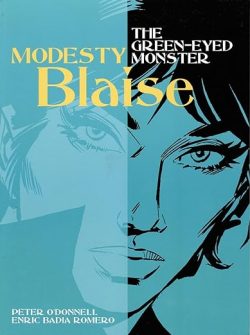
Modesty Blaise: The Green Eyed Monster


By Peter O’Donnell & Enrique “Enric” Badía Romero (Titan Books)
ISBN: 978-1840238662 (Album PB)

Spanish artist Romero was a familiar presence for generations of British comics and newspaper strip readers. He died on February 15th this year with most of his work out of print and nigh forgotten. Here are two reasons why that’s not right and should be rectified as soon as possible.

Infallible super-criminals Modesty Blaise and her lethally charming, compulsively platonic, equally adept partner Willie Garvin gained fearsome reputations whilst heading underworld gang The Network. At the height of their power, they retired young, rich and still healthy. With honour intact and hands relatively clean, they cut themselves off completely from careers where they made all the money they would ever need and far too many enemies: a situation exacerbated by their heartfelt and – for their calling – controversial conviction that killing was only ever to be used as a last resort.

When devious British Spymaster Sir Gerald Tarrant sought them out, they were slowly dying of boredom in England. That wily old bird offered them a chance to get back into harness, have fun and do some good in the world. They jumped at his offer and began cleaning up society’s dregs in their own unique manner. That self-appointed crusade took decades…

From that tenuous beginning the dynamite duo went on to crush the world’s vilest villains and most macabre monsters in a succession of tensely suspenseful, inspirational action thrillers over more than half a century. The inseparable associates debuted in The Evening Standard on 13th May 1963 and, over passing decades, starred in some of the world’s most memorable crime fiction, in approximately three panels a day.

Creators Peter O’Donnell & Jim Holdaway (who previously collaborated on Romeo Brown – another lost strip classic equally as deserving of its own archive albums) crafted a timeless treasure trove of potent pictorial escapades until the illustrator’s tragic early death in 1970, whereupon Spanish artist Enrique “Enric” Badía Romero (and also occasionally John Burns, Neville Colvin & Pat Wright) assumed art duties, taking the partners-in-peril to even greater heights.

The series was syndicated world-wide and Modesty starred in prose novels and short-story collections, several films, a TV pilot, radio play, original American graphic novel from DC, an audio serial on BBC Radio 4 as well as nearly 100 comic adventures. The strip’s conclusion came on 11th April 2001 in The Evening Standard. Many papers around the world immediately began running reprints and further new cases were conceived, but British newspaper readers never saw them. We’re still waiting…

The pair’s astounding exploits comprise a broad blend of hip adventuring, glamorous lifestyle and cool capers: a melange of international espionage, crime and even plausibly intriguing sci fi/supernaturally-tinged horror fare, with ever-unflappable Modesty & Willie canny, deadly, yet all-too-fallibly-human defenders of the helpless and avengers of the wronged…

We have Titan Books to thank for collecting the saga of Britain’s Greatest Action Hero (Women’s Division), although they haven’t done so for a while now…

This volume was the first to feature Romero as sole artistic hand, following the unexpected death of Holdaway partway through ‘The Warlords of Phoenix’. To ease him into the job author O’Donnell was asked to write a lighter tale to follow up the epic. ‘Willie the Djinn’ plays well to the new artist’s strengths, and although there are echoes of a previous O’Donnell &Holdaway Romeo Brown romp, this tale of kidnapped dancing girls, oil sheikhs and military coups is a short, sweet treat, and change of pace to the usual storm of murder, intrigue and revenge.

Those elements return in ‘Green-Eyed Monster’ as the spoiled and obnoxious daughter of a British ambassador is kidnapped by South American rebels. Modesty & Willie must use all their skills to get her out of the terrorists’ clutches, escape deadly jungles and resist the overwhelming temptation to kill her themselves….

‘Death of a Jester’ closes out the volume as our antiheroes stumble across a bizarre murder that leads to another job for British spymaster Sir Gerald Tarrant. A man in Jester’s garb is impaled by a knight’s lance and thrown to lions in a caper revolving around Mediaeval Re-enactments, a band of bored and dangerous British ex-commandos and the impossible theft of the Navy’s latest super torpedo.

The infectious whimsy of the early 1970s was becoming increasingly present but under the strictly controlled conditions of prolific, ingenious O’Donnell and sleek slick Romero, Blaise & Garvin grew in stature and accomplishments to carve out a well-deserved reputation for excellence in these magnificent tales of modern adventure. Certified Gold. So bring them back please…
© 2005 Associated Newspapers/Solo Syndication.

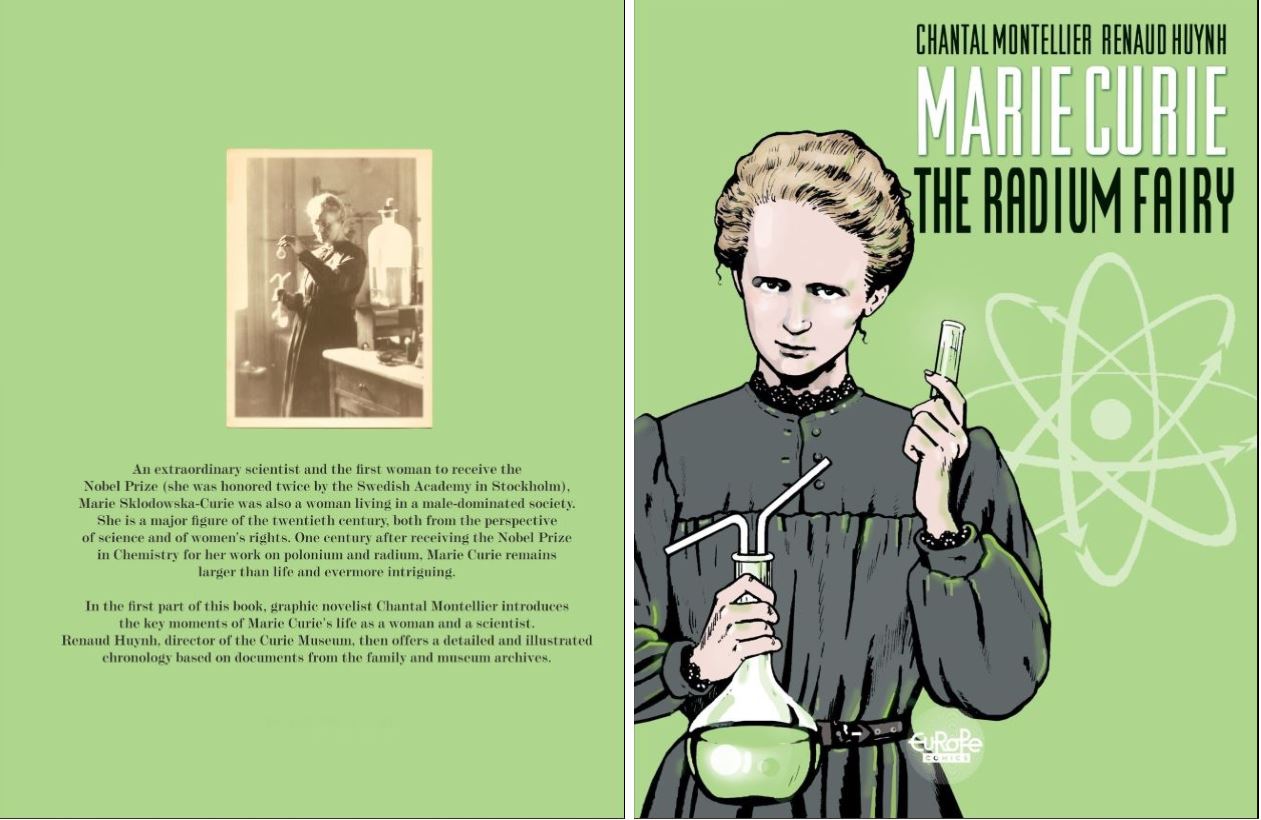
Marie Curie – The Radium Fairy


By Chantal Montellier & Renaud Huynh translated by Lara Vergnaud (Europe Comics)
No ISBN: digital-only publication

I’ve waited ages (well, since March 2017, but I’m old and joyless and my days are clearly pretty limited now) for this superb book to be picked up by a print publisher, but now I’m just going to plug it again it anyway and assume that as you’re reading this on a computer, you can make the leap to seeing comics that way too.

And yes, I know all about the smell and feel of proper books. I feel that way too, but we’re killing more trees than we need to. Just think of it as portable fun you can’t crumple or rip…

Originally released across Europe in 2011, Marie Curie La Fée du Radium was produced in collaboration with the Curie Museum and the Cité des sciences et del ’industrie (part of Universcience), with educator, illustrator and bande dessinée creator Chantal Montellier (Odile et les crocodiles, Les Damnés de Nantes).

The book summarises and dramatizes via graphic narrative a most astounding life, prior to research scientist, educator and museum curator Renaud Huynh’s (La fantastique histoire du radium) extensive and copious Timeline which traces the triumphs, tribulations and legacy of Marie Sklodowska-Curie (1867-1934): thus far the only woman to win two Nobel Prizes.

The critical comics component kicks off in Stockholm on September 4th as aging Marie Curie works on a speech; preparing to receive that second cherished accolade. Thinking back, she pictures her departed husband Pierre Curie. Their joint isolation of the element they named Polonium after her place of birth was a grand achievement but doesn’t make up for her years of struggle for acceptance or his tragic accidental death so early in their marriage…

And so, briefly, concisely and sans fanfare unfolds a true tale of brilliance applied, adversity overcome and persistence rewarded. Today, Curie is credited with adding two elements to the Periodic Table – Radium was the other one – and venerated for her unceasing researches. She was also the first woman allowed to teach at the prestigious Sorbonne, but for much of her life had to overcome entrenched patriarchal attitudes and oppression whilst being vilified in the media and by wider society for her “scandalous” personal life… and generally just for being an uppity female who didn’t know her place.

Isn’t it great how much everything has changed since then? (I am of course waiting for my own Nobel for the isolation of Sarcastium…)

This small but powerful digital-only tome concludes with that large and detailed Timeline. Huynh’s pictorial essay is packed with photographic illustrations, cartoons and clippings combining to encapsulate and clarify Curie’s life and achievements. It is all deconstructed and précised in chapters entitled 1867/1895 Warsaw-Paris’, ‘1896/1905 A Scientific Dream’, ‘1906/1911 Hardships and Success’, ‘1912/1921 The Radium Institute’ and ‘1922/1934: An International Figure’, before concluding with an ‘Epilogue’ revealing how 60 years after her death, Marie Curie’s ashes were transferred to the Pantheon (resting place of the nation’s greatest citizens). She was the first woman to be accorded this honour based solely on her own merits…

Making learning fun, Marie Curie – The Radium Fairy is a potent and powerful inspiration, venerating one of history’s most dedicated scientists: one every youngster of any age should know.
© 2016 – DUPUIS – Chantal Montellier & Renaud Huynh. All rights reserved.

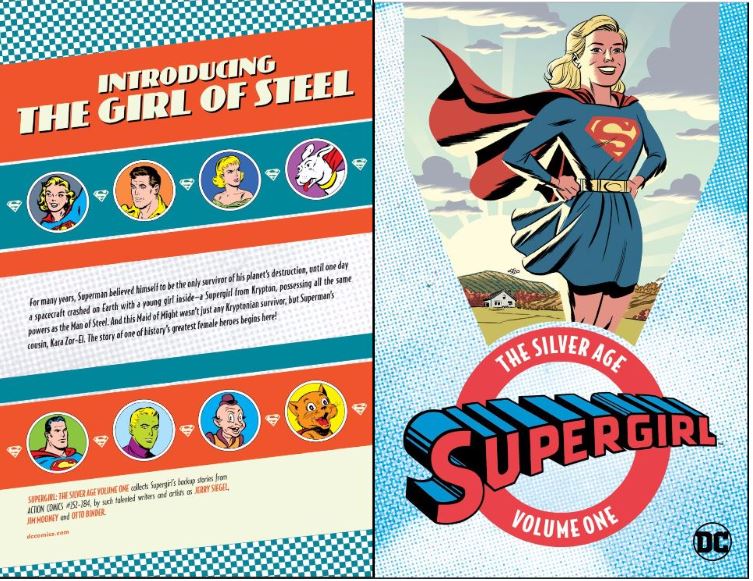
Supergirl: The Silver Age volume 1


By Otto Binder, Al Plastino, Jerry Seigel, Jim Mooney & various (DC Comics)
ISBN: 978-1-4012-7292-0 (TPB/Digital edition)

Superhero comics seldom do sweet or charming anymore. Narrative focus nowadays concentrates on turmoil, angst and spectacle and – although there’s nothing intrinsically wrong with that – sometimes the palate just craves a different flavour.

Such was not always the case as this superb compendium of the early career of Superman’s cousin Kara Zor-El of Argo City – gathering material from Action Comics #252-284 and spanning May 1959-January 1962 – joyously proves. Also included to kick off proceedings is the delightful DC House Ad advertising the imminent arrival of a new “Girl of Steel”. Sadly missing, however, is the try-out story ‘The Three Magic Wishes’ – written by Otto Binder and illustrated by Dick Sprang & Stan Kaye from Superman #123, August 1958 – which told how a mystic totem briefly conjured up a young girl with super powers as one of three wishes made by Jimmy Olsen. Such was the reaction to the plucky distaff hero that within a year a new version was introduced to the Superman Family…

Here, then, the drama commences with ‘The Supergirl from Krypton!’, the third story from Action Comics #252 introducing Superman’s cousin Kara, who had been born on a city-sized fragment of Krypton, which was somehow hurled intact into space when the planet exploded. Eventually Argo City turned to Kryptonite like the rest of the giant world’s debris, and Kara’s dying parents, having observed Earth through their scanners and scopes, sent their daughter to safety as they perished.

Crashing on Earth, she is met by Superman who creates the cover-identity of Linda Lee whilst hiding her in an orphanage in small town Midvale allowing her to learn about her new world and powers in secrecy and safety. This groundbreaking tale was also written by Binder and drawn by the hugely talented Al Plastino.

Once the formula was established Supergirl became a regular feature in Action Comics (starting with #253), a residency that lasted until 1969 when she graduated to the lead spot in Adventure Comics. In ‘The Secret of the Super-Orphan!’, at her new orphanage home she makes the acquaintance of fellow orphan Dick Wilson (eventually Malverne) who would become her personal gadfly (much as the early Lois Lane was to Superman), a recurring romantic entanglement who suspects she has a secret. As a young girl in far less egalitarian times, romance featured heavily in our neophyte star’s thoughts and she frequently met other potential boyfriends: including alien heroes and even a Merboy from Atlantis.

Many early tales involved keeping her presence concealed, even whilst performing super-feats. Jim Mooney became regular artist as Binder remained chief scripter for the early run. In Action #254’s ‘Supergirl’s Foster-Parents!’ sees an unscrupulous couple of con-artists easily foiled, after which Linda meets a mystery DC hero when ‘Supergirl Visits the 21st Century!’ in #255. Her secret is nearly exposed in ‘The Great Supergirl Mirage!’ before she grants ‘The Three Magic Wishes!’ to despondent youngsters and teaches a mean bully a much-needed lesson.

The Man of Steel often came off rather poorly when dealing with women in those far less enlightened days, always under the guise of “teaching a much-needed lesson” or “testing” someone. When she ignores his secrecy decree by playing with super dog Krypto, cousin Kal-El banishes the lonely young heroine to an asteroid in ‘Supergirl’s Farewell to Earth!’ but of course there’s paternalistic method in the madness…

‘The Cave-Girl of Steel!’ sees her voyage to Earth’s ancient past and become a legend of the Stone Age before AC #260 finds her transformed by the mystical Fountain of Youth into ‘The Girl Superbaby!’ The next tale introduced feline fan-favourite Streaky the Super-Cat in ‘Supergirl’s Super Pet!’ after which ‘Supergirl’s Greatest Victory!’ supplies a salutary lesson in humility to the Girl of Steel. Binder moved on after scripting ‘Supergirl’s Darkest Day!’ in which the Maid of Might rescues an alien prince before incoming Jerry Siegel began his own tenure by scripting ‘Supergirl Gets Adopted!’: a traumatic yet sentimental tale which ends with the lonely lass back at Midvale orphanage.

I’ve restrained myself so please do likewise when I say the next adventure isn’t what you think. ‘When Supergirl Revealed Herself!’ (Siegel & Mooney, Action #265) is another story about nearly finding a family, after which Streaky returns in ‘The World’s Mightiest Cat!’ as prelude to Supergirl finding fantastic fellow super-kids in Action #267’s ‘The Three Super-Heroes!’ She narrowly fails to qualify for the Legion of Super Heroes through the cruellest quirk of fortune, but – after picking herself up – exposes ‘The Mystery Supergirl!’ prior to Siegel & Mooney introducing fish-tailed Mer-boy Jerro as ‘Supergirl’s First Romance!’

Packed with cameos like Batman & Robin, Krypto and Atlantean Lori Lemaris, ‘Supergirl’s Busiest Day!’ sees her celebrating a very special occasion, after which Streaky enjoys another bombastic appearance as the wonder child builds ‘Supergirl’s Fortress of Solitude!’ before Binder wrote ‘The Second Supergirl!’ – an alternate world tale too big for one issue. Sequel ‘The Supergirl of Two Worlds!’ appeared in Action #273 – as did a novel piece of market research. ‘Pick a New Hairstyle for Linda (Supergirl) Lee!’ involved eager readers in the actual physical appearance of their heroine and provided editors valuable input into who was actually reading the series…

Siegel & Mooney soundly demonstrated DC dictum that “history cannot be changed” in ‘Supergirl’s Three Time Trips!’ before ‘Ma and Pa Kent Adopt Supergirl!’ offered a truly nightmarish scenario: rapidly followed by a return visit to the Legion of Super Heroes in ‘Supergirl’s Three Super Girl-Friends!’, whilst Action #277 featured an amazing animal epic in ‘The Battle of the Super-Pets!’

The next five tales form an extended saga, taking the Girl of Steel in totally new directions. On the eve of Superman announcing her existence to the world, Supergirl loses her powers and – resigned to a normal life – is adopted by the childless Fred and Edna Danvers. Sadly, it’s all a cruel and deadly plot by wicked Lesla-Lar, Kara’s identical double from the Bottle City of Kandor. This evil genius wants to replace Supergirl and conquer Earth…

This mini-epic – ‘The Unknown Supergirl!’, ‘Supergirl’s Secret Enemy!’, ‘Trapped in Kandor!’, ‘The Secret of the Time-Barrier!’ and (following the results of the Hair Style competition) ‘The Supergirl of Tomorrow!’ ran in Action #278-282: solidly repositioning the character for a more positive, effective and fully public role in the DC universe. The saga also hinted of a more dramatic, less paternalistic, parochial and even reduced-sexist future for the most powerful girl in the world, over the months to come; although the young hero is still very much a student-in-training, her existence still kept from the general public as she lives with adoptive parents who are completely unaware the orphan they have adopted is a Kryptonian super-being.

The accent on these stories generally revolves around problem-solving, identity-saving and loneliness, with both good taste and the Comics Code ensuring readers weren’t traumatised by unsavoury or excessively violent tales. Plots akin to situation comedies often pertained, as in ‘The Six Red “K” Perils of Supergirl!’ Peculiar transformations were a mainstay of Silver Age comics, and although a post-modern interpretation might discern some metaphor for puberty or girls “becoming” women, I rather suspect the true answer can be found in author Seigel’s love of comedy and an editorial belief that fighting was simply unladylike…

Red Kryptonite, a cosmically-altered isotope of the radioactive element left when Krypton exploded, caused temporary physical and sometimes mental mutations in the survivors of that doomed world. It was a godsend to writers in need of a challenging visual element when writing characters with the power to drop-kick planets. Here the wonder-stuff generates a circus of horrors, transforming Supergirl into a werewolf, shrinking her to microscopic size and making her fat. I’m not going to say a single bloody word…

The drama continues and concludes – like this initial Silver Age compilation – with ‘The Strange Bodies of Supergirl!’ wherein Linda Lee Danvers’ travails escalate after she grows a second head, gains death-ray vision (ostensibly!) and morphs into a mermaid. This daffy holdover to simpler times presaged a major change in the Girl of Steel’s status… but that’s a volume for another day.

Throughout her formative years Kara of Krypton underwent more changes than most of her confreres did in 20 years, as editors struggled to find a niche the buying public would appreciate, but for all that, these yarns remain exciting, ingenious and utterly bemusing.

Possibly the very last time a female super-character’s sexual allure wasn’t equated to sales potential and freely and gratuitously exploited, these tales are a link and window to a far less crass time, displaying one of the few truly strong and resilient female characters parents can still happily share with even their youngest children.
© 1959, 1960, 1961, 1962, 2017 DC Comics. All Rights Reserved.

Trish Trash Rollergirl of Mars – The Collected Edition


By Jessica Abel, with Lydia Roberts & Walter various (Super Genius/Papercutz)
ISBN: 978-1-5458-0167-3 (TPB/Digital edition) 978-1-5458-0166-6 (HB)

Our fascination with Mars has never faltered and now that we’re almost within touching distance, the Red Planet’s allure and presence in our fiction has never been more broad-based and healthily imaginative. Amidst all the recent TV, movie and literary product, one of the most engaging treatments was an enthralling comics serial detailing the life of an extraordinary young woman in exceedingly trying times.

After Earth collapses in an ecological and economic meltdown, recently arrived first settlers on Mars were trapped under an increasingly burdensome fixed economic structure and oppressive corporate plutocracy. Two centuries later, an entire class of indentured servants eke out a fraught existence, harvesting water and food with machines rented from Arex (“we’re the air that you breathe”). The air they don’t breathe is meagre, toxic, dust-filled and a bit radioactive…

On Mars, everything belongs to The Company, and people usually live from cradle to grave in crippling debt. There is, ostensibly, a chance to escape: mandatory offworld mining missions to the asteroid belt. These Temporary Labor Assignments, however, are regarded as a quick ticket to certain death.

All tyrannies need bread and circuses though. On Mars that’s Hoverderby…

Based on an ancient Earth entertainment, teams of women race around a hover track in flying boots, scoring points by beating each other up. It’s the planet’s most popular spectator sport and Arex own that too…

Trish Nupindu is seven-and-a-half (on Mars. In Earth terms she’s 15): a smart, recently-orphaned kid who’s really good with engines and most mechanical systems. Stuck on her aunt’s water farm, Trish dreams of becoming a Hoverderby star and is utterly discontented with the state of her existence. All “Marty” reel from the force of crushing, inescapable poverty and Trish totally believes her only chance of getting out from under a system stacked from the get-go against ordinary people is to become a media star of the great game.

Bold and impatient, one day she sneaks off to join the local team and is suckered into a binding intern’s contract, even though she’s under-age…

Trish doesn’t even get to play: the team manager wants her because she’s good at fixing the hoverboots continually malfunctioning due to the all-pervasive dust. Her world turns upside down after she and avowed-revolutionary/pal Marq discover a native Martian. Recalled from near-death, the mythical creature opens their eyes to a whole new world, and “her” secrets will change forever not just the way Hoverderby is played but also the very economic balance of power on the Red Planet – if the ruthless upper echelons of Arex don’t stop them first…

The inspirational drama is backed up by extensive supplemental features such as the rules of Hoverderby; Derby Gear: Then and Now; illustrated specifications for Radsuits; fact-features on The Homestead Debate, Native Martians, Ares Collective Statement of Debt (ACSOD), TLAs and Asteroid Mining all delivered in the manner of wiki pages. Also on show are data bursts on legendary water miner Ismail Khan, faux kids’ comics “True Tales of the Early Colonists” and a complete Timeline of Mars Colonization.

Jessica Abel has been wowing readers and winning prizes since 1997 when she took both the Harvey and Lulu awards for Best New Talent. Previous graphic delights include the fabulous Artbabe, Growing Gills, Life Sucks, Drawing Words & Writing Pictures, collections Soundtrack and Mirror, Window plus the Harvey-winning La Perdida.

Trish Trash began gradually unfolding in 2016: a sublime blend of subversive human drama and hard science fiction thriller with a supremely human and believable lead taking charge and changing the world. After three album releases, the entire saga was made available in this oversized (218 x 284 mm) hardback, plus paperback and eBook editions, at least one of which you really must see ASAP.
© Jessica Abel and Dargaud. All rights reserved. All other editorial material © 2018 by Super Genius.

The Cabbie volume 1


By Marti, with an introduction by Art Spiegelman (Fantagraphics Books)
ISBN: 978-1-60699-4504 (HB/Fantagraphics) 978-0874160420 (Album PB Catalan Communications)

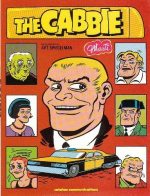
Although out of print since 1987, in 2011 Fantagraphics rescued from relative obscurity one of the darkest yet most grimly illuminating classics of European cartooning in this remastered and augmented reissue of The Cabbie: a stylish, nightmarish psycho-sexual noir thriller that has as much seedy kick now as it had when first translated by Catalan Communications…

Now as the macabre maestro has died, my conscience prompts me to pay for neglecting such wonderful comics and it’s only right we should pause to revisit his greatest achievement. Maybe some publisher will endeavour to bring some of his other dark wonders – like Doctor Vertigo, Propaganda Moderna, crime fantasy-thriller Calvario Hills, Cien dibujos por la libertad de Prensa or Terrorista – to a wider international audience.

Marti Riera Ferrer (1955 – 19th January 2024) was born in Barcelona during the heyday of fascist rule. He studied at the Massana School of Arts and Crafts where his efforts coincided with the Generalissimo’s death, and from 1975 to 1979 a liberalisation saw “Marti” creating comics for alterative magazines like Rock COMIC and Star.

From its launch in 1979 he also began contributing to apocalyptic iconoclast El Vibora: short stories and series such as Tony Nuevaola and – with Rodolfo – Lola Lista contra los Nada. These efforts brought international interest and Marti began appearing in Raw and Drawn & Quarterly. Il TaxistaThe Cabbie – began in 1982 and he episodically added to the canon over succeeding years, and although semi-retired from the early Nineties he continued generating other material at his own pace for the magazine Makoki and Tobalina. These tales varied from erotic fiction to general illustrated fare.

Dick Tracy is one of the most well-known strips on Earth and the super-cop’s contributions to the art form are many and indisputable. They occurred over many decades and the medium of graphic narrative grew up with it. Imagine the effect instant exposure – or overexposure – to such an uncompromising, bombastic, iconic property on the artists of a nation where free-expression and creative autonomy was suppressed for generations. That’s what happened when the death of General Franco (who had held Spain in a fascistic time-warp from his victory in April 1939 until his death in November 1975) opened up and liberalised all aspects of Spanish life. When Marti saw the strip he was changed for life…

As Art Spiegelman says in his introduction, “decades of political and social repression gave way to a glorious eruption of creativity that allowed a full-fledged counterculture to come to life at just about the same time that America’s “Love Generation” gave way to what Tom Wolfe labelled the “Me Generation.””

How odd yet fitting then that an American symbol of “The Establishment” so enchanted and captivated young cartoonist Marti Riera that he assimilated every line and nuance to create a bleak, stripped-down and extremely angry homage detailing the tribulations of a seedy, desperate taxi-driver trapped in an abruptly vanished past and prey to a world at once free and dangerous, ungoverned and chaotic…

Driving around the seediest part of town our hero picks up a high-rolling gambler who’s just won big, but the driver’s night goes horribly wrong when a knife-wielding thief hijacks the cab and robs his passenger. Luckily, the Cabbie can handle himself and he quickly, brutally subdues the thug.

Our protagonist is a decent, hard-working man who lives with his ailing mother, humouring her talk of a mysterious inheritance, and allowing her to keep the embalmed cadaver of his father in the spare bedroom, but he’s tragically unaware that his citizen’s arrest will have terrible repercussions for them both. When the son of the thief he captured is released from prison, the ingrate immediately begins a grim campaign of retribution against the Cabbie that creates a maelstrom of tragedy, degradation and despair.

This is a harsh, uncompromising tale of escalating crime and uncaring punishments: blackly cynical, existentially scary and populated with a cast of battered, desolate characters of increasingly degenerate desperation. Even the monsters are victims, but for all that The Cabbie is an incredibly compelling drama with strong allegorical overtones and brutally mesmerizing visuals.

Any mature devotee of comics should be conversant with Marti’s superb work, and with a second volume out there and the hope of digital editions (One bloody Day!), hopefully we soon all will be…
The Cabbie (Taxista) © 2011 Marti. Introduction © 2011 Art Spiegelman. This edition © 2011 Fantagraphics Books.

The Lincoln Brigade


By Pablo Durá, Carles Esquembre & Ester Salguero, translated/edited by Andrea Lorenzo Molinari (Caliber Comics)
ISBN: 978-1-63529-822-2 (TPB/Digital edition)

I’m glad my parents are dead.

Their generation thought that they had dealt with fascism so their children wouldn’t have to, but every day it looks like that kind of intolerance is hardwired in some of us and never goes away. Maybe we simply need to be as ruthless and unforgiving as the foe if we want the insanity to finally end.

At least there are still plenty of people willing to fight and keen to share warnings from the past in books like this digital clarion call.

Preceded by an contextualising Introduction by Josephine Nelson – Commander of the Veterans of the Abraham Lincoln Brigade and daughter of Abraham Lincoln Brigade leader Steve NelsonThe Lincoln Brigade is a brief but powerful account ruminating on what 3,015 mostly white, largely second-generation European American, passionately Communist volunteers of the 17th (latterly 58th) battalion of the XV International Brigade experienced during the heroic but doomed struggle to defend Republican Spain from Franco and his Nazi allies in the Spanish Civil War (17th July 1936 -1st April 1939). That skilfully managed proxy conflict is now considered by many historians as a test run for World War II: something certain Russian asshats know very well…

The struggle is seen through the eyes of Oliver Law – one of the few black comrades of the “Lincoln Brigade”. Texas born Law (October 23rd 1900 – July 9th 1937) served in the 24th Infantry Regiment, US Army: a professional soldier in a “coloured unit” stationed on the Mexican border. He served efficiently and with honour from 1919-1925 and on mustering out moved gradually north via Indiana and Chicago, finding jobs as a cement worker, taxi driver, restaurateur and dock worker.

Law’s experiences led to him becoming a labour organiser and member of the American Communist Party. As the Great Depression progressed, he was a member of the International Labor Defense movement employed by the Works Project Administration. Moments of early activism are observed as he meets legendary, inspirational African American freedoms fighter Harry Haywood (February 4th 1898 – January 4th 1985) and faces strike-breaking cops beside equally fervent allies of all colours.

In 1936, Benito Mussolini ordered an invasion of Ethiopia in one of the first overt acts of fascist expansionist colonialism and Law realised – as did so many others across the world – that he would have to fight the rise of a tyranny even greater than that he and his kind faced at home. When Spain erupted into chaos with Generalissimo Francisco Franco Bahamonde leading the army (supported by Nazi/Italian National Fascist Parties) in revolt against the democratically elected government, Law and thousands like him volunteered to fight for the embattled Republic.

In this fictionalised account of events by Pablo Durá (Original Sins, Tales of Rogues) illustrated by Carles Esquembre (Lorca – un poeta en Neueva York) and colourist Esther Salguero we see how Law – like so many others – had to sneak across neutral Europe into Spain by pretending to be a tourist or else face arrest by his own government. Like most nations the USA and Britain had signed a non-intervention treaty Italy and Germany were happy to flout…

What comes next is grim, tragic, stupid and shameful as the daily grind of driven idealists betrayed by their own supposed allies and cut down as much by indifference and ineptitude as enemy action lead to Law’s swift rise as a soldier and untimely death. In the course of his duties the Texan advances to Commander of the Machine Gun Company and before his death was for a brief moment the official Commander of the whole Abraham Lincoln Brigade. Of the approximately 3000 Americans he so briefly led, 681 were killed in action or died of wounds or sickness…

Oliver Law commanded the first fully-integrated unit of American soldiers in combat 10 years before white and black US soldiers were in 1948 forcibly made to serve together by Presidential decree of Harry S. Truman

It’s all here for you to see and you really should, as it’s delivered with coldly emphatic understatement and clinically clear authenticity: blurring fact with myth and history with extrapolation in the same compelling, upsetting manner as Orwell’s Homage to Catalonia, or in graphic novels like Paco Roca, Rodrigo Terrasa & Astiberri’s El abismo del olvido (The Abyss of Forgetting), Mónica Montanés’ Different: A Story of the Spanish Civil War Picture Book or Vittorio Giardino’s epic No Pasaran! trilogy.

Like all those, this too is a book anyone unhappy with the way things are should peruse and ponder upon.
© 2020 Pablo Durá and Carles Esquembre. All Rights Reserved.

Deathlok: The Living Nightmare of Michael Collins


By Dwayne McDuffie, Gregory Wright, Jackson Guice, Denys Cowan, Scott Williams, Rick Magyar, Kyle Baker, Mike DeCarlo & Friends, Paul Mounts, Brad Vancata, Richard Starkings, Joe Rosen & various (MARVEL)
ISBN: 978-0-7851-5988-9 (HB/Digital edition)

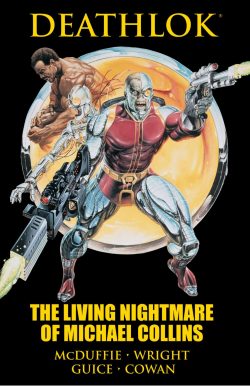
As created by Rich Buckler and originally scripted by Doug Moench in 1974, Deathlok the Demolisher was an honourable soldier condemned to an horrific fate in a dystopian alternate future. It’s his 50th anniversary this year and we’ll get around to the time-tossed travails of Manning another day. This book is not about him.

As you’d expect of a character who was designed as a bio-mechanised weapon, Deathlok is a complex concept with a lot of backstory and many later models. Most of that and those also belong in different reviews. Here we’re concentrating on the most successful iteration of the cyborg: a black man enduring living hell, subjugation and slavery to merciless masters who fights for his dignity and liberty with everything he has left to him…

Bookshelf format limited series Deathlok #1-4 was first released July through October 1990, and its success prompted a cheaper newsprint reprint run – as Deathlok Special #1-4 – less than a year later. Tragic champion Michael Collins sprang from this epic tale of deception and malfeasance into his own monthly series: 34 issues and 2 Annuals spanning July 1991 to April 1994, plus guest shots (across Marvel’s US and UK branches) in the nineties.

It begins in an 8-page prequel story from Marvel Comics Presents #62 (cover dated November 1990 but on sale in late summer) wherein Dwayne McDuffie, Gregory Wright & Jackson “Butch” Guice took Deathlok on a ‘Test Run’. The vignette saw soldier Colonel John Kelly – or at least his brain and assorted organic leftovers attached to a biomechanical body of intriguingly unknown origins – ruthlessly despatch a dozen mercenaries who had no idea what they were really facing; until a computer glitch ends the exercise and almost project leader Harlan Ryker.

Kelly would later be eventually resurrected as cyborg antihero Siege but the failed test left the Cybertek Systems Inc. team (cybernetics division of Marvel’s corporate villain organization Roxxon) in need of a new brain donor…

The story of this Deathlok really begins with the first solo issue as Dwayne McDuffie, (co-writer and colourist) Gregory Wright, Jackson Guice, Scott Williams & hard-pressed, overworked letterer Richard Starkings introduce readers to ‘The Brains of the Outfit’. Cybertek is dirty. It uses subterfuge to achieve its ends. When programmer, engineer, pacifist and devoted family man Michael Collins discovers his innovations are going into advanced weapons systems and not medical equipment he rebels and quits, inadvertently making himself the next candidate for the organic wetware of Deathlok. The enigmatic war frame requires a human brain to operate, but it doesn’t have to be alive…

Mere days after a tragic “accident”, good friend Harlan Ryker tries to comfort widow Tracy Collins and Michael’s son Nick, even as a new Deathlok is unleashed in Amazon rainforest republic Estrella. Here, future Roxxon profits require a change of environment, a new dam and an end to eco-guerilla resistance. However, once again the onboard systems malfunction mid fire-fight and the presumed expired personality of Michael Collins takes control of the body whilst striking a détente with the murderously efficient semi-sentient programmed systems.

In charge and very angry, Collins wants Ryker, Cybertek and Roxxon to pay, but cannot abandoned his principles. His first action is to institute a “no-kill” command in the super-soldier body he shares with a computer he must negotiate every action with. This does not hamper his combat efficiency in the slightest…

It proves a perfectly workable arrangement as Deathlok when he returns to the New Jersey Cybertek facility and violently confronts the “friends” who betrayed him. Ryker and his team desperately launch their other project – a cybernetically-controlled all-terrain super-tank piloted by ruthless paraplegic co-worker and barely suppressed psychopath Ben Jacobs. After wrecking the project, Deathlok flees but finds no solace. Now the embodiment of everything he loathes, he doesn’t even know if he’s truly still alive.

An attempt to reach out to Tracy and Nick results in disaster and only anonymous contact with his boy via a computer game stays him from self-termination. Lost and alone, he decides to use his situation to help others…

Second issue ‘Jesus Saves’ sees Deathlok operating as vigilante in New York’s Coney Island, defending the dregs of society – generally from themselves. After stopping a mugging he is befriended by the elderly victim Jesus who offers “Mike” shelter. Elsewhere, the event at Cybertek has reached the attention of S.H.I.E.L.D. director Nick Fury (the white one), but Ryker is more concerned by pressure his Roxxon superiors are exerting on him. In response to a deadly deadline, he commissions a mercenary “fixer” called Wajler – AKA Mainframe – to eradicate Deathlok whilst Ryker unctuously probes Tracy and Nick for possible intel and warns them that a rogue robot might be stalking them. Nick is not fooled…

Wracked by human memories and doubts, Deathlok uses the ability to access computer files and enter a communal cyber-scape to look for ways to stop Ryker, but his reaching out endangers his few remaining friends. It also makes him a target and Mainframe’s mech-enhanced team zero in on Coney Island and explosively attack, uncaring of the innocent crowds enjoying themselves there. The resultant chaos makes headlines everywhere and as S.H.I.E.L.D. steps in Deathlok decides it’s time to go back to Estrella and fix what he inadvertently started as a slave of Cybertek…

Artists Denys Cowan & Rick Magyar joined McDuffie & Wright, in #3 as ‘Dam if He Don’t’ sees the cyborg hero subject to intense S.H.I.E.L.D. scrutiny even as Collins joins the remaining eco-guerillas in wrecking Roxxon’s scheme to build a super dam and make the entire region easier to mine. Even after convincing the resistors he’s on their side – this time – there’s still an army of soldiers and regiment of giant robot ants controlled by revenge hungry Ben Jacobs to deal with.

The unstoppable Deathlok’s crusade is greatly assisted by a late-in-the-day alliance with Nick Fury, setting up a final face-off with Ryker, but the malign master manipulator has one last card to play and offers to reinsert Collins’ brain in the body he removed it from and has been judiciously keeping alive “just in case”…

The clash of wills and Collins brief ethical “wobble” culminates in catastrophic combat that draws in naive Japanese ultra-nationalist/part-time X-Man Sunfire, his cunningly controlling sensei Yoritomo and a secret army of ninjas on ‘Ryker’s Island’ (McDuffie & Wright, Cowan, Kyle Baker, Mike DeCarlo & Friends). Despite at first being pacified by Harlan’s promises of restoring him alive to his family, Deathlok recovers his moral compass in time for S.H.I.E.L.D. to assist him in averting a nuclear armageddon Ryker thought he could profit from, but in the confusion everyone loses sight of Michal Collins’ bottled body…

The least Fury can do is lie to Tracy and Nick for him: telling them the pacifist is on a secret mission for S.H.I.E.L.D. as Deathlok hides, facing an uncertain future as a hero in waiting…

With covers by Joe Jusko, Bill Sienkiewicz, Kent Williams, Cowan & Tom Smith, plus frontispiece/inside cover art by Guice, an historical essay on ‘Deathlok’ by Peter Sanderson and covers for reprint series Deathlok Special #1-4 (Guice & Cowan), the origin of Marvel’s most conflicted champion is a challenging but rewarding romp for older readers.
© 2016 Marvel Characters, Inc. All rights reserved.

The Art of Ramona Fradon


By Ramona Fradon; interviewed by Howard Chaykin (Dynamite Entertainment)
ISBN: 978-1-60690-140-3 (HB/Digital edition)

In a matter of mere weeks that have taken many accomplished, acclaimed and beloved comics luminaries (including Paul Neary, Enrique Badía Romero, José Delbo, Marti (Riera), John G. Miller and Keith Giffen) – we are particularly saddened to learn that pioneering cartoonist Ramona Fradon died on February 24th. At the age of 97 she had only just officially retired a month previously. Her incomparable works will keep her with us through characters and titles such as Super Friends, Aquaman and Metamorpho (slated to appear in the next Superman film). Until then, here’s another tome you should own…

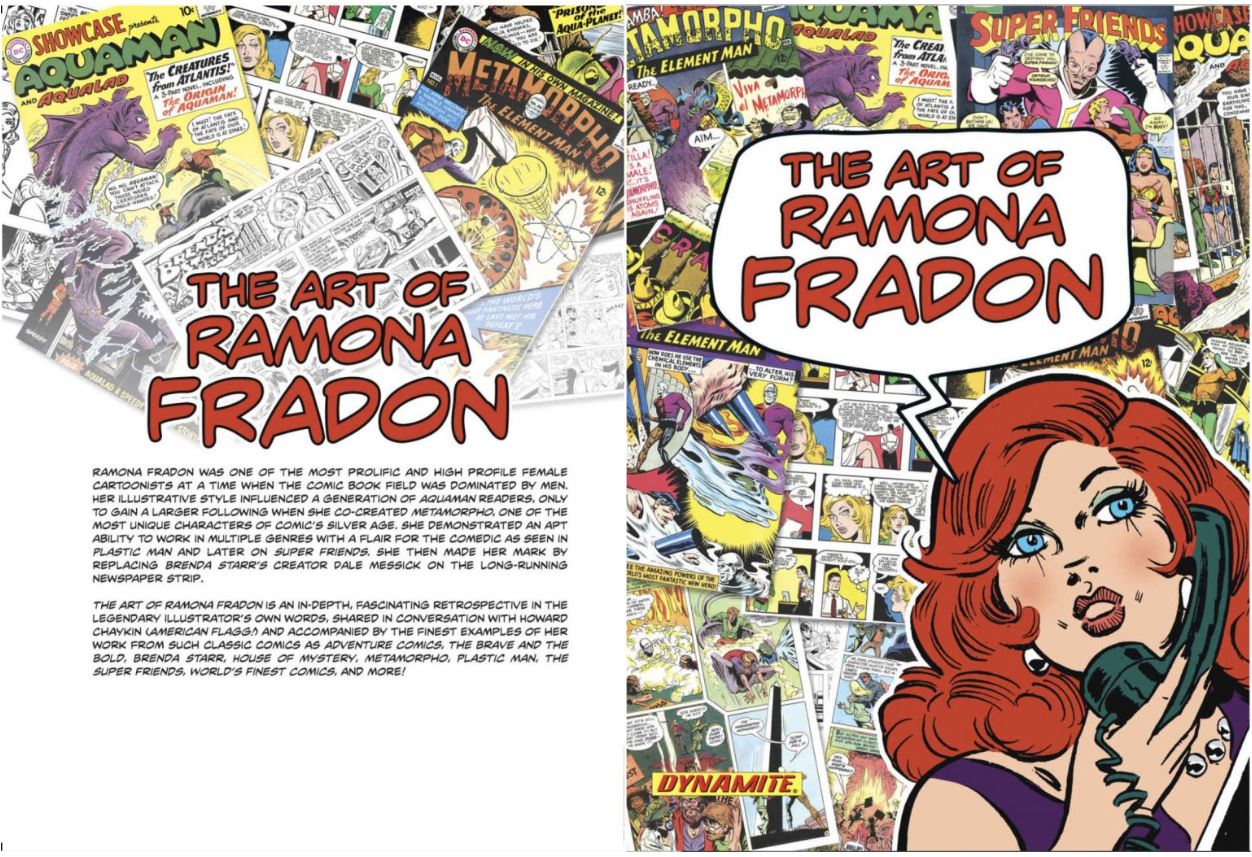
Although present in comic books from the start, women – like so many other non-white/male “minorities” – have been largely written out of history. One of the very few to have weathered that inexplicable exclusion was Ramona Fradon. This excellent commemorative art collection celebrates not only her life and contribution, but thanks to its format – a free, unexpurgated extended interview with iconoclastic creator Howard Chaykin – shares the artist’s frank and forthright views on everything from work practise to the power of fans…

It begins with an Introduction from Walt Simonson who proclaims ‘Meet your Idol… and discover They’re even Cooler than you Thought!’, before early days are revealed in ‘Part One: Setting the Scene’ and ‘Part Two: In the Beginning’

Ramona Dom was born on October 2nd 1926 to an affluent Chicago family with many ties to commercial creative arts. Her father was a respected artisan, letterer and calligrapher who had designed the logos for Camel cigarettes, Elizabeth Arden and other major brands, and also formulated the fonts Dom Casual and Dom Bold. He had plans for his daughter, urging her to become a fashion designer…

The family moved to (outer) New York when Ramona was five. Ramona initially attended The Parsons School of Design, and discovered she had absolutely no interest in creating clothes. Although she’d never read comic books, she had voraciously read illustrated books like John Barton Gruelle’s Raggedy Anne and Andy series, and was a devoted fan of newspaper strips. Favourites included Dick Tracy, Bringing Up Father, The Phantom, Alley Oop, Flash Gordon, Terry and the Pirates and Li’l Abner (all herein represented by 1930s examples).

Ramona soon transferred to the New York Art Students League – a hotbed of cartooning – where she met and married Arthur Dana Fradon. He became a prolific illustrator, author and cartoonist and a regular contributor to The New Yorker between 1948-1992. They wed in 1948 and he actively encouraged her to seek work in the still young funnybook biz…

‘Part Three: Gingerly Breaking into Comics’ reveals how her first forays at Timely Comics led to DC/National Comics and a Shining Knight yarn published in Adventure Comics #165 (cover-dated June 1951), 10 months later taking over the veteran Aquaman feature in #167. Fradon was one of the first women to conspicuously and regularly illustrate comic books, drawing the strip throughout the 1950s and shepherding the Sea King from B-lister to solo star and Saturday morning TV pioneer.

In the first of a series of incisive, informative mini biographies, ‘Sidebar: Murray Boltinoff’ reveals the influence of that much-neglected and under-appreciated editor. ‘Part Four: Queen of the Seven Seas’ and ‘Part Five: Man of 1000 Elements’ show how occasional stints on The Brave and the Bold team-ups led to her co-creation of Sixties sensation Metamorpho, the Element Man. However in 1965 – at the pinnacle of success – she abruptly retired to raise a daughter, only returning to comics in 1972 for another stellar run of landmark work.

‘Sidebar: George Kashdan’ tells all about the multi-talented scripter before ‘Part Six: Ramona Returns to Comics… At Marvel???’ details how the House of Ideas lured the artist back to her board and highlights her difficulties working “Marvel-style” on assorted horror shorts, The Claws of the Cat and Fantastic Four, all presaging a return to DC…

‘Sidebar: Joseph Patterson’ looks into the astounding strip Svengali who green lit Dick Tracy, Little Orphan Annie, Gasoline Alley and more before ‘Part Seven: Back Home at DC Comics’ where she was busier than ever. As well as horror and humour shorts, Fradon drew a new Metamorpho try-out, superhero spinoff Freedom Fighters and her twin magnum opuses: revived comedy superhero Plastic Man and TV sensation Super Friends. These revelations are bolstered by ‘Sidebar: E. Nelson Bridwell’, exploring the life of the man who knew everything about everything…

In 1980, Fradon took over Dale Messick’s long-running newspaper strip Brenda Starr, drawing it for 15 years. ‘Part Eight: Leaping From Books to Strips’ explores that painful and unpleasant chore in sharp detail, supplemented by ‘Sidebar: Brenda Starr’ outlining the feature’s history and reprinting those episodes when the ageless reporter met a certain cop, allowing Fradon to finally draw childhood idol Dick Tracy

The most fascinating stuff is left until last as ‘Part Nine: Ramona the Author’ discusses her career post-Brenda: drawing for Bart Simpson and Spongebob Squarepants comics, returning to higher education and writing a philosophical historical mystery novel – The Gnostic Faustus: The Secret Teachings Behind the Classic Text – as well as illustrated kids book The Dinosaur That Got Tired of Being Extinct.

Packed throughout with candid photos, and stunning pencil sketches, painted pictures and privately commissioned works – like Aquaman, assorted Super Friends, Superman, Batman, Wonder Woman, Robin; Metal Men, Aqualad, Brenda Starr, Black Canary, Shazam/Captain Marvel, Shining Knight, The Atom, The Spirit, Metamorpho & cast, Marvel Girl, Miss America, Power Girl, Catwoman, Hawkman, numerous illustrations from The Story of Superman book plus convention sketches, this celebration concludes with even more fabulous sleek super art images in ‘Part Nine: Ramona Today’ and ‘Part Eleven: Bibliography’

This is an amazing confirmation of an incredible career and any fan’s dream package. Amongst gems unearthed here are complete Aquaman stories ‘The Kid from Atlantis!’ (Adventure Comics #269, 1960), ‘A World Without Water’ (Adventure#251, 1958) and ‘How Aquaman Got his Powers!’ (Adventure #260, 1959), plus tales from Star Spangled War Stories (#184, 1975) and ‘The Invisible Bank Robbers!’ (Gangbusters #30, 1952).

Also on show are unpublished sample strips by Dana & Ramona Fradon and a monumental cover gallery of unforgettable images from Super Friends #3, 5-8, 10, 11, 13, 17, 19, 21, 22, 24-27, 31, 33, 36-39 & 41; Plastic Man #16-20; The Brave and the Bold #55, 57, 58, Showcase #30 & 33, Metamorpho, the Element Man #1-5, Namora #1 (2010), Fantastic Four #133 and Freedom Fighters #3.

These are supported by selected interior pages in full colour or monochrome from Star Spangled War Stories #8; Adventure Comics #190; Metamorpho, the Element Man #1; 1st Issue Special #3; Fantastic Four #133; The Brave and the Bold #57; House of Secrets #116 & 136; Secrets of Haunted House #3 & 14; House of Mystery #232 & 273; Plop! #5; Freedom Fighters #3 & 5; Plastic Man #14; Super Friends #6-8, 10, 13, 16, 19, 21, 23 & 25 and the Super DC Calendar 1977.

A truly definitive appreciation of the Comic Book Hall of Fame inductee 2006, this oversized (229 x 305 mm) hardback reproduces hundreds of pages and covers, plus a wealth of out-industry artwork and commissioned wonders, as accompaniment to an astonishingly forthright testament and career retrospective of a phenomenal and groundbreaking talent.

The Art of Ramona Fradon will delight everyone by showing everybody how comics should be done….
Marvel Characters © and ™ 1941-2013 Marvel Characters, Inc. DC Comics Characters © and ™ DC Comics. Brenda Starr™ © 2013 Tribune Media Services. All Rights Reserved.