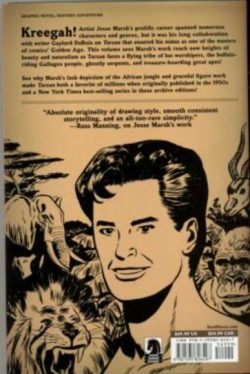
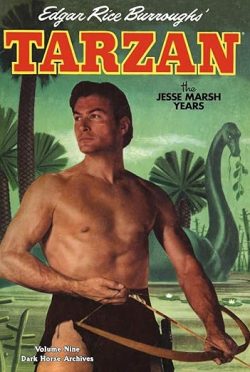
Edgar Rice Burroughs’ Tarzan: The Jesse Marsh Years Volume Nine


By Gaylord DuBois & Jesse Marsh (Dark Horse Books)
ISBN: 978-1-59582-649-7 (HB)

This book includes Discriminatory Content produced in less enlightened times.

Win’s Christmas Gift Recommendation: Primal fantasy Adventure… 8/10

I don’t know an awful lot about Jesse Marsh, other than that he was born on 27th July 1907 and died far too young: on April 28th 1966 from diabetic complications at the height of a TV Tarzan revival he was in large part responsible for. What I do know, however, is that to my unformed, pre-fanboy, kid’s mentality, his drawings were somehow better than most of the other artists and that every other kid who read comics in my school disagreed with me.

There’s a phrase we used at 2000 AD that summed it up: “Artist’s artist”, which usually meant someone whose fan-mail divided equally into fanatical raves and bile-filled hate-mail. It seems there are some makers of comic strips that many readers simply don’t get.

It isn’t about the basic principles or artistic quality or even anything tangible – although you’ll hear some cracking justifications: “I don’t like his feet” (presumably the way he draws them) and “it just creeps me out” being my two favourites. Never forget in the 1980s DC were told by the Comics Code Authority that Kevin O’Neill’s entire style and manner of Drawing was unacceptable to American readers!

I got Jesse Marsh. He was another Disney animator (beginning in 1939) who moved sideways – in 1945 – to become a full-time narrative illustrator for the studio’s comic book licensee Whitman Publishing. Marsh never looked back and became the go-to guy for other ERB adaptations such as John Carter of Mars.

Situated on the West Coast, Western’s Dell/Gold Key imprints rivalled DC and Marvel at the height of their powers, and the licensee famously never capitulated to the wave of anti-comics hysteria that resulted in the crippling self-censorship of the 1950s. No Dell Comics ever displayed a Comics Code Authority symbol on the cover – they never needed to…

Marsh jobbed around adapted movie properties – mostly westerns like Gene Autry – until 1948 when Dell introduced the first all-new Tarzan comic book. The newspaper strip had run since 1929 and all previous funnybook releases had featured expurgated and modified reprints of those adventures. That all changed with Dell Four Color Comic #134 (February 1947) which featured a lengthy, captivating tale of the Ape-Man scripted by Robert P. Thompson, who also wrote both the Tarzan radio show and the aforementioned syndicated strip (as you can see in Tarzan and the Adventurers).

The comic was very much in the Burroughs tradition: John Clayton, Lord Greystoke and his friend Paul D’Arnot aid a young woman in rescuing her lost father from a hidden tribe ruled over by a monster. The engrossing yarn was made magical by the simple, underplayed magic of a heavy brush line and absolutely unmatched design sense. Marsh was unique in the way he positioned characters in space, using primitivist forms and hidden shapes to augment his backgrounds, and as the man was a fanatical researcher, his trees, rocks, and constructions were 100% accurate. His animals and natives, especially children and women, were all distinct and recognisable; not the blacked-up stock figures in grass skirts even the greatest artists so often resorted to.

He also knew when to draw big and draw small: the internal dynamism of his work is spellbinding. His Africa became mine, and of course the try-out comic book was an instant hit. Marsh and Thompson’s Tarzan returned with two tales in Dell Four Color Comic #161, cover-dated August 1947. This was a remarkable feat: Four Colour was a catch-all title showcasing in rotation literally hundreds of different licensed properties, often as many as ten separate issues per month. So rapid a return engagement meant pretty solid sales figures…

Bolstered by a healthy and extremely popular film franchise and those comics strips, within six months, bimonthly Tarzan #1 was released (January/February 1948). It was a swansong for Thompson, but another unforgettable classic for Marsh – and the first of an unbroken run that would last until 1965: over 150 consecutive issues. Moreover there were also spin-offs featuring other ERB character adaptations and gigantic specials like the Annual that opens this collected volume.

Prior to that, the collection – reprinting material from 1953 from Edgar Rice Burroughs’ Tarzan #44-46 and monumental bonus book Tarzan’s Jungle Annual #2 – opens with Foreword ‘Looking for Jesse Marsh’: a heartfelt appreciation and appraisal of the secretive genius by publisher Dan Nadel, packed with information about the enigmatic master. Then, cover-dated August 1953 and on sale from 16th July, that colossal bonus book delivers a painted cover by Morris Gollub (not featuring then current big screen Tarzan Lex Barker) in advance of a beguiling trip to an Africa that never was…

A monochrome Jungle World frontispiece revels in an idyllic quiet moment for the Ape-Man and faithful pachyderm pal Tantor, before main event ‘Tarzan in the Valley of Towers’ transports the Jungle Lord and pilot/scientist Professor Alexander MacWhirtle to a distant unexplored region in aid of a girl who sent a plea for help in a tiny parachute woven from spider-webs…

As always this yarn (and everything else including puzzles) was written by Gaylord DuBois. Editor and prolific scripter (Lone Ranger, Lost in Space, Turok, Son of Stone, Brothers of the Spear and many more) he was Marsh’s creative collaborator for nearly 20 years.

Flying into the great desert, Tarzan and “Professor Mac” soon find Heather Day laid out as a sacrifice on a towering limestone altar, left for giant carnivorous bats by debased humans who have turned themselves into flying/gliding predators in their image. The battle to overthrow the petty tyrants of the sky takes them from the highest peaks to deepest subterranean depths, but inevitably Tarzan triumphs and returns Hearther to the outer world.

Back then, entertainment was full on and informative, so this Annual was packed with fact and activity features. First up, and still all Marsh in vision, is potted travelogue ‘Jungle Trails’ augmented by a simple method for ‘Making Maps’ and a clever rebus message from Tarzan to his ‘Jungle Village’. Then it’s back to action as ‘Tarzan and the Cannibals of Kando-Mor’ finds the Ape-Man and his Waziri friend Chief Muviro traversing the fearsome Great Swamp when the party is captured by man-eating men. Their escape brings the wanders fully into Burroughs’ rich fantasy-scape as they discover another isolated and embattled outpost of lost land Pal-Ul-Don (introduced in 8th novel Tarzan the Terrible) and befriend the buffalo-worshipping Gallugos. The event is quite timely as the ever-encroaching cannibals have almost completed their extended scheme to eliminate the cow-lovers…

Almost…

Illustrated sheet music provides long-distance lessons for ‘Dancing Feet’ to cavort at a ‘Moonlight Marriage’ ceremony, whilst ‘Happy Warrior’ shares the secrets of kite-making before ‘Boy Stands by a Friend’ offers another intimate peek at the formative years of Greystoke’s African family when Boy – later called Korak – and ape pal Zorok stow away on a riverboat and nearly end up as zoo exhibits. ‘Letters from Boy’ to the readers feature next, as ‘Jungle Hunt’ details how to make an inner tube popgun and water canteens, prior to an adventure with elephants as ‘The Troubles of Tantor’ seen the herd patriarch go to extraordinary lengths to rescue wayward calves captured by angry farmers.

Picture essays detail the secrets of MacWhirtle’s plane and the domain of dinosaurs in ‘Boys Air Adventure to the Valley of Monsters’ after which a touch of old-fashioned racial profiling describes native characteristics in ‘Jungle Tribes’ and ‘Jungle Woman’ before embracing romance as final story ‘Tarzan Trails the Brothers of the Barracuda’ sees the Ape-Man reunite shipwrecked and separated young lovers by hunting down the slave traders who have seized and sought to sell her…

Wrapping up with a load of lexicons, ‘Jungle Language: Swahili-English’ and ‘Jungle Language: Ape-English’ provides illustrated dictionaries that come in handy for the puzzle pages and crossword, before monochrome endpiece ‘Jungle World’ explores the violent existence of bugs and minibeasts.

Cover-dated May 1953, Edgar Rice Burroughs’ Tarzan #44 sees the Jungle Lord enjoying a quiet ride over vast hidden Pal-Ul-Don on his giant eagle Argus when he saves a tiny shepherd from a vulture as big as the mighty raptor Tarzan rides. In ‘Tarzan and the Little Spearmen’ this good deed soon sours. Coro of Saparta is grateful and desperate and happy in turn as the benevolent giant and his equally immense pal Muviro hunt down the ferocious carrion feeders who find living little people more tasty than corpses. Sadly, the interaction sparks civil war between the farming fraternity and now-unemployed spearman clan who used to defend them, especially after Tarzan teaches them the high-tech marvel of archery…

Pathos and nostalgia hit hard in second saga ‘Tarzan and the Strange Balu’ as a she-ape finds a human baby and replaces her own dead newborn with him. Poor, grieving Kalahari will not surrender the infant, leaving the Ape-Man in a double bind: finding the child’s real family and saving the mother surrogate from heartbreak…

The task is made even harder but more gratifying when Tarzan discovers vile slavers have been transporting a white woman to market…

The issue ends with a stunning pinup of Argus and a GIANT-giant vulture and contemporary house ad before ERBT #45 (June 1953) opens with ‘Tarzan and the Haunted Plantations’ wherein the Ape-Man visits old friend Chief Buto and learns his warrior comrade is plagued by devils and ghosts. A little careful investigation then reveals the fields where his people hire out as croppers are coveted by a bandit with knowledge of unexploited resources beneath that fruitful dirt, and Razan devises a sneaky scheme…

‘Boy and the Shamba Raider’ again focuses on the exploits of Korak-to-come as the kid and his pal Dombie take executive action to trap rogue water buffalo raiding crops and attacking workers. They wouldn’t have had to if the adult warriors had listened to them in the first place…
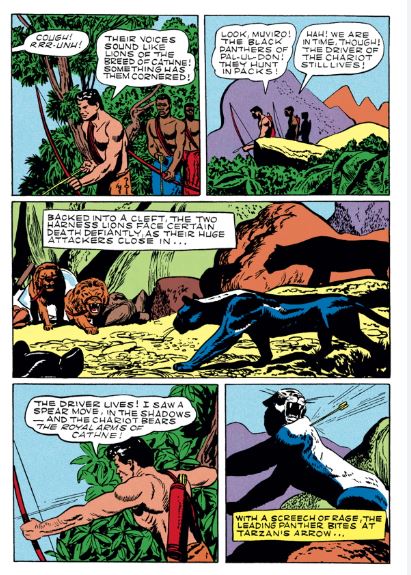
Epic fantasy follows in ‘Tarzan Returns to Cathne’ when the Jungle Man and Waziri’s Pal-Ul-Don explorations bring them into conflict with sabretooth tigers attacking the war-lions of Queen Elaine of Cathne. The staunch friend and ally is a fugitive now as her husband King Jathon is gone and usurper Timon rules. The madman is unstoppable and seeks to conquer sister city Athne, but Tarzan has other ideas and the wits to implement them…

The issues closes with another house ad and ‘Tarzan’s World’ pinup of the Dangina (Cape Hunting Dog) before we segue into final entry Tarzan #46 .

Dated July 1953 it begins with ‘Tarzan Defends a City’ as the Ape-Man and not-dead Jathon (surprise!) trek back to Cathne with super-colossal war lion Goliath, only to find the citadel under siege by crocodile-riding Terribs from the Great Swamp. Things look bleak until the Gallugos – freshly fled from the cannibal Kando-Mors – arrive and turn the muddy tide. All they want in return is land to build their new city…

Back in regular Africa, ‘Boy Faces the Fangs of the Mamba’ after Matusi witchdoctor Ungali – having failed to kill Tarzan – frames his annoying spawn Boy for theft and orchestrates a lethal trial by snake. Sadly for the villain, Ape-Man arrives just in time…

This titanic tome terminates with whimsical mystery ‘Tarzan and the Treasure of the Apes’ as brutal unscrupulous white hunters discover the great apes dubbed “mangani” are all bedecked in priceless jewels. Ruthlessly stalking the vain bedazzled beasts the safari killers even manage to wound Tarzan, before he convinces the apes to surrender their “pretty stones” in favour of something better: something edible.

The Jungle King then delivers a unique judgement that might not look like justice but truly is nothing but…

Although these are tales from a far-off, simpler time they have lost none of their passion, inclusivity and charm, whilst the artistic virtuosity of Jesse Marsh looks better than ever. Perhaps this time a few more people will “get” him…
Edgar Rice Burroughs® Tarzan®: The Jesse Marsh Years volume 9 © 1953, 2011, Edgar Rice Burroughs Inc. Tarzan ® Edgar Rice Burroughs Inc. All rights reserved.

In 1952 Jack of all comics trades Keith Giffen was born. We haven’t reviewed Ambush Bug, Legion of Super-Heroes or his Doom Patrol yet, so why not recall gleeful glory days with Justice League International volume 1?

In 1978 screen writer and comics luminary Robert Kirkman was born. You probably know him best for Walking Dead volume 1: Days Gone Bye.

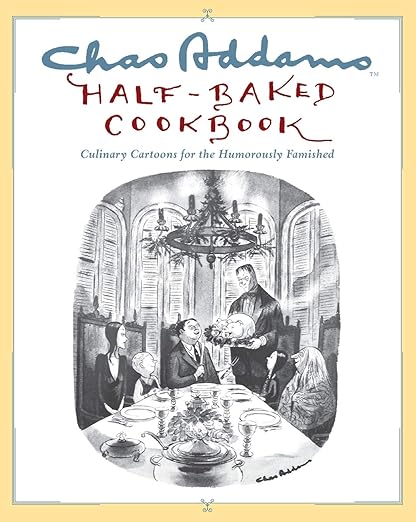
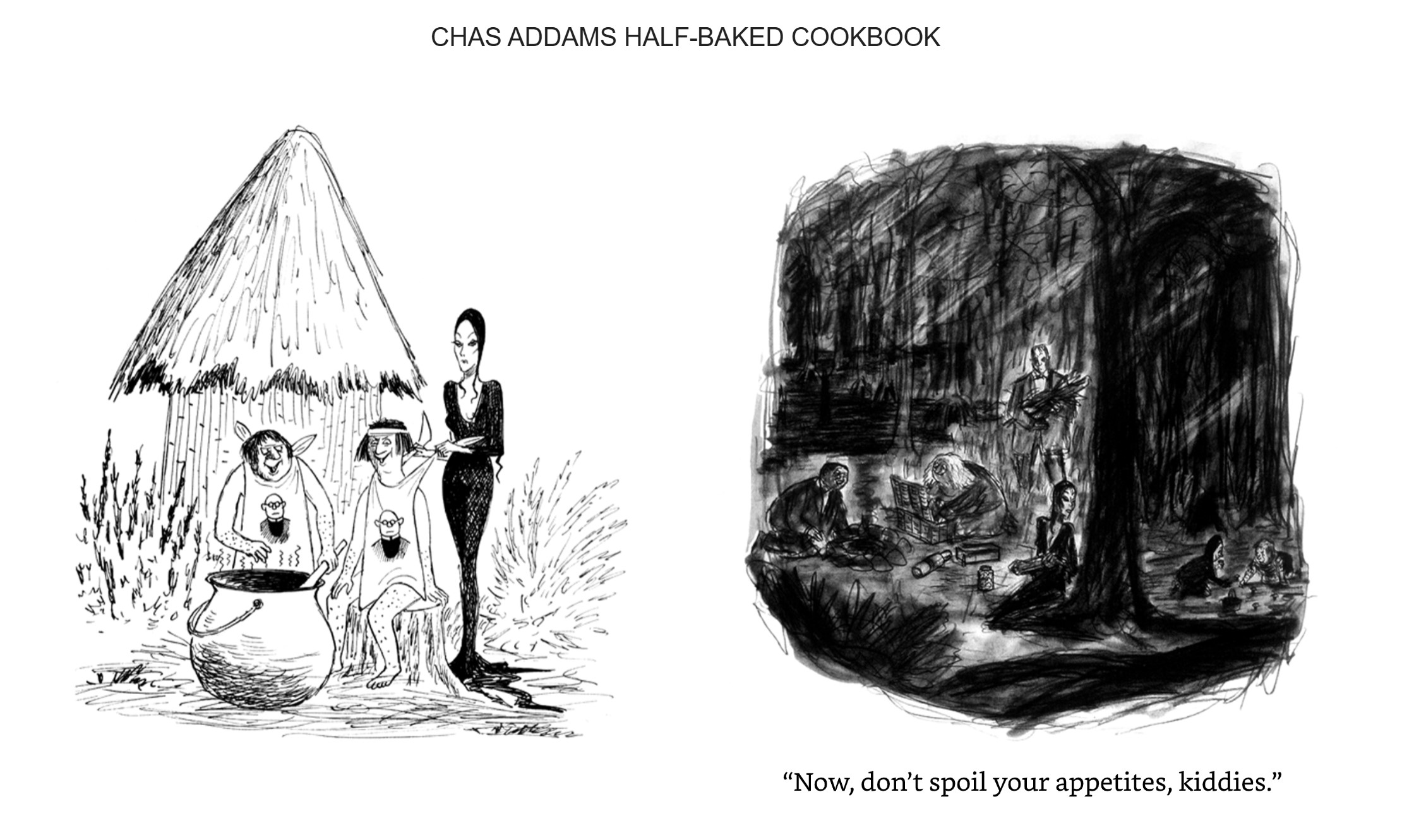
Chas Addams™ Half-Baked Cookbook: Culinary Cartoons for the Humorously Famished


By Charles Addams (Simon & Schuster)
ISBN: ?978-0-7432-6775-5 (PB) eISBN: 978-1-439-10386-9

This boos includes Discriminatory Content produced in less enlightened times. It also uses Discriminatory Content included for comedic and satirical effect.

Cartoonist Charles Samuel Addams (1912-1988) was a distant descendant of two American Presidents (John Adams & John Quincy Adams). He compounded that hereditary infamy by perpetually making his real life as extraordinary as his dark, mordantly funny drawings.

Born into a successful family in Westfield, New Jersey, the precocious, prankish, constantly drawing child was educated at the town High School, Colgate University, the University of Pennsylvania, and New York City’s Grand Central School of Art, and apparently spent the entire time producing cartoons and illustrations for a raft of institutional publications.

In 1932 he became a designer for True Detective magazine – “retouching photos of corpses” – and soon after started selling drawings to The New Yorker. In 1937, at the peak of popular fascination in cinematic and literary horror stories, he began a ghoulish if not outright macabre sequence of family portraits that ultimately became his signature creation. However, during WWII, he toned down the terror and served with the US Signal Corps Photographic Center, devising animated training films for the military.

Whether Addams artfully manufactured his biography to enhance his value to feature writers or was genuinely a warped and wickedly wacky individual is irrelevant, although it makes for great reading – especially the stuff about his wives – and, as always, the internet is eager to be your informative friend…

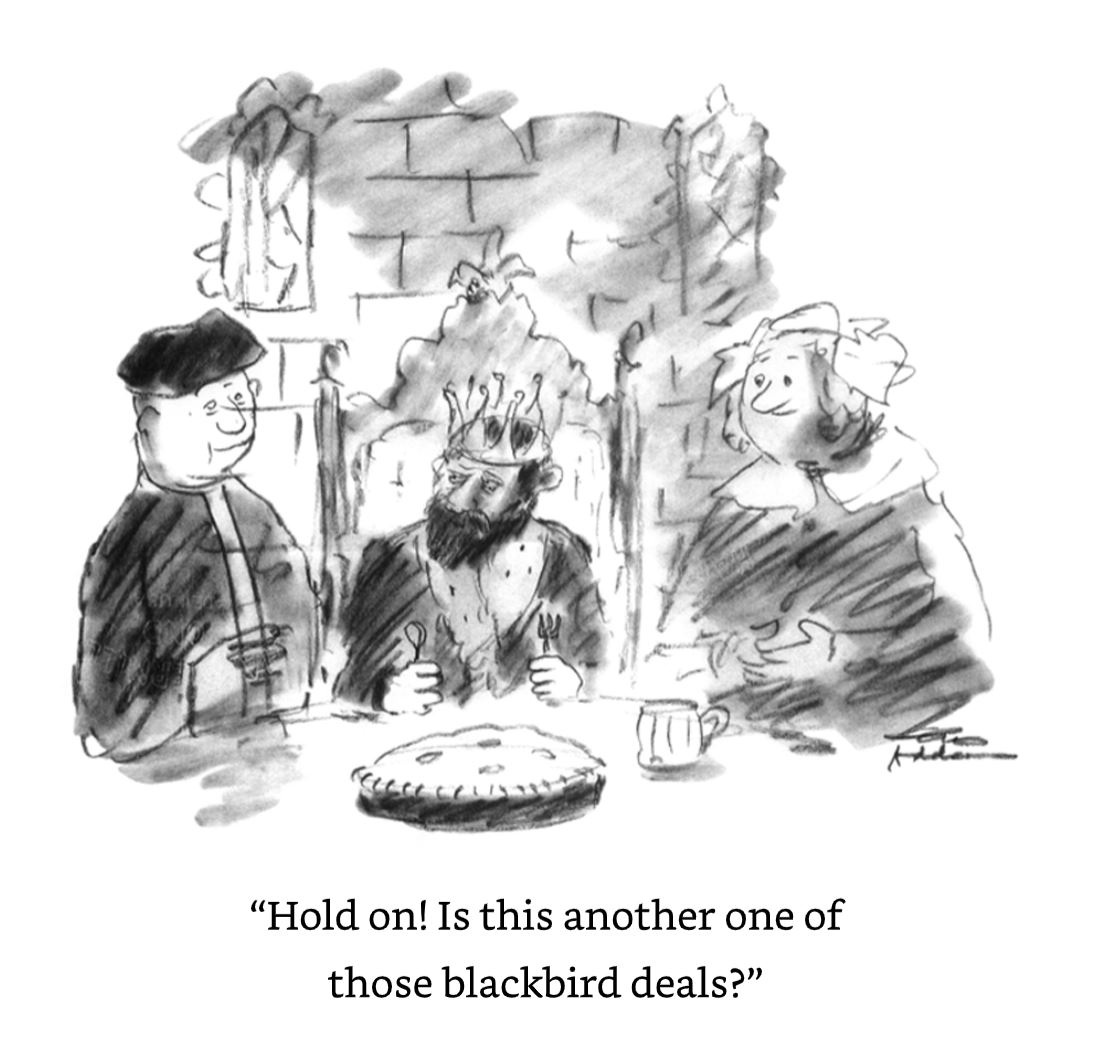
What is important is that in all the years he drew and painted those creepily sardonic, gruesome gags and illustrations for The New Yorker, Colliers, TV Guide and so many others, he managed to beguile and enthral his audience with a devilish mind and a soft, gentle approach that made him a household name long before television turned his characters into a hit and generated a juvenile craze for monsters and grotesques that lasts to this day. That eminence was only magnified once the big screen iterations debuted. And now we have streaming fun too. He would have loved the sheer terrifying inescapability of it all…

As he worked on unto death, Addams got even wackier: marrying his third wife in a pet cemetery, spending a fortune collecting weapons and torture devices – “for reference” – and inventing… recipes…

In a legendary career dedicated to being odd, the sudden swerve into crafting and compiling an actual cookbook garnished with macabre cartoon japery is a fabulous affirmation of all the unharnessed unpredictability man stood for, and one which constantly delivers treat after tasty treat…

The compendium commences with introduction ‘Café Styx’ from culinary author Allen S. Weiss, after which a bundle of gags – many starring Addams Family stalwarts – brings us to the secrets of making mouthwatering ‘Mushrooms Fester’. Always be sure when cooking this where you sourced your fungi from – and what you need them to do…

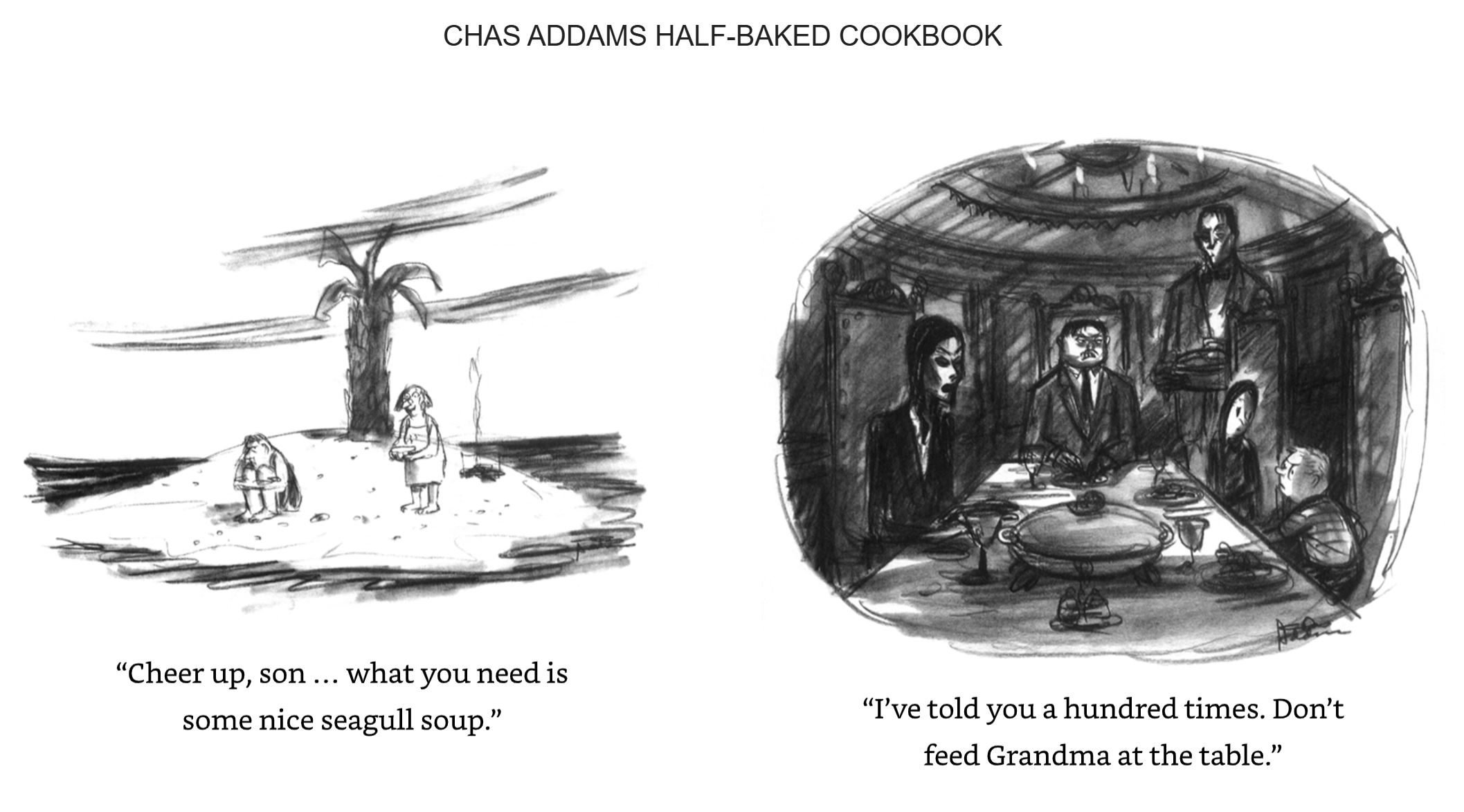
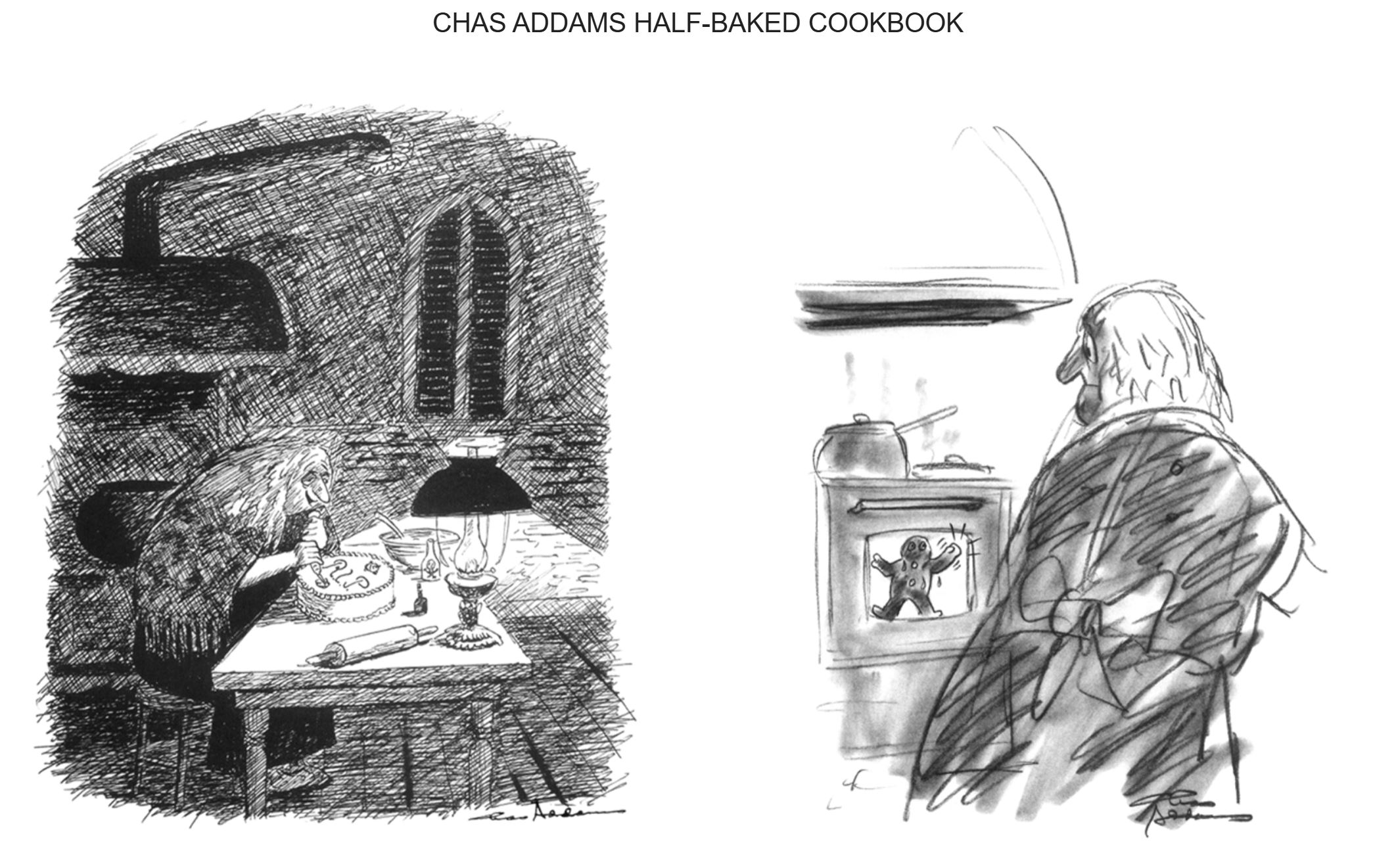
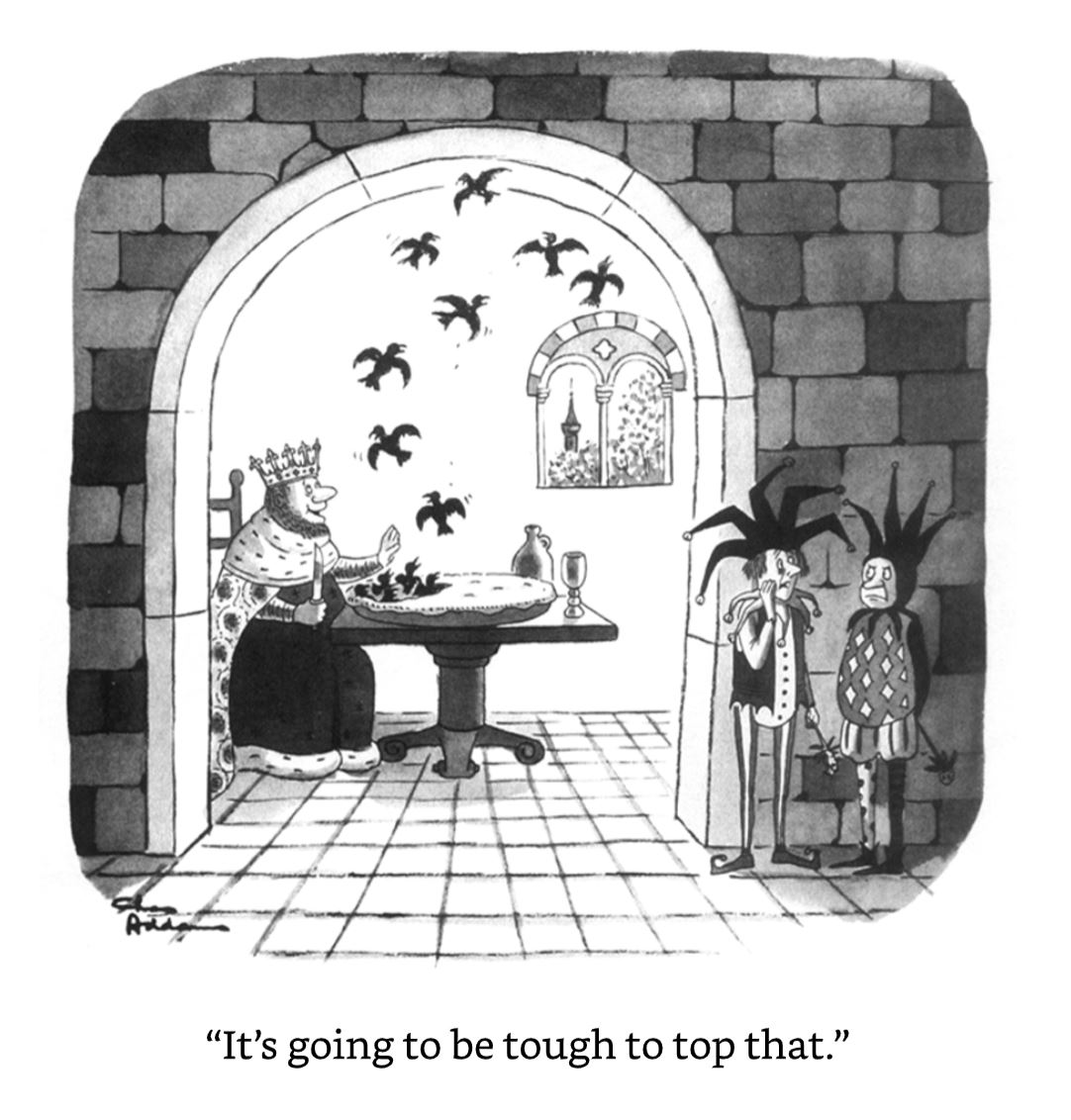
The pattern repeats throughout in chapters divided into ‘Platters’: soundly sinister laughs and gruesomely gustatory giggles peppered with rather tasty recipes. You can see for yourself the quality of the cartooning here so I’ll be brief for a change and simply menu the other olfactory and tongue-tangling taste-bombs included.

The next is utterly self-explanatory ‘Macaroni and Oysters’, ending the first course prior to commencing the ‘Second Platter’ – specifically ‘Black Puddings’ (Yanks call them “blood puddings” and they’re not wrong) and ‘Transparent Pie’ with ‘Boiled Salad of Fiddleheads’ (that’s newly sprouted ferns)…

Pausing for a delicious ‘Intermezzo’ of home-made (for who could sell them?) ‘Dandelion Beer’ and ‘Influenza Punch’ accompanied by ‘Stewed Pigeons’, ‘Potted Woodland Squirrel’ & ‘Fried Locusts’ sagaciously catered to with helpful ‘Hints for the Ill’, we eventually come to what all gastrophiles, gastronomes (and gastrophobes!) have been waiting for: the triumphant ‘Third Platter’ and subsequent ‘Digestifs’

Here the drawings are in their prime and perfectly piquant whilst consumers are advised on how to tackle ‘Hearts Stuffed for Valentine’s Day’ (with a most special Stuffing mix); ‘Ostrich Eggs’ and ‘Reindeer Rice Curry’. Of course, as with all comedy, acquiescence and acceptance in adversity might mean modern kitchen scullions might need to replace the odd ingredient for all these GENUINE early American recipes collected by Chas and Tee Addams over decades, but what really matters is that gradually older collections of the Addams oeuvre are being unearthed and this one’s truly scrumptious; or perhaps just an acquired taste…

For clarity and pure knowledge this volume closes with a full biography of the auteur and full list of ‘Credits’ for the recipes included.

Should you not be as familiar with his actual cartoons as with the big and small screen legacy Addams unleashed, you really owe it to yourself to see the uncensored brilliance of one of America’s greatest humourists. It’s very appetising and dead funny…

© 2005 by Tee and Charles Addams Foundation. All rights reserved.

Today was a biggie for Comics. In 1764, grand master and originator of mean drawing William Hogarth died. In 1931 Stan’s brother (the one who could write AND Draw) Larry Lieber was born. Among his many unsung triumphs was Rawhide Kid, co creating Iron Man and writing most of the stories in Mighty Marvel Masterworks: The Mighty Thor volume 1: The Vengeance of Loki.

In 1941 Belgian Bob De Groot was born. You really should read one of his many light adventure gems such as Clifton volume 5: Jade.

In 1970, two US strips launched today one was Mel Lazarus’ venerable Momma, and the other was by Gary Trudeau. Go see and worship some more with the fabulous Yuge! – 30 Years of Doonesbury on Trump.

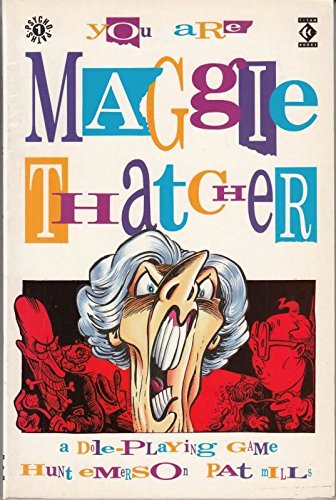
You Are Maggie Thatcher: A Dole-Playing Game


By Pat Mills & Hunt Emerson (Titan Books)
ISBN: 978-1-85286-011-0 (TPB)

This book includes Discriminatory Content produced in less enlightened times, and for comedic and satirical effect.

With the recent anniversary hagiographic whitewashing of “the Greatest Prime Minister we’ve ever had”, fond reminiscences of those truly grim times and policies by the still-privileged and renewed assaults on the poor and unwelcome in Britain, why don’t we proles also indulge in bit of comforting nostalgia for the good old days?

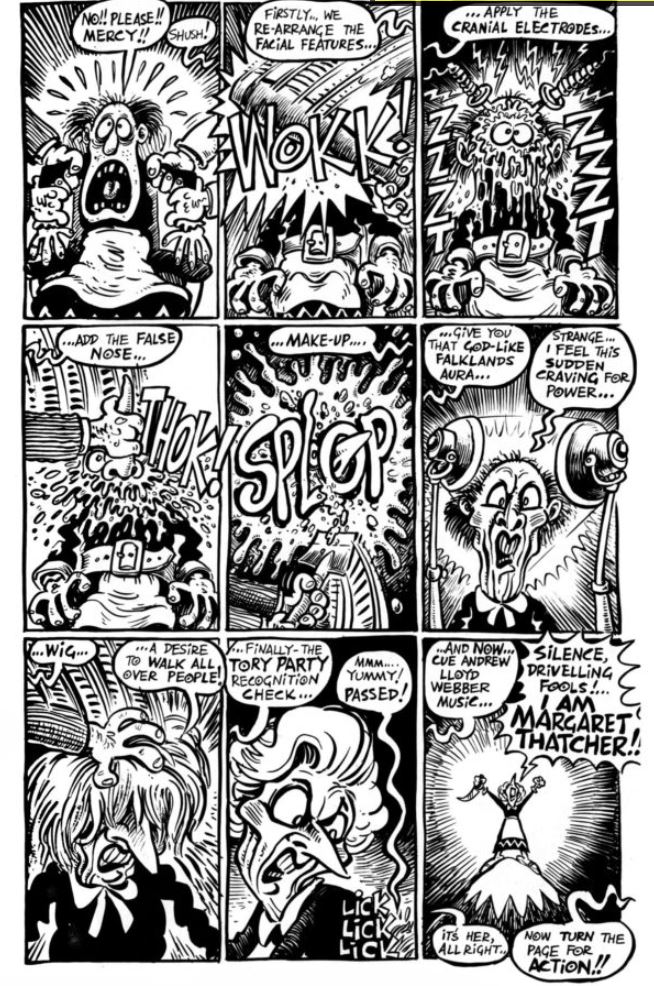
The most successful comic strips depend more on the right villain than any hero or combination of protagonists, so this quirky oddment was better placed than most for success. Created by British comics legends Pat Mills & Hunt Emerson at a time when our industry was at its most politically active, this strident, polemical satire put the proletarian boot in on the appalling tactics and philosophies of the third term Thatcher government with savagely hilarious art and stunningly biting writing.

Illo 1 here please


The concept is simple now but groundbreaking in 1987. The reader is to be Prime Minister Maggie who, by reading sections of the book and selecting a choice of action at the end of each chapter is directed to another page to experience the ramifications of that decision. The objective is to win another election (ah the wonderful irony!) and the method is to make only vote-winning decisions – hence the multiple-choice page-endings. The intention is not to win the game, obviously. What kind of monster are you?!

This powerful piece of graphic propaganda may have dated on some levels but the home truths are still as pertinent. Even as Maggie and her demented pack of lap-dogs wriggled and squirmed on Mills & Emerson’s pen-points, their legacy of personal gain was supplanting both personal and communal responsibility to become the new norm. More than ever, today’s Britain is their fault and this still readily available book reminds us of a struggle too few joined and a fight we should have won, but didn’t.

It’s still really, really funny too.
Text and concept © 1987 Pat Mills. Illustrations © 1987 Hunt Emerson. All Rights Reserved.

Today in 1969 anarchic weekly British treasure trove Whizzer and Chips began its three-decade rampage of fun. You could get a flavour of it all (mostly toffees, liniment, perished rubber and sweaty feet) by seeing Whizzer and Chips Annual 1979.

In 1973 cartoonist Walt Kelly finally had enough of our petulant crap and passed over. You can pay your respects at Pogo – The Complete Syndicated Comic Strips volume 3: Evidence to the Contrary

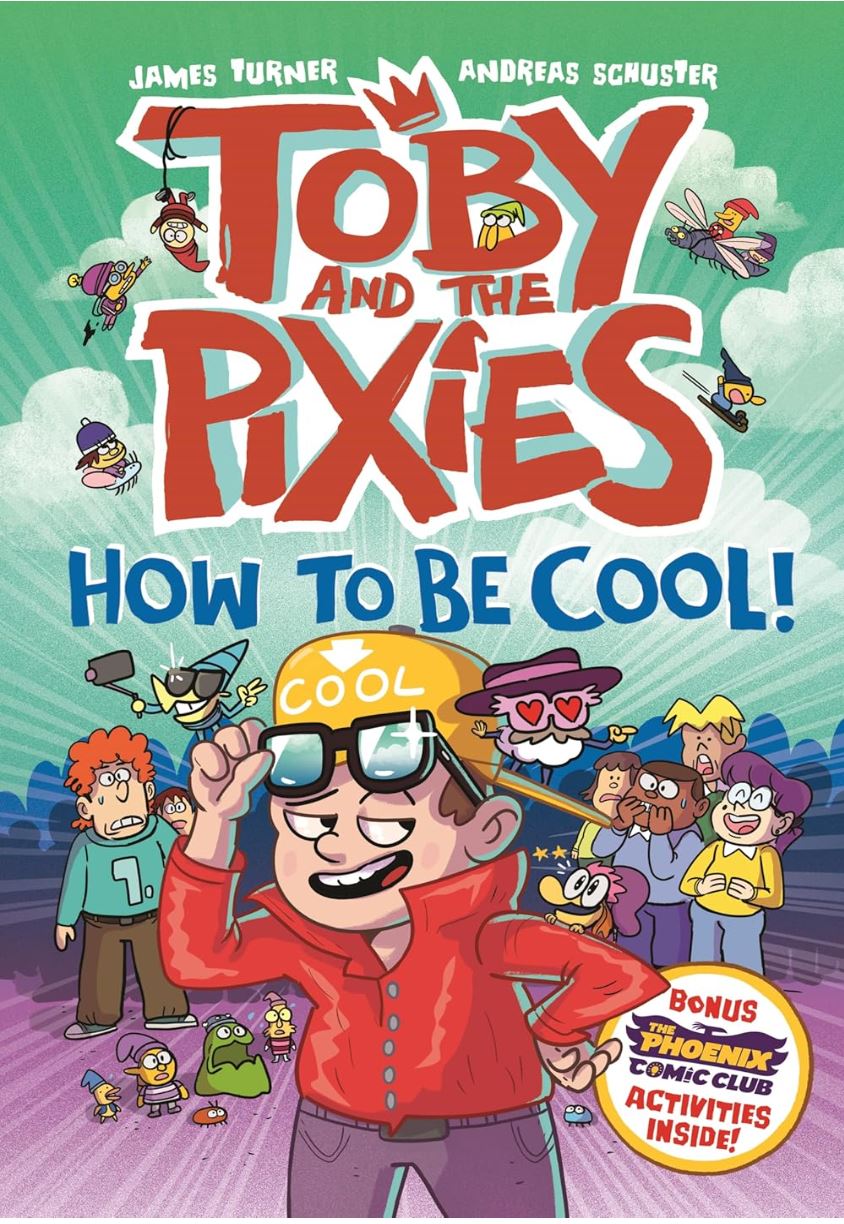
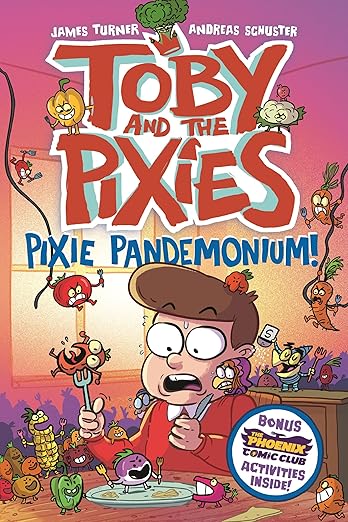
Toby and the Pixies: volume 3: Pixie Pandemonium!


By James Turner & Andreas Schuster (David Fickling Books)
ISBN: 978-1-78845-355-4 (TPB)

Way back in January 2012, Oxford-based David Fickling Books made a rather radical move by launching a traditional anthology comics weekly aimed at under-12s. It revelled in reviving the good old days of picture-story entertainment intent whilst embracing the full force of modernity in style and content.

To this day each issue features humour, adventure, quizzes, puzzles and educational material in a joyous parade of cartoon fun and fantasy. The Phoenix has successfully established itself as a potent source of children’s entertainment because, like Beano and Dandy, it is equally at home to boys and girls, and HAS mastered the magical trick of mixing amazingly action-packed adventure series with hilarious humour strip serials such as this one. Most of the strips have also become graphic collections; just like this one…

Crafted by the exceedingly clever James Turner (Star Cat, Super Animal Adventure Squad, Mameshiba, The Unfeasible Adventures of Beaver and Steve) and Canadian cartoonist/designer/animator Andreas Schuster (KLARA AND ANTON in PRIMAX Magazine), Toby and the Pixies began in January 2020 as I Hate Pixies and, once out of the compost bag of creative wonders, just wouldn’t stop. Those first forays were remastered and released as Toby and the Pixies: Worst King Ever! and follow-up fun folio Best Frenemies charting the course of a nerdy boy at a nice school – until it all goes wrong…

Unappreciated, anxious 12-year-old Toby Cauldwell was resigned to and content with his meagre, second-rate friends, dedicated personal bullies, negative charisma levels and functional classroom invisibility at Suburbiton High School, but began rapidly shedding his appallingly uncool reputation the day after his electric-toaster-obsessed Dad ordered him to sort out their unruly, out-of-control back garden…

That’s when Toby discovered that wild, jungle-like urban wilderness was – unbeknownst to any mortal – the camouflaging screen for a fabulous fey realm. The ethereal, moist and rather mucky enclave had endured unseen in the green shambles of the Cauldwell backyard for countless ages. Now – thanks to an inept and inadvertent act of emancipation triggered by Toby kicking an unfortunately placed plaster garden gnome – the status quo forever altered. A tool of fate, the reluctant lad was instantly elevated to the position of supreme overlord, by dint of accidently yet totally obliterating the sitting tyrant. It was only for a hidden kingdom of magical morons, but they were really happy to be shot of their previous mad, mean, magical master….

As interpreted by the former King’s advisors – Royal Druid Mouldwarp, wise(ish) Lore Keeper/Potion Master Gatherwool and Toadflax (she eats stuff) – deliberate or otherwise, despatching King Thornpickle made Toby new absolute monarch. Pixie law also stated said ruler could do anything they wanted… a prospect so laden with responsibility that it made Toby weep with terror…

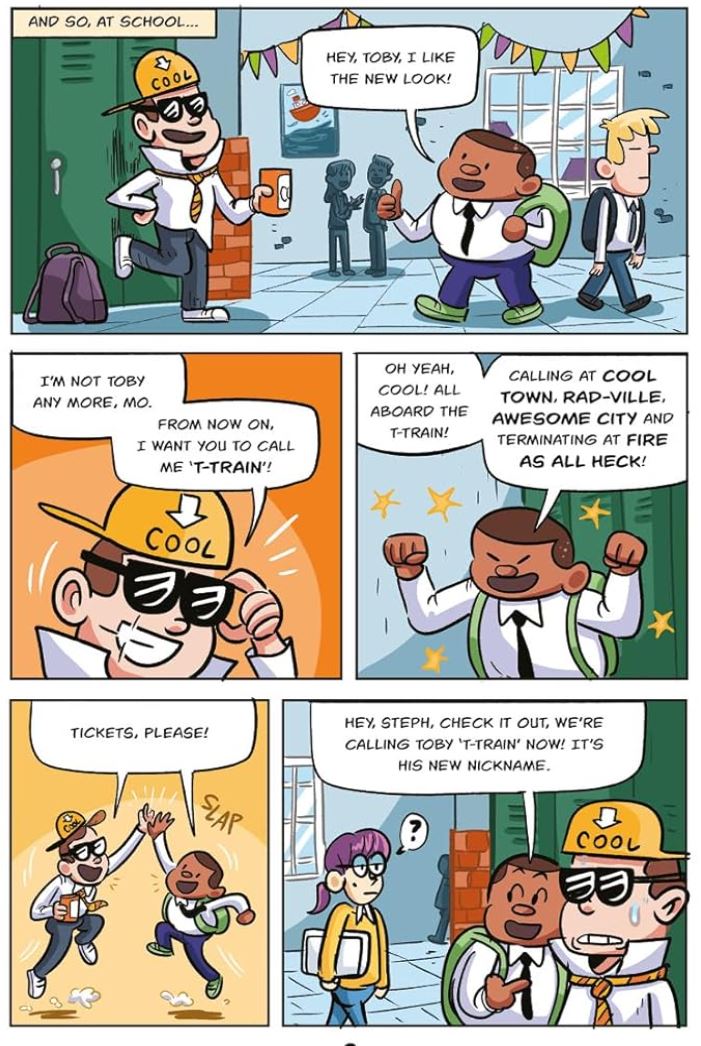
Just coming to terms with MAGIC actually existing, and that the ever-present freaky, anarchic imps can do it whilst still being absolute idiots and morons was awful enough, without also still having to survive school’s normal horrors. Thankfully, as the little odds and sods increasingly impinged and impacted on Toby’s life, education and prospects, they also turned school upside on a daily basis, and Toby’s fellow outcast Mo soon discovered the shocking secret of their existence. And he thought it was BRILLIANT!

In the short term, it actually made things worse but now, apart from constant teasing and perpetual whining pleas to visit the magic kingdom, there is a fellow human King Toby can moan at. Two actually, as snarky bully Steph also soon discovered the secret and has since proved to not be quite as awful as she might be…

That’s good because knowledge is a dangerous, trouble-causing thing, particularly as the Pixies are now everywhere and Toby’s succession triggered many problems: especially when magic-slime wielding Princess Sugarsnap – daughter of Thornpickle and rightful heir to a job Toby really, really doesn’t want – started a war to take back the throne Toby absolutely doesn’t want…

This third fondly foetid foofaraw opens with a chance to get reacquainted with key regulars Toby, Mo, Steph, Toadflax, Gatherwool & Mouldwarp in a comprehensive double page intro. Then it’s back to school and off the deep end (or is it?) in ‘Chapter 1: Off Sick’ as Toby is confined to bed with a cold. Typically, his loyal subjects think magic is the answer, but they couldn’t be more wrong… or destructive…

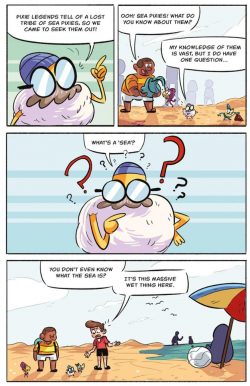
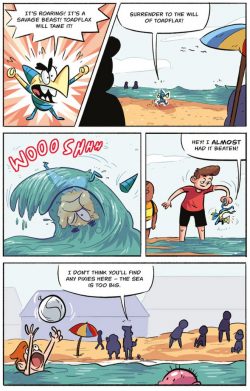
‘Chapter 2: On Holiday’ finds Mr. Cauldwell attending a seaside toaster convention and “thoughtfully” leaving his son and Mo on the beach all day. The King thought he was going to have a pixie-free rest but his Royal Champion (that’s Mo. Keep up!) has kindly brought the Advisors along. They’ve never seen the sea before but think there must be sea pixies they can declare war on if they find them. That ends in frustration but they do discover the narcotic rush power of limitless sugar as delivered by candyfloss…

A systemic examination of each Advisor begins with ‘Chapter 3: Toadflax Day’ as the luckless little omnivore tries to celebrate her birthday in peace and with a minimum of injury, but still falls victim to cruel prankish fate, after which ‘Chapter 4: The Dentist’ finds Toby trapped in the dreaded gob-surgery with his extremely curious courtiers aware of his anxiety but not sure how magic can help. It doesn’t stop them trying though, with terrifying results…

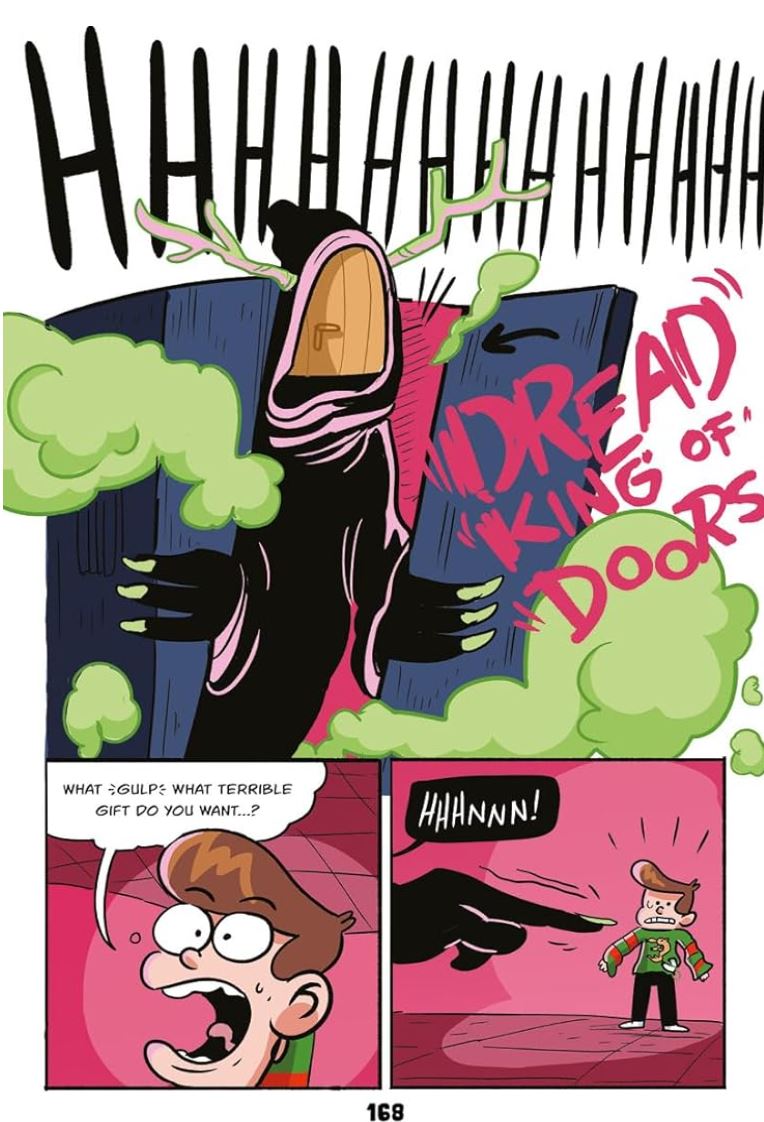
‘Chapter 5: Mouldwarp’s Day’ unearths the pocket Druid’s secret desire to be a mighty – and adored – hero of the Realm, but his dreams are crushed in Gatherwool’s agenda to celebrate King Toby’s 100th visit to the Kingdom and gift the human with the nation’s most dangerous and deadly arcane artefacts. What could possibly go wrong?

Of course, it’s not just royal duties that stress Toby out. Ordinary school interactions are also a nightmare, which is why, after saying something really stupid he truly wished he hadn’t, the junior Cauldwell accepts the use of a pixie enchantment to erase that embarrassing moment. ‘Chapter 6: Time Cape’ only serves to remind him that no matter how bad a situation seems, it can always be amplified to near-cosmic armageddon by a little mucky mud magic…

In ‘Chapter 7: Bixenjammer’ Toby, despite all his past experiences, allows the Advisors to distract him from his homework with tales of the pixies’ ultimate nemesis. Happily his subsequent search for it turns up nothing, after which ‘Chapter 8: Talking to Vegetables’ sees the King foolishly accept the power to communicate with beasts only to find Gatherwool has confused the Fruit of Animal Communication with the equivalent Vegetable version. Barracked and besieged by the contents of fridge and fruit bowl, it takes mere moments to spark a retaliatory war with outraged groceries and only sheer luck saves Toby and the rest of meat world…

‘Chapter 9: Gatherwool’s Day’ reveals the depths of the Lore Keeping Potion Master’s devotion as he undertakes enlarging his beloved monarch to colossal proportions, despite every effort of everyone else to convince him he should check or at least ask first, before Romance fills the air in ‘Chapter 10: Crushed’ after Toby becomes besotted by French foreign exchange student Josephine. The milestone occurs just as the pixies are undertaking similar outreach by inviting demonic Boggart exchange student Grax’norx’ng’kk to observe their way of life. Everyone loves Love and is eager to help, but Toby – and Toadflax – really should have refused all offers to help…

‘Chapter 11: Logically Speaking’ finds Mo and his liege lord asked to advise on a trade logistics problem involving transport of grain, chickens and foxes – with predictably disastrous results – and then joining the school newspaper staff. When the pixies are introduced to the concept of journalism, ‘Chapter 12: No News’ proves their version, utilising a Magic Parchment of Truth to alter reality to match what’s been written, is far more tempting and satisfactory. Thankfully, Steph keeps her wits as Toby succumbs to his unleashed dark side and the status quo is restored before the universe ends…

Somehow, unconfident Toby lands a major part in a school theatrical production, and foolishly accepts aid from Gatherwool to calm his stage fright in ‘Chapter 13: Play Time’. Of course the resultant chaos only adds to the performance but ‘Chapter 14: It’s Snow Joke’ has far more serious repercussions after the Advisors animate the snowmen built by gleeful innocent kids – and Toby & Mo. Apparently, even happy chilly manmade ice folk can dream of world conquest…

The story portion pauses on an early seasonal saga as the pixies share their own Christmas traditions in ‘Chapter 15: A Blimpmas Carol’ whilst test-traumatised Toby humbugs all and sundry in his nervous flurry of revision. When Mo introduces the Advisors to a certain classic book, the stage is set for some life- and attitude-changing ghost action and time travel, but these are the pixies in the pilot seat and you know it won’t go as planned…

Wrapping up the fungal fun and mucky madness is a bunch of pages of related activities: a swathe of features offered under the aegis of the Phoenix Comics Club. Bring paper, pencils and you to a compact online course in all aspects of comic strip creation supervised by Andreas Schuster who helms an activity section that includes ‘Let’s Draw a Pixie!’, ‘A Square Pixie!’ ‘A Circle Pixie!’ ‘An Oval Pixie!’ ‘Expressions!’ ‘Noses!’ ‘Glasses!’ ‘Hair!’ Ideas for Hats!’ ‘Yoghurt Pots!’ ‘A Broken Cup!’ ‘Foam Darts!’ ‘Leaves!’ ‘Pinecones!’ ‘Raccoons!’ ‘Snow Pixies!’ ‘Desert Pixies!’ and ‘Jungle Pixies!’ which ends on an extensive plug for the Phoenix Comics Club website complete with instant access via a QR code.

Toby and the Pixies is a joyous concatenation of nonsense no lover of laughs and lunacy should deprive themselves of and a feast of yuckky yoks all kids will gleefully consume. What are we all waiting for?
Text and illustrations © The Phoenix Comic 2025. All rights reserved.

Toby and the Pixies: volume 3: Pixie Pandemonium! is published on 11th September 2025 and available for preorder now.

Star Cat – Unicorns in Space


By James Turner & Yasmin Sheikh (David Fickling Books)
ISBN: 978-1-78845-356-1 (TPB)

Never forget: all the best cats are ginger, and especially so if space is their back yard and litter box…

Way back in January 2012, Oxford-based David Fickling Books made a rather radical move by launching a traditional anthology comics weekly aimed at under-12s. It revelled in reviving the good old days of picture-story entertainment intent whilst embracing the full force of modernity in style and content.

Each issue still features humour, adventure, quizzes, puzzles and educational material in a joyous parade of cartoon fun and fantasy. Since then The Phoenix has established itself a potent source of children’s entertainment as, like The Beano and The Dandy, it is equally at home to boys and girls, and has mastered the magical trick of mixing amazingly action-packed adventure series with hilarious humour strip serials such as this one.

One of the wildest rides of the early days was Space Cat by James Turner (Super Animal Adventure Squad, Mameshiba, The Unfeasible Adventures of Beaver and Steve). His yarns entertained us for ages before, eventually Yasmin Sheikh (Luna the Vampire) joined in – a hopefully unendingly collaboration to amuse us all for years to come…

Like an animalistic Red Dwarf, the premise is timeless and instantly engaging, detailing far-out endeavours of spacefaring nincompoops in classic mock-heroic manner. There’s so very far-from-dauntless and possibly neurotic Captain Spaceington; extremely dim and utterly unschooled amoeboid Science Officer Plixx; inarticulate, barely housebroken feral beastie The Pilot and disdainfully arrogant Robot One, who quite erroneously believes itself at the forefront of the cosmos’ smartest thinkers. The colossal, void-busting vessel the Captain and his substandard crew traverse the universe in looks like a gigantic ginger tom, and that’s because that’s what it is: half cat, half spaceship. What more do you need to know?

After briefly reconnecting with the interstellar imbeciles via info spread ‘Welcome Aboard’, the ramshackle roving resumes in ‘Chapter 1: Deity Dishes’ as our stellar sentinels are tasked with testing a breakthrough in cosmic power production and storage. Omega Toroids are so potent and jam-packed with energy that they can’t be used in series or left together, but as the Captain and Plixx install a single unit in the Star Cat’s engine, overconfident know-it-all Robot One’s craving for donuts creates a mix-up of potentially devastating proportions after mistakenly stuffing his metal maw with all the remaining toroids and getting an inadvertent upgrade to all-conquering star-god status. Sadly, despite the boost, he’s still intrinsically him and becomes the cause of his own downfall while ravaging the Pixie planet…

Supervising chicken-on-a-mission The Space Mayor then despatches his top team (no, Spaceington & Co…) on an urgent mission to end a rubber chicken shortage on Clowntopia-8. So desperate is the crisis that, against all advice and common sense, they consider a short cut through the notorious Spooky Quadrant… and literally live to regret it after encountering all the horrors of the damned at sinister Space Castle Spaceferatu in ‘Chapter 2: Nothing to Fear Except Fear Itself’.

Just purely coincidentally, the creepy citadel in space that is reputed to hold the most unimaginably priceless treasure in the universe has no impact on the team making that diversion short cut. However, even with Robot-One’s “Moral Dilemma Mode” activated, they make the wrong decision and it proves as useless as all the rest of R-1’s upgrades in dealing with the terrifying and sneaky Space Vampyr

Deplorably deranged, terrifying two-dimensional tyrant/archenemy Dark Rectangle reappears in ‘Chapter 3: Flat Out’, when his trusty hench-being Murky Hexagon begs Spaceington’s aid in curing his master’s dose of 3-D Flu. That noble deed demands the idiots invade the 2-D “Flati-verse” Dark Rectangle came from, and leads to odd adjustments, bizarre doings and a very nasty clash with the villain’s ghastly family…

After crashing on an unknown world, the Star Cat crew are accused of cultural sabotage and sundry misdemeanours in ‘Chapter 4: Rhyme Crime’ but soon get the hang of talking for better or verse… all except Robot-One of course…

That mini-armageddon is as nothing when measured against the chaos generated by the Massivitis germs that transform and utterly embiggen the boss of space in ‘Chapter 5: Mega Mayor’. Thankfully, self-identified chicken-biologist (and closet proctologist) Robot-One has a plan, but it does require golden wigs, giant automatons in drag, extremely invasive incursions by medically untrained volunteers and biscuits, Many, many biscuits…

That fantastic voyage successfully concluded, ‘Chapter 6: Crab to the Future’ details how all but The Pilot are flash frozen on the coldest planet in the galaxy and eventually defrosted in the far future. Ten thousand years of progress – and the occasionally case of time-meddling – have created an odd yet ideal utopia, but the Captain, Plixx and especially the annoying Robot soon fix that, prior to returning to their own lethally enthralling era…

Eventually, even the dimmest crewmember realizes the robot is getting more arrogant, nasty and dangerous, but that doesn’t stop the Space Mayor sending him and his comrades to the Lovely Sector to fetch a crystal flower from the most pure and good planet in the galaxy. ‘Chapter 7: Unicorns in Space!’ reveals how Unicornia initially takes the wild rovers to its collective hearts and bosoms, but it’s not long before the abhorrent android taints even this rainbow hued paradise…

As a result of the tragedy he triggered, Robot-One earnestly seeks to change and ‘Chapter 8: A Light Year in Your Shoes’ has the crew indulge in a spot of body-switching and mind transference that only causes more chaos. The Space Mayor gets accidentally involved in ‘Chapter 9: Change of Mind’ when the Chook in Charge pays a visit to the ginger starship just as Robot-One starts editing aspects of his digital personality and memory…

Closing – for now – on an even-more lowered tone, acronym layered ‘Chapter 10: Fair-Weather Friends’ finds the crew supervising the mayor’s new project – a Binary Universal Manipulator constructed for the Federation of Allied Republics and Territories. Uncannily, the freshly modulated, good-as-gold & nice-as-pie Robot-One is no help at all when Dark Rectangle sabotages the test and causes climactic calamities so all that good work must be undone to unleash the old personality if the obnoxious oblong is to be defeated…

Wrapping up the sidereal silliness are a bunch of pages of related activities: a swathe of features offered under the aegis of the Phoenix Comics Club. Bring paper, pencils and you to a compact online course in all aspects of comic strip creation supervised by James Turner & Yasmin Shiekh, expounding on how to draw the crew, absorb the basics of page-craft and learn professional terms. With features on lettering, layouts and composition, colouring, example panels/pages and even some page blanks to go wild in, plus an extensive plug for the Phoenix Comics Club website complete with instant access via a QR code. What are we all waiting for?

Text and illustrations © The Phoenix Comic 2025. All rights reserved.
Star Cat – Unicorns in Space will be published on August 14th 2025 and is available for pre-order now.

Jamie Smart’s Max & Chaffy: What a Delicious Discovery!


By Jamie Smart, and coloured by Emily Kimbell (David Fickling Books)
ISBN: 978-1-78845-345-5 (PB)

Laced with cheerful welcoming charm by cartoonist, comics artist and novelist Jamie Smart, Max & Chaffy books for younger readers (five when this one comes out and augmented online by www.findchaffy.com) hark back to more traditional times and fare. Initially introduced in Welcome to Animal Island, little Max moved to a new home in a lighthouse and made many amazing friends like Orlando, Crumbs, Moose, Pedalo and especially a strange little creature called Chaffy.

The tiny fluffbundle has mismatched ears and was easily confused: constantly getting lost and needing Max and the reader’s help to be where it belongs. The reason for getting misplaced so much was and is a desire to locate other unique-unto-themselves Chaffys (as seen in follow-up fables The Great Cupcake Mystery!, Search for the Ice Chaffy! and Hunt for the Pirate’s Gold!): a desire magnified once the soon-to-be-inseparable pair joined the Official Chaffy Finding Club…

Unlike Smart’s multi award-winning comics offerings (Bunny vs. Monkey, Looshkin – the Adventures of the Maddest Cat in the World!!, Fish Head Steve!, Corporate Skull, Space Raoul, and many brilliant strips for The Beano, Dandy and others) or his illustrated kids novels like the Flember quartet, Max & Chaffy adventures are crafted for early readers, offering strong directed stories laced with interactive pages, with participation an integral part of the storytelling. The most engaging of these page games are recurring Search & Find tableaux – just like Where’s Wally? – cunningly combined with grouping/collecting moments as they search for new specimens of Chaffy, all offering flavours of Pokémon and echoes of Mr. Men whenever they find and befriend one.

Joyous, inclusive, accepting and particularly appetising, this outing sees our tiny tot stars initially doing something other than seeking new Chaffys – all with a list of identifying characteristics – a bit later, but opens with them soundly asleep in the Lighthouse… until a colossal explosion wakes them up in a hurry!

The detonation is at the bakery where Crumbles’ lives; caused by her latest recipe going awfully wrong. In fact, all the Chaffy’s efforts at cooking are misfiring, and have never really been right ever since she left baking school. Crumbles also really misses her old baking partner Sprinkles

Max sincerely wants to help and is even more determined once he learns Sprinkles now lives on another island…

Resolved to reunite the cookery champions, Max asks grumpy Captain Foghorn to ferry them over, and when he reuses gets a lift in Orlando Pig’s new Hot Air Balloon. Scarily, it almost doesn’t make it, but eventually everyone alights safely on ‘Food Island’, eager for fun, tasty treats and possibly new Chaffies for Max’s book. Sadly, as Mayor Chomp Chomp explains, they have arrived in the middle of a culinary crisis. The Grand Food Festival has just begun, but in every specialised region, recipes are going wrong and all the new dishes devised are inedible!

Max naturally offers to investigate as he, Crumbles and Chaffy search for Sprinkles, and soon their trek takes them to ‘Pasta Hills!’ where very upset Pasta Pete explains how nothing has the right texture or taste anymore. This sends Chaffy into a finding frenzy that only ends when he finds an undiscovered Burger Chaffy adrift in the land of spaghettis, cheesy sauces and meatballs…

Gradually the pattern repeats across the island, with our explorers locating never-before-catalogued Chaffy pals in ‘Burger Valley!’, ‘Veggie Park!’, ‘Sushi Land’ and ‘Bakersville’, inspiring brand new taste and flavour combinations before ultimately reuniting and similarly reinvigorating the baking partnership of Sprinkles and Crumbles. Max can’t decide what’s best: wonderful new food or more Chaffies for his book. Actually, of course he can…

The fun is followed by a round of exotic fusion foods for all, and supplemented by more things to do, beginning with a bonus feature where Sprinkles asks readers to search for his misplaced ingredients (with answers kindly provided…)

Exuberant, enticing, eminently palatable and remarkably re-readable, this is another must-have treat of no kid of any age could possibly resist.

Text and illustrations © Fumboo Ltd. 2025. All rights reserved.
Max & Chaffy: What a Delicious Discovery! will be released on August 14th 2025 and is available for pre-order now.

Pandora in Puzzlevale: The Secret Town (volume 1)


By Paul Duffield, Poqu, Siobhan McKenna & various (Pheonix Comic Books/David Fickling Books)
ISBN: 978-1-78845-349-3 (TPB)

These days, kids are more likely to find their formative strip narrative experiences online or in specially tailored graphic novels rather than the anthological, pick ‘n’ mix of pictorial periodicals that defined my long-dead youth. And yet, once upon a time, the comics industry was a commercial colossus that thrived by producing copious amounts of gaudy, flimsy pamphlets in a multitude of subjects and sub-genres, subdivided into a range of successful, self-propagating, seamlessly self-perpetuating age-specific publications.

These eye-catching items generated innumerable tales and immeasurable delight, designed to entertain, inform and educate tightly-defined target demographics including Toddler/Pre-school, Younger & Older Juvenile, Girls, Boys. General and even Young Teens, but today Britain can barely maintain a few paltry out-industry licensed tie-ins and spin-offs for a dwindling younger readership. Where once cheap and prolific, strip magazines in the 21st century are extremely cost-intensive and manufactured for a highly specific niche market, whilst all those beguiling and bombastic genres that originally fed and nurtured comics are more immediately disseminated via TV, movies and interactive media. There are a few venerable, long-lived holdouts like The Beano & 2000 AD, but overall the trend since the 1970s has been downwards and declining.

That seeming inevitability was happily turned on its head in January 2012 when Oxford-based family publisher David Fickling Books launched The Phoenix: a traditional (seeming) anthology comic weekly aimed at girls and boys between 7 and 14, revelling in those good old days of picture-story entertainment Intent whilst embracing the full force of modernity in style and Content. It has been generating fun, fantasy, educational episodes and wild adventure for kids ever since, scoring many impressive results whilst lifting the standards of comics literature and quality of graphic novels. Each weekly issue still offers humour, adventure, quizzes, puzzles and educational material in a joyous parade of cartoon fun and fantasy and, in the years since its premiere, the comic has gone from strength to strength. It is, most importantly, big and bold, totally tuned in to its contemporary readership and tremendous fun.

The powers that be at the company also understand the sheer wonder of the creative urge and spend a vast amount of time and energy getting readers to have a go themselves: honing their own comics storytelling skills and making their own characters and stories via various outlets cumulatively designated The Phoenix Comics Club.

You can run that by your preferred search engine or just buy this book and access their portal via the enclosed QR code…

Moreover, as established comics companies seem to give up the ghost (in this country at least), old-school prose publishers embraced the graphic novels that evolved to fill their vacated niche. With a less volatile and tenuous business model and far more sustainable long-term goals, book sellers have prospered from magazine makers’ surrender, and there have never been so many and varied cartoon and comics chronicles, compilations and tomes for readers to enjoy. Happily, many of The Phoenix’s superb serials and series have joined that market, having been superbly repackaged as all-ages graphic albums. There are comedy adventures Bunny Vs Monkey, Mega Robo Bros, Toby and the Pixies, Evil Emperor Penguin, Donut Squad, Looshkin, Star Cat, Long Gone Don, Corpse Talk and fantasy dramas like No Country, Tosh’s Island, Tamsin, Pirates of Pangaea, Lost Tales, Troy Trailblazer, Tales of Fayt and The Adventures of John Blake.

The comic has inspired factual series like the award-winning Martin Brown’s Lesser Spotted Animals sequence and an entrancing and absorbing range of puzzle/activity books including Von Doogan and the Curse of the Golden Monkey/The Great Air Race, Bunny vs Monkey: The Whopping World of Puzzles! or How to Make Awesome Comics (With Professor Panels & Art Monkey!), and more…

The one we’re looking at today is Pandora in Puzzlevale: The Secret Town, the first of a serial offering a dazzling display of cartoon virtuosity and brain-busting challenges co-composed by writer/art director Paul Duffield, graphic staging scenarist Poqu and illustrator Siobhan McKenna. A comic strip mystery that operates and progresses by solving assorted tests and conundrums, it all begins in ‘Welcome to Puzzlevale’ as aspiring crimebuster and Detective Crow devotee Pandora is dragged from her comic long enough to realise that the tedious drive to their holiday home has been paused. Although the route to the much-anticipated “secrets-themed” village seemed straightforward, the road is long, winding and confusing. Now, heavy mists are falling and the satnav doesn’t seem to work right anymore…

When Mum and Dad pull up at a petrol station to ask directions, Pandora is fully engrossed in her comic, but eventually she looks up and realises she’s all alone. Her parents are gone…

Thus opens the catalogue of confusion and a casebook of ratiocination and logical deduction as the young girl is drawn deeper and deeper into a program apparently designed to test her physical and mental abilities.

For readers the principle is simple: by accessing the book and selecting a choice of action at a critical moment in each episode, you/Pandora are directed to another page to experience the ramifications of that decision. The final objective is to find her folks and learn the nested secrets of Puzzlevale but it’s you who will be doing much of the work…

In-world, there are people in the mist-shrouded hamlet such as fortune tellers, tea shop staff, rambling bystanders and potential witnesses like gossip Granny Garnett and enigmatic rhymer Rita Idyll – but everyone’s motives and accounts are unverifiable and not to be trusted so Pandora is ultimately left to fend for herself. At least in this very strange and mutable place, she occasionally has Detective Crow by her side and leading her on…

Her methodology includes clue finding, location identification, map-making, maze-defeating, symbol deciphering, wordsearch weaving, witness-statement verifying, code-breaking, rune reading, message translating, riddle-solving, character assessing, crossword completing, key & lock retrieving, object unearthing, back-story compiling and comparison testing as well as frequent odd behaviour explanation, with all facts slowly forming a working hypothesis and eventual plan of action in her trusty ever-present notebook…

But there are so many questions, such as why do the buildings seem to shift, and why do so many villagers wear masks and all-concealing costumes?

Pandora’s quest is divided into 26 sequential ‘Mysteries’ undertaken across five chapters – ‘Welcome to Puzzlevale’, ‘The Curious Crow’, ‘The Mysterious Mask’, ‘The Great Escape’, and ‘The Mists of Change’ – each with its own set of tests and challenges contributing to a Big Picture solution, but even after Pandora completes them all, she’s left with much more to solve and a divergent path to follow…

To Be Continued…

Story! Games! Action! Beguiling mystery unravelled in the manner of multiple-choice decisions and all there in the irresistible shape of entertaining pictures. How much cooler can a book get?

Well, quite a lot actually since this premier tome devotes a bunch of pages to related activities in a swathe of features offered under the aegis of the aforementioned Phoenix Comics Club: tips and snippets by Duffield & McKenna on ‘Drawing Pandora’, and how Poqu crafts the buildings, backgrounds and locations of Puzzlevale, as well as how to construct puzzles, draft alphabets and design symbols, before we conclude for now with a full list of mystery solving clues and hints detailing how it all came about in a closing glimpse at ‘Pandora’s Notes’

Bring paper, pencils and your intellectual A-game, and have the time of your life…
Text and illustrations © The Phoenix Comic, 2025. All rights reserved.

Pandora in Puzzlevale: The Secret Town will be published on June 5th 2025 and is available for pre-order now.

Bunny vs Monkey: The Whopping World of Puzzles!


By Jamie Smart, with Sammy Borras (David Fickling Books)
ISBN: 978-1-78845-350-9 (Digest HB)

Bunny vs Monkey has been the hairy/fuzzy backbone of The Phoenix since the very first issue back in 2012: recounting a madcap vendetta gripping animal arch-enemies in an idyllic arcadia masquerading as more-or-less mundane but critically endangered English woodlands.

Concocted with gleefully gentle mania by cartoonist, comics artist and novelist Jamie Smart (Fish Head Steve!; Looshkin; Max and Chaffy, Flember), his trendsetting, mindbending multi award-winning yarns have been wisely retooled as graphic albums available in digest editions such as this one.

The tail-biting tension and animal argy-bargy began yonks ago after an obnoxiously annoying little anthropoid plopped down in some serene British woodland, in the wake of a disastrous local space shot. Crashed down in Crinkle Woods, scant miles from his launch site, lab animal Monkey reckoned himself the rightful owner of a strange new world… despite every effort to dissuade him by reasonable, rational, sensible, genteel, contemplative forest resident Bunny. No amount of patience, propriety or good breeding on the part of the laid-back lepine could curtail, contain or control the incorrigible idiot ape.

A keen rivalry arose between them, as the ape intruder crudely made himself at home, and to this day Monkey remains a rude, noise-loving, chaos-creating, troublemaking lout intent on building his perfect “Monkeyopia” – with or without the aid of evil supergenius ally Skunky or their “henches” Metal Steve and Action Beaver. Problems are exacerbated by other unconventional Crinkle creatures, like Pig, Weenie, Ai, Lucky, Le Fox. Mad scientist Skunky’s intellect and cavalier attitude to life presents as a propensity for building extremely dangerous robots, Brobdingnagian bio-beasts and sundry other super-weapons…

Here the mundane multi-coloured – albeit rendered here in multifarious shades of mystifying monochrome tones – manic war of nerves and mega-munitions is pettishly paused for a session of traditional entertainment and activities as the entire cast amble ‘To the Woods’ and into a fun-filled framing comic tale. Exploring and ending up somewhere never seen before, our cuddly combatants mutually discover and take charge of a ramshackle and abandoned “lost” fun-fair. Their ingrained competitive lunacy sees all involved revive old rides but also -and this is where you come in – refit and revamp games and puzzles stalls, seeking to make it a holiday fun ride for all…

Cue a selection of character-themed quizzes, puzzles, tests of skill and imagination and other pen and paper activities, Part One of which focuses on reconditioned ‘Games Stalls’. We open with the titular attention-seeking simian lout. His odd-one-out conundrum ‘I am Monkey’ leads to self-explanatory ‘Bunny’s Cross Words’ and more esoteric wordplay in ‘Action Beaver’s Bibblesearch’, ‘Weenie’s Wall of Words’, and ‘Ai’s Speedy Wordswitches’ before naughty wordsearch ‘Monkey’s Too Rude!’ brings us to pencil-driven ‘Metal E.V.E.’s Hall of Mirrors’, ‘Spaces for Faces’ and ‘Embiggening for Beginners’

Riddles and enigmas abound next in ‘Codewords with Le Fox’ after which traversing the ‘Amazing Mud Maze’ will afford a pause to assess ‘Who Will Win? Only You Can Decide’ prior to Part Two commencing with ‘Costume Conundrums!’ and paper-folding foolishness for ‘Fortune-Telling Monkey’ and his ‘Laugh of Truth’ before ‘Bunny’s Would You Rather?’ poses challenging questions in advance of really AARRRRD! stuff in ‘Name That Pirate with Weenie and Pig’ and ‘Talk Like a Pirate’, before again asking ‘Who Will Succeed? Only you can decide!’

Part Three contains culinary calamities and chewy comestibles aplenty, all bedecking assorted ‘FoodStalls’. Learn how to deal with ‘Candyfloss Quiffs’ and identify ‘Weenie’s Cake a Difference’ whilst cowering in glee over ‘Cookery Corner: Wobbleberry Buns’. Having cooked but not burned, we wonder ‘What’s That Smell?’, ‘What’s That Noise?’ and ‘Who’s in the Loo?’ and reassess how ‘Only One Will Succeed!’ before Part Four brings us to a House of Horror uncovering Skunky’s private lab wherein lurks ‘Skunky’s Monster Maker’, ‘House of Horror’, and ‘The All-Seeing Eye!’

Should you need to take breath ‘Skudoku’ and ‘Badgoku’ are available as are ‘Metal E.V.E.’s Hints and Tips’ and ‘Skunky’s Number Puzzle’ just before a barrage of life-challenging decisions await those tackling adventure quiz ‘None of the Fun of the Fair’

The comic story resumes and concludes in traditional shocking vulgar fashion before the last survivors stagger up to the bit with all the ‘Answers’

Daft, compulsively addictive, dangerously read-out-loud-able and fearfully unputdownable, this cutting edge retro-treat is the perfect gift for anyone with crayons, paper and too many kids.
Text and illustrations © Fumboo Ltd. 2024. All rights reserved.

Bunny vs Monkey: The Whopping World of Puzzles! will be published on March 27th 2025 and is available for pre-order now.

Jamie Smart’s Max & Chaffy: Hunt for the Pirate’s Gold!


By Jamie Smart, coloured by Emily Kimbell (David Fickling Books)
ISBN: 978-1-78845-310-3 (PB)

Laced with cheerful welcoming charm by cartoonist, comics artist and novelist Jamie Smart, Max & Chaffy books for younger readers (four when this one comes out) hark back to more traditional times and fare. Initially introduced in Welcome to Animal Island, little Max moved to a new home in a lighthouse and soon made some amazing friends: Orlando, Crumbs, Moose, Pedalo and a strange little creature called Chaffy.

The little fluffball has  mismatched ears and is easily confused: constantly getting lost and needing Max and the reader’s help to be where it belongs. The reason for getting misplaced so much is a desire to locate other Chaffys (as seen in follow-up fables The Great Cupcake Mystery! and Search for the Ice Chaffy!):  a desire magnified once the soon-to-be inseparable pair joined the Official Chaffy Finding Club…

Unlike Smart’s multi award-winning comics offerings (Bunny vs. Monkey, Looshkin – the Adventures of the Maddest Cat in the World!!, Fish Head Steve!, Corporate Skull, Space Raoul, and many brilliant strips for The Beano, Dandy and others) or his illustrated kids novels like the Flember quartet, Max & Chaffy adventures are crafted for early readers, offering strong directed stories laced with interactive pages, with participation an integral part of the storytelling. The most engaging of these page games are regularly recurring Search & Find tableaux – just like Where’s Wally? – cunningly combined with grouping/collecting moments (as they search for new specimens of Chaffy), offering flavours of Pokémon and echoes of Mr. Men whenever they find and befriend them.

Joyous, inclusive and accepting, this fourth outing sees our tiny tot stars seeking new Chaffys – all with a list of identifying characteristics – before teaming up with grumpy sea captain Foghorn. He takes them on a tour of Animal Island’s wilder shores and ultimately under the sea, where one quest is soon satisfied by the discovery of a timid, rapidly-inflating Puffa-Chaffy before they are all distracted and diverted by unearthing a pirate treasure map in a bottle…

When they discover it was drawn by Foghorn’s ancestor – and World’s Greatest Pirate – Captain Boombox Foghorn, they just have to go find it, aided by the restless spirit of Boombox himself. An extended undersea excursion sees them all experiencing fabulous creatures and places, discovering a unique new Chaffy to add to Max’s growing list and learning that there’s much more than one kind of treasure…

That’s reiterated by a bonus feature requiring a second read as Boombox urges a review of the buoyant bouncy pages and a search for his lost valuables in the recesses of the pages and panels.

Exuberant, enticing, rewarding and eminently re-readable, this is another must-have pearl of great wisdom no kid of any age could possibly resist.

Text and illustrations © Fumboo Ltd. 2024. All rights reserved.
Max & Chaffy: Hunt for the Pirate’s Gold! will be released on August 1st 2024 and is available for pre-order now.

Letters to Margaret


By Hayley Gold, with Andy Kravis, Mike Selinker & various (Lone Shark Games)
ISBN: 978-1-7356380-2-7 (TPB/Digital edition)

If you read a lot of comics, you’re probably quite used to being puzzled, but probably not in the deliberate, cunningly conceived way cartoonist Hayley Gold (Across and Down) would like you to be…

Once upon a distant time, crossword puzzles were a scandalous obsession, then a passionate compulsion before ultimately becoming part of everyday life – far more so for some than for others. There are many variations, but we’re all big boys, girls and other here, so please assume that henceforward I’m talking about brain-busting cryptic crosswords, unless I say otherwise…

In the USA and other, lesser dominions, a whole subset/tribe of locution-loving smart people – call them “cruciverbalists” and “etymologists” if you like labels – are positively compelled to solve periodical conundra of varying vigour and varieties, with many skilled wordsmiths (amateur or otherwise) making The New York Times legendary crossword their paragon of play.

Every self-identifying tribe – be they comics addicts, cosplayers, petrol heads, film freaks, crossword fans or whatever, are subject to polarising issues specific to their particular passion, and such localised critical controversies underpin the hijinks here as our cast address issues crucial to those billions as they enact the narrative that will change their lives…

All of that is mere background context but is supremely, subtly interwoven into an extremely engaging, handily hands-on interactive rom-com graphic novel devised by Gold: delivered as a digital and/or paper-printed split-book in the manner of the 1960s publishing trend for dual-release paperbacks.

Those bad boys offered a double-bill of individual tales in one package, but here and now that pattern’s evolved into a twin-pronged delivery of a single story, presented back-to-back, drenched in fourth-wall ruptures and augmented by seditious puns, crafty jibes and actual crosswords for each chapter.

These lexicon-busting brain-benders are devised by pro quiz compilers Andy Kravis (The New Yorker) and Mike Selinker (Game theory in the Age of Chaos), and “others” such as Phil Zoffle, John Dough, Beau Kaye, Margie Rynn, Annie Boddy & Hugh Wynne. By solving them, readers can glean upcoming story-hints of the pages that follow.

You never really needed that physics degree to enjoy Star Trek, so please don’t fret if you won’t or can’t complete the grids here: the artwork and story are delightfully sufficient unto themselves, thanks especially to a wickedly judgemental hilarious running commentary. This comes via a contemporary Greek Chorus of graphic symbolism: arrow symbols Ebony and Irony are omnipresent, sassy, smart-assed, pun-obsessed ambulatory footnotes who take no prisoners when exposing the secret subtext of our protagonists and their associates.

The actual narrative consists of a love story wrapped in a mystery, developing between two young people of unflinching ideals and expanded vocabularies but both direly in need of a good shaking…

Our tale primarily offers two widely differing perspectives on the same story and events, as experienced by crossword aficionado/blogger/student Margaret A. “Maggie” Cross and her Teaching Assistant Derry Down: a rival cruciverbalist/scholarly hipster/raconteur and unlikely romantic lead. In pursuit of the perfect puzzle (difficult, innovative, ethically pure, free from bias and not just catering to old white men) they cross swords as much as words over one verbally eventful semester at Columbia University School of Journalism…

Their journey is mirrored, marred and misunderstood by friends, colleagues, and mentors; most crucially Derry’s boss – journalism professor Lewis Dodgson – and Maggie’s force-of-human-nature, investigative junk-food blogging pal Amanda Zucker, both of whom secretly steer the eventual lovers’ courses whilst enhancing their intellectual and ethical advancement and rapprochement…

I won’t say too much more about the relationship as that tale is best savoured by enjoying it first hand, but I will add one last tantalising teaser titbit. A social media war erupts after harsh words in assorted anonymous blog spats, but although feisty, uncompromising Maggie verbally gives as good as she gets, her dream is to turn her coursework into successful submissions to the NYT crossword department.

Happily, her efforts are rewarded with a string of suggestions and comments from the editor. Incredibly, however, that editor is Margaret Petherbridge Farrar, the woman credited with formalising and eventually popularising the crossword during WWII, and who has been dead since 1987…

How that time-bending confusion is ultimately cleared up makes for compelling and deliriously compulsive reading and the whimsical enigmas and pointed wars of words are supported on both sides of the book by a wealth of extras including How it came A. Cross: The Crossword, How it all went Down A. Cross: The Crossword, Solutions, Puzzles, People, Jargon and Resources.

Affiliated Add-ons available include an 8-page minicomic by Gold and crossword legend Robyn Weintraub and even a code-busting Solver’s Bundle pencil set to supplement the tale as you fill in the clues. For those unwilling to mar their pages or leave marks on a screen, copies come with PDF in .puz format for printing off the puzzles…

If you love words, puckish wordplay, playful romance, and especially words skilfully wedded to engaging picture to tell unforgettable stories and are tempted by an interactive comic you can solve, Letters to Margaret should be on your “must-do” list…
© 2021 Hayley Gold, Andrew Kravis and Mike Selinker on behalf of Lone Shark Games, Inc..

Letters to Margaret can be purchased in digital or physical editions direct from Lone Shark Games, at Letters to Margaret – Lone Shark Games