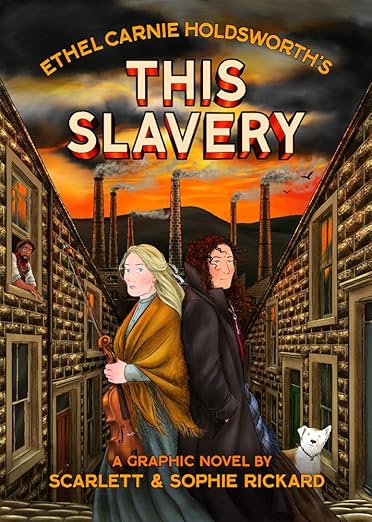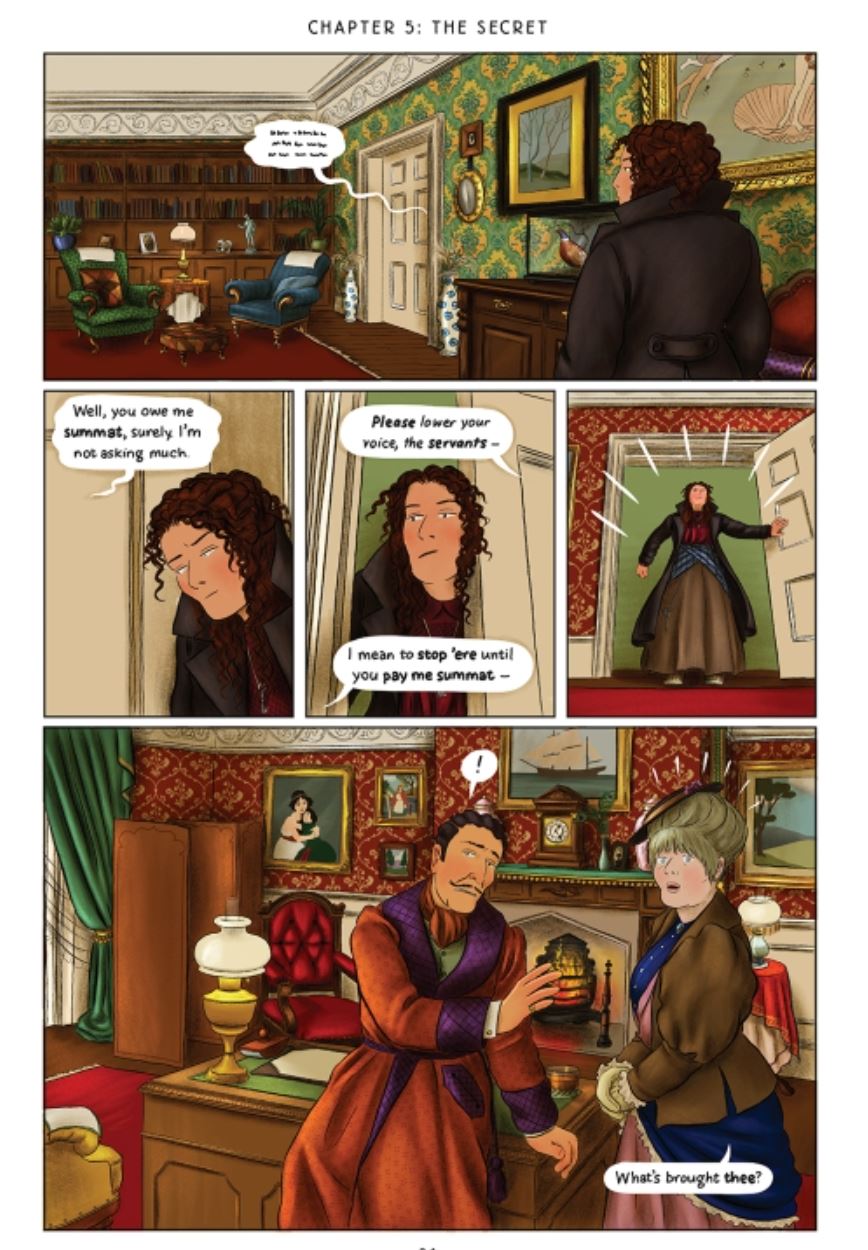
Ethel Carnie Holdsworth’s This Slavery


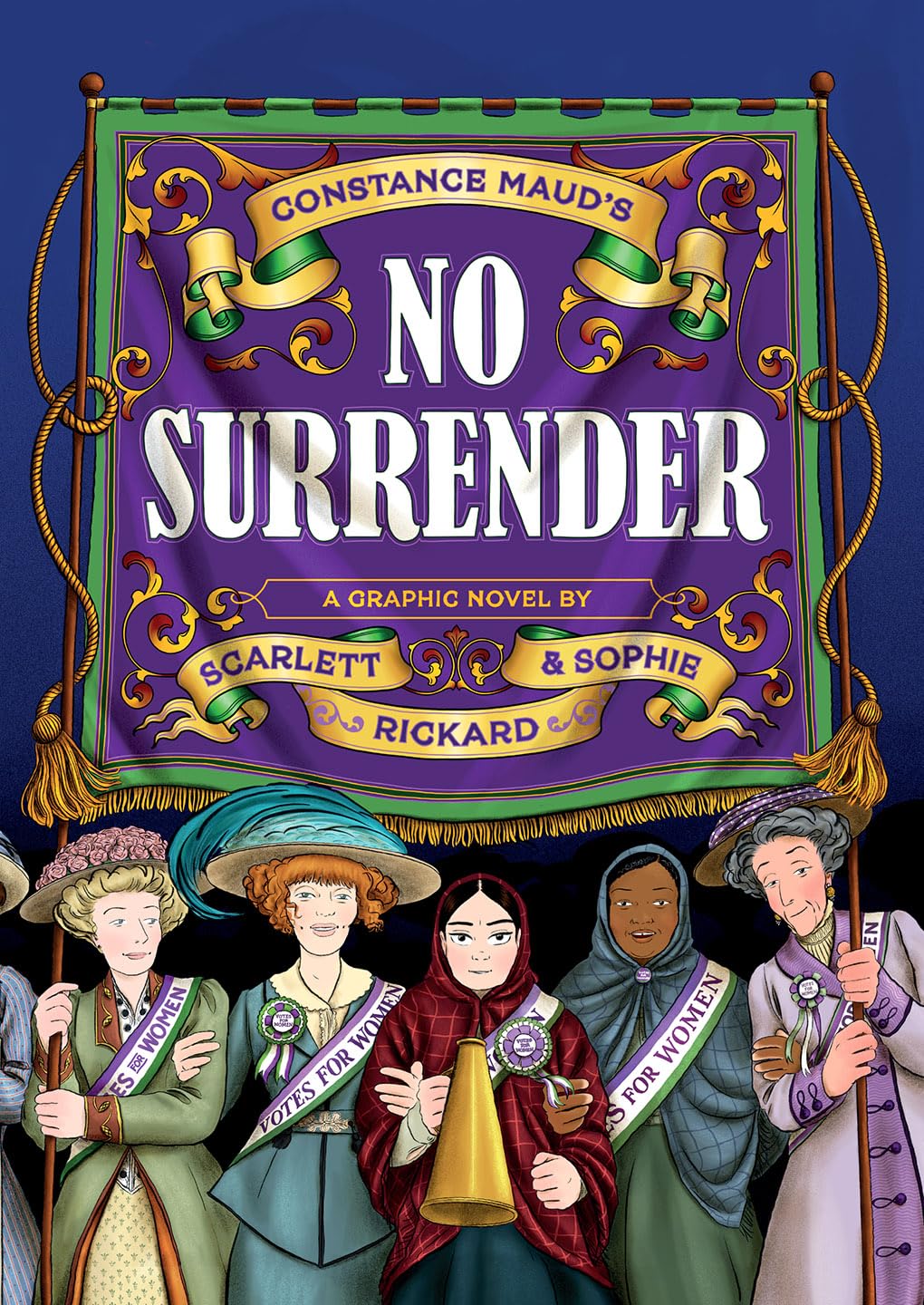
Adapted by Scarlett & Sophie Rickard, edited by David Hine (SelfMadeHero)
ISBN: 978-1-91422-435-5 (TPB)

This book includes Discriminatory Content included for dramatic effect.

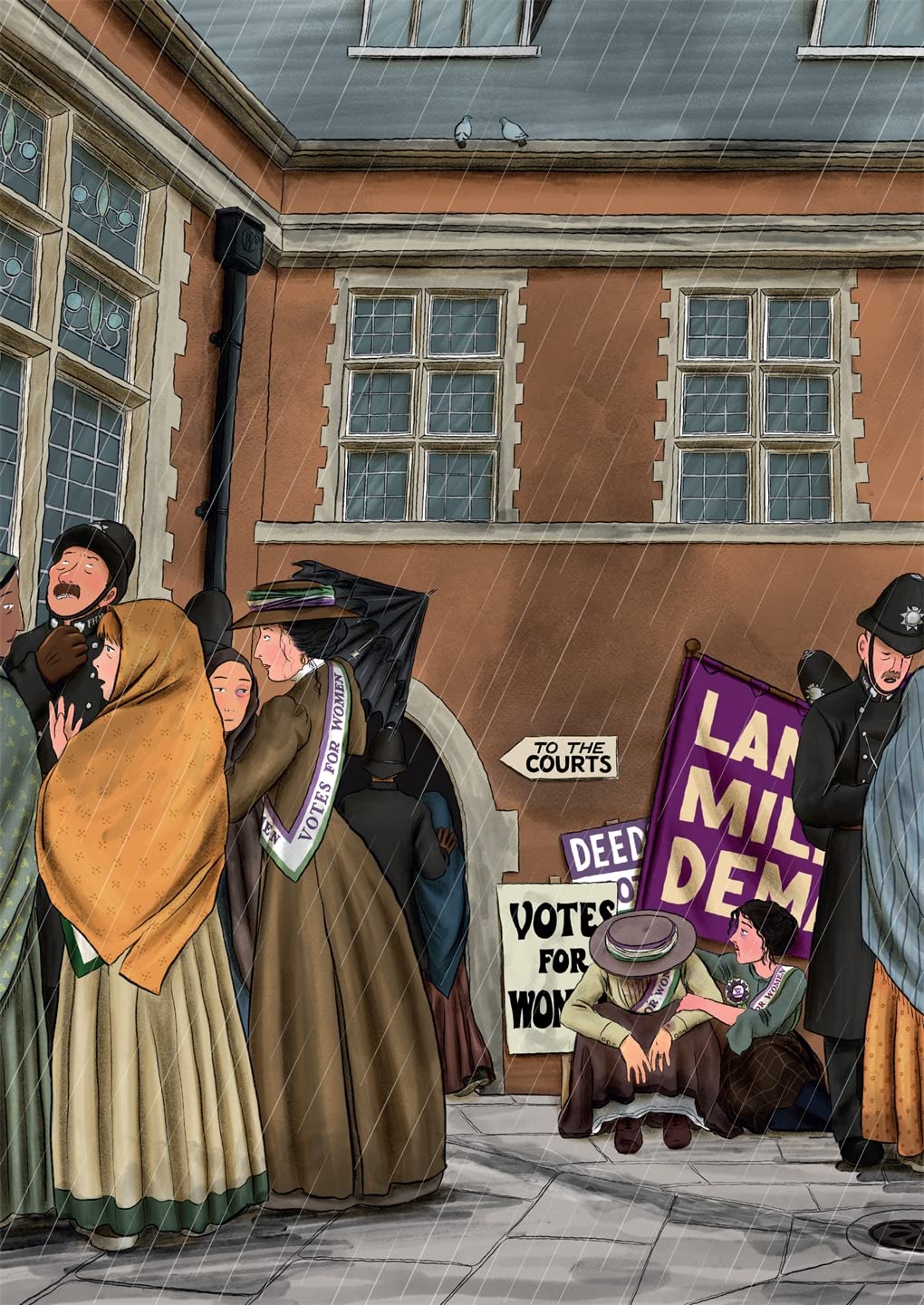
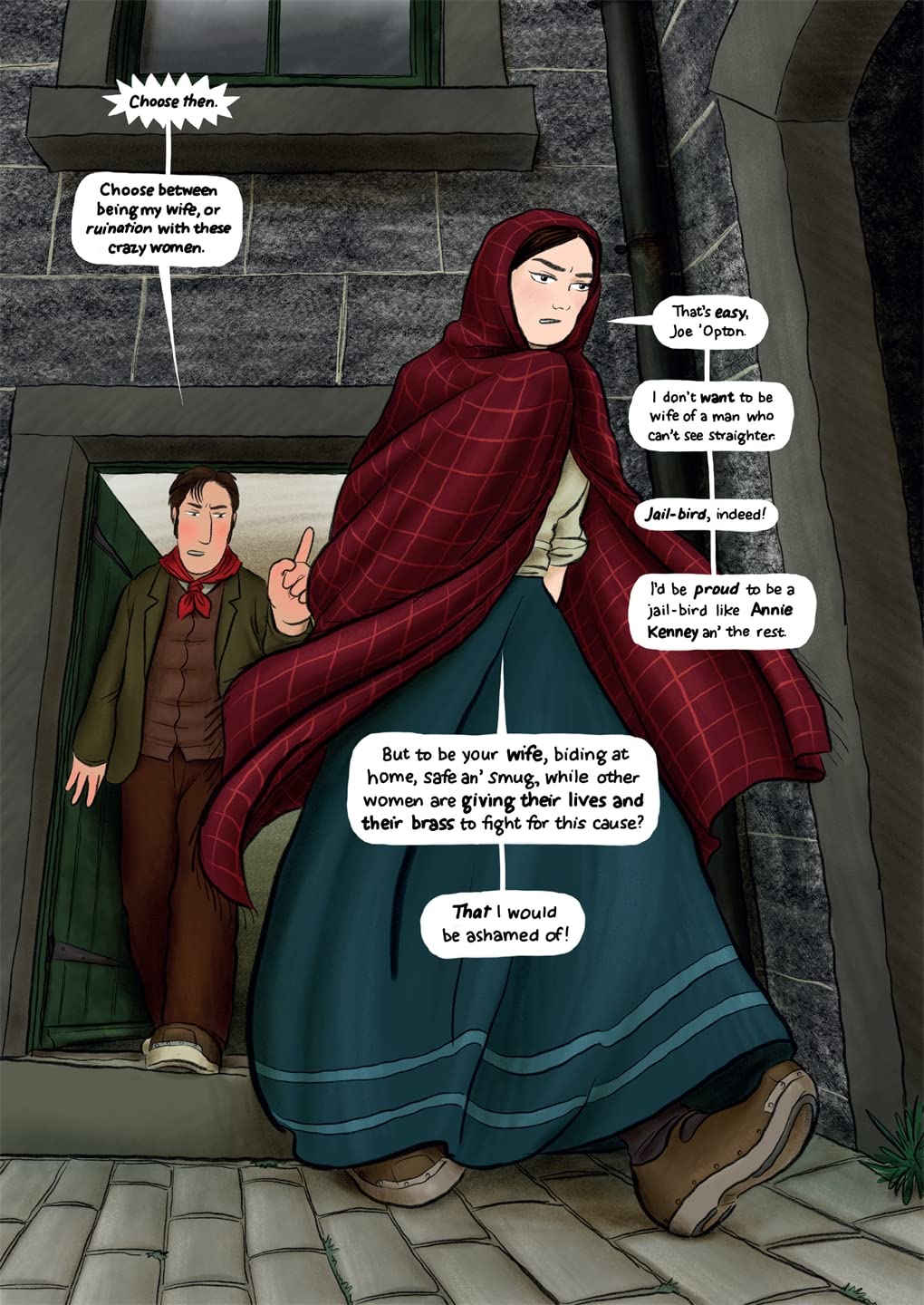
Published in 1925, and set in the cotton town of Great Harwood, near Blackburn at the Edwardian height of the Lancashire weaving industry, the prose This Slavery explored the ironclad imbalances of the feudal class structure the industry depended upon and did it in terms of a then-fashionable romance novel. It was dismissed in many quarters because of it. Its author Ethel Carnie Holdsworth (January 1st 1886 – December 28th 1962) was a poet, journalist, editor, educator, children’s author and novelist (with at least 10 books released in her lifetime, and whose fashionable gothic romances briefly outsold works by H.G. Wells!) and the first working class woman in Britain to have a book published – Miss Nobody in 1913.

Working class and self-made, she escaped the drudgery of her birth to become a socialist intellectual, foe of fascism, successful author and ardent campaigner. However, she was gradually and in her own lifetime erased from history and public consciousness – perhaps because this daring experiment was intended to reach beyond the intelligentsia on both sides of the cultural battlegrounds. Maybe – just perhaps – it happened because this story recognised that even though all workers were equal, female ones were supposed to be less equal than all the rest, before then challenging that apparently sacrosanct sacred cow and credo…

Divided into two Books, this saga is sparked by the aftermath of a fire at Barstock’s mill. This triggers another cycle of unemployment, privation and deaths for the weakest. Workers are paid a pittance and toil at the owners’ discretion with no salaried protections. Even skilled workers lives depend on the pennies weaving factories dole out whenever the owners need them to, and unemployment is common and frequent. Now, with their only livelihood destroyed with no sign of reopening, many men are leaving for more favourable climes. Of course, their wives and sweethearts must remain…

Hester and Rachel Martin live with their mother and grandmother, one a fierce and ferocious firebrand advocate of political and social change for all and the other a fair-faced, gifted musician in search of peace and security. Life for them is scrounging and performing for pennies or else perpetually borrowing to make do. When their granny dies, they don’t even have the money to bury her…

As their friends and lovers leave, existence becomes ever more onerous, and each achieves a shocking revelation regarding a woman’s place in the grand schemes, Thus each chooses a difficult way to survive…

The manner in which each “gets by” is moodily realised in grittily oppressive episodes beginning with ‘Chapter One: The Proposal’ and inexorably unfolding in a tapestry of tragedy comprising ‘The Denial’, ‘The Exile’, ‘The Struggle’, ‘The Secret’, ‘The Inevitable’, ‘The Undesirables’, ‘The Last Snap’ and ‘The Commitment’ all confirming that the war for freedom and equality is a three way battle: rich vs poor vs women…

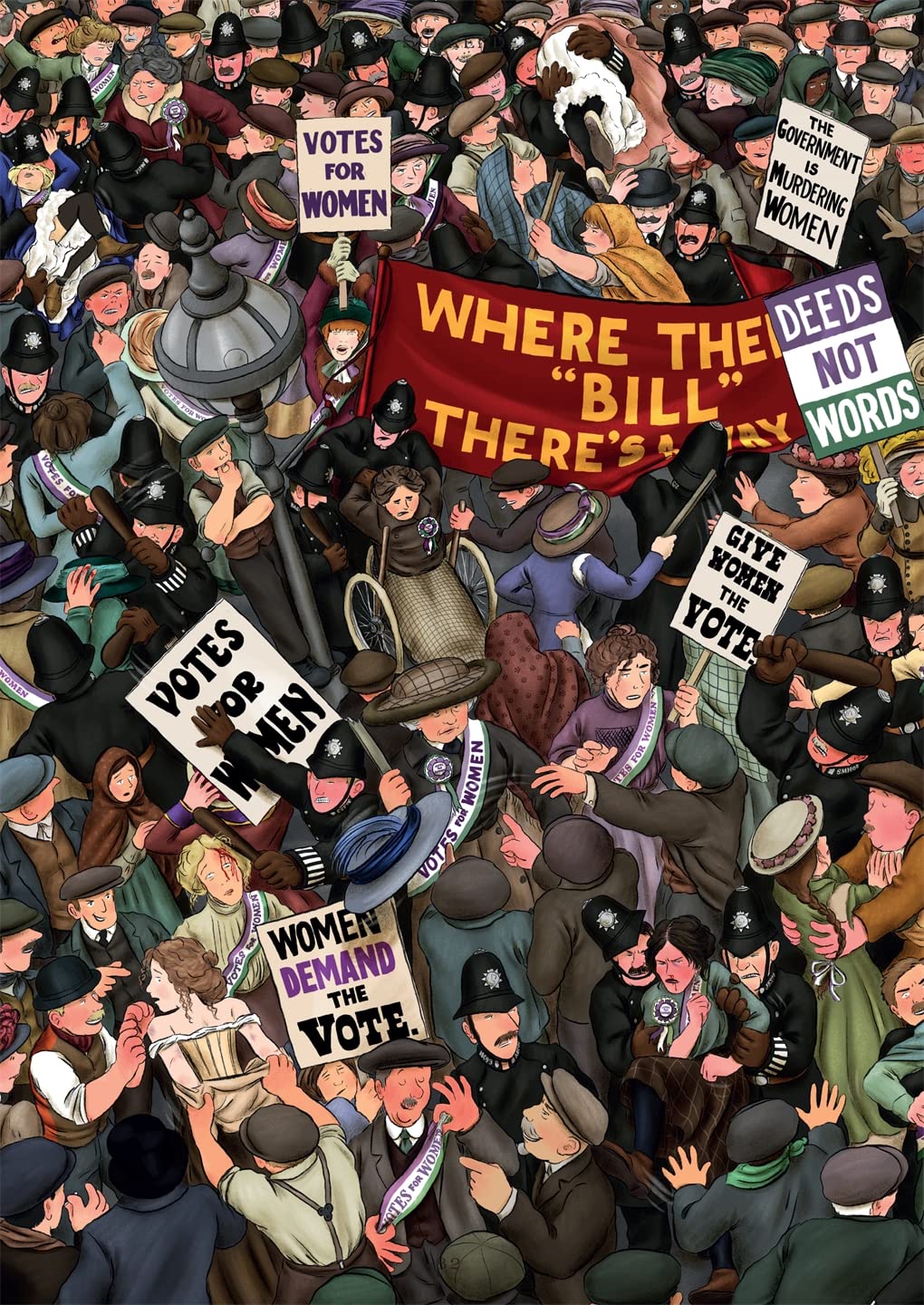
As Hester and Rachel each make life-changing decisions, the illustration embraces and resonates with powerful natural forces of nature and darkness opposed to crushing streets, oppressive architecture and shining gleaming inescapable artificial light that emotionally ground down the workers – employed or otherwise. Moreover, as Book Two sees the situation escalate into inevitable mass violence, readers are not allowed to forget that police, “scab” workers, and the military always have paid work to do…
As the drama leads to an inevitable conclusion each sister rediscovers her true nature via ‘Chapter Ten: The Negotiations’, ‘The Strike’, ‘The Lost Opportunity’, ‘The Innocents’, ‘The Beasts of the Jungle’, ‘The Revelations’, ‘The Rebellion’, ‘The Decision’ and momentous moment ‘The Last Battle’

Like any inspirational tale espousing change, there is the hint of happy endings and brighter futures for all depicted in an ‘Epilogue’ with the entire story reinforced by a candid and thoughtful Afterword from adaptors Sophie & Scarlett Rickard (Mann’s Best Friend, A Blow Borne Quietly, The Ragged Trousered Philanthropists, No Surrender).

Righteously strident, passionately polemical and powerfully enraging, engaging, this never-more-timely tale of the eternal injustice and biologically apologist is superbly readable, dramatically enticing and should be compulsory viewing for all – as long as we don’t force anyone …

© 2025 SelfMadeHero. Text © 2025 Sophie Rickard. Artwork © 2025 Scarlett Rickard. All rights reserved.
Ethel Carnie Holdsworth’s This Slavery will be published on September 11th 2025 and is available for pre-order now.

Today in 1917, cartoonist/writer Frank Robbins was born. Among his many, many masterworks this character stands at the forefront.

Star Trek: Gold Key Archives volume 1


By Dick Wood, Nevio Zaccara, Alfredo Giolitti & various (IDW)
ISBN: 978-1-61377-922-4 (HB/Digital edition)

This book includes Discriminatory Content produced in less enlightened times.

Star Trek debuted on American televisions on September 8th 1966 and ran until June 3rd 1969: three seasons comprising 79 episodes. A moderate success, it only really became popular after going into syndication, running constantly throughout the 1970s. It was also sold all over the world, popping up seemingly everywhere and developing quite a devoted fanbase.

Being a third world country, Britain didn’t see the show until July 12th 1969 during the rocket fever surrounding the Apollo moon landings, when BBC One screened “Where No Man Has Gone Before” in black-&-white before proceeding to broadcast the rest of the series in the wrong order. “Arena” was the first episode screened in colour (November 15th 1969), but viewers didn’t care. We were all hooked anyway and many of the show’s catchphrases – many erroneous and some entirely fictitious – quickly entered the popular lexicon of the nation.

The series spawned a licensed, British-originated comic strip which ran in Joe 90, TV21 and TV21 and Valiant from the late 1960s into the 1970s. These have also been collected and I’ll get to them in the fullness of time and space.

In the USA, although there was some merchandising, things were a little less enthusiastically embraced. Even though there was a comic book – from “properties magnate” Gold Key and running for almost a decade after the show’s cancellation – authenticity at the start wasn’t really a watchword. Nor was immediacy or urgency an issue. In fact, only six issues were released during the show’s entire three-season run. Published between July 1967 and December 1968, they are all gathered in this first archive Star Trek

Printing giant Whitman Publishing had been producing their own books and comics for decades through their Dell and Gold Key imprints, rivalling and often surpassing DC and Timely/Marvel at the height of their powers in sales and popularity. Famously Whitman never capitulated to the wave of anti-comics hysteria resulting in the crippling self-censorship of the 1950s and Dell Comics never displayed a Comics Code Authority symbol on their covers.

They never needed to: their canny blend of media and entertainment licensed titles were always produced with a family market in mind and the creative staff took their editorial stance from the mores of the filmic Hayes Code and the burgeoning television industry.

Just like the big and little screen, the product enticed but never shocked and kept contentious social issues implicit instead of tacit. It was a case of “violence and murder are fine, but never titillate”…

Moreover, the vast majority of their adventure comics’ covers were high quality photos or paintings – adding a stunning degree of veracity and verisimilitude to even the most outlandish of concepts for us wide-eyed waifs in need of awesome entertainment. The company seemed the only logical choice for a licensed comic book, and to be honest, these stories are cracking space opera yarns, even if they occupy an odd position in the hearts of older screen-dominant fans. In the UK, distribution of US comics was haphazard at best, but Gold Key Trek yarns were reprinted in our beloved and trusted hardback Christmas annuals. Nevertheless, the earliest ones bore little resemblance to what we’d seen on TV.

Our little minds were perplexed and we did wonder, but as the tales offered plenty of action and big sci fi concepts we just enjoyed them anyway.

Original British Star Trek yarns came in serialised comic-strip form, superbly illustrated and bearing a close resemblance to the source material. The feature only appeared as 2 or 3-page instalments in weekly anthologies, but was at least instantly familiar to TV viewers.

I discovered the answer to the jarring discrepancy, years later. Apparently scripter Dick Wood (a veteran writer who had worked on hundreds of series from Batman and the original Daredevil to Crime Does Not Pay and Doctor Solar, Man of the Atom) had not seen the show when commissioned to write the comic book iteration, and both he and Italian artists Nevio Zaccara – and latterly Alberto Giolitti – received only the briefest of outlines and scant reference materials from the show’s producers. They were working almost in the dark…

When you read these stories, you’ll see some strange sights and apparent contradictions to Trek canon lore, but they were all derived from sensible assumptions by creators doing the very best with what meagre information they had. If you’re likely to have your nostalgic fun spoiled by wrong-coloured shirts or Lasers rather than Phasers, think alternate universe or read something else. Ultimately, you are the only one missing out…

That’s enough unnecessary apologising. These splendidly conceived all-ages tales don’t deserve or need it, and even the TV wellspring was a constantly developing work-in-progress, as fan and occasional Trek scripter Tony Isabella reveals in his Introduction ‘These Are the Voyages…’

Accompanied by the stunning photo-collage covers and endpapers (an expensive rarity at the time outside Gold Key titles) the quirky collation of cosmic questing commences with ‘The Planet of No Return’ (by Wood & Zaccaria, from #1, July 1967) as the Enterprise enters a region of space oddly devoid of life and encounters predatory spores from a planet designated Kelly-Green. This is a world of horror where vegetative life contaminates and transforms flesh whilst mindlessly seeking to constantly consume and conquer. After the survivors of the landing party escape deadly doom and return to the safety of space, there is only one course of action Captain Kirk can take…

‘The Devil’s Isle of Space’ was released with a March 1968 cover-date and found the ever-advancing Enterprise trapped in a space-wide electronic net. The technology was part of a system used by an alien race to pen death-row criminals on asteroids, where they would be (eventually) executed in a truly barbarous manner. Sadly, it’s hard not to interfere in a sovereign culture’s private affairs when the doomed criminals hold Federation citizens hostage and want Kirk to hand his ship over to them…

Bombastic. beguiling and spectacular, ‘Invasion of the City Builders’ (#3, December 1968) saw legendary Alberto Giolitti take the artistic reigns. Prolific, gifted and truly international, his work and the studio he founded produced a wealth of material for three continents; everything from Le Avventure di Italo Nurago, Tarzan, The Phantom, Mandrake, Flash Gordon, Zorro, Cisco Kid, Turok, Gunsmoke, King Kong, Cinque anni dopo, Tex Willer and dozens more. In England, the Giolitti effect enhanced many magazines and age ranges; everything from Flame of the Forest in Lion to Enchanted Isle in Tammy. His textural adeptness and gritty line-work added visual terseness and tension to the mix, as seen in his first outing here, as Enterprise crewmembers land on a planet where automated machines originally programmed to build new homes and roads have been out of control for a century. Forcing the organic population to the edge of extinction, the mechs build cities no one can live in over the soil they need to grow food. The machines seem utterly indestructible, but Mr. Spock has an idea…

Social commentary gave way to action and suspense when ‘The Peril of Planet Quick Change’ (June 1969) finds the explorers investigating a world of chimerical geological instability, only to see Spock possessed by beings made of light. These creatures use him to finally stabilise their unruly world, but once the crisis is averted, one of the luminous spirits refuses to exit the Vulcan and plans to make the body its own…

‘The Ghost Planet’ (September 1969) was fast approaching parity with the TV incarnation as Enterprise reaches a world ravaged by radiation rings. Its twin rulers are eager for the star men’s help in removing the rings, but don’t want them hanging around to help rebuild the devastated civilisation. A little quiet investigation reveals that most of the carnage is due to eternal warfare which the devious despots plan to resume as soon as the Federation ship destroys the radiation rings and leaves…

Wrapping up this initial TV treasure-trove is ‘When Planets Collide’ (December 1969): a classic conundrum involving two runaway worlds inexorably drawn to each other and mutual destruction. What might have been a simple observable astronomical event becomes fraught with peril when the Enterprise’s crew discover civilisations within each world: both of which would rather die than evacuate their ancient homes…

With time running out and lives at stake there’s only one incredible chance to save both worlds, but it will take all Spock’s brains and Kirk’s piloting skill to avert cosmic catastrophe…

Bold, expansive and epic, these are great stories to delight young and old alike and well worth making time and space for. Why not explore lost worlds and sagas of guaranteed merit via the comics wayback machine? You know the one: it’s the comic shop located on the Edge of Forever?

® and © 2014 CBS Studios, Inc. Star Trek and related marks are trademarks of CBS Studios, Inc. All Rights Reserved.

Today Finnish cartoonist Lars Jansson was born today in 1926. You can see his work in Moomin Volume 9.

Today in 1937, Archie Goodwin was born: a gentle genius and still the Nicest Man in Comics, of whom you can learn more and appreciate his subtle mastery by checking Tales of the Batman: Archie Goodwin.

1941 – The Illustrated Story


By Stephen Bissette, Rick Veitch & Allan Asherman (Heavy Metal Books/Arrow Books)

ISBN: 978-0- 09922-720-7 (HMB) 978-0-09922-720-5 (Arrow Album PB)

This book includes Discriminatory Content produced during less enlightened times.

This book includes Discriminatory Content intended for dramatic and satirical effect.

It’s not often that I get to review a graphic adaptation that surpasses the source material, but this odd little item certainly does that. I’ll leave it to your personal tastes to determine if that’s because of the comic creators or simply because the movie under fire here wasn’t all that great to begin with…

Written by Robert Zemeckis, Bob Gale and John Milius, 1941 was a big budget screwball comedy starring some of the greatest comedy talents of the day. It was also youngish Steven Spielberg’s blockbuster follow-up to Jaws and Close Encounters of the Third Kind, but did not nearly receive the same kind of accolades and approbation.

The plot, adapted by Allan Asherman, concerns a certain night in December of that year when Hollywood was panicked by some “sightings” and many panicked reports of Japanese planes and submarines. One week after the devastation of Pearl Harbor, much of the USA – particularly its West Coast – was terrified of an invasion by the Imperial Forces of Emperor Hirohito. To be fair so were most of the white colonised Pacific, including Australia and New Zealand…

In this tale, one lone sub, borrowed from the Nazis, actually fetches up on the balmy shores of La-La land, but is largely ignored by the populace. The panic actually starts when gormless “Zoot-Suiters” Wally & Denny use an air-raid siren to distract store patrons and staff so that they can shop-lift new outfits, and inevitably peaks later when these feckless wastrels start a fist-fight at a USO (United Services Organisation) Dance. From there on, chaos and commotion carry this tale to its calamitous conclusion…

For the film that premise and delivery isn’t too successful, burdened as it is by leaden direction and a dire lack of spontaneity. However, all the frenetic energy and mania that was absent on screen is present in overwhelming abundance in the comic art of Steve Bissette (Swamp Thing, Taboo, 1963, Tyrant) & Rick Veitch (Swamp Thing, Army@Love, Heartburst, The One, Can’t Get No, 1963, Miracleman).

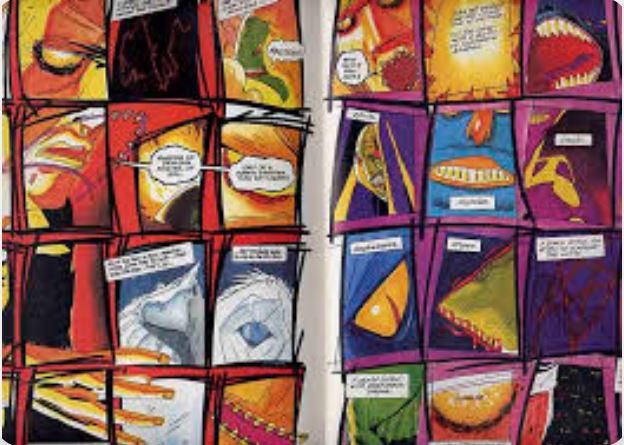
Taking their cue from the classic Mad Magazine work of the 1950s, they produced a riot of colour pages for the tie-in album reminiscent of Underground Comix and brimming with extra sight-gags, dripping bad-taste and irony, and combining raw, exciting painted art with collage and found imagery.

It’s not often that I say the story isn’t important in a graphic package, but this is one of those times. 1941 – The Illustrated Story is a visual treat and a fine example of two major creators’ earlier – and decidedly more experimental – days. If you get the chance, it’s a wild ride you should take. You can even shade your late-arriving curiosity in terms of “research” as we head towards the 80th anniversary of VJ Day if it makes you feel better…
© 1979 Universal City Studios, Inc. and Columbia Pictures Industries, Inc.

Richard Wagner’s The Ring of the Nibelung


Adapted by P. Craig Russell, translated by Patrick Mason, with Lovern Kindzierski & Galen Showman (Dark Horse)
ISBN: 978-1-61655-401-9 (HB) eISBN 978-1-63008-154-6

This book includes some Discriminatory Content included for dramatic effect.

If you’re planning on being in Germany next month, music lovers are reminded that THE BAYREUTH FESTIVAL is performing Wagner’s superhero-inspiring RING CYCLE (Das Rheingold:26 July – Schwarz/Young, Die Walküre: 27 July – Schwarz/Young, Parsifal: 28 July – Scheib/Heras-Casado and Siegfried: 29 July – Schwarz/Young. If you check out or even take this tasty tome along, you may achieve a far greater understanding of the text and even certain leitmotif…  but probably not most of the prevailing attitudes, bad manners and big fancy hats…

  1. Craig Russell began his illustrious career in comics during the early 1970s: coming to fame early for a groundbreaking run on science fiction adventure series Killraven, Warrior of the Worlds.

Russell’s fanciful, meticulous classicist style was derived from the great illustrators of Victorian/Edwardian heroic fantasy and was greatly at odds with the sausage-factory deadlines and sensibilities of the mainstream comic book industry. By the 1980s he had largely retired from the merciless daily grind, preferring to work on his own projects (mostly adapting operas and plays into sequential narratives) whilst undertaking occasional high-profile Special Projects for the majors – such as Dr. Strange Annual 1976 (totally reworked and re-released as the magnificent Dr. Strange: What Is It that Disturbs You, Stephen? in 1996) or Batman: Robin 3000.

As the industry grew up and a fantasy boom began, he returned to comics with 1982’s Marvel Graphic Novel: Elric, further adapting Michael Moorcock’s iconic sword-&-sorcery star in the magazine Epic Illustrated and elsewhere. Russell’s stage-arts adaptations had begun appearing in 1978: firstly in groundbreaking independent Star*Reach specials Night Music and Parsifal and then, from 1984, at Eclipse Comics where the revived Night Music became an anthological series showcasing his earlier experimental adaptations: not only the operatic dramas but also tales from Kipling’s Jungle Books and other sources.

As mainstream comics rapidly matured, his stylings were seen in Vertigo titles like The Sandman and Mike Mignola’s Hellboy titles. He never, however, abandoned his love of operatic drama. In 2003 Canadian publisher NBM began a prodigious program to collect all those music-based masterpieces into The P. Craig Russell Library of Opera Adaptations, but just before that, the artist took a couple of years (2000 – 2001) to complete a passion project. Originally released as a procession of linked miniseries – The Ring of the Nibelung: The Rhinegold #1-4, The Ring of the Nibelung: The Valkyrie #1-3, The Ring of the Nibelung: Siegfried #1-3 and The Ring of the Nibelung: Götterdämmerung #1-4 – Russell and his regular collaborator Lovern Kindzierski adapted Richard Wagner’s masterpiece to comics. His wasn’t the first, but it’s most certainly the best.

Collected in a stunning single volume the Teutonic saga is augmented by a Preface from music critic and scholar Michael Kennedy, an Introduction by comics star Matt (no relation) Wagner, and is followed by Russell’s fascinating, heavily-illustrated essay ‘What is an Adaptation?’: describing his thinking, creative process and philosophy in the crafting of this epic, whilst offering an intimate peek into how the magic was made along via a range of pencil, ink and/or fully-coloured sketches and art studies as well as the entire gallery of covers from the original comics.

The four operas Das Rheingold, Die Walküre, Siegfried and Götterdämmerung (or Twilight of the Gods if you’re less pompous or well-travelled than me) is a classic distillation of Germano-Norse myth and the poems collected as the Icelandic Eddas. Over 26 years the master of German music distilled them into a cycle of staggering power, which people either love or hate. Great tunes, too.

Doesn’t absolutely everybody love the brilliant animated tribute-come-distillation starring Bugs Bunny entitled ‘What’s Opera, Doc?’ They probably refer to it as “Kill the Wabbit!” though. Joking aside, the Ring Cycle is a true masterpiece of Western Culture and immortal inspiration to purveyors of drama and historic fiction. In 1989 and 1990 long-time fans and comics superstars Roy Thomas (who’d already integrated the plot into the canon of Marvel’s Mighty Thor) and Gil Kane produced a 4-part, prestige-format miniseries that adapted the events into comic strip form. That’s superbly impressive, but trust me, Russell’s is in a league of its own…

Bold, bright, glittering and tightly adhering to the rhythms and staging of the theatre version – thanks to translator Patrick Mason’s deft contribution – it all begins with the creation of the world…

At some time later, Alberich the Nibelung is a hideous troglodytic Dwarf shunned by all, but smart enough to outwit the three haughty Rhine Maidens. Commanded to guard an accursed treasure horde even the Gods cannot tame, the river nymphs reveal the secret to the glib intruder. Whoever casts The Rhinegold into a ring will have all the wealth and power of the world, but must forever forswear love and joy. Never having known either, greedy Alberich readily and scornfully forsakes these dubious emotional necessities and seizes the treasure even All-Father Voton feared to touch.

Meanwhile, wily Logé has convinced Voton to promise giants Fasolt and Fafnir anything they wish if they build the great castle Valhalla to house the world’s heroes. Assured that the trickster god can free him from his promise to the giants, the All-Father and Preserver of Oaths accepts their price, but on completion the giants demand possession of Freia; goddess of the apples of immortality.

Bound by their Lord’s sworn oath, the gods must surrender Freia, but malicious Logé suggests that Alberich’s stolen gold – now reshaped into a finger-ring – can be used by any other possessor without abandoning love. The brothers then demand the world-conquering trinket as a replacement fee… and no god can sway or deter them. The course is set to disaster!

Second miniseries The Valkyrie sees an earthly warrior calling himself “Woeful” as the sole survivor of a blood-feud. Fleeing, he claims Right of Hospitality from a beautiful woman in a remote cottage. However, when her husband Hunding returns, they all discover that he belongs to the clan Woeful recently slaughtered so many of…

Secure for the night under the sacrosanct bond of Hospitality, Woeful realises he must fight for his life in the morning when the sacred truce expires. Without weapons, he counts little for his chances until the woman reveals to him a magic sword embedded in the giant Ash tree that supports the house. Unfortunately, the gods have already decreed that there can be no happy ending to be won, only further sin and shame and the fall of Voton’s most beloved servant Brunhildé

Sixteen years later, Siegfried is the child of an illicit union, raised by malicious, cunning Mime: a blacksmith who knows the secrets of the Nibelung. No loving parent, the metal-shaper wants the indomitable wild boy to kill a dragon (Fafnir, who was once a giant) and steal the magical golden horde the monster so jealously guards. Of course, the young hero has his own heroic dreams and faces the fearsome firedrake for his own reasons: glory, fame, pride and because he wishes to awaken an otherworldly maiden who slumbers eternally behind a wall of fire!

Years of plotting and treachery and the inescapable onerous burden of fate culminate in Götterdämmerung as all the machinations, faithlessness and oath-breaking of truly flawed divinities lead to their ultimate destruction. Siegfried has won his beauteous Brunhildé from the flames but their happiness is not to be. False friends Hagen and Gunther drug him to steal his beloved, simultaneously betrothing the befuddled hero to a woman he does not love. Final betrayal by a comrade – whose father was Alberich – leads to his death and the inevitable fall of all that is!

If you know the operas you know how much more remains to enjoy in this quartet of tales, and the scintillating passion and glowing beauty the art magnificently captures the grandeur and tragedy of it all. This primal epic is visual poetry and no fan should be without it.
© 2000, 2001, 2014 P. Craig Russell. All rights reserved.

Eagle Classics: The Adventures of P.C. 49


By Alan Stranks & John Worsley (Hawk Books -1990)
ISBN: 978-0-948248-17-7 (album TPB)

This book includes Discriminatory Content produced in less enlightened times.

Eagle is 75 years old this year and the reason we old farts remember it so fondly are many and various. Here’s just one of them.

On 14th April 1950 Britain’s grey, postwar gloom was partially lifted with the first issue of a glossy new comic that seemingly gleamed with light and colour. Eagle was the most influential comic of the era, running until 26th April 1969, and its legions of mesmerised readers were understandably enraptured with the gloss and dazzle of Dan Dare, Pilot of the Future: a charismatic star-turn venerated to this day. However it also carried a plethora of traditional genre strips, fact and prose regulars. These included both original features and further exploits of some of their favourite radio shows and cinema heroes – and even best beloved gustatory treats!

It was the brainchild of a Southport vicar, the Reverend Marcus Morris, who was worried about the detrimental effects of US comic books on British children. He advocated a good, solid, Christian antidote. Seeking out like-minded creators he jobbed around a dummy to British publishers for over a year – with little success – until he found an unlikely home at Hulton Press, a company producing general interest magazines such as Lilliput and Picture Post. The result was a huge hit that spawned in-house clones Swift, Robin and Girl – targeting other sectors of the children’s market – whilst generating crucial radio series, books, toys and other sorts of merchandising. The Eagle phenomenon reshaped the industry, compelling UK comics colossus Alfred Harmsworth to release cheaper imitations through his Amalgamated Press/Odhams/Fleetway/ IPC group such as the far longer-lived Lion (23rd February 1952 – 18th May 1974) and many companion titles like Tiger and Valiant.

A huge number of soon-to-be prominent creative figures worked on Eagle, and although Dan Dare is deservedly revered as its star, many other strips were as popular at the time, some rivalling the lead in quality and entertainment value. At its peak the periodical sold close to a million copies a week, before changing tastes and a game of “musical owners” killed Eagle. In 1960 Hulton sold out to Odhams, who became Longacre Press. A year later they were bought by The Daily Mirror Group who evolved into IPC. Due to multiple episodes of cost-cutting, many later issues carried Marvel Comics reprints rather than home-originated material. It took time, but the Yankee cultural Invaders won out in the end. In 1969, with the April 26th issue, Eagle merged into Lion, before eventually disappearing altogether. Successive generations revived the title, but never the initial blockbuster success.

In its youth, heydays and prime, Eagle was tabloid sized with photogravure colour inserts, alternating with monochrome pages of text and comic features. Tabloid is a big page, and you can get a lot of material onto each one, so – at the start – something of equal merit deserved almost as much space. One of the biggest draws to Eagle’s mighty pantheon was family radio/film attraction P.C. 49. Although latterly eclipsed by BBC radio colleagues Jeff Arnold/Riders of the Range (whose comic exploits were handled by Charles Chilton & Frank Humphris), and John Ryan’s TV sensation-in-waiting Captain Pugwash and the inimitable Harris Tweed, the unflagging beat copper pre-dated the comic, bringing an established (and frequently older) audience with him. All of them became darlings of other media too via promotional tie-ins such as books, puzzles, toys, games, apparel and comestibles as well as and all other sorts of ancillary merchandising – although the PC had his share of that boodle too…

Dare of course soon overtook them all, especially after acquiring his own weekly radio serial on Radio Luxembourg. The Adventures of Dan Dare played out five nights a week from July 1951 to May 1956…

Preceded by fantastically informative pictorial essay ‘The Many Adventures of P.C.49 – An introduction by Norman Wright’, this epic oversized (330 x 238mm) tribute edition provides background on the radio episodes, both films and all iterations of the comic and prose publishing incarnations of Archibald Berkeley-Willoughby AKA “Fortynine”. That specifically includes how the radio hero progressed from ambitious affable “plod” to proud father and family man after marrying his sassy, smarter, fiancée/crimebusting rival/competitor Joan Carr in the broadcast world, as well as how all that was shunted aside and ignored in comics. Instead from August 1951 Joan vanished and was replaced by an international kid’s gang of juvenile sidekicks – the Boys Club – who would help Fortynine solve crimes if not actually get his longed-for promotion to plainclothes detective…

Initially illustrated by illustrator/gallery artist Charles Sidebotham “Strom” Gould (Storm Nelson) – who limned the first four cases – The Adventures of P.C.49 – from the famous radio series by Alan Stranks began on page 3 of Eagle #1, and ran until March 1957, long after the radio show finished. It featured the daily travails of genial posh berk turned keen as mustard Police Constable Archibald Berkeley-Willoughby as he sought to make progress from beat copper into the serried ranks of plainclothes detectives. This all occurred in Q Division, the sleeziest parts of a major modern metropolis where, despite many weekly triumphs and his immediate uniformed superiors being utterly convinced that “Fortynine” did not have “what it takes”, he proved he did…

Collected here are three yarns by originator Stranks and the strip’s most beloved co-creator. In 1903, Australian Alan Stranks (Dick Barton, Special Agent, Dan Dare- Prisoners of Space) was born in Brunswick, Victoria. Beginning his career in the 1920s as a lyricist – he penned Britain’s very first Eurovision entry “All” – Stranks became a crime reporter before moving to England. He continued in the field but added feature writing and gradually moved sideways into drama; writing novels, radio plays and serials, as well as movies and comics. He died suddenly and without warning from a cerebral haemorrhage in 1959.

The radio Adventures of PC 49 ran (intermittently thanks to Stranks’ increasingly busy schedule) on the BBC Home Service from October 27th 1947 to Summer 1953, just as the astounding John Worsley was making the comic strip one of the most entertaining and enthralling pages in the periodical with his charmingly informative and sublimely expressionistic cartooning style.

Illustrator/Naval war artist, police sketch artist, commercial designer, president of the Royal Society of Marine Artists and certified war hero John Godfrey Bernard Worsley was born on 16th February 1919 in Liverpool and raised in Kenya. After studying at Goldsmiths College of Art he became a travelling artist and portraitist before joining the Royal Navy in WWII. For a fuller assessment of this incredible man go to John Worsley (artist) – Wikipedia or track down John Worsley’s War… or watch the film Albert RN

For all his other artistic endeavours Worsley is rightly renowned, but we’re here for the comics. His cartooning career began with Tommy Walls in Eagle. An advertising campaign for the ice cream company masquerading as an adventure strip serial, it led to him taking over P.C. 49 from Strom Gould and handling ancillary strips and illustrations for Annuals and Archie’s own line of books. This led to more strips: Daughter of the Nile and Belle Of The Ballet in Girl – reprinted as Lindy of Latmyer Grange in Princess Tina – and the delightful Wee Willie Winkie for Treasure as well as ads, military recruitment materials, books such as The Little Grey Men and The Wind in the Willows, and – his personal favourite – a lavish cartoon interpretation of A Christmas Carol created to support a major television special in 1970. Aged 81, Worsley died on October 3rd 2000.

In lieu of a full P.C. 49 collection or other curated compilations, his gifts live on here as first seen here in seventh serial saga ‘The Case of the Spotted Toad’. This began in the Christmas 1952 issue of Eagle and carried on into May 1953 as the cheery copper is hospitalised by ruthless gangsters Knocker Dawson and Slim Jiggs after saving homeless boy Dickie Duffle and his dog Rip. His eager young pals and Boy’s Club protégées Toby, Mongatiki, Snorky, Gigs & Bunny plus “Terrible Twins” Pat & Mick Mulligan join forces to finish the job of capturing the murderous fur thieves and finding the well-hidden loot, with Archie back on his feet just in time to face the explosive final showdown…

Nervous tyke Bunny and his pocket pet Victor take centre stage in follow up ‘The Case of the Magnificent Mouse’ wherein the nosy nipper sees local tramp Tatty Bogle kidnapped and a perfect duplicate beggar appear. Of course no one believes him but before too long it all unfolds as a major counterfeiting caper run by Lew Lupus and Nix Nobbler. When they snatch Bunny, the police are stumped until the Boys Club lead P.C. 49 to the impenetrable lair of the villains, but in the ends it’s up to Victor to magnificently save the day…

Concluding the casebook, ‘The Case of the Old Crock’ finds the Boys Club preparing for their annual hike/unsupervised holiday at the seaside (because all us Boomer kids were utterly feral and fearless!). Seeing how worn out Archie is thanks to loads of compulsory overtime, the lads use club funds to buy the weary, footsore adult a “car”. Sadly, their choice is not only an appalling fixer-upper, it’s secretly the safe used by master thief Tiger Maggs to stash a map to where he’s buried his carefully hoarded loot. Guess which seaside beach it’s stashed under?

Of course Maggs’ henchmen Junky and Dandy have no idea of the clunker’s real value when they dupe the boys into buying it, but with Scots Boys Club recruit Tam Piper unleashed on it, the junker soon seems roadworthy and eye-catching. Best of all, Bunny has found a map, but he can’t convince anyone that it could lead to pirate treasure…

When Maggs gets out of prison and goes to pick up his car, all hell breaks loose, leading to escalating excitement, another shockingly white-knuckle concatenation of circumstances and a brutally gripping denouement…

Blending genuine tension with schoolboy thrills and genteel police procedurals, The Adventures of P.C. 49 is a true lost gem of British comics, funny, warm, scary, inclusive (as any strip of that period can be), rollercoaster-paced and truly beautiful to see. I can’t see how it will ever be reproduced in full, but I so very much wish it would be. Yet another one to add to “The Why Is This Not In Print?” drawer…
P.C. 49 strip © 1990 Fleetway Publications. This arrangement and Compilation © 1990 Hawk Books.

The Dick Tracy Casebook – Favourite Adventures 1931-1990


By Chester Gould, selected by Max Allan Collins & Dick Locher (St. Martins/Penguin)
ISBN: 978-0-31204-461-9 (HB) 978-0-14014-568-7 (PB)

This book includes Discriminatory Content produced in less enlightened times.

Lost in all the landmarks and events of the moment, I’d intended to commemorate and memorialise the anniversary of a true comics giant yesterday, but missed my shot. On May 11th 1985, Chester Gould passed away. On that same day in 1953, latterday Dick Tracy scribe Mike Curtis was born. He wrote the latest exploits of the unflinching super-cop, as collected in Calling Dick Tracy!. Justice may be slow sometimes, but if the comics are anything to go by, cannot be deferred forever…

All things considered, comics have a pretty good track record on creating household names. We could play the game of picking the most well-known fictional characters on Earth (with Sherlock Holmes, Mickey Mouse, Superman, James Bond and Tarzan usually topping most lists) but you’ll also see Batman, Popeye, Blondie, Charlie Brown, Tintin, Wonder Woman, Spider-Man, and not so much now – but once upon a time – Dick Tracy there as well.

At the height of the Great Depression cartoonist Chester Gould was looking for strip ideas. The story goes that as a decent guy incensed by the exploits of gangsters (like Al Capone who monopolised front pages of contemporary newspapers) he settled upon the only way a normal man could fight thugs: Passion and Public Opinion.

Raised in Oklahoma, Gould was a Chicago resident who hated seeing his home town in the grip of such wicked men, with far too many honest citizens beguiled and seduced by the gangsters’ power and charisma. Boy, if they could see how politics today exploits that self-destructive tendency…

Gould decided to pictorially get it off his chest with a procedural crime thriller championing the ordinary cops who protected civilisation. He took “Plainclothes Tracy” to legendary newspaperman/comic strip Svengali Captain Joseph Patterson, whose golden touch had blessed such strips as Gasoline Alley, The Gumps, Little Orphan Annie, Winnie Winkle, Smilin’ Jack, Moon Mullins and Terry and the Pirates among others. Casting his seasoned eye on the samples, Patterson renamed its stark, stern protagonist Dick Tracy and revised his love interest into steady girlfriend Tess Truehart. The series launched on October 4th 1931 through Patterson’s Chicago Tribune Syndicate and rapidly became a huge hit, with all the attendant media and merchandising hoopla that follows.

Amidst the toys, games, movies, serials, animated features, TV shows et al, the strip soldiered on, influencing generations of creators and entertaining millions of fans. If you’ve never seen the original legend in action this collection – still readily available and originally released to accompany a movie adaptation in 1990 – is a great introduction.

Selected by successor scripter Max Allen Collins & Dick Locher, who worked on the strip after Gould retired in 1977, it re-presents complete adventures from each decade of the strip’s existence to date, offering a grand overview of the development from radical, ultra-violent adventure to forensic Police Procedural, through increasingly fantastical science fiction and finally back-to-basics cop thriller under Collins’ own script tenure.

From the 1930s comes the memorable and uncharacteristic ‘The Hotel Murders’ (9th March – 27th April, 1936) wherein the terrifyingly determined – some might say obsessed – cop solves a genuine mystery with a sympathetic antagonist instead of the usual unmitigated, unsavoury, unrepentant outlaw.

Whodunits with clues, false trails and tests of wits were counterproductive in a slam-bang, daily strip with a large cast and soap-opera construction, but this necessarily short tale follows all the ground rules as Tracy, adopted boy side-kick Junior, special agent Jim Trailer and the boys on the beat track down the killer of a notorious gambler.

The best case of the 1940s – and for many the best ever – was ‘The Brow’ (22nd May – 26th September 1944) in which the team hunt down a brilliant but ruthless Nazi spy. As my own personal favourite, I’m doing you all the favour of saying no more about this compelling, breathtaking yarn, and you’ll thank me for it, but I will say that this is a complete reprinting, as others have been edited for violence and one edition simply left out every Sunday instalment – which is my own definition of police brutality.

By the 1950s Gould was at his creative peak. ‘Crewy Lou’ (22nd April – 4th November, 1951) and ‘Model’ (23rd January – 27th March, 1952) are perfect examples of the range of his abilities. The first is an epic of minor crimes and perpetrators escalating into major menaces whilst the latter is another short shocker with the conservative Gould showing social ills could still move him to action in a tale of juvenile delinquency as Junior grows into a teenager and experiences his first love affair…

As with many established cartoonists in it for the long haul, the revolutionary 1960s were a harsh time. Along with Milton Caniff’s Steve Canyon, Dick Tracy especially foundered in a cultural climate of radical change where popular slogans included “Never trust anybody over 21” and “Smash the Establishment!”. The strip’s momentum faltered, perhaps as much from the shift towards science fiction themes (Tracy moved into space and an alien character – Moon Maid – was introduced) as any old-fashioned attitudes.

In the era when strip proportions had begun to diminish as papers put advertising space above feature clarity, his artwork had attained dizzying levels of creativity: mesmerising, nigh-abstract monochrome concoctions that grabbed the eye no matter what size editors printed it. ‘Spots’ (3rd August – 30th November) 1960 comes from just before the worst excesses, but still displays the artist’s stark, chiaroscurist mastery in a terse thriller demonstrating the fundamental secret of Tracy’s success and longevity… Hot Pursuit wedded to Grim Irony…

The 1970s are represented by ‘Big Boy’s Open Contract’ (12th June – 30th December 1978) by Collins & Rick Fletcher. Although officially retired since 1977, Gould still consulted with the new creative team, and the third outing for the new guys saw the long-awaited return of Big Boy, the thinly disguised Capone analogue Tracy had sent to prison at the very start of his career, and whose last attempt at revenge tragically cost the dutiful hero a loved one whilst forever changing the strip. Despite a strong core readership the series had stalled, especially as improbable, Bond-style villains were utilised to beef up its perceived “old-fashioned” attitudes. Even the introduction of more minority and women characters and hippie cop Groovy Groove couldn’t stop the rot. However, the feature soldiered on regardless…

When Gould retired, 29-year-old author Max Allen Collins (Road to Perdition Nathan Heller, Mike Mist, Ms. Tree) won the prestigious writer’s role, promptly taking the series back to its crimebusting roots for a breathtaking run, assisted by Gould’s insights as his chief artistic assistant Rick Fletcher was promoted to full illustrator. After 11 years, in 1992 Collins was removed and replaced by Mike Kilian – who apparently worked for half the author’s price – until his death in October 2005, whereafter Dick Locher took over story and art, with assistant Jim Brozman assuming drawing duties from March 2009.

On January 19th 2011, Tribune Media Services announced Locher’s retirement and replacement by a new team – Mike Curtis and Joe Staton. You already know where to find them…

Representing the 1980s, the final tale here is ‘The Man of a Million Faces’ (October 5th 1987 – April 10th 1988) by Collins & Locher. Like Fletcher, this illustrator was an art assistant to Gould who took up the master’s mantle. Despite the simply unimaginable variety of crimes and criminals Tracy has brought to book, this sneaky story of a bank robber and his perfect gimmick proves that sometimes a back to basics approach produces the best results.

Dick Tracy is a milestone strip that has influenced all popular fiction, not simply comics. Baroque villains, outrageous crimes and fiendish death-traps pollinated the work of numerous strips and comics such as Batman, but his studied use – and startlingly accurate predictions – of crimefighting technology and techniques gave the world a taste of cop thrillers, police procedurals and forensic mysteries decades before TV made those disciplines everyday coinage.

This is fantastically readable, and this chronological primer is a wonderful way to sneak into his stark, no-nonsense, Tough-love, Hard Justice world.
© 1990 Tribune Media Services, Inc. All Rights Reserved.

Noggin the Nog


By Oliver Postgate & Peter Firmin (Egmont)
Noggin the King ISBN: 978-1- 4052-8152-2 (HB)
Noggin and the Whale ISBN: 978-1- 4052-8153-9 (HB)
Nogbad Comes Back ISBN: 978-1- 4052-8155-3 (HB)
Noggin and the Dragon ISBN: 978-1- 4052-8154-6 (HB)
Nogbad and the Elephants ISBN 978-1- 4052-8142-3 (HB)
Noggin and the Moon Mouse ISBN: 978-1- 4052-8141-6 (HB)
Noggin and the Storks ISBN: 978-1- 4052-8144-7 (HB)
Noggin and the Money ISBN: 978-1- 4052-8143-0 (HB)

Baby Boomers like me consider our childhoods – no matter how feted or feral, and personally privileged or dire and deprived – to have been a golden age in terms of liberty, agency and especially entertainment. That’s probably due in large part to being exposed to the gentle, life-affirming fantasy worlds of these guys.

Today celebrating a century of being splendid, Richard Oliver Postgate was a writer, puppeteer, animator and unrepentant itinerant storyteller who was born to an extremely prestigious, overachieving and drama-drenched family. He entered the world on April 12th 1925 in Hendon Middlesex and was eventually educated at Woodstock School, Woodhouse Secondary, the legendary Dartington Hall School/College and Kingston College of Art. He joined the Home Guard in 1942 but when at last called up, declared himself a Conscious Objector – just as his father had during the Great War. Court martialled and sentenced to Feltham Prison, Oliver eventually became a land-worker growing crops. After the war he worked for the Red Cross in Occupied Germany. On returning to Britain in 1948, he went to Drama School and drifted from job to job.

In 1957, whilst working as a stage manager for commercial TV company Associated Rediffusion, he observed the appalling quality of children’s programming up close and knew he could do better for the same paltry money offered. Writing Alexander the Mouse he convinced a Central School of Art tutor named Peter Firmin to draw the backgrounds for him. After moving on to short-lived deaf-viewer project The Journey of Master Ho, in 1959 the creators formalised their partnership as independent studio Smallfilms. The rest is history… and fantasy and wonder and charm and devastating nostalgia…

When not shaping the minds of 30-years-worth of kids, Postgate continued trying to save the world and refine its inhabitants. He was active in the CND movement, penning their pamphlet The Writing on the Sky and 1981 book Thinking it Through: The Plain Man’s Guide to the Bomb. In 1986, he created a 15-meter artwork for his latterday romantic partner Naomi Linnell’s book Illumination of the Life and Death of Thomas Beckett, repeating the exercise for The Triumphant Failure (about Christopher Columbus) and triptych A Canterbury Chronicle, which ended up in the city’s Royal Museum Art Gallery and Eliot College Campus…

Working when he pleased, Postgate narrated – in the calm, quietly compelling voice that became hardwired into the brains of millions – radio comedy and documentary shows, more books such as autobiography Seeing Things, and accompanied (arguably) his greatest creation Bagpuss – voted in 1999 the Most Popular Children’s Television Programme of All Time – as the plushly-stuffed purple & white cat accrued awards such as an honorary degree from the University of Kent at Canterbury.

Postgate died – hopefully properly and rightly well-contented – in Broadstairs Kent, on December 8th  2008.

Peter Arthur Firmin was born in Harwich on 11th December 1928. Following training at Colchester School of Art and National Service in the Royal Navy, he attended Central School of Art and Design in London from 1949 to 1952. A creative man of many talents and disciplines, he then worked as a stained-glass designer, jobbing illustrator and lecturer.

Whilst teaching at Central in 1957 he was targeted by audacious, up-and-coming children’s TV writer Oliver Postgate who believed (quite rightly) that clever individuals could produce high-quality kids’ viewing at reasonable cost.

After crafting backgrounds for Postgate’s Alexander the Mouse and The Journey of Master Ho, Firmin became equal partner in new venture Smallfilms, which grew in and out of a shed at the artist’s Canterbury home. The kindred spirits initially produced hand-drawn cartoons and eventually stop motion animation episodes for series including Ivor the Engine, Pingwings, The Saga of Noggin the Nog, Pogle’s Wood/The Pogles, Bagpuss, The Clangers and much more. Postgate wrote, voiced and filmed, whilst Firmin – roping in any family and friends in the immediate vicinity – drew, painted, built sets and made puppets. Their spouses were often dragooned too, if they showed useful talents like sewing or knitting…

During those early days Firmin seemed tireless. In addition to the Smallfilms job he also devised, designed and populated other kids shows such as The Musical Box and Smalltime. In 1962 with Ivan Owen he created a fox puppet for The Three Scampies. That creation soon had his own show and career as Basil Brush

Throughout his life, Firmin continued his cartooning and illustration career. This included writing and/or illustrating a number of books including Basil Brush Goes Flying, The Winter Diary of a Country Rat, Nina’s Machines and Postgate’s Seeing Things – An Autobiography. Firmin also worked as a printmaker and engraver, designer and educator. In 1994 he was asked to create a British postage stamp and produced a magnificent offering featuring Noggin and the Ice Dragon.

Even at their most productive and overworked, Postgate & Firmin always ensured there was plenty of ancillary product such as Christmas Annuals, comic strips, spin-off books, games and puzzles for their devoted young fans. One of the most charming and enduring was a series of “Starting-to-Read” books released by Kaye & Ward between 1965 and 1973. Postgate & Firmin crafted all 8 books in a kid-friendly format gently sharing the further adventures of the Nicest Norseman of Them All…

In 2016 the octet of all ages, easy-going comedy dramas and gently humorous escapades were rereleased as superb hardcover editions perfect for tiny hands, but are now (at least thus far) out-of-print-&-hard-to-find. Starring the full TV cast and illustrated in a variety of duo-toned line-&-colour tomes, they display all the wit and subtle charm of the irrepressible Firmin whilst Postgate seductively and seditiously showed how much nicer things could be if we all tried a little harder to get on with each other.

This is the Saga of Noggin the Nog… Upon the death of his father, quiet, unassuming Noggin becomes king of the northland Viking tribe known as the Nogs. He rules with understanding and wisdom – generally thanks to his advisors: wife Nooka who hails from the far north (we’d call her an Inuit or Inuuk princess these days), bluff old codger Thor Nogson and wisdom-stuffed talking green cormorant Graculus. Despite many fantastic but necessary adventures, Noggin prefers a quiet home life with his people and his boisterous son Knut

Noggin the King opens with bucolic pastoral scenes of the Nogs, with the good-hearted sovereign helping his people however he can. However, whilst happily repairing the roof of an old farmer, the ruler dislodges a bird’s nest. Bringing the nest and its occupants back to his castle, he cares for the fledglings and mother, pondering if he is also the King of birds in the Land of Nogs. If he is, then they are his subjects too and thus he is responsible for their safety and welfare. Riven with doubt, the King, with Nooka at his side, sets out on a short quest/ fact-finding mission to confirm his suspicions and is rewarded by the feathered kingdom with a great but grave new honour…

Noggin and the Whale features far more light-hearted aspects of kingship as the mild-mannered monarch celebrates his birthday in the usual manner: doling out gifts to all the children of his realm. This year they all get musical instruments, but when they hold an impromptu concert on a boat in the little walled harbour, the merriment is interrupted by a most insistent whale.

Every time the kids get going the cetacean surges up under the boat and eventually even placid Noggin loss his temper and orders the sea-beast to swim away. Instead it glides over to the open harbour gate and sulkily blocks the way, just as Noggish fishing boats are trying to moor up for the night. Nothing the townsfolk can do will shift the surly creature.

Suddenly Prince Knut has an idea. He realises why the whale has been acting so strangely and, after consulting with his father, commissions Royal Inventor Olaf the Lofty to create a unique present for the morose marine mammal…

Originally released in 1966, Noggin and the Dragon sees little Prince Knut and his chums pestering the royal couple to let them go on a dragon hunt. Noggin and Nooka are reluctant at first – Dragon Valley is no place for little boys and besides, the best thing to do with dragons is give them sweets and make friends – but eventually the proud parents capitulate to pester power. To ensure things go smoothly they insist doughty old warrior Thor Nogson goes with them, but as the unruly boys trek into a gathering storm, no one has any idea of the shocking surprise in store for them all…

From the same year, Nogbad Comes Back highlights the return from exile of Noggin’s wicked usurping uncle, just in time to try and spoil the King’s annual animal and vegetable show. Living up to his name, Nogbad the Bad tries to win the glittering jewel-encrusted cup for best flora and fauna by devious cheating and, when that fails, through simple shameful theft. Thankfully, Nooka is not as forgiving and kind as her husband and has been keeping a close eye on her outlaw in-law…

The next year saw two more tomes: one of which may have been a notional precursor to one of Smallfilms’ most successful franchise creations. Noggin and the Moon Mouse begins with Knut enacting an official ceremony at a water trough. Proceedings are utterly disrupted when a strange silver ball crashes down and a child-sized rodent-like creature emerges. Caught up in the excitement, the prince and his unruly pals give chase… until Queen Nooka takes charge. After admonishing the boys, she and Noggin befriend the strange visitor (who actually comes from another world) helping him gather odd household items he requires to return to the stars.

And yes, a few years later a peculiar band of armoured woolly beasties began communicating with us all in their universally comprehensible pennywhistle pipings in a little show called The Clangers

Nogbad and the Elephants proves there are many perks to being royal. One is wonderful presents such as the gigantic gem-encrusted, long-nosed big-eared beast presented to Prince Knut by the King of Southland. Sadly, the wonderful creature is perpetually unhappy and falls under the sway of crafty Nogbad who lures it away to steal its jewelled coat. Realising it’s been hoodwinked, the piteous pachyderm takes restorative action in its own unique manner, compelling Knut to make his first grown-up decision…

The last brace of tales originated in 1973, beginning with hilariously anti-capitalist tract Noggin and the Money. Here Court Inventor Olaf the Lofty suffers a setback in his dream to modernise the nation. Nogs have been happily soldiering on using barter and trade as long as anyone can remember, so when the big thinker creates coins as currency, he thinks he’s made life easier for everybody. Thor Nogson soon disagrees after he’s despatched to acquire eggs for the royal breakfast and meets rather a lot of resistance to this new-fangled commerce nonsense…

Wrapping up the fun is Noggin and the Storks as the King sagely deals with a minor ecological crisis. Sooty Storks have nested on the chimneys of the town for decades, using the heat of human cooking fires to warm their eggs. This year, as the birds are particularly numerous, the populace are continually being smoked out of their own homes.

Despite his people angrily petitioning Noggin to let them chase the pests away, as king of birds as well as people, the smooth sovereign seeks another, more equitable solution. Cue Olaf the Lofty, who has an idea involving an old chalk quarry, a stand of hollow trees, masses of convoluted piping, steel sheets and tons of firewood…

Serenely bewitching, engaging and endlessly rewarding (both these books and their much-missed, multi-talented originators) the works of Postgate and Firmin shaped generations of children and parents. If you aren’t among them, do yourself a great favour and track down those DVD box sets, haunt the streaming services and buy these books and anything else with their names on it. You won’t regret it for an instant.
Text © The Estate of Oliver Postgate 1965-1973. Illustrations © Peter Firmin/The Estate of Peter Firmin 1965-1973.

Paul Auster’s The New York Trilogy: City of Glass, Ghosts, The Locked Room


By Paul Auster, adapted and illustrated by Paul Karasik, Lorenzo Mattotti & David Mazzucchelli (Faber & Faber)
ISBN: 978-0-571-38928-5 (HB/Digital edition)

This book includes Discriminatory Content produced for dramatic effect.

We reviewers frequently use the phrase “better read that critiqued” for difficult books, because although it’s a lazy cop-out it’s also immensely useful and mostly true. It’s generally a cue that what we’re recommending is exceptionally special and that you’d be an idiot not to take the hint and dive into the item under the lens…

The three prose novels comprising The New York Trilogy are far better read than critiqued by me (or anyone else) and you should get to them ASAP. Written by Paul Auster (Moon Palace, The Book of Illusions, Winter Journal, 4 3 2 1) and originally published as 1985’s City of Glass, with both Ghosts and The Locked Room released a year later, they are lauded as postmodern masterpieces. The stories use the trappings and tone of detective and mystery fiction – especially the haunting modes of Film Noir – to explore literary and philosophical themes and do it in a totally absorbing and compulsive manner, equal parts gripping, mystifying and oddly charming.

The prose trilogy has been adapted to many other forms, including an audiobook version, and opening piece City of Glass has been two separate plays; one in the US and the other here in Britain. Art Spiegelman illustrated a prose rerelease in 2006, and there was a gallery show at the 2009 Dedica Literary Festival in Pordenone, Italy, but to my admittedly prejudiced mind, nothing has bettered the graphic novel adapted by Paul Karasik (How to Read Nancy: The Elements of Comics in Three Easy Panels, You Shall Die by Your Own Evil Creation!) and David Mazzucchelli (Asterios Polyp, Batman: Year One, Daredevil: Born Again, Rubber Blanket, Big Man).

It was first published by Avon Books in 1994 as Neon Lit: Paul Auster’s City of Glass (a Graphic Mystery), but despite being named one of “The Top 100 English-Language Comics of the Century”, vanished without trace until rereleased in 2004 as City of Glass: The Graphic Novel and finally finding fame on the international scene; if not the English-speaking world. Now it forms the spine of a fabulous complete compilation of Auster’s triptych as Karasik – who has worked with Auster for decades (until his death April 2024) on adapting Ghosts and The Locked Room – completes a task decades in the making.

In the shadows of Kurt Vonnegut, Thomas Pynchon, Philip K. Dick, and John Barth, and enlisting the fundamental themes and tools of postmodernism – metafiction, unreliable narration, self-reflexivity, intertextuality – these graphic interpretations also act in conjunction with Auster’s own personal beliefs about human nature, communication and language, concerns about isolation, identity, coincidence, chance and the inescapable lure of obsession.

Layered with meaning and conceptual red herrings, City of Glass “stars” a crime fiction writer inexorably drawn into a real-life investigation following a bizarre and disturbing wrong number on the telephone. The case comes with real dangers, chilling consequences and alarming revelations, but just like poor demented Don Quixote, the paid fantasist cannot let go and will not reclaim his good sense, and thereby pays the full price…

It’s followed by two premiers as both illustrated adaptations Ghosts and The Locked Room are published for the first time in this volume. Illustrated by master draughtsman Lorenzo Mattotti (Fires, Stigmata, Labyrinths, Murmur, Dr Jekyll & Mr Hyde, Guirlanda) from Kurasik’s script, Ghosts is a far more formally orchestrated crime caper and mystery play. Set firmly in the celluloid wonderland of post-WWII America, with characters assuming colour-based pseudonyms Mr. Brown, Mr. Gray, Mr. Green, Mr. White, Mr. Black and more, all the layers of players are circling youthful but driven surveillance specialist Mr. Blue who gradually grows too close to his subject and suddenly finds he’s in far too deep…

Concluding the project, Kurasic writes and draws the tale of The Locked Room. Here a failing and uninspired editorial writer rediscovers his own spark of creative greatness after the wife of an almost forgotten childhood pal asks him to assess and curate the literary life’s work of an unsuspected genius wordsmith. Sadly, as the works of Fanshawe permeate the failure’s life, the missing man’s wife dominates his emotional world, and our unhappy, unremarkable and unreliable narrator begins to realise he is being buried alive whilst Fanshawe is neither missing nor dead but rather close by with an alarming personal agenda in play…

This evocative tribute to the subgenre of locked room mysteries and power of lost loves concludes a powerful and beguiling walk in the shadows that will stay with the reader forever, and which makes this very visual New York threesome a book that must be seen and savoured.
Paul Auster’s The New York Trilogy: City of Glass, Ghosts, The Locked Room © William Golding 1954. Adaptations and illustrations © Aimée de Jongh 2024. All rights reserved.
Paul Auster’s The New York Trilogy: City of Glass, Ghosts, The Locked Room will be published on April 10th 2025 and is available for pre-order now.

Stingray Comic Albums volumes 1 & 2 – Battle Stations! & …Stand By For Action


Written, edited and compiled by Alan Fennel with Dennis Hooper, illustrated by Ron Embleton, with Steve Kite (Ravette Books/Egmont)
ISBN: 978-1-85304-456-4 (Album TPB #1) 978-1-85304-457-1 (Album TPB #2)

This book includes Discriminatory Content produced in less enlightened times.

The worlds of Gerry Anderson have provided generations of fans with life-changing, formative puppet-based entertainment since 1957’s The Adventures of Twizzle and 1958’s Torchy the Battery Boy (made with fellow fantasy puppetry pioneer Roberta (Space Patrol) Leigh before they went their separate ways). Anderson’s later TV efforts included Four Feather Gulch, Supercar, Fireball XL5, Stingray, Thunderbirds, Captain Scarlet and the Mysterons, Joe 90, and truly bizarre transition to live action feature The Secret Service. As was the nature of the times, these audio-visual delights spawned comics iterations, initially licensed to outside publishes but eventually via an in-house publishing venture created in collaboration with City Magazines (part of the News of the World group).

TV Century 21 (the unwieldy “Century” was eventually dropped) patterned itself on a newspaper – albeit from 100 years into the future – a shared conceit that carried the avid readership into a multimedia wonderland as television and reading matter fed off each other.

Stuffed with high quality art and features, tabloid sized TV21 featured Anderson strips such as Fireball XL5 and Supercar as well as the crack team of aquanauts pitted against a bizarre and malevolent plethora of beings who lived beneath the waves. Even the BBC were represented by a full-colour strip starring The Daleks. In-house crossovers were common and graphic adventures were supplemented with stills from the TV shows (and later, films). A plenitude of photos also graced the text features adding to the unity of one of the industry’s first “Shared Universe” products. The comic also offered features, gags, and other (US) television adaptations such as My Favourite Martian and Burke’s Law.

TV Century 21 #1 launched on January 23rd 1965 – Happy Birthday future-boys! – instantly capturing the hearts and minds of millions of children, and further proving to comics editors the unfailingly profitable relationship between television shows and healthy sales. Filled with high quality art and features, printed in glossy, gleaming photogravure, TV21 featured previous shows in strips including latest hit Stingray, prior to next big draw Thunderbirds beginning on 15th January 1966, and incredibly illustrated by Frank Bellamy. It also ran the adventures of future spy Lady Penelope in advance of her screen debut.

In an attempt to mirror real world situations and be topical, the allegorically Soviet state of Bereznik constantly plotted against the World Government (for which read The West) in a futuristic Cold War to augment aliens, aquatic civilisations, common crooks and cosmic disasters that perpetually threatened the general wellbeing of the populace. Even the BBC’s TV “tomorrows” were represented by a full-colour strip starring The Daleks. In that first year, Fireball XL5, Supercar, Lady Penelope and Anderson’s epic submarine series Stingray captivated fans and catered to their future shocks, with top flight artists including Mike Noble, Eric Eden, Ron Embleton, Don Lawrence and Ron Turner.

These collected comic albums stem from the early 1990s (when many of Anderson’s unforgettable creations enjoyed a popular revival on TV and in comics publishing), each reprinting three unforgettable strip thrillers from the legendary weekly, scripted by editor/writer Alan Fennel (and possibly studio partner Dennis Hooper) and limned by the incredible Ron Embleton (Strongow the Mighty, Wulf the Briton, Wrath of the Gods, Biggles, The Trigan Empire, Oh, Wicked Wanda! and many more, in Mickey Mouse WeeklyExpress Weekly, TV Century 21, Princess, Boys’ World, Look and Learn, Penthouse and others). For TV21, he especially distinguished himself on the Captain Scarlet and Stingray strips.

In September 2024 an epic hardback collection – the Stingray Comic Anthology Vol. 1: Tales from the Depths – was released by Anderson Entertainment: a hefty hardback with no digital edition available yet. That’s a book for another time and if it’s beyond your means at the moment, these paperback tomes are still readily available, remarkably cheap and eminently re-readable…

Although reproduction leaves something to be desired, and chronologically adrift in terms of running order, initial compilation Stingray Comic Album volume 1: Battle Stations delivers weekly undersea action by Fennel, Dennis Hooper & Embleton, collectively covering TV21 #23-44, cover-dated 26th June – 20th November 2065. As part of the conceit, every issue was forward dated by a century, so if you still need help that’s 26th June – 20th November 1965…

Spanning #23 to 30 (26th June – 14th August) ‘The Ghosts of Station Seventeen’ see trusty aquanauts Troy Tempest, Phones Sheridan and Commander Sam Shore investigating a research station no scientist can remain in, uncovering sly skullduggery by aquatic aliens, whilst ‘Aquatraz’ (#31-37, 21st August to 2nd October) offers a gritty yet fantastical prison break yarn as our heroes must spring WASP personnel held by Titan at the bottom of the ocean. The action ends with another calamitous battle bonanza as ‘The Uranium Plant Invasion’ (TV21 #38-44, 9th October 2065 November 20th 1965) sees Titan’s forces steal the secrets of atomic energy from the surface men and upgrade their Terror Fish fleet. The resultant war is spectacular, short, and a near-fatal wake-up call for humanity…


Stingray Comic Album volume 2 declares …Stand By for Action and re-presents the earliest episodes of the original run in staggeringly lovely 2-page weekly episodes by Fennel & Embleton as crafted for the incredibly rewarding but notoriously laborious and difficult to master photogravure print process. Throughout, these tales run in landscape format spreads – so read across, not down the page, guys…

Crafted by Fennel & Embleton, ‘The Monster Jellyfish’ (TV21 #1-7, 23rd January – March 6th 1965) sees subsea despot Titan of Titanica attack the World Aquanaut Security Patrol with a mutated sea predator, capable of sinking the most modern aircraft carriers in the fleets. Thankfully Troy, Phones and amphibian ally Marina are on the job and Marineville is saved by the sterling super-sub, before plunging on to face the astounding ‘Curse of the Crustavons’ (#8-14, March 13th – April 24th).

Once the threat of losing all Earth’s capital cities to talking lobster villains is dealt with, the drama descends into far more personal peril as ‘The Atlanta Kidnap Affair’ (#15-21, May 1st – June 12th 1965) sees Commander Shore’s capable daughter made a pawn in the ongoing war. Abducted by Titan’s agents whilst on a painting holiday, the incident incites Troy to go undercover to track her down and rescue her…

These are cracking fantasy rollercoaster rides full of action and drama and illustrated with captivating majesty by the incredible Ron Embleton, who supplemented his lush colour palette and uncanny facility for capturing likenesses with photographic stills from the TV shows. Whether for expediency, artistic reasons tor editorial diktat the effect on impressionable young minds was electric. This made the strips “more real” then and the effect has not diminished with time. These are superb treat for fans of all ages.
© 1992 ITC Entertainment Group Ltd. Licensed by Copyright Promotions Ltd. All Rights Reserved.

Peanuts Dell Archive


By Charles M. Schulz, Jim Sasseville, Dale Hale, Tony Pocrnick & various (KaBOOM!)
ISBN: 978-1-68415-255-1 (HB) eISBN: 978-1-64144-117-9

This book includes Discriminatory Content produced in less enlightened times.

Peanuts is unequivocally the most important comics strip in the history of graphic narrative. It is also the most deeply personal. Cartoonist Charles Monroe “Sparky” (forever dubbed thus by an uncle who saw young Charlie reading Billy DeBeck’s strip Barney Google: that hero’s horse was called “Spark Plug”) Schulz crafted a moodily hilarious, hysterically introspective, shockingly philosophical epic for half a century, producing 17,897 strips from October 2nd 1950 to February 13th 2000. He died, from the complications of cancer, the day before his last strip was published. Twenty five years later, his strip is still seen daily all over the world.

At its height, Peanuts ran in 2,600 newspapers in 75 countries, translated into 21 languages. Many of those venues are still running perpetual reprints, and have ever since his departure. Attendant book collections, a merchandising mountain and television spin-offs made the publicity-shy artist a billionaire.

In case you came in late – and from Mars – our focus (we just can’t call him “star” or “hero”) is everyman loser Charlie Brown who, with increasingly high-maintenance, fanciful mutt Snoopy, is at odds with a bombastic and mercurial supporting cast hanging out doing kid things with disturbingly mature psychological overtones…

The gags and tales centre on play, pranks, sports, playing musical instruments, teasing each other, making baffled observations about the incomprehensible world and occasionally acting a bit too much like grown-ups. The ferocious unpredictability and wilfulness of seasonal weather often impacts on these peewee performers, too. You won’t find many adults in the mix – which includes Mean Girl (let’s call her “forthright”) Violet, prodigy Schroeder, “world’s greatest fussbudget” Lucy, her strange baby brother Linus and dirt-magnet “Pig-Pen” all adding signature twists to the mirth – because this is essentially a kids’ world.

Charlie Brown has settled into existential angst and is resigned to his role as eternal loser: singled out by fate and the relentless diabolical wilfulness of Lucy who sharpens her spiteful verve on everyone around her. Her preferred target is always the round-headed kid though: mocking his attempts to fly a kite, kicking away his football and perpetually reminding him face-to-face how rubbish he is…

A Sunday page debuted on January 6th 1952; a standard half-page slot offering more measured fare than the daily. Both thwarted ambition and explosive frustration became part of the strip’s signature denouements and these weekend wonders gave Sparky room to be at his most visually imaginative, whimsical and weird. By that time, rapid-fire raucous slapstick gags were riding side-by-side with surreal, edgy, psychologically barbed introspection, crushing judgements and deep ruminations in a world where kids – and certain animals – were the only actors. The relationships were increasingly deep, complex and absorbing…

None of that is really the point. Peanuts – a title Schulz loathed, but one the syndicate forced upon him – changed the way comics strips were received and perceived, by showing cartoon comedy could have edges and nuance as well as pratfalls and punchlines. It also became a multimedia merchandising bonanza for Schulz and the United Features Syndicate, generating toys, games, books, TV shows, apparel and even comic books. These days there’s even an educational institution, The Charles M. Schulz Museum and Research Center, from which a goodly portion of the archival contributions in this wonderful compilation originate…

Just how and why the comic book version differs from the strip is explored with incisive and analytical vigour in Derrick Bang’s (of CMS M&RC) Introduction ‘Peanuts in Comic Books’ revealing how, in the early 1950s, reprints in St. John and, later, Dell Comics titles such as Tip Top Comics and United Comics gradually gave way to original back-up material in Fritzi Ritz, Nancy and other anthology titles. Very little of it was by Schulz – although he did contribute many covers – but rather were ghosted by hand-picked associates like Jim Sasseville, who ably aped Sparky Schulz and kept the little cast in character and on message for strips in Fritzi Ritz, Nancy, Tip Top or Nancy and Sluggo. Sasseville wrote and drew all of the Western Publishing’s Peanuts try-out issue (Four Color #878, February 1958). However, Schulz contributed heavily to the second FC Peanuts (#969, February 1959) with Dale Hale and Tony Pocrnick handling subsequent back-up tales plus third Four Color tester #1015 (August/October 1959).

The fourth release became Peanuts #4: a title that ran for 13 issues, before ending in July 1962. By then, Dell staff artists and writers were generating the stories and the overall quality was nothing to brag about – although Schulz still drew covers, at least. In terms of calibre and standards, the 75 comic tales here – beginning with the very first by Schulz from Nancy #146 (September 1957) to the anonymous last – are quite enjoyable and some are truly exceptional: such as Sasseville’s ‘The Mani-Cure’ (Tip Top #211, November 1957/ January 1958) or Dale Hale’s untitled treatise on keeping secrets from Tip Top #217 (May/July 1959).

Admittedly, hard core fans might have trouble with later yarns as the kids face an amok robot or dare the terrors of an old haunted house, but overall this collection remains a splendid peek at a little known cranny of the franchise and there is the joy of all those lost gems from Sparky to carry the day. After all, where else are you going to see the kids in stories you haven’t read yet… you Blockhead!?
Peanuts Dell Archive all contents unless otherwise specified © 2005 Peanuts Worldwide, LLC. All rights reserved.