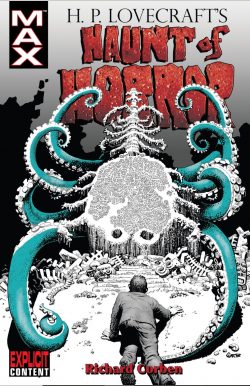
Haunt of Horror: Lovecraft


By H.P. Lovecraft adapted by Richard Corben with Jeff Eckleberry (MARVEL MAX)
ISBN: 978-0-7851-3287-5 (HB/Digital edition)

Richard Corben was one of America’s greatest proponents of graphic narrative: an animator, illustrator, publisher and cartoonist, who sprang from the tumultuous wave of independent counterculture commix of the 1960s and 1970s to become a major force in graphic narrative storytelling with his own unmistakable style and vision.

He is equally renowned for his mastery of airbrush, captivatingly excessive anatomical stylisation and delightfully wicked, darkly comedic horror, fantasy and science fiction tales. In later years he has become an elder statesman of horror and fantasy comics lending his gifts and cachet to such icons as John Constantine, Hulk, Hellboy, Punisher and Ghost Rider as well as new adaptations and renditions of literary classics by the likes of William Hope Hodgson, and the master of gothic terror Edgar Allan Poe.

Corben never sold out and American publishing eventually caught up, finally growing mature enough to accommodate him – due in no small part to his own broad and wickedly pervasive influence…

Born in Anderson, Missouri in 1940, Corben graduated with a Fine Arts degree in 1965 and found work as an animator. At that time, the neutered comic books of the Comics Code Authority era were just starting to lose disaffected, malcontent older fans to the hippy-trippy, freewheeling, anything-goes publications of independent-minded creators across the continent. These folks were increasingly making the kind of material Preachers and Mummy and their Lawyers wouldn’t approve of…

Creativity honed by the resplendent and explicitly mature 1950s EC Comics, Carl Barks’ perfectly crafted Duck tales and other classy early strips, a plethora of young artists like Corben responded with numerous small-press publications – including Grim Wit, Skull, Slow Death, Fever Dreams and his own Fantagor – which featured shocking, rebellious, sexed-up, raw, brutal, psychedelically-inspired cartoons and strips blending the new wave of artists’ unconventional lifestyles with their earliest childhood influences… honestly crafting the kind of stories they would like to read.

Corben inevitably graduated to more professional – and paying – venues. As his style and skills developed, he worked for Warren Publishing in Eerie, Creepy, Vampirella, Comix International and outrageous adult science fiction anthology 1984/1994. He also famously coloured some strips for the revival of Will Eisner’s The Spirit.

Soon after, he was producing stunning graphic escapades for a number of companies, making animated movies, painting film posters and producing record covers such as multi-million-selling album Bat Out of Hell. He never stopped creating comics but preferred personal independent projects or working with in-tune collaborators such as Bruce Jones, Jan Strnad and Harlan Ellison.

In 1975, Corben approached French fantasy phenomenon Métal Hurlant and quickly became a fixture of its American iteration Heavy Metal, cementing his international reputation in the process. Garnering huge support and acclaim in Europe, he was been regularly collected in luxurious albums even as he seemingly fell out of favour – and print – in his own country. Through it all he never strayed far from his moss-covered roots.

Corben died in 2020.

This particular tome gathers a 2007 return to adaptations of classic literary horror canon. First published as a 3-issue limited series, it features adaptations of poems and stories by an undisputed master of supernal terror: H.P. Lovecraft. The tales are radical reworkings of the troubled author’s works, rendered in line and gray-tones, and each sequential narrative reinterpretation is accompanied by its original prose iteration.

Howard Phillips Lovecraft was born in August 1890 in Providence, Rhode Island and his life in New England was one of gradual loss and despair. His father was institutionalised when he young, and a comfortable life of wealth ended when his grandfather died. Enduring privation, he lost his mother to another asylum in 1919. He married in 1924 after moving to New York, where his writing for Weird Tales and other pulp fiction magazines drew acclaim – and even acolytes – but little by way of commercial security.

He returned to New England in 1926 and wrote ever more fevered and chilling tales of weird science, fantasy and horror fiction. In the next 11 years he penned some of the most disturbing stories in literature, centred around his belief in Civilizational decline and Cosmicism: affirming the insignificance of humanity and its ultimate fragility and inability to endure in a harsh, unforgiving universe.

He is best remembered today for his Cthulhu Mythos: an elder god cosmology as seen in The Call of Cthulhu and other stories.

Lovecraft died in 1937 as a result of stomach cancer.

This selection of speculative meanderings opens with ‘Dagon’, as an ailing and oppressed marine researcher records how a close call with a German U-boat catapulted him onto a lost isle of monsters and ancient artefacts, and forever marked him as prey for an indescribable horror. The original prose vignette follows, after which ‘The Scar’ tells of betrayal and abandonment as a young man opts to save himself but not his companion from hellish plants: – a grisly episode eerily expanded upon from the poem ‘Recognition’ as collected in the tome Fungi from Yuggoth.

From the same book comes both the poem ‘A Memory’ and chilling icy exploration as Jack searches the desolate region that claimed his father and finds a relic that that dooms him via fatal family connection to lost and malign cultists of Shub Niggurath

The second issue began with ‘The Music of Erich Zann’, as an impoverished student recalls how long ago he lived in a hilltop hovel where an elderly fellow boarder played bizarre melodies that shook the world and summoned arcane atrocities before – again bordered by a text version – another extract from Fungi from Yuggoth finds a flood survivor desperately searching for her lost love in the body-packed detritus of ‘The Canal’

Sticking with the bulletins from Yuggoth, ‘The Lamp’ focuses on an unexpected and angry archaeological breakthrough that is alive and hungry after four millennia, before the final issue opens with extended scary satire ‘Arthur Jermyn’ and thereafter its primary text ‘Facts Concerning the Late Arthur Jermyn and His Family’. In a wry change of pace, it traces – via his proud descendants -the history and heritage of a gentleman explorer and anthropologist who in 1750 discovered a lost kingdom and injected some new blood into an old, old race.

Of course the miscegenation has resulted in some few throwbacks and anomalies in the hallowed English lineage since then…

Another ravening predator inhabits ‘The Well’ foolishly dug by southern farmer Seth Atwood, one using love and thirst to draw in victims, and our last glimpse of the outer dark comes through ‘The Window’ of a desolate old house as an orphan son returns to discover what took his parents 25 years ago…

A potent and evocative peep into the nastiest places in creation, this collection also includes ‘Cover Sketches’ and ‘Promotional Images’, plus a selection of inked pages prior to the application of the cloaking grey tones.

Infamous for his dark, doom-laden horror stories, Lovecraft was a pioneer of the subgenre of supernal, inescapable terror and under Corben’s imaginative scrutiny, the grim gloomy odes and yarns take on a whole new level of distressing dissonance. This compelling collection of classic chillers is a modern masterpiece of arcane abomination and inhuman horror no shock addict of mystery lover will want to miss.
© 2020 MARVEL.

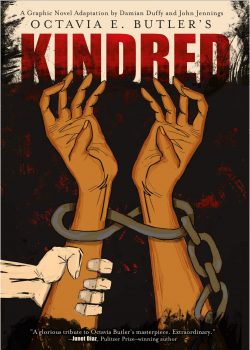
Kindred – A Graphic Novel Adaptation


By Octavia E. Butler, adapted by Damian Duffy & John Jennings (Abrams ComicArts)
ISBN: 978-14197-0947-0 (TPB/Digital)

This month we’re (rather crazily!) focussing on material pertinent to Black History Month and simultaneously indulging ourselves in the regular Halloween fright-fest. Maybe one year minorities and women will get a whole month to themselves or perhaps the powers that decree these arbitrary festivals might even acknowledge that these subjects are acceptable everyday fare…

However, here and now let’s consider a very different kind of scary story that qualifies on either and both counts..

Octavia Estelle Butler (1947-2006) overcame the stacked handicaps of being female, shy, dyslexic, depressive, fatherless, poor and black in post-war America to become a shining light of the socially-aware science fiction scene that grew out of the works of Philip K Dick, Harlan Ellison, Theodore Sturgeon, Samuel R. Delaney, Zenna Henderson, John Brunner and others.

Reared in ethnically diverse but still segregated Pasadena, California, she studied hard, followed her passions, took every opportunity available to studious young women of colour and became one of the most innovative and lauded science fiction authors of her generation. Butler went to community college just as the Black Power Movement took off and – attending writers workshops – realised that her own experiences could and should inform her writing.

In series like her Parable books, Patternist and Xenogenesis sequences, stand-alone novels and dozens of award-winning short stories, she explored how societies and splinter groups acted, addressing themes of alienation, exclusion, social and biological evolution, control through belief systems, mutual coexistence of species, genetic manipulation, parapsychic abilities and biological adjustment. These subjects were screened through a lens of co-dependent cultures of dominance and submission, and framed in terms of “racism, sexism, ethnocentrism, classism, and all the other ‘isms’ that cause so much suffering in the world.”

Elements of loss, contamination, interbreeding, miscegenation, mutation, symbiosis, surrender of autonomy and especially fear continually resurface as scenes of coercion, rape and violence: exploring how and why the weak are ruled by the strong and suggesting such actions are a kind of evolutionary parasitism which might be corrected by sociobiological interventions…

Her works are often associated with the vibrant subgenre of Afrofuturism – as so ideally depicted in Ta-Nehisi Coates’ Black Panther stories – but Butler’s stories are rife with disenfranchised outsiders or lowly minority characters who are putatively weak: born compromised, enduring and tolerating appalling changes of state and status simply to survive.

Such is certainly the case with the protagonist of Kindred. Adapted here by Damien Duffy and illustrated by John Jennings, the 1979 novel was a stand-alone time-travel tale written by Butler in response to a colleague’s questions about why antebellum slaves tolerated captivity and treatment. Her response was this story, offering brutal, inescapable context justifying  how those accepting years of “willing” subservience might have worked…

It’s still in preproduction-limbo for a TV series , but until then you can hunt it out in two kinds of print – prose and pictorial…

The graphic odyssey is preceded by a heartfelt Introduction by Nnedi Okorafor’ before the shocking drama opens with a ‘Prologue’ as African American Dana contemplates the limb she no longer has…

A mystery starts to unravel on June 9th 1976, as she and her white husband Kevin Franklin celebrate her 26th birthday by unpacking the boxes that brought all their worldly goods into their new home. They’re both writers and have lots to stuff into this house, but dreamy domesticity ends abruptly as she’s seized by an uncanny force and vanishes. She reappears by ‘The River’ just in time to save a little a white boy named Rufus from drowning…

Dana is then attacked and beaten by his mother and shot at by his father before warping back to Kevin and home. Her soaked, dishevelled condition categorically proves that what she experienced was no delusion: an inexplicable event that has shattered her joy and composure. Dana no longer feels safe or secure: here or anywhere…

The dreaded incident reoccurs mere hours later with Dana manifesting in Rufus’ bedroom just as he’s sparking ‘The Fire’ that would have destroyed the vast plantation house he lives in. The boy is at least four years older and deeply disturbed, but Dana patiently establishes a working relationship with him, based on a shared fear of his parents. With open mind and terrified conviction, Dana has concluded that she is somehow being pulled through time to a place where her kind are objects bought and sold, a fact Rufus confirms when he reveals the year is 1815…

Further cautious conversation draws from the boy his surname – Weylin – and the plantation’s location in Maryland. With horror, Dana recalls snippets of her own family history and realizes this half-crazed, privileged, firebug – WHITE – brat is her direct ancestor…

Despite her bizarre clothes, hair, manners and spurious claims to be a freed woman, Dana tries to flee the manorial house but is caught up in a slave-taker’s punishment raid. After torturing runaways, they then turn on her and a callous beating edges into a sexual assault that only a sudden switch back to 20th century California prevents from becoming her last moment.

Grievously battered, she refuses to let Kevin call an ambulance. By his reckoning, she’s only been gone for three minutes, but cannot bear the thought of vanishing again from a hospital…

Anticipating another vanishing, they assemble a “go-bag” of 20th century medicines and tools for her next abduction and Kevin bones up on black history from their reference library. Here and now, knowledge is power…

Fondly recalling how they first got together, Dana is unprepared for the next summoning, but when the force grips her now, Kevin reacts rapidly. Grabbing her, he goes with her and sees for himself the living past. Rufus is visibly older and has just broken his leg in ‘The Fall’

Reacting with fury to the news that these adults are married – scandalously illegal miscegenation! – Rufus is taken into their confidence as they conclusively prove they come from the future.

Forced to be Dana’s “owner” whilst a guest in the Weylin household, Kevin spends too much time apart from his wife whilst she is assigned to the plantation staff. After savagely beating her for teaching blacks to write, her shameful ability to read is secretly exploited by Rufus’ parents, who remain unaware that the strange slave is making many friends and useful connections amongst the lower orders. However, when the future calls her again, Kevin is nowhere to be found and left behind…

And so the story unfolds, with years passing as eyeblink instalments with Dana gradually building a seditious second life among slaves she secretly seeks to radicalise and protect, under the aegis of her family recollections.  She searches in vain for her missing husband and contrives a disturbing, discordant and deeply unhealthy relationship with the cruelly manipulative – adult – ancestor/owner Rufus in ‘The Fight’, before the time-lost lovers are finally reunited in ‘The Storm’.  And at last an ending arrives after Dana’s lowest moments in ‘The Rope’

The scattered threads of family are then drawn together in an ‘Epilogue’ that trusts but cannot prove that the mystery is done and the travelling finished…

A chilling, complex and extremely challenging reappraisal of many kinds of status quo, Kindred is more topical and germane than ever, examining social, racial and gender roles in a culture that has never been less stable or secure. Delivered with the full, uncompromising force of graphic narrative and in the charged, unrestrained terms and language of the 19th century via 1970s liberal outrage, this is a rewarding, informative yet potentially shocking narrative demanding your full attention and a tacit acceptance that history must not be shaded or censored. If unsanitised violence, non-voyeuristic nudity and harsh language are more distressing to you than learning uncomfortable truths, you might be better served by today’s other review…

Adding value here, this adaptation (which was followed by the team’s treatment of Butler’s Parable of the Sower and the still-forthcoming Parable of the Talents) includes biographies ‘About Octavia E. Butler’ and ‘About the adaptor and artist’ plus ‘Acknowledgements’ and material recommended ‘For Further Reading’

Kindred is powerful and upsetting, just like it was always meant to be, and is a story you should know in all its forms. There’s no time like the present…

Kindred © The Estate of Octavia E. Butler. Adaptation © 2017 Damian Duffy and John Jennings. Introduction © 2017 Nnedi Okarador. Based on the novel Kindred by Octavia E.
Butler © 1979. All rights reserved.

The House on the Borderland


By Simon Revelstroke, Richard Corben & various (Vertigo)
ISBN: 978-1-56389-545-6 (HB) 978-1-56389-860-8 (TPB)

So, what’s better, the book or the movie?

This is a highly charged question with only one answer: “It depends”.

Adapting works from one medium to another is always contentious, and often ill-advised – but the only fair response has to be both highly personal and broadly irrelevant. Just because I don’t like any X-Men films doesn’t make them bad, just as my deep love and admiration for the works of Oliver Postgate & Peter Firmin doesn’t make me six years old (no matter how much I’d like it to be true!).

The real issue is whether an adaptation treats the original fairly or callously exploits it – and make no mistake: 99.5 % of all reworkings are done with money in mind. Half of that other percent point is a genuine desire to proselytise: a mission to “bring the original to the masses” whilst the fractional remainder is an artist’s desire to interpret something that moved them in their own arena of expertise: for years I yearned to adapt Hodgson’s Carnacki the Ghost-Breaker/Ghost-Finder short stories into graphic novel format. I’m not dead yet and there might still be time unless someone more talented gets there first…

The author of those tales, as well as the source material for this excellent graphic novel from underground comix legends Simon Revelstroke & Richard Corben, is the brilliant William Hope Hodgson. Son of a poor parson, he was born in 1877, and took to sea at 14. In 1899 to make a living he turned to photography and writing. He was an early devote of physical culture (a bodybuilder) and patriot. Aged 40, he died in the Fourth Battle Ypres, sometime between the 17th and 19th of April 1918. Literature is the poorer for his premature departure.

Hodgson’s stories are dark and moody explorations of terrors internal and ghastly, against a backdrop of eternal, malignant forces beyond human comprehension ever waiting to take the incautious, unwary or overly-inquisitive. As Alan Moore describes in his Introduction here, Hodgson was the point-man for a new kind of story.

The gothic ghost-story writers and high fantasists of Victorian publishing gave way as the century turned to such cosmic horrorists as HP Lovecraft, Robert Bloch and Clive Barker, but with such epics as The Night Land and The House on the Borderland, Hodgson lit the way. His too-brief catalogue of works stands as a beacon of pervasive unease and outright terror and why he’s not a household name I simply can’t fathom. His career was cut tragically short in the trenches, but unlike so many of them he faded into relative obscurity and never bloomed into posthumous posterity…

Rather than religiously translate his masterpiece, Revelstroke & Corben truncated and marginally updated the novel, concentrating on what can actually be visualised – so much of Hodgson’s power comes from the ability to stir the subconscious brain – and in fairness, could be called a companion rather than adaptation of the original text.

October, 1952 in the rural hamlet of Kraighten in the Republic of Ireland. Two English students on a walking tour accidentally provoke the locals and must flee for their lives. They are chased to a ramshackle, desolate ruin on the edge of a crumbling abyss, a misty ravine which harks back to a long-forgotten time.

In the bracken they find an old journal. Scared and still hiding, they begin to read the words of Byron Gault, who in 1816 moved himself, his sister Mary and his faithful hound into the infamous but irresistibly inexpensive old house. Of horrors both physical and otherwise that attacked them and the incredible, infinity-spanning journey that resulted…

How this tale proceeds is a treat I’ll save for your own consumption. This adaptation was nominated for Best Graphic Novel of the Year by the International Horror Guild in 2003. It is not, Can Not be the original book. So get both if you can, read both and revel in what makes each unique to their own form, rather than where they can conveniently overlap and coincide.
© 2000 Simon Revelstroke and Richard Corben. All Rights Reserved.

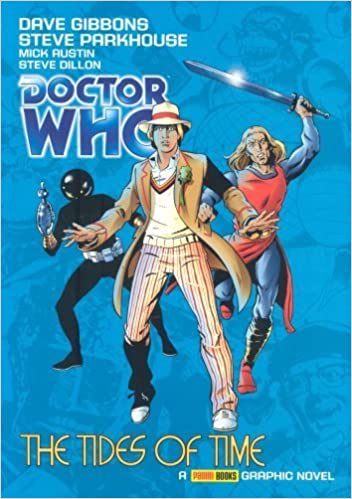
Doctor Who Graphic Novel volume 3: The Tides of Time


By Steve Parkhouse, Dave Gibbons, Dez Skinn, Paul Neary, Mick Austin, Steve Dillon & various (Panini Books)
ISBN: 978-1-904159-92-6 (Album TPB)

The British love comic strips and they love celebrity and they love “Characters.” The history of our homegrown graphic narrative has a peculiarly disproportionate number of comedians (stage, screen and radio), Variety stars, general celluloid icons and all manner of television actors both in and out of character. This includes such disparate legends as Charlie Chaplin, Arthur Askey, Flanagan & Allen, Shirley Eaton (“The Modern Miss”), Max Bygraves, Jimmy Edwards, Charlie Drake, and so many more; all dead and mostly forgotten.

As much adored and adapted were actual shows and properties like Whacko!, ITMA, Our Gang (a British version of Hal Roach’s film sensation by Dudley Watkins ran in The Dandy as well as the American comicbook series by Walt Kelly), Old Mother Riley, Andy Pandy Muffin the Mule, Supercar, Thunderbirds, Pinky and Perky, The Clangers and more.

Hugely popular anthology comics like Radio Fun, Film Fun, TV Fun, TV Tornado, Look-In, TV Comic and Countdown translated our viewing and listening favourites into pictorial joy every week, and it was a pretty poor star or show that couldn’t parley the day job into a licensed comic property…

Doctor Who premiered on black-&-white televisions across Britain on November 23rd 1963 with the first episode of ‘An Unearthly Child’ and in 1964 a decades-long association with TV Comic began: issue #674 offered the premier instalment of ‘The Klepton Parasites’

On 11th October 1979 (although adhering to the US off-sale cover-dating system so it says 17th), Marvel’s UK subsidiary launched Doctor Who Weekly. It regenerated into a monthly magazine in September 1980 (#44) and has been with us – under various names and guises – ever since. proving that the Time Lord is a comic hero with an impressive pedigree.

Panini’s UK division (formerly Marvel UK until 1995) endeavoured to collect every strip from its tenure as publisher into a compete archive in a uniform series of oversized graphic albums, each concentrating on a particular incarnation of the deathless wanderer. This particular tome was first released in 2005, collecting strips from Doctor Who Monthly #61-83 and #86-87 plus a bonus story from Doctor Who Weekly #17-18 spanning February 1982 to April 1984 and featuring the complete comics oeuvre of the “Fifth Doctor” as played by Peter Davidson.

With Steve Parkhouse scripting and increasingly in-demand Dave Gibbons still illustrating – albeit not for much longer as America called and global stardom beckoned – ‘The Tides of Time’ opens proceedings with a spectacular epic pulling together threads from previous strip exploits, as multiversal control mechanism The Event Synthesizer is compromised and its attendant guardian The Prime Mover assaulted and ousted by demonic intruder Melanicus.

Built to harmonise the flow of time into a single logical sequence, under the demon’s control the device begins randomising time and wrecking reality…

Meanwhile on Earth in the putative Now, a certain wandering Gallifreyan steps out to bat on a warm afternoon in a village cricket match.

Play suddenly stops when the ball turns into a live grenade halfway to the wicket! Total chaos ensues and the Doctor investigates, incidentally befriending and dragging along displaced medieval knight Sir Justin when irresistibly summoned to a conclave of “higher evolutionaries”: advanced beings such as Gallifrey’s original Master of Time Rassilon, and other sublime and elevated members of the Celestial Intervention Agency who despatch him to deal with the salvo of time-warps Melanicus has unleashed to unmake existence.

Aided – at first unknowingly – by Rassilon’s secondary agent Shayde (a complex program given form to match his function), The Doctor and Justin travel beyond time and reality to encounter bizarre and fantastic things before finally ending the demon’s reign of chaos…

In the aftermath as existence resets itself The Doctor returns to his cricket match and a waiting game…

Doctor Who Monthly #68-69 featured Gibbons’ final work on the feature as seeming standalone tale ‘Stars Fell on Stockbridge’ laid the groundwork for the rest of this Gallifreyan incarnation’s tenure whilst introducing local UFO nut and fantasist skywatcher Maxwell Edison who stumbles across a true alien and shares his TARDIS on the voyage of a lifetime.

Sadly, it intersects with an incredible ancient starship and awakens something incomprehensible before breaking up and raining down as fireworks over the sleepy British town…

Parkhouse pencilled the opening episodes of ‘The Stockbridge Horror’ in #70-75 before his inker Paul Neary was joined by Mick Austin for a dazzling mystery that opened when the local quarry blasted open a sheet of rock five hundred million years old to find a perfect fossilised impression of an old police box…

News of it ruined The Doctor’s breakfast in Stockbridge and precipitated a chase across creation: uncovering the horrifying fact that his TARDIS was increasingly rebellious and dysfunctional due to having been possessed and parasitized. It took a voyage across, between and beyond universes and a total rebuild to fix the problem and demanded a supreme sacrifice from Shayde…

It also brought the wanderer to the attention of Gallifrey’s shamefully opportunistic Military and caused another show trial of the Time Lord before honour could be restored and the parasite – which had gone on to shape all human history – was dealt suitably with. All that was left was to institute a cover-up on Earth, but the Time Lords were to slow and not thorough enough and some details remained in the hands of the UK’s S.A.G.3 unit: a covert squad of super-powered intelligence operatives…

In dire need of a vacation, the Doctor goes fishing in the tropics, but his downtime at the ‘Lunar Lagoon’ in #76-77 (all art by Austin) is marred when he’s captured by a Japanese soldier who doesn’t realise the war has ended. As he gradually befriends confused hold-out Fuji, his gentle therapy is short-circuited by an America warplane strafing the TARDIS before being shot down by Japanese planes!

Due to the Gallifreyan’s misguided interference, confusion follows tragedy as the American flier kills Fuji leading into epic follow-up serial ‘4-Dimensional Vistas’ (DWM #78-83) as the pilot reveals that the date is 1963 and the war never ended. In shock, The Doctor realises he has been on an alternate Earth since the Time Lords released him and offers Angus “Gus” Goodman a chance to escape the conflict forever…

After travelling back to a point when the world was still roiling stardust, the Doctor finally finds “his” Earth, in time to finish the secret mission that first found him playing a waiting game in Stockbridge. In the Arctic, another airliner is brought down and its remnants added to a long-running secret project instigated by Martian Ice Warriors and a hidden ally. Using stolen Gallifreyan technology a traitor Time Lord has been creating an ultimate weapon for the military maniacs, but had not reckoned on a last-ditch assault by the super-agents of S.A.G.3, and more interference from old enemy The Doctor. Although ultimately successful, the brutal battle at the top of the world is only won at great cost…

An era ended and the tone lightened with ‘The Moderator’ in #86-87. Steve Dillon deftly added gritty action and sardonic mirth to the tale of an infallible hired killer commissioned to destroy The Doctor and secure his time vehicle for a new recurring villain…

Ultimate disaster capitalist Josiah W. Dogbolter was the richest man (humanoid frog actually) in creation and believed that Time was Money, further positing that if he had a machine to control time all the money would naturally follow. He was not happy when The Doctor couldn’t be bought…

This stunning, sterling trade paperback concludes with a short story by veteran British comics stalwart Paul Neary (from a plot by Dez Skinn) as an extragalactic chronovore invades the TARDIS, causing continuity to reverse itself and requiring the attention of all four Doctors (and K-9!) to counter the threat of ‘Timeslip’ (DWW #17-18: February 6th – 13th 1980).

Sheer effusive delight from start to finish, this is a splendid confection for casual readers, a fine shelf addition for dedicated fans of the show and a perfect opportunity to cross-promote our particular art-form to anyone minded to give comics another shot. The only thing that could improve it would be a digital edition…

All Doctor Who material © BBCtv. Doctor Who, the Tardis, Dalek word and device mark and all logos are trademarks of the British Broadcasting Corporation and are used under licence. Dalek device mark © BBC/Terry Nation 1963. All other material © its individual creators and owners. Published 2005 and 2014 by Panini. All rights reserved.

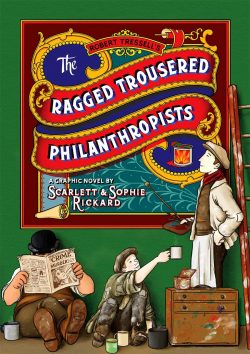
The Ragged Trousered Philanthropists


By Robert Tressell; adapted by Scarlett & Sophie Rickard (SelfMadeHero)
ISBN: 978-1-910593-92-9 (TPB/Digital edition)

Born in Dublin to unfavourable circumstances, Robert Croker – AKA Robert Noonan – (17 April 1870 – 3 February 1911) was a man of many parts. His short, globetrotting, eventful life ended with him a housepainter and signwriter (a skilled trade) dying of tuberculosis in The Liverpool Royal Infirmary in 1911.

In all likelihood nobody today would remember him if he hadn’t spent his off hours in the declining years of 1906 to 1910 writing a book. He failed to have it published in his lifetime, but his daughter Kathleen Noonan persevered and a first (heavily edited, highly abridged and politically redacted) version was released on April 23 1914 – four months before the Great War began. That clash resulted in a changed planet and the first socialist (sic) state…

The full manuscript didn’t reach the public until 1955. Even bowdlerized editions were potent enough to make it one of the most important books of the century. Released under the nom de plume Robert Tressell, the cultural satire and barely-disguised socialist polemic was The Ragged Trousered Philanthropists.

After reading the million plus-selling, never out-of-print pioneering prose opus of working class literature, you should research the times it was set in and read up on the author, if you want to see how a fascinating man responded to the injustice of his world. There’s a splendid Afterword by the creators in this hefty graphic novel to get you started…

A more jaded person might assume current businesses and governments have also studied the text, with a view to rolling back all the hard-won advances made since then, returning us to the days where workers toiled in a brutal gig economy without safety nets of social housing, medicine or pensions. Work or die was the way of world and it’s well on its way back…

The tale – masquerading, like a Thomas Hardy Wessex novel, as a peek at the lives of poor working folk – was a major influence on thinkers in the aftermath of WWI, and many of the civil rights and common benefits of civilisation that we’re gradually allowing to be taken from us were predicted in its more utopian moments…

Politics aside however, it’s also a sublime realisation and examination of the working classes in all their warty, noble, scurrilous, generous, mean-spirited, self-sacrificing, self-serving, gullible, aspirational, tractable, intractable, skiving, hard-working, honest and human glory: a state perfectly realized in this warm-hearted and supremely inviting comics adaptation by Sophie Rickard, illustrated with charm, simplicity and abiding empathy by Scarlett Rickard. You will also want to see Mann’s Best Friend and A Blow Borne Quietly and their eagerly-anticipated adaptation of suffragist Constance Maud‘s inspirational No Surrender…

The semi-autobiographical story detailed here closely follows a group of workers and their families over a year in the town of Mugsborough: proudly go-getting municipal powerhouse (closely based on Hastings, where Croker had worked) with the usual band of rich, mercantile bastards in charge and on the Council, feathering their own lavish nests with the approval and assistance of the local churches and clergy…

The 23 chapters span a year as seen through the eyes of skilled labourers at a time when jobs were scarce and cut-throat competition had the men who hire them fiercely undercutting each other to secure commissions. The artisans are currently refurbishing an ornate house on the cheap for a grasping boss, under the penny pinching eye of foreman Mr. ‘Unter.

In breaks and off moments the disparate crew – dispassionately at first – discuss the job, the way of the world and ever-present threat of work drying up again. Artisan painter/signwriter Frank Owen argues the greed and dishonesty of capitalism and enlightening sense of socialism to his highly resistant and openly hostile mates. Over many days, they all hotly debate ‘The Causes of Poverty’ and the Church’s complicity in maintaining an unfair status quo in ‘The Lord Our Shepherd’. Further discussion in ‘The Economists’ focuses on the impossibility of making do on ever-diminishing wages and ‘The Ever-Present Danger’ of being thrown away once a worker is no longer usable.

This is no pedant’s dry and dusty tirade. “Tressell’s” arguments are bolstered by the declining state of the wives, elders and children of the workers – most of whom still argue ferociously against improvement of their own conditions. As those above them reduce wages and increase hours, uncaring of the horrific repercussions of their parsimony, Frank and enigmatic associate George Barrington gradually convert many, but a resolute group cannot countenance any change to the old system.

That begins changing in ‘The Truth’, and revelation is heightened after the Church is exposed to ‘The Shining Light’, especially once Owen makes a breakthrough by explaining ‘The Money Trick’ underpinning Capitalism.

The damaging power of booze on the hopeless is witnessed after a night at ‘The Cricketers’, presaging work briefly pausing for ‘The Christmas Party’. A New Year exposes corporate skulduggery and public malfeasance by ‘The Council’ of Mugsborough…

Every opinion expounded by the painters can be seen here and now: echoed on modern TV vox-pop segments with today’s exploited, bread & circus sated citizens repeating that we should let the rich (our “betters”) do the hard job of making the big decisions for us, happily abrogating all responsibility for their own evermore parlous state…

Deepening personal crises auger greater tragedies as ‘The Beginning of The End’ finds a beloved friend condemned to the Workhouse as a cynically tongue-in-cheek glimpse at what the Establishment considers ‘The Solutions’ to poverty lead to a long look at ‘The Meetings’ inside the Municipal Council and how a glimmer of reform is crushed by the prestigious clique…

After a period of scarcity, fresh work at a lower wage comes in ‘The Summer’ before a turning point comes when Barrington challenges the Bosses on a rare day’s holiday jaunt in ‘The Beano’ (slang for “BNO” – Boys Night Out).

Again arguing – but with a much smaller and more vocal group of workmates – Owen and Barrington begin ‘The Great Oration’, overruling and disproving ‘The Objections’ of bellicose working class holdouts – the apologists and willing henchmen who happily betray their own sort for elevated status, extra pennies and the cheery disdain of the capitalists. However, grief has not ended and as talk of elections and the growth of a socialist Labour Party blooms, death comes again. Even here the rich and their lackeys find a way to make a profit in ‘The Rope’ and a sordid exhibition at ‘The Funeral’. After the worker’s death comes what we today call “the cover-up”…

Feelings of hope manifest in final chapters ‘The Will of the People’, ‘The Sundered’ and ‘The New Position’ as utopian ideals and practical solutions are leavened with home truths, and a concentration on making change happen…

Uplifting ending notwithstanding, The Ragged Trousered Philanthropists is a major milestone in the west’s path to becoming truly civilised, and this beautifully accessible iteration – deliciously illustrated in the manner of an inviting children’s picture book – could not be more timely, both as a reminder and warning from history. It’s also a wonderfully human drama gauging the limitations and frailties of the most exploited and vulnerable in society and “a book that everyone should read”.

I didn’t write that, George Orwell did, in 1946. Who could argue with that? Class is class no matter what you think…
© 2020 SelfMadeHero. Text © 2020 Sophie Rickard. Artwork © 2020 Scarlett Rickard. All rights reserved.

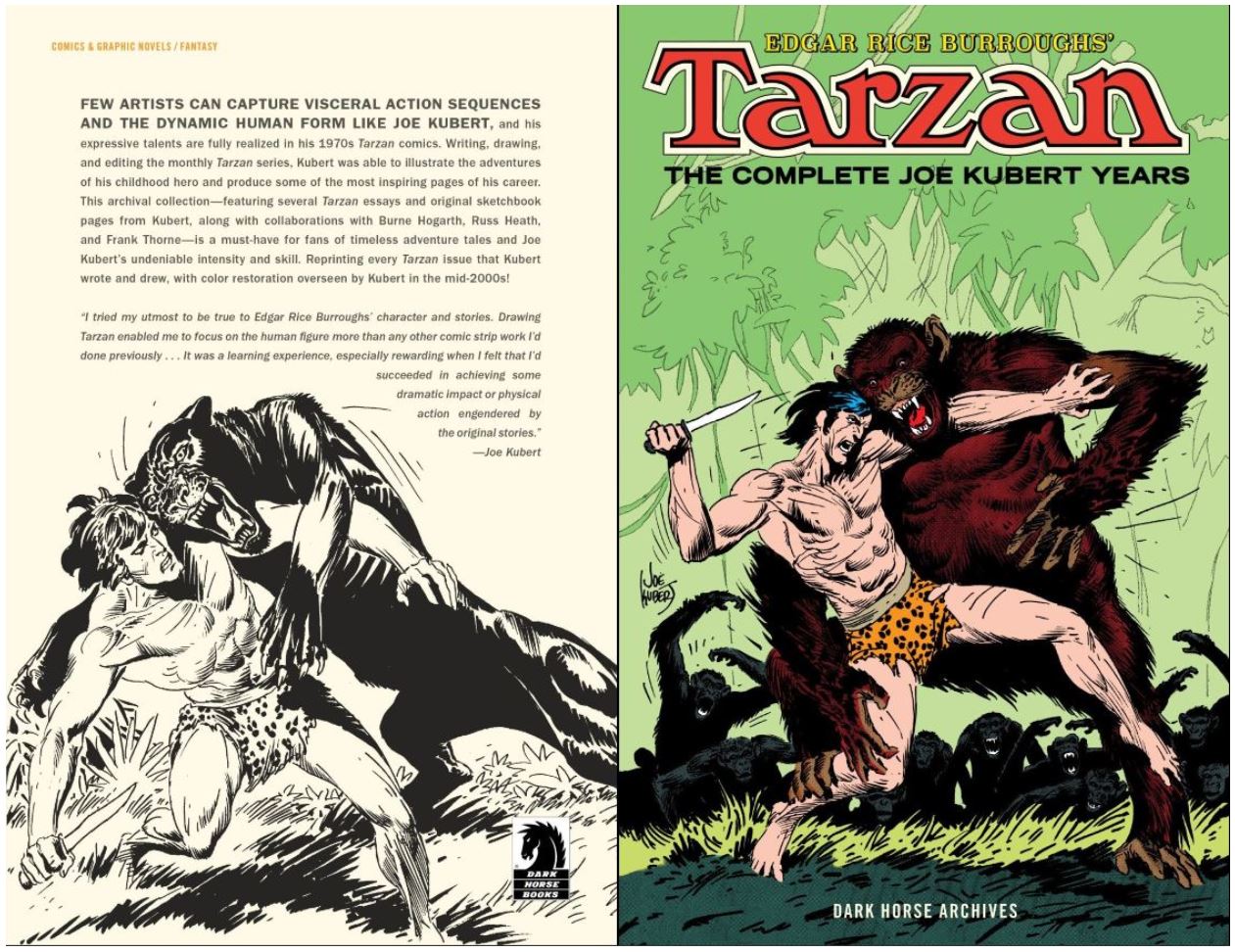
Edgar Rice Burroughs’ Tarzan: The Complete Joe Kubert Years


By Joe Kubert with Burne Hogarth, Hal Foster, Frank Thorne, Robert Kanigher, Russ Heath & various (Dark Horse)
ISBN: 978-1-61655-982-3 (TPB/digital editions)

For those that care, it’s a week until St. Valentine’s Day, and once more I’m foregoing gift recommendations in favour of comics-related pep talks. This year, you can see here how some relationships – albeit in cartoon form – have weathered the test of time. One of the longest drives a strip that – despite a shift in social sensibilities and general growth in consensus attitudes – still has lot to offer on many levels…

Soon after first publication in 1912, Tarzan of the Apes became a multi-media sensation and global brand. More novels and many, many movies followed: a comic strip arrived in 1929, followed by a radio show in 1932 with the Ape-Man inevitably carving out a solid slice of the comic book market too, once that industry was firmly established.

Rivalling and frequently surpassing DC and Marvel at the height of their powers, Western Publishing were a big publishing/print outfit based on America’s West Coast. They specialised in licensed properties and the jewels in their crown were comics starring the Walt Disney and Warner Brothers cartoon characters.

As publishers, they famously never capitulated to the wave of anti-comics hysteria that resulted in the crippling self-censorship of the 1950s. Dell Comics – and latter imprints Gold Key and Whitman – never displayed a Comics Code Authority symbol on their covers. They never needed to.

Dell also handled other properties like movie or newspaper strip franchises, and would become inextricably associated with TV adaptations once the small screen monopolised modern homes. In 1948, Dell produced the first all-new Tarzan comic book. The newspaper strip had previously provided plenty of material for expurgated reprint editions until Dell Four Color Comic #134 (February 1947).

That milestone featured a lengthy, captivating tale of the Ape-Man scripted by Robert P Thompson – who wrote both the radio show and aforementioned syndicated strip – with art by the legendary Jesse Marsh.

Marsh & Thompson’s Tarzan returned with two further tales in Dell Four Color Comic #161, cover-dated August 1947. This was a frankly remarkable feat: Four Colour was an umbrella title showcasing literally hundreds of different properties – often as many as ten separate issues per month – so such a rapid return meant pretty solid sales figures.

Within six months, the bimonthly Tarzan #1 was released (January/February 1948), beginning an unbroken run that only ended in 1977, albeit by a convoluted route…

After decades as solid Whitman staples, licensed Edgar Rice Burroughs properties transferred to DC – not just Tarzan and his extended family, but also fantasy pioneers John Carter of Mars, Carson of Venus, Pellucidar and others – with the new company continuing the original numbering.

Tarzan #207 had an April 1972 cover-date and the series carried on until #258 in February 1977. Thereafter, Marvel, Malibu and Dark Horse extended the Jungle Lord’s comic canon…

The early 1970s were the last real glory days of National/DC Comics. As they lost market share to Marvel, their response was controversial: delivered in the form of landmark superhero material eschewing fantasy and super-villains in favour of social commentary. However their greatest strength lay – as it always had – in the variety and quality of its genre divisions. War, Mystery & Supernatural, Romance, and Kids’ titles remained strong and the company’s eye for a strong brand was as keen as ever.

The Ape Man and his family were a Dell/Gold Key mainstay and global multi-media phenomenon, so when DC acquired rights they justifiably trumpeted it out, putting one of their top creators in sole charge of the legend’s monthly exploits, as well as generating a boutique bunch of ERB titles in a variety of formats.

DC’s incarnation premiered in a blaze of publicity at the height of a nostalgia boom and was generally well received by fans. For many of us, those years provided the definitive graphic Tarzan, thanks solely to the efforts of the Editor, publisher and illustrator who shepherded the Ape-man through the transition.

They were all the same guy: Joe Kubert.

Kubert was born in 1926 in rural Southeast Poland (which became Ukraine and might be Outer Russia by the time you read this). His parents took him to America when he was two. and he grew up in Brooklyn. According to his Introduction, his earliest memory of cartooning was Hal Foster’s Tarzan Sunday strips…

Joe’s folks encouraged him to draw and the precocious kid began a glittering career at the start of the Golden Age, before he was even a teenager. Working and learning at the Chesler comics packaging “Shop”, MLJ, Holyoke and assorted other outfits, he began his lifelong association with DC in 1943.

A canny survivor of the Great Depression, he also maintained outside contacts, dividing his time and energies between Fiction House, Avon, Harvey and All-American Comics, where he particularly distinguished himself on The Flash and Hawkman. In the early 1950s he and old school chum Norman Maurer were the creative force behind publishers St. Johns: creating evergreen caveman Tor and launching the 3D comics craze with Three Dimension Comics.

Joe never stopped freelancing: appearing in EC’s Two-Fisted Tales, Avon’s Strange Worlds, Lev Gleason Publications & Atlas Comics until 1955 when, with the industry imploding, he took a permanent position at DC, only slightly diluted whilst he illustrated the contentious and controversial newspaper strip Tales of the Green Berets (1965 to 1968). From then on, he split his time drawing Sgt. Rock and other features, designing covers and editing DC’s line of war comicbooks.

And then DC acquired Tarzan…

This monumental archive collects the entirety of his work with the Ape-Man: stories from Tarzan #207-235 (April/November 1972 to February/March 1975): a tour de force of passion transubstantiated into stunning comic art, with Kubert writing, illustrating and lettering.

Moreover, the vibrant colours in this epic re-presentation are based on Tatjana Wood’s original guides, offering readers a superbly authentic and immersive experience whether you’re coming fresh to the material or joyously revisiting a beloved lost time.

The only disconcerting things about this stellar compilation are the cover reproductions, which appear in all their iconic glory but manipulated to remove DC’s trademark logos. The mightiest force in the modern jungle is still Intellectual Property lawyers…

The tense suspense begins with Kubert’s Introduction to earlier collections before his adaptation of debut novel Tarzan of the Apes opens with a safari deep in the jungle. A pretty rich girl is driving her white guide and native bearers at a ferocious pace as she desperately hunts for her missing father.

When a bronzed god bursts into view battling a panther, she watches aghast as human impossibly triumphs over killer cat and then pounds his chest whilst emitting astounding screams. As the terrifying figure vanishes back into the green hell, the girl’s questions are grudgingly answered by the old hunter who relates a story he has heard…

‘Origin of Tarzan of the Apes’ reveals how, following a shipboard mutiny, John Clayton, Lord Greystoke – and his wife Lady Alice – are marooned on the African coast with all their possessions, including a vast library of books and Primers intended for their soon-to-be-born baby…

Against appalling odds, they persevered with Greystoke building a fortified cabin to shelter them from marauding beasts, particularly the curious and savage apes roaming the region. Despite the birth of a son, eventually the jungle won and the humans perished, but their son was saved by a grieving she-ape who adopted the baby to replace her own recently killed “Balu”…

The ugly, hairless boy thrived under Kala’s doting attentions, growing strong but increasingly aware of intrinsic differences. He only discovered the how and why after years of diligent effort: through sheer intellectual effort and the remnants of his father’s books and papers, Tarzan learned to read and thereby deduced that he was a M-A-N…

The tale within a tale continues in ‘A Son’s Vengeance: Origin of the Ape-Man Book 2’ as the boy rises to prominence amongst his hirsute brethren and through imagination and invention masters all the beasts of his savage environment. Eventually, brutal, nomadic natives settle in the area and Tarzan has his first contact with creatures he correctly identifies as being M-E-N like him…

The new situation leads to the greatest tragedy of his life as a hunter of M’Bonga‘s tribe kills beloved, devoted Kala and Tarzan learns the shock of loss and overpowering hunger for revenge…

Issue #209 revealed how civilisation finally caught up with Tarzan as ‘A Mate For the Ape-Man: Origin of the Ape-Man Book 3’ saw him meet and save American Jane Porter, her elderly father and his own cousin…

Just as had happened years earlier, these unlucky voyagers were marooned by mutineers. Discovering John Clayton’s cabin, the castaways find the lost peer’s diary, which is of especial interest to William Clayton, the current Lord Greystoke. As tensions rise and humans die, Tarzan takes his golden-haired mate deep into the impenetrable verdure…

It all concludes neatly and tantalisingly in ‘Civilisation: Origin of the Ape-Man Book 4’ wherein the innately noble Tarzan returns Jane to her fiancé William, just in time for the westerners to be rescued by Naval Officer Paul D’Arnot.

When the dashing French Lieutenant is captured and tortured by M’Bonga’s warriors, Tarzan rescues and nurses him back to health. In return, the grateful sailor teaches him to speak human languages that up until that moment he could only read and write in. By then, however, the navy vessel and saved souls have all sailed away, each carrying their own secrets with them…

With no other options, lovelorn Tarzan accompanies D’Arnot back to civilisation. The eternal comrades eventually settle in Paris with Tarzan practically indistinguishable from other men…

Even today ‘Origin of the Ape-Man’ is still the most faithful adaptation of ERB’s novel in any medium: potent and evocative, fiercely expressive: a loving, utterly visceral translation of the landmark saga.

Kubert’s intent was to adapt all 24 Burroughs novels and intersperse them with short, complete tales, but the workload, coupled with his other editorial duties, was crippling. To buy some time #211 combined old with new as ‘Land of the Giants’ partially adapted and incorporated Don Garden & Burne Hogarth’s newspaper classic ‘Tarzan and the Fatal Mountain’: Sunday strip pages #582-595 which had originally ran from May 3rd to August 2nd 1942.

A clash with crocodiles lands Tarzan in a lost valley where giant natives are persecuted by deformed, diminutive outworlder Martius Kalban: a sadist hungry for the secrets of their prodigious size and strength. Even after gaining his dark desire, Kalban finds himself no match for the outraged Ape-Man…

It’s followed by ‘The Captive!’: a latter-day exploit beginning a run of yarns based on the short stories comprising ERB’s book Jungle Tales of Tarzan as the relationship between Ape-Man and elephants is explored with each saving the other from the ever-present threat of the hunters of M’Bonga…

The Jungle Tales reworkings continue with ‘Balu of the Great Apes’ with childhood friends of Tarzan becoming incomprehensibly aggressive after the birth of their first baby, before ending with ‘The Nightmare’ as starving Tarzan steals and gorges on meat and drink from the native village. The resultant food poisoning takes him on a hallucinogenic journey never to be forgotten: one that almost costs his life when he can no longer tell phantasm from genuine threat…

Following Kubert’s Introduction to Tarzan #215-#224, the pictorial wonderment resumes with another vintage visual treat as ‘The Mine!’ (Tarzan #215, December 1972) incorporates material originally seen in 1930s Sunday newspaper strips (by Foster & George Carlin) embedded in an original tale by Kubert.

As before, deadline pressure again compelled Kubert to combine original with found material, detailing how Tarzan is captured by slavers and pressed into toil deep in the bowels of the earth for a sadistic mine owner. Naturally, he soon chafes at enforced servitude and leads a savage workers’ revolt to overturn and end the corporate bondage…

Issue #216 took another route to beating deadlines with old pal Frank Thorne pencilling Kubert’s script for ‘The Renegades’: leaving hard-pressed Joe to ink and complete the story of a murderous raid which wipes out a Red Cross mission.

Investigating the atrocity, Tarzan discovers the “maddened savages” responsible are actually white men in disguise; stealing supplies for a proposed expedition to plunder a lost treasure vault. When he catches the culprits, Tarzan’s vengeance is terrible indeed…

‘The Black Queen!’ was all-new, all-Kubert, as the Jungle Lord almost saves a man from crocodiles. Acceding to the ravaged victim’s last wish, Tarzan then travels to his distant country and overturns the brutal regime of tyrannical Queen Kyra – who rules her multicultural kingdom with whimsy, ingrained prejudice and casual cruelty…

The equally selfish choices of American millionaire tycoon Darryl T. Hanson blight his family as his search for ‘The Trophy’ decimates the fauna of Tarzan’s home and leads to a clash of wills and ideologies which can only end in tragedy…

With #219, Kubert began an epic 5-issue adaptation of ERB’s sequel novel The Return of Tarzan. It opens in Paris as the unacknowledged son of long-vanished Lord Greystoke tries to adapt to his new life as a civilised man of leisure.

One night, his natural gallantry draws him to the side of a woman screaming for help and he is attacked by a gang of thugs. After easily thrashing the brigands he is astounded to find her accusing him of assault and simply bounds effortlessly away from the gendarmes called to the disturbance. The entire trap had been engineered by a new enemy; Russian spy and émigré Nikolas Rokoff beside his duplicitous toady Paulvitch…

The rightful heir to the Greystoke lands and titles silently stood aside and let his apparently unaware cousin William Cecil Clayton claim both them and the American Jane Porter after the wild one rescued her from attacking apes in the jungle. Missing her terribly, Tarzan has chosen to make his own way in the human world beside French Naval Officer D’Arnot. In the course of his urbane progression, Tarzan had exposed the Russian cheating at cards to blackmail French diplomat Count De Coude and earned himself a relentless, implacable foe, forever.

When Rokoff subsequently tries to murder Tarzan, the vile miscreant agonisingly learns how powerful his jungle-bred enemy is…

With physical force clearly of no use, Rokoff’s latest plan is to put the Ape-Man through a ‘Trial by Treachery’: manufacturing “evidence” that Tarzan is having an affair with the Comte’s wife. Once again, the civilised beast underestimates his target’s forthright manner of handling problems and is savagely beaten until he admits to the plot and clears the innocent woman’s name…

With news of Jane’s impending marriage to Clayton, Tarzan seeks to ease his tortured mind with action, and the next chapter sees him in Algeria where, sponsored by the grateful, ashamed Count, he works for the French Secret Service in Sidi Bel Abbes, ferreting out a traitor in the turbulently volatile colony. His hunt leads to a likely turncoat and subsequent brutal battle with Arab agent provocateurs, but things start to turn his way after he liberates a dancing slave who is the daughter of a local sheik.

When word of Jane comes from D’Arnot, Tarzan throws himself even more deeply into his tasks and falls into another ambush organised by Rokoff. This time his ‘Fury in the Desert’ seems insufficient to his needs …until his newfound friend the Sheik rides to the rescue…

The intrigue further unfolds in ‘Return of the Primitive’ as Tarzan finally uncovers a link between Rokoff and spies at Sidi Bel Abbes. Mission accomplished, he is then posted to Capetown and aboard ship meets voyager Hazel Strong, a close friend of Jane’s who reveals the heiress had never forgotten her tryst with an Ape-Man.

Unable to watch Jane enter into a loveless marriage, Hazel took off on an ocean cruise…

The story rocks Tarzan’s mind, but not so completely that he fails to notice Rokoff is also aboard and murderously dogging his footsteps. This time, the Tsarist is properly prepared and that night the jungle man vanishes from the ship…

Rokoff’s act of assassination is a purely pyrrhic victory. Soon after reaching Capetown the villain insinuates himself into the Clayton wedding party but when their yacht’s boilers explode next morning, he, Hazel, Clayton, Jane and her father are left adrift in a lifeboat…

Tarzan, meanwhile, has survived being tumbled overboard and spent days swimming hundreds of miles. He now washes up on the same beach his parents were left upon decades ago. Staggering inland, he finds himself in the cabin his father built before being stolen and adopted by Kala the She-Ape.

John Clayton is forgotten, for fate has brought Tarzan home…

A man changed by his time amongst other men, the Jungle Lord instinctively saves a native warrior from certain death and is astonished to find himself declared chieftain of the Waziri nation.

…And off the coast, a lifeboat filled with dying travellers espies land and wearily sculls towards a welcoming beach in the heart of primeval forests…

Revelling in his newfound status, popularity and freedom, Tarzan enquires about the fabulous jewelled ornaments of his new friends and learns of an incredible lost metropolis. Soon he is curiously journeying to ‘The City of Gold’ to encounter debased, degenerate sub-men led by a gloriously beautiful Queen.

La is high priestess of lost Atlantean outpost Opar, but can barely control her subjects enough to allow the perfect specimen of manhood to escape to safety. Both she and Tarzan know they are destined to meet again…

Refusing to be cheated of their sacrifice, the bloodthirsty Oparian males search far into the jungle and soon encounter the Clayton yacht survivors. When the primitives attack the human strangers and carry off Jane, Rokoff shows his true colours, leaving William to his fate. This callous act also inadvertently clears the path for Tarzan to finally claim his inheritance and reunite with Jane. All the Jungle Lord has to do is break back into Opar, save his one true love from ‘The Pit of Doom!’ and escape the wrath of spurned Queen La…

That mission accomplished, he and Jane return to the beach in time to witness William’s dying confession and accept the succession to the estates and title of Lord Greystoke…

The adaptation is followed by an original adventure codicil, seeing Tarzan rescue a beautiful maiden from attacking apes to find she comes from La, now in peril of her life…

In Opar, another Beast Man insurrection has left the Queen imperilled by her subjects and threatened by a gigantic mutant whom she tearfully reveals is her sibling in ‘Death is My Brother!’ With no choice, Tarzan regretfully battles the nigh-mindless brute and proves to the insurgents that his wrath is greater than their malice…

A third and final Kubert text missive of fond reminiscences about Tarzan #225-235 leads into original tale ‘Moon Beast’ which sees a mother and child brutally slaughtered and Tarzan captured: framed for the hideous crime by cunning medicine man Zohar. When the vile trickster overreaches himself, the captive lord breaks free but still has to deal with the mutant brute Zohar employed to perpetrate the atrocity…

Kubert only produced the cover for #226, as deadline pressures finally caught up with him. The contents – not included here – featured a retelling of the Ape-Man’s origins by Russ Manning, taken from the Sunday newspaper strips of 15thNovember 1970-7th February 1971.

Back for #227, Joe took Tarzan out of his comfort zone as ‘Ice Jungle’ saw young warrior Tulum endure a manhood rite at the top of a mountain. Also converging on the site for much the same reason is American trust-fund brat J. Pellington Stone III: determined to impress his father by bagging a legendary snow ape. Sensing impending doom, Tarzan follows them both and is proved correct in his assessment…

After single-handedly killing an immense Sabretooth tiger in an unexplored region of the continent, Tarzan is captured by pygmies intent on offering him as sacrifice to a mighty monster that has terrorised them for years. However, a ‘Trial By Blood!’ sees the Ape-Man cleverly outwit a giant lizard and teach tribal elders a valuable lesson in leadership, after which albino queen Zorina seeks to extend her power by making him her consort.

The mighty wanderer wants nothing to do with ‘The Game!’, and, after the kingdom descends into savage civil war, sees ironic Fate deal the white queen a telling death blow…

With Tarzan #230 (April/May 1974), the title transformed into a sequence of 100-page giants, mixing new material with reprints of ERB characters and thematically-aligned stars from DC’s vast back-catalogue.

Leading off that issue was a brief all-Kubert vignette as ‘Tarzan’ saves a deer from a lioness. It neatly segues into ‘Leap into Death’ starring Korak, Son of Tarzan (written by Robert Kanigher, with Kubert pencilling and inks from Russ Heath). Here the titanic teen nomad hunts for his stolen true love Meriem and barbarian Iagho who   abducted her, before stumbling into a nest of aggressively paranoid bird-people who learn to respect his courage before flying away with his lover…

The next issue featured the start of another-Kubert-adapted Burroughs novel: possibly the most intriguing conception of the entire canon.

‘Tarzan and the Lion Man Part One’ sees a movie company on location in the deep jungle. They are making a picture about a white man raised by animals who becomes undisputed master of all he surveys. The chain of coincidences grows more improbable as actor Stanley Obroski is a dead ringer for Tarzan… which probably explains why he is taken by savages set on torturing the Jungle Legend to death…

Rescued by Tarzan, Stanley explains how the expedition was attacked, unaware exactly how much trouble his fellow actors are in. During Obroski’s absence, stand-in Rhonda Terry and starlet Naomi Madison are kidnapped by El Ghrennem‘s Arab bandits. They think the production’s prop map leads to an actual valley of diamonds…

When Tarzan finds the rest of the film crew, he is mistaken for Stanley and drawn into their search for the missing women. The plucky Americans have already made a mad dash for freedom, however, and Rhonda has been captured by creatures she simply cannot comprehend…

After a fascinating bonus section revealing Kubert’s ‘Layouts and Thumbnails’ for the opening chapter, ‘Tarzan and the Lion Man Part Two’ reveals Rhonda taken by apes who speak Elizabethan English, and made the subject of a fierce debate. Half of the articulate anthropoids want to take her to “God” whilst the other faction believes her a proper prize of their liege lord “King Henry VIII”…

After being briefly recaptured by El Ghrennem, Naomi too is taken by the talkative Great Apes. When Tarzan discovers the kidnapper’s corpses, he follows a trail up an apparently unscalable escarpment. Rescuing and returning Miss Madison to her surviving friends, “Stanley” then re-ascends the stony palisade to discover an incredible pastoral scene complete with feudal village and English castle…

Tracking Rhonda, he enters the citadel and meets a bizarre human/ape hybrid calling himself God. The garrulous savant explains that once he was simply a brilliant Victorian scientist pursuing the secrets of life. When his unsavoury methods of procuring test-subjects forced him to flee England and relocate to this isolated region of Africa, he resumed his experiments and transformed himself into a superior being, before making the apes into fitting servants.

Now they have a society of their own – based on the history books he brought with him – and his experiments near completion. Having already extended his life and vitality far beyond its normal span by experimenting upon himself, God is now ready to attain immortality and physical perfection. All he has to do is consume Tarzan…

Of course, the madman has no conception of his captive’s capabilities, and when the Ape-Man and Rhonda promptly vanish from his dungeon it sends the palace into turmoil and God into a paroxysm of insanity…

The chaos also prompts already ambitious apostate King Henry to begin a revolt to overthrow his creator. As ‘Part Three‘ opens, war between Church and State is in full swing and Tarzan battles to rescue Rhonda whilst God’s castle becomes a flaming hell. Losing her in the chaos, Tarzan is forced into a hasty alliance with God, unaware that maniacal monarch Henry has taken her back to the jungles below the escarpment, and into a region where God casts his scientific failures…

All too soon Henry is dead and Rhonda is facing beings even stranger than talking apes. Thankfully, ‘Part Four‘ (preceded by another fascinating Kubert Layout spread) sees the Ape-Man arrive in time to save and return her to the film party in a dazzling, tragic conclusion…

Kubert ended his close association with Tarzan in #235’s ‘The Magic Herb’. Here, the hero saves a couple from a crashed aeroplane and siblings Tommy and Gail urge him to help them find a legendary flower that might cure the man’s fatal ailment. However, something about them makes Tarzan deeply suspicious…

Nevertheless, he takes them to the primeval lost valley where it grows, only to be betrayed as the intruders frame him: throwing the jungle lord to the resident lizard men and fleeing with specimens that will make them millionaires in the outside world. Sadly, the treacherous pair have completely misunderstood the powers of the plant and pay the ultimate price all betrayers must…

Wrapping up the astounding thrills and captivating artistry, more revelatory treasures from ‘Joe Kubert’s Tarzan Sketchbook’ trace the art process from page-roughs to competed page.

Supplemented by Creator Biographies of Burroughs and Kubert, this tome is an unmissable masterpiece of romance fantasy, wild adventure and comics creation no lover of the medium or genre can do without.
Edgar Rice Burroughs’ The Complete Joe Kubert Years © 1972, 1973, 1974, 1975, 2005, 2016 Edgar Rice Burroughs, Inc. All rights reserved. Trademark Tarzan and Edgar Rice Burroughs Inc. All rights reserved.

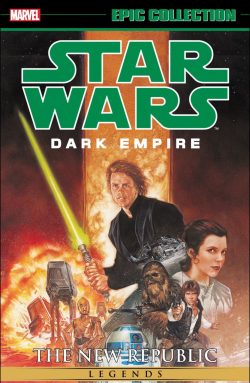
Star Wars – The New Republic Epic Collection volume 5: Dark Empire


By Tom Veitch, Peet Janes, Scott Allie, Jason Hall, Henry Gilroy, Joe Casey, Cam Kennedy, Jim Baikie, Paul Lee, Brian Horton, John McCrea, Dario Brizuela, Francisco Paronzini, Arthur Adams, Edvin Biuković, Steve Crespo, Rodolfo DaMaggio, Doug Mahnke, John Nadeau, Jordi Ensign, Stan Manoukian, Vince Roucher, Isaac Buckminster Owens, Dusty Abell, Jim Royal, Jan Duursema, Pop Mhan, Andrew Robinson & various (Marvel)
ISBN: 978-1-3029-2698-4 (TPB)

Win’s Christmas Gift Recommendation: Epic Entertainment and Adventure… 9/10

I’m sure we’re all familiar with the mythology of Star Wars. What you might not know is that the first sight future fanatics got of its breathtakingly expansive continuity and the mythology-in-the-making way back in 1977 was the premier issue of the Marvel comic book adaptation. It hit shelves two weeks before the film launched in cinemas, setting the scene for a legion of kids and beginning a mini-phenomenon which encompassed the initial movie trilogy and expanded those already vast imaginative horizons.

Marvel had an illustrious run with the franchise – nine years’ worth of comics, specials and paperback collections – before the option was left to die. Comic book exploits were reinstated in 1991 by Dark Horse Comics who built on the film legacy with numerous superb titles and tales until Disney acquired the rights to Star Wars in 2012. Around the same time, the home of Donald & Mickey also bought Marvel Comics and before long the original magic was being rekindled…

When Marvel relaunched the enterprise, they included not just a core title but also solo books for the lead stars. Moreover, rather than ignore what had passed between their two bites of the cherry, Disney/Marvel began reissuing the Dark Horse material too. Amongst the very best of it was a tryptic of miniseries released as one grand adventure under their Star Wars Legend imprint.

Scripted primarily by Tom Veitch, this fifth paperback/digital Epic Collection gathers Star Wars: Dark Empire #1-6; Dark Empire II #1-6; Empire’s End #1-2, plus material from Star Wars Tales #8, 11, 16, 17 and Star Wars Handbook volume one: X-Wing Rogue Squadron & Star Wars Handbook volume three: Dark Empire: originally seen between December 1991 and September 2003.

Set after the movie Return of the Jedi and now relegated conceptually to an alternate universe in light of later cinematic releases, Dark Horse kicked off its Star Wars franchise with a supremely moody, action-packed thriller. Illustrator Cam Kennedy (reuniting with scripter Veitch after previously collaborating on the excellent and peculiar Light and Darkness War), rendered the alien universe and familiar characters in his own unique and magnificent manner, delivering quirky but reassuringly authentic settings and scenarios for a space opera romp that satisfyingly captures the feel and pace of the cinema versions, whilst building on the canon for Force-starved fanatics everywhere.

Star Wars: Dark Empire opened in December 1991 with ‘The Destiny of a Jedi’: unfolding about ten years after the Battle of Endor and the death and redemption of Darth Vader. Although the Emperor is gone, the war continues. The militaristic remnants of the Empire are still battling for every inch of the galaxy. The New Republic is desperately hard-pressed. Han Solo and his wife Leia, although new parents, are as deeply involved as ever, and Luke Skywalker is pushed to ever-more desperate measures as he attempts to destroy the pervasive unleashed evil corrupting the universe. His solution to rebalance the Force is to revive and rebuild the fabled Jedi Knights…

A mysterious new leader employing ingenious new super-weapons is winning the war for the Empire in ‘Devastator of Worlds’ and the heroes must separate to succeed. The Alliance is being picked off world by world and as ‘The Battle for Calamari’ rages, Han and Leia pursue the strategic aspects of the conflict resulting in a ‘Confrontation on the Smugglers Moon’ whilst Luke heads directly to the source and succumbs to the Dark Side when a dead foe returns thanks to he horrors of cloning in ‘Emperor Reborn’.

‘The Fate of a Galaxy’ is decided with closing 6th issue (October 1992) with Leia’s newly conceived child destined to become the greatest threat the galaxy has ever faced…

Can the heroes reunite to avert the tragedy before all is lost?

No need to guess as December 1994 saw the start of sequel series Star Wars: Dark Empire II with ‘Operation Shadow Hand’.

Veitch & Kennedy returned in a blaze of glory after the runaway success of Dark Empire with a superb continuation featuring the further battles of Luke, Leia, Han Solo and all the other movie favourites…

Deprived of clone bodies he was incubating to ensure a return to physicality, the ghost of Emperor Palpatine is intent on possessing the unborn child in Leia’s belly even as his Dark Side lieutenants struggle to become his successor. The Empire’s last infrastructure remnants are producing more diabolical planet-killing weapons to terrorise and subdue the battered, war-weary galaxy and the monster expects success thanks to his last resort weapon: Seven Dark Jedi fanatically executing his contingency plans, whilst his nemesis Skywalker pursues a cosmic wild goose chase sparked by Jedi database the Holochron. It has set him in pursuit of scattered Jedi survivors who might have escaped the purge…

‘Duel on Nar Shaddaa’, ‘World of the Ancient Sith’ and ‘Battle on Byss’ unite old favourites with new Star Warriors – such as Ysanna tribe adepts Rayf and Jem – in a desperate struggle for survival even as reborn, young Palpatine readies ‘The Galaxy Weapon’ to deliver total victory.

Han and Leia have been hiding their Force-rich twins Jacen and Jaina from the Emperor for years, but are now fearful that their imminent third child will be the spectral horror’s new target for possession. When news comes that Palpatine has eradicated the entire Alliance leadership, Luke and his new Jedi disciples arrive in time to rally the last survivors in a last-ditch attempt to push back the swiftly-closing ‘Hand of Darkness’ (#6, May 1995). Tragically, the Dark Jedi are hot on their trail and a deadly confrontation looms…

This big bombastic blockbuster rockets along, packed with tension and invention, with action aplenty and spectacular set pieces for the fans – although it might be a tad bewildering if your Star Wars IQ is limited.

The trilogy concluded later that year in Star Wars: Empire’s End (October & November 1995) with Jim Baikie replacing Kennedy as artist for a much shorter adventure wrapping up all the plot-threads in a fittingly spectacular fashion. Issue #1’s ‘Triumph of the Empire’ sees the regrowth and expansion of a new rebel alliance and next generation of Jedi Knights when Palpatine discovers his clone-body is breaking down. The ‘Rage of the Emperor’ compels him to attempt a precipitous possession of new-born Anakin Solo leading to one final, sacrifice soaked confrontation…

Accompanying the colossal star-shaking events are a tranche of short stories taken from anthological series Star Wars Tales, beginning with ‘Tall Tales’ by Scott Allie, Paul Lee & Brian Horton from #11 (March 2002). Here, gossip among patrons in a cantina about a ship called the Millennium Falcon leads to another brawl by some very familiar strangers, after which ‘The Other’ (#16, June 2003 by Jason Hall & John McCrea) sees Luke and Leia on Coruscant, debating her future and provoking some awful memories of when they were constantly at war…

Star Wars Tales #8 (June 2001 by Henry Gilroy & Dario Brizuela & Francisco Paronzini) shares ‘The Secret Tales of Luke’s Hand’ as 4-year old Anakin Solo hears bedtime stories of his uncle’s prosthetic paw before Joe Casey & Francisco Paronzini expose ‘Phantom Menaces’ (#17, September 2003) when Ambassador Luke Skywalker encounters a seemingly spectral Sith Lord haunting a candidate planet of the New Republic …

After all that, true Jedi adepts and prospective Padawans can enhance their SWIQ through studying a veritable avalanche of new friends and foes whilst also reacquainting themselves with old favourites in data-drenched Star Wars Handbook volume one: X-Wing Rogue Squadron by Peet Janes, Arthur Adams, Edvin Biuković, Steve Crespo, Rodolfo DaMaggio, Doug Mahnke, John Nadeau, Jordi Ensign, Stan Manoukian, Vince Roucher and Star Wars Handbook volume three: Dark Empire by Janes, Nadeau, Ensign, Isaac Buckminster Owens, Dusty Abell, Jim Royal, Jan Duursema, Pop Mhan & Andrew Robinson.

These catalogues detail everybody and everything from Wedge Antilles and Boba Fett to World Devastators and the Jedi Holocron and segue efficiently into a trove of extras including a gallery of covers – movie photos and painted works from Dave Dorman, Ashley Wood, Kia Asamiya, John Nadeau – plus previous collection covers by Dorman, Mark Zug and Tsuneo Sanda.

There’s also Dark Empire painted promo art, character roughs and equipment sketches, and pencilled pages all by Cam Kennedy; text End-pieces and Introductions from the original comics as well as art Prints and Plates by Kennedy and Dorman.

Exceptional fun, in strong stories with beautiful pictures, this is an utter delight for devotees of a galaxy not so very far, far away and anyone hungry for good old fashioned action entertainment.
STAR WARS and related text and illustrations are trademarks and/or copyrights in the United States and other countries of Lucasfilm Ltd. and/or its affiliates. © & ™ Lucasfilm Ltd. All rights reserved.
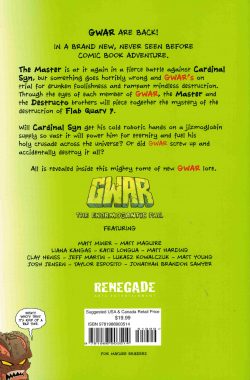
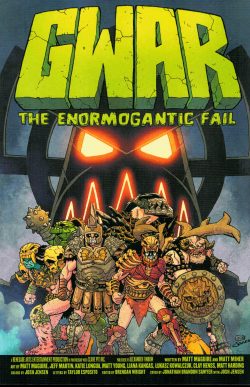
GWAR – The Enormogantic Fail


By Matt McGuire & Matt Miner, Jeff Martin, Katie Longua, Matt Young, Liana Kangas, Lukasz Kowalczuk, Clay Henss, Matt Harding & various (Renegade Arts Entertainment)
ISBN: -978-1-98890-351-4 (TPB) eISBN: 978-1-98890-364-4

Fancy a bit of scary dress-up?

GWAR have played loud, fantasy-themed heavy metal music since 1984. The ever-shifting band roster comprises of an excessively theatrical rock combo performing as mythological Sci Fi personas, delivering raucous, rousing good times as well-defined yet fluid fantasy characters. They are happy to shock and might well offend your nan – unless she’s like my nan was…

Operating under the umbrella designation Slave Pit Inc., they should more correctly be assessed as an arts collective of musicians, artists and filmmakers. You should check them out, especially if you’re the sort of reader who was weaned on the anarchic glory days of British comics like 2000 AD and The Beano…

Their brand and output is soaked in rude, crude satire, ultra-violent and sexualised imagery and a deliciously deviant sense of fun…

Shock Rockers GWAR positively encourage sidebar story projects and ventures. This graphic novel is their second starring vehicle (the first was in 1998), craftily capturing the spirit of the performances through the lens of comic combat as pawns and agents of rival galactic archetypes The Master, the Destructo Brothers and Cardinal Syn.

Crafted collaboratively by writers Matt McGuire & Matt Miner, and finishers Jeff Martin, Katie Longua, Matt Young, Liana Kangas, Lukasz Kowalczuk, Clay Henss, Matt Harding and others, this rocket-paced, rollicking yarn exposes the very origins of humanity after the daft but doughty warrior-scumdogs go on trial for their many failures – and failings – in pursuit of the much-desired Jizmogoblin.

Tragically, and as per normal operating conditions, there’s far more going on than these simple berserker grunts can fathom…

Wild, rowdy and manically cathartic, this exuberant romp is heaped high with fun and sly commentary, masquerading as simple cosmic cartoon carnage. Think Hitchhikers Guide to the Galaxy on steroids mating with Red Dwarf‘s disinherited half-brother, scored by Cradle of Filth and catered by Slipknot and you won’t be far out… but will be much amused.

Or you will be utterly shaken, outraged and appalled, and reinforced in your views that the modern world and its sundry entertainments are further confirmatory proof of the end of days. You be the judge…
GWAR The Enormogantic Fail © Slave Pit Inc. 2019.

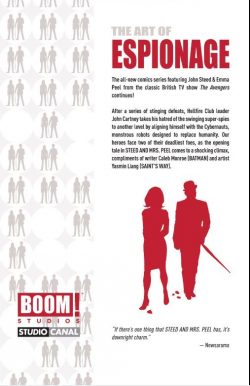
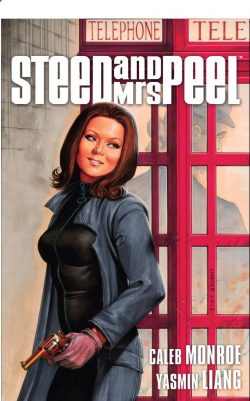
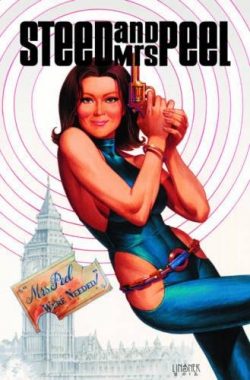
Steed and Mrs Peel volume 3: The Return of the Monster


By Caleb Monroe, Steve Bryant, Will Sliney, Yasmin Liang & Chris Rosa (Boom! Studios)
ISBN: 978-1-60886-363-1 (TPB) eISBN: 978-1-61398-363217-4

The (British) Avengers was an astoundingly stylish, globally adored TV show glamorously blending espionage with arch comedy and deadly danger with technological extrapolation from swinging Sixties through to the beginning of the 1980s. A phenomenal cult hit, it and sequel The New Avengers call up pangs of Cool Britannia style, cheeky action-adventure, kinky quirkiness, mad gadgetry, dashing heroics, bizarrely British festishistic attire, surreal suspense and the wholly appropriate descriptive phrase “Spy Fi”.

Enormously popular everywhere, the show evolved from 1961’s gritty crime thriller Police Surgeon into a paragon of witty, thrilling and sophisticated adventure lampoonery with suave, urbane British Agent John Steed and dazzlingly talented amateur sleuth Mrs. Emma Peel battling spies, robots, criminals, secret societies, monsters and even “aliens” with tongues very much in cheeks and always under the strictest determination to remain calm, dashingly composed and exceedingly eccentric…

The format was a winner. Peel, as played by Dame Diana Rigg, and replacing landmark character Cathy Gale – the first hands-on fighting female on British TV history – took the show to even greater heights of success. Emma Peel’s connection with viewers cemented the archetype of a powerful, clever, competent woman into the nation’s psyche: largely banishing the screaming, eye-candy girly-victim to the dustbin of popular fiction.

Rigg left in 1967, herself replaced by another feisty female: Tara King (Linda Thorson) who carried the series to its demise in 1969. Continued popularity in more than 90 countries led to a revival in the late 1970s. The New Avengers saw glamorous Purdey (Joanna Lumley) and manly Gambit (Gareth Hunt) as partners and foils to the agelessly debonair but deadly Steed…

The show remains an enduring cult icon, with all the spin-off that entails. During its run and beyond, The Avengers spawned toys, games, collector models, a pop single and stage show, radio series, audio adventures, posters, books and all the myriad merchandising strands that inevitably accompany a media sensation. The one we care most about is comics and, naturally, the popular British Television program was no stranger there either.

Following an introductory strip starring Steed & Gale in listings magazines Look Westward and The Viewer – plus the Manchester Evening News – (September 1963 to the end of 1964), legendary children’s staple TV Comic launched its own Avengers strip in #720 (October 2nd 1965) with Emma Peel firmly ensconced.

This ran until #771 (September 24th 1966) and the dashing duo also starred in TV Comic Holiday Special, whilst a series of young Emma Peel adventures featured in June & Schoolfriend, before transferring to DC Thomson’s Diana until 1968 whereupon it returned to TV Comic with #877, depicting Steed and Tara King until #1077 in 1972.

In 1966 Mick Anglo Studios unleashed a one-off, large-sized UK comicbook, and two years later in America, Gold Key’s Four-Color series published a try-out book using recycled UK material as John Steed/Emma Peel – since Marvel had secured an American trademark for comics with the name “Avengers”…

A constantly evolving premise, fans mostly fixate on the classic pairing of Steed and Peel – which is handy as the Avengers title is embargoed up the wazoo now

There were wonderful, sturdily steadfast hardback annuals for the British Festive Season trade, beginning with 1962’s TV Crimebusters Annual and thereafter pertinent TV Comic Annuals before a run of solo editions graced Christmas stockings from 1967-1969: supplemented by a brace of New Avengers volumes for 1977 and 1978.

Eclipse/ACME Press produced a trans-Atlantic prestige miniseries between 1990 and 1992. Steed & Mrs. Peel was crafted by Grant Morrison & Ian Gibson with supplementary scripts from Anne Caulfield. That tale was reprinted in 2012 by media-savvy publishers Boom! Studios: a kind of pilot for the later iteration under review here.

The Adventures of Steed and Mrs. Peel began with issue #0 (August 2012), reintroducing the faithful and newcomers to a uniquely British phenomenon, and terminate here with #8-11, as Caleb Monroe, Yasmin Liang, Ron Riley and letterer Ed Dukeshire conclude the sparkling revival with a quartet of fabulous missions, beginning with ‘The Art of Resurrection’.

A long-delayed sequel to 1966 TV episode ‘A Touch of Brimstone’ sees the demented offspring of Hellfire Club Supremo the Honorable John Cleverly Cartney rescue their barely-alive sire and begin a campaign of vengeance decked out as doppelgangers of Steed and Peel.

The manic scheme takes a darker twist as daddy dearest’s personality is installed in a robotic body for ‘The Clothes Make the Cybernaut’ (who featured in three small screen episodes). His progeny might be no match for our True Brits, but Cartney 2.0 is far more formidable, easily subduing the agents when they track down the mad malefactors…

However, the perfidious plan unravels in ‘Punchlines and Proposals’ when the wicked kids accidentally discover their daddy never had any children and still intends on making Mrs Peel his bride…

The madness and mayhem spectacularly wrap up in wedding issue ‘What They Do’, with the reunited operatives firing on all cylinders to thwart all the treacherous plots and counterplots before enjoying a spot of bubbly and another splendid sunset…

Wry, arch and wickedly satisfying, this closing salvo of the reborn franchise is a delight for staunch fans and curious newcomers alike and includes a covers and variants gallery by Joseph Michael Linsner, Joe Corroney & Brian Miller, and Dan Davis & Vladimir Popov to charm the eyes whilst the story salves the senses…
© 2014 Studio Canal S.A. All rights reserved.

Steed and Mrs Peel volume 2: The Secret History of Space


By Caleb Monroe, Yasmin Liang, Ron Riley & various (Boom! Studios)
ISBN: 978-1-60886-340-2 (TPB)

The (other) Avengers was an incredibly stylish, globally popular British TV show which blended espionage with arch glamor, seductively knowing comedy and deadly danger with elements of technological fantasy. It ran from the 1960s through to the beginning of the 1980s. A phenomenal cult hit, the show (and sequel The New Avengers) is best remembered for Cool Britannia outreach, stylish action-adventure, kinky quirkiness, mad gadgetry, dashing heroics, uniquely English festishistic trappings, surreal suspense and the wholly appropriate descriptive phrase “Spy Fi”.

Enormously popular all over the globe, the show evolved from 1961’s gritty crime thriller Police Surgeon into a paragon of witty, thrilling and sophisticated drama/lampoonery with suave, urbane British Agent John Steed and dazzlingly talented amateur sleuth Mrs. Emma Peel battling spies, robots, criminals, secret societies, monsters and even “aliens” with tongues very much in cheeks and always under the strictest determination to remain calm, dashingly composed and exceedingly eccentric…

The format was a winner. Peel, as played by Dame Diana Rigg, had replaced landmark character Cathy Gale – the first hands-on fighting female on British TV history – and took the show to even greater heights of success. Emma Peel’s connection with viewers cemented into the nation’s psyche the archetype of a powerful, clever, competent woman: largely banishing the screaming, eye-candy girly-victim to the dustbin of popular fiction.

Rigg left in 1967, herself replaced by another feisty female: Tara King (Linda Thorson) who carried the series to its demise in 1969. Continued popularity in more than 90 countries led to a revival in the late 1970s. The New Avengers saw glamorous Purdey (Joanna Lumley) and manly Gambit (Gareth Hunt) as partners and foils to agelessly debonair but deadly Steed…

The show remains an enduring cult icon, with all the spin-off that entails. During its run and beyond, The Avengers spawned toys, games and collector models; a pop single, stage show and radio series, plus audio adventures, posters, books and all the myriad merchandising strands that inevitably accompany a media sensation. The one we care most about is comics and naturally, the popular British Television program was no stranger there either.

Following an introductory strip starring Steed & Gale in listings magazines Look Westward and The Viewer – plus the Manchester Evening News – (September 1963 to the end of 1964), legendary children’s staple TV Comic launched its own Avengers strip in #720 (October 2nd 1965) with Emma Peel firmly ensconced.

This ran until #771 (September 24th 1966), and the dashing duo also starred in TV Comic Holiday Special, whilst a series of young Emma Peel adventures featured in June & Schoolfriend, before transferring to DC Thomson’s Diana until 1968 whereupon it returned to TV Comic with #877, depicting Steed and Tara King until #1077 in 1972.

In 1966, Mick Anglo Studios unleashed a one-off, large-sized UK comicbook, and two years later in America, Gold Key’s Four-Color series published a try-out book using recycled UK material as John Steed/Emma Peel – since Marvel had since secured an American trademark for comics with the name “Avengers”. Although a constantly evolving premise, fans mostly fixate on the classic pairing of Steed and Peel – which is handy as the Avengers title is embargoed up the wazoo now.

There were wonderful, sturdily steadfast hardback annuals for the British Festive Seasonal trade, beginning with 1962’s TV Crimebusters Annual and thereafter pertinent TV Comic Annuals before a run of solo editions graced Christmas stockings from 1967-1969: supplemented by a brace of New Avengers volumes for 1977 and 1978.

Most importantly, Eclipse/ACME Press produced a trans-Atlantic prestige miniseries between 1990 and 1992. Steed & Mrs. Peel was crafted by Grant Morrison & Ian Gibson with supplementary scripting from Anne Caulfield. That tale was reprinted in 2012 by media-savvy publishers Boom! Studios: a notional pilot for the later iteration under review here.

The Adventures of Steed and Mrs. Peel began with issue #0-3 (August 2012), reintroducing the faithful and newcomers to a uniquely British phenomenon and saw the grand dames of Spy Fi tackle old (TV) enemies The Hellfire Club at the height of the 1960s.

After quelling last volume’s A Very Civil Armageddon, the intrigue resumes here and now with Steed and Peel clearing up loose ends by attending a highly suspect gala soiree in ‘Ballroom Dance Fu’ (by Caleb Monroe, Yasmin Liang & colourist Ron Riley). The scoundrel du jour under investigation is wealthy rogue Lloyd Cushing, but the true target is scurrilous brainwasher Mr. Blackwell – the sinister mindbender who facilitated the Hellfire Club’s schemes and previously warped Mrs Peel into their Queen of Sin.

Sadly, despite a minimum of murders and the defeat of their foe, our heroes are left little wiser, and blithely unaware that the schemes of a hidden mastermind are still proceeding apace…

Main event ‘The Secret History of Space’ then kicks off with the abduction of British Air Chief Marshal Trevor Seabrook‘s wife in opening gambit ‘Steed Drifts Off into Space’. The hidden villain’s ultimate aim is achieved when the distraught airman – head of the UK’s Space Program – hands over an item long stored and forgotten in a research facility. Investigating the extortion, Steed and Peel are baffled to learn that the top-secret booty is a decades-old empty glass jar…

Diligent investigation leads the Derring Duo to a warehouse where old enemy Dr. Peter Glass (another TV series recruit) has been continuing his deadly experiments into optical lasers. It’s quite the conundrum since Steed clearly remembers killing him…

The answer is forthcoming as ‘Time Flies’ reveals a bit of chronal meddling from the bonkers boffin’s future assistant Jamie upsetting the timeline and risking things from beyond our comprehension getting dangerously close to humanity. Thankfully, even a gang of time-duplicated henchpersons are no match for Mrs Peel in full assault mode…

With normality restored, our heroes then voyage to small Welsh mining town Abergylid, where an unlikely cluster of suicides (24 in one month) has the Ministry deeply concerned. After both almost simultaneously succumb to manic death-urges, simple deduction leads to an outside influencer callously operating with malign intent and methods in ‘Tawdry Little Endings’.

Wry, sharp and wickedly satisfying, these classy cloak-&-dagger dramas are sheer delight for staunch fans and curious newcomers alike and this volume also includes a wealth of covers and variants gallery by Joe Corroney & Brian Miller; Drew Johnson, Mike Perkins, Barry Kitson and Davis (all coloured by Vladimir Popov), Lorena Carvalho and Chan Hyuk Lee.
© 2012, 2013 Studio Canal S.A. All rights reserved.