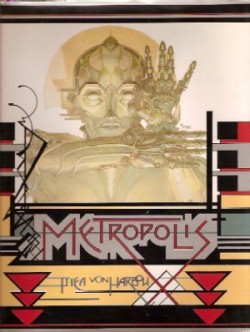
Metropolis


By Thea von Harbou, illustrated by Michael W. Kaluta (Donning/Starblaze)
ISBN: 0-89865-519-6 (HB)

People who work in comics adore their earliest influences, and will spout for hours about them. Not only did they initially fire the young imagination and spark the drive to create but they always provide the creative yardstick by which a writer or artist measures their own achievements and worth. Books, comics, posters, even gum cards (which mysteriously mutated into “Trading Cards” in the 1990s) all fed the colossal hungry Art-sponge which was the developing brain of the kids who make comics.

But by the 1970s an odd phenomenon was increasingly apparent. It became clear that new talent coming into the industry was increasingly aware only of comic-books as a source of pictorial fuel. The great illustrators and storytellers who had inspired the likes of Howard Chaykin, Bernie Wrightson, Mike Kaluta, P. Craig Russell, Charles Vess, Mike Grell, and a host of other top professionals were virtually unknown to many youngsters and aspirants. I suspect the reason for this was the decline of illustrated fiction in magazines – and general magazines in general.

Photographs became a cheaper option than artwork in the late 1960s and, as a broad rule, populations read less and less each year from that time onwards.

In the late 1980s, publisher Donning created a line of oversized deluxe editions reprinting “lost” prose classics of fantasy, illustrated by major comics talents who felt an affinity for the selected texts. Charles Vess illustrated Shakespeare’s A Midsummer Night’s Dream, P. Craig Russell created magic for The Thief of Bagdad and Mike Grell revisited Pyle’s take on the world’s greatest archer in The Merry Adventures of Robin Hood of Great Renown in Nottinghamshire.

Arch period stylist Mike Kaluta lucked in to something a little more exotic; illustrating the original film scenario (a broad shooting script used by movie-makers in the days before dialogue) written by Thea von Harbou after her husband returned from a trip to America.

Herr “von Harbou” was German expressionist genius Fritz Lang, and his account of his fevered impressions, responses and reminiscences became the ultimate social futurist fiction film Metropolis – possibly the most stirring, visually rich and influential movie of the silent era – and officially the most expensive film ever made during the pre-Talkies era.

If you haven’t seen the film… Do. Go now, a new re-re-restored version was released in 2010 – the most complete yet. I’ll wait…

The plot – in simple terms – concerns the battle between proletarian workers and the rich, educated elite of a colossal city where workers toil in hellish, conformist subterranean regiments to provide a paradise for the bosses and managers who live like gods in the lofty clouds above.

It would be the perfect life for Freder, son of the grand architect Joh Fredersen, except for the fact that he has become besotted with Maria, an activist girl from the depths. The boy will move Heaven and Earth to have her love him. He even abandons his luxuries to become a worker near her…

Distraught Fredersen renews his tempestuous relationship with the crazed science-wizard Rotwang, once an ally and rival for the love of the seductive woman Hel.

Rotwang offers his aid but it is a double-edged sword. He kidnaps Maria and constructs an incredible robotic replacement of her, to derail her passive crusade and exact his own long-deferred revenge…

This “novelisation” – for want of a better term – is as engrossing as the film in many ways, but the story is elevated by the incredible illustrations produced by Kaluta: 5 full page artworks in evocative chalk-and-pastel colour, two incredible double-page spreads in black line plus 32 assorted monochrome half-frames and full pages rendered in black & white line, grey-tones, charcoal, chalk monotones and pastel tints – an absolute banquet for lovers of art deco in particular and immaculate drawing in general.

Whilst no substitute for the actual filmic experience, this magnificent book is a spectacular combination of art and story that is the perfect companion to that so-influential fantasy masterpiece beloved by generations of youngsters. Well overdue for refit, recovery and revival…
© 1988 by the Donning Company/publishers. Art © 1988 Michael W. Kaluta. All rights reserved.

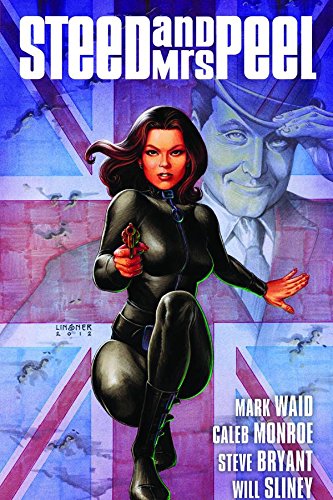
Steed and Mrs Peel volume One: A Very Civil Armageddon


By Mark Waid, Caleb Monroe, Steve Bryant, Will Sliney, Yasmin Liang & Chris Rosa & various (Boom! Studios/Titan Books)
ISBN: 987-1-60886-306-8 (TPB)

Generally, when I write about the Avengers, we’re all thinking about an assembled multitude of Marvel superheroes, but – until the blockbuster movie franchise stormed the 21st century world – for most non-comics civilians that name usually conjured up images of dashing heroics, old world charm, incredible, implausible adventure and true British style – not to say bizarrely fetishistic attire. It’s easy to see how that might lead to some consumer confusion…

In this anniversary year for the TV show, I thought we’d revisit some of the many comics outings of the English iteration, so we’re starting here. Be prepared for a sparkling variety of follow-up treats in the months ahead…

The (other) Avengers was a stylish, globally popular crime/spy TV show made in Britain: glamorously and seductively blending espionage thrills with arch, knowing comedy. After a grim-‘n’-gritty start in 1961, it gradually combined deadly danger with elements of technological fantasy, capturing the mood of two distinct eras, A phenomenal cult hit, the show and its1980s sequel The New Avengers are best remembered now for Cool Britannia-styled action, kinky quirkiness, mad gadgetry, surreal suspense and the wholly appropriate descriptive phrase “Spy Fi”.

The legacy of the series is apparent in many later shows like The Invisible Man (both TV spy iterations); Chuck, the Mission: Impossible movie franchise and Marvel’s Agents of S.H.I.E.L.D.

Enormously popular across the globe – even Warsaw Pact Poland was crazy for Rewolwer i melonik (“A Revolver and a Bowler Hat”) – the show evolved from bleak vengeance thriller Police Surgeon (September-December 1961) into the epitome of wittily sophisticated adventure lampoonery with suave, urbane British Agent John Steed partnering with a succession of dazzlingly talented women displaying the true meaning of the term “agency”.

Most revered was amateur sleuth Mrs. Emma Peel who battled spies, supervillains, robots, criminals, secret societies, monsters and even “aliens” with tongue very much in cheek and always under the strictest determination to remain cool, dashingly composed and exceedingly eccentric…

The format was a winner. Peel, as played by (Dame) Diana Rigg, had been a replacement for landmark and breakthrough character Cathy Gale – the first hands-on fighting female in British television history. She left the show in 1964 to become Bond Girl Pussy Galore (in Goldfinger), but her replacement with Rigg took the show to even greater heights of success. The role of recently bereaved Emma Peel hit a chord with viewers and cemented the archetype of a powerful, clever, competent woman into the nation’s psyche: forever countering – if not quite abolishing – the screaming, eye-candy girly-victim to the dustbin of popular fiction.

Rigg left in 1967 (to marry James Bond in On Her Majesty’s Secret Service) and another feisty female was found in the person of Tara King (Linda Thorson) to carry the series to its demise in 1969. Its continued popularity in more than 90 countries eventually resulted in a revival during the late 1970s. The New Avengers saw glamorous “Sloane Ranger” Purdey (Joanna Lumley) and brutishly manly Gambit (Gareth Hunt) acting as partners and foils to the agelessly debonair and deadly Steed…

The show has remained a hugely enticing cult icon. There was a rather ill-conceived major motion picture in 1998, but the television version regularly features in Top 20 rankings for assorted polls assessing Cult TV Shows. During its run and beyond, the internationally adored series has spawned toys; games; collector models; a pop single and stage show; radio series; posters and books plus all the myriad merchandising strands that inevitably accompany an evergreen media sensation.

Naturally, as a popular British Television program these Avengers were no stranger to our comics pages either.

Following an introductory cartoon strip starring Steed & Gale in listings magazines Look Westward, The Viewer and Manchester Evening News (September 1963 to the end of 1964), legendary children’s staple TV Comic launched its own Avengers strip in #720 (October 2nd 1965) with Emma Peel firmly ensconced and crushing crime.

This serial ran until #771 (September 24th 1966), with the dashing duo also starring in TV Comic Holiday Special, whilst a series of young Emma Peel adventures featured in June & Schoolfriend. This feature transferred to DC Thomson’s Diana, running until 1968 whereupon it returned to TV Comic (from #877): now depicting Steed and Tara King until 1972 (#1077).

In 1966 there was a one-off, large-sized UK comicbook from Mick Anglo Studios whilst in America, Gold Key’s Four-Color series published a try-out book in 1968 using recycled UK material under the rather obvious title John Steed/Emma Peel – since Marvel had already secured an American trademark for comics with the name “Avengers”.

There were also a number of wonderful, sturdily steadfast hardback annuals for the British Festive Season trade, beginning with 1962’s TV Crimebusters Annual and thereafter pertinent TV Comic Annuals after which a run of solo editions graced Christmas stockings from 1967-1969, augmented by plus a brace of New Avengers volumes for 1977 and 1978.

Between 1990 and 1992, Eclipse Comics and the UK’s ACME Press produced a trans-Atlantic prestige miniseries, Steed & Mrs. Peel: crafted by Grant Morrison, Anne Caulfield & Ian Gibson. Stay tuned for a review of that one too…

Repackaged and reprinted in 2012 by media-savvy publishers Boom! Studios, that event acted as a pilot for a fresh iteration, the first compilation of which is under review here. Wisely set in the series’ Swinging Sixties Britain heyday, this volume of Steed and Mrs. Peel collects issues #0-3 (August-December 2012): a worthy reintroduction for the faithful and happily accessible introduction for notional newcomers as the dedicated followers of felons return for another clash with memorable TV antagonists The Hellfire Club.

These baroque bounders appeared in episode ‘A Touch of Brimstone’ and so warped the maturing personalities of young Chris Claremont & John Byrne that they later created their own version for a comic book they were working on – the Uncanny X-Men…

The drama here opens in ‘A Very Civil Armageddon: Prologue’ (written by Boom! chief creative guru Mark Waid and illustrated by Steve Bryant) as, way back then, our heroes are called upon to investigate ‘The Dead Future’, as an active – albeit murdered – agent seemingly ages decades overnight.

The situation reminds Mrs. Peel of the mind-bending, lethally effective fun-&-games perpetrated by the insidious Hellfire Club and its now-defunct leader the Honourable John Clever-Cartney…

Further inquiries take them to the latest incarnation of the ancient Gentleman’s Club where avowed futurist Ian Lansdowne Dunderdale Cartney disavows any knowledge of the matter… or his dad’s old antisocial habits. In fact, the current scion is far more absorbed with the World of Tomorrow than the embarrassing peccadilloes of the past. However, it’s all a trap and whilst Mrs Peel is attacked by a killer robot maid, Steed is ambushed – only to awaken as a doddering old man 35 years later in the year 2000AD!

Forever undaunted, the temporarily separated Derring-Duo refuse to accept the improbable, impeccably and individually striking back to uncover the incredible answer to an impossible situation…

The main event – by Waid & Caleb Monroe with art from Will Sliney – depicts ‘London Falling’ as long-anticipated and dreaded nuclear Armageddon finally happens, leaving Steed, Peel and a swarm of politicians, Lords and civil servants as the only survivors, hunkered down in a battered atomic bunker beneath the utterly devastated Houses of Parliament.

The shattered, shaken remnants of Empire and Civilisation soon discover that the only other survivors are ghastly atomic mutants and a coterie of exceptionally well-stocked and fully prepared members of the Hellfire Club…

‘Life in Hell’ finds the former foes joining forces and combining resources, but Steed and Peel are convinced something is “not kosher”. For one thing, former members of once-important political committees and knowledgeable generals keep disappearing, but – most importantly – Ian Cartney and his deplorable sister Dirigent are now known to be masters of their father’s dark arts of illusion, trickery and brainwashing…

Almost too late, Steed rumbles the nature of an audaciously cunning Psy-Ops espionage scheme as Emma is once more transformed into a ferocious, whip-wielding bondage nightmare for concluding instalment ‘Long Live the Queen’. Of course, a good spy, like a boy scout, is always prepared, and the dapper detective adroitly turns the tables on his foes just in time for a rollicking, explosively old-fashioned comeuppance…

Wry, arch and wickedly satisfying, this opening salvo in the reborn franchise remains a delight for staunch fans and curious newcomers alike. This volume includes a vast (28) gallery of covers and variants by Joseph Michael Linsner, Phil Noto, Joshua Covey & Blond, Mike Perkins & Vladimir Popov and Drew Johnson to astound the eyes as much as the story assaults the senses…

…And the best is yet to come…
© 2013 StudioCanal S.A. All rights reserved.

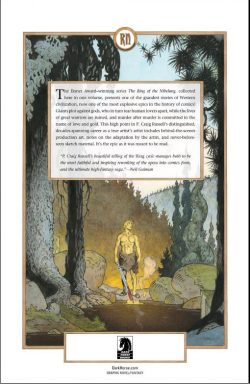
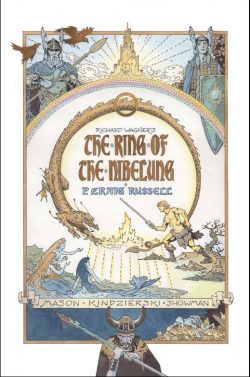
Richard Wagner’s The Ring of the Nibelung


Adapted by P. Craig Russell, translated by Patrick Mason, with Lovern Kindzierski & Galen Showman (Dark Horse)
ISBN: 978-1-61655-401-9 (HB) eISBN 978-1-63008-154-6

Win’s Christmas Gift Recommendation: Classical Comic Perfection! 10/10

P. Craig Russell began his illustrious career in comics during the early 1970s and came to fame early with a groundbreaking run on science fiction adventure series Killraven, Warrior of the Worlds. His fanciful, meticulous classicist style was derived from the great illustrators of Victorian and Edwardian heroic fantasy and was greatly at odds with the sausage-factory deadlines and sensibilities of the mainstream comicbook industry.

By the 1980s he had largely retired from the merciless daily grind, preferring to work on his own projects (mostly adapting operas and plays into sequential narratives) whilst undertaking occasional high-profile Special Projects for the majors – such as Dr. Strange Annual 1976 (totally reworked and re-released as the magnificent Dr. Strange: What Is It that Disturbs You, Stephen? in 1996) or Batman: Robin 3000.

As the industry grew up and a fantasy boom began, he returned to comics with Marvel Graphic Novel: Elric (1982), further adapting Michael Moorcock’s iconic sword-&-sorcery star in the magazine Epic Illustrated and elsewhere.

Russell’s stage-arts adaptations had begun appearing in 1978: firstly in groundbreaking independent Star*Reach specials Night Music and Parsifal and then, from 1984, at Eclipse Comics where the revived Night Music became an anthological series showcasing his earlier experimental adaptations: not just operatic dramas but also tales from Kipling’s Jungle Books and others.

As mainstream comics matured, his stylings could be seen in Vertigo titles such as The Sandman or Mike Mignola’s Hellboy titles. He never, however, abandoned his love of operatic drama. In 2003 Canadian publisher NBM began a prodigious program to collect all those music-based masterpieces into The P. Craig Russell Library of Opera Adaptations, but just before that, the artist took a couple of years (2000 and 2001) to complete a passion project. Originally released as a succession of linked miniseries – The Ring of the Nibelung: The Rhinegold #1-4, The Ring of the Nibelung: The Valkyrie#1-3, The Ring of the Nibelung: Siegfried #1-3 and The Ring of the Nibelung: Götterdämmerung #1-4, Russell and his regular collaborators Lovern Kindzierski adapted Richard Wagner’s masterpiece to comics. His wasn’t the first, but it’s most certainly the best.

Collected in a stunning hardback volume (also available digitally) the Teutonic saga is augmented by a Preface from music critic and scholar Michael Kennedy, an Introduction by comics star Matt (no relation)Wagner, and is followed by Russell’s fascinating, heavily-illustrated essay ‘What is an Adaptation?’ describing his thinking, creative process and philosophy in the crafting of this epic, offering an intimate peek into how the magic was made along with as a range of pencil, ink and/or fully-coloured sketches and art studies as well as the entire gallery of covers from the original comics.

The four operas Das Rheingold, Die Walküre, Siegfried and Götterdämmerung (or Twilight of the Gods if you’re less pompous or well-travelled than me) is a classic distillation of Germano-Norse myth and the classic poems collected as the Icelandic Eddas. Over 26 years the master of German music distilled them into a cycle of staggering power, which people either love or hate. Great tunes, too.

Doesn’t absolutely everybody love the brilliant animated tribute-come-distillation starring Bugs Bunny entitled ‘What’s Opera, Doc?’ They probably refer to it as ‘Kill the Wabbit!’, though.

Joking aside, the Ring Cycle is a true masterpiece of Western Culture and an immortal inspiration to purveyors of drama and historic fiction. In 1989 and 1990 long-time fans and comics superstars Roy Thomas (who had already integrated the plot into the canon of Marvel’s Mighty Thor) and Gil Kane produced a 4-part, prestige-format miniseries that adapted the events into comic strip form and it’s superbly impressive, but trust me Russell’s is in a league of its own.

Bold, bright, glittering and tightly adhering to the rhythms and staging of the theatre version – thanks to translator Patrick Mason’s deft contribution – it begins with the creation of the world

Alberich the Nibelung is a dwarf shunned by all, but still manages to outwit the three Rhine Maidens. Commanded to guard an accursed treasure horde t even the Gods cannot tame, the river nymphs reveal the secret to the glib intruder. Whoever casts The Rhinegold into a ring will have all the wealth and power of the world, but must forever forswear love and joy. Never having known either, greedy Alberich readily forsakes these joys and seizes the treasure even All-Father Voton feared to touch.

Meanwhile, wily Logé has convinced Voton to promise giants Fasolt and Fafnir anything they wish if they build the great castle Valhalla to house the world’s heroes. Assured that the trickster god can free him from his promise to the giants, the all-father and Preserver of Oaths accepts their price, but on completion the giants want Freia; goddess of the apples of immortality.

Bound by their Lord’s sworn oath the gods must surrender Freia, but malicious Logé suggests that Alberich’s stolen gold – now reshaped into a finger-ring – can be used by any other possessor without abandoning love. The brothers demand the world-conquering trinket as a replacement fee and no god can sway or deter them. The course is set to disaster!

Second miniseries The Valkyrie sees an earthly warrior who calls himself Woeful as the sole survivor of a blood-feud. Fleeing, he claims Right of Hospitality from a beautiful woman in a remote cottage. But when her husband Hunding returns, they discover that he belongs to the clan Woeful recently slaughtered so many of.

Secure for the night in the holy bond of Hospitality, Woeful realises he must fight for his life in the morning when the sacred truce expires. Without weapons, he thinks little of his chances until the woman reveals to him a magic sword embedded in the giant Ash tree that supports the house. Sadly, the gods have decreed there can be no happy ending to be won, only further sin and shame and the fall of Voton’s most beloved servant Brunhildé!

Sixteen years later, Siegfried is the child of an illicit union, raised by malicious, cunning Mime, a blacksmith who knows the secrets of the Nibelung. No loving parent, the smith wants the indomitable wild boy to kill the dragon Fafnir – who was once a giant – and steal the magical golden horde the monster so jealously guards.

But the young hero has his own heroic dreams and wishes to wake an otherworldly maiden who slumbers eternally behind a wall of fire!

Years of plotting and treachery and inescapable burden culminate in Götterdämmerung, as all the machinations, faithlessness and oath-breaking of the flawed divinities lead to ultimate destruction. Siegfried has won his beauteous Brunhildé from the flames but their happiness is not to be. False friends Hagen and Gunther drug him to steal his beloved, and betroth the befuddled hero to a woman he does not love. Final betrayal by a comrade whose father was Alberich leads to his death and the inevitable fall of all that is!

If you know the operas you know how much more remains to enjoy in this quartet of tales, and the scintillating passion and glowing beauty the art magnificently captures the grandeur and tragedy of it all. This primal epic is visual poetry and no fan should be without it.
© 2000, 2001, 2014 P. Craig Russell. All rights reserved.

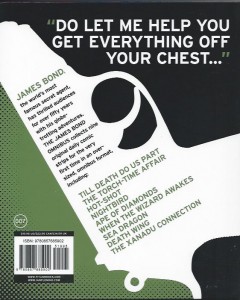
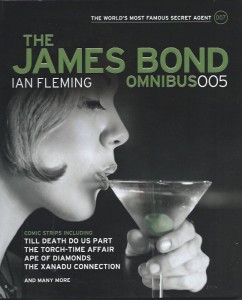
The James Bond Omnibus 005


By Jim Lawrence & Yaroslav Horak (Titan Books)
ISBN: 987-0-85768-590-2 (PB)

Win’s Christmas Gift Recommendation: Still the Most Traditional Licence to Thrill… 9/10

I’ve just heard that one of the true cartooning greats has passed away. Yaroslav Horak (12th June 1927 – 24th November 2020) was a conics star in Australia for years before taking over James Bond in 1966: a unique stylist and gifted writer and painter too. For a full biography and appreciation, check out the wonderful downthetubes.net. You should be doing that anyway if you’re a lover of comics and related media.

As my own farewell and thanks, here’s an old review of one of the best examples of Horak’s work, still readily accessible through online vendors. Your actions will be well rewarded…

There are very few British newspaper strips to challenge the influence and impact of classic daily and Sunday “funnies” from America, especially in the field of adventure fiction. The 1930’s and 1940’s were particularly rich in popular, not to say iconic, creations. You would be hard-pressed to come up with home-grown household names to rival Popeye, Dick Tracy, Buck Rogers, The Phantom, Mandrake the Magician, Flash Gordon or Steve Canyon, let alone Terry and the Pirates or the likes of Little Lulu, Blondie, Li’l Abner, Little Orphan Annie or Popeye – and yes, I know I cited him twice, but Elzie Segars’s Thimble Theatre was funny as well as thrilling, constantly innovative, and really, really good.

What can you recall for simple popularity let alone longevity or quality in Britain? Rupert Bear? Absolutely. Giles? Technically, yes. Nipper? Jane? The Perishers? Garth?

I hope so, but doubt it.

The Empire didn’t quite get it until it wasn’t an empire any more. There were certainly very many wonderful strips being produced: well-written and beautifully drawn, but that stubborn British reserve just didn’t seem to be in the business of creating household names… until the 1950’s.

Something happened in ‘fifties Britain – but I’m not going to waste any space here discussing it. It just did.

In a new spirit that seemed to crave excitement and accept the previously disregarded, comics (as well as all entertainment media from radio to novels) got carried along on the wave. Eagle, the regenerated Dandy and Beano, girls’ comics in general: all shifted into creative high gear, and so did newspapers. And that means that I can go on about a graphic collection with proven crossover appeal for a change.

The first 007 novel Casino Royale was published in 1953 and subsequently serialised in the Daily Express from 1958, beginning a run of paperback book adaptations scripted by Anthony Hern, Henry Gammidge, Peter O’Donnell and Kingsley Amis before Jim Lawrence, a jobbing writer for American features (who previously scripted the aforementioned Buck Rogers) came aboard with The Man With The Golden Gun to complete the transfer of the Fleming canon to strip format, thereafter being invited to create new adventures, which he did until the strip’s ultimate demise in 1983 – all apparently thanks to the striking effects of his artistic collaborator.

The art on the feature was always of the highest standard. Initially John McLusky provided illustration until 1966’s conclusion of You Only Live Twice and, although perhaps lacking in verve, the workmanlike clarity of his drawing easily coped with the astonishing variety of locales, technical set-ups and sheer immensity of cast members, whilst serving the then-novel conceit of advancing a plot and ending each episode on a cliff-hanging “hook” every day.

He was succeeded by Yaroslav Horak, who also debuted on …Golden Gun with a looser, edgier style; at once more cinematic and with a closer attention to camera angle and frenzied action that seemed to typify the high-octane 1960’s.

Horak was born in Manchuria in 1927, of Russian/Czech descent and the family relocated to Australia before WWII. Artistic from the start, Horak worked as a portraitist and magazine illustrator before moving into the nation’s vibrant comics industry in 1947. Following years of success and even some controversy from high-minded busybodies, the writer/artist moved over to newspaper strips in the 1950’s before emigrating to England in 1962. Even after landing the 007 gig he maintained links “Downunder”, carrying on with ‘Mike Steel – Desert Rider’ for Women’s Day until 1969. His pre-Bond UK output includes a selection of War and Battle Picture Library stories, and serial strips for DC Thomson’s The Victor and The Hornet.

In 1975, he returned to Australia, continuing the super-spy’s exploits while crafting homegrown features such as Cop Shop and Andea. We’ll not see his like again…

Titan books have re-assembled the heady brew of adventure, sex, intrigue and death into a series of addictively accessible monochrome Omnibus editions and this fifth compilation finds the creators on top form as they reveal how the world’s greatest agent never rests in his mission to keep us all free, safe and highly entertained…

The James Bond Omnibus gathers the series’ frantic derring-do and dark, deadly diplomacy in fabulous monochrome editions and this one commences with ‘Till Death Do Us Part’, which first ran in the Daily Express from July 7th to October 14th 1975. Solidly traditional 007 fodder, it found Bond assigned to kidnap/rescue Arda Petrich, comely daughter of a foreign asset, and keep vital intelligence out of the hands of the KGB.

This pacy thriller is most notable more for the inevitable introduction of the eccentric gadgets which had become an increasingly crucial component of the filmic iteration than for the actual adventure, but there are still racy thrills and icy chills aplenty on view.

Hard on the heels of that is brief but enthralling encounter ‘The Torch-Time Affair’ (October 15th 1975 – January 15th1976), wherein the hunt for a record of all Soviet subversion in Latin America leads to bodies on the beach, a mountain of lies and deceit, breathtaking chases on roads and through jungles, plus an astonishingly intriguing detective mystery as Bond and female “Double-O” operative Susie Kew must save the girl, get the goods and end the villain.

But, which one…?

‘Hot-Shot’ (January 16th – June 1st) finds the unflappable agent assisting Palestinian freedom fighter Fatima Khalid as she seeks to restore her people’s reputation for airline atrocities actually committed by enigmatic Eblis terrorists. Their cooperative efforts uncover a sinister Indian billionaire behind the attacks before Bond recognises an old enemy at the heart of it all… Dr. No!

In ‘Nightbird’ (2nd June – 4th November) sporadic attacks by what appear to be alien invaders draw Bond into a diabolical scheme by a cinematic genius and criminal master of disguise apparently in search of military and political secrets and weapons of mass destruction. However, a far more venal motive is the root cause of the sinister schemes and reign of terror…

Despite surreal trappings, ‘Ape of Diamonds’ (November 5th 1976 – January 22nd 1977) is another lethally cunning spy exploit as a deadly maniac uses a colossal and murderous gorilla to terrorise London and kidnap an Arab banker, leading Bond to a financial wild man determined to simultaneously destroy Britain’s economic prosperity and steal the Crown Jewels. Happily for the kingdom, Machiavellian Rameses had completely underestimated the ruthless determination of James Bond…

‘When the Wizard Awakes’ finds bad guys employing supernatural chicanery, when the body of a Hungarian spy – dead for two decades – walks out of his tomb to instigate a reign of terror that eventually involves S.P.E.C.T.R.E., the Mafia and the KGB until the British Agent unravels the underlying plot…

In 1977 the Daily Express ceased publication of the Bond feature and the tale was published only in the Sunday Express(from January 30th -May 22nd 1977). Later adventures had no UK distribution at all, only appearing in overseas editions. This state of affairs continued until 1981 when another British newspaper – the Daily Star – revived his career. Presumably, we’ll deal with those cases in another volume.

The first of those “lost” stories are included here, however, beginning with ‘Sea Dragon’, produced for European syndication: a maritime adventure with geo-political overtones wherein crazed billionairess and scurrilous proponent of “women’s liberation” Big Mama Magda Mather tried to corner the World Oil market using sex, murder and a deadly artificial sea serpent.

In ‘Death Wing’ Bond is needed to solve the mystery of a new and deadly super-weapon employed by the Mafia for both smuggling contraband and assassination. Despite a somewhat laborious story set-up, once the tale hits its stride, the explosive end sequence is superb as the undercover agent becomes a flying human bomb aimed at the heart of New York City. His escape and subsequent retaliation against eccentric hit-man Mr. Wing is an indisputable series highpoint.

This astounding dossier of espionage exploits ends with ‘The Xanadu Connection’ (1978) as the daring high-tech rescue of undercover agent Heidi Franz from East Germany inexorably leads Bond down a perilous path of danger and double-cross.

When Bond is tasked with safeguarding the wife of a British asset leading resistance forces in Russian Turkestan, the mission inevitably leads 007 to the Sino-Soviet hotspot where he is embroiled in a three-sided war between KGB occupation forces, indigenous Tartar rebels and their ancestral enemies of the Mongol militias led by insidious, ambitious spymaster Kubla Khan.

Deep in enemy territory with adversaries all around him, Bond is hardly surprised to discover that the real threat might be from his friends and not his foes…

Fast, furious action, masses of moody menace, sharply clever dialogue and a wealth of exotic locales and ladies make this an unmissable adjunct to the Bond mythos and a collection no fan can do without. After all, nobody does it better…
© 1975, 1977, 1977, 1978, 2013 Ian Fleming Publications Ltd/ Express Newspapers Ltd. All rights reserved.

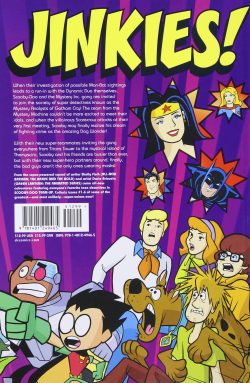
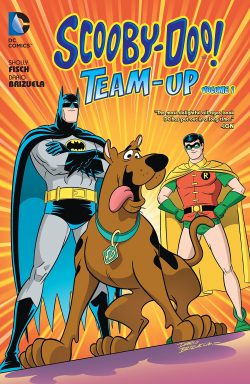
Scooby-Doo! Team-Up volume 1


By Sholly Fisch, Dario Brizuela & various (DC Comics)
ISBN: 978-1401249465 (TPB)

Win’s Christmas Gift Recommendation: All-Ages Fun and Frolic… 8/10

It’s been bad year for everybody, but from my selfish and blinkered perspective, the graphic arts have been particularly diminished by the loss of many giants. Here’s an offhand tribute to two more…

The links between kids’ animated features and comicbooks are long established and, I suspect, for young consumers, indistinguishable. After all, it’s just adventure entertainment in the end…

Although never actual comics workers, animation titans and series writers Joe Ruby (March 30th 1933-August 26th 2020) and Ken Spears (March 12th 1938-November 6th 2020) co-originated dozens of cartoon shows which ultimately translated into multi-million comic book sales, joy and glee for generations and a subtle reshaping of the World’s cultural landscape. They also popularised the superhero concept on TV, through shows such as Superman, The Plastic Man Comedy/Adventure Show and Thundarr the Barbarian, consequently employing former funnybook creators such as Doug Wildey, Alex Toth, Steve Gerber, Jack Kirby and other comics giants. For all this, they are most renowned for devising mega-franchise Scooby-Doo, Where Are You!

Over decades of screen material, Scooby-Doo and his sidekicks Shaggy, Velma, Daphne and Freddy became global icons, and amidst the mountain of merchandise and derivatives generated by the franchise was a succession of comic book series from Gold Key (30 issues beginning December 1969 and ending in 1974), through Charlton (11 issues 1975-1976), Marvel (9 issues 1977-1979), Harvey (1993-1994) and Archie (21 issues, 1995-1997). The creative cast included Phil DeLara, Jack Manning, Warren Tufts, Mark Evanier, Dan Spiegle, Bill Williams, and many others.

In 1997, DC Comics acquired all the Hanna Barbera properties for its Cartoon Network imprint, which was for a very long time the last bastion of children’s comics in America. It produced some truly magical homespun material (such asTiny Titans, Batman: Brave and the Bold or Billy Batson and the Magic of Shazam!) as well as stunning interpretations of such television landmarks as Powerpuff Girls, Dexter’s Laboratory, Ben 10 and vintage gems such as The Flintstones and Scooby Doo…

In 2013, the mystery-solving pesky kids fully integrated with the DCU via a digital series of team ups that inevitably manifested as comics books and graphic novels. Compiling material from Scooby-Doo! Team-Up #1-6 (January-November 2014) this first fabulous trade paperback – or eBook – features a wild parade of joint ventures from writer Sholly Fisch illustrator Dario Brizuela, colourists Franco Riesco & Heroic Age and letterers Saida Temofonte & Deron Bennett.

It all begins with Mystery Inc. aiding Dynamic Duo Batman and Robin in a hunt for mutated scientist Kirk Langstrombefore being diverted by a gang of fake flyers in ‘Man-Bat and Robbin’!’ after which issue #2 asks ‘Who’s Scared?’ As the Caped Crusader and Ace, the Bat-Hound enjoy seeing the original Scooby gang admitted to the legendary Mystery Analysts of Gotham City, the terror-inducing Scarecrow strikes, and only the canine contingent can resist his latest fear chemicals…

Still visiting Gotham City, the gang discover ‘Two Mites Make It Wrong’ as impulsive imp Bat-Mite starts his reality-altering pranks again and normality is only possible through the intervention of unforeseen antithesis Scooby-Mite…

Channelling a contemporary surreal TV hit, ‘Teen Titans – Ghost!’ then brings the Mystery Machine to Jump City for a spot of haunting at Titans Tower, before Daphne and Velma visit Wonder Woman on Themyscira and indulge in a Kanga rodeo whilst the boys mess about in the invisible jet before reuniting to solve a mythological monster mystery causing ‘Trouble in Paradise’…

This initial outing concludes with a mass masked hero marathon when a visit to the Super Friends‘ Hall of Justice leads to a ghost hunt. Mystery soon solved, the gang, Wonder Twins Zan and Jayna, the Justice League of America and Supergirl then must all battle the notorious Legion of Doom in ‘A (Super) Friend in Need’…

Despite being ostensibly aimed at TV kids, this fast-paced, funny and superbly inclusive parcel of thrills skilfully revisits the charm of early DC in stand-alone mini-sagas no self-respecting fun-fan should miss: accessible, entertaining, well-rendered yarns for the broadest range of excitement-seeking readers. This is a terrific tome offering perfect, old fashioned delight. What more do you need to know?
© 2014, 2015 Hanna-Barbera and DC Comics. All Rights Reserved. Batman, Robin, Superman, Wonder Woman and all related characters and elements are ™ DC Comics. Scooby-Doo and all related characters and elements are ™ and © Hanna-Barbera.

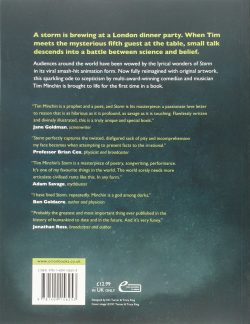
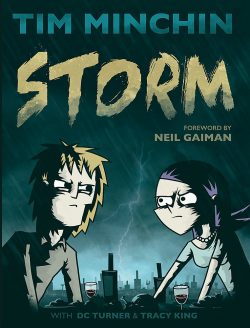
Storm


By Tim Minchin, DC Turner, Tracy King & various (Orion)
ISBN: 978-1-4091-5209-5 (HB), 978-1-4091-5625-3 (TPB), eISBN: 978-1-4091-5210-1)

The world is a magical, wondrous place stuffed with miracles and mysteries.

However, there’s not one single atom of it that depends on the eldritch or supernatural and none of it – or even the greater universe around it – is wrought from the efforts of supreme beings. Nor does it operate on principles of forgotten lore denied us common folk…

It’s all explainable, utterly rational and absolutely subject to revision by us every time we find out or disprove something that previously has been a puzzle or misunderstood. To do otherwise is nothing less than a crime against humanity.

No gods, no ghosts, no witchcraft, no magic crystals. Got it?

It’s amazing how many people haven’t and how the latest anti-science fad or fashion can cause genuine harm to the world, deprive generally sensible folk of their money and too often make dinner parties a theatre of war. That’s especially relevant at a time when a new lifeform is predating upon large sections of humanity in a manner we haven’t anticipated or properly categorised yet…

Tim Minchin is an Australian creative whirlwind and multi-media entertainment polymath who performs musical stand-up comedy, acts in edgy sitcoms, composes award-winning stage musicals like Matilda and acts in hit shows like Jesus Christ, Superstar.

He’s very smart, very funny and doesn’t believe in goblins or faith-healing.

In 2006 his 90-second diatribe ‘If You Open Your Mind Too Much Your Brain Will Fall Out (Take My Wife)’ – a “refutation of the plausibility of astrology, psychics, homeopathy and an interventionist God” impressed and delighted fans.

In 2008, after a close encounter with a pontificating new-agey nitwit at a party where the reasonable, rationalist Mr. Minchin politely opted not to contest a stream of bubble-headed nonsense, he took his ire and indignation and turned it into a piece of true inspiration: a beat poem, Socratic dialogue and “anthem for critical thinkers”…

It’s a very funny, edgy slice of entertaining refutation and I-wish-I’d-said-that-ism which was used as the closer for the Ready For This? Tour for more than two years.

In Britain animators/illustrators/producers Dan “DC” Turner and Tracy King saw that show and determined that at all costs they must turn that paean to logic and sense into an animated film. As described in Minchin’s Introduction to this book (available in trade paperback and eBook formats as well as a 1000 copy Limited Edition Deluxe Hardback with extra content) and the Afterword by Turner and King, after some wheeler-dealing, they did just that…

Storm became an internet sensation with many million hits on YouTube after its launch in 2011. The artists and Mr. Minchin then completely reworked that cartoon sensation into an astoundingly compulsive and scathingly funny graphic novel which opens at an intimate soiree in North London where the narrator and his wife sit down to sup with friends and are force-fed a stream of nonsensical blather by a beautiful girl with a tattoo of a fairy.

Her name is Storm and this time the quiet man she inanely and arrogantly lectures is not going to hold his tongue…

By turns tense, barbed, hilariously evocative and furiously cathartic, this stunning visual feast delivers the barrage of scathing sense we’ve always wanted (but been too polite) to unleash on evolution-deniers, pseudo-scientists, astrological aromatherapy advocates, vaccination-withholders, ghost-chasers and every other stripe of pontificating irrationalist in a graphic tumult of colour, line and typography that will simultaneously stun and galvanise.

This magnificent reinterpretation includes a Foreword by Neil Gaiman, Biography pages for Minchin, Turner & King and – because it’s all about the fun – a selection of variant covers by Ricky Earl, Freya Harrison, Andy Herd, Dave “Swatpaz” Ferguson and Stuart Mason & Rachael King which might have graced the issues had this yarn been serialised as comic periodicals rather than released as a complete book…

There has been and always will be a valuable and cherished place for fantasy, imagination and all the wild and woolly boggles and phantasms of a rich realm of tradition and ignorance. Indeed I believe it’s absolutely necessary for every child to be fully acquainted with all aspects of fairies and spectres and wish-fulfilling rings and lamps, but there comes a time when they must retire to a place of nostalgia and fun, regularly revisited for amusement but never, never, never used to dictate the content of school curricula, divert funds from genuine medical research or be employed as justification to persecute whole sectors of society or even one single “different” individual…

Storm is an edgy pictorial tour de force to delight and enchant readers who love the funny and fantastic but never forget where the horizons of fantasy end and the borders of imagination begin…
Text © Tim Minchin 2014. Illustrations © Tracy King and Daniel Charles Turner 2014. All rights reserved.

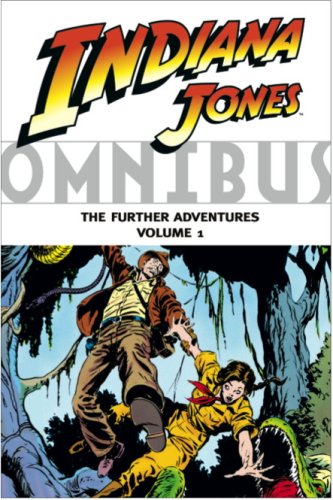
The Further Adventures of Indiana Jones Omnibus volume 1


By Walt Simonson, Denny O’Neil, David Michelinie, Howard Chaykin, Archie Goodwin, John Buscema, John Byrne, Gene Day, Richard Howell, Ron Frenz, Kerry Gammill, Dan Reed, Luke McDonnell & various (Dark Horse/Titan Books)
ISBN: 978-1-59582-246-8 (Dark Horse TPB) 978-1-84576-808-9 (Titan TPB)

Although dormant for the moment, Dark Horse Comics have held the comics-producing franchise for Indiana Jones since 1993: generating thousands of pages of material, much of it excellent and some not quite. It might be construed as heretical to say it, but dedicated film fans aren’t all that quality conscious when it comes to their particular fascination, whether it’s games about finding Atlantis or the latest watered-down kids’ interpretation or whatever.

The Dark Horse Omnibus line is a wonderfully economical way to keep older material in print for such fans by bundling old publications into classy, full-colour digests. They’re slightly smaller than US comic-books but larger than a standard tankōbon manga volume, running about 400 pages per book, but not all of them are available in digital editions at the moment.

This initial Indy volume (of three) chronologically re-presents the first dozen Marvel Comics (the original license holder) interpretations which followed the film Raiders of the Lost Ark as well as including the 3-issue miniseries adaptation by Walt Simonson, John Buscema & Klaus Janson that preceded that celluloid landmark. I’m being this specific because the comic version was also released as a single glossy, enhanced-colour magazine in the Marvel Super Special series (#18: Indiana Jones and the Raiders of the Lost Ark, if you’re curious).

And, just in case you’re the one who hasn’t seen the film… Set in the days before World War II, Hitler’s paranormal investigation division gathers occult artifacts from around the planet and soon crosses swords with a rough and ready archaeology professor from a New York university. Soon the unconventional Doctor Indiana Jones is scammed by the US government into tracking down his old tutor: a savant who might have knowledge of the biblical and mystically potent Ark of the Covenant…

Although Abner Ravenwood has since died, his daughter Marion possesses the clues the Jones needs. Unfortunately, she’s also an old flame he abandoned and would rather burn in hell than help him…

However, when the Nazis turn up and try to torch her in the Nepalese bar she washed up in, Marion joins Jones in a breakneck chase across the globe from Cairo to the lost city of Tanis to a secret Nazi submarine base on a tropical island, fighting natives and Nazis every step of the way until the ancient artifact separates the just from the wicked in a spectacular and terrifying display of Old Testament style Wrath…

The movie’s format – baffling search for a legendary object, utterly irredeemable antagonists, exotic locales, non-stop chase action, outrageous fights and just a hint of eldritch overtones – became the staple for the comic book series that followed, opening in impressive manner with ‘The Further Adventures of Indiana Jones’ a 2-part yarn from Jack-of-all-genres John Byrne, assisted by Terry Austin, with veteran scripter Denny O’Neil pitching in for the concluding ’22-Karat Doom!’

When an old student is murdered before his eyes, Indy swears to complete the lad’s research, subsequently trekking through Africa in search of a tribe who can turn men to gold. He is never more than one step ahead of a maniac millionaire with no love of mysteries or antiquities, but is possessed by a deep and abiding love of profit…

That adventure ends with our hero plunging out of a doomed plane and into issue #3’s American-set adventure ‘The Devil’s Cradle’ (by O’Neil, Gene Day, Richard Howell, Mel Candido & Danny Bulanadi) wherein he lands in a hillbilly wilderness where a rogue US Army Colonel and a band of witch-burning yokels are separately hunting a 400 year-old alchemist with all the secrets of the ages at his fingertips…

David Michelinie, Ron Frenz & Bulanadi’s ‘Gateway to Infinity!’ then sees the archaeological adventurer en route to Stonehenge, courtesy of the US government, as a ring of Nazi spies again fail to kill him. Hitler’s spies and parapsychologists are still hunting preternatural artifacts and the crystal cylinder uncovered at the ancient monument definitely qualifies. English professor Karen Mays dates it to the Triassic period, millions of years before Man evolved, so the murderous Aryans will stop at nothing to make it theirs…

Luckily for Jones and Mays – but not the Reich – the spies eventually succeed. However, to their eternal regret their vile machinations unleash ‘The Harbingers’ and only Indy’s swift reactions prevent a horror beyond time escaping into our world.

Jazz Age mastermind Howard Chaykin joins Austin to illustrate the wonderfully classy ‘Club Nightmare’ (plotted by Archie Goodwin and scripted by Michelinie) as Marion opens a swanky Manhattan night-spot only to run afoul of mobsters and worse even before it opens. With Indy on hand to save the day, the situation swiftly goes from calamitous to disastrous…

Michelinie, Kerry Gammill & Sam de La Rosa soon have the hero globe-trotting again in ‘Africa Screams’, as a tussle in Tuscany with tomb-robber Ian McIver provides a solid clue to an even deeper mystery. Following an old map, Indy and Marion are soon on their way to the Dark Continent in search of the legendary Shintay – a tribe of pale giants, outcast from and last survivors of fabled Atlantis…

Unfortunately, McIver and those ever-eager Nazi scavengers are also on the trail and in ‘Crystal Death’ the vast power of the Shintay nearly wipes out half of Africa…

Issues #9 and 10 find our artifact hunter the target of a sinister plot by German spies and Aztec wannabees in ‘The Gold Goddess: Xomec’s Raiders’ (Goodwin, Michelinie, Dan Reed & Bulanadi), leading to a series of death-defying battles in the lofty heights of the Big Apple and the depths of the Brazilian jungle

This volume concludes in epic style with a breathtaking global duel and a brand-new villain as Indy is seduced by nefarious antiquities collector Ben Ali Ayoob into hunting down a persistent Biblical myth: ‘The Fourth Nail’.

In ‘Blood and Sand’, Jones travels from the Australian Outback to Barcelona trying to find the unused final spike that should have ended Christ’s suffering on the Cross, but his quest is dogged by bad luck, Arabic ninjas, guardian gypsies, immense insane bandits and irascible bulls looking for a handy matador to mangle…

The perilous pilgrimage reaches an inevitable conclusion in ‘Swords and Spikes’ (with additional art from Luke McDonnell and Mel Candido), a cavalcade of carnage, breakneck action and supernatural retribution.

With a covers gallery from such able and diverse hands as James T. Sherman, Walt Simonson, Terry Austin, Byrne, Howell & Armando Gil, Frenz, Mike Gustovich, Chaykin, Gammill, Bob Wiacek and Bob McLeod, this is a splendid chunk of simple escapist fun: the type of buried treasure any fan of any age would be delighted to unearth and rejoice over.
™ &© 1981, 1983, 2009 Lucasfilm Ltd. All rights reserved.
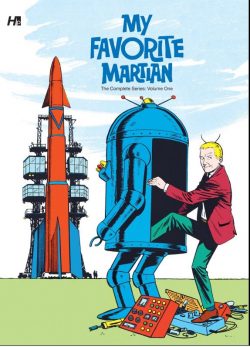
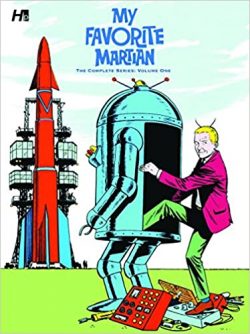
My Favorite Martian – The Complete Series Volume One


By Paul S. Newman, Bob Ogle, Russ Manning, Dan Spiegle, Sparky Moore, Mike Arens & various (Hermes Press)
ISBN: 978-1-932563-79-5(HB) eISBN 978-1-932563-79-2

My Favorite Martian debuted in America in September 29th 1963, the forerunner of a miniature golden age of fantasy-themed sitcoms that included Living Doll, Bewitched, I Dream of Jeannie, The Ghost and Mrs Muir, Nanny and the Professor and many more: all operating on the premise of a science fictional or magical character acting as disruptive outsider and playing hob with “normal” American domestic life.

Coming in at the height of the Space Race, My Favorite Martian ran for three seasons and 107 episodes – the last of which premiered in May 1966 – and particularly shone because of the laidback style, intriguing music, strong scripts and the unparalleled gifts of lead actor Ray Walston and his “straight man” young Bill Bixby. Many episodes haven’t dated at all – at least in term of gags, if not cultural attitudes, something which sadly, cannot be said of Disney’s 1999 movie reboot…

Like most successful television properties, the series spawned a ton of nifty merchandise, including a comic book (nine issues running between January 1964 and October 1966) from licensing specialists Gold Key. Here, the first five are curated in an imposing hardcover (or eBook) collection from comics-resurrection and nostalgia specialists Hermes Press. It’s especially welcome as it unearths incidences of masterful lost work from some of our industry’s biggest names…

Preceded by stunning H. Greer game box art, Kate Walston’s Foreword ‘My Dad and My Favorite Martian’ reminisces over her dad’s career, friendship with co-star Bixby and the show before a photo from the pilot episode (the volume is liberally and peppered throughout with photos) precedes Daniel Herman’s Introduction discussing the careers of ‘The Artists of My Favorite Martian’.

The writers were “King of Comics” Paul S. Newman – whose astoundingly prolific career encompassed scripts for almost every publisher in the US on titles such as The Lone Ranger, Tom Corbett – Space Cadet, Turok, Son of Stone, Dr. Solar, Patsy Walker, G.I. Combat, House of Mystery ad infinitum – and Bob Ogle, an animator and voice actor who also wrote for Gold Key’s vast stable of ties-in and TV shows such as Shirt Tales, Wheelie and the Chopper Bunch, The Kwicky Koala Show and Yogi’s Gang.

The premise of My Favorite Martian was supremely evergreen, yet smartly contemporary. The pilot episode revealed how 450-year old Martian anthropologist Exigius 12½ is marooned on Earth after his ship almost collides with experimental American rocket-plane X-15, fired from Edwards Air Force Base. The crash is observed by passing journalist Tim O’Hara who takes the alien under his wing – and into his lodgings as his Uncle Martin – until the voyager can repair his wrecked vessel.

Sadly, Tim has a nosy landlady in busybody Mrs Brown and Martin has strong opinions, incredible scientific gifts, a whole raft of uncanny powers and no luck at all…

The comic launched in January 1964 and, behind a photo-cover, was graced with artwork from one of the industry’s greatest exponents. Russ Manning (Magnus, Robot Fighter, Tarzan, Star Wars) was one of comics’ greatest stylists and perfectly caught the tone of the show in Newman’s ‘My Favorite Martian’, which adapted and reprised the origin before revealing how Tim’s scoop on the X-15 – and suppression of his meeting with Martin – lead to his being arrested by the authorities for espionage…

No sooner has the Martian finagled Tim out of a cell and cleared his name than he’s risking his new friend’s life by having them infiltrate a top-secret project in search of a fuel source necessary to power the hidden Martian ship he’s gradually rebuilding…

The romp ends with a monochrome single page gag highlighting Martin’s ability to talk to animals, probably drawn by Mike Arens.

Issue #2 carries a July 1964 cover-date and is the only one to employ an illustrated rather than photographic cover. It and the interiors that follow are by the criminally unsung Dan Spiegle, whose career was two-pronged and incredibly long. Born in 1920, Spiegle wanted to be a traditional illustrator but instead fell – after military service in the Navy – into comics at the end of the 1940s. He was equally adept at dramatic and cartoon narrative art and his portfolio includes impeccable work on Hopalong Cassidy, Rawhide, Sea Hunt, Space Family Robinson, Blackhawk, Crossfire, Nemesis, Scooby Doo, Who Framed Roger Rabbit?, Indiana Jones, the Hanna-Barbera stable and so much more.

He opens here with ‘Destination Mars’ as a well-meaning intervention by the landlady’s daughter ruins Martin’s latest fuel formulation and he is driven by frustration and loneliness to try stowing away on a robotic Mars probe built by the backward earthmen…

This is counterbalanced by a romantic flight of whimsy in ‘Priscilla Loves Melvin’ as Martin intervenes – with catastrophic effect – to reunite a lovesick zoo gorilla with her missing spouse…

Another monochrome gage strip detailing the danger of Mrs Brown’s pies segues into #3 (February 1965) with Sparky Moore (Rin Tin Tin, The Three Stooges) assuming visual control for ‘It’s a Small World’, with Martin and Tim off to Africa in search of an ancient Martian crash-site and discovering an astonishing connection to the Martian’s past! ‘Sighted! Green Monster’ reveals a startling side effect of Martian food on human physiology when Tim and Martin have a picnic in Florida and set off a E.T. panic…

Ogle took over scripting and Mike Arens (Dale Evans, Chuckwagon Charley, Roy Rogers) became regular artist with MFM #4 (May 1965), nicely balancing the drama and fantasy elements for ‘Once Upon a Ding-Ding’, wherein a trip to the Zoo and an incautious nap manifests a beloved beast of Mars from Martin’s ferociously potent, semi-autonomous subconscious with the now-traditional calamitous results, after which the visitor’s attempts to diminish his own awesome powers inadvertently revert Tim to toddler size and threaten to rejuvenate him out of existence in ‘Kid Stuff’…

This initial outing concludes with August 1965’s fifth issue, opening with ‘The Creep of Araby’, as Martin’s latest invention – a molecular duplicator – complicates and endangers Tim’s life just as he’s about to interview a desert sultan. Later, when the Martian’s escaped and now-physically realised subconscious starts recklessly granting wishes in ‘Martin’s Other Self’, Tim has to take extraordinary action to circumvent the chaos that follows…

Wrapping up the vintage wonderment, ‘Memorabilia, Photos and Publicity’ offers a collection of merchandise, art – such as colouring book covers, game and model kit boxes – and publicity stills (including show costume designs) to delight fans old and freshly-minted.

TV-themed compendia of screen-to-page magic were an intrinsic part of growing up in Britain for generations and still occur every year with only the stars/celebrity/shows changing, not the package. The show itself has joined the vast hinterland of fantasy fan-favourites immortalised in DVD and streamed all over the world, but if you want to see more, this rewarding tome is a treat you won’t want to overlook.
My Favorite Martian® © 1966-1965 and 2011 The Contingent Trust of the Jack and Florence Chertok Trust dated October 22, 1990/ Jack Chertok Television, Inc; Peter Greenwood Licensing Manager Worldwide. Reprinted with Permission. All Rights Reserved.

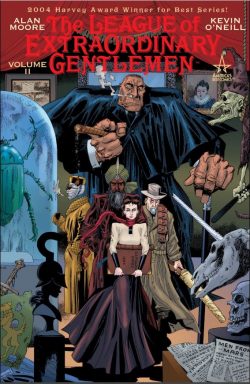
League of Extraordinary Gentlemen volume II


By Alan Moore & Kevin O’Neill & various (Americas Best Comics/WildStorm/DC)
ISBN: 978-1-4012-0118-0 (TPB)

The Victorian era saw the birth of both popular and populist publishing, particularly the genres of fantasy and adventure fiction. Writers of varying skill but possessing unbounded imaginations expounded personal concepts of honour and heroism, wedded unflinchingly to the innate belief in English Superiority. In all worlds and even beyond them the British gentleman took on all comers for Right and Decency, viewing danger as a game and showing “Johnny Foreigner” just how that game should be played.

For all the problems this raises with our modern sensibilities, many of the stories remain uncontested classics of literature and form the roadmap for all modern fictional heroes. Open as they are to charges of Racism, Sexism (even misogyny), Class Bias and Cultural Imperialism the best of them remain the greatest of all yarns.

An august selection of just such heroic prototypes were seconded – and slyly re-examined under modern scrutiny – by Alan Moore & Kevin O’Neill for a miniseries in 1999 that managed to say as much about our world as that long gone one, and incidentally tell a captivating tale as compelling as any of its antecedents.

In short succession there was an inevitable sequel, once more pressing into service vampire-tainted Wilhelmina Murray, aged Great White Hunter Allan Quatermain, Invisible Man Hawley Griffin, the charismatic genius Captain Nemo and both cultured Dr. Henry Jekyll and his bombastic alter-ego Mister Hyde. The tale also added cameos from the almost English Edwin Lester Arnolds’ Gullivar Jones, Edgar Rice Burroughs’ John Carter of Mars and even many creatures from C.S. Lewis’ allegorical sequence Out of the Silent Planet.

The idea of combining shared cultural brands is evergreen: Philip Jose Farmer in particular spun many a yarn teaming such worthies as Sherlock Holmes, Doc Savage, Tarzan and their like; Warren Ellis succumbed to similar temptation in Planetary and Jasper Fforde worked literary miracles with the device in his Thursday Next novels, but the sheer impetus of Moore & O’Neill’s para-steampunk revisionism, rush of ideas (and the stunning, startling visuals that carry them) make this book (and all the previous ones) form an irresistible experience and absolute necessity for every fiction fan, let alone comic collector…

In ‘Phases of Deimos’, as London rebuilds after the cataclysmic denouement of the previous volume, a savage planetary conflict on the fourth planet ends with the firing of gigantic projectiles at our fragile, unsuspecting world …

The barrage hits home in ‘People of Other Lands’ and the cohort of reluctant agents is on hand when hideous otherworldly invaders begin incinerating the best that Britain can offer. One of the operatives considers treachery as more cylinders arrive in ‘And Dawn Comes Up Like Thunder’ and acts upon the temptation as the incursion renders Earth’s most advanced defenders helpless…

With the Empire being dismantled by Tripods and other supra-scientific engines of destruction, ‘All Creatures Great and Small’ finds half of the chastened and dispirited agents seeking other allies and ideas, even as ‘Red in Tooth and Claw’ sees the traitor exposed and dealt with despite the inexorable advance of the Martian horde before the tide unexpectedly and shockingly turns in ‘You Should See Me Dance the Polka…’

This startlingly impressive and beguilingly effective interleaving of HG Wells’ landmark fantasy classic with the skewed but so-very plausible conceit that all the great adventurers of literature hung out together captures perfectly the feeling of a world and era ending. As one would expect, internal conflicts pull apart the champions – at no time do they ever even slightly resemble a team – and Moore’s irrepressible imagination and vast cultural reservoir dredges up a further elite selection of literary touchstones to enhance the proceedings.

Dark and genuinely terrifying, the tale unfolds largely unchanged from the original War of the Worlds plot, but a string of parallel side-stories are utterly gripping and unpredictable, whilst the inclusion of such famed and/or lost characters as Bill Samson, Doctor Moreau, Tiger Tim and even Rupert Bear (among others) sweetens the pot for those in the know.

Those who aren’t you can always consult A Blazing World: the official companion to the drama…

This book is an incredible work of scholarship and artistry recast into a fabulous pastiche of an entire literary movement. It’s also a stunning piece of comics wizardry of a sort no other art form can touch, and as with the other Moore & O’Neill collaborations there are wry visual supplements (including, activity pages, puzzles and mazes, faux ads and a board game) plus a substantial text feature – The New Traveller’s Almanac – at the back, in-filling the alternative literary history of the League.

It is quite wordy, but Read It Anyway: it’s there for a reason and is more than worth the effort as it outlines the antecedents of the assorted champions in a fabulously stylish and absorbing manner. It might also induce you to read a few other very interesting and rewarding books…
© 1999, 2000 Alan Moore & Kevin O’Neill. All Rights Reserved.

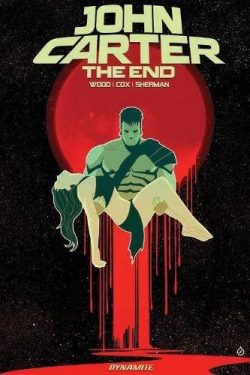
John Carter – The End


By Brian Wood, Alex Cox, Hayden Sherman, Chris O’Halloran & various (Dynamite Entertainment)
ISBN: 978-1-52410-438-2 (TPB)

Edgar Rice Burroughs is arguably the most influential fantasy author of the 20th century: a creator not just of dozens of vivid and thrilling characters and concepts but also generator of at least two distinct heroic archetypes – Tarzan and John Carter of Mars. You should read the books. Despite the inherent sexism and now-deeply uncomfortable overtones of imperialist white exceptionalism (which, to be frank, still underpin the vast majority of global heroic literature and cinema) they are rip-roaring reads packed with invention and potent power.

John Carter was the star of ERB’s first novel. Written in 1911, whilst Burroughs was almost impoverished and selling pencil sharpeners wholesale, Under the Moons of Mars appeared as a serial in adventure pulp The All-Story between February and July 1912. It was promptly ignored and forgotten. In that year’s October issue however, Tarzan of the Apes began serialisation. His meteoric success prompted the revival of Carter.

In 1917, Moons of Mars was released as a complete novel, retitled A Princess of Mars. There would be ten more books, intermittently released between 1918 and 1964 when John Carter of Mars was posthumously published.

In the first book Carter is established as a former Confederate Officer and aristocratic Gentleman of Virginia who, by arcane and inexplicable means, is astrally projected to Mars. On Barsoom, as it is called by its many indigenous races, his fighting spirit and earth-gravity conditioned body allow him to rise to the forefront of its mightiest and most noble humanoid race.

He finds eternal immortal love with incomparable warrior princess Dejah Thoris, founds a dynasty and generally crushes evil and iniquity whilst extending the dying world’s dwindling lifespan…

Although undoubtedly inspired by Edwin Lester Arnold’s 1905 novel Lieut. Gullivar Jones: His Vacation, it was Carter and his bombastic exploits which became the template for a breed of itinerant warrior wandering fantastic kingdoms with sword and/or gun in hand, battling debased science or sinister sorcery both in literature and comics.

Brawny barbarians and sleek duellists from Jirel of Joiry to Kothar, Thongor to Fafhrd & Gray Mouser to Conan, dozens of Michael Moorcock’s heroes such as Elric and Dorian Hawkmoon – not to mention ERB’s own numerous variations on the theme such as Carson Napier of Venus, David Innes of Pellucidar and so many others – all follow the same pattern: one that humanises the original mythic feats of Gilgamesh, Hercules and Beowulf…

The Warlord of Mars has become a touchstone, resource and meme-well for science fiction writers from Frank Herbert to Robert Heinlein to Moorcock. You can probably blame Burroughs and Carter for the whole Dungeons and Dragons, fantasy role playing phenomenon, too…

Comics books and strips borrowed shamelessly from John Carter. As well as appearing under his own brand, aspects of the Virginian’s look and milieu inspired and influenced Alex Raymond’s Flash Gordon, Buck Rogers, Superman, Adam Strange, Warp!, Richard Corben’s Den and countless others.

When Carter and Co made the jump to comics in his own name (in 1953 and 1964 from Dell/Gold Key as well as later iterations from DC, Marvel, Dark Horse and Dynamite), the result was – and continues – to be some of the most potent and memorable action adventures ever seen. And that’s not simply because his female co-stars are usually depicted all but naked – and yes, I know that’s what the novels describe. I say it’s not practical to wave sharp swords about whilst clad in nipple clips and hankies, and simply suggest that the stories don’t need to assume adolescent boys of all ages are the exclusive target demographic…

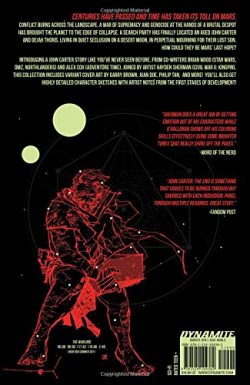
Proof of that comes in this superb addition to the modern world’s “last adventure of…” sub-genre. Written by Brian Wood (DMZ, Northlanders, Star Wars) and Alex Cox (Adventure Time) and illustrated by Hayden Sherman (The Few, Kingpin, Civil War II) and colourist Chris O’Halloran, John Carter – The End takes us far into the future when even the once-reckoned immortal Barsoomians are aged and weary.

Carter and Dejah Thoris have removed themselves from Mars and are passing their advanced years rather acrimoniously on Titan, when a ship calls them home. ‘Twilight of the Red Queen’ brings word to them that the planet is dying… and it is all Carter’s fault…

The messengers are Tharks – the four-armed Green Men of Mars – and they have come to warn of genocidal conflict on the Red Planet, sparked and fanned to full fury by the Royal Couple’s grandson. The shock is more than Dejah can bear. The cause of the ill-feeling between her and her husband is that long ago the Warlord had to put down their twisted, descendent Den Thorkar like a murderous mad dog that he was. Now the Princess of Mars realises her man didn’t have the guts to do his duty then, and leaves him to finish the job herself…

Carter follows her in ‘Apocalypse Barsoom’ and finds his beloved adopted world drenched in blood and consumed in conflict. Although both estranged lovers individually hunt the architect of Barsoom’s woes, their paths are radically different. Dejah heads straight to the capital citadel New Helium to confront the deranged ruler face to face, whilst Carter joins the Tharks’ resistance movement The Swords of Old Barsoom and meets again old ally Tars Tarkas. The noble old warrior is undergoing an incredible metamorphosis…

Planet-shaking secrets begin to unravel in third chapter ‘I’m of Your Blood, Yours and the Warlord’s…’ Dejah uncovers a web of corruption at the heart of government and the horrific truth of her pitiless great, great grandson. The chaos, carnage and catastrophe escalate in ‘The Old Man on the Ocean Floor’ as Carter learns of an ancient plot conceived by one of his vilest enemies and gains the most unexpected of allies in his proposed revolution…

The climax comes in spectacular fashion as ‘Onward to New Helium’ sets the scene for slaughter, retribution and even a measure of reconciliation…

An epic action-packed romp, John Carter – The End is far closer to the spirit of the ERB novels than almost anything I’ve seen in the last twenty years and should delight old time fans, most modern sci fi aficionados and all seekers of blockbuster dramas.

This paperback/digital collection of the 2017 miniseries also offers bonus material including design artwork and character sketches and composites by Hayden Sherman plus a covers and variants gallery by Garry Brown, Gabriel Hardman, Juan Doe, Philip Tan, Mel Rubi and Roberto Castro.
Barsoom™, John Carter™ and Edgar Rice Burroughs® owned by Edgar Rice Burroughs, Inc and used by Permission. All rights reserved.