Dash: The Case of the Mysterious Zita Makara


By Dave Ebersole, Delia Gable, Vinnie Rico, Sean Von Gorman, Tana Ford, Josh Lester & various (Northwest Press)
ISBN: 978-1-94-389055-2 (TPB) eISBN 978-1-94-389056-9

The 1930s were a golden age of fantasy fiction, particularly in the genres of pulp adventure, crime stories and supernatural horror. As such it’s a time period accessible to some degree by most modern consumers of escapist entertainment. It was also a time of great hypocrisy, social conservatism – except in the arts and politics – and enforced conformity.

All that gets a great big “So What?” in this deliriously rambunctious melange of mixed media forms wherein writer Dave Ebersole and illustrator Delia Gable finally complete their long-delayed epic tale of boozy, proudly unrepentant queer private eye Dashell Malone, who cautiously negotiates the hostile environment of pre-WWII Los Angeles and outraged former colleagues from the LAPD in search of the mystic horror that destroyed the man he loved…

It all begins in 1940 when exotic and sultry Zita Makara hires him to act as go-between in a shady deal. She is exceptionally unforthcoming with useful details and not a little annoyed at his easy resistance to her charms and attentions… much to the amusement of Dash’s sassy but efficient secretary Cindy Crenshaw…

The PI’s attention is further derailed by the return of his lover, shady ne’er-do-well Johnny Plinketts, so when his diligent investigations of Zita take him to a travelling Egyptian antiquities exhibition, Dash is totally unprepared for the appalling consequences. Dash still has friends on the force – such as patrolman Sal McGillicutty – who is there to break the shocking news that “Plink” has been found dead in incredible circumstances. Moreover, he’s not the first. LA has become the hunting grounds for a ghastly beast…

A convenient suspect for bigoted detective Bruno Perez, Dash is eventually released and falls into a depression until Cindy and Sal get him moving on finding the real killer, but before long the trail leads to an ancient Egyptian heretic cursed by the gods and an undying predator active for ages. This terror has been methodically preparing to turn back time and remake the world and Plink was not only his latest meal but also deeply involved in the plot from the start…

As events spiral and supernatural Hell inescapably comes to Earth, Dash is thrust into the role of mystic avenger and saviour of humanity, but it’s a job the grieving shamus neither wants nor feels qualified to handle…

Augmented by an effusive Introduction and appreciation from Steve Orlando, the book also includes a background-packed ‘Interlude’ from Ebersole and artist Vinnie Rico, as well as a trio of brief ‘Further Cases’.

‘The Case of the Man in the Mask’ (art by Sean Von Gorman) sees Dash dismantle a devious blackmail scheme, whilst Rico’s ‘The Case of the Best Friend on the Police Force’ traces the story of LAPD officers Malone and McGillicutty before Cindy’s origins are explored in ‘The Case of the Wisecracking Secretary’ (Rico again). Rounding up the fun is early promotional art, Afterwords and thank-yous, plus a recipe section inviting you to “make the cocktails you just read about” in ‘You Don’t Have to Drink, But If You Do… Drink Well!’

A superbly engaging romp in the manner of The (1999) Mummy whilst tipping its battered, dusty fedora to classics of film noir and latter-day pulp homages like Raiders of the Lost Ark and Hooten and the Lady, this is a splendid excursion categorically proving that not all rugged he-men get the girl in the end…
© 2020 Dave Ebersole. Dash co-created by Dave Ebersole and Delia Gable. All rights reserved.

David Boring


By Daniel Clowes (Pantheon/Jonathan Cape)
ISBN: 978-0-37540-692-8 (Pantheon HB) 978-1-022406-323-4 (Jonathan Cape PB)

One of the greatest assets of the comics medium is the ostensibly straightforward nature of its storytelling. With pictures wedded to text, what you see is so clearly what you get. So, whenever a master creator deliberately subverts that implicit convention, the result might be occasionally obscure or confusing, but is always utterly engrossing.

At the forefront of comics storytelling for almost four decades Daniel Clowes is, for many, an acquired taste. However, once he’s in your brain there’s certainly no shaking the things he can do with pen and ink, motive, character and the special kind of situational magic that inhabits the world of pictures and words on paper.

Born in Chicago in 1961, he began his career as a cartoonist with humour magazine Cracked before creating uniquely skewed short comic tales for Fantagraphics. His first piece debuted in Love and Rockets # 13 (September 1985): an introductory prelude to his retro-chic detective magazine Lloyd Llewellyn which launched soon after and ran in various incarnations for three years.

In 1989 he created anthology vehicle Eightball and began producing a variety of tales – short and serial-lengths – ranging from social satire, nostalgic absurdist anthropomorphic yarns to surreal, penetrating human dramas, all viewed through the lens of iconic popular cultures and social motifs. All that material has since been collected into graphic novels and two of these, Ghost World and Art School Confidential, have been adapted into critically acclaimed feature films.

His experiences in Hollywood combined with deep-seated childhood influences of noir movies and comics books combined and resulted in ‘David Boring’ – originally serialised in Eightball #19-21 before being collected by Pantheon Books in America and Jonathan Cape in Britain.

David Boring is the narrator of his own story, living a life of unsatisfactory gratification, harassed by his mother and obsessed by his absentee father – a second rate cartoonist and comic book artist who disappeared decades previously. David spends his days with his only real friend, a lesbian named Dot he has known since High School. David is listlessly indulging in his life’s work by searching for his perfect woman when an old friend suddenly shows up, triggering a series of bizarre events that should make his life a living action movie, but instead just steers him into increasingly unpalatable and mundane tragedies and horrors…

Set against a backdrop of impending catastrophes, ranging from murder to the end of the world, David’s progress is trenchantly plebeian and low-key: an odyssey rendered drama-free by the protagonist’s relentless lack of – or rather resistance to – passion and unwillingness to fully engage in events occurring around him.

His world is full of sexual encounters, assaults, murders, chases and even global holocausts, but he passively accepts and adapts to it all.

Clowes has stated that he crafted this stunningly engaging and challenging tale as an exercise in writing an un-filmable comic. He has, but it was still optioned by Hollywood…

This is another of those too-rare productions that shouldn’t really be reviewed, just read, with themes of adolescence, maturity, quest for self and the impending end of life delivered via a landscape of comics, film noir, mock-heroics and the irreducible knowledge that families make individuals; sublimely combining in a truly personal experience for every reader.

Be warned: the most telling narrative device used here is uncertainty. A tremendous amount of the story is left unstated: this is a saga littered with reader’s conclusions not the characters’ actions. Events are set in motion and consequences are noted, but the course of intervening actions if not experienced by David can only be surmised or extrapolated: David Boring is a protagonist with few of the overt drives of a regular narrative hero and his story is one that can’t happen to any one of us…

Brilliant, compelling, utterly wonderful? That’s up to you…
© 2000, 2002 Daniel Clowes. All rights reserved.

August Moon


By Diana Thung (Top Shelf)
ISBN: 978-1-60309-069-8 (PB)

Here’s a mysterious thing. For a while, a few years back, Diana Thung was a glittering name and shining prospect in graphic storytelling, but after two brilliant all-ages fantasy triumphs she dropped out of sight. I don’t know why – or to be honest have any right to. But it is a shame as her work was superb. I hope she’s well and happy, but I’m not going to stop recommending her delightful creations…

Thung was born in Jakarta, and grew up in Singapore before eventually settling in Australia. She is a natural storyteller, cartoonist and comics creator of sublime wit and imagination with a direct hotline to infinite thoughtscapes of childhood. Every single thing populating her astonishingly unique worlds is honed to razor sharpness and pinpoint logical clarity, no matter how weird or whimsical it might initially seem.

The sentiment is pure and unrefined; scenarios are perfectly constructed and effectively, authentically realised …and when things get tense and scary they are excessively tense and really, really scary…

After SLG published debut series Captain Long Ears in 2010, Thung catapulted to (relative) fame two years later following the release of her first graphic novel. August Moon is a magnificent blending of eastern and western comics influences that remixed many standard elements of fantasy into a superbly fresh conjunction for young and old alike.

Rendered in stunning, organically enticing black and white, the scene opens in the Asian township of Callico: an isolated little metropolis in the midst of lush jungle verdure, and a place with a few strange secrets…

Accessible only by one solitary bridge, generally cut off from the wider world by dense surrounding forests and innate unchanging dullness, the town moves at its own pace. Life is slow, existence is bucolic and the biggest deal for the people is the perennial debate over whether the strange dancing lights seen in the trees at night are actually Soul Fire dead ancestors watching over the town – or just some unexplained scientific phenomenon…

Answers start coming for a select few after ugly, business-suited strangers begin buying up empty shops for a company named Mon & Key. Some older street vendors are understandably anxious, but only Grandma and her peculiar little associate Jaden know the appalling threat these interlopers pose…

Events start spiralling out of control when the newcomers murder a hitherto unknown “animal” and news of the bizarre beast’s corpse leaks out into the wider world. The amazing discovery brings college biologist Dr. Gan back to the town his dead wife grew up in for the first time in years, dragging unhappy teenaged daughter Fiona with him.

Reluctant to be there, Fi keeps to herself; spending time snapping photos with her instamatic camera. The dull old backwater suddenly becomes far more intriguing after she captures a candid shot of a boy leaping like a grasshopper over the rooftops…

When she finally meets the incomprehensibly enigmatic Jaden, Fi is quickly drawn into his bizarre struggle against the ape-like invaders. After meeting the clandestine forest creatures who are the true source of Soul Fire, she makes their struggle her own…

The cruel and cunning interlopers of Mon & Key worship commerce and progress. Their agenda involves destroying forests to build factories. Ruthless and multi-resourced, they retaliate by killing all objectors, whilst attempting to dissuade and eventually assassinate Fi’s father.

However, with the aid of Callico’s street children – and a few clued-in, sympathetic adults like her Uncle Simon – Fi and super-powered, magic moon-boy Jaden spearhead a spirited secret war to destroy the rapacious deforestation machines of Mon & Key.

As the holiday season nears its end, the town prepares for its annual Soul Fire Festival and parade. As Mon & Key’s forces assemble for one final deforesting assault, they have totally underestimated Jaden’s resolve, Fi’s ingenuity and Callico’s communal desire to remain unchanged and unchanging…

A funny, scary, magical and thrilling modern fable, August Moon seamlessly stitches together ecological themes with beguiling myth to create a captivating tale of youthful empowerment and rebellious wonder. This is a fabulously enticing young reader’s epic every lover of comics and storytelling should take to their hearts.
© 2011 Diana Thung.

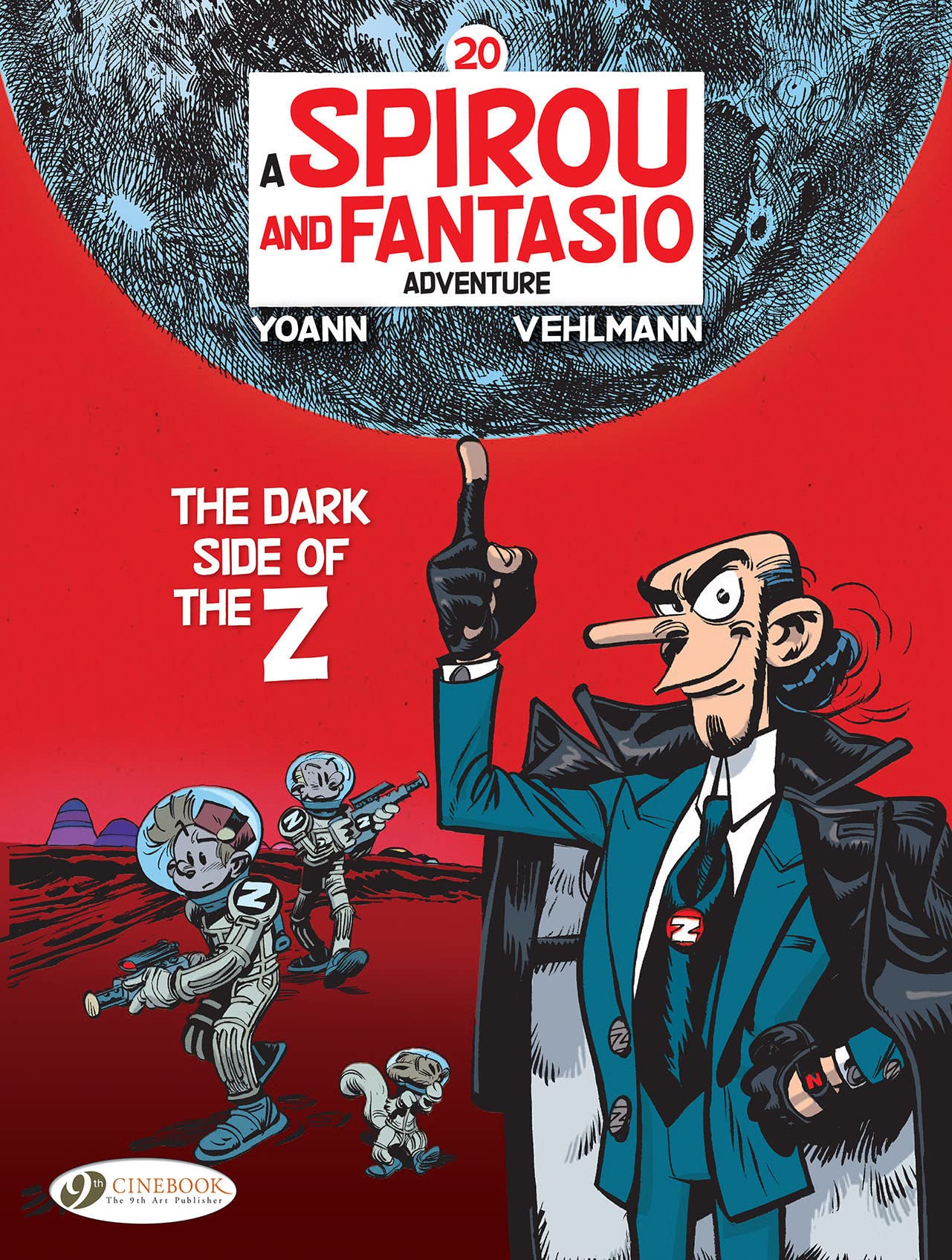
Spirou & Fantasio volume 15 – Shadow of the Z


By André Franquin, with Jidéhem & Greg; translated by Jerome Saincantin (Cinebook)
ISBN: 978-1-84918-419-9 (Album PB)

Spirou (whose name translates as both “squirrel” and “mischievous” in the tongue of the Walloons) was created by French cartoonist François Robert Velter – AKA Rob-Vel – for Belgian publisher Éditions Dupuis in response to the phenomenal success of Hergé’s Tintin at rival outfit Casterman.

The legendary anthology Le Journal de Spirou was launched on April 21st 1938 with this other red-headed lad as lead of the anthology weekly comic which bears his name to this day.

He began life as a plucky bellboy/lift operator employed by the Moustique Hotel (a reference to the publisher’s premier periodical Le Moustique) whose improbable adventures with his pet squirrel Spip eventually evolved into high-flying surreal comedy dramas.

The Spirou cast have been the magazine’s vanguard for most of its life, with a phalanx of truly impressive creators carrying on Velter’s work, beginning with his wife Blanche “Davine” Dumoulin who took over the strip when her husband enlisted in 1939. She was aided by Belgian artist Luc Lafnet until 1943 when Dupuis purchased all rights to the feature, after which comic-strip prodigy Joseph Gillain (“Jijé”) took over.

In 1946, Jijé‘s assistant André Franquin assumed the reins, slowly retiring short, gag-like vignettes in favour of longer epic adventure serials, introducing a wide and engaging cast of regulars. He ultimately devised a phenomenally popular nigh-magical animal dubbed Marsupilami, with the wondrous critter debuting in Spirou et les héritiers in 1952.

On January 3rd 1924, Belgian Franquin was born in Etterbeek. Drawing from an early age, he began formal art training at École Saint-Luc in 1943 and when the war forced the school’s closure a year later, Franquin found animation work at Compagnie Belge d’Animation in Brussels. Here he met Maurice de Bevere (Lucky Luke creator “Morris”), Pierre Culliford (AKA Peyo, creator of The Smurfs) and Eddy Paape (Valhardi, Luc Orient).

In 1945 all but Culliford signed on with Dupuis, and Franquin began his career as a jobbing cartoonist and illustrator, producing covers for Le Moustique and scouting magazine Plein Jeu. Throughout those early days, Franquin and Morris were being trained by Jijé, at that time the main illustrator at Le Journal de Spirou. He turned the youngsters and fellow neophyte Willy Maltaite – AKA Will (Tif et Tondu, Isabelle, Le jardin des désirs) – into a perfect creative bullpen known as the La bande des quatre or “Gang of Four”. They promptly revolutionised Belgian comics with their prolific and engaging “Marcinelle school” style of graphic storytelling.

Jijé handed Franquin all responsibilities for the flagship strip part-way through Spirou et la maison préfabriquée, (LJdS#427, June 20th 1946. The eager beaver ran with it for two decades, enlarging the scope and horizons until it became purely his own. Almost every week fans would meet startling new characters such as comrade and rival Fantasio and crackpot inventor the Count of Champignac.

Along the way Spirou & Fantasio became globe-trotting journalists, endlessly expanding their weekly exploits in unbroken four-colour glory. They travelled to exotic climes, exposing crimes, revealing the fantastic and clashing with a coterie of arch-enemies such as Zorglub and Zantafio and one of the first strong female characters in European comics – rival journalist Seccotine (renamed Cellophine in the current English translation).

In a splendid example of good practise, Franquin mentored his own band of apprentice cartoonists during the 1950s. These included Jean Roba (La Ribambelle, Boule et Bill), Jidéhem (Sophie, Starter, Gaston Lagaffe) and Greg (Bruno Brazil, Bernard Prince, Zig et Puce, Achille Talon), who all worked with him on Spirou et Fantasio. In 1955, a contractual spat with Dupuis saw Franquin sign up with rivals Casterman on Le Journal de Tintin, where he collaborated with René Goscinny and old pal Peyo whilst creating the raucous gag strip Modeste et Pompon. Franquin soon patched things up with Dupuis and returned to Spirou, subsequently co-creating Gaston Lagaffe (now known in Britain as Gomer Goof) in 1957, but was obliged to carry on his Casterman commitments too…

From 1959, writer Greg and background artist Jidéhem assisted Franquin, but by 1969 the artist had reached his Spirou limit. He quit, taking his mystic yellow monkey with him…

His later creations include fantasy series Isabelle, illustration sequence Monsters and bleak adult conceptual series Idées Noires, but his greatest creation – and one he retained all rights to on his departure – is Marsupilami, which, in addition to comics tales, has become a star of screen, plush toy store, console and albums.

Plagued in later life by bouts of depression, Franquin passed away on January 5th 1997, but his legacy remains: a vast body of work that reshaped the landscape of European comics.

Cinebook have published Spirou and Fantasio’s exploits since 2009, initially concentrating on Tome & Janry’s superb pastiche/homages of Franquin, with infrequent doses of the original article also available in paperback and digitally.

Here, in the sequel to Z is for Zorglub (also by Franquin, Greg & Jidéhem) we head back to 1960 for a return engagement with a super-scientific arrogant buffoon whose believes he is the rightful ruler of Earth and the solar system thanks to his discovery of the mind-bending “Zorglwave”.

Previously, the smug weirdo had used his hypnotic rays to make Fantasio one of his mind-controlled Zorglmen whilst attempting to destroy their inspirational boffin acquaintance: mushroom-mad Count Champignac. Apparently, they were at school together…

After an epic encounter, Zorglub was outwitted by Spirou, Spip and the Marsupilami, and all his grand plans scuttled, but as this volume opens our heroes are cleaning up in the generally placid hamlet of Champignac-in-the-Sticks where one last Zorglman is still prowls, armed with a paralysis ray and causing a catastrophic kerfuffle…

Sadly, no sooner do our heroes solve that problem than Zorglub himself turns up to reclaim the last of his evil machines and advanced aircraft: keen to resume his duel with the kindly Count. An inconclusive clash results in Zorglub heading off for his last hidden base – creating a shocking swathe of chaos and destruction in his wake – unaware that he has left a crucial clue.

Soon the heroic gang are off to Palombia – home of wild Marsupilami – landing just in time to become embroiled in the madman’s latest outrage: dominating the local toiletries market through his hypnotic devices. With all that operating capital, his conquest of Earth is assured…

As economic unrest drags the Palombian populace towards destitution and revolution, the Count perfects his anti-Z wave technology and our heroes’ counterattack, but unknown to all, a malicious old enemy has formed a third faction to exploit Zorglub’s grand scheme for shoddy personal gain. When he’s finally exposed, the monster resorts to the death-ray even Zorglub was too ashamed to use but has underestimated Spirou, the Count and the marvellous Marsupilami. The end is a sudden, shocking, comeuppance but we have not seen the last of Zorglub…

Stuffed with an astounding array of astonishing hi-tech spoofery, riotous chases, sight gags and verbal ripostes, this exultant escapade is a fast and fabulous fiesta of angst-free action and thrills. Readily accessible to readers of all ages and drawn with beguiling style and seductive élan, this is pure cartoon gold, truly deserving of reaching the widest audience possible.

Buy it for you, get another for the kids and give copies to all your friends…
Original edition © Dupuis, 1962 by Franquin, Jidéhem & Greg. All rights reserved. English translation 2018 © Cinebook Ltd.

Bob Powell’s Complete Jet Powers


By Bob Powell with James Vance, John Wooley, Steve Rude & various (Kitchen Sink Books/Dark Horse)
ISBN: 978-1-61655-764-5 (HB) eISBN:978-1-63008-646-6

Like every art form, comics can be readily divided into masterpieces and populist pap, but that damning assessment necessarily comes with a bunch of exclusions and codicils.

Periodical publications, like pop songs, movies and the entirety of television’s output (barring schools programming and I’m not sure about them, anymore), are designed to sell stuff to masses of consumers.

As such, the product must reflect the target and society at a specific moment in time and perforce quickly adapt and change with every variation in taste or fashion. Although very much an artefact of its time, I consider the Buzzcocks single “Ever Fallen in Love (With Someone You Shouldn’t’ve)” to be the perfect pop song, but I’m not going to waste time trying to convince anybody of the fact.

For me, and perhaps only for me, it just is.

The situation is most especially true of comics – especially those created before the medium gained any kind of popular credibility: primarily deemed by their creators and publishers as a means of parting youngsters from cash. The fact that so many have been found to possess redeeming literary and artistic merit or social worth is simply post hoc rationalisation.

Creators striving for better, doing the very best they could because of their inner artistic drives, were being rewarded with just as meagre a financial reward as the shmoes just phoning it in for the paycheck…

That sad state of affairs in periodical publication wasn’t helped by the fact that most editors thought they knew what the readership wanted – safe, prurient gratification – and usually they were right.

Even so, from such swamps gems occasionally emerged…

A certain kind of two-fisted, brawny science fiction has always been part-&-parcel of the comics experience, and retrospectives – no matter how impressive – generally come with some worrisome cultural baggage. However, ways can be found to accommodate crystallised or outdated attitudes, especially when reading from a suitably detached historical perspective and even more so for many when the art is crafted by a master storyteller like Bob Powell.

After all, even though change is gradually coming now, it’s not that big a jump from fictionalised 1950s futures to the filmic metropolises of today where tech-bolstered (and usually white) Adonises with godlike power paternalistically save us all from something unimaginable, or our own folly, whilst winning over some initially unresponsive piece of feminine exotica…

I truly adore all comics in all genres from all eras, but sometimes the “guilty pleasure” alarm on my conscience just redlines every so often and I can’t stop it. Repeat after me, it’s not real. It’s not real, it’s never been real…

As businessmen, editors and publishers “knew” what hormonal kids wanted to see and they gave it to them. It’s no different today. Peruse any comic-shop shelf or cover listings site and see how many fully-clad, small-breasted females you can spot and how many hunky heroes pack teeny-weeny pistols…

No more prevaricating. Let’s talk about Bob…

Born in 1916 in Buffalo, New York, Stanley Robert Pawlowski studied at the Pratt Institute in Manhattan before joining one of the earliest comics-packaging outfits: the Eisner-Iger Shop.

He was a solid and dependable staple of American comicbooks’ Golden Age, illustrating many key features. He drew original Jungle Queen Sheena in Jumbo Comics plus other Jungle Girl features and Spirit of ’76 for Harvey’s Pocket Comics.

Powell handled assorted material for Timely titles such as Captain America in All-Winners Comics, Tough Kid Comics and sundry genre material like Gale Allen and the Women’s Space Battalion for anthologies like Planet Comics,Mystery Men Comics and Wonder Comics.

Relatively recently he was revealed to have co-scripted/created Blackhawk as well as drawing Loops and Banks in Military Comics and so many more now near-forgotten strips: all under a variety of English-sounding pseudonyms, since, white or not, the tone of those times was unforgiving for creative people of minority origins…

Eventually the artist settled on S. Bob Powell and had his name legally changed. Probably his most well-remembered and highly regarded tour of duty was on Mr. Mystic in Will Eisner’s legendary national newspaper insert The Spirit Section. After serving in World War II, Bob came home and quit to set up his own studio. Eisner never forgave him…

Powell – with assistants Howard Nostrand, Martin Epp and George Siefringer – quickly established a solid reputation for quality, versatility and reliability. They supplied a huge variety of material for Fawcett (Vic Torry & His Flying Saucer,Hot Rod Comics, Lash Larue); Harvey Comics (Man in Black, Adventures in 3-D and True 3-D) and Street & Smith’s Shadow Comics.

Powell was particularly prolific in numerous titles for Magazine Enterprises (ME), including TV tie-in Bobby Benson’s B-Bar-B Riders, Red Hawk in Straight Arrow; a short but bombastic turn with quasi-superhero Strong Man and timely sci fi frolic Jet Powers.

A master of the human form and caricature, Powell easily turned his hand to a vast range of genre staples – War, Western, Science Fiction, Crime, Comedy and Horror material – and consequently rendered, as a by-product, some of the best and most glamorous “Good Girl art” of the era, both in comics and in premiums/strip packages for business clients.

In the 1960s, he pencilled the infamous Mars Attacks cards, illustrated Bessie Little’s Teena-a-Go-Go and the Bat Masterson newspaper strip. He ended his days drawing Daredevil, the Human Torch and Giant-Man for Marvel.

This captivating hardback compilation and electrifying eBook edition gathers all the Jet Powers appearances – some possibly written by ubiquitous jobbing scripter Gardner Fox. ME publications employed a truly Byzantine method of numbering their comicbooks, but this title is little easier than most. All Jet issues were actually part of expansive umbrella anthology vehicle A-1 comics. Jet #1 was also A-1 #30 January 1951 – cover-splashed as Jet Powers and Space Ace – whilst #2-4 were A-1 #32, #35 and #39.

It makes no real difference to your enjoyment of what’s to come but satisfies my pedantic and didactic side…

This splendid tome includes a biography ‘Bob Powell (1916-1967)’, an effusive Introduction by Steve Rude and an erudite essay – ‘My First Encounter with the Two-Fisted Brainiac Jet Powers’– by John Wooley.

Jet Powers began as a classic holdover of a pristine pulp Sci Fi concept: the scientific everyman who solves all problems with razor-sharp intellect and a something he’s just handily cobbled together. Powers was actually a cut well-above the crowd of valiantly brilliant space-jockey boffins whizzing about the funnybook cosmos in the early 1950s: a cerebral genius, true, but one who nevertheless solidly stuck to the action-adventure side of the equation, and one who was ultimately mutated by world events and political frenzy into a man unrecognisable to his earlier antecedents.

We first meet “The Master of Atoms and Molecules” in Jet #1 1951 – cover-splashed as Jet Powers and Space Ace. ‘Captain of Science!’ introduces a solitary researcher roused to action after America is wracked by shattering earthquakes. It doesn’t take him long to confirm the events are being triggered by an evil enemy somewhere in Southern Asia…

Rocketing to the sinister citadel and armed with his trusty antigravity gun, Powers finds and foils the diabolical schemes of Mr Sinn while deeply upsetting the loyalties and affections of the madman’s sultry catspaw Su Shan…

The villain tries again in ‘The Man in the Moon!’, with meteors raining down on earth directed by his satellite fortress, but is again thwarted by the Man of Science after which a marauding intelligent alien bug ravages Earth, with only Jet capable of foiling ‘The Thing from the Meteor’…

In Jet #2 (April-June), Powers tackles an invasion from the future in ‘The Three-Million-Year-Old Men!’; Su Shan is abducted by mad scientist Marlon Stone and requires rescue from deadly beasts in ‘The House of Horror!’ after which background radiation from atomic tests grant intelligence, autonomy and megalomania to a pile of scrap who allies with Mr Sinn and propagates ‘The Metal Monsters!’ it needs to conquer Earth. Calling Jet Powers…

The tech terrors continue in Jet #3, beginning with a radioactive space cloud that cuts off sunlight. Thankfully Powers has a bold plan to destroy the The Dust Doom!’ Shockingly for the era, he does not completely succeed and the series veers into post-apocalyptic dystopia…

As Earth recovers, deranged Professor Mikla unleashes biological atrocities via ‘The Devil’s Machine’, until Powers stops him. Barely pausing for breath Jet then jousts with Martians and Venusians to fend off ‘The Interplanetary War!’

Still feeling the effects of the doom-laden space dust, Earth endures ‘The Rain of Terror!’ in #4 as a cashiered general makes a bid for global domination and Jet spearheads a libertarian resistance, after which the industry trend for genre anthology sees Powers narrate the salutary tale of ‘The First Man in History Who Could Not Die!’.

Back in action for the last time as a science warrior, Jet then defeats ‘The Fleets of Fear!’ as war is rekindled by a Martian tyrant-in-waiting…

With no fanfare or warning the hero metamorphosed to follow a developing trend for anti-communist war stories, fuelled by the escalating Korean conflict. Jet morphed into The American Air Forces and, numbering maintained – #5/A-1 #45 in this instance – introduced visually identical ‘Army Air Ace Jet Powers’. Army Air Force Captain Johnny Powers is a fighter pilot from a family of fliers operating in Korea, but apparently afflicted with psychological inhibitions rendering him useless in combat. Not for long…

After a turbulent publishing year, issue #6/A-1 #54 opened 1952 in bombastic gung-ho style as Powers laments the noble, necessary sacrifice of a comrade on ‘MiG Alley Patrol’, after which #7(A-1 #58) introduces exotic fantasy as Powers and wingman Kenneth Loomis clash with murderous Red murderess Kali Soo in an ancient temple blasphemously converted into a commie fortress in ‘Whom the Gods Destroy!’

By the time of #8 (A-1 #65) comic book propaganda was in full swing as ‘Secret of the Tunnel’ lavishly adds torture, whipping and women in chains to the material Yankee kids could read. Despite being a jet ace, Powers spent a lot of time surviving crashes and battling on terra firma. After this fortuitous landing, he saves a slave girl and falls into a cavern full of North Korean ordnance he knows just how to ignite…

More of the same comes as 1952 closes as #9 (A-1 #69) finds him rescuing a downed buddy and narrowly dodging hundreds of ‘Bayonets Dipped in Blood!’, before 1953 opens with – and ends his service – in #12 (A-1 #91) with an actual aerial exploit as the fighter pilot downs a couple of MiGs, and narrowly avoids the typical Commie skulduggery of ‘The Death Trap’.

With the artistic action ended, this compelling compendium concludes with an incisive appreciation of the multi-talented hero courtesy of essay ‘The Jet Age’ by James Vance and John Wooley.

Despite my quibbles and cavils – and some genuine concerns about racial and gender holdover subtext of material produced 70 years ago – this book celebrates one of the mostly beautifully rendered characters in pictorial fiction and is a true tribute to the astounding talents of Bob Powell and his team. If you love perfect comic storytelling (of its time), but transcending fashion or trendiness, this is a treasure just waiting to be rediscovered.

Bob Powell’s Complete Jet Powers compilation © 2015 Kitchen, Lind and Associates LLC. Introduction © 2015 Steve Rude. “My First Encounter with the Two-Fisted Brainiac Jet Powers” © 2015 John Wooley. “The Jet Age” essay © 2015 James Vance and John Wooley. All rights reserved.

Yoko Tsuno volume 9: The Forge of Vulcan


By Roger Leloup (Cinebook)
ISBN: 978-1-84918-197-6 (Album PB)

The uncannily edgy yet excessively accessible European exploits of Japanese scientific adventurer Yoko Tsuno began first began gracing the pages of Le Journal de Spirou in September 1970 and are still going strong.

The explosive, eye-popping, expansively globe-girdling, multi award-winning series was devised by Roger Leloup, another hugely talented Belgian who worked as one of Hergé’s assistants on the Adventures of Tintin strip before striking out on his own.

Compellingly told, superbly imaginative but always solidly placed in hyper-realistic settings sporting utterly authentic and unshakeably believable technology, these illustrated epics were at the vanguard of a wave of strips starring smart, competent and brave female protagonists which revolutionised Continental comics from the last third of the 20th century onwards and are as potently empowering now as they ever were.

The initial Spirou stories ‘Hold-up en hi-fi’, ‘La belle et la bête’ and ‘Cap 351’ were introductory vignettes before the formidable Miss Tsuno and her always awestruck and overwhelmed male comrades truly hit their stride with premier extended saga Le trio de l’étrange which began serialisation with the May 13th 1971 issue.

That epic of extraterrestrial intrigue was the first of 30 European albums, with this one was first serialised in 1973 (Spirou #1819-1840) before being released the same year as La forge de Vulcain. A spectacular earth-shaking rollercoaster romp, it was chronologically the third album and reached us as Cinebook’s ninth translated chronicle.

It all begins when Yoko spots a TV report of a disaster on an oil rig near Martinique and realises the drill has impacted and penetrated the same strange material – “vitreous, luminous and ultra-magnetic” – that was a basic building material of the subterranean aliens known as the Vineans…

Those ancient wanderers had been secretly hibernating deep within the earth for hundreds of thousands of years until she, TV producer Vic Van Steen and his frivolous cameraman pal Pol Paris encountered them to set the lost race on a new path…

Now the Vineans seem to be at the heart of a burgeoning ecological catastrophe of cataclysmic proportions, and none too soon Yoko and the lads are winging their way to the Caribbean. Upon landing, they waste no time in bluffing their way into the offices of oil company Forex, aided by a few mementoes of their under-earth adventure.

They are, however, about to be unceremoniously ejected when news comes that the soon-to-explode rig has encountered a new problem: a strange craft, unlike any ever seen, trapped in the rig’s legs even as inexplicable seismic distortions propagate, creating an area of meteorological instability.

Yoko convinces the manager she has prior experience in matters like these and is promptly jetting over in a helicopter. Of course, she had to stow away first…

Before long she is valiantly prying a live Vinean and his scout vessel out of a boiling gusher of mud and has discerned the true scale of the threat. The rig’s drill has intercepted a Vinean magma tunnel – used in their construction projects – which has strayed too close to the oil field, triggering a potential geological time-bomb…

Thankfully the crisis has brought forth an unexpected benefit too as old friend and benevolent alien scientist Khanyarrives to take charge. The forthright technologist already has a plan but needs her old surface allies’ assistance to carry it out. Soon Yoko, Pol and Vic are abandoning the incredulous rig engineers and heading back under earth where an unpleasant surprise is awaiting them.

The Vineans had slept in huge, manufactured caverns for almost half a million years, but since recently reviving, internecine strife has entered the lives of the blue-skinned colonist/refugees.

In The Curious Trio, ambitious militaristic throwback Karpan made a play to seize power from the vast electronic complex known as The Centre which regulated the lives of the colonists. The blustering bully was ultimately frustrated by Khany and her newfound surface pals but now – thanks to humanity’s underground atomic testing – has returned to prominence amongst his terrified people and set in motion a dangerous scheme to destroy Earth’s civilisation and conquer the survivors.

Subverting a plan to divert magma and grow a new continent for the Vineans to occupy, Karpan wants to use the colossal magma-shifting technology to drown the surface world. Khany and her followers were already attempting to scuttle the scheme, but now grim fortune and the humans’ drill have damaged the super-engineered magma-tubes, a drastic solution is necessary to save the planet both species occupy from exploding like a cosmic firecracker…

Naturally Yoko has a plan, but this one depends as much on luck as her scientific ingenuity and martial arts prowess as she tries to mould lava like plasticine and thwart Karpan’s globally suicidal schemes…

As always, the most potent asset of these breathtaking dramas is the staggeringly detailed draughtsmanship, which benefits from Leloup’s diligent research and meticulous attention to detail, honed through years of working on Tintin.

Possibly the most frenetic and visually spectacular of all her adventures, The Forge of Vulcan is a relentless, rocket-paced race to doom or salvation that will appeal to any fan of blockbuster action fantasy.
Original edition © Dupuis, 1973, 1979 by Roger Leloup. All rights reserved. English translation 2014 © Cinebook Ltd.

Yakari volume 17: The Snow Bird


By Derib & Job, coloured by Dominique and translated by Jerome Saincantin (Cinebook)
ISBN: 978-1-84918-460-1 (Album PB)

Children’s magazine Le Crapaud à lunettes was founded in 1964 by Swiss journalist André Jobin who then wrote for it under the pseudonym Job. Three years later he hired fellow French-Swiss artist Claude de Ribaupierre AKA “Derib”. The illustrator had launched his own career as an assistant at Studio Peyo (home of Les Schtroumpfs), working on Smurfs strips for venerable weekly Le Journal de Spirou. Together they created the splendid Adventures of the Owl Pythagore before striking pure comics gold a few years later with their next collaboration.

Derib – equally au fait with enticing, comically dynamic “Marcinelle” cartoon style yarns and devastatingly compelling meta-realistic action illustrated action epics – went on to become one of the Continent’s most prolific and revered creators. It’s a crime that groundbreaking strips such as Celui-qui-est-né-deux-fois, Jo (the first comic ever published dealing with AIDS), Pour toi, Sandra and La Grande Saga Indienne) haven’t been translated into English yet, but we still patiently wait in hope and anticipation…

Many of Derib’s stunning works over the decades feature his cherished Western themes; magnificent geographical backdrops and epic landscapes. Yakari is considered by fans and critics to be the strip which first led him to deserved mega-stardom.

Debuting in 1969, Yakari follows the life of a young Oglala Lakota boy on the Great Plains; set sometime after the introduction of horses by the Conquistadores but before the coming of modern Europeans.

The series – which has generated two separate TV cartoon series and a movie release – has achieved 40th albums: a testament to the strip’s evergreen vitality and the brilliance of its creators, even though originator Job has moved on and Frenchman Joris Chamblain has assumed the writer’s role from 2016.

Overflowing with gentle whimsy and heady compassion, young Yakari enjoys a largely bucolic existence: at one with nature and generally free from privation or strife. For the sake of our delectation, however, the ever-changing seasons are punctuated with the odd crisis, generally resolved without fuss, fame or fanfare by a little lad who is smart, brave… and can – thanks to the boon of his totem guide the Great Eagle – converse with all animals …

Originally released in 1992, L’osieau de niege was the 18th European album, but – as always with the best books – the content and set-up are both stunningly simple and effectively timeless, affording new readers total enjoyment with a minimum of familiarity or foreknowledge required…

This time, the little wonder willingly yields focus to human companion Rainbow as the kids idly play at the debilitating heights of the summer. They are confined to one of the capacious rawhide tipis thanks to a sudden deluge when the storm suddenly picks up the entire tent – floor and all – and whisks them away into the sky…

The tipi heads steadily north at high altitude and eventually lands in frozen tundra where old pal and mystic spirit rabbit Nanabozho is waiting. He’s summoned them for fun and adventure…

Rapt in wonder, the little girl soon befriends a lemming and saves him from a hunting snowy owl before she and Yakari are separated. A long search for each other finds them exhausted and baffled as the sun never goes down…

After a long nap on the too-bright plains, Yakari has a long chat with the giant owl and joins an army of lemmings as they cross a stream. Rainbow, meanwhile, is caught in a similar migration, but the reindeer she’s wandered into are far larger and determined. Before long she’s been carried with them and dumped in a raging river. Thankfully, the owl is soaring above and drags her out before she can drown…

Reunited at last, the little wanderers seek out their tipi, and befriend a herd of musk oxen just as a snap snowstorm hits. Not only do the mighty beasts warm them until it passes, but they’re quite protective when a hungry and inquisitive pack of wolves considers them as the next meal…

When Nanabozho pops up again, the general consensus is that it might be time to return, but as the tipi takes off, the kids realise they have a stowaway…

Exotically enticing, deviously educational and wildly entertaining, this cheery travelogue of natural wonders allows Derib & Job full rein to display their astounding and compelling narrative virtuosity: a glorious graphic tour de force capturing the appealing courage of our diminutive heroes, and a visually stunning, seductively smart and happily heart-warming saga to delight young and old alike.

Yakari is one of the most unfailingly absorbing all-ages strips ever conceived and should be in every home, right beside Tintin, Uncle Scrooge, Asterix and The Moomins.
Original edition © Derib + Job – Editions du Lombard (Dargaud- Lombard s. a.) 2000. English translation 2019 © Cinebook Ltd.

Red Range: A Wild West Adventure


By Joe R. Lansdale, Sam Glanzman & various (It’s Alive!/IDW)
ISBN: 978-1-63140-994-3 (HB)

Once upon a time, not that very long ago, nearly all of popular fiction was obsessed with tales of Cowboys and Indians. As always happens with such periodic popular phenomena – for example the Swinging Sixties’ Superspy and Batmania booms or the recent trend for Vampire and/or Werewolf Boyfriends – there was a tremendous amount of momentary merit, lots of utter dross and a few irrefutable gems that would affect public tastes from then on.

Most importantly, once such surges have petered out, there’s generally a small cadre of frustrated devotees who mourn its passing and, on growing up, resolve to do something to venerate or even revive their lost and faded favourite fad…

Following World War II, the American family entertainment market – for which read comics, radio and the nascent but burgeoning television industry – became comprehensively enamoured of the clear-cut, simplistic sensibilities and easy, escapist solutions offered by the antiseptic anodyne branch of Tales of the Old West; already a firmly established favourite of paperback fiction, movie serials and feature films.

I’ve often pondered on how almost simultaneously a dark, bleak, nigh-nihilistic and oddly left-leaning Film Noir genre quietly blossomed alongside that wholesome revolution, seemingly for the cynical minority of entertainment intellectuals who somehow knew that returned veterans still hadn’t found a Land Fit for Heroes… but that’s a thought for another time and a different review.

Even though comic books embraced six-gun heroes from the very start – there were cowboy crusaders in the premier issues of both Action Comics and Marvel Comics – the post-war years saw a vast outpouring of anthology titles with new gun-slinging idols to replace the rapidly-dwindling supply of costumed Mystery Men, and true to formula, most of these pioneers ranged from transiently mediocre to outright appalling. And they were all white.

With every comics publisher turning hopeful eyes westward, it was natural that most of the historical figures would quickly find a home and of course facts counted little, as was always the case with cowboy literature…

Despite minor re-flowerings in the early 1970s and mid-1990s, for the longest time cowboy comics largely vanished from graphic pages: seemingly unable to command enough mainstream commercial support to survive the crushing competition of garish wonder-men and the furiously seductive future-scapes.

Europe and Britain heartily embraced the Sagebrush zeitgeist, producing some pretty impressive work, with France and Italy eventually making the genre their own by the end of the 1960s. They still make the best straight Western strips in the world…

Happily, however, an American revolution in comics retailing and print technologies at the end of the 20th century allowed fans to create and disseminate relatively inexpensive comic books of their own and – happier still – many of those fans are incredibly talented creators in other genres. A particularly impressive case in point is this captivating lost treasure originally published by independent, creator-led outfit Mojo Press.

The brainchild of Richard Klaw (publisher, reviewer, essayist, writer, historian and self-confessed geek maven), the little outfit published amazing and groundbreaking horror, fantasy, science fiction and Western graphic novels – plus some prose books – between 1994 and their much-lamented demise in 1999.

As revealed in Klaw’s informative Introduction ‘When Old is New and New Old‘, Red Range was probably their most controversial release: an uncompromising adventure tale and deftly-disguised (a tad too much so, apparently) attack on contemporary racism and institutionalised bigotry, astoundingly couched as an ultra-violent cowboy revenge yarn.

Originally published in stark monochrome in 1999, Joe E. Lansdale & Sam Glanzman’s amazing unfinished odyssey was remastered and adapted to full-colour (courtesy of Jorge Blanco & Jok and letterer Douglas Potter) and given a new lease of life in this sublime hardcover/digital edition, just as America’s worst President seemed set to return the nation to those days of implicit supremacism, casual segregation and wealth-based Jim Crow laws…

A Word of Warning: if your sensibilities and senses are liable to freak out at profoundly yet historically accurate scenes of violence or repeated use of the “N” word as used by drawn representations of murdering racist bastards in white sheets, don’t buy this book. Actually, do buy it; just don’t whine that you weren’t warned…

Texas in the late 19th century: a band of Klansmen brutally torture a black family who have the temerity to buy land and plant crops. The ignorant butchers’ repugnant fun is mercilessly interrupted when a masked negro vigilante known as TheRed Mask attacks, killing many and driving off their leader Batiste.

The unlikely avenger is too late to save the parents, but takes their son Turon under his wing. As they ride to his hideout, the lone rider confides in his youthful new companion. Caleb Range‘s story is appallingly similar to the boy’s own tragedy. It’s probably one repeated hundreds of times every day in America since the Black Man was first emancipated…

Back in town, Batiste recruits a specialist tracker and plenty more white men eager to teach “coloureds” their rightful place. Hunting down Red Mask, the bigot again underestimates his quarry’s determination and facility with weapons…

Angry, frustrated and humiliated, Batiste gathers yet more men and sets out to end his nemesis forever. Relentless pursuit leads into the desert wastes and straight out of any semblance of rationality as Caleb and Turon survive one more cataclysmic battle before falling into a lost world of ancient tribes and ravenous dinosaurs, with Batiste and his few surviving killers hard on their heels…

In this place however, it’s the so-superior white men who are seen as less than human by the indigenous inhabitants: nothing more than prey and provender. Regrettably, they hold pretty much the same opinion regarding Caleb and Turon, who quickly discover they might not just be lost in space but also time…

To Be Continued…

Vivid, shocking, staggeringly exciting, ferociously uncompromising and often outrageously, laugh-out-loud funny, Red Range has both message and moral, but never for a moment lets that stand in the way of telling a great story.

Adding value and enlightenment, this opening chapter in an extended saga is augmented by ‘Beneath the Valley of the Klan Busters: (A Sort of) Afterword by Stephen R. Bissette’ which offers historical and social context to the proceedings and inside gen on creators Lansdale & Glanzman, as well as a potted history of the role of black people in western movies from 1920s star-turn Bill Pickett to Jamie Foxx in Django Unchained.

The bonus goodies continue with a silent monochrome masterpiece of action and bleak, black humour. ‘I Could Eat a Horse!’ was first seen in Wild West Show (1996) with the artist displaying a firm grip of both killer slapstick and grim irony as Cowboy, Indian and other beasts go in search of a meal, before Bissette rides us into the sunset with an erudite and fascinating trip down memory lane for “Pop Culture Cowpokes and Carnosaurs” with ‘A Brief History of Cowboys & Dinosaurs’…

These fresh looks at an overexposed idiom prove there’s still meat to found on those old bones, and cow-punching aficionados, fans of nostalgia-tainted comics and seekers of the wild and new alike can all be assured that there’s a selection of range-riding rollercoaster thrills and moody mysteries still lurking in those hills and on that horizon…
Red Range: A Wild West Adventure © 1999-2017 Joe R. Lansdale. “I Could Eat a Horse” © 2017 Sam Glanzman. “When Old is New and New Old” © 2017 Richard Klaw. “Beneath the Valley of the Klan Busters” and “A Brief History of Cowboys & Dinosaurs” © 2017 Stephen R. Bissette. All rights reserved.

Benny Breakiron volume 3: The Twelve Trials of Benny Breakiron


By Peyo, with Yvan Delporte & Walthéry, translated by Joe Johnson (Papercutz/NBM)
ISBN: 978-1-59707-492-6 (HB Album)

Pierre Culliford was born in Belgium in 1928 to a family of British origin living in the Schaerbeek district of Brussels. An admirer of the works of Hergé and American comics licensed to Le Journal de Mickey, Robinson and Hurrah!, he developed his own artistic skills but the war and family bereavement forced him to forgo further education and find work.

After time spent toiling as a cinema projectionist, in 1945 Culliford joined C.B.A. animation studios, where he met André Franquin, Morris and Eddy Paape. When the studio closed, he briefly studied at the Brussels Academy of Fine Arts before moving full-time into graphic advertising. In his spare time, he began submitting comic strips to the burgeoning post-war comics publishers.

His first sale was in April 1946: Pied-Tendre, a tale of American Indians in Riquet, the comics supplement to the daily L’Occident newspaper. Further sales to other venues followed and in 1952 his knight Johan found a permanent spot in Le Journal de Spirou. Retitled Johan et Pirlout, the strip prospered and in 1958 introduced a strange bunch of blue woodland gnomes to the tale. They were called Les Schtroumpfs.

Culliford – by now using nom de plume Peyo – would gradually turn those adorable little mites (known to us and most of the world as The Smurfs) into an all-encompassing global empire, but before being sucked onto that relentless treadmill, he still found time to create a few other noteworthy strips such as the titanic tyke on view here today.

In 1960, Benoît Brisefer – AKA Benedict Ironbreaker and/or (in Dutch) Steven Sterk – debuted in Le Journal de Spirou #1183 (December 1960). With a few slyly added tips of the hat to Siegel & Shuster’s Superman, the wryly bucolic adventures celebrated a small boy with superhuman strength living in a generally quiet and unassuming little Belgian town.

Quiet, well-mannered, gentle and a little lonely, Benny just happens to be the mightiest boy on Earth; able to crush steel in his tiny hands, leap huge distances and run faster than a racing car. He is also generally immune to all physical harm, but his fatal and rather ubiquitous weakness is that all his strength deserts him whenever he catches a cold…

Benny never tries to conceal his abilities but somehow no adults ever catch on. They generally think he’s telling fibs or boasting, and whenever he tries to prove he can bend steel in his hands, the unlucky lad gets another case of the galloping sniffles…

Most kids avoid him. It’s hard to make friends or play games when a minor kick can pop a football like a balloon and a shrug can topple trees…

Well-past-it Brits of my age and vintage might remember the character from weekly comics in the 1960’s. As Tammy Tuff – The Strongest Boy on Earth – and later as Benny Breakiron and Steven Strong – our beret-wearing champion appeared in Giggle and other periodicals from 1967 onwards.

With Peyo’s little blue cash-cows taking up ever larger amounts of his concentration and time, other members of his studio assumed greater responsibilities for Benoît as the years passed. Willy Maltaite (“Will”), Gos, Yvan Delporte, François Walthéry and Albert Blesteau all pitched in and Jean Roba created many eye-catching Spirou covers, but by 1978 the demands of the Smurfs were all-consuming and all the studio’s other strips were retired.

You can’t keep a good super-junior down, though, and after Peyo’s death in 1992, his son Thierry Culliford and cartoonist Pascal Garray revived the strip, adding six more volumes to the eight generated by Peyo and his team between 1960 and 1978.

Thanks to the efforts of US publisher Papercutz, the first four of those gloriously genteel and outrageously engaging power fantasies are available to English-language readers – both as robust full-colour hardbacks and as all-purpose eBooks – and this third exploit begins in the sedate city of Vivejoie-la-Grande, where the kid goes about his solitary life, doing good deeds in secret and being as good a boy as he can….

During the annual fair, his elderly friend Monsieur Dussiflard meets an old chum from their days in a jazz band. In the course of catching up, they learn that another mutual pal has become emir of an Arabian kingdom. Long ago, he gave the members of the band a charter granting them rights to a piece of desert… one that is now worth billions in oil revenues…

Back then, the comrades thought it hilarious to scrupulously divide the precious paper into nine parts, but none of them ever threw way their scrap…

As the adults chat and Benny listens, dark deeds are underway. Dussiflard’s home is burgled, triggering a frantic race around the world, with our heroes one step behind a cunning mastermind who will baulk at nothing to secure the entire document and the riches it promises…

All over the globe, Little Benny performs a succession of incredible feats – each one completely missed by Dussiflard and his beleaguered Jazz men – to stymie the malevolent schemer, before arriving home to deal the villain his just desserts…

Fast-paced, wry and sporting a fine eye for the dafter side of super-heroics, this is another fabulously winning fantasy about childhood validation and agency, providing a wealth of action, thrills and chortles for lovers of incredible adventure and comics excellence.
© Peyoâ„¢ 2013 – licensed through Lafig Belgium. English translation © 2013 by Papercutz. All rights reserved.

The Bluecoats volute 5: Rumberley


By Willy Lambil & Raoul Cauvin, translated by Erica Jeffrey (Cinebook)
ISBN: 978-1-84918-108-2 (Album PB)

The myths and legends of the cinematic American West have fascinated Europeans virtually since the actual days of stagecoaches and gunslingers. Hergé and Moebius were passionate devotees and the wealth of stand-out Continental comics series ranges from Italy’s Tex Willer to such Franco-Belgian classics as Blueberry and tangential all-ages classics such as Yakari. Even colonial dramas such as Pioneers of the New World and Milo Manara & Hugo Pratt’s Indian Summer fit the broad-brimmed bill.

As devised by Louis “Salvé” Salvérius & Raoul Cauvin – who has scripted the first 64 best-selling volumes until his retirement in 2020 – Les Tuniques Bleues (The Bluecoats) debuted at the end of the 1960s, specifically created to replace Lucky Luke when the laconic maverick defected from weekly anthology Le Journal de Spirou to rival publication Pilote.

The substitute swiftly became one of the most popular bande dessinée series in Europe.

Salvé was a cartoonist of the Gallic big-foot/big-nose humour school, and when he died suddenly in 1972 his replacement, Willy “Lambil” Lambillotte slowly introduced a more realistic – but still overtly comedic – illustrative tone and manner. Lambil is Belgian, born in 1936 and, after studying Fine Art in college, joined publishing giant Dupuis in 1952 as a letterer.

Born in 1938, scripter Cauvin is also Belgian and before entering Dupuis’ animation department in 1960 studied Lithography. He soon discovered his true calling – comedy writing – and began a glittering and prolific career at Spirou. In addition to Bluecoats he scripted dozens of long-running, award winning series including Cédric, Les Femmes en Blanc and Agent 212: more than 240 separate albums. The Bluecoats alone has sold more than 15 million copies of its 65 (and counting) album sequence.

Our sorry, long-suffering protagonists are Sergeant Cornelius Chesterfield and Corporal Blutch; a pair of worthy fools in the manner of Laurel & Hardy: hapless, ill-starred US cavalrymen posted to the wild frontier and various key points of fabled America during the War Between the States.

The original format featured single-page gags set around an Indian-plagued Wild West fort, but from the second volume Du Nord au Sud, the sad-sack soldiers went back East to fight in the American Civil War (a tale was rewritten as 18thalbum Blue retro to describe how the chumps were drafted during the war). Every subsequent adventure, although often ranging far beyond America and taking in a lot of thoroughly researched history, is set within the timeframe of the Secession conflict.

Blutch is your run-of-the-mill, whinging little-man-in-the street: work-shy, mouthy, devious and especially critical of the army and its inept commanders. Ducking, diving, even deserting whenever he can, he’s you or me – except sometimes he’s quite smart and heroic if no other (easier) option is available.

Chesterfield is a big burly professional fighting man; a career soldier who has passionately bought into all the patriotism and esprit-de-corps of the Military. He is brave, never shirks his duty and wants to be a hero. He also loves his cynical little troll of a pal. They quarrel like a married couple, fight like brothers and simply cannot agree on the point and purpose of the horrendous war they are trapped in…

Rumberley was the fifth translated Cinebook album (chronologically the 15th European volume) and a far darker affair than usual. After a horrific battle, Union and Confederate forces are spent and exhausted, although the Blues have advanced far into the South as a result of the sustained slaughter. However, with dwindling food and little ammunition, the Generals opt to fall back and re-supply with fresh troops and munitions. The only problem is what to do with the wounded. After all, bringing them back to safety would only slow down the rearward advance. Then one bright, over-privileged spark has the notion of just billeting the unusable Union soldiers on the nearest – albeit enemy – town…

Amongst the dead and dying are grievously injured Chesterfield and war-crazy Captain Stark. Even Blutch is there, but his leg wound might be minor, self-inflicted or possibly utterly bogus…

Their reception by the women, children, aged and infirm of Rumberley is hostile to say the least, but the Union dregs have no place else to go and no strength left to leave anyway. Forcibly appropriating the livery stable as a field hospital, Blutch and Chesterfield aid the exhausted doctors and surgeons as best they can, but the simmering tensions and occasional assaults by the townsfolk indicates there is real trouble brewing and this kettle is about to boil over very soon…

And then the townsfolk start drifting away. Rumours spread that a Confederate force is approaching Rumberley. The doctors try to move their charges out, and Blutch finds himself in the uncanny position of staying behind as rearguard when Chesterfield decides to buy them time to get away…

When it comes, the battle is a bizarre affair. The Rebels are fit but have little ammunition so the Bluecoats give a good accounting of themselves, but are almost done for when Stark unexpectedly leads a life-saving cavalry charge of the Union wounded to save them. During the insane clash, town buildings are set afire and the citizens of Rumberley rush back to save their home and possessions.

And then something strange happens: the killing stops and Blues, Greys and civilians work together to save rather than destroy…

This is a hugely amusing anti-war saga targeting younger, less world-weary audiences. Historically authentic, and always in good taste despite an uncompromising portrayal of violence, the attitudes expressed by our down-to-earth pair never make battle anything but arrant folly and, like the hilarious yet insanely tragic war-memoirs of Spike Milligan, these are comedic tales whose very humour makes the occasional moments of shocking verity doubly powerful and hard-hitting.

Funny, thrilling, beautifully realised and eminently readable, Bluecoats is the sort of war-story and Western which appeals to the best, not worst, of the human spirit.
© Dupuis 1979 by Lambil & Cauvin. English translation © 2011 Cinebook Ltd. All rights reserved.