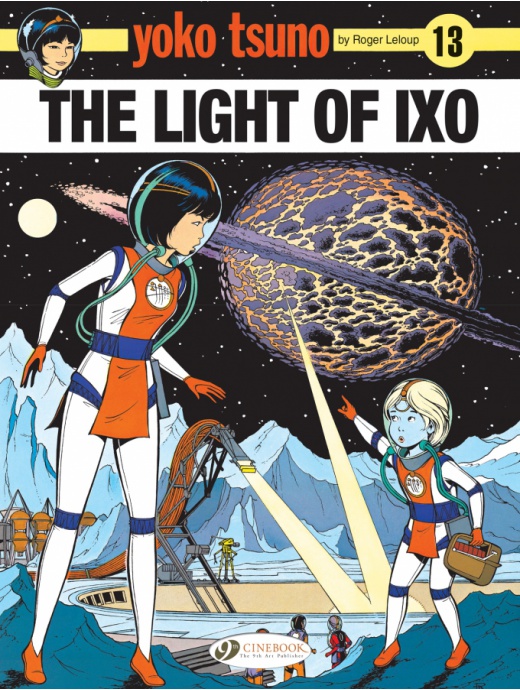
Yoko Tsuno volume 13: The Light of Ixo


By Roger Leloup, coloured by Beatrice/Studio Leonardo, translated by Jerome Saincantin (Cinebook)
ISBN: 978-1-84918-392-5 (Album PB)

Indomitable intellectual adventurer Yoko Tsuno began her career in Le Journal de Spirou in 1970 and is still delighting regular readers and making new fans to this day. Her astounding, all-action, excessively accessible adventures are amongst the most intoxicating, absorbing and broad-ranging comics thrillers ever created.

The globe-girdling, space-&-time-spanning episodic epics starring the Japanese technologist-investigator were devised by monumentally multi-talented Belgian maestro Roger Leloup, who began his own solo career after working as a studio assistant on Herge’s Adventures of Tintin.

Compellingly told, superbly imaginative and – no matter how implausible the premise of any individual yarn may appear – always firmly grounded in hyper-realistic settings underpinned by authentic, unshakably believable technology and scientific principles, Leloup’s illustrated escapades were at the vanguard of a wave of strips revolutionising European comics in the mid-1970s.

That long-overdue sea-change heralded the rise of competent, clever and brave female protagonists taking their rightful places as heroic ideals; elevating Continental comics in the process. Happily, most of their endeavours are as timelessly engaging and empowering now as they ever were, and none more so than the trials and tribulations of Miss Tsuno.

Her very first outings (the still unavailable Hold-up en hi-fi, La belle et la bête and Cap 351) were simple introductory vignettes before the superbly capable electrical engineer and her valiant if less able male comrades Pol Paris and Vic Van Steen properly hit their stride with premier full-length saga Le trio de l’étrange in 1971 with Spirou’s May 13th issue…

Yoko’s exploits include explosive exploits in exotic corners of our world, time-travelling jaunts and sinister deep-space sagas – such as this one – with our human troubleshooters working beside the disaster-prone alien colonists of planet Vinea beside devoted best friend Khany: a competent, commanding single mother who combines parenting her toddler Poky with saving worlds, leading her people and chasing cosmic adventure…

There have been 30 European albums to date and today’s tale originally debuted in 1980 as La Lumière d’Ixo, technically the 10th Yoko Tsuno exploit and the fifth to feature the extraterrestrial Vineans. It appears here via UK translation powerhouse Cinebook, offering an interstellar mystery of beguiling power and confirming the dreadful menace of faith in the hands of ruthless manipulators…

In their first outing together, Yoko, Vic and frivolous Pol discovered a pocket of dormant extraterrestrials hibernating for eons in the depths of the Earth. After freeing them from robotic tyranny, the valiant humans occasionally helped the alien refugees (who had fled their own planet two million years previously) rebuild their lost sciences, before ultimately accompanying them on their return to their own star system and presumed-dead homeworld. As the Vineans rebuilt their civilisation and culture, the humans became regular guests…

On this excursion, the trio join an exploratory mission to distant moon Ixo. In ages past, it was a dumping ground for lethal toxic wastes, uncontrollable superweapons and other deadly discoveries, but since reclaiming their homeworld, the Vinean refugee/re-colonisers have observed periodic flashes of luminescence from what should be nothing but a dead ball of ice and rock. Now, the humans, Khany and her ever-present Poky join a science team seeking answers…

As the expedition travels across the eerily beautiful frozen vacuum of the moon, they discover a hidden sub-surface enclave of enigmatic survivors dedicated to a staggering goal. In the millions of years the Vineans slept in the depths of Earth, their primary civilisation collapsed. One of the greatest casualties was a neighbour planet used to house rebels and exiles, which at some distant time was reduced to a field of space debris.

For eons now, the banished dwellers of surviving self-contained orbital city Shyra have been harvesting energy on Ixo and transmitting it at the rubble, where it has been utilized to slowly reconstruct the broken world.

Tragically, the vast generational task has devolved into a holy crusade, governed by dogma and superstition. As an age-old power struggle between engineers and priests reaches boiling point, Khany and her human companions are captured and impressed into service. Plunged right into the heart of the clash, with hostile forces all around, the deeply empathic Yoko overcomes all odds and opposition: dethroning two minor dictators while perfecting the colossal concave ice mirror used to beam power across space to the shattered world, and even brokers a tenuous peace between Vinea and the Shyrans who have for millions of years considered their sister world a demonic, implacable enemy…

Gripping and visually spectacular, The Light of Ixo combines hard science with tense drama and a soupcon of social criticism: delivering another terse, action-packed, “Big Sky” sci fi thriller, once again magnified into magnificence by the astonishingly compelling and staggeringly detailed draughtsmanship and storytelling of Leloup.
Original edition © Dupuis, 1980 by Roger Leloup. All rights reserved. English translation 2018 © Cinebook Ltd.

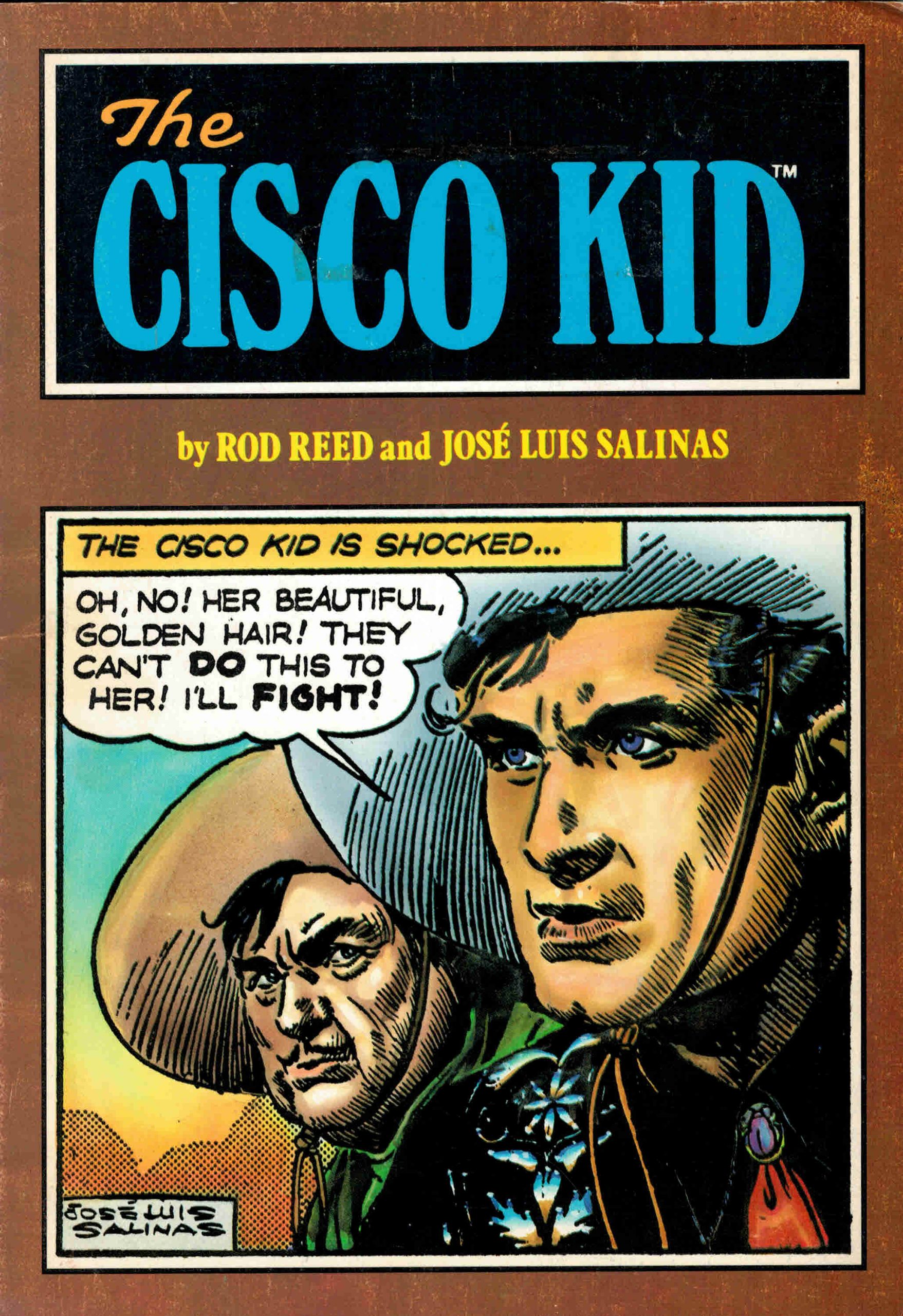
The Cisco Kid™ 


By Rod Reed & José Luis Salinas (Ken Pierce Books) 

ISBN: 0-912277-00-9 (PB) 

As with so many classic mass-media heroes, The Cisco Kid began as charismatic villain. Created by O. Henry for short prose tale “The Caballero’s Way”, he first appeared in Everybody’s Magazine in July 1907, and was included in the author’s anthological collection Heart of the West, which was published in the same year. 

Gone but not forgotten, The Kid returned and was gradually rehabilitated via a series of 27 films spanning 1914-1950; a radio serial running from 1942-1956; a one shot comic book in 1944 and – most crucially – a TV series (the first ever shot in colour) comprising 156 episodes, which spanned 1950-1956. Those latter media milestones in particular spawned a Dell Comics series (41 issues from 1950-1958) and informed a spectacular and beautiful comic strip licensed by King Features Syndicate which ran in numerous newspapers and across the world from 1951 to 1968. 

The hero is a dashing Mexican roaming the American west like the Lone Ranger, righting wrongs for no appreciable reason or reward. His comedy sidekick Pancho is fat, jolly, and eternally anxious, but also smart, deceptively brave and extremely capable: a rare example of positive depictions of Latino characters at that time or even by most modern examples… 

In the end, every effort of so many creators across the mass-communications divide couldn’t much help as increasingly polarized views about minorities pretty much cemented a certain view of Mexican characters in American public opinion in the 1960s and 1970, but at least our guys always were heroes, not low-grade villains, and lazy language stereotyping was kept to an absolute minimum.  

Cisco and Pancho spoke floridly, but never like Speedy Gonzales…  

This strip feature, like so many beautiful examples of western adventuring, has been all but forgotten today, but holds up remarkably well in terms of modern sensibilities …and as I’ve indicated, it is so very, very beautifully drawn.  

This impossible-to-find collection comes courtesy of pioneering comics archivist Ken Pierce, whose one-man campaign to preserve the best of newspaper strips throughout the 1970 and 1980s (Abbie an’ Slats; Axa; Danielle; Fred Kida’s Valkyrie) resulted this slim single volume of monochrome daily episodes, fronted by writer Rod Reed’s evocative Introduction. Reed was a veteran golden age scripter whose best work was for Fawcett and Quality Comics, and in the five stories re-presented here (covering January 17th to May 4th 1950), he ingeniously blends traditional family entertainment/action with wry wit and a devilishly wicked sense of the absurd… 

The writing is top notch but the true joy comes from the stunning draughtsmanship and graphic empathy of the illustrator. José Luis Salinas (February 11, 1908-January10, 1985) was Argentinian, beginning as an advertising artist before moving into comics El Tony and Paginas de Columba. In 1936 he created his first strip. Hernán el Corsario in Patoruzu was followed by many more classic adventure escapades. In 1949, he began working for American enterprise King Features Syndicate, who eventually partnered him with Reed. Their partnership – and the strip – lasted eighteen years, and apparently they never ever met or even corresponded even once… 

Individual storylines very much mirror TV episodes of any western of the era – like Hopalong Cassidy, Champion the Wonder Horse; Gunsmoke, Bonanza or the aforementioned Lone Ranger and all the usual tropes are in play, but thanks to Reed’s deft touches and Salinas’ skill, what might to us seem cliched, still sparkles with verve and vivacity… 

The dramas launches with ‘The First Story’ as the heroes help feisty rancher Lucy Baker uncover a swindle perpetrated by the local judge. His malfeasance is initially uncovered because he won’t allow “the wimmen-folk” vote on his new dam project, but all too soon it devolves into murder plots, frantic horse-chases and plenty of gunplay… 

‘The Deadly Stage Ride’ then sees the nomads save a failing stage coach company by replacing the driver and shotgun guard. Even if they had known sinister mastermind The Jagged Dagger was behind the campaign of sabotage and robbery, it would not have stopped them doing the right thing…  

Humour is paramount in ‘The Artist’ as French painter François Palette arrives, determined to capture the action and glamour of the Wild West and its great heroes – like Wyatt Earp, Bat Masterson, and The Cisco Kid – only to become the target of a fugitive Barbary Bill: a bullying thug who didn’t like his portrait… 

The Latin Lawgivers stumble across a dying man and carry out his deathbed wish to save an innocent man from execution in ‘The Harmonica Mistake’ before this delicious but dated delight closes down with a heartwarming mystery as Cisco and Pancho aid a poor widow and her son when outlaws kidnap the family pet. It seems there’s lost loot somewhere which old Spot can track in ‘Treasure Dog’…    

Swashbuckling thrills in the flamboyant style of Errol Flynn and Gene Kelly, combining the character dynamics of Don Quixote (& Sancho Panza ) with Holmes & Watson and Batman and Robin, these merry light-adventure yarns are so very moreish, and it’s well past time one of the specialist archival outfits like Hermes Press or IDW brought them all back to us… 

The Cisco Kid™ © 1983 Doubleday & Company. Editorial content and arrangement © 1983 Rod Reed. All rights reserved.

High Crimes 


By Christopher Sebela & Ibrahim Moustafa (Dark Horse) 
ISBN: 978-1-61655-472-9 (HB) 978-1-53431-047-6 (TPB/Digital edition) 

Generally I prefer to go into loads of detail regarding the plot of a book under review but sometimes that’s not possible or even fair. This is definitely one of those occasions… 

High Crimes originated as a 12-part digital comic from writer Christopher Sebela (Screamland: Death of the Party, Captain Marvel, Escape from New York) and artist Ibrahim Moustafa (The Pound: Ghoul’s Night Out, The Flash: Season Zero). It was produced by Monkeybrain Comics and its stunning blend of captivating big-sky concept, seedy suspense thriller and chase-movie blockbuster was just too heady an experience to deny fellow action fans. 

The scintillating serial took the industry by storm; garnering immense praise and loads of award nominations and was on completion collected by Dark Horse in its entirety – along with sidebar stories and a wealth of behind-the-scenes and promotional material – into a splendid hardcover and paperback chronicle for a wider, more traditionally-minded, book-loving audience. 

Once upon a time Suzanne Jensen owned the world. Now she’s an exile eking out a shabby life on its metaphorical roof. When she was a world-famous Olympic snowboarder, medals piled up, but after the authorities discovered their public paragon of perfection was an unrepentant recreational drug abuser, “Zan” went to extraordinary lengths to escape punishment, abandoning everything she knew and loved to avoid giving back those glittering but pointless symbols of former greatness. 

Drifting across the globe, she eventually settled in Kathmandu, working as a fly-by-night, cut-rate guide, living life one pharmaceutical hit and geological challenge at a time. Despite countless promises to herself, however, she never quite made it to the top of the granite goddess dominating the view and attention of everyone around her, native, grifter or spoiled obnoxious tourist… 

She found makework and a fellow damaged soul in aged burn-out Haskell Price, who preys on the families of rich idiots and starry-eyed dreamers risking everything to reach the top of Mount Everest. Haskell is a cold-hearted modern-day graverobber, collecting small personal effects and occasionally recovering the bodies of the many climbers who don’t make it. 

More accurately, he initially rescues just their right hands (for fingerprint identification), strong-arming grieving relatives into handing over cash to retrieve the complete cadaver for decent burial. The mountain takes a ferocious toll on the ever-growing mass of thrill-seeking visitors, and even if only one bereaved family in a handful fall for his proffered “service”, it’s enough to get by… 

Everything changes when he finds a corpse-icle lost for years near the summit. When these particular prints are faxed Stateside it unleashes an avalanche of terror in the form of an ultra-secret, black-ops hit-squad determined to find missing super-agent Sullivan Mars and – most importantly – the still-crucial secrets he absconded with so long ago. Haskell can’t help them when they turn up, since Zan has already swiped Mars’s journal and a canister of microfilm, but when she sees the collateral carnage the cleaner-squad are prepared to inflict, she makes the craziest decision of her life. 

As the merciless operatives force Haskell to lead them on the arduous, weeks-long trek to the summit and Mars’ body, she determines that with no place left to run she’s going to clean up her own mess for once. 

Following the killer elite, Zan resolves to rescue Haskell, or barring that, at least finally get to summit of the overpowering mountain and see the world as it truly is before she dies… 

Mirroring her slow and torturous progress with a succession of shocking revelations from Sullivan’s stolen secrets, and clocking up a startling bodycount, this epic odyssey offers a stupendous and breathtakingly vicarious journey of discovery no armchair adrenaline addict could possibly resist, with an emotional pay-off that is a joy to behold and shock to experience. 

Preceded by an Introduction from Greg Rucka, the compulsively enthralling yarn is complimented by a Bonus Features section including commentary by author Sebela; alternate cover sketches; the 3-page trailer vignette ‘Strange Truths’ from Free Comic Book Day 2014’s ‘Comic Book Legal Defense Fund’s Defend Comics’; a “declassified” ‘User’s Guide to High Crimes’, loads of character sketches and all the phenomenal, inspired and imaginative promotional postings and briefs issued to rouse interest in the series. 

Epic, arduous and devastatingly addictive, something to treasure for all the right reasons and not just because it’s there… 
High Crimes™ © 2013, 2014 Christopher Sebela & Ibrahim Moustafa. All rights reserved. 

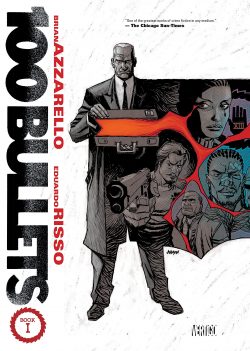
100 Bullets: Book One 


By Brian Azzarello, Eduardo Risso & various (Vertigo/DC Comics) 
ISBN: 978-1-4012-3201-6 (Deluxe HB) 978-1-4012-5056-0 (TPB/Digital edition) 

What’s your favourite crime movie? TV Show? Novel? Chances are it isn’t 100 Bullets, but trust me, it should be… 

Now that there’s a little distance and the initial furore has died down, it’s time to review one of the most hyped comic sensations of the early 21st century. This initial compilation collects 100 Bullets #1-19 (August 1999- February 2001) and includes a brief tale that first appeared in seasonal anthology Vertigo: Winter’s Edge #3.  

It all begins with eponymous revenge yarn ‘100 Bullets’… 

Isabelle “Dizzy” Cordova is released from prison but isn’t happy. She’s returning to the crime-infested, poverty-wracked streets she came from, dead inside since while she was there her man and her baby boy were killed in a drive-by shooting. 

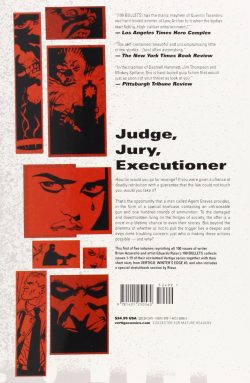
On the ride back, an old man gets on the train. He looks like a spy from a 1960s movie. Sharp black suit, sunglasses, thin black tie, shiny attaché case: He says he’s Agent Graves. He says he knows all about Dizzy Cordova. He says Hector and Santiago weren’t killed by accident. He says that if she wants to make it right, he has a gun and one hundred rounds of ammunition that will never – EVER – show up in a police investigation. If she wants revenge she can have it free and clear… 

And so begins one of the best crime comics of all time, but this premise, which would surely be enough for five hit seasons on any TV channel, is merely the beginning of a decade-long conspiracy thriller that is dark, engrossing and, after nearly 23 years, still a phenomenal achievement and tribute to the abilities of writer Brian Azzarello and illustrator Eduardo Risso and their loyal accomplices colourists Grant Goleash & Patricia Mulvihill, and letterer Clem Robins. 

After practically constant re-reading, I’m still finding nuggets and gems that confirm its brilliance and the creators’ gift for forward planning and attention to detail. 

Following on from Dizzy’s seemingly self-contained moment of epiphany comes ‘Shot, Water Back’ as we meet a down-on-his-luck barman whose entire life was destroyed by a rich girl’s petty whim. When she walks into his bar one night though, Agent Graves has just walked out, leaving behind him another gleaming attaché case… 

Next follows an 8-page seasonal delight set in a police station. ‘Merry Christmas, Bitches’ is funny and chilling, proving that the short story form is not yet dead, and panel for panel is the best thing in this wonderful, terrifying so-very-adult book. More importantly, the apparent throwaway nature of this brief encounter will have crushing repercussions later on… 

The fascinating proposition of what you would you do with a grudge, a gun, one hundred untraceable bullets and an ironclad guarantee of no comeback is more deeply explored through further seemingly unconnected interactions, consequently but so slowly unravelling the mystery of enigmatic Agent Graves – purveyor of both the ordnance and the inquiry. 

‘Short Con, Long Odds’ introduces hard luck kid Chucky Spinks, a cheap grifter and ex-con who gets a visit from the cadaverous Man in Black. Chucky’s life was ruined when he got drunk and killed some kids: but at least his friend Pony always looked out for him when he got out of prison. Still, what kind of friend would drag your drunken ass out of the passenger seat and behind the steering wheel before the cops show up…  and never tell you? 

In ‘Day, Hour, Minute… Man’ we gain some insight into the manipulative Graves’ long-term goals as he engineers gang-war to draw some old comrades back into his game. There are intriguing hints of an old crew and some very high-powered bosses – operating as “The Trust” – after contact is made with brutal mob enforcer Lono and someone wonders out loud if somebody is reviving something called “the Minutemen”… 

‘The Right Ear, Left in the Cold’ then finds ice-cream vendor Cole Burns - who sells more than popsicles from his van – shocked to discover that his current boss torched an old folks’ home where Cole’s grandmother died. That’s just the start of a vicious round of revelations before Cole is revealed as another “retired” Minuteman. It looks like someone’s putting the band back together… 

A viscerally satisfying one-off story follows as a waitress gets an unwelcome heads-up about her happy home in the chilling ‘Heartbreak, Sunnyside Up’… 

Dizzy Cordova resurfaces next: bundled off to Paris to meet American ex-pat Mr. Branch: a reporter who once dug too deep and uncovered the greatest secret in US history. ‘Parlez Kung Vous’ begins unpicking the mysteries of the Trust, the Minutemen, and especially Agent Graves in a brutal yet delicate manner, engrossing and satisfying: yet manages the magician’s trick of leaving a bigger puzzle and readers hungry for the next instalment. In the meantime though, Dizzy learns some secrets and gets on the job training to die for… 

The best crime comic in decades oh-so-slowly begins transforming itself into the best conspiracy thriller in the business with ‘Hang Up on the Hang Low’ as further hints about The Trust and their unique police squad The Minutemen slip out during the dark, bleak story of Louis “Loop” Hughes, a young street tough swiftly going the way of most of his kind in the streets of Philadelphia… at least until impeccable Agent Graves turns up. He knows exactly where Loop’s father has been for the embittered kid’s entire life, but he’s only telling about the last few years… 

Curtis Hughes collects debts for one of the nastiest old loan-sharks in Philly. The broken down old leg-breaker has been around and seen it all, but wasn’t expecting a street punk to stick one of those guns in his face – and certainly not the son he abandoned all those years ago. Against all odds, he reconciles with his son and starts teaching him business and life; but once family duty and work allegiances come into conflict, there’s only ever one outcome. And just how does Curtis know about Graves and the Minutemen? As always, where Graves has been, lives change, bodies drop and more undisclosed secrets are uncovered… 

The story portion of this book concludes with some scene-setting character portraits as ‘Epilogue for a Road Dog’ sees Loop reconnect with Agent Graves whilst wild card Lono discovers an unsuspected connection with the young gangbangers cousin Carlos. As Graves moves his pieces in a vast but still undeclared game unlikely alliances are forged in anticipation of a coming conflict… 

Rounding out this extremely adult entertainment is ‘Dossier’: a sketchbook by Eduardo Risso offering early character designs of the broad and diverse castoff reprobates thus far embroiled in the unfolding saga… 

These tense, bleak opening dramas have the generational grandeur of The Godfather trilogy, as much febrile resonance as The Wire and more punch than Goodfellas: weaving a tragic tapestry of family, disillusionment and overwhelming necessity, and although readers of the original comic books didn’t know it, laid much of the groundwork for the “Big Reveals” to come.  

Astoundingly accessible and readable in its own right, this gripping tome is just step one on a path of intricate mystery and intrigue: one no fiction-fan (grown-up, paid-up and immune to harsh language and rude behaviour) could resist… nor should you. The slick switch from crime comic to conspiracy thriller is made with superb skill, with no diminution of the extreme violence and seedy sexuality that are hallmarks of this uncompromising series. Savage, brilliantly executed and utterly addictive, this is a landmark book in a landmark series. 
© 1999, 2000, 2001, 2014 Brian Azzarello, Eduardo Risso and DC Comics. All Rights Reserved. 

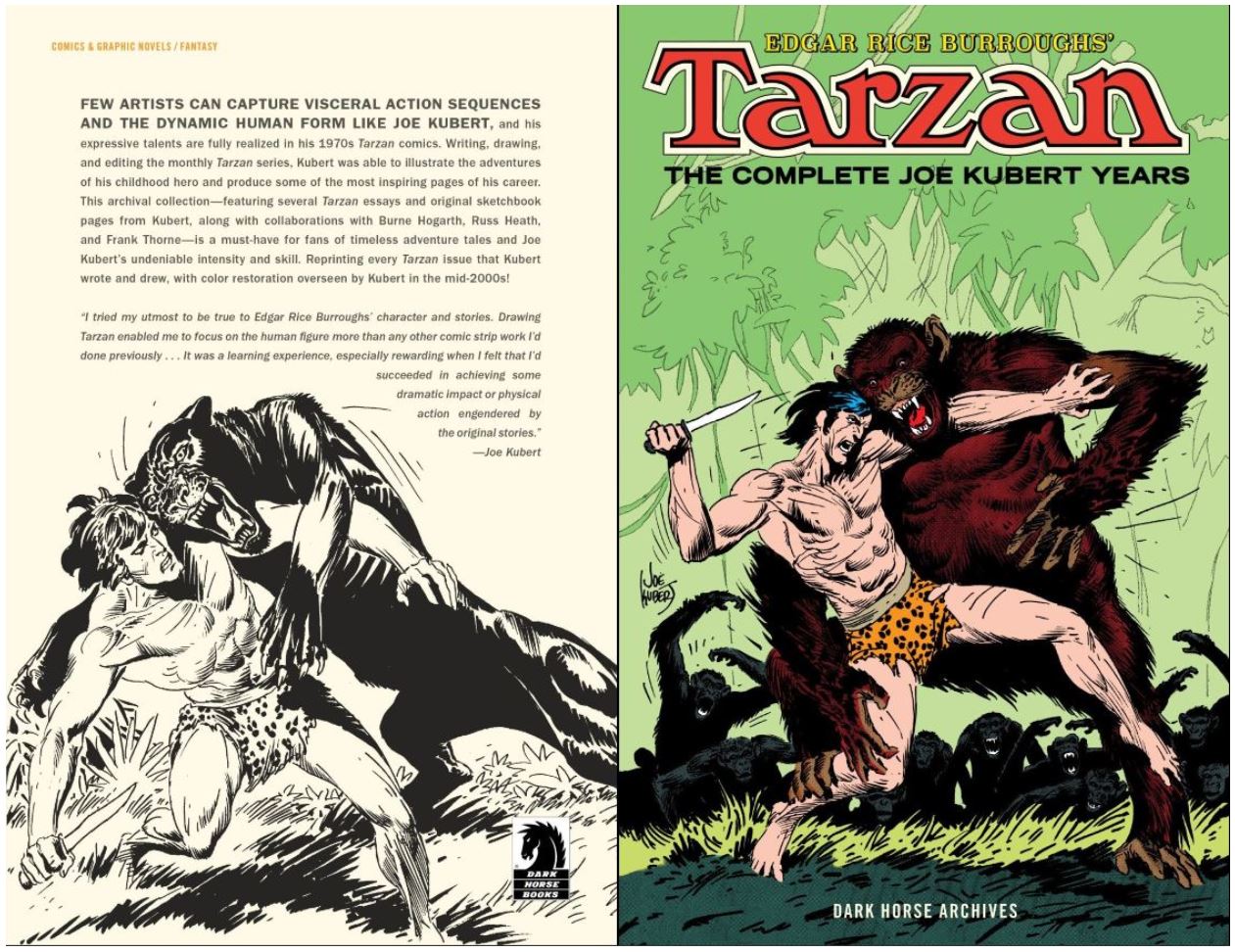
Edgar Rice Burroughs’ Tarzan: The Complete Joe Kubert Years


By Joe Kubert with Burne Hogarth, Hal Foster, Frank Thorne, Robert Kanigher, Russ Heath & various (Dark Horse)
ISBN: 978-1-61655-982-3 (TPB/digital editions)

For those that care, it’s a week until St. Valentine’s Day, and once more I’m foregoing gift recommendations in favour of comics-related pep talks. This year, you can see here how some relationships – albeit in cartoon form – have weathered the test of time. One of the longest drives a strip that – despite a shift in social sensibilities and general growth in consensus attitudes – still has lot to offer on many levels…

Soon after first publication in 1912, Tarzan of the Apes became a multi-media sensation and global brand. More novels and many, many movies followed: a comic strip arrived in 1929, followed by a radio show in 1932 with the Ape-Man inevitably carving out a solid slice of the comic book market too, once that industry was firmly established.

Rivalling and frequently surpassing DC and Marvel at the height of their powers, Western Publishing were a big publishing/print outfit based on America’s West Coast. They specialised in licensed properties and the jewels in their crown were comics starring the Walt Disney and Warner Brothers cartoon characters.

As publishers, they famously never capitulated to the wave of anti-comics hysteria that resulted in the crippling self-censorship of the 1950s. Dell Comics – and latter imprints Gold Key and Whitman – never displayed a Comics Code Authority symbol on their covers. They never needed to.

Dell also handled other properties like movie or newspaper strip franchises, and would become inextricably associated with TV adaptations once the small screen monopolised modern homes. In 1948, Dell produced the first all-new Tarzan comic book. The newspaper strip had previously provided plenty of material for expurgated reprint editions until Dell Four Color Comic #134 (February 1947).

That milestone featured a lengthy, captivating tale of the Ape-Man scripted by Robert P Thompson – who wrote both the radio show and aforementioned syndicated strip – with art by the legendary Jesse Marsh.

Marsh & Thompson’s Tarzan returned with two further tales in Dell Four Color Comic #161, cover-dated August 1947. This was a frankly remarkable feat: Four Colour was an umbrella title showcasing literally hundreds of different properties – often as many as ten separate issues per month – so such a rapid return meant pretty solid sales figures.

Within six months, the bimonthly Tarzan #1 was released (January/February 1948), beginning an unbroken run that only ended in 1977, albeit by a convoluted route…

After decades as solid Whitman staples, licensed Edgar Rice Burroughs properties transferred to DC – not just Tarzan and his extended family, but also fantasy pioneers John Carter of Mars, Carson of Venus, Pellucidar and others – with the new company continuing the original numbering.

Tarzan #207 had an April 1972 cover-date and the series carried on until #258 in February 1977. Thereafter, Marvel, Malibu and Dark Horse extended the Jungle Lord’s comic canon…

The early 1970s were the last real glory days of National/DC Comics. As they lost market share to Marvel, their response was controversial: delivered in the form of landmark superhero material eschewing fantasy and super-villains in favour of social commentary. However their greatest strength lay – as it always had – in the variety and quality of its genre divisions. War, Mystery & Supernatural, Romance, and Kids’ titles remained strong and the company’s eye for a strong brand was as keen as ever.

The Ape Man and his family were a Dell/Gold Key mainstay and global multi-media phenomenon, so when DC acquired rights they justifiably trumpeted it out, putting one of their top creators in sole charge of the legend’s monthly exploits, as well as generating a boutique bunch of ERB titles in a variety of formats.

DC’s incarnation premiered in a blaze of publicity at the height of a nostalgia boom and was generally well received by fans. For many of us, those years provided the definitive graphic Tarzan, thanks solely to the efforts of the Editor, publisher and illustrator who shepherded the Ape-man through the transition.

They were all the same guy: Joe Kubert.

Kubert was born in 1926 in rural Southeast Poland (which became Ukraine and might be Outer Russia by the time you read this). His parents took him to America when he was two. and he grew up in Brooklyn. According to his Introduction, his earliest memory of cartooning was Hal Foster’s Tarzan Sunday strips…

Joe’s folks encouraged him to draw and the precocious kid began a glittering career at the start of the Golden Age, before he was even a teenager. Working and learning at the Chesler comics packaging “Shop”, MLJ, Holyoke and assorted other outfits, he began his lifelong association with DC in 1943.

A canny survivor of the Great Depression, he also maintained outside contacts, dividing his time and energies between Fiction House, Avon, Harvey and All-American Comics, where he particularly distinguished himself on The Flash and Hawkman. In the early 1950s he and old school chum Norman Maurer were the creative force behind publishers St. Johns: creating evergreen caveman Tor and launching the 3D comics craze with Three Dimension Comics.

Joe never stopped freelancing: appearing in EC’s Two-Fisted Tales, Avon’s Strange Worlds, Lev Gleason Publications & Atlas Comics until 1955 when, with the industry imploding, he took a permanent position at DC, only slightly diluted whilst he illustrated the contentious and controversial newspaper strip Tales of the Green Berets (1965 to 1968). From then on, he split his time drawing Sgt. Rock and other features, designing covers and editing DC’s line of war comicbooks.

And then DC acquired Tarzan…

This monumental archive collects the entirety of his work with the Ape-Man: stories from Tarzan #207-235 (April/November 1972 to February/March 1975): a tour de force of passion transubstantiated into stunning comic art, with Kubert writing, illustrating and lettering.

Moreover, the vibrant colours in this epic re-presentation are based on Tatjana Wood’s original guides, offering readers a superbly authentic and immersive experience whether you’re coming fresh to the material or joyously revisiting a beloved lost time.

The only disconcerting things about this stellar compilation are the cover reproductions, which appear in all their iconic glory but manipulated to remove DC’s trademark logos. The mightiest force in the modern jungle is still Intellectual Property lawyers…

The tense suspense begins with Kubert’s Introduction to earlier collections before his adaptation of debut novel Tarzan of the Apes opens with a safari deep in the jungle. A pretty rich girl is driving her white guide and native bearers at a ferocious pace as she desperately hunts for her missing father.

When a bronzed god bursts into view battling a panther, she watches aghast as human impossibly triumphs over killer cat and then pounds his chest whilst emitting astounding screams. As the terrifying figure vanishes back into the green hell, the girl’s questions are grudgingly answered by the old hunter who relates a story he has heard…

‘Origin of Tarzan of the Apes’ reveals how, following a shipboard mutiny, John Clayton, Lord Greystoke – and his wife Lady Alice – are marooned on the African coast with all their possessions, including a vast library of books and Primers intended for their soon-to-be-born baby…

Against appalling odds, they persevered with Greystoke building a fortified cabin to shelter them from marauding beasts, particularly the curious and savage apes roaming the region. Despite the birth of a son, eventually the jungle won and the humans perished, but their son was saved by a grieving she-ape who adopted the baby to replace her own recently killed “Balu”…

The ugly, hairless boy thrived under Kala’s doting attentions, growing strong but increasingly aware of intrinsic differences. He only discovered the how and why after years of diligent effort: through sheer intellectual effort and the remnants of his father’s books and papers, Tarzan learned to read and thereby deduced that he was a M-A-N…

The tale within a tale continues in ‘A Son’s Vengeance: Origin of the Ape-Man Book 2’ as the boy rises to prominence amongst his hirsute brethren and through imagination and invention masters all the beasts of his savage environment. Eventually, brutal, nomadic natives settle in the area and Tarzan has his first contact with creatures he correctly identifies as being M-E-N like him…

The new situation leads to the greatest tragedy of his life as a hunter of M’Bonga‘s tribe kills beloved, devoted Kala and Tarzan learns the shock of loss and overpowering hunger for revenge…

Issue #209 revealed how civilisation finally caught up with Tarzan as ‘A Mate For the Ape-Man: Origin of the Ape-Man Book 3’ saw him meet and save American Jane Porter, her elderly father and his own cousin…

Just as had happened years earlier, these unlucky voyagers were marooned by mutineers. Discovering John Clayton’s cabin, the castaways find the lost peer’s diary, which is of especial interest to William Clayton, the current Lord Greystoke. As tensions rise and humans die, Tarzan takes his golden-haired mate deep into the impenetrable verdure…

It all concludes neatly and tantalisingly in ‘Civilisation: Origin of the Ape-Man Book 4’ wherein the innately noble Tarzan returns Jane to her fiancé William, just in time for the westerners to be rescued by Naval Officer Paul D’Arnot.

When the dashing French Lieutenant is captured and tortured by M’Bonga’s warriors, Tarzan rescues and nurses him back to health. In return, the grateful sailor teaches him to speak human languages that up until that moment he could only read and write in. By then, however, the navy vessel and saved souls have all sailed away, each carrying their own secrets with them…

With no other options, lovelorn Tarzan accompanies D’Arnot back to civilisation. The eternal comrades eventually settle in Paris with Tarzan practically indistinguishable from other men…

Even today ‘Origin of the Ape-Man’ is still the most faithful adaptation of ERB’s novel in any medium: potent and evocative, fiercely expressive: a loving, utterly visceral translation of the landmark saga.

Kubert’s intent was to adapt all 24 Burroughs novels and intersperse them with short, complete tales, but the workload, coupled with his other editorial duties, was crippling. To buy some time #211 combined old with new as ‘Land of the Giants’ partially adapted and incorporated Don Garden & Burne Hogarth’s newspaper classic ‘Tarzan and the Fatal Mountain’: Sunday strip pages #582-595 which had originally ran from May 3rd to August 2nd 1942.

A clash with crocodiles lands Tarzan in a lost valley where giant natives are persecuted by deformed, diminutive outworlder Martius Kalban: a sadist hungry for the secrets of their prodigious size and strength. Even after gaining his dark desire, Kalban finds himself no match for the outraged Ape-Man…

It’s followed by ‘The Captive!’: a latter-day exploit beginning a run of yarns based on the short stories comprising ERB’s book Jungle Tales of Tarzan as the relationship between Ape-Man and elephants is explored with each saving the other from the ever-present threat of the hunters of M’Bonga…

The Jungle Tales reworkings continue with ‘Balu of the Great Apes’ with childhood friends of Tarzan becoming incomprehensibly aggressive after the birth of their first baby, before ending with ‘The Nightmare’ as starving Tarzan steals and gorges on meat and drink from the native village. The resultant food poisoning takes him on a hallucinogenic journey never to be forgotten: one that almost costs his life when he can no longer tell phantasm from genuine threat…

Following Kubert’s Introduction to Tarzan #215-#224, the pictorial wonderment resumes with another vintage visual treat as ‘The Mine!’ (Tarzan #215, December 1972) incorporates material originally seen in 1930s Sunday newspaper strips (by Foster & George Carlin) embedded in an original tale by Kubert.

As before, deadline pressure again compelled Kubert to combine original with found material, detailing how Tarzan is captured by slavers and pressed into toil deep in the bowels of the earth for a sadistic mine owner. Naturally, he soon chafes at enforced servitude and leads a savage workers’ revolt to overturn and end the corporate bondage…

Issue #216 took another route to beating deadlines with old pal Frank Thorne pencilling Kubert’s script for ‘The Renegades’: leaving hard-pressed Joe to ink and complete the story of a murderous raid which wipes out a Red Cross mission.

Investigating the atrocity, Tarzan discovers the “maddened savages” responsible are actually white men in disguise; stealing supplies for a proposed expedition to plunder a lost treasure vault. When he catches the culprits, Tarzan’s vengeance is terrible indeed…

‘The Black Queen!’ was all-new, all-Kubert, as the Jungle Lord almost saves a man from crocodiles. Acceding to the ravaged victim’s last wish, Tarzan then travels to his distant country and overturns the brutal regime of tyrannical Queen Kyra – who rules her multicultural kingdom with whimsy, ingrained prejudice and casual cruelty…

The equally selfish choices of American millionaire tycoon Darryl T. Hanson blight his family as his search for ‘The Trophy’ decimates the fauna of Tarzan’s home and leads to a clash of wills and ideologies which can only end in tragedy…

With #219, Kubert began an epic 5-issue adaptation of ERB’s sequel novel The Return of Tarzan. It opens in Paris as the unacknowledged son of long-vanished Lord Greystoke tries to adapt to his new life as a civilised man of leisure.

One night, his natural gallantry draws him to the side of a woman screaming for help and he is attacked by a gang of thugs. After easily thrashing the brigands he is astounded to find her accusing him of assault and simply bounds effortlessly away from the gendarmes called to the disturbance. The entire trap had been engineered by a new enemy; Russian spy and émigré Nikolas Rokoff beside his duplicitous toady Paulvitch…

The rightful heir to the Greystoke lands and titles silently stood aside and let his apparently unaware cousin William Cecil Clayton claim both them and the American Jane Porter after the wild one rescued her from attacking apes in the jungle. Missing her terribly, Tarzan has chosen to make his own way in the human world beside French Naval Officer D’Arnot. In the course of his urbane progression, Tarzan had exposed the Russian cheating at cards to blackmail French diplomat Count De Coude and earned himself a relentless, implacable foe, forever.

When Rokoff subsequently tries to murder Tarzan, the vile miscreant agonisingly learns how powerful his jungle-bred enemy is…

With physical force clearly of no use, Rokoff’s latest plan is to put the Ape-Man through a ‘Trial by Treachery’: manufacturing “evidence” that Tarzan is having an affair with the Comte’s wife. Once again, the civilised beast underestimates his target’s forthright manner of handling problems and is savagely beaten until he admits to the plot and clears the innocent woman’s name…

With news of Jane’s impending marriage to Clayton, Tarzan seeks to ease his tortured mind with action, and the next chapter sees him in Algeria where, sponsored by the grateful, ashamed Count, he works for the French Secret Service in Sidi Bel Abbes, ferreting out a traitor in the turbulently volatile colony. His hunt leads to a likely turncoat and subsequent brutal battle with Arab agent provocateurs, but things start to turn his way after he liberates a dancing slave who is the daughter of a local sheik.

When word of Jane comes from D’Arnot, Tarzan throws himself even more deeply into his tasks and falls into another ambush organised by Rokoff. This time his ‘Fury in the Desert’ seems insufficient to his needs …until his newfound friend the Sheik rides to the rescue…

The intrigue further unfolds in ‘Return of the Primitive’ as Tarzan finally uncovers a link between Rokoff and spies at Sidi Bel Abbes. Mission accomplished, he is then posted to Capetown and aboard ship meets voyager Hazel Strong, a close friend of Jane’s who reveals the heiress had never forgotten her tryst with an Ape-Man.

Unable to watch Jane enter into a loveless marriage, Hazel took off on an ocean cruise…

The story rocks Tarzan’s mind, but not so completely that he fails to notice Rokoff is also aboard and murderously dogging his footsteps. This time, the Tsarist is properly prepared and that night the jungle man vanishes from the ship…

Rokoff’s act of assassination is a purely pyrrhic victory. Soon after reaching Capetown the villain insinuates himself into the Clayton wedding party but when their yacht’s boilers explode next morning, he, Hazel, Clayton, Jane and her father are left adrift in a lifeboat…

Tarzan, meanwhile, has survived being tumbled overboard and spent days swimming hundreds of miles. He now washes up on the same beach his parents were left upon decades ago. Staggering inland, he finds himself in the cabin his father built before being stolen and adopted by Kala the She-Ape.

John Clayton is forgotten, for fate has brought Tarzan home…

A man changed by his time amongst other men, the Jungle Lord instinctively saves a native warrior from certain death and is astonished to find himself declared chieftain of the Waziri nation.

…And off the coast, a lifeboat filled with dying travellers espies land and wearily sculls towards a welcoming beach in the heart of primeval forests…

Revelling in his newfound status, popularity and freedom, Tarzan enquires about the fabulous jewelled ornaments of his new friends and learns of an incredible lost metropolis. Soon he is curiously journeying to ‘The City of Gold’ to encounter debased, degenerate sub-men led by a gloriously beautiful Queen.

La is high priestess of lost Atlantean outpost Opar, but can barely control her subjects enough to allow the perfect specimen of manhood to escape to safety. Both she and Tarzan know they are destined to meet again…

Refusing to be cheated of their sacrifice, the bloodthirsty Oparian males search far into the jungle and soon encounter the Clayton yacht survivors. When the primitives attack the human strangers and carry off Jane, Rokoff shows his true colours, leaving William to his fate. This callous act also inadvertently clears the path for Tarzan to finally claim his inheritance and reunite with Jane. All the Jungle Lord has to do is break back into Opar, save his one true love from ‘The Pit of Doom!’ and escape the wrath of spurned Queen La…

That mission accomplished, he and Jane return to the beach in time to witness William’s dying confession and accept the succession to the estates and title of Lord Greystoke…

The adaptation is followed by an original adventure codicil, seeing Tarzan rescue a beautiful maiden from attacking apes to find she comes from La, now in peril of her life…

In Opar, another Beast Man insurrection has left the Queen imperilled by her subjects and threatened by a gigantic mutant whom she tearfully reveals is her sibling in ‘Death is My Brother!’ With no choice, Tarzan regretfully battles the nigh-mindless brute and proves to the insurgents that his wrath is greater than their malice…

A third and final Kubert text missive of fond reminiscences about Tarzan #225-235 leads into original tale ‘Moon Beast’ which sees a mother and child brutally slaughtered and Tarzan captured: framed for the hideous crime by cunning medicine man Zohar. When the vile trickster overreaches himself, the captive lord breaks free but still has to deal with the mutant brute Zohar employed to perpetrate the atrocity…

Kubert only produced the cover for #226, as deadline pressures finally caught up with him. The contents – not included here – featured a retelling of the Ape-Man’s origins by Russ Manning, taken from the Sunday newspaper strips of 15thNovember 1970-7th February 1971.

Back for #227, Joe took Tarzan out of his comfort zone as ‘Ice Jungle’ saw young warrior Tulum endure a manhood rite at the top of a mountain. Also converging on the site for much the same reason is American trust-fund brat J. Pellington Stone III: determined to impress his father by bagging a legendary snow ape. Sensing impending doom, Tarzan follows them both and is proved correct in his assessment…

After single-handedly killing an immense Sabretooth tiger in an unexplored region of the continent, Tarzan is captured by pygmies intent on offering him as sacrifice to a mighty monster that has terrorised them for years. However, a ‘Trial By Blood!’ sees the Ape-Man cleverly outwit a giant lizard and teach tribal elders a valuable lesson in leadership, after which albino queen Zorina seeks to extend her power by making him her consort.

The mighty wanderer wants nothing to do with ‘The Game!’, and, after the kingdom descends into savage civil war, sees ironic Fate deal the white queen a telling death blow…

With Tarzan #230 (April/May 1974), the title transformed into a sequence of 100-page giants, mixing new material with reprints of ERB characters and thematically-aligned stars from DC’s vast back-catalogue.

Leading off that issue was a brief all-Kubert vignette as ‘Tarzan’ saves a deer from a lioness. It neatly segues into ‘Leap into Death’ starring Korak, Son of Tarzan (written by Robert Kanigher, with Kubert pencilling and inks from Russ Heath). Here the titanic teen nomad hunts for his stolen true love Meriem and barbarian Iagho who   abducted her, before stumbling into a nest of aggressively paranoid bird-people who learn to respect his courage before flying away with his lover…

The next issue featured the start of another-Kubert-adapted Burroughs novel: possibly the most intriguing conception of the entire canon.

‘Tarzan and the Lion Man Part One’ sees a movie company on location in the deep jungle. They are making a picture about a white man raised by animals who becomes undisputed master of all he surveys. The chain of coincidences grows more improbable as actor Stanley Obroski is a dead ringer for Tarzan… which probably explains why he is taken by savages set on torturing the Jungle Legend to death…

Rescued by Tarzan, Stanley explains how the expedition was attacked, unaware exactly how much trouble his fellow actors are in. During Obroski’s absence, stand-in Rhonda Terry and starlet Naomi Madison are kidnapped by El Ghrennem‘s Arab bandits. They think the production’s prop map leads to an actual valley of diamonds…

When Tarzan finds the rest of the film crew, he is mistaken for Stanley and drawn into their search for the missing women. The plucky Americans have already made a mad dash for freedom, however, and Rhonda has been captured by creatures she simply cannot comprehend…

After a fascinating bonus section revealing Kubert’s ‘Layouts and Thumbnails’ for the opening chapter, ‘Tarzan and the Lion Man Part Two’ reveals Rhonda taken by apes who speak Elizabethan English, and made the subject of a fierce debate. Half of the articulate anthropoids want to take her to “God” whilst the other faction believes her a proper prize of their liege lord “King Henry VIII”…

After being briefly recaptured by El Ghrennem, Naomi too is taken by the talkative Great Apes. When Tarzan discovers the kidnapper’s corpses, he follows a trail up an apparently unscalable escarpment. Rescuing and returning Miss Madison to her surviving friends, “Stanley” then re-ascends the stony palisade to discover an incredible pastoral scene complete with feudal village and English castle…

Tracking Rhonda, he enters the citadel and meets a bizarre human/ape hybrid calling himself God. The garrulous savant explains that once he was simply a brilliant Victorian scientist pursuing the secrets of life. When his unsavoury methods of procuring test-subjects forced him to flee England and relocate to this isolated region of Africa, he resumed his experiments and transformed himself into a superior being, before making the apes into fitting servants.

Now they have a society of their own – based on the history books he brought with him – and his experiments near completion. Having already extended his life and vitality far beyond its normal span by experimenting upon himself, God is now ready to attain immortality and physical perfection. All he has to do is consume Tarzan…

Of course, the madman has no conception of his captive’s capabilities, and when the Ape-Man and Rhonda promptly vanish from his dungeon it sends the palace into turmoil and God into a paroxysm of insanity…

The chaos also prompts already ambitious apostate King Henry to begin a revolt to overthrow his creator. As ‘Part Three‘ opens, war between Church and State is in full swing and Tarzan battles to rescue Rhonda whilst God’s castle becomes a flaming hell. Losing her in the chaos, Tarzan is forced into a hasty alliance with God, unaware that maniacal monarch Henry has taken her back to the jungles below the escarpment, and into a region where God casts his scientific failures…

All too soon Henry is dead and Rhonda is facing beings even stranger than talking apes. Thankfully, ‘Part Four‘ (preceded by another fascinating Kubert Layout spread) sees the Ape-Man arrive in time to save and return her to the film party in a dazzling, tragic conclusion…

Kubert ended his close association with Tarzan in #235’s ‘The Magic Herb’. Here, the hero saves a couple from a crashed aeroplane and siblings Tommy and Gail urge him to help them find a legendary flower that might cure the man’s fatal ailment. However, something about them makes Tarzan deeply suspicious…

Nevertheless, he takes them to the primeval lost valley where it grows, only to be betrayed as the intruders frame him: throwing the jungle lord to the resident lizard men and fleeing with specimens that will make them millionaires in the outside world. Sadly, the treacherous pair have completely misunderstood the powers of the plant and pay the ultimate price all betrayers must…

Wrapping up the astounding thrills and captivating artistry, more revelatory treasures from ‘Joe Kubert’s Tarzan Sketchbook’ trace the art process from page-roughs to competed page.

Supplemented by Creator Biographies of Burroughs and Kubert, this tome is an unmissable masterpiece of romance fantasy, wild adventure and comics creation no lover of the medium or genre can do without.
Edgar Rice Burroughs’ The Complete Joe Kubert Years © 1972, 1973, 1974, 1975, 2005, 2016 Edgar Rice Burroughs, Inc. All rights reserved. Trademark Tarzan and Edgar Rice Burroughs Inc. All rights reserved.

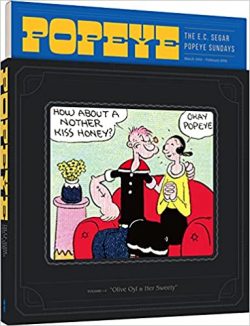
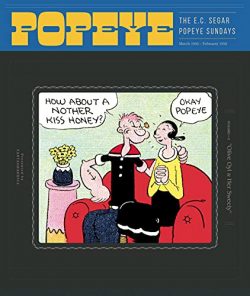
Popeye volume 1: Olive Oyl & Her Sweety (The E.C. Segar Popeye Sundays


By Elzie Crisler Segar with Sergio Ponchione, Cathy Malkasian & various(Fantagraphics Books)
ISBN: 978-1- 68396-462-9 (PB/digital edition)

Popeye popped up in the Thimble Theatre comic strip for January 17th 1929. The strip was an unassuming feature that debuted on 19th December 1919: one of many newspaper cartoon funnies to parody, burlesque and mimic the era’s silent  movies serials. Its more successful forebears included C.W. Kahles’ Hairbreadth Harry and Ed Wheelan’s Midget Movies / Minute Movies .

These all used a repertory company of characters to play out generic adventures firmly based on those expressive cinema antics. Thimble Theatre‘s cast included Nana and Cole Oyl, their gawky daughter Olive, diminutive-but-pushy son Castor, and Horace Hamgravy, Olive’s sappy, would-be beau.

The series ticked along for a decade, competent and unassuming, with Castor and Ham Gravy (as he became) tumbling through get-rich-quick schemes, fear-free adventures and simple gag situations until September 10th 1928, when explorer uncle Lubry Kent Oyl gave Castor a present from his latest exploration of Africa: a hand-reared Whiffle Hen – most fabulous of all birds. It was the start of something groundbreaking.

Whiffle Hens are troublesome, incredibly rare and possessed of fantastic powers, but after months of inspired hokum and slapsick shenanigans, Castor was resigned to Bernice – for that was the hen’s name – when a series of increasingly peculiar circumstances brought him into contention with the ruthless Mr. Fadewell, world’s greatest gambler and king of the gaming resort of ‘Dice Island’.

Bernice clearly affected writer/artist E.C. Segar, because his strip increasingly became a playground of frantic, compelling action and comedy during this period…

When Castor and Ham discovered that everybody wanted the Whiffle Hen because she could bestow infallible good luck, they sailed for Dice Island to win every penny from its lavish casinos. Sister Olive wanted to come along but the boys planned to leave her behind once their vessel was ready to sail. It was 16th January 1929…

The next day, in the 108th instalment of the saga, a bluff, irascible, ignorant, itinerant and exceeding ugly one-eyed old sailor was hired by the pair to man the boat they had rented, and the world was introduced to one of the most iconic and memorable characters ever conceived. By sheer, surly willpower, Popeye won the hearts and minds of readers: his no-nonsense, grumbling simplicity and dubious appeal enchanting the public until by the end of the tale, the walk-on had taken up full residency. He would eventually make the strip his own…

The Sailor Man even affably bulldozed his way onto the full-colour Sunday Pages which form the main course of this curated collection spanning 2nd March 1930 through February 28th  1932.

This paperback is the first of four that will contain the entire Segar Sunday canon and is designed to be stored in a forthcoming slipcase. Spiffy as that sounds, the wondrous stories are also available in digital editions if you want to think of ecology or mitigate age and muscle strain in your spinach-deprived muskles…

Since many papers only carried dailies or Sundays, not necessarily both, a system of differentiated storylines developed early in American publishing, and when Popeye finally made his belated appearance, he was already a fairly well-developed character.

Thus, Segar concentrated on more family-friendly gags – and eventually continued mini-sagas – and it was here that the Popeye/Olive Oyl modern romance began: a series of encounters full of bile, intransigence, repressed hostility, jealousy, mind games and passion which usually ended in raised voices and scintillating cartoon violence – and they are still as riotously funny now as then. Olive was well ahead of her time: the serendipitous stick insect knew her mind and always gave better than she got…

Preceding the vintage treats, this tome also offers some modern and very lovely laudatory comic strips in Sergio (DKW; Grotesque; Memorabilia) Ponchione’s ‘Have a Segar’ and Cathy (Percy Gloom; Eartha) Malkasian’s ‘Oomph – A Popeye Short’: each offering their unique interpretations of Segar’s now meta-real cast and how they changed the world…

When the wondrous weekly full-page instalments start we see Castor Oyl heading home at the heart of the Depression accompanied by Ham Gravy who is appalled to find a ghastly sailor man pitching woo at his (presumed) sweet patootie. When the rival suitors clash, it’s Olive who has the final word …and throws the last punch!

From there onwards, in done-in-one gag instalments an unlikely but enduring romance blossomed (withered, bloomed, withered some more, hit cold snaps and early harvests – you get the idea…) as Olive pursued her man and Popeye vacillated between ignoring her and moving mountains to impress her. As she always kept her options open, he spent a lot of time fighting off – literally – her other gentlemen callers…

A mercurial creature, the maiden miss Oyl spent a lot of her time trying to stop her beau’s battles – tricky, as he spent his time ashore as an extremely successful “sprize fighter” – but would batter mercilessly any floozy who cast cow eyes at the devil-may-care matelot…

In these early formative Sundays, we see how Castor becomes Popeye’s manager and how originally-philanthropic millionaire Mr. Kilph moves from eager backer to demented arch enemy, willing to pay any price to see Popeye pummelled. Opponents include husky two-fisted guys with names like Bearcat, Mr. Spar, Kid Sledge, Joe Barnacle, Kid Smack, Kid Jolt, The Bullet, Johnny Brawn, an actual giant dubbed Tinearo and even a trained gorilla (Kid Klutch), but none ever win and Kilph goes crazier and crazier…

Among many timeless supporting characters, mega moocher J. Wellington Wimpy debuts here as a lazy and corrupt ring referee in extended, trenchant and scathingly witty sequences about boxing. Rowdy, slapstick cartoon violence is at a premium – family values were different then – but Segar’s worldly, probing satire and Popeye’s beguiling (but relative) innocence and lack of experience keeps the entire affair in hilarious perspective whilst making him an unlikely and lovable waif, albeit one eternally at odds with cops and rich folk…

We see softer sides of the sailor-man as he repeatedly gives away multiple purses – and even houses – to widows and “orphinks”, and his rebellious core with numerous jail sentences self-commuted. Popeye always escapes, but – being scrupulously fair-minded – never fails to turn himself in when his latest escapade ends.

After a riot of fun, bonkers pugilism and mad love, this initial outing closes with the Sailor Man’s bold disclosure that the secret of his strength is spinach. Cue a riot at Rough-House‘s seedy diner…

Segar famously considered himself an inferior draughtsman – most of the world disagreed and still does – but his ability to weave a yarn was unquestioned, and grew to astounding and epic proportions in these strips.

Week after week he was creating the syllabary and graphic lexicon of a brand-new art-form: inventing narrative tricks and beats that generations of artists and writers would use in their own cartoon creations.

Popeye is fast approaching his centenary and well deserves his place as a world icon. How many comics characters are still enjoying new adventures 93 years after their first? These volumes are the perfect way to celebrate the genius and mastery of E.C. Segar and his brilliantly flawed superman. These are books that belong in every home and library.
This edition of Popeye Volume 1: Olive Oyl and Her Sweety is © 2021 Fantagraphics Books Inc. All Segar comics and drawings © 2021 King Features Syndicate. Inc./ ™Hearst Holdings, Inc. Strips provided by Bill Blackbeard and his San Francisco Academy of Comic Art, “Have a Segar!” © Sergio Ponchione. Translation © Jamie Richards. “Oomph” © Cathy Malkasian. All rights reserved.

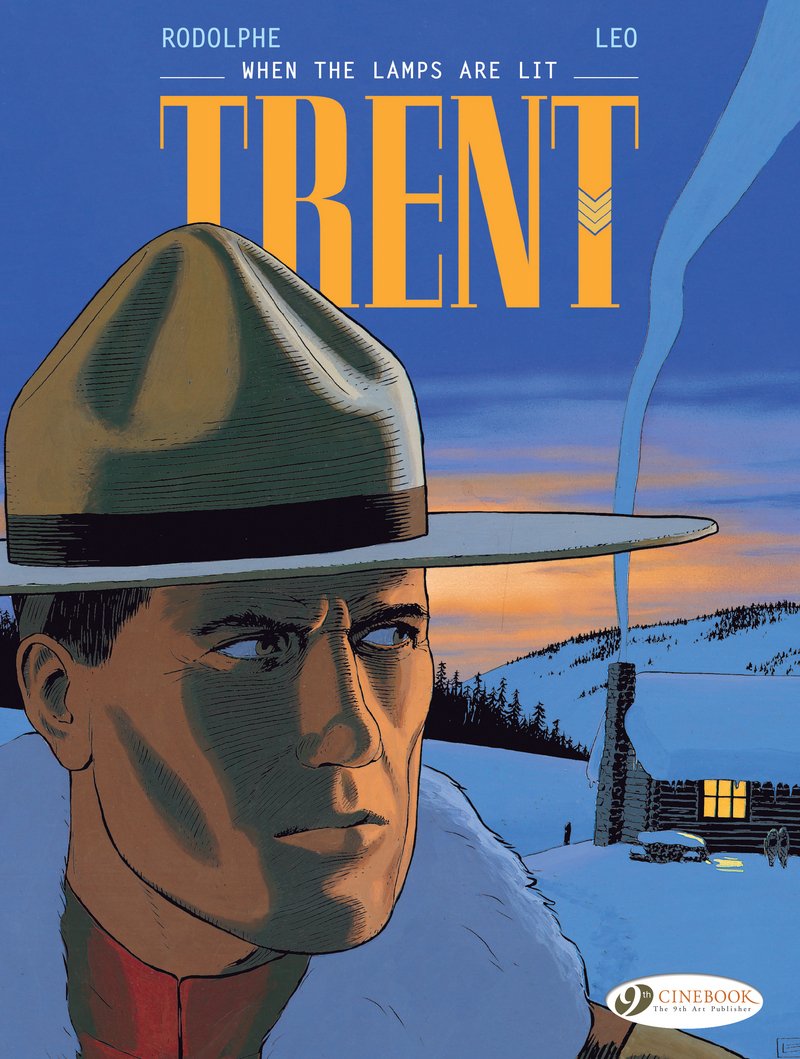
Trent volume 3: When the Lamps are Lit


By Rodolphe & Léo with colour by Marie-Paule Alluard, translated by Jerome Saincantin (Cinebook)
ISBN: 978-1-84918-836-4 (Album PB)

I’m thinking about relationships and romance at the moment, and comics have always explored pair-bonds as a fundamental aspect of any genre they exploit. It’s not always about simple attainment of a dream either. Sometimes, failure and the loss of love is more powerful, rewarding and/or entertaining than “True Love Ways”. The attendant emotion certainly has generated some astoundingly moving fiction…

European comics audiences have long been fascinated with the mythologised American experience, whether it be the Big Sky Wild West or later eras of crime-riddled, gangster-fuelled dramas. They also have a vested historical interest in the northernmost parts of the New World which has resulted in some pretty cool graphic extravaganzas.

Léo is actually Brazilian artist and storymaker Luiz Eduardo de Oliveira Filho: born in Rio de Janeiro on December 13th, 1944. Attaining a degree in mechanical engineering from Puerto Alegre in 1968, he was a government employee for three years, until forced to flee the country because of his political views. While a military dictatorship ran Brazil, he lived in Chile and Argentina before illegally returning to his homeland in 1974. To survive, he worked as a designer/graphic artist in Sao Paulo and created his first comics art for O Bicho magazine.

In 1981 he migrated to Paris, seeking to pursue a career in Bande Dessinée, and found work with Pilote and L’Echo des Savanes as well as more advertising and graphics fare. The big break came when Jean-Claude Forest invited him to draw stories for Okapi which led to regular illustration work for Bayard Presse. In 1988 Léo began his long association with scripter and scenarist Rodolphe D. Jacquette – AKA Rodolphe.

His prolific, celebrated writing partner has been a giant of comics since the 1970s: a Literature graduate who transitioned from teaching and running libraries to creating poetry and writing criticism, novels, biographies, children’s stories and music journalism. In 1975, after meeting Jacques Lob, he expanded his portfolio to write for a vast number of artists and strip illustrators in magazines ranging from Pilote and Circus to À Suivre and Métal Hurlant. Amongst his most successful endeavours are Raffini (with Ferrandez) and L’Autre Monde (Florence Magnin) but his collaborations in all genres and age ranges are too numerous to list here.

In 1991 he began working with Léo on a period adventure series of the far north. Taciturn, introspective and fiercely driven Royal Canadian Mounted Police sergeant Philip Trent premiered in L’Homme Mort, forging a lonely path through the 19th century Dominion over eight tempestuous, hard-bitten albums between then and 2000. He also prompted the collaborators’ later fantasy classics Kenya (and its spin-offs), Centaurus and Porte de Brazenac.

Cast very much in the classic adventure mould perfected by Jack London and John Buchan, Trent is a man of few words, deep thoughts and unyielding principles who gets the job done whilst stifling emotional turmoil boiling deep within him, but is the very embodiment of the phrase “still waters run deep”…

As ‘Quand S’allument Les Lampes’, this third adventure comes from 1993, with the solitary man and his faithful hound “Dog” trudging into and through another snow-wrapped town (stunning rendered as always by Leo) to eventually make camp alone in the frozen woods beyond. His thoughts dwell on the warm loving families therein, and wander back, as they always will, to Agnes.

He had saved her – but not her brother – and was given a clear invitation that he had never acted upon. Now, under the cold stars, he makes a decision. Applying for leave, he travels to Providence with marriage in mind, but on arrival finds a dilapidated, empty house and learns that his Miss St. Yves had reached the same conclusion years ago… and with another man…

Shaken and crushed, he finds a saloon and picks up a whisky glass…

Weeks later, a penniless broken staggering shambles, he plagues the barkeeps of a nameless frontier railtown, pitied and despised by residents as they go about their business and try to avoid the rummy in the gutter.

Howling constantly with desolated loss, Trent’s only human connection is bar girl Mary Lou, but he is blind to her more than Christian interest. Wendley City is all bustle and terror. The railway will bring wealth – and is already reaping dividends – but it’s also drawn out human wolves. Seemingly invisible outlaws dubbed “the Coalmen” have targeted elderly residents for months, cruelly torturing and killing to extract the savings of the weakest townsfolk…

After another night of atrocity, an outraged posse manages to wound a suspect before losing him. The fugitive hides under the stoop drunken sot Trent is slumped on, and in gratitude offers the despised reprobate a job if he has the stomach for bad business and can sober up…

The final act contains a brutal denouement and reveals a cunning and extended undercover scheme to catch the Coalmen, but one that turned on the implacable Mountie’s honest despair and deadly near all-consuming brush with loss and loneliness…

Mission accomplished, the quiet man returns to duty and the wastelands he patrols to preserve the safety of the families he cannot find a way to join…

Another beguiling and introspective voyage of internal discovery, where environment and locales are as much lead characters as hero and foe, When the Lamps are Lit offers suspense, action, drama and poignant evocation in a compelling confection that will appeal to any fan of widescreen cinematic crime fiction or epic western drama.
Original edition © Dargaud Editeur Paris 1993 by Rodolphe & Léo. All rights reserved. English translation © 2017 Cinebook Ltd.

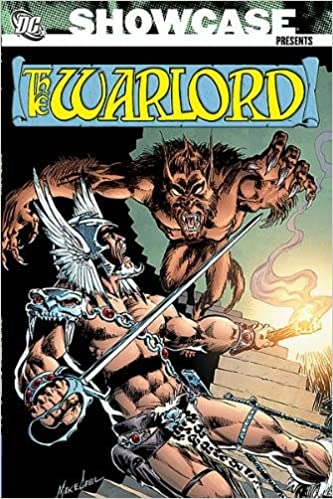
Showcase Presents Warlord


By Mike Grell, with Vince Colletta & various (DC Comics)
ISBN13: 978-1-4012-2473-8 (TPB)

Geez! Once you start thinking about what books you’d like to see on sale again, your brain just won’t let go…

During the troubled 1970s the American comics industry suffered one of the worst of its periodic downturns and publishers desperately cast about for anything to bolster the flagging sales of superhero comics.

By revising their self-imposed industry code of practice (administered by the Comics Code Authority) to allow supernatural and horror comics, publishers tapped into a global revival of interest in spiritualism and the supernatural, and – as a by-product – opened their doors to Sword-&-Sorcery as a viable genre, thanks primarily to Roy Thomas & Barry Windsor-Smith’s adaptation of R. E. Howard’s Conan the Barbarian.

DC launched a host of such titles into that budding market but, although individually interesting, nothing seemed to catch the public’s eye until issue #8 of the company’s latest try-out title First Issue Special.

In that issue popular new Legion of Super-Heroes, Aquaman and Green Lantern artist Mike Grell launched his pastiche, homage and tribute to Edgar Rice Burroughs’s works (particularly Pellucidar – At the Earth’s Core) which, after a rather shaky start (like Conan, the series was cancelled early in the run but rapidly reinstated) went on to become for a time DC’s most popular book.

Blending swords, sorcery and super-science with spectacular, visceral derring-do, the lost land of Skartaris was a venue expertly designed for adventure: stuffed with warriors, mythical creatures, dinosaurs and scantily-clad hotties. How could it possibly fail?

This stupendous monochrome compendium, gathers 1st Issue Special #8 (from November 1975) and Warlord #1-28 (January-February 1976 – December 1979), delivering wild wonder and breathtaking thrills from the outset.

The magic commences with ‘Land of Fear!’ as in 1969, U2 spy-pilot Colonel Travis Morgan is shot down whilst filming a secret Soviet base. The embattled aviator manages to fly his plane over the North Pole before ditching, expecting to land on frozen Tundra or pack-ice on the right side of the Iron Curtain.

Instead he finds himself inside the Earth, marooned in a vast, tropical jungle where the sun never sets. The incredible land is populated by creatures from every era of history and many that never made it into the science books. There are also cavemen, savages, lost races, mythical beasts, barbaric kingdoms and fabulous warrior-women.

Plunging head-on into the madness, the baffled airman saves an embattled princess from a hungry saurian before both are captured by soldiers. Taken to the city of Thera, Morgan is taught the language by his fellow captive Tara and makes an implacable enemy of the court wizard Deimos. After surviving an assassination  attempt the pair escape into the eternal noon of the land beneath the Earth.

Within months Morgan won his own-bimonthly title written, pencilled and inked by Grell. ‘This Savage World’ saw the lost airman and the Princess of Shamballah fall deeply in love, only to be separated by slavers who leave Morgan to die in #2’s ‘Arena of Death.’ Surviving a timeless period as a galley slave, Morgan, with Nubian warrior Machiste, lead an insurrection of Gladiators that escalates into full-scale revolution, earning him the title of The Warlord in the process.

However, after this issue the series vanished for months until the end of the year. Cover-dated October-November 1976, Warlord #3 debuted ‘War Gods of Skartaris’, as Morgan returned in all his gory glory, leading his army of liberation and hunting for Tara until he stumbles across his downed aircraft – now worshipped as a god by lizard-men but still packed with lots of 20th century ordnance…

Moreover, it had crashed into a temple that gave the first clues to the incredible secret of the lost land…

‘Duel of the Titans’ sees the Warlord’s army lay siege to Thera, where Deimos has seized power and holds Tara hostage. The mage’s sorcery is no match for high explosives and inevitably he loses his life to Morgan’s flashing blade.

Warlord #5 finds the reunited lovers heading for Tara’s home city Shamballah, discovering en route ‘The Secret of Skartaris!’ in a lost temple that hides millennia-old computer records revealing the entire land to be a lost colony of Atlantis, with much of the magic of the timeless region nothing more than advanced technology. When one such dormant device rockets Morgan away, Tara thinks her man is gone forever…

‘Home is a Four-Letter Word!’ sees the displaced aviator returned to the surface-world with eight years gone by since his crash: emerging from a lost outpost in the Andes where a multi-national excavation is being conducted in the ruins of Machu Pichu.

However, the dig scientists use Morgan’s dog-tags to contact his CIA superiors and rapidly-arriving, extremely suspicious spooks assume he defected all these years ago: especially since one of the archaeologists is soviet researcher Mariah Romanova. When the intransigent spies rouse a demonic watchdog Morgan’s only chance is to head back to Skartaris – with Mariah in tow…

Back in the temple, the day spent on Earth has somehow translated into an interminable time within it. Tara is long gone and Morgan elects to follow her trail to Shamballah. Stopping in the city of Kiro, Morgan and Mariah save his old comrade Machiste from the insidious horror of ‘The Iron Devil’, after which the trio voyage together: attacked by cyborg vampires from ‘The City in the Sky’ and braving ‘The Lair of the Snowbeast’ – wherein Morgan discovers a unique benefactor and a tragically brief love…

Warlord #10 offers the opening sally in a long-running saga as the ‘Tower of Fear’ has the trio aiding a maiden in distress and inadvertently restoring the underland’s greatest monster to life. ‘Trilogy’ in #11 features a triptych of vignettes to display conflicting aspects of the Warlord’s complex character, after which ‘The Hunter’ pits the wandering warriors against a manic, vengeful CIA agent who followed Morgan to Skartaris before ‘All Men Are Mine’ depicts the gravely wounded Warlord’s battle against the very personification of Death.

Issue #15,‘Holocaust’ (inked by Joe Rubinstein) marks the series’  advancement to a monthly schedule whilst finally reuniting Morgan and Tara in Shamballah. The obtuse warrior is stunned to see Mariah heartbroken by the couple’s joy, resulting in hers and Machiste’s incensed departure. The biggest shock, though, is Morgan’s  introduction to his son, Joshua… He doesn’t have much time to dwell, though, as the city starts to explosively self-destruct. …And while Morgan and Tara combat the crisis, undead Deimos strikes, abducting the baby…

Vince Colletta came aboard as regular inker with the beginning of ‘The Quest’ as Morgan and Tara hunt the revenant sorcerer, starting with ‘Visions in a Crimson Eye’; battling Deimos’ minions and rival magicians; encountering and surviving the desert-locked ‘Citadel of Death’ (which reveals some intriguing Skartaran history from the Age of the Wizard Kings) before being briefly distracted by alien invaders in ‘Bloodmoon’.

Scouring Skartaris, Tara and Morgan reunite with Mariah and Machiste in ‘Wolves of the Steppes’ after which the quartet brave Deimos’ fortress in ‘Battlecry’, just as the unliving savant begins experimenting on little Joshua, marrying recovered Atlantean science with his sinister sorceries…

The epic quest concluded in Warlord #21 with Morgan compelled to battle an enslaved adult Joshua in ‘Terminator’. When he kills his own son, the Warlord’s heart breaks and his love abandons him… but as ever, nothing is quite as it seems…

Shell-shocked, Morgan loses himself in drink and bloodletting, battling werewolves and worse in ‘The Beast in the Tower’; subterraneans and cannibals in ‘The Children of Ba’al’ and tragically trysting with a love that cannot last in ‘Song of Ligia’ before becoming a mercenary in ‘This Sword For Hire’ and making a new friend in unscrupulous but flamboyant thief Ashir.

Together they accept ‘The Challenge’ of winning ultimate knowledge and, as Deimos begins his next deadly assault, Morgan relives all his past lives (which include Lancelot, Jim Bowie and Crazy Horse) whilst experiencing first-hand the true story of ‘Atlantis Dying’…

The last inclusion in this compilation comprises two linked tales. In the first, Morgan crushes alien horrors in ‘The Curse of the Cobra Queen’ whilst long absent Tara, Mariah and Machiste are drawn into a time-warping encounter with the lost masters of ‘Wizard World’ – the opening salvo in another extended epic that you’ll have to wait for a second volume to enjoy…

The tricky concept of relativistic time and how it does or doesn’t seem to function in this Savage Paradise increasingly grated with many readers, but as Grell’s stated goal was to produce a perfect environment for yarn-spinning, not a science project, the picky pedant would be best advised to suck it up or stay away.

For we simple, thrill-seeking fantasy lovers, however, these are pure escapist tales of action and adventure, light on plot and angst but aggressively and enthusiastically jam-packed with action and wonder. These are timeless tales that will enthral, beguile and enchant. As the man himself constantly says “in Skartaris, always expect the unexpected”… even a long overdue revival of these reprint compendia…
© 1975, 1976, 1977, 1978, 1979, 2009 DC Comics. All Rights Reserved.

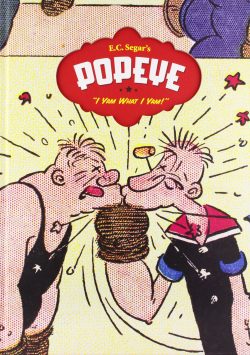
E.C. Segar’s Popeye volume 1: “I Yam What I Yam!”


By Elzie Crisler Segar (Fantagraphics Books)
ISBN: 978-1-56097-779-7 (HB)

HAPPY BIRTHDAY POPEYE!

The incredible Sailor-Man first shumbled onto the world stage in comic strip Thimble Theatre on January 17th 1929. Even though last year Fantagraphics began rereleasing this material in smaller less copious volumes – which I’ll also be reviewing – this initial colossal collection is probably my favourite vintage book ever and I mourn much that it’s out of print and unavailable digitally. I live in hope though…

Thimble Theatre was an unassuming comic strip which began on 19th December 1919; one of many newspaper features that parodied/burlesqued/mimicked the era’s (silent) movies. Its more successful forebears included C.W. Kahles’ Hairbreadth Harry and Ed Wheelan’s Midget Movies (later renamed Minute Movies).

These all used a repertory company of characters to play out generic adventures firmly based on those expressive cinema antics. Thimble Theatre‘s cast included Nana and Cole Oyl, their gawky daughter Olive, diminutive-but-pushy son Castor, and Horace Hamgravy, Olive’s sappy would-be beau.

The series ticked along for a decade, competent and unassuming, with Castor and Ham Gravy, as he became, tumbling through get-rich-quick schemes, gentle adventures and simple gag situations until September 10th 1928 (the first strip reprinted in this astonishingly lavish and beautiful collection), when explorer uncle Lubry Kent Oyl gave Castor a present from his latest exploration of Africa: a hand-reared Whiffle Hen – most fabulous of all birds. It was the start of something groundbreaking.

As eny fule kno Whiffle Hens are troublesome, incredibly rare and possessed of fantastic powers, but after months of inspired hokum and slapsick shenanigans, Castor was resigned to Bernice – for that was the hen’s name – when a series of increasingly peculiar circumstances brought him into contention with the ruthless Mr. Fadewell, world’s greatest gambler and king of the gaming resort of ‘Dice Island’.

Bernice clearly affected writer/artist E.C. Segar, because his strip increasingly became a playground of frantic, compelling action and comedy during this period…

When Castor and Ham discovered that everybody wanted the Whiffle Hen because she could bestow infallible good luck, they sailed for Dice Island to win every penny from its lavish casinos. Sister Olive wanted to come along but the boys planned to leave her behind once their vessel was ready to sail. It was 16th January 1929…

The next day, in the 108th instalment of the saga, a bluff, irascible, ignorant, itinerant and exceeding ugly one-eyed old sailor was hired by the pair to man the boat they had rented, and the world was introduced to one of the most iconic and memorable characters ever conceived. By sheer, surly willpower, Popeye won the hearts and minds of readers: his no-nonsense, grumbling simplicity and dubious appeal enchanting the public until by the end of the tale, the walk-on had taken up full residency. He would eventually make the strip his own…

The journey to Dice Island was a terrible one: Olive had stowed away, and Popeye – already doing the work of twelve men – did not like her. After many travails the power of Bernice succeeded and Castor bankrupted Dice Island, but as they sailed for home with their millions Fadewell and his murderous associate Snork hunted them across the oceans. Before long, Popeye settled their hash too, almost at the cost of his life…

Once home, their newfound wealth quickly led Castor, Ham and Olive into more trouble, with carpetbaggers, conmen and ne’er-do-wells constantly circling, and before long they lost all their money (a common occurrence for them), but one they thing they couldn’t lose was their sea-dog tag-along. The public – and Segar himself – were besotted with the unlovable, belligerent old goat. After an absence of 32 episodes Popeye shambled back on stage, and he stayed for good.

Although not yet the paramour of Olive, Popeye increasingly took Ham’s place as a foil for sharp-talking, pompous Castor Oyl, and before long they were all having adventures together. After escaping jail at the start of ‘The Black Barnacle’ (December 11th 1929) they found themselves aboard an empty ship and at the start of a golden age of comic strip magic…

Segar famously considered himself an inferior draughtsman – most of the world disagreed and still does – but his ability to weave a yarn was unquestioned, and it grew to astounding and epic proportions in these strips.

Day by day he was creating the syllabary and graphic lexicon of a brand-new art-form, inventing narrative tricks and beats that a generation of artists and writers would use in their own works, and he did it while being scary, thrilling and funny all at once.

‘The Black Barnacle’ introduced the dire menace of the hideous Sea-Hag – one of the greatest villains in fiction – and the scenes of her advancing in misty darkness upon our sleeping heroes are still the most effective I’ve seen in all my years…

This incredible tale leads seamlessly into diamond-stealing, kidnappings, spurned loves, an African excursion and the introduction of wealthy Mr. Kilph, whose do-gooding propensities lead Castor and Popeye into plenty of trouble, beginning with the eerie science fiction thriller ‘The Mystery of Brownstone Hill’ and the return of the nefarious Snork, who almost murders the salty old seadog a second time…

The black and white dailies section ends with ‘The Wilson Mystery’ as Castor and Popeye set up their own detective agency – something that would become a common strip convention and the perfect maguffin to keep adventurers tumbling along. Even Mickey Mouse donned metaphoric deerstalker and magnifying glass for much of his own strip service…

These superb and colossal hardcover albums (200 pages and 368 mm by 268 mm) are augmented with fascinating articles and essays; including testimonial remembrances from famous cartoonists – Jules Feiffer in this first volume – and accompanied by the relevant full colour Sunday pages from the same period.

Here then are the more gag-oriented complete tales from 2nd March 1930 through February 22nd 1931, including the “topper” Sappo.

A topper was a small mini-strip that was run above the main feature on a Sunday page. Some were connected to the main strip, but many were just extraneous filler. They were used so that individual editors could remove them if their particular periodical had non-standard page requirements. Originally entitled The 5:15, Sappo was a surreal domestic comedy gag strip created by Segar in 1924 which became peculiarly entwined with the Sunday Thimble Theatre as the 1930s unfolded – and it’s a strip long overdue for consideration on its own unique merits….

Since many papers only carried dailies or Sundays, not necessarily both, a system of differentiated storylines developed early in American publishing, and when Popeye finally made his belated appearance, he was already a fairly well-developed character. Thus, Segar concentrated on more family-friendly gags – and eventually continued mini-sagas – and it was here that the Popeye/Olive Oyl modern romance began: a series of encounters full of bile, intransigence, repressed hostility, jealousy and passion which usually ended in raised voices and scintillating cartoon violence – and they are still as riotously funny now as then.

We saw softer sides of the sailor-man and, when Castor and Mr. Kilph realised how good Popeye was at boxing, an extended, trenchant and scathingly witty sequence about the sport of prize-fighting began. Again, cartoon violence was at a premium – family values were different then – but Segar’s worldly, probing satire and Popeye’s beguiling (but relative) innocence and lack of experience kept the entire affair in hilarious perspective whilst making him an unlikely and lovable waif.

Popeye is fast approaching his centenary and still deserves his place as a world icon. How many comics characters are still enjoying new adventures 93 years after their first? These magnificent volumes are the perfect way to celebrate the genius and mastery of EC Segar and his brilliantly imperfect superman. These are books that every home and library should have.

© 2006 Fantagraphics Books Inc. All comics and drawings © 2006 King Features Inc. All rights reserved.
Beano and Dandy Gift Book 2022- Arty Farty!


By Dudley D. Watkins, Allan Morley, Reg Carter, Davy Law, Bill Holroyd, Leo Baxendale, Ken Reid, Eric Roberts, James Crichton, Paddy Brennan, and many & various (DC Thomson & Co)
ISBN: 978-1-84535-856-3 (HB)

This splendidly oversized (225 x 300mm) 144 page hardback compilation rightly glories in the incredible wealth of ebullient creativity that paraded through the flimsy, colourful pages of The Beano and The Dandy during a particularly bleak and fraught period in British history… aren’t they all? Tragically, neither it nor its companion volumes are available digitally yet, but hope springs ever eternal…

Until it folded and was briefly reborn as a digital publication on 4th December 2012, The Dandy was the third-longest running comic in the world (behind Italy’s Il Giornalino – launched in 1924 – and America’s Detective Comics in March 1937).

Premiering on December 4th 1937, The Dandy broke the mould of its traditional British predecessors by using word balloons and captions rather than narrative blocks of text under sequential picture frames. A huge success, it was followed eight months – on July 30th 1938 – later by The Beano and together they utterly revolutionised the way children’s publications looked and, most importantly, how they were read.

Over decades the “terrible twins” spawned a bevy of unforgettable and beloved household names who delighted countless avid and devoted readers, and the unmissable end of year celebrations were graced with bumper bonanzas of the comics’ weekly stars in extended stories in magnificent hardback annuals.

This particularly tome is a collation of strips examining “Art” and a superb tribute to Celtic creativity, packed literally cover-to-cover with brilliant strips, with the mirth starting on the inside front with a rather psychedelic and fourth-wall rending confrontation between The Bash Street Kids and the ever-interventionist “Beano/Dandy artist” actually illustrated by David Sutherland, I suspect.

Sadly, as usual none of the writers are named and precious few of the artists, but I’ve offered a best guess as to whom we should thank, and of course would be so very happy if anybody could confirm or deny my suppositions…

When not in monochrome or full colour, DC Thomson titles were always extremely inventive in using their two-colour printing plate format. Way back when, most annuals and many comics were jazzed up by a wonderful “half-colour” process British publishers used to keep costs down. This was done by printing sections (“Signatures”) of the books with only two plates, such as Cyan (Blue) and Magenta (Red) or Yellow and Black. The sheer versatility and colour range provided was simply astounding…

This book shows that pagination skill over and over again in strips that exploit the print process and deftly subordinate it to the narratives. What splendid fellows their printers must have been to go to all that extra effort…

Here and now though, the picture-in-picture gag cover of Dandy Annual 1971 – a Korky the Cat visual pun by James Crichton or possibly Richard Nixon – segues into a monochrome Big Eggo strip from Reg Carter before indisputable key man Dudley D. Watkins shines in black, white and red with magical lad Peter Piper (from short-lived junior title The Magic Comic) animating pictures at an exhibition before Good King Coke (He’s Stoney Broke) seeks fame in a frame thanks to early art and orange tints from Eric Roberts.

Also from The Magic Comic comes Dolly Dimple – Not So Simple: a monochrome romp by Allan Morley that leads to an Orange section starting with Julius Sneezer the Sneezing Caesar (Morley); Lord Snooty, by the incredibly prolific Watkins, detailing an art heist from an early annual, after which Morley renders more magic with Sammy’s Super Rubberand posh poseur Swanky Lanky Liz – by Charles Holt – makes more enemies with a school painting competition…

Morley’s Old Ma Murphy the Strong-Arm School-Ma’rm gets away with what we’d deem child abuse in her art class before three Dennis the Menace strips from David Law prove that chaos is an art. They’re followed by a drawing lesson with Minnie the Minx (by Jim Petrie?) and a Law full colour Beryl the Peril strip he did for a Topper Annual with the girly menace trying her hand at photography before we enjoy some black, white and red poetry-appreciation piece from a Beano Book The Bash Street Kids extended episode by Sutherland. It precedes a classic Desperate Dan diversion where he paints the town – guess what hue? – and Korky’s Catty Dictionary by Robert Nixon.

A red-toned double bill of Roger the Dodger japes by Ken Reid neatly diverts to fantastic crime as an extended (orange-flavoured) Captain Woosh caper sees the wily jetpack bandit again outwitted by good-hearted errand boy Terry Ball in a stunning Dandy Annual exploit from Charles Grigg, after which Sutherland triumphs in a pan-toned (black, red, yellow and white) classic starring The Bash Steet Kids and Teacher…

Following colourful puzzle pages ‘Blank Looks’ and ‘You Can Draw Me!’, Law’s Dennis the Menace plays ‘Pranks with Paint!’ and shares ‘Drawings by Dennis’ before we all go green with Watkins’ Desperate Dan and enjoy ‘Arty-Crafty!’and ‘Crafty Arty!’ hijinks with perilous Beryl…

Winker Watson gets a fresh look – courtesy of Terry Bave, I believe – as the wily waif interrupts a school painting chore before Ken H. Harrison’s blue period sees Harry and his Hippo get the snapping bug before the Bash Street Dogs of Pup Parade (Nigel Parkinson?) get their portraits done and Bill Holroyd’s robot rascal Brassneck saves the school play – from surly teacher Mr. Snodgrass…

Minnie the Minx endures a multi-coloured assault from a mischievous Beano artist (Tom Paterson?) before Dennis regrets ‘Making his Mark’ as a prelude to more full colour fun from Bill Ritchie’s Baby Crockett and Gordon Bell’s Colonel Blink, before Pup Parade with the Bash Street Dogs resorts to orange tints for a kennel painting prank…

Advancing print technology finally catches up and the remainder of the collection is all full-colour, beginning with Neighbourhood Witch as a little sorceress gets too interested in the family tree, after which Ritchie’s love-starved Smittengoes to extraordinary lengths to find a girlfriend…

Harrison’s Lord Snooty makes no friends when he voluntarily takes up the trumpet, whilst Paterson’s Little Larry truly turns heads (away) with his candid snaps before Bully Beef and Chips (Wayne Thompson?) clash over painted portraits whilst Dennis decrees ‘It’s a Draw’ and The Bash Street Kids romp in extended mayhem looking for cash rewards in ‘A Load of Junk’…

Robot toy manipulator General Jumbo then gets some highly specialised new units to win a painting competition, before activity page ‘Be a Dandy Artist’ segues into a Korky curated museum visit before ‘Quick on the Draw with Ivy the Terrible’ (by Lew Stringer?) ends the tour with a far more accessible lesson learned.

As you leave the volume please be sure to enjoy Sutherland’s classic Beano Book 1971 cover and denouement of the frontispiece saga that opened this extravaganza, and don’t forget to tip your reviewer…

A marvel of nostalgia and timeless comics wonder, the true magic of this collection is the brilliant art and stories by a host of talents that have literally made Britons who they are today, and bravo to DC Thomson for letting them out to run amok once again.
© DCT Consumer Products (UK) 2021 Ltd.