
Milton Caniff’s Steve Canyon 1947


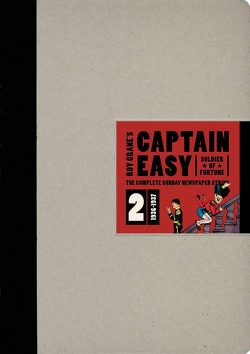
By Milton Caniff (Checker Book Publishing Group)
ISBN: 978-0-97102-49-9-1

Milton Caniff wasn’t an overnight sensation. He worked long and hard before he achieved stellar status in the comic strip firmament. Before Terry and the Pirates brought him fame, and Steve Canyon secured his fortune and reputation, the strip which brought him to the attention of legendary Press Baron “Captain” Joseph Patterson (in many ways the co-creator of Terry) was an unassuming daily feature about a little boy hungry for adventure.

Caniff was working for The Associated Press as an entry-level jobbing cartoonist when a gap opened in their strips department. AP was an organisation that devised and syndicated features for the thousands of local and small newspapers which could not afford to produce the cartoons, puzzles, recipes and other fillers that ran between the local headlines and the regional sports.

Over a weekend Caniff came up with Dickie Dare, a studious lad who would read a book and then fantasize himself into the story, taking his faithful little white dog Wags with him. The editors went for it and the strip launched on July 31st 1933. Caniff produced the adventures for less than eighteen months before moving on, but his replacement Coulton Waugh steered the series until its conclusion two decades later.

As well as being one of the greatest comic-strip artists of all time, Caniff was an old-fashioned honest American Patriot, from the time when it wasn’t a dirty word or synonym for fanatic.

The greatest disappointment of his life was that he was never physically fit enough to fight. Instead, during World War II he not only continued the morale-boosting China Seas epic Terry and the Pirates newspaper strip seven days a week, he also designed art, brochures and posters (all unpaid) for the War Department and made live appearances for soldiers and hospital residents. Even that wasn’t enough.

Again unpaid, he devised Male Cale: a strip to be printed in the thousands of local military magazines and papers around the world. Originally using established characters from Terry, Caniff swiftly switched (for reasons best explained in Robert C Harvey’s wonderful Meanwhile… a Biography of Milton Caniff) to a purpose-built (and was she built!) svelte and sexy ingénue who would titillate, amuse but mostly belong to the lonely and homesick American fighting men away from home and under arms.

Funny, saucy, even racy but never lewd or salacious, Miss Lace spoke directly to the enlisted man – the “ordinary Joe” – as entertainer, confidante and trophy date. She built morale and gave brief surcease from terror, loneliness or boredom. Although comparisons abound with our own Jane, the rationales behind each combat glamour girl were poles apart. Miss Lace spoke to and with the soldiers, and she wasn’t in normal papers. She was simply and totally theirs and theirs alone.

After leaving the incredibly successful and world-renowned Terry and the Pirates Caniff created another iconic comic hero in the demobbed World War II pilot Steve Canyon. The reasons for the move were basically rights and creative control, but it’s also easy to see another reason. Terry, set in a fabled Orient – even with the contemporary realism the author so captivatingly imparted – is a young man’s strip and limited by locale.

The worldly, if not war-weary, Canyon was a mature adventurer who could be sent literally anywhere and would appeal to the older, wiser readers of Atom-Age America, now a fully active, if perhaps reluctant, player on the world stage.

Canyon also reflects an older creator who has seen so much more of human nature and frailty than even the mysterious East could provide. Put another way, William Shakespeare could write Romeo and Juliet as a young man, but needed more than passion and genius to produce King Lear.

Steve Canyon began on 13th January 1947, after a long period of public anticipation following a very conspicuous resignation from Terry. Always a master of suspense and adept at manipulating his reader’s attention, Caniff’s eponymous hero didn’t actually appear until January 16th (and then only in a “file photograph”).

The public first met Stevenson Burton Canyon, former bomber pilot, medal winning war-hero, Air-Force flight instructor and latterly, independent charter airline operator in the first Sunday colour page, on 19th January 1947.

By then, eager readers had glimpsed his friends and future enemies, how acquaintances felt about him and even been introduced to ultra-rich, super-spoiled Copper Calhoun, the latest in a startlingly long line of devastating Femme Fatales created by Caniff to bedevil his heroes and captivate his audiences. And thus, the magic began…

This series of collections from Checker re-presents the strip in yearly segments (regrettably, with the Sundays printed in the same black-&-white as the daily episodes) and this one begins as Calhoun manoeuvres Canyon’s Horizons Unlimited charter line into flying her to countries where her pre-war holdings were disrupted. That seemingly simple job results in deadly peril from both strangers and trusted employees. There’s also a goodly helping of old-fashioned intrigue, jealousy and racketeering in the mix too…

The action and tragedy lead directly to an encounter with a couple of deadly female con-artists in ‘Delta’, and a gripping, yet light-hearted, romp in the booming petroleum industry in ‘Easter’s Oil’ which also introduces off-the-wall supporting character Happy Easter and the lascivious Madame Lynx, who would play such large and charismatic roles in the strip’s future.

The first volume ends with ‘Jewels of Africa’, a classic of suspense with modern-day pirate and wrecker Herr Splitz falling foul of our heroes in a world rapidly becoming a hotbed of International tension.

As Caniff’s strip became more and more a compass of geo-political adventure, his skill with human drama became increasingly mature and intense. This was comic strip noir that was still irresistible to a broad spectrum of readers. And that’s as true now as it was then. Steve Canyon is magnificent comic art at its two-fisted best.

These stories are also available in a fancy IDW hardcover archive, but although lovely it does suffer from small print – unless you have a digital edition – so if you love stunning artwork stick with this cheap-&-cheerful monochrome version.
© 2003, Checker Book Publishing Group, an authorized collection of works © Ester Parsons Caniff Estate 1947.

All characters and distinctive likenesses thereof are trademarks of the Ester Parsons Caniff Estate. All rights reserved.

Spirou and Fantasia volume 1: Adventure Down Under


By Tome & Janry, translated by Jerome Saincantin (Cinebook)
ISBN: 978-1-84918-011-5

For most English-speaking comic fans and collectors Le Journal de Spirou is probably Europe’s biggest secret. The character is a rough contemporary – and bald commercial response – to Hergé’s iconic superstar Tintin, whilst the comic he has headlined for decades is only beaten in sheer longevity and creativity by our own Beano and Dandy.

First conceived at Belgian Printing House by Jean Dupuis in 1936, a magazine targeting a juvenile audience debuted on April 21st 1938 (three and a bit months before DC Thomson’s Beano, but still beaten by The Dandy which launched on December 4th 1937). It was edited by Charles Dupuis (a mere tadpole, only 19 years old himself) and took its name from the lead feature, which recounted the improbable adventures of a plucky bellboy/lift operator employed by the Moustique Hotel: a reference to the publisher’s leading magazine, Le Moustique.

With his pet squirrel, Spip (who joined the cast on June 8th 1939; he’s the longest running character in the strip after Spirou himself, so happy 80th anniversary, little dude!) the plucky kid was the idea of French artist Robert Velter, who signed himself Rob-Vel.

A Dutch language edition – Robbedoes – debuted a few weeks later and ran more-or-less in tandem with the French parent comic until it’s cancellation in 2005.

Although some home-grown product crept in, the bulk of the comic was taken up with cheap American reprint imports: Red Ryder by Fred Harman, William Ritt & Clarence Gray’s Brick Bradford and Siegel & Shuster’s landmark creation Superman. Most prominent were ‘Tif et Tondu’ by Fernand Dineur (which ran until the1990s) and ‘L’Epervier Blue’ by Sirius (Max Mayeu), and they were soon supplemented by comic-strip wunderkind Joseph Gillain – “Jije”. During World War II Jije legendarily drew the entire comic by himself, continuations of the banned US imports included, as well as assuming production of the Spirou strip where he created the current co-star Fantasio.

Except for a brief period when the Nazis closed the comic down (September 1943 to October 1944 when the Allies liberated Belgium) Spirou and its boyish star – now a globe-trotting reporter – have continued their weekly exploits in unbroken four-colour glory.

Among the other myriad major features that began within those pages are ‘Jean Valhardi’ (Jean Doisy & Jije), ‘Blondin et Cirage’ (Victor Hubinon), Buck Danny, ‘Jerry Spring’, ‘Les Schtroumpfs’ (AKA the Smurfs), Gaston Lagaffe (here seen as Gomer Goof) and a certain laconic cowboy named Lucky Luke.

Spirou the character (the name translates as both “squirrel” and “mischievous”) has starred in the magazine for most of its life, evolving – under a succession of creators – into a simultaneously urbane yet raucous fantasy/adventure hero with the accent heavily on light humour.

With comrade and rival Fantasio and crackpot inventor the Count of Champignac, Spirou travels to exotic places, uncovering crimes, revealing the fantastic and garnering a coterie of exotic arch-enemies.

During the War, when Velter went off to fight, his wife Blanche Dumoulin took over the strip using the name Davine, assisted by Luc Lafnet. Dupuis assumed control of and rights to the strip in 1943, assigning it to Jije who handed it to his assistant André Franquin in 1946. It was the start of a golden age.

Among Franquin’s innovations were villains Zorglub and Zantafio, Champignac and one of the first strong female characters in European comics, rival journalist Seccotine (renamed Cellophine in this current English translation), but his greatest creation – one he retained on his departure in 1969 – was the incredible magic animal Marsupilami (first seen in Spirou et les héritiers in 1952). The little perisher is now a star of screen, plush toy store, console and albums all his own.

From 1959 writer Greg and background artist Jidéhem assisted Franquin, but by 1969 the artist had reached his Spirou limit and resigned, taking his mystic yellow monkey with him. He was succeeded by Jean-Claude Fournier who updated the feature over the course of nine stirring adventures that tapped into the rebellious, relevant zeitgeist of the times with tales of environmental concern, nuclear energy, drug cartels and repressive regimes.

As the series entered the 1980s Spirou seemed to stall: three discrete creative teams alternated on the serial: Raoul Cauvin & Nic Broca, Yves Chaland and the creators of the graphic novel under review here: Philippe Vandevelde writing as Tome and artist Jean-Richard Geurts AKA Janry.

These last adapted and referenced the beloved Franquin era and revived the feature’s fortunes, producing 14 wonderful albums between 1984 and 1998. This one, Spirou et Fantasio 34 – Aventure en Australie from 1985, was their second.

Since their departure Lewis Trondheim, and the teams of Jean-Davide Morvan & Jose-Luis Munuera and Yoann & Vehlmann, have brought the official album count to 55 (there also are a bunch of specials, spin-offs and one-shots, official and otherwise)…

Without further ado we plunge straight into the bizarre, treasure-hunting drama as dire doings Down Under segue into Spirou and Fantasio arriving home exhausted from their latest assignment. They are intercepted by Cellophine at the airport: odd things are occurring in the depths of the Outback and the always-newsworthy Count of Champignac is right at the heart of it. Instantly awake again, all three jet out to Australia where nefarious deeds are occurring at the desolate Albuh Opal Mine.

The crazy inventor is there on the verge of a fabulous and incredible discovery far more precious than jewels, but the ruthless miners don’t seem that impressed, although they are worried by disappearing diggers, inexplicable accidents, men driven crazy and, if some observers are to be believed, levitating aborigines…

This classy blend of thrilling mystery, weird science, light adventure and broad slapstick remains a pure refreshing joy in a market far too full of adults-only carnage and testosterone-fuelled breast-beating. Easily accessible to readers of all ages drawn with all the welcoming style and panache that makes Asterix, Lucky Luke and Iznogoud so compelling and readily available in both paperback album and eBook formats, this is a cracking read and the start of a long line of translated epics that should be as much a household name as those series – and even Tintin himself…
Original edition © Dupuis, 1985 by Tome & Janry. All rights reserved. English translation 2009 © Cinebook Ltd.

Trish Trash Rollergirl of Mars: The Collected Edition


By Jessica Abel, with Lydia Roberts & Walter various (Super Genius/Papercutz)
ISBN: 978-1-5458-0167-3 (TPB)               978-1-5458-0166-6 (HB)

Our fascination with Mars has never faltered and now that we seem within touching distance, the Red Planet’s allure and presence in our fiction has never been more broad-based and healthily imaginative. Amidst all the recent TV, movie and literary product, one of the most engaging treatments has been a comics serial detailing the life of an extraordinary young woman in exceedingly trying times.

After Earth collapsed in an ecological and economic meltdown, the recently arrived first settlers on Mars became trapped under an increasingly burdensome fixed economic structure and oppressive corporate plutocracy. Two hundred years later, an entire class of indentured servants eke out a fraught existence, harvesting water and food with machines rented from Arex (“we’re the air that you breathe”). The air they don’t breathe is meagre, toxic, dust-filled and slightly radioactive…

On Mars, everything belongs to the company, and people usually go from cradle to grave in crippling debt. There is, ostensibly, a chance to escape: mandatory offworld mining missions to the asteroid belt. These Temporary Labor Assignments, however, are looked on as a quick ticket to certain death…

All tyrannies need bread and circuses though. On Mars that’s Hoverderby.

Based on the ancient Earth entertainment, teams of women race around a hover track in flying boots, scoring points by beating each other up. It’s the planet’s most popular spectator sport and Arex own that too…

Trish Nupindu is seven-and-a-half (on Mars: in Earth terms that’s 15), a smart, recently-orphaned kid who’s really good with engines and mechanical systems. Stuck on her aunt’s water farm, she dreams of becoming a Hoverderby star and is utterly discontented with the state of her existence…

All “Martys” reel from the force of crushing, inescapable poverty and Trish believes her only chance of getting out from under a system stacked from the get-go against ordinary people is to become a media star of the great sport.

Bold and impatient, she sneaks off to join the local team and is suckered into a binding intern’s contract, even though she’s under-age…

Trish doesn’t even get to play: the team manager wants her because she’s good at repairing the hoverboots continually malfunctioning due to the all-pervasive dust…

The world turns upside down after she and her avowed-revolutionary pal Marq discover a native Martian. Recalled from near-death, the mythical creature opens their eyes to a whole new world and “her” secrets will change forever not just the way Hoverderby is played but the very economic balance of power on the Red Planet… if the ruthless upper echelons of Arex don’t stop them first…

The inspirational drama is backed up by extensive supplemental features delivered in the manner of wiki pages such as the rules of Hoverderby; Derby Gear: Then and Now; illustrated specifications for Radsuits; fact-features on The Homestead Debate, Native Martians, Ares Collective Statement of Debt (ACSOD), TLAs, Asteroid Mining and legendary water miner Ismail Khan, faux kids’ comics “True Tales of the Early Colonists” and a complete Timeline of Mars Colonization.

Jessica Abel has been wowing readers and winning prizes since 1997 when she took both the Harvey and Lulu awards for Best New Talent. Her previous graphic delights include the fabulous Artbabe, Growing Gills, Life Sucks, Drawing Words & Writing Pictures, collections Soundtrack and Mirror, Window plus the Harvey-winning La Perdida.

Trish Trash has been gradually unfolding since 2016: a sublime blend of subversive human drama and hard science fiction thriller with a supremely human and believable lead taking charge and changing the world. After three previous album releases, the entire saga is now available in oversized (218 x 284 mm) hardback, paperback and eBook editions, at least one of which you really must see ASAP.
© Jessica Abel and Dargaud. All rights reserved. All other editorial material © 2018 by Super Genius.

Trish Trash Rollergirl of Mars: The Collected Edition will be released January 22nd 2019 and is available for pre-order now.

The Adventures of Jo, Zette & Jocko: The Valley of the Cobras


By Hergé, translated by Leslie Lonsdale-Cooper & Michael Turner (Egmont UK/Mammoth)
ISBN: 978-1-4052-1244-1 (HB)                    978-0-74970-385-1 (PB)

George Remi, world famous as Hergé, had a long creative connection to Catholicism. At the behest of Abbot Norbert Wallez, editor of Belgian Catholic newspaper Le XXe Siécle, he had created Tintin before moving on to such strips as the mischievous Quick and Flupke, Tim the Squirrel in the Far West’, ‘The Amiable Mr. Mops’, ‘Tom and Millie’ and ‘Popol Out West’ – all while continuing and expanding the globe-trotting adventures of the dauntless boy reporter and his faithful little dog.

In 1935, between working on serialised Tintin epics The Blue Lotus and The Broken Ear, Remi was approached by Father Courtois, director of the French weekly newspaper Coeurs Vaillants (Valiant Hearts). The paper already carried the daily exploits of Hergé’s undisputed star-turn, but Courtois also wanted a strip depicting solid family values and situations that the seemingly-orphaned and independent boy reporter was never exposed to.

He also presumably wanted something less subversive than the mischievous, trouble-making working-class boy rascals Quick and Flupke…

The proposed feature needed a set of characters typifying a decent, normal family: A working father, a housewife and mother, young boy, a sister, even a pet. Apparently inspired by a toy monkey called Jocko, Hergé devised the family Legrand.

Jacques was an engineer, and son Jo and daughter Zette were average kids; bright, brave, honest, smart and yet still playful. Mother stayed home, cooking and being rather concerned rather a lot. They had a small, feisty monkey for a pet – although I suspect as Jocko was tailless, he might have been a baby chimpanzee, which “As Any Fule Kno” is actually a species of ape.

The first adventure was a two-volume treasure: ‘The Secret Ray’ – only once published in English and consequently rarer than Hen’s teeth or monkey feathers. A ripping yarn of scientific bandits, gangsters, mad professors, robots and, regrettably, some rather ethnically unsound incidences of cannibal savages, this is very much a product of its time in too many respects.

Although Hergé came to deeply regret (and wherever possible amend) his many early uses of that era’s racial stereotyping, the island dwelling natives in Le “Manitoba” Ne Répond Plus and L’ Éruption Du Karamako (which originally ran in Coeurs Vaillants from January 19th 1936 to June 1937) will now always be controversial.

It’s a true pity that such masterful and joyous work has to be viewed with caution, read strictly in context and must be ascribed subtext and values which may never have been intended, merely because the medium is pictorial and its meaning passively acquired rather than textual, and which can therefore only be decoded by the conscious effort of reading.

I also wonder how much was a quiet, sensitive artist led by an aggressively proselytising, missionary Church’s doctrine and policy…

How much Church opposition was there to Mussolini’s invasion of Ethiopia in October 1935 for example? And don’t get me started on Nazi Germany and the Vatican…

Sorry. Rant brakes have been applied now…

The last completed adventure of the boldly capable Legrand family came out in the 1950’s, when Hergé was at the peak of his creative powers. Although he found the concept a difficult one to work with, devoid of the opportunities for satire or social commentary, the wholesome derring-do of this series still provides thrilling and funny entertainment for kids of all ages.

Whilst vacationing in the Alps, Jo and Zette inadvertently fall foul of the whimsical and capricious Maharajah of Gopal, who is infuriated that they are better skiers than he. Matters only worsen when Jo accidentally hits the Maharajah with a snowball.

The spoiled, rich bully’s appalling behaviour escalates until eventually their father Jacques administers a long overdue spanking to the middle-aged potentate which completely changes his attitude. The much friendlier Maharajah promptly commissions the engineer to construct a bridge across the fabled Valley of the Cobras that divides his mountainous kingdom.

As the family embark for the sub-continent, all are unaware that the villainous Prime Minister of Gopal has colluded with a greedy Fakir to sabotage the project…

Begun in 1939 but shelved for nearly two decades, this is still a light exuberant romp, full of thrills and packed with laughs, executed with the captivating artistry that has made Tintin a global phenomenon. This is a book any child will adore and it baffles me why it and its companion volumes are out of print. Hopefully not for long though
© 1957, 2007 Editions Casterman, Paris & Tournai. All rights reserved. English text © 1986, 2005 Egmont UK Limited. All rights reserved.

Adventures of Tintin: The Crab with the Golden Claws


By Hergé & various; translated by Leslie Lonsdale-Cooper & Michael Turner (Egmont)
ISBN: 978-1-40520-808-6 (HB)                    : 978-0-31619-876-9 (PB)

Win’s Christmas Gift Recommendation: Comics and Presents don’t get better than this… 10/10

Georges Prosper Remi – AKA Hergé – created a true masterpiece of graphic literature with his many tales of a plucky boy reporter and his entourage of iconic associates. Singly, and later with assistants including Edgar P. Jacobs, Bob de Moor and the Hergé Studio, Remi completed 23 splendid volumes (originally produced in brief instalments for a variety of periodicals) that have grown beyond their popular culture roots and attained the status of High Art.

It’s only fair, though, to ascribe a substantial proportion of credit to the many translators whose diligent contributions have enabled the series to be understood and beloved in 38 languages. The subtle, canny, witty and slyly funny English versions are the work of Leslie Lonsdale-Cooper & Michael Turner.

On leaving school in 1925, Remi worked for Catholic newspaper Le Vingtiéme Siécle where he fell under the influence of its Svengali-like editor Abbot Norbert Wallez. The following year, the young artist – a passionate and dedicated boy scout – produced his first strip series: The Adventures of Totor for the monthly Boy Scouts of Belgium magazine.

By 1928 he was in charge of producing the contents of the paper’s children’s weekly supplement Le Petit Vingtiéme and unhappily illustrating The Adventures of Flup, Nénesse, Poussette and Cochonette when Abbot Wallez urged Remi to create a new adventure series. Perhaps a young reporter who would travel the world, doing good whilst displaying solid Catholic values and virtues?

And also, perhaps, highlight and expose some the Faith’s greatest enemies and threats…?

Having recently discovered the word balloon in imported newspaper strips, Remi decided to incorporate this simple yet effective innovation into his own work.

He would produce a strip that was modern and action-packed. Beginning January 10th 1929, Tintin in the Land of the Soviets appeared in weekly instalments, running until May 8th 1930.

Accompanied by his dog Milou (Snowy to us Brits), the clean-cut, no-nonsense boy-hero – a combination of Ideal Good Scout and Remi’s own brother Paul (a soldier in the Belgian Army) – would report back all the inequities of the world, since the strip’s prime conceit was that Tintin was an actual foreign correspondent for Le Petit Vingtiéme…

The odyssey was a huge success, assuring further – albeit less politically charged and controversial – exploits to follow. At least that was the plan…

During the Nazi Occupation of Belgium, Le Petit Vingtiéme was closed down and Hergé was compelled to move the popular strip to straight daily newspaper. He diligently continued producing strips for the duration, but in the period following Belgium’s liberation was accused of being a collaborator and even a Nazi sympathiser.

It took the intervention of Resistance hero Raymond Leblanc to dispel the cloud over Hergé, which he did by simply vouching for the cartoonist and by providing the cash to create a new magazine – Le Journal de Tintin – which he published and managed. The anthology comic swiftly achieved a weekly circulation in the hundreds of thousands.

With this tale we enter the Golden Age of an iconic creator’s work. Despite being produced whilst Belgium was under the control of Nazi Occupation Forces during World War II, the qualitative leap in all aspects of Hergé’s creativity is tangible.

His homeland fell to the invaders in 1940, and Georges Remi’s brief military career was over. He was a reserve Lieutenant, working on The Land of Black Gold when he was called up, but the swift fall of Belgium meant that he was back at his drawing board before the year’s end, albeit working for a new paper on a brand-new adventure. He would not return to the unfinished ‘Black Gold’, with its highly anti-fascistic subtext, until 1949.

Initially Le Crabe aux pinces d’or featured in children’s supplement Le Soir Jeunesse, from October 17th 1940 to September 3rd 1941, when increasing paper shortages resulted in the kid’s section being axed. The strip continued in parent paper Le Soir (Belgium’s premiere French-language newspaper and a most crucial tool for the occupiers to control minds if not hearts) until conclusion on 18th October 1941: the first of six extraordinary tales of light-hearted, escapist thrills, with strong plots and deep characterisation that created a haven of delight from the daily horrors of everyday life then and remain a legacy of joyous adventure to this day.

On completion it was collected as a monochrome book in 1941 and later serialised in French newspaper Coeurs Vaillants (from June 21st 1942), before being re-released as a full colour volume in 1943. Its success sparked a flurry of reissues of earlier albums – all but Tintin in America and The Black Island, both set in countries Germany was still at war with…

This remastered edition of The Crab with the Golden Claws was modified by Studio Hergé and released in 1953: revised to accommodate the wishes of publishers in the US and UK. It opens with Snowy getting his head caught in an empty crab-meat can whilst scavenging in a trash bin. When Tintin meets the detectives Thompson and Thomson, they discuss their latest case and he sees that a vital piece of evidence is a scrap of label from a crab-meat tin – and it matches the torn label on the can he so recently extricated his bad dog from!

And so begins a superb mystery adventure as Tintin follows his lead to the sinister freighter “Karaboudjan” where he uncovers a sinister criminal enterprise and is nearly murdered before the diabolical first mate Allan (last seen in Cigars of the Pharaoh) shanghaies him.

It is whilst a prisoner that the boy reporter meets a drunken reprobate who would become his greatest companion: The ship’s inebriated Master, Captain Haddock.

Escaping together, they eventually reach the African Coast, with Haddock’s dipsomaniac antics as much a threat to the pair as the gangsters, ocean storms, and deprivation. These trials are masterpieces of comedy cartooning that have never been surpassed.

Despite all odds the heroes survive sea, sands and scoundrels to link up with the military authorities. Making their perilous way to Morocco, battling Berber desert raiders and Haddock’s ongoing hallucinations, the plucky pair – and Snowy – track down the criminals to reveal a huge opium smuggling operation. A fast-paced tour-de-force of art and action, liberally laced with primal comedy and captivating exotic locales, this is quite simply mesmerising fare.

Full of dash, as breathtaking as a rollercoaster ride and as compelling as any Indiana Jones romp, this is classic adventure to match the best of the cinema’s swashbucklers and as suspenseful as a Hitchcock thriller, balancing insane laughs with moments of genuine tension.

Clearly as the world experienced a new Dark Age, Hergé was concentrating on the next -Golden – one…

These ripping yarns for all ages are an unparalleled highpoint in the history of graphic narrative. Their constant popularity proves them to be a worthy addition to the list of world classics of literature.
The Crab with the Golden Claws: artwork © 1953, 1981 Editions Casterman, Paris & Tournai. Text © 1958 Egmont UK Limited. All Rights Reserved.
Adventures of Tintin: King Ottokar’s Sceptre


By Hergé & various; translated by Leslie Lonsdale-Cooper & Michael Turner (Egmont)
ISBN: 978-1-40520-619-8 (HB)                    : 978-0-31613-383-8 (PB)

Georges Prosper Remi – AKA Hergé – created a true masterpiece of graphic literature with his many tales of a plucky boy reporter and his entourage of iconic associates. Singly, and later with assistants including Edgar P. Jacobs, Bob de Moor and the Hergé Studio, Remi completed 23 splendid volumes (originally produced in brief instalments for a variety of periodicals) that have grown beyond their popular culture roots and attained the status of High Art.

Like Dickens with The Mystery of Edwin Drood, Hergé died in the throes of creation, and final outing Tintin and Alph-Art remains a volume without a conclusion, but still a fascinating examination and a pictorial memorial of how the artist worked.

It’s only fair, though, to ascribe a substantial proportion of credit to the many translators whose diligent contributions have enabled the series to be understood and beloved in 38 languages. The subtle, canny, witty and slyly funny English versions are the work of Leslie Lonsdale-Cooper & Michael Turner.

On leaving school in 1925, Remi worked for Catholic newspaper Le Vingtiéme Siécle where he fell under the influence of its Svengali-like editor Abbot Norbert Wallez. The following year, the young artist – a passionate and dedicated boy scout – produced his first strip series: The Adventures of Totor for the monthly Boy Scouts of Belgium magazine.

By 1928 he was in charge of producing the contents of Le XXe Siécles children’s weekly supplement Le Petit Vingtiéme and unhappily illustrating The Adventures of Flup, Nénesse, Poussette and Cochonette when Abbot Wallez urged Remi to create a new adventure series. Perhaps a young reporter who would travel the world, doing good whilst displaying solid Catholic values and virtues?

And also, perhaps, highlight and expose some the Faith’s greatest enemies and threats…?

Having recently discovered the word balloon in imported newspaper strips, Remi decided to incorporate this simple yet effective innovation into his own work.

He would produce a strip that was modern and action-packed. Beginning January 10th 1929, Tintin in the Land of the Soviets appeared in weekly instalments, running until May 8th 1930.

Accompanied by his dog Milou (Snowy to us Brits), the clean-cut, no-nonsense boy-hero – a combination of Ideal Good Scout and Remi’s own brother Paul (a soldier in the Belgian Army) – would report back all the inequities from the “Godless Russias”.

The strip’s prime conceit was that Tintin was an actual foreign correspondent for Le Petit Vingtiéme…

The odyssey was a huge success, assuring further – albeit less politically charged and controversial – exploits to follow. At least that was the plan…

Originally published as a weekly monochrome strip Le Sceptre d’Ottokar ran from August 4th 1938 to August 10th 1939. The rousing Ruritanian saga of plot and counter-plot was designed as a satirical critique of Nazi Germany’s nefarious expansionist policies, but in a remarkably short course of time real life terrifyingly caught up with fictional hijinks. Another commercial winner, the tale was promptly released in collected book form upon conclusion and Herge’s team moved straight on to new serial Land of Black Gold. That tale was curtailed by the fall of Belgium in 1940 and the closure of Le Vingtiéme Siécle. We’ll talk more about that later…

When the war ended and Tintin led a resurgence of European comics, Le Sceptre d’Ottokar, was revived, reformatted, reconditioned and rereleased in a full-colour album. It was the first book to make the jump to English editions – in 1956 – and was adapted for the small screen by Belvision Studios. Twice in fact, as Canada’s Ellipse/Nelvana crafted their own animated version in 1991.

Older British readers might have another reason to recall this tale. Many of them had an early introduction to Tintin and his dog (then called Milou, as in the French editions) when fabled comic The Eagle began running King Ottokar’s Sceptre in translated instalments on their prestigious full-colour centre section in 1951.

During the Occupation, Hergé continued producing comic strips for Le Soir and in the period following Belgium’s liberation was accused of being a collaborator and even a Nazi sympathiser.

It took the intervention of Resistance hero Raymond Leblanc to dispel the cloud over Hergé, which he did by simply vouching for the cartoonist and by providing the cash to create the magazine – Le Journal de Tintin – which he published. The anthology comic swiftly achieved a weekly circulation in the hundreds of thousands.

The story itself is pure escapist magic as a chance encounter via a park bench leads our youthful hero on a mission of utmost diplomatic importance to the European kingdom of Syldavia. This picturesque principality stood for a number of countries such as Czechoslovakia that were in the process of being subverted by Nazi insurrectionists at time of writing.

Tintin becomes a surveillance target for enemy agents and, after a number of life-threatening near misses, flies to Syldavia with his new friend. The sigillographer Professor Alembick is an expert on Seals of Office and his research trip coincides with a sacred ceremony wherein the Ruler must annually display the fabled sceptre of King Ottokar to the populace or lose his throne.

When the sceptre is stolen it takes all of Tintin’s luck and cunning to prevent an insurrection and the overthrow of the country by enemy provocateurs…

Full of dash, as breathtaking as a rollercoaster ride and as compelling as any Bond movie, this is classic adventure story-telling to match the best of the cinema’s swashbucklers and as suspenseful as a Hitchcock thriller, balancing insane laughs with moments of genuine tension.

Clearly just as the world headed into a new Dark Age, Hergé was entering a Golden one…

These ripping yarns for all ages are an unparalleled highpoint in the history of graphic narrative. Their constant popularity proves them to be a worthy addition to the list of world classics of literature.
King Ottokar’s Sceptre: artwork © 1947, 1975 Editions Casterman, Paris & Tournai. Text © 1958 Egmont UK Limited. All Rights Reserved.
Adventures of Tintin: The Black Island


By Hergé & various; translated by Leslie Lonsdale-Cooper & Michael Turner (Egmont)
ISBN: 978-1-40520-806-2 (HB)                    : 978-1-40520-61-1 (PB)

Georges Prosper Remi – AKA Hergé – created a true masterpiece of graphic literature with his many tales of a plucky boy reporter and his entourage of iconic associates. Singly, and later with assistants including Edgar P. Jacobs, Bob de Moor and the Hergé Studio, Remi accomplished 23 splendid volumes (originally produced in brief instalments for a variety of periodicals) that have grown beyond their popular culture roots and attained the status of High Art.

Like Charles Dickens with The Mystery of Edwin Drood, Hergé died in the throes of creation, and final outing Tintin and Alph-Art remains a volume without a conclusion, but still a fascinating examination and a pictorial memorial of how the artist worked.

It’s only fair though, to ascribe a substantial proportion of credit to the many translators whose diligent contributions have enabled the series to be understood and beloved in 38 languages. The subtle, canny, witty and slyly funny English versions are the work of Leslie Lonsdale-Cooper & Michael Turner.

On leaving school in 1925, Remi worked for Catholic newspaper Le XXe Siécle where he fell under the influence of its Svengali-like editor Abbot Norbert Wallez. The following year, the young artist – a passionate and dedicated boy scout – produced his first strip series: The Adventures of Totor for the monthly Boy Scouts of Belgium magazine.

By 1928 he was in charge of producing the contents of Le XXe Siécles children’s weekly supplement Le Petit Vingtiéme and unhappily illustrating The Adventures of Flup, Nénesse, Poussette and Cochonette when Abbot Wallez urged Remi to create a new adventure series. Perhaps a young reporter who would travel the world, doing good whilst displaying solid Catholic values and virtues?

And also, perhaps, highlight and expose some the Faith’s greatest enemies and threats…?

Having recently discovered the word balloon in imported newspaper strips, Remi decided to incorporate this simple yet effective innovation into his own work.

He would produce a strip that was modern and action-packed. Beginning January 10th 1929, Tintin in the Land of the Soviets appeared in weekly instalments, running until May 8th 1930.

Accompanied by his dog Milou (Snowy to us Brits), the clean-cut, no-nonsense boy-hero – a combination of Ideal Good Scout and Remi’s own brother Paul (a soldier in the Belgian Army) – would report back all the inequities from the “Godless Russias”.

The strip’s prime conceit was that Tintin was an actual foreign correspondent for Le Petit Vingtiéme…

The odyssey was a huge success, assuring further – albeit less politically charged and controversial – exploits to follow. At least that was the plan…

Originally published as monochrome strip Le Mystère De L’Avion Gris (The Mystery of the Grey Plane) from April 15th to November 16th 1937, the stirring saga was rerun in French Catholic newspaper Coeurs Vallaint from April 17th 1938. Its doom-laden atmosphere of espionage, criminality and darkly gathering storms settling upon the Continent clearly caught the public imagination…

Later that year Éditions Casterman released the entire epic as L’ÃŽle noire in a hardback volume that Hergé hated. It was eventually re-released in 1943, reformatted, extensively redrawn and in full colour and was greeted with rapturous success and acclaim.

Further revisions came after Tintin crossed the channel into British bookstores. The Black Island required a number of alterations to suit British publisher Methuen, leading to Herge’s assistant Bob De Moor travelling to England in 1961 for an extensive and extremely productive fact-finding mission which resulted in a new revised and updated edition that appeared not only here but was again serialised in Europe.

One evening as Tintin and Snowy are enjoying a walk in the country, a small plane experiences engine trouble and ditches in a field. When the helpful reporter offers assistance, he is shot…

Visited in hospital by bumbling detectives Thompson and Thomson, the patient discovers they’re off to England to investigate the crash of an unregistered plane. Putting the meagre facts together Tintin discharges himself, and with Snowy in tow, catches the boat-train to Dover.

The young gallant is utterly unaware that he’s been targeted by sinister figures. Before journey’s end they have framed him for an assault and had him arrested. All too soon the wonder boy has escaped and is hounded across the countryside as a fugitive.

Despite the frantic pursuit, he makes it safely to England, having temporarily eluded the authorities, but is still being pursued by the murderous thugs who set him up…

He is eventually captured by the gangsters – actually German spies – and uncovers a forgery plot that circuitously leads him to the wilds of Scotland and a (visually stunning) “haunted” castle on an island in a Loch.

Undaunted, the bonny boy reporter goes undercover to investigate and discovers the gang’s base. He also finds out to his peril that the old place is guarded by a monstrous ape…

And that’s when the action really takes off…

This superb adventure, powerfully reminiscent of John Buchan’s The Thirty-Nine Steps, guarantees the cherished notion that, as always, virtue, daring and a huge helping of comedic good luck inevitably leads to a spectacular and thrilling denouement…

It’s hard to imagine that comics as marvellous as these still haven’t found their way onto everybody’s bookshelf, but if you are one of this underprivileged underclass, now is the time series to rectify that sorry situation.

The Black Island: artwork © 1956, 1984 Editions Casterman, Paris & Tournai.
Text © 1966 Egmont UK Limited. All Rights Reserved.

The Campbells volume 1: Inferno


By Jose Luis Munuera, coloured by Sydas and translated by Emma Wilson (Europe Comics)
Digital Edition No ISBN:

Arrr! It be International Talk Like a Pirate Day once morrrre, me Hearties! That gives me license to act like a complete berk whilst plugging a suitably themed graphic yarn. This ‘un be a real cracker, too…

As heavily influenced by a certain Disney movie franchise as continental Europe’s long-standing affection for the genre, and exhibiting a deft hand with the traditions and history of light-hearted freebooting romps, Inferno is the introductory salvo in a convoluted yet engaging family saga about a most unconventional bunch of buccaneers.

Crafted by Andalusian comics veteran Jose Luis Munuera (No Hay Domingos en el Infierno, Merlin, Walter le Loup, Spirou et Fantasio, P’tit Boule et Bill) who has been delighting readers since his debut in 1996, the epic voyage of discovery commences here with smart, snappy episodes introducing an extremely large cast of roguish characters.

First up are devious rapscallion “Captain” Carapepino and his trusty dogsbody Haggins. A very minor player with huge aspirations, the smooth talker is off burying his first chest of treasure on a sun-kissed tropical island when he is ambushed and hijacked by the infamous – and long-missing – Captain Campbell.

Through a most cunning ploy, the pirate’s pirate (with his two young daughters at his side) appropriates the gem-strewn chest and smugly paddles away to another paradisiacal atoll…

The next vignette sees the wonder man at ease in his luxurious haven on Garden Island, patiently watching teenaged Itaca explode again as her obnoxiously bratty sister Genova reads excerpts from her stolen secret diary…

Despite their acting out and outrageous feats of derring-do, the well-educated, ultra-fit kids love each other and desperately miss their mother…

Out in the briny depths, formidable Captain Inferno terrorises victims and his own men. He is a man of dark moods and soaring ambition, but haunted by visions of a dead woman who comes to him often to repeat three horrifying predictions that he cannot escape.

His night terrors are suppressed but not abated by the arrival of the unctuous Carapepino who reveals his encounter with the sea terror’s most despised enemy… and husband of the ghost who currently plagues him…

The Campbells might be a sea-wolves but they are most unconventional ones. Amongst those who love them most are the inhabitants of the Isle of Bakaloo, a leper colony the family regularly visit with supplies of food, books and other life-easing essentials.

On this latest trip, the canny corsairs bring along the latest chest of valuables: after all, what normal, superstitious rogues would risk their scurvy skins amongst the unclean and diseased?

Some days later, the family visit the fiercely neutral township of Bahia Cambalanche, Port Franc. Here all hawks of the seas can meet to trade, carouse and fence their stolen booty. Here and now, Itaca and Genova reluctantly attend lessons arranged by their father.

Right here, right now, Carapepino and a press gang provided by Inferno attempt to abduct the girls only to be beaten back by their unbridled fury and the late intervention of gorgeous teenager Blond Luca.

Itaca is instantly smitten by the glorious hero, blithely unaware that her saviour is a pawn in a dastardly long con…

The deception blossoms soon after as Garden Island is invaded by Carapepino’s borrowed forces. Nevertheless, the trio of Campbells fight free, humiliate the craven dogs and make a bold escape to a new sanctuary…

In the interim, Inferno has not been idle. By ruthless manipulation and scurrilous deals, he has ingratiated himself with English nobility – and Campbell’s oldest enemies – in order to have himself admitted to the top flight of the corrupt aristocracy.

Now invested as Baron of England, with a warrant to hunt all shipping but British vessels, Inferno moves quickly to consolidate power and replace the crown’s agents with his own people…

The Campbells have relocated to Bakeloo where Itaca broods over Luca’s betrayal and her father worries about her distress. Father is blithely oblivious to the passionate adoration of native lovely Nutel-La but the practical islander finally makes a big impression when she suggests that the devoted dad needs to have “the talk” with his swiftly maturing daughter…

Having lost yet another ship, Carapepino and his surviving crew at last link up with former employer Baron Inferno, just in time to become his first prisoners as the newly ennobled provincial ruler moves into his new Governor’s Palace.

The interloper eases gracefully to the head of the aristocratic pack, gleaming in fine clothes, sparkling with newfound power and respectability. After all, aren’t these rich privileged fools just another gang of self-proclaimed predators? Especially the shockingly blunt and ruthlessly amoral Lady Helvetia, who soon becomes his boon companion and more…

However, when the revels end, the Baron’s mind races back decades to the docks of London where he and his bold, inventive, loyal brother picked pockets and sought to escape their monster of a father. How far they have come since then. How far they have drifted apart…

To Be Continued…

Only currently available in English in digital editions, The Campbells is a fabulously engaging rollercoaster of thrills and fun, as good as the first Pirates of the Caribbean movie and far more entertaining and satisfying than the rest of that franchise.

Combining smart and constant laughs with bombastic action, an enticing generational war, murder mystery and heartbreakingly winning characters – goodies and baddies! – the series goes from strength to strength. This first volume is captivating from the outset, with its hyper-kinetic Marcinelle School-derived art grabbing the attention and dragging readers along as though caught in a bow wave, with the raffish gags subtly counterbalancing a strong, and complex family-based conflict and just the merest hint of supernatural menace lurking in the shadows.

Don’t wait for a surely-inevitable print release, scour the electric waves and track down this book and series…
© DUPUIS – MUNUERA 2017. Al rights reserved.

Showcase Presents Eclipso


By Bob Haney, Lee Elias, Alex Toth, Jack Sparling & various (DC Comics)
ISBN: 978-1-4012-2315-1

Although it’s generally accepted that everybody loves a good villain they seldom permit them the opportunity of starring in their own series (except perhaps in British comics, where for decades the most bizarre and outrageous rogues such as Charlie Peace, Spring-Heeled Jack, Dick Turpin, Von Hoffman or The Dwarf were seen as far more interesting than mere lawmen).

However, when America went superhero crazy in the 1960s (even before the Batman TV show sent the entire world into a wild and garish “High Camp” frenzy) DC converted all of its anthology titles into character-driven vehicles. Long-running paranormal investigator Mark Merlin suddenly found himself sharing the cover spot with a costumed but very different kind of co-star.

Breathing new life into the hallowed Dr. Jekyll/Mr. Hyde concept, Bob Haney & Lee Elias debuted ‘Eclipso, The Genius Who Fought Himself’ in House of Secrets #61 (cover-dated July-August 1963. It began the torturous saga of solar scientist Bruce Gordon who was cursed to become host to a timeless Evil.

Whilst observing a solar eclipse on tropical Diablo Island, Gordon is attacked and wounded by Mophir, a crazed witchdoctor wielding a black diamond. As a result, whenever an eclipse occurs Gordon’s body is possessed by a demonic, destructive alter ego with incredible powers and malign hyper-intellect.

The remainder of the first instalment showed how the intangible interloper destroyed Gordon’s greatest achievement: a futuristic solar-powered city.

The format established, Gordon, his fiancé Mona Bennett and her father, who was also Gordon’s mentor, pursued and battled the incredible Eclipso and his increasingly astounding schemes. At least he had a handy weakness: exposure to sudden bright lights would propel him back to his cage within Bruce Gordon…

‘Duel of the Divided Man’ saw the helpless scientist attempting to thwart the uncontrollable transformations by submerging to the bottom of the Ocean and exiling himself to space – to no effect, whilst in ‘Eclipso’s Amazing Ally!’ – illustrated by the justifiably-legendary Alex Toth – the malignant presence manifests when an artificial eclipse and lab accident frees him entirely from Gordon’s body.

Against the backdrop of a South American war Gordon and Professor Bennett struggle to contain the liberated horror but all is not as it seems…

Issue #64 ‘Hideout on Fear Island’ finds Gordon, Mona and Bennett hijacked to a Caribbean nation inundated by giant plants for an incredible clash with giant robots and Nazi scientists. Naturally, when Eclipso breaks out things go from bad to worse…

‘The Man Who Destroyed Eclipso’ has the Photonic Fiend kidnap Mona before a deranged physicist actually separates Eclipso and Gordon as part of his wild scheme to steal a nuclear missile, after which the threat of a terrifying alien omnivore forces heroes and villain to temporarily join forces in ‘The Two Faces of Doom!’

‘Challenge of the Split-Man!’ sees Gordon and Eclipso once more at odds as the desperate scientist returns to Mophir’s lair in search of a cure before inexplicably following the liberated villain to a robot factory in Scotland.

Veteran cartoonist Jack Sparling took over the artist’s role with #68 wherein ‘Eclipso’s Deadly Doubles!’ reveal how Gordon’s latest attempt to effect a cure only multiplies his problems, after which ‘Wanted: Eclipso Dead or Alive!’ relates how the beleaguered boffin is hired by Scotland Yard to capture himself – or at least his wicked and still-secret other self…

‘Bruce Gordon, Eclipso’s Ally!’ returns the long-suffering trio to Latin America where an accident robs Gordon of his memory – but not his curse – leading to the most ironic alliance in comics…

‘The Trial of Eclipso’ has the periodically freed felon finally captured by the police and threatening to expose Gordon’s dark secret after which ‘The Moonstone People’ strand the Bennetts, Gordon and Eclipso on a lost island populated by scientists who haven’t aged since their own arrival in 1612…

Even such a talented writer as Bob Haney occasionally strained at the restrictions of writing a fresh story for a villainous protagonist under Comics Code Restrictions, and later tales became increasingly more outlandish after ‘Eclipso Battles the Sea Titan’, in which a subsea monster threatens not just the surface world but also Eclipso’s ultimate refuge – Bruce Gordon’s fragile body…

Another attempt to expel or eradicate the horror inside accidentally creates a far more dangerous enemy in ‘The Negative Eclipso’ after which a criminal syndicate, fed up with the Photonic Fury’s disruption of their operations, decrees ‘Eclipso Must Die!’…

It had to happen – and did – when Mark Merlin (in his new and unwieldy superhero persona of Prince Ra-Man) met his House of Secrets stable-mate in book-length thriller ‘Helio, the Sun Demon!’ (#76, with the concluding second chapter drawn by the inimitable Bernard Baily).

Here Eclipso creates a fearsome, fiery solar slave and the Bennetts team with the enigmatic super-sorcerer to free Bruce and save the world from flaming destruction.

All-out fantasy subsumed suspense in the strip’s dying days with aliens and weird creatures abounding, such as ‘The Moon Creatures’ which Eclipso grew from lunar dust to do his wicked bidding or the hidden treasure of Stonehenge that transformed him into a ‘Monster Eclipso’.

Issue #79 saw a return match for Prince Ra-Man in ‘The Master of Yesterday and Tomorrow!’ with Baily again pitching for an extended epic wherein Eclipso gets his scurrilous hands on a selection of time-bending trinkets, before #80 (October 1966) ended the series with no fanfare, no warning and no ultimate resolution as ‘The Giant Eclipso!’ pitted the fade-away fiend against mutants, cops and his own colossal doppelganger.

Not everything old is gold and this quirky, exceedingly eccentric collection of comics thrillers certainly won’t appeal to everyone. However, there is a gloriously outré charm and helter-skelter, fanciful delight in these silly but absorbing sagas.

If you’re of an open-minded mien and the art of Elias, Toth, Sparling and Baily appeals as it should to all right-thinking fans (the drawing never looked more vibrant or effective than in this crisp and splendid black and white collection) then this old-world casket of bizarre wonders will certainly appeal.

Not for him or her or them then, but perhaps this book is for you?
© 1963-1966, 2009 DC Comics. All Rights Reserved.

Adventures of Tintin: Tintin and the Broken Ear


By Hergé & various; translated by Leslie Lonsdale-Cooper & Michael Turner (Egmont)
ISBN: 978-1-40520-617-4 (HB)                    : 978-0-416-57030-5 (PB)

Georges Prosper Remi – AKA Hergé – created a true masterpiece of graphic literature with his many tales of a plucky boy reporter and his entourage of iconic associates. Singly, and later with assistants including Edgar P. Jacobs, Bob de Moor and the Hergé Studio, Remi completed 23 splendid volumes (originally produced in brief instalments for a variety of periodicals) that have grown beyond their popular culture roots and attained the status of High Art.

Like Charles Dickens with The Mystery of Edwin Drood, Hergé died in the throes of creation, and final outing Tintin and Alph-Art remains a volume without a conclusion, but still a fascinating examination and a pictorial memorial of how the artist worked.

It’s only fair though, to ascribe a substantial proportion of credit to the many translators whose diligent contributions have enabled the series to be understood and beloved in 38 languages. The subtle, canny, witty and slyly funny English versions are the work of Leslie Lonsdale-Cooper & Michael Turner.

On leaving school in 1925, Remi worked for Catholic newspaper Le XXe Siécle where he fell under the influence of its Svengali-like editor Abbot Norbert Wallez. The following year, the young artist – a passionate and dedicated boy scout – produced his first strip series: The Adventures of Totor for the monthly Boy Scouts of Belgium magazine.

By 1928 he was in charge of producing the contents of Le XXe Siécles children’s weekly supplement Le Petit Vingtiéme and unhappily illustrating The Adventures of Flup, Nénesse, Poussette and Cochonette when Abbot Wallez urged Remi to create a new adventure series. Perhaps a young reporter who would travel the world, doing good whilst displaying solid Catholic values and virtues?

And also, perhaps, highlight and expose some the Faith’s greatest enemies and threats…?

Having recently discovered the word balloon in imported newspaper strips, Remi decided to incorporate this simple yet effective innovation into his own work.

He would produce a strip that was modern and action-packed. Beginning January 10th 1929, Tintin in the Land of the Soviets appeared in weekly instalments, running until May 8th 1930.

Accompanied by his dog Milou (Snowy to us Brits), the clean-cut, no-nonsense boy-hero – a combination of Ideal Good Scout and Remi’s own brother Paul (a soldier in the Belgian Army) – would report back all the inequities from the “Godless Russias”.

The strip’s prime conceit was that Tintin was an actual foreign correspondent for Le Petit Vingtiéme…

The odyssey was a huge success, assuring further – albeit less politically charged and controversial – exploits to follow. At least that was the plan…

After six years of continuous week-by-week improvement, Hergé was approaching his mastery when he began The Broken Ear. His characterisations were firm in his mind, and the storyteller was creating a memorable not to say iconic supporting cast, whilst balancing between crafting satisfactory single instalments and building a cohesive longer narrative.

The version reprinted here (in either hardback or softcover as you prefer) was repackaged in colour by the artist and his studio in 1945, although the original ran as monochrome 2-page weekly instalments from 1935-1937, but there are still evident signs of his stylistic transition in this hearty, exotic mystery tale that makes Indiana Jones look like a boorish, po-faced amateur.

Back from China, Tintin hears of an odd robbery at the Museum of Ethnography and, rushing over, finds the detectives Thompson and Thomson already on the case in their own unique manner.

A relatively valueless carved wooden Fetish Figure made by the Arumbaya Indians has been taken from the South American exhibit. Bafflingly, it was returned the next morning, but the intrepid boy reporter is the first to realise that it’s a fake, since the original statue had a broken right ear.

Perhaps coincidentally, a minor sculptor has been found dead in his flat…

Thus begins a frenetic and enthralling chase to find not just who has the real statue but also why a succession of rogues attempt to secure the dead sculptor’s irreverent and troublesome parrot, with the atmospheric action encompassing the modern urban metropolis, an ocean-going liner and the steamy, turbulent Republic of San Theodoros.

Hhere the valiant lad becomes embroiled in an on-again, off-again Revolution. Eventually, though, our focus moves to the deep jungle where Tintin finally meets the Arumbayas and a long-lost explorer, finally getting one step closer to solving the pan-national mystery.

Whilst unrelenting in my admiration for Hergé I must interject a necessary note of praise for translators Leslie Lonsdale-Cooper & Michael Turner here. Their light touch has been integral to the English-language success of Tintin, and their skill and whimsy is never better seen than in their dialoguing of the Arumbayas.

Just read aloud and think Eastenders…

The slapstick and mayhem incrementally build to a wonderfully farcical conclusion with justice soundly served all around, all whilst solid establishing a perfect template for many future yarns: especially those that would perforce be crafted without a political or satirical component during Belgium’s grim occupation by the Nazis.

Here, however, Hergé’s developing social conscience and satirical proclivities are fully exercised in a telling sub-plot about rival armaments manufacturers using an early form of shuttle diplomacy to gull the leaders of both San Theodoros and its neighbour Nuevo-Rico into a war simply to increase company profits, and once again oil speculators would have felt the sting of his pen – if indeed they were capable of any feeling…

It’s hard to imagine that comics as marvellous as these still haven’t found their way onto everybody’s bookshelf, but if you are one of this underprivileged underclass, there’s no better time to rectify that sorry situation.

The Broken Ear: artwork © 1945, 1984 Editions Casterman, Paris & Tournai.
Text © 1975 Egmont UK Limited. All Rights Reserved.