Adventures of Tintin: Tintin and the Broken Ear


By Hergé & various; translated by Leslie Lonsdale-Cooper & Michael Turner (Egmont)
ISBN: 978-1-40520-617-4 (HB)                    : 978-0-416-57030-5 (PB)

Georges Prosper Remi – AKA Hergé – created a true masterpiece of graphic literature with his many tales of a plucky boy reporter and his entourage of iconic associates. Singly, and later with assistants including Edgar P. Jacobs, Bob de Moor and the Hergé Studio, Remi completed 23 splendid volumes (originally produced in brief instalments for a variety of periodicals) that have grown beyond their popular culture roots and attained the status of High Art.

Like Charles Dickens with The Mystery of Edwin Drood, Hergé died in the throes of creation, and final outing Tintin and Alph-Art remains a volume without a conclusion, but still a fascinating examination and a pictorial memorial of how the artist worked.

It’s only fair though, to ascribe a substantial proportion of credit to the many translators whose diligent contributions have enabled the series to be understood and beloved in 38 languages. The subtle, canny, witty and slyly funny English versions are the work of Leslie Lonsdale-Cooper & Michael Turner.

On leaving school in 1925, Remi worked for Catholic newspaper Le XXe Siécle where he fell under the influence of its Svengali-like editor Abbot Norbert Wallez. The following year, the young artist – a passionate and dedicated boy scout – produced his first strip series: The Adventures of Totor for the monthly Boy Scouts of Belgium magazine.

By 1928 he was in charge of producing the contents of Le XXe Siécles children’s weekly supplement Le Petit Vingtiéme and unhappily illustrating The Adventures of Flup, Nénesse, Poussette and Cochonette when Abbot Wallez urged Remi to create a new adventure series. Perhaps a young reporter who would travel the world, doing good whilst displaying solid Catholic values and virtues?

And also, perhaps, highlight and expose some the Faith’s greatest enemies and threats…?

Having recently discovered the word balloon in imported newspaper strips, Remi decided to incorporate this simple yet effective innovation into his own work.

He would produce a strip that was modern and action-packed. Beginning January 10th 1929, Tintin in the Land of the Soviets appeared in weekly instalments, running until May 8th 1930.

Accompanied by his dog Milou (Snowy to us Brits), the clean-cut, no-nonsense boy-hero – a combination of Ideal Good Scout and Remi’s own brother Paul (a soldier in the Belgian Army) – would report back all the inequities from the “Godless Russias”.

The strip’s prime conceit was that Tintin was an actual foreign correspondent for Le Petit Vingtiéme…

The odyssey was a huge success, assuring further – albeit less politically charged and controversial – exploits to follow. At least that was the plan…

After six years of continuous week-by-week improvement, Hergé was approaching his mastery when he began The Broken Ear. His characterisations were firm in his mind, and the storyteller was creating a memorable not to say iconic supporting cast, whilst balancing between crafting satisfactory single instalments and building a cohesive longer narrative.

The version reprinted here (in either hardback or softcover as you prefer) was repackaged in colour by the artist and his studio in 1945, although the original ran as monochrome 2-page weekly instalments from 1935-1937, but there are still evident signs of his stylistic transition in this hearty, exotic mystery tale that makes Indiana Jones look like a boorish, po-faced amateur.

Back from China, Tintin hears of an odd robbery at the Museum of Ethnography and, rushing over, finds the detectives Thompson and Thomson already on the case in their own unique manner.

A relatively valueless carved wooden Fetish Figure made by the Arumbaya Indians has been taken from the South American exhibit. Bafflingly, it was returned the next morning, but the intrepid boy reporter is the first to realise that it’s a fake, since the original statue had a broken right ear.

Perhaps coincidentally, a minor sculptor has been found dead in his flat…

Thus begins a frenetic and enthralling chase to find not just who has the real statue but also why a succession of rogues attempt to secure the dead sculptor’s irreverent and troublesome parrot, with the atmospheric action encompassing the modern urban metropolis, an ocean-going liner and the steamy, turbulent Republic of San Theodoros.

Hhere the valiant lad becomes embroiled in an on-again, off-again Revolution. Eventually, though, our focus moves to the deep jungle where Tintin finally meets the Arumbayas and a long-lost explorer, finally getting one step closer to solving the pan-national mystery.

Whilst unrelenting in my admiration for Hergé I must interject a necessary note of praise for translators Leslie Lonsdale-Cooper & Michael Turner here. Their light touch has been integral to the English-language success of Tintin, and their skill and whimsy is never better seen than in their dialoguing of the Arumbayas.

Just read aloud and think Eastenders…

The slapstick and mayhem incrementally build to a wonderfully farcical conclusion with justice soundly served all around, all whilst solid establishing a perfect template for many future yarns: especially those that would perforce be crafted without a political or satirical component during Belgium’s grim occupation by the Nazis.

Here, however, Hergé’s developing social conscience and satirical proclivities are fully exercised in a telling sub-plot about rival armaments manufacturers using an early form of shuttle diplomacy to gull the leaders of both San Theodoros and its neighbour Nuevo-Rico into a war simply to increase company profits, and once again oil speculators would have felt the sting of his pen – if indeed they were capable of any feeling…

It’s hard to imagine that comics as marvellous as these still haven’t found their way onto everybody’s bookshelf, but if you are one of this underprivileged underclass, there’s no better time to rectify that sorry situation.

The Broken Ear: artwork © 1945, 1984 Editions Casterman, Paris & Tournai.
Text © 1975 Egmont UK Limited. All Rights Reserved.

Artemis Fowl: The Graphic Novel


By Eoin Colfer &Andrew Donkin, illustrated by Giovanni Rigano with colour by Paolo Lamanna (Puffin Books)
ISBN: 978-0-141-32296-4

In an age when the boundaries of good guys and bad guys are constantly blurred and redefined, it’s well to keep your options open. One admirable player for the other side (mostly) is the captivating Artemis Fowl II. A criminal mastermind, scion of Ireland’s greatest family of rogues and villains, he is probably the greatest intellect on the planet.

The wee lad inherited the family business when his father mysteriously vanished on a caper, a loss from which Artemis’ mother has never recovered.

This Machiavellian anti-hero is a teenager so smart that he has deduced that fairies and mystical creatures actually exist and thus spends this first book stealing their secrets to replenish the family’s depleted fortunes and fulfil his greatest heart’s desire…

His greatest ally is Butler, a manically loyal and extremely formidable hereditary retainer who is a master of physical violence…

The first of the eight novels (with four so far making the transition to sequential narrative whilst production of the Disney movie nears completion) is here adapted by the author and Andrew Donkin; illustrated in a kind of Euro-manga style that won’t suit everybody but which nevertheless perfectly captures the mood and energy of the original.

This lavish adventure is also interspersed with comprehensive and clever data-file pages (by Megan Noller Holt) to bring everybody up to full speed on this wild, wild world…

Fowl is utterly brilliant and totally ruthless. Once determining that the mythological realm of pixies, elves, ogres and the like are actually a highly advanced secret race predating humanity and now dwelling deep underground, he “obtains” and translates their Great Book and divines all their secrets of technology and magic.

Artemis has a plan for the greatest score of all time, and knows that he cannot be thwarted, but he has not reckoned on the wit, guts and determination of Holly Short, an elf who works for the Lower Elements Police Reconnaissance Force.

She is the only female LEPRecon operative allowed to work on the world’s surface and has had to prove herself every moment of every day…

Combining sinister mastery, exotic locales, daring adventure, spectacular high fantasy concepts and appallingly low puns and slapstick, this tale has translated extremely well to the comics medium (but that’s no reason not to read the books too, especially as they’re all available in paperback and digital formats), offering a clever plot and characters that are both engaging and grotesquely vulgar – and thus perfect fare for kids.

I especially admire the kleptomaniac dwarf Mulch Diggum, whose species’ biological self-defence mechanism consists of overwhelming, explosive flatulence…

Farting, fighting and fantasy are pretty much the perfect combination for kid’s fiction and boys especially will revel in the unrestrained power of the wicked lead character. This is a little gem from a fabulously imaginative creator and an unrelentingly rewarding publisher. Long may you all reign…
Text © 2007 Eoin Colfer. Illustrations © 2007 Giovanni Rigano. All rights reserved.

The Thief of Bagdad


By Achmed Abdullah, illustrated by P. Craig Russell (Donning/Starblaze edition)
ISBN: 978-0-89865-523-0

This is a tenuous entry for a graphic novel listing, and potentially a controversial one, but other than all publishers’ motivation to turn a profit, these editions of the late 1980s had a worthy purpose and an admirable intention.

Donning’s Starblaze Editions began as a way of introducing lost classics to a new audience, by reproducing them with illustrations provided by some of the most respected names in comics. Their other selections were the silent film icon Metropolis by Thea von Harbou and illustrated by Michael Wm. Kaluta; Charles Vess’ illuminated A Midsummer Night’s Dream and most contentiously, The Merry Adventures of Robin Hood by Howard Pyle with new artwork by Mike Grell replacing the author’s own groundbreaking illustrations. These are all household names but also tales that very few could admit to have ever actually read.

The Thief of Bagdad (and that’s how the West spelt it back then) began as a film by Douglas Fairbanks in 1924, with a screenplay by Elton Thomas, accompanied by a short story written by Lotta Woods. The fantastic and exotic tale of a common vagabond who wins a Princess was an eye-popping, swashbuckling blend of magic, adventure and romance which captivated the viewing public, leading to what was probably the World’s first ever novelisation of a movie.

Achmed Abdullah (1881-1945) was actually Alexander Nicholayevitch Romanoff, a prolific English author whose father was Russian Orthodox whilst his mother was a Muslim. Educated at Eton and Oxford, he joined the British Army, serving in France, India and China before becoming a jobbing writer of Crime, Adventure and Mystery tales, many apparently based on his own early life.

He was also a screen-writer, with his most well-known success being the 1935 film Lives of a Bengal Lancer (very loosely based on the novel by Francis Yeats-Brown).

As a book this is a cracking, literally spellbinding read and the illustrations are Russell at this flamboyant best. There are five vibrant full-colour plates plus an additional ten large black and white line drawings combining the artist’s clean design line with a compositional style that owes much to the works of Aubrey Beardsley.

Whilst not technically a graphic narrative, this book features all the crucial antecedents of one with the additional virtues of being a hugely entertaining concoction garnished with some of the best art ever produced by one of the industry’s greatest stylists. Believe me, you really want this book and I really want some modern publisher to revive this tome and its companions, even if only in eBook format…
© 1987 the Donning Company/Publishers. Art © 1987 P. Craig Russell. All Rights Reserved.

Essential Godzilla


By Doug Moench, Herb Trimpe, Tom Sutton & various (Marvel)
ISBN: 978-0-7851-2153-4

What’s big and green and leaves your front room a complete mess? No, not a Christmas tree, but (arguably) the world’s most famous monster.

Back in 1976 manga and anime were only starting to creep into global consciousness and the most well-known popular culture Japanese export was a colossal radioactive dinosaur who regularly rampaged through the East, destroying cities and fighting monsters even more bizarre and scary than he was.

At this time Marvel was well on the way to becoming the multi-media corporate colossus of today and was looking to increase its international profile. Comic companies have always sought licensed properties to bolster their market-share and in 1977 Marvel truly landed the big one with a 2-year run of one of the world’s most recognisable characters. They boldly broke with tradition by dropping him solidly into real-time contemporary company continuity. The series ran for 24 guest-star-stuffed issues between August 1977 and July 1979.

Gojira first appeared in the eponymous 1954 anti-war, anti-nuke parable directed by Ishiro Honda for Toho Films; a symbol of ancient forces roused to violent reaction by mankind’s incessant meddling. The film was re-cut and dubbed into English with a young Raymond Burr inserted for US audience appeal, and the Brobdingnagian beast renamed Godzilla. He has smashed his way through 27 further Japanese movies, records, books, games, many, many comics and is the originator of the manga sub-genre Daikaijû (giant strange beasts).

Although a certified sell-out, this mammoth monochrome collection is not generally available and – due, I presume to copyright issues – is not likely to resurface anytime soon in either physical or digital form, but if you’re a regular prowler in back issue bins you might get lucky. Stranger things have happened…

In this no-frills, no-preamble Marvel interpretation compilation, the drama begins with ‘The Coming!’, courtesy of Doug Moench, Herb Trimpe & Jim Mooney, as the monstrous aquatic lizard with radioactive fire-breath erupts out of the Pacific Ocean and rampages through Alaska.

Superspy organisation S.H.I.E.L.D. is quickly dispatched to stop the onslaught, and Nick Fury calls in Japanese experts Dr. Yuriko Takiguchi, his grandson Robert and their eye-candy assistant Tamara Hashioka. After an inconclusive battle of ancient strength against modern tech, Godzilla returns to the sea, but the seeds have been sown and everybody knows he will return…

In Japan many believe that Godzilla is a benevolent force destined to oppose true evil. Young Robert is one of them and he gets the chance to expound his views in #2’s ‘Thunder in the Darkness!’ (inked by Frank Giacoia & George Tuska) when the skyscraper saurian resurfaces in Seattle and nearly razes the place before being lured away by S.H.I.E.L.D. ingenuity.

Veteran agents Dum-Dum Dugan, Gabe Jones and Jimmy Woo are seconded to a permanent anti-lizard task force until the beast is finally vanquished, but there are also dozens of freelance do-gooders in the Marvel universe…

Sadly, when the Green Goliath takes offence at San Francisco’s Golden Gate Bridge, he attracts the attention of a local superhero team. The Champions – a short-lived, California-based team consisting of Black Widow, The Angel, Iceman, Ghost Rider and Hercules – rapidly respond in ‘A Tale of Two Saviours’ (with the solids inks of Tony DeZuñiga adding a welcome depth to the art). Typically, the humans spend more time fighting each other than the monster…

There’re only so many cities even the angriest dinosaur can trash before tedium sets in so writer Moench begins his first continued story in #4 with ‘Godzilla Versus Batragon!’ (guest-pencilled by the superb Tom Sutton and again inked by DeZuñiga), wherein deranged scientist Dr. Demonicus enslaves Aleutian Islanders to help him grow his own world-wrecking giant horrors… until the real thing shows up…

The epic encounter concludes in ‘The Isle of Lost Monsters’ (inked by a fresh-faced Klaus Janson) before ‘A Monster Enslaved!’ in #6 opens another extended epic as Herb Trimpe returns and Godzilla as well as the general American public are introduced to another now commonplace Japanese innovation.

Giant, piloted battle-suits or Mecha first appeared in Go Nagai’s 1972 manga classic Mazinger Z, and Marvel would do much to popularise the sub-genre in their follow-up licensed title Shogun Warriors, (based on an import toy rather than movie or comic characters but by the same creative team as Godzilla). Here young Rob Takiguchi steals S.H.I.E.L.D.’s latest weapon – a giant robot codenamed Red Ronin – to aid the Big Green Guy when he is finally captured.

Fred Kida stirringly inked the first of a long line of saurian sagas with #7’s ‘Birth of a Warrior!’ whilst the uneasy giant’s alliance ends in another huge fight in concluding chapter ‘Titan Time Two!’

‘The Fate of Las Vegas’ (Trimpe and Kida) in Godzilla #9 is a lighter-toned morality play with the monster destroying Boulder Dam and flooding the modern Sodom and Gomorrah, but it’s soon back to big beastie bashing in ‘Godzilla vs Yetrigar’: another multi-part mash-up that ends in ‘Arena for Three!’ as Red Ronin returns to tackle both large looming lizard and stupendous, smashing Sasquatch.

The first year ends with #12’s ‘The Beta-Beast!’: first chapter in an invasion epic. Shanghaied to the Moon, Godzilla is co-opted as a soldier in a war between alien races who breed giant monsters as weapons, and when the battle transfers to Earth in ‘The Mega-Monsters from Beyond!’, Red Ronin joins the fray for blockbusting conclusion ‘The Super-Beasts’ (this last inked by Dan Green).

Afterwards, loose in cowboy country, Godzilla stomps into a rustling mystery and modern showdown in ‘Roam on the Range’ and ‘The Great Godzilla Roundup!’ before the final story arc begins.

‘Of Lizards, Great and Small’ in #17 starts with a logical solution to the beast’s rampages after superhero Ant-Man‘s shrinking gas is used to reduce Godzilla to a more manageable size. However, when the diminished devastator escapes from his cage and becomes a ‘Fugitive in Manhattan!’, it’s all hands on deck as the city waits for the shrinking vapour’s effects to wear off.

‘With Dugan on the Docks!’ then sees the secret agent battle the saurian on more or less equal terms before the Fantastic Four step in for ‘A Night at the Museum.’

The FF have another humane solution and dispatch Godzilla to a primeval age of dinosaurs in #21’s ‘The Doom Trip!’, allowing every big beast fan’s dream to come true as the King of the Monsters teams up with Jack “King” Kirby’s uniquely splendid Devil Dinosaur – and Moon Boy – in ‘The Devil and the Dinosaur!’ (inked by Jack Abel), before returning to the 20th century and full size for a spectacular battle against the Mighty Avengers in ‘The King Once More’.

The story and series concluded in #24 (July 1979) with the remarkably satisfying ‘And Lo, a Child Shall Lead Them’ as all New York’s superheroes prove less effective than an impassioned plea, and Godzilla wearily departs for new conquests and other licensed outlets.

By no means award-winners or critical masterpieces, these stories are nonetheless a perfect example of what comics should be: enticing, exciting, accessible and brimming with “bang for your buck.”

Moench’s oft-times florid prose and dialogue meld perfectly here with Trimpe’s stylised interpretation, which often surpasses the artist’s excellent work on that other big, green galoot.

These are great tales to bring the young and disaffected back to the comics fold and are well worth their space on any fan’s bookshelf. If only somebody could get all the lawyers in a room and have them battle out a solution to enable us to see them in a new edition…
© 1977, 1978, 1979, 2006 Toho Co., Inc. All Rights Reserved. Godzilla, King of the Monsters ® Toho Co., Inc.

The Only Living Boy Omnibus


By David Gallaher & Steve Ellis (Papercutz)
ISBN: 978-1-54580-126-0

Here’s a rather short but exceedingly heartfelt and enthusiastic review for a mighty big book that’s been a long time coming. Scripter Dave Gallaher (Green Lantern, Box 13) and illustrator Steve Ellis (High Moon) first began their stupendous science fiction saga in 2012.

The series started life as a webcomic before being picked up by Papercutz. The hugely popular comics yarn (multiple reprintings and numerous award nominations) was collected as a quintet of graphic albums – Prisoner of the Patchwork Planet; Beyond Sea and Sky; Once Upon a Time; Through the Murky Deep and To Save a Shattered World – and now the tale is done has been regathered in a bulky paperback (or eBook edition) recounting the complete saga and including fresh material from a Free Comic Book Day tie-in and other sources.

So, what’s it about?

Erik Farrell is 12 years old and scared. That’s why he runs into Central Park at the dead of night in a thunderstorm. In the morning he wakes up in the roots of a tree clutching a little kid’s teddy-bear backpack that, for some inexplicable reason, he must not lose. He’s also lost most of his memory. Even so, he’s pretty sure home never had wild jungles, marauding monsters, talking beasts and bugs or a shattered moon hanging low in the sky…

Chased by howling horrors and dimly aware that the decimated city ruins are somehow familiar, Erik is saved by a green warrior calling herself Morgan Dwar of the Mermidonians, but the respite is short lived.

All too soon they are captured by slaves of diabolical experimenter Doctor Once and taken to his revolting laboratory. It doubles as gladiatorial arena where the scientist’s involuntary body modifications can prove their worth in combat.

Erik’s fellow captives soon apprise him of the state of his new existence. The world is a bizarre of patchwork regions and races, all of them at war with each other and all threatened by monstrous shapeshifting dragon Baalikar. The Doctor seeks the secrets of trans-species evolution and is ruthless and cruel in the pursuit of his goal.

In the arena, however, Erik shows them all the value of cooperation and promptly escapes with Morgan and insectoid Sectaurian Princess Thelandria AKA Thea…

Constantly running to survive, the boy slowly uncovers an incredible conspiracy affecting this entire world and even long-gone Earth. The big surprise is an unsuspected secret connection between his own excised past, Doctor Once and the hidden manipulators known as the Consortium. On the way, just like Flash Gordon, Erik somehow inspires and unites strangely disparate and downtrodden races and species into a unified force to save the planet they must all share…

After a heroic journey and insurmountable perils faced Erik’s story culminates in the answers he’s been looking for and a classic spectacular battle where the many races ultimately extinguish the evil of Baalikar.

Sadly though, that just makes room for another menace to emerge…

Adding bonus thrills to the alien odyssey are a complete cover gallery plus two lengthy sidebar tales. ‘Under the Light of the Broken Moon’ and ‘In the Clutches of the Consortium’ focus on the developing relationship between Morgan and Sectaurian Warlord Phaedrus and on the repercussions of failure for failed-tool Doctor Once at the hands of his backers…

Rocket-paced, bold and constantly inventive, The Only Living Boy is a marvellous and unforgettable romp to enthral every kid with a sense of wonder and thirst for adventure.
© 2012-2018 Bottled Lightning LLC. All Rights Reserved.

The Only Living Boy Omnibus is scheduled for publication on 25th August 2018 and is available for pre-order now.

Adventures of Tintin: The Blue Lotus


By Hergé & various; translated by Leslie Lonsdale-Cooper & Michael Turner (Egmont)
ISBN: 978-1-40520-804-8 (HB)                    : 978-1-40520-616-7 (PB)

Georges Prosper Remi – AKA Hergé – created a true masterpiece of graphic literature with his many tales of a plucky boy reporter and his entourage of iconic associates. Singly, and later with assistants including Edgar P. Jacobs, Bob de Moor and the Hergé Studio, Remi completed 23 splendid volumes (originally produced in brief instalments for a variety of periodicals) that have grown beyond their popular culture roots and attained the status of High Art.

Like Charles Dickens with The Mystery of Edwin Drood, Hergé died in the throes of creation, and final outing Tintin and Alph-Art remains a volume without a conclusion, but still a fascinating examination and a pictorial memorial of how the artist worked.

It’s only fair though, to ascribe a substantial proportion of credit to the many translators whose diligent contributions have enabled the series to be understood and beloved in 38 languages. The subtle, canny, witty and slyly funny English versions are the work of Leslie Lonsdale-Cooper & Michael Turner.

On leaving school in 1925, Remi worked for Catholic newspaper Le XXe Siécle where he fell under the influence of its Svengali-like editor Abbot Norbert Wallez. The following year, the young artist – a dedicated boy scout – produced his first strip series: The Adventures of Totor for the monthly Boy Scouts of Belgium magazine.

By 1928 he was in charge of producing the contents of Le XXe Siécle’s children’s weekly supplement Le Petit Vingtiéme; unhappily illustrating The Adventures of Flup, Nénesse, Poussette and Cochonette when Abbot Wallez urged Remi to create a new adventure series. Perhaps a young reporter who would travel the world, doing good whilst displaying solid Catholic values and virtues?

And also, perhaps, highlight and expose some the Faith’s greatest enemies and threats…?

Having recently discovered the word balloon in imported newspaper strips, Remi decided to incorporate this simple yet effective innovation into his own work. He would produce a strip that was modern and action-packed. Beginning January 10th 1929, Tintin in the Land of the Soviets appeared in weekly instalments, running until May 8th 1930.

The clean-cut, no-nonsense boy-hero – a combination of Ideal Good Scout and Remi’s own brother Paul (a soldier in the Belgian Army) would be accompanied by his dog Milou (Snowy to us Brits) and report back all the inequities from the “Godless Russias”.

The strip’s prime conceit was that Tintin was an actual foreign correspondent for Le Petit Vingtiéme…

The odyssey was a huge success, assuring further – albeit less politically charged and controversial – exploits to follow. At least that was the plan…

The Blue Lotus was serialised weekly from August 1934 to October 1935 before being published in a collected volume by Casterman in 1936: a tale of immense power as well as exuberance, and a marked advance on what has gone before.

This adventure took place in a China that was currently under sustained assault by Imperial Japan: imbued with deep emotion and informed by the honest sentiment of a creator unable to divorce his personal feeling from his work.

Set amidst ongoing incursions into China by the Japanese during the period of colonial adventurism that led to the Pacific component of World War II, readers would see Tintin embroiled in a deep, dark plot that was directly informed by the headlines of the self-same newspapers that carried the adventures of the intrepid boy reporter…

Following the drug-busting exploits seen in Cigars of the Pharaoh, and whilst staying with the Maharajah of Gaipajama, Tintin intercepts a mysterious radio message just before a visit by a secretive oriental from Shanghai. This gentleman is attacked with madness-inducing narcotic Rajaijah, before he can introduce himself or explain his mission, so the lad sets off for China to solve the mystery.

At the conclusion of Cigars, Remi advertised that Tintin would go to China next, and the author was promptly approached by Father Gosset of the University of Leuven, who begged him to avoid the obvious stereotyping when dealing with the East.

The scholar introduced him to a Chinese art-student named Chang Chong-chen (or Chong-jen or possibly Chongren). They became great friends and Chang taught Hergé much of the history and culture of one of the greatest civilisations in history.

This friendship also changed the shape and direction of all Hergé’s later work. The unthinking innate superiority of the Colonial white man was no longer a casual given, and the artist would devote much of his life to correcting those unthinking stereotypes that populated his earlier work.

Chang advised Hergé on Chinese art and infamously lettered the signs and slogans on the walls, shops and backgrounds in the artwork of this story. He also impressed the artist so much that he was written into the tale as the plucky, heroic street urchin Chang, and would eventually return in Tintin in Tibet…

As Tintin delves into the enigma he uncovers a web of deception and criminality that includes gangsters, military bullies, Japanese agent provocateurs, and corrupt British policemen. Hergé also took an artistic swing at the posturing, smugly superior Westerners that contributed to the war simply by turning a blind eye, even when they weren’t actively profiting from the conflict…

As Tintin foils plot after plot to destroy him and crush any Chinese resistance to the invaders, he finds himself getting closer to the criminal mastermind in league with the Japanese. The reader regularly views a valiant, indomitable nation fighting oppression in a way that would typify the Resistance Movements of Nazi-occupied Europe a decade later, with individual acts of heroism and sacrifice tellingly mixed with the high-speed action and deft comedy strokes.

The Blue Lotus is an altogether darker and oppressive tale of high stakes: the villains in this epic of drug-running and insidious oppression are truly fearsome and despicable, and the tradition of Chinese wisdom is honestly honoured. After all, it is the kidnapped Professor Fang Hsi-ying who finally finds a cure for Rajaijah – once rescued by Tintin, Snowy and Chang. But despite the overwhelmingly powerful subtext that elevates this story, it must be remembered that this is also a brilliant, frantic rollercoaster of fun.

It’s hard to imagine that comics as marvellous as these still haven’t found their way onto everybody’s bookshelf, but if you are one of this underprivileged underclass, this lush series – in both hardcover or paperback – is a hugely satisfying way of rectifying that sorry situation. So why haven’t you..?
The Blue Lotus: artwork © 1946, 1974 Editions Casterman, Paris & Tournai. Text © 1983 Egmont UK Limited. All Rights Reserved.

Showcase Presents Strange Adventures volume 1


By John Broome, Otto Binder, Edmond Hamilton, Joe Samachson, Gardner Fox, Dave Wood, Bill Finger, Harry Sharp, Sid Gerson, Jerry Coleman, Gil Kane, Carmine Infantino, Sid Greene, Murphy Anderson, Sy Barry, Joe Giella, Jerry Grandenetti, John Giunta, Joe Kubert & various (DC Comics)
ISBN: 978-1-4012-1544-6

As the 1940s closed, masked mystery-men dwindled in popularity and the American comicbook industry found new heroes.

Classic genre titles flourished; resulting in anthologies dedicated to crime, war, westerns and horror amongst most comics publishers. These were augmented by newer fads like funny animal, romance and especially science fiction which, in 1950, finally escaped its glorious thud and blunder/ray guns/bikini babes in giant fishbowl helmets pulp roots (as perfectly epitomised in the uniquely wonderful Golden Age icon Planet Comics) with the introduction of Strange Adventures.

Packed with short adventures from jobbing SF prose writers and offering a plethora of new heroes such as Chris KL99, Captain Comet, the Atomic Knights and others, the magnificent monthly compendium – supplemented a year later with sister-title Mystery in Space – introduced wide-eyed youngsters to a fantastic but intrinsically rationalist universe and all the potential wonders and terrors it might conceal…

This spectacular and economical black-&-white collection (astonishingly, there are still no archival collections of this stuff available to modern readers these days; not even via that future-fangled interweb) re-presents stories from the inception of the self-regulatory Comics Code.

Strange Adventures #54-73 covers March 1955 to October 1956, right up to the start of the Silver Age when superheroes began to successfully reappear, offering beguiled readers technological wonderment and the sure-&-certain knowledge that there were many and varied somethings “Out There”…

On a thematic note: a general but by no means concrete rule of thumb was that Strange Adventures generally occurred on Earth or were at least Earth-adjacent, whilst – as the name suggests – Mystery in Space offered readers the run of the rest of the universe.

Moreover, many of the plots, gimmicks, maguffins and even art and design would be cleverly recycled for the later technologically-based Silver Age superhero revivals…

This mind-blowing, physics-challenging monochrome colossus opens with the March 1955 issue and four classic vignettes, beginning with ‘The Electric Man!’ by John Broome & Sy Barry, wherein a geologist in search of new power sources accidentally unleashes destructive voltaic beings from the centre of the Earth.

As always – and in the grand tradition of legendary pulp sci-fi editor John Campbell – human ingenuity and decency generally solves the assorted crises efficiently and expeditiously…

‘The World’s Mightiest Weakling!’ from Otto Binder, Carmine Infantino & Bernard Sachs, offers a charming yet impossible conundrum after a puny stripling gains incomprehensible mass and density during the course of an experiment, whilst ‘Interplanetary Camera!’ (Binder, Gil Kane & Sachs) grants a photographer a glimpse of the unknown when he finds an alien image recorder and uncovers a plot to destroy Earth.

The issue concludes with another Binder blinder in the taut thriller ‘The Robot Dragnet!’, illustrated by Harry Sharp & Joe Giella, with a rip-roaring romp of rampaging robotic rage.

This tale was actually the sequel to an earlier yarn but sufficiently and cleverly recapped so that there’s no confusion or loss of comprehensibility…

Issue #55 led with ‘The Gorilla who Challenged the World’ by Edmond Hamilton & Barry, wherein an ape’s intellect is scientifically enhanced to the point where he becomes a menace to all mankind. So great was his threat that this tale also carried over to the next issue…

During this period editors were baffled by a bizarre truism: every issue of any title which featured gorillas on the cover always resulted in increased sales. Little wonder then that so many DC comics had hairy headliners…

‘Movie Men from Mars!’ (Hamilton, Sharp & Giella) sees our world the unwilling location for cinematographers from the Red Planet. Unfortunately, they’re making a disaster movie…

‘A World Destroyed!’ by Joe Kubert offered a fanciful yet gripping explanation for how the asteroid belts between Mars and Jupiter were formed and that cataclysm theme is revisited in ‘The Day the Sun Exploded!’ with Broome, Kane & Sachs depicting a desperate dash by scientists to save Earth from melting.

Sid Gerson, Murphy Anderson & Giella then wrap up by revealing the baffling puzzle of ‘The Invisible Spaceman!’

SA #56 opened whimsically with ‘The Fish-Men of Earth!’ (Broome, Infantino & Sachs) as air density goes temporarily askew thanks to invading aliens, before ‘Explorers of the Crystal Moon!‘ (Broome, Sharp & Sachs) finds a little boy going for a secret solar safari with visiting extraterrestrials.

Artist Paul Paxton then inadvertently becomes ‘The Sculptor Who Saved the World!’ when future-men ask him to make some highly specific pieces for them: a fast-paced yarn by Broome, Kane & Giella. Penitent Dr. Jonas Mills then corrects his evolutionary error by finally defeating his mutated gorilla in the concluding part of simian saga ‘The Jungle Emperor!’ by Hamilton & Barry.

Broome, Sid Greene & Sachs’ ‘The Spy from Saturn!’ opened issue #57 with a Terran scientist replaced by a perfect impostor, whilst ‘The Moonman and the Meteor!’ (Bill Finger & Barry) posits millionaires and aliens trying to buy or inveigle a fallen star from a humble amateur astronomer for the best and worst of reasons, after which Binder, Kane & Giella proffer ‘The Riddle of Animal “X”’ after a small boy finds a pet like no other creature on Earth…

Broome, Infantino & Giella then reveal an incredible ancient find to a Uranium prospector and some fugitive convicts desperate enough to try any means of escape in ‘Spaceship Under the Earth!’…

Issue #58 opens with a police chief’s frantic search for a superhuman felon in ‘I Hunted the Radium Man!’ (Dave Wood & Infantino) whilst ‘Prisoner of Two Worlds!’ – Finger & Barry – sees the long-awaited return of genius detective Darwin Jones of The Department of Scientific Investigation.

Although an anthology of short stories, Strange Adventures featured a number of memorable returning characters and concepts such as Star Hawkins, Space Museum and The Atomic Knights during its run.

Jones debuted in the very first issue, solving fringe science dilemmas for the Federal Government and making thirteen appearances over as many years. In this third adventure he assists alien peace-officers in preventing a visiting extraterrestrial from taking a commonplace earth object back to his homeworld where it would become a ghastly terror-weapon…

‘Dream-Journey Through Space!’ (Broome, Kane & Sachs) depicts an ordinary human plucked from Earth to rescue an ancient civilisation from destruction as well as a humble but cunning ventriloquist who save our world from invasion by invincible aliens in Finger, Greene & Giella’s ‘The Invisible Masters of Earth!’

A young married couple have to find a way to prove they aren’t dumb animals on ‘The Ark from Planet X’ (Broome, Greene & Giella) which opened #59, after which ‘The Super-Athletes from Outer Space!’ came to our world to train in a heavier gravity environment and find the galaxy’s greatest sports-coach in a charming tale by Binder, Kane & Sachs.

Ed “France” Herron & Infantino then explore the domino theory of cause and effect in ‘Legacy from the Future!’ before Broome & Barry delve into ancient history and doomsday weaponry to discover the secret of our solar system and ‘The World that Vanished!’

Strange Adventures #60 featured a light-hearted time-travel teaser by Broome, Jerry Grandenetti & Giella concerning how historians gather together famous historic personages from ‘Across the Ages!’

‘The Man Who Remembered 100,000 Years Ago!’ (Binder, Kane & Sachs) is a terse, tense thriller as lightning provokes ancestral memories of a previous civilisation just in time for a scientist to cancel his unwitting repeat of the self-same experiment which had eradicated them…

Broome, Greene & Sachs then follow the life of a foundling boy who turns out to be an ‘Orphan of the Stars!’ before the issue concludes with a future-set thriller wherein schoolboy Ted Carter wins a place on a multi-species outing to the ‘World at the Edge of the Universe!’ (Binder & Barry).

In #61, ‘The Mirages from Space!’ (Binder, Kane & Sachs) are a portal into a fantastic other world and hold the secret of Earth’s ultimate salvation; ‘The Thermometer Man’ – Binder, Greene & Giella – sees a scientist striving to save a stranded Neptunian from melting in the scorching hell of our world and a lighthouse keeper is forced to play smart to counter a Plutonian invasion with ‘The Strange Thinking-Cap of Willie Jones!’ (Herron & Barry).

In conclusion Binder, Greene & Giella’s ‘The Amazing Two-Time Inventions’ finds an amateur inventor making fortuitous contact with his counterparts in 3000AD…

SA #62 introduced ‘The Fireproof Man’ (Broome, Infantino & Sachs) whose equally astounding dog foils an alien invasion even as an ordinary handyman falls into another dimension to become a messiah and ‘The Emperor of Planet X’ (Broome, Greene & Giella). Binder, Kane & Giella then report an abortive ‘Invasion from Inner Space!’ before ‘The Watchdogs of the Universe!’ recruit their first human agent in a tantalising tale by Binder, Greene & Giella.

Joe Samachson, Grandenetti & Giella start #63 with ‘I Was the Man in the Moon!’: an intriguing puzzle for an ordinary Joe who awakes to find aliens have inexplicably re-sculpted the lunar surface with his face, after which a Native American forest ranger becomes Earth’s only hope of translating an alien warning in The Sign Language of Space!’ (Binder, Greene & Giella).

‘Strange Journey to Earth!’ by Jerry Coleman, Kane &Giella sees an ordinary school teacher deduce an alien’s odd actions and save the world before the issue ends in ‘Catastrophe County, U.S.A.!’ where Hamilton, Greene & Giella introduce scientists to the Government’s vast outdoor natural disaster lab…

Sales-boosting simians resurface in #64 as Finger, Infantino & Sachs deliver hostile ‘Gorillas in Space!’ who are anything but, whilst a first contact misunderstanding results in terror and near-death for an Earth explorer lost in ‘The Maze of Mars’ (Binder, Greene & Sachs).

Then a technological Indiana Jones becomes ‘The Man Who Discovered the West Pole!’ (Binder, Kane & Giella) and Samachson & Grandenetti craft a canny tale of planetary peril in ‘The Earth-Drowners!’

In #65 (February 1956) ‘The Prisoner from Pluto!’ by Binder, Greene & Giella, features an alien attempting to warn Earth of imminent Saturnian attack and forced to extreme measures to accomplish his mission.

A different kind of cultural upheaval is referenced in the quaint but clever tale of ‘The Rock-and-Roll Kid from Mars!’ (Samachson, Kane & Giella). A stage mentalist outfoxes genuine telepaths in ‘War of the Mind Readers!’ by Binder, Infantino & Sachs before a biologist turns temporary superhero to foil an alien attack in ‘The Man who Grew Wings!’ by Binder, Greene & Giella to end the issue.

Issue #66 opens with Broome & Infantino’s tale of ‘The Human Battery!’ as an undercover cop suddenly develops an incredible power, whilst a guy in a diner mistakenly picks up ‘The Flying Raincoat!’ (Samachson, Greene & Giella) and accidentally averts an insidious clandestine invasion of our world.

Binder, Kane & Sachs then see Darwin Jones solve the ‘Strange Secret of the Time Capsule!’ and the metamorphic ‘Man of a Thousand Shapes!’ (Samachson, Infantino & Sachs) proves to be a being with a few secrets of his own…

‘The Martian Masquerader!’ (Strange Adventures #67, by Broome, Kane & Giella) plays clever games as editor Julie Schwartz (aka “Mr. Black”) is approached by an alien in need of assistance in tracking down an ET terrorist after which Hamilton, Greene & Giella hone in on a subatomic scientist desperate to find his infinitesimal homeworld in ‘Search for a Lost World!’

‘The Talking Flower!’ in chemist Willie Pickens‘ buttonhole is a lost alien who helps him save the world in Samachson, Infantino & Sachs’ charming romance, but the time-travelling travails experienced by archaeologist Roger Thorn after he discovers the ‘Gateway Through the Ages!’ (Hamilton, Greene & Giella) lead only to danger and hard-earned knowledge…

Issue #68 starts with ‘The Man who Couldn’t Drown!’ (Broome, Infantino & Sachs): a tale of genetic throwbacks and unfathomable mystery whilst a ‘Strange Gift from Space!’ (Samachson, Greene & Giella) results in a safer planet for all, after which a chance chemical discovery produces a happy salvation in ‘The Balloons That Lifted a City!’ (Samachson, Kane & Giella) and a common thief gets in way over his head when he robs a laboratory in Samachson, Greene Sachs’ witty ‘The Game of Science!’

SA #69 sees a time-traveller voyage into pre-history and help dawn-age humans overcome ‘The Gorilla Conquest of Earth’ (Broome, Kane & Sachs) whilst the arrival of ‘The Museum from Mars’ (Gardner Fox, Greene & Giella) offers almost irresistible temptation and deadly danger to humanity and ‘The Man with Four Minds!’ (Hamilton & Infantino) sees a man with too much knowledge and power eschew it all for normality. ‘The Human Homing Pigeon!’ (Samachson, Greene & Giella) then burns out his own unique gift in the service of his fellows…

The Triple Life of Dr. Pluto!’ by Broome, Greene & Giella in #70 deals with the dangers of a human duplicating ray after which Darwin Jones confronts a deadly dilemma when warring aliens both claim to be our friends and ‘Earth’s Secret Weapon!’ (Samachson, Kane & Giella).

An early computer falls into the hands of a petty thief with outrageous consequences in ‘The Mechanical Mastermind!’ (Samachson & Infantino) whilst the ‘Menace of the Martian Bubble!’ (Broome, Greene & Giella) is foiled by a purely human mind and the skills of a stage magician.

Issue #71 features ‘Zero Hour for Earth!’ (Broome & Barry) as a scientist at world’s end sends a time-twisting thought-message back to change future history, whilst invisible thieves of the planet’s fissionable resources are thwarted by a scientist with a unique visual impairment in ‘Raiders from the Ultra-Violet!’ by Binder, Greene & Giella. Writer Ray Hollis sees a star fall and encounters ‘The Living Meteor!’ (Fox, Kane & Sachs) whilst a guy with a weight problem discovers he has become ‘The Man Who Ate Sunshine!’ in a clever conundrum from Samachson, Grandenetti & Giella.

Strange Adventures #72 begins with a fabulous, self-evident spectacular in ‘The Skyscraper that Came to Life!’ by Broome, Greene & Giella, whilst a shooting star reveals an ancient ‘Puzzle from Planet X!’ which promises friendship or doom in a classy yarn from Hamilton, Greene & Sachs.

‘The Time-Wise Thief!’ (Gerson & John Giunta) provides a salutary moral for a bandit with too much technology and temptation before ‘The Man Who Lived Nine Lifetimes!’ (Binder, Kane & Giella) is aroused from a sleep of ages to save us all from robot invasion…

The initial flights of fantasy conclude with the contents of issue #73, beginning with ‘The Amazing Rain of Gems!’ by Broome, Greene & Giella, wherein a sentient jewel almost beguiles the entire world, whilst humans are hijacked to attend a ‘Science-Fiction Convention on Mars’ (Fox, Kane & Giella) and ‘The Man with Future-Vision!’ (Fox, Infantino & Sachs) discovers that knowing what’s coming isn’t necessarily enough…

The imaginative inspiration ends with a clever time-paradox fable in Hamilton, Greene & Giella’s ‘Reverse Rescue of Earth!’

Conceived and edited by the brilliant Julie Schwartz and starring the cream of the era’s writers and artists, Strange Adventures set the standard for mind-boggling all-ages fantasy fiction. With stunning, evocative covers from such stellar art luminaries as Murphy Anderson, Carmine Infantino, Gil Kane and Ruben Moreira, this titanic tome is a perfect portal to other worlds and, in many ways, far better times.

If you dream in steel and plastic and are agonising and still wondering why you don’t yet own a personal jet-pack, this volume might go some way to assuaging that unquenchable fire for the stars…

Then again so might a spiffy new collection as part of DC’s Silver Age archive strand…
© 1955, 1956, 2008 DC Comics. All Rights Reserved.

Albion: Origins


By Tom Tully, Scott Goodall, Ken Mennell, Solano Lopez, Eric Bradbury & various (Titan Books)
ISBN: 978-1-84576-172-1

Here’s a truly superb collection of British comic strips from the glory days of the 1960s courtesy of Titan Books and originally released to support and cash in on the profile-raising American Albion miniseries and collection.

In this stunning, non-nonsense monochrome hardback are four complete early exploits of some of Britain’s weirdest comic strip heroes.

Kelly’s Eye featured ordinary, thoroughly decent chap Tim Kelly who came into possession of the mystical “Eye of Zoltec”: a fist-sized gem that kept him free from all harm… as long as held on to it.

You won’t be surprised to discover that, due to the demands of weekly boys’ adventures, Tim lost, dropped, misplaced and was nefariously deprived of that infernal talisman pretty darned often – and always at the most inopportune moment…

The moody and compelling artwork of Argentinean Francisco Solano Lopez was the prime asset of this series, with the story reprinted here being about a Seminole Indian uprising threatening modern Florida. Complete with eerie evil witch doctor, supernatural overtones from a demonic drum and consumer America imperilled, this story is a classic. Tom Tully & Scott Goodall were the usual scripters for this little gem of a series.

And yes, due to the pressure of these weekly deadlines, occasionally fill-in artists had to pinch-hit in most British strip-series every now and then. Such was the breakneck pacing though, that us kids hardly even noticed and I doubt you will either. Still. If you are eagle-eyed, you might spot such luminaries as Reg Bunn, Felix Carrion, Carlos Cruz, Franc Fuentesman, and Geoff Campion in this volume. But you probably won’t…

House of Dolman was a curious and inexplicably absorbing blend of super-spy and crime-buster strip from Tully and utterly wonderful master illustrator Eric Bradbury. Dolman’s cover was as a shabby ventriloquist (I digress, but an awful lot of “our” heroes were tatty and unkempt – we had “Grunge” down pat decades before the Americans made a profit out of it!) who designed and constructed an army of specialised robots which he disguised as his puppets.

Using these as his shock-troops, the enigmatic Dolman waged a dark and crazy war against the forces of evil…

Featured here are a number of his complete 4-page thrillers wherein he defeats high-tech kidnappers, rascally protection racketeers, weapons thieves, blackmailers and the sinister forces of arch super-criminal ‘The Hawk’.

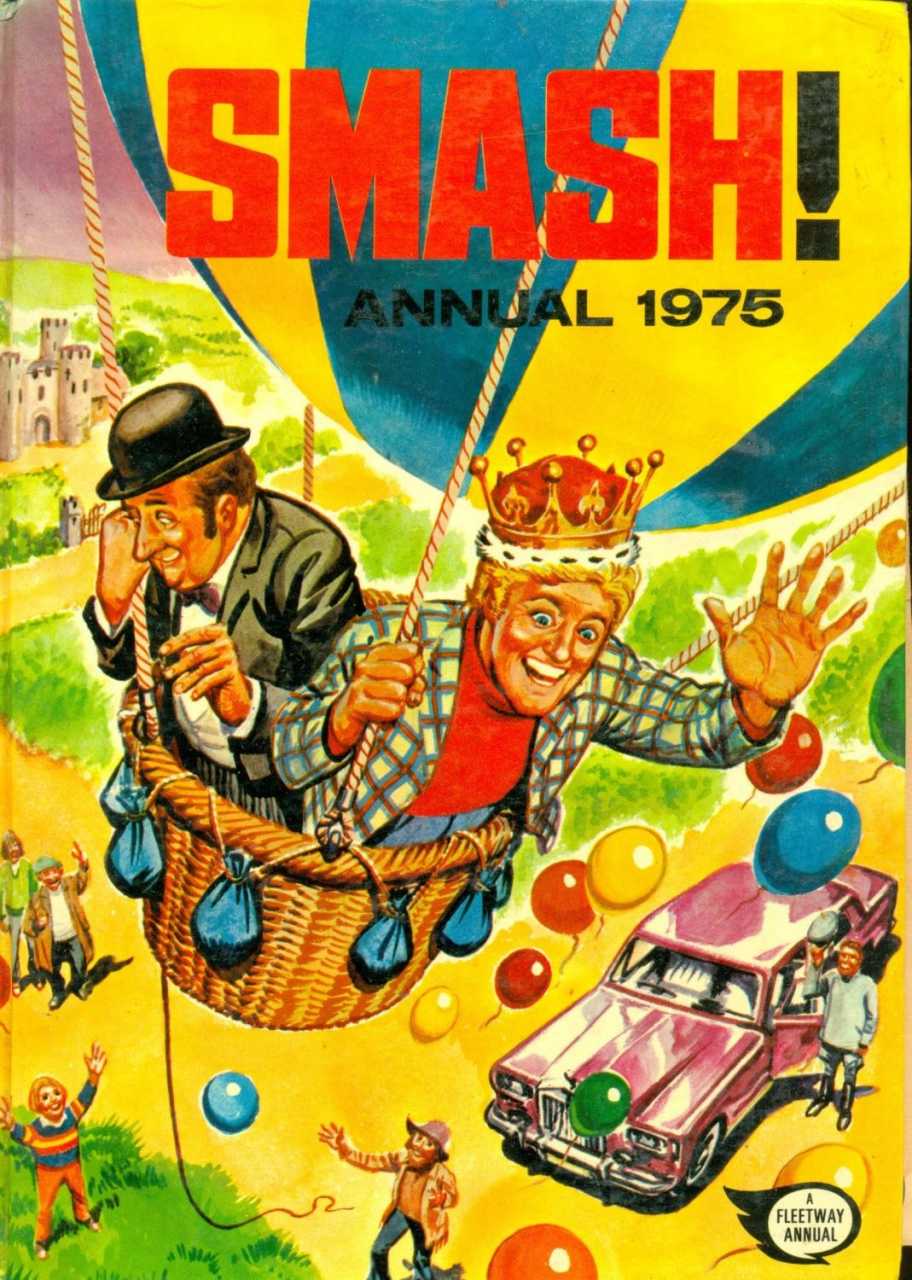
Janus Stark was a fantastically innovative and successful strip. Created by Tully for the relaunch of Smash in 1969, the majority of the art was from Solano Lopez’s studio, providing an aura of eerie, grimy veracity well suited to this tale of a foundling who grew up in a grim orphanage only to become the greatest escapologist of the Victorian age.

The Man with Rubber Bones also had his own ideas about retribution and justice and would joyously sort out those scoundrels the Law couldn’t or wouldn’t touch. A number of creators worked on this feature, which survived until the downsizing of the publisher’s comics division in 1975 – and even beyond – since Stark escaped oblivion by emigration.

When the series ended in Britain it was continued in French publications – even unto Stark’s eventual death and succession by his son. Here though, we get to see his earliest feats and I for one was left hungry for more. Encore!

The last spot in this sturdy hardback treasury falls to the Spooky Master of the Unknown Cursitor Doom. This series is the unquestioned masterpiece of Eric Bradbury – an artist who probably deserves that title as much as his visual creation.

Writer Ken Mennell, who usually invented characters for other writers to script, kept Doom for himself and the result is a darkly brooding Gothic thriller quite unlike anything else in comics then or since. If pushed, I’ll liken it most to William Hope Hodgson’s Karnacki the Ghost Breaker novelettes – although that’s more for flavour than anything else and even that doesn’t really cover it.

Doom is a fat, bald, cape-wearing foul-tempered know-it-all who just happens to be humanity’s last-ditch defence against the forces of darkness. With his strapping and rugged young assistant Angus McCraggan and Scarab, a trained raven (or is it, perhaps, something more?), Cursitor crushed without mercy any threat to humanity’s wellbeing.

Re-presented here is the ‘Dark Legion of Mardarax’ wherein a cohort of Roman soldiers extracted from the mists of antiquity rampages across the British countryside, intent on awaking an ancient and diabolical monstrosity from the outer Dark!

Perhaps these tales are a thrill for me because I first read them when I was just an uncomprehending nipper, but I don’t think so. It’s a tremendous thrill now to realise that despite all the age, wisdom, and sophistication I can now muster, that these strips really were – and are – as great if not better, than most of the comics I’ve seen in fifty-plus years of reading. Don’t take my word for it: track down this book and see if you’re not as hungrily avid for more of the same…
© 2005 IPC Media Ltd. All rights reserved.

The Golden Years of Adventure Stories


By various (DC Thomson & Co., Ltd.)
ISBN: 978-0851165271

Here’s a wonderful compilation commemorating the truly unique DC Thomson comic experience, concentrating on their many action and adventure serials. The Dundee based company has long been a mainstay of British popular reading and the strong editorial stance has informed a huge number of household names over the decades.

The main tenet of the Thomson adventure philosophy is a traditional, humanistic sense of decency. Runner Alf Tupper‘The Tough of the Track’ – might be a poor, rough, working class lad, competing in a world of privileged “Toffee-Nosed Swells”, but he excels for the sheer joy of sportsmanship, not for gain or glory.

There are no anti-heroes in the Thomson heroic stable, almost in direct opposition to the iconic, anarchic, mischief-makers of their humour comics.

British spy Bill Sampson may be the dreaded ‘Wolf of Kabul’ to the Afghan tribesmen he encounters with devoted assistant Chung (who will live forever as the wielder of the deadly “Clicky Ba” – that’s a cricket bat to you and me), but he’s still just an ordinary chap at heart, as are all the other characters spotlighted here. They’re just the sort of people ordinary kids should want to grow up into.

Heroes like Samson actually predate the company’s conversion of prose adventure fiction into comic strips – generally accepted as 1961, when the proliferation of TV sets among the perceived audience dictated the switch from words to pictures.

For many years previously, what children bought were boys’ or girls’ “papers”, packed with well-written text stories and the odd illustration and features page. Thomson held these over in titles such as Adventure until the end of the 1950s, but eventually succumbed to the inevitable, converting their pulp-stars into pictorial idols.

Wolf of Kabul, for instance, began in 1922, but was easily and successfully translated into a comic strip in the 1960s.

In this compendium are both prose stories and strips featuring some of Britain’s best loved and longest running heroes subdivided into categories that mirror the average schoolboy’s interests.

So thrill again, or catch the bug with such Schooldays sagas as The Red Circle School (1940s) and Kingsley Comp (1980s); the sporting triumphs of The Tough of the Track (1949-onwards), Wilson the mysterious Man in Black (The Truth About Wilson: 1943-onwards), or Gorgeous Gus (a millionaire – even before he became a footballer – who didn’t like to run but had an infallible shot).

You might prefer to peruse Cast, Hook and Strike, the story of Joe Dodd: an exceptional angler from the 1970s (yes, a fishing strip, and don’t knock it ’til you’ve tried it).

Or perhaps your fancy will be caught by the War stories I Flew with Braddock, Code-name Warlord, and V for Vengeance, or the outrageous heroics of Morgyn the Mighty (Strongest Man in Africa), The Laughing Pirate, or The Hairy Sheriff (a cowboy ape).

And, as ever, Wolf of Kabul will capture your fancy and fulfil that desire to sample simpler times.

These tales, taken from the classic periodical publications Adventure, The Skipper, The Wizard and Rover, latterly supplemented by material from Hornet, Hotspur, Victor and Warlord, are accompanied and augmented by numerous glorious cover reproductions and feature pages, loaded with fun and shiny with nostalgia.

I only wish I could name all the creators responsible, but Thomson’s long-standing policy of creative anonymity means I’d be guessing too many times. I can only hope that future collected celebrations will include some belated acknowledgement of all the talented individuals who between them shaped the popular consciousness of generations, and made childhoods joyful, wondrous and thrilling.
© 1991 DC Thomson & Co., Ltd. All Rights Reserved.

The Mirror Classic Cartoon Collection


By Peter O’Donnell, Jim Edgar, Barrie Tomlinson, Steve Dowling, John Allard, Frank Bellamy, Martin Asbury, Reg Smythe, Jim Holdaway, Jack Greenall, Jack Clayton, John Gillatt & various, compiled by Mike Higgs (Hawk Books)
ISBN: 978-1-89944-175-4

The Daily Mirror has been home to a number of great strips over its long history – beginning with one of the Empire’s greatest successes Tiger Tim, (who debuted there in 1904) and culminating with the likes of the war-winning morale-boosting naive nymph Jane, not to mention The Perishers, Garth, Andy Capp and many others.

Two of the above cited feature in this beautiful compilation from Mike Higgs’ Hawk Books which did so much over the years to keep British cartoon history alive. This particular triumph gathers sample selections from the newspaper’s back catalogue in a spiffy, luxuriously oversized (280 x 180 mm) hardback that is stuffed with fun, thrills and quality nostalgia.

The illustrious Garth is the first star, featured in an adventure from 1957 by series originator and longest serving creator Steve Dowling (1943-1969) – and then succeeded by his assistant John Allard, then Frank Bellamy and finally Martin Asbury.

Garth is a hulking physical specimen, a virtual human superman with the involuntary ability to travel through time and experience past and future lives. This simple concept lent the strip an unfailing potential for exotic storylines and fantastic exploits.

‘The Captive’ – written by Peter O’Donnell and illustrated by Dowling and Allard – is a contemporary tale with our hero abducted from Earth as a prize in a galactic scavenger hunt instigated by bored hedonistic aliens who don’t realise quite what they’ve gotten themselves involved with…

A second adventure, ‘The Man-hunt’, is the last that Frank Bellamy worked on. The astounding Bellamy died in 1976 whilst drawing this story of beautiful alien predators in search of prime genetic stock with which to reinvigorate their tired bloodlines. Written by Jim Edgar, the strip was completed by Asbury who took over with the 17th instalment. This tongue-in-cheek thriller is full of thrills and fantastic action, yet never loses its light humorous touch.

Andy Capp is a drunken, skiving, misogynistic, work-shy, wife-beating scoundrel who has somehow become one of the most popular and well-loved strip characters of all time. Created by jobbing cartoonist Reg Smythe to appeal to northern readers during a circulation drive, he first saw the light of day – with long-suffering, perpetually abused-but-forgiving wife Florrie in tow – on August 5th 1957.

This volume reprints 37 strips from the feature’s 41-year run, which only ended with Smythe’s death in 1998, but the sheer magic of this lovable rogue is as inexplicably intoxicating as it always was, defeating political correctness and common decency alike: A true Guilty Pleasure.

Romeo Brown began in 1954, drawn by Dutch artist Alfred “Maz” Mazure, and starred a private detective with an eye for the ladies and a nose for trouble. The feature was a light, comedic adventure series that added some glamour to the dour mid-1950s, but really kicked into high gear when Maz left in 1957 to be replaced by Peter O’Donnell and the brilliant Jim Holdaway, who would go on to create the fabulous Modesty Blaise together. Romeo shut up shop in 1962 and is represented here by a pair of romps from the penultimate year. ‘The Arabian Knight’ and ‘The Admiral’s Grand-daughter’ combine sly, knowing humour, bungling criminality and dazzlingly visuals in a manner any Carry-On fan would die for.

Useless Eustace was a gag-panel (a single-picture joke) that ran from January 1935 to 1985. Created by Jack Greenall, its star was a bald nondescript everyman who met the travails of life with unflinching enthusiasm but very little sense. Greenall produced the strip until 1974, and other artists continued it until 1985. The selections here are from the war years and the 1960s. Another comedy panel was Calamity Gulch, a particularly British view of the ubiquitous “Western” which invaded our sensibilities with the rise of television ownership in the 1950s. Created by Jack Clayton, it began its spoofing and sharp-shooting on 6th June 1960, and you can see 21 of the best right here, Pardner.

A staple of children’s comics that never really prospered in newspapers was the sports adventure. At least not until 1989 when those grown up tykes opened the Daily Mirror to find a football strip entitled Scorer, written by Barrie Tomlinson and drawn by Barry Mitchell, and eventually John Gillatt. Very much an updated, R-rated Roy of the Rovers, the strip stars Dave ‘Scorer’ Storry and his team Tolcaster F.C. in fast, hot, sexy tales of the Beautiful Game that owed as much to the sports pages it began on as to the grand cartoon tradition.

‘Cup Cracker’, included here is by Tomlinson & Gillatt from 1994, and shows that WAGS (Wives And GirlfriendS, non-sports fans) were never a new phenomenon.

Not many people know this – or indeed, care – but before I review an old book (which I arbitrarily define as something more than three years old) I try to locate copies on the internet. It’s a blessing then to still see this wonderful and utterly British tome is readily available in France, Germany – most of Europe in fact and even in Britain. Surely that’s a testament to the book’s quality and desirability, and if that’s the case maybe The Mirror Group or some print philanthropist should expedite a new edition – or even a few sequels…
© 1998 Mirror Group Newspapers, Ltd. All Rights Reserved.