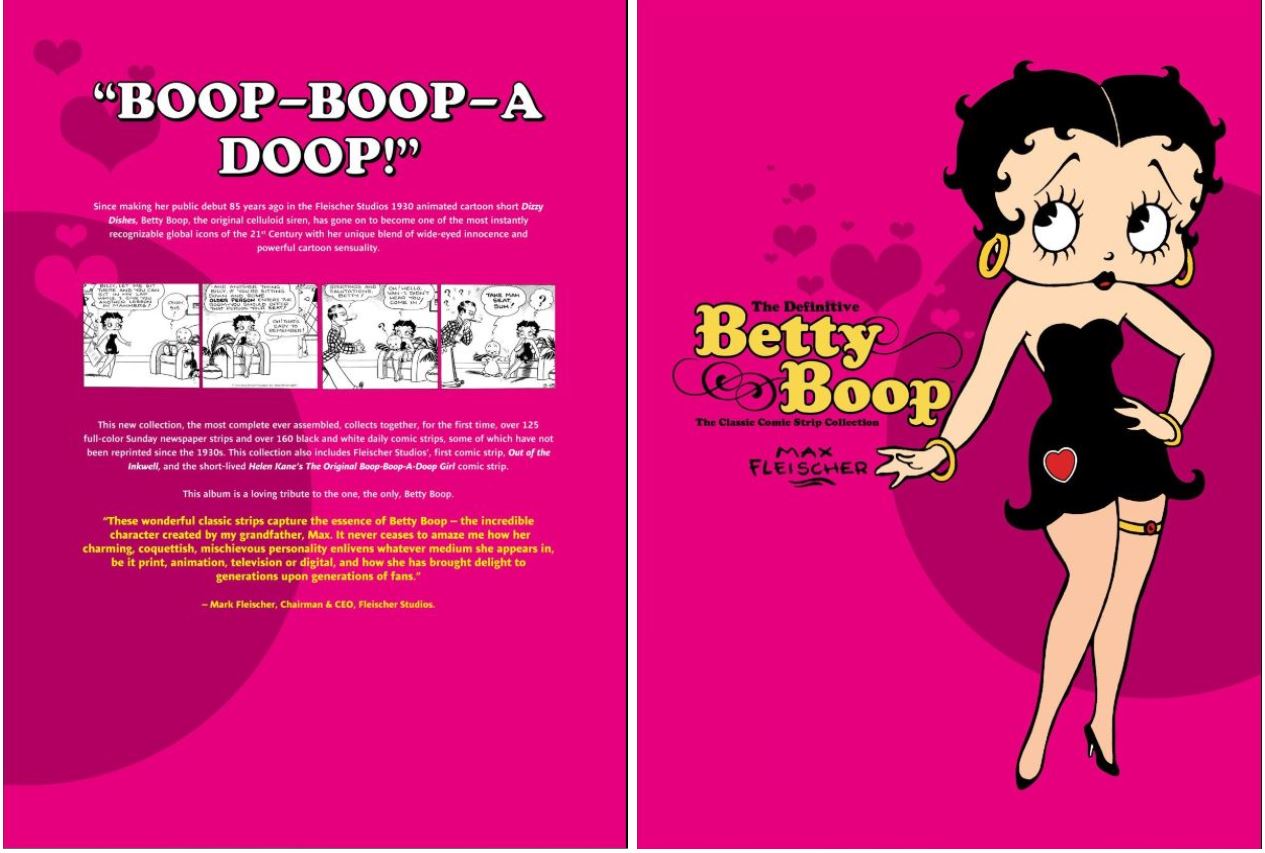
The Definitive Betty Boop: The Classic Comic Strip Collection


By Max Fleischer, Bud Counihan, with Hal Seeger & various (Titan Comics)
ISBN: 978-1-84856-707-8 (HB/Digital edition)

This book includes Discriminatory Content produced in less enlightened times.

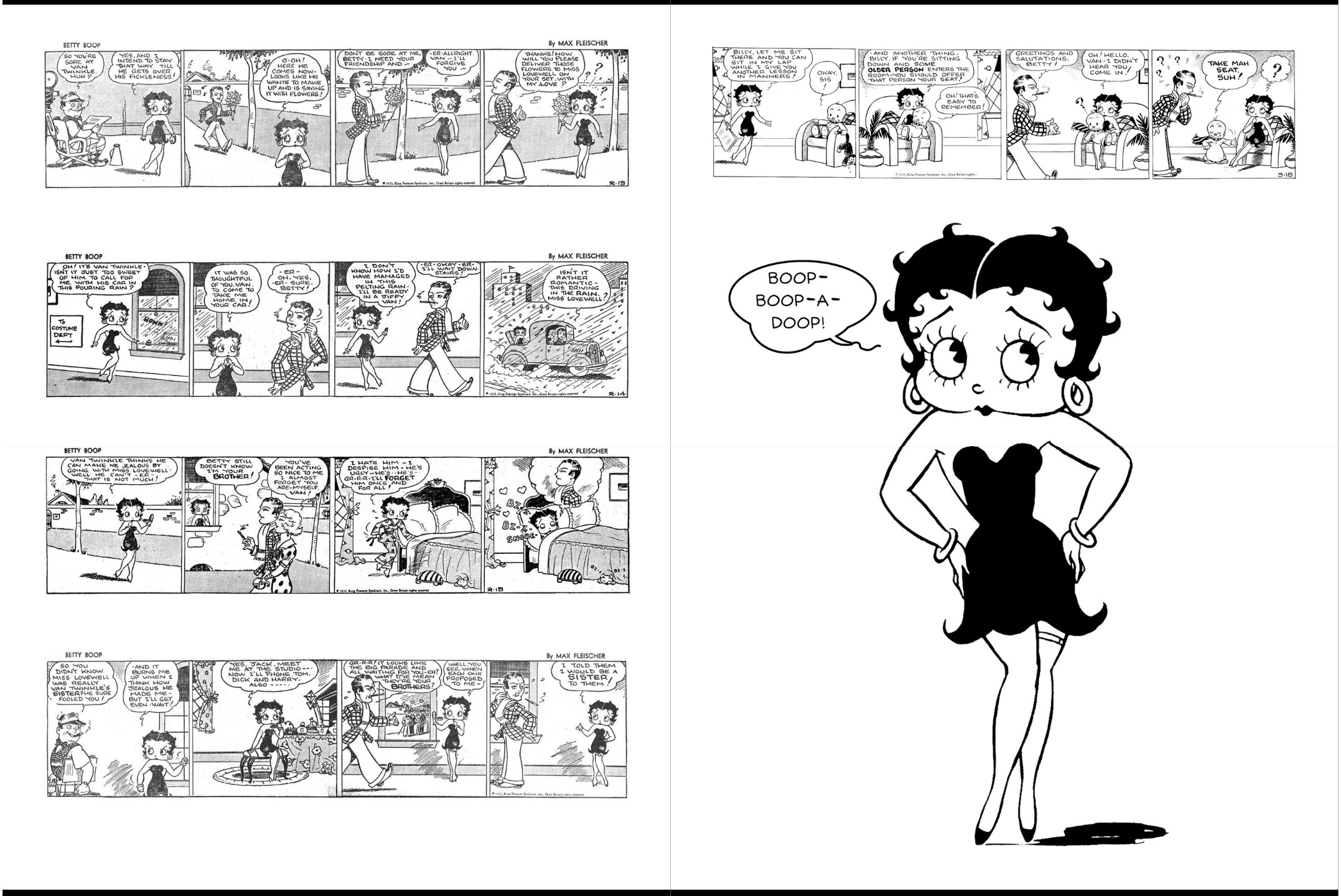
Betty Boop is one of the most famous and long-lived fictional media icons on the planet and probably the one who has generated the least amount of narrative creative material – as opposed to simply merchandise – per year since her debut.

She was created at the Fleischer Cartoon Studios, most likely by either by Max Fleischer himself or top cartoonist and animator Grim Natwick – depending on whomever you’ve just read – and had a bit part in the monochrome animated short feature Dizzy Dishes: the seventh “Talkartoon” release from the studio, screened for the first time on August 9th 1930.

A calculatedly racy sex-symbol from the start, albeit anthropomorphised into a sexy French Poodle (!!), Betty was primarily based on silent movie star and infamous “It-Girl” Clara Bow. Or, according to some historians, it was far more than just her distinctive sound Betty took from popular contemporary star Helen Kane. In those pioneering days of “talkies”, Betty was voiced by a succession of actresses including Margie Hines, Kate Wright, Ann Rothschild and ultimately Mae Questel, who all mimicked Bow’s soft, seductive (no, really!) Brooklyn accent. Or possibly Kane’s. There’s a court case involved in this history so opinions are hard held and still very divided…

Although frequently appearing beside early Fleischer Studios stars Bimbo (a homely puppy dog also called Fitz) and Koko the Clown – who both debuted in Fleischer’s earliest screen offerings Out of the Inkwell – Betty had become a fully, if wickedly shaped, human girl by 1932’s Any Rags, and she quickly co-opted and monopolised all the remaining Talkartoons, before graduating to the Screen Songs featurettes. Betty ultimately won her own animated cartoon series to become “The Queen of the Animated Screen”, reigning until the end of the decade.

A Jazz Age flapper in the Depression Era, the delectable Boop was probably the first sex-charged teen-rebel of the 20th century, yet remained winningly innocent and knowledgeably chaste throughout her career. Maybe that’s why she became so astoundingly, incredibly popular – although her appeal diminished appreciably once the censorious Hayes Production Code cleaned up all that smut and fun and sophistication oozing out of Hollywood in 1934 – even though the Fleisher Studio was proudly New York born and bred.

Saucy singer Helen Kane – who had performed in a sexy “Bow-esque” Brooklyn accent throughout the 1920s and was billed as “The Boop-Oop-A-Doop Girl” – famously sued for “deliberate caricature” in 1932. As well as a renowned actor, she was sharp enough to briefly steal the show and actually become the star of the first Betty newspaper strips…

When Kane’s lawsuit failed, Betty took over the paper outlets in her own name, but couldn’t withstand a prolonged assault by the National Legion of Decency and Hayes Code myrmidons. With all innuendo removed, salacious movements restricted and wearing much longer skirts, Betty gained a boyfriend and family, whilst newspaper strip scripts consciously targeted younger audiences. The tabloid feature folded in 1937 and her last animated cartoon stories were released in 1939. The only advantage to Betty’s screen neutering and new wholesome image was that she suddenly became eligible for inclusion on the Funnies pages of family newspapers, alongside the likes of Popeye, Little Orphan Annie and Mickey Mouse….

This superb collection gathers every pre-war iteration associated with Betty Boop – including ones she isn’t in – and is augmented by fond remembrances from Mark Fleischer and Virginia Mahoney in their Foreword ‘About our grandad, Max Fleischer…’ and comes with an informative Introduction tracing Betty’s wild ride of a career. Supplementing his text with candid behind-the-scenes photos and contemporary art as well as advertising items and memorabilia of the time, cartoonist Brian Walker (son of Beetle Bailey and Hi & Lois creator Mort Walker) traces the celluloid and tabloid star’s creation, rise, fall and latter day resurgence in ‘Made of Pen and Ink, she can win you with a Wink’.

There was a brief flurry of renewed activity during the 1980s, which led to a couple of TV specials, a comic book from First Comics (Betty Boop’s Big Break, 1990) and a second newspaper strip. Betty Boop and Felix was crafted by Walker and his brothers Neal, Greg, and Morgan, wherein the glamour queen shared adventures with fellow King Features nostalgia icon Felix the Cat. It ran from July 23rd 1984 – January 31st 1988, but even counting those – and we aren’t here – that’s still a pretty meagre complete comics canon for a lady of Betty’s longevity, pedigree and stature…

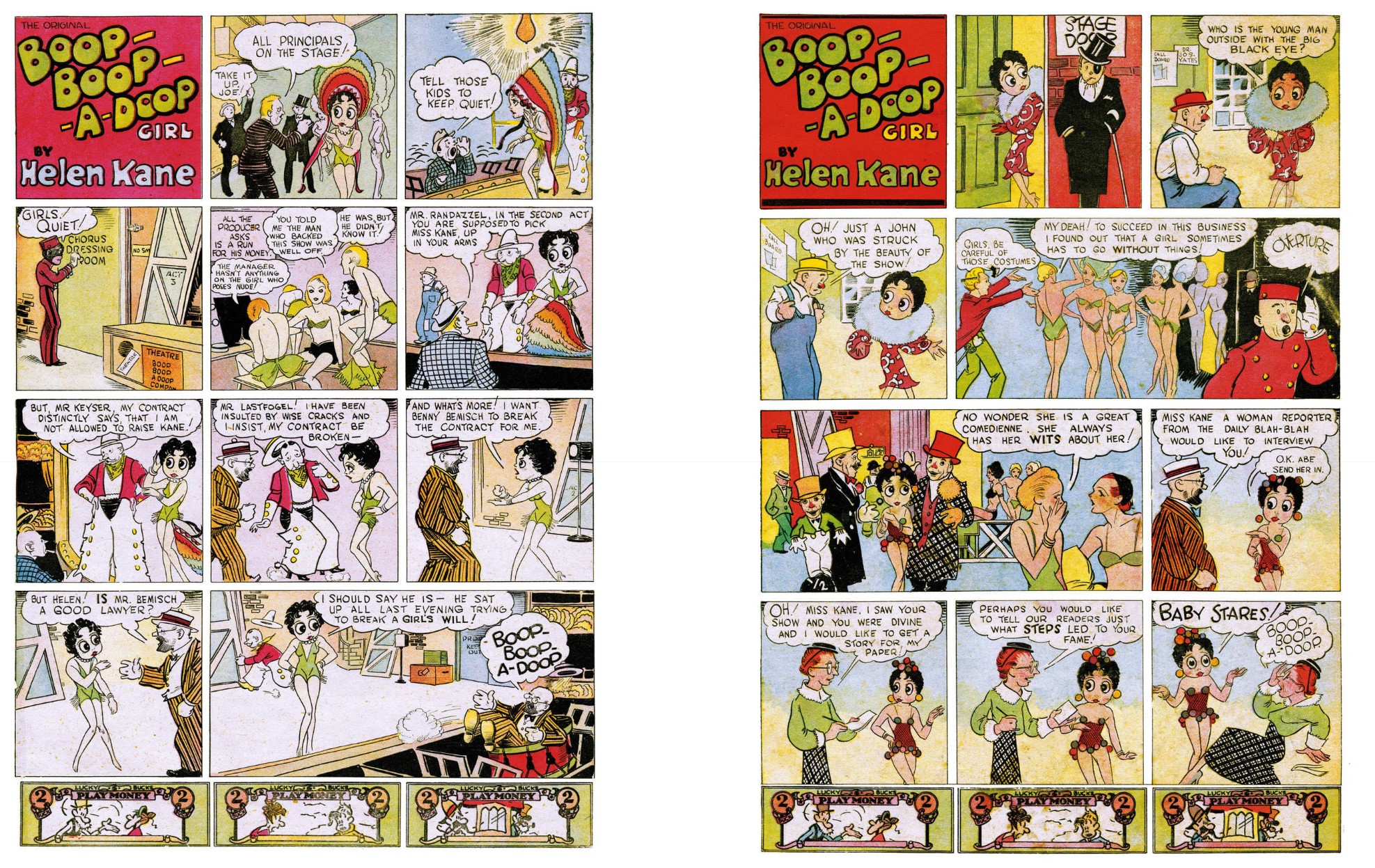
Confusion and contention abound in Betty’s print career and that’s mirrored in this book. Her first regular strip was as a daily feature in black-&-white, but you’ll see that last, because the comics experience begins in full colour with an experimental Out of the Inkwell Koko the Klown Sunday strip starring the manic mime in silent surreal romps that have the cachet of being Fleischer’s first work for King Features Syndicate. They ran from November 25th – December 15th 1934 and are followed by The Original Boop Boop-A-Doop Girl: a Sunday feature spanning August 5th to October 12th 1934. As negotiations between Fleischer and King Features stalled in 1933, Helen Kane approached the Syndicate and offered herself as a straight knock-off for the cartoon star. The resultant domestic comedy strip ran for just 11 weeks, and only in the tabloid New York Sunday Mirror. It was dropped as soon as Fleischer signed with King Features…

Attributed to Kane and drawn by Ving Fuller, the succession of manic gag pages are basic, innocently racy vaudeville one-liners, but do still evoke a certain nostalgic charm…

Whilst we’re on a possibly touchy subject: a lot of attitudes to women and visualisations of minorities won’t really pass an earnest examination here, and readers should be aware that these were all created in a different time for far less enlightened audiences. A little patience and forbearance will be your best guides on some pages…

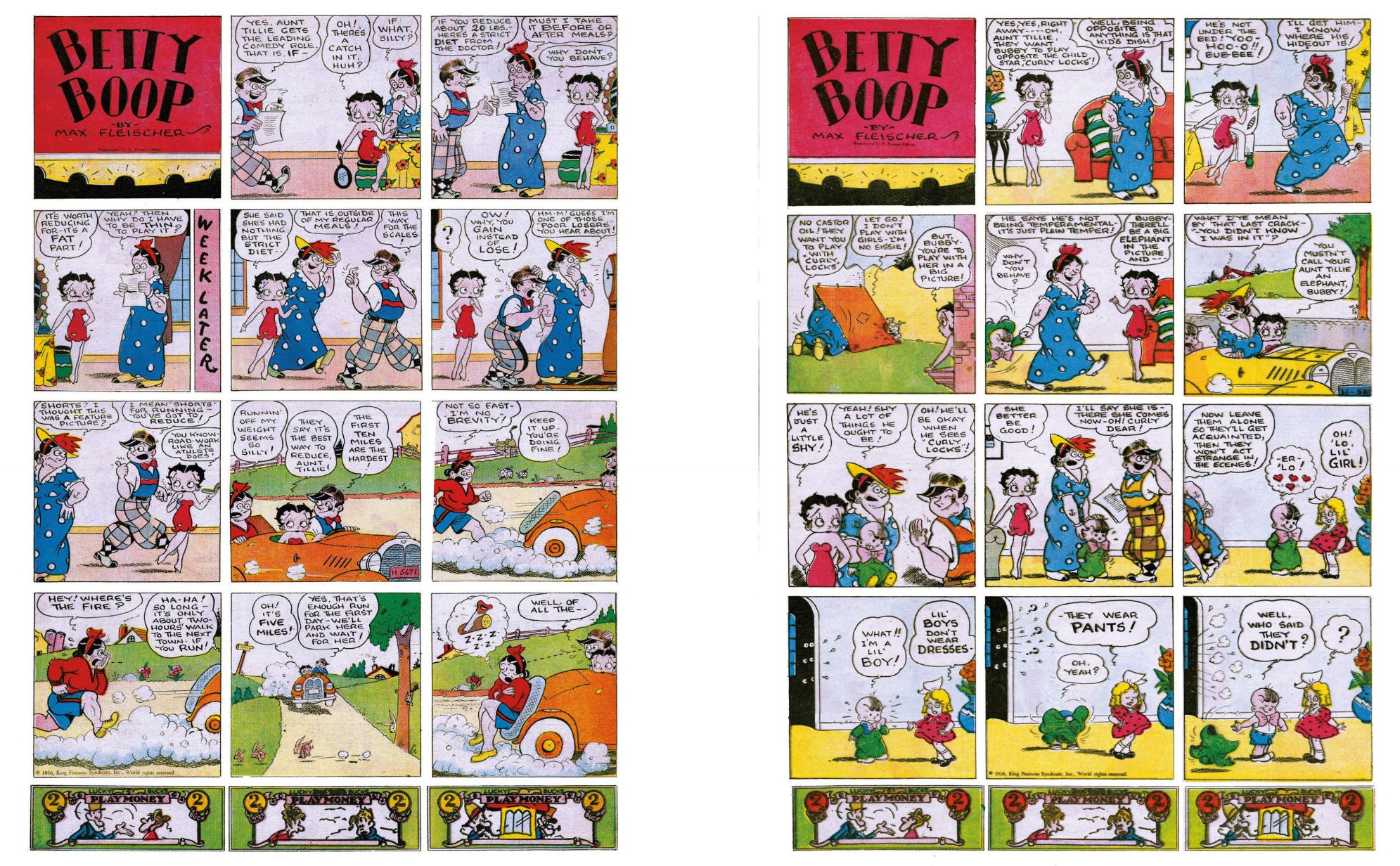
Running from November 25th 1934 to November 27th 1937, the full colour Sunday strips starring the original and genuine Betty Boop were drawn by Bud Counihan: a veteran ink-slinger who had created the Little Napoleon strip in the 1920s before becoming Chic Young’s assistant on Blondie. They commenced a few months after the daily feature and might be a little confusing as they encompass a large supporting cast for aspiring starlet Betty as she navigates a tiresome and treacherous career in Hollywood. I’d advise reading the dailies first and ending your reading enjoyment here, but it’s your choice…

These gag episodes feature the freshly-sanitised, family-oriented heroine of the post-Hayes Code era, but for devotees of the period and comics fans in general, the strip still retains a unique and abiding charm. Counihan’s Betty is still oddly, innocently coquettish yet confidant: a saucy thing with too-short skirts and skimpy apparel. Some outfits – especially bathing costumes – would raise eyebrows even now, and although the bald innuendo that made her a star is absent, these tales of a street-wise young thing trying to “make it” in Tinseltown are plenty sophisticated when viewed through the knowing, sexually adroit and informed eyes of 21st century readers. Well some of them, anyway…

Produced as full-page strips, the Sundays are broadly slapstick, with moments of cunning wordplay: single joke stories regarding the weirdness of acting and the travails of fandom. There’s a succession of blandly arrogant romantic leading men (mostly called Van something-or-other) but none stick around for long as Betty builds her career, and eventually scenarios change to a western setting as cast and crew begin making Cowboy Pictures, leading to many weeks’ worth of “Injun Jokes”, but ones working delightfully and hilariously counter to expected unpleasant stereotypes of those times. However, the introduction of fearsome lower-class virago Aunt Tillie – chaperone, bouncer and sometime comedy movie extra – moves the strip into an unexpected direction and begins Betty’s life as an extra in her own show…

Soon, a clear and unflinching formula sets in with Bubby (see below), Aunt Tillie and her diminutive new beau Hunky Dory increasingly edging Betty out of the spotlight and even occasionally off the page entirely. By 1937 the show was over…
The Betty Boop daily strip began on July 23rd 1934: a raw, raucous comedy gig that ran until March 18th 1935 in an extended sequence of gag-a-day encounters blending into an epic comedy-of-errors. Here Betty’s lawyers do litigious battle with movie directors and producers to arrive at the perfect contract for all parties. That’s clearly a war that still rages to this day and once again it’s happening under the cost restrictions of what is, after all, another Great Depression like the one Betty was a constant momentary antidote to…

Jokes come thick and fast in the same vein, with lawyers, entourage and all extras providing the bulk of the humour whilst Betty stands in for the Straight Man in her own strip… Except for a recurring riff about losing weight to honour her contract, which stipulates she cannot be filmed weighing more than 100 pounds! Geez! Her head alone has got to weigh at least… sorry, I know… it’s just a comic…

Like most modern stars, Betty had a dual career and there’s a lot of recording industry and song jokes as well as fan affrontery and boyfriend woes, as well as the introduction of the first of an extended cast: Betty’s streetwise baby brother Bubby (originally Billy). He’s a riotous rapscallion intended to act as a chaotic foil to the star’s affably sweet, knowingly dim complacency, and he’s another celluloid wannabe in waiting…

By no means a major effort of the Golden Age of Comics Strips, Counihan’s Betty Boop (like most licensed syndicated features the strip was “signed” by the copyright holder, in this case Max Fleischer) remains a hugely effective, engaging and entertaining work, splendidly executed and well worthy of the attentions of fans with a penchant for history or feeling for fashion.

With the huge merchandising empire built around the effervescent cartoon Gamin/Houri, (everything from apparel to wallpaper, clocks to drinking paraphernalia) surely there’s room today to address her small brief but potent contributions to the comics arts. If you think so, this book is for you…

Betty Boop © 2015 King Features Syndicate, Inc./Fleischer Studios, Inc. ™ & © Hearst Holdings, Inc./Fleischer Studios, Inc. All rights reserved. Foreword © 2015 Mark Fleischer & Ginny Mahoney. Introduction © 2015 Brian Walker.
Today in 1877, pioneering Swedish cartoonist/comics creator Oskar Emil O.A. Andersson was born, and in 1911 the amazing Jack Burney (Superman, Batman, Starman) also arrived. In 1957 Belgian star BernardYslaireHislaire was born followed a year later by Ms. Tree co-creator Terry Beatty with writer/editor Bob Harras coming one year later. Sam (Zero Girl, The Maxx, Wolverine) Keith, arrived in 1963.

Sadly in 1998 we lost astoundingly adept Canadian import Win Mortimer (Superman, Batman, Legion of Super-Heroes).

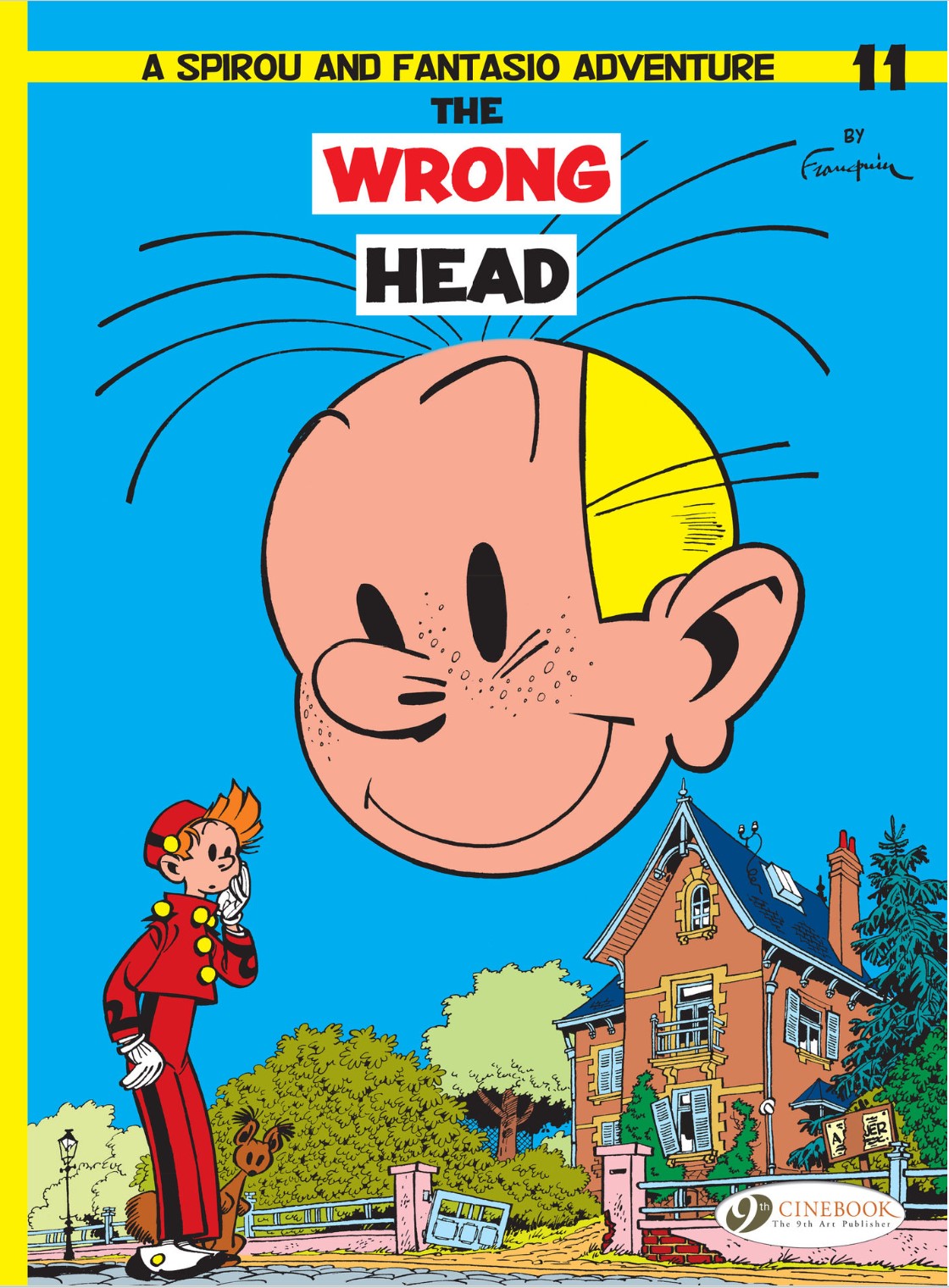
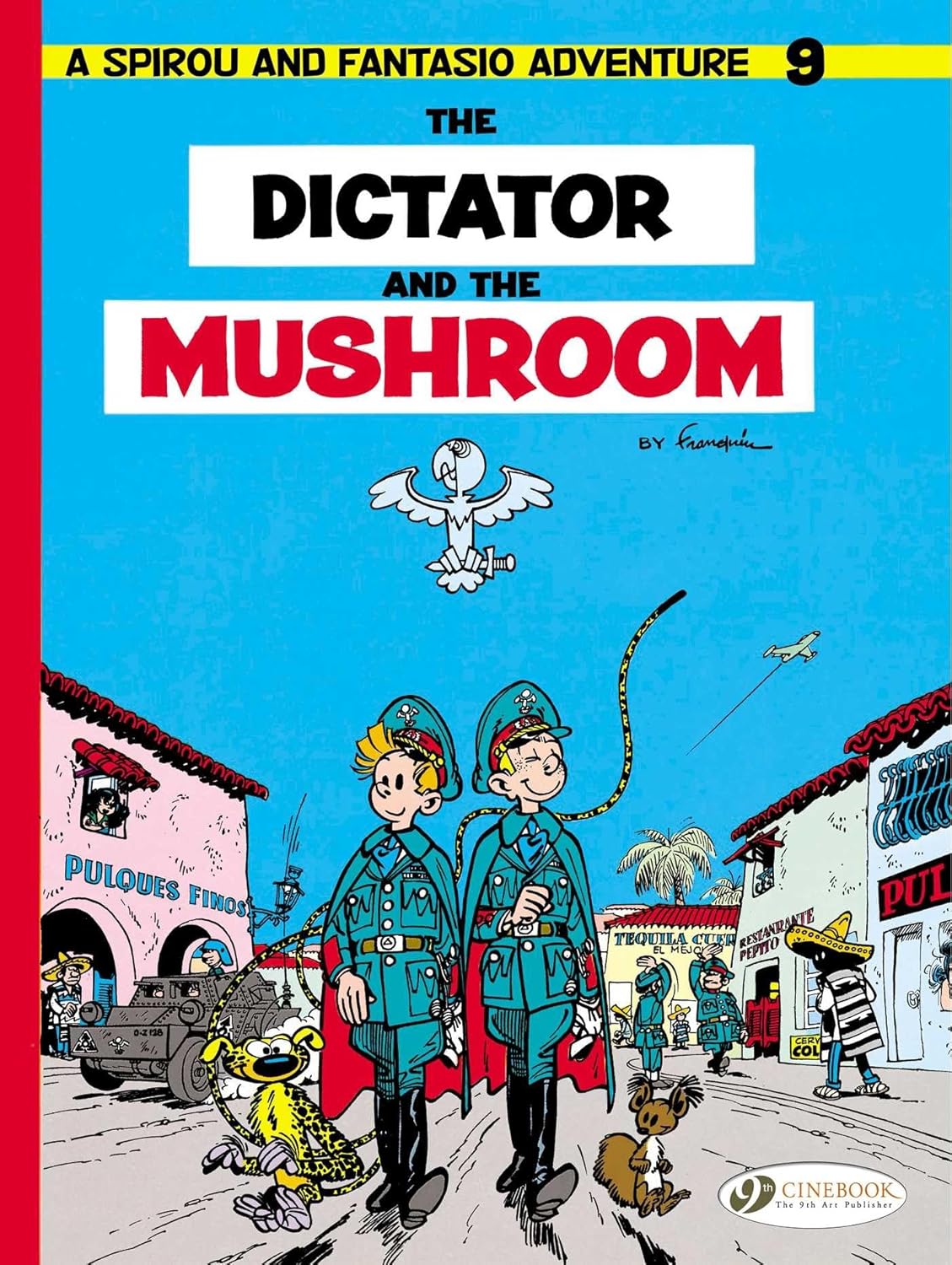
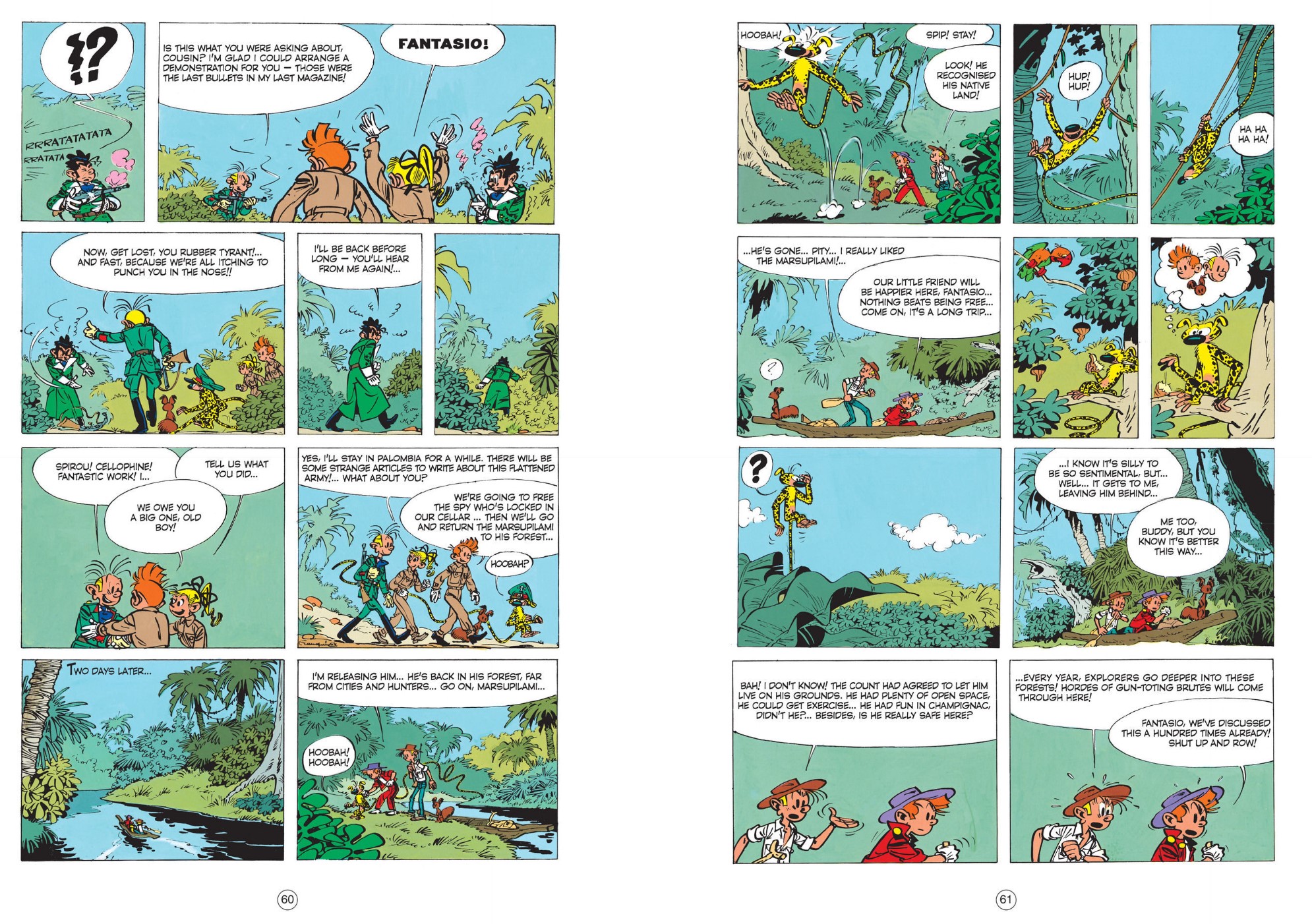
Spirou and Fantasio volume 9: The Dictator and the Mushroom


By André Franquin, translated by Jerome Saincantin (Cinebook)
ISBN: 978-1-84918-267-6 (album PB/Digital edition)

This book includes Discriminatory Content produced in less enlightened times.

Another anniversary I just couldn’t leave unremarked upon. Deal with it. I’m old, morose and accursed with nostalgia.

André Franquin was born in Etterbeek, Belgium on January 3rd 1924 and died on January 5th 1997. In between there were good times and bad, which he offset by creating the most incredible characters and stories, and by making people laugh and think – but mostly laugh. This is one of the very best you can find translated into English.

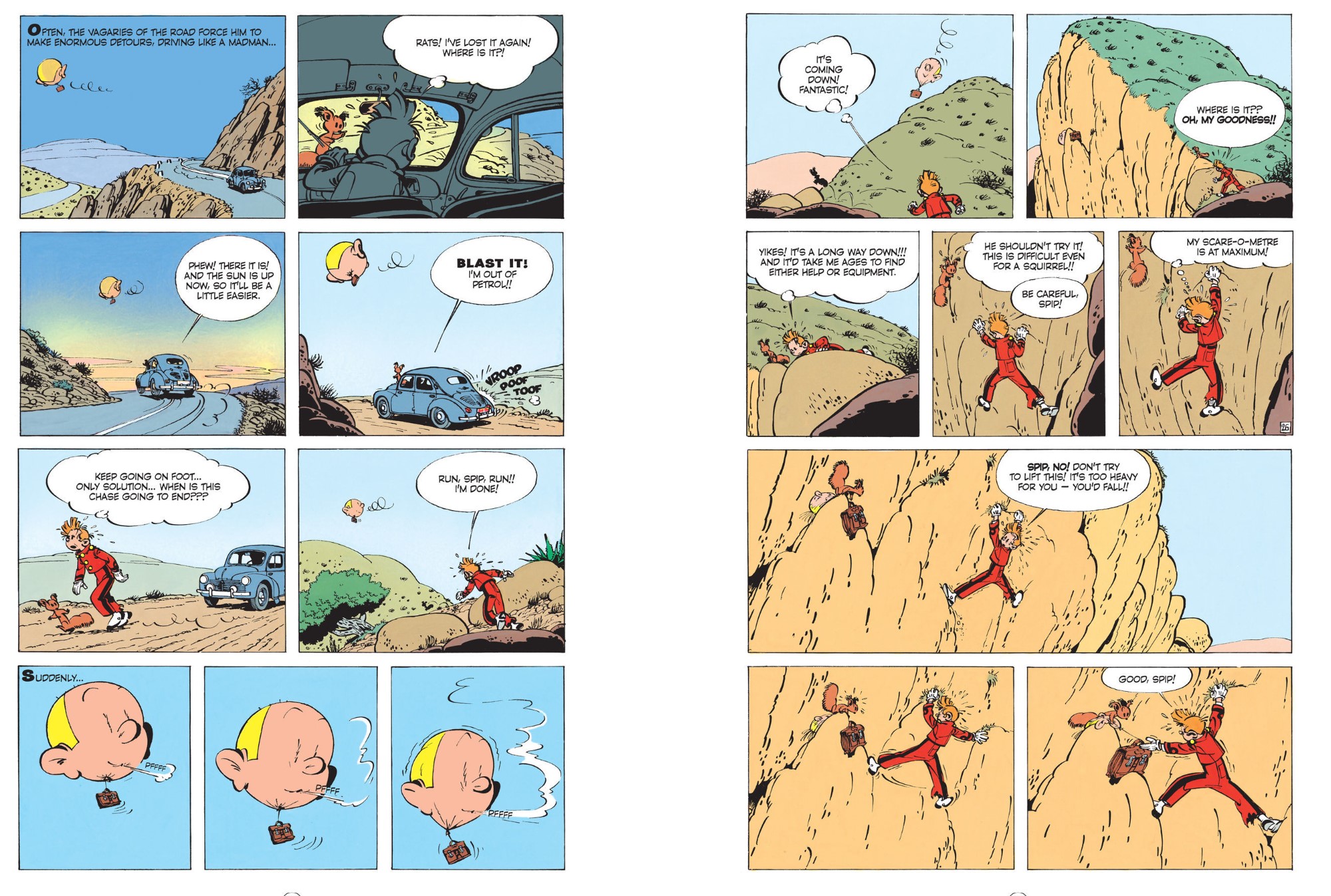
Adventure-seeking kid Spirou headlined the magazine he was named for from the first issue (dated April 21st 1938). He was created by French cartoonist Françoise Robert Velter using his pen-name Rob-Vel for Belgian publisher Éditions Dupuis in direct response to the success of Hergé’s Tintin for rival outfit Casterman. Originally a plucky bellboy/lift operator employed by the Moustique Hotel (a sly reference to the publisher’s premier periodical Le Moustique), his improbable exploits with pet squirrel Spip gradually grew into high-flying, far-reaching and surreal comedy dramas. That evolution was mainly thanks to Velter’s wife Blanche “Davine” Dumoulin who took over the strip when her husband enlisted in 1939 and Belgian artist assistant Luc Lafnet… at least until 1943 when Dupuis purchased all rights to the property, after which comic-strip prodigy Joseph Gillain (Jijé) took the helm.

Our interest really begins when Jijé handed his own trainee assistant complete responsibility for the flagship strip part-way through Spirou et la maison préfabriqué, (Le Journal de Spirou #427, June 20th 1946). Andre Franquin ran with it for two decades; enlarging the scope and horizons until it became purely his own. Almost every week fans would meet startling new characters such as comrade/rival Fantasio or crackpot inventor and Merlin of mushroom mechanics the Count of Champignac.

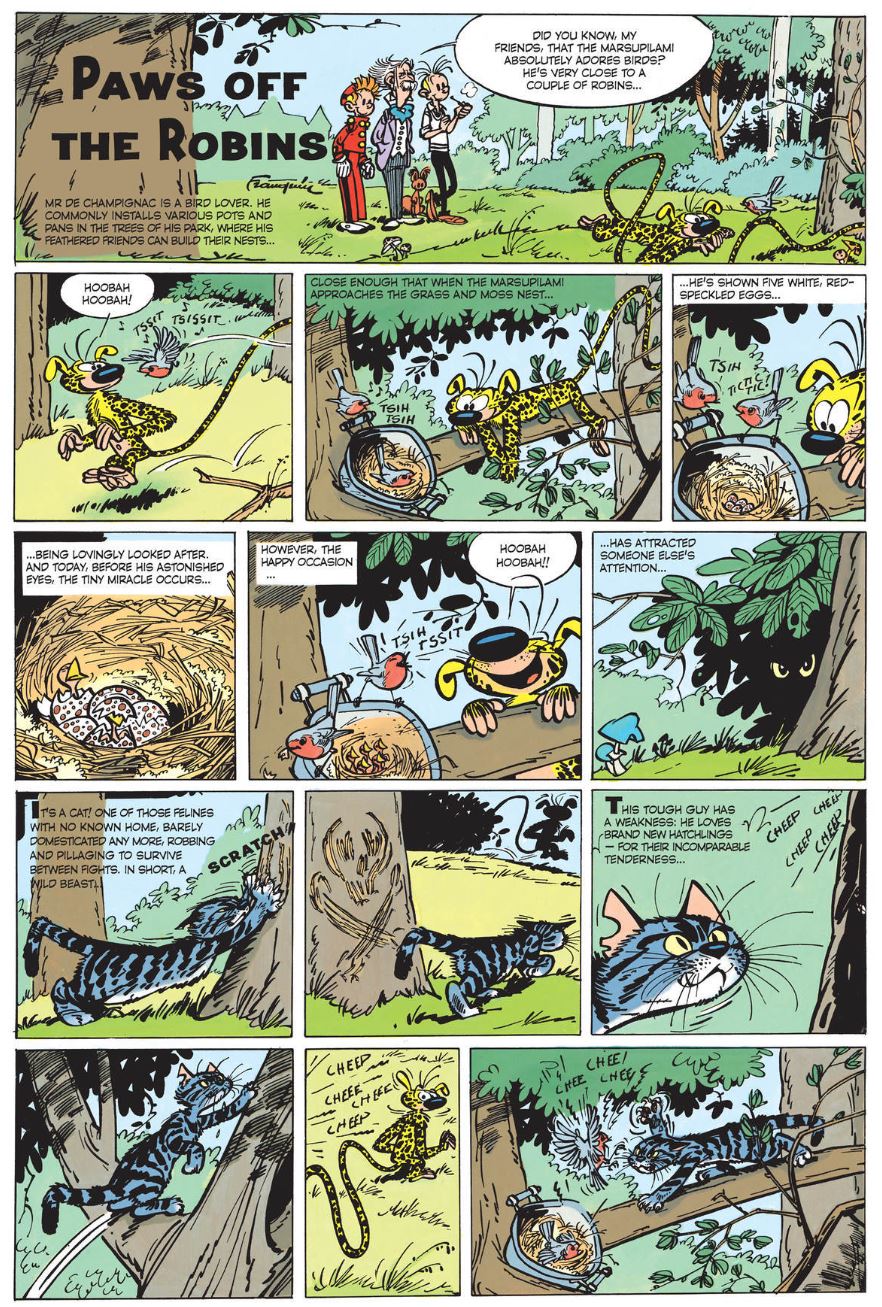
Spirou and Fantasio became globe-trotting journalists, travelling to exotic places, uncovering crimes, exploring the fantastic and clashing with a coterie of exotic arch-enemies such as Zorglub and Fantasio’s unsavoury cousin Zantafio. Incidentally, eerily-relevant The Dictator and the Mushroom features the second appearances of Zantafio and strong, capable, female (!) rival journalist Seccotine (renamed Cellophine for these English translations)…

Franquin, plagued in later life by bouts of depression, passed away in 1997 but his legacy remains; a vast body of work which reshaped the landscape of European comics.

Here then as originally serialised in LJdS #801-838, between 1953 and 1954 before subsequently being released on the continent in 1956 as hardcover album Spirou et Fantasio 7 – Le Dictateur et Le Champignon, this epic episode begins as globe-trotting troubleshooter Spirou and his short-tempered reporter pal Fantasio approach the isolated home of eccentric inventor Count Champignac. They are resolved to return the mischievous miracle monkey Marsupilami to its natural habitat in the jungles of Palombia

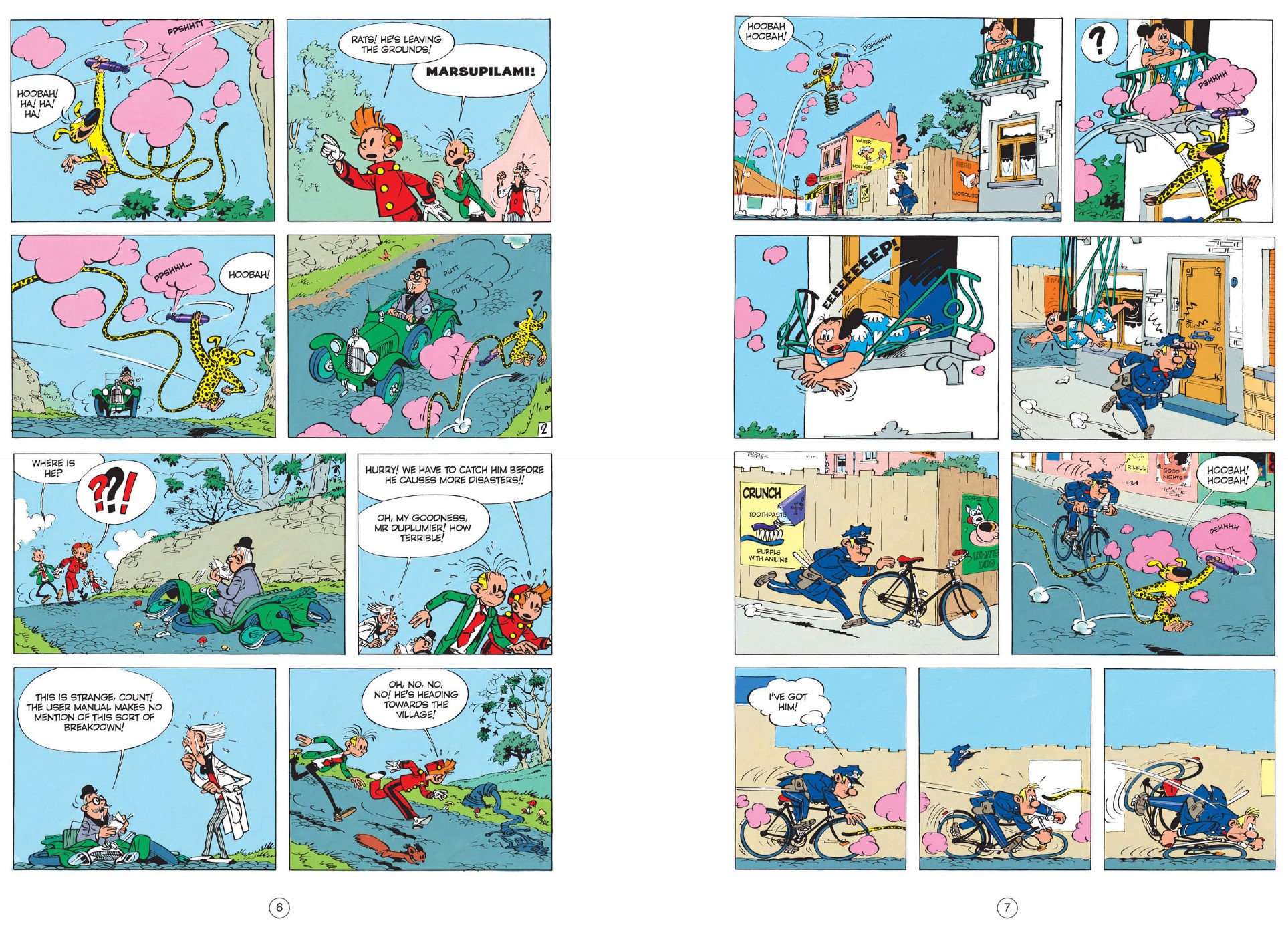
Sadly, whilst they discuss their plan with the elderly savant, the mischievous monkey he’s been safeguarding swipes the inventor’s latest mycoprotein marvel and heads for town…

Champignac calls the gaseous form of his newest mushroom extract “metalsoft” and that’s exactly what the stuff does: reduce the solidity of iron, brass, bronze, tin or whatever to the consistency of hot wax. By the time the prankish primate has finished innocently playing with the pump dispenser, locals are in uproar and their village is practically a puddle…

With nobody in Europe objecting, the lads promptly book passage on a South America-bound cruise ship, where once again the elastic-tailed terror causes a cacophony of comedic chaos. Eventually, though, our increasingly irate and exhausted adventurers at last head in-country towards sleepy Palombia where a big surprise is waiting for them…

Thanks to Marsupilami, they are forced to travel the last ten miles to capital city Chiquito on foot and are astonished to observe the sheer number of military vehicles constantly overtaking them. In the city, an altercation with soldiers leads to their arrest and interview with new supreme dictator General Zantas. The meeting is both a huge shock and unhappy reunion…

Fantasio’s cousin Zantafio had been only a little mean and perhaps misguided when they were all first hunting for the Marsupilami, but since then has reinvented himself, graduating into a full-blown murderous megalomaniac. A cheap thug in a flashy uniform, he is determined to carve himself a bloody empire and vast wealth through the conquest of his national neighbours. Moreover, Zantafio/Zantas wants his countrymen and cousin to join him in the campaign of conquest, a horrific demand the reporters initially refuse.

Locked in jail, Spirou & Fantasio ponder how to stop the murderous scheme and realise the perfect counter to Zantas’ burgeoning war machine is Champignac’s Metalsoft. All they have to do is get a message to the inventor and have him send enough of the wonder stuff to destroy the ever-expanding army…

Thus they apparently switch sides and are soon installed as high ranking officers. Of course, Zantafio is no fool and sets his most cunning spy to watch them; just waiting for the moment when they betray themselves.

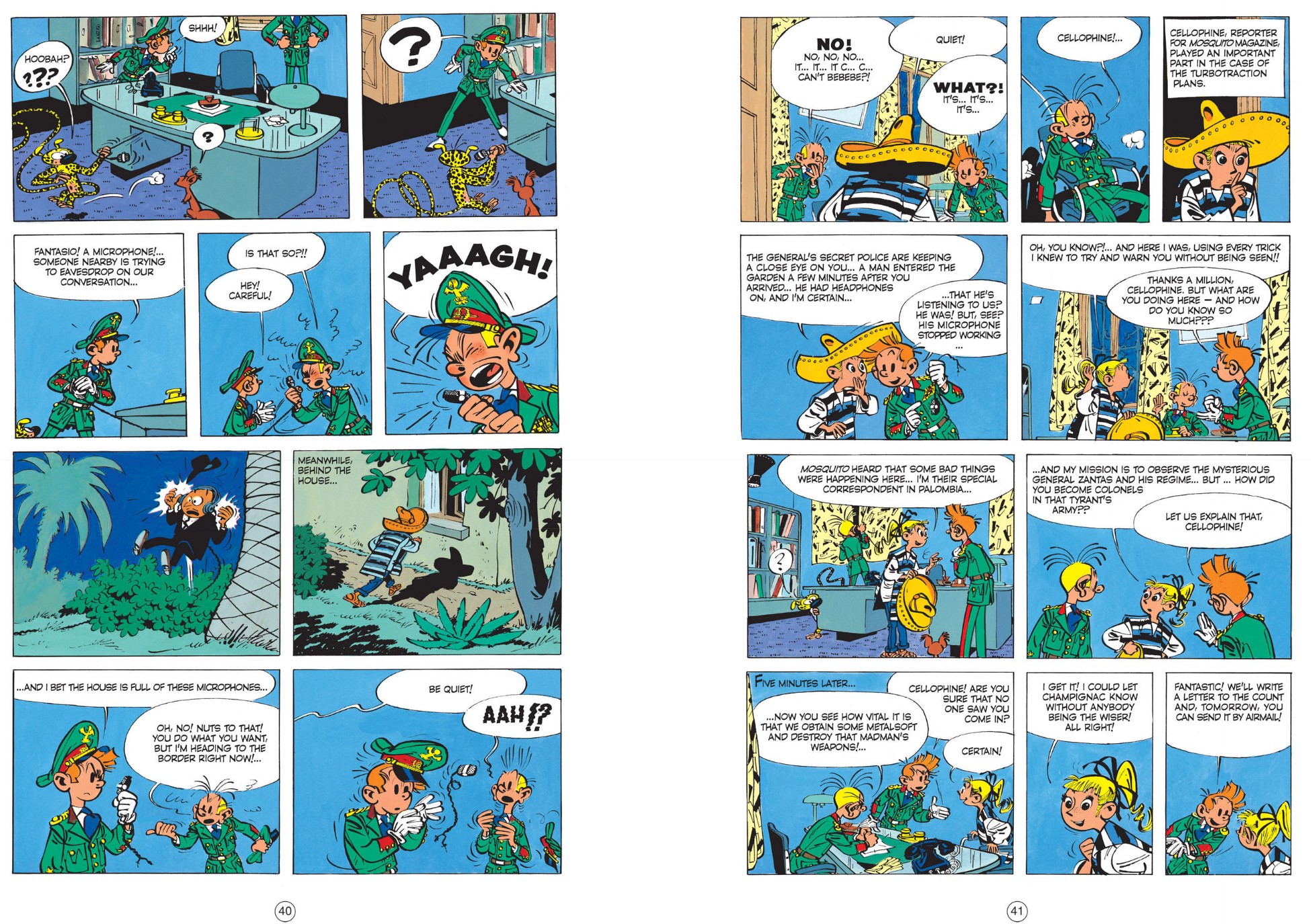
It’s not our heroes’ first rodeo either and, aware of their shadow, the lads engage in a prolonged and hilarious game of cat-&-mouse with the spook, all the while fretting that D-Day is approaching and they still haven’t been able to smuggle out a message…

A solution presents itself when go-getting journalist Cellophine makes contact. She’s been secretly covering the crisis for ages – without being caught like her mere male rivals – and offers to ferry the request for Metalsoft to Champignac ASAP…

Things aren’t all going Zantafio’s way. Even though weapons dealers are frantically auditioning their death-dealing wares for the General, Colonels Spirou & Fantasio are especially diligent and somehow able to find dangerous faults in everything on offer…

And then one night Cellophine sneaks back into Palombia with the secret weapon which will end Zantas’ dreams of empire…

Following a fantastical fight with the mushroom-gas-wielding trio battling an entire modern military, and a tense yet inconclusive showdown with Zantafio, peace and democracy break out and the boys finally complete their original mission. Having at last safely returned the Marsupilami to his natural wilderness, Spirou & Fantasio wearily head back to civilisation, content in the knowledge that the lovable little perisher is back where he belongs.

Of course, the pestilential primate has his own ideas on the matter…

Stuffed with superb slapstick situations, riotous chases and gallons of gags, but barely concealing a strongly satirical anti-war message, this exuberant yarn is a joyous example of angst-free action, thrills and spills. Easily accessible to readers of all ages and drawn with beguiling style and seductively wholesome élan, this is an enduring comics treat from a long line of superb exploits, deserving to be as much a household name as that other kid reporter and his dog…
Original edition © Dupuis, 1956 by Franquin. All rights reserved. English translation 2015 © Cinebook Ltd.

Today in 1941 mangaka/anime director Hayao Miyazaki (Nausicaa of the Valley of Wind) was born, and two years later so was street level/underground commix crafter Roger (Eerie, Tales of Sex and Death, Yellow Dog) Brand. In 1957 Brick Bradford cartoonist Clarence Gray died, as did André Franquin in 1997, and in 2000, master mangaka Goseki Kojima famed and missed for such wonders as Kozure Okami (Lone Wolf and Cub), Kubikiri Asa (Samurai Executioner) and Hanzo no Mon (Path of the Assassin).

Not Quite Last-Minute Presents: Goodnight Opus, The Last Basselope & Red Ranger Came Calling

By Berkeley Breathed (Little, Brown & Co.)

Win’s Christmas Gift Recommendation: To Be Read Every Christmas Until the Stars Grow Cold… 10/10 Each!

If – like me – you’re actually too busy to enjoy the season, or maybe poor, scared, fed up or otherwise disengaged, here’s a way to get it done and still derive some joy – absolutely astounding comics and cartoon wonder – all in one bunch!


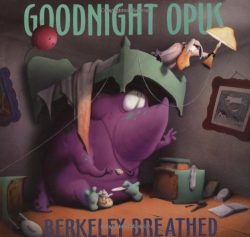
Goodnight Opus

ISBN: 978-0-316-10853-9 (HB) 978-0-316-10599-6 (PB)

After a desperately brief and glittering career as a syndicated strip cartoonist and socio-political commentator (so often the very same function) Berkeley Breathed retired his award-winning Bloom County and Outland vehicles and became a writer and illustrator of children’s books. He lost none of his perception, wit or imagination, and actually got better as a narrative artist. He didn’t completely abandon his entrancing cast of characters and – as a happy ever after postscript – eventually revived them all for another go-round of satire and social advocacy. Yay!

This one is a story about the magic of storytelling and features universal innocent Opus the Penguin. One night, as she has done two hundred and nine times before, Granny starts to read the svelte yet uncool waterfowl his favourite bedtime book. But this night is different. Tonight, Opus’ mind wanders and he “departs the text”…

And so begins a riotous flight of Technicolor fantasy as sedate monochromatic images give way to a powerful, vibrant and surreal romp extending to the Milky Way and back, by way of animated monuments, the burned out Fairy of Sleep, and stopovers at some of the most exotic corners of the planet.

Less a story than an exuberant travelogue of Imagination, delivered in sharply lyrical rhyme, this is a book to trigger dreams and promote creativity. A perfect primer to explain how to wonder and wander…

Every kid, at any age, should have this.
© 1994 Berkeley Breathed. All Rights Reserved.


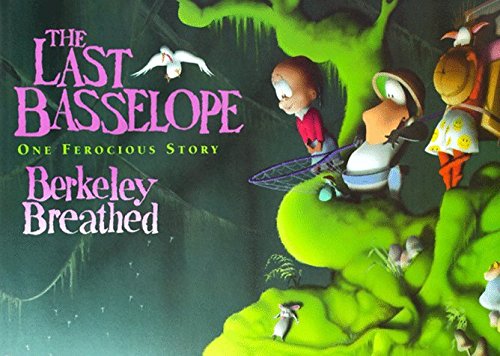
The Last Basselope – One Ferocious Story

ISBN: 978-0-316-10761-7 (HB) 978-0-590-47542-6 (PB)

Berke Breathed is no one-trick-pony and has never been limited to one specific season or holiday. He can do fun and wonder all year round. Although not a proper Christmas story, this charming, tearfully funny tale is another joyous celebration of childhood realms and regions and how little adventures can become great big ones.

It stars his best-loved characters from Bloom County and Outland: jolly, unfulfilled Opus, Bill the Cat, Milquetoast the Housebug, Ronald-Anne (her mother named her for President Reagan – because he had done so much to advance the cause of Poor Black Women) and Rosebud, the eponymous, enigmatic Basselope of the title.

Opus is a dreamer of great dreams and frustrated explorer. In his unassuming, shy way he lusts for glory and the heady wine of immortality. As everybody knows, that can only be found by Discovering Something.

Anything will do. And in the pages of the latest National Geographic Enquirer he finds his dream waiting…

Organising a safari, our fish-fuelled fool heads for the woods in back of the house in search of the most elusive beast in history; every crypto-zoologist’s Holy Grail.

How he finds The Last Basselope and what he actually learns comprises a magical journey of intense discovery into the uncharted wilds of childhood’s imagination which reveals the strength, power and character of true friendship.

This beautifully illustrated, captivating and multi-layered fable is ideal for the eternally young at heart and all those still looking for a path back to their own wonder years.
© 1994 Berkeley Breathed. All Rights Reserved.


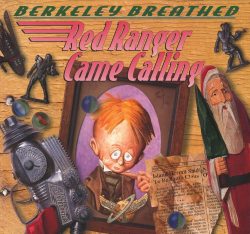
Red Ranger Came Calling – A Guaranteed True Christmas Story

ISBN: 978-0-61371-758-8 (HB) 978-0-31610-249-0 (PB)

We sneer at sentimentality these days but in the hands of a master storyteller it can be a weapon of crippling power. This glorious fable is purportedly one told every Christmas Eve to the author by his own father before being generously shared with us in mesmerising prose and captivating illustrations.

In 1939 young Red Breathed was well on the way to becoming a snotty, cynical wiseacre. Sent to spend the Holidays with his Aunt Vy, he mooches about all day with her old dog Amelia, while lusting as only a child can after an Official Buck Tweed Two-Speed Crime-Stopper Star Hopper bicycle.

Tweed, of course, is the famous movie serial star “Red Ranger of Mars” and the only thing capable of brightening the benighted life of the woeful, unfairly exiled child. Times are tough though, and Red knows his chances of getting that bike are nonexistent, but he just can’t stop himself hoping…

On his way home one day he sees an odd, pointy-eared little man heading for the ramshackle house of that reclusive old man Saunders. Since he’s a big kid now, Red knows there’s no Father Christmas and none of that hokey magic stuff is true, but even so finds himself sneaking up to the old house that Christmas Eve night…

This is a gloriously powerful tale fully capturing and emphasising the magic of belief and tragedy of realisation, and yet still ends with a Christmas miracle and a stunning surprise ending. Get this book for the kids, get this book for yourself, but get this book – and on pain of emotional death, don’t peek at the last page until the time is right!
© 1994 Berkeley Breathed. All Rights Reserved.

Today in 1892 artist Alfred Bestall was born. Anything else needful to know can be gleaned by visiting Rupert: A Celebration of Favourite Stories – 100 Years of Rupert Bear 1920-2020. In 1914 the day welcomed troubled genius Jack Cole who was responsible for manic innovation as packed into DC Finest: Plastic Man – The Origin of Plastic Man. It’s also – in 2011- the day we lost comic legend Joe Simon, co-creator of Captain America, Boy Commandos, Newsboy Legion and The Fly as well as inventor of Brother Power The Geek and other wild notions.

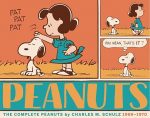
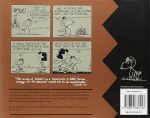
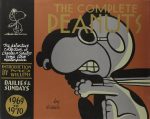
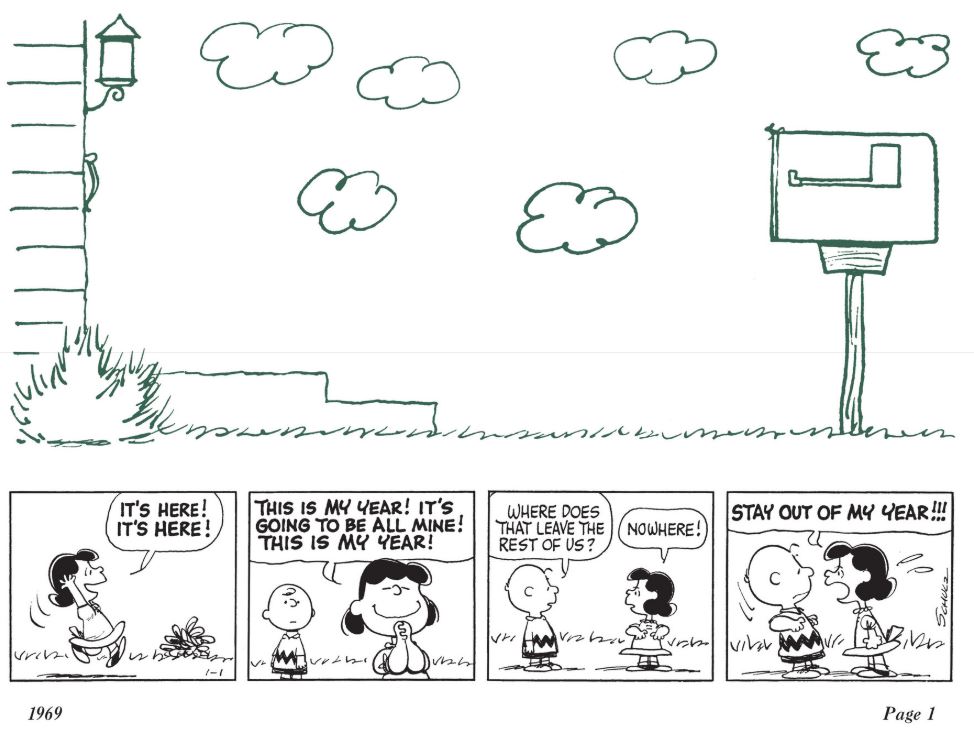
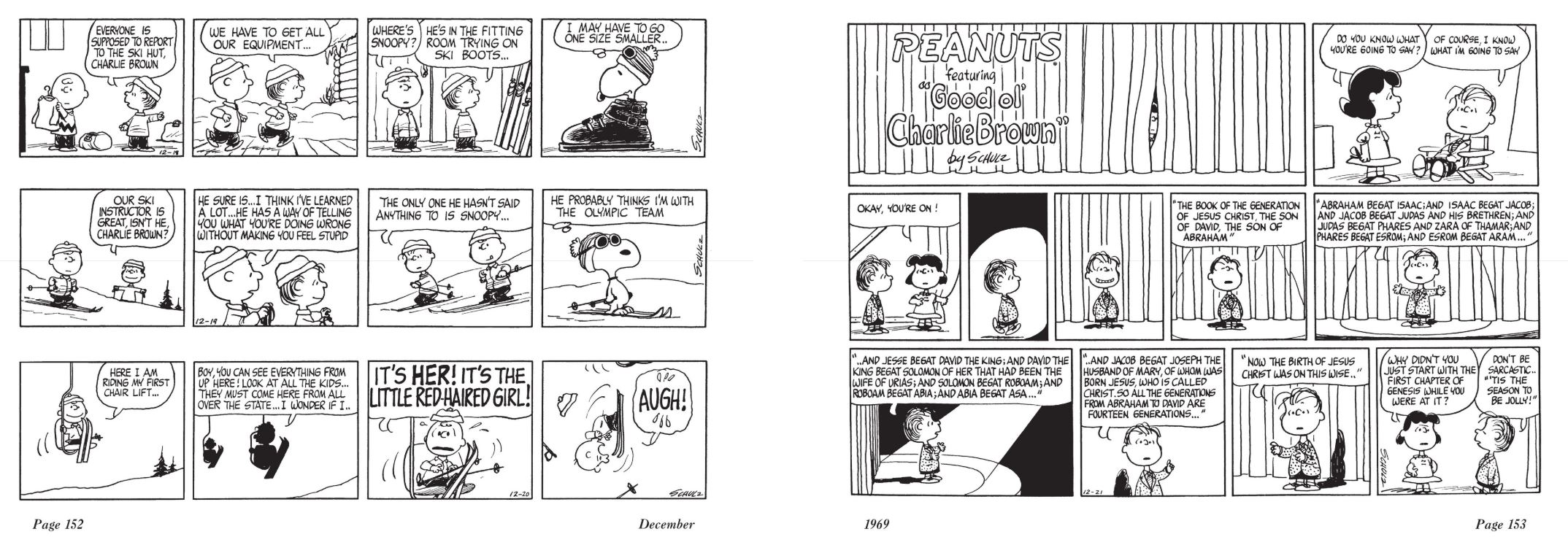
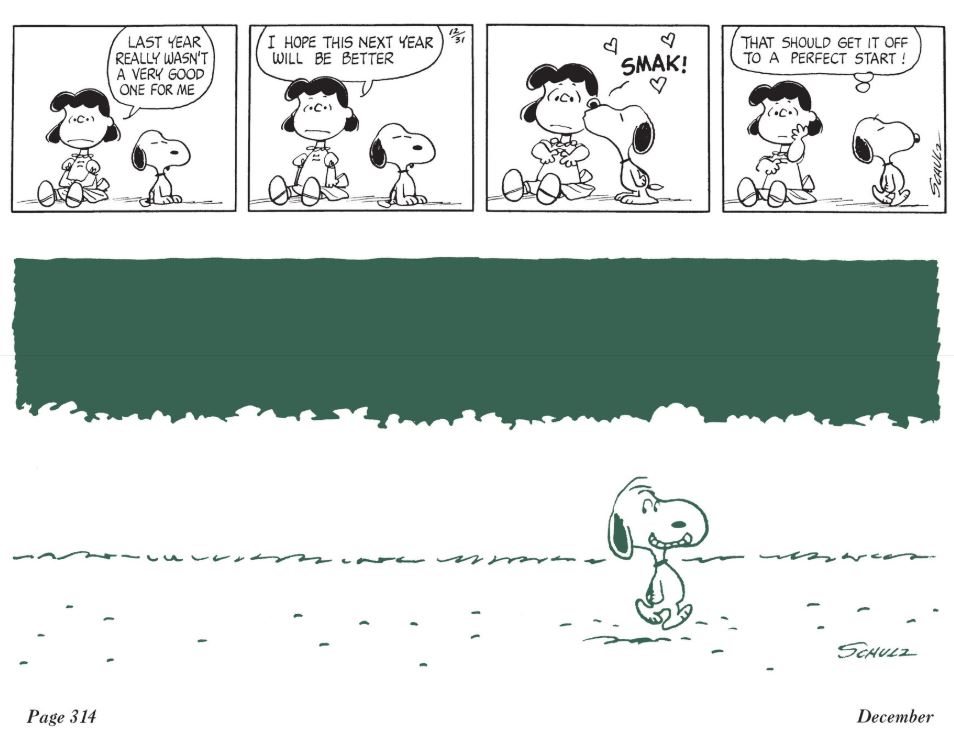
The Complete Peanuts volume 10: 1969-1970


By Charles M. Schulz (Fantagraphics Books/Canongate Books UK)
ISBN: 978-1-68396-126-0 (US TPB) 978-0857862143 (Cannongate HB)

This book includes Discriminatory Content produced in less enlightened times.

Win’s Christmas Gift Recommendation: Towering Monumental Tradition Writ (and Drew) Large… 10/10

Peanuts is unequivocally the most important comic strip in the history of graphic narrative. It is also the most deeply personal. Cartoonist Charles M Schulz crafted his moodily hilarious, hysterically introspective, shockingly surreal philosophical epic for half a century: 17,897 strips spanning October 2nd 1950 to February 13th 2000. He died – from complications of cancer – the day before his last strip was printed.

At its height, Peanuts ran in 2,600 newspapers, in 21 languages and75 countries. Many of those venues still run it as perpetual reprints, and have done ever since “Sparky” passed. During his lifetime, book collections, a merchandising mountain and television spin-offs had made the publicity-shy doodler an actual billionaire at a time when that really meant something…

None of that matters. Peanuts – a title Schulz loathed, but one the syndicate forced upon him – changed the way comics strips were received and perceived: proving cartoon comedy could have edges and nuance and meaning as well as too-soon-forgotten pratfalls and punchlines.

We begin with an effusive and enthusiastic foreword from author/animator/illustrator Mo Willems (Don’t Let the Pigeon Drive the Bus!, Knuffle Bunny, Sheep in the Big City) expressing his debt to the strip.

On the pages, this period heralds a true renaissance probably triggered by headlines in an era of swiftly shifting changes in social attitudes and rampant cultural exploration. Notionally, our focus and point of contact remains quintessentially inspirational loser Charlie Brown who, despite slowly taking a few steps behind fanciful, high-maintenance mutt Snoopy, remains squarely at odds with the mercurial supporting cast. They are still hanging out doing what at first sight seems to be Kids Stuff in an increasingly hostile and intrusive universe of perverse happenstance. Except perhaps that Lucy Van Pelt kid. She’s not like the others…

Neatly interspersed with daily doses of gloom, the Peanuts Sunday page first debuted on January 6th 1952: a standard half-page slot offering more measured fare than 4-panel dailies. Thwarted ambition, sporting failures, crushing frustration abound, alternating with Snoopy’s inner life of aviation and war stories, star gazing, shooting the breeze with bird buddies, weather woes and food fiascos. These and other signature sorties across the sabbath indulgences afforded Schulz room to be his most imaginative, whimsical and provocative…

Regular tentpole moments to relish include more Snoopy v Lucy deathmatches/ambush snogs/dance offs; Charlie Brown’s food feud with the beagle, an assortment of night terrors; Lucy’s emphatically simple solutions to complex questions; doggy dreams; the power of television; sporting endeavours and the sharply-cornered romantic triangle involving Lucy, Schroeder & Beethoven – albeit wedded to “sophisticated” fallout when pushy Frieda decides she also wants to play…

Always, gags centre on play, varying degrees of musicality, pranks, interpersonal alignments, the mounting pressures of ever-harder education, mass media lensed through young eyes and a selection of sports in their season. All are leavened by agonising teasing, naked contempt, kindled and crushed hopes, the making of baffled observations and occasionally acting a bit too much like grown-ups. However, in this tome, themes and tropes that define the entire series (especially in the wake of many animated TV specials) become mantra-like yet endlessly variable, but focus less on Charlie and more on those around him. Also, the outside grown-up world considerably encroaches, as when Lucy declares herself a “ New Feminist” although no one looking can see any difference to any presumably previously un-enlightened Miss van Pelt…

Human interactions still find the boy a pitiable outlier. Mean girl Violet, musical prodigy Schroeder, self-taught psychoanalyst/dictator-in-waiting Lucy, her brilliantly off-kilter little brother Linus and dirt-magnet “Pig-Pen” are fixtures honed and primed to generate joke-routines and gag-sequences around their signature foibles, but some early characters have faded away in favour of fresh attention-attracting players. Newcomers sidle in and shuffle off without much flurry or fanfare but in our real world the use of “Minority” characters José Peron of New Mexico and African American Franklin drew much attention and controversy – because, I guess, there will always be gits and arseholes – especially if the oblivious readers elected them…

The most significant expansion is that weird upside bird bugging the beagle gets a name – Woodstock (as revealed on June 22, 1970) – and a job as his dogsbody – secretary, actually – whilst shock near-cripples the round-headed kid when he discovers that the “little red-haired girl” he almost plucked up the nerve to talk to moves to a new city. It’s a blow he’s still reeling from when this book ends two years later, and one only Linus really understands. After all, his teacher Miss Othmar is gone after the teacher’s strike…

There is much more madcap politically-tinged material, including repeated riffs on a recently inaugurated new real-world president (Richard Milhous Nixon on January 20, 1969) as seen when Snoopy briefly becomes the most powerful mutt in the Free world after being chosen as the new Grand Beagle…

At least the Brown boy’s existential crisis/responsibility vector/little sister Sally has grown enough to become just another trigger for relentless self-excoriation. As she grows, pesters librarians, forms opinions and propounds steadfastly authoritarian views, Charlie is relegated to being her dumber, but eternally protective, big brother especially as her biggest bugbear is starting school and Charlie is such an expert on all things scholastic…

Resigned to – but far from uncomplaining about – life as a loser in the gunsight of cruel and capricious fate, the boy Brown is helpless meat in the clutches of openly sadistic Lucy. When not sabotaging his efforts to kick a football, she monetises her spiteful verve via a 5¢ walk-in psychoanalysis booth (although supply and demand economics also affects this unshakeable standard), ensuring that whether at play, in sports, kite-flying or just brooding, the round-headed kid truly endures the character-building trials of the damned.

One deliciously powerful constant that grows more abundant is the boy’s utter inability to fly that kite. Here war with wind, gravity and landscape reaches absurdist proportions, as the tree haunts Charlie Brown’s adored pastime with vicious, violent and malign venom. Moreover, other kids are aware of its growing power. After one terse musical interlude with Schroeder, Lucy lobs our reluctant lover-boy’s beloved piano into the voracious carnivorous conifer…

By now, the beagle is the true star of the show, with his primary quest for more and better playing out against an increasingly baroque inner life, wild encounters with birds, sports, dance marathons and skating trysts (especially the close-order combat called ice hockey!), philosophical ruminations, and ever-more-popular catchphrases. Here, burgeoning whimsy leads to more glimpses of the interior world: his WWI other life, peppered with dogfights against the accursed Red Baron, but also careers as an astronaut, a sports coach, a prairie dog and a detective seeking his lost mother. That tragic obscured past as an alumni of the Daisy Hill Puppy Farm leads to constant introspection… and dancing… lots and lots of dancing…

Naturally, Snoopy soon subverts all that misery and curiosity to fuel his creative side and begins the Great American Novel that will change literature forever… but that’s before the Browns go on vacation and leave the dog with the Van Pelts. Naturally, Lucy has an idea about finally fixing the pooch. It doesn’t end well…

As always, timeless episodes of play, peril, peewee psychoanalysis and personal excoriation are beards for some heavy topics. Rendered in marvellous monochrome, there are crucial character introductions, plot developments and creation of more traditions we all revere to this day. Of particular note is the growing role of Patricia Reichardt – AKA tomboy Peppermint Patty – who heartbreakingly deals with the so-early discovery that she will never be pretty or beautiful. Even Snoopy’s most concerted efforts can’t quite salve that sting…

Another trenchant continued gag-series resumes Lucy obsessive attempts to “cure” Linus of his blanket dependency by again playing him off against Grandma who will give donations to charities if the boy grows up…

Snoopy is the only force capable of challenging if not actually countering Lucy. Over these two years, her campaign to curb that weird beagle, cure her brother of blanket addiction and generally reorder reality to her preferences reaches astounding heights and appalling depths, but the dog keeps trying and scores many minor victories. As always the book opens and closes with many strips riffing on snow, food, movie-going and television – or the gang’s responses to it – becoming ever more pervasive. And as always, Lucy constantly, consistently sucks all the joy out of the white wonder stuff and the astounding variety offered by the goggle-box. Perpetually sabotaged, and facing abuse from every female in their life, Brown and Snoopy endure more casual grief from smug, attention-seeking Frieda, who champions shallow good looks over substance. At least Linus is growing: hardened inside by what happened to teacher Miss Othmar, but Lucy’s amatory ambitions for Schroeder grow ever more chilling and substantive. She will never move on…

Schulz established way points in his year: formally celebrating certain calendar occasions – real or invented – as perennial shared events: Mothers and Fathers’ Days, Fourth of July, National Dog Week strips accompanied in their turn yearly milestones like Christmas, St. Valentine’s Day, Easter, Halloween/Great Pumpkin Day and Beethoven’s Birthday were joined this year by a return to another American ritual as many of the cast return to summer camp. At least there is unbridled joy when Brown’s baseball team hits a winning streak and Charlie meets his all-time sporting idol – except of course they’re not quite the boons they first appear…

Sports loom large and terrifying as ever, but star athlete Snoopy is more interested in new passions than boring old baseball or hockey. Even Lucy finds far more absorbing pastimes but still enjoys crushing the spirits of her teammates in whatever endeavour they are failing at. Anxiety-wracked Brown even steps down from the baseball team to ease his life, but that only intensifies his woes, and does nothing to help his kite wielding or football kicking…

Linus endures more disappointment in two Great Pumpkin seasons and before you know it, there’s the traditional countdown to Christmas and another year filled with weird, wild and wonderful moments…

Wrapping it all up, Gary Groth celebrates and deconstructs the man and his work in ‘Charles M. Schulz: 1922 to 2000’, preceded by a copious ‘Index’ offering instant access to favourite scenes you’d like to see again…

Available in multiple formats, this volume guarantees total enjoyment: comedy gold and social glue metamorphosing into an epic of spellbinding graphic mastery that still adds joy to billions of lives, and continues to make new fans and devotees long after its maker’s passing.
The Complete Peanuts: 1969-1970 (Volume Ten) © 2008 Peanuts Worldwide, LLC. The Foreword is © 2008, John Waters. “Charles M. Schulz: 1922 to 2000” © 2008 Gary Groth. All rights reserved.

Today in 1946 Lucky Luke “debuted” in the Spirou Alamanch Annual – except if you read Lucky Luke: The Complete Collection Volume One you’ll know that ain’t necessarily so…

And in 1970 the incredible Rube Goldberg shuffled off this mortal coil. It was probably one he had designed in his masterful cartoons. Go google Rueben Awards

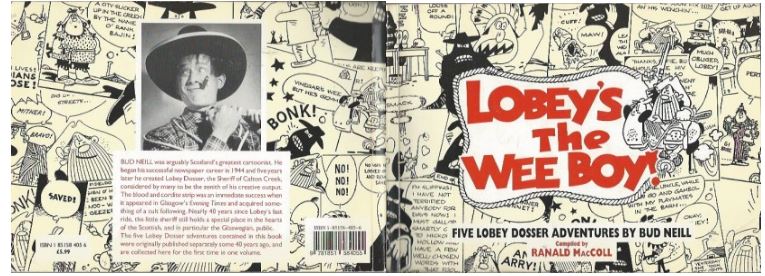
Lobey’s The Wee Boy! – Five Lobey Dosser Adventures by Bud Neill


By Bud Neill, compiled by Ranald MacColl (Mainstream Publishing)
ISBN: 1-85158-405-6 (PB)

This book includes Discriminatory Content produced in less enlightened times.

Win’s Christmas Gift Recommendation: Get it! Get It! GET IT! …10/10

A wee while ago we covered Desperate Dan and I bravely questioned what is it with the Scots and Cowboys. Graciously ignoring any subsequent comments since, I’m just going to point to this out now…

Nobody’s ever accused me of being sensitive to the tone of the times, but with a cold snap on and all thoughts directed north of the border for now, I’m focussing on this superbly fitting dose of Celtic (more properly Glaswegian) cartoon magic today. It’s the work of a tragically near-forgotten genius of pen & brush who should rightly be a household name wherever people like to laugh and ponder the absurdity of existence, no matter what flag they fly.

William Neill – forever immortalised as “Bud” – was Partick-born in 1911, just before the family moved to Troon in Ayrshire. He was a typical kid and fell in love with the brash wonder of silent movies – most especially the rambunctious westerns of William S. Hart. His other great drive was a love of horses, and he could always be found hanging around stables, trading odd jobs for the chance of a few minutes’ riding…

After being done with school the young artistic star won a place at Glasgow School of Art and, in the late 1930s, briefly emigrated. Bud worked in Canada and deftly absorbed the still-developing tricks of America’s greatest newspaper cartoonists during their creative heyday. He then served as a gunner in WWII before being invalided out and ending up a bus driver. These varied experiences led to his creating a series of pocket cartoons starring the “Caurs & Clippies” of Glasgow’s tramcar system.

By 1944 Bud was drawing for the Glasgow Evening Times: sharp, wry observational pieces starring the city and its inhabitants, characterised by devastating, instantly enchanting use of the iconic rhythms, vernacular and argot everyone shared. In January 1949, The Evening News began running the uniquely surreal escapades of his greatest creation.

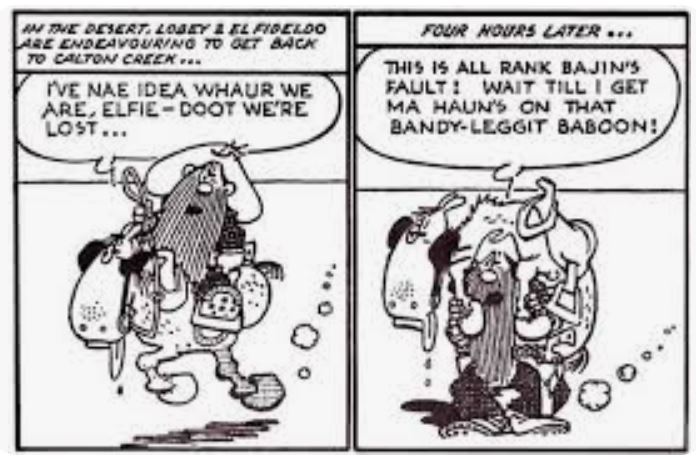
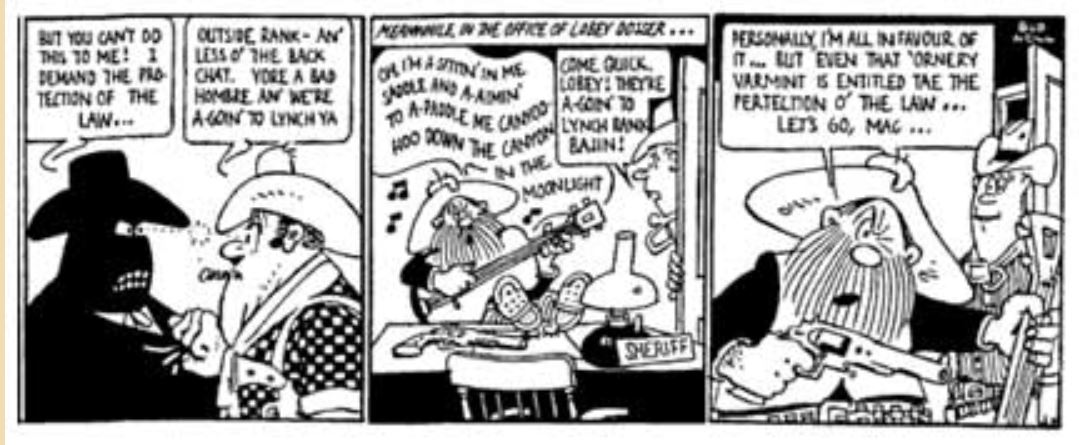
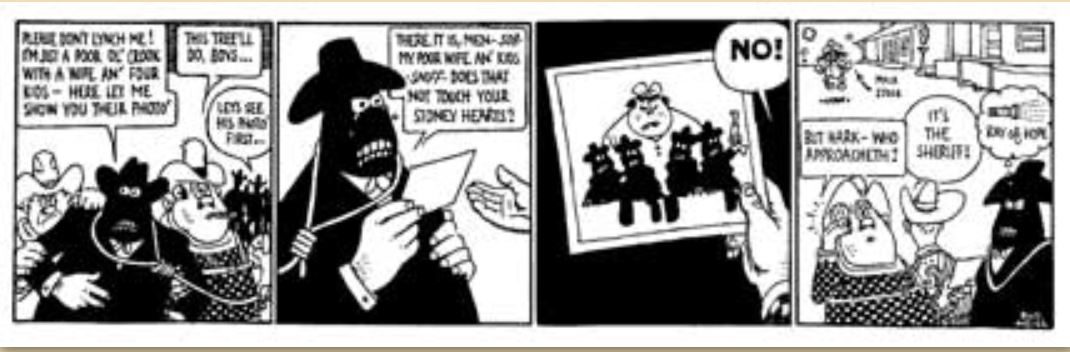
Sheriff Lobey Dosser of Calton Creek was a brilliant, magnificent inspiration: the ongoing adventures of a canny wee lawman in a hauntingly typical western town but populated exclusively by Scots (from Glasgow’s Calton district, presumably) all living an outrageously domestic, hilariously apt inner-city life and tricked out in cowboy hats and with six-guns.

Delving deep into the venerable, anarchic, often surreal material of pantomime and music hall, Bud crafted a supremely odd, anachronistically familiar, bizarrely inviting world of inviting solecism masquerading as local events and exotic adventure. The series transferred to The Sunday Mail in 1956, supported by previous, complete strip adventures collected as instant sell-out, one shilling landscape booklets (all incredibly sought after collectors’ items these days).

Neill died in 1970, but his work steadily continued to garner fans and acquire a mythical status, so by the middle of the decade Glasgow artist and sculptor Ranald MacColl began work on a biography. That in turn led to a series of graphic collections such as this one and eventually belated recognition for Neill and his most memorable creations. Bud was celebrated in exhibitions, galleries and – following Glasgow’s becoming European City of Culture in 1990 – two separate bronze statues (Lobey, Rank Bajin and noble steed Elfie in Woodlands Road and, in Homecoming Year 2009, The G.I. Bride and her “Wean” at Partick Station), funded by public donations, Strathclyde Passenger Transport and private sponsors.

Hard to find but so worth the effort, Lobey’s The Wee Boy! gathers five of those shilling collections in a sensibly narrative chronological – not publication or even creation – order, and is packed with informative extras. These include MacColl’s fascinating historical and atmospheric Introduction and a hilarious Prologue by Bud himself from 1958, before the astonishing origin of the champion of Calton Creek is revealed in ‘Lobey Dosser: His Life Story’. On a rare quiet day the grizzled sheriff recounts his early life to a jail full of impressionable young’uns…

Once upon a time in auld Glesca, a mother had one bairn too many. One day, to spare her further hardship, the precocious tyke put his possessions in a hanky on a stick and headed off to make his way in the world. Although but a few months old, he rejected being fostered out to his mean Auntie Mabel and joined a merchant ship under tyrannical Captain Blackswite, unaware that the big shouty blackguard was a pirate…

After many exciting years at sea Lobey jumped ship and was befriended by cannibals and their erudite chief Hannibal which led to more exploring, meeting monsters and other strange things before encountering a race of Oxbridge-educated white savages and happily acquiring a rare two-legged horse. El Fideldo would become his greatest friend and inseparable companion.

Together they made their way to Mexico where the wee wanderer discovered an unsuspected talent for upholding the law and keeping the peace. After cleaning out a nest of vicious banditos, the restless pair headed north and fetched up in Laredo, Texas where a disastrous love affair with Adoda, formidable daughter of wealthy Whisk E. Glorr led to a clash with rustlers led by scurrilous Watts Koakin

His heart broken – even though he had cleaned up the range – Dosser & Elfie kept heading west until they reached Arizona and first met future archnemesis Rank Bajin selling out the wagon train he was guiding to the local Sioux. Rescuing the embattled settlers, Lobey opted to stay with the Scots expats as they built a town in the wilderness. They called it Calton Creek…

Wild, imaginative and with every daily episode fully loaded with sight gags, striking slapstick, punishing puns, cartoon in-jokes and intoxicating vernacular, each Lobey Dosser tale was a non-stop carnival of graphic mirth. This terrific tome continues in fine fettle with ‘The Mail Robbery’ wherein nefarious Bajin attempts to incite an Indian uprising amongst the Pawnee of Chief Toffy Teeth, and at one point leaves the little lawman to die of thirst in the searing deserts. Moreover, as the scorched sheriff struggles and strives to survive, the naive citizens are left to adapt to a protective occupation by flash Yankee G.I.s and airmen…

Sardonic and satirically cutting, the yarn also sports one of the best – and daftest – horseback chases in entertainment history…

Romance and mystery abound in ‘The Secret of Hickory Hollow’ as that Bajin scoundrel buys up the mortgage on Vinegar Hill’s farm and attempts to evict and kick out the old coot and his substantial niece Honey Perz. The villain has gotten wind of a mineral resource on the property that would make a man as wealthy as the Maharaja of Baroda, or perhaps even a regional Deputy Superintendent of the Coal Board…

When Lobey organises the cash needed to pay off the outstanding loan, Bajin reluctantly resorts to the last resort and begins romancing sweet, innocent, hulking Honey. It all looks bleak for justice until the sheriff befriends an astoundingly good-looking and wholesome uranium prospector named Hart O’Gold who quickly tickles Honey’s fickle fancy. However nobody – including ghostly guardian Rid Skwerr – is prepared for the Soviet spies behind the entire affair to jump in and take over…

Ultimately it needs the timely intervention of mystic imp Fairy Nuff to save everyone’s accumulated hash before the Dosser can finally expose the viper in the nest…

The local natives are always up to mischief and ‘The Indian War’ kicks off when the Railroad tries to lay track through Pawnee territory just as Chief Rubber Lugs of the Blackfeet Tribe revisits an old and outstanding grudge with counterpart commander Toffy Teeth. Ineffectual Captain Goodenough arrives with a division of cavalry to safeguard the white citizenry but matters soon worsen, painfully exacerbated when the folk of Calton Creek take advantage of Lobey’s absence (he’s trying to negotiate with both bunches of bellicose braves) to run Bajin out of town. Instead, the hooded hoodlum starts freely peddling weapons to all sides…

… And then Bajin kills Lobey and takes over the town.

… And then…

The final yarn in this masterful monochrome tome of tall tales is the most incredible of all as ‘The “Reform” of Rank Bajin’ sees the vile villain scooting around Calton Creek doing good deeds and selling off his astounding arsenal of wicked weapons and cunning contraband. Baffled, perplexed, confused and not sure what’s going on, Lobey asks Boot Hill-haunter Rid Skwerr to spy on the no-longer-reprehensible Rank. Even love-struck Fairy Nuff gets in on the act before the astounding truth finally emerges.

Bajin has a boy who is growing up honest, so is selling up and returning to the family he deserted in Borstal Bluffs, Iowa to sort the shameful lad out. Knowing the tremendous vacuum his absence will leave in Calton’s exciting landscape, he has, however, a recommendation for a locum archenemy for his archenemy…

Can this possibly all be true or is the beastly Bajin executing his most sinister scheme yet?

Cunningly absurdist, socially aware, humorously harnessed insanity in the manner of Spike Milligan, Michael Bentine and the immortal Goon Show, the adventures of Lobey Dosser are a brilliant example of comic strips perfectly tailored to a specific time, place and audience: targeted treats which can magically transcend their origins to become masterpieces of the art form.

It’s also side-splitting, laugh-out-loud, Irn Bru spit-take hilarious and really needs to be recollected for today’s audiences.

And of course that’s what I really want: a complete reprinting of these sublimely perfect spoofs.

Trust me Pal: once you read some so will you… even if you ain’t no Scottisher…
© Ranald MacColl 1992. All rights reserved.

Today in 1959 Argentine artist Eduardo Risso was born. Sure, you’ve seen 100 Bullets, Sgt. Rock and Batman, but have you checked out Red Moon?
In 1986 unsung legend Norman Maurer died. When someone published stuff by the co-originator of 3D comics, the Three Stooges comics and much more, we’ll cover it.
In 2003, Berke Breathed’s Bloom County & Outland star began his own eponymous Sunday strip. Naturally. Opus soon fluffed it all up…
If you’re American, you probably wouldn’t be reading this or any strip stuff if it wasn’t for “father of comics fandom” Dr. Jerry Bails, who died today in 2006 with his job so very well done.

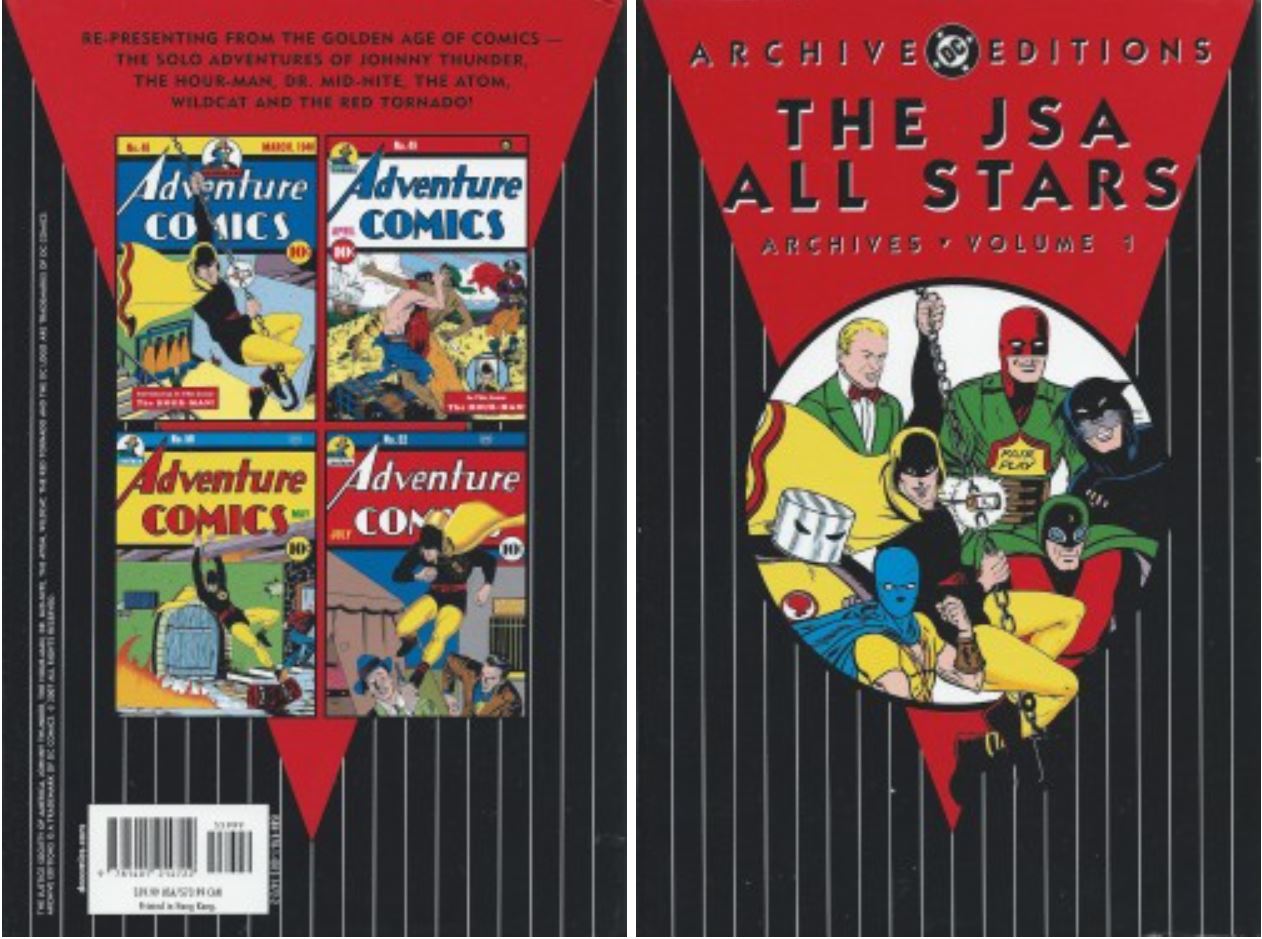
The JSA All Stars Archives volume 1


By John Wentworth, Ken Fitch, Bill O’Connor, Sheldon Mayer, Charles Reizenstein, Bill Finger, Stan Aschmeier, Bernard Baily, Ben Flinton & Leonard Sansone, Howard Purcell, Hal Sharp, Irwin Hasen & various (DC Comics)
ISBN: 978-1-4012-1472-2 (HB)

This book includes Discriminatory Content produced in less enlightened times.

Win’s Christmas Gift Recommendation: Golden Aged but Evergreen Enjoyment …8/10

In the JSA’s anniversary year, here’s yet another DC classic collection long overdue for revival and digital return. Until then – and if you can find it – this hardback will make a perfect present for you or yours…

After the actual invention of the comic book superhero – indisputably Action Comics’ debut of Superman in June 1938 – the most significant event in the industry’s history was the combination of individual sales-points into a group. Thus what seems blindingly obvious to us with the benefit of four-colour hindsight was proven: consumers couldn’t get enough of garishly-hued mystery men and combining a multitude of characters inevitably increases readership. Plus, of course, a mob of superheroes is just so much cooler than one… or one-and-a-half if there’s a sidekick involved…

The creation of the Justice Society of America in 1941 (with copies of All-Star Comics #3 going on sale today waaay back then) utterly changed the shape of the budding business. However, before that team could unite they had to be popular enough to qualify, and this superb hardcover sampler gathers the debut adventures of a septet of beloved champions who never quite made it into the first rank but nonetheless scored enough to join the big team and maintain their own solo spots for much of the Golden Age of American Comics.

Whilst most favoured 1940s stalwarts all won their own DC Archive collections (some even making it into digital modern editions this century), this particular tome bundles a bunch of lesser lights – or at least those who never found as much favour with modern fans and revivalists – and features the first 5 appearances of 7 of the JSA‘s “secondary” mystery men: all solid supporting acts in their own anthology homes but who were potentially so much more…

Gathered here are short, sharp, stirring tales from Flash Comics #1-5; Adventure Comics #48-52; All-American Comics #19-29 and Sensation Comics #1-5, collectively spanning January 1940 to May 1942. They are preceded a sparkling, informative and appreciative Foreword by Golden Age aficionado and advocate Roy Thomas… himself enjoying an anniversary today so a very happy 85th birthday to you, sir!

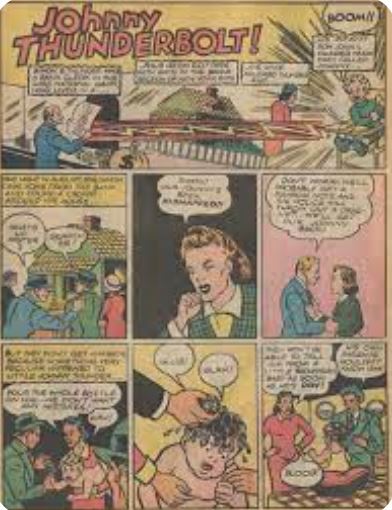
The vintage vim & vigour begins with a character equally adored and reviled in modern times. Johnny Thunderbolt – as he was originally dubbed – was an honest, well-meaning, courageous soul who was also a grade A idiot. However, what he lacked in smarts he made up for with sheer luck, unfailing pluck and the unconscious (at least at first) control of an irresistible magic force.

The series was played for action-packed laughs, but there was no getting away from it: Johnny was, quite frankly, a simpleton in oblivious control of an ultimate weapon. At least his electric genie was more plausible than an egomaniacal orange-toned cretin in control of America’s nuclear arsenal…

John Wentworth & Stan Aschmeier introduced the happy sap in ‘The Kidnapping of Johnny Thunder’ from January 1940’s Flash Comics #1: a fantastic origin detailing how, decades previously, the infant seventh son of a seventh son in America was abducted by priests from mystical island Badhnisia. The child was to be raised as the long-foretold wielder of a fantastic magical weapon, all by voicing the eldritch command “Cei-U” – which sounds to western ears awfully like “say, you”…

However, ancient enemies on neighbouring isle Agolea started a war before ceremonial indoctrination could be completed and at age seven the lad, through that incomprehensible luck, returned to his parents to be raised in relative normality of the Bronx. Everything was fine until Johnny’s 17th birthday, when the rite finally came to fruition and – amid bizarre weather conditions – Badhnisians cultists intensified the search for their living weapon.

By the time they tracked him down, he was working in a department store and had recently picked up the habit of blurting out the phrase “say you.” It generally resulted in something very strange happening. One example being a bunch of strange “Asiatics” attacking him and being blown away by a mysterious pink tornado…

Pattern set, each month Johnny looked for gainful employment, stumbled into a crime or crisis where his voluble temperament resulted in an inexplicable unnatural phenomenon that solved the problem but left him no better off. It was a winning theme that lasted until 1947, by which time the Force had resolved into a wisecracking thunderbolt-shaped humanoid genie, while Johnny was ousted from his own strip by sexy new crimebuster Black Canary.

Flash Comics #2 featured ‘Johnny Becomes a Boxer’. Upon stepping in to save a girl from bullies, Johnny somehow convinces vivacious Daisy Darling to be his girlfriend. He then becomes Heavyweight Champion, leading to his implausibly winning a fixed bout in #3’s ‘Johnny versus Gunpowder Glantz’. Only now, Daisy refuses to marry a brute who lives by hitting others. The solution came in ‘Johnny Law’ when kidnappers attempt to abduct Daisy’s dad. Following his sound thrashing of the thugs, and at his babe’s urging, Johnny then joins the FBI. This tantalising taste of times past concludes with ‘G-Man Johnny’ (#5 May 1940) as the kid’s first case involves him in a bank raid and results in his own dad being taken hostage…

Although he eventually joined the JSA, and despite affable, good-hearted bumbling carrying him through the war, shifting peace-time fashions found no room for a hapless hero anymore, and when he encountered a sultry masked female Robin Hood who stole from crooks, the writing was on the wall. Nevertheless, fortuitously imbecilic (and remarkably Millennial in outlook and prospects) Johnny Thunder is fondly regarded by many modern fans, still having much to say and a decidedly different way of saying it…

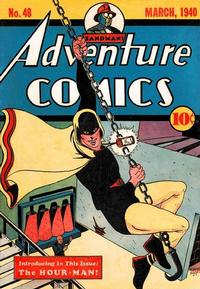
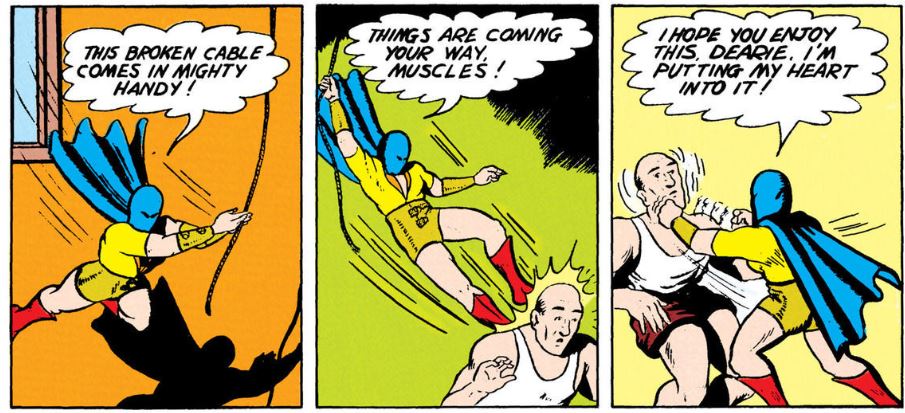
Ken Fitch & Bernard Baily’s Hourman was a far more serious proposition. He actually had a shot at stardom and began by supplanting The Sandman as cover feature in Adventure Comics #48 (March 1940). Here, his exploits run through #52 (July) establishing the unique and gripping methodology which made him such a favourite of later, more sophisticated fans.

In an era where origins were never as important as action, mood and spectacle, ‘Presenting Tick-Tock Tyler, the Hour-Man’ begins with a strange classified ad offering assistance to any person in need. Chemist Rex Tyler had invented Miraclo: a drug super-energising him for 60 minutes at a time, and his first case sees him help a wife whose man is being dragged back into criminal endeavours by poverty and bad friends. Then ‘The Disappearance of Dr. Drew’ finds Tyler locating a missing scientist kidnapped by thugs before ‘The Dark Horse’ has the Man of the Hour crush a crooked, murderous bookie who swipes both horse and owner before a key race. Mad science and a crazy doctor employing ‘The Wax-Double Killers’ adds scary thrills and supervillain cachet for our timely hero to handle, and ‘The Counterfeit Hour-Man’ concludes the offerings here as he again defeats Dr. Snegg in a scurrilous scheme to frame the hooded hero.

Hourman always looked great and his adventures developed into tight and compulsive affairs, but as simply another strong, fast, tough masked guy, he never caught on and eventually timed out at the beginning of 1943 with Adventure #83.

Our third second string star is Calvin College student Al Pratt: a diminutive but determined kid fed up with being bullied by jocks. Al remade himself by effort and willpower into a pint-sized, two-fisted mystery man ready for anything. One of the longest lasting Golden Age greats, The Mighty Atom was created by writer Bill O’Connor and rendered by Ben Flinton & Leonard Sansone. He debuted in All-American Comics #19 and, after an impressive run there, transferred to Flash Comics in February 1947. The Atom sporadically appeared until the last issue – #104, cover-dated February 1949 – and made his final bow in the last JSA tale (All Star Comics #57) in 1951.

The cases here span AAC #19-23 (October 1940 – February 1941), beginning by ‘Introducing the Mighty Atom’ as the bullied scholar hooks up with down-&-out trainer Joe Morgan, whose radical methods soon have the kid at the very peak of physical condition and well able to take care of himself. However, when Al’s hoped-for girlfriend Mary is kidnapped, the lad eschews fame and potential sporting fortune to bust her loose, thereafter opting for clandestine extracurricular activities….

The Atom sported a costume for his second adventure, going into ‘Action at the College Ball’ to foil a hold-up before tackling ‘The Monsters from the Mine’ – actually enslaved victims of a scientific maniac intent on conquest. The college environment offered plentiful plot opportunities and in ‘Truckers War’ the hero crushes hijackers who bankrupt a fellow student and football star’s father. These episodes conclude with ‘Joe’s Appointment’ as Al’s trainer is framed for spying by enemy agents and needs a little atomic assistance…

Although we think of the Golden Age as a superhero wonderland, the true watchword was variety. Flagship anthology All-American Comics offered everything from slapstick comedy to aviation adventure on its four-colour pages and one of the very best humour strips featured semi-autobiographical exploits of Scribbly Jibbet: a boy who wanted to draw.

Created by actual comics wonderboy Sheldon Mayer, Scribbly: Midget Cartoonist debuted in AAC #1 (April 1939) and built a sterling rep for himself beside star reprint features including Mutt and Jeff and all-new adventure serial Hop Harrigan, Ace of the Airways. However, when contemporary fashions demanded a humorous look at mystery men, in #20 (November 1940) Mayer’s comedy feature evolved into a delicious spoof of the trend as Scribbly’s formidable landlady Ma Hunkel decided to do something about crime in her neighbourhood… so she dressed up as a husky male masked hero.

‘The Coming of the Red Tornado’ sees her don cape, woollen longjohns and a saucepan for aN identity-obscuring helmet to crush gangster/kidnapper Tubb Torponi. The mobster had made the mistake of snatching Ma’s terrible nipper Sisty and Scribbly’s little brother Dinky (who would later become her masked sidekicks), so Ma was determined to see justice done…

An ongoing serial rather than specific episodes, the dramedy concluded in ‘The Red Tornado to the Rescue’, with irate, inept cops deciding to pursue the mysterious new vigilante, with the ‘Search for the Red Tornado’ only making them look (more) stupid. With the scene set for outrageous parody ‘The Red Tornado Goes Ape’ pits the parochial masked manhunter against a zoo full of critters before the superb, sublime silly selection ends with ‘Neither Man nor Mouse’ (All-American Comics #24) with the hero apparently retiring and crime resurging – until Dinky & Sisty become crime- crunching duo The Cyclone Kids

A far more serious and sustainable contender debuted in the next AAC issue, joining the growing horde of grim masked avengers. Delivered by Charles Reizenstein & Aschmeier in All-American Comics #25 (April 1941), ‘Dr. Mid-Nite: How He Began’ reveals how surgeon Charles McNider is blinded by criminals but subsequently discovers he can see perfectly in darkness. Becoming an outspoken criminologist, the maimed medico devises blackout bombs and other night paraphernalia to also wage secret war on gangsters, aided only by his new pet owl Hooty

After bringing his own assailant to justice, the good doctor smashes river pirates protected by corrupt politicians in ‘The Waterfront Mystery’ and rescues innocent men blackmailed into serving criminals’ sentences in jail in ‘Prisoners by Choice’ (#27, illustrated by Howard Purcell). With Aschmeier’s return, Mid-Nite crushes aerial wreckers using ‘The Mysterious Beacon’ to down bullion planes and then smashes ‘The Menace of King Cobra’: a secret society leader lording it over copper mine workers.

The Master of Darkness also lasted until the era’s end and appeared in that last JSA story. Since his 1960s return he’s become one of the most resilient and mutable characters in DC’s pantheon of Golden Age revivals, whereas the next nearly-star was an almost forgotten man for decades. Of course his nineties reboot successor is a big shot screen star now…

When Sensation Comics launched (on sale from November 5th 1941) all eyes were rightly glued to uniquely eye-catching Wonder Woman who hogged all the covers and unleashed a wealth of unconventional adventures every month. However, like all anthologies of the era, her exploits were balanced by other features. Sensation #1-5 (cover-dates January to May 1942) also featured a pugnacious fighter who was the quintessence of manly prowess and a quiet, sedate fellow problem-solver who was literally a master of all trades.

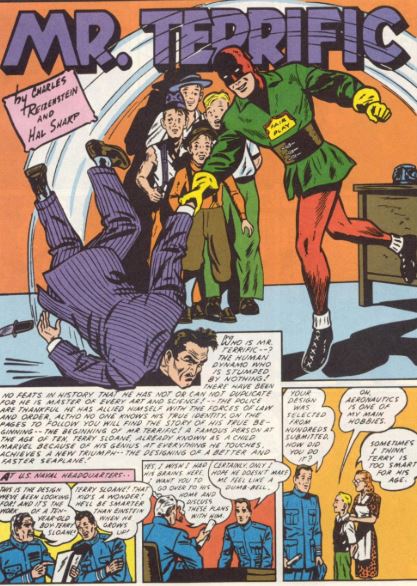
Crafted by Reizenstein & Hal Sharp, ‘Who is Mr. Terrific?’ introduced physical and mental prodigy Terry Sloane who so excelled at everything he touched, that by the time of the opening tale he was planning his own suicide to escape terminal boredom. Happily, on a very high bridge he found Wanda Wilson, a girl with the same idea. By saving her, Sloane found purpose: crushing the kinds of criminals who had driven her to such despair…

Actively seeking out villainy of every sort, he performs ‘The One-Man Benefit Show’ after thugs sabotage performers, travels to the republic of Santa Flora to expose ‘The Phony Presidente’ and helps a rookie cop pinch an “untouchable” gang boss in ‘Dapper Joe’s Comeuppance’. Sloan’s last showing here sees him at his very best, carefully rooting out political corruption and exposing ‘The Two Faces of Caspar Crunch’

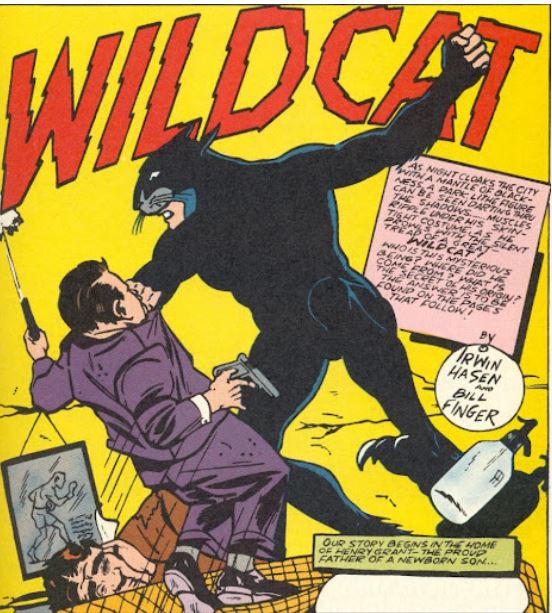
Closing out this stunning hardback extravaganza is another quintet from Sensation #1-5, this time by Bill Finger & Irwin Hasen: already established stars for their work on Batman and Green Lantern.

‘This is the Story of Wildcat’ premieres one the era’s most impressive lost treasures and a genuine comic book classic in the tale of Ted Grant: a boxer framed for the murder of his best friend. Inspired by a kid’s hero-worship of Green Lantern, Grant clears his name by donning a feline mask and costume and ferociously stalking the true killers. Finger & Hasen captured everything which made for perfect rollercoaster adventure in their explosive sports-informed yarns. Mystery, drama and action unfolded unabated in sequel ‘Who is Wildcat?’ as Ted retires his masked identity to compete for the vacant world boxing title, but cannot let innocents suffer as crime and corruption befoul the city. ‘The Case of the Phantom Killers’ sees Wildcat stalk mobsters seemingly striking from beyond the grave, before his adventures alter forever with the introduction of hard-hitting hillbilly hayseed ‘Stretch Skinner, Dee-teca-tif!’ He came to the big city to be a private eye and instead became Grant’s foil, manager and crimebusting partner. The capsule comic craziness then concludes for now with a rousing case of mistaken identity and old-fashioned framing, as Wildcat saves his new pal from a murdering gambler in ‘Chips Carder’s Big Fix’…

These eccentric early adventures might not suit some modern fans’ tastes but they stand as an impressive and joyous introduction to the fantastic worlds and exploits of the World’s oldest if not always greatest superheroes. If you have an interest in the way things were or just hanker for simpler times, less complicated and angsty fun, this may well be a book you’ll cherish forever…
© 1940, 1941, 1942, 2007 DC Comics, Inc. All Rights Reserved.

Also Today, in 1901 Roy Crane was born. His Wash Tubbs, Captain Easy and Buz Sawyer all shaped the way comics evolved and deserve your attention. In 1923 Belgian cartoonist Paul (Corentin) Cuvelier was born. You can celebrate the birthday of Marjane Satrapi who joined the world in 1969 by checking out Persepolis – The Story of a Childhood & Persepolis 2 – The Story of a Return or recall the wonders of C.C. Beck who died today in 1989 just by heading to The Shazam! Archives volume 1. Better yet, you could skip my blather and just read the actual books I’m plugging…

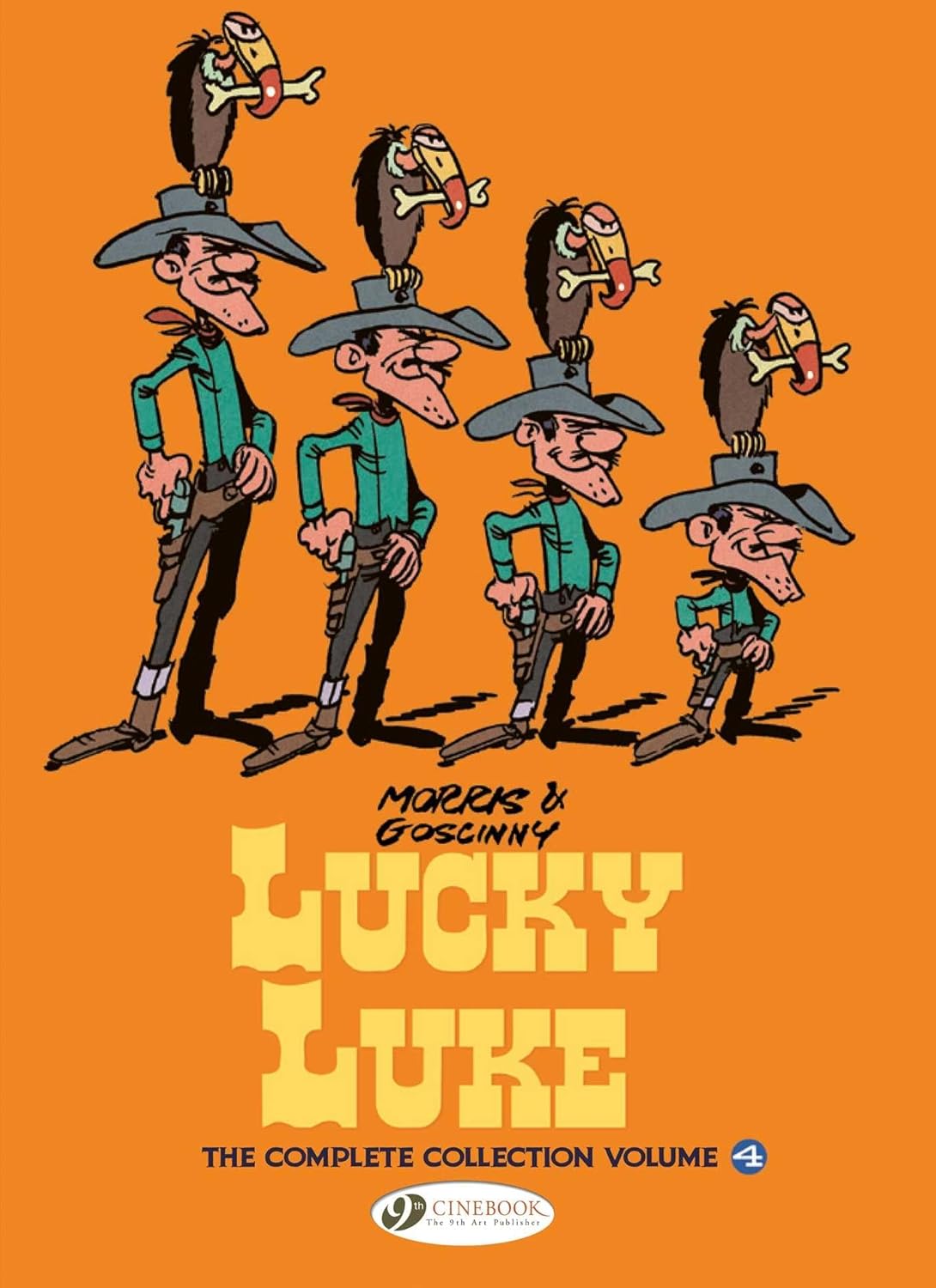
Lucky Luke: The Complete Collection volume 4


By Morris & René Goscinny, with Christelle & Bertram Pissavy-Yvernault: translated by Jerome Saincantin (Cinebook)
ISBN: 978-1-80044-169-9 (Album HB/Digital edition)

This book includes Discriminatory Content produced in less enlightened times.

Win’s Christmas Gift Recommendation: Family Thrills and Frolics No Movie Can Match… 8/10

On the Continent, the populace has a mature relationship with comics: according them academic and scholarly standing as well as meritorious nostalgic value and the validation of acceptance as an art form. Whilst tracing the lost origins of a true global phenomenon, this hardback and digital compilation celebrates the formulative early triumphs of a fictional hero who is certainly a national treasure for both Belgium and France, and it’s also timely in that this worldwide western wonder celebrates his 80th anniversary next year.

As we know him now, Lucky Luke is a rangy, good-natured, lightning-fast cowboy roaming the fabulously mythic Old West, having light-hearted adventures with his horse Jolly Jumper and interacting with archetypes, historical figures and mythic icons. His ongoing exploits have made him one of the best-selling comic characters in Europe (83 collected books plus around a dozen spin-offs and specials, totalling over 300 million albums in at least 33 languages thus far). That has generated all the usual spin-off toys, computer games, puzzles, animated cartoons, TV shows and live-action movies that come with that kind of popularity. It has also spurred a bunch of academicians to steer studies his way and garnered a lot of learned words. Some of those you can read here, if you’re keen…

Lucky debuted in 1946, courtesy of Belgian animator, illustrator and cartoonist Maurice de Bévère (“Morris”). For decades we all believed his first appearance was in autumn release Le Journal de Spirou Christmas Annual (L’Almanach Spirou 1947) prior to being catapulted into his first weekly adventure ‘Arizona 1880’ on December 7th 1946. However, the initial volume in this superb archival series proved the value of scholarship by revealing that the strip actually premiered earlier that year in the multinational weekly comic, albeit sans title banner and only in the edition released in France.

This fourth curated outing presents – in strict chronological order – strips published between February 2nd 1956 through September 1957 with all the art and pages fully restored, rejiggled and remastered to achieve maximum contemporary authenticity and synchronicity with the original weekly serialisation. Those stories were subsequently gathered as albums The Bluefeet are Coming!, Lucky Luke vs Joss Jamon and The Dalton Cousins and there’s even a few little extras scattered about for fascinated completists.

Before all that, though, there’s a wealth of background and unseen other works to enjoy, beginning with a lost cartoon gem as an old goldminer waggishly details ‘The Thousand Uses… of a Hat’

A precocious, westerns-addicted, art-mad kid, well off and educated by Jesuits, Maurice de Bevere was born on December 1st 1923 in Kortrijk, Belgium. A far from illustrious or noteworthy scholar – except in all the ways teachers despise – Maurice sought artistic expression in his early working life via forays into film animation before settling into his true vocation. While working at the CBA (Compagnie Belge d’Actualitiés) animation studio, “Morris” met future comics superstars Franquin & Peyo, and worked as a caricaturist for weekly magazine Le Moustique. Morris quickly became one of la Bande des quatre (Gang of Four) comprising Jijé, Will and old comrade Franquin. Each was a leading proponent of a loose, free-wheeling artistic style known as the “Marcinelle School” which came to dominate Le journal de Spirou in aesthetic contention with the “Ligne Claire” style of Hergé, E.P. Jacobs and others in Le Journal de Tintin.

Previous volumes detailed Morris’s life, career, and achievements, and here Christelle & Bertram Pissavy-Yvernault augment past pictorial essays with ‘Wanted: Lucky Luke’ exploring life after returning to Belgium after his American holiday. It was May 1955 and the artist and his family had been gone for seven years…

Back home and back at work, Morris added to his output by illustrating novels, adding editorial content like quizzes to his Lucky workload and tasting new styles with a vast range of magazine covers, an inordinate number of which were ‘Sappy Moments’ for romance magazines and periodicals…

For Flemish readers he did cartoon sports columns and generally traded as a jobbing commercial artist, but all the while, he was still watching westerns and producing cowboy wonders and other comics stuff, such as the ‘Wild West Journalism’ article he wrote and included here in full. He was also constantly chatting with one of the Europeans he’d met in the US: cartoonist and scripter René Goscinny…

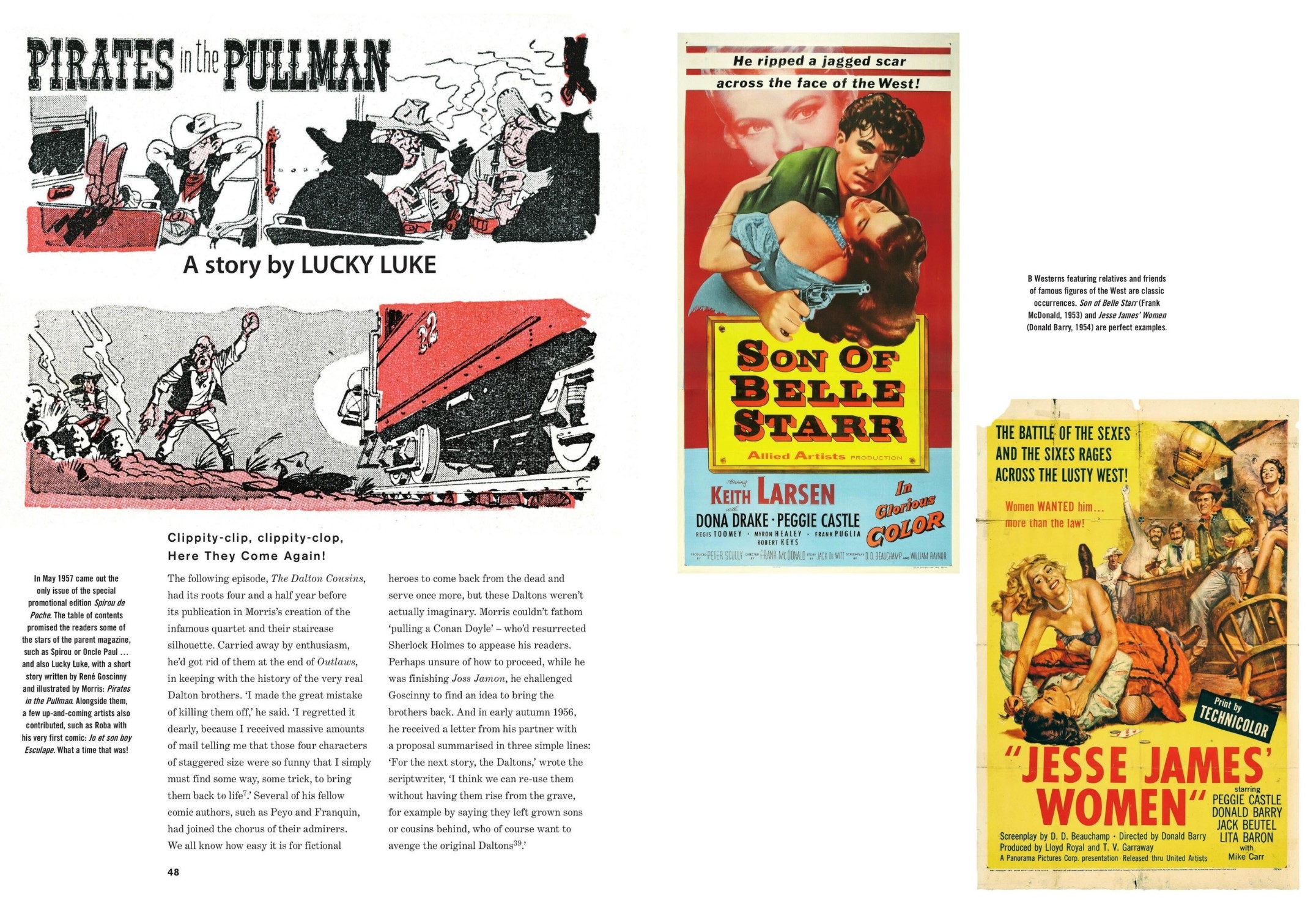
Accompanied by published cartoons, covers, script pages, contemporary ads, family photos and tons of original art, the in-depth treatise focuses on artistic development and the team building that resulted in one of comics’ most fruitful double acts Goscinny.

Morris had taken nearly a decade to craft nine albums of affectionate sagebrush parody and action. Now, with Goscinny as regular wordsmith, Luke would attain dizzying heights of super swift superstardom, commencing with Des rails sur la Prairie (Rails on the Prairie), in Le Journal de Spirou in August 1955. Before that though we enjoy a lost treat that first appeared in Risque Tout #11 (February 2nd 1956) prior to inclusion in Under A Western Sky. ‘Androcles’ details animal lover Luke’s interactions with a mistreated circus bear and proves that western justice applies equally to all…

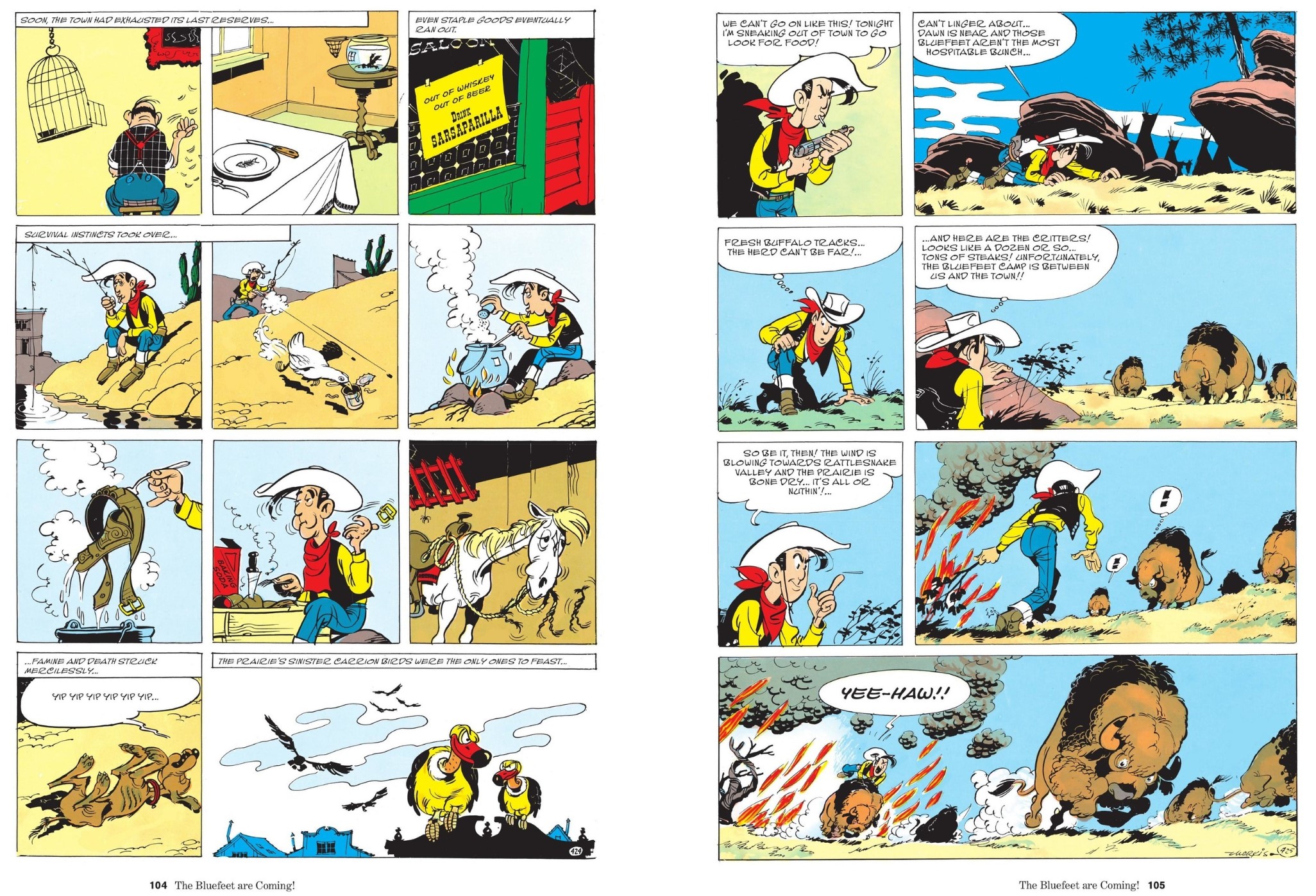
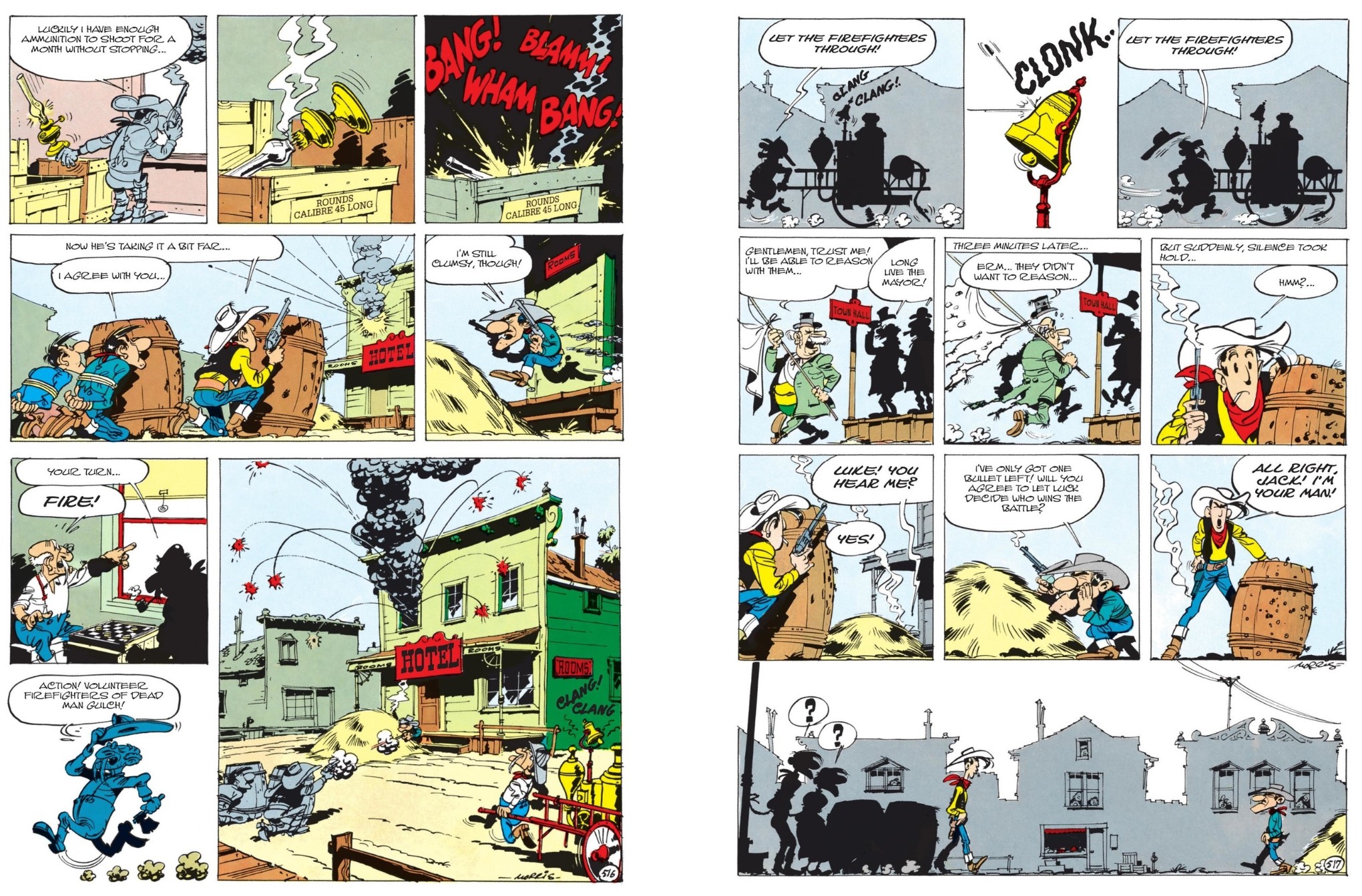
Then the main event begins with all-Morris action as originally serialised in LJdS #938-957 (April 5th – August 16th and released in 1958 as Alerte aux Pied-Bleus/The Bluefeet are Coming!) It’s seen here with original French cover, editorial material and even ads.

A procession of linked gags sees Morris pile on and kick hard familiar themes and scenarios as the town of Rattlesnake Valley welcomes wanderer Lucky. The lone rider is just in time to save super-superstitious sheriff Jerry Grindstone from sneaky gambler/professional card cheat Pedro Cucaracha. His plans to fleece the old codger result in his painful and shameful eviction from civilisation; so naturally, the scoundrel tries to rob and blow up the bank on his way out. Chased into the surrounding desert, the scurvy Mexican then gulls the alcoholic Great Chief of the local Bluefeet Indians into laying siege to the town, tempting the old warrior with promises of unlimited booze…

Old Parched Bear is happy to oblige, and soon the town is forming a militia, telegraphing for the cavalry and erecting barricades. As food and water grow scarce profiteering proliferates, with Lucky and Jerry battening down the hatches and bolstering morale for a protracted and perilous defence of their lives and loved ones…

Against that framework of classic movie moments there are rich slapstick pickings as spies, crossdressers, raids & counter-raids and devious secret weapons all build to a bombastic finale, with Pedro and Parched Bear attempting all manner of nefarious invention to get respectively vengeance and more “firewater”…

… And then, when it’s almost too late, the Cavalry arrive… just after the deployment of late arriving support from Greenfeet and Yellowfeet branches of the family of First Nations. It can only end in catastrophe unless Lucky can contrive a solution…

Daft and Spectacular in equal amounts, this is perhaps a tale for older kids who have gained a bit of historical perspective and social understanding, although the action and slapstick situations are no more contentious than any old movie – as if that’s any help or comfort…

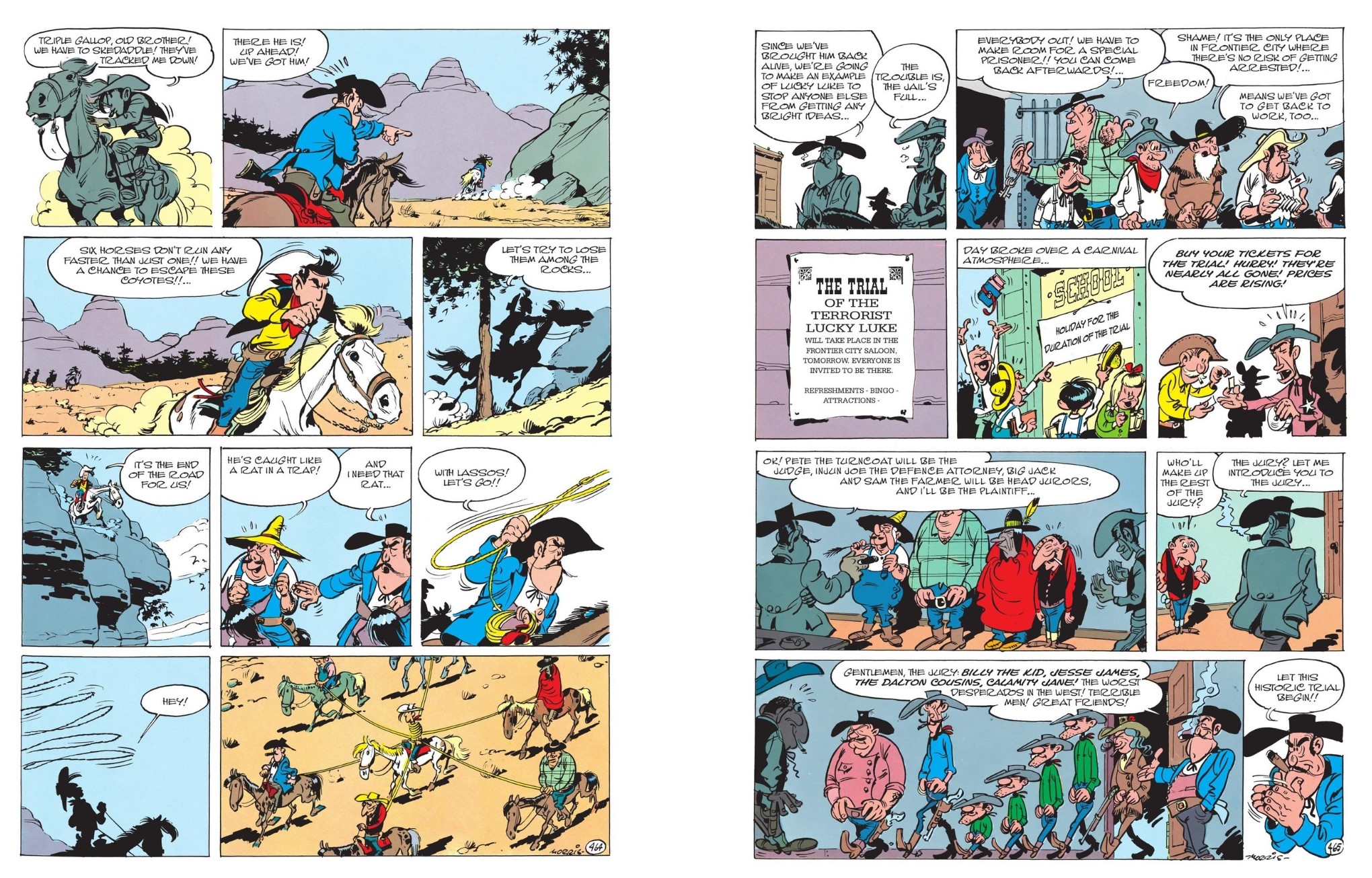
Rushing right on, Le Journal de Spirou #966-989 (October 18th 1956 – March 28th 1957) offered an uncredited Goscinny script as La bande de Joss Jamon and/or Lucky Luke contre Joss Jamon pitted our laconically lanky hero against a very different kind of bad guy. Again on view with original cover and ads, what we know as Lucky Luke vs Joss Jamon finds our happy wanderer facing guns, lynching, slander, a diabolical frame-up and political office, after Confederate soldiers turn their wartime skills to garnering personal profit in the years of Reconstruction that followed the American Civil War.

However, as vile as sly conman Pete the Wishy-washy, brutish Jack the Muscle, murderous Indian Joe, ruthless trickster Sam the Farmer and cardsharp Bill the Cheater may be, their combined villainy cannot match that of their ambitious scheming leader Joss Jamon. He has a dream of running the state if not the country and enough drive to make it happen…

How that doesn’t happen sees Luke battle them singly and in a wild bunch as Jamon moves into Los Palitos and frames Luke for robbery. Barely escaping the neck-stretching, Luke swears to bring back the real culprits in six months or surrender himself for the waiting noose…

The trail finds Jamon in bustling metropolis Frontier City where, after taking over businesses by making offers nobody dares to refuse, Jamon is running for Mayor. Despite physically a match for his enemies, Luke now needs to change tactics to unseat the entrenched plutocrat. That means a menace-packed war of nerves and even running as a rival candidate…

Even though election day is the farce you’d expect, and Lucky is branded an outlaw, he has one last card to play… civil dissatisfaction and unrest…

Witty, wry and cynical, this yarn is actually more socially relevant mow than it ever was when politicians at least feared the repercussions of being caught doing wrong…

Still anonymous, Goscinny also wrote closing inclusion. The Dalton Cousins was first enjoyed in LJdS #992-1013 (April 18th to September 12th 1957) and reappears here with original cover and ads. For this manic mirth-fest Goscinny performed a much-demanded act of necromancy, resurrecting a quartet of killers Lucky had already dealt with, but whom readers want not dead but alive…

Published back in December 1954 Hors-la-loi was Morris’ 6th album and included a strip which saw our hero meet and beat Emmett Bill, Grat & Bob Dalton: real life badmen who had plagued the west during the 1890s. On those funny pages, Lucky was hired by railroad companies to end the depredations of the desperados who had been imported into the strip, but given a comedic, yet still vicious spin. A cat & mouse chase across the wildest of wests saw Luke constantly frustrated by close calls and narrow escapes in superbly gripping movie set-pieces until, inevitably, justice claimed the killers. At the close, Morris had Lucky end the gang forever, but they and the story itself were insanely popular with fans. These owlhoots were comedy gold and ideal foils, so eventually they returned in the form of their own cousins…

From the response to that tale eventually came this aforementioned revival, as Goscinny’s third collaboration. When this iteration of the appalling Dalton Brothers – now and forever after Averell, Jack, William & devious, slyly psychotic, tyrannical diminutive brother Joe – showed up, the course of the strip altered forever…

It opens on a remote farm in Arizona where four brothers mourn the loss of the murderous bandits they resemble and are related to. They know they aren’t nearly good enough to fill the dead men’s boots or kill their killer Lucky Luke… but they are willing to try their hardest to change all that…

The replacement Daltons’ first attempt to settle the score is frankly embarrassing, but fortune and persistence gradually harden and hone them. They even at one stage have the happy wanderer train them…

Ultimately, however, after they besiege a town and regularly succeed in theft and terrorism, Lucky is forced to take action before they become as great a menace as their dearly departed favourites ever were…

Sadly, he leaves it too late and is forced to resort to tricky tactics of dividing to conquer. It either that or be hunted down like a dog: a role he’s just not suited for…

As much thriller as comedy romp, this yarn proved how crucial great villains are to any hero and started a western showdown that fruitfully persists and thrives to this day…

Graced with biographies of Morris and Goscinny and peppered with contemporaneous extras this is perfect for kids with a smidgen of historical perspective and social understanding, although the action and slapstick situations are no more contentious than any Laurel and Hardy film – perfectly understandable as Morris was a huge fan of the duo. These formative forays are a grand old hoot in the tradition of Destry Rides Again or Support Your Local Sheriff, superbly executed by master storytellers, and a wonderful introduction to a unique genre for anyone who might well have missed the romantic allure of the Wild West that never was…
Original edition © Lucky Comics 2022. English translation © 2025 Cinebook Ltd.
All pages & illustrations relating to The Thousand Uses of a Hat, Androcles and The Bluefeet are Coming! © Morris/Goscinny/Dupuis 2022.
All pages & illustrations relating to Horse Thieves, Lucky Luke vs Joss Jamon and The Dalton Cousins © Morris/Goscinny/Dupuis 2022.
All documents relating to Morris are © Morris/Dupuis 2022.
All documents relating to René Goscinny are © Anne Goscinny 2022 barring cited exceptions.

Today in 1948 Underground Commix cartoonist and proud pornographer Larry Welz (Yellow Dog, Captain Guts, Cherry PopTart) was born, whilst in 1992 epically long-running UK adventure weekly The Victor published its last issue.

DC’s Greatest Imaginary Stories


By Otto Binder, Bill Finger, Jerry Siegel, John Broome, Leo Dorfman, Edmond Hamilton, Jim Shooter, C.C. Beck, Dick Sprang, Kurt Schaffenberger, Curt Swan, Carmine Infantino, Bob Kane & various (DC Comics)
ISBN: 978-1-4012-0534-8 (TPB)

This book includes Discriminatory Content produced in less enlightened times.

Win’s Christmas Gift Recommendation: Purely Addictive Comics Madness… 9/10

Alan Moore’s infamous epigram notwithstanding, not all comics tales are “Imaginary Stories”.

When DC Editor Mort Weisinger was expanding the Superman continuity and building the legend, he realised that each new tale was an event that added to a nigh-sacred canon: that what was written and drawn mattered to the readers. But, as a big concept guy, he wasn’t going to let that aggregated “history” stifle a good idea, nor would he allow his eager yet sophisticated audience to endure clichéd deus ex machina cop-outs to mar the sheer enjoyment of a captivating concept. The mantra known to every baby-boomer fan was “Not a Dream! Not a Hoax! Not a Robot!” boldly emblazoned on covers depicting scenes that couldn’t possibly be true… as a way of exploring non-continuity deviations, plots and scenarios devised at a time when editors believed entertainment trumped consistency and knew that every comic read was somebody’s first… or potentially last.

This jolly little compilation – long overdue for revival and expansion – celebrates the time when whimsy and imagination were king but somewhat stretches the point by leading with a fanciful tale of the World’s Mightiest Mortal. Courtesy of Otto Binder & CC Beck, ‘Captain Marvel and the Atomic War’ (Captain Marvel Adventures #66, October 1946) actually hoaxes the public through a demonstration of how the world might end in the new era of Nuclear Proliferation.

‘The Second Life of Batman’ (Bill Finger, Dick Sprang & Charles Paris in Batman #127, October 1959) doesn’t really fit the strict definition either, but the tale of a device that predicts how Bruce Wayne’s life would have run if his parents had not been killed is superb and engaging all the same. In contrast, ‘Mr. and Mrs. Clark (Superman) Kent!’ (Jerry Siegel & brilliant Kurt Schaffenberger) was the first of an occasional series that began in Superman’s Girlfriend Lois Lane #19 (August 1960). Far more apropos, it depicts the laughter and tears that might result if the plucky news-hen secretly marries the Man of Steel.

From an era uncomfortably parochial and patronising to women, there’s actually plenty of genuine heart and understanding in this tale and a minimum of snide sniping about “silly, empty-headed girls”…

Eventually the concepts became so bold that Imaginary Stories could command book-length status. ‘Lex Luthor, Hero!’ (Superman #149, November 1961) by Siegel, Curt Swan & Sheldon Moldoff details the mad scientist’s greatest master-plan and ultimate victory in a tale as powerful now as it ever was. In many ways this is what the whole concept was made for! No prizes for guessing what ‘Jimmy Olsen Marries Supergirl!’ (Superman’s Pal Jimmy Olsen #57, December 1961) is about, but the story is truly a charming delight, beautifully realized by Siegel, Swan & Stan Kaye.

Once more stretching a point ‘The Origin of Flash’s Masked Identity!’ (John Broome, Carmine Infantino & Joe Giella in The Flash# 128, May 1962) although highly entertaining, is more an enthusiastic day-dream than alternate reality and, I suspect, is added to bring variety to the mix – as is the intriguing ‘Batman’s New Secret Identity’ (Batman #151, November 1961, by Finger, Bob Kane & Paris).

‘The Amazing Story of Superman-Red and Superman-Blue!’ (Superman #162, July 1963) is possibly the most influential tale of this entire subgenre. Written by Leo Dorfman with art from Swan & George Klein, this startling utopian classic was so well-received that decades later it still influences and flavours Superman continuity. The plot involves the Action Ace being divided into two equal wonder men who promptly solve all universal problems and even the love rivalry between Lois Lane and Lana Lang!

Siegel & Schaffenberger’s ‘The Three Wives of Superman!’ is an enchanting tragedy of missed chances from SGLL #51 (August 1964) clearing the palate for ‘The Fantastic Story of Superman’s Sons’ (by Edmond Hamilton, Swan & Klein in Superman #166, November 1964): a solid thriller built on a tragic premise (what if only one of Superman’s children inherited his powers?), and this bright and breezy book closes with the stirring, hard-hitting ‘Superman and Batman… Brothers!’, wherein orphaned Bruce Wayne is adopted by the Kents, but cannot escape a destiny of tragedy and darkness. Written by Jim Shooter, with art from Swan & Klein for World’s Finest Comics #172 (cover-dated December 1967) this moody thriller in many ways signalled the end of carefree days and the beginning of a grittier, more cohesive DC universe for a less whimsical, fan-based audience.

This collection is a glorious slice of fancy, augmented by an informative introduction from columnist Craig Shutt, bolstered with mini-cover reproductions of many tales that tragically never made it into the collection, but I do have one minor quibble: No other type of tale was more dependent on an eye-catching, conceptually intriguing cover, so why couldn’t those belonging to these collected classics have been included here, too?

Surely, it’s time for a re-issue in either print or digital format with all those arresting covers included. Yes, it is… and don’t call me Shirley.
© 1946, 1959-1964, 1967, 2005 DC Comics. All Rights Reserved.

Today in 1900 Chester Gould was born. No help from me here, deduct who he was.

Happy birthday British arts icon Rian Hughes, arrived today in 1963, joined three years after by Jill Thompson and Guy Davis. Them also you should seek out here or in their own books…

The Legend of Desperate Dan – 60 Years of Classic Cartoon Art


By Dudley D. Watkins, with Charles Grigg, Ken Harrison & various (DC Thomson & Co)
ISBN: 978-0-85116-657-5 (tabloid HB)

This book includes Discriminatory Content produced in less enlightened times.

It needs to be said. Scotland is an ancient and proud nation steeped in unique history, character and culture, and one that has enriched the entire world. That having been said, they all seem to have a rather odd and frequently disturbing fascination with the notion of cowboys…

A timeless case in point is an icon of action and hilarity who began life as a mere half-page feature in the very first issue of The Dandy. The rowdy roughneck (and chin, and chest and…) was first seen fleeing town on December 4th 1937, but has since mellowed, found a family and settled down, He’s still the Strongest Man on Earth and always in trouble because he doesn’t know his own strength…

As seen in the eponymous opening historical section of this colossal tome, ‘The Legend of Desperate Dan’ predates Superman’s debut and owes more to Elzie Segar’s maritime masterpiece Popeye (as seen back then in Thimble Theatre) by way of a countless stampede of Saturday morning movie two-reelers. However Desperate Dan didn’t roam too long on the range and swiftly garnered a family including formidable Aunt Aggie, super-tough nephew Danny, niece Katey, the hard-pressed Mayor, Sheriff and so forth… and lots of put-upon, shell-shocked neighbours usually caught in the catastrophic aftermath of Dan’s latest efforts to help…

Like so many of DC Thompson’s most memorable stars, the Big Guy was the brainchild of Dudley D. Watkins (1907-1969) at his most imaginative and culturally adroit. A tireless and prolific illustrator equally adept at comedy, adventure, educational and drama storytelling, Watkins’ style more than any other shaped the pre and especially postwar look and form of the Scottish publishing giant’s comics output. Yes, the company AND the cowboy…

Watkins started life in Manchester and Nottingham as an artistic prodigy prior to entering Glasgow College of Art in 1924. Before long he was advised to get a job at expanding, Dundee-based Thomson’s, where a 6-month trial period illustrating prose “Boys’ Papers” stories led to comic strip specials and some original cartoon creations. Percy Vere and His Trying Tricks and Wandering Willie, The Wily Explorer made him the only contender for both lead strips in a bold new project conceived by Robert Duncan Low (1895-1980). Managing Editor of Children’s Publication. Between 1921 – 1933, Low launched the company’s “Big Five” story papers for boys: Adventure, The Rover, The Wizard, The Skipper and The Hotspur. In 1936, he created the “Fun Section”: a landmark 8-page comic strip supplement for national newspaper The Sunday Post. This illustrated accessory – prototype and blueprint for every comic the company subsequently released – was launched on 8th March. From the outset, The Broons and Oor Wullie were the uncontested headliners… and both illustrated by Watkins. The other features included Chic Gordon’s Auchentogle, Allan Morley’s Nero and Zero, Nosey Parker and others. These pioneering comics laid the groundwork for the company’s next great leap. In December 1937 Low launched DC Thomson’s first weekly all-picture strip comic, The Dandy. Amidst the serried rank of funsters was a half-page western gag strip. It related the riotous outrages of a mean desperado dubbed Dan…

Dan was extremely popular and in 1939 briefly enjoyed taking up 75% of a page before expanding onto the star status of a full one. Famously, Dandy editor Alber Barnes – who hired Watkins and was the comic’s boss until 1982 – was the model for that unmissable chin. Almost everything else was made up…

This collation offers a wealth of strips, beginning with those calamity-stuffed half-pagers, filled with mighty gaffes, massive consumption and appalling comedic animal cruelty, all preceding the inevitable war contributions as the officially neutral US citizen kept finding ways to bugger up Hitler and Goebbels’ plans for Britain. Another cautionary note: back then smoking tobacco was MANLY, so Dan did it in vast and generally competitive amounts. Be warned and wary…

Monochrome trips about eating, fighting, shaving, Dan’s Girlfriend Lizzie, eating, fighting some more and getting even pause for a colour featurette on ‘The Dandy Monster Comic’ as Dan hoved further westward into Books and Annuals before the strips concentrate on the ‘War years’ with Cactusville slowly morphing in all but name into a fair-sized Scottish town as Dan inflicted ever more outlandish punishments on the weary, wary Wehrmacht…

Feature on firsts follows with ‘Desperate Dan’ shouting out to his ever expanding cast, after which post-war tales encompass a momentous trip to the North Pole; jobs; cow pie; sweet rationing; clothing for the bigger man; bank robbers; cow pie; how feeble modern buildings are; toothache for tough guys and how meat rationing impacts on the mightiest appetite ever known. Once again it’s some pretty hard sledding for us wimpy modern animal-lovers…

Covers, strips and other treats from the Christmas tomes explore Dan’s unstoppable progress and includes a spread on ‘Back Covers on Annuals’ – the cowboy’s sole province from 1954 to 1965 – before segueing into a 1950s selection as Britain, Empire & Commonwealth and Dandy underwent dramatic revision and change…

The Watkins-limned prose yarn ‘Two Desperate Tiddley-Winkers’ leads to more fifties fun with Dan no longer in any way intentionally dangerous in strips covering the star’s invulnerable hair & bristles, coal mining in the High Street; cow pie; and Dan’s utterly unique pedal bike (take one steamroller and three parts tractor…) before closing on a momentous moment of history as Dan voyages to London to see the Queen’s coronation as originally published in Dandy dated June 6th 1953…

‘The Desperate Dan Song’ – sorry, just words & pictures so you’ll need to wrangle up your own tune – leads into more strips with enhanced roles for Danny & Katey, prior to the Sixties revivals opening with ‘Annual features’ including a glance at Dan’s primordial forebear Desprit Jake.

With contemporary strips coming thick & fast the fun is closely followed by two-colour Annual larks involving li’l Dan’s photo-day at ‘Cactusville School’ whilst – happily mining a fresh seam – ‘Desperate Dan’s Schooldays’ (as illustrated by Charles Grigg and first published in the Desperate Dan Annual 1979) gives readers another bucket of whimsical back-story from the big man boyhood as the end approaches.

In 1984, the Biggest Yin made it to the front – and back – of the weekly Dandy covers, displacing Grigg’s Korky the Cat after five straight decades. Here a full colour spread celebrates an anniversary year with a quartet (octet?) of images shouting out fifty years of Desperate astonishment wonder before we unsaddle for the moment with final modern colour feature ‘The Hobbies of Desperate Dan’ as seen in the 1994 Dandy Annual and showing what the term “extreme sports” really means…

Timeless, hilarious and not nearly as tame as you thought, Desperate Dan is a pure paradigm of our lengthy comics glory – and disregard for other people’s culture. Here is a book that – if you’re properly braced and forewarned – will delight and warm your secret, stifled cartoon coloniser’s heart.
© D.C. Thomson & Co Ltd 1997.

Today in 1913 Golden Age artist Charles (Spy Smasher, et al) Sultan was born. In 1943, Metabarons artist Juan Giménez was born. You might also want to peek at A Matter of Time, before celebrating that in 1962 Darwyn Cooke (DC: The New Frontier, Batman: Ego, Parker) joined us for far too short a time.

DC Finest: Super Friends – The Fury of the Super Foes


By E. Nelson Bridwell, Denny O’Neil, Ramona Fradon, Kurt Schaffenberger, Ric Estrada, Alex Toth, Joe Orlando, Bob Smith, Vince Colletta with Dick Giordano, Curt Swan & Geoge Klein & various (DC Comics)
ISBN: 978-1-79950-316-3 (TPB)

This book contains Discriminatory Content produced during less enlightened times.

Win’s Christmas Gift Recommendation: Evergreen Superhero Sagas For All… 9/10

Once upon a time comics were primarily created with kids in mind. Whilst I’d never advocate exclusively going back to those days, the modern industry has for the longest time sinned by not fully addressing the needs and tastes of younger fans these days. By that I mean less tie-ns and more accessible standard stoires like Marvel Adventures material or this stuff here.

Happily, DC has latterly been rectifying the situation with new and – most importantly for old geeks like me – remastered, repackaged age-appropriate gems from their vast back catalogue.

A superb case in point of all-ages comics done right is this tome celebrating the joys of childhood when comics and TV shows were interchangeable in kids’ head. It was all one great big dangerous fun world to save or conquer…

DC Finest: Super Friends:- The Fury of the Super Foes gathers comic book tales spun off from a hugely popular Saturday Morning TV Cartoon show: one that, thanks to the canny craftsmanship and loving invention of lead scripter E. Nelson Bridwell, became an integral and unmissable component of the greater pre Crisis on Infinite Earths DC Universe.

It was also one of the most universally thrilling and satisfying superhero titles of the period: featuring the smart, witty, straightforward adventures people my age grew up with, produced during a period when the entire industry was increasingly losing itself in colossal continued storylines and bombastic, convoluted, soap opera melodrama.It’s something all creators should have tattooed on their foreheads: sometimes all you really want is a smart plot well illustrated, sinister villains well-smacked, a solid resolution and early bed…

TV show Super Friends ran (under various iterations) from 1973 to 1986; starring primarily Superman, Batman and Robin, Wonder Woman, Aquaman and a brace of studio-originated kids as student crimebusters. The cast was supplemented by guest stars from the DCU on a case by case basis. The animated series made the transition to print as part of the publisher’s 1976 foray into “boutiqued” comics which saw titles with a television connection cross-marketed as DC TV Comics.

Child-friendly Golden Age comic book revival Shazam!- the Original Captain Marvel had been adapted into a successful live action series and its Saturday Morning silver screen stablemate The Secrets of Isis consequently reversed the process to become a comic book. With the additions of hit comedy show Welcome Back Kotter and animated blockbuster Super Friends four-colour format, DC had a neat outreach imprimatur tailor-made to draw viewers into the magic word of funnybooks.

At least that was the plan: with the exception of Super Friends none of the titles lasted more than ten issues beyond their launch…

This massive mega-extravaganza collects Super Friends #1-26 (spanning November 1976 to November 1979), includes promo comic Aquateers Meet the Super Friends and reprints material from Limited Collectors’ Edition #C-41 and C-46.

The fun begins a crafty 2-part caper by the wondrous E. Nelson Bridwell and illustrators Ric Estrada, Vince Colletta & Joe Orlando. ‘The Fury of the Super Foes’ finds heroes-in-training Wendy & Marvin – and their incredibly astute mutt Wonderdog – studying at the palatial Hall of Justice, even as elsewhere, a confederation of villains prove imitation is the sincerest form of flattery… if not outright intellectual theft. Having auditioned a host of young criminals, The Penguin, Cheetah, Flying Fish, Poison Ivy and Toyman are creating a squad of sidekicks and protégés to follow in their felonious footsteps. Now Chick, Kitten, Sardine, Honeysuckle and Toyboy are all ready and willing to carry out their first caper…

When the giant “Troubalert” screen informs our heroes of a 3-pronged attack on S.T.A.R. Labs’ latest inventions, the team split up to tackle the crises, but are thoroughly trounced until Wendy & Marvin break curfew to help them. As a result of the clash, Chick and Kitten are brought back to the Hall of Justice, but their talk of repentance is a rascally ruse and they secretly sabotage vital equipment. Thankfully, Wonderdog has seen everything and quickly finds a way to inform the still-oblivious good guys in issue #2, but too late to prevent the Super Friends being briefly ‘Trapped by the Super Foes’

Aided and abetted by inker Bob Smith, the incomparable Ramona Fradon (Aquaman; Metamorpho the Element Man; Brenda Starr, Reporter) became penciller with #3, as ‘The Cosmic Hit Man?’ sees 50 intergalactic super-villains murdered by infernal Dr. Ihdrom, who then blends their harvested essences to create an apparently unbeatable hyper-horror to utterly overwhelm Earth’s heroic defenders. However, he falls victim to his own arrogance and Wendy & Marvin’s logical deductions…

‘Riddles and Rockets!’ sees the Super Friends overmatched by new ne’er-do-well Skyrocket whilst simultaneously seeking to cope with a rash of crimes contrived by King of Conundra The Riddler. Soon a pattern emerges and a criminal connection is confirmed…

Author Bridwell (Secret Six; Inferior Five; Batman; Superman; The Flash; Legion of Super-Heroes; Captain Marvel/Shazam!) was justly famed as DC’s Keeper of Lore and top Continuity Cop thanks to his astoundingly encyclopaedic knowledge of its publishing minutiae and ability to instantly recall every damn thing! ‘Telethon Treachery!’ gave him plenty of scope to display it with a horde of near-forgotten guest-stars joining the heroes as they host a televised charity event. Sadly, money-mad menace Greenback lurks in the wings, awaiting his moment to grab the loot and kidnap the wealthiest donors. Then The Atom (Ray Palmer) plays a crucial role in stopping the depredations of an animal trainer using beasts as bandits in ‘The Menace of the Menagerie Man!’ before a huge cast change is unveiled in #7 (October 1977) with ‘The Warning of the Wondertwins’

You all know TV is very different from comics. When the next season of Super Friends aired, Wendy, Marvin & Wonderdog were abruptly gone, replaced without explanation by alien kids Zan & Jayna and their elastic-tailed space monkey Gleek. With room to extrapolate and in consideration of fans, Bridwell explained the sudden change via a battle to save Earth from annihilation whilst introducing the newest student heroes in memorable style. At the Hall of Justice Wendy & Marvin spot a spaceship hurtling to Earth on the Troubalert monitor and dash off to intercept it. Aboard are two siblings from distant planet Exor: a girl able to transform into animals and a boy who can become any form of water, from steam to ice. They have come carrying an urgent warning…

Superman’s alien enemy Grax has resolved to eradicate humanity and devised a dozen different superbombs and attendant weird-science traps to ensure his victory. These are scattered all over Earth and even the entire Justice League cannot stretch its resources to cover every angle and threat. To Wendy & Marvin the answer is obvious: call upon the help and knowledge of hyper-powered local heroes…

Soon Superman and Israel’s champion The Seraph are dismantling a black hole bomb whilst Elongated Man and titan-tressed Godiva perform similar service on a life-eradicator in England. Flash (Barry Allen) and mighty-leaping Impala dismantle uncatchable ordnance in South Africa before Hawkman & Hawkwoman join Native American avenger Owlwoman to crush darkness-breeding monsters in Oklahoma, whilst from the Hall of Justice Wendy, Marvin and the Wonder Twins monitor the crisis with a modicum of mounting hope…

The cataclysmic epic continues in #8 with ‘The Mind Killers!’ as Atom and Rising Son tackle a device designed to decimate Japan, and in Ireland Green Lantern Hal Jordan and Jack O’Lantern battle multi-hued monstrosities before switching off their technological terror.

In New Zealand, time-scanning Tuatara tips off Red Tornado to the position of a bomb cached in the distant past whilst Venezuela’s doom is diverted through a team-up of Batman, Robin and reptile-themed champion Bushmaster. And in Taiwan a melding of sonic superpowers possessed by Black Canary and the astounding Thunderlord harmoniously saves the day…

The saga soars to a classic climax with ‘Three Ways to Kill a World!’ in which the final phases of Grax’s scheme fail thanks to Green Arrow & Tasmanian Devil in Australia, with Aquaman & Little Mermaid sorting out the embattled seas off Denmark and Wonder Woman & The Olympian preserving modern Greece.

Or at least, they would have if the Hellenic heroes had found the right foe. Sadly, their triumph against Wrong-Place, Right-Time terrorist Colonel Conquest almost upsets everything. Thankfully, the quick thinking hero-students send an army of defenders to Antarctica where Norwegian novice Icemaiden dismantles the ultimate booby-trap bomb.  However, whilst the adult champions are engaged, Grax invades the Hall of Justice seeking revenge on the pesky whistleblowing Exorian kids. He’s completely unprepared for and overwhelmed by Wendy, Marvin & Wonderdog, who categorically prove they’re ready to graduate to the big leagues…

Thus with Zan & Jayna enrolled as latest heroes-in-training, Super Friends #10 details their adoption by Batman’s old associate – and eccentric time travel theoretician – Professor Carter Nichols, just before a legion of alien horrors arrive on Earth to teach the kids that appearances can be lethally deceiving in ‘The Monster Menace!’ In #11, ‘Kingslayer’ pits the heroes against criminal mastermind Overlord who has contracted the world’s greatest hitman to murder more than one hundred leaders at one sitting…

Another deep dive into DC’s past resurrected Golden Age titans T.N.T and Dan, the Dyna-Mite in ‘The Atomic Twosome!’ These 1940s mystery men had been under government wraps ever since their radioactive powers began to melt down, but when an underground catastrophe ruptures their individual lead-lined vaults, the Super Friends are called in to prevent potential nuclear nightmare. Then the subterranean reason for the near tragedy is tracked to a monstrous mole creature, and leads to the introduction of eternal mystic Doctor Mist, who reveals the secret history of civilisation and begs help to halt ‘The Mindless Immortal!’ before its random burrowing shatters mankind’s cities. From here, Bridwell would build a fascinating new team concept that would support decades of future continuity…

Super Friends #14 opens with ‘Elementary!’; introducing four ordinary mortals forever changed when possessed by ancient sprits. Tasked by Overlord with plundering the world, Undine, Salamander, Sylph & Gnome are defeated by our heroes yet retain their powers and so become crimefighting team The Elementals. Also on view is a short back-up illustrated by Kurt Schaffenberger & Bob Smith. ‘The Origin of the Wondertwins’ at last reveals they are Exorian genetic throwbacks (despised outcasts on their homeworld) who fled from a circus of freaks and uncovered Grax’s plot before taking that fateful voyage to Earth.

Big surprises come in ‘The Overlord Goes Under!’ (Fradon & Smith) as the Elementals begin battling evil by joining the Super Friends in crushing the crook. All those superheroes are blithely unaware that they are merely clearing the way for a far more cunning and subtle mastermind to take Overlord’s place…

‘The People Who Stole the Sky!’ in SF #16 is a grand, old-fashioned alien invasion yarn, foiled by the team and the increasingly adept Wonder Twins whilst ‘Trapped in Two Times!’ has Zan & Jayna used by the insidious Time Trapper to lure their adult mentors into deadly peril on Krypton in the days before it detonated, and future water world Neryla in the hours before it’s swallowed by its critically expanding red sun. After rescuing the kids – thanks largely to Superman’s legendary lost love Lyla Ler-Rol – the Super Friends employ Tuatara’s temporal insight and Professor Nichol’s obscure chronal methodologies to hunt the Trapper in a riotous yet educational ‘Manhunt in Time!’ (art by Schaffenberger & Smith), by way of Atlantis before it sank, medieval Spain and Michigan in 1860CE: all to thwart a triple-strength scheme to derail history and end Earth civilisation…

SF #19 sees an encore for Menagerie Man in ‘The Mystery of the Missing Monkey!’ (Fradon & Smith) as the animal exploiter appropriates Gleek: intent on turning his elastic-tailed talents into a perfect pickpocketing tool, before Denny O’Neil (as Sergius O’Shaugnessy) teams with Schaffenberger & Smith for a more jocular turn. Here, chaos and comedy ensue when the team tackles vegetable monsters unleashed after self-obsessed shlock-movie director Frownin’ Fritz Frazzle uses Merlin’s actually magical Magic Lantern to make a “masterpiece” on the cheap in ‘Revenge of the Leafy Monsters!’

Bridwell & Fradon bounce back in #21 where ‘Battle Against the Super Fiends!’ has the heroes travelling to Exor to combat super-criminals who can duplicate their power-sets, after which ‘It’s Never Too Late!’ (#22, O’Shaugnessy, Fradon & Smith) reveals how time bandit Chronos subjects the Super Friends to a chronal-delay treatment rendering them perennially too late to stop him… but only until Batman and the Wonder Twins out-think him.

The Mirror Master divides and banishes teachers from students in #23 but is ultimately unable to prevent an ‘SOS from Nowhere!’ (Bridwell, Fradon & Smith) to the Flash. This episode also spends time fleshing out the Wonder Twins’ earthly alter egos as Gotham Central highschoolers John & Joanna Fleming

With O’Shaugnessy scripting, ‘Past, Present and Danger!’ sees Zan & Jayna’s faces found engraved on a recently-unearthed Egyptian pyramid. Upon investigation inside the edifice, the heroes awaken two ancient exiles who resemble the kids, but who are in truth criminals who fled Exorian justice thousands of years previously. How lucky, then, that the kids are perfect doubles that the villains can send back with the robot cops surrounding the pyramid – once they’ve got rid of all those busybody Earthling heroes…

Enjoying promotion through treachery, habitually harassed Underling has seized power at last in Bridwell’s ‘Puppets of the Overlord’, and then employs forbidden technology to mind-control adult and junior heroes. Happily, international champions Green Fury (later Fire), Wonder Woman’s sister Nubia, Tasmanian Devil and Seraph can join Green Lantern and Queen Mera of Atlantis in delivering a liberating solution, after which this splendid selection of super thrills pauses with SF #26 as Bridwell, Fradon & Smith bring back some old friends and enemies for ‘The Wondertwins’ Battle of Wits!’ when a scheming former Bat-foe enacts an infallibly murderous plot…

Rounding out the frenetic fun is a features section that includes the Alex Toth cover from Limited Collectors’ Edition #C-41  and new material from sequel C-46. These include a comic strip collaboration with Bridwell on introductory tale ‘Super Friends’ which was a star-studded framing sequence for a big reprint issue of Justice League classics. The wonders are further augmented by Toth’s comprehensive pictorial essay on creating ‘TV Cartoons’ (with contributions from Bob Foster), plus his ‘The JLA on TV’ model sheets, and designs of ‘The Hall of Justice’ by Terry Austin. As you of course know, comics legend Toth was lead designer on the characters’ transition to TV animation…

The extras include mini-comic Aquateers Meet the Super Friends – a 1979 promotional giveaway included with every purchase of Super Friends Swim Goggles. An uncredited framing sequence (which looks like a Continuity Associates project that Dick Giordano & Frank McLoughlin had a hand in) segues into ‘The Greatest Show on Water’ – an Aquaman short by Fradon originally published in Adventure Comics #219, (December 1955).

The bumper fun wraps with Alex Ross’ painted cover from 2001 book collection Super Friends!

With covers by Fradon, Smith, Schaffenberger, Colletta, Ernie Chan and more, this hopefully initial compendium is superbly entertaining, masterfully crafted and utterly engaging. It offers stories of pure comics gold to delight children and adults in equal proportion. Truly generational in appeal, they are probably the closest thing to an American answer to the magic of Tintin or Asterix and no family home should be without this tome.

Sadly, this masterful mystery megamix is not yet available digitally, but we live in hope. In the meantime, if you prefer your cartoon crimebustng computer collated you could access 2020’s Super-Friends: Saturday Morning Comics volume 1.
© 1976, 1977, 1978, 1979, 2001, 2025 DC Comics, Inc. All Rights Reserved.

Today in 1697, Willam Hogarth was born. Notionally adding to the comics lustre and significance, in 1918, Howard Purcell was also added to the planet’s roster, as was Neil Gaiman in 1960. In the exit column for today, in 1993 we lost astounding illustrator Alberto Breccia, and in 2006 immortal sci fi writer Jack Williamson. All those other guys you can find in old posts here, but I particularly recommend Beyond Mars – The Complete Series 1952-1955.