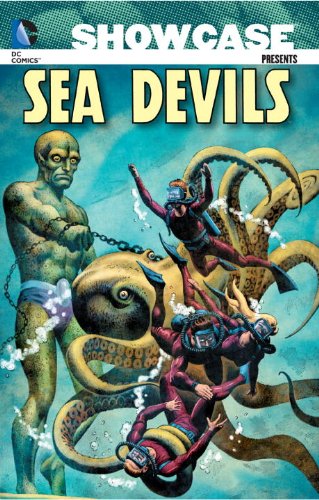
Showcase Presents Sea Devils volume 1


By Robert Kanigher, Bob Haney, France E. Herron, Hank P. Chapman, Russ Heath, Irv Novick, Joe Kubert, Gene Colan, Ross Andru & Mike Esposito, Jack Abel, Bruno Premiani, Sheldon Moldoff, Howard Purcel & various (DC Comics)
ISBN: 978-1-4012-3522-2

This book includes Discriminatory Content produced in less enlightened times.

Robert Kanigher (18th June 1915 – 7th May 2002) was one of the most distinctive authorial voices in US comics, blending rugged realism with fantastic fantasy and outrageous imagination in his signature war comics, as well as for the wealth of horror stories, romance yarns, “straight” adventure, westerns and superhero titles such as Wonder Woman, Teen Titans, Hawkman, Metal Men, Flash, Batman (plus other characters and genres far too numerous to cover here) at which he also excelled.

He sold his first stories and poetry in 1932, wrote for theatre, film and radio, and joined Fox Features’ “shop” at the beginning of the comic book phenomenon where he created The Bouncer, Steel Sterling and The Web, whilst providing scripts for established features like Blue Beetle and Captain Marvel (who we all call “Shazam!” these days). In 1945 he settled at All-American Comics as both writer & editor, staying put when the company amalgamated with National Comics to become the forerunner of today’s DC.

Bob wrote the Golden Age Flash and Hawkman, created Black Canary and many more sexily memorable villainesses such as Harlequin and (Rose and) the Thorn. This last temptress he redesigned in the early 1970s relevancy period: originating a schizophrenic crimebusting superheroine to haunt the back of Superman’s Girlfriend Lois Lane – which he also scripted at the time.

When mystery-men faded at the end of the 1940s, Kanigher moved easily into other genres like spy thrillers, westerns and war stories. In 1952 he became chief writer/editor of the company’s combat line: All-American War Stories, Star Spangled War Stories and Our Army at War. He launched Our Fighting Forces in 1954 and added G.I. Combat to his packed portfolio when Quality Comics sold their dwindling line of titles to National/DC in 1956. A year earlier, Kanigher had devised historical adventure anthology The Brave and the Bold and its stalwart stars Silent Knight, Golden Gladiator and Viking Prince whilst still scripting Wonder Woman, Johnny Thunder, Rex the Wonder Dog and a host of others.

In 1956, for Julius Schwartz he scripted ‘Mystery of the Human Thunderbolt’: the first story of the Silver Age, introducing new Flash Barry Allen to hero-hungry kids of the world.

Kanigher was restlessly creative, frequently using his uncanny if formulaic action arenas as a testing ground for future series concepts. Among the many epochal war features he created were Sgt. Rock, Enemy Ace, The War that Time Forgot, The Haunted Tank and The Losers. However, he always kept an eye on contemporary trends too. When supernatural comics took over the industry as the 1960s closed, he was a mainstay at House of Mystery, House of Secrets and Phantom Stranger. In 1975 he created gritty human interest crime feature Lady Cop. Fifteen years earlier he had caught a similar wave (Oh, ha ha, hee hee…) by cashing in on the popularity of TV show Sea Hunt. His entry into a sudden subgenre deluge of scuba-diver comics featured the traditional contemporary adventure formula of a heroic quartet (Smart Guy, Tough Guy, Young Guy and A Girl) to indulge in all manner of (undersea) escapades from logical to implausible, topical to fantastical. He dubbed his team The Sea Devils

These classy yarns still haven’t made it into modern full-colour editions but they are magnificent examples of comics storytelling, and if you have to read these lost treasures in mere monochrome, at least that’s better than nothing…

Re-presenting the turbulent, terrific try-out stories from Showcase #27-29 (July/August to November/December 1960) and Sea Devils #1-16 – spanning cover-dates September/October 1961 – March/April 1964 – this mammoth black-&-white paperback blends bizarre fantasy, sinister spy stories, shocking science fiction and two-fisted aquatic action with larger-than-life yet strictly human heroes who carved their own unique niche in comics history…

In almost every conceivable way, “try-out title” Showcase created the Silver Age of US comic books and is responsible for the multi-million-dollar industry and art form we all enjoy today. The comic book was a printed periodical Petri dish designed to launch new series and concepts with minimal commitment of publishing resources. If a new character sold well initially a regular series would follow. The process had been proved with Frogmen, Lois Lane, Challengers of the Unknown, The Flash, Green Lantern and many, many more. The principle was a sound one which paid huge dividends. Editors at National were apparently bombarded with readers’ suggestions for new titles and concepts and the only possible way to feasibly prove which would be popular was to offer test runs and assess fan – and most crucially sales – reactions.

Showcase #27 followed a particularly fruitful run of successful non-superhero debuts including Space Ranger, Adam Strange and Rip Hunter…Time Master. At a time when costumed characters seemed unstoppably ascendant, memories of genre implosions remained fresh, but it seemed the premiering publication could do no wrong. Moreover, it wasn’t Kanigher and illustrator Russ Heath’s first dip in this particular pool. Showcase #3 had launched war feature The Frogmen in an extended single tale following candidates for a WWII US Underwater Demolitions Team as they perilously graduated from students to fully-fledged underwater warriors. The feature, if not the actual characters, became a semi-regular strip in All-American Men of War #44 (April #1957) and other Kanigher-edited war comics: making Frogmen the first success of the try-out system. Now, with tales of underwater action appearing in comics, books, film and TV, the time was right for a civilian iteration to make some waves…

The drama here begins in Kanigher & Heath’s ‘The Golden Monster’ as lonely skin-diver Dane Dorrance reminisces about his WWII frogman father and that senior’s trusty buddies before being saved from a sneaky shark by a mysterious golden-haired scuba-girl. Judy Walton is an aspiring actress who, seeking to raise her Hollywood profile, has entered the same underwater treasure hunt Dane is engaged in, but as they join forces, they have no idea of the dangers awaiting them…

Locating the sunken galleon they’ve been hunting, both are trapped when seismic shifts and a gigantic octopus bury them inside the derelict. Happily, hulking third contestant Biff Bailey is on hand and his tremendous strength tips the scales and allows the trio to escape. Now things take a typical Kanigher twist as the action switches from tense realistic drama to riotous fantasy, with the explosive awakening of a colossal reptilian sea-monster who chases the divers until Judy’s little brother Nicky races in to distract the beast…

Temporarily safe, the relative strangers unite to destroy the thing – with the help of a handy floating mine left over from the war – before deciding to form a professional freelance diving team. They take their name from the proposed movie Judy wanted to audition for, becoming forever “The Sea Devils”. In Showcase #28 Dane’s dad again offers his boy ‘The Prize Flippers’ papa won for war exploits, but Dane feels his entire team should be allowed to compete for them. Of course, each diver successively outdoes the rest, but in the end a spectacular stunt with a rampaging whale leaves the trophy in the hands of a most unlikely competitor…

A second story sees the new team set up shop as “underwater trouble-shooters” and stumbling into a mystery as pretty Mona Moray begs them to find her missing dad. Professor Moray was lost when his rocket crashed into the ocean, but as our scuba stalwarts diligently search the crash site, they are ambushed by underwater aborigines and join the scientist in an uncanny ‘Undersea Prison’. Only when their captors reveal themselves as invading aliens do the team finally pull together, escape the trap and bring the house down on the insidious aquatic horrors.

Showcase #29 also offered a brace of briny tales, casting off with ‘The Last Dive of the Sea Devils’, wherein a recently-imprisoned dictator from Venus escapes to Earth and battles the astounded team to a standstill from his giant war-seahorse. The blockbusting bust-up costs them their beloved vessel The Sea Witch, before the crew make use of a handy leftover torpedo to end the interplanetary tyrant. Sea-born giants also abound in ‘Undersea Scavenger Hunt’ wherein the cash-strapped troubleshooters compete in a contest to win a new boat. Incredible creatures and fantastic treasure traps are no real problem, but the actions of rival divers The Black Mantas almost cost our heroes their lives…

Everything works out though, and nine months later Sea Devils #1 hit the stands with Kanigher & Heath leading the way. In ‘The Sea Devils vs. the Octopus Man’ our watery quartet are now stars of a monster movie, but when the lead beastie comes to lethal life and attacks them, all thoughts of fame and wealth sink without trace. The second tale was scripted by superbly inventive Bob Haney who riffed on Moby Dick’s plot in a tale of how Vikings hunted a mythical orca with a magic harpoon, before latter-day fanatical whaler Captain Shark mercilessly seeks out the ‘Secret of the Emerald Whale’ with our desperate Devils dragged along for the ride…

Haney wrote both yarns in the next issue, beginning with ‘A Bottleful of Sea Devils’ as mad scientist Mr. Neptune employs a shrinking device to steal a US Navy weapon prototype. With the aquatic investigators hard on his flippered heels, the felon is soon caught, after which ‘Star of the Sea’ introduces implausibly brilliant performing seal Pappy who repeatedly saves the sea squad before finding freedom and true love in the wild waters of the Atlantic. Kanigher returned for #3’s ‘Underwater Crime Wave’ as the Devils clashed with a modern Roman Emperor who derives incredible wealth from smuggling and traps the team in his undersea arena. Judy then finds herself the only one immune to the allure of ‘The Ghost of the Deep’ as subsea siren Circe makes the boys her latest playthings with her mortal rival compelled to pull out all the stops to save her friends…

Sea Devils #4 led with ‘The Sea of Sorcery’ as the team investigate – but fail to debunk – incredible myths of a supposedly haunted region of ocean, after which Haney details how the squad travel into the heart of South America to liberate a tribe of lost, pre-Columbian Condor Indians from a tyrannical witch doctor to solve ‘The Secret of Volcano Lake!’ Then ‘The Creature Who Stole the 7 Seas’ (Kanigher) opens SD #5 as a particularly dry period for the troubleshooters ends with a crashing UFO disgorging a sea giant intent on transferring Earth’s oceans to his own arid world. Oddly for the times, here mutual cooperation and a smart counter-plan save the day for two panicked planets.

Veteran writer Hank P. Chapman joined an ever-expanding team with a smart yarn of submerged Mayan treasure and deadly traps imperilling the team whilst solving the ‘Secret of the Plumed Serpent’, before Kanigher comes back with a book-length thriller for #6 and the Devils seemingly ensorcelled by ancient parchments which depict them battling incredible menaces in centuries past. Biff battles undersea knights for Queen Cleopatra, Judy saves Ulysses from Sirens, Nicky rescues a teenage mermaid from a monstrous fishman and Dane clashes with ‘The Flame-Headed Watchman!’, but is wise enough to realise the true threat comes from the mysterious stranger who has brought them such dire documents…

The switch to longer epics was wise and productive, followed up in #7 with ‘The Human Tidal Wave!’ as the heroes spectacularly battle an alien made of roaring water to stop a proposed invasion, whilst SD #8 sees them strive to help a fish transformed into a grieving merman by the ‘Curse of Neptune’s Giant!’ The malignant horror’s mutative touch briefly makes monsters of the heroes too, but ultimately Sea Devil daring trumps eldritch cruelty…

More monster madness followed in #9’s ‘The Secret of the Coral Creature!’ as the team become paragliding US Naval medics to rescue an astronaut. That’s mere prelude to the oceanic atomic bomb test which blasts them to a sea beneath the sea that imprisons an ancient alien for eons of crushing solitude, and who had no intention of ever letting the newly-arrived air-breathers go…

A concatenation of crazy circumstances creates the manic madness of #10’s ‘4 Mysteries of the Sea!’ as godly King Neptune decrees that on this day every wild story of the sea will come true, just as the Sea Devils are competing in a “Deep Six Tall Tales” contest. Soon the incredulous squad are battling pirates in an underwater ghost town, rescued from captivity by a giant octopus thanks to a friendly seal (Good old Pappy!), facing off against aliens of the Martian Canals Liars Club and saving Neptune himself from a depth-charge attack…

The hugely underrated Irv Novick took over as primary illustrator with #11, as the Devils agree to test human underwater endurance limits in an ocean-floor habitat. Soon, however, Dane is near breaking point, seeing a succession of monsters from the ‘Sea of Nightmares!’

Kanigher then relinquished writing to fellow golden age alumnus France E. Herron, who kicked off in rip-roaring form with a classy sci fi romp. Here Nicky’s growing feelings of inadequacy are quashed after he saves his comrades – and the world – from the ‘Threat of the Magnetic Menace!’

Always experimental and rightfully disrespectful of the fourth wall, editors Kanigher and George Kashdan turned issue #13 over to the fans for ‘The Secrets of 3 Sunken Ships’, as successive chapters of Herron’s script were illustrated by Joe Kubert (whose 99th birthday would be today if he was still with us), Gene Colan and Ross Andru & Mike Esposito for the audience to judge who was the best. The artists all appear in-world, conducting interviews and researching our heroes as they tackle a reincarnated sea captain, travel to an ancient sea battle between Greece and Persia and meet the alien who kidnapped the crew of the Marie Celeste! The gag continued in Sea Devils #14 as illustrator Novick comes along for the ride when the amazing aquanauts try to end the catastrophic ‘War of the Underwater Giants’ This finds aging deities Neptune and Hercules clashing for supremacy in Earth’s oceans.

Jack Abel was artistic substitute in supplementary yarn ‘Challenge of the Fish Champions!’, as our heroes enter a cash prize competition to buy scuba equipment for a junior diving club. Unfortunately, crazy devious scientist Karpas also wants the loot and so fields a team of his own technologically augmented minions. Before long, the human skindivers are facing off against a sea lion, a manta ray, a squid and a merman. Nobody specified contestants had to be human…

Novick got back into the act illustrating #15 as author Herron revealed Judy & Nicky’s relationship to the ‘Secret of the Sunken Sub!’ When inventor Professor Walton vanishes whilst testing his latest submersible, it’s only a matter of time before his children drag the rest of the Sea Devils to the bottom of every ocean to find him and his lost crew. The uncanny trail takes them through shoals of monsters, astounding flora and into the lair of an incredible sea spider before the mission is successfully accomplished…

Events regained a semblance of narrative normality with the final issue in this compilation with Chapman contributing two high adventure yarns beginning with ‘The Strange Reign of Queen Judy and King Biff’, superbly rendered by the wonderful Bruno Premiani & Sheldon Moldoff. When a massive wave capsizes the Sea Witch, only Dane & Nicky seemingly survive, but the determined explorers persevere, eventually finding their friends as bewitched captives on the island of an immortal wizard. All they have to do is kidnap their ferociously resisting comrades, escape an army of angry guards and penetrate the island’s mystic defences a second time to restore everything to normal. No problem…

This eccentric and exciting voyage of discovery concludes with ‘Sentinel of the Golden Head’ – illustrated by always impressive Howard Purcell & Moldoff – as the restored aquatic quartet stumble onto the lost island of Blisspotamia in time to witness a beautiful maiden trying to sacrifice herself to the sea gods. By interfering, they incur the wrath of a legion of mythological horrors and have no choice but to defy the gods to free the terrified islanders from ignorance and tyranny…

These capacious monochrome compendia were superb value and provided a vital service by bringing older, less flashy (but still astonishingly expensive in their original issues) tales to a readership which might otherwise be denied them. However, this is probably the only series which I can honestly say suffers in the slightest from the lack of colour. Whilst the line-art story illustrations are actually improved by the loss of hue, the original covers – by Heath & Novick as supervised and inked by production ace Jack Adler – used all the clever technical print effects and smart ingenuity of the period to add a superb extra layer of depth to the underwater scenes which tragically cannot be appreciated in simple line & tone reproduction. Just go to any online cover browser site and you’ll see what I mean…

Nevertheless, the amazing art and astounding stories are as good as they ever were and Showcase Presents Sea Devils is stuffed with incredible ideas, strange situations and non-stop action. These underwater wonders are a superb slice of the engaging fantasy thrillers which were once the backbone of US comic books. Perhaps a little whacky in places, they are remarkably similar to many tongue-in-cheek, anarchic Saturday morning kids’ animation shows and will certainly provide jaded fiction fans with hours of unmatchable entertainment. Let’s hope the editors of the DC Finest line are casting about for some rarer salvage to preserve…
© 1960, 1961, 1962, 1963, 1964, 2012 DC Comics. All Rights Reserved.

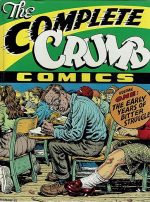
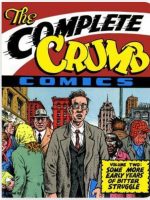
The Complete Crumb Comics volumes 1 & 2: The Early Years of Bitter Struggle & Some More Early Years of Bitter Struggle


By Robert Crumb and Charles Crumb (Fantagraphics Books)
ISBN: 978-0-93019-343-0 (HB vol 1) 978-0-93019-362-8 (TPB vol 1)

ISBN: 978-0-93019-373-7(HB vol 2) 978-0-93019-362-1 (TPB vol 2)

These books employ Discriminatory Content for comedic and dramatic effect.

Immensely divisive but a key figure in the evolution of comics as an art form, Robert Crumb was born today 81 years ago. He is a unique creative force in the world of cartooning with as many detractors as devotees. His uncompromising, excoriating, neurotic introspections, pictorial rants and invectives unceasingly picked away at societal scabs and peeked behind forbidden curtains for his own benefit, but he has always happily shared his unwholesome discoveries with anybody who takes the time to look. Last time I looked, he’s still going strong…

In 1987 Fantagraphics Books began the nigh-impossible task of collating, collecting and publishing the chronological totality of the artist’s vast output. The earliest volumes have been constantly described as the least commercial and, as far as I know, remain out of print, but contrary as ever, I’m reviewing them anyway before the highly controversial but inarguably art-form enfant terrible/bête noir/shining hope finally puts down his pens forever. A noted critic of Donald Trump, he might well be hanging on just for the sheer satisfaction of outliving ol’ Taco-scabby paws…

The son of a career soldier, Robert Dennis Crumb was born in Philadelphia in 1943 into a functionally broken family. He was one of five kids who all found different ways to escape their parents’ shattering problems and comics were always paramount amongst them.

As had his older brother Charles, Robert immersed himself in strips and cartoons of the day; not simply reading but feverishly creating his own. Harvey Kurtzman, Carl Barks and John Stanley were particularly influential, but so were newspaper artists like E.C. Segar, Gene Ahern, Rube Goldberg, Bud (Mutt and Jeff) Fisher, Billy (Barney Google), De Beck, George (Sad Sack) Baker and Sidney (The Gumps) Smith, as well as illustrators like C.E. Brock and the wildly imaginative and surreal 1930’s Looney Tunes and Merrie Melodies animated shorts.

Defensive and introspective, young Robert pursued art and slavish self-control through religion with equal desperation. His early spiritual repression and flagrant, hubristic celibacy constantly warred with his body’s growing needs…

Escaping a stormy early life, he married young and began working in-house at the American Greeting Cards Company. He discovered like minds in the growing counterculture movement and discovered LSD. In 1967 Crumb relocated to California to become an early star of Underground Commix. As such he found plenty of willing hippie chicks to assuage his fevered mind and hormonal body whilst reinventing the very nature of cartooning with such creations as Mr. Natural, Fritz the Cat, Devil Girl and a host of others. The rest is history…

Those tortured formative years provide the meat of first volume The Early Years of Bitter Struggle, which, after ‘Right Up to the Edge’ – a comprehensive background history and introduction from lifelong confidante Marty Pahls – begins revealing the troubled master-in-waiting’s amazingly proficient childhood strips from self-published Foo #1-3 (a mini-comic project passionately produced by Robert and older brother Charles from September to November 1958).

Rendered in pencils, pens and whatever else was handy; inextricably wedded to those aforementioned funnybooks, strips and animated shorts cited above, the mirthful merry-go-round opens with ‘Report From the Brussels World’s Fair!’ and ‘My Encounter With Dracula!’: frantic, frenetic pastiches of the artists’ adored Mad magazine material, with Robert already using a graphic avatar of himself for narrative purposes. Closely following are the satirical ‘Clod of the Month Award’, ‘Khrushchev Visits U.S.!!’ and ‘Noah’s Ark’.

From 1959, ‘Treasure Island Days’ is a rambling gag-encrusted shaggy dog Russian Roulette experiment created by the lads each concocting a page and challenging the other to respond and continue the unending epic, after which ‘Cat Life’ followed family pet Fred’s fanciful antics from September 1959 to February 1960 before morphing (maybe “anthropomorphing”) into an early incarnation of Fritz the Cat in ‘Robin Hood’

That laconic stream of cartoon-consciousness resolved into raucous, increasingly edgy saga ‘Animal Town’ followed here by a very impressive pin-up ‘Fuzzy and Brombo’, before a central full-colour section provides a selection of spoof covers. Four ‘R. Crumb Almanac’ images – all actually parts of letters to Pahls – are complemented by three lovely ‘Arcade’ covers, swiftly followed by a return to narrative monochrome and ‘A Christmas Tale’ which saw Crumb’s confused and frustrated sexuality begin to assert itself in his still deceptively mild-mannered work.

A progression of 11 single-page strips produced between December 1960 – May 1961 precedes 3 separate returns to an increasingly mature and wanton ‘Animal Town’ – all slowly developing the beast who would become Crumb’s first star, until Fritz bows out in favour of ‘Mabel’ – a prototypical big and irresistible woman of the type Crumb would legendarily have trouble with – before  this initial volume concludes with another authorial starring role in the Jules Feiffer/Explainers-inspired ‘A Sad Comic Strip’ from March 1962.


Second volume Some More Early Years of Bitter Struggle continues the odyssey after another Pahls reminiscence – ‘The Best Location in the Nation…’ describes a swiftly maturing deeply unsatisfied Crumb’s jump from unhappy home to the unsatisfying world of work. ‘Little Billy Bean’ (April 1962) returns to the hapless, loveless nebbish of ‘A Sad Comic Strip’ whilst ‘Fun with Jim and Mabel’ revisits Crumb’s bulky, morally-challenged amazon prior to focus shifting to her diminutive and feeble companion ‘Jim’.

Next, an almost fully-realised ‘Fritz the Cat’ finally gets it on in a triptych of saucy soft-core escapades from R. Crumb’s self-generated Arcade mini-comic project. From this point on, the varied and exponentially impressive breadth of Crumb’s output becomes increasingly riddled with his frequently hard-to-embrace themes and declamatory, potentially offensive visual vocabulary as his strips grope towards a creator’s long-sought personal artistic apotheosis.

His most intimate and disturbing idiosyncrasies regarding sex, women, ethnicity, personal worth and self-expression all start to surface here…

Therefore, if intemperate language, putative blasphemy, cartoon nudity, fetishism and comedic fornication are liable to upset you or those legally responsible for you, stop reading this review right here and don’t seek out the book.

Working in the production department of a vast greetings card company gave the insular Crumb access to new toys and new inspiration as seen in the collection of ‘Roberta Smith, Office Girl’ gag strips from American Greetings Corporation Late News Bulletins (November 1963 – April 1964), followed here by another Fritz exploit enigmatically entitled ‘R. Crumb Comics and Stories’ which includes just a soupcon of raunchy cartoon incest, so keep the smelling salts handy…

A selection of beautiful sketchbook pages comes next and a full-colour soiree of faux covers: letters to Pahls and Mike Britt disguised as ‘Farb’ and ‘Note’ front images as well as a brace of Arcade covers and the portentously evocative front of R. Crumb’s Comics and Stories #1 from April 1964. The rest of this pivotal collection is given over to 30 more pages culled from the artist’s sketchbooks: a vast and varied compilation ably displaying Crumb’s incredible virtuosity and proving that if he had been able to suppress his creative questing Robert could easily have settled for a lucrative career in any one of a number of graphic disciplines from illustrator to animator to jobbing comic book hack.

Crumb’s subtle mastery of his art form and obsessive need to expose his most hidden depths and every perceived defect – in himself and the world around him – has always been an unquenchable fire of challenging comedy and riotous rumination, and these initial tomes are the secret to understanding the creative causes, if not the artistic affectations of this unique craftsman and auteur.

This superb series charting the perplexing pen-and-ink pilgrim’s progress was the perfect vehicle to introduce any (over 18) newcomers to the world of grown up comics. And if you need a way in yourself, seek out these books and the other fifteen as soon as conceivably possible. Or, just perhaps, Fantagraphics could unleash them all again and include digital editions for these artistic pearls of immeasurable price…
Report From the Brussels World’s Fair!, My Encounter With Dracula!, Clod of the Month Award, Khrushchev Visits U.S.!! & Noah’s Ark © 1980 Robert and Charles Crumb. Other art and stories © 1969, 1974, 1978, 1987, 1988 Robert Crumb. All rights reserved.

Showcase Presents Our Army At War


By Dave Wood, Robert Kanigher, David Khan, Hal Kantor, John Reed, France “Ed” Herron, William Woolfolk, John Reed, Art Wallace, Nat Barnett, Irv Novick, Carmine Infantino, Gene Colan, Bernie Krigstein, Frank Giacoia, Joe Giella, Bernard Sachs, Irwin Hasen, Bob Lander, Gil Kane, Ross Andru & Mike Esposito, Jerry Grandenetti, Bob Oksner, Mort Drucker, Sy Barry, Fred Ray, Eugene Hughes, Ray Burnley, Ray Schott & various (DC Comics)
ISBN: 978-1401229429 (TPB)

This book includes Discriminatory Content produced in less enlightened times.

In America following the demise of EC Comics in the mid-1950’s – and prior to Warren Publishing’s astounding Blazing Combat – the only certain place to find challenging, entertaining and often controversial American war comics was at DC. In fact, even as Archie Goodwin’s stunning yet tragically mis-marketed quartet of classics were waking up a generation, the home of Superman, Batman & Wonder Woman was also a cornucopia of gritty, intriguing, beautifully illustrated battle tales presenting combat on a variety of fronts and from many differing points of view. As the very public Vietnam War escalated, and secret wars in central America festered unseen, 1960s America increasingly endured a Home Front death-struggle pitting deeply-ingrained Establishment social attitudes against a youthful freedom-from-old-values-oriented generation with a radical new sensibility. In response, the military-themed comic books of DC (or rather National Periodical Publishing, as it then was) became ever bolder and more innovative…

That stellar and challenging creative period came to an end as all strip trends do, but some of the more impressive and popular features (Sgt. Rock, Haunted Tank, Unknown Soldier, The War That Time Forgot, The Losers, Enemy Ace) survived well into the second – post horror-boom – superhero revival as character not genre vehicles. Currently, English-language fans of war stories are grievously underserved in both print and digital formats, but this magnificent monochrome reprint compendium is still readily available. It collects Our Army At War #1-20, from August 1952 – March 1954. With war comics resurgent, it was a new anthology title that was on sale from June 11th 1952 which ran for 301 issues until March 1977, whereupon it was redesignated Sgt. Rock and soldiered on (sorry, couldn’t stop myself!) until #422 cover dated June 1988. The appeal of that style and genre has largely vanished from comic books but once, these were hugely popular casual entertainments for kids and others.

Pure anthology Our Army At War very much followed Harvey Kurtzman’s EC model for Two-Fisted Tales & Frontline Combat, primarily featuring the proud American fighting man on a variety of historical battlefronts including the Revolutionary War, War of 1812, Civil War, Spanish-American War, WWI and Korean War even whilst concentrating the majority of its creative firepower on WWII – in which the target readership’s fathers and older relatives had just fought.

Sans ado or preamble, OAAW #1 opens with ‘Last Performance!’ as Dave Wood, Frank Giacoia & Joe Giella reveal how former acrobats Eddie March & Bert Brown escape a deadly German ambush thanks to their old act and a little common sense, after which Kanigher, Irv Novick & Bernard Sachs take us to the Pacific theatre of war and explain – without dialogue – how an entrenched marine patrol only survive Japanese scare tactics by when they ‘Dig Your Foxhole Deep!’

Fanciful – if not outright whimsical – notions proliferated in this era and David Khan, Irwin Hasen & Bob Lander gleefully kick off the practise as a Kentucky mountain man (and a dog!) unused to combat boots provides invaluable pedal intel at the Kasserine Pass thanks to ‘Radar Feet!’ prior to Dave Wood, Gil Kane & Giella ending the issue with inter service rivalry in the Pacific as ‘SOS Seabees!’ sees US troops and navy engineers forced to cooperate to survive…

In issue #2, Kanigher returned his much-loved boxing-as-combat metaphor in ‘Champ!’ with Carmine Infantino & Giella limning a yarn of sporting rivals meeting again over gunsights and in foxholes, before Dave Wood, Bob Oksner & Sachs depicted a tense moment as a sentry spots what might be Germans disguised as GIs in ‘Second Best!’, after which a soldiers takes drastic action to ensure a little peace and quiet to finish ‘A Letter from Joe!’ (by Hal Kantor, Mort Drucker & Lander). The issue ends on Khan, Novick & Lander’s ‘Survival for Shorty!’ as a sensitive short-tempered pee-wee powerhouse strives to proves he’s as big a man as any of his team as they raid a Japanese stronghold…

Kanigher, Novick & Sachs open #3 with the war deep inside a US Marine’s head as he endures the pressure of another ‘Patrol!’ even as Wood, Kane & Lander offer ‘No Exit!’ for former stunt-bikers Skeets & Wally when the former’s combat-trauma traps them behind enemy lines with crucial knowledge of a forthcoming surprise attack…

Kantor & Eugene Hughes then prove superstitious Roy has no need of his lost ‘Lucky Charm!’, before Kantor, Drucker & Lander complete the issue with the tale of ‘Frightened Hero!’ Perry Walters whose tardiness made him a lifelong mouse… until he hit the D-Day beaches…

The contemporaneous Korean conflict led in OAAW #4 where Kanigher, Novick & Sachs reveal the lonely response – and fate – of the ‘Last Man!’ in a unit wiped out by the pitiless enemy after which Kantor & Bernie Krigstein introduce a soldier hoping to take it easy until his ‘Replacement!’ shows up, before Kantor, Ray Schott & Lander, explore the job similarities of a peacetime mailman once more carrying a ‘Special Delivery!’ through the mud and weather of the 38th Parallel. Kantor, Jerry Grandenetti & Giella then finish the forays with an ironically barbed close look at the ‘Soft Job!’ tank men face every day in modern warfare…

Staying in Korea, #5 opens with Kanigher, Novick & Sachs wryly exploring the perennial problem of keepsakes in ‘Battle Souvenir!’, whilst Kantor, Oksner & Lander cover the other regular misdemeanour of illicit underage enlistment as a seasoned officer must act quickly after finding out the age of new unit replacement ‘Baby Face!’. Combat engineers then get a moment in the spotlight – and mud – blowing a crucial bridge in ‘T.N.T. Bouquet!’  courtesy of John Reed, Gene Colan & Sy Barry, after which Khan & Hughes detail the rocky ride of an elite ‘Ranger!’ in a unit of ordinary dogface… until the shooting starts…

Variety overrules contemporaneity in #6 as Kanigher, Novick & Sachs head back to the American Civil War for ‘Battle Flag!’: the lyrical tale of a grandfather recalling what carrying that bloody banner as boy-soldier cost, and followed by a highly experimental yarn from Kantor, Grandenetti & Ray Burnley that’s tantamount to science fiction, wherein a ‘Killer Sub!’ meets its fate. Robert Bernstein & Hughes take us to Korea next as a GI foils a cunning booby trap and makes a mortal enemy determined to have the ‘Last Laugh!’ at any cost before Kahn, Colan & Giella close the issue with the charming tale of a US soldier and a music (and democracy!) loving Korean boy happy to help out as ‘Kid Private!’

Cover-dated February 1953 and on sale from December 10th 1952, OAAW #7 closed the first year with a mixed bag of yarns beginning with ‘Dive Bomber!’ by Kanigher, Grandenetti & Giella, wherein the novice team piloting a Curtiss Helldiver in a mass attack against the Japanese Navy are shot down and must survive all perils…

Kahn, Drucker, Lander then upgrade to Korea and trace the perilously peripatetic path of a US service pistol as narrated by ‘I, The Gun!’, prior to Reed, Colan & Lander detailing how lost puppy Tugger saves a doughboy patrol from murderous ‘Counterattack!’ before we close on alpine WWII combat as Wood, Colan & Giella’s ‘Mountain Trooper!’ learns a lesson about glamour jobs before returning to the good old infantry…

In #8, Kanigher & Novick’s ‘One Man Army!’ cogitates on being a cog in a massive war machine before single handedly conquering a communist Korean citadel, whilst Wood & Krigstein spectacularly play with the form in ‘Toy Soldier!’ – the short saga of an amazing inventor in the US trenches of the Great War. Reed & Colan then present ‘Rearguard!’ action as a lonely man holds off an unseen army and ponders his life before a brief cessation of hostilities as Wood, Grandenetti & Giella test argumentative sibling soldiers with roaring rapids, crucial supply deliveries and many, many murderous “commies” chasing then through the ‘Pusan Pocket!’

Opening #9, uncanny coincidence and the powers of a jinx concern the crew of US submarine Flying Fish after picking up a message in a bottle written by members of their WWI namesake. The eerie tale of the ‘Undersea Raider!’ (by Kahn, Colan & Giella) ends badly and portentously for all before segueing into Wood, Grandenetti & Sachs’ generational saga of US pilots whose glorious deaths in combat overwhelm the latest scion and compel Joey Rickard to become a ‘Runaway Hero’ by joining the infantry in Korea. However, destiny is a harsh mistress…

Bernstein & Hughes test out motor pool instruction theory when novice corporal Jim Terris goes off book to deliver crucial supplies by making a ‘Fatal Choice!’ after which Kahn & Krigstein imaginatively refocus the ‘Eyes of the Artillery’ when a fighter pilot is forced to become a specialist bomber in primitive crate to destroy a deadly North Korean supergun…

Kanigher & Krigstein lead in #10, with Signal Corps veterans Don & Steve adding to their already lethal workload as ‘Soldiers of the High Wire’ when their commanding officer sanctions a broadcast for the folks back home and they have to keep the civilians alive and recording despite attacks from jets, tanks and even Korean guerillas…

‘Deadlock!’ by Wood, Colan & Giella then details how a downed American pilot and his Nazi counterpart are trapped in a standoff on a sinking submarine, each anticipating rescue by their side as time runs out. Next, Kantor, Grandenetti & Giella reveal how ‘Chessmen of War’ decide the course of a battle when captured Red Chinese Major Tao plays a fateful game with his US interrogator, after which we close on Kahn & Krigstein depict the ultimate triumph of a ‘Fighting Mess Sergeant’ taken prisoner by North Koreans…

Our Army At War #11 opens in the sky where Kanigher, Novick & Sachs compare the attitudes of Kamikaze pilots and US swabbies shooting them down in ‘Scratch One Meatball!’, whilst Kahn, Colan & Giella stick with the last days of WWII – specifically Luzon island – for ‘Guerilla Fighters’, where a grizzled yank sergeant and a young Filipino recruit make things hot for the embattled occupiers. Kantor & Hughes stick to same war but head to Europe for a ‘Combat Report’ as embedded war correspondent (albeit for a company newspaper) Davey Brown gets fed up with evasions from GIs and makes his own news before Wood & Krigstein return to Korea and depict how an embarrassing present from home can change a ‘Soldier’s Luck!’

William Woolfolk, Grandenetti & Giella secure pole position in #12 as ‘Flying Blind’ sees a cynical solitary US Navy pilot learn to trust when he is injured in mid-air even as Kahn, Colan & Giella oversee the reuniting of a team of track & field sportsmen on a Pacific island infested with Japanese killers and forced to endure a ‘Death Relay’ to survive, before Reed, Colan & Sachs define the ‘End of the Line!’ for a publicity-seeking fool who always had to be first in peacetime and paid the price for it in battle-shattered Belgium. Kanigher & Novick pause the fighting for the moment in a tale of performance anxiety as a paratrooper frets over ‘The Big Drop!’ on the night before D-Day…

Woolfolk, Grandenetti & Giella again lead in OAAW #13 as the torch of mentor/guardian passes from one pilot to another above bomb-shattered Japan in moody yarn ‘Ghost Ace!’, after which Wood, Novick & Sachs describe how ‘Combat Fever!’ chills one hypochondriac GI as his unit establish a beachhead on the ferociously occupied Solomon Islands. Human frailty and pomposity are punctured in Kahn, Colan & Giella’s ‘Phantom Frogman’ as a Navy hero describes the mysterious undersea guardian angel actually responsible for all his feats and medals before the issues closes on ‘Minuteman of Saratoga!’ by Nat Barnett & Krigstein wherein cocky young Roger Holcomb eventually proves his worth to his elders in the proud militia…

The concentration on American servicemen ended in #14 as Woolfolk & Krigstein share the militarily profound and uplifting tale of a boy more steadfast than Napolean himself and known forever after as the ‘Drummer of Waterloo’, before Kahn, Colan & Giella return to quarrelsome GIs in a foxhole inadvertently capture Nazi bigwigs in ‘Double or Nothing!’ Woolfolk, Ross Andru & Mike Esposito then detail the casual heroism of a military doctor who goes all out to save his patients as a ‘Soldier Without Armor’, in advance of the same author – with Grandenetti & Giella – exposing one soldier’s phobia over heavy ordnance… and how he was cured by a ‘Killer Tank’

Kanigher, Novick & Sy Barry claimed the lead spot in #15 as ‘Thunder in the Skies’ exposed the pressures of night bombing raids over Germany as experienced by the waist gunner of a Flying Fortress, before Art Wallace, Colan & Sachs visit Italy as a history loving GI – one of the US divisions trying to kick out the Nazis – becomes an unwilling ‘Tourist with T.N.T.’ Reed, Colan & Giella then embrace 1918 and the Battle of Chateau Thierry as members of the 4th Marine Brigade take ‘A Sunday Walk’, into utter carnage before a ceasefire of sorts closes the issue with Reed, Grandenetti & Sachs’ ‘The Fifteen-Minute War’ – a brutal, barbaric fug-enshrouded 1942-set battle for Massacre Ridge on Attu in the Aleutians…

Obsessive hunger for vengeance grips hard in OAAW #16’s opener, ‘A Million-to-One Shot!’ as Kanigher, Novick & Giella detail how the lone survivor of a Japanese strafing attack on shipwrecked sailors turns into a quest spanning the entire Pacific war. Nat Barnett, Andru & Esposito cover a typically gung-ho ‘Battle of the Bugles!’ during the Spanish-American War’s attack on San Juan Hill, before Reed, Colan & Giella channel cyclic history for a 1940 ‘Last Stand!’ in the mountains of Greece with eerie echoes of 300 Spartans at Thermopylae. Ending on a lighter note, France “Ed” Herron, Andru & Esposito share the story of a street corner in liberated French city Metz that suddenly comes under Nazi attack with only a ‘Traffic Cop Soldier!’ to save the day…

Kanigher & Novick detail combat on skis to start #17, as ‘The White Death!’ follows an elite snow-skimming team ordered to take a key mountain pass untouchable by bomber raids, whilst Barnett, Colan & Giella draw the ‘Sword for a Statue’: revealing the strangest exploit of the War of 1812 and West Point’s mythology. Then, Wallace, Hughes & Giella recount an aspiring author’s ‘Battle Without Bullets!’ and unbelievable victory over his German captors, prior to Herron, Grandenetti & Sachs showing how a ‘Washed-Out Cadet!’ failure to make pilot officer is the Japanese’s loss after he finds his true killing calling…

Kahn, Colan & Giella open #18 in WWII as a Navy rescue helicopter pilot continually causes trouble in ‘The Duel’ by picking fights with Nazi infantry and even shipping and U-Boats, after which we head back to 1775 where ‘Frontier Fighter’ Mr. Wade casually and most effectively tramples all over the old-fashioned rules of combat held dear by his British employers and their French opponents in a frighteningly belligerent tale of early American exceptionalism from Barnett, Grandenetti & Sy Barry. Reed, Andru & Esposito then wittily address a fluke of combat as a simple corporal is rotated out before ever even seeing a Germen. Happily for him his ‘Delayed Action’ getting back to his lines more than makes up for his previous lack of stories to tell his kids. The issue closes with a more serious yarn from Woolfolk, Colan & Sachs as a sleep-deprived Pacific based Marine is constantly told to ‘Wake Up – And Fight!’

Penultimate inclusion OAAW #19 commences with Kanigher & Novick’s ‘The Big Ditch’ as a fighter pilot shot down by a Focke is picked by a Nazi crash boat and interrogated at a hidden rocket base before escaping and destroying it all. That remarkably low concept yarn is made up for by Woolfolk, Grandenetti & Giella’s ‘No Rank’ as damaged, isolated lone wolf Jack Randall learns the value and responsibilities of leadership, after which historical specialist/veteran Superman and Tomahawk illustrator Fred Ray delivers a potent paean to the Civil War with his Gettysburg-set ‘Stand-In Soldier’, after which Kahn, Colan & Giella play games as ‘G.I. Tarzan’ sees a former ape-man actor employ what he learned on set to flush out Japanese soldiers hiding in lush island jungles…

Closing this vintage veteran-fest, Our Army At War #20 (cover dated March 1954 and on sale from January 4th) sees Kanigher, Grandenetti & Sachs launch proceedings with the life story of USS Lion from the mustering of its crew to the Captain’s command to ‘Abandon Ship!’, whilst Joseph Daffron, Andru & Esposito more light-heartedly trace the fall and rise of a seemingly cursed B-25 bomber in ‘The Flying Crackerbox’. Herron & Frank Giacoia address the hostility and acrimony of defeated southern soldiers in ‘The Blue and the Gray’, and the epic war stories conclude for now with ‘T.N.T. Mail!’ by Woolfolk, Grandenetti & Giella wherein contented loner and voluntary outsider Charlet West at long last learns the value of comradeship during a colossal tank engagement…

With covers by Novick, Infantino, Giella, Giacoia, Kane, Colan, Krigstein & Grandenetti this compilation is technically excellent but suffers from many flaws caused by changing tastes and expanded consciousness. Bombastic, triumphalist and frequently overbearingly jingoistic, this mighty black-&-white treasure trove of combat classics also holds thoughtful, clever and even funny yarns of relatively ordinary guys in the worst times of their lives, making it a monument to a type and style (if not ideology) of storytelling we’re all the poorer without. Hopefully the publishers will wise up soon and begin restoring their like to the wide variety of genre sagas currently available in graphic collections…
© 1977, 1978, 1979, 1980, 2014 DC Comics. All Rights Reserved.

Ka-Zar Marvel Masterworks volume 2


By Mike Friedrich, Steve Gerber, Carol Seuling, Ross Andru, Don Heck, Dan Adkins, Jim Starlin, Marie Severin, Werner Roth, George Tuska, Paul Reinman, Mike Royer, Bob Brown, Sal Buscema, Gene Colan & various (Marvel)
ISBN: 978-1-3029-0966-6 (HB/Digital edition)

This book includes Discriminatory Content produced in less enlightened times.

There are quite a few comics anniversaries this year. Some of the most significant will be rightly celebrated, but a few are going to be unjustly ignored. As a feverish fanboy wedged firmly in the past, I’m again abusing my privileges and advising an encounter with something old, nigh forgotten but definitely worth a soupçon of your time and energies…

IT’S A JUNGLE OUT THERE! …and apparently everywhere else, too…

Retconned from a pulp hero and latterly comics B-Lister from the early days of Timely comics, primal white jungle god Ka-Zar most accurately stems from 1965 where he stole the show in a dinosaurs & mutants yarn in X-Men #10.

Beginning as a cheeky Tarzan tribute act relocated to a lost world in a realm of swamp-men and dinosaurs, Ka-Zar eventually evolved into one of Marvel’s more complex – if variable – characters. Fabulously wealthy heir to one of Britain’s oldest noble families, his bestest friend is “sabretooth tiger” Zabu and his wife is feisty environmental-crusader Shanna the She-Devil. His dad was apparently a mad scientist, his brother a homicidal super-scientific modern day pirate. Kevin Reginald, Lord Plunder is perpetually torn between the clean life-or-death simplicity of the wilds and bewildering constant compromises of modern civilisation.

The primordial paragon is arguably Marvel’s oldest star, having begun life as a prose star, boasting three issues of his own pulp magazine between October 1936 and June 1937. They were authored by Bob Byrd – a pseudonym for publisher Martin Goodman or one of his retinue of staff writers. Goodman latterly shoehorned him into his speculative venture: new-fangled comic book Marvel Comics #1 (October 1939), where he lurked alongside fellow pulp line graduate The Angel, Masked Raider, Human Torch and Sub-Mariner

In the sixties, when Ka-Zar reappeared he was all rowdy, reimagined and renovated by Jack Kirby for X-Men #10 (cover-dated March but actually on sale from January 5th), and it was clear the uncrowned Sovereign of the Savage Land was destined for bigger and better things. However, for years all we got was guest shots as a misunderstood foe du jour for Daredevil, Sub-Mariner, Spider-Man, and The Hulk.

In 1969 he got his shot as a lone wolf starring in Marvel Super-Heroes. Later that year – after Roy Thomas & Neal Adams used him so effectively in their X-Men run (issues #62-63) – Ka-Zar was awarded his own giant-sized title, reprinting most of his previous appearances. However, the reruns oddly bracketed all-new stories of Hercules and The Angel (the new one from X-Men not the costumed detective of the 1940s). That same month, his first solo series began in a split book entitled Astonishing Tales

Gathering material from Astonishing Tales #17-20, Shanna the She-Devil #1-5, Ka-Zar (volume 2) #1-5 and Daredevil #110-112, spanning cover-dates December 1972 through August 1974, this sequel compilation volume begins with reminiscences from Mike Friedrich and Carole Petersen-Sueling in two separate (but equal) Introductions.

Previously, Ka-Zar & Zabu’s idyllically brutal lives hunting dinosaurs and battling aliens, gods, wizards and lost civilisations in the Savage Land had been turned on its head with the arrival of apparently irresistible S.H.I.E.L.D. agent Barbra “Bobbi” Morse (who becomes costumed spy/Avenger Mockingbird many years from now) and aging biologist Dr. Wilma Calvin. Their quest for a Super-soldier formula dragged the wild man across continents to Florida and into conflict with Advanced Idea Mechanics (A.I.M.), the Man-Thing, super-mercenary Gemini and, on reaching New York City, drug lord dope peddler The Pusher…

Increasingly enamoured of Morse, Ka-Zar opts to give the modern world another go, but increasingly comes to despise the greed, the dirt, the greed, the callous brutality and the sheer greed of civilisation, especially after encountering the drug crisis first hand…

Culture clash conflict resumes with ‘Target: Ka-Zar!’ as crafted by Friedrich, Dan Adkins & Frank Chiaramonte for April 1973’s Astonishing Tales #17. Here, the Jungle Lord’s impatience and discontent are magnified when AIM again tries to snatch Calvin’s prototype serum, employing gunmen on the ground and ultimately super-mercenary Gemini to humiliatingly grab the formula from S.H.I.E.L.D.’s helicarrier and making Ka-Zar and Zabu look like idiots in the process…

Pride stung and mad as hell, the wild man follows Gemini to earth and falls into an ambush laid by his brother Parnival and backed up by his pet alien monster. Hired by AIM to secure the serum the Plunderer has the upper hand when ‘Gog Cometh!’ since the childlike colossus is lethally loyal and can teleport on command. He/it is also growing larger every minute…

The saga spirals out of control as Ka-Zar wins a rematch with Gemini but loses the serum sample to The Plunderer who heads for Manhattan whilst in Land’s End, England, another strand of the search for super-soldiers culminates with AIM scientist Professor Victor Conrad surviving a gun battle with S.H.I.E.L.D. agents by taking his own medicine…

Back in the USA, late-arriving Bobbi Morse and Zabu give the blonde barbarian a lift to Manhattan in time to channel the end of King Kong, as the ever-enlarging Gog runs amok with the local landmarks before confronting its destiny on top of the city’s tallest building, even as, far below, the strictly human clashes result in triumph for the forces of right and wonders of chemistry…

With the serum recovered and his honour upheld, the Noble Savage realises that – other than Bobbi – there is nothing about civilisation that please him, but as he ponders that and pines for the Savage Land, one last loose thread needs tying off as a new threat seizes control of AIM and seeks redress for past sins. Inked by Jack Abel, and with Jim Starlin stepping in to complete the episode begun by Adkins, AT #19 reveals ‘…And Men Shall Name Him… Victorius!’ as Conrad abducts agent Morse to obtain S.H.I.E.L.D.’s version of the formula that made him an unstoppable warrior. When Ka-Zar & Zabu track him down he rejects taking the serum himself and attacks the scientist, Gemini and brother Parnival in all his purely human might and main…

Marie Severin, Werner Roth & Frank Giacoia wrap up the run as Astonishing Tales # 20 (October 1973) depicts ‘The Final Battle!’ before Ka-Zar returns to his (un)natural environment and a new solo title, pausing only to crush his assembled foes turn down a job with Nick Fury and briefly regret losing Bobbi to the Big City….

Before that new beginning though, there’s a slight chronological sidestep to introduce a soon-to-be-crucial character who came and went with little fanfare a few months previously. As the costumed cohort craze subsided with the close of the Sixties, Stan Lee & Roy Thomas looked into creating a girl-friendly boutique of female stars written by women.

Opening shots in this act of liberation were Claws of the Cat by Linda Fite, Marie Severin & Wally Wood (who at least knew how to draw them) and Night Nurse by Jean Thomas & Win Mortimer. Both #1’s were cover-dated November 1972 and despite impressive creative teams none of these fascinating experiments lasted beyond a fifth issue, although a third shot was kept from limbo by some judicious teamwork. The caregiver vanished for decades and the feline fury mutated into Tigra, the Were-Woman in Giant-Size Creatures #1 (July 1974), and even though their experimental comrade stuck around, the general editorial position was upheld… “books starring chicks don’t sell…”

Contemporary jungle queen – possibly the last hurrah of an extremely popular genre subset in Fifties comic books – Shanna the She-Devil #1 was created by Carole Seuling, Steve Gerber & George Tuska, and on sale from 29th August with a December 1972 cover date.

Inked by Vince Colletta, Shanna the She-Devil #1 debuted in a touching and troubled tale, detailing how the gun-hating daughter of Africa-based American game warden Gerald O’Hara became a vet in Manhattan. Wrapped in a contemporary framing sequence, ‘Shanna the She-Devil!’ recalls her origin whilst stalking ruthless poachers ravaging a game preserve in modern-day Africa.

The clash and her capture prompt memories of how, decades previously, she had fled that verdant world of casual slaughter to save lives… and how a moment of casual atrocity by “fun-loving” American gun nuts in the zoo where she worked led to the death of all its big cats bar two panther cubs she saved and fled to Africa with…

Recreating herself as guardian of nature, rearing the kittens Ina & Biri and training her body to the peak of physical readiness and unarmed combat prowess, Shanna O’Hara became a legend to the local peoples, a trusted and valuable ally to game warden Patrick McShane and a nemesis to all interlopers endangering the balance of nature or disrupting its uncompromising harmony…

Two months later Sueling, Ross Andru & Colletta exposed ‘The Sahara Connection!’ as Shanna acquiesces to the desperate requests of S.H.I.E.L.D. agent Jakuna Singh and uses her gifts and cats to crush drug-peddling human traffickers El Montano and Abdullah after which ‘The Moon of the Fear-Bulls!’ finds her fighting the murderous thralls of a lost Minoan colony sacrificing entire African villages to their lost gods and current chief Phobotauros: a maniac with an unsavoury secret…

Gerber scripted Seuling’s plot for #4 as ‘Cry… Mandrill!’ introduced one of Marvel’s wildest mutants. Searching for her vanished father, Shanna inadvertently unravels a conquest plot to subjugate three emerging African nations by the ape-visaged maniac with the power to control women – except apparently Shanna… usurped and captured, Mandrill scores one minor victory by admitting Gerald O’Hara is his hostage…

The series abruptly folded with #5 cover-dated August 1973, but as we’ll see here later, the She-Devil carried on via judicious team-ups and eventually scored a continuance of solo sagas in matured-themed monochrome magazine Savage Tales.

Here and now, Gerber, Andru & Colletta reveal ‘Where Nekra Walks – Death Must Follow!’ as Jakuna Singh, S.H.I.E.L.D. and FBI agent Amos Duncan request Shanna’s participation in dismantling the still-active organisation of Mandrill’s enthralled women: a task necessitating a quick consult with mutant advisor Professor Charles Xavier

The trail then leads to barbarous ceremonies held by the villain’s top subordinate, a brutal superstrong mutant who stokes hatred to feed on the emotion and augment her powers. Directing all her loathing at Shanna makes Nekra physically unbeatable, but being angry all the time is no help if your opponent can stay calm and clear-headed…

Cover dated January 1974, Ka-Zar #1, (volume 2, and on sale from September 25th 1973) boasted the adventurer’s ‘Return to the Savage Land!’, courtesy of Friedrich, Paul Reinman & Mike Royer, and teasingly saw Shanna in a cameo as the victim du jour.

Being parachuted in by S.H.I.E.L.D. was the last modern convenience Kevin Plunder would stomach. Within minutes he was back battling behemoths in his furry underwear and announcing his return to all the primitive tribes, but Ka-Zar was blithely unaware that a new menace lurked. Evil necromancer Malgato, the Red Wizard sought power and control and used the Jungle Lord’s most despised enemy Maa-Gor the Man-Ape to carry out his schemes. These almost come together after a brief history of Ka-Zar’s kingdom, when a pteranosaur ambush leads to our stalwart hero being held for sacrifice beside a strikingly beautiful red-headed woman in a leopard-skin bikini…

Don Heck & Jack Abel limned the catastrophic conclusion and ‘The Fall of the Red Wizard!’ as faithful Zabu comes to the rescue, unleashing utter chaos, routing the wizard and latterly proving the mage and his mission were never what they seemed…

Issue #3 played out on the ‘Night of the Man-God!’ as Maa-Gor, humiliated again by the puny human, undertakes a trek to the mutagenic Region of Mists and gets boosted far up the evolutionary ladder. Transformed into a telepathic wonder, he still clings to his hatred of Ka-Zar and psychically connects to old X-Men villain El Tigre, drawing him to the Savage Land to trap his foe. The ambush succeeds, but only until Bobbi Morse shows up intent on settling unresolved issues. Battling the villains and stopping Man-God’s plans to despoil the wild sanctuary is a welcome break for both unhappy lovers but the battle carries over into #4, albeit broken here by a fabulous maps section entitled ‘Ka-Zar Presents The Savage Land’

Plotted by “Bullpen West”, written by Friedrich and illustrated by Heck & Royer, ‘Into the Shadows of Chaos!’ sees Ka-Zar and all his allies crushed as the Man-God broadcasts global threats of extinction, before distracting himself by resurrecting his dead Man-Ape kin to destroy his most despised foe. The issue concludes with a Royer pin-up of ‘Ka-Zar’s Lair!’ before Mike Esposito inks the epic downfall of the monster in #5’s ‘A Man-God Unleashed!’ wherein a desperate Jungle monarch – and Bobbi – trash the anthropoidal zombies and Maa-Gor falls victim to his own doubts…

Ka-Zar would soon experience a complete change of outlook and genre, but the saga of Shanna and Mandrill carried on in series scripted by Gerber. Here, an excerpt from Daredevil #109 and longer extract from Marvel Two-in-One #3, bring DD, Black Widow, The Thing and, briefly, Captain America into the ongoing war with a sinister terrorist group…

In DD #109 (by Gerber, Bob Brown & Heck), Foggy Nelson’s radical student sister Candace tells Matt Murdock of a plot by criminal gang Black Spectre to steal government printing plates. En route to stop the raid the Scarlet Swashbuckler is intercepted by The Beetle and this brutal interference allows the sinister plotters to abscond with the prize. Even as the exoskeleton-clad thugs break away in Manhattan, in San Francisco Natasha Romanova is attacked by Nekra, Priestess of Darkness, who tries to forcibly recruit her into Black Spectre.

After defeating the Beetle, DD meets Africa-based champion Shanna O’Hara, unaware the fiery American ex-pat is seeking bloody vengeance against enemies who have attacked Foggy, Natasha and the US economy… and murdered her father…

Marvel Two-in-One #3 (Gerber, Sal Buscema & Joe Sinnott) peeped ‘Inside Black Spectre!’ as destabilising attacks on prosperity and culture foment riot in the streets of the beleaguered nation. Following separate clue trails, Ben Grimm joins the Man Without Fear to invade the cabal’s aerial HQ, before they are improbably overcome soon after discovering the Black Widow has defected to the rebels…

Reprinted in full, DD #110 (Gerber, Gene Colan & Frank Chiaramonte) sees perfidious plot ‘Birthright!’ expose Black Spectre as an exclusively female-staffed group, personally led by pheromone-emitting male mutant Jerome Beechman AKA Mandrill. One of the earliest “Children of the Atom”, he endured years of appalling abuse and rejection until he met equally ostracised Nekra. Once they realised their combined power, they swore to make America pay…

Brown & Jim Mooney drew ‘Sword of the Samurai!’ in #111, with DD & Shanna attacked by a formidable Japanese warrior, even as the She-Devil discloses her tragic reasons for hunting Nekra and Mandrill. When she too is taken by Black Spectre – who want to dissect her to discover how she can resist Mandrill’s influence – DD is attacked again by an outrageously powerful sword-wielding Silver Samurai

Triumphing over impossible odds, the Man Without Fear infiltrates the cabal’s flying fortress in #112 to spectacularly conclude the insurrection in ‘Death of a Nation?’ (Colan & Frank Giacoia), which finds the mutant duo seemingly achieving their ultimate goal by desecrating the White House and temporarily taking (symbolic) control of America… But only until Shanna, freshly-liberated Natasha and the fighting mad Man Without Fear marshal their utmost resources…

With covers throughout by Adkins, John Romita, John Buscema, Gil Kane, Frank Brunner, Frank Giacoia, Jim Steranko, Joe Sinnott, Ron Wilson and Colan, this remarkably collegiate collection concludes with tantalising treats including house ads, cover sketches by Romita, original art by Brunner, Heck, Abel and Royer plus a truly copious creator biographies section…

Boldly bombastic if sometimes madly muddled, brilliantly escapist and crafted by some of the biggest and best in comics, these wild rides and riotous romps are timeless fun from the borderlands of Marvel’s endless universe: a fabulous excursion to forgotten worlds you’ll want to treasure forever…
© 2018 Marvel Characters, Inc. All rights reserved.

Pogo – The Complete Syndicated Comic Strips volume 3: Evidence to the Contrary


By Walt Kelly, edited by Carolyn Kelly & Eric Reynolds (Fantagraphics Books)
ISBN: 978-1-60699-694-2 (HB/Digital edition)

This book includes Discriminatory Content included for comedic and satirical effect.

Today in 1975 the final episode of Pogo was published. Walt’s widow Selby Kelly said it was because newspapers were reducing print size to accommodate more ads but many, Many, Many of us knew it was really because fiction and satire could no longer keep up with reality. now with the burden of hindsight I can safely say “What the $££&%!! did we know?”

Books of this stature, calibre and merit are worth buying and reading at every moment of every day, and rather than waste your valuable time with my purely extraneous blather, you could just hit the shops or online emporia and grab this terrific tome right now. And Stay Tuned, Every time I see the news I resolve to finally finish reviewing these astounding tomes… AND THIS TIME I MEAN IT!

If you still need more though, and aren’t put off by me yet, I’m honoured to elucidate at some length so let’s restart here…

Walter Crawford Kelly Jr. was born in 1913 and began his cartooning career whilst still in High School as artist/reporter for the Bridgeport Post. In 1935 he moved to California and joined the Disney Studio, working on animated short films and such features as Dumbo, Fantasia and Pinocchio. His steady ascent was curtailed by the infamous animator’s strike in 1941. Refusing to take sides, Kelly quit, moving back East and into comic books – primarily for Dell, who held at that time the Disney rights license – amongst many other popular and invaluable properties.

Despite his glorious work on major mass-market, people-based comics classics such as the Our Gang movie serial spin-off, Kelly preferred – and particularly excelled – with anthropomorphic animal and children’s fantasy material.

For the December 1942-released Animal Comics #1 he created Albert the Alligator and Pogo Possum, and wisely retained the copyrights to the ongoing saga of two affable Bayou critters and their young African-American pal Bumbazine. Although the black kid soon disappeared, the animal actors stayed on as stars until 1948 when Kelly moved into journalism, becoming art editor and cartoonist for hard-hitting, left-leaning liberal newspaper The New York Star.

On October 4th 1948, Pogo, Albert and an ever-expanding cast of gloriously addictive, ridiculously exuberant characters began strip careers, appearing in the paper six days a week until the periodical folded in January 1949.

Although ostensibly a gently humorous kids feature, by the end of its NYS run (collected in Pogo: The Complete Syndicated Comic Strips vol. 1), first glimmerings of an astoundingly barbed, boldly satirical masterpiece of velvet-pawed social commentary had begun to emerge.

When the paper folded, Pogo was picked up for mass distribution by the Post-Hall Syndicate, debuting on May 16th 1949 in selected outlets across the nation. The colour Sunday page launched on January 29th 1950 and both were produced simultaneously by Kelly until his death in 1973 and thereafter by his talented wife and family until the feature was at last laid to rest on July 20th 1975. At its height the strip appeared in 500 papers in 14 countries and book collections (which began in 1951) eventually numbered nearly 50; collectively selling over 30 million copies… and all long before this Fantagraphics series even began…

In this third volume of a proposed full dozen reprinting the entire Kelly canon of Okefenokee Swamp’s critter citizenry, undoubtedly our main aspect of interest is the full-on comedic assault against possibly the greatest danger and vilest political demagogue America ever endured (at least in the last century…) but the counterattack against witch-hunter Senator Joe McCarthy is merely one of many delights in this stunning mix of free expression and wild and woolly whimsy…

This colossal and comfortingly sturdy landscape compilation includes monochrome ‘Daily Strips’ from January 1st 1953 to December 31st 1954, and Sundays – in their own full-colour section at the back of the bus book – from January 4th to December 26th of the same years.

Supplemental features this time comprise a Foreword by award-winning cartoonist Mike Peters (Mother Goose & Grimm); a wealth of deliriously winning unpublished illustrations, working drawings by Kelly and utterly invaluable context and historical notes in R.C. Harvey’s ‘Swamp Talk’ appendix. This last also compellingly, almost forensically, details the rise and fall of rabblerousing “red-baiter” Joe McCarthy and how Kelly courageously opened America’s fight back against the unscrupulous, bullying chancer (and the movement for which he was merely a publicity-hungry figurehead. Nope! NOTHING CHANGES) with an unbeatable combination broadside of ridicule and cool disdain…

Mark Evanier’s closing biographical feature ‘About Walt Kelly’ is supplemented by a comprehensive ‘Index of the Strips’ and a gloriously inspired selection of ‘Noteworthy Quotes’ to fill the academic needs of the reader, but of course the greatest boon here is the strips and characters themselves.

Kelly was a masterful inventor of engaging and endearing personalities, all of whom carried as many flaws as virtues. The regular roll call (some commentators reckon to be as many as 1000!) included gentle, perpetually put-upon bemused possum Pogo; boisterous, happily ignorant alligator Albert; dolorous, sensitive Porkypine; obnoxious turtle Churchy La Femme; lugubrious hound Beauregard Bugleboy; carpet-bagging Seminole Sam Fox; pompously ignorant know-it-all Howland Owl; sveltely seductive skunk Miz Mam’selle Hepzibah; long suffering matron Miz Beaver; maternal Miz Groun’chuck and her incomprehensible, bitey baby Grundoon plus all the other bugs, beasts and yapping young’uns of the swamp, but the author’s greatest strength lay in his uniquely Vaudevillian rogues, scoundrels and outright villains.

The likes of Tammanany Tiger, officious Deacon Mushrat, sinister, sycophantic beatnik communist Catbirds Compeer and Confrere, sepulchral Sarcophagus MacAbre, sloganeering P.T. Bridgeport and a trio of brilliantly scene-stealing bats named Bewitched, Bothered and Bemildred were perfect confections to illustrate all manner of pestilential pettifogging, mean manners and venal self-serving atrocities as they intermingled and interfered with the decent folk volubly enduring the vicissitudes of such day-to-day travails as love, marriage, comic books, weather, rival strips, fishing, the problem with kids, the innocent joys of sport, cadging food, making a living and why neighbours shouldn’t eat each other.

You could – and probably should – replace any government anywhere on Earth with them today and nobody would spot a lick of difference…

In this volume topics of exotically extravagant conversation include the longevity and worth of New Year’s Resolutions; the scandalous behaviour of Porkeypine’s kissing-thief Uncle Baldwin; a get-rich scheme involving dirt; and opening shots at the burgeoning phenomenon of commercial television. However, the gradual conversion of the Deacon’s Boy Bird Watchers society into a self-policing vigilante committee looking for strangers and making sure all citizens are right-thinking and proper-looking would quickly insinuate itself into every corner of the feature…

Anti-foreigner sentiments peak following the arrival of Deacon Mushrat’s old pal The Hon. Mole MacCarony; a blind, self-aggrandizing politico determined to root out all (undisclosed) threats, enforce conformity and stamp out the diseases obviously carried by strangers. The xenophobic dirt-digger was based on Nevada Senator Patrick McCarran, who briefly shaped paranoid public opinion on a platform of severely restricting immigration and implementing the speedy deportation of all communists and non-Americans. Clearly and sadly, his poisonous legacy and methodology remains a valuable asset and divine dogma for many politicos and opinion-shapers today…

Things got much darker – and therefore more effectively ludicrous – with the arrival of Mole’s malicious and ambitious associate Simple J. Malarkey – whose bullying tactics soon began to terrify his fellow bigots as much as the increasingly outraged, off-balance citizens. Eventually the villains fall out and trigger their own downfall, with the mortified Deacon sheepishly denying his part in the fiasco. Peace and (in)sanity return and with sunny days ahead weather-prognosticating frog Picayune debuts, only to suffer a great loss when Albert accidentally ingests the amphibian’s pal Halpha – an amoeba who actually did all the meteorological messing about…

Voracious Albert swallowed a lot of things over the years, but his biggest gaffe probably occurs after meeting Roogey Batoon, a pelican impresario who – briefly – “managed” Flim, Flam & Flo: a singing fish act billed as the Lou’siana Perches

Many intriguing individuals shambled into view at this time: Ol’ Mouse and his tutorial pal Snavely (who taught worms how to be cobras and rattlers); cricket-crazed British bugs Reggie and Alf and family icons Bug Daddy and Chile, but the biggest mover and shaker to debut was undoubtedly a sporty Rhode Island Red chicken dubbed Miss Sis Boombah. The formidable biddy is a physically imposing and prodigiously capable sports enthusiast – and Albert’s old football coach – who wanders in as survey taker for Dr. Whimsy’s Report on the Sectional Habits of U.S. Mail Men (a brilliant spoof of societally sensational Kinsey Report on sexual behaviour in America) but her arrival also generates a succession of romantic interludes and debacles which eventually lead to a bewildered Mushrat proposing marriage before leaving her in the lurch and disappearing into the deepest parts of the swamp…

Mole reared his unseeing head again, causing merely minor mischief, but when the marriage-averse Deacon encounters the terrifying Malarkey lurking in hiding with sinister acolyte Indian Charlie (who bears a remarkable resemblance to then US Vice-President Richard Milhouse Nixon) the scene is set for another savage, often genuinely scary confrontation…

That’s also exactly what Miss Boombah has in mind as she sets out – accompanied by Bewitched, Bothered and Bemildred – to hunt down the scoundrel who left her in the lurch at the church…

Other story strands and insane interludes include such epic mini sagas as the search for an abducted puppy – lampooning TV cop series Dragnet – and a long session on the keeping and proper sharing of secrets; much ado about gossip and the art of being a busybody. Most memorable of all though, is Churchy’s sudden predilection for dressing up as a pretty little blonde girl, perpetually visiting Martians, and poor Pogo’s oddly domestic recipe for A-Bombs…

In his time, satirical supremo Kelly unleashed his bestial spokes-cast upon many other innocent, innocuous celebrity sweethearts such as J. Edgar Hoover, the John Birch Society and Ku Klux Clan, as well as lesser leading lights like Hubert Humphrey, Lyndon B. Johnson and – with eerie perspicacity – George W. Romney (U.S. Secretary of Housing and Urban Development, Governor of Michigan and father of a guy named Mitt), but nothing ever compared to his delicious and devilish deconstruction of “Tailgunner Joe” in the two extended sequences reprinted here. Kelly’s unmatched genius lay in his seemingly effortless ability to lyrically, if not vivaciously, portray through anthropomorphic affectation and apparently frivolous nonsense language comedic, tragic, pompous, infinitely sympathetic characters of any shape or breed, all whilst making them undeniably human.

Kelly used that gift to readily blend hard-hitting observation of our crimes, foibles and peccadilloes with rampaging whimsy, poesy and sheer exuberant joie de vivre. However, he usually toned down the satirical scalpels for the magnificently imaginative ‘Sunday Funnies’: concentrating instead on fantastic and unfailingly hilarious serial fables and comedy romps.

Some of the best he ever conceived conclude this volume, beginning with the epic saga of little faun Melonbone whose search for the Fountain of Youth inadvertently causes Sam Duck to revert to an egg. The distraught drake’s wife is not best pleased at having to hatch her own husband out at her age… after all, she’s no spring chicken…

Churchy & Albert endure the ire of sharp toothed tot Grundoon as the kid’s inability to converse leads the alligator to accidentally swallow his turtle pal, after which the animal crackpots all get very lost for a long time in their own swampy backyard…

Howlan Owl’s latest get-rich-quick scheme – digging to China – results in his and Albert’s reluctant consultation of an Atlas and the shocking conclusion that the Russians have taken over Georgia…

The panicked reaction of the chumps precipitates their accidentally awakening an oversleeping bear who opts to celebrate Christmas in the middle of August. Eventually, everybody catches up to him just in time for the true Yule event…

After the usual New Year’s shenanigans, 1954 truly takes hold as everyone’s favourite alligator tries to recount the amazing exploit of ‘King Albert and the 1001 Arabian Knights of the Round Table’ – despite each listener’s evident and express disinterest – before Howlan and Churchy became compulsively embroiled in a furious feud over pugilism. Soon thereafter Albert is mistaken for a monster after getting his head stuck in a cauldron. Sadly, once he’s finally extricated from the calamitous cookpot, other unhappy folk become the infernal alembic’s unwilling method of locomotion…

No sooner does that culinary catastrophe conclude than the whole sorry fiasco promptly kicks off again with a lovesick octopus now playing transient chapeau to a succession of unfortunate and duly startled swamp critters…

The hairy, scaly, feathered, slimy folk of the surreal swamplands are, of course, inescapably us, elevated by burlesque, slapstick, absurdism and all the glorious joys of wordplay from puns to malapropisms to raucous accent humour into a multi-layered hodgepodge of all-ages delight – and we’ve never looked or behaved better. This stuff will certainly make you laugh; it will probably provoke a sentimental tear or ten and will certainly satisfy your every entertainment requirement. Timeless and ineffably magical, Pogo is a giant not simply of comics, but of world literature and this magnificent third tome should be the pride of every home’s bookshelf, right beside the others.

… Or, in the popular campaign parlance of the all politically astute critters – “I Go Pogo!”… and so should you.

Pogo Vol. 3: Evidence to the Contrary and all POGO images, including Walt Kelly’s signature © 2014 Okefenokee Glee & Perloo Inc. All other material © 2014 the respective creator and owner. All rights reserved.

Rails on the Prairie – Lucky Luke Adventure vol. 32 & The Bluefeet are Coming! – Lucky Luke Adventure vol. 43


Lucky Luke volume 25: Rails on the Prairie
By Morris & Goscinny, translated by Jerome Saincantin (Cinebook)
ISBN: 978-1-84918-104-4 (Album PB/Digital edition)

Lucky Luke volume 43 – The Bluefeet are Coming!
By Morris, translated by Jerome Saincantin (Cinebook)
ISBN: 978-1-84918-173-0 (Album PB/Digital editions)

These books include Discriminatory Content produced in less enlightened times.

Today in 2001 we said “adios!” to one of the true masters of our industry and art form. Happily, his legend lives on in the form of his most significant creation.

A precocious, westerns-addicted, art-mad kid, well off and educated by Jesuits, Maurice de Bevere was born on December 1st 1923 in Kortrijk, Belgium. A far from illustrious or noteworthy scholar – except in all the ways teachers despise – Maurice later sought artistic expression in his early working life via forays into film animation before settling into his true vocation. While working at the CBA (Compagnie Belge d’Actualitiés) animation studio, “Morris” met future comics superstars Franquin & Peyo, and worked for weekly magazine Le Moustique as a caricaturist. Morris quickly became one of la Bande des quatre – The Gang of Four – comprising Jijé, Will and old comrade Franquin: leading proponents of a loose, free-wheeling artistic style known as the “Marcinelle School” which dominated Le journal de Spirou in aesthetic contention with the “Ligne Claire” style favoured by Hergé, EP Jacobs and other artists in Le Journal de Tintin.

In 1948, said Gang (all but Will) visited America, befriending many US comics creators and sightseeing. Morris stayed for six years, meeting fellow traveller René Goscinny, scoring some work from newly-formed EC sensation Mad and making copious notes and countless sketches of the swiftly vanishing Old West. That research would resonate on every page of his life’s work.

Working solo, albeit with occaisonal script assistance from his brother Louis De Bevere until 1955, Morris produced nine albums of affectionate sagebrush parody and comedic cinematic homage before formally uniting with Goscinny, who became the regular wordsmith as Luke attained the dizzying heights of superstardom, commencing with Des rails sur la Prairie which began in weekly  LJd S on August 25th 1955. The collected album was first released for Christmas in 1957, the ninth in the series, and was follewed by Morris’ final solo tale Alerte aux Pieds Bleus/The Bluefeet are Coming! in 1958.

Lucky Luke Rails on the Prairie

Doughty, rangy, and dashingly dependable Lucky Luke is a likable, imperturbable, implacably even-tempered cowboy do-gooder who can “draw faster than his own shadow”. He amiably ambles around a mythic, cinematically informed Old West, having light-hearted adventures on his petulant, stingingly sarcastic wonder-horse Jolly Jumper. Over nearly nine decades, his exploits in Le Journal de Spirou (and from 1967, in rival periodical Pilote) have made the sharp shooter a legend of stories across all media and monument of merchandising.

His exploits have made him one of the bestselling comic characters in Europe (83 collected albums plus around a dozen spin-offs and specials – totalling over 300 million books in at least 33 languages), with all the spin-off toys, computer games, puzzles, animated cartoons, TV shows and live-action movies that come with that kind of popularity.

The rapid pace and seeming simplicity of these spoof tales means older stories can generally sit quite comfortably alongside newer material crafted for a more modern readership. Here, material from Le Journal de Spirou #906-929 – originally spanning 25th August 1955 to 2nd February 1956 – was collected in November 1957 as ninth album Des rails sur la Prairie: the first epic result of a grand partnership.

Although initially uncredited, it was cowritten by Morris and fellow euro-expat/US tourist Goscinny: auguring an astounding creative partnership to come. Goscinny produced 45 albums with Morris before his death in 1977, from whence Morris continued both singly and with fresh collaborators. Before all that, though, this wild & woolly transitional delight offers a far more boisterous and raw hero than we’re used to, highlighting the sunnier side of a mythic western scenario. Moreover, it ends with the first incidence of Lucky riding into the sunset singing “I’m a poor, lonesome cowboy”…

When track-laying for the Transcontinental Railroad stalls, outraged train moguls demand action. Dead Ox Gulch, Nebraska becomes a crunch point of construction confrontation. Constant hold-ups are actually caused by a traitor at home back East. Although a board-member in good standing, Black Wilson is secretly sabotaging the project to protect his other business: a stage coach company…

He contracts the nefarious Wilson Boys to keep up their bad work, even as a laconic stranger rides into town. Before long, the newcomer is assuredly spearheading the march of progress and civilisation simply by foiling every dirty trick the gang can conceive…

Once renewed efforts have moved beyond town and onto the prairie and the rails inch ever closer to California, a train carries Lucky, passengers and the navvies further westward, negotiating and stymying hostile natives, greedy townships and the still-active Wilson boys’ shady tactics and stratagems.

Ultimately, Black Wilson takes personal charge and boards a stagecoach westward to destiny. Despite his every trick, though, the showdown between spoiler and visionary is a foregone conclusion…

Fast funny, episodic and enthralling, these early exploits are a big old hoot in the tradition of Destry Rides Again or Support Your Local Sheriff, superbly set up and laid out by a master storyteller, and make a wonderful introduction to a unique genre for modern kids who might well have missed the romantic allure of the Wild West that never was.

The Bluefeet are Coming! Lucky Luke volume 43

Au Continent, the populace has a mature relationship with comics, according them academic and scholarly standing as well as nostalgic value and the validation of acceptance as an art form. That even applies to challenging material such as seen in Alerte aux Pieds Bleus: Morris’s final solo effort until Goscinny passing in 1977. A tribute to all the purest western tropes and leitmotifs, it too offers a rowdier, boldly raw hero in transition, just hitting his stride and strutting his stuff, but also relies heavily on the cliches and narrative shortcuts of that earlier era, particularly in the depiction of other cultures and races appearances and customs for comedic intent. I can only apologise for my ancestors and ask that you read with an open mind: after all, Morris was simply exploiting longstanding filmic and comics influences. If I was really desperate, I might also say that his utilsation of comedy in these stereotypes may have helped challenge the status quo…

Lucky Luke debuted in autumn 1946: catapulted sans name or title into rolling gag vignettes in the French edition of multinational publication Le Journal de Spirou, before appearing (with a name) in Christmas Annual L’Almanach Spirou 1947. Then his comic serial ‘Arizona 1880’ opened in the December 7th 1946 comic; and no one has ever looked back…

He first appeared in Britain syndicated to weekly comic Film Fun and again in 1967 in Giggle where he was renamed Buck Bingo. In all these venues – as well as numerous attempts to follow the English-language successes of Tintin and Asterix albums – Luke hung a trademark cigarette insouciantly from his lip, before in 1983 Morris, no doubt amidst pained howls and muted mutterings of “political correctness gone mad” (oooh! That’s what “woke” must mean!!) substituted a strand of straw for the dog-end, which garnered him an official tip of the hat from the World Health Organization…

Morris died in 2001, having drawn 70 Lucky adventures, plus spin-off tales of Rantanplan (“dumbest dog in the West” and a charming spoof of cinema canine Rin-Tin-Tin), with a posse of talented creators taking over the franchise.

The most successful attempt to bring Lucky Luke to our shores and shelves comes from Cinebook (who rightly restored the foul weed to his lips on the interior pages if not the covers), but sensibly took their own sweet time bringing the oldest, most potentially controversial tales to market. As serialised in LJdS #938 – #957, Alerte aux Pieds Bleus is certainly one of those…

A procession of linked gags sees Morris pile on and kick hard familiar themes and scenarios as the town of Rattlesnake Valley welcomes wanderer Lucky. The lone rider is just in time to save super-superstitious sheriff Jerry Grindstone from sneaky gambler and professional cheat Pedro Cucaracha whose plans to fleece the old codger result in his painful and shameful eviction from civilisation. Of course, the scoundrel had tried to rob and blow up the bank on his way out…

Chased into the desert, the scurvy Mexican then gulls the alcoholic Great Chief of the local Bluefeet Indians into laying siege to the town, tempting the old warrior with promises of unlimited booze…

Old Parched Bear is happy to oblige, and soon the town is forming a militia, telegraphing for the cavalry and setting up barricades. As food and water grow scarce profiteering proliferates, with Lucky and Jerry battening down the hatches and bolstering morale for a long and dangerous defence of their lives and loved ones…

Against that framework of classic movie moments there are rich slapstick pickings as spies, crossdressers, raids & counter-raids and devious secret weapons all build to a bombastic finale, with Pedro and Parched Bear attempting all manner of nefarious invention to get respectively vengeance and more “firewater”…

… And then, when it’s almost too late, the Cavalry arrive… just after the deployment of late arriving support from the Greenfeet and Yellowfeet branches of the family of First Nations. It can only end in catastrophe unless Lucky can contrive a solution…

Daft and Spectacular in equal amounts, this is perhaps a tale for older kids who have gained a bit of historical perspective and social understanding, although the action and slapstick situations are no more contentious than any old movie…
© Dargaud Edituer Paris 1971 by Morris. © Lucky Comics. English translations © 2011, 2013 Cinebook Ltd.

Lucky Luke volume 24: The Judge


By Morris & Goscinny, translated by Jerome Saincantin (Cinebook)
ISBN: 978-1-84918-045-0 (Album PB/Digital edition)

This book includes Discriminatory Content produced in less enlightened times.

Doughty, rangy, and dashingly dependable cowboy Lucky Luke is an imperturbable, implacably even-tempered do-gooder who can “draw faster than his own shadow”. He roams the mythic, cinematically fuelled Old West in light-hearted adventures astride his petulant, stingingly sarcastic wonder-horse Jolly Jumper. Over nine decades, his exploits in Le Journal de Spirou (and from 1967, in rival periodical Pilote) have made the sharpshooter a legend across all media… and a monument of merchandising.

Working solo with occasional script assistance from his brother Louis, Morris – AKA Maurice de Bévère – produced 10 albums worth of affectionate and thrilling sagebrush parody before formally uniting with René Goscinny, who became regular wordslinger with Des rails sur la Prairie (Rails on the Prairie) commencing in Le Journal de Spirou on August 25th 1955. Morris & Goscinny literarily rode together on another 44 albums as Luke scaled the dizzying heights of superstardom. The partnership continued after the six-gun straightshooter switched teams in 1968, transferring to Goscinny’s own magazine Pilote with classic comedy thriller La Diligence (The Stagecoach).

Our laconic volunteer lawman’s trailblazing travails often draw on actual western history as much as movie mythology and he regularly interacts with noteworthy figures, as well as even odder fictional folk as his authors incessantly explore and refine key themes of classic cowboy films – plus some uniquely European notions and interpretations. The happy wanderer is not averse to being a figure of political change and Weapon of Mass Satire… as in this primal, heavily history-affronting affair…

First published continentally in December 1959, Le Juge was the 13th European album and Morris & Goscinny’s fourth official outing together, opening – after a terse background note on the real Judge Roy Bean – with Lucky as a literal cowboy ferrying a herd of prime steers from Austin, Texas to Silver City, New Mexico. The relatively uneventful cattle conveyance sadly stalls when, ignoring the advice that “there ain’t no law west of the Pecos”, Lucky stops at Langtry: a growing town on that legendary river that is ruled by saloon keeper/self-appointed Judge Roy Bean, who with his trained bear Joe rides roughshod over the citizenry whilst making himself incomprehensibly rich by exploiting an old law book he possesses. Through a system of carefully mis-applied court fines, bribes, indentured servitude and judicious hangings, the charismatic rogue is a virtual king who finally bites off more than he can chaw after impounding Lucky’s herd and subjecting him to a bogus trial (for rustling his own cattle) that ends with the hero sentenced to hang…

Escaping at gunpoint, Luke suddenly hatches a plan after travelling gambler Bad Ticket hits town and decides to set up in opposition to Bean with his own saloon, bad booze, sham trials and crooked scams…

Craftily striving to balance the scales of injustice, Lucky at first aids newcomer Bad Ticket in the war of law and lore. However, as Bad Ticket swiftly proves to be even less honourable and more devious than Bean, Luke switches sides – albeit almost too late – as the new judge turns on him and also sentences the citizens to string him up…

Opting for the devil he knows, Lucky recruits exiled loser Roy Bean – and Joe – to help him reclaim the town for decency and, with the rascally reprobate actually trying to make amends and (in his own way) atone for past sins and misdemeanours, sets Langtry back on the path to peace and progress. Of course that means much fighting, running, shenanigans & hijinks, insane alliances and a unique day in court for all concerned, in a case utterly unique to the annals of jurisprudence…

These youthful forays of an indomitable hero offer grand joys in the wry tradition of Destry Rides Again, Support Your Local Sheriff, or, dare I say it, John Milius & John Huston’s misunderstood 1972 demi-classic The Life and Times of Judge Roy Bean. Superbly executed by master storytellers, this is a wonderful introduction to a unique genre for modern kids who might well have missed the romantic allure of the Wild West that never was…
© Dargaud Editeur Paris 1971 by Morris. © Lucky Comics. English translation © 2010 Cinebook Ltd.

The Phantom: The Complete Sunday Archive volume Five 1953-1956


By Lee Falk & Wilson McCoy, & various (Hermes Press)
ISBN: 978-1-61345-169-4 (HB/Digital edition)

This book includes Discriminatory Content produced in less enlightened times.

Born Leon Harrison Gross, “Lee Falk” created the Ghost Who Walks at the request of his King Features Syndicate employers who were already making history, public headway and loads of money with his first strip sensation Mandrake the Magician. Although technically not the first ever costumed champion in comics, The Phantom was the prototype paladin to wear a skin-tight body-stocking and the first to have a mask with opaque eye-slits…

The generational champion debuted on February 17th 1936, in an extended sequence pitting him against an ancient global confederation of pirates called the Singh Brotherhood. Falk wrote and drew the daily strip for the first fortnight before handing over illustration to artist Ray Moore. The spectacular and hugely influential Sunday feature began in May 1939.

For such a long-lived, influential series, in terms of compendia or graphic collections, The Phantom was quite poorly served in the English language market (except for the Antipodes, where he’s always been accorded the status of a pop culture god). Many companies have sought to collect strips from one of the longest continually running adventure serials in publishing history, but in no systematic or chronological order and never with any sustained success. That began to be rectified when archival specialists Hermes Press launched their curated collections…

This fifth fabulous festival of rain forest romances and jungle action is a landscape hardback (or digital) tome, displaying alternately complete full colour Sunday episodes or crisp monochrome instalments shot from press proofs and digitally remastered. Released in December 2018, its 208 pages are stuffed with sumptuous visual goodies and documentary materials like panel and logo close-ups, comics covers and original art, and opens with publisher Daniel Herman’s Introduction ‘The Phantom Sundays Continue…’.

This recaps all you need to know about the ongoing feature and discloses how reproduction of such an ancient and venerated features offers its own unique problems…

For those who came in late: 400 years ago, a British mariner survived an attack by pirates, and – after washing ashore on the African coast – swore on the skull of his father’s murderer to dedicate his life and that of his descendants to destroying all pirates and criminals. The Phantom fights evil and injustice from his fabulous lair deep in the jungles of Bengali, revered and feared throughout Africa and Asia as the “Ghost Who Walks”…

His unchanging appearance and unswerving war against injustice led to his being considered an immortal avenger by the uneducated, credulous and wicked. Down the decades, one heroic son after another has inherited the task, fought and died in an unbroken family line, with the latest wearer of the mask indistinguishable from the first and proudly continuing the never-ending battle. In his first published exploit, the Phantom met and fell for wealthy American sophisticate Diane Palmer. His passion for her was soon reciprocated and returned and she became a continuing presence in both iterations of the series as ally, partner, sounding board, a means of reader identification and naturally a plot pawn and perennial hostage to fortune. She was also a handy conduit as the hero occasionally shared four centuries of Phantom history, hearing tales of ancestral Ghosts Who Walked in earlier eras. As was the fashion of the feature almost every saga included powerful, capable and remarkably attractive women as both heroes and villains.

However as the ultra-conservative 1950s unfolded, that femme fatale policy was increasingly downplayed. For Falk & Wilson McCoy’s opening tale ‘Madcap Miriam’ (running from (May 31st to October 18th, 1953), that results in a bored multi-millionairess deciding only the “most romantic man of Earth” is good enough for her and sends faithful personal secretary Steve to scour the globe for him. When he at last returns with a photo of the Ghost Who Walks all Miriam’s wealth and wiles are turned upon him…to no effect.

When everything else fails, Miss Miriam tracks him to the jungle and hires thugs to abduct him, before The Phantom loses his patience, crushes her brute squad and makes Miriam his skivvy in the Skull Cave. The miracle of honest toil, being relentlessly bullied and close proximity soon works its unique romantic magic on the captive when Steve arrives to rescue her…

Running October 25th 1953 to January 31st 1954, ‘The Imaginary Playmate’ sees the Jungle Guardian befriend a lonely lad stuck alone on a busy plantation. With his parents too preoccupied to pay attention, Conley Wright is happy to find a fantastic adult willing to indulge in his games and stories. However, as Dad grows more concerned about his boy being lost in fantasy, a gang intent on acquiring the plantation offer incontrovertible proof that the kid’s playmate is all too real and very protective…

February 7th to June 6th 1954 encompassed an epic tale of vengeance as the current Ghost Who Walks finally faced the traitor who betrayed his father when that worthy sought to end the Singh Brotherhood and returned without his equipment, only to die. Now at last The Phantom’s justice lands on mini-tyrant Rama: the villain who killed his father and stole ‘The Belt’. A decade later this yarn was retooled for Gold Key’s Phantom comic book.

The same is true for ‘The Master Spy’ (June 13th – October 10th 1954) which focuses on the Jungle Patrol: a peacekeeping paramilitary force secretly established and run by the Phantom to police the many tribes and intruders seeking to exploit them. When they are approached by “historian” Dr. Heg they have no idea that he is employed by a colonising totalitarian state to undermine the stable society. He benefits greatly from the covert nature of the force, as “The Patrol” are worthy soldiers have truly no idea who their mysterious “Commander” is. When Heg subverts an ambitious but well-meaning new recruit the efficient system goes awry and chaos almost destroys everything until the Phantom takes a firm grip of the situation…

Contemporary politics gives way to timeless fantasy next as ‘Alexander’s Cup’ (October 17th 1954 – February 27th 1955) reveals how History’s greatest treasures are stored in the fabulous Skull Cave. After saving fever-wracked explorer Wells, the Phantom foolishly shows him The Diamond Cup of Alexander the Great (also owned by Xerxes, Jules Caesar and other great men before vanishing from public gaze) and accidentally triggers a greed-fuelled rampage by eager criminals and ambitious chancers like Wells’ explorer colleague Lorgen. Eventually, however, the stolen chalice is restored, but only after one of the most spectacular recovery operations the Ghost Who Walks has ever attempted…

A brief, palate-cleansing all action clash with protection racketeers ‘The Gibs Brothers’ (March 6th – April 3rd) segues into extended warfare against a society of murderers as ‘The Crescent Cult’ sees the Jungle Ghost crushing an assassination gang determined to murder their country’s new Maharani. The assaults are constant and the cult of Kratan is riddled deep in every stratum of the kingdom, so the Phantom’s first move is to kidnap and hold prisoner the intended victim. From there it’s just mopping up, really…

The USA’s rapidly growing dose of UFO fever manifested next as from August 14th through November 6th, a tribal headman teaches the village children of the time when the Ghost Who Walks repelled ‘The Horned Star Demons’. What follows is a wry spin on a classic plot as alien scouts pick The Phantom as the “typical earthling” to test their prowess and superior technology on, prior to deciding to invade or not…

An always fruitful recurring subplot involved Diana Palmer’s stinking rich family continually seeking to discredit her true love and get her married off to money. Now her grandfather had his shot at ending the romance by finding her ‘A Proper Husband’ (November 13th 1955 – February 13th 1956). Bigwig H.H. Palmer’s grand idea is to apply business methods and interview an army of tough guy types, but of course no one measures up and are completely useless when kidnappers join the festivities. Lucky The Phantom and Good Boi Devil aren’t too far away…

Penultimate peril ‘The Jungle Tourneys’ (February 19th – May 20th) then reminds readers that tribal rivalries are settled by Phantom-instituted combat sports days, which culminate with the African last man standing allowed the honour of battling the Ghost Who Walks. Sadly this year an unlucky prison escapee who finds the Phantom’s clothes is stuck fighting a native gladiator in a centuries-old grudge match… and loses.

With legends shattered, the prestige of victory goes to the head of Woban of the Wambesi whose triumph sparks chaos and disruption until the real Phantom restores the status quo of The Phantom’s Peace…

Closing this graphic safari, ‘Pirate Day’ (May 27th – August 19th 1956) finds the port city of Bengali-Town celebrating its own version of trick or treat. Unfortunately, as adults, citizens and kids pick up swag sacks and go marauding like jolly corsairs and buccaneers, real crooks use the festivities to rob a swank ball. When they villains are separated all the loot goes into one sack, and that one is accidentally confused with a candy-stuffed satchel that passed around with astounding frequency, before the Ghost Who Walks settles the matter to everyone’s satisfaction. Well, not the robbers, of course. The Phantom hates pirates…

If the kind of fare you’d encounter in a 1940s Tarzan movie or noir thriller might offend, you should consider carefully before starting this book, but if you’re open to oldies with inherent but honest historical and cultural challenges there’s a lot to be said for these straightforward pioneering thrillers. Finally rediscovered in this hemisphere, these lost gems are especially rewarding as the material is still fresh, entertaining and addictively compelling. However, even if it were only of historical value (or just printed for Australians – manic devotees of the implacable champion from the get-go) surely the Ghost Who Walks and fiancée/wife-who-waits is worthy of a little of your time?

The Phantom® © 1953-1956 and 2018 King Features Syndicate, Inc. ® Hearst Holdings, Inc. Reprinted with permission. All rights reserved.

Gomer Goof volume 12: Twenty-One Goof Salute!


By Franquin, translated by Jerome Saincantin (Cinebook)
ISBN: 978-1-80044-161-3 (PB Album/Digital edition)

This book includes Discriminatory Content produced during less enlightened times and some used for dramatic and comedic effect.

Born in Etterbeek, Belgium on January 3rd 1924, André Franquin began his astounding career in the golden age of European cartooning. In 1946, as assistant to Joseph “Jijé” Gillain on top strip Spirou, he inherited sole control of the keynote feature, going on to create countless unforgettable characters like Fantasio and The Marsupilami. Over two decades Franquin made the strip purely his, expanding its scope and horizons, as co-stars Spirou & Fantasio – with hairy Greek Chorus Spip the squirrel – became globetrotting troubleshooters visiting exotic places, exposing crimes, exploring the incredible and clashing with bizarre, eccentric arch-enemies. Throughout all that, Fantasio remained a full-fledged – albeit entirely fictional – reporter for Le Journal de Spirou, popping back to base between assignments. Regrettably, ensconced there like a splinter under a fingernail was an arrogant, accident-prone office junior tasked with minor jobs and general dogs-bodying. He was Gaston Lagaffe; Franquin’s other immortal – or peut-être unkillable? – conception…

There’s a hoary tradition of comics personalising fictitiously back-office creatives and the arcane processes they indulge in, whether it’s Marvel’s Bullpen or DC Thomson’s lugubrious Editor and underlings at The Beano and Dandy; it’s a truly international practise. Somehow though, after debuting in LJdS #985 (February 28th 1957), the affable dimwit grew – like one of his own monstrous DIY projects – beyond control. Whether guesting in Spirou’s romps or his own strips/faux reports on the editorial pages Lagaffe became one of the most popular and ubiquitous components of the comic he was supposed to paste up.

In initial cameos or occasional asides on text pages, the well-meaning foul-up and ostensible studio gofer Gaston lurked and lounged amidst a crowd of diligent toilers until the workshy slacker employed as a general assistant at LJdS’s head office became a solid immovable fixture. Ultimately the scruffy bit-player inevitably stumbled into his own star feature…

In terms of schtick and delivery, older readers will recognise favourite beats and elements of well-intentioned helpfulness wedded to irrepressible self-delusion as seen in Benny Hill or Jacques Tati vehicles and recognise recurring riffs from Only Fools and Horses and Mr Bean. It’s blunt-force slapstick, using paralysing puns, fantastic ingenuity and inspired invention to mug smugness, puncture pomposity, lampoon the status quoi? (and that’s British punning, see?) and ensure no good deed goes noticed, rewarded or unpunished…

As previously stated, Gaston/Gomer can be seen (if you’re very quick or extremely patient) toiling at Le Journal de Spirou’s editorial offices. At first he reported to Fantasio, but as pressure of work took the hero away, the Goof instead complicated the lives of office manager Léon Prunelle and other harassed and bewildered staffers, all whilst effectively ignoring any tasks he’s paid to actually handle. These notionally include page paste-up, posting packages, filing, clean-up, collecting stuff inbound from off-site and editing readers’ letters – the reason why fans’ requests and suggestions are never acknowledged or answered…

Gomer is lazy, hyperkinetic, opinionated, ever-ravenous, impetuous, underfed, forgetful and eternally hungry: a passionate sports fan, self-proclaimed musician maestro and animal lover whose most manic moments all stem from cutting work corners, stashing or consuming contraband nosh in the office or inventing the Next Big Thing. This situation leads to constant clashes with colleagues and draws in notionally unaffiliated bystanders like increasingly manic traffic cop Longsnoot and fireman Captain Morwater, plus ordinary passers-by who should know by now to keep away from this street.

Through it all, the obtuse office oaf remains affable, easy-going and incorrigible. Only three questions matter: why everyone keeps giving him one last chance, what does gentle, lovelorn Miss Jeanne see in the self-opinionated idiot, and will perpetually-outraged and accidentally abused capitalist financier De Mesmaeker ever get his perennial, pestiferous contracts signed?

Gathering material created between 1980-1982, Gaston – La saga des gaffe became the 14th European album, and the last to use originated material solely by the increasingly troubled genius. Released in translation, it’s Cinebook 12th compilation, offering non-stop, all-Franquin gags and wry observations in formats ranging from single tier and half pagers to extended multi-page yarns.

There’s a preponderance of bitter and bizarre clashes with hard-pressed, long suffering traffic cop Longsnoot (AKA Joseph Longtarin in European editions) that has become known as the “Parking Meter War”, as their protracted clash of ideologies and nerves seemingly reflected Franquin’s mounting ecological concerns and increasingly fraught emotional state and declining mental health.

Here, many strips indulge that struggle via clashes with forces of authority, revealed via encounters with polluters, open support of Greenpeace, advocacy of urban “greening” projects and even anti-military, pro “Save the Whales” episodes, which never forget to be funny as well as trenchant.

The simmering duel with the rulers of the road peaks over many car-based clashes as a cold war involving the million-&-one things that can be done with (and to) parking meters goes into overdrive. This all culminates in the Goof’s invention of mobile dummy replicas of the despised coin collecting taxation-tools, programable roving units and prophetically realistic wandering self-driving robots like those terrorising us all right now…

Other riffs revisited include rare moments of paradise with inexplicably besotted paramour Miss Jeanne, more nigh-deadly diversions with his menagerie (Cheese the mouse, goldfish Bubelle, an adopted feral cat and a black-headed gull) and Gomer’s growing tendency to insomnia or nightmares with real world consequences…

As ever, the forward-looking Goof is blind to the problems his antiquated automobile causes, despite numerous attempts to soup up, cleanse, modify and mollify the motorised atrocity he calls his. The decrepit, dilapidated Fiat 509 is only fit for assisted dying, and here the ultimate improvements are beta-tested, as the boy genius trials super-elastic seat belts and his electric, (barely) roadworthy mobile bedstead – to the shock, awe and horror of all that see it…

Naturally, many moments of chaos still occur at work (if and when he gets there): incidents involving “improved” fire suppression systems, coatracks, photocopiers, recycling schemes and especially the untapped potential of the studio’s new computers…

Our well-meaning, overconfident, overly-helpful know-it-all hindrance invents more stuff making office life unnecessarily dangerous, and continues his pioneering and perilous attempts to befriend and boost fauna and flora alike and improve the modern mechanised world, but this doesn’t leave much time for recreation. Still, there’s time to “master” kitchen bicycle trials and haul out the truly terrifying old Brontosaurophone/Goofophone, and Gomer does make a new enemy after a protracted dispute with the office plumber – an old lag who knows a blowhard meddler when he sees one…

At least lovely Miss Jeanne and forever faithful pal/accomplice Jules-from-Smith’s-across-the-street are still keenly appreciative of his efforts to improve the world, even if it seems at the cost of a few paltry lives, much municipal and private property, the wellbeing of long-suffering Prunelle and eternally frustrated De Mesmaeker

Dipped in dark mordant wit, but still the funniest French comic ever, isn’t it time you quit being so serious and started Goofing around?
© Dupuis, Dargaud-Lombard s.a. 2009 by Franquin. All rights reserved. English translation © 2025 Cinebook Ltd.

Noggin the Nog


By Oliver Postgate & Peter Firmin (Egmont)
Noggin the King ISBN: 978-1- 4052-8152-2 (HB)
Noggin and the Whale ISBN: 978-1- 4052-8153-9 (HB)
Nogbad Comes Back ISBN: 978-1- 4052-8155-3 (HB)
Noggin and the Dragon ISBN: 978-1- 4052-8154-6 (HB)
Nogbad and the Elephants ISBN 978-1- 4052-8142-3 (HB)
Noggin and the Moon Mouse ISBN: 978-1- 4052-8141-6 (HB)
Noggin and the Storks ISBN: 978-1- 4052-8144-7 (HB)
Noggin and the Money ISBN: 978-1- 4052-8143-0 (HB)

Baby Boomers like me consider our childhoods – no matter how feted or feral, and personally privileged or dire and deprived – to have been a golden age in terms of liberty, agency and especially entertainment. That’s probably due in large part to being exposed to the gentle, life-affirming fantasy worlds of these guys.

Today celebrating a century of being splendid, Richard Oliver Postgate was a writer, puppeteer, animator and unrepentant itinerant storyteller who was born to an extremely prestigious, overachieving and drama-drenched family. He entered the world on April 12th 1925 in Hendon Middlesex and was eventually educated at Woodstock School, Woodhouse Secondary, the legendary Dartington Hall School/College and Kingston College of Art. He joined the Home Guard in 1942 but when at last called up, declared himself a Conscious Objector – just as his father had during the Great War. Court martialled and sentenced to Feltham Prison, Oliver eventually became a land-worker growing crops. After the war he worked for the Red Cross in Occupied Germany. On returning to Britain in 1948, he went to Drama School and drifted from job to job.

In 1957, whilst working as a stage manager for commercial TV company Associated Rediffusion, he observed the appalling quality of children’s programming up close and knew he could do better for the same paltry money offered. Writing Alexander the Mouse he convinced a Central School of Art tutor named Peter Firmin to draw the backgrounds for him. After moving on to short-lived deaf-viewer project The Journey of Master Ho, in 1959 the creators formalised their partnership as independent studio Smallfilms. The rest is history… and fantasy and wonder and charm and devastating nostalgia…

When not shaping the minds of 30-years-worth of kids, Postgate continued trying to save the world and refine its inhabitants. He was active in the CND movement, penning their pamphlet The Writing on the Sky and 1981 book Thinking it Through: The Plain Man’s Guide to the Bomb. In 1986, he created a 15-meter artwork for his latterday romantic partner Naomi Linnell’s book Illumination of the Life and Death of Thomas Beckett, repeating the exercise for The Triumphant Failure (about Christopher Columbus) and triptych A Canterbury Chronicle, which ended up in the city’s Royal Museum Art Gallery and Eliot College Campus…

Working when he pleased, Postgate narrated – in the calm, quietly compelling voice that became hardwired into the brains of millions – radio comedy and documentary shows, more books such as autobiography Seeing Things, and accompanied (arguably) his greatest creation Bagpuss – voted in 1999 the Most Popular Children’s Television Programme of All Time – as the plushly-stuffed purple & white cat accrued awards such as an honorary degree from the University of Kent at Canterbury.

Postgate died – hopefully properly and rightly well-contented – in Broadstairs Kent, on December 8th  2008.

Peter Arthur Firmin was born in Harwich on 11th December 1928. Following training at Colchester School of Art and National Service in the Royal Navy, he attended Central School of Art and Design in London from 1949 to 1952. A creative man of many talents and disciplines, he then worked as a stained-glass designer, jobbing illustrator and lecturer.

Whilst teaching at Central in 1957 he was targeted by audacious, up-and-coming children’s TV writer Oliver Postgate who believed (quite rightly) that clever individuals could produce high-quality kids’ viewing at reasonable cost.

After crafting backgrounds for Postgate’s Alexander the Mouse and The Journey of Master Ho, Firmin became equal partner in new venture Smallfilms, which grew in and out of a shed at the artist’s Canterbury home. The kindred spirits initially produced hand-drawn cartoons and eventually stop motion animation episodes for series including Ivor the Engine, Pingwings, The Saga of Noggin the Nog, Pogle’s Wood/The Pogles, Bagpuss, The Clangers and much more. Postgate wrote, voiced and filmed, whilst Firmin – roping in any family and friends in the immediate vicinity – drew, painted, built sets and made puppets. Their spouses were often dragooned too, if they showed useful talents like sewing or knitting…

During those early days Firmin seemed tireless. In addition to the Smallfilms job he also devised, designed and populated other kids shows such as The Musical Box and Smalltime. In 1962 with Ivan Owen he created a fox puppet for The Three Scampies. That creation soon had his own show and career as Basil Brush

Throughout his life, Firmin continued his cartooning and illustration career. This included writing and/or illustrating a number of books including Basil Brush Goes Flying, The Winter Diary of a Country Rat, Nina’s Machines and Postgate’s Seeing Things – An Autobiography. Firmin also worked as a printmaker and engraver, designer and educator. In 1994 he was asked to create a British postage stamp and produced a magnificent offering featuring Noggin and the Ice Dragon.

Even at their most productive and overworked, Postgate & Firmin always ensured there was plenty of ancillary product such as Christmas Annuals, comic strips, spin-off books, games and puzzles for their devoted young fans. One of the most charming and enduring was a series of “Starting-to-Read” books released by Kaye & Ward between 1965 and 1973. Postgate & Firmin crafted all 8 books in a kid-friendly format gently sharing the further adventures of the Nicest Norseman of Them All…

In 2016 the octet of all ages, easy-going comedy dramas and gently humorous escapades were rereleased as superb hardcover editions perfect for tiny hands, but are now (at least thus far) out-of-print-&-hard-to-find. Starring the full TV cast and illustrated in a variety of duo-toned line-&-colour tomes, they display all the wit and subtle charm of the irrepressible Firmin whilst Postgate seductively and seditiously showed how much nicer things could be if we all tried a little harder to get on with each other.

This is the Saga of Noggin the Nog… Upon the death of his father, quiet, unassuming Noggin becomes king of the northland Viking tribe known as the Nogs. He rules with understanding and wisdom – generally thanks to his advisors: wife Nooka who hails from the far north (we’d call her an Inuit or Inuuk princess these days), bluff old codger Thor Nogson and wisdom-stuffed talking green cormorant Graculus. Despite many fantastic but necessary adventures, Noggin prefers a quiet home life with his people and his boisterous son Knut

Noggin the King opens with bucolic pastoral scenes of the Nogs, with the good-hearted sovereign helping his people however he can. However, whilst happily repairing the roof of an old farmer, the ruler dislodges a bird’s nest. Bringing the nest and its occupants back to his castle, he cares for the fledglings and mother, pondering if he is also the King of birds in the Land of Nogs. If he is, then they are his subjects too and thus he is responsible for their safety and welfare. Riven with doubt, the King, with Nooka at his side, sets out on a short quest/ fact-finding mission to confirm his suspicions and is rewarded by the feathered kingdom with a great but grave new honour…

Noggin and the Whale features far more light-hearted aspects of kingship as the mild-mannered monarch celebrates his birthday in the usual manner: doling out gifts to all the children of his realm. This year they all get musical instruments, but when they hold an impromptu concert on a boat in the little walled harbour, the merriment is interrupted by a most insistent whale.

Every time the kids get going the cetacean surges up under the boat and eventually even placid Noggin loss his temper and orders the sea-beast to swim away. Instead it glides over to the open harbour gate and sulkily blocks the way, just as Noggish fishing boats are trying to moor up for the night. Nothing the townsfolk can do will shift the surly creature.

Suddenly Prince Knut has an idea. He realises why the whale has been acting so strangely and, after consulting with his father, commissions Royal Inventor Olaf the Lofty to create a unique present for the morose marine mammal…

Originally released in 1966, Noggin and the Dragon sees little Prince Knut and his chums pestering the royal couple to let them go on a dragon hunt. Noggin and Nooka are reluctant at first – Dragon Valley is no place for little boys and besides, the best thing to do with dragons is give them sweets and make friends – but eventually the proud parents capitulate to pester power. To ensure things go smoothly they insist doughty old warrior Thor Nogson goes with them, but as the unruly boys trek into a gathering storm, no one has any idea of the shocking surprise in store for them all…

From the same year, Nogbad Comes Back highlights the return from exile of Noggin’s wicked usurping uncle, just in time to try and spoil the King’s annual animal and vegetable show. Living up to his name, Nogbad the Bad tries to win the glittering jewel-encrusted cup for best flora and fauna by devious cheating and, when that fails, through simple shameful theft. Thankfully, Nooka is not as forgiving and kind as her husband and has been keeping a close eye on her outlaw in-law…

The next year saw two more tomes: one of which may have been a notional precursor to one of Smallfilms’ most successful franchise creations. Noggin and the Moon Mouse begins with Knut enacting an official ceremony at a water trough. Proceedings are utterly disrupted when a strange silver ball crashes down and a child-sized rodent-like creature emerges. Caught up in the excitement, the prince and his unruly pals give chase… until Queen Nooka takes charge. After admonishing the boys, she and Noggin befriend the strange visitor (who actually comes from another world) helping him gather odd household items he requires to return to the stars.

And yes, a few years later a peculiar band of armoured woolly beasties began communicating with us all in their universally comprehensible pennywhistle pipings in a little show called The Clangers

Nogbad and the Elephants proves there are many perks to being royal. One is wonderful presents such as the gigantic gem-encrusted, long-nosed big-eared beast presented to Prince Knut by the King of Southland. Sadly, the wonderful creature is perpetually unhappy and falls under the sway of crafty Nogbad who lures it away to steal its jewelled coat. Realising it’s been hoodwinked, the piteous pachyderm takes restorative action in its own unique manner, compelling Knut to make his first grown-up decision…

The last brace of tales originated in 1973, beginning with hilariously anti-capitalist tract Noggin and the Money. Here Court Inventor Olaf the Lofty suffers a setback in his dream to modernise the nation. Nogs have been happily soldiering on using barter and trade as long as anyone can remember, so when the big thinker creates coins as currency, he thinks he’s made life easier for everybody. Thor Nogson soon disagrees after he’s despatched to acquire eggs for the royal breakfast and meets rather a lot of resistance to this new-fangled commerce nonsense…

Wrapping up the fun is Noggin and the Storks as the King sagely deals with a minor ecological crisis. Sooty Storks have nested on the chimneys of the town for decades, using the heat of human cooking fires to warm their eggs. This year, as the birds are particularly numerous, the populace are continually being smoked out of their own homes.

Despite his people angrily petitioning Noggin to let them chase the pests away, as king of birds as well as people, the smooth sovereign seeks another, more equitable solution. Cue Olaf the Lofty, who has an idea involving an old chalk quarry, a stand of hollow trees, masses of convoluted piping, steel sheets and tons of firewood…

Serenely bewitching, engaging and endlessly rewarding (both these books and their much-missed, multi-talented originators) the works of Postgate and Firmin shaped generations of children and parents. If you aren’t among them, do yourself a great favour and track down those DVD box sets, haunt the streaming services and buy these books and anything else with their names on it. You won’t regret it for an instant.
Text © The Estate of Oliver Postgate 1965-1973. Illustrations © Peter Firmin/The Estate of Peter Firmin 1965-1973.