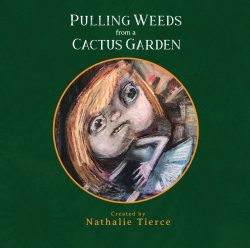
Pulling Weeds from a Cactus Garden – Life is Full of Pricks


By Nathalie Tierce (Indigo Raven)
ISBN: 978-1-73783-260-7 (PB) eISBN: 978-1-734174-4-1

Win’s Christmas Gift Recommendation: Particularly Pointed Party Favours for all those Imminent, Inescapable Get-togethers… 8/10

The marriage of image and text is a venerable, potent and astoundingly evocative discipline that can simultaneously tickle like a feather, cut like a scalpel and hit like a steam-hammer. Moreover, repeated visits to a particular piece of work can even generate different responses depending on the recipient’s mood.

If you’re a multi-talented artist like Nathalie Tierce, who’s excelled in film and stage production for everyone from the BBC to Disney and Tim Burton to Martin Scorsese; music performance design for Andrew Lloyd Webber and the Rolling Stones; gallery art; painted commissions and latterly, graphic narratives such as Fairy Tale Remnants, challenges must be a hard thing to find.

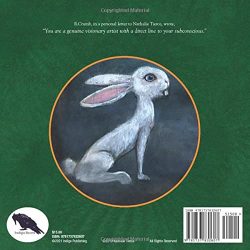
Thankfully, human-watching is frequently its own reward, resulting in books like this slim, enthrallingly revelatory paperback (or digital digest) which forensically dissects human nature: exploring modern times and unchanging human nature through a lens of Lockdown and via the immortal truths of folklore as expressed in Aesop’s Fables.

On show in this handy art boutique are stunning paintings in a range of media, but all rendered in the bizarrely baroque classical manner of Breughel or Bosch, albeit blended with the quixotic energy of cartoon satirists Gerald Scarfe and Ralph Steadman.

Each condemnatory visual judgement is deftly wedded to moving, querulous and frankly often quite terrifying epigrams capturing contemporary crisis points of isolation, confusion, despondency and simple surrender to fate: summarised in fractured haikus and weaponised odes such as ‘Lost in a Supermarket’, ‘Domestic Bliss’, ‘Thoughts on the Outside’,‘Destiny Guides Our Fortunes’, ‘Say No Meore’, ‘The Lamb and the Wolf’, ‘Clown Adrift’, ‘Plucked Grumpy Chicken’,‘Speeding Back to the Comfort of Hell’, ‘Tragic Circus’ and more.

Blending wicked whimsy with everyday paranoia and neighbourly competitiveness, Pulling Weeds from a Cactus Garden is a mature delight for all students of human nature with a sharp eye and unforgiving temperament – and surely, isn’t that all of us?
© 2021 Indigo Raven. © 2021 Nathalie Tierce. All rights reserved.

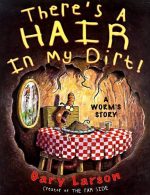
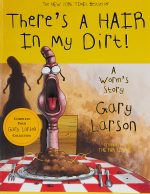
There’s a HAIR in My Dirt! – A Worm’s Story


By Gary Larson, coloured by Nick Bell (Little, Brown and Co/HarperCollins)
ISBNs: 978-0-31664-519-5 (HB) 978-0060932749 (PB)

We may not be rocket scientists but all cartoonists tend to lurk at the sharp end of the IQ bell curve – and then there’s Gary Larson. He could be a rocket scientist if he wanted to. Happily though, his inclinations tend towards natural history, Jazz and Life Sciences.

And making people laugh in a truthful, thinking kind of way…

Larson was born in 1950 and raised in Washington State. After school and college (also Washington State where he got a degree in communications), he bummed around and got a job in a music store – which he hated. During a self-imposed sabbatical he evolved into a cartoonist by submitting to Pacific Search Magazine) in Seattle, who astonished him by accepting and paying for his six drawings. Bemused and emboldened, Larson kept on doodling and in 1979 The Seattle Times began publishing his strip Nature’s Way. When The San Francisco Chronicle picked up the gag feature, they renamed it The Far Side

From 1980 on, the Chronicle Syndicate peddled the strip with huge success. The Far Side became a global phenomenon and Larson’s bizarre, skewed and bitingly surreal strip – starring nature Smug in Tooth and Claw – almost took over the world. With 23 collections (over 45 million copies sold), two animated movies, calendars, greetings cards and assorted merchandise seemingly everywhere, the smartypants scribbler was at the top of his game when he retired the feature on January 1st 1995.

After fifteen years at the top, Larson wanted to quit while he was ahead. He still did the occasional promo piece or illustration but increasingly devoted his time to ecological causes and charities such as Conservation International. He is still passionately crusading for environmental reform – hell, even a slim simple common sense will do – and other issues affecting us all. Happily, on July 7th this year, he began releasing new material online: just go to the Far Side website and check out “New Stuff”…

Of course, even back in the 1990s, he couldn’t stop drawing or thinking or, indeed, teaching even if officially off the clock. In 1998 he crafted this stunningly smart and cool children’s book for concerned and nervous adults. It was a huge hit and is more relevant now than ever…

There’s a HAIR in My Dirt! brilliantly, mordantly tells a parable within a fable and serves up a marvellously meaningful message for us to absorb and ingest whilst simultaneously making us laugh like loons and worry like warts.

One day underground, a little worm having dinner with his folks finds something unnatural and icky in his meal and starts bemoaning the lowly status and general crappiness of his annelidic existence (look it up, I’m showing off and making a comedic point too…).

To counter this outburst of whingeing, Father Worm offers up a salutary tale to put things into their proper perspective…

Thus begins the tragic tale of Harriet, a beautiful human maiden living – she believed – at one with the whole world. Dwelling in the woods, she was enraptured with the bountiful Magic of Nature and on one particularly frolicsome day encountered cute squirrels, lovely flowers, icky bugs, happy birds, playful deer, tortoises and every kind of creature… and completely missed the point about all of them…

Masterfully mimicking an acerbic fairytale teller, Larson delivers an astoundingly astute and unforgettable ecology lesson, equally effective in educating young and old alike about Nature’s true nature – and yet still miraculous wonders – whilst maintaining a monolithic amount of outrageous comic hilarity.

This sublime illustrated yarn became a New York Times Best Seller on its release and still serves as a fabulous reminder of what really clever people can achieve even if they don’t do rocket science…

There’s a HAIR in My Dirt! is one of the smartest, funniest and most enticingly educational kid’s books ever created and should be on every school curriculum. Since it isn’t, perhaps it’s best if you picked one up for the house…?
© 1998 FarWorks, Inc. All rights reserved.

Gaia Blues


By Gud (Europe Comics)
No ISBN: digital release only

Win’s Christmas Gift Recommendation: Because it’s never too soon and not quite too late… 8/10

Assuming you don’t live in a bubble – and maybe we’ll all be doing that soon – you know the planet is in a parlous state whilst those we put in charge are refusing to do anything meaningful to fix it.

Comics and creators have a great deal of soft power but we can’t do much to mend a planet – more’s the pity. However, we can keep banging on about the crisis, capturing hearts and minds until some sort of tipping point – or spontaneously assembled citizens’ committee of eco-assassins dedicated to primal justice – removes the political and business interests sabotaging the path to salvation. Aah, it’s good to dream…

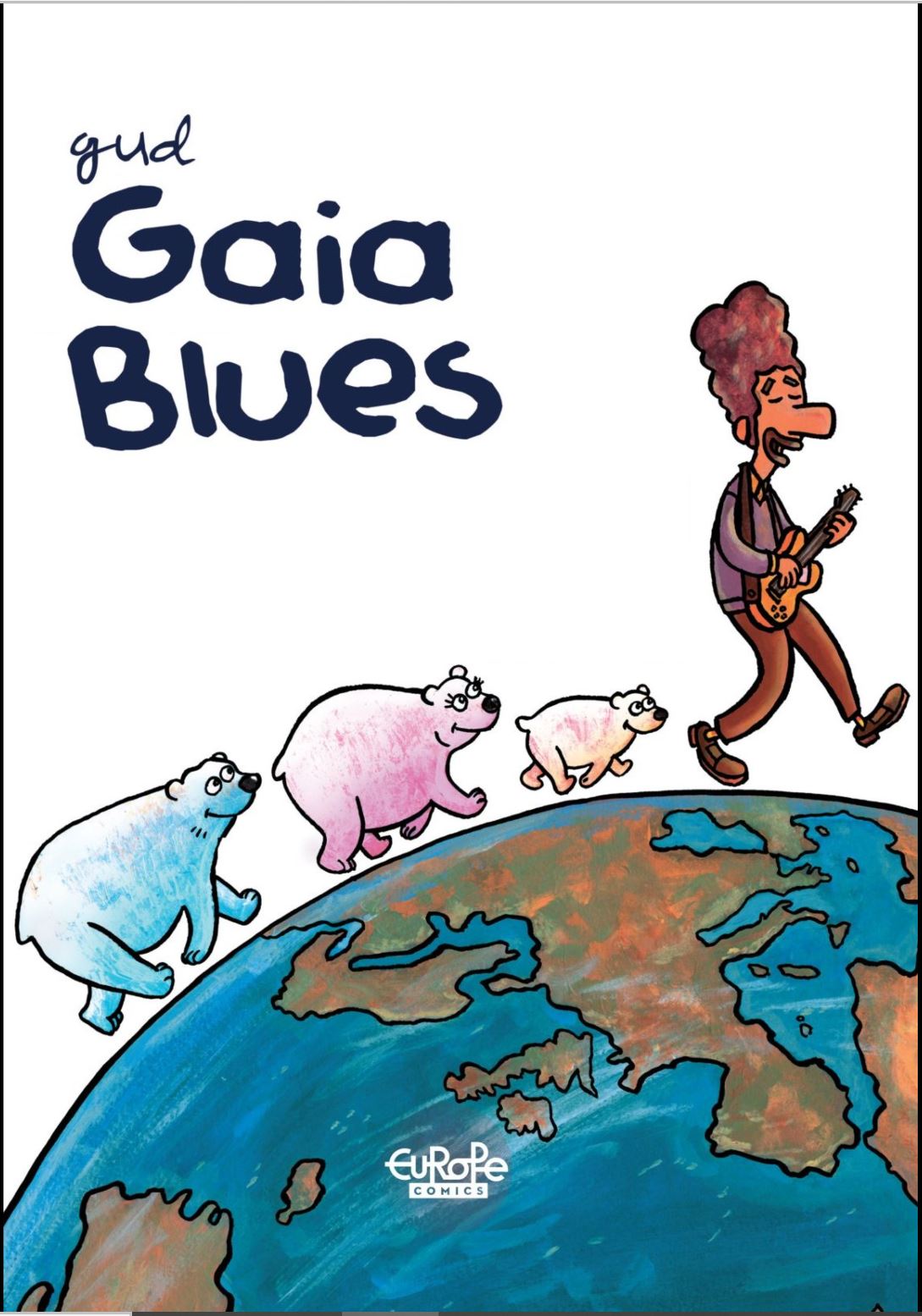
Gaia Blues was first released in 2011, an epic journey and painful odyssey painted in comely cartoons by Italian artist, animation designer and storyteller Gud (Gentes; Heidi, Mon Amour; Timothy Top)

It details in a beguiling rollercoaster ride of images, an endless journey around our increasingly befouled and besieged world, rendered in an inviting wealth of primary colours and images bereft of text: a tragic silent movie with adorable characters pantomiming the end of the world so simplistically even the youngest of kids and most dissembling and disingenuous of world leaders will get the message. It even offers a tantalising spark of hope at the end.

You should read it while we still have time…
© 2016 TUNUÉ (Tunué S.r.l.) – Gud. All rights reserved.

The Marvel Art of Savage Sword of Conan the Barbarian


By John Rhett Thomas, Roy Thomas, P. Craig Russell, Barry Windsor-Smith, John Buscema, Gil Kane, Neal Adams, Alex Toth, Walter Simonson, M.W. Kaluta, Tony DeZuñiga, Richard Corben, Boris Vallejo, Earl Norem, Joe Jusko, Michael Golden & many & various (Marvel)
ISBN: 978-1-3029-2382-2 (HB)

During the 1970’s the American comic book industry opened up after more than 15 years of cautious and calcified publishing practises that had come about as a reaction to the censorious oversight of the self- inflicted Comics Code Authority. This body was created to keep the publishers’ product wholesome after the industry suffered their very own McCarthy-style Witch-hunt during the 1950s.

One of the first genres revisited was Horror/Mystery comics and from that sprang pulp icon Conan the Barbarian, via a little tale in anthology Chamber of Darkness #4, whose hero bore no little thematic resemblance to the Cimmerian. It was written by Roy Thomas and drawn by Barry (now Windsor-) Smith: a recent Marvel find, and one who was gradually breaking out of the company’s all-encompassing Jack Kirby house-style.

Despite some early teething problems – including being cancelled and reinstated in the same month – the comic book adventures of Robert E. Howard’s brawny warrior soon became as big a success as the revived prose paperbacks which had heralded a world boom in tales of fantasy and the supernatural.

After decades away, and despite being fully owned by CPI (Conan Properties International), the brawny brute returned to the aegis of Marvel in 2019 and made himself fully at home. As well as his own title and in-world spin-offs, many collections celebrating “the Original Marvel Years” – due to the character’s sojourn with other publishers – have been released. This one is indubitably the most pretty to look upon.

The first time around, Conan broke many moulds, including being able to sustain not just his general audience boutique of titles and a newspaper strip, but also easily fitting Marvel’s black & white magazine division, offering more explicitly violent and risqué fare for supposedly more mature readers. For this market he debuted in Savage Tales #1 (1971) before winning his own monochrome title. Savage Sword of Conan launched in August 1974, running 235 issues until its cancellation in July 1995.

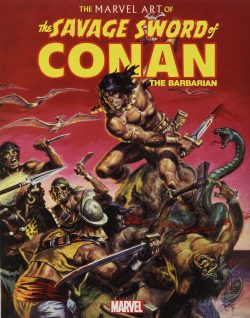
Throughout its life SSoC offered powerful stories, features on all things Robert E Howard and some of the most incredible artwork ever to grace comics pages.

All of that is covered by legendary Hyborian Scribe Roy Thomas in his Introduction and the page-by-page annotations of compiler John Rhett Thomas, but what’s really of interest is the painted covers, pin-ups, portfolios and extracts of story sequences by a stunning pantheon of internationally acclaimed artists which include John Buscema, Barry Windsor-Smith, Alex Toth, Neal Adams, Tony DeZuñiga, Jim Starlin, Frank Brunner, Alfredo Alcala, Alex Niño, Mike Zeck, Walter Simonson, Tim Conrad, Val Mayerik, Richard Corben, Steve Leialoha, Vicente Alcazar, Dick Giordano, Gene Colan, Pablo Marcos, E.R. Cruz, Rudy Nebres, Kerry Gammil, Nestor Redondo, Ernie Chan, Gene Day, Pat Broderick, Bill Sienkiewicz, Armando Gil, Gary Kwapisz, Adam Kubert, Dale Eaglesham, Dave Simons, Mike Docherty, Rafael Kayanan, Andrew Currie and P. Craig Russell, who also provides a picture-packed Afterword and appreciation of the mighty magazine and it’s star. I’m sure there are plenty more artists I’ve missed here, but you get the picture. Everyone and his granny wanted a shot at Conan…

Cover artists providing pulse-pounding paintings include Buscema, Adams, Starlin, Conrad, Sienkiewicz, Mayerik, Boris Vallejo, Earl Norem, Bob Larkin, Joe Jusko, Joe Chiodo, Michael Golden, Steve Hickman, Doug Beekman, David Mattingly, Dorian Vallejo, Nick Jainschigg, Ovi Hondru, Michael William Kaluta, George Pratt, Julie Bell and more, making this bombastic compilation a must-have bestiary of how to have cathartic fun and get paid too…

Groundbreaking, gripping, graphic wonderment, this astounding hardback and digital delight is every fantasy fan’s dream come true – and you know gift-giving season is just around the corner, right?
Conan the Barbarian published monthly by MARVEL WORLDWIDE INC., a subsidiary of MARVEL ENTERTAINMENT LLC. Conan © 2020 Conan Properties International LLC.

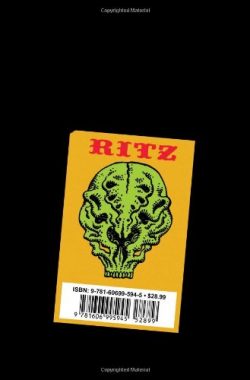
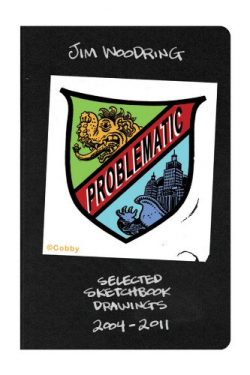
Problematic: Sketchbook Drawings 2004-2012


By Jim Woodring (Fantagraphics Books)
ISBN: 978-1-60699-594-5 (HB)

Some creators in the world of comics just defy description and their collected works are beyond the reviewer’s skills (mine certainly) to elucidate or encapsulate. Some are just so pedestrian or mind-numbingly bad that one simply can’t face writing about them. Others are so emphatically wonderful that no collection of praise and analysis can do them justice.

At the apex of that tricky funnybook pyramid is Jim Woodring: a position he’s maintained for years and appears capable of holding for years to come. Woodring’s work is challenging, spiritual, philosophical, funny, beautiful and extremely scary. And, even after reading that sentence, you will have absolutely no idea of what you will be seeing the first time you read any of it.

Moreover, even if you have scrupulously followed cartoonist, animator, Fine Artist, toy-maker and artistic Renaissance Man James William Woodring through an eccentric career spanning his first mini-comics in 1980; groundbreaking Fantagraphics magazine series such as Jim (1986), notional spin-offs Frank and Weathercraft, Tantalizing Stories, Seeing Things, Congress of the Animals or more mainstream storytelling such as Star Wars and Aliens tales for Dark Horse, you’ll still have no idea how you will respond to his work.

Woodring delivers surreal, abstract, wild, rational, primal cartooning: his clean-mannered art a blend of woodblock prints, Robert Crumb style, wry humour and eerie conviviality, Dreamscape, religious art and monstrous phantasmagoria. His works form a logical, progressional narrative pockmarked with multiple layers of meaning but generally devoid of speech or words, magnificently dependent on the intense involvement of the reader as a fully active participant.

So you can imagine what his first formative thoughts, passing observations and moments of wild unfettered graphic whimsy must be like…

This stunning hardback or digital compilation opens the gates of dream just a crack wider than is safe, offering selected graphic snippets from the artist’s sketchbooks covering a superbly productive period following the millennium and offering a few choice views of other graphic avenues he might have pursued if the world of harnessed hallucinations had not exhibited such a strong hold…

In his ‘Introduct’, Woodring describes his abandonment of traditional graphic tomes for diminutive “Moleskine” doodle-pads: using the flimsy palm-sized books to capture ideas roughly, quickly and with intense immediacy. The gimmick clearly works. The material collected here – mostly enlarged 140% up from the originals – simply buzzes with life and energy….

Many Frank regulars show up, including the eponymous Krazy Kat-like ingénue himself, and there are absolute torrents of bizarre, god-like household appliances, vulture-things, frog-things, rhino-things, plant-things and unspeakable Thing-things, all resident in the insanely logical traumic universe of his sensoria.

There are snippets of reportage, plenty of designs and even roughs and layouts from finished stories. Woodring also proves himself a pretty sharp pencil when it comes to capturing the weird moment of reality we all experience, a keen caricaturist and a deliciously funny “straight gag-man”, glamour artist and capturer of friends in idle moments – just like all of us sad art-school escapees who break into a cold sweat whenever we realise we’ve left the sketchbook at home and there’s only beer-mats and napkins to draw on….

Woodring is not to everyone’s taste or sensibilities – for starters, his drawings have a distressing habit of creeping back long after you’ve put the book down and scaring the bejeezus out of you – but he is an undisputed master of the form and an innovator always warping the creative envelope.

As such, this welcome peek into his creative process and conceptual/visual syllabary offers encouragement and delight to artists and storytellers of every stripe, as well as being just plain wonderful to see.

All art-forms need such creators and this glorious hardback monochrome tome could well change your working and reading habits for life.

Go on, aren’t you tempted, tantalized or terrified yet? What about curious, then…?
© 2012 Jim Woodring. This edition © 2012 Fantagraphics Books. All rights reserved.
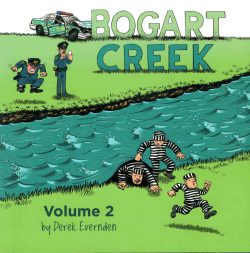
Bogart Creek volume 2


By Derek Evernden (Renegade Arts Entertainment)
ISBN: 978-1-98890-390-3 (PB) eISBN: 978-1-98890-397-2

Welcome to September, start of Autumn and notionally a season of mellow fruitfulness. Sod all that though, let’s kick off with some much-needed hearty chuckles, thanks to a second helping of quirkily Canadian observational comedy…

Cartoonist Derek Evernden has a skewed, devious way of looking at the world and its many potentialities; probably the result of growing up in a small, quiet, very pleasant place. Everyone knows early and repeated exposure to that kind of environment twists your brains…

You know that old line about writing/drawing what you know? Evernden grew up in actual Bogart Creek, Ontario, so let’s all hope at least some of this stuff is just made up, right? He’s Canadian, so must be polite and sympathetic, but clearly, he’s also the other sort of Canadian: someone with a lot to laugh at, plenty of time to take notice and probably perfused with that slow-burning, ever-mounting rage everyone gracious and well-mannered has boiling inside, because of the nonsense the rest of us get up to…

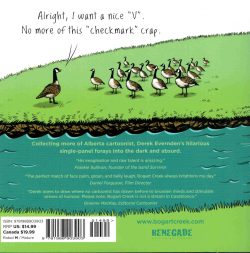
Bogart Creek is a daily single panel gag delivered in a variety of artistic styles; viewing the world – especially popular culture – with a mordant, cruelly satirical eye. It deftly delivers charmingly rendered and seditious examples of how reality actually operates, through popular themes like murder, philosophy, crime, history, vengeance, psychiatry, cryptozoology and the natural world. Think of it as a school for smirking realists…

Like all of us, Evernden is a child of mass-culture, inspired by movies, fashion, sports, popular culture, the media and anything else passing strangers might discuss at a water cooler or bus stop in deference to social convention…

The strip is also hopelessly mired in painful punning on a mega “dad-joke” scale; absurdist revelation and surreal slapstick. The creator has mastered the art of wedding funny notions to effective dialogue and efficient, smart cartooning. Evernden proudly admits his debt to and influence of Gary Larson’s The Far Side, but he can’t keep blaming that poor guy for all of this new stuff in this second collection of infectious, debased hilarity…

On prominent display here are monochrome and full-colour japes and jests concerning home-schooled surgeons, morgue sports, school days, lab animals, manufacturing and the job market, animal amusements, protesting, historical moments, fat-shaming, driving, monsters, inventors, bucket lists and Christmas. There’s also a frighteningly large number of gags aimed at (and scoring palpable hits on) superhero, sci fi and horror movies, balanced by a delightful concentration on the sheer arbitrary lunacy of modern life…

Smart, inventive, cruelly witty, instantly addictive and cheekily outrageous, this is a collection (in paperback or digital editions) to restore any weary adult in need of tension release and a therapeutic schadenfreude. We’ve all been proverbially up the creek before, but at least now you have a jolly tome to paddle back to reality with.
Cover illustration, book design and cartoons all © 2020 Derek Evernden. All rights reserved.


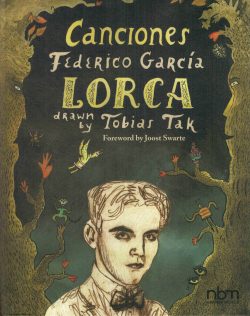
Canciones – Federico García Lorca Drawn by Tobias Tak


Adapted and translated by Tobias Tak (NBM)
ISBN: 978-1-68112-274-8 (HB) eISBN 978-1-68112-275-5

These days a seemingly infinite variety of subjects fit under the umbrella of modern graphic novels – everything from superheroes, sci fi and the supernatural to philosophy, journalism and education. Thanks to its global reach and outlook, NBM are at the forefront of this welcome revolution, bringing a range of visions to the English-speaking table that apparently daunt most mainstream publishers here and in America.

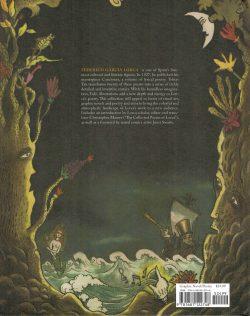
Today’s book is a perfect case in point: a sequence of visual adaptations of one of the world’s most celebrated modern poets, brought to scintillating life by a renowned scholar and a multidisciplinary artist. The result is an utterly enticing hardback treasure, and there’s not a single tragic supervillain in sight…

Federico García Lorca was born in 1898 and died in 1936: winning acclaim in Spain and across the world for his plays, music and poems during a life both dramatic and perilously brief. A strident socialist reformer, he was executed on the orders of fascist dictator General Franco, but his works and observations remain relevant and challenging to this day.

Here, Boston University-based official translator and Lorca expert Christopher Maurer (The Collected Poems of Garcia Lorca) offers crucial background in his Introduction ‘Cloudscapes’, whilst Holland’s cartooning national treasure Joost Swarte (Horst Serie; Modern Papier; Jopo de Pojo; Modern Art) ponders the cultural and creative similarities between the poet and his visual interpreter before the bilingual wonderment begins.

We lost Tobias Eduard Tak (Tante Leny; Gaboon’s Daymare; Upside Down; The Spirit of Saturn) far too early. The Dutch choreographer, dancer, singer, author and illustrator was born in January 1954 in Voorburg and studied at the Royal Academy of Fine Arts in the Hague. Graduating in the late 1970s, he moved to London and began contributing to comics publications across the world, as well as successfully pursuing stage creative disciplines. Delivered in Dutch and Spanish, Canciones was his last completed work. “Tobi” died in Amsterdam on January 7th 2020.

Lorca’s most popular work, Canciones is a collection of Andalusian folk songs and ballads, which lend themselves easily to Tak’s lifelong fascination with dream states and fairy tales.

With English replacing Dutch text on these vividly intoxicating pages, and the Spanish lines cunningly woven into the gently meandering designs, twenty fanciful moments of wistful rumination and longing are yours to share. Preceded by an enchanting ‘Preludio/Prelude’, ‘Song of November and April’, ‘The Deceiving Mirror’, ‘Conch!’, ‘It’s True’, ‘Fable’, ‘First Anniversary’ and ‘Second Anniversary’ carry us through a bizarre and beguiling voyage of discovery with fantastical creatures and characters tirelessly looking… but for what?

The search shifts to ploys of conquest as we learn what is said ‘In a Girl’s Ear’ and experience despondency from the ‘Song of the Barren Orange Tree’, after which the hunt for truth and contentment resumes in ‘Debussy’, ‘The Mute Boy’, ‘Schematic Nocturne’, ‘A Song Sung’, ‘Riverside Songs’ and ‘The Moon Comes Up’.

Temptation comes calling on ‘The Street of the Mute’, leading to painful introspection and fresh insights in ‘Foolish Song’, ‘Farewell’ and ‘Song of the Departing Day’ before we arrive at a deeply personal Mise en Abyme (just look it up: it’s never too late to learn things) in concluding ode ‘In Another Manner’…

Wild, near-hallucinogenic vistas and characters blend history with mythology to depict ephemeral situations and timeless moments in this evocative picture hymnal dedicated to the human condition. It’s a beautiful achievement and the ideal gift for the sensitive ones in your life.
© 2017 Tobias Tak/Scratch Books. Foreword © 2017 Christopher Maurer. Introduction © 2017 Joost Swarte.

Canciones – Federico García Lorca Drawn by Tobias Tak will be released on August 19th 2021 and is available for pre-order now

Little Paintings


By James Kochalka (Top Shelf Productions)
ISBN: 978-1-60309-017-9 (HB)

James Kochalka is a prolific and always entertaining giant of comics creation, whose vast, sublimely surreal, enticing works range from kid-friendly romps such as the Glorkian Warrior and Johnny Boo series, to self-examining daily journal strip American Elf and the indescribably fun SuperF*ckers (and that’s my censorious edit there, not his…)

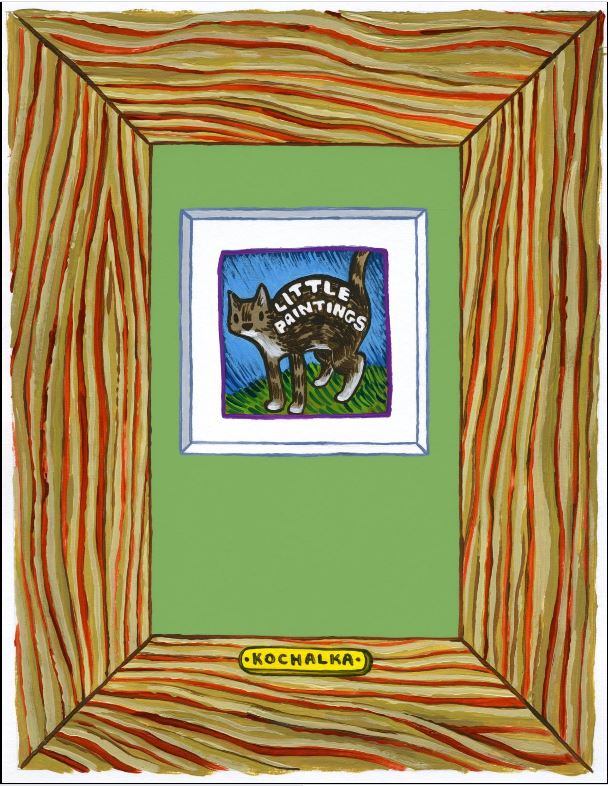
The author, artist, animator and rock musician is utterly wedded to the energies of creativity and this tantalizing tome gathers hundreds of mini-paintings he knocked up to sell at various conventions between 2001 and 2007. All the old familiar face are there: cats, ghosts, robots, monsters, aliens, bathrooms, birds, chicks and dudes, animals, cats, mushrooms, landscapes and weather, cats, machines and random images, all apparently arranged in no particularly order and inviting your response. Did I mention, there’s cats?

There is a narrative here, but it’s completely generated by the viewer who can’t help but create a story around the hundreds of thumbnail paintings of gloriously hued things and folks and stuff, and a lot to read in if you’re willing to take some time.

Go on, you know you want to…
© James Kochalka 2011. All rights reserved.

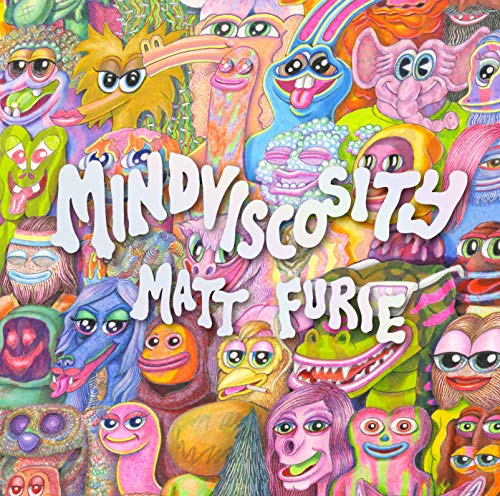
Mindviscosity


By Matt Furie (Fantagraphics Books)
ISBN: 978-1-68396-370-7 (HB)

Matt Furie was born in Columbus, Ohio in 1979. After studying at Wesleyan University, he became an artist for pay, creating characters, strips (that eventually became the 2016 graphic novel Boys Club) and children’s book The Night Riders.

Boys Club inadvertently made him a figure of global controversy after one of his characters became a universal meme and was appropriated against his wishes by some very nasty people. If you need to know more you can search for Pepe the Frog online or watch the 2020 documentary Feels Good Man. I’m pretty sure Furie has had enough of the entire affair, so let’s move on.

What we have in plush hardback Mindviscosity is a collection of designs, studies and full, multi-character paintings of incredible monsters, beasts and unnatural wonders displaying fantastic imagination along the lines of Dr. Seuss and Basil Wolverton, rendered in a variety of styles and media: a joyous bestiary of happy horrors, celebrating otherness in a garish parade of surreal collations. Be warned though, there’s so much that kids will love here, but some of the situations are rather mature in content so either police this material or be prepared to answer some tricky comments on the birds and the beasts and where monsters come from…

Quirkily inclusive, brashly optimistic and preceded by appreciative Foreword ‘Matt’s World’ from John Lee of PFFR, this is a superb showcase of Furie’s painterly skills and narrative gifts making him in so many ways this generation’s Bosch or Bruegel. Here, truly, every picture tells a story…
© 2020 Matt Furie. Matt’s World © 2020 John Lee. This edition © 2020 Fantagraphics Books Inc. All rights reserved.

A Secret History of Coffee, Coca & Cola


By Ricardo Cortés (Akashic Books)
ISBN: 978-1-61775-134-9 (HB)

Win’s Christmas Gift Recommendation: Potent, Punchy and Thought-Provoking Fodder to Ponder and Enjoy after Overindulging… 9/10

The astounding power of graphic narrative to efficiently, potently and evocatively disseminate vast amounts of information in layered levels has always been best utilised in works with a political or social component. That’s seldom been better demonstrated than in this stunning and scholarly work from Ricardo Cortés.

Born in 1973, illustrator/artistic intellectual activist Cortés has had a sublimely seditious career thus far. He made waves in Vanity Fair, Entertainment Weekly, The New York Post, The Village Voice, San Francisco Chronicle, and been challenged on CNN and FOX News after his controversial children’s book Marijuana: It’s Just a Plant – written by Marsha Rosenbaum – was mentioned in Congress. He followed up by illustrating Adam Mansbach’s Times Best-Selling Go the F**k to Sleep and sequel Seriously, Just Go to Sleep, and created the colouring book I Don’t Want to Blow You Up! about famous Muslims who aren’t terrorists.

In 2011 he received a grant from the Department of Cultural Affairs’ Greater New York Arts Development to create Jury Independence Illustrated – a public booklet dealing with Jury Nullification produced with the intention of educating potential jurors about their powers to acquit if they disagree with specific laws or judicial rulings. Clearly a born troublemaker…

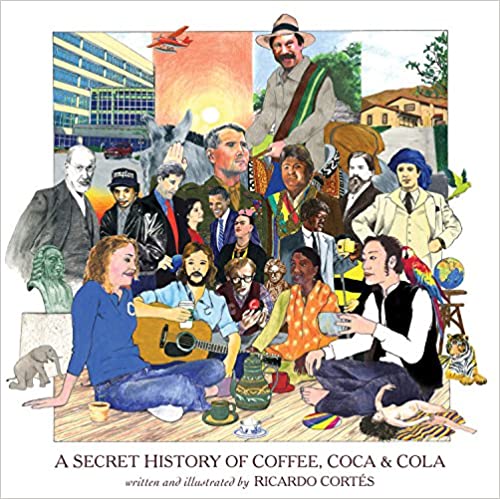
This particular project is a brilliantly engrossing exploration of acceptable addictions blending scrupulously scholarly reportage with a seductively beautiful selection of captivating images and historical reproductions.

The story starts with the origins and history of ‘Coffee‘ from its mythic discovery as a berry fruit for goats in Ethiopia, through being taken up by Yemeni traders who disseminated “qahwah” throughout the Islamic world. A proven intoxicant, concerns over its salubrity, morality and legality grew and it was soon being trafficked by desperate men. In the 16th century the beverage was banned in Mecca, Cairo and elsewhere, but its taste and effects were impossible to resist.

By the time “kahveh” reached Turkey, trading in the beans carried the death penalty. As “Coffee” it reached Europe in the 17th century, touted as a miracle cure-all for everything from headache to miscarriage and grew explosively into an intellectual’s seditious vice. In 1675, Charles II ordered it suppressed and closed England’s Coffee Houses by Royal Edict.

Things got even stranger in 1820 after the alkaloid “Caffe-ine” was finally distilled from the coffee cherry…

The rest of caffeine’s turbulent and torturous legal and commercial progress to today’s status as the world’s most popular stimulant is followed by the story of ‘Cola and Coca’ in which caffeine’s other singularly popular method of natural dissemination is examined. The Kola Nut of West Africa is amazingly high in the stimulant alkaloid and has been used for centuries – if not millennia – as an energy-intensifying fortifier by the various tribes and nations either by chewing the raw nut or brewing a drink called “cola”.

Cola is one of the most popular ancient beverages on Earth and when in 1886 Dr. John Pemberton devised his own formulation – dubbed Coca-Cola – by adding a dash of coca leaves, his medicinal tonic, after an initial shaky start, grew to become the most monolithic drinks brand on Earth.

…But not, apparently, without a little government help…

Coca originated in the Andes, where for centuries indigenous peoples used the herbal bounty as a pick-me-up. Indios chewed coca leaves the way we do gum in the west and in 1499 explorer Amerigo Vespucci brought back tales of the wonder herb’s propensity to promote feats of concentration and endurance. In 1859, Dr. Karl Scherzer returned to Austria after a 2-year scientific voyage aboard the Frigate Novara with 60 pounds of coca, as previously requested by German pharmacologists. Soon after doctoral student Albert Niemann isolated from the samples a new alkaloid which he dubbed “Coca-ine”. This fresh medical marvel – its transparent crystals easily derived from coca leaves – was from 1884 enthusiastically prescribed by the likes of Sigmund Freud for melancholia. Oculist Carl Koller discovered it to be an incredible regional (or as we now say “local”) anaesthetic, allowing unprecedented new surgical procedures to be performed. It became a popular treatment for toothache, labour pains, nervousness, fatigue, impotence, asthma and as a cure for morphine addiction – hence Pemberton’s inclusion of the stuff in his health tonic.

By 1889 cases of compulsive use and abuse began to be reported, leading to heated medical debate, and when the era’s obsessive racial concerns were added to the mix (“cocaine made negroes insane” and it was peddled by “greedy Jewish doctors”) the writing was on the puritanical wall for the foreign import.

On a rising tide of public disapproval, the 1914 Harrison Narcotics Act prohibited Cocaine use and coca importation in the USA. However, due to some truly unbelievable backroom dickering, the already powerful Coca-Cola Company secured a constant supply of the banned substance – re-designated “Merchandise No. 5” – for their Schaefer Alkaloid Works in New Jersey – still thriving today as the Stepan Chemical Company. This mercantile miracle was all due to diligent work of Commissioner Harry J. Anslinger of the Federal Bureau of Narcotics and Ralph Hayes, a former aide to the US Secretary of War and – from 1932 – a vice President of the Coca-Cola Company.

Anslinger was a rabid anti-drug zealot, so just why did he spend 40 years – under seven different US Presidents – enforcing draconian and often expensive, nigh-impossible bans on a vast number of natural pharmaceutical products whilst actively securing and defending Coca-Cola’s uninterrupted supply of cocaine? He even facilitated clandestine schemes to grow coca on American soil and his campaign was so successful that American policy became UN and global norms, forcibly negating all the proven scientific benefits of resources which grew naturally in countries which could never afford Western drugs and chemical advances.

Trust me; you only think you know the answer…

Astonishingly addictive and intoxicatingly revelatory, Coffee, Coca & Cola offers an impressively open-minded history lesson and an incredible look at the dark underbelly of American Capitalism. Exposed here through telling research and beguiling illustrations is a catalogue of hypocrisy wherein successive political administrations and big business always found ways to place commercial interests ahead of any specious moral imperative ingenuously forwarded by the “World’s Cop”.

Learn here how corporations and statesmen conspired to ruthlessly crush the traditions, customs and rituals of other nations and cultures (as recently as 2010, America acted to suppress many sovereign South American countries’ social, spiritual, medicinal and nutritional use of coca) and continue to prevent poor countries utilisation of such ancient natural resources as caffeine and cocaine whilst peddling products inescapably wedded to both American Expansionism and Ideology…

A stunning, hardcover coffee-table book (also available in digital formats) for concerned adults, this captivating chronicle is a true treasure – or perhaps in the parlance of the idiom, I might just say – lip-smacking, trust-quenching, cool looking, stimulating, motivating, hard talking, fool busting, fast thinking, hard quizzing… and unmissable.
© 2012 Ricardo Cortés. All rights reserved.