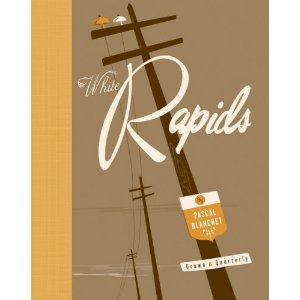
White Rapids


By Pascal Blanchet, translated by Helge Dascher (Drawn & Quarterly)
ISBN: 978-1-897299-24-1 (Album PB)

A fascinating moment in relatively recent social history was brought magically to life in this captivating and innovative graphic novel which eschewed the traditional iconography and lexicography of sequential narrative, instead utilising the bold stylisations of art deco design and the gloriously folksy imagery of 1950s Modernism (think the architecture and landscape of David Suchet’s definitive television Poirot and the movie Metropolis wedded to the crinkly curlicue characters populating the title sequences of Bewitched or Those Magnificent Men in Their Flying Machines).

The effect is like looking at a period brochure, which tragically underscores the bold and far too typical story of the town which lived and died at the behest of forces beyond the control of the everyday working stiffs who lived there.

A design tour de force, this was the first translated work of award-winning Québécois creator Pascal Blanchet who transformed the history from dry fact into a magnificent torrent of visual music. And no, you can’t find this bloody book anywhere. It’s why I’m re-reviewing it, in the hope some wise (and probably Canadian) publisher will revive it…

In the 1920s, Canada’s growing power demands were supplied by private companies, and the most efficient generation method was hydroelectric, created by damming the mighty rivers of the country. In 1928 the Shawinigan Water & Power Company decided to build a new dam in a remote northern region of the St. Maurice River at Rapide Blanc, a section where the waters narrowed into the eponymous fast-running white waters of the title.

To operate a power-plant in such an inaccessible – and for nearly half of each year, actively hostile – region, a company town needed to be built for workers and their families. Moreover, for any man to bring his family into such a wilderness, it would have to be an impressive and wonderful town indeed…

Blanchet avoids the tempting option of personalising or dramatizing the tale, preferring to let mood, impression, atmosphere and style describe the birth, brief life and sad, sudden death of White Rapids (here’s a clue: it involved bottom lines and transfers of ownership, not evolving environmentalism) as a gleaming moment of Enlightened Capitalism actually doing the right and decent thing for the Proletarian Worker winked out and was washed away.

This is like no other Graphic Novel you’ve ever seen and is stunningly effective for all that; rendered in reduced hues of orange, brown and grey, marvellously devoid of the heretofore presumed necessary clichés of narrative convention. It also avoids the dynamic seductions of Protagonist/Antagonist and the avid fetishism of Vitruvian representational faces and forms that underpin all comics art no matter how avant-garde.

This is a beautiful work and deserves every award it’s ever won as well as your rapt attention. Why not start a internet campaign to have some solid citizen publisher bring it back for us all to share?
© 2006, 2007 Pascal Blanchet. All Rights Reserved.
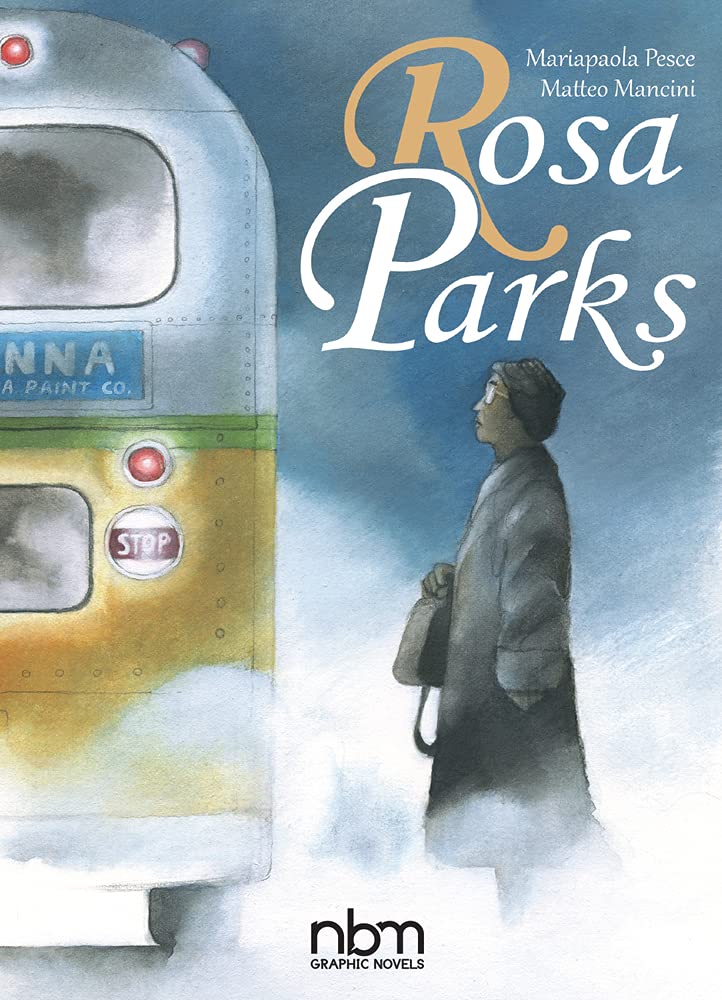
Rosa Parks


By Mariapoala Pesce & Matteo Mancini, translated by Nanette McGuiness (NBM)
ISBN: 978-1-68112-291-5 (HB) eISBN: 978-1-68112-292-2

It must be quite hard to say something new – or even get under the accumulated skin – of a legend, and doubly so when the single act the entire world knows them for is not the beginning or end, but rather a middle moment in a long life of impassioned exceptionalism…

On December 1st 1955, “negro” seamstress Rosa Parks rode the bus home. She had taken said public transport vehicle many times before and until that moment had always followed the rules. This was in Montgomery, Alabama, where “Jim Crow” laws had been steadily snatching back every vestige of freedom and liberty won with shot and shell during the War Between the States, almost from the moment the shooting stopped…

Thus, on those commuter routes – as everywhere else – white people had priority, and if a black person was seated, they had to get up and literally move to the back of the bus to let “their betters” sit down.

On that evening, weary Rosa Parks refused to give up her seat, even when told to by the white bus driver. She knew there would be consequences, anticipated them and was ready for them. Perhaps she wasn’t so sure where that act of passive defiance would take her and the entire country…

That moment is as much part of mythology as history, but here – via some intriguing extrapolation from writer Mariapoala Pesce (Angela Davis; Alice in Austenland; La Fattoria Degli Animali) and illustrator/designer Matteo Mancini (Una divisa per nino) – we take a look at what made the moment: who Rosa Parks was before and what she became after that act of wanton lawbreaking…

Preceded by thoughtful author’s preface ‘Does it still make sense to talk about Rosa Parks?’ the story is then told through a distant lens, beginning in a taxicab on December 1st 2014, where a hot young rapper frets and slowly gets acquainted with the elderly blue collar driver. They’re different generations of black man, but as the ride progresses, conversation shows how much has changed and how much they’re still alike…

The star is wearing an “I Can’t Breathe” shirt and that cause celebre sparks talk of another more distant time…

And thus is told an intimate tale of the thoughtful family woman who weathered instant infamy and dangerous notoriety to become an eternal activist, iconic institution and tireless campaigner for employment equality, civil rights education, literacy and an end to sexual abuse and exploitation of black women and girls.

The captivating tale within a tale is augmented by ‘Martin Luther King’s Letter to Citizens of Montgomery, AL’; an essay by Stephanie Brooks detailing ‘Rosa Parks After’; a bibliography of Further Reading and a beautiful, capacious and extensive sketch and design section.

Intriguing and entertaining, Rosa Parks offers a powerful and enriching approach to a much-lauded but little known example of humanity at its very best.
© Mariapoala Pesce 2020 for the text. © Matteo Mancini 2020 for the illustrations. © for the original Italian EditionBeccoGiallo S.r.l. 2020. All rights reserved.

Rosa Parks will be published on February 17th 2022 and is available for pre-order now. For more information and other great reads see http://www.nbmpub.com/

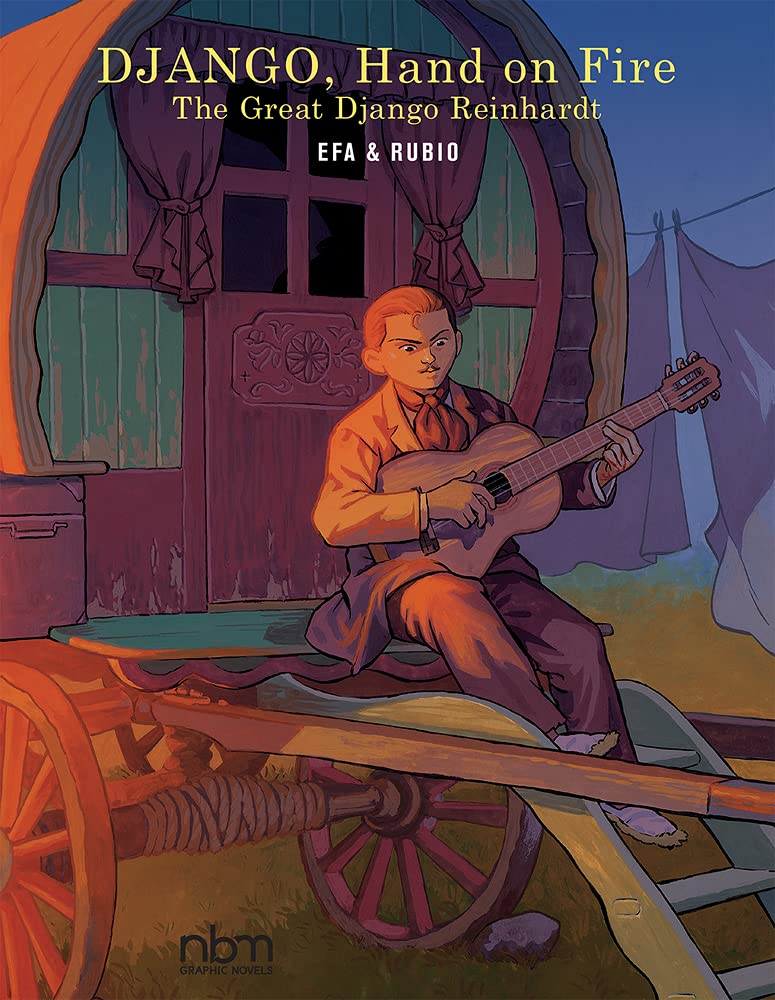
Django, Hand on Fire: The Great Django Reinhardt


By Salva Rubio & Efa, translated by Matt Madden (NBM)
ISBN: 978-1-68112-287-8 (HB) eISBN: 978-1-68112-288-5

Publisher NBM’s line of European-originated biographies never fails to delight, and this new oversized luxury hardcover (also available in digital formats) is one of the most engaging yet: skilfully deconstructing – when not actually aiding and adding to – the myths and legends surrounding a top contender for the title of greatest guitar player of all time…

Django, Hand on Fire happily reunites award-winning screenwriter, historian and novelist Salva Rubio (Max; The Photographer of Mauthausen) with animator and illustrator Ricard Fenandez AKA “Efa” (Les Icariades; Rodriguez; L’Âme du Vin; Le Soldat) – whose other collaborations are also beautiful biographies – Monet: Itinerant of Light and the as yet untranslated Degas: La danse del la solitude.

Originally released in France, the translated Django, main de feu is preceded here by an introductory prose appraisal from Thomas Dutronc. This stunning confection of painterly images traces the life of the troubled and unfortunate Roma musician from his fraught birth in a frozen field in Belgium to his second birth and reunion with the true love he threw away and found again…

That natal moment was in 1910 as his father and the other itinerant performers of their tribe were eking out a wage entertaining outworlders.

By 1922, the troupe were resident in Paris’ “Zone”: an enclave for his sort where social outcasts could reside until posh folks found a use for them. The lad was cocky and troublesome, an arrogant illiterate born for mischief but blessed with astounding musical skill…

His life turned around when his mama acquired a six-string banjo for him and all his energies refocussed on mastering music. Soon he was making money – and losing it gambling – even before he was considered a man…

Still an emotional child, he became the star of a professional (adult) band but his actions and attitude lost him many friends and family and ultimately the girl who adored him: Irma AKA Naguine. She faithfully trailed in his wake as producers and record publishers tracked the young man and watched in resignation as he succumbed to the shining blonde glory of artificial flower maker Florine/Bella. Naguine left the Zone entirely when Django and the flower girl wed, but swore to return…

The musician’s meteoric rise stalled only as he awaited his first child’s birth. As they slept in their wagon, it caught fire and although Bella got out, Django was badly burned on his legs and left hand…

How – driven by his mother – he battled back to overcome his life-changing injuries and, by changing his style, mastered another instrument, found undying fame and finally realized where his true love lay is a fabulous – if not strictly accurate – tale to warm the heart and gladden the eyes…

The pictorial paean to persistence and testament to passion is supported by a Bibliography and Creator Biographies plus ‘Django Reinhardt, from mystery to legend… In the light of History’: a fulsome, copiously-illustrated essay detailing the author’s factual choices and path to this particular truth, categorised and examined in ‘A mythical birth’, ‘The Zone’, ‘An interloper in the world of bal-musette’, ‘J’ai deux amours: Naguine and “le jass”‘, ‘The Cross of Blood…’, ‘…and the fiery flowers’, ‘Hospital for the Poor’ and ‘Hand on fire’…

Sparkling and inspirational, this is destined for the reading list of every music historian and intrigued dilettante: a beguiling magic window into another world and one you should seek out tout de suite…
© DUPUIS 2020 by Rubio, Efa. All rights reserved.

Django, Hand on Fire: The Great Django Reinhardt will be published on January 18th 2022 and is available for pre-order. For more information and other great reads see http://www.nbmpub.com/

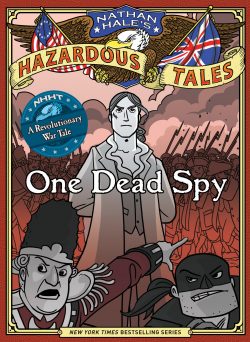
Nathan Hale’s Hazardous Tales: One Dead Spy


By Nathan Hale (Abrams/Amulet Books)
ISBN: 978-0-4197-0396-6 (HB)

Author/cartoonist Nathan Hale has a famous namesake and has been riffing on him, with great effect, for nearly a decade now. I don’t know if he – and his familial collaborators – have any genealogical connection to the American undercover operative and war hero of the same name, but the lightly comedic cartoon history books – such as Alamo All-Stars, Big Bad Ironclad and more bearing their shared name – are a sheer, educative treat. They make some pretty tough and harrowing material palatable and memorable by mixing fact and happenstance with a witty veneer of whimsy. You might also want a peek at more of his general fiction fun stuff like Rapunzel’s Revenge, One Trick Pony and Apocalypse Taco…

Debuting the series in 2012, One Dead Spy sets the scenario on a surreal yet jolly note as September 22nd 1776 sees a dim but jolly executioner and British Army Provost bring an earnest young man to the Hanging Tree on Manhattan Island. The eager crowd of spectators soon leave after learning the day’s entertainment is not the arsonist plaguing the district but only a spy. Moreover, even he can’t be dealt with promptly because no one’s brought the official orders…

With time to kill, Hangman and Nathan Hale strike up a conversation: discussing last words, possible regrets, sandwiches and – eventually – just how a meek school teacher became America’s “first” spy. As is duly noted, Nathan Hale really wasn’t a very good one…

The delay is then further extended by a bizarre event involving a magic tome (“The Big Huge Book of American History”) that shows him all his nascent nation’s years to come – a key factor in future volumes – and Hale becomes a revolutionary era Scheherazade, spinning yarns to extend his last moments on Earth…

Rendered in welcoming, comfortable but fact-intense muted color and monochrome cartoon strips with beguiling overtones of the Horrible History books, “unlucky” Hale’s own unremarkable life unfolds, tracing the build-up to and key moments of the War of Independence through his acquaintance with figures such as George Washington, Ben Tallmadge, Henry Knox,

Major battles like Bunker Hill, Winter Hill and the siege of Boston are demythologised and legendary figures such as Ethan Allen (and his Green Mountain Boys), traitorous Major Robert Rogers and Colonel Thomas Knowlton are reassessed. It was Knowlton who convinced the obsessively honest and utterly out of his depth Hale to take up the shameful role of clandestine information-gatherer in his one and only espionage mission…

And as this book closes with the promise of more gallows’ yarns to come, there-even an illustrated section offering ‘A Little More Biographical Info About…’ Hale Knox, Knowlton, Allen, Benedict Arnold, Rogers, Stephen Hempstead, Benjamin Tallmadge and the actual execution of our spy star as well as map of North America showing which nations owned what in 1775; a full bibliography; a Q&A feature and ‘First to Defy, First to Die!‘ – an 8-page mini-comic tale of African American Revolutionary and former slave Crispus Attucks who died during the 1770 Boston Massacre.

Charming, wittily informative, extremely funny and delightfully compelling, Hale’s cartoon tales detail incredible exploits that will enthral you and your kids and – like the other volumes of this wonderful series – ought to be a treasured part of every school library… if we ever have those again…
Text and illustrations © 2012 Nathan Hale. All rights reserved

Putin’s Russia – The Rise of a Dictator


By Darryl Cunningham (Myriad Editions)
ISBN: 978-1-912408-91-7 (TPB)

Artist and journalist Darryl Cunningham was born in 1960, lived a pretty British life (didn’t we all back then?) and graduated from Leeds College of Art. A regular on the Small Press scene of the 1990s, his early strips appeared in legendary paper-based venues such as Fast Fiction, Dead Trees, Inkling, Turn amongst many others. In 1998, he & Simon Gane crafted Meet John Dark for the much-missed Slab-O-Concrete outfit. It is still one of my favourite books of the era. You should track it down or agitate for a new edition.

Briefly putting comics on the backburner as the century ended, Cunningham worked on an acute care psychiatric ward: a period which informed 2011 graphic novel Psychiatric Tales, a revelatory inquiry into mental illness delivered as cartoon reportage.

When not crafting web comics for Forbidden Planet or working on his creations Uncle Bob Adventures, Super-Sam and John-of-the-Night or The Streets of San Diablo, he’s been steadily consolidating his position at the top of the field of graphic investigative reporting; specifically science history, economics and socio-political journalism through books such as Science Tales, Supercrash: How to Hijack the Global Economy, Graphic Science: Seven Journeys of Discovery, The Age of Selfishness: Ayn Rand, Morality and the Financial Crisis and Billionaires: The Lives of the Rich and Powerful.

His latest offering is his boldest yet, particularly as the subject of these investigations and revelations has a scary track record of suddenly outliving every critic, commentator, judge and denouncer. Of course, part of that murderous mystique also includes ludicrous gaffes, fumbles and cock-ups, so perhaps it’s a fair risk for a potential big reward…

Simply put, what’s on show here is another sublimely forensic and easily digestible dissection of one more major cause of global concern, in the form of a mediocre Soviet spy who became the biggest crook on Earth.

Cunningham methodically traces the path of Vladimir Vladimirovich Putin from childhood in a St Petersburg (then Leningrad) communal apartment to the world’s most tasteless billionaire mancave (“Putin’s Palace” at Gelendzhik), translating dry facts and shocking atrocities into irrefutable, easily assimilated data snippets, tracing the Dictator-in-Chief’s cunning rise in the shadow of and on the coattails of far more flamboyant and unwise would-be leaders until suddenly he’s the last man standing…

A much-curated personal life is unmade and remeasured against a historical yardstick as the Soviet Union stumbles into oblivion: broken up and its riches redistributed by pirates and brigands in suits amongst a cabal of soon-to-be Oligarchs only marginally less unsavoury than their notional leader.

Gorbachev, Yeltsin, Sobchak and a flurry of Western appeasers and greedy bankers are all indicted for their failings as Putin climbed a greasy pole soaked in the blood of opponents, competitors and particularly journalists and critics. Especial attention is rightly paid to manufactured and proxy wars, terrorist acts and inept interventions; modern imperialism and global calamities, weaponized bigotry, harnessed ancient grudges and sheer unrelenting opportunism at every possible juncture. That’s a big bill to lay on one person, but the arguments are all there in black and white and magenta and green and…

You will also be sagely reminded of assassinations as acts of petty spite; western money laundering of a nation’s pilfered assets, the suborning of national leaders (and we’re not just talking about orange hairpiece #45, here!) and the sadly pathetic ongoing quest for validation of a self-described hard man…

A heady mix of cold fact, astute deduction and beguiling visualisation, this deft examination of a bandit who stole a nation and how at last his comeuppance is at hand is a delicious blend of revelation and confirmation, and Cunningham even has the courage to offer bold – and serious – suggestions on how to rectify the current state of affairs, all backed up with a vast and daunting list of References from print, media and other sources for everything cited in the book.

Comics have long been the most effective method of imparting information and eliciting reaction (that’s why assorted governments and militaries have used them for hard and soft propaganda over the last century and a half), and with Putin’s Russia you can see that force deployed against one of today’s greatest threats…
© Darryl Cunningham 2021. All rights reserved.

Putin’s Russia will be released on September 16th 2021 and is available for pre-order now.

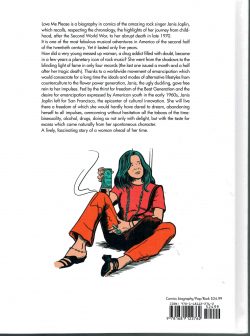
Love Me Please – The Story of Janis Joplin (1943-1970)


By Nicolas Finet, Christopher & Degreff: translated by Montana Kane (NBM)
ISBN: 978-1-681122-76-2 (HB) eISBN: 978-1-681122-77-9

The list of people who lived hard, died young and changed the world is small but still, somehow, painfully overcrowded. Possibly the most tragic, influential, yet largely unknown is a born rule-breaking rebel who defied all conventions and became almost inevitably THE icon of doomed youth-with-big-dreams everywhere…

Author, filmmaker, journalist, publisher, educator and music documentarian Nicolas Finet has worked in comics for more than three decades and also generated a bucketload of reference works – such as Mississippi Ramblin’ and Forever Woodstock. His collaborator on that last one was veteran author, journalist and illustrator Christopher (The Long and Winding Road; many other music-centred tomes and adaptor of Bob Dylan).

Their compelling treatise on misunderstood and self-destructive Janis – just like her music, poetry and art – is something to experience, not read about, but I’ll do my best to convince you anyway…

After a quick dip into early life and influences, the story proper opens in Texas in 1947 as ‘Forget Port Arthur’ zeroes in on key childhood traumas and revelations around the homelife and schooling of little Janis Lyn Joplin at the start of the most culturally chaotic and transformative period in American history…

Brilliant, multi-talented, sexually ambiguous, starved for love whilst desperately directionless, her metamorphosis through Blues music mirrors that of many contemporaries (a fair few of whom comprise the infamous “27 Club” of stars who died young). However, as this book shows, although something indefinable was always just out of Joplin’s reach, her response was never to passively accept or ever surrender…

After wildly rebellious teen years, an uncomfortable educational life, a brief brush with conventional conformity and a near-lethal counter-culture encounter in San Francisco – as detailed in ‘The Temptation of Disaster’ – her meteoric rise in the era of flower power, liberal love and drug experimentation and record company exploitation lead to her return to California and triumphant breakthrough in 1966, all carried along by ‘Spells and Charms’…

Stardom with hot band Big Brother and the Holding Company, a host of legendary encounters and even greater personal dissipation makes wild child into living myth at Monterey and other landmarks of the Summer of Love, before success and acceptance prove to be her darkest nightmare in ‘Lost and Distraught’…

Global stardom and media glorification are balanced by heartbreak, betrayal and too-many brushes with death. As Woodstock confirms her status and talent to the world, the landscape inside her head turns against Janis. Endless exhausting tours and brief amorous encounters further destabilise the girl within and the end – when it comes – is no surprise to anyone…

With a moving Preface from comics legend and childhood friend Gilbert Shelton, a huge and star-studded Character Gallery and suggested Further Reading and Viewing, this forthright, no-nonsense yet extremely imaginative interpretation of the too-short flowering of “the Rose” offers insight but no judgement into a quintessentially complex, contradictory and uncompromised life…

NBM’s library of graphic biographies are swiftly becoming the crucial guide to the key figures of modern history and popular culture. If you haven’t found the answers you’re seeking yet, then you’re clearly not looking in the right place…
© Hatchette Livre (Marabout) 2020. © 2021 NBM for the English translation. All rights reserved.

Love Me Please – The Story of Janis Joplin 1943-1970 is scheduled for release on July 15th 2021 and is available for pre-order in both print and digital editions.

Most NBM books are also available in digital formats. For more information and other great reads see http://www.nbmpub.com/

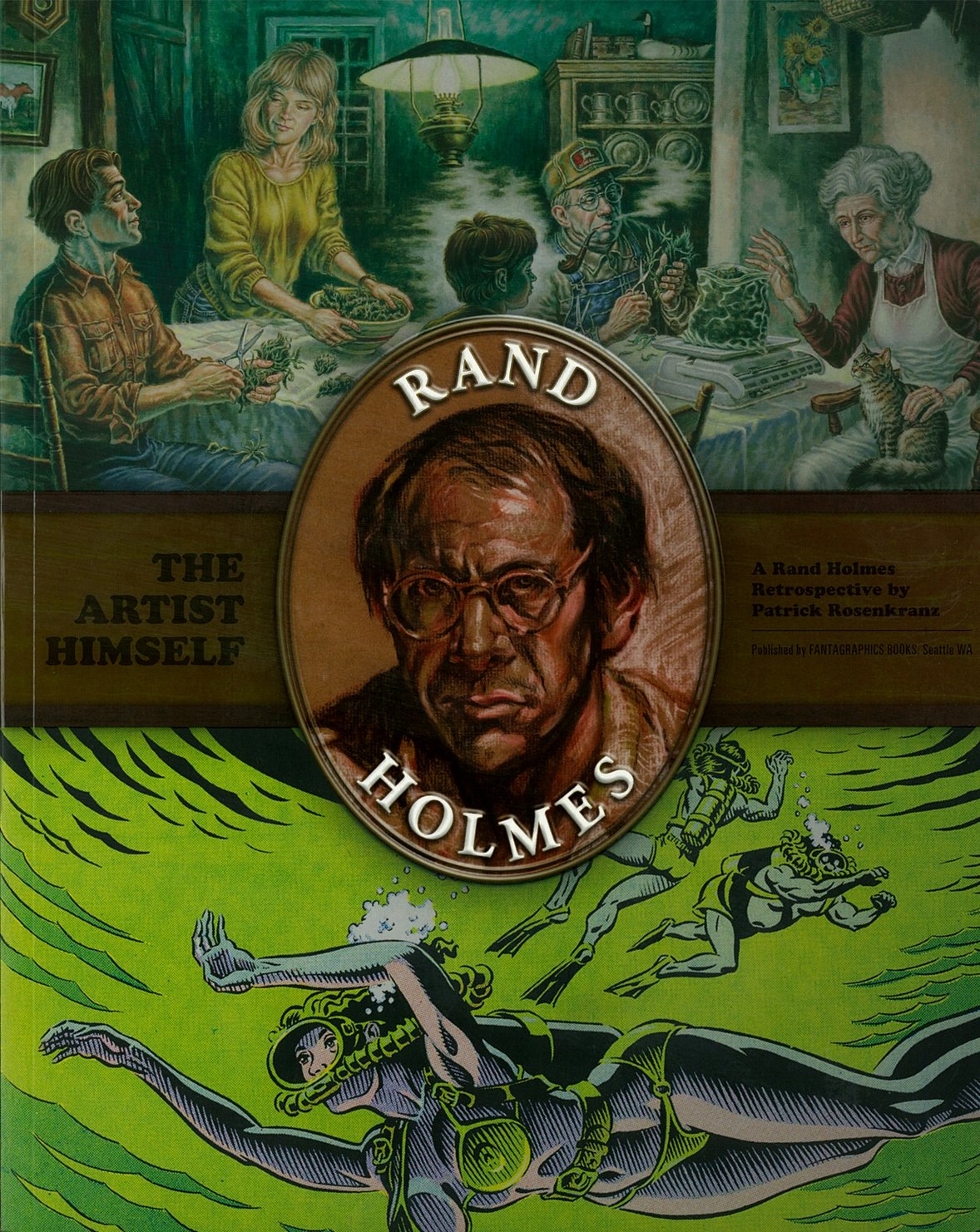
The Artist Himself: A Rand Holmes Retrospective


By Rand Holmes; written and compiled by Patrick Rosenkranz (Fantagraphics Books)
ISBN: 978-1-60699-170-1 (TPB)

Randolph Holton Holmes was a unique individual: a self-taught artist who grew up troubled, found peace and sufficiency if not fame and fortune, and died far too young on March 15th 2002. Available in wrist-wrenching paperback and soothing digital editions, this superbly curated compilation and biography re-presents scads of sketches; reproductions of drawings; cartoons and paintings he created in later life, preserved alongside a copious collection of his wickedly wonderful underground and alternative comic strips for fans and the soon to be devoted…

As usual, I’ll deliver here my warning for the easily offended: this book contains comic strips never intended for children. If you are liable to be offended by raucous adult, political and drug humour, or beautifully illustrated scenes of explicit sex, unbelievable comedic violence and controversial observations, don’t buy this book. In fact, stop reading this graphic novel review. You won’t enjoy any of it and might be compelled to cause a fuss.

I’ll cover something far more wholesome tomorrow so please come back then if you want. Be warned again though: I think you are being silly and may just cover something just as unseemly. That’s just the way I am…

Rand Holmes was born in Nova Scotia on February 22nd 1942 and raised in Edmonton, Alberta, Canada. After a rather remarkable early life (no clues from me – the whole point is to get you to buy this book) which included honing a prodigious artistic talent through diligently absorbing the work and drawing styles of Jack Davis, Will Eisner, Harvey Kurtzman (who bought Rand’s first profession efforts for Help! magazine) – and most especially Wally Wood – Holmes became a jobbing cartoonist and illustrator at The Georgia Straight in 1969: one of many youth-oriented, counter-culture /“underground” newspapers that blossomed during the period.

Whilst there he created signature character Harold Hedd. It ran as a regular strip, and was assembled in 1972 into an outrageously hilarious, adults-only comic-book The Collected Adventures of Harold Hedd. A second volume followed a year later. Married young and always restless, Holmes generated an astounding amount of cartoon and comic work, which appeared in White Lunch Comix, All Canadian Beaver Comics, Slow Death, Fog City Comics, Gay Comics, Dope Comics and Snarf, amongst many others.

Holmes was by inclination a completely liberated sexual and political satirist. Sadly, his meticulously lush and shockingly explicit strips often obscured powerful social commentaries by being just too damn well-drawn. He produced strips for Rolling Stone and Cheri magazine and, in the 1980s, worked briefly in the mainstream comics market. When the Direct Sales revolution first flourished, he crafted EC-flavoured yarns for genre anthologies Twisted Tales and Alien Worlds,reuniting with long-time publishing collaborator Denis Kitchen for horror anthology Death Rattle as well as the fabulous mini-series Hitler’s Cocaine: the hip, trippy, return of Harold Hedd (included in its entirety in this volume).

Holmes married a second time in 1982 and moved his family to the idyllic, isolated artistic community of Lasqueti Island where he increasingly concentrated on a self-sufficient life-style, with oil painting replacing cartooning as an outlet for his relentless artistic drives. Here, with other creative hermits, he built an art centre which has become his lasting monument.

He passed away from Hodgkin’s Lymphoma in 2002 and this book was the result of the first retrospective show compiled by his family from the treasury of superb material he left behind.

As well as a photo-stuffed and highly engaging history, this volume contains a wealth of artwork from early doodles to teen cartoons; illustrations and covers from his commercial art days; sketches; paintings; fascinating excerpts from the journals he kept for most of his life and a wonderful selection of his comics.

These last include many ‘Out to Lunch’ hotrod strips; early Harold Hedd pages from the Georgia Straight; sexy horror yarn ‘Raw Meat’; assorted ultra-nasty Basement Man tales; ‘Nip an’ Tuk – Those Cute Little Fuzzy Mices’; even more Hedd in ‘Wings Over Tijuana’ plus an unfinished story, as well as the aforementioned ‘Hitler’s Cocaine’ saga. Also on view are ‘And Here He Is… the Artist Himself’; ‘Killer Planet’; ‘Junkyard Dog’ (written by Mike Baron) and ‘Mean Old Man’ (written by Rob Maisch) – a powerful yarn that smacks of autobiography – before the artist portion concludes with a gallery of the stunning paintings that occupied his later days.

Rand Holmes was a true artist in every sense of the word: mostly producing work intended to change society, not fill his pockets. This terrific tome is a splendid and fitting tribute: one any grown-up art lover will marvel at and cherish.
© 2010 Patrick Rosenkranz, with the exception of the Rand Holmes diary entries which are © 2010 Martha Holmes. All artwork © 2010 Martha Holmes. Individual comic stories © their respective writers. All rights reserved.

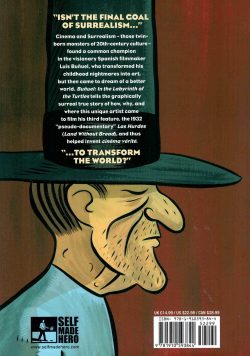
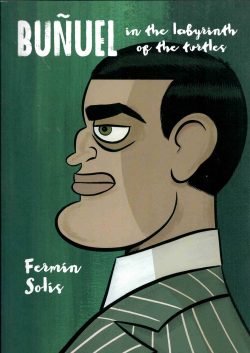
Buñuel in the Labyrinth of the Turtles


By Fermín Solís, translated by Lawrence Schimel (SelfMadeHero)
ISBN: 978-1-910593-84-4 (PB)

The places and moments where great art intersects with mundane reality have always made for great storytelling, and that’s never been more deftly demonstrated than in this highly personal interpretation of a crucial moment in the history of 20th century cinema.

Luis Buñuel Portholés (February 22nd, 1900 – July 29th 1983) was a Spanish filmmaker who renounced his citizenship in favour of Mexico, and his catholic faith in favour of truth: an iconoclastic, moralistic thinker and revolutionary who embraced surrealist doctrine and reshaped the arts of filmmaking.

If you have the stomach and suitable respect for the medium, please view Un Chien Andalou, L’Age d’Or and That Obscure Object of Desire – if not all of his heady output – but probably best leave it until after reading this engaging visual introspection from award-winning cartoonist Fermín Solís Campos.

The self-taught cartoonist, animator and illustrator of such treats as Otra Vida and El Hombre del Perrito shares many similarities with his subject and a solid yet whimsical earthy touch that is perfect for this examination of a key moment in the celluloid auteur’s rocky progression from wunderkind to industry lynchpin.

‘Do Not Disturb! Artist Dreaming’ opens with Buñuel wracked by his usual night terrors of barnyard fowl, Christian iconography and talking wildlife before an old friend calls to inform him of a cash windfall. It’s the end of 1932 and old comrade Ramón Acin trails him through the seedy warrens of the city, carousing and pontificating on past glories before deducing ‘Paris no Longer Loves Us’. Are there no challenges left? Is surrealism no longer enough to challenge the world and outrage society?

‘Ten Hours from Paris’ and months later, they and a small crew are assessing one of the most poverty-stricken regions of Europe. A Spanish region wedded to faith but so poor that the residents have no conception of even basic foodstuffs like bread. As the bizarre villagers and their weird tortoise-like huts bore into Buñuel’s fevered subconsciousness, his creative dry spell vanishes. Inspired again, he carefully concocts Las Hurdes: Tierra Sin Pan (Land Without Bread) contravening all established rules and mores to create a new genre beyond simple documentary. Alternatively called ethnofiction, pseudo-documentary or cinema verité, its cost to veracity, human compassion and even simple morality might be too much to bear…

Challenging, compelling and utterly absorbing, Buñuel in the Labyrinth of the Turtles is a superb graphic assessment of the creative process that will surprise and delight in equal measure
© 2008, 2019 Fermín Solís. © 2019 Penguin Random House Grupo Editorial, S.A.U. All rights reserved.

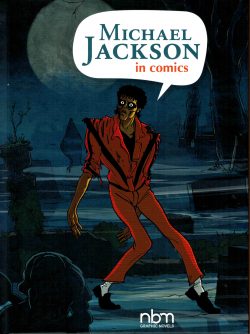
Michael Jackson in Comics


By Céka, illustrated by Patrick Lacan, Filippo Neri & Piero Ruggeri, JGSB, Laurent Houssin, Lu-K, Guillaume Griffon, Sarah Williamson, BiG ToF, Nikopek & Lou, Vox, Domas, Clément Baloup, Martin Trystram, Bast, Guillaume Tavernier, Aurélie Neyret, Anthony Audibert, Yigaël, Julien Akita, Lapuss, Kyung-Eun Park, Jean-Christophe Pol & Vallale; translated by Montana Kane (NBM)
ISBN: 978-1-68112-228-1 (Album HB) eISBN: 978-1-68112-230-4

Graphic biographies – especially those produced in Europe dissecting the lives of iconic celebrities and artists – are incredibly popular these days. This one was originally released in 2018: an inevitable but accessible addition and one featuring probably the most popular and controversial musical star of all time.

If you’ve never heard of Michael Jackson, there’s very little point in you carrying on any further.

Still with us? Okay then…

Offering cannily repackaged popular culture factoids and snippets of celebrity history, this tome – written by journalist Céka, with a legion of illustrators providing vivid and vibrant mini-strips – hones in on key moments in the controversial star’s career: detailing them through brief text essays.

It all began at ‘2300 Jackson Street’ where an extended family of juvenile performers were harshly schooled by their ruthless dad, after which the inner life of an abused kid is depicted in ‘I Wish I Could Have Been… A Child’, as portrayed in strip-form by Patrick Lacan.

The euphoria of winning talent contests and getting picked up by a major label is described in text article ‘From the Apollo Theater to Motown’ before Filippo Neri & Piero Ruggeri detail the draconian rehearsal regimen forced on the Jackson 5 by ambitious father Joe.

As their fame grew, little Michael constantly sought surrogate maternal relationships from a string of female celebrities. This is detailed in ‘One Father and Five Mothers’, with vividly lurid cartoon extrapolation ‘Diana Ross: THE Lady in his Life’ exploring the situation courtesy of JGSB.

‘From the Jackson 5 to Michael’ details the fractious move to solo stardom and hard-won autonomy ‘Made in Motown’(art by Laurent Houssin), whilst ‘5% Talent, 95% Hard Work’ explore the boy star’s ultimate idol in Lu-K’s ‘James Brown, the Mentor’.

The start of autonomy comes with ‘The Quincy Jones Trilogy’, depicting the global-shocks attending the making of‘Thriller: No Mere Mortal Can Resist!’ by Guillaume Griffon. Status is confirmed by ‘Birth of an Icon’ and attendant Moonwalk step-chart ‘An Extraterrestrial on Earth’ (Sarah Williamson art) before I Have a Dream’ starts tracing the cracks, and ‘The MTV Blackout’ – by Big ToF – discloses the colour bar keeping certain performers’ videos off pioneering music channels…

‘Jackson’s Jackpot’ and Nikopek & Lou’s linked visualisation of ‘A 47-and-a-Half Million-Dollar Blunder’ explore the tensions between the young star and Paul McCartney as well as music ownership rights, whilst – courtesy of Vox – carton strip ‘The Man with the White Socks’ illustrates the consequences of Prince of Pop’s style decisions as textually defined and described in ‘Fashionista’. ‘Dancing Machine’ examines signature moves, with Domas limning the steps in cartoon guide ‘The Man Who Slides on Clouds’. Before, social conscience engaged, ‘We are the World’ recalls the era of charity mega-records, with Clément Baloup depicting how the song was written in ‘Check Your Egos at the Door’.

The crown starts to wobble as ‘Neverland’ reveals how the fabulous ranch of dreams began, with Martin Trystram illustrating ‘Now Go Go Go Where you Want’, after which the media rumour mill runs wild in ‘Animal Spirit’, with Bast fancifully sketching out the story of exotic pets like ‘Bubbles, Muscles, and Co.’

Once unleashed, the press is relentless and ludicrous, as exposed in ‘Tabloid of Fact?’, with Guillaume Tavernier offering a strip further covering ‘The Rumor Mill’, whilst Aurélie Neyret’s cartoon tale of ‘Ryan White: Gone Too Soon’ adds balance to the uncomfortable reports of child-centred indiscretions recounted in ‘The Lost Children’…

Excesses real or otherwise dominate in ‘Tabloid Junkie’, with Anthony Audibert vignetting ‘The Elephant Man Case’before the years of defensive self-isolation are detailed in ‘Blood on the Dance Floor’ and Yigaël draws the benefits – and not – of ‘Privacy’.

‘Scandal at Neverland’ leads to Julien Akita’s sensitive exploration of ‘Jordan Chandler vs Peter Pan’, a review of ‘Family Life’ with attendant strip ‘Once Upon a Time’ from Lapuss, after which ‘The Man With 240 Awards’ reveals ‘The Whims of a Star’ thanks to cartoonist Kyung-Eun Park.

The final days approach, as seen in essay ‘Fans, I Love You More!’ with Jean-Christophe Pol & Vallale visually enquiring ‘What Kind of Fan Are You?’ of the music man’s broad church of devotees.

The star-studded, star-crossed story concludes with ‘Never Can Say Goodbye’ as Clément Baloup draws things to a close with ‘Michael Forever’…

Although intellectually slight and far from incisive or comprehensive in addressing the many controversies surrounding the star in question, Michael Jackson in Comics is far from a concealing hagiography either and presents a remarkably readable and beautifully rendered confection for comics and music fans alike.
© 2018 Editions Petit a Petit. © 2021 NBM for the English translation.

For more information and other great reads see http://www.nbmpub.com/

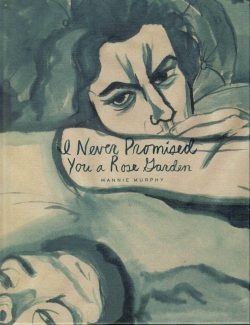
I Never Promised You a Rose Garden


By Mannie Murphy (Fantagraphics Books)
ISBN: 978-1-68396-410-0 (HB)

How does memory work? Are your recollections neatly sorted and filed away: dry, dusty documents effortlessly relating time, place, event and response, or is the act of personal recall mired in apparently extraneous passions and seemingly irrelevant sidebars of emotion, pulling you from the topic far and away before circling back to what originally set you thinking?

Mine’s that last one, and it’s a phenomenon used to devasting effect by Mannie Murphy as they pull together deeply intimate musings on famous – but presumably unrequited – imagined inamorata who endured tragic fates, peppered with youthful school experiences and personal philosophies while powerfully delivering a chilling expose of the proudly racist and white supremacist history of hometown Portland, Oregon.

Rendered as a personal diary with sometimes-impenetrable cursive script married to wash-&-ink images, Murphy details long-distance, strictly hands-off relationships with teen icons River Phoenix, Keanu Reeves (specifically as observed in Gus Van Sant’s My Own Private Idaho); Kurt Cobain and less well-known or admired personalities: all while deftly dissecting the far-from-savoury development and current state of a region long considered the promised land for Far Right fantasists and dreamers.

Available in hardback or various digital formats, the meandering masterclass opens with ‘My Own Private Portland’setting the scene for a mesmerising journey through the city and state through the lens of damaged, disenfranchised and frequently doomed youth. Second chapter ‘Ken Death is Dead’ expands the discussion detailing the career of a beautiful poster child for Nazi extremism and convicted mass killer, who was just another pawn in a cruel game played by older, nastier Machiavellians, after which the story of Oregon and its awful record of racism, exclusion and mass murder – much of it permitted or committed by a complacent and compliant police force – is covered in ‘Flood’.

A hard-earned, personal view of the educational set-up and its grim consequences is related in ‘Victims of Groupthink’with perspective supplied by further reference to celluloid Lost Boys and their connections to bands like The Red Hot Chili Peppers, and other notable outsiders, all cleverly married to distressing accounts of tragedies and disasters that systematically shaped the city and the kids growing up the Oregon way.

The miraculous transport of curated memories then closes with a chilling Epilogue as ‘Young Hatemongers’ revisits the Ken Death trial and media storm around it with revelations that came to light during the later stages of this book’s creation.

Dark, brooding, deeply upsetting while brimming with potent immediacy and rough-hewn passion, I Never Promised You a Rose Garden is an apparently rambling but carefully steered narrative of seemingly random remembrances that serve as a warning from history and heartfelt plea for people to be better than they are…
© 2021 Mannie Murphy. This edition © 2021 Fantagraphics Books, Inc. All rights reserved.