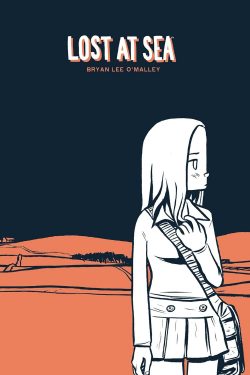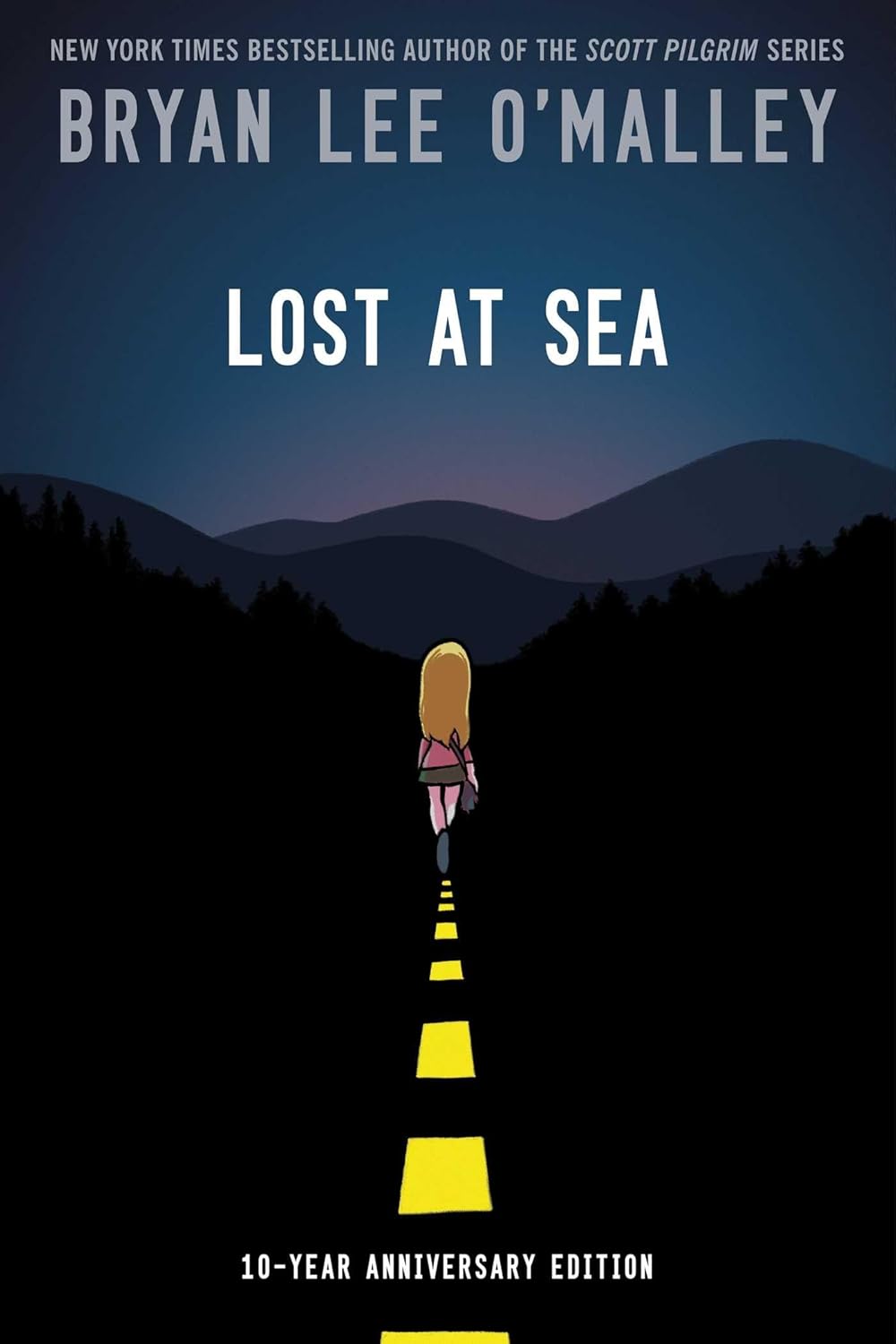
Lost at Sea


By Brian Lee O’Malley (Oni Press)
ISBN: 978-0-932664-16-4 (PB); 978-1-62010-113-1 (10th Anniversary Edition HB)

You’ve no doubt heard that appallingly clichéd phrase “it’s about the journey”?

Well, sometimes it actually is.

This moody, enticingly sensitive and charming not-coming-of-age road-trip argosy is by Bryan Lee O’Malley, whose Scott Pilgrim tales of an adorable boy-idol idle slacker seemed to encapsulate the tone and tenor of the last-but-one generation to have invented sex and music and growing up confused…

Lost at Sea is a lovely languid and lyrical look at a self-confessed outsider, couched in terms of a quasi-mystical mystery and rendered in an utterly captivating, boldly simple style simultaneously redolent of childhood misgivings and anticipatory tales of horror and imagination.

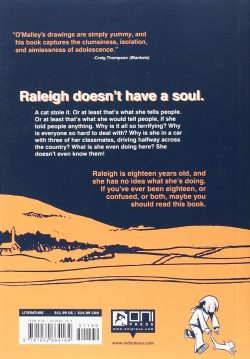
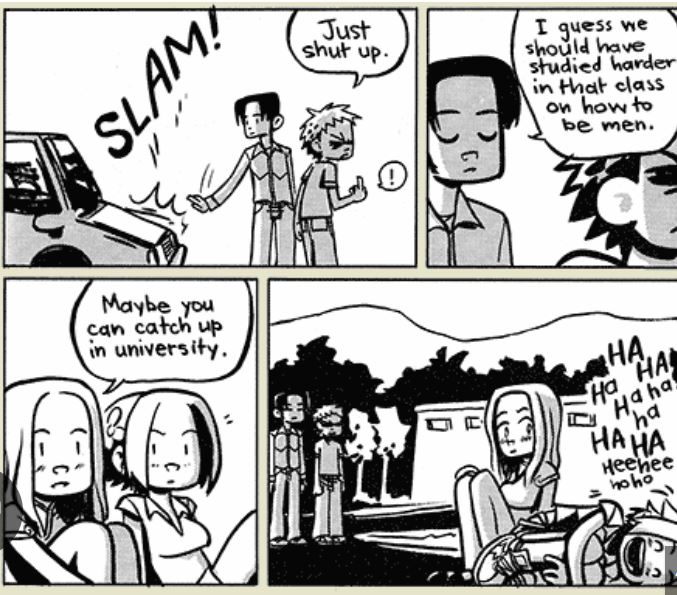
High School senior Raleigh is a passenger in a car slowly meandering its way back to Vancouver from California. She doesn’t really know Stephanie or the boys Dave & Ian. She only met them because dippy Stephanie never deletes any numbers from her phone and pocket-dialled her by coincidental accident, just moments after Raleigh missed her train home. She had been enduring an unfortunate visit with her dad and his latest woman near San Francisco. As the Canadian kids had a car and were heading back north, somehow, although a social misfit and practical stranger, Raleigh ended up travelling homeward with them…

Even though they all go to the same school – Sturton Academy – these kids are not really like her. They weren’t hot-housed or sent to “gifted” classes… and they still have their souls…

Raleigh lives with her mum and really misses her best friend, who she hasn’t seen in four years, six months and 24 days. Raleigh also has a secret internet boyfriend in California (the real reason for visiting Dad and his new lady) and is very confused and lonely after travelling to meet darling Stillman.

Raleigh lost her soul in Ninth Grade when her mother sold it to Satan in return for being successful, but the girl can’t quite remember why it was put into a cat. Ever since then, cats seem to crop up everywhere she goes, even following her, and she can’t tell if she’s crazy or imagining it all.

Naturally, Raleigh is violently allergic to cats…

However, when she finally loosens up and tells Stephanie her satanic secret, the boisterous wild child admits to seeing them too and suggests they should catch them and see if they can be made to cough up that stolen soul. Dave & Ian are game too…

Expressionistic, impressionistic, existential, self-absorbed, vastly compassionate, deeply introspective and phenomenally evocative of that monstrous ball of confusion that is the End of Adolescence, Lost at Sea is a graphic marvel which seems, from my admittedly far-distant perspective, the perfect description of that so-human rite of passage we all endured and mostly survived.

There was a 10th Anniversary edition, but as far as I can tell no digital edition (yet) but that’s still plenty to be going on with, right? Buy it for your teenagers, read it to rekindle your own memories and cherish it because it’s wonderful.

™ & © 2002, 2003, 2005, 2008 Bryan Lee O’Malley. All Rights Reserved.

Today in 1948, Doug Moench (Batman, Moon Knight, Planet of The Apes, Shang Chi, Master of Kung Fu) was born and we lost the amazing, under-adored Don Heck (Iron Man, Avengers, Batgirl, everybody) in 1995. Reading-wise, 1913 saw the launch of Gus Mager’s Hawkshaw the Detective in 1913, Marge’s Little Lulu in 1935 and Britain’s Lion weekly in 1952. It was also the last episode of Makoto Yukimura’s Planetes in 2004.

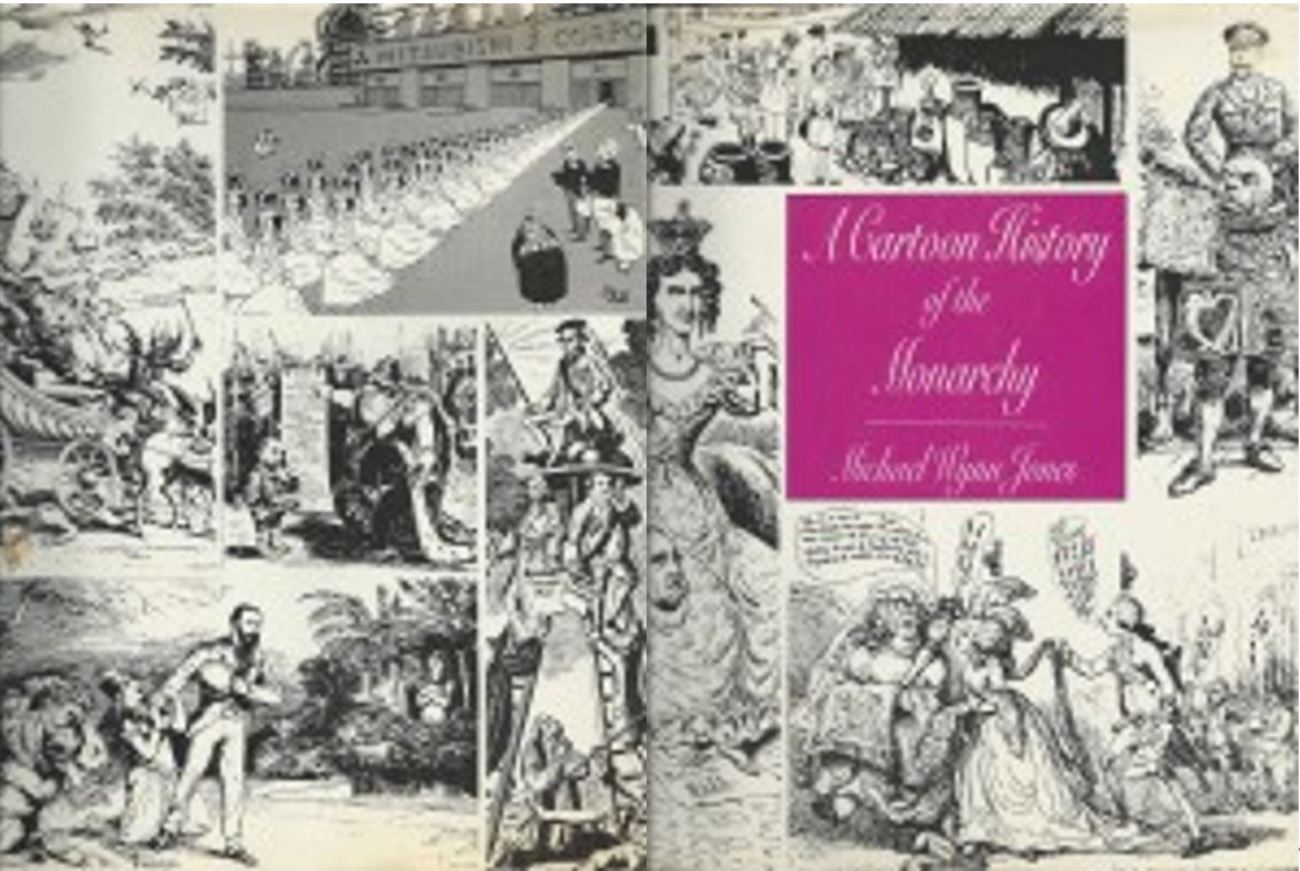
A Cartoon History of the Monarchy


By Michael Wynn Jones and Many & Various (Macmillan)
ISBN: 978-0333198056 (PB)

This book includes Discriminatory Content produced in less enlightened times.

We’re far too reluctant in this country to celebrate the history and quality of our own cartooning tradition; preferring simply to remark on the attention-grabbers or impressive longevity of one or two classic and venerable veterans of the pen-&-ink game for TV soundbites and platform clickbait. The actual truth is that for an incredibly long time the political art movement of the Empire and Commonwealth – and its enemies – was vast, varied and fantastically influential.

The British wing of the form has been magnificently serviced over centuries by masters of form, line, wash and most importantly ideas, repeatedly tickling our funny bones or enraging our sleeping consciences and sensibilities, all whilst poking our communal pomposities and fascinations.

From earliest inception, satiric draughtsmanship has been used to attack and sell: initially ideas, values, opinions and prejudices or but eventually actual products too. In newspapers, magazines and especially comic books, the sheer power of graphic narrative, with its ability to create emotional affinities, has led to the creation of unforgettable images and characters – and the destruction of real people or social systems.

When those creations can affect the daily lives of millions of readers, the force they can apply in the commercial or political arena is well-nigh irresistible…

In Britain, the cartoonist has held a bizarrely precarious position of power for centuries: the deftly designed bombastic broadside or savagely surgical satirical slice instantly capable of ridiculing, exposing, uplifting or deflating the powerfully elevated, unapproachable and apparently untouchable with a simple shaped-charge of scandalous wit and crushingly clear, universally understandable visual metaphor.

For this method of concept transmission, lack of literacy or education is no barrier. As the Catholic Church proved centuries ago with the Stations of the Cross, stained glass windows and a superteam of idealised saints, a picture is worth far more than a thousand words…

For as long as we’ve had printing there have been scurrilous gadfly artists commentating on rulers, society and all iniquities: pictorially haranguing the powerful, pompous, privileged and just plain perfidious through swingeing satire and cunning caricature. Sometimes artists have been just plain mean. Those are usually the best and most memorable…

Britain had no monopoly on talent and indignation, and this canny compendium also frequently features European – and latterly American – takes on our always-scandalous Royals (wow, is THAT true today!) and oddball citizenry…

Released in 1978 and desperately in need of updating and re-issue, A Cartoon History of the Monarchy offers a potted, far from hagiographic history and deliciously skewed view of our Ruling Elite in all their unsavoury glory. Here reside an unbroken line of jibes, asides and broadsides culled from diverse sources by jobbing journalist and aficionado of japes, lampoons and sketches Michael Wynn Jones, who casts his discriminating eye from the reign of Elizabeth I up until just before the Silver Jubilee of the second Regina to bear the name…

Following a rota of the Kings and Queens of England, the pomposity-puncturing procession commences with The Age of Intolerance, reproducing cartoons and adding commentary dealing with the doings of the 10 monarchs from the initial Elizabeth I to George II.

Accompanying essays share the zeitgeist of those times; the religious questions as England, Wales, Ireland and eventually Scotland faced numerous crises regarding succession. That issue always revolved around whether the land should be Catholic or Protestant. ‘Popes, Plots and Puritans’ led to a final solution when ‘The Men from Hanover’ arrived to settle the matter and fully cement the nation under the Church of England.

A savage sampling of national and European opinions are represented by 26 visual bombards such as allegorical assault ‘Diana and Callisto’ by Dutch artist Miricenys (1585), anonymous ‘England’s Miraculous Preservation’ (1648) and ‘The Royal Oake of Brittayn’ (1649) amongst many others.

Cartoon grotesques like ‘Cromwell’s Car’ (1649) or ‘Babel and Bethel’ (1679) appear beside such scandalous foreign attacks as Dutch illustrator Dusart’s ‘Fr. James King’ or anonymous French pictorial polemic ‘Notice of Burial’ (both from 1690). We Brits riposted with jeering celebrations of martial triumphs such as ‘The Arrival of William and Mary’ (1689), ‘The Great Eclipse of the Sun’ (simultaneously a topical spin on a 1706 solar event and defeat of “Sun King” Louis XIV by the British armies of Queen Anne), and ‘A Bridle for the French King’ from the same year.

Domestic contretemps are highlighted through such draughtsman’s delights as anonymous 1743 shocker ‘The Hanover Bubble’, Ebersley’s ‘The Agreeable Contrast’ (1746 and attacking King George’s brother “Butcher” Cumberland’s treatment of Jacobites after the Young Pretender’s defeat), and exposure of Popish influence in the Highlands, described in ‘The Chevalier’s Market’ 1745…

Whereas much of this material – British and otherwise – was generally national commentary and pure religio-political assault, by the time period covered in The Wickedest Age: George III to George IV (1760-1830), the cartoon had also evolved into a weapon designed to wound with wit and crush through cruel caricature. After covering major crises and scandals of the generally sensible – if parsimonious – third George in ‘The Royal Malady’, ‘The Dregs of Their Dull Race’ and ‘Twilight Years’: a veritable Golden Age of popular disapproval and pictorial pummelling of the Prince Regent and much-delayed, frustrated monarch (plus his many indiscreet mistresses) is covered in ‘The Prince of Whales’, ‘The Secret Marriage’, ‘…Pray Get Me a Glass of Brandy’ and ‘Delicate Investigations’.

The public disdain of the times generated a fusillade of cartoon prints, represented here by 35 graphic thrusts and savage cartoon sallies by names now as famous as any ruler. However master character assassins Townsend (‘The Scotch hurdy-gurdy’), George Cruikshank (‘Royal Condescension’), Gillray (‘A New Way to Pay the National Debt’, ‘A Voluptuary under the Horrors of Digestion’), Rowlandson (‘The Prospect Before Us’) and Heath (‘A Triumph of innocence over perjury’) are brilliantly bolstered by lesser lights West (‘The Save-all and the Extinguisher!’), Williams (‘Low Life above stairs’), Vowles (‘The shelter for the destitute’) and Marshall (‘The kettle calling the pot ugly names’) and some anonymous pen-pricks who nevertheless hit hard with ‘Tempora Mutantor’, ‘The captive Prince’ and ‘Reading of the Imperial decree’ and more.

Eventually, periodical publication overtook print-shops as the great disseminators of cartoon imagery, and open savagery and targeted vulgarity of caricaturists gradually gave way to mannered, if barbed, genteel observation. Thus The Age of Discretion: William IV to Victoria (1830-1901) offers a different style of Royal Commentary: no less challenging, but certainly more overtly respectful even when critical. Sometimes, though, the new family-oriented cartooning – even in magazines like Punch and The Times – simply sunk to fawning veneration as the institution of monarchy became more and more removed from the lives of the citizenry.

William’s times are summed up in text via ‘The Sailor King’ and ‘Reform Billy’ whilst Victoria’s epochal reign and the Parliamentarians who increasingly wielded decisive power is described through ‘The Queen of the Whigs’, ‘Revolutions are bad for the Country’, ‘The Black and the Brown’ and ‘Years of Widowhood’. The 36 collected images recapture days of Empire, with Heath, Seymour & Doyle predominant in illustrating bluff sea-dog William’s socially contentious days of Reform (no, not our modern bunch of useless Gammons, but actually people seemingly seeking to make the country better very long ago…)

Victoria’s years – from engaging popular ingénue Queen, through happy bride to politically intrusive grand dame of European Court intrigue – highlights the craft of Doyle ‘The Queen in Danger’ (1837), Leech ‘There’s Always Something’ (1852), Tenniel ‘Queen Hermione’ (1865), ‘New Crowns for Old Ones!’ (1876), Morgan (Where is Britannia?’ and ‘A Brown Study’ (both 1867) and Sambourne ‘Kaiser-i-Hind’ (1876) amongst so many others. Her latter years saw a rise in social conscience cartooning as displayed by the crusading Merry with ‘The Scapegrace of the Family’ (1880), ‘The fall of the rebels’ in 1886 and more. The telling modernist take of Max Beerbohm cuttingly illustrated the rift between the Empress and her playboy heir in ‘The rare, the rather awful visits of Albert Edward to Windsor Castle’

Despite her well-publicised disapproval of the good-time Prince, he became an effective king as did his son, both covered in The Edwardian Age: Edward VII to George V, spanning 1901-1936. Their dutiful achievements are depicted in ‘The Coming King’ and ‘The First Gentleman of Europe’ before war with Germany necessitated a family name change for George: ‘The First Windsor’

With kings increasingly used as good-will ambassadors and cited in scandals frequently ending in court (sound familiar?), the 30 cartoons in this section include many German pieces from not only the war years but also the tense decade that preceded them. At that time of tinderbox politics, Imperial Superpowers jostled for position and used propaganda to appeal to the world’s “unwashed masses” for justification in their aims and ambitions. Beside veteran caricaturists like Leech, Morgan, May, Partridge, Staniforth and David Low are merciless lampoons from German cartoonists Brandt, Blir, Heine, Gulbransson and Johnson as well as French illustrator Veber and lone American Kirby.

Our pen-&-ink pictorial history lesson concludes with The Age of Respectability: Edward VIII, George VI, Elizabeth II, by generally skipping World War II, concentrating on the openly secret scandal of Edward & Mrs Simpson in ‘Abdication’. Thereafter the advent of ‘New Elizabethans’ brought a modern age of monarchs as sideshow attractions…

Although Fleet Street chose to whitewash and suppress the affair between a King-in-waiting and an American divorcee, the rest of the world made great play of the situation: as seen here with 11 telling cartoon shots from Americans McCutcheon and Orro, whilst French scribbler Effel posited typically insouciant Gallic pragmatism in ‘Une Solution’ and German-based Gulbransson played up the true romance angle…

In the meantime, British cartoonist Low had to be at his most obliquely hilarious, delineating the crisis by not mentioning it, whilst Punch stars such as Partridge steadfastly pursued a line of deferential, tragic sacrifice…

Although there is very little material featuring wartime monarch George VI – a propaganda casualty of the conflict – the last 20 cartoons herein celebrate the changing image of a very public Royal Family, pictured by names hopefully familiar to contemporary cartoon lovers.

The imagery is also contextually far more familiar – and presumably comfortable – to modern tastes as print media generally learned to save their vitriol for politicians and celebrities: reserving only minor chidings and silly teasing for “the Royals”, as seen in ‘Birthday Greetings’ and ‘Under the Splendid Empire Tree’ (Shepard fin 1947) or Illingworth’s 1951 panels ‘Family Ties’ and ‘Happy Returns’. Papers were, however, happy to utilise monarchy to score points against governments, as seen in an attack on Enoch Powell (Cummings’ ‘Ministry of Repatriation’) and the battle between Rhodesia’s Ian Smith and Harold Wilson, lampooned in ‘Your Move!’ by Jak (both 1968) or the legendary Giles’ ‘New Rent Assistance Bill’ (1971).

Also offering acerbic jollity of a far more blueblood-specific variety are cartoon giants Trog and Waite, joining the abovementioned in exploiting the Royal Family’s gift for headline-stealing gaffes in such daring gags as ‘I Suppose we did send them to the Right Schools?’, ‘I Suppose she’ll think these are of the Queen Mother’, ‘More Pay’ and ‘Andrew’s Exchange Student’: coming full circle with the best of Hanoverian excesses scrutinised by cost-conscious government and public – albeit this time for rather more gentle laughs…

Appended with a scholarly section of Acknowledgements, Illustration sources and Index of artists, this is an extremely effective introduction to the lasting relationship between Royalty, Church and Fourth Estate, offering a fantastic overview of Regal adaptability and cultural life through cunningly contrived images and pictorial iconography that shaped society and the world.

These are timeless examples of the political pictorialist’s uncanny power and, as signs of the times, form a surprising effecting gestalt of the never-happy nation’s feeling and character.

None of that actually matters now, since these cartoons have performed the task they were intended for: moulding attitudes of generations of voters who never voted for monarchy. That they have also stood the test of time and remain beloved relics of a lethal art form is true testament to their power and passion.

Stuffed with astounding images, fascinating lost ephemera and mouth-watering tastes of comic art no aficionado could resist, this colossal collection is a beautiful piece of cartoon history to delight and tantalise all who read it.

We haven’t had many monarchs since this book was first released, but there are plenty of new Royals and so many scandals to explore, so it’s long past time for a fresh edition, no?

NOW CAN WE HAVE A NEW REVISED EDITION PLEASE?
© Michael Wynn Jones 1978. All rights reserved.

Today in 1893 attorney and psychologist Elizabeth Holloway Marston was born, although you won’t find her name on any of the Wonder Woman stories she wrote with her husband. In 1929 Australian John Dangar Dixon (Air Hawk and the Flying Doctors – which ran from 1959 until 1986) was born, as was Torpedo creator Enrique Sánchez Abulí in 1945 and colourist Steve Oliff in 1954. Dwayne McDuffie arrived in 1962, as did Mike Allred, whilst Lady Killer, Batman & Catwoman scribe Joëlle Jones didn’t join the party until 1980.

We lost both Superman stalwart Wayne Boring and Blake & Mortimer creator Edgar Pierre Jacobs in 1987 and strips scribe Elliot Caplin (Dr. Bobbs, Peter Scratch, Big Ben Bolt, Abbie an’ Slats, Long Sam, Little Orphan Annie, The Heart of Juliet Jones) in 2000.

If you’re British and never grew up, today in 1971 TV based weekly Countdown launched…

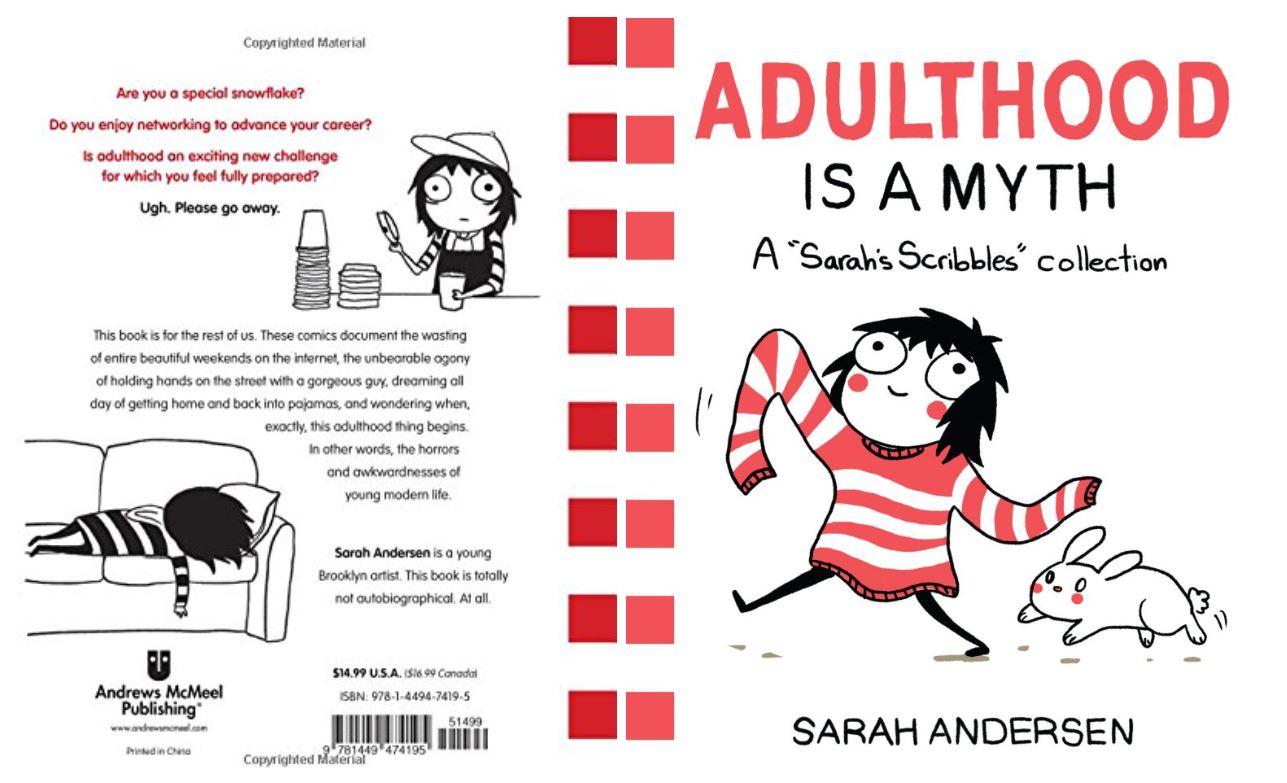
Adulthood is a Myth – A “Sarah’s Scribbles” Collection


By Sarah Andersen (Andrews McMeel)
ISBN: 978-1-44947-419-5 (PB/Digital edition)

Scary times need radical solutions, but in lieu of that and considering how helpless we all are, all I can suggest is burying yourself in a book (gallows pun not intended). Here’s one that is both funny and incisive and is available online either in physical form or digitally. Moreover, as it’s about – and by – a Millennial, all us old sods who lived through a few crises can chortle and feel smugly superior in the knowledge that problems such as these in here are transitory and shall also pass. That one was deliberate…

Sarah’s Scribbles started in 2013 as a webcomic (first on Tumblr, and latterly Facebook, Instagram and Line Webtoon) before going legit in 2016 in as a book from Andrews McMeel. Adulthood is a Myth was followed by Big Mushy Happy Lump in 2017, Herding Cats in 2018 and Oddball in 2021. Every collection won that year’s Goodreads Choice Award. That’s because the strips and lead character are accessible, personable, relatable and fetchingly funny.

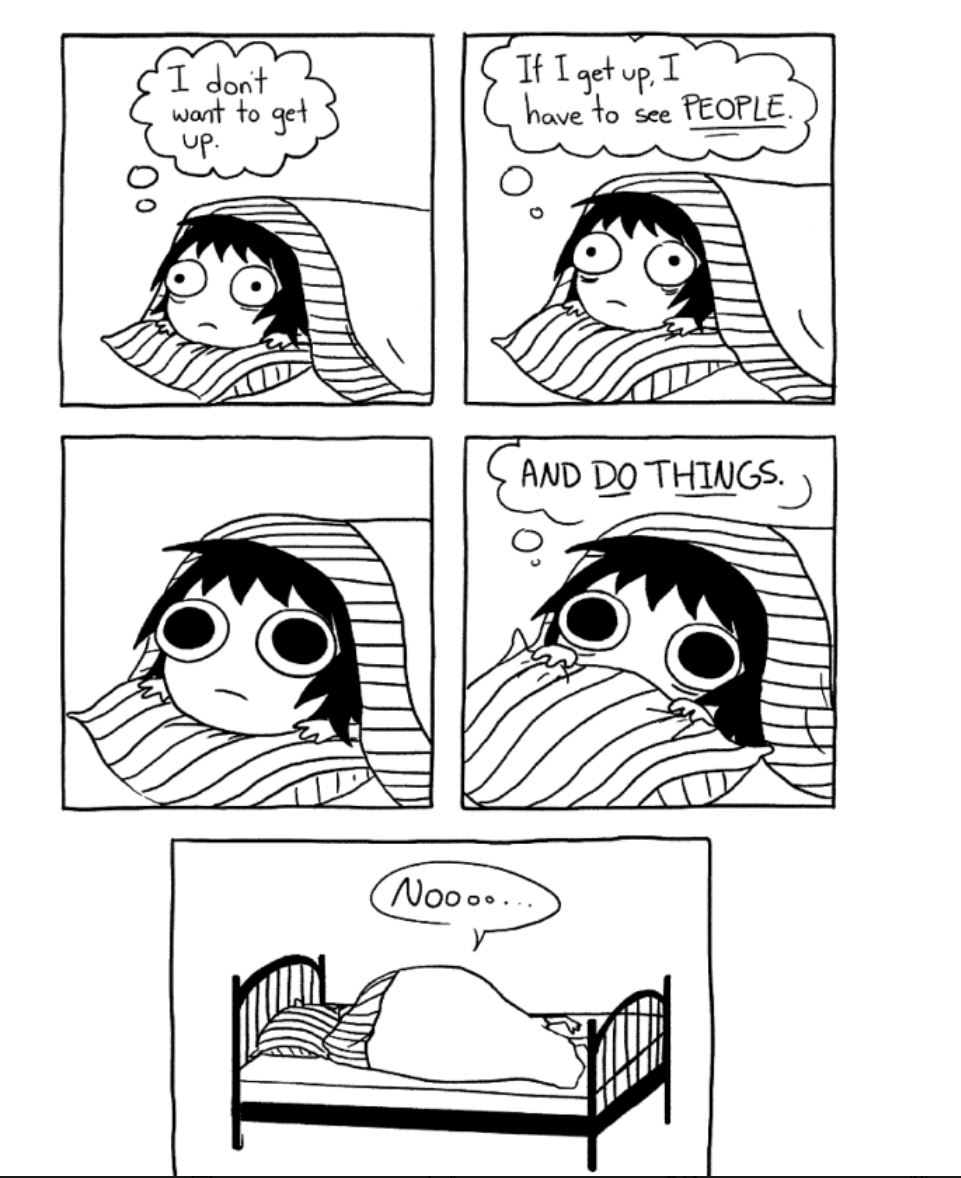
Autobiographical to a degree I’m unqualified to assess and distressed to acknowledge, what you get are pithy observational comedy gag strips with a semi-surreal undertone about the thoughts and (mostly) inactions of an arty student who lives with an exceptionally critical but ultimately supportive rabbit. Think of it as pictorial inner monologue from a very nervous and unconfident teen, roaring and giddy with hormones and expectations she can’t possibly hope to meet and indoctrinated with standards she can’t let go of…

As well as casual interactions with her peers, major causes of cartoon comment include projections of her eventual senility and decrepitude (‘Me in the Future’), social anxiety, body issues, relationships, housework, fashion, awkwardness, bingeing and attraction through episodes with such enticing titles as ‘Nightmares for Introverts’, ‘When to Change/Wash’, ‘Things I Know’, ‘Habits of the Common Bookworm’, ‘Getting Drunk (For Beginners)’, ‘Social Media in Real Life’, ‘What I Eat on a Typical Day’, ‘5 Phrases that make My Blood Run Colder than Ice’, ‘Watching Stuff’, ‘Things that make me Feel Safe’ and ‘Benefits of Stealing Boys’ Hoodies’.

On less excoriating days you’ll share her views on ‘Normal People’ versus ‘Me’, ‘How Graduating Feels’, ‘Internet Comment Threads’, ‘Folding Laundry’, ‘The Introvert’s Brain’, ‘How to know Your Partner is Serious about the Future’, and the potential of ‘The Future’, so that’s pretty much a view on everything to deal with…

Sarah Andersen was a student at the Maryland Institute College of Art before this took over her life so she knows the value of Extra Credits. That’s why this tome includes lots of strips created specifically for the collection so if you’ve been following her on the interwebs, you’ll still miss some good stuff if you don’t get this delirious delight.
© 2016 by Sarah Andersen. All rights reserved.

Born today in 1887: cartoonist and animator Paul Terry (Mighty Mouse, Heckle and Jeckle), and DC’s ubiquitous cartoonist Henry Boltinoff in 1914. In 1944 writer/director Don Glut (The Occult Files of Dr. Spektor, Tragg and the Sky Gods, Captain America, The Invaders, Star Wars, Vampirella) appeared, as did William Messner-Loebs (Journey: The Adventures of Wolverine MacAlistaire, Wonder Woman, The Flash) in 1949, with Gerry Shamray (American Splendor) popping by in 1957.

In 2000 we lost mega-talented multi-skilled miracle worker George Roussos (Batman, Air Wave, Fantastic Four, every comic at Marvel and DC in the 1980s).

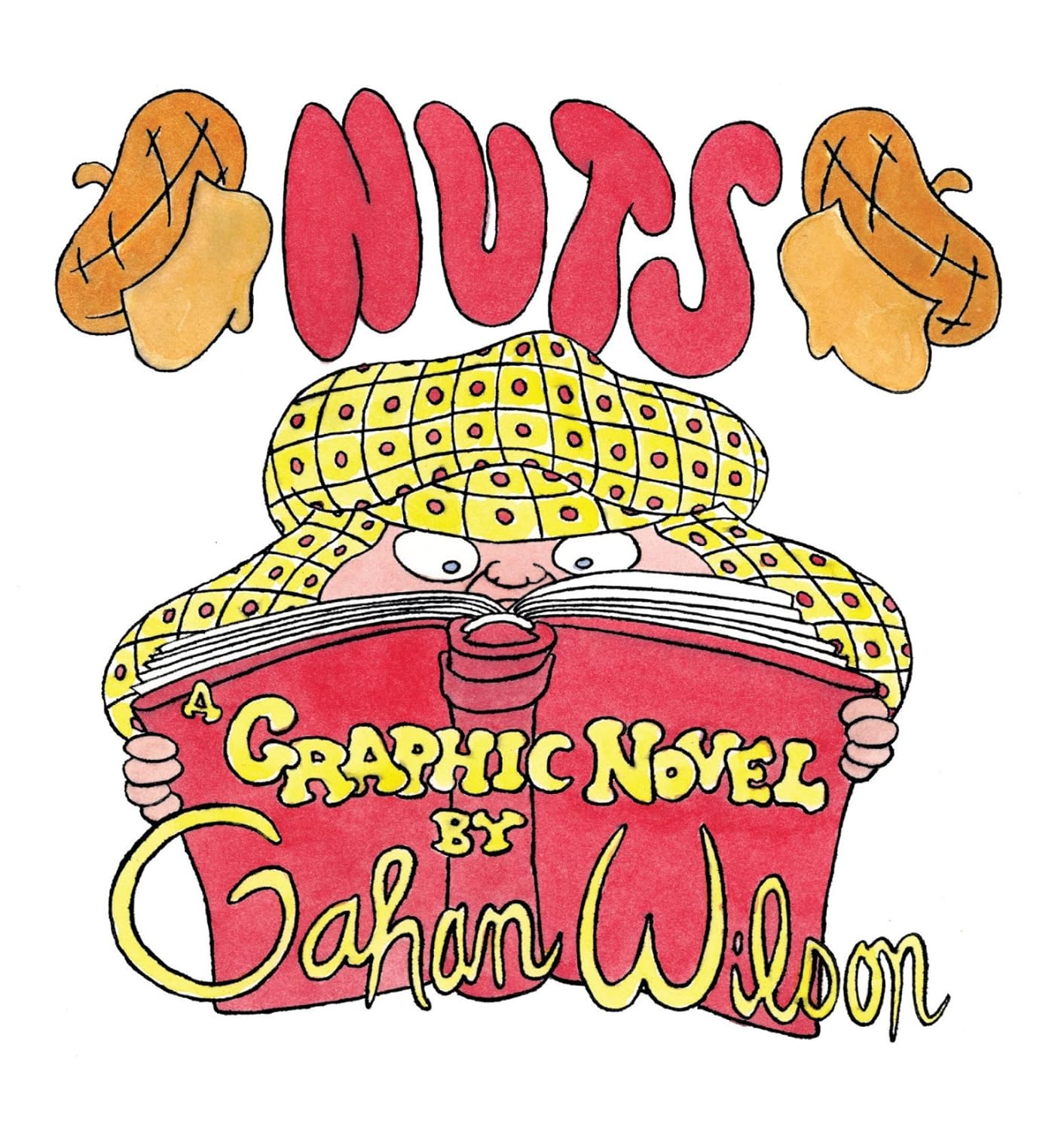
Nuts


By Gahan Wilson (Fantagraphics Books)
ISBN: 978-1-60699-454-2 (HB/Digital edition

This book includes Discriminatory Content produced in less enlightened times.

Born on February 18th 1930 and dying November 21st 2019, Gahan Allen Wilson was an illustrator, cartoonist, essayist and author who always had his eyes and heart set on the future. According to Gary Groth, the artist/author grew up reading comic strips as much as fantasy fiction.

It always showed.

The mordantly macabre, acerbically wry and surreal draughtsman tickled funnybones and twanged nerves with his darkly dry graphic confections from the 1960s onwards; contributing superb spoofs, sparklingly horrific and satirically suspenseful drawings and strips and panels as a celebrated regular contributor in such major magazines as Playboy, Collier’s, The New Yorker and others. He also wrote cutting edge science fiction for Again Dangerous Visions, The Magazine of Fantasy & Science Fiction, The Twilight Zone Magazine and Realms of Fantasy as well as contributing criticism, book and film reviews for them all.

In an extremely broad and long career he wore dozens of creative hats, even embracing the modern digital universe by creating – with Byron Preiss – his own supernatural computer game Gahan Wilson’s the Ultimate Haunted House.

When National Lampoon first began its devastatingly satirical (geez, do modern folk even recognize satire anymore?) all-out attack on the American Dream, Wilson was invited to contribute a regular strip to their comics section. His sublimely semi-autobiographical, darkly hilarious paean to lost childhood ran from 1972 and until 1981 and was collected as Nuts, another superb compilation from this publisher that you should own and share. Few people – me included – knew that during that period he also, apparently more for fun and relaxation than profit, produced his own syndicated Sunday strip feature. For two years – beginning on March 3rd 1974 – Gahan Wilson Sunday Comics appeared in a small cross-section of newspapers from Boston to Los Angeles and, as with all his work, it bucked a trend.

At a time when most cartoonists were seeking a daily continuity strip, building a readership and eking jokes out with sensible parsimony, Wilson let himself go hog-wild, generating a half-dozen or so single-shot gags every Sabbath, blending his signature weird, wild monsters, uncanny aliens and unsavoury scenes with straight family humour, animal crackers, topical themes and cynically socio-politically astute observations.

Looking at them here it’s clear to me that his intent was to have fun and make himself laugh as much or even more than his readership: capturing those moments when an idea or notion gave him pause to giggle whilst going about his day job…

I’m not going to waste time describing individual cartoons: there are just too many and despite being a fascinating snapshot of ancient life, they’re almost all still outrageously funny in the way and manner that Gary Larson’s Far Side was a scant six years later.

I will say that even whilst generating a storm of humorous, apparently unconnected one-offs, consummate professional Wilson couldn’t restrain himself and eventually the jokes achieved an underlying shape and tone with recurring motifs (clocks, beasts, wallpaper, etc), and features-within-the-feature such as The Creep and Future Funnies

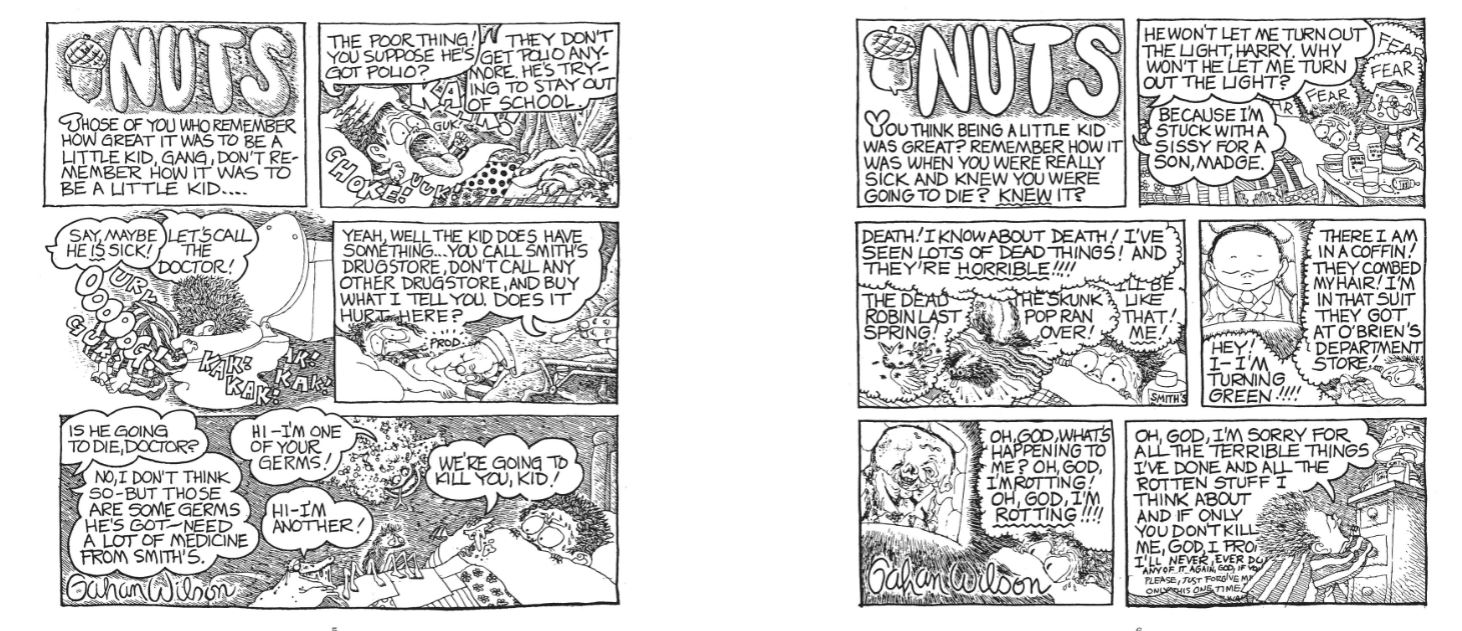
Here, generally a single-page complete graphic epigram “star” a grotty little chubby homunculus dubbed The Kid. This fabulous monochrome (and occasionally colour) collection gathers that complete serial for collectors and potential addicts in a perfect package that readers will dip into over and over again.

Taking his lead from popular sickly-sweet strips about or starring little children and the brilliant but definitely not jejune Peanuts (which was populated, to all intents and purposes, with teeny-weeny neurotic middle-aged midgets), Wilson sought to do the exact opposite and attempt to access the fear, frustration, confusion and unalloyed joy of being a young, impressionable, powerless, curious and demanding…

… and magnificently succeeded.

Dense, claustrophobic, intense and trenchantly funny, these self-contained strips range from satire to slapstick to agonising irony, linking up over the years to form a fascinating catalogue of growing older in the USA: a fearfully faithful alternate view of childhood and most importantly, of how we adults choose to recall and process those distant days…

Each strip begins with the question “Remember how…?” or “One of the…” or some equally folksy enquiry before unveiling bafflement, bewilderment, night-terrors or a deeply-scarring embarrassment which haunts us till doomsday, all wrapped in a comradely band-of-brothers, shared-coping-mechanism whimsy that is both moving and quintessentially nostalgic.

Topics include the unremitting horror of germs; sudden death; being ill; inappropriate movies; forced visits; grandparents; things adults do that they don’t want you to see; unexplained noises; the butcher’s shop; accidents and rusty nails; things in closets; doctors and needles; dying pets; Santa Claus; seasonal disappointments; summer camp; sleep; bodily functions; school and lessons (two completely different things); fungus; bikes and toys; haircuts; comic books; deaths of relatives; hot weather; candy; overhearing things you shouldn’t; stranger danger; hobby-kits and glue; daydreaming; babies and so many other incomprehensible daily pitfalls on the treacherous path to maturity…

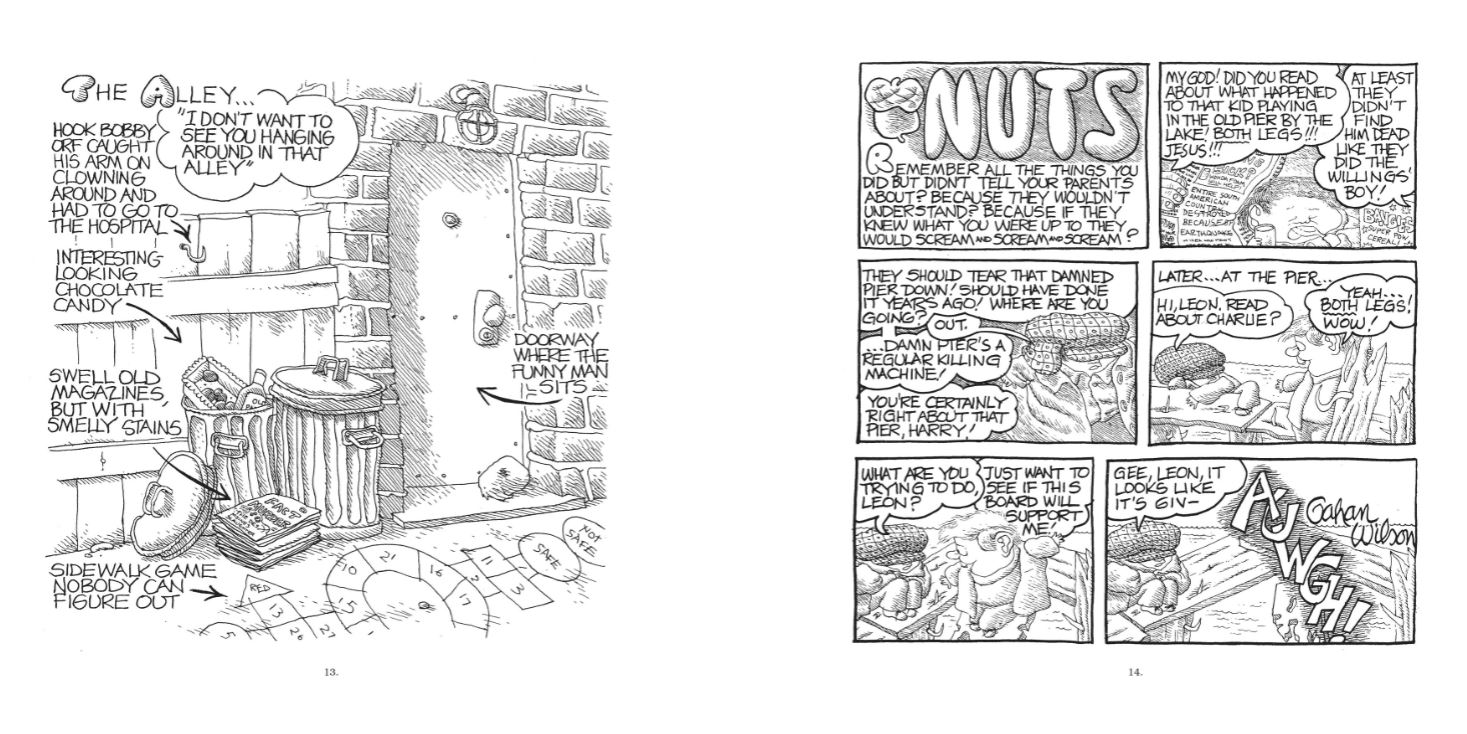
Peppered also with full page, hilariously annotated diagrams of such places of enduring childhood fascination as ‘The Alley’, ‘The Kit for Camp Tall Lone Tree’, ‘Mr. Schultz’s Cigar Store’, ‘The Movie Theater Seat’, ‘Table Set Up For Making Models’, ‘The Doctor’s Waiting Room’, ‘The Closet’, ‘The Sick Bed’ and ‘The Private Drawer’, this glorious procession also covers occasions of heartbreaking poignancy and those stunning, blue moon moments of serendipity and triumph when everything is oh-so-briefly perfect…

Complete with a 3-D strip and ‘Nuts to You’ – a comprehensive appreciation and history by Gary Groth – this funny, sad, chilling and sublimely true picture-passport to growing up is unmissable cartoon gold.
© Fantagraphics Books. All Nuts strips © 2011 Gahan Wilson. All rights reserved.

Today in 1917, Golden Age writer/editor Ruth Roche was born, followed by forgotten genius Joe Maneely in 1926, Gahan Wilson in 1930, Johnny Hart in 1931 and both comic book artist Doug Mahnke and cartoonist Mark Bodé in 1963.

We lost Belgian megastar and Marcinelle School founder Willy Maltaite (“Will”) in 2000 and lifelong multi-style achiever Bob Oksner in 2007.

Comics wise, UK standby Radio Fun (published since 1938) folded today in 1961 and Power Comic Fantastic launched today in 1967.

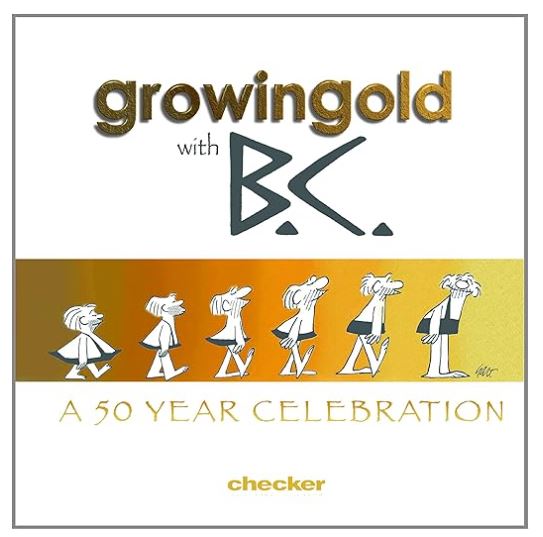
Growing Old with B.C. – A 50 Year Celebration


By Johnny Hart (Checker BPG)
ISBN: 978-1-905239-63-4 (HB) 978-1-933160-68-9 (PB/Digital edition)

This book includes Discriminatory Content produced in less enlightened times.

John Lewis Hart was born in Endicott, New York in 1931, and his first published cartoons appeared in military newspaper Stars and Stripes while he served with the US Air Force during the Korean War. On returning to Civvy Street in 1953, he sold a few gags to The Saturday Evening Post, Colliers Weekly and elsewhere, but had to earn a living as a general designer.

In 1958, for some inexplicable reason, caveman jokes were everywhere in magazines and comics (even latterly creeping onto TV and into movies). Despite all the dawn-age foofaraw, General Electric draughtsman and still-wannabe cartoonist Johnny Hart hadn’t sold a single one. He also desperately wanted to create a syndicated newspaper strip but couldn’t think of an idea.

And then one of his co-workers said why not do a strip feature one about Cavemen? Just like Alley Oop, but different…

Hart took a good look at the state of the world, and especially the people around him, and the wryly outrageous social commentarians supporting and harassing our hapless nebbish leading man B.C. quickly took shape…

The concept sold instantly to the New York Herald-Tribune Syndicate and the strip – starting today in 1958 – rapidly became a global hit, with the first of 41 collected editions (Hey! B.C.) released in 1959. In 1964 Hart started collaborating with fellow cartoonist Brant Parker on a new strip. The Wizard of Id also became a monster hit. The features won Hart an astounding hoard of awards over the years: making him one of only 4 American cartoonists to produce two strips appearing contiguously in more than 1000 newspapers.

Hart died of a stroke on April 7th 2007. He was working at his drawing board. Brant Parker passed away eight days later.

Hart became a devout Christian during the mid-1980s – something which increasingly and controversially manifested in later strips – but his urgent need to preach and share took a long time to impact the trenchant, whimsically surreal wit and primal byplay of his primordial playpen.

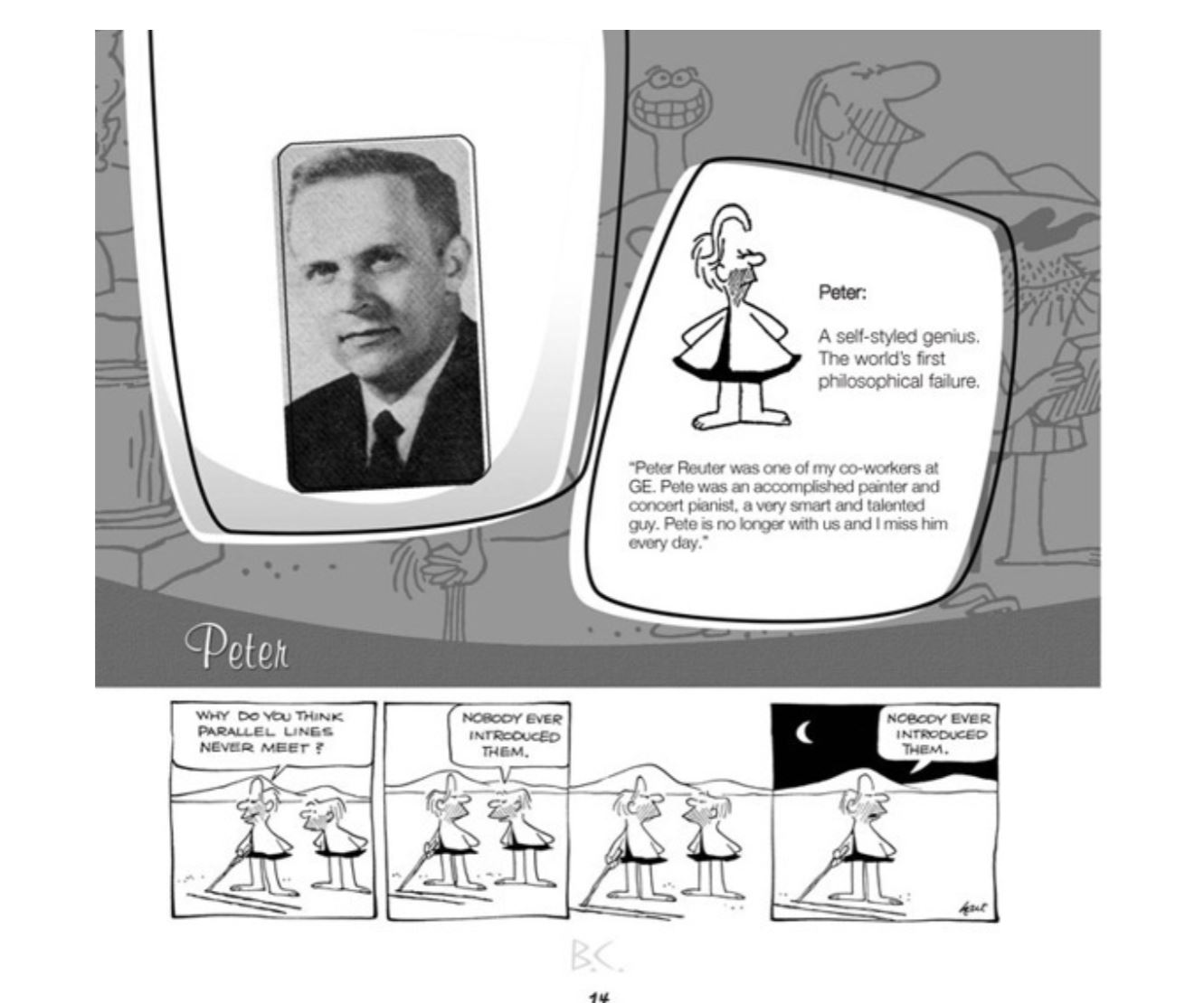
B.C. is a modern everyday kind of guy: a general purpose ordinary slob just getting by, but he has some odd and interesting friends breaking up the monotony of the pre-civilised world. These include self-proclaimed genius Peter, superstitious misogynist Wiley, proto-prime nerd Clumsy Carp, pre-human missing-link Grog, uber-sarcastic Curls and rakish lady-killer Thor.

Apparently, all of them are based on actual people – life-long friends of Hart’s – and their candid reminiscences provide a charming and poignant insight into the life of one of the most revered and successful cartoonists of modern times.

Other materialised regulars include a variety of talking beasts and inanimate objects: chatty, snappy dinosaurs; ants and ant-eaters; clams, snakes; turtles; birds and an apteryx – but I’m guessing they never had analogues with day-jobs in Eisenhower’s America…

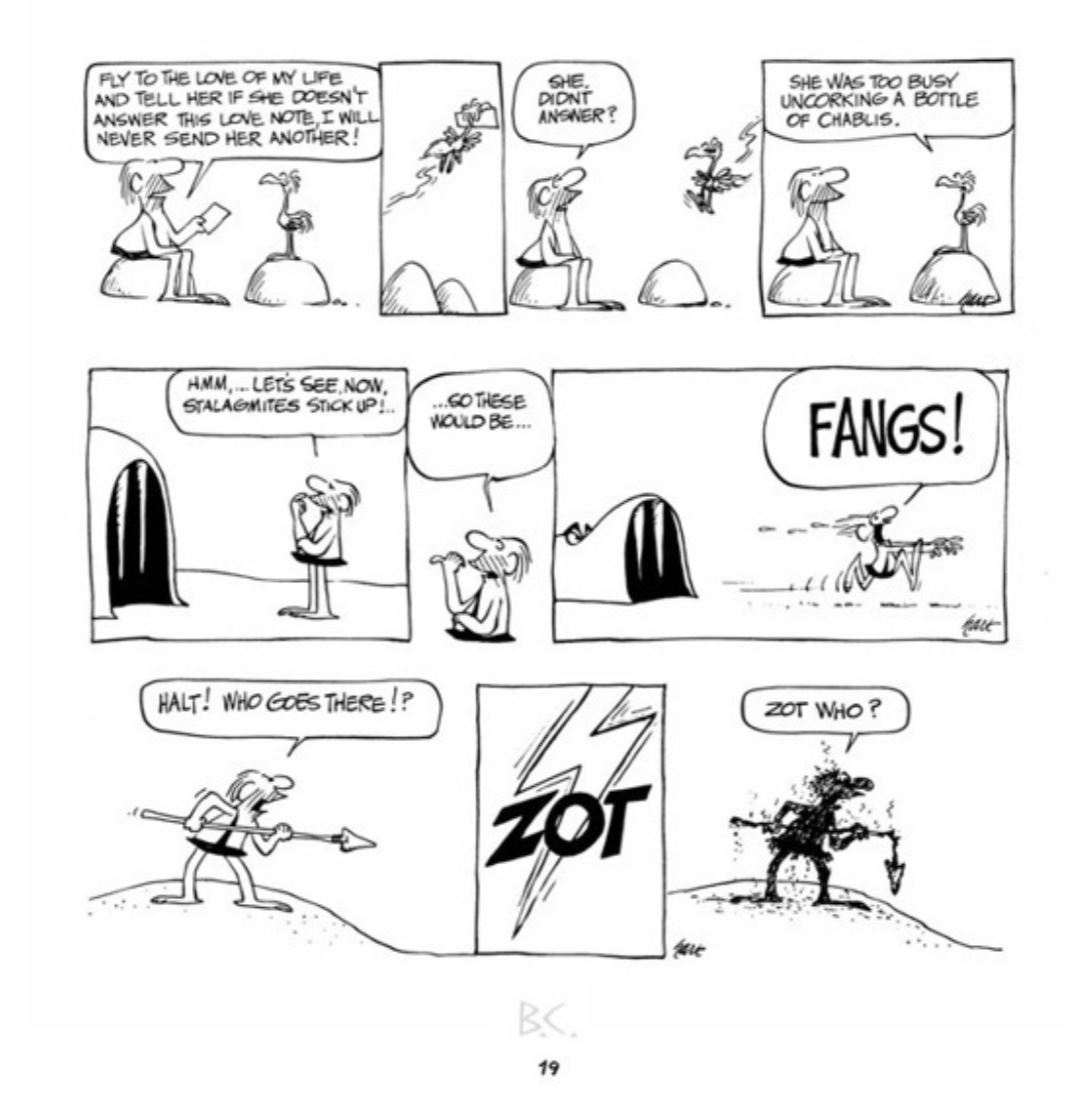
This magnificent tome – available in hardcover, paperback and digital editions – offers a decade-by-decade selection of the best and most memorable B.C. strips, supplemented by a listing of its many awards, and comes stuffed with photographs and observations. It is a most delightful commemoration of a truly great and very funny strip.

Hart died during the finishing stages of this book’s creation, making this the best way to celebrate his achievements. His legacy of brain-tickling, absurdist lunacy will never date, and creative anachronism has never been better used to raise a smile or an eyebrow in this lush collection of timely and timeless fun.
B.C. © 2007 Creators Syndicate Inc. B.C. © 1958-2006 John L. Hart Family Limited Partnership.

Today in 1914 writer Leo Dorman was born, as was fellow Superman stalwart Curt Swan in 1920. In 1929 Alejandro Jodorowsky came along, with today also greeting modern myth makers Nelson De Castro/“Nelson” in 1969 and Leah Williams in 1988.

Big day for strip launches too. As well as BC, we all started loving Richard F. Outcault’s The Yellow Kid in 1985, Lee Falk’s The Phantom in 1936 and Jack Williamson & Lee EliasBeyond Mars in 1952.

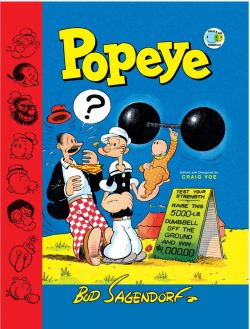
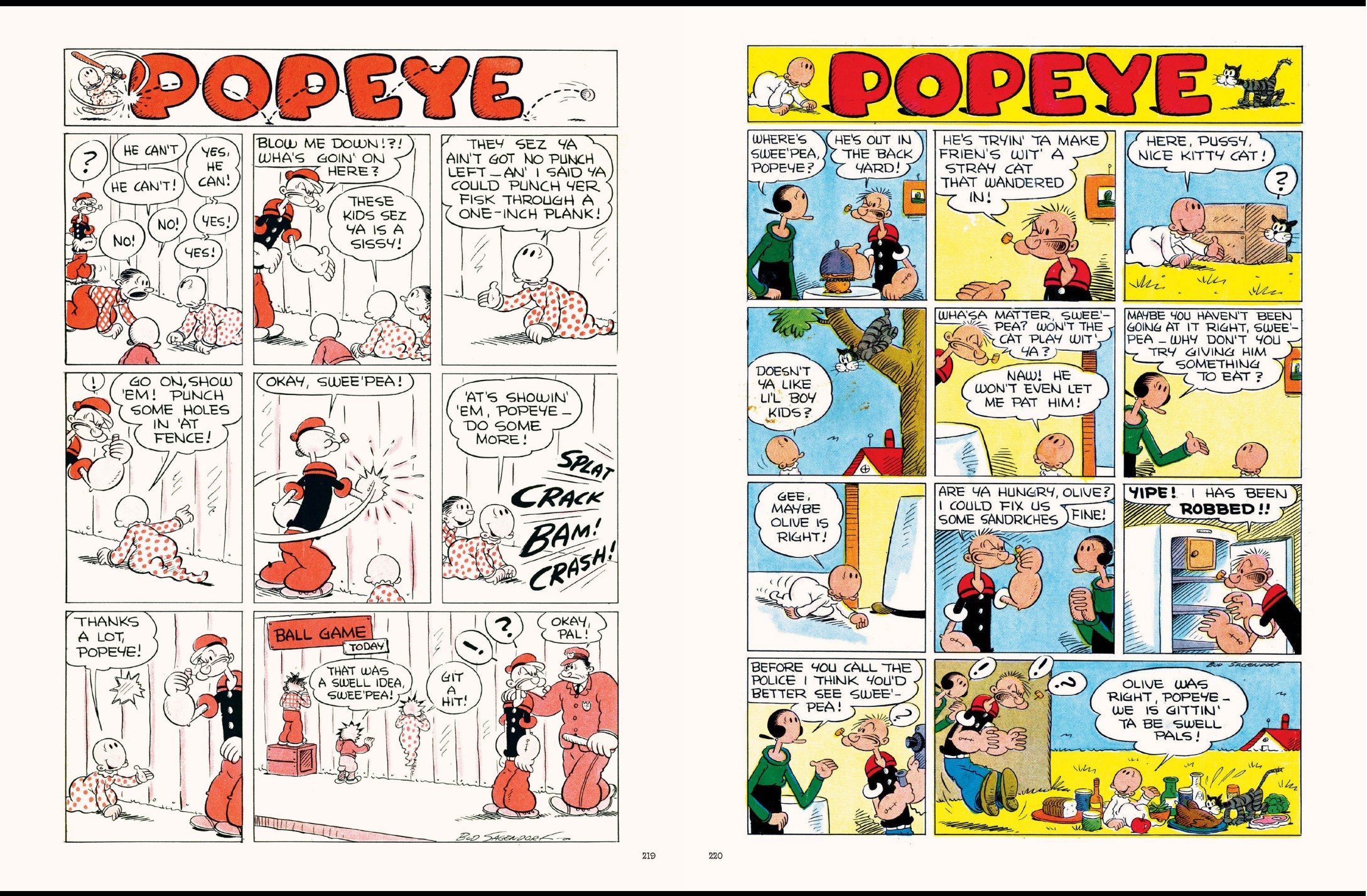
Popeye Classics volume 1


By Bud Sagendorf, edited and designed by Craig Yoe (Yoe Books/IDW)
ISBN: 978-1-61377-557-8 (HB) eISBN: 978-1-62302-264-8

This book includes Discriminatory Content produced in less enlightened times.

There are few comic characters that have entered communal world consciousness, but a grizzled, bluff, uneducated, visually impaired old sailor with a speech impediment is possibly the most well-known of that select bunch.

Elzie Segar had been producing Thimble Theatre since December 19th 1919, but when he introduced a coarse, brusque “sailor man” into the saga of Ham Gravy and Castor Oyl on January 17th 1929, nobody suspected the giddy heights that walk-on would reach…

Happy birthday, Sailor Man!

In 1924 Segar created a second daily strip The 5:15: a surreal domestic comedy featuring weedy commuter and would-be inventor John Sappo and his formidable wife Myrtle which endured – in one form or another – as a topper/footer-feature accompanying the main Sunday page throughout the author’s career. It survived his untimely death, eventually becoming the trainee-playground of Popeye’s second great stylist Bud Sagendorf.

After Segar’s tragic, far too premature death in 1938, Doc Winner, Tom Sims, Ralph Stein and Bela Zambouly all worked on the strip even as animated features brought Popeye to the entire world. Sadly, none of them had the eccentric flair and raw inventiveness that had put Thimble Theatre at the forefront of cartoon entertainments. Nonetheless, the strip continues to this day, with new Sunday episodes written and drawn by R. K. Milholland, whilst daily episodes are reprints by that man Sagendorf.

Born in 1915, Forrest “Bud” Sagendorf was barely 17 when his sister – who worked in the Santa Monica art store where Segar bought his supplies – introduced the kid to the master. Segar became his teacher and employer as well as a father-figure and, in 1958, Sagendorf took over the strip and all merchandise design duties, becoming Popeye’s prime originator…

When Sagendorf took over, his loose, rangy style and breezy inspired scripts brought the strip back to the forefront of popularity. Bud made reading it cool and fun all over again. He wrote and drew Popeye in every graphic arena for 24 years. Sagendorf died in 1994 after which Underground cartoonist Bobby London took over.

Bud had been Segar’s assistant and apprentice, and from 1948 onwards he wrote and drew Popeye’s comic book adventures in a regular monthly title published by America’s king of licensed periodicals, Dell Comics. When Popeye first appeared, he was a rude, crude brawler: a gambling, cheating, uncivilised ne’er-do-well. He was soon exposed as the ultimate working class hero: raw and rough-hewn, practical, but with an innate, unshakable sense of what’s fair and what’s not, a joker who wanted kids to be themselves – but not necessarily Good – and someone who took no guff from anyone. Naturally, as his popularity grew, Popeye mellowed somewhat. He was still ready to defend the weak and had absolutely no pretensions or aspirations to rise above his fellows, but time and popularity eroded that power.

Such was not the case in Sagendorf’s comic book yarns…

Collected in their entirety in this beguiling full-colour hardback or digital edition are the first four 52-page quarterly funnybooks produced by the Young Master, spanning February/April 1948 to November 1948/January 1949.

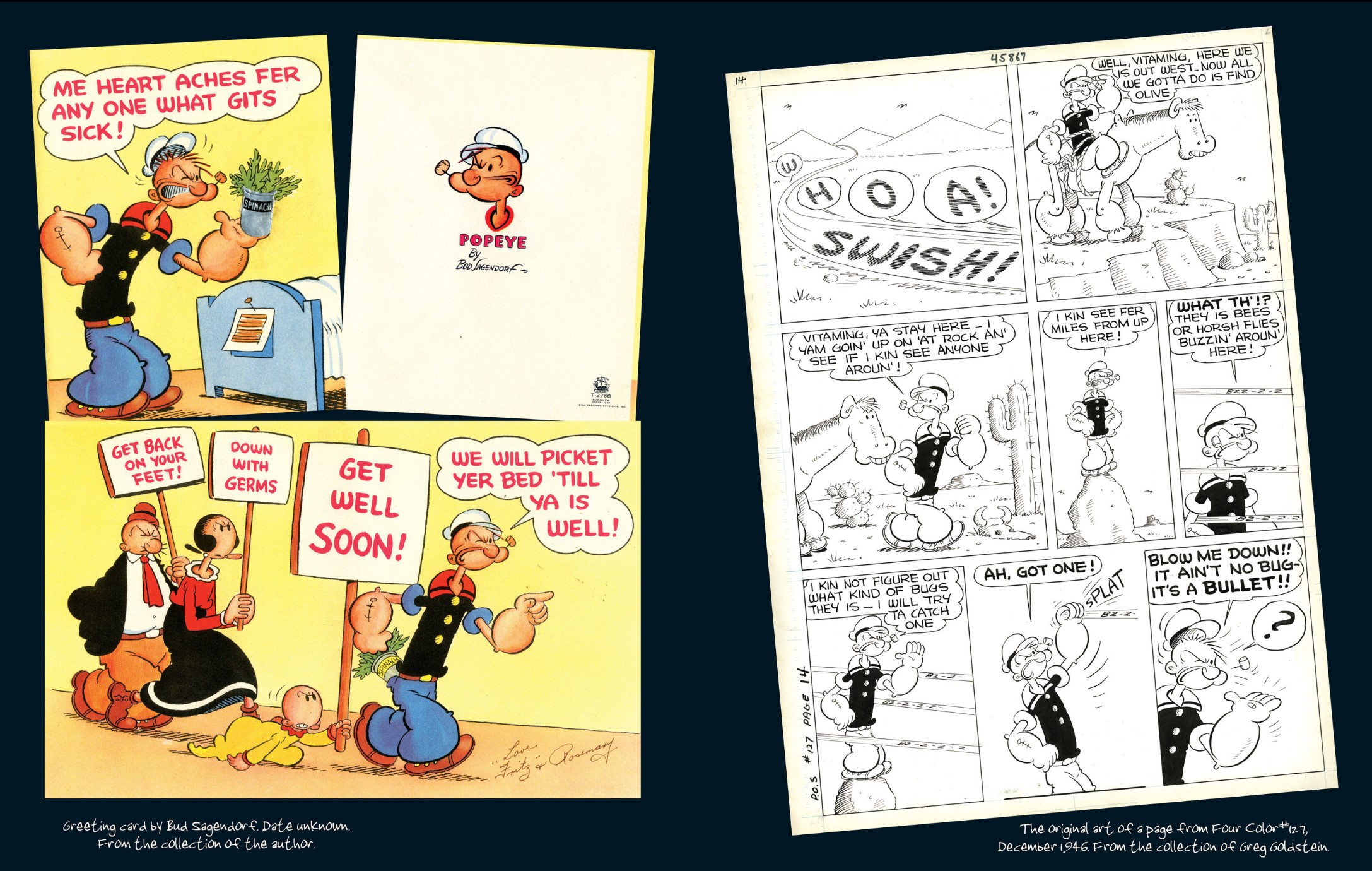
These stunning, seemingly stream-of-consciousness stories are preceded by an effusively appreciative Introduction‘Society of Sagendorks’ – by inspired aficionado, historian and publisher Craig Yoe accompanied by a fabulous collation of candid photos and letters, plus strip proofs, original comicbook art and commissioned paintings, an Activity Book cover and greetings card designs contained in ‘A Bud Sagendorf Scrapbook’.

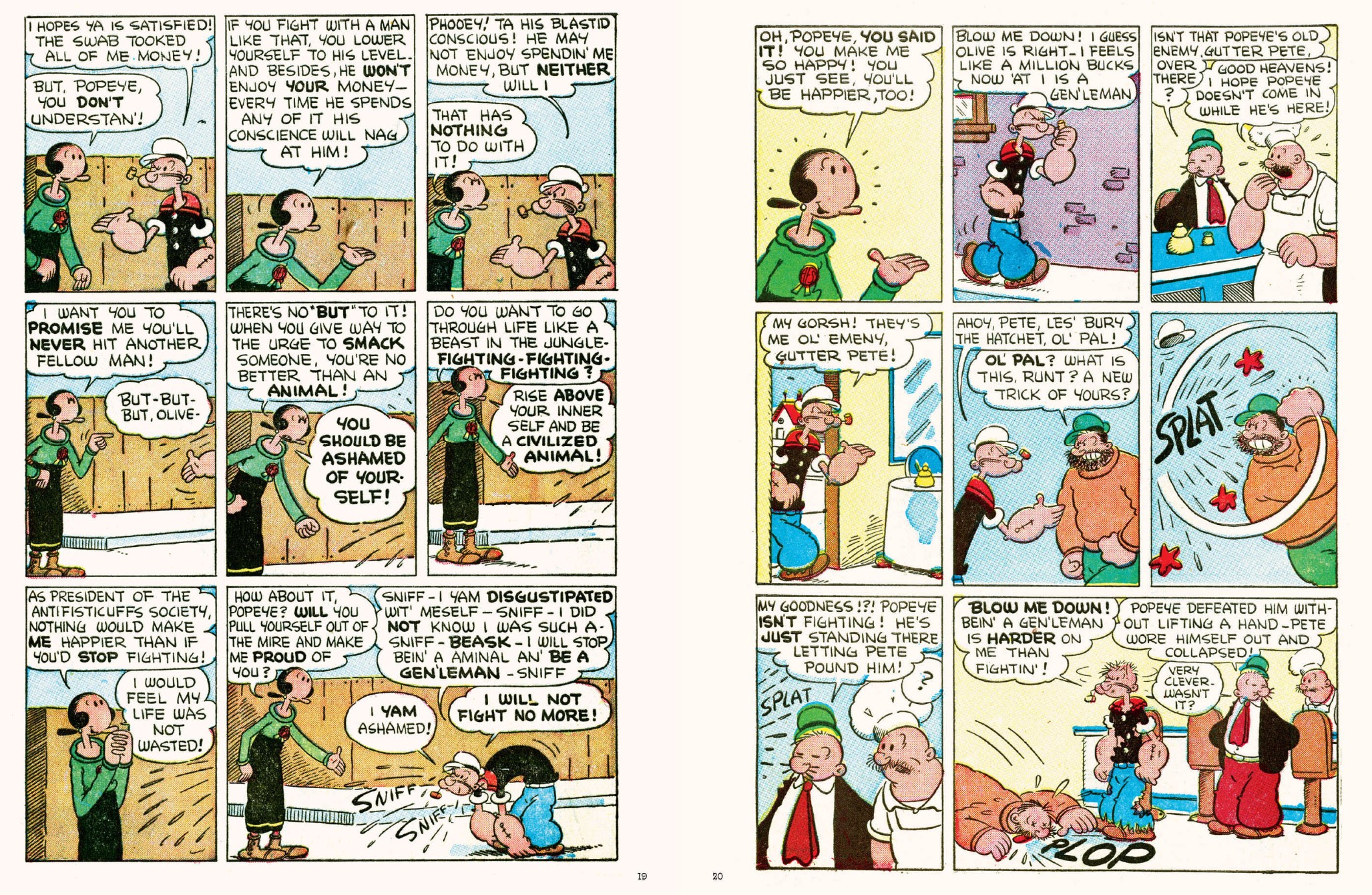
Popeye‘s fantastic first issue launched in February 1948 with no ads and duo-coloured (black & red) single page strips on the inside front and back covers. The initial instant episode finds mighty muscled, irrepressible “infink” Swee’ Pea enquiring ‘Were There Ever Any Pirates Around Here?’ before doing a bit of digging, after which full-coloured extended fun begins with ‘Shame on You! or Gentlemen Do Not Fight! or You’re a Ruffian, Sir!’

As everyone knows, the salty swab earns a lucrative living as an occasional prizefighter and here upcoming contender Kid Kabagge and his cunning manager Mr. Tillbox use a barrage of psychological tricks to put Popeye off his game. The key component is electing Olive Oyl President of the deeply bogus Anti-Fisticuff Society to convince her man to stop being a beastly ruffian and abandon violence. That only works until the fiery frail learns she’s been gulled…

Swee’ Pea then stars in ‘Map Back! Or Back Map!’ as sinister unprincipled villain Sam Snagg tattoos an invisible secret diagram onto the baby’s body(!) before falling foul of the boy’s garrulous guardian when trying to reclaim the kid and divine the location of Spinachovia’s hidden treasures. Wrapping up the full-length action is ‘Spinach Revolt’ as Popeye’s perfidious pater Poopdeck Pappy kicks up a fuss about constantly having to eat healthy food…

As the first Superman of comics, Popeye was not a comfortable hero to idolise. A brute who thought with his fists and had no respect for authority, he was uneducated, short-tempered, fickle (when hot tomatoes batted their eyelashes – or thereabouts – at him); an aggressive troublemaker, who wasn’t welcome in polite society… and wouldn’t want to be. Time changed Popeye and made him tamer but the shocking sense of unpredictability, danger and anarchy he initially provided was sorely missed… so in 1936 Segar brought it back again…

A memorable and riotous sequence of Dailies introduced ancient, antisocial crusty reprobate Poopdeck Pappy. The elder mariner was a hard-bitten, grumpy lout quite prepared – even happy – to cheat, steal or smack a woman around if she stepped out of line. He was Popeye’s prodigal dad and once the old goat was firmly established, Segar set Olive and her Sailor Man the Herculean task of “Civilizing Poppa”. Even at the time of this tale that’s still very much a work in progress…

Fed up with eating spinach, Pappy hides his meals and steals the wherewithal to secretly subsist on a diet of candy, cakes and sodas. He even inveigles the lad next door into being the mule in his scurrilous scheme, but cannot evade the digestive consequences of his actions…

The premiere outing ends with a brace of single pagers detailing how Swee’ Pea deals with persistent salesmen and a day’s fishing before issue #2 commences…

Master moocher Wellington J. Wimpy again has cause to declare ‘Sir! You are a cheapskate!’ before Swee’ Pea & Popeye are swept up in a controversial debate. In ‘That’s What I Yam! or ‘I Yam! I Yam’, the sailor believes his baby boy tough enough to wander around town unsupervised but has reasons to revise his opinion after the kid vanishes. Moreover, when he does resurface, the titanic tyke is subject to strange transformations and behaviours. It’s as if a class of trainee hypnotists have all been using the kid as a practise subject but forgot to bring him out of his trance afterward…

Pappy stars in ‘Easy Money’, with the greedy reprobate realising how much cash his sterling son earns for each boxing bout. Determined to get on the gravy train too, the oldster shaves off his beard and impersonates Popeye. By the time his boy catches wise, Pappy has conned Olive and Wimpy into his scheme and set up a punishing bout with a huge purse, so somebody is going to have to fight…

The issue ends with a two-tone short showing the hazards of bathing Swee’Pea and another full colour back cover gag as a bullying neighbour realises the folly of trying to spank Popeye’s boy…

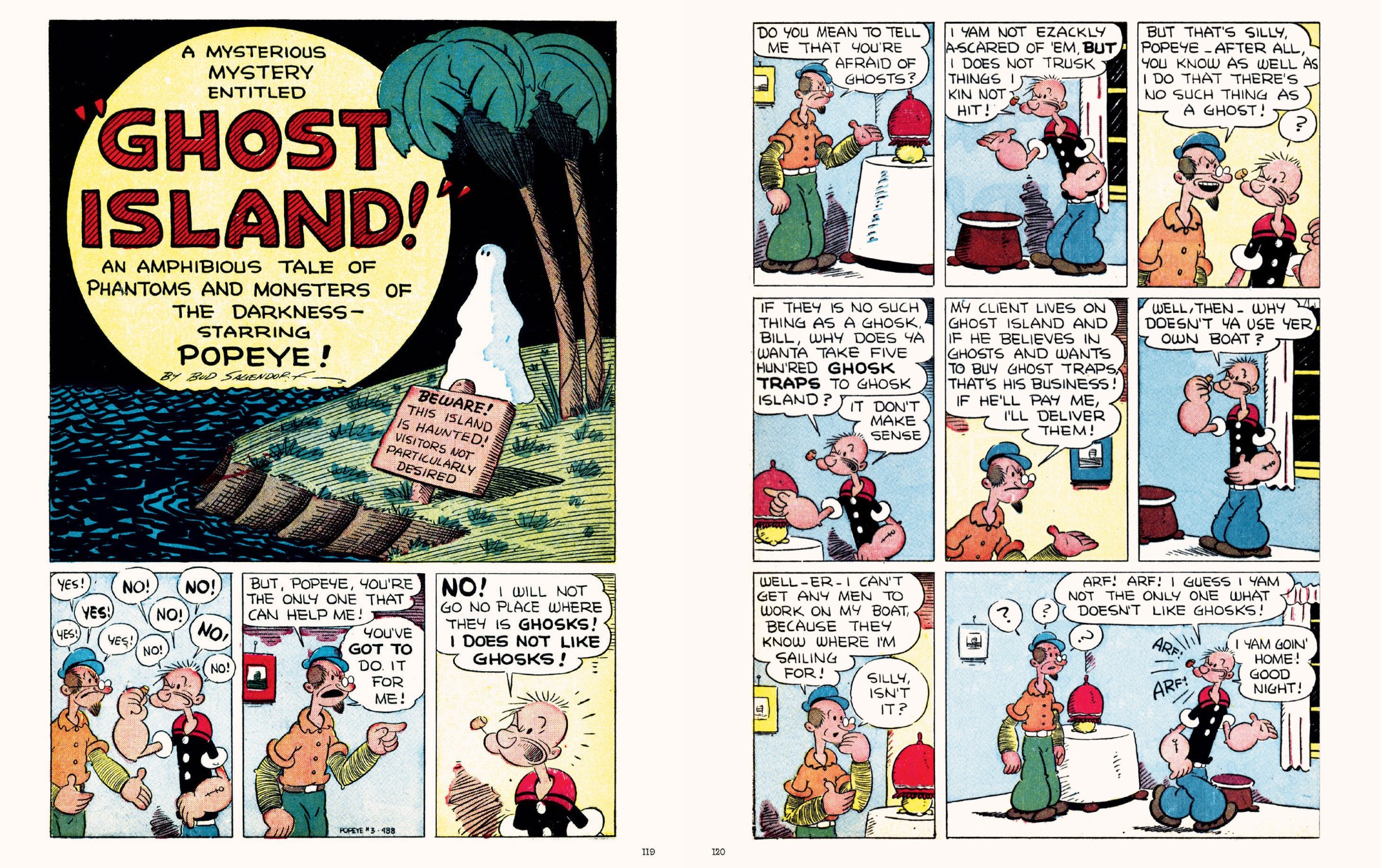
Popeye #3 leads with an epic 32-page spooky maritime epic as the superstitious sailor reluctantly agrees to transport 250 “ghosk” traps to ghastly, radish – and phantom – infested ‘Ghost Island’: a cunning yarn of mystery and over-zealous imagination starring many cast regulars and preceded by a hilarious map of the route replacing the inside-front-cover gag…

Following up is an implausible account of Popeye apparently becoming a violent bully, beating up ordinary citizens in ‘Smash! or You Can Tell She’s My Girl, Because She’s Wearing Two Black Eyes!’ Happily, a doctor at the sailor’s trial is able to diagnose the incredible truth before things go too far, after which Swee’Pea indulges in too much sugar in the red & black bit and learns the manly way to play with dolls on the colour back cover…

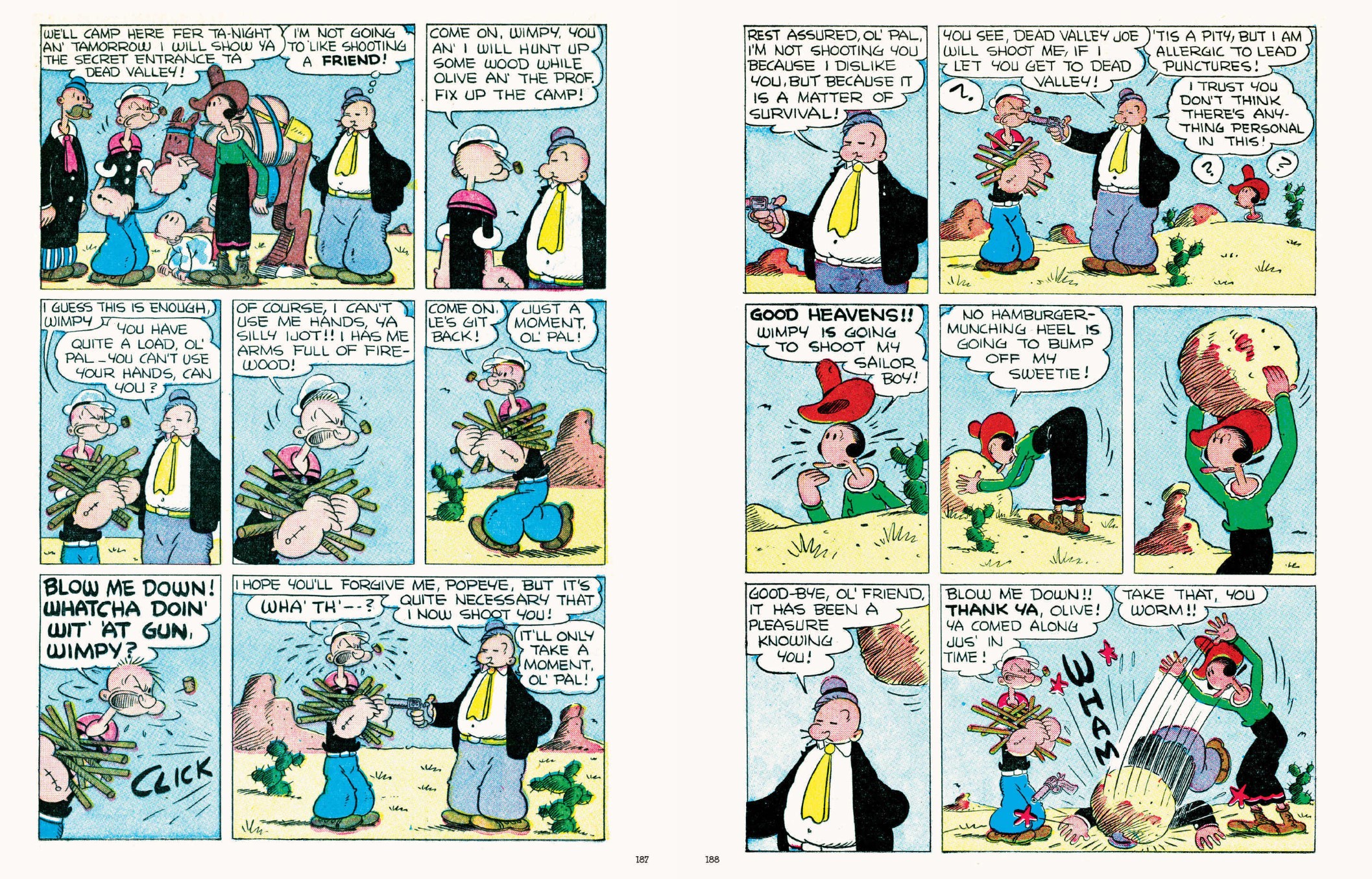
The fourth and final inclusion in this outrageous, timelessly wonderful compilation begins with Wimpy up to his old tricks whilst Popeye hunts ducks, before another extended odyssey finds the Sailor Man and hangers-on Swee’Pea, Olive & Wimpy heading West on safari to capture a rare Ipomoea from sagebrush hellhole ‘Dead Valley’

It’s a grim wilderness Popeye has endured before: an arid inferno no sane man would want to revisit unless a scientist hired him to. Sadly, that’s not the opinion of local bandit boss Dead Valley Joe who assigns all his scurvy gang the task of dissuading or despatching the uppity easterners before they uncover the region’s incredible secret…

Back home again, Olive Oyl receives a surprise ‘Gift from Uncle Ben!’ Sadly, the strange flying beast called a Zoop prefers Swee’Pea’s company, and her warm generosity in donating the beast takes a hard knock when a stranger offers a million bucks for it…

One final brace of Swee’ Pea shorts then sees the wily kid orchestrate free baseball views for his pals before indulging in food politics to win over a stray cat and wrap up in amiable style these jolly, captivating cartoon capers.

There is more than one Popeye. If your first thought on hearing the name is an unintelligible, indomitable white-clad sailor always fighting a great big beardy bloke and mainlining tinned spinach, that’s okay: the animated features have a brilliance and energy of their own (even the later, watered-down anodyne TV versions have some merit) and they are indeed based on the grizzled, crusty, foul-mouthed, bulletproof, golden-hearted old swab who shambled his way into Thimble Theatre and wouldn’t leave. But they are really only the tip of an incredible iceberg of satire, slapstick, virtue, vice and mind-boggling adventure…

There is more than one Popeye. Most of them are pretty good, and some are truly excellent. This book is definitely one of the latter and if you love lunacy, laughter and rollicking adventure you must now read this.
Popeye Classics volume 1 © 2013 Gussoni-Yoe Studio, Inc. All Rights Reserved. Popeye © 2013 King Features Syndicate. ™ & © Heart Holdings Inc.

Today in 1851 pioneering US illustrator A/B. Frost (Br’er Rabbit) was born, and in 1877 Australian artist Cecilia May Gibbs (Gumnut Babies/Bush Babies/Bush Fairies, Bib and Bub, Snugglepot and Cuddlepie, Tiggy Touchwood).

In 1920 epic UK weekly comic Film Fun began with the first of its 2225 issues. Never appearing therein was erotic cartoonist Georges (Blanche Épiphanie) Pichard who was born in the same year.

One year later Cuban Spy vs Spy/Mad magazine mastermind Antonio Prohias was born. As was Spanish artist Alfonso Azpiri (Black Hawk [UK Tornado], Bethlehem Steele, Lorna) in 1947 and Ann Nocenti in 1957 and the astonishing Genndy Tartakovsky in 1970.

Sadly we lost Belgian Pascal Garray in 2017, a quiet star who worked for years largely unheralded on The Smurfs, and Benoît Brisefer/Steven Sterk/Benny Breakiron.

The Squirrel Machine


By Hans Rickheit (Fantagraphics Books)
ISBN: 978-1-60699-646-1 (TPB/Digital edition) 978-1606993019 (HB)

This book includes Discriminatory Content produced in for dramatic effect.

Hans Rickheit was born in 1973 and has been producing skilfully crafted art in different arenas since the 1990s, beginning with self-published minicomics before graduating to full-sized, full-length epics such as Kill, Kill, Kill or The Gloaming. He has also worked in film, music, gallery works and performance art.

A Xeric award beneficiary, he came to broader attention in 2001 with controversial graphic novel Chloe, and has since spread himself wide contributing to numerous anthologies and periodicals such as The Stranger, creating webcomics and instigating the occasional anthology periodical Chrome Fetus.

An avid student observer of dreams, Rickheit has been called obscurantist, and indeed in all his beautifully rendered and realised concoctions meaning is layered, structured and open to wide interpretation. His most approachable and possibly preferred oeuvre is the recondite imagery and sturdily fanciful milieu of Victorian/Edwardian Americana which proved such rich earth for fantasists such as Edgar Allen Poe, H.P. Lovecraft, Clark Ashton Smith and August Derleth, whilst his fine, studied, meticulously clear line is a perfect, incisive counterpoint to the cloud of miasmic mystery and cosmic confusion engendered by the protagonists of his most successful book.

Brothers Edmund and William Torpor abide in an abode in a secluded 19th century New England town but they have never been part of their community. Raised alone by their artist mother, they are quite different from other children, with Edmund especially obsessed with arcane engineering and the assemblage of one-of-a-kind musical instruments from utterly inappropriate components.

Fantastic dream-like journeys and progressions mark their isolated existence, which is far more in tune with a greater metaphysical cosmos, but as puberty gradually moves them to an awareness of base human sexuality, they find the outside world impacting their private one in ways which can only end in tragedy and horror…

Moreover, just where exactly did the plans for the ghastly Squirrel Machine come from¦?

Visually reminiscent of Rick Geary at his most beguiling, this is nevertheless a singularly surreal and mannered design; a highly charged, subtly disturbing delusion that will chill and upset and possibly even outrage many readers.

It is also compelling, seductive, sublimely quirky and nigh-impossible to forget. As long as you’re an adult and braced for the unexpected, expect this to be one of the best books you’ll read this century – or any other…

Out of print for decades, The Squirrel Machine has now been remastered and released in an accessible paperback edition, as well as that futuristic digital doings, just in time to disturb the sleep of a new generation of fear fans just as the winter nights draw in…
© 2013 Fantagraphics Books. Contents © 2009 Hans Rickheit. All Rights Reserved.

Today in 1991 Abbie an’Slats illustrator Raeburn van Buren was born; he shares the day with Ted (Metropol) McKeever, Joe (Daredevil) Quesada, Kala (Girl Genius) Foglio, Hans (The Squirrel Machine, Cochlea & Eustachia, Delia, Chloe) Rickheit and, I’m sure, many others.

However in 2001 we lost Italian mega maven Gian Luigi Bonelli, the man who gave the world Tex Willer.

The Complete Peanuts volume 10: 1969-1970


By Charles M. Schulz (Fantagraphics Books/Canongate Books UK)
ISBN: 978-1-68396-126-0 (US TPB) 978-0857862143 (Cannongate HB)

This book includes Discriminatory Content produced in less enlightened times.

Win’s Christmas Gift Recommendation: Towering Monumental Tradition Writ (and Drew) Large… 10/10

Peanuts is unequivocally the most important comic strip in the history of graphic narrative. It is also the most deeply personal. Cartoonist Charles M Schulz crafted his moodily hilarious, hysterically introspective, shockingly surreal philosophical epic for half a century: 17,897 strips spanning October 2nd 1950 to February 13th 2000. He died – from complications of cancer – the day before his last strip was printed.

At its height, Peanuts ran in 2,600 newspapers, in 21 languages and75 countries. Many of those venues still run it as perpetual reprints, and have done ever since “Sparky” passed. During his lifetime, book collections, a merchandising mountain and television spin-offs had made the publicity-shy doodler an actual billionaire at a time when that really meant something…

None of that matters. Peanuts – a title Schulz loathed, but one the syndicate forced upon him – changed the way comics strips were received and perceived: proving cartoon comedy could have edges and nuance and meaning as well as too-soon-forgotten pratfalls and punchlines.

We begin with an effusive and enthusiastic foreword from author/animator/illustrator Mo Willems (Don’t Let the Pigeon Drive the Bus!, Knuffle Bunny, Sheep in the Big City) expressing his debt to the strip.

On the pages, this period heralds a true renaissance probably triggered by headlines in an era of swiftly shifting changes in social attitudes and rampant cultural exploration. Notionally, our focus and point of contact remains quintessentially inspirational loser Charlie Brown who, despite slowly taking a few steps behind fanciful, high-maintenance mutt Snoopy, remains squarely at odds with the mercurial supporting cast. They are still hanging out doing what at first sight seems to be Kids Stuff in an increasingly hostile and intrusive universe of perverse happenstance. Except perhaps that Lucy Van Pelt kid. She’s not like the others…

Neatly interspersed with daily doses of gloom, the Peanuts Sunday page first debuted on January 6th 1952: a standard half-page slot offering more measured fare than 4-panel dailies. Thwarted ambition, sporting failures, crushing frustration abound, alternating with Snoopy’s inner life of aviation and war stories, star gazing, shooting the breeze with bird buddies, weather woes and food fiascos. These and other signature sorties across the sabbath indulgences afforded Schulz room to be his most imaginative, whimsical and provocative…

Regular tentpole moments to relish include more Snoopy v Lucy deathmatches/ambush snogs/dance offs; Charlie Brown’s food feud with the beagle, an assortment of night terrors; Lucy’s emphatically simple solutions to complex questions; doggy dreams; the power of television; sporting endeavours and the sharply-cornered romantic triangle involving Lucy, Schroeder & Beethoven – albeit wedded to “sophisticated” fallout when pushy Frieda decides she also wants to play…

Always, gags centre on play, varying degrees of musicality, pranks, interpersonal alignments, the mounting pressures of ever-harder education, mass media lensed through young eyes and a selection of sports in their season. All are leavened by agonising teasing, naked contempt, kindled and crushed hopes, the making of baffled observations and occasionally acting a bit too much like grown-ups. However, in this tome, themes and tropes that define the entire series (especially in the wake of many animated TV specials) become mantra-like yet endlessly variable, but focus less on Charlie and more on those around him. Also, the outside grown-up world considerably encroaches, as when Lucy declares herself a “ New Feminist” although no one looking can see any difference to any presumably previously un-enlightened Miss van Pelt…

Human interactions still find the boy a pitiable outlier. Mean girl Violet, musical prodigy Schroeder, self-taught psychoanalyst/dictator-in-waiting Lucy, her brilliantly off-kilter little brother Linus and dirt-magnet “Pig-Pen” are fixtures honed and primed to generate joke-routines and gag-sequences around their signature foibles, but some early characters have faded away in favour of fresh attention-attracting players. Newcomers sidle in and shuffle off without much flurry or fanfare but in our real world the use of “Minority” characters José Peron of New Mexico and African American Franklin drew much attention and controversy – because, I guess, there will always be gits and arseholes – especially if the oblivious readers elected them…

The most significant expansion is that weird upside bird bugging the beagle gets a name – Woodstock (as revealed on June 22, 1970) – and a job as his dogsbody – secretary, actually – whilst shock near-cripples the round-headed kid when he discovers that the “little red-haired girl” he almost plucked up the nerve to talk to moves to a new city. It’s a blow he’s still reeling from when this book ends two years later, and one only Linus really understands. After all, his teacher Miss Othmar is gone after the teacher’s strike…

There is much more madcap politically-tinged material, including repeated riffs on a recently inaugurated new real-world president (Richard Milhous Nixon on January 20, 1969) as seen when Snoopy briefly becomes the most powerful mutt in the Free world after being chosen as the new Grand Beagle…

At least the Brown boy’s existential crisis/responsibility vector/little sister Sally has grown enough to become just another trigger for relentless self-excoriation. As she grows, pesters librarians, forms opinions and propounds steadfastly authoritarian views, Charlie is relegated to being her dumber, but eternally protective, big brother especially as her biggest bugbear is starting school and Charlie is such an expert on all things scholastic…

Resigned to – but far from uncomplaining about – life as a loser in the gunsight of cruel and capricious fate, the boy Brown is helpless meat in the clutches of openly sadistic Lucy. When not sabotaging his efforts to kick a football, she monetises her spiteful verve via a 5¢ walk-in psychoanalysis booth (although supply and demand economics also affects this unshakeable standard), ensuring that whether at play, in sports, kite-flying or just brooding, the round-headed kid truly endures the character-building trials of the damned.

One deliciously powerful constant that grows more abundant is the boy’s utter inability to fly that kite. Here war with wind, gravity and landscape reaches absurdist proportions, as the tree haunts Charlie Brown’s adored pastime with vicious, violent and malign venom. Moreover, other kids are aware of its growing power. After one terse musical interlude with Schroeder, Lucy lobs our reluctant lover-boy’s beloved piano into the voracious carnivorous conifer…

By now, the beagle is the true star of the show, with his primary quest for more and better playing out against an increasingly baroque inner life, wild encounters with birds, sports, dance marathons and skating trysts (especially the close-order combat called ice hockey!), philosophical ruminations, and ever-more-popular catchphrases. Here, burgeoning whimsy leads to more glimpses of the interior world: his WWI other life, peppered with dogfights against the accursed Red Baron, but also careers as an astronaut, a sports coach, a prairie dog and a detective seeking his lost mother. That tragic obscured past as an alumni of the Daisy Hill Puppy Farm leads to constant introspection… and dancing… lots and lots of dancing…

Naturally, Snoopy soon subverts all that misery and curiosity to fuel his creative side and begins the Great American Novel that will change literature forever… but that’s before the Browns go on vacation and leave the dog with the Van Pelts. Naturally, Lucy has an idea about finally fixing the pooch. It doesn’t end well…

As always, timeless episodes of play, peril, peewee psychoanalysis and personal excoriation are beards for some heavy topics. Rendered in marvellous monochrome, there are crucial character introductions, plot developments and creation of more traditions we all revere to this day. Of particular note is the growing role of Patricia Reichardt – AKA tomboy Peppermint Patty – who heartbreakingly deals with the so-early discovery that she will never be pretty or beautiful. Even Snoopy’s most concerted efforts can’t quite salve that sting…

Another trenchant continued gag-series resumes Lucy obsessive attempts to “cure” Linus of his blanket dependency by again playing him off against Grandma who will give donations to charities if the boy grows up…

Snoopy is the only force capable of challenging if not actually countering Lucy. Over these two years, her campaign to curb that weird beagle, cure her brother of blanket addiction and generally reorder reality to her preferences reaches astounding heights and appalling depths, but the dog keeps trying and scores many minor victories. As always the book opens and closes with many strips riffing on snow, food, movie-going and television – or the gang’s responses to it – becoming ever more pervasive. And as always, Lucy constantly, consistently sucks all the joy out of the white wonder stuff and the astounding variety offered by the goggle-box. Perpetually sabotaged, and facing abuse from every female in their life, Brown and Snoopy endure more casual grief from smug, attention-seeking Frieda, who champions shallow good looks over substance. At least Linus is growing: hardened inside by what happened to teacher Miss Othmar, but Lucy’s amatory ambitions for Schroeder grow ever more chilling and substantive. She will never move on…

Schulz established way points in his year: formally celebrating certain calendar occasions – real or invented – as perennial shared events: Mothers and Fathers’ Days, Fourth of July, National Dog Week strips accompanied in their turn yearly milestones like Christmas, St. Valentine’s Day, Easter, Halloween/Great Pumpkin Day and Beethoven’s Birthday were joined this year by a return to another American ritual as many of the cast return to summer camp. At least there is unbridled joy when Brown’s baseball team hits a winning streak and Charlie meets his all-time sporting idol – except of course they’re not quite the boons they first appear…

Sports loom large and terrifying as ever, but star athlete Snoopy is more interested in new passions than boring old baseball or hockey. Even Lucy finds far more absorbing pastimes but still enjoys crushing the spirits of her teammates in whatever endeavour they are failing at. Anxiety-wracked Brown even steps down from the baseball team to ease his life, but that only intensifies his woes, and does nothing to help his kite wielding or football kicking…

Linus endures more disappointment in two Great Pumpkin seasons and before you know it, there’s the traditional countdown to Christmas and another year filled with weird, wild and wonderful moments…

Wrapping it all up, Gary Groth celebrates and deconstructs the man and his work in ‘Charles M. Schulz: 1922 to 2000’, preceded by a copious ‘Index’ offering instant access to favourite scenes you’d like to see again…

Available in multiple formats, this volume guarantees total enjoyment: comedy gold and social glue metamorphosing into an epic of spellbinding graphic mastery that still adds joy to billions of lives, and continues to make new fans and devotees long after its maker’s passing.
The Complete Peanuts: 1969-1970 (Volume Ten) © 2008 Peanuts Worldwide, LLC. The Foreword is © 2008, John Waters. “Charles M. Schulz: 1922 to 2000” © 2008 Gary Groth. All rights reserved.

Today in 1946 Lucky Luke “debuted” in the Spirou Alamanch Annual – except if you read Lucky Luke: The Complete Collection Volume One you’ll know that ain’t necessarily so…

And in 1970 the incredible Rube Goldberg shuffled off this mortal coil. It was probably one he had designed in his masterful cartoons. Go google Rueben Awards

Lobey’s The Wee Boy! – Five Lobey Dosser Adventures by Bud Neill


By Bud Neill, compiled by Ranald MacColl (Mainstream Publishing)
ISBN: 1-85158-405-6 (PB)

This book includes Discriminatory Content produced in less enlightened times.

Win’s Christmas Gift Recommendation: Get it! Get It! GET IT! …10/10

A wee while ago we covered Desperate Dan and I bravely questioned what is it with the Scots and Cowboys. Graciously ignoring any subsequent comments since, I’m just going to point to this out now…

Nobody’s ever accused me of being sensitive to the tone of the times, but with a cold snap on and all thoughts directed north of the border for now, I’m focussing on this superbly fitting dose of Celtic (more properly Glaswegian) cartoon magic today. It’s the work of a tragically near-forgotten genius of pen & brush who should rightly be a household name wherever people like to laugh and ponder the absurdity of existence, no matter what flag they fly.

William Neill – forever immortalised as “Bud” – was Partick-born in 1911, just before the family moved to Troon in Ayrshire. He was a typical kid and fell in love with the brash wonder of silent movies – most especially the rambunctious westerns of William S. Hart. His other great drive was a love of horses, and he could always be found hanging around stables, trading odd jobs for the chance of a few minutes’ riding…

After being done with school the young artistic star won a place at Glasgow School of Art and, in the late 1930s, briefly emigrated. Bud worked in Canada and deftly absorbed the still-developing tricks of America’s greatest newspaper cartoonists during their creative heyday. He then served as a gunner in WWII before being invalided out and ending up a bus driver. These varied experiences led to his creating a series of pocket cartoons starring the “Caurs & Clippies” of Glasgow’s tramcar system.

By 1944 Bud was drawing for the Glasgow Evening Times: sharp, wry observational pieces starring the city and its inhabitants, characterised by devastating, instantly enchanting use of the iconic rhythms, vernacular and argot everyone shared. In January 1949, The Evening News began running the uniquely surreal escapades of his greatest creation.

Sheriff Lobey Dosser of Calton Creek was a brilliant, magnificent inspiration: the ongoing adventures of a canny wee lawman in a hauntingly typical western town but populated exclusively by Scots (from Glasgow’s Calton district, presumably) all living an outrageously domestic, hilariously apt inner-city life and tricked out in cowboy hats and with six-guns.

Delving deep into the venerable, anarchic, often surreal material of pantomime and music hall, Bud crafted a supremely odd, anachronistically familiar, bizarrely inviting world of inviting solecism masquerading as local events and exotic adventure. The series transferred to The Sunday Mail in 1956, supported by previous, complete strip adventures collected as instant sell-out, one shilling landscape booklets (all incredibly sought after collectors’ items these days).

Neill died in 1970, but his work steadily continued to garner fans and acquire a mythical status, so by the middle of the decade Glasgow artist and sculptor Ranald MacColl began work on a biography. That in turn led to a series of graphic collections such as this one and eventually belated recognition for Neill and his most memorable creations. Bud was celebrated in exhibitions, galleries and – following Glasgow’s becoming European City of Culture in 1990 – two separate bronze statues (Lobey, Rank Bajin and noble steed Elfie in Woodlands Road and, in Homecoming Year 2009, The G.I. Bride and her “Wean” at Partick Station), funded by public donations, Strathclyde Passenger Transport and private sponsors.

Hard to find but so worth the effort, Lobey’s The Wee Boy! gathers five of those shilling collections in a sensibly narrative chronological – not publication or even creation – order, and is packed with informative extras. These include MacColl’s fascinating historical and atmospheric Introduction and a hilarious Prologue by Bud himself from 1958, before the astonishing origin of the champion of Calton Creek is revealed in ‘Lobey Dosser: His Life Story’. On a rare quiet day the grizzled sheriff recounts his early life to a jail full of impressionable young’uns…

Once upon a time in auld Glesca, a mother had one bairn too many. One day, to spare her further hardship, the precocious tyke put his possessions in a hanky on a stick and headed off to make his way in the world. Although but a few months old, he rejected being fostered out to his mean Auntie Mabel and joined a merchant ship under tyrannical Captain Blackswite, unaware that the big shouty blackguard was a pirate…

After many exciting years at sea Lobey jumped ship and was befriended by cannibals and their erudite chief Hannibal which led to more exploring, meeting monsters and other strange things before encountering a race of Oxbridge-educated white savages and happily acquiring a rare two-legged horse. El Fideldo would become his greatest friend and inseparable companion.

Together they made their way to Mexico where the wee wanderer discovered an unsuspected talent for upholding the law and keeping the peace. After cleaning out a nest of vicious banditos, the restless pair headed north and fetched up in Laredo, Texas where a disastrous love affair with Adoda, formidable daughter of wealthy Whisk E. Glorr led to a clash with rustlers led by scurrilous Watts Koakin

His heart broken – even though he had cleaned up the range – Dosser & Elfie kept heading west until they reached Arizona and first met future archnemesis Rank Bajin selling out the wagon train he was guiding to the local Sioux. Rescuing the embattled settlers, Lobey opted to stay with the Scots expats as they built a town in the wilderness. They called it Calton Creek…

Wild, imaginative and with every daily episode fully loaded with sight gags, striking slapstick, punishing puns, cartoon in-jokes and intoxicating vernacular, each Lobey Dosser tale was a non-stop carnival of graphic mirth. This terrific tome continues in fine fettle with ‘The Mail Robbery’ wherein nefarious Bajin attempts to incite an Indian uprising amongst the Pawnee of Chief Toffy Teeth, and at one point leaves the little lawman to die of thirst in the searing deserts. Moreover, as the scorched sheriff struggles and strives to survive, the naive citizens are left to adapt to a protective occupation by flash Yankee G.I.s and airmen…

Sardonic and satirically cutting, the yarn also sports one of the best – and daftest – horseback chases in entertainment history…

Romance and mystery abound in ‘The Secret of Hickory Hollow’ as that Bajin scoundrel buys up the mortgage on Vinegar Hill’s farm and attempts to evict and kick out the old coot and his substantial niece Honey Perz. The villain has gotten wind of a mineral resource on the property that would make a man as wealthy as the Maharaja of Baroda, or perhaps even a regional Deputy Superintendent of the Coal Board…

When Lobey organises the cash needed to pay off the outstanding loan, Bajin reluctantly resorts to the last resort and begins romancing sweet, innocent, hulking Honey. It all looks bleak for justice until the sheriff befriends an astoundingly good-looking and wholesome uranium prospector named Hart O’Gold who quickly tickles Honey’s fickle fancy. However nobody – including ghostly guardian Rid Skwerr – is prepared for the Soviet spies behind the entire affair to jump in and take over…

Ultimately it needs the timely intervention of mystic imp Fairy Nuff to save everyone’s accumulated hash before the Dosser can finally expose the viper in the nest…

The local natives are always up to mischief and ‘The Indian War’ kicks off when the Railroad tries to lay track through Pawnee territory just as Chief Rubber Lugs of the Blackfeet Tribe revisits an old and outstanding grudge with counterpart commander Toffy Teeth. Ineffectual Captain Goodenough arrives with a division of cavalry to safeguard the white citizenry but matters soon worsen, painfully exacerbated when the folk of Calton Creek take advantage of Lobey’s absence (he’s trying to negotiate with both bunches of bellicose braves) to run Bajin out of town. Instead, the hooded hoodlum starts freely peddling weapons to all sides…

… And then Bajin kills Lobey and takes over the town.

… And then…

The final yarn in this masterful monochrome tome of tall tales is the most incredible of all as ‘The “Reform” of Rank Bajin’ sees the vile villain scooting around Calton Creek doing good deeds and selling off his astounding arsenal of wicked weapons and cunning contraband. Baffled, perplexed, confused and not sure what’s going on, Lobey asks Boot Hill-haunter Rid Skwerr to spy on the no-longer-reprehensible Rank. Even love-struck Fairy Nuff gets in on the act before the astounding truth finally emerges.

Bajin has a boy who is growing up honest, so is selling up and returning to the family he deserted in Borstal Bluffs, Iowa to sort the shameful lad out. Knowing the tremendous vacuum his absence will leave in Calton’s exciting landscape, he has, however, a recommendation for a locum archenemy for his archenemy…

Can this possibly all be true or is the beastly Bajin executing his most sinister scheme yet?

Cunningly absurdist, socially aware, humorously harnessed insanity in the manner of Spike Milligan, Michael Bentine and the immortal Goon Show, the adventures of Lobey Dosser are a brilliant example of comic strips perfectly tailored to a specific time, place and audience: targeted treats which can magically transcend their origins to become masterpieces of the art form.

It’s also side-splitting, laugh-out-loud, Irn Bru spit-take hilarious and really needs to be recollected for today’s audiences.

And of course that’s what I really want: a complete reprinting of these sublimely perfect spoofs.

Trust me Pal: once you read some so will you… even if you ain’t no Scottisher…
© Ranald MacColl 1992. All rights reserved.

Today in 1959 Argentine artist Eduardo Risso was born. Sure, you’ve seen 100 Bullets, Sgt. Rock and Batman, but have you checked out Red Moon?
In 1986 unsung legend Norman Maurer died. When someone published stuff by the co-originator of 3D comics, the Three Stooges comics and much more, we’ll cover it.
In 2003, Berke Breathed’s Bloom County & Outland star began his own eponymous Sunday strip. Naturally. Opus soon fluffed it all up…
If you’re American, you probably wouldn’t be reading this or any strip stuff if it wasn’t for “father of comics fandom” Dr. Jerry Bails, who died today in 2006 with his job so very well done.

The Legend of Desperate Dan – 60 Years of Classic Cartoon Art


By Dudley D. Watkins, with Charles Grigg, Ken Harrison & various (DC Thomson & Co)
ISBN: 978-0-85116-657-5 (tabloid HB)

This book includes Discriminatory Content produced in less enlightened times.

It needs to be said. Scotland is an ancient and proud nation steeped in unique history, character and culture, and one that has enriched the entire world. That having been said, they all seem to have a rather odd and frequently disturbing fascination with the notion of cowboys…

A timeless case in point is an icon of action and hilarity who began life as a mere half-page feature in the very first issue of The Dandy. The rowdy roughneck (and chin, and chest and…) was first seen fleeing town on December 4th 1937, but has since mellowed, found a family and settled down, He’s still the Strongest Man on Earth and always in trouble because he doesn’t know his own strength…

As seen in the eponymous opening historical section of this colossal tome, ‘The Legend of Desperate Dan’ predates Superman’s debut and owes more to Elzie Segar’s maritime masterpiece Popeye (as seen back then in Thimble Theatre) by way of a countless stampede of Saturday morning movie two-reelers. However Desperate Dan didn’t roam too long on the range and swiftly garnered a family including formidable Aunt Aggie, super-tough nephew Danny, niece Katey, the hard-pressed Mayor, Sheriff and so forth… and lots of put-upon, shell-shocked neighbours usually caught in the catastrophic aftermath of Dan’s latest efforts to help…

Like so many of DC Thompson’s most memorable stars, the Big Guy was the brainchild of Dudley D. Watkins (1907-1969) at his most imaginative and culturally adroit. A tireless and prolific illustrator equally adept at comedy, adventure, educational and drama storytelling, Watkins’ style more than any other shaped the pre and especially postwar look and form of the Scottish publishing giant’s comics output. Yes, the company AND the cowboy…

Watkins started life in Manchester and Nottingham as an artistic prodigy prior to entering Glasgow College of Art in 1924. Before long he was advised to get a job at expanding, Dundee-based Thomson’s, where a 6-month trial period illustrating prose “Boys’ Papers” stories led to comic strip specials and some original cartoon creations. Percy Vere and His Trying Tricks and Wandering Willie, The Wily Explorer made him the only contender for both lead strips in a bold new project conceived by Robert Duncan Low (1895-1980). Managing Editor of Children’s Publication. Between 1921 – 1933, Low launched the company’s “Big Five” story papers for boys: Adventure, The Rover, The Wizard, The Skipper and The Hotspur. In 1936, he created the “Fun Section”: a landmark 8-page comic strip supplement for national newspaper The Sunday Post. This illustrated accessory – prototype and blueprint for every comic the company subsequently released – was launched on 8th March. From the outset, The Broons and Oor Wullie were the uncontested headliners… and both illustrated by Watkins. The other features included Chic Gordon’s Auchentogle, Allan Morley’s Nero and Zero, Nosey Parker and others. These pioneering comics laid the groundwork for the company’s next great leap. In December 1937 Low launched DC Thomson’s first weekly all-picture strip comic, The Dandy. Amidst the serried rank of funsters was a half-page western gag strip. It related the riotous outrages of a mean desperado dubbed Dan…

Dan was extremely popular and in 1939 briefly enjoyed taking up 75% of a page before expanding onto the star status of a full one. Famously, Dandy editor Alber Barnes – who hired Watkins and was the comic’s boss until 1982 – was the model for that unmissable chin. Almost everything else was made up…

This collation offers a wealth of strips, beginning with those calamity-stuffed half-pagers, filled with mighty gaffes, massive consumption and appalling comedic animal cruelty, all preceding the inevitable war contributions as the officially neutral US citizen kept finding ways to bugger up Hitler and Goebbels’ plans for Britain. Another cautionary note: back then smoking tobacco was MANLY, so Dan did it in vast and generally competitive amounts. Be warned and wary…

Monochrome trips about eating, fighting, shaving, Dan’s Girlfriend Lizzie, eating, fighting some more and getting even pause for a colour featurette on ‘The Dandy Monster Comic’ as Dan hoved further westward into Books and Annuals before the strips concentrate on the ‘War years’ with Cactusville slowly morphing in all but name into a fair-sized Scottish town as Dan inflicted ever more outlandish punishments on the weary, wary Wehrmacht…

Feature on firsts follows with ‘Desperate Dan’ shouting out to his ever expanding cast, after which post-war tales encompass a momentous trip to the North Pole; jobs; cow pie; sweet rationing; clothing for the bigger man; bank robbers; cow pie; how feeble modern buildings are; toothache for tough guys and how meat rationing impacts on the mightiest appetite ever known. Once again it’s some pretty hard sledding for us wimpy modern animal-lovers…

Covers, strips and other treats from the Christmas tomes explore Dan’s unstoppable progress and includes a spread on ‘Back Covers on Annuals’ – the cowboy’s sole province from 1954 to 1965 – before segueing into a 1950s selection as Britain, Empire & Commonwealth and Dandy underwent dramatic revision and change…

The Watkins-limned prose yarn ‘Two Desperate Tiddley-Winkers’ leads to more fifties fun with Dan no longer in any way intentionally dangerous in strips covering the star’s invulnerable hair & bristles, coal mining in the High Street; cow pie; and Dan’s utterly unique pedal bike (take one steamroller and three parts tractor…) before closing on a momentous moment of history as Dan voyages to London to see the Queen’s coronation as originally published in Dandy dated June 6th 1953…

‘The Desperate Dan Song’ – sorry, just words & pictures so you’ll need to wrangle up your own tune – leads into more strips with enhanced roles for Danny & Katey, prior to the Sixties revivals opening with ‘Annual features’ including a glance at Dan’s primordial forebear Desprit Jake.

With contemporary strips coming thick & fast the fun is closely followed by two-colour Annual larks involving li’l Dan’s photo-day at ‘Cactusville School’ whilst – happily mining a fresh seam – ‘Desperate Dan’s Schooldays’ (as illustrated by Charles Grigg and first published in the Desperate Dan Annual 1979) gives readers another bucket of whimsical back-story from the big man boyhood as the end approaches.

In 1984, the Biggest Yin made it to the front – and back – of the weekly Dandy covers, displacing Grigg’s Korky the Cat after five straight decades. Here a full colour spread celebrates an anniversary year with a quartet (octet?) of images shouting out fifty years of Desperate astonishment wonder before we unsaddle for the moment with final modern colour feature ‘The Hobbies of Desperate Dan’ as seen in the 1994 Dandy Annual and showing what the term “extreme sports” really means…

Timeless, hilarious and not nearly as tame as you thought, Desperate Dan is a pure paradigm of our lengthy comics glory – and disregard for other people’s culture. Here is a book that – if you’re properly braced and forewarned – will delight and warm your secret, stifled cartoon coloniser’s heart.
© D.C. Thomson & Co Ltd 1997.

Today in 1913 Golden Age artist Charles (Spy Smasher, et al) Sultan was born. In 1943, Metabarons artist Juan Giménez was born. You might also want to peek at A Matter of Time, before celebrating that in 1962 Darwyn Cooke (DC: The New Frontier, Batman: Ego, Parker) joined us for far too short a time.