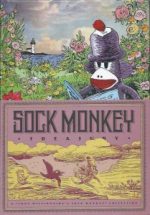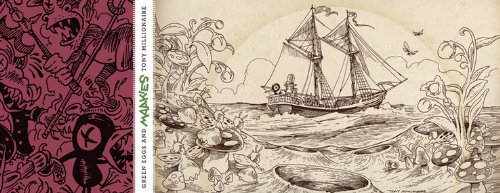
Sock Monkey Treasury: A Tony Millionaire’s Sock Monkey Collection


By Tony Millionaire (Fantagraphics Books)
ISBN: 978-1-60699-696-6 (HB)

Tony Millionaire loves to draw and does it very, very well: referencing classical art, classic children’s book illustration and an eclectic mix of pioneering comic strip draughtsmen like George McManus, Rudolph Dirks, Cliff Sterrett, Frank Willard, Harold Gray, Elzie Segar and George Herriman. These influences, styles and sensibilities he seamlessly blends with the vision of European engravings masters from the “legitimate” side of the pictorial storytelling racket. The result is eye-popping

Born Scott Richardson, he especially cites Johnny (Raggedy Ann and Andy) Gruelle and English illustrator Ernest H. Shepard (The Wind in the Willows, Winnie the Pooh) as definitive formative influences.

He has a variety of graphical strings to his bow – such as his own coterie of books for children like the superbly stirring Billy Hazelnuts series; animation triumphs and the brilliant if disturbing weekly strip Maakies – which describes the riotously vulgar and absurdly surreal adventures of an Irish monkey called Uncle Gabby and his fellow über-alcoholic and nautical adventurer Drinky Crow. They are abetted but never aided by a peculiarly twisted, off-kilter cast of reprobates, antagonists and confrontational well-wishers. However, those guys are the mirror universe equivalents of the stars of this sublime confection, gathering many past glories in one huge (286 x 203mm), sumptuous 336-page hardback – 80 in full colour. It collects twelve uniquely dark and fanciful multiple award-winning, all-ages adventures originally published as occasional miniseries between 1998 and 2007 by Dark Horse Comics. Also included are the two-colour hardcover storybooks Millionaire created in 2002 and 2004. Should you prefer, the tome is also available in digital editions.

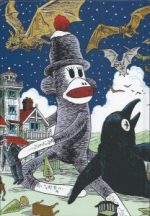
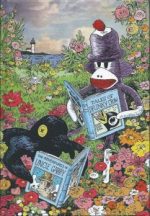
In a Victorian House – of variable shape and size – by the sea, an old Sock Monkey named Uncle Gabby has great adventures and ponders the working of a wonderful yet often scary world. His constant companion is a small cuddly-toy bird with button eyes. Mr. Crow doesn’t understand why he cannot fly and sometimes eases his sorrow with strong spirits.

Their guardian is a small girl named Ann-Louise, and many other creatures living and artificial share the imposing edifice…

The gloriously imaginative forays into the fantastic begin as the material monkey is chased through the house by marauding toy pirates in their bombastic brigantine. In his flight, Uncle Gabby espies a gleaming, glittering glass concoction hanging from the ceiling. Convinced something so beautiful must be the Promised Land, he enlists his artificial avian pal to help him enter ‘Heaven’. Sadly, the pirates have not given up and the chaos soon escalates…

‘Borneo’ describes the pair’s discovery of a shrunken human head and subsequent heroic oceanic odyssey to return the decapitated talisman to its home. Of course, if they had thought to unseal the sewn-shut lips, he could have told them they were going in the wrong direction…

The next tale is a macabre all-action thriller which begins when a lost bat gets stuck in the attic ‘Dollhouse’. Mr. Crow, meanwhile, is attempting to console freshly widowed Mrs. Smalls in the cellar. Things go even more savagely awry when the faux crow and well-meaning matchmaker Monkey seek to introduce the grieving mouse to the strapping, winged stranger, utterly unaware of his pedigree as a South American Rodent-Eating Bat…

Knick-knacks, trinkets and ornaments have been going missing in the next tale, and Ann-Louise attributes the thefts to ‘The Trumbernick’ who lives in the Grandfather clock. Having mislaid his hipflask, Mr. Crow investigates and finds the horde of goodies, in truth purloined by a capricious Blue Jay…

Disillusioned by the death of a beloved myth and disheartened by the antics of a venal – and extremely violent – bird, they are subsequently stunned to see an actual Trumbernick return, righteously enraged at the blow to his spotless reputation…

In ‘The Hunters’, stuffed bird and Sock Monkey – inspired by a room full of trophies and stuffed beasts – decide to take up the sport of slaughter. All too soon they find that their size, relative ineffectuality and squeamishness – not to mention the loquacity and affability of their intended prey – prove a great impediment to their ambitions…

Millionaire proves the immense power of his storytelling in ‘A Baby Bird’, as Uncle Gabby’s foolish meddling with a nest – after being specifically told not to – results in tragedy, with brutal self-immolating repercussions that would make King Lear quail…

The author abandoned masterful pen-&-ink etching style for soft mutable charcoal rendering in ‘The Oceanic Society’, wherein excitable doll Inches unknowingly performs an act of accidental cruelty at the shore: inviting the vengeance of many outraged sea creatures against the inhabitants of Ann-Louise’s house…

An innocent attempt by the little girl and Mr. Crow to find Uncle Gabby a romantic companion goes hideous wrong and results in monstrous ‘Heartbreak’ when they throw away his actual true love and replace her with a ghastly mechanical monkey horror. The bereft puppet can then only find surcease in escalating acts of hideous destruction…

In 2002 Millionaire took his characters into a whimsical watercolour wonderland with “a Populare Pictonovelette” hardback entitled ‘The Glass Doorknob’. The beguiling tale is included here in a series of full-colour plates supplemented by blocks of text, describing how the house dwellers once saw an indoor rainbow beneath a doorknob and subsequently spent all summer trying to recreate the glorious spectacle by acquiring and aligning every other item of glass, crystal or pellucid material they could find or steal…

The return to stark monochrome augurs the onset of terrifying 4-part epic ‘The Inches Incident’ which begins off the coast of Cape Ann when grizzled mariner Oyster Joe discovers thieving stowaways plundering his sailing ship.

Amidst spectacular hunts for sea monsters, those villains Uncle Gabby and Mr. Crow explain how their former friend Inches mysteriously shanghaied and dumped them at sea…

Their new ally returns them home, but upon arrival they discover that the doll has become Evil! Boldly braving the house, they discover the poor creature has been possessed by an inconceivable horror which drives them off and provokes a fantastic sea voyage to find the devil’s only nemesis…

This staggering, bleakly charming compendium closes with an existential treat from 2004. Coloured by Jim Campbell, ‘Uncle Gabby’ was another one-shot hardback – albeit in standard comics format – which offered a few revelatory indulgences on the puppet heroes’ poignant origins, all wrapped up in a baroque bestiary and imaginative travelogue as Sock Monkey discloses his shocking ability to un-name things and thereby end their existences…

Visually intoxicating, astoundingly innovative and stunningly surreal, Sock Monkey yarns judiciously leaven wonder with heartbreak and gleeful innocence with sheer terror. Millionaire describes them as for “adults who love children’s stories” and these tall tales all offer enchanting pictorial vistas and skewed views of the art of storytelling that no fan of comics or fantasy could ever resist.
Sock Monkey Treasury © 2014 Tony Millionaire. This edition © 2014 Fantagraphics Books.

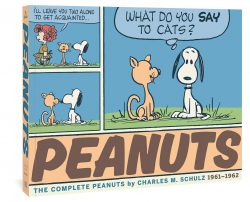
The Complete Peanuts volume 6: 1961-1962


By Charles M. Schulz (Fantagraphics Books)
ISBN: 978-1-56097-672-1 (HB) 978-1-60699-949-3 (PB)

Peanuts is unequivocally the most important comics strip in the history of graphic narrative. It is also the most deeply personal. Cartoonist Charles M Schulz crafted his moodily hilarious, hysterically introspective, shockingly philosophical surreal epic for half a century: 17,897 strips from October 2nd 1950 to February 13th 2000. He died from the complications of cancer the day before his last strip was published…

At its height, the strip ran in 2,600 newspapers in 75 countries, translated into 21 languages. Many of those venues are still running perpetual reprints, as they have ever since his departure. Attendant book collections, a merchandising mountain and television spin-offs made the publicity-shy artist a billionaire.

None of that matters. Peanuts – a title Schulz loathed, but one the syndicate forced upon him – changed the way comics strips were received and perceived: proving cartoon comedy could have edges and nuance as well as pratfalls and punchlines.

Following Diana Krall’s Foreword – discussing past times and secular humanism – the timeless times of play, peril and psychoanalysis resume as ever in marvellous monochrome, with more character introductions, plot advancements and the creation of even more traditions we all revere to this day…

As ever our focus is quintessential inspirational loser Charlie Brown who, with increasingly fanciful high-maintenance mutt Snoopy, remains at odds with a bombastic, mercurial supporting cast, all hanging out doing kid stuff.

As always, daily gags centre on playing, musical moments, pranks, and a seasonal selection of sports; teasing, making baffled observations and occasionally acting a bit too much like grown-ups. However, with this tome, the themes and tropes that define the series (especially in the wake of all those animated TV specials) become mantra-like and endlessly variable.

Mean girl Violet, prodigy Schroeder, self-taught psychoanalyst and world dictator-in-waiting Lucy, her off-kilter little brother Linus and dirt-magnet “Pig-Pen” are fixtures perfectly honed to generate joke-routines and gag-sequences around their own foibles, but now another clutch of new disruptive players join the mob.

Moreover, Charlie Brown’s existential responsibility for baby sister Sally expands crushingly as she grows and he assumes the mantle of dumber, yet protective, big brother…

Resigned – almost – to being an eternal loser singled out by fate, Charlie is helpless in the clutches of relentless Lucy who monetises her spiteful verve via a 5¢ walk-in psychoanalysis booth – ensuring that whether at play, in sports, flying his kite or just brooding, the round-headed kid truly endures the trials of the damned…

Perpetually sabotaged, and facing face-to-face abuse from all females in his life. Charlie Brown now endures a fresh hell in the form of smug attention-seeking Frieda who demands constant approval for her “naturally curly hair” and champions the cause of shallow good looks over substance. Even noble Snoopy is threatened, as the newcomer drags – literally – her boneless, functionally inert – but still essentially Feline – cat Faron into places where cats just don’t belong!

Other notable events include a sinister escalation in the Blanket war as Lucy sadistically seeks ways to decouple Linus from the fabric comforter that sustains him in the worst of times…

Moreover, when she isn’t stealing, slicing, mutilating, interring or otherwise assaulting the cloth, Snoopy is there to fight the tormented kid for it. And worst of all, Linus is afflicted with the compulsion to collect things and diagnosed with a need to wear eyeglasses. Oh, the humanity…!

The bizarre beagle increases his strange development in all ways. Other than his extended Cold War duel for possession of the cherished comfort blanket, the manic mutt must adapt to that darn cat, but still finds time to philosophise, eat, dance like a dervish, stand on his head, converse with falling leaves, play with sprinklers, befriend birds, eat more, brave the elements and coin a bucketload of new slogans like “Happiness is a piece of fudge caught on the first bounce”…

The Sunday page had debuted on January 6th 1952; a standard half-page slot offering more measured fare than 4-panel dailies. Thwarted ambition, sporting failures, explosive frustration – much of it kite-related – and Snoopy’s inner life became the strip’s signature denouements as these weekend wonders afforded Schulz room to be at his most visually imaginative, whimsical and weird…

Particular moments to relish this time involve the increasingly defined and sharply-edged romantic triangle of Lucy, Schroeder and Beethoven; Sally’s extended performance anxiety over starting kindergarten; Linus discovering the magic of a library card; the satisfaction of shoelace-tying; more “pencil-pal” communications; snow-games, rain, hiccups, stargazing ruminations; cooking gaffes; television, and grandeur and weirdness of Autumn.

There’s also slow-maturing madness through the first converts to the cult of The Great Pumpkin and the dread power of romance manifests with the return of Linus’ unattainable schoolteacher/inamorata Miss Othmar…

To wrap it all up, Gary Groth celebrates and deconstructs the man and his work in ‘Charles M. Schulz: 1922 to 2000’whilst a copious ‘Index’ offers instant access to favourite scenes you’d like to see again….

Readily available in hardcover, paperback and digital editions, this volume ensures total enjoyment: comedy gold and social glue metamorphosing into an epic of spellbinding graphic mastery that still adds joy to billions of lives, and continues to make new fans and devotees long after its maker’s passing.
The Complete Peanuts: 1961-1962 (volume Six) © 2006, 2014 Peanuts Worldwide, LLC. The Foreword is © 2006, Diana Krall. “Charles M. Schulz: 1922 to 2000” © 2006 Gary Groth. All rights reserved.
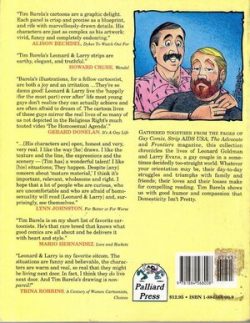
Domesticity Isn’t Pretty – a Leonard & Larry Collection


By Tim Barela (Palliard Press)
ISBN: 978-1-88456-800-8 (Album PB)

In an era where Pride events are just another way to hold up traffic and where acceptance of LGBTQIA+ citizens is a given – at least in all the civilised countries where organised religions and “hard men” totalitarian dictators (I’m laughing at a private dirty joke right now) are kept in their place by their desperation to stay tax-exempt, rich and powerful – Gay themes and scenes in entertainment are ubiquitous and simply No Big Deal anymore.

That’s a good thing but was not always the case. In fact, it has only changed within the span of (my) living memory. For English-language comics, the change from simple illicit pornography to homosexual inclusion in all drama, comedy, adventure and other genres started as late as the 1970s and matured in the 1980s, thanks to the efforts of editors like Robert Triptow and Andy Mangels and cartoonists like Tim Barela.

A native of Los Angeles, Barela was born in 1954, and became a fundamentalist Christian in High School. He had dreams of becoming a cartoonist and loved motorbikes. He was also a gay kid struggling to come to terms with what was still judged illegal, wilful deviancy and appalling sin…

Following an appreciative Foreword from John Preston, author, critic, journalist, producer, media-maven and former Gay Comix editor Andy Mangels’ Introduction tracks the history and evolution of the characters who eventually gelled into Barela’s extended Leonard & Larry clan.

In 1976, Barela began an untitled comic strip about working in a bike shop for Cycle News. Some characters then reappeared in later efforts Just Puttin (Biker, 1977-1978); Short Strokes (Cycle World, 1977-1979); Hard Tale(Choppers, 1978-1979) plus The Adventures of Rickie Racer, The Adventures of Rickie Racer and cooking strip (!) The Puttin Gourmet… America’s Favorite Low-Life Epicurean in Biker Lifestyle and FTW News.

In 1980, the cartoonist unsuccessfully pitched a domestic strip called Ozone to LGBT news periodical The Advocate. Among the quotidian cast were literal and metaphorical straight man Rodger and openly gay Leonard Goldman who had a “roommate” named Larry Evans…

Gay Comix was an irregularly published anthology, edited at that time by Underground star Robert Triptow (Strip AIDs U.S.A.; Class Photo). He advised Barela to ditch the restrictive newspaper strip format in favour of longer complete episodes, and printed the first of these in Gay Comix #5 in 1984. The new feature was a huge success, included in many successive issues and became the solo star of Gay Comix Special #1 in 1992.

L&L also showed up in prestigious benefit comic Strip AIDs U.S.A. before triumphantly moving into The Advocate in 1988, and from 1990, its rival Frontiers. The lads even moved into live drama in 1994: adapted by Theatre Rhinoceros of San Francisco as part of stage show Out of the Inkwell.

Following all the warmly informative background and wonderful examples of those earlier strip ventures, this wonderfully oversized (220 x 280 mm) monochrome tome then divides the main feature into specific periods, beginning with ‘Early Stories from Gay Comix, and opening with the Strip AIDs U.S.A. tale ‘Hi there, We’re the Gay Neighbors’.

Actual introductory yarn ‘Revenge of the Yenta’ comes from Gay Comix #5, setting the scene with established couple Leonard & Larry navigating another meal with Leonard’s formidable unaccepting mother who is still ambushing him with blind dates and nice Jewish girls…

‘Lovers and Other Uninvited Guests’ focuses on a dinner party disaster which includes Leonard’s outrageous former lover Dennis and his new man Leon meeting Larry’s ex-wife Sharon and her Christian Moral Majority champion/fiancé Gordon…

‘…Till Tricks Do Us Part.’ features Gordon’s shock return as a fully out-&-proud leatherboy cruiser, stalking Larry from his exotic good store on Melrose Avenue to his favourite gay clubs in search of all the experiences and passion he’s been denying himself…

A parental milestone is reached and botched during a visitation weekend for Larry’s teenaged sons Richard and David. ‘Chocolate Chip Cookies and Sympathy’ is required when Larry finds (hetero) porn in oldest son’s room and braces himself to have “the Talk”. Thankfully, Leonard is there to offer back-up…

An untitled tale provides an origin as L&L celebrate Leonard’s birthday and eight years as a couple, after which ‘Little Victories’ leavens the comedy with contemporary reality as the guys discuss the loss of a friend to a lethal new disease…

As well as featuring a multi-generational cast, Leonard & Larry is a strip that progresses in real time, with characters all aging and developing accordingly. ‘From the pages of The Advocate spans 1988-1990 with episodes covering the couple’s home and work lives, constant parties, physical deterioration, social gaffes, rows, family revelations, holidays and even events like earthquakes and fanciful prognostications such as ‘West Hollywood 1999′; with the now-decrepit pair whining about the old days…

Rounding off this initial compilation, ‘Recent Stories from Frontiers Magazine’ particularly highlights how the world goes on without regard for personal feelings as one of Larry’s kids comes out and the other makes them grandparents. The couple’s friends and clients win larger roles and offer other perspectives on LA life and the ever-evolving gay scene. Larry stumbles into commercial conflict with an expansionist storekeeper who wants his store at any cost, and time plays its cruellest tricks on many key players who must re-evaluate their activities and fashion choices, erotic and otherwise….

We meet Larry’s no-nonsense-but-painfully-sheltered mom and dad Earl and Wilma; enjoy another take on inclusion and – during a long-dreaded High School reunion – learn some deliciously entertaining facts about Leonard in the days before he accepted his attraction to men. That leads to a delightful seasonal yarn that finally reunites his large, long-warring painfully-buttoned-down Jewish family. Moreover, as Larry’s 40th birthday looms, the couple’s already rich dream life goes into overdrive as religious icons and beloved dead composers come calling with rest-rending dilemmas.

…And through it all, the real world always intrudes, as when flamboyant engineer Frank Freeman loses his aerospace job because his “lifestyle” is considered a security risk by the Federal government or when publicity hungry religious zealots picket Larry’s shop…

The strips are not and never have been about sex – except in that the subject is a constant generator of hilarious jokes and outrageously embarrassing situations. Leonard & Larry is a traditionally domestic marital sitcom soap opera with Lucille Ball & Desi Arnaz – or more aptly, Dick Van Dyke & Mary Tyler Moore – replaced by a hulking bearded “bear” with biker, cowboy and leather fetishes and a stylishly moustachioed, no-nonsense fashion photographer. Taken in total, it’s a love story about growing old together, but not gracefully or with any dignity…

Populated by adorable, fully fleshed out characters and in a generational saga about being yourself, Leonard & Larry is an irresistible slice of gentle whimsy to nourish the spirit and beguile the jaded. Four volumes of the strip were compiled by Palliard Press between 1993 and 2003 – all long overdue for rerelease and in properly curated digital editions – but until then you can at least take your Walk on the Mild Side through internet vendors. And you should…
Domesticity Isn’t Pretty © 1993 Palliard Press. All artwork and strips © 1993 Tim Barela. Foreword © 1993 John Preston. Introduction © 1993 Andy Mangels. All rights reserved.
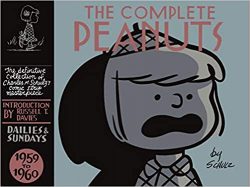
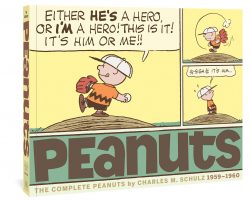
The Complete Peanuts volume 5: 1959 to 1960


By Charles M. Schulz (Canongate Books/Fantagraphics Books)
ISBN: 978-1-84767-149-3 (Canongate HB) 978-1-60699-921-9 (Fantagraphics PB)

Peanuts is unequivocally the most important comics strip in the history of graphic narrative. It is also the most deeply personal.

Cartoonist Charles M Schulz crafted his moodily hilarious, hysterically introspective, shockingly philosophical surreal epic for half a century: 17,897 strips from October 2nd 1950 to February 13th 2000. He died from the complications of cancer the day before his last strip was published…

At its height, the strip ran in 2,600 newspapers in 75 countries, translated into 21 languages. Many of those venues are still running perpetual reprints, as they have ever since his departure. Attendant book collections, a merchandising mountain and television spin-offs made the publicity-shy artist a billionaire.

None of that matters. Peanuts – a title Schulz loathed, but one the syndicate forced upon him – changed the way comics strips were received and perceived: proving cartoon comedy could have edges and nuance as well as pratfalls and punchlines.

Following a Foreword of fun and frank shared reminiscences between editor Gary Groth and mega star Whoopi Goldberg, the timeless times of play, peril and psychoanalysis resume as ever in marvellous monochrome, but this time major changes are in motion as the feature enters its true glory days …

Our focus is quintessential inspirational loser Charlie Brown who, with increasingly high-maintenance, fanciful mutt Snoopy, remains at odds with a bombastic, mercurial supporting cast, all hanging out doing kid stuff.

As always, daily gags centre on playing, pranks, and a seasonal selection of sports; musical moments, teasing, making baffled observations and occasionally acting a bit too much like grown-ups. However, with this tome, the themes and tropes that define the series (especially in the wake of all those animated TV specials) are truly bedded in.

Mean girl Violet, prodigy Schroeder, “world’s greatest fussbudget” Lucy and her off-kilter little brother Linus and dirt-magnet “Pig-Pen” are fixtures sufficiently fleshed out and personified to generate jokes and sequences around their own foibles, but a new disruptive force is introduced. The existential angst of Charlie Brown is magnified by more responsibility with the coming of his new baby sister Sally…

Resigned to his role as eternal loser and singled out by fate and the relentless, diabolical Lucy – who now intensifies and monetises her spiteful verve with a 5¢ walk-in psychoanalysis booth – the round-headed kid really endures the trials of Job from now on. His attempts to fly a kite or kick a football are perpetually sabotaged, and he faces from all the females in his life constant face-to-face reminders of how rubbish he is. Can this new one in his own house be any different?

Other notable events include the first instances of Linus’ doomed relationships: primarily with alternative mythical entity The Great Pumpkin, but also unattainable, equally unseen schoolteacher/inamorata Miss Othmar…

Wonder beagle Snoopy increases his strange development in all ways. His extended Cold War duel for possession of Linus’ cherished comfort blanket escalates but the manic mutt also finds time to philosophise, dance like a dervish and battle City Hall to save his doghouse from a proposed Freeway Bypass…

The Sunday page had debuted on January 6th 1952; a standard half-page slot offering more measured fare than 4-panel dailies. Both thwarted ambition and explosive frustration became part of the strip’s signature denouements as these weekend wonders gave the auteur room to be at his most visually imaginative, whimsical and weird…

By 1959, rapid-fire raucous slapstick gags were riding side-by-side with increasingly abstract, obscure, edgy, psychologically barbed introspections: deep ruminations in a world where kids and animals were the only actors. The relationships are now deep, complex and absorbing but there was still room and time for pure artistic expression. The “Clouds” page for Sunday August 14th was instantly revered by readers and cited by Schulz as his all-time personal favourite.

Sheer exuberance and a spontaneous tendency to barrack perceived failure or weakness at any provocation remains a trusted standby, supported by sporting crises, loneliness, the difficulties of learning to read and wearing long pants, plus a growing attention to issues of motherhood.

Particular moments to relish here involve Snoopy’s muzzle-pugilism; Charlie Brown’s “pencil-pal”; snow-games, rain, cooking gaffes; television, the dread power of romance and grandeur and weirdness of Autumn: all while offering more examples of Schroeder’s eternal love affair of Beethoven and inability to discern Lucy’s far-from-apparent attractions.

The general trends for all the kids being beguiled by stargazing, waxing philosophical at the heavens’ splendour and enduring St. Valentines’ Day traumas continues and there’s even a sighting of Lucy’s softer side. This collection features the first incidence of a minor phenomenon springing from the April 25th daily which first disclosed that “Happiness is a warm puppy…”

To wrap it all up, Gary Groth celebrates and deconstructs the man and his work in ‘Charles M. Schulz: 1922 to 2000’whilst a copious ‘Index’ offers instant access to favourite scenes you’d like to see again….

Readily available in hardcover, paperback and digital editions, this volume offers a rare example of a masterpiece in motion: comedy gold and social glue metamorphosing into an epic of spellbinding graphic mastery that remains part of the fabric of billions of lives, and which continues to make new fans and devotees long after its maker’s passing.
The Complete Peanuts: 1959-1960 (volume 5) © 2006 United Features Syndicate, Inc. The Foreword is © 2006 Whoopi Goldberg. “Charles M. Schulz: 1922 to 2000” © 2006 Gary Groth. All rights reserved.

The Hidden


By Richard Sala (Fantagraphics Books)
ISBN: 978-1-60699-385-6 (HB)

One of the cruellest side-effects of the current pandemic is its power to cut you down emotionally and fill you with guilt over things you have no power to control. Prime offender for me is finding out people I like admire or just simply know have gone, and I’m probably the last to know. Just like this guy…

Richard Sala was a lauded and brilliantly gifted exponent and creator of comics who deftly blended beloved pop culture artefacts and conventions – particularly cheesy comics and old horror films – with a hypnotically effective ability to tell a graphic tale.

A child who endured sustained paternal abuse, Sala grew up in Chicago and Arizona. Retreating into childish bastions of entertainment he eventually escaped family traumas and as an adult earned a Masters Degree in Fine Arts. He became an illustrator after rediscovering the youthful love of comic books and schlock films that had brightened his youth.

His metafictional, self-published Night Drive in 1984 led to appearances in legendary 1980s anthologies Raw, Blab! and Prime Cuts and animated adaptations of the series were produced for Liquid Television.

His work remains welcomingly atmospheric, dryly ironic, wittily quirky and mordantly funny; indulgently celebrating childhood terrors, gangsters, bizarre events, monsters and manic mysteries, with girl sleuth Judy Drood and the glorious trenchant storybook investigator Peculia the most well-known characters in his gratifyingly large back catalogue.

Sala’s art is a joltingly jolly – if macabre – joy to behold and has also shone on many out-industry projects such as his work with Lemony Snickett, The Residents and even Jack Kerouac; illustrating the author’s outrageous Doctor Sax and The Great World Snake.

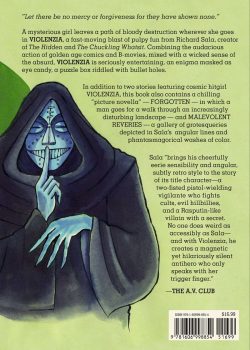
One of my personal favourites is The Hidden which revels in the seamy, scary underbelly of un-life: an enigmatic quest tale following a few “lucky” survivors who wake up one morning to discover civilisation has succumbed to an inexplicable global Armageddon. The world is now a place of primitive terror, with no power, practically no people and ravening monsters roaming everywhere.

Trapped on in the fog on a mountain, Colleen and Tom emerge into the world of death and destruction before promptly fleeing back to the wilderness. As they run, they encounter an amnesiac bum, who uncomprehendingly leads them to other young survivors – each with their own tale of terror – and together they seek a place of sanctuary in the desert and the shocking true secret of the disaster…

Clever, compelling and staggeringly engaging, this fabulous full-colour hardback (also available in digital formats) is a perfect introduction to Sala’s world: a sublimely nostalgic escape hatch back to those days when unruly children scared themselves silly under the bedcovers at night. It is an ideal gift for the big kid in your life – whether he/she/they are just you, imaginary or even relatively real…
© 2011 Richard Sala. All rights reserved.

A Valentine for Charlie Brown


By Charles M. Schulz (Fantagraphics Books)
ISBN: 978-1-60699- (HB)

Peanuts is unequivocally the most important comics strip in the history of graphic narrative. It is also the most broadly accepted, since – after the characters made the jump to television – the little nippers become an integral part of the American mass cultural experience.

Charles M. Schulz crafted his moodily hilarious, hysterically introspective, shockingly philosophical epic for 50 years, publishing 17,897 strips from October 2nd 1950 to February 13th 2000. He died from the complications of cancer the day before his last strip was published…

At its height, the strip ran in 2,600 newspapers in 75 countries, translated into 21 languages. Many of those venues are still running perpetual reprints, as they have ever since his departure. Attendant book collections, a merchandising mountain and TV spin-offs made the publicity-shy artist a billionaire. That profitable sideline – one Schulz devoted barely any time to over the decades – is where this little gem originates from…

Peanuts – a title Schulz loathed, but one the syndicate forced upon him – changed the way comics strips were received and perceived by showing that cartoon comedy could have edges and nuance as well as pratfalls and punchlines.

The usual focus of the feature (we just can’t call him “star” or “hero”) is everyman loser Charlie Brown who, with high-maintenance, fanciful mutt Snoopy, endures a bombastic and mercurial supporting cast who hang out doing kid things in a most introspective, self-absorbed manner.

The daily gags centred on playing (pranks, sports, musical instruments), teasing each other, making ill-informed observations and occasionally acting a bit too much like grown-ups. The consistently expanding cast also includes mean girl Violet, child prodigy Schroeder, “world’s greatest fussbudget” Lucy Van Pelt, her other-worldly baby brother Linus and dirt-magnet “Pig-Pen”: each with a signature twist to the overall mirth quotient and sufficiently fleshed out and personified to generate jokes and sequences around their own foibles. As a whole, the kids tackled every aspect of human existence in a charming and witty manner, acting as cartoon therapists and graphic philosophical guides to the world that watched them.

Charlie Brown is settled into his existential angst and resigned to his role as eternal loser as if singled out by a gleeful Fate. It’s a set-up that remains timelessly funny and infinitely enduring…

Available in a child-friendly hardback and the usual digital formats, A Valentine for Charlie Brown offers a trio of extended vintage sequences revolving around further crushing the spirit of the saddest, yet most optimistic kid on Earth. All he wants is someone to love, but for many of us, it’s not that easy to find the one – or even anyone…

The tales are told in a series of monochrome panels (generally four to a page) and we open with ‘Valentine’s Vigil at the Mailbox’ as the perpetually anxious and responsibility-burdened Charlie anticipates a card or maybe more at this time of romantic intensity. Sadly, the mail is not an ally and most post goes to the hairy pal who truly does dote on him…

Of course, there’s always Linus to share thoughts with, sister Sally to show him up and Lucy to be… well Lucy…

Not that Van Pelt has much joy with her own chosen inamorata. Schroeder loves music and would do anything to be alone with his passion…

A new year brings fresh hope as Charlie discovers ‘The Little Red-Haired Girl’, but even after burdening all his pals with his aspirations and disappointments, our gallant would-be swain painfully realises the course of true love never yadda, yadda, yadda…

Wrapping up the melancholy mirth is delicious change of pace ‘My Sweet Babboo’ which sees Sally set her cap for Linus with terrifying determination: an all-points pursuit to delight jaded older souls and simultaneously chill the heart of anybody with pet bunnies..

Sally and Linus take centre stage in this outrageous and inventive sequence but there’s still plenty of time for Charlie and the others to suffer their usual hang-ups, between marvelling at the dogged determination on show…

Timeless and evergreen, Charlie Brown’s existentialist travail and amorous aspirations have been delighting readers seemingly forever and clearly will not be stopping or superseded anytime soon. If you haven’t joined this club yet, why not sign up now?
A Valentine for Charlie Brown © 2015 Peanuts Worldwide, LLC. All rights reserved.

The Mythology of S. Clay Wilson: volume 1: Pirates in the Heartland


By S. Clay Wilson, edited by Patrick Rosenkranz (Fantagraphics Books)
ISBN: 978-1-60699-747-5 (HB)

Once more, I’m altering the fixed schedules to note the passing of a giant. Everybody’s losing loved one in far greater numbers than we can really afford or cope with, but this one is even more poignant and powerful: the death of one of the most vital and vigorous cartoonists we’ve ever been privileged to enjoy. Here’s a parental warning to prove it…

This book is filled with dark, violent sexual imagery and outrageous situations intended to make adults laugh and think. If that hasn’t clued you in, please be warned that this book contains images of nudity, extreme violence, sexual intimacy and excess – both hetero- and homosexual – and language commonly used in the privacy of the bedroom, drunken street brawls and school playgrounds whenever adults aren’t present.

If the thought of all that offends you, read no further and don’t buy the book. The rest of us will just enjoy some of the most groundbreaking cartoon experiences ever created without you.

Steve Clay Wilson was a pioneering light of America’s transformative Underground Commix movement: an uncompromising, controversial, in-your-face pioneer of the counterculture, constantly challenging attitudes and sensitivities whilst telling the kind of cartoon tales he wanted – or perhaps had – to.

Something of a contradiction to those who knew him, charming, charismatic Wilson lived life to the full and took his art seriously.

And what art! Stark, complex, shocking, incredibly detailed tableaux jumping with modern Rabelaisian content: mesmerising scenes packed with intense multi-layered busyness, crammed with outrageous, iconic characters in constant surging motion – mostly combative and hilariously violent.

The manly, hedonistic exuberance of frantic fighters rejoicing in the wild freedom as exemplified by bikers, cowboys, pirates, bull dykes and devils, augmented by other violent ne’er-do-wells, grotesques, human-scaled beasts and things which could be drawn but never described…

His work seethed and abounded with excess: monsters, mutilations, booze and drug-fuelled romps populated with priapic plunderers and ravening beasts, dangerous and disturbed women and always, always unsettling scenes of society’s biggest taboos – sex and personal freedom.

All Americans already worshipped violence; Wilson just pushed the visuals for that sacrament as far as he could into surreal parody. Everybody who knew Wilson adored him, but around him they were usually a little nervous and stepped lightly…

The modern successor to Pieter Bruegel and Hieronymus Bosch moved on to other artistic arenas when the Underground movement foundered, but he never toned down his visions. In 2008 he suffered massive brain damage in mysterious circumstances and underwent full-time palliative care ever since. He died aged 79, on Sunday February 7th 2021.

This intimate and informative oversize (286 x 202mm) hardcover biography and graphic overview – also available in digital formats – is compiled from previous writings and extensive interviews with the people he grew up with and who shared his eventful life.

Moreover, each telling anecdote and reminiscence is augmented with photos, paintings, illustrated letters and private or previously-unpublished artworks, and each chapter offers a wealth of gloriously outrageous strips: comprising all of his published comics work from the heady days of America’s counterculture explosion in 1968 to its virtual demise in 1976.

It opens with a warm, picture-packed, fact-filled Introduction by college pal and flatmate John Gary Brown before the hagiography of horrors begins with ‘Wilson’s Childhood’.

Described by Robert Crumb as “the strongest, most original artist of my generation” Steven Clay Wilson grew up in down-home Lincoln, Nebraska, thriving on a diet of EC comics (especially Piracy), post-war prosperity and Great Plains sensibilities. His early life was filled with good family, cool pets, cycling, school and drawing.

Lots of drawing (much of it impressively included in the first chapter) takes us out of High School and into college, but before that unfolds there’s a gory welter of early triumphs in the black and white comics section which includes such classics as ‘Shorts in the Bowl’ (from Gothic Blimp Works #1), ‘River City Shoot-Out’ from the second issue and ‘No Loot for You, Captain Namrooth’ from Gothic Blimp Works #6, all circa 1969, followed by a ‘Goodtimes Front Cover’for May 1st 1970.

The entirety – 26 images – of the mega-successful arts project which became ‘S. Clay Wilson Portfolio Comix’ leads into the strip ‘Afterwards’ (Hydrogen Bomb Funnies, 1970) and the tableaux ‘It’s a Thrill to Kill’ from Thrilling Murder Comics, 1971 and ‘The 137th Dream of Lester Gass’ (Illuminations, 1971).

A productive strip period begins with ‘Insect Paranoia’ (Insect Fear #1),‘Insect Angst’ (#2, both 1970) and ‘Insomnia Angst’ (#3, 1972), followed by ‘Boogie Boogie Horror Yarn’ (Laugh in the Dark, 1971) and closes with ‘Whip Tip Tales’and ‘Soft Core Porn Yarn’ from San Francisco Comic Book issues #1 and #3 in 1970.

Wilson’s turbulent brush with art school and academia at the University of Nebraska is detailed in ‘Higher Education’ as is his understandably less than glorious military service and adoption of the drop-out life style, topped off by more manic strips and panels (he called them “Deep Scenes”) beginning with ‘The Hog Ridin’ Fools’ (Zap Comix #2, 1968 and featuring a very early appearance of Wilson’s signature character the Checkered Demon). That issue also supplies ‘Just as you said Madge… He’s Shitting’ and ‘Head First’, whilst from the third comes ‘Captain Pissgums and His Pervert Pirates’, ‘Gilded Moments’, ‘Captain Edwards St. Miguel Tilden Bradshaw and his crew come to Grips with bloodthirsty foe pirates’, ‘Come Fix’ and ‘Arnie, my bra ain’t on’.

Wilson drew at a phenomenal rate and Zap Comix #4 1969 unleashed ‘A Ball in the Bung Hole’, an untitled phantasmagorical double-spread, ‘Leather Tits’ and the debut of his occasional lewd lead ‘Star-Eyed Stella’. Zap #5 (1970) barely contained ‘Lester Gass the Midnight Misogynist’, ‘Ruby the Dyke Meets Weedman’ and ‘Snake Snatch Tale’.

At the end of 1966 Wilson relocated to ‘Lawrence, Kansas’: a burgeoning Midwestern oasis of countercultural thought and self-expression, and a useful place to concentrate creative energies before his inevitable move to the West Coast. This chapter is abutted by another wave of glorious filth and ferocity, comprising non-biblical epic ‘The Felching Vampires Meet the Holy Virgin Mary’ (Felch Cumics, 1975), adult fairy tale ‘Puducchio’ from Pork (1974), which also offers a quartet of single-frame gags, after which Bent (1971) provides Deep Scene ‘Dwarf Snuffing Station #103’, ‘Pendants’; a return engagement for ‘Star-Eyed Stella’ and ‘Nail Tales’.

Declaring “Art is Therapy”, Wilson always saw its creation as a collaborative process: one which demanded a response. On reaching the golden lands of ‘The Barbary Coast’ his artistic jams with the likes of Crumb – who claims the flatlander inspired him to completely release all his artistic inhibitions – and creative compadrés like Spain Rodriguez, Rick Griffin, Robert Williams and Victor Moscoso, made them royalty in the San Francisco heart of the revolution.

That star-studded, astounding period and how it began to fade makes up the last revelatory chapter in this initial volume (of three) and concludes with one last selection of colour and monochrome masterpieces including eye-popping ‘Deranged doctors perform operational experiments on mutated patients under the antiseptic incandescent gaze of the Big Daddy Devil Doctor’ from Arcade #3, 1975; illustrations for William Burroughs’ seminal short story ‘Fun City in Badan’ (Arcade #4), ‘The Corpse Gobblin’ Ogre of Columbite Mountain’(Arcade #5), ‘Monster Bride’ (Arcade #6) and ‘Vampire Lust’ (Arcade #7, 1976).

Also on show are multi-hued strip ‘Last Foe’ (Apple Pie July 1975), the cover from Zap Comix #3, front-&-back covers from S. Clay Wilson Portfolio Comix, Bent and Pork; ‘It’s a treat to blast away the flat foot’s feet’ from Tales of Sex and Death #1 (1971), 8-page, in-record minicomic insert ‘The Saga of Yukon Pete’ from the vinyl platter of the same name by Son of Pete and the Muffdivers, wrapping up in fine style with the infernally euphoric ‘Surfsup’ strip from Tales from the Tube #1, 1972.

Scholarly yet surprisingly engaging, this superb collation, contrived and shepherded by Patrick Rosenkranz, offers an amazingly and unforgettable close-up view of one of the most important cartoonists in American history. This is a book no serious lover of the art form or devotee of grown-up comics can afford to miss.
The Mythology of S. Clay Wilson volume one: Pirates in the Heartland © 2014 Fantagraphics Books. All comics and images by S. Clay Wilson © 2014 S. Clay Wilson. All biographical text © 2014 Patrick Rosenkranz. All other material © 2014 its respective creators and owners. All rights reserved.

The Amazing, Enlightening and Absolutely True Adventures of Katherine Whaley


By Kim Deitch (Fantagraphics Books)
ISBN: 978-1-60699-631-7 (HB)

Ever got a hankering for a certain flavour, and nothing seems to satiate it? Some people are like that with comics…

Kim Deitch has been one of most consistently effective stars of America’s Commix Underground for decades, although as with Harvey Pekar’s American Splendor, it’s only relatively recently that he’s won wider acclaim: primarily through interconnected prose-&- strip fantasies such as Boulevard of Broken Dreams, Shadowland, The Search for Smilin’ Ed and other multi-layered alternative history/faux biographies.

Much of his feverish output has been short stories about a down-at-heel carnival and the shabby, eccentric no-hopers who have populated it throughout the 150 years of its existence, the eerie aliens who have preserved its posterity and, of course, the immortal Waldo the Cat.

That saga organically grew into explorations of the minor characters they encountered and soon a great big narrative snowball started rolling…

In The Amazing, Enlightening and Absolutely True Adventures of Katherine Whaley (available in hardback or digital formats) we return to the increasingly formalised, craftily chronicled Deitch Universe, albeit tangentially, as the author focuses on other members of his inexhaustible cast, all the while tellingly revealing lost secrets of American history through a lens of scholarly examination and conspiracy theory woven through popular culture scenarios of the past.

Notionally picking up on a minor player last seen in Deitch’s Pictorama, the story here explores the incredible life of an unprepossessing little old lady, as disclosed in a letter left as part of a bequest…

The story-within-a-story begins in the grotty logging town of Lumberton, New York State. It is 1908, and demure Katherine Whaley, after failing as librarian and school teacher, takes a job playing piano in the brand-new movie theatre operated by old man Braunton. It’s just another way to deprive lumberjacks and dissolute townies of their hard-earned cash…

The early 20th century was a time of immense and radical social change and, after a brush with movie stardom – courtesy of a roving chapter-play Production Company – Katherine makes the acquaintance of the charismatic Charles Varnay and his super-intelligent dog Rousseau. The man’s esoteric and beguiling beliefs in the nigh-mystical powers of “Enlightenment” carry her off her on an odyssey of self-discovery…

Varnay sees her as the personification of that noble conceptual ideal and wants her to star in a movie serial that will spread his life-changing philosophy to the world’s masses. Naturally, much of her part as The Goddess of Enlightenment involves acting sans costume of any sort…

Covering the major cultural landmarks of the early century, from movie mania, the Jazz Age, Great War and Prohibition, Katherine’s account swings between dubious memoir to laudatory manifesto as her perceptions and opinions of the mysterious Varnay swing from philandering charlatan to messianic superman.

Whilst she might find it hard to accept that the philosopher possesses actual recordings of Jesus Christ delivering his teachings, undiluted by millennia of obfuscating organised religion, there is no doubt that Varnay has great power: after all he stopped her aging and may himself be more than 200 hundred years old…

The beauty of this tale is the complex detail with which it unfolds: the grace and wit with which Deitch overlays historical fact with brilliant fabrication. I’m certainly not going to spoil the sheer revelatory enchantment for you by giving anything away…

With this surreal historiography of the little-known peripheries of the birth of cinema, Deitch concocted another utterly unique and absorbing graphic treat – delivered in a lavish widescreen format – once again sharing the intoxicating joys of living in the past and dwelling in shared social memories.

Combining science-fiction, conspiracy theory, pop history, fact and legend, show-biz razzmatazz and the secret life of Beavers; displaying a highly developed sense of the absurdly meta-real, Dietch once more weaves an irresistible spell that charms, thrills and disturbs whilst his meticulous drawing holds the reader in a deceptively loose yet inescapable grip.

Follow the secret saga of the World According to Deitch and you too will succumb to the arcane allure of his ever-unfolding cartoon parade revealing the “Americana Way”. In Fact – or Fiction – you might already be there, but you’ll never know unless you look…
© 2013 Kim Deitch. This edition © 2013 Fantagraphics Books, Inc. All Rights Reserved.

Shadowland


By Kim Deitch (Fantagraphics Books)
ISBN 978-1-56097-771-1 (PB)

Roll, up! Roll, up!

Kim Deitch has been one of the leading lights of America’s Comix Underground since its earliest days, although as with Harvey Pekar and American Splendor, it was only relatively late on that he has won wider acclaim: in his case for 2002’s Boulevard of Broken Dreams and 2010’s The Search for Smilin’ Ed. For much of his cartooning career he has crafted occasional short stories about a down-at-heel carnival and the shabby, eccentric no-hopers that have populated it through-out the 150 years. Shadowland – available in paperback or digital formats – was the first complete collection, and also features a splendid colour gallery of supplemental artwork.

Combining science-fiction, conspiracy theory, urban history and legend, show-biz razzmatazz, Film Noir and an outrageously honed sense of the absurd, Deitch weaves an irresistible spell that charms, thrills and disturbs whilst his meticulous black and white drawing holds the reader in a deceptively fluffy grip.

Dripping authentic loving nostalgia and oozing the sleazy appreciation everyone secretly harbours for trashy entertainments, the story of clown and Carny Al Ledicker Jr. as he shambles his way through the sleaziest parts of the 20th century in this wonderful compendium and critique of the “Americana Way” is a truly unmissable, fabulously guilty pleasure. Fill yer boots, folks!
Text, art & characters © 2006 Kim Deitch. All rights reserved.

Popeye Classics volume 6


By Bud Sagendorf, edited and designed by Craig Yoe (Yoe Books/IDW)
ISBN: 978-1631403255 (HB) eISBN: 978-1-62302-786-5

How many cartoon classics can you think of still going after a century? Here’s one…

There are a few fictional personages to enter communal world consciousness – and fewer still from comics – but a grizzled, bluff, uneducated, visually impaired old sailor with a speech impediment is possibly the most well-known of that select bunch.

Elzie Crisler Segar was born in Chester, Illinois on 8th December 1894. His father was a general handyman, and the boy’s early life was filled with the kinds of solid, dependable blue-collar jobs that typified his generation of cartoonists. He worked as a decorator, house-painter and also played drums; accompanying vaudeville acts at the local theatre.

When the town got a movie-house, he played for the silent films, absorbing all the staging, timing and narrative tricks from keen observation of the screen. Those lessons would become his greatest assets as a cartoonist. It was while working as the film projectionist, at age 18, that he decided to become a cartoonist and tell his own stories.

Like so many others in those hard times, he studied art via mail, in this case W.L. Evans’ cartooning correspondence course out of Cleveland, Ohio, before gravitating to Chicago where he was “discovered” by Richard F. Outcault – regarded by most in the know today as the inventor of modern newspaper comic strips with The Yellow Kid and Buster Brown.

The celebrated pioneer introduced Segar around at the prestigious Chicago Herald. Still wet behind the ears, the kid’s first strip, Charley Chaplin’s Comedy Capers, debuted on 12th March 1916.

In 1918, Segar married Myrtle Johnson and moved to William Randolph Hearst’s Chicago Evening American to create Looping the Loop, but Managing Editor William Curley saw a big future for Segar and packed the newlyweds off to New York, HQ of the mighty King Features Syndicate.

Within a year Segar was producing Thimble Theatre, which launched December 19th 1919 in the New York Journal. It was a smart pastiche of cinema and knock-off of movie-inspired features like Hairbreadth Harry and Midget Movies, with a repertory of stock players to act out comedies, melodramas, comedies, crime-stories, chases and especially comedies for vast daily audiences. It didn’t stay that way for long…

The core cartoon cast included parental pillars Nana and Cole Oyl; their lanky, highly-strung daughter Olive, diminutive-but-pushy son Castor and the homely ingenue’s plain and (very) simple occasional boyfriend Horace Hamgravy (latterly, just Ham Gravy).

Segar had been successfully, steadily producing Thimble Theatre for a decade when he introduced a brusque, vulgar “sailor man” into the daily ongoing saga of hapless halfwits on January 17th 1929. Nobody suspected the giddy heights that stubborn cantankerous walk-on would reach…

Many Happy Returns, you old matelot, you…

In 1924 Segar created a second daily strip The 5:15: a surreal domestic comedy featuring weedy commuter and would-be inventor John Sappo and his formidable wife Myrtle. This one endured – in one form or another – as a topper/footer-feature accompanying the main Sunday page throughout the author’s career. The feature even survived his untimely death, eventually becoming the trainee-playground of Popeye’s second great humour stylist: Bud Sagendorf.

After Segar’s far-too-premature death in 1938, Doc Winner, Tom Sims, Ralph Stein and Bela Zambouly all worked on the strip, even as the Fleischer Studio’s animated features brought Popeye to the entire world, albeit a slightly different vision of the old salt of the funny pages. Sadly, none of them had the eccentric flair and raw inventiveness that had put Thimble Theatre at the forefront of cartoon entertainments. But then, finally, Bud arrived…

Born in 1915, Forrest “Bud” Sagendorf was barely 17 when his sister – who worked in the Santa Monica art store where Segar bought his drawing supplies – introduced the kid to the master cartoonist who became his teacher and employer as well as a father-figure. In 1958, after years on the periphery, Sagendorf finally took over the strip and all the merchandise design, becoming Popeye’s prime originator…

When Sagendorf became the main man, his loose, rangy style and breezy scripts brought the strip itself back to the forefront of popularity and made reading it cool and fun all over again. Bud wrote and drew Popeye in every graphic arena for 24 years and when he died in 1994, he was succeeded by controversial “Underground” cartoonist Bobby London.

Young Bud had been Segar’s assistant and apprentice, and from 1948 onwards was exclusive writer and illustrator of Popeye’s comicbook adventures. These launched in February of that year in a regular monthly title published by America’s unassailable king of periodical licensing, Dell Comics.

When Popeye first appeared, he was a rude, crude brawler: a gambling, cheating, uncivilised ne’er-do-well. He was soon exposed as the ultimate working-class hero: raw and rough-hewn, practical, but with an innate, unshakable sense of what’s fair and what’s not; a joker who wanted kids to be themselves – but not necessarily “good” – and someone who took no guff from anyone…

Naturally, as his popularity grew, Popeye mellowed somewhat. He was still ready to defend the weak and had absolutely no pretensions or aspirations to rise above his fellows, but the shocking sense of dangerous unpredictability and comedic anarchy he initially provided was sorely missed… but not in Sagendorf’s comicbook yarns…

Collected in their entirety in this beguiling full-colour hardback (also available in digital editions) are issues #25-29 of Popeye‘s comic book series, produced by the irrepressible Sagendorf and collectively spanning July-September 1953 to July-September 1954.

The stunning, nigh stream-of-consciousness slapstick sagas are preceded by an effusively appreciative ‘Society of Sagendorks’ mission statement by inspired aficionado, historian and publisher Craig Yoe, offering a mirthful mission statement after which the regular collation of ephemera and a merchandise dubbed the ‘Bud Sagendorf Scrapbook’ shares cover art domestic and foreign; themed key-rings, art from Segar Russell (Broom-Hilda) Myers and excerpts from Bud’s Artists Cartoon Course (1960). Also included are ghosted Thimble Theatre strips he did during the Tom Sim/Bela Zaboly era, commissioned cast sketches and assorted trivia such as packaging for the Popeye Funny Face Maker and a TV syndication ad.

We rejoin the ceaseless parade of laughs, surreal imagination and thrills with #25 which opens and closes with a prose yarn adorning both inside front and back covers. ‘Bread Time!’ reveals how a cow named Harriet deals with her unlikely passion for baked goods before the comic capers commence with ‘Shrink Weed!’ as some “wild spinach” reduces the old salt and baby Swee’Pea to the size of insects with potentially dire and outrageous consequences…

Sagendorf was a smart guy in tune with popular trends and fashions as well as understanding how kids’ minds worked. His tales are timeless in approach and delivery. In the era of rapid television expansion, cowboys were King, with westerns dominating both large and small screens as well as plenty of comics. Thus, many sagas featured Popeye as a horse-riding sagebrush wanderer who ran a desert railroad when he wasn’t prospecting…

‘Live Game’ finds infant Swee’Pea contending with a little Indian boy and his pet bear before teaming up to play a prank on the adults after which back-up feature Sherm features another bright spark youngster. Here the kid succumbs to the juvenile blandishments of the girl next door in ‘Ah Love!’

Issue #26 opens and closes with text tale ‘Cat Fish’ as an inner-city moggy imaginatively satisfies a yearning for fresh fodder, whilst ‘Popeye and the Gang’ face an invasion of ‘Spookers!’ intent of avenging themselves on senior reprobate Poopdeck Pappy after which ‘Popeye and Swee’Pea in “Kid Raising!!”’ finds Popeye and Olive using book learning to counter Swee’Pea’s pester power.

Following the trend for sci fi fun, new feature ‘Axle and Cam on the Planet Meco’ introduces a robotic father and son in a wild romp featuring a spare-parts scavenging rogue called the Black Mechanic…

Popeye #27 (January-March 1954) starts with a prose parable about a blacksmith’s cat discovering a new toy in ‘Space Ball!’ before the entire cartoon cast visit ‘The Happy Little Island’ and confront subsurface creatures doing their darndest to spoil that jolly atmosphere.

Popeye and Swee’Pea then clash as the little nipper tries boosting his strength with a spinach overdose in ‘Full Power!’, before Axle and Cam on the Planet Meco! sees the clever kid construct a junk yard dog from junk yard junk…

In #28 ‘Fowl! Fowl!’ offers a text yarn about an alley cat promising a slap-up feed for his pals before ‘Popeye and Swee’Pea! in “Moneybag! Or Buddy, Can You Spare a Nugget?”’ sees old moocher Wimpy bamboozle himself when he sees Swee’Pea playing with Popeye’s bullion bags…

An engaging Micawber-like coward, cad and conman, the insatiably ravenous J. Wellington Wimpy debuted in the newspaper strip on May 3rd 1931 as an unnamed and decidedly partisan referee in one of Popeye’s pugilistic bouts. The scurrilous yet scrupulously polite oaf struck a chord and Segar gradually made him a fixture. Always hungry, keen to solicit bribes and a cunning coiner of many immortal catchphrases – such as “I would gladly pay you Tuesday for a hamburger today” and “Let’s you and him fight” – Wimpy is the perfect foil for a simple action hero who increasingly stole the entire show… and anything else unless it was extremely well nailed down…

He’s no match for the kid, though…

Calamity strikes courtesy of the sinister Sea Hag next as ‘“Weed Shortage” or “Pass the Spinach!”’ finds the sailor man scuppered by a global spinach blight. Captured by his frightful foe, the weakened water warrior needs the motivation of Wimpy and sweety-pie Olive to save his own bacon…

Axle and Cam on the Planet Meco then clash as the junior robot starts copying human kids and their bizarre games, and dad tries to set him straight…

Closing the comic capers for now, Popeye #29 (July-September 1954) opens with prose poser ‘Nine for Nine’ wherein Garry the Cat plays fast and loose with his stockpile of spare lives. Popeye then excels in another epic confrontation with the Sea Hag, who unleashes magical menace ‘The Boo-Bird!’ in the certainty that the old salt has no defence. Yet again, the villain underestimates Olive and the restorative power of spinach…

When Popeye refuses to give his kid a dime, Swee’Pea consults Wimpy and crafts a brilliant get-rich quick scheme in ‘Pay Dirt!’ after which ‘Axle and Cam!’ sees dad swept off his feet by the boy’s latest fun invention…

Outrageous and side-splitting, these all-ages yarns are evergreen examples of surreal narrative cartooning at its most inspirational. Over the last nine decades Thimble Theatre‘s most successful son has unfailingly delighted readers and viewers around the world. This book is simply one of many, but definitely top-tier entertainment for all those who love lunacy, laughter, frantic fantasy and rollicking adventure. If that’s you, add this compendium of wonder to your collection.
Popeye Classics volume 6 © 2015 Gussoni-Yoe Studio, Inc. All Rights Reserved. Popeye © 2015 King Features Syndicate. ™ Heart Holdings Inc.