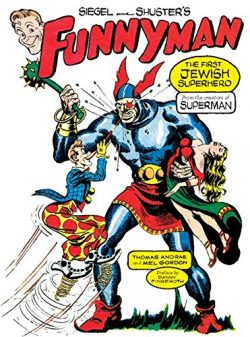
Siegel and Shuster’s Funnyman: The First Jewish Superhero


By Jerome Siegel & Joe Shuster with Thomas Andrae, Mel Gordon & various (Feral House)
ISBN: 978-1-932595-78-9 (TPB/Digital edition)

The comics industry owes an irredeemable debt to two talented and ambitious Jewish kids from Cleveland in the right place at the right time who were able to translate their enthusiasm and heartfelt affection for beloved influences and delight in a new medium into a brand-new genre which took the world by storm.

Writer Jerome Siegel and artist Joe Shuster were a jobbing cartoonist team just breaking into the brand-new yet already-ailing comicbook business with strips such as ‘Henri Duval’, Doctor Occult and Slam Bradley. Thanks to editorial visionary Sheldon Mayer, they hastily rejigged a frequently rejected newspaper strip concept for an upcoming new title and manifested the greatest action sensation of the age – if not all time…

Superman captivated depression-era audiences and within a year had become the vanguard of a genre and an industry. In those early days, the feature was both whimsical and bombastic – as much gag strip as adventure serial – and it was clear the utterly inspired whiz kids were wedded to laughs just as much as any wish-fulfilling empowerment fantasies.

As even the most casual scholar knows, Siegel & Shuster were not well-served by their publishers and by 1946 no longer worked for National Periodicals (today’s DC Comics). In fact, they were in acrimonious litigation which led to the originators losing all rights to their creation and suffering years of ill-treatment until an artist-led campaign at the time of the 1978 Superman movie shamed the company into a belated reversal and financial package (consisting mostly of having their names returned to the character’s logo and company medical benefits).

Long before this however, the dynamic duo produced an abortive “Last Hurrah”: another unique character based on early influences, but one who sadly did not catch the public’s attention in those post war years when the first super-heroic age was ending.

Based broadly on performing sensation Danny Kaye, Funnyman was a stand-up comedian dressed as a clown who used comedy gimmicks to battle criminals, super-villains and aliens: initially in 6 issues of his own comic book and thereafter as a Daily/Sunday newspaper strip.

A complete antithesis to the Man of Steel, Larry Davis was a total insider, no orphan or immigrant, but a wealthy, successful man, revered by society, yet one who chose to become a ridiculous outsider, fighting for not the common good but because it gave him a thrill nothing else could match. The series was light, beautifully audacious, tremendous fun and sank like a concrete-filled whoopee cushion.

Here social historians Thomas Andrae and Mel Gordon carefully re-examine the strip in the much broader context of Jewish Identity and racial character, with particular reference as it applies to Jewish-Americans, and make some fascinating observations and postulates.

Following an intriguing preface by author, writer, editor and comics historian Danny Fingeroth, this book assiduously dissects the history and psychology of the Judaic experience in a compelling series of astoundingly illustrated essays gathered under the umbrellas of Gordon’s ‘The Farblondjet Superhero and his Cultural Origins’ and Andrae’s ‘The Jewish Superhero’.

The former (and Farblondjet translates as “mixed up” or “lost”) probes ‘The Mystery of Jewish Humor’, ‘The Construct of Humor in Everyday Jewish Life’, ‘The Old Theories: Laughter-Through-Tears’; ‘A Laughing People’; ‘Outside Observer’ and ‘The Badkhn Theory’ (Badkhn being performers hired to insult, offend and depress guests and celebrants at social gatherings such as weddings or funerals).

‘Characteristics of Modern Jewish Humor’ are subdivided and explored in ‘Aggression’, ‘The Yiddish Language’, ‘Self-Mockery’, ‘Inversion and Skepticism’, ‘Scatology’, ‘Gallows Humor’ and ‘Solipsism and Materialism’ before Gibson’s compelling, contextual potted-history concludes with ‘American-Jewish Comedy Before 1947’ (the year Funnyman debuted), ‘Weber and Fields’, ‘On the Boards’, ‘The Borscht Belt’, ‘Cartoons and Jokebooks’ and ‘Hollywood Talkies and Syndicated Radio’.

Then, in ‘The Jewish Superhero’ Andrae examines Siegel & Shuster’s possible influences; everything from German expressionist cinema masterpiece The Golem: How He Came into This World to real-life strongman Sigmund Breitbart, a Polish Jew who astounded the world with his feats in the early 1920s. On his American tour Sigmund appeared in Cleveland in October 1923. Siegel, a local resident, would have been 9 years old – which as everyone knows is the actual “golden age of comics”…

‘Funnyman, Jewish Masculinity and the Decline of the Superhero’ explores the psychology and landscape of the medium through the careers and treatment of Siegel & Shuster in ‘The Birth of Funnyman’, ‘The Body Politic’, ‘The Schlemiel and the Tough Jew’, ‘The Decline of the Superhero’ and ‘Comic Book Noir’ before going on to recount the story of the newspaper strips in ‘The Funnyman Comic Strip’ and ‘Reggie Van Twerp’ (a last ditch attempt by the creators to resurrect their comic fortunes) before the inevitable axe falls in ‘End Game…

Thus far this engaging tome is a compulsive and hugely informative academic work, but in ‘Funnyman Comic Book Stories’ the resplendently vintage fan fun truly takes hold with a full colour section reproducing a selection of strips from the 6-issue run.

‘The Kute Knockout!’ (Funnyman #2, March 1948) pits the Hilarious Hero against a streetwalker robot built to seduce and rob Johns after which ‘The Medieval Mirthquake’ (Funnyman #4, May 1948) propels our Comedy Crusader back to the time of Camelot. From the same issue comes ‘Leapin’ Lena’ as Funnyman faces a female bandit who can jump like a kangaroo whilst yarn #5 (July 1948) catches him chasing a worrisome new crime wrinkle in ‘The Peculiar Pacifier’.

Also included are the striking covers of all 6 issues, the origin of Funnyman from #1, lots of splash pages and a selection of Shuster’s Superman art, but the most welcome benefit for fans and collectors is a detailed precis of the entire run’s 20 tales.

The same consideration is offered for the newspaper strips. As well as similar synopses for the Sundays (12 adventures spanning October 31st 1948 to the end of October 1949) and the Dailies (another dozen larks covering October 18th 1948 to September 17th 1949), there are 11 pages of full-colour Sunday sections plus the complete monochrome ‘Adventure in Hollywood’ (December 20th-January 12th 1949) to enjoy and marvel over.

Like Funnyman himself, this book is an odd duck. Whereas I would have loved to see the entire output gathered into one volume, what there is here is completely engrossing: a wonderful assessment and appreciation of genuine world-altering hugely creative comics pioneers enjoying some well-deserved acclaim and compelling cultural contextualization for something other than their mighty Man of Steel. This is a fabulous tome with an appeal extending far beyond its arguably limited funnybook fan audience.
Siegel and Shuster’s Funnyman © 2010 Thomas Andrae and Mel Gordon. All rights reserved.

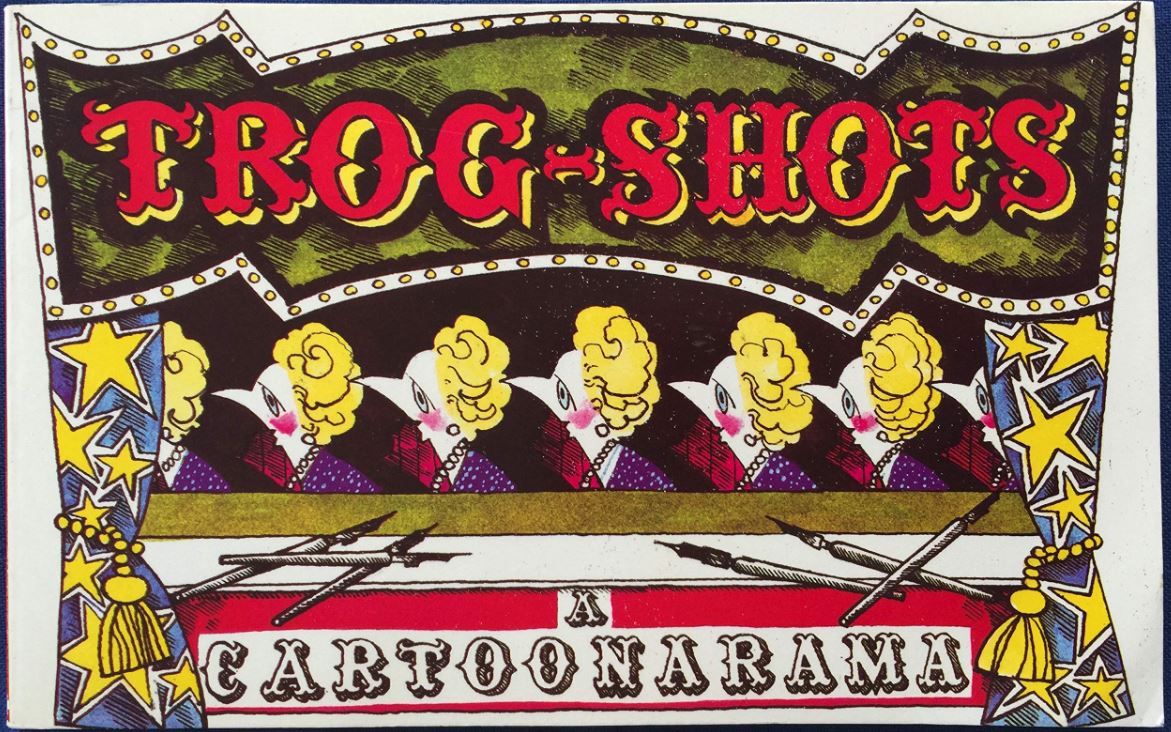
Trog-Shots: A Cartoonerama


By Trog AKA Wally Fawkes (Patrick Hardy Books)
ISBN: 978-0-7444-0049-6 (Landscape PB)

Our last lost giant was someone who drew a beloved all-ages politically-barbed satirical children’s strip for decades and had a second cartoon career as a rapier-witted rottweiler going after society’s true devils.

I’m holding off discussing Flook until I have a decent collection to recommend without pauperising anyone, but until then here’s a collection of Trogs’s other other line of work to celebrate his genius and mourn his loss…  

The one thing I really don’t miss about the 1970s and 1980s is just how many truly ruthless bastards and utter swine were out, proud and loudly ruling us, America and all the other morally bankrupt countries. No matter how bad our current crop of greedy, shallow, inept, self-serving plutocrats might be, they are pitiful pikers when compared to the vicious, callous and ethically challenged rulers of our forefathers. Those guys were actually good at what they did and appreciated a good cover-up too…

That still didn’t keep them out of the sights of a legion of cartoonists like Ralph Steadman, Gerald Scarfe, Steve Bell and Wally Fawkes – who perpetrated his personal acts of socio-political vigilantism under the alias “Trog”. The nom de plume stems from “troglodyte”, but its derivation is hotly disputed to this day…

Born Walter Ernest Pearsall (June 24th 1924 – March 1st 2023) in Vancouver, Canada, Fawkes took his stepfather’s surname after  moving to Britain when he was seven. He taught himself to play clarinet and was never happier than when playing Jazz. His first pro gigs came in 1944 with George Webb, before joining Humphrey Lyttelton in the 1950s. Wally clearly enjoyed his three careers (which he termed “minority pursuits”), and was apparently beyond compare in all of them. I’m not qualified to comment on his jazz playing: I only ever saw him twice but certainly had a great time on each occasion…

If anything was less financially rewarding than playing music it was drawing cartoons, so Wally started doing that too. After reaching England in 1931, he had grown up in South London and – aged 14 – won a scholarship to study at Sidcup Art School. The lifelong comics fan studied there until the money ran out and then plunged into the world of work. When war came, pleurisy kept him out of the armed forces and he contributed to the home front effort by painting camouflage on factories and mapping mines for the British Coal Commission.

In 1942, Fawkes won a cartoon competition held by The Daily Mail, and the judge (the paper’s illustrious chief cartoonist Leslie Illingworth) found him a position at advertising agency Clement Davies. Three years later – on Wally’s 21st birthday – Illingworth hired him as a junior cartoonist. In 1949, Wally’s unique blend of luck and perseverance scored a huge hit when he began his whimsical fantasy masterpiece Flook.

Newspaper owner Lord Rothermere had just come back from America where he had seen Crockett Johnson’s strip Barnaby. When he got home, the magnate wanted something similar but British for The Daily Mail and asked young Fawkes if he could handle it…

Co-scripted by a Who’s Who of media stars (including Sir Compton Mackenzie, Humphrey Lyttelton, George Melly, Barry Norman, Barry Took, Keith Waterhouse and others) it ran in the increasingly ultra-conservative Daily Mail until 1984. A true fish out of water feature, Flook told the increasingly Bohemian, left-leaning and liberal tales of a fuzzy, carrot-nosed, shapeshifting alien innocent and his naive little Earth boy pal Rufus.

Eventually the strip escaped its Right Wing captivity and moved into working class organ The Daily Mirror/Sunday Mirror, before being killed by print tyrant Robert Maxwell.

That didn’t stop Fawkes, though. He still had his clarinet, ideals, imagination, innate unshakeable sense of injustice and a third job as one of the country’s greatest caricaturists and satirists…

From its earliest inception cartooning has been used to sell: initially ideas or values but eventually actual products too. In newspapers, magazines and especially comic books the sheer power of narrative with its ability to create emotional affinities is linked to unforgettable images and characters. When those stories affect the daily lives of generations of readers, the force they can apply in a commercial or social arena is almost irresistible.

In Britain, the cartoonist has held a bizarrely precarious position of power for centuries: deftly designed bombastic broadsides or savagely surgical satirical slices instantly inflicting ridicule, exposing and deflating the powerfully elevated and seemingly untouchable with shaped-charges of scandalous wit and crushingly clear, universally understandable visual metaphor.

For this kind of concept transmission, literacy and lack of education are no barrier. As the Catholic Church proved centuries ago with the Stations of the Cross, stained glass windows and idealised saints, a picture is absolutely worth a thousand words. Moreover, even more than work, sport, religion, fighting or sex, politics has is the very grist that feeds a pictorial gadfly’s mill…

Having for decades contributed regularly to The Spectator, New Statesman, Observer, Guardian, Sunday Telegraph, The Week, Today, London Daily News, plus venerable anti-establishment periodicals Punch and Private Eye (all whilst freelancing as a book illustrator), Fawkes simply carried on lambasting politicians of all stripes and persuasions and caustically commenting on a declining global civilisation until 2005, when failing eyesight finally silenced his excoriating commentaries. One year earlier he had added “Political Cartoonist Of The Year” to his horde of tributes and awards…

Trog died on March 1st 2023, from simple, well-earned old age.

There are still no definitive collections of Flook or Trog’s highly influential (just ask devoted fans Nicholas Garland, Malky McCormick, Barry Fantoni, Steve Bell or Raymond Briggs) stabs at iniquity and hypocrisy, but this collection from 1984 is both representative of the man and his mirth and readily available.

Preceded by a telling, deconstructive and revelatory Foreword by bandmate and Flook co-writer Melly, Trog-Shots: A Cartoonerama re-presents 57 late 1970s/early 1980s art sallies and includes many gags from his regular “Mini-Trog” feature: a general social commentary comedy residency in The Observer.

Culled – as should have been so many of his unsavoury targets – from a time when Monetarism and Reagan took over the USA; Soviet leaders were dropping like flies and Apartheid had just started being rejected by the world, here is a rogues gallery of putrid politicians, scurrilous scandals, and social shout-outs. Here you’ll see the worst of political indifference impacting shoppers, the National Health Service, workers and miners. Here also be monstrous economic mismanagement, revolting journalists, feuding Royals, racist policemen acting beyond the law, sporting skulduggery and Cold War crises. There are starring roles for all the old lags from Jim Callaghan, Michael Foot & Neil Kinnock to Ted Heath, Thatcher, Howe, Tebbitt, Whitelaw, Lawson and all their malign ilk, plus lesser lights like Jeremy Thorpe, Arthur Scargill, and Davids Steele & Owen are soundly skewered and taken to task for what they had – and hadn’t – done…

Awash with astounding images, fascinating lost ephemera and mouth-watering art no fan could resist, this compact compendium is a beautiful fragment of cartoon history that will delight and tantalise, and forms a fitting tribute to a self-effacing master craftsman whose departure has left us all so much poorer. Hopefully, we will at least soon see his legacy back in print…
Collection © 1984 by Wally Fawkes. Foreword © 1984 by George Melly. All rights reserved.

The Fosdyke Saga volume 1


By Bill Tidy (Wolfe Publishing)
ISBN: 72340499-2/978-0-72340-499-6 (Landscape PB)

The world became a far less smart and infinitely grimmer place over the last weeks, due to the loss of three cartooning giants many of you have probably never heard of.

As so little of their superb output is readily accessible to digital-age readers, I’m celebrating their amazing achievements and acknowledging my personal debt to them here with items that can still be easily sourced and the heartfelt advice that if you like to laugh and have a surreal bent, these are comedy craftsmen you need to know.

Today, let’s plunge full-on into a lost world of sheerly startling shoddy grandeur…

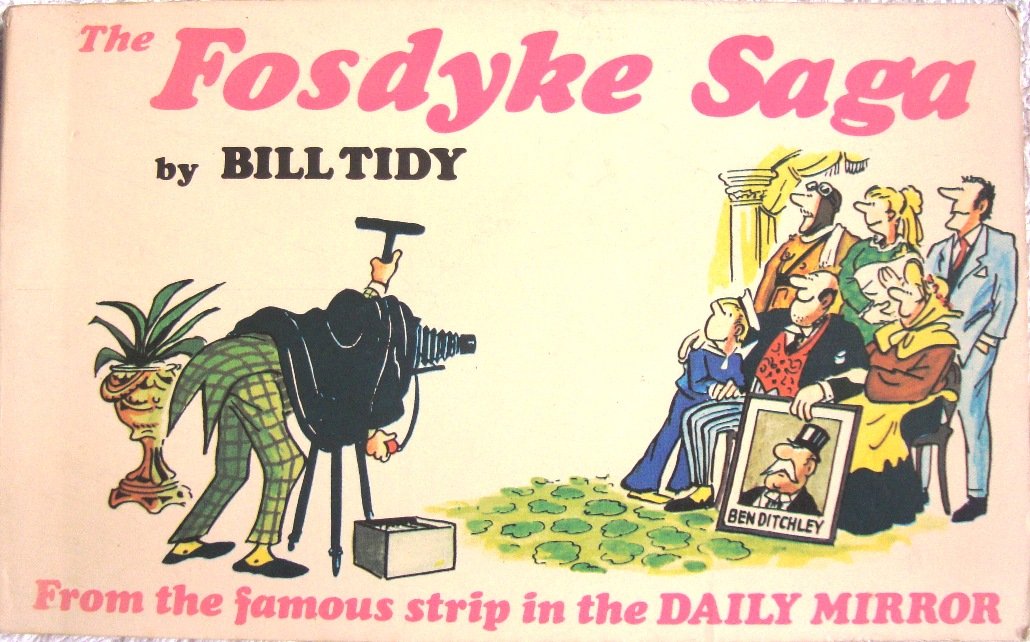
William Edward “Bill” Tidy (MBE) was born on the 9th of October 1933 and died on March 11th 2023. For most of those 89 years he charmed people and made them laugh. Happily, many of his books are available digitally, although incomprehensibly not his sublimely daft (and that’s “Daffft” as in daffodil not “Darhhhhhhhhhhft” as in Dalek or Darling) 14 volume “magnificent octopus” The Fosdyke Saga.

But first, a few words about amusing folk…

Nothing is universally funny, but other people’s idiosyncrasies come pretty close. Comedy is cruel and can be mean-spirited at its core: it all depends on who’s saying what and how. Bill Tidy’s Fosdyke Saga is a grand exemplar: combining a smart, painfully self-aware surreal blend of parody, insular localised legend and working-class aspiration with sheer surrealism.

It is therefore utterly inexplicable to the young or the “Johnny Foreigner” of our Empire Days. In this case that also includes people of other utterly alien cultures – like Americans or Millennials – but also probably incorporates anyone British from further south than bucolic Berkhamsted in Hertfordshire, or Buckinghamshire’s austere Aston Clinton and hoity-toity Tring.

Indeed, rumour has it that until recently, travellers using the Grand Union Canal – grizzled, gruff and grubby bargees hauling coal and rubbing liniment down to the sunlit uplands whilst posh snobs pleasure-boating as disaster tourists trekked a little way into the grim north – had to have their passports checked and stamped at the Apsley/Kings Langley buffer quay…

Seriously though, once upon a time British humour was fiercely and proudly local, regional and factional: cherishing warring accents and nurturing civic rivalries, ancient prejudices (still got plenty of them, though, Ta Very Much!!) and generational grudges. Midlands comedians weren’t funny in Glasgow and Manchester mirth-makers stayed the heck out of Liverpool. But then, after the war – the second one – we began homogenising aspects of life.

In the world of laughter, everything now had a manic, off-kilter skew. Random madcappery abounded where once only genteel wit grazed. The Goon Show and its bastard offspring Do Not Adjust Your Set and Monty Python’s Flying Circus challenged the rational senses whilst racism, sexism, jingoism, wife/mother-in-law jokes, illicit sex, smut, double entendres, “my doctor said” and sporting jibes could no longer securely address all our giggling needs.

Over in a corner somewhere, the bigger picture, establishment inertia and adamantine class structures were still being poked at by a dying cadre of satirists. Then, suddenly, it were 1971 and cartoonist Bill Tidy had a splendidly wicked idea…

He was born in Tranmere, Cheshire and proudly embraced his Northern working-class heritage in everything he did. Raised and educated in Liverpool, his first published work was a cartoon in his school magazine.

Bill joined the Royal Engineers in 1952 and made his first professional cartoon sale three years later whilst posted in Japan. Demobbed and back in Blighty, Tidy joined a Liverpool art agency, creating small ads and doing illustrations for various magazines, and sold his cartoons wherever he could.

Regular clients soon included The Daily Mirror and Daily Sketch so he moved down to London. Time passed and he met other freelancers and in 1966 co-founded a workers club – The British Cartoonists Association. A true wit and natural raconteur, he was mesmerising to listen to and even more so if you were lucky enough to chat with him over a pint…

Although a master of done-in-one single image gags – such as the immortal “Is There Any news of the Iceberg?” (look it up – both the cartoon itself and the illustrated autobiography it now fronts), Tidy inevitably told big stories. He cherished strong narratives powering the engines of his work, and his tales were delivered in a loose flowing, hyper-energetic style perfectly carrying the machine-gun rapidity of his ideas and whacky wordplay.

In April 1967 he created The Cloggies – an Everyday Saga in the Life of Clog Dancing Folk – which ran in Private Eye until 1981 and thereafter The Listener until 1986. He had a few comic residencies: weird/evil science spoof Grimbledon Down (1970-1994 in New Scientist), Dr. Whittle (1970-2001 in General Practitioner) and – from 1974 – imbibers strip Kegbusters in the Campaign for Real Ale’s periodical What’s Brewing? Other regular venues included Classic FM Magazine, The Oldie, The Mail on Sunday, The Yorkshire Post and Punch. When that last venerable humour institution (1841-2002) went bust, Tidy unsuccessfully tried to buy it and keep it going…

Tidy also authored 20 books and illustrated 70 more. If you’re interested, my favourites are The Bedside Book of Final Words and Disgraceful Archaeology: or Things You Shouldn’t Know About the History of Mankind

From cartooning and dedicated charity work with the Lords Taverners, he latterly drifted into radio and TV presentation, appearing on or hosting shows such as I’m Sorry I Haven’t a Clue, Draw Me, Countdown, Watercolour Challenge, Blankety Blank and Countryfile. There will never be another like him.

The best way to remember him is through his work: most notably the multi-volume Fosdyke Saga as gathered in collections from the 1970s and 1980s (but not so much the 2016 compilation).

Perhaps a little context is appropriate. In 1906, author John Galsworthy began in The Man of Property a sequence of novels detailing the lives of an English upper-middle class “new money” family. Spanning half a century (1886-1936) and augmented by In Chancery and To Let, the generational tale was formally repackaged as The Forsyte Saga in 1922. From then onwards, the societal epic has been adapted regularly as movies, immense radio plays and – in 1967 – a groundbreaking BBC television serial. Galsworthy wrote two more trilogies of novels plus spin-off “interludes” – like Indian Summer of a Forsyte and Awakening – cumulatively known as the Forsyte Chronicles. The effort won him 1932’s Nobel Prize for Literature.

Generally, it all showed how even posh folk don’t get to be secure or content and remains a powerful literary presence. The saga was revived in 1994 in a new novel by Suleika Dawson.

The British truly love their television and the BBC especially have produced numerous game changing dramas – everything from the Quatermass stories to I, Claudius. However, their 26-part Forsyte Saga adaptation utterly captivated viewers in a whole new way, so in regard to what’s we’re reviewing here, a little further clarification is required.

The Galsworthy adaptation had originally run from January 7th to July 1st 1967, in BBC 1’s prestigious prime Saturday slot. It was augmented by repeat showings three days later on BBC 2, and the entire series was re-screened on Sundays from September 8th 1968 with the final episode in 1969 seen by 18 million viewers. Overseas sales were staggering (it was the first BBC product sold to the Soviet Union!) and worldwide viewing figures topped in excess of 160 million. All this in the era before home recordings were available. If you missed an episode of anything, all you could was endure other people’s smug gloating…

The TV sensation inspired much imitation, such as ITV’s Upstairs Downstairs, which ran on Sundays from October 10th 1971 to December 21st 1975… just as Bill Tidy’s delirious spoof was hitting its baggy-trousered stride…

I mention this simply because Upstairs Downstairs also highlighted disparities, similarities and interactions of upper-class toffs and working people in a weekly accessible form, but explored the same Edwardian and Georgian eras as Tidy’s wickedly whacky wonders. It ensured the cartoon’s strong historical underpinnings were familiar to the hoi-polloi Daily Mirror readership who might have slept through school, but avidly paid attention to the goggle box…

Just like its inspiration, The Fosdyke Saga is no stranger to media adaptations: spawning a TV series, a play co-written by Alan Plater, two radio series and latterday sequels…

Describing itself as “a classic tale of Struggle, Power, Personalities and Tripe” the story follows Josiah Fosdyke and his family, who in 1900 emigrate from Lancashire mining town Griddlesbury to cosmopolitan Manchester. The move follows another near-death experience “down pit” as the aspiration scab labourer crosses picket lines and nearly ends up another casualty of “King Coal”…

Resolved that this is no way to get ahead, Jos, wife Rebecca, daughter Victoria and sons Tom, Albert and newborn Tim eschew aid from Becky’s wealthy brother and head for Manchester – “where streets are studded wi’ meat pies!”…

A chance meeting with old Ben Ditchley – the Lancashire Tripe King – sets them on the path to prosperity. As Jos repeatedly impresses the self-made millionaire with his cunning and ruthless work ethic, Ditchley’s dissolute son Roger dishonours and debauches Vicky and ultimately is disinherited in Fosdyke’s favour. The end result is by-blow Sylvia Fosdyke, Victoria’s radicalisation and eternal involvement with the paramilitary wing of the Women’s Suffrage Movement and Roger’s lifelong vendetta to crush the family who cost him his inheritance…

The Fosdyke Saga ran from March 1971 to February 1985 and was purportedly personally killed by unctuous, sleazily gentrifying corporate bandit Robert Maxwell after he acquired Mirror Group Newspapers in 1984. This volume is a severely edited compilation of the first few years of the sublime bizarre strip, packed with gags about fierce powerful women (many with full beards and steel toecap boots), privation, music halls, and new inventions. It’s populated by rogues, scoundrels, wastrels and gobsmacked bystanders, and stuffed with shocking foodstuffs like pigs trotters, cowheels, tripe and assorted offal, pigs ears and pickled cabbage, Bavarian Death’s Head Infantry Sausage, Sauerkraut und Schweinwurst and Tinned Tripe for the Troops, all of which act as milestones tracing Fosdyke fortunes in war and peace…

After inheriting old Ben’s business, Jos imaginatively expands and diversifies, but family troubles and Roger’s machinations constantly confound his plans for repast supremacy. Sub-plots reference contemporary turning points like the Titanic’s launch, the Salvation Army movement, suffragettes and the King’s horse, poverty, depression and the day-by day-absurdist drama of the Great War at home, at the Front and everywhere in between…

We see how Tom converts from staunch Conscientious Objector to trench infantryman/POW (with Jos naturally seeking to corner the white feather trade), and Albert’s astounding duel of wills and imagination with Red Baron Von Richthoven and sordid French air ace Marcel Waive, as well as Tom’s thriving prison camp restaurant trade.

The tripeworks is sabotaged and bombed by zeppelins and Jos is accused of being the Salford Ripper, before being blackmailed by Roger for colluding with the enemy, but always the Fosdykes soldier on…

High points for young Ditchley include sending aviator Albert on countless suicide missions, fomenting the Manchester Tripe Wars, seducing a quasi-mystical Tripe Inspector, and hiring the murderous O’Malley Sisters to crush Jos’ trade. When Ditchley’s scheme is quashed by Vicky’s suffragette comrades, the cad enlists “Legendary Lancashire Lothario” T. Edgar Shufflebottom to seduce them in job lots, before being foiled by a simple twist of fate…

When straightforward murder fails too, Roger blackmails “Russian Nightingale” Nadine Buzom into compromising Jos just as little Tim ships out as a cabin boy and is lost at sea…

With the war ended, attacks on the factory resume, Albert is lost in an air race that lands him and Albion’s adored aviatrix the Hon. Cynthia Spofforth at the mercy of a lusty and frustrated Arab sheik and Tom heads west to America’s ease Prohibition woes with Fosdyke’s latest innovation. Sadly, Ditchley is already there, getting rich in Chicago with whisky-soaked offal in his illicit Tripe-Easy…

As Tom joins Elliot Ness and the Untouchables, the volume ends with Jos’s hunger to expand his markets landing him in big trouble: held captive by a Soviet Commissar who just wanted a million tons of free tripe for her starving people… until the elder Fosdyke’s devastatingly manly demeanour turns her Red head…

A forgotten treat for us oldsters and a potential new delight for smart youngsters, Bill Tidy’s surreal tour de force is a delicious treat just waiting to be rediscovered. Over to you…
© Daily Mirror Newspapers Limited 1972.

Totally Mad – 60 Years of Humor, Satire, Stupidity and Stupidity


By “The Usual Gang of Idiots” & edited by John Ficarra (Time Home Entertainment)
ISBN: 978-1-61893-030-9 (HB)

The world has become a measurably less smart and infinitely less funny place over the last month or so, due to the loss of three cartooning giants many of you have probably never heard of.

As it’s unforgivably crass to bundle them all up together – especially because so little of their incredible output is readily accessible to modern readers – I’m celebrating their amazing achievements and acknowledging my personal debt to them over the next few days with items that can still be easily sourced and the heartfelt advice that if you like to laugh and have a surreal bent, these are comedy craftsmen you need to know.

We’re kicking off with the unsung god of cunningly contrived chortles…

Eldest of 4 sons, Abraham Jaffee was born in Savannah, Georgia on March 13th 1921. A successfully transplanted New Yorker, he died in the Big Apple on April 10th 2023, after three years of retirement. For 74 years – 65 of them as an invaluable and unmissable regular contributor to Mad Magazine – he had been paid to make people laugh and think…

Jaffee garnered many awards, inspired millions – including Steven Colbert, John Stewart and generations of other satirists like Gary Larson, Matt Groening and Ted Rall – and he holds the Guinness World Record for longest career as a comics artist. The writer/artist officially retired in 2020 aged 99, and between April 1964 and April 2013 appeared in all but one issue of Mad. And that’s only consecutively – he also joined earlier than you think and carried on after he quit.

Those facts barely scrape the surface of an incredible career…

Jaffee’s early life was troubled: a succession of brief stays in Savannah, Far Rockaway, Queens and Zarasai, Lithuania, resulted from his mother arbitrarily and repeatedly returning to the Old Country with her sons. Eventually he and they at last escaped domestic turmoil to settle in New York.

For escape, he read comic strips (primarily those by Harold Foster, Milton Caniff, Noel Sickles, Otto Soglow, Alex Raymond and Rube Goldberg) and devised ingenious little contraptions from rubbish and junk – a habit that served him well during his later Mad days on the long running Crazy Inventions feature…

During the 1930s, he studied at the NYC High School of Music and Art. That institution also tutored his troubled brother/lifelong assistant Harry Jaffee and future co-workers Harvey Kurtzman, Will Elder, John Severin and Al Feldstein…

Abraham was a brilliantly innovative writer and gifted, multi-disciplined artist who officially started work in late 1942: acting as an illustrator for Timely’s Joker Comics. Soon he was an editor too, all whilst creating features such as Super Rabbit and Ziggy Pig and Silly Seal – originally two singles who became a knockout double act.

In truth, Jaffee had begun selling comedy a year earlier: working for a “Studio Shop” and inventing spoof hero Inferior Man, who debuted in Quality Comics’ Military Comics #7 (cover-dated February 1942 and on sale from December 10th 1941). When his own call-up time came, Jaffee’s war service involved working at the Pentagon as a military draughtsman. He found his first wife there and used the Service’s name-change facility to become Allan “Al” Jaffee…

Returned to civvy street in 1946, he hooked up with Stan Lee again at Timely/Atlas, and became editor of the hugely popular teen division headlined by Patsy Walker Comics.

Al was apparently tireless, freelancing all over even whilst in his ascendancy at Mad. He first worked there in 1955, on the second issue after conversion from colour comic book to monochrome magazine). His school pal Kurtzman was editor then and quit three months later in a fractious dispute with owner Bill Gaines. Al went with him and worked on Kurtzman’s retaliatory rival satire magazines Trump and Humbug. Only when the later closed in 1958 did Jaffee head back to Mad to formally become one of “The Usual Gang of Idiots”.

Between 1957-1963, he wrote and drew 2200 episodes of internationally syndicated strip Tall Tales for the New York Herald Tribune, before ghosting Frank Bolle’s soap opera melodrama Debbie Deere from 1966-1969 and Jason between 1971-1974. From 1984 Jaffee produced kids strip The Shpy for The Moshiac Times. He was an illustrator for Boy’s Life for 25 years and a stalwart of World’s Best Science Fiction (1977) and Ghoulish Book of Weird Records (1979).

Between 1963-1964, Al co-ghosted Kurtzman & Elder’s legendary adult satire Little Annie Fanny for Playboy: a tenure that surely inspired his most memorable Mad creation – the “Fold-In”. Hugh Hefner’s men’s magazine was infamous for its nude “fold-outs”, revealing even more pulchritudinous flesh than other skin mags, so what could be more potent and fitting than a graphic creation that exposed an uncomfortable truth by covering up an innocuous image?

Jaffee’s first fold-in appeared in Mad #86 (April 1964) and became one its most popular and immortal features. Other Jaffee landmarks include Vietnam-war era strip Hawks and Doves, Don’t You Hate…, Scenes We’d Like to See, Mad Inventions, Crazy Gadgets and Fake Ads, assorted covers, movie and TV parodies and utterly irresistible Snappy Answers to Stupid Questions. Many of these have been seen in countless Mad Paperback collections released since the mid-Sixties…

I’ll hopefully get around to his Tall Tales strip collection soon, or maybe some of his Mad paperbacks or even 4-volume HB Boxed set The Mad Fold-In Collection: 1964-2010, but don’t wait for me: buy them if you see them…

For now, however, here’s a great big compendium jam-packed with Jaffe goodness showing him amongst his kind and playing in his natural environment… the world’s greatest humourists…


Totally Mad – 60 Years of Humor, Satire, Stupidity and Stupidity

EC Comics began in 1944 when comicbook pioneer Max Gaines sold the superhero properties of his All-American Comics company to half-sister National/DC, retaining only Picture Stories from the Bible. His plan was to produce a line of Educational Comics with schools and church groups as the major target market.

Gaines augmented this core title with Picture Stories from American History, Picture Stories from Science and Picture Stories from World History, but the so-worthy notion was already struggling when he died in a boating accident in 1947. With disaster looming, son William was dragged into the family business and with much support and encouragement from unsung hero Sol Cohen – who held the company together until the initially unwilling Bill Gaines abandoned his dreams of a career in chemistry – transformed the ailing enterprise into Entertaining Comics

After a few tentative false starts and abortive experiments, Gaines and his multi-talented associate Al Feldstein settled into a bold, fresh publishing strategy, utilising the most gifted illustrators in the field to tell a “New Trend” of stories aimed at an older and more discerning readership. From 1950 to 1954 EC was the most innovative, influential publisher in America, dominating the genres of crime, horror, war and science fiction, spawning a host of cash-in imitations and, under the auspices of writer, artist and editor Harvey Kurtzman, the inventor of an entirely new beast: the satirical comic book…

Mad also inspired dozens of knock-offs and even a controversial sister publication, Panic.

Kurtzman was a cartoon genius and probably the most important cartoonist of the last half of the 20th century. His early triumphs in the fledgling field of comicbooks (Mad, Two-Fisted Tales, Frontline Combat) would be enough for most creators to lean back on, but Kurtzman was a force in newspaper strips (See Flash Gordon Complete Daily Strips 1951-1953) and a restless innovator, a commentator and social explorer who kept on looking at folk and their doings: a man with exacting standards who just couldn’t stop creating.

By inventing a whole new format he gave the USA Populist Satire: transforming highly distasteful, disgraceful, highly successful colour comic Mad into a mainstream monochrome magazine, safely distancing the outrageously comedic publication from fall-out caused by the 1950s socio-political witch-hunt that eventually killed all EC’s other titles, and bringing the now more socially acceptable publication to a far wider, broader audience. Kurtzman wasn’t around for long…

He then pursued his unique brand of thoughtfully outré comedy and social satire in Trump, Humbug and Help!, all the while conceiving challenging and powerfully effective humour strips like Little Annie Fannie (in Playboy), The Jungle Book, Nutz, Goodman Beaver, and Betsy and her Buddies. Seemingly tireless, he inspired a new generation through his creations on Sesame Street and by teaching cartooning at the School of Visual Arts in New York. He died far too early in 1993.

… And he was just one of the astonishingly gifted creators who made Mad an international franchise, a staggeringly influential cultural phenomenon and a global brand in the years that followed…

Totally Mad -and we’re long overdue for an updated edition, y’all – reviews the rise and rise of the magazine, with tantalising snippets of gags and features accompanied by big excerpts and illustrations from many brilliant creators to have contributed to its success.

Be Warned: this is not a “best of” collection – it would be impossible to choose, and there are hundreds of reprint compilations and websites for that. This is a joyous celebration of past glories and a compulsive taster for further exploration, albeit with few complete stories…

At 256 pages, this luxuriously huge (312x235mm) compendium is regrettably only on sale in physical form but does include historical articles, amazingly funny art and cleverly barbed observations, all divided by decade and augmented by many full-colour, iconic cover reproductions. The minimal text references favourite features such as Spy vs Spy (both by originator Antonio Prohias and successor Peter Kuper), Dave Berg’s The Lighter Side of…, Mad Mini-Posters, Film and TV parodies including ‘Gunsmoked’, ‘My Fair Ad-Man’, ‘East Side Story’, ‘Flawrence of Arabia’, ‘Star Blecch’, ‘Jaw’d’, ‘Saturday Night Feeble’, ‘LA Lewd’, ‘Dorky Dancing’, and assorted mega-movie franchises ad infinitum as well as sterling examples of Jaffee’s uniquely barbed ‘Mad Fold-Ins, ‘Scenes We’d Like to See’ and ‘Snappy Answers to Stupid Questions’.

Whatever your period, and whichever is your most dearly revered, it’s probably sampled and trammelled here…

Following an eccentric and loving Introduction from Stephen Colbert and Eric Drysdale -ably illustrated by Sam Viviano – veteran contributor Frank Jacobs provides a photo-packed profile of Mad’s unique father-figure by asking – and answering – ‘Who Was Bill Gaines?’ after which ‘Mad in the 1950s’ recalls the Kurtzman era with brightly-hued extracts from giant ape spoof ‘Ping Pong!’, ‘Superduperman!’, ‘Lone Stranger Rides Again!’, ‘Sound Effects!’, ‘Melvin of the Apes!’, ‘Mad Reader!’, ‘Bringing Back Father!’ and ‘Starchie’. These highlight the talents of Will Elder, Wallace Wood, Jack Davis, John Severin, Basil Wolverton & Bernie Krigstein before moving into the magazine phase via spoof advertising and popular pastimes such as ‘Readers Disgust’, ‘What Makes a Glass of Beer Taste so Good?’ and more.

Arch-caricaturist Mort Drucker began a stellar run at this time, as did mildly maniacal Don Martin, whilst comics legends Joe Orlando, Wood, Davis and George Woodbridge reached astonishing peaks of artistic excellence as seen via a parade of stunning covers and end-pages with additional contributions by Kurtzman, Kelly Freas, Norman Mingo and others…

In ‘Who is Alfred E. Neuman?’, Jacobs recounts the twisted, turbulent origins of the iconic gap-toothed-idiot company mascot, after which ‘Mad in the 1960s’ highlights the rise of Television and the counter-culture before ‘Was Mad Ever Sued?’ sees Jacobs testify to some truly daft and troubling moments in the mag’s life…

Many of the very best bits of ‘Mad in the 1970s’ is followed by the conclusion of ‘Who Was Bill Gaines?’ prior to Davis, Dick DeBartolo & Jacobs’ iconic ‘Raiders of the Lost Art skit heralding ‘Mad in the 1980s’ wherein patriotism, movie blockbusters, Hip-hop and computer games seized the public’s collective imagination…

‘What Were the Mad Trips?’ explores a grand tradition of company holidays, after which ‘Mad in the 1990s’ covers Rap music, the rise of celeb culture and the magazine’s frenzied forays into a rapidly changing world. Then comes ‘Mad After Gaines’, detailing internal adjustments necessitated by the death of its hands-on, larger-than life publisher in 1992. ‘Mad in the 2000s’ details the brand’s shift into the digital world, with exemplars from creators old and new spoofing medicines, newspaper strips, elections, religion, dead phrases, celebrity causes, cell-phones, man-boobs, war in Iraq, obesity, satirical competitor ‘The Bunion’, contemporary Racism and media sensations Donald Trump (Who He?): all accompanied by parodies including ‘Bored of the Rings’, ‘Sluts in the City’, ‘Spider-Sham’, and more…

Editor John Ficarra offers his Afterword and this magnificent tome also includes a poster pack of a dozen of the very best covers from Mad’s epochal run.

Most of you can happily stop now, but if you’re into shopping lists, here’s a small portion of other contributing “idiots” making Mad a national institution… like graft, perjury, prison and pimples:

Sergio Aragonés is represented throughout with Mad Marginals and many masterful cartoons and pastiches, whilst guest writers include Vic Cohen, Tom Koch, Larry Siegel, Nick Meglin, Earl Doud, Lou Silverstone, Jacobs, DeBartolo, Arnie Kogen, Chevy Chase, Max Brandel, Stan Hart, Marylyn Ippolito, Billy Doherty, Barry Liebman, Desmond Devlin, Russ Cooper, Joe Raiola, Charlie Kadau, Robert Bramble, Michael Gallagher, and Butch D’Ambrosio.

All-rounders both scripting and scribbling include Berg, Aragonés, Martin, Kuper, John Caldwell, Drew Friedman, Paul Peter Porges, Don “Duck” Edwing, Tom Cheney, Feggo, Christopher Baldwin and the incomparable Mister Jaffee.

There are also star artists making a rare splash amongst these venerable veterans. These include Frank Frazetta, John Cullen Murphy, Angelo Torres, Bill Wray, Mark Frederickson, Bob Clarke, Gary Belkin, Paul Coker Jr., Mutz, Jack Rickard, Irving Schild, Gerry Gersten, Rick Tulka, Harry North, Richard Williams, Tom Bunk, Steve Brodner, Mark Stutzman, Tom Richmond, and Gary Hallgren… Heck! – the list is nigh endless.

Wrist-wreckingly huge, eye-poppingly great and mind-bogglingly fun, this is one to treasure and pore through… and probably fight over…
© 2012 E.C. Publications, Inc. All rights reserved.

A Treasury of Victorian Murder Compendium II


By Rick Geary (NBM/ComicsLit)
ISBN: 978-1-56163-907-6 (Digest HB)

Master cartoonist Rick Geary is a unique presence in both comics and true crime literature. His compelling forensic dissections – in the form of graphic novel reconstructions – of some of the most infamous and groundbreaking murder mysteries since policing began never fail to beguile or entertain.

Although outrageously still unavailable digitally, for many years Geary’s unblinking eye powerfully probed the last hundred years or so in his Treasury of XXth Century Murder series. Prior to that, he first began graphically capitalising on a fascination with Mankind’s darker aspects way back in 1987, via a delicious anthologised tome entitled A Treasury of Victorian Murder.

That initial volume and 3 of the 8 that succeeded it (Jack the Ripper, The Fatal Bullet and The Beast of Chicago) were combined and re-issued in 2012 as a splendidly morbid monochrome deluxe hardback – because, after all, bloody murder is always a black and white affair…

More of his most compelling past triumphs were gathered into a second blockbusting 400-page monochrome hardback to delight fans of the genre and, without a shadow of a doubt, make new converts out of the as yet unconvinced…

Combining a superlative talent for laconic prose, incisive observation and meticulously detailed pictorial extrapolation with his gift for recounting the ruthless propensities of humans throughout history, Geary ceaselessly scoured police blotters, newspaper archives and even history books to compile more irresistibly infectious social sins and felonious infractions.

His unique cartooning style is the perfect medium to convey starkly factual narratives in a memorable, mordant and undeniably enjoyable manner. Each epic endeavour is accompanied by an Introduction and scholarly Bibliography, with most adaptations also offering splendidly informative maps and diagrams to set the stories firmly in place.

Starting off this largely ladykiller-laden catalogue of crime is The Borden Tragedy, digging through an abundance of details surrounding one of the most infamous – if not mythic – crimes ever perpetrated.

In Fall River, Massachusetts on August 4th 1892, prosperous self-made man Andrew Borden and his second wife Abby were found slain inside their own home. Death in both cases was caused by multiple axe blows.

Rather than his later neutral narrative stance, here Geary illustrates the “first-hand account” of an acquaintance of youngest daughter Lizzie Borden who – after much inept investigation and public speculation – was settled upon by the authorities as the likeliest suspect.

Many and various suppositions, theories, scandals and gossip-points are scrupulously examined as she stands trial for the crimes – a case muddled by a subsequent axe-murder whilst Lizzie was actually in custody – and the spotlight follows her through the much-protracted case, past her acquittal and to her eventual death in 1927…

The graphic re-enactment is accompanied by a copious photo and text section featuring a wealth of ‘Press Clippings of the Time’ as well as a reproduction of ‘Borden’s Indictment’ and The Boston Advertiser article on her eventual “Not Guilty” verdict.

The Mystery of Mary Rogers concerns the assault and murder of a New York City cigar shop girl which mesmerised the citizenry in 1841. Such was the furore that author Edgar Allen Poe appropriated the events for his C. Auguste Lupin tale The Mystery of Marie Roget: a rather unwise move, since he knew the deceased and thereby opened himself up to loudly-voiced suspicions of complicity…

The facts are that on the 28th July 1841, a number of well-to do-citizens left stifling Manhattan Island for the Jersey Shore and there discovered the body of the “Segar Girl” floating in the Hudson; battered, strangled and with her hands tied across her chest.

A hasty autopsy and even quicker inquest, held under insultingly cavalier circumstances, produced no culprits or suspects but somehow managed to throw suspicion on everyone from the men who pulled her out of the water to her drunken suicidal fiancée and even her own mother…

A talking point for all and sundry from the highest society paragon to the lowliest street trash, her death produced ever-more scandalous revelations and groundless lewd rumours – all scrupulously explored by Geary – over the next few years, but the case remains unsolved still…

The Saga of the Bloody Benders began in largely unsettled Kansas, during the period immediately following the American Civil War, when a family of German-speaking immigrants settled near the Osage Trail. There they built a General Store-&-Hotel equidistant between the nascent townships of Cherry Vale, Parsons and Thayer.

By the time they vanished four years later, provably ten but probably many, many more travellers and settlers had been robbed and murdered. Thereafter, the insalubrious Benders simply vanished from the sight of man…

Geary, with supreme style and dry wit, presents the facts and the best of the rumours in his inimitable style to create yet another unforgettable masterpiece of Gothic whimsy.

The Case of Madeleine Smith focused on the true and scandalous secret affair between Emile L’Anglier, a low-born French clerk, and prim, proper, eminently respectable Miss Madeleine Smith, daughter of a wealthy Scottish merchant.

The slow poisoning of the Gallic Romeo led to a notorious trial in the 19th century and the eventual verdict shocked everyone and satisfied nobody…

The entrancing chronicle of carnage and venality concludes with the epic account of The Murder of Abraham Lincoln, covering the 62 days from 4th March to May 4th 1865, when actor John Wilkes Booth and a band of like-minded Confederate diehards schemed to murder the President (and other Northern politicians they held responsible for the destruction of the South), and how their wild plot came to startling, implausible fruition…

Following the Inauguration Ceremony for his second Term of Office, the normally fatalistic and security-disparaging President Lincoln was troubled by unease, disquiet and dreams of assassination. They might have been possibly generated by the sack-full of death threats stashed away by his Secretary John Hay.

Elsewhere, Secessionist sympathiser Booth was planning a blow for revenge and personal immortality, but increasingly found his co-conspirators a disappointing bunch. Driven and desperate, he persevered for his cause…

All the many players are scrutinised in Geary’s careful examination, with the peculiar circumstances that left Lincoln vulnerable counterbalanced by insights and minutiae provided into his less-than-fanatical nemeses.

Only one of the many assassinations planned by the Secessionist cabal came to anything, and following that foul deed, grisly death-watch and post mortem, Geary’s depiction of the bold but inept manhunt which followed is capped here by Booth’s satisfyingly dramatic end, leaving nothing but the artist’s masterful summing up to ask the questions nobody has answered yet and leave us all with the certain knowledge that this too is a murder still largely unexplained if not unsolved…

These compelling cold cases are a perfect example of how graphic narrative can be so much more than simplistic fantasy entertainment, and such merrily morbid murder masterpieces as these should be mandatory reading for every mystery addict and crime collector.

Such seductive storytelling, erudite argument and audacious drawing produce an irresistible dash and verve which makes for unforgettable reading: Geary is a unique talent in the comic industry, as much for his style as his subject matter and methodology in telling tales. Always presenting both facts and the theories – contemporary and modern – with chilling graphic precision, captivating clarity and devastating dry wit, he attacks criminology’s greatest mysteries with a force and power even Oliver Stone would envy, and every true crime podcaster should admire…
© 1997-2007, 2015 Rick Geary.

If You Loved Me, You’d Think This was Cute – Uncomfortably True Cartoons About You


By Nick Galifianakis (Andrews McMeel)
ISBN: 978-0-7407-9947-1 (TPB/Digital edition)

Delivering biting wit, groundbreaking revelation or an excoriating assault with an unforgettable drawing and a few well-chosen words is one of the greatest gifts humans might possess. Even those stuck-up holdouts who pointedly claim to have “never read a comic” certainly enjoy strips or panels: a golden bounty of brief amusement demanding no commitment other than a moment’s close attention.

Truth be told, it’s probably in our genes and a bit like love, no?

According to the text preface by Carolyn Hax in this astoundingly funny collection, the cartoons gathered here by immensely gifted illustrator Nick Galifianakis were originally intended as little pictorial add-ons to accompany and supplement her nationally syndicated Advice Column (cited by Time magazine as America’s best…).

Apparently, Nick kept making them so funny that the pictures became an intrinsic and unmissable companion and in 2010 a whole bunch of the very best of them turned into this book.

Also included are an outrageous Foreword by his cousin Zach – yes, that movie comedian guy – sharing the kind of intimate incident insights and past humiliations only a close family member can; as well as a vast Acknowledgments section and insider information on the way Nick works in his Introduction. There are also concrete clues that his one true love is his dog ZuZu

All that aside, what’s on offer here is a spellbinding examination of human relationships as seen from a natural raconteur’s perspective: devastatingly penetrating, sharp to the point of cruelty, warmly sympathetic, ultimately understanding and forgiving and, most importantly, laugh-out-loud, Horlicks-jetting-out-of-your-nose funny.

Or whatever your shared evening tipple of choice might be. I’m not saying that his gags make your body mysteriously manufacture Horlicks. That would be weird…

In this delicious monochrome paperback (or eBook, you choose: it’s an officially free albeit expensive world and you’re most likely some sort of consenting adult) you’ll see all the perilous wonders and tribulations of human relationships. Crucially, you will also find the search for love reduced to simple, forthright categories stuffed with beautifully rendered line drawings exemplifying the rights and wrongs of finding and keeping – or satisfactorily jettisoning – a partner.

It kicks off with the male perspective as seen through female eyes in ‘The Bastard Files’ before naturally offering an opposing viewpoint in ‘The Unfair Sex’

The eternal hunt is deconstructed in ‘Finding the Ones(s)’ and expanded upon in ‘So This Was The One’ before learning how to negotiate deadly traps and bile-filled traumas of ‘The Bridal Industrial Complex’.

Weddings avoided or survived, everybody’s all reconciled to being one great big joyous clan, as proved here in the acerbically astute ‘Putting the Eff in Family’, but please remember, Love’s all about the children really, isn’t it? Thus a close-up-and-personal dissection of procreation in ‘Just Kidding’ which leads to the conclusion that some sons and daughters don’t ever grow up in ‘When We’re Five We’re All Artists…’

If confused or in trouble, the natural thing to do is depend on your closest comrades in the Battle of the Sexes, but ‘With Friends Like These’, clarity and understanding are early casualties. Still, if we’re being truly honest we can only trust our ‘Lusting Impressions’ before settling for ‘A Little Something on the Side’ to avoid getting ‘Ego-Tripped’.

At least our animal companions still offer us unconditional love… don’t they? Perhaps not, if the bestial examples in ‘Ark Types’ are to be believed and if you ‘Catch My Riff’

When all’s said (sad?) and done then, perhaps it’s best to play safe and just try the ‘Flair of the Dog’ when looking for truly lasting love…

With recurring themes including Frogs and Princesses, malevolent Cupids, uncomprehending Adams and Eves, weary Saint Peter at the Pearly Gates and the absolutely crucial role of Lawyers and Counsellors in all relationship matters, this compendium of situational quandaries and unromantic entanglements is a superbly cathartic look at love and one every new home and generational estate should have in pride of place on the mantelpiece – near the heavy candlesticks, poker, poisons and matching tasers…

© 2010 by Nick Galifianakis. All rights reserved.

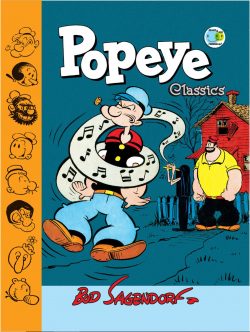
Popeye volume 2: Wimpy and His Hamburgers (The E.C. Segar Popeye Sundays)


By Elzie Crisler Segar with Kevin Huizenga & various (Fantagraphics Books)
ISBN: 978-1- 68396-668-5 (TPB/digital edition)

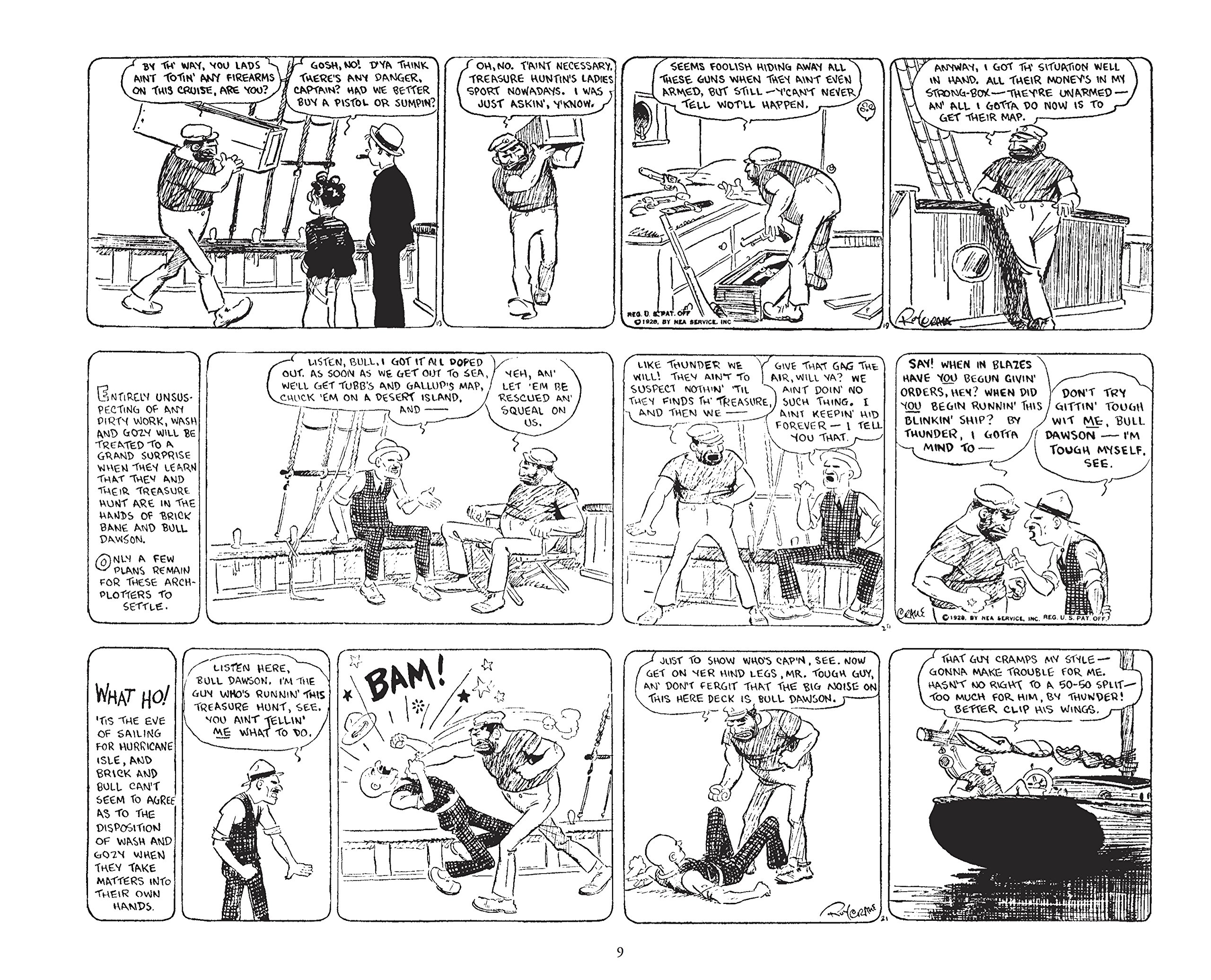
Popeye embarked in the Thimble Theatre comic feature with the instalment for January 17th 1929. The strip was an unassuming vehicle that had launched on 19th December 1919: one of many newspaper cartoon funnies to parody, burlesque and mimic the era’s silent movie serials. Its more successful forebears included C.W. Kahles’ Hairbreadth Harry or Ed Wheelan’s Midget Movies/Minute Movies – which Thimble Theatre replaced in media mogul William Randolph Hearsts’ papers.

All the above-cited strips employed a repertory company of characters playing out generic adventures based on those expressive cinema antics. Thimble Theatre’s cast included Nana and Cole Oyl, their gawky, excessively excitable daughter Olive, diminutive-but-pushy son Castor and Olive’s sappy, would-be beau Horace Hamgravy.

The series ticked along nicely for a decade: competent, unassuming and always entertaining, with Castor and Ham Gravy (as he became) tumbling through get-rich-quick schemes, frenzied, fear-free adventures and gag situations until September 10th 1928, when explorer uncle Lubry Kent Oyl gave Castor a spoil from his latest exploration of Africa.

It was the most fabulous of all birds – a hand-reared Whiffle Hen – and was the start of something truly groundbreaking…

Whiffle Hens are troublesome, incredibly rare and possessed of fantastic powers, but after months of inspired hokum and slapstick shenanigans, Castor was inclined to keep Bernice – for that was the hen’s name – as a series of increasingly peculiar circumstances brought him into contention with ruthless Mr. Fadewell, world’s greatest gambler and king of the gaming resort dubbed ‘Dice Island’.

Bernice clearly affected and inspired writer/artist E.C. Segar, because his strip increasingly became a playground of frantic, compelling action and comedy during this period…

When Castor and Ham discovered that everybody wanted the Whiffle Hen because she could bestow infallible good luck, they sailed for Dice Island to win every penny from its lavish casinos. Big sister Olive wanted to come along, but the boys planned to leave her behind once their vessel was ready to sail. It was 16th January 1929…

The next day, in the 108th episode of the saga, a bluff, brusquely irascible, ignorant, itinerant and exceeding ugly one-eyed old sailor was hired by the pathetic pair to man the boat they had rented, and the world was introduced to one of the most iconic and memorable characters ever conceived.

By sheer surly willpower, Popeye won readers hearts and minds: his no-nonsense, grumbling simplicity and dubious appeal enchanting the public until, by the end of the tale, the walk-on had taken up full residency. He would eventually make Thimble Theatre his own…

The Sailor Man affably steamed onto the full-colour Sunday Pages forming the meat of this curated collection covering March 6th 1932-November 26th 1933. This paperback prize is the second of four that will contain Segar’s entire Sunday canon: designed for swanky slipcases. Spiffy as that sounds, the wondrous stories are also available in digital editions if you want to think of ecology or mitigate the age and frailty of your spinach-deprived “muskles”…

Elzie Crisler Segar was born in Chester, Illinois on 8th December 1894, son of a handyman. Elzie’s early life was filled with the solid, earnest blue-collar jobs that typified his generation of cartoonists. The younger Segar worked as a decorator and house-painter, and played drums accompanying vaudeville acts at the local theatre and – when the town got a movie house – he played for the silent films. This allowed him to absorb the staging, timing and narrative tricks from close observation of the screen, and would become his greatest assets as a cartoonist. It was whilst working as the film projectionist, aged 18, he decided to draw for his living, and tell his own stories.

Like so many from that “can-do” era, Segar studied art via mail: in this case W.L. Evans’ cartooning correspondence course out of Cleveland, Ohio – from where Jerry Siegel & Joe Shuster would launch Superman upon the world. Segar gravitated to Chicago and was “discovered” by Richard F. Outcault (The Yellow Kid, Buster Brown), arguably the inventor of newspaper comics.

Outcault introduced Segar around at the prestigious Chicago Herald and soon – still wet behind the ears – Segar’s first strip Charley Chaplin’s Comedy Capers debuted on 12th March 1916. Two years, Elzie married Myrtle Johnson and moved to Hearst’s Chicago Evening American to create Looping the Loop. Managing Editor William Curley saw a big future for Segar and promptly packed the newlyweds off to the Manhattan headquarters of the mighty King Features Syndicate.

Within a year Segar was producing Thimble Theatre for the New York Journal. In 1924, Segar created a second daily strip. The 5:15 was a surreal domestic comedy featuring weedy commuter/would-be inventor John Sappo …and his formidable, indomitable wife Myrtle (!).

A born storyteller, Segar had from the start an advantage even his beloved cinema couldn’t match. His brilliant ear for dialogue and accent shone out from his admittedly average melodrama adventure plots, adding lustre to stories and gags he always felt he hadn’t drawn well enough. After a decade or so – and just as cinema caught up with the introduction of “talkies” – he finally discovered a character whose unique sound and individual vocalisations blended with a fantastic, enthralling nature to create a literal superstar.

Incoherent, plug-ugly and stingingly sarcastic, Popeye shambled on stage midway through Dice Island’ and once his very minor part played out, simply refused to leave. Within a year he was a regular. As circulation skyrocketed, he became the star.

In the less than 10 years Segar worked with his iconic sailor-man (January 1929 until the artist’s untimely death on 13th October 1938), the auteur constructed an incredible meta-world of fabulous lands and lost locales, where unique characters undertook fantastic voyages spawned or overcame astounding scenarios and experienced big, unforgettable thrills as well as the small human dramas we’re all subject to.

This was a saga both extraordinary and mundane, which could be hilarious or terrifying – frequently at the same time. For every trip to the rip-roaring Wild West or lost kingdom, there was a brawl between squabbling neighbours, spats between friends or disagreements between sweethearts – any and all usually settled with mightily-swung fists.

Popeye is the first Superman of comics, but he was not a comfortable hero to idolise. A brute who thought with his fists, lacking all respect for authority, he was uneducated, short-tempered and – whenever hot tomatoes batted their eyelashes (or thereabouts) at him – fickle: a worrisome gambling troublemaker who wasn’t welcome in polite society… and wouldn’t want to be.

The mighty marine marvel is the ultimate working-class hero: raw and rough-hewn, practical, with an innate and unshakable sense of what’s fair and what’s not, a joker who wants kids to be themselves – but not necessarily “good” – and someone who takes no guff from anybody. Always ready to defend the weak and with absolutely no pretensions or aspirations to rise above his fellows, he was and will always be “the best of us”…

This current tranche of reprinted classics concentrates on the astounding full-page Sunday outings (here encompassing March 6th 1932 to November 1933, but sadly omits the absurdist Sappo toppers. You’ll need to track down Fantagraphics’ hardback tabloid collections from a decade ago to see those whacky shenanigans…

Since many papers only carried dailies or Sundays, but only occasionally both, a system of differentiated storylines developed early in American publishing, and when Popeye finally made his belated sabbath day move, he was already a well-developed character.

Ham and Castor had been the stars since Thimble Theatre’s Sundays since the ancillary feature began on January 25, 1925; they all but vanished once the mighty matelot stormed that stronghold. From then on, Segar concentrated on gag-based extended dramatic serials Mondays to Saturdays, leaving family-friendly japes for Sundays: an arena perfect for the Popeye-Olive Oyl modern romance to unfold. With this second volume, however, we get to play with Segar’s second greatest character creation: morally maladjusted master moocher J Wellington Wimpy

Preceding the vintage views, this tome offers a lovely laudatory comic strip deconstruction, demystification and appreciation in ‘“Segar’s Wimpy” – An Introduction by Kevin Huizenga’. The experimental fabulist (Glen Ganges in The River At Night, Comix Skool USA, Riverside Companion) probes everything from how different illustrators handle the human dustbin to how Wimpy’s eyes are drawn…

When the wondrous weekend instalments began last volume, we saw Ham Gravy gradually edged out of romancing Olive. From there onwards, done-in-one gag instalments outlined an unlikely but enduring romance which blossomed (withered, bloomed, withered some more, hit cold snaps and early harvests – you get the idea…) as Olive alternately pursued her man and dumped him for better prospects.

To be fair, Popeye always vacillated between ignoring her and moving mountains to impress her. Since she always kept her options open, he spent a lot of time fighting off – quite literally – her other gentlemen callers. A mercurial creature, the militantly maidenly Miss Oyl spent as long trying to stop her beau’s battles (a tricky proposition as he spent time ashore as an extremely successful “sprize fighter”) as civilise her man, yet would mercilessly batter any flighty floozy who cast cow eyes at her devil-may-care suitor…

In those formative episodes, Castor became Popeye’s manager and we revelled in how originally-philanthropic millionaire Mr. Kilph moved from eager backer to demented arch enemy paying any price to see Popeye pummelled. The sailors’ opponents included husky two-fisted Bearcat, Mr. Spar, Kid Sledge, Joe Barnacle, Kid Smack, Kid Jolt, The Bullet, Johnny Brawn, an actual giant dubbed Tinearo and even trained gorilla Kid Klutch.

None were tough enough and Kilph got crazier and crazier…

History repeated itself when a lazy and audaciously corrupt ring referee was introduced as a passing bit player. The unnamed, unprincipled scoundrel kept resurfacing and swiping more of the limelight: graduating from minor moments in extended, trenchant, scathingly witty sequences about boxing and human nature to speaking – and cadging – roles…

Among so many timeless supporting characters, mega moocher J. Wellington Wimpy stands out as the complete antithesis of feisty big-hearted Popeye, but unlike any other nemesis I can think of, this black mirror is not an “emeny” of the hero, but his best – maybe only – friend…

As previously stipulated, the engaging Mr. Micawber-like coward, moocher and conman debuted on 3rd May 1931 as an unnamed referee officiating a bombastic month-long bout against Tinearo. He struck a chord with Segar who made him a (usually unwelcome) fixture. Eternally, infernally ravenous and always soliciting (probably on principle) bribes of any magnitude, we only learned the crook’s name in the May 24th instalment. The erudite rogue uttered the first of many immortal catchphrases a month later.

That was June 21st – but “I would gladly pay you Tuesday for a hamburger today” like most phrases everybody knows, actually started as “Cook me up a hamburger, I’ll pay you Thursday”. It was closely followed by my personal mantra “lets you and him fight”…

Now with a new volume and another year, we open with more of the same. The romantic combat between Olive, Popeye and a string of rival suitors continues, resulting in the sailor winning a male beauty contest (by force of arms), and brutally despatching a procession of potential boyfriends.

As hot-&-cold Olive warms to the moocher, there’s more of Wimpy’s ineffable wisdom on show, as he reinvents himself as the final arbiter of (strictly negotiable) judgement…

Whether it’s her beaux or who’s hardest hit by government policies – sailors like Popeye or restaurant owners like Rough-House – Wimpy has opinions he’s happy to share… for a price.

Mr. Kilph turns up again, arranging a bout between Popeye and his new million-dollar robot, but even with Wimpy officiating, the sailor comes up trumps. The moocher briefly becomes our matelot’s best pal, but blows it by putting the moves on Olive after tasting her cooking…

Another aspect of Popeye’s complex character is highlighted in an extended sequence running from May 29th  through July 17th1932, one that secured his place in reader’s hearts.

The sailor was a rough-hewn orphan who loved to gamble and fight. He was proudly not smart and superhumanly powerful, but he was a big-hearted man with an innate sense of decency who hated injustice – even if he couldn’t pronounce it.

When starving waif Mary Ann tries to sell him a flower, Popeye impetuously adopts her, inadvertently taking her from the brutal couple who use her in a begging racket.

Before long the kid is beloved of his entire circle – even Olive – and to support her, Popeye takes on another prize fight: this time with savage Kid Panther and his unscrupulous manager Gimbler

He grows to truly love her and there’s a genuine sense of happy tragedy when he locates her real and exceedingly wealthy parents. Naturally Popeye gives her up…

That such a rambunctious, action-packed comedy adventure serial could so easily turn an audience into sobbing, sentimental pantywaists is a measure of just how great a spellbinder Segar was. Although rowdy, slapstick cartoon violence remained at a premium – family values were different then – Segar’s worldly, socially- probing satire and Popeye’s beguiling (but relative) innocence and lack of experience keeps the entire affair in hilarious perspective whilst confirming him as an unlikely and lovable innocent, albeit one eternally at odds with cops and rich folk…

Following weeks of one-off gags – like Olive improbably winning a beauty contest and a succession of hilarious Wimpy episodes (such as cannily exposing himself to score burgers from embarrassed customers and ongoing problems with sleep-eating) – a triptych of plot strands opens as Miss Oyl engages a psychiatrist to cure Popeye of fighting, even as the sailor discovers Wimpy has such an affinity with lower life forms that he can be used to lure all the flies and sundry other bugs from Rough-House’s diner…

The third strand has further-reaching repercussions. Popeye has been teaching kids to fight and avoid spankings which has understandably sparked a riot of rebellion, bad behaviour and bad eating habits. Now, distraught parents need Popeye to set things right again…

Naturally it goes too far once the hero-worshipping kids start using the sailor-man as a source of alt-fact schooling too…

We constantly see softer sides of the sailor-man as he repeatedly gives away most of what he earns – to widows and “orphinks” – and exposes his crusading core with numerous assaults on bullies, animal abusers and romantic rivals, but when the war of nerves and resources between Wimpy and Rough-House inevitably escalates, Popeye implausibly finds himself as “the responsible adult”.

That means being referee in a brutal and ridiculous grudge match settled in the ring, with all proceeds going to providing poor kids with spinach. The bout naturally settles nothing but does have unintended consequences when the moocher is suddenly reunited with his estranged mother after 15 years…

Tough men are all suckers for a sob story and even Rough-House foolishly amplifies the importance and regard people supposedly feel for the now-homeless little old lady’s larcenous prodigal. It’s a move the moocher can’t help but exploit…

As the Sunday Pages followed a decidedly domestic but rowdily riotous path, the section was increasing given over to – or more correctly, appropriated – by the insidiously oleaginous Wimpy: an ever hungry, intellectually stimulating, casually charming and usually triumphant conman profiting in all his mendicant missions.

Whilst still continuing Popeye’s pugilistic shenanigans , the action of the Sunday strips moved away from him hitting quite so much to alternately being outwitted by the unctuous moocher or saving him from the vengeance of the furious diner-owner and passionately loathing fellow customer George W. Geezil. The soup-slurping cove began as an ethnic Jewish stereotype, but like all Segar’s characters swiftly developed beyond his (now so offensive) comedic archetype into a unique person with his own story… and another funny accent. Geezil was the chief and most vocal advocate for murdering the insatiable sponger…

Wimpy was incorrigible and unstoppable – he even became a rival suitor for Olive Oyl’s unappealingly scrawny favours – and his development owes a huge debt to his creator’s love and admiration of comedian W.C. Fields.

A mercurial force of nature, the unflappable mendicant is the perfect foil for common-man-but-imperfect-hero Popeye. Where the sailor is heart and spirit, unquestioning morality and self-sacrifice, indomitable defiance, brute force and no smarts at all, Wimpy is intellect and self-serving greed, freed from all ethical restraint or consideration, and gloriously devoid of impulse-control.

Wimpy literally took candy from babies and food from the mouths of starving children, yet somehow Segar made us love him. He is Popeye’s other half: weld them together and you have an heroic ideal… (and yes, those stories are all true: Britain’s Wimpy burger bar chain was built from the remnants of a 1950s international merchandising scheme seeking to put a J Wellington Wimpy-themed restaurant in every town and city).

The gags and exploits of the two forces of human nature build riotously in 1933, ever-more funny and increasingly outrageous.

Having driven Rough-House into a nervous collapse, plundered farms, zoos and the aquarium and committed criminal impersonation and actual fraud, Wimpy then relentlessly targets the cook’s business partner Mr. Soppy: bleeding him dry as visiting royalty Prince Wellington of Nazilia

Even being run out of town and beaten so badly that he’s repeatedly hospitalised can’t stop his crafty contortions. He does, however, discover a useful talent: musical gifts that all but enslave his audiences…

Eventually, the master beggar triumphs over all and gets to eat his fill… and must deal with the consequences of his locust-like consumption…

Popeye seems unable to stop him. Half the time he’s helpless with laughter at the moocher’s antics, and when not. there are his major prize fights with 500lb wrestler Squeezo Crushinski and human dinosaur Bullo Oxheart. Naturally Wimpy is referee for both those clashes of the titans and makes out like a bandit…

The only real pause to the seeming dominance of the schemer is when he falls for new diner waitress Lucy Brown. She’s currently spending all her time with manly stud Popeye, but a quiet word with Olive Oyl should have cleared Wimpy’s path.

Should have, but didn’t, and in truth results in Popeye and Olive opening their own eatery in competition with Rough-House, leading to a ruthless cutthroat culinary cold war with the polite parasite reaping the spoils…

The laugh-out-loud antics seem impossible to top, and maybe Segar knew that. He was getting the stand-alone gag-stuff out of his system: clearing the decks and setting the scene for a really big change….

These tales are as vibrant and compelling now as they’ve ever been and comprise a world classic of graphic literature that only a handful of creators have ever matched. Within weeks (or for us, next volume) the Thimble Theatre Sunday page changed forever. In a bold move, the dailies blood-and-thunder adventure serial epics traded places with the Sunday format: transferred to the Technicolor “family pages” splendour where all stops might be pulled out…

Segar famously considered himself an inferior draughtsman – most of the world disagreed and still does – but his ability to weave a yarn was unquestioned, and grew to astounding and epic proportions in these strips. Week after week he was creating the syllabary and graphic lexicon of a brand-new art-form: inventing narrative tricks and beats that generations of artists and writers would use in their own cartoon creations. Despite some astounding successors in the drawing seat, no one has ever bettered Segar’s Popeye.

Popeye is fast approaching his centenary and well deserves his place as a world icon. How many comics characters are still enjoying new adventures 94 years after their first? These volumes are the perfect way to celebrate the genius and mastery of E.C. Segar and his brilliantly flawed superman. These are tales you’ll treasure for the rest of your life and superb books you must not miss…
Popeye volume 2: Wimpy and His Hamburgers is copyright © 2022 King Features Syndicate, Inc./™Hearst Holdings, Inc. This edition © 2022 Fantagraphics Books Inc. Segar comic strips provided by Bill Blackbeard and his San Francisco Academy of Comic Art. “Segar’s Wimpy” © 2022 Kevin Huizenga. All rights reserved.

The Complete Peanuts volume 7: 1963-1964


By Charles M. Schulz (Fantagraphics Books/Canongate Books UK)
ISBN: 978-1-56097-723-0 (HB) 978-1683960058 (US PB) 978-1847678140 (UK HB)

Peanuts is unequivocally the most important comic strip in the history of graphic narrative. It is also the most deeply personal. Cartoonist Charles M Schulz crafted his moodily hilarious, hysterically introspective, shockingly philosophical surreal epic for half a century: 17,897 strips from October 2nd 1950 to February 13th 2000. He died from the complications of cancer the day before his last strip was published…

At its height, the strip ran in 2,600 newspapers, translated into 21 languages in 75 countries. Many of those venues are still running perpetual reprints, as they have ever since his death. In his lifetime, book collections, a merchandising mountain and television spin-offs had made the publicity-shy artist a billionaire.

None of that really matters. Peanuts – a title Schulz loathed, but one the syndicate forced upon him – changed the way comics strips were received and perceived: proving cartoon comedy could have edges and nuance as well as pratfalls and punchlines.

Following animator Bill Melendez’s Foreword – relating how he became the TV arm of the Peanuts phenomenon – the timeless episodes of play, peril, psychoanalysis and personal recrimination resume as ever in marvellous monochrome, with more character introductions, plot advancements and the creation of even more traditions we all revere to this day…

As ever our focus is quintessential inspirational loser Charlie Brown who, with increasingly fanciful, high-maintenance mutt Snoopy, remain largely at odds with a bombastic, mercurial supporting cast, all hanging out doing what at first sight seems to be Kids Stuff.

As always, daily gags centre on playing, musical moments, pranks, interpersonal alignments and a seasonal selection of sports, all leavened by agonising teasing, aroused and crushed hopes, the making of baffled observations and occasionally acting a bit too much like grown-ups.

However, with this tome, the themes and tropes that define the series (especially in the wake of those animated TV specials) become mantra-like yet endlessly variable. A consistent theme is Charlie Brown’s inability to fly a kite, and here the never-ending war with wind, gravity and landscape reaches absurdist proportions…

Mean girl Violet, prodigy Schroeder, self-taught psychoanalyst and world dictator-in-waiting Lucy van Pelt, her brilliantly off-kilter little brother Linus and dirt-magnet Pig-Pen” are fixtures honed to generate joke-routines and gag-sequences around their own foibles, but some early characters – like Shermy and Patty – gradually disappear as new attention-attracting players join the mob. Here that’s thoroughly modern lad “5” and his forward-looking non-conformist family “the 95472s”…

At least Charlie Brown’s existential crisis/responsibility vector/little sister Sally has settled into being just another trigger for relentless self-excoriation. As she grows, pesters librarians, forms opinions and propounds steadfastly authoritarian views, he is increasingly relegated to being her dumber, yet always protective, big brother…

Resigned – almost – to life as an eternal loser singled out by cruel and capricious fate, the Boy Brown is helpless meat in the clutches of openly sadistic Lucy. When not playfully sabotaging his efforts to kick a football, she monetises her spiteful verve via a 5¢ walk-in psychoanalysis booth: ensuring that whether at play, in sports, flying that kite or just brooding, the round-headed kid truly endures the character-building trials of the damned…

At least she’s consistent and equally mean to all. Over these two years, her campaign to curb that weird beagle and cure her brother of his comfort blanket addiction reaches astounding heights and appalling depths – such as when she wins a school science fair by exhibiting Linus as a psychological case study.

This volume opens and closes with many strips riffing on snow, and with Lucy constantly and consistently sucking all the joy out of the white wonder stuff…

Her family ally in the Blanket War is Grandma, but that never-pictured elder’s efforts to decouple Linus from the fabric comforter that sustains him in the worst of times are becoming easier to counter, even as Snoopy’s schemes to swipe the shroud become more elaborate and effective…

Lucy also finds time to master skipping and train others in the wonders of her “jump rope”, but ultimately her unflinchingly high standards lead to accusations of “crabbiness”. The prodigy cannot, however, master the intricacies of kicking a football herself, to the woe of all around her…

Perpetually sabotaged, and facing abuse from every female in his life, Charlie Brown endures fresh hell in the form of smug, attention-seeking Frieda, who demands constant approval for her “naturally curly hair” and champions the cause of shallow good looks over substance. Even noble Snoopy is threatened, as she drags – literally – her boneless, functionally inert but still essentially Feline cat Faron into places where cats just don’t belong. When not annoying the ever-hungry, entertainment-starved beagle, Frieda constantly cajoles the unconventional hound into chasing rabbits like a real dog!

Endless heartbreak ensues once Charlie Brown foolishly lets slip his closet romantic aspirations regarding the “little red-haired girl”: a fascination outrageously exploited by others whenever the boy doesn’t simply sabotage himself…

With great effect, Schulz began assiduously celebrating more calendar occasions as perennial events in the feature: adding Mothers and Fathers’ Days, the Fourth of July and National Dog Week strips to established yearly milestones like Christmas, St. Valentine’s Day, Easter, Halloween/Great Pumpkin Day and Beethoven’s Birthday.

Other notable events include persistent scholastic prevarications and a futile quest to attain that one elusive baseball bubble-gum card for Charlie’s set (Joe Shlabotnik, if you have a spare…), and the gang’s epic and sustained attempt to clean Snoopy’s labyrinthine multistorey doghouse.

At this time, the beagle was growing into the true star of the show, with his primary quest for more and better food playing out against an increasingly baroque inner life, wild encounters with birds, dance marathons, philosophical ruminations, and evermore popular catchphrases. Here, that sense of untrammelled whimsy leads to drama and rabies shots for Snoopy…

Sports injuries play a major role too, with baseball manager/pitcher Charlie Brown benched by “Little Leaguers elbow”, leading to a winning streak for the team. The event also spawns a late diagnosis of “eraserophagia” (nervous chewing of school pencil rubbers). At least the gang gamely rally round, with Linus becoming a lauded sporting superstar of the pitcher’s mound, whilst all and sundry are happy to scream at Charlie whenever he puts a pencil anywhere near his mouth…

The bizarre beagle magnified his strange interior development in all ways. Other than an extended Cold War duel for possession of the cherished comfort blanket, the manic mutt adapted to that darn cat and sundry rabbits but still made time to philosophise, eat, dance like a dervish, stand on his head, converse with falling leaves, play with sprinklers, befriend and battle birds, eat more, stoically brave the elements and discover the potent power of placards and marches…

The Sunday page had debuted on January 6th 1952: a standard half-page slot offering more measured fare than regular 4-panel dailies. Thwarted ambition, sporting failures, explosive frustration – much of it kite-related – and Snoopy’s inner life became the segment’s signature denouements as these weekend wonders afforded Schulz room to be at his most visually imaginative, whimsical and weird…

Particular moments to relish this time involve an increasingly defined, sharply-cornered romantic triangle involving Lucy, Schroeder and Beethoven; Charlie Brown’s backyard camping excursions; copious “pencil-pal” communications; poor penmanship; the power of television and decline of comic books; Lucy’s invention of “immoral” sporting tactics; an outbreak of tree-climbing in advance of the regular autumnal leaf collapse; horrendous rainfall; the growth of avian protest marches; Linus’ mural of the Story of Civilisation and eventual run for School President (with Charlie Brown as Veep!) and a new feature declaring what “Happiness Is…” at the start of each Sunday strip…

To wrap it all up, Gary Groth celebrates and deconstructs the man and his work in ‘Charles M. Schulz: 1922 to 2000’, preceded by a copious ‘Index’ offering instant access to favourite scenes you’d like to see again…

Readily available in hardcover, paperback and digital editions, this volume guarantees total enjoyment: comedy gold and social glue metamorphosing into an epic of spellbinding graphic mastery that still adds joy to billions of lives, and continues to make new fans and devotees long after its maker’s passing.
The Complete Peanuts © 2007, United Features Syndicate, Ltd. 2014 Peanuts Worldwide, LLC. The Foreword is © 2006, Bill Melendez. “Charles M. Schulz: 1922 to 2000” © 2007 Gary Groth. All rights reserved.

The Great Treasury of Christmas Comic Book Stories


By John Stanley, Walt Kelly, Richard Scarry, Jack Bradbury, Klaus Nordling, Mike Sekowsky, Alberto Giolitti & various: edited and designed by Craig Yoe with Clizia Gussoni (IDW Publishing)
ISBN: 978-1-60010-773-3(HB); 978-1-68405-009-3(TPB); eISBN: 978-1-68406-352-9

Win’s Christmas Gift Recommendation: The Clue is in the Title… 10/10

Justifiably revered for brilliant, landmark newspaper strip Pogo, or perhaps his wonderful Our Gang tales, the incredible Walt Kelly also has a pretty strong claim to owning traditional western culture’s Christmas – at least in terms of childhood experience. From 1942 until he quit comic-books for newsprint, Kelly produced stories and magazines dedicated to the season of Good Will for publishing giant Dell.

Santa Claus Funnies and Christmas with Mother Goose were a Holidays institution in both their Four Color and Dell Giant incarnations, and the sheer beauty and charm of Kelly’s art defined what Christmas should be for generations. Kelly transferred his affinity for the best of all fantasy worlds to the immortal Pogo but still was especially associated with the Festive season. Many publications sought out his special touch. The Christmas 1955 edition of Newsweek even starred Kelly and Co on the cover.

Thanks to dedicated preserver of America’s Comics history Craig Yoe, we can add more great creators and stories to our communal archive of seasonal joy, with this cracking tome celebrating Yuletide comic classics.

Wrapped up here are old masters and vintage delights from Santa Claus Funnies # 61, 91,128, 175, 205, 302, 361, 867, 1154 & 1274 (spanning 1944-1962) plus 1962’s Santa Claus Funnies #1 and material from A Christmas Treasury #1 1954; Sleepy Santa (1948); Ha Ha Comics #49 (1947); Santa and the Pirates (1953); Here Comes Santa (1960); Christmas at the Rotunda, Giant Comics #3 (1957) and Christmas Carnival volume 1 #2 (1954). This superb funfest opens with a silent short by Kelly revealing the Big (in red) Man’s working practice, & Mo Gollub introducing ‘The Christmas Mouse’ (from Santa Clause Funnies #126 and #175) before we enjoy a Seasonal message (illustrated by Mel Millar) revealing ‘Hey Kids, Christmas Comics!’

‘How Santa Got his Red Suit’ is a superbly imaginative, gnome-stuffed origin fable by Kelly from Santa Claus Funnies # 61, after which H.R. Karp & Jack Bradbury reveal the salutary saga of ‘Blitzen, Jr.’ as first seen in Ha Ha Comics #49, whilst a tragically uncredited team disclose in prose-&-picture format the magical adventure of ‘Santa and the Pirates’, taken from a booklet Premium released by Promotional Publishing Co. NYC.

As rendered by the inimitable John Stanley, SCF #1154’s ‘Santa’s Problem’ explores the good intentions and bad habits of polar bears, before Mike Sekowsky contributes a concise, workmanlike adaptation of Charles Dickens’ ‘A Christmas Carol’ (from A Christmas Treasury #1) before Kelly returns with the heart-warming tale of ‘A Mouse in the House’ (SCF #128).

Stanley strikes again with ‘The Helpful Snowman’ (Here Comes Santa) offering aerial assistance to Kris Kringle whilst Christmas at the Rotunda offers a classy version of ‘The Shoemaker and the Elves’ courtesy of Elsa Jane Werner & Richard Scarry, after which cognoscenti can see potent prototypes for Pogo characters in 1945’s ‘Christmas Comes to the Woodland’ (SCF #91): another whimsical Kelly classic.

Imbecilic but well-meaning elf Scamper causes mayhem, prompting ‘Santa’s Return Trip’ in a wry delight from John Stanley & Irving Tripp (from SCF #1274), after which Stanley & Dan Gormley craft an epic voyage for determined rugrats Cathy and David as they deliver ‘A Letter for Santa’ (Santa Claus Funnies #1).

Another masterful Kelly prose-&-picture fable then recounts the sentimental journey of ‘Ticky Tack, the Littlest Reindeer’ (SCF #205) and the animal crackerz continue as a lost puppy finds friendship and a new home in ‘Sooky’s First Christmas’ (Stanley & Gormley from SCF #867)…

Charlton Comics were late to the party for X-mas strips, but their glorious Giant Comics #3 from 1957 provides here both Frank Johnson’s anarchic ‘Lil’ Tomboy in It Was the Day Before Christmas…’ and an extra-length action-packed romp for Al Fago to masterfully orchestrate in ‘Atomic Mouse in The Night before Christmas’. Separating those yarns is a deft updating of Clement Clark Moore’s ubiquitous ode in ‘The Night before Christmas’ by Dan Gormley from A Christmas Treasury #1…

In 1947, Kelly set his sights on consolidating a new Holiday mythology and succeeded with outrageous aplomb in ‘The Great Three-Flavoured Blizzard’ (Santa Claus Funnies #175) as an unseasonal warm spell precipitates a crisis and necessitates the making of a new kind of snow, before fabulous Klaus Nordling contributes a stylish comedy of errors with ‘Joe and Jennifer in the Wonderful Snowhouse’ from Christmas Carnival volume 1 #2.

Bringing things to a close Dan Noonan concocts a staffing crisis for Santa to solve with the aid of ‘Teddy Bear in Toyland’ (SCF #91, 1950) after which we enjoy a moment of sober reflection as ‘The Christmas Story’ – according to St. Matthew’s gospel and illuminated by Alberto Giolitti – (A Christmas Treasury #1) reminds us that for many people it’s not just about loot, excess and fantasy.

Kelly then ushers us out with a brace of end pieces encompassing a poetic hunt for the old boy and a silent silly symphony from ‘The Carollers’

It absolutely baffles me that Kelly and his peers’ unique and universally top-notch Christmas tales – and Batman’s too for that matter – are not re-released every November for the Yule spending spree. Christmas is all about nostalgia and good old days and there is no bigger sentimental sap on the planet than your average comics punter. And once these books are out there their supreme readability will quickly make converts of the rest of the world.

Just you wait and see…
The Great Treasury of Christmas Comic Book Stories © 2018 Gussoni-Yoe Studio, Inc. All Rights Reserved. Material reprinted: Sleepy Santa © 1948 Belda Record & Publishing Co. Ha Ha Comics #49 © Creston Publications Corporation. Santa and the Pirates © 1953 Promotional Publishing Co. NYC. Christmas at the Rotunda © 1955 Ford Motor Company and Artists and Writers Guild, Inc. Giant Comics #3 © 1957 Charlton Comics Group Christmas Carnival vol. 1 #2 St. John Publishing Corp. ©1954. © Western Printing & Lithographing Co. 1948, 1950, 1951, 1954, 1957, 1960, 1961, 1962. © 1944, 1945, 1946, 1947, Oscar Lebek/Dell Publishing, Western Printing & Lithographing Co.

Some Frightful War Pictures illustrated by W. Heath Robinson


By W. Heath Robinson (Last Post Press)
ISBN: 978-1-4733-3483-0 (PB/Digital edition)

Not many people enter the language due to their own works and efforts. Fewer still last the course and remain relevant. Can you recall what “doing an Archer” means? We’ll soon be calling it “doing a Boris”… or “Truss” or “Sunak” or…

Moreover, when such endeavours also challenge egregious public perceptions and seek to correct outrageous out-of-control attitudes whenever  governments seek to enflame the worst of humanity for immediate political gain – and yes I am drawing parallels with now – these heroes need to be remembered just as much as The Fallen of so many wars. On this day of all days, never forget that, and also please recall that all the dead we commemorate are only that way because politicians and diplomats on all sides of every conflict failed to do their jobs right and only cartoonists and satirists ever called them out for it…

William Heath Robinson was born on 31st May 1872 into an artistic dynasty. His father Thomas was chief staff artist for Penny Illustrated Paper and older brothers Thomas and Charles were also illustrators of note. After proper schooling, William tried – unsuccessfully – to become a watercolour landscape artist before turning to the family trade.

In 1902, he released fairy story Uncle Lubin before finding graphic work at The Tatler, Sketch, Strand, Bystander and London Opinion. During this period, he developed the humorous whimsy and penchant for eccentric over-engineered mechanical devices for simple tasks which made him a household name.

During The Great War, Heath Robinson uniquely avoided the jingoistic stance and fervour of many of his competitors, preferring to satirise the absurdity of conflict itself in every periodical venue and volumes of collected cartoons. When the shooting stopped, he went on to a career of phenomenal success and creativity in cartooning, illustration and advertising.

Sadly he found himself doing it all over again in World War Two…

William Heath Robinson died on 13th September 1944.

There was a mild resurgence of interest in his efforts some years ago (from whence stems this timely collection) and if you’re interested you could scour the internet or even real bookshops for Hunlikely! (1916) or The Saintly Hun: A Book of German Virtues (1917). More general joys and niggles can be seen in Flypapers (1919), Get On With It (1920), The Home Made Car (1921), Quaint and Selected Pictures (1922), Humours of Golf (1923) and Let’s Laugh (1939), and in larger compendia Heath Robinson At War (1941) and The Penguin Heath Robinson (1946)

His literary collaborations can be found in The Incredible Inventions Of Professor Branestawm – 1933, accompanying the novels of N Hunter – or in Mein Rant with R. F. Patterson (1940).

In the 1970s and 1980s Duckworth reprinted a selection of albums including Inventions, Devices, The Gentle Art of Advertising, Heath Robinson at War, Humours of Golf, How To Be A Motorist, How To Be A Perfect Husband, How To Live in a Flat, How To Make your Garden Grow, How To Run a Communal Home, How To Build a New World, and, ominously and rather perspicaciously foresightfully, How To Make the Best of Things

Some of these may still be found at or ordered through your local Library Service. Both Ribaldry and Absurdities were reissued in the 1990s and were readily available online last month…

There is very little point of in-depth analysis in the limited space available here, but surely some degree of recommendation is permissible. In Absurdities (1934), Heath Robinson personally gathered his favourite works into a single volume that more than any other describes the frail resilience of the human condition in the Machine Age and particularly how the English used to deal with it all. They are also some of his funniest panels.

In Railway Ribaldry – a commission from The Great Western Railway Company to celebrate their centenary in1935 (and more power to them; can you imagine a modern company paying someone to make fun of them?) – he examined Homo Sapiens Albionensis, as steel and rails and steam and timetables gradually bored their way into the hearts and minds of us folk. Much too little of his charming and detailed illustrative wit is in print today, a situation that cries out for rectification more than any other injustice in the sadly neglected field of cartooning and Popular Arts.

I apologize for the laundry-list nature of the above, but I’m not sorry to have produced it and neither will you be when you find any the wonderful, whimsical, whacky work of William Heath Robinson, Wizard of Quondam Mechanics.

In the spirit of his unique contribution to war and peace, this review ostensibly concerns his first combat collection which is readily available in digital editions. Published in 1915, Some Frightful War Pictures reprinted gags and observations first published in The Sketch and The Illustrated Sporting and Dramatic News: assaulting both the despised and press-pilloried “Boche” and the Empire’s own inept High Command with genteel mockery.

In complex, convoluted cartons with titles like ‘The True Reason of the War (July 1914)’, ‘Nach Paris!’, ‘Hague Convention Defied!’, ‘Kolossal!’, ‘The War Lord at the Front!’ and ‘War Komforts!’, the artist repeatedly points out how alike all sides are, whilst subtly hinting that other ways of settling issues are always available…
© 2017 The Estate of William Heath Robinson.