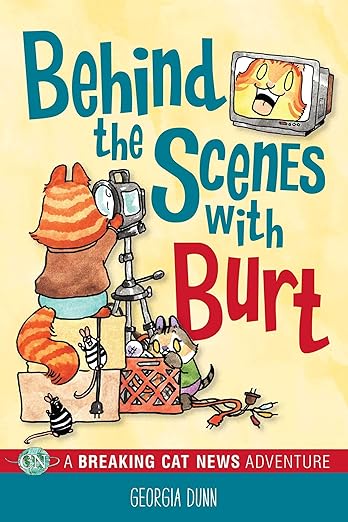
Breaking Cat News: Cats Reporting on the News That Matters to Cats


By Georgia Dunn (Andrews McMeel)
ISBN: 978-1-4494-7413-3 eISBN: 978-1-4494-7927-5

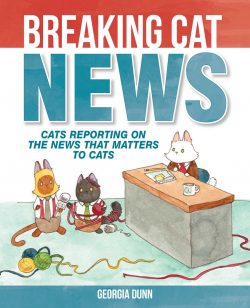
As I eagerly await the imminent release of the next feline frenzy fact file from Georgia Dunn (Gosh! When willit bee Septemphber?) I feel the need to revisit how it all began… 

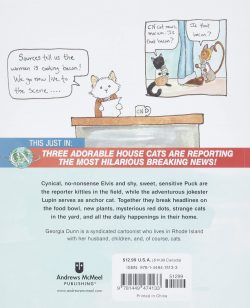
Cats rule the world. Just ask the internet. Now, now, now. Those of us with moggies also learn pretty quickly that they run the house too. However, illustrator and cartoonist Georgia Dunn found a way to make her indolent furry overlords earn their keep after watching them converge on a domestic accident and inquisitively and interminably poke their little snouts into the mess.

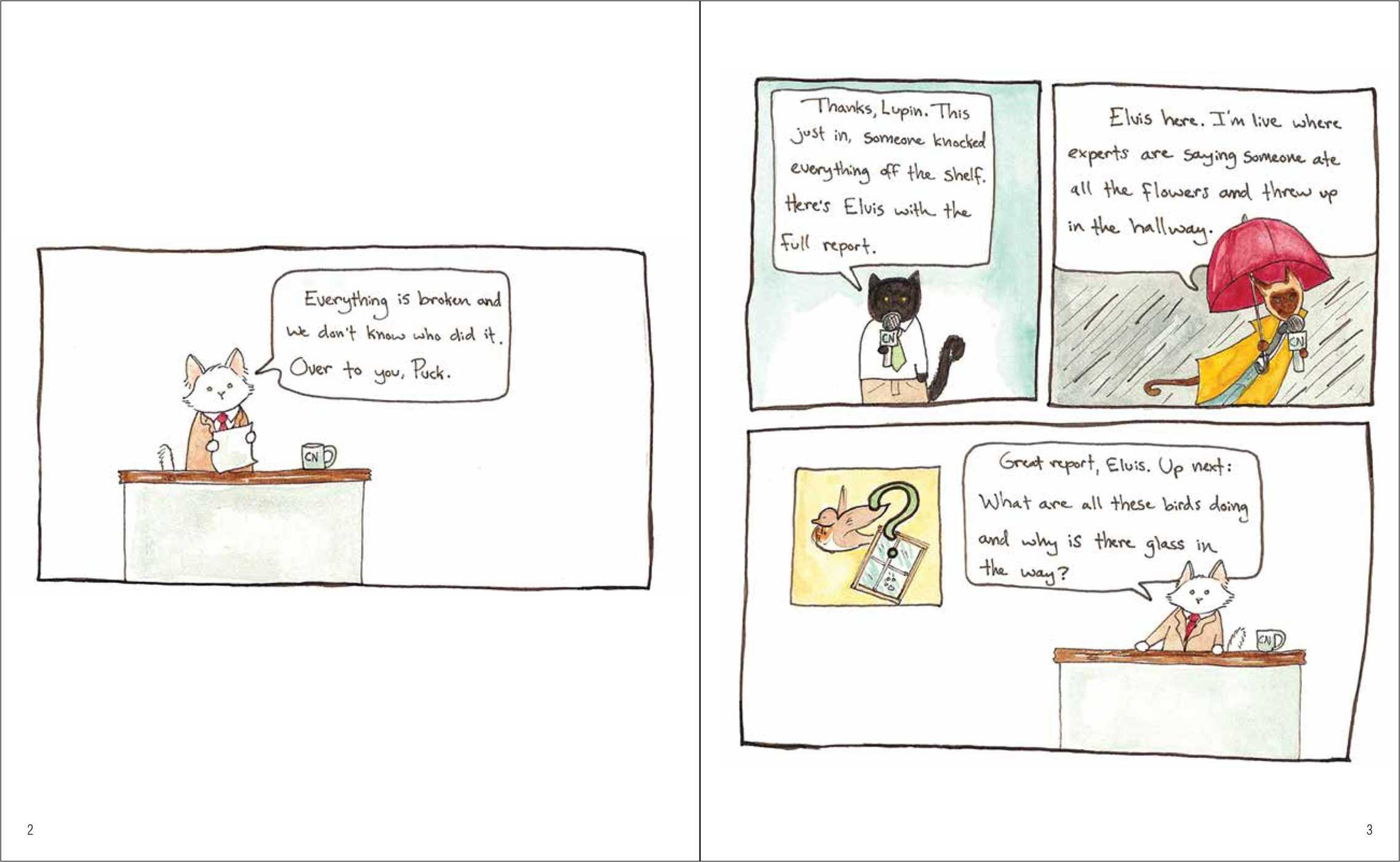
Thus was born Breaking Cat News: a hilariously beguiling series of strips detailing how – when no-one’s looking – her forthright flurry of felines form their own on-the-spot news-team with studio anchor Lupin, and field reporters Elvis (investigative) and Puck (commentary) delivering around-the-clock reports on the events that really resonate with cats – because, after all, who else matters?

The history and development of the feature is covered in Dunn’s Introduction (which you can read if your own murder-mittened mates give you some time off) before this superbly engaging full-colour digest-sized (165 x 203 mm) paperback concentrates on crucial domestic and foreign issues.

Drawing attention on the home front are items such as ‘Everything is Broken and We Don’t Know Who Did It’, ‘The Food Bowl is Still Empty’, ‘The People Bought Some Stupid-Looking Thing For the Dining Room’, ‘The Woman is Cooking Bacon’, ‘The Woman is Trying to Use a Laptop’, ‘The Woman is Trying to Make the Bed’ and ‘The People Bought a Different Kind of Kibble’ whilst long-range outside broadcasts confirm ‘The Man is in the Backyard’, ‘The Neighborhood is Under Attack’ and ‘The Trees are Falling Apart’

The rolling news is backed up by In-Depth packages devoted to ‘The People Are Going Insane’ (moving house to us two-foots) and the entire team undertake a dedicated series on a lengthy brush with maternity (‘The Woman is Feeling Under the Weather’, ‘The Spare Room is Filled With New Cat Furniture’, ‘The Woman has a Hair Ball’ and ‘The People are Awake in the Middle of the Night’) to prove that cats don’t just want vapid snippets of information for mayfly attention spans, but can also handle complex issues with no simple solutions…

Smart, witty, imaginative and deliciously whimsical, Breaking Cat News is a fabulously funny regularly re-readable feel-good feature rendered with great artistic elan and a light and breezy touch that will delight not just us irredeemable cat-addicts but also anyone in need of good laugh.
© 2016 Georgia Dunn. All rights reserved.

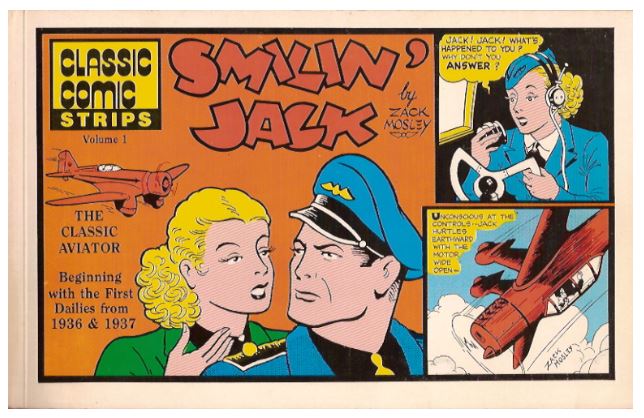
Smilin’ Jack: The Classic Aviator book 1


By Zack Mosley (Classic Comic Strips)
No ISBN, no digital editions

Here’s another forgotten birthday boy seriously in need of an archival revival…

Modern comics evolved from newspaper comic strips. Those pictorial features were – until relatively recently – hugely, incredibly popular with the public and highly valued by publishers who used them as an irresistible weapon for guaranteeing and increasing circulation and profits.

It’s virtually impossible for us to understand the overwhelming power of the comic strip in America from the Great Depression to the end of World War II. With no social media or television, broadcast radio far from universal and movie shows at best a weekly treat for most poor to middle-income folk, household entertainment was mostly derived from comic sections in daily and especially Sunday newspapers.

“The Funnies” were the most common and practically communal recreation for millions who were well served by a fantastic variety and incredible quality. From the very start humour was paramount – hence the terms “Funnies” and “Comics” – and from these gag and stunt beginnings came hybrids like Roy Crane’s Wash Tubbs.

Comedic when it began in 1924, it evolved from mock-heroics to light-action to become a full-blown, rip-roaring adventure series with the introduction of prototype swashbuckler Captain Easy in 1929. From there it wasn’t such a leap to full-on action blockbusters like Tarzan (debuting on January 7th 1929) and Buck Rogers (the same day). Both were adaptations of pre-existing prose properties, but the majority of drama strips that followed were original creations.

The tidal-wave began in the early 1930s when an explosion of action/drama strips (tastefully tailored for a family audience and fondly recalled as “Thud and Blunder” yarns by those who read them) were launched with astounding frequency and rapidity.

Not only strips but entire genres were born in that decade, material that still impacts on not just today’s comic books but all our popular fiction. Always most common, however, were and are general feel-good humour strips with an occasional child-oriented fantasy…

Arguably the most welcome of the new adventure genres was the Aviator serial. With air speed, distance and endurance records bring broken every day, travelling air-circuses barnstorming across rural America and real-life heroes like Charles Lindbergh and Amelia Earhart plastered across front pages and in movie newsreels, it wasn’t difficult to grasp the potential of comics strip analogues joining the horde of prose, radio and movie flyers.

The first was Glenn Chaffin & Hal Forrest’s Tailspin Tommy – story of boy pilot Tommy Tompkins. It ran from May 21st 1928 (almost exactly one year after Lindbergh’s epic transatlantic flight in the Spirit of St. Louis) until 1942, and was swiftly followed by both Lester J Maitland & Dick Calkins Skyroads (May 20th 1929, to 1942) and John Terry’s Scorchy Smith which soared from 1930 -1961. Close on their high-flying heels came such late-arriving classics as Flyin’ Jenny, Buz Sawyer and latterly, Steve Canyon.

Zack Mosley was an enterprising young cartoonist who assisted Calkins on both Skyroads and the legendary Buck Rogers in the 25th Century. He was also a dedicated pilot and avaition enthusiast, and when he heard that Captain Joe Patterson (influential editor of The Chicago Tribune) was taking flying lessons, Zack swiftly pitched a series to the kingmaker of comic strips.

On the Wing debuted as a Sunday page on October 1st 1933, but the name never took off and with the December 31st episode the feature was more snappily re-titled Smilin’ Jack. Apparently, Moseley was surreptitiously called “Smiling Zack” around the Tribune office…

The strip steadily gained interest and syndication subscribers and, on June 15th 1936, was augmented by a monochrome daily strip.

Jack Martin was a nervous student pilot, and the series originally played safe by vacillating between comedy and hairsbreadth thrills as he and his fellow unqualified pilots learned the ropes. Never a top-tier series, Smilin’ Jack nevertheless always delivered terrific entertainment to the masses, moving and morphing with the times into a romance, war-feature, crime thriller (complete with Dick Tracy style villains) and even a family soap opera.

More importantly, the strip progressed in real time and when it closed on 1st April 1973, Jack was a twice-married air veteran with a grown son and a full cast of romantic dalliances in tow. It wasn’t lack of popularity that ended it either. At 67 years of age, Mosley wanted to spend his final years in the air, not crouched over a drawing board…

This fabulous (and shamefully scarce) collection gathers a splendid selection of rousing romps, beginning with that name-changing first episode from December 31st 1933, before concentrating on some classic sequences from the roaring Thirties.

Meet here or be reintroduced to Jack, comedy foil Rufus Jimpson (a hillbilly mechanic), eye-candy air hostess and love interest Dixie Lee (subject of an extended romantic triangle), Latin spitfire (the curvy sort, not the fighter plane kind) Bonita Caliente and sundry spies, thugs, imbecilic passengers, South American revolutionaries and even a foreign Legion of the Skies, with an eerily prescient stiff-necked Prussian flyer named Von Bosch whose type would soon be plastered all over strips and comic books once WWII broke out…

This kind of strip is, I suspect and fear, an acquired taste today like films by Preston Sturges, Billy Wilder or George Cukor, requiring the reader contribute a little intellectual and historical concentration, but the effort is absolutely worth it, and if this kind of stuff is good enough for the likes of George Lucas and Steven Spielberg it’s perfectly good enough for you and me…

A grand adventure and one you should definitely undertake if the chance comes. Maybe one day it will even be properly curated and collected for all to re-enjoy…
© 1989, 2009 Chicago Tribune Syndicate. All Rights Reserved. (I’m going on best evidence here: if somebody else actually owns the rights now, let me know and I’ll happily amend the entry).

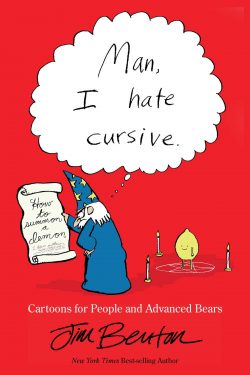
Man I Hate Cursive – Cartoons for People and Advanced Bears


By Jim Benton (Andrews McMeel)
ISBN: 978-1-4494-7889-6 (PB) eISBN: 978-1-4494-8414-9

I love cartoons. Not animated films, but short, visual (although most often text-enhanced) stylised drawings which tell a story or potently and pithily express a mood or tone. In fact most people do. That’s why historians and sociologists use them as barometers of a defined time or era.

For nearly 200 years gag-panels and cartoon strips were the universal medium to disseminate wit, satire, mirth, criticism and cultural exchange. Sadly, after centuries of pre-eminence and ferocious power, these days the cartoon has been all but erased from printed newspapers – as indeed the physical publications themselves have dwindled in shops and on shelves.

However, thanks to the same internet which is killing print media, many graphic gagsters and drawing dramatists have enjoyed resurgence in an arena that doesn’t begrudge the space necessary to deliver a cartoon in all its fulsome glory…

Cartooning remains an unmissable daily joy to a vast global readership whose requirements are quite different from those of hard-core, dedicated comic fans, or even that ever-growing base of intrigued browsers just starting to dip their toes in the sequential narrative pool.

Even those stuck-up holdouts proudly boasting they have “never read a comic” certainly enjoy strips or panels: a golden bounty of ephemeral amusement demanding no commitment other than a moment’s close attention. Truth be told, it’s probably in our genes…

And because that’s the contrary nature of things, those gags now get collected in spiffy collections like this one, intended to be enjoyed over and over again like a beloved favourite song…

Jim Benton began his illustration work making up crazy characters in a T-Shirt shop and designing greetings cards. Born in 1960, he’d grown up in Birmingham, Michigan before studying Fine Arts at Western Michigan University.

Now tirelessly earning a living exercising his creativity, he started self-promoting those weird funny things he’d dreamed up and was soon raking in the dosh from properties such as Dear Dumb Diary, Dog of Glee, Franny K. Stein, Just Jimmy, Just Plain Mean, Sweetypuss, The Misters, Meany Doodles, Vampy Doodles, Kissy Doodles, jOkObo and It’s Happy Bunny in a variety of magazines and other venues. Latterly, he made a move into more conventional but no less entertaining delights. You should especially seek out Attack of the stuff and Fann Club: Batman Squad

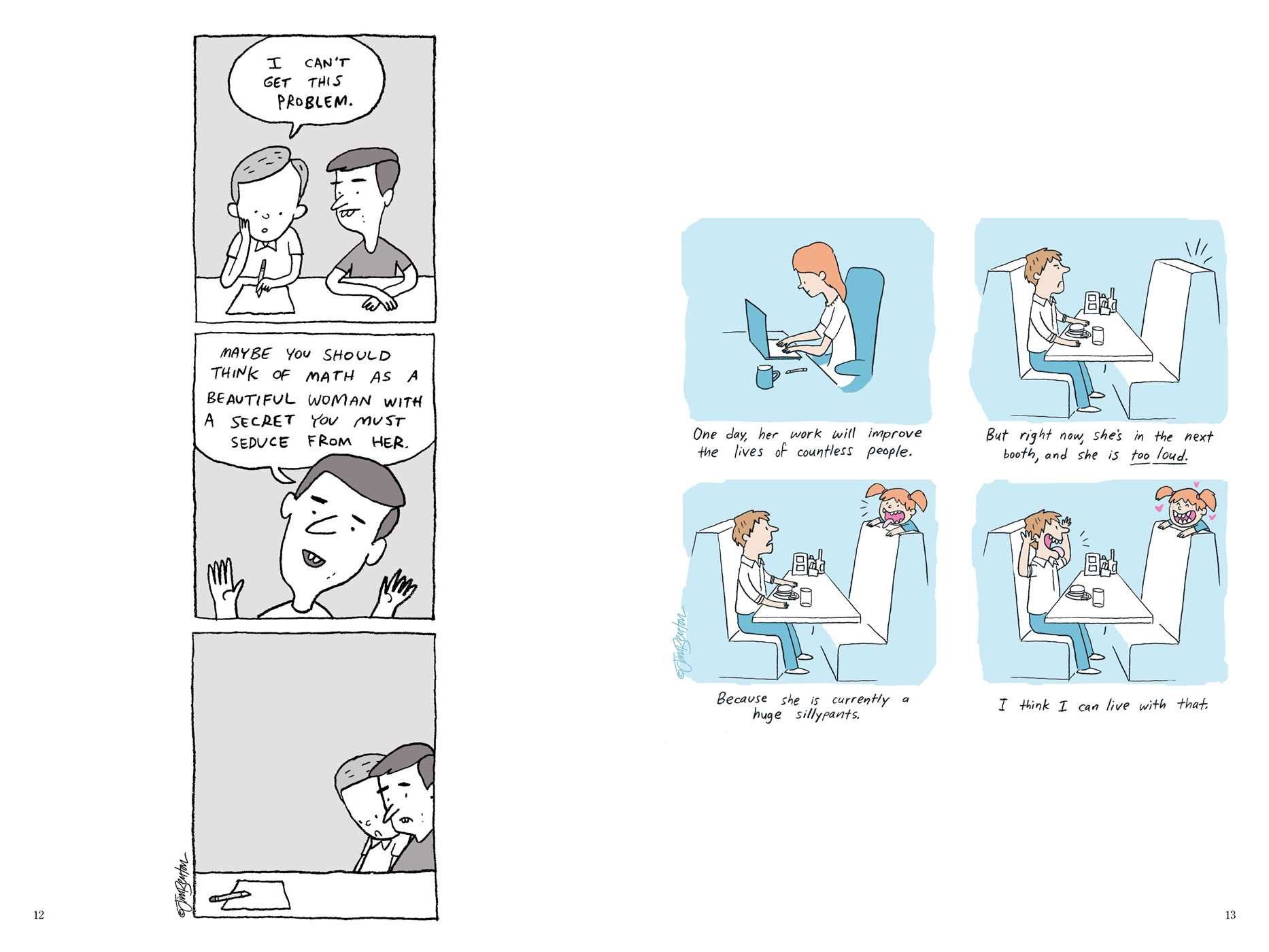
His gags, jests and japes are delivered in a huge variety of styles and manners: each perfectly in accord with whatever sick, sweet, clever, sentimental, whimsical or just plain strange content each idea demands. This particular collection is from 2016 but is still fresh, strange and irreverent enough to have you clutching your sides in approved cartoon manner…

Here you will explore the innocently horrific inner world of children and monsters, learn to appreciate anew the contributions to society of teachers and experience Benton’s satirical side as bigots and racists are convicted out of their own mouths.

There are heaping helpings of animal antics – both wryly sardonic and barbarously slapstick – and wicked observations on the dating scene, plus true love pictured in all its infamy, how robots need a little tenderness too as well as the inside track on what it means to be Death…

You’ll see some of the strangest and most disquietingly surreal gags ever penned – such as the dysfunctional band made of animate body parts or the bizarrely extrovert characters comprising ‘The Sideshow’ – and even a truly unique take on historical personages and superheroes of the screen and comics pages…

As ever, there are trenchant swipes at the worlds of Art and Big Business as well as incisive explorations of the relationship between us and our pets, the perils of inventing stuff and a pants-wetting selection debating the downsides of air travel…

And best of all, the artist sets aside time and space to share with us God’s Plan and proves that the Almighty’s sense of humour is both wicked and petty…

You might discover Not-Facts that will change your life after gleaning Benton’s take on loneliness, fast food, binge eating, farting, periods, disabilities, growing up, Big Pharma, and the business of medicine in single page giggle-bombs ranging from strident solo panels to extended strips; silent shockers to poetically florid and verbose tracts.

There are also some jokes about bears…

Another uproarious compilation to make the sourest persimmon laugh as sweetly as pie (there are no joke about pies in this volume)…
© 2016 Jim Benton. All rights reserved.

Hurricane Isle: The Best of Captain Easy and Wash Tubbs


By Roy Crane, edited by Rick Norwood (Fantagraphics Books)
ISBN: 978-1-60699-809-0 (HB)

Modern comics evolved from newspaper cartoons and comic strips, and these pictorial features were until relatively recently utterly ubiquitous and hugely popular with the public. They were also highly valued by publishers who used them as an irresistible sales weapon to guarantee and increase circulation and profits.

It’s virtually impossible for us to today to understand the overwhelming power of the comic strip in America (and the wider world) from the Great Depression to the end of World War II. With no television, broadcast radio barely established and movie shows at best a weekly treat for most folk, household entertainment was mostly derived from the comic sections of daily and especially Sunday Newspapers. They were the most common recreation for millions who were well served by a fantastic variety and incredible quality. Crucially this notionally free entertainment kept readers loyal to the papers that ran a family’s favourites…

From the very start humour was paramount; hence the terms “The Funnies” and “Comics”, and from these gag and stunt beginnings – a blend of silent movie slapstick, outrageous fantasy and raucous vaudeville shows – came a thoroughly entertaining mutant hybrid: Roy Crane’s Wash Tubbs.

Washington Tubbs II was a comedic gag-a-day strip not much different from family favourite Harold Teen (by Crane’s friend and contemporary Carl Ed). As first depicted on April 21st 1924, Tubbs was a diminutive, ambitious and bumbling young store clerk when the feature debuted, but after only three months Crane re-evaluated his little enterprise, making a few changes which would reshape the entire art form…

Having Wash run away to the circus (Crane did much the same in the name of research). the artist gradually moved the strip into mock-heroics, then through a period of gently boisterous action romps to become a full-blown, light-hearted, rip-roaring adventure series. It was the first of its kind and dictated the form for decades thereafter. Crane then sealed its immortality with the introduction of prototype he-man and ancestral moody swashbuckler Captain Easy in the landmark episode for 6th May, 1929.

As the yarns became more exotic and thrill-drenched, our globe-trotting little dynamo clearly needed a sidekick and sounding board. After a number of bright and breezy types were tried and discarded, Crane decided on one who could believably handle the combat side of things, and thus, in the middle of a European war in the fairytale kingdom of Kandelabra, Tubbs liberated a mysterious fellow American from a dungeon and history was made.

Before long the mismatched pair were inseparable; tried-and-true travelling companions hunting treasure, fighting thugs and rescuing startlingly comely damsels in distress…

The bluff, two-fisted, completely capable and utterly dependable, down-on-his-luck “Southern Gentleman” was something not seen before in comics: a taciturn, raw, square-jawed hunk played completely straight rather than the previously popular buffoon or music hall foil seen in such classic serials as Hairsbreadth Harry or Desperate Desmond.

Moreover, Crane’s seductively simple blend of cartoon exuberance and design was a far more accessible and powerful medium for action story-telling than the static illustrative style favoured by artists like Hal Foster who was just beginning to make waves on the new Tarzan Sunday page at this time.

Tubbs & Easy were as exotic and thrilling as the Ape Man but rowdily rattled along like the tempestuous Popeye, full of vim, vigour and vinegar, as attested to by a close look at the early work of the would-be cartoonists who followed the strip with avid intensity. Floyd Gottfredson, Milton Caniff, Jack Kirby, Will Eisner and especially young Joe Shuster were eager fans taking notes and following suit…

After a couple of abortive attempts starring his little hero, Crane eventually bowed to the inevitable and created a full colour Sunday page dedicated solely to his increasingly popular hero-for-hire. The Captain Easy feature debuted on 30th July 1933, in wild and woolly escapades set prior to his fateful meeting with Tubbs.

Both together and separately, reprinted exploits of these troubleshooters became staples of the earliest comic books – specifically The Funnies from October 1936 and The Comics, from March 1937 onwards.

With an entire page and vibrant colours to play with, Crane’s imagination ran wild and his fabulous visual concoctions achieved a timeless immediacy that made each page a unified piece of sequential art. The effect of these can be seen in so many strips since, especially the works of such near-contemporaries as Hergé and giants in waiting like Charles Schulz. They have all been collected in the 4-volume Roy Crane’s Captain Easy, Soldier of Fortune: The Complete Sunday Newspaper Strips. Sadly, no digital versions yet, but there’s always hope…

Those pages were a clearly as much of a joy to create as to read. In fact, the cited reason for Crane surrendering the Sunday strip to his assistant Les Turner in 1937 was NEA Syndicate’s abruptly and arbitrarily demanding that henceforward, all its strips be produced in a rigid panel-structure to facilitate being cut up and re-pasted as local editors dictated. Crane just walked away, concentrating on the daily feature. In 1943 he quit NEA completely, to create wartime aviator strip Buz Sawyer, and Turner became the able custodian of the heroes’ fate.

Wash Tubbs ran until January 10th 1988.

Before all that, however, Wash was the affable and undisputed star of a never-ending parade of riotous monochrome daily escapades and this superb hardback opens with two of them: part of a cherry-picked compilation of ten of the very best adventures of the bombastic buddies. Hopefully it will one day lead to another complete reprinting such as the 18-volume series covering the entirety of the Wash Tubbs run – 1934-1943 – that was published by NBM from 1987-1992. Good luck finding those…

Before the non-stop nonsense begins author and pre-eminent comic strip historian Ron Goulart details all you need to know about the tales in ‘A History of Lickety Whopwhilst editor Rick Norwood provides further background information in his copiously illustrated Introduction, after which we’re plunged into astounding adventure on eponymous ‘Hurricane Isle(which originally ran from February 23rd to June 6th 1928)…

At this time Wash and fellow inveterate fortune-hunter Gozy Gallup are gloating over securing an ancient map which once belonged to the dread pirate Edward Teach… AKA Blackbeard!

As they research the infamous buccaneer and scrabble to find a ship to take them where they need to go, they are unaware that aggrieved enemy Brick Bane – the “Bandit King of Mexico – is hard on their heels and hungry for vengeance. Stalking them as they journey from New Orleans to the Caribbean, he takes a nasty sea captain into his confidence and arranges for that sinister salt to hire out his ship to the treasure seekers. The skipper is unsavoury brute Bull Dawson: destined to become Tubbs’ – and later Easy’s – greatest, most implacable foe…

After travelling to the island with them Dawson, having already removed Bane, springs his trap and turns Wash and Gozy into enslaved labourers, digging with the crew to find the fabled horde. The lads soon rebel and escape into the jungle to search on their own, and also abortively attempt to steal Dawson’s ship.

The wily brute is too much for them, however, and even after the boys finally locate the loot, the malicious mariner reappears to take it from them. The sadistic swine is preparing to maroon them when Bane arrives with a ship full of Mexican bandits and a shooting war begins…

With bullets flying and bodies dropping, Wash and Gozy convince affable deckhand Samson to switch sides and the trio take off for civilisation with the treasure in the hold…

Money comes and goes pretty freely for these guys but by the time ‘Arabia(July 30th – December 12th 1928) opens, they are still pretty flush and opt for a luxurious Mediterranean cruise. Unfortunately Wash’s propensity for clumsy gaffes raises the ire of very nasty sheik Abdul Hoozit Hudson Bey and the affronted potentate swears vengeance when the ship docks in Tunis.

As if icing fate’s cake, when wandering through the bazaar Wash is glamoured by a pair of gorgeous eyes and inadvertently seals his doom by attempting to rescue a girl from a seraglio: Jada is not only a distressed damsel but Bey’s favourite wife…

Heeding the French authorities’ advice to leave town quickly, the lads take off on a camel caravan into the Sahara. They have no idea they are heading into cunning Bey’s trap…

The fact that Jada is the favourite of the incensed chieftain saves them temporarily, but when the sheik finally finds a way to surreptitiously assassinate them, she and her devoted slave Bola dash into the deep desert to save them, and the quartet strike out for safety and freedom together.

That trek dumps them in the clutches of Bey’s great rival Abdullah Bumfellah and leads to a tribal shooting war. Happily, Bola has been busy and found a Foreign Legion patrol to save the day.

And that’s when Jada drops her bombshell. She is actually a princess from a European principality, sold to Bey by her father’s Grand Vizier so that he could steal the throne. Now that she’s free again, Jada must return to liberate her poor people. Despite having to get back to America, Wash won’t shut up about wishing he’d gone with her…

He soon gets the chance. Spanning April 11th through July 6th 1929, ‘Kandelabra’ became the most significant sequence in the strip’s history: introducing Captain Easy in a riotous, rousing Ruritanian epic which we join after Wash reunites with Jada in the postage stamp kingdom she had been so cruelly stolen from.

Our little go-getter infiltrates the government and rises to the rank of admiral of the landlocked realm before overplaying his hand and beingframed for stealing the army’s payroll. Delivered to a secret dungeon he (partially) escapes and finds a gruff fellow American who refuses to share his name but insists on being called “Easy”…

Busting out his new ally, Wash and the stranger are soon caught in a bloody revolution when the aggrieved army mutinies. Before long the Vizier’s cronies are ousted, the vile villain accidentally orchestrates his own demise and regally restored Jada declares the birth of the continent’s newest democracy…

In ‘Desert Island(February 6th – June 7th 1930) Bull Dawson returns to steal Tubbs’ entire fortune, and flies off across America in a bid to escape with his ill-gotten gains. The robbery becomes a nationwide sensation and we join the action as Wash & Easy pursue the fugitive. Tracking Dawson to San Francisco, they continue the chase as the malign mariner takes off in a schooner with our heroes first stowaways and, before long, prisoners…

The sadistic Bull lose face after being thrashed in a no-holds barred fight with Easy, which was mere subterfuge to allow the southern soldier of fortune to pick Dawson’s pocket and recover Wash’s easily portable $200,000 in cash. As the battered thug recuperates, the vessel is hit by a monster typhoon which apparently leaves our heroes sole survivors aboard shattered shards of the schooner.

The wreck fetches up on a desolate Pacific atoll where the boys soon fall into the routine of latter-day Robinson Crusoes. The isolated idyll becomes cruelly complicated when they find the place is already home to a young woman who was the only survivor of an attack by roving headhunters from Borneo. Mary Milton is brave, competent and beautiful and before long the lonely pals are fierce rivals for her affections…

The situation grows dangerously intense and only stabilises when the savages return, forcing the warring suitors to stand together or fall separately…

I think it’s about time that I remind everyone that these stories were crafted a long time ago for audiences with far less progressive ideas than us. There’s no deliberate intention to belittle or deride, but these lovely pages are certainly piled high with outdated assumptions and behaviour. If you are unable to forgive or set aside such treatment, please give this book a miss.

When the brutal battle ends, the westerners are in possession of a sturdy war canoe and opt to risk their lives on an epic ocean odyssey to the nearest outpost of civilisation. It’s only after the voyagers are far out to sea that Wash agonisingly recalls that he left his stash of dollars behind…

The next adventure (running from June 9th – October 1930) immediately follows on, with the weary travellers reaching French Indo-China and, thanks to a friendly soldier, escaping far inland via a mighty river. After days of travel they reach the previously hidden kingdom of Cucumbria and fall foul of the toad-worshipping emperor Igbay Umbay who takes one look at Mary and decides he has to have her…

Being a coward who stole the throne from his brother, this Grand Poobah hasn’t the nerve to simply take her, and so orchestrates a succession of scurvy schemes to get rid of Wash and Easy. Naturally, the boys are too smart and bold to fall for them.

Infuriatingly rising in power and status, aided by young prince Hilo Casino – freshly returned from college in America – the Americans finally seem be out of Umbay’s hair after they agree to lead his armies against supernatural rebel leader ‘The Phantom King

Despite deep misgivings “General” Easy and his aide Washington Tubbs embark upon a campaign that will ravage the hidden kingdom, unseat an emperor, cost thousands of lives and lose them the girl they both love…

A year later, ‘Down on the Bayou(March 12th to July 25th 1931) found the world-weary wanderers nearing home again, only to be arrested as they approach New Orleans in a stolen plane. They were fleeing a clever frame-up in infamous Costa Grande, but without any proof could only evade their US Navy captors and flee into the swampy vastness of the Mississippi Delta…

Lost for days and starving, they are picked up by vivacious gangster’s moll Jean who recruits them into a gang of smugglers and rum-runners who inhabit a huge plantation somewhere between Pelican Island and Barataria, dedicated to various criminal enterprises. Tubbs & Easy soon comfortably settle in amidst the rogues and outcasts, but everything changes when Jean’s brother returns from a smuggling trip. His name is Bull Dawson…

He is prevented from killing our heroes by Jean and the huge Cajun in charge of the outlaw outpost, but takes it badly. With his gang of deadly bodyguards in tow, Bull decides to take over the whole enterprise. A couple of murders later he’s big boss, but also oddly friendly to his most despised enemies.

Maybe it’s a ploy to put them off guard, or perhaps it has more to do with the gang of Chicago mobsters who have come down South, to put an end to the bootlegging mavericks cutting into their profits…

The troubles and bloodshed escalate exponentially and Jean drops her final bombshell: she’s a federal agent working with the Coast Guard to smash the budding criminal empire!

Once the dust settles she has one final surprise in store. In all the years of their friendship Wash could never get his taciturn pal to talk of his past or even reveal his real name. Now the government girl gives Mr. William Lee a message which sends him rushing across country to an old plantation home. Here the astounded Wash hears all about his pal’s shocking life, sordid scandals and abandoned wife… and then he learns the whole truth…

Soon, the impediments and lies which blighted Easy’s life are all removed and the wanderer settles in to a well-deserved retirement with the girl he always loved but could never have. Tubbs moves on, quickly reuniting with old chum Gozy Gallup…

Some weeks later, ever-restless Wash is riding a tramp steamer headed for Europe, intent on paying Jada a visit in Kandelabra but – falling foul of rustic transportation systems – ends up in the similar but so different Principality of Sneezia

Apart from pretty girls, the tiny kingdom has only one point of interest: the world’s dinkiest railway service. Run by aged expatriate American Calliope Simpson, ‘The Transalpina Express(August 13th – November 21st 1931) links Sneezia to sister kingdom Belchia and is the most unique and beloved (by its intoxicated customers at least) service in the world.

Wash is especially keen to learn the business, since being the engineer has made octogenarian Cal the most irresistible man in two countries, fighting off adorable young women with a stick…

Someone’s greatest dream comes true when Simpson finally elopes with one of his adoring devotees and Washington Tubbs become sole operator of the Express, but his joy at all the feminine attention soon sours when Belchia and Sneezia go to war, and both sides want to use his train to move men and material into combat. Of course, the dilemma can only end in disaster and before long our boy is running for his life again…

There’s a big jump to the next yarn which finds Wash and Easy reunited and stowing away on the wrong-est ship imaginable. Quickly caught, they are understandably assumed to be part of the contingent of prisoners bound for the final destination – ‘Devils Island(June 9th to August 30th 1932)…

No sooner are they mixed in with the hopeless prison population than the planning of their inevitable escape begins. However, success only leads to greater peril as they and their criminal confederates take ship with a greedy captain subject to murderous bouts of paranoia and madness…

‘Whales(April 24th – August 30th 1933) is probably the most shocking to modern sensibilities of the perennial wanderers’ exploits. Here Wash & Easy are drugged in a Dutch cafe and dumped aboard one of the last sailing ships to work the whaling trade. Elderly and nostalgic Captain Folly has been convinced by psychotic First Mate Mr. Slugg to compete one last time against the new-fangled factory whaling fleets, unknowingly crewing his creaking old ship with shanghaied strangers…

The grim minutiae of the ghastly profession are scrupulously detailed as our heroes seek some means of escape, but with Slugg becoming increasingly unbalanced – and eventually murdering Folly – bloody mutiny leads to the ship foundering. Both factions – or at least the survivors of each – are subsequently marooned on arctic Alaskan ice, where (naturally) our heroes find the only pretty girl in a thousand square miles…

This fabulous treasury of thrills concludes with one last battle against Bull Dawson after the incorrigible monster links up with gorgeous grifter Peggy Lake, who fleeces gullible Wash of his savings and disappears into the endless green wilderness of the swamps of ‘Okefenokee(June 13th – July 24th 1935).

The crime leads to a massive police manhunt through the mire before the boys personally track down the villains and deliver one more sound thrashing to the malodorous malcontent and his pretty patsy…

Rounding off this superb collection is a thorough ‘Captain Easy and Wash Tubbs Episode Guideby Rick Norwood, a glorious graphic Mexican travelogue feature by Crane in ‘An Afterword in Picturesand informative biography section ‘About the Authors

If I’ve given the impression that this has all been grim and gritty turmoil and drama thus far, please forgive me: Crane was a superbly irrepressible gag-man and his boisterous, enchanting serials resonate with breezy, light-hearted banter, hilarious situations and outright farce – a sure-fire formula modern cinema directors plunder to this day.

Easy was the Indiana Jones, Flynn (The Librarian) Carsen and Jack (Romancing the Stone) Cotton of his day – and, clearly blazed a trail for all of them – whilst Wash was akin to Danny Kaye or our own Norman Wisdom: brave, big-hearted, well-meaning, clay-footed, irrepressible and utterly indomitable everymen… just like all of us.

This superb monochrome landscape hardback (274 x 33 x 224 mm) is a wonderful means of discovering or rediscovering Crane’s rip-snorting, pulse-pounding, exotically racy adventure trailblazer.

This is comics storytelling of the very highest quality: unforgettable, spectacular and utterly irresistible. These tales rank alongside her best of Hergé, Tezuka and Kirby, irrefutably informing the creations of all of them. These strips inspired the giants of our art form. How can you possibly resist?
Hurricane Isle: The Best of Captain Easy and Wash Tubbs © 2015 Fantagraphics Books. All Wash Tubbs and Captain Easy Strips © 2015 United Features Syndicate, Inc. All other material © the respective copyright holders. All rights reserved.

Popeye Classics volume 9: The Sea Hag’s ‘Magic Flute’ and More!


By Bud Sagendorf, edited and designed by Craig Yoe (Yoe Books/IDW Publishing)
ISBN: 978-1-63140-772-7 (HB) eISBN: 978-1-68406-092-4

How many cartoon classics can you think of still going after a century? Here’s one…

There are a few fictional personages to enter communal world consciousness – and fewer still from comics – but this grizzled, bluff, uneducated, visually impaired old tar with a speech impediment is possibly the most well-known of that august bunch.

Elzie Crisler Segar was born in Chester, Illinois on 8th December 1894. His father was a general handyman, and the boy’s early life was filled with the solid, dependable blue-collar jobs that typified the formative years of his generation of cartoonists. Segar worked as a decorator, house-painter and also played drums; accompanying vaudeville acts at the local theatre.

When the town got a movie-house, Elzie played silent films, absorbing all the staging, timing and narrative tricks from keen observation of the screen. Those lessons would become his greatest assets as a cartoonist. It was while working as the film projectionist, at age 18, that he decided to become a cartoonist and tell his own stories.

Like so many others in those hard times, he studied art via mail, specifically W.L. Evans’ cartooning correspondence course out of Cleveland, Ohio, before gravitating to Chicago where he was “discovered” by Richard F. Outcault – regarded as the inventor of modern newspaper comic strips with The Yellow Kid and Buster Brown. The celebrated pioneer introduced Segar around at the prestigious Chicago Herald. Still wet behind the ears, the kid’s first strip, Charley Chaplin’s Comedy Capers, debuted on 12th March 1916.

In 1918, Segar married Myrtle Johnson and moved to William Randolph Hearst’s Chicago Evening American to create Looping the Loop, where Managing Editor William Curley foresaw a big future for Segar and promptly packed the newlyweds off to New York: HQ of the mighty King Features Syndicate. Within a year Segar was producing Thimble Theatre, (launching December 19th 1919) in the New York Journal: a smart pastiche of cinema and knock-off of movie-inspired features like Hairbreadth Harry and Midget Movies, with a repertory of stock players acting out comedies, melodramas, comedies, crime-stories, chases and especially comedies for vast daily audiences. It didn’t stay that way for long…

The core cartoon cast included parental pillars Nana & Cole Oyl; their lanky, cranky, highly-strung daughter Olive; diminutive-but-pushy son Castor and the homely ingenue’s plain and (so very) simple occasional boyfriend Horace Hamgravy (latterly, plain Ham Gravy).

Thimble Theatre had already run for a decade when, on January 17th 1929, a brusque, vulgar “sailor man” shambled into the daily ongoing saga of hapless halfwits. Nobody dreamed the giddy heights that stubbornly cantankerous walk-on would reach…

In 1924, Segar created a second daily strip. Surreal domestic comedy The 5:15 featured weedy commuter/aspiring inventor John Sappo and his formidable spouse Myrtle. It endured – in one form or another – as a topper/footer-feature accompanying the main Sunday page throughout Segar’s career, survived his untimely death, and eventually became the trainee-playground of Popeye’s second great humour stylist – Bud Sagendorf.

After Segar’s premature passing in 1938, Doc Winner, Tom Sims, Ralph Stein and Bela Zambouly all took on the strip as the Fleischer Studio’s animated features brought Popeye to the entire world, albeit a slightly variant vision of the old salt of the funny pages. Sadly, none had the eccentric flair and raw inventiveness that had put Thimble Theatre at the forefront of cartoon entertainments. And then, finally, Bud arrived…

Born in 1915, Forrest “Bud” Sagendorf was barely 17 when his sister – who worked in the Santa Monica art store where Segar bought his drawing supplies – introduced the kid to the master cartoonist who became his teacher and employer as well as a father-figure. In 1958, after years on the periphery, Sagendorf finally took over the strip and all the merchandise design, becoming Popeye’s prime originator…

With Sagendorf as main man, his loose, rangy style and breezy scripts brought the strip itself back to the forefront of popularity and made reading it cool and fun all over again. Bud wrote and drew Popeye in every graphic arena for 24 years. When he died in 1994, his successor was controversial “Underground” cartoonist Bobby London.

Bud had been Segar’s assistant and apprentice, and in 1948 became exclusive writer/artist of Popeye’s comic book exploits. That venture launched in February of that year: a regular title published by America’s unassailable king of periodical licensing, Dell Comics.

On his debut, Popeye was a rude, crude brawler: a gambling, cheating, uncivilised ne’er-do-well, but was soon revered as the ultimate working-class hero. Raw and rough-hewn, he was also practical, with an innate, unshakable sense of what’s fair and what’s not: a joker who wanted kids to be themselves – but not necessarily “good”. Above all else he was someone who took no guff from anyone…

Naturally, as his popularity grew, Popeye mellowed somewhat. He was still ready to defend the weak and had absolutely no pretensions or aspirations to rise above his fellows, but the shocking sense of dangerous unpredictability and comedic anarchy he initially provided was sorely missed… except in Sagendorf’s sagas…

Collected here are Popeye #40-44, crafted by irrepressible “Bud” and collectively spanning April-June 1957 to April-June 1958. The stunning, nigh stream-of-consciousness slapstick sagas and nautical nuttiness are preceded by a treasure-stuffed treatise on ‘The Big Guy who Hates Popeye!’, as Fred M. Grandinetti details all you need to know about archetypal “heavy” Bluto. The lecture on the thug of many names is backed up by character and model sheets from animated appearances, comic book covers, and numerous comic excepts. Also emergent are strip precursors and alternate big bullies, original strip art from Sagendorf and London, plus a kind-of guest shot from Jackson Beck – the meaty matelot’s on-screen voice…

Sadly missing the usual ‘Society of Sagendorks’ briefing by inspired aficionado, historian and publisher Craig Yoe, and the ever-tantalising teasers of ephemera and merchandise of ‘Bud Sagendorf Scrapbooks’, we instead plunge straight back into ceaseless sea-savoured voyages of laughter, surreal imagination and explosive thrills with quarterly comic book #40, opening with a monochrome inside front cover gag concerning the sailor’s ward Swee’Pea and his fondness for digging in the dirt, before ‘Thimble Theatre presents Popeye the Sailor in The Mystery of the “Magic Flute!”’ once more pits the mariner marvel against the ghastly and nefarious Sea Hag.

Here she unleashes an army of agents to locate and secure a mystic talisman safeguarded by Popeye. With it, she can rid the world of her great enemy…

With the family house overrun, impetuous elder Poopdeck Pappy unthinkingly hands over the wishing whistle and instantly Popeye is whisked into a pit with lions, thugs and Bluto all lined up to kill him. It doesn’t work out well for any of them…

‘Popeye the Sailor and Eugene the Jeep’ then reintroduces another of Segar’s uniquely wonderful cartoon cryptids. The little marvel had originally debuted on March 20th 1936: a fantastic 4th dimensional beast with incredible powers whom Olive and Wimpy use to get very rich, very quickly. Of course, they quickly lost it all betting on the wrong guy in another of Segar’s classic and hilarious set-piece boxing matches between Popeye and yet another barely-human pugilist…

This time he pops up after Olive and the old salt clash over setting an engagement date, and Wimpey suggests asking the Jeep’s advice. Instantly he materialises, and the question is nervously asked. The response is ambiguous and draws nothing but trouble…

Prose filler ‘Ol’ Blabber Mouth’ tells how a parrot accidentally causes all his friends to be captured by pet trade hunters before we arrive at the ever-changing back-up feature. Sappo – now reduced to gullible foil and hapless landlord to the world’s worst lodger – endured the ethics-free experiments of Professor O.G. Wotasnozzle “The Professor with the Atomic Brain”.

Callously and constantly inflicting the brunt of his genius on the poor schmuck, here the boffin seizes top billing with The Brain of O.G. Wotasnozzle, building a robot replica of his landlord and running rings around the sap in ‘Double Double Who’s Got Trouble’

The issue ends with an endpaper monochrome gag with Popeye and the precious “infink” disputing bedtimes and a colour back cover jape with them disastrously fishing…

Issue #41 (July-September) opens with ‘Popeye the Sailor in Spinach Soap!’ as the sailor battles Olive’s new beau. He looks just like Bluto, but has one advantage the sailor cannot match …a steady job!

In response, the money-disdaining matelot calls his secret weapon and Wimpey takes charge of Popeye’s savings – a million bucks – all so that he can set up a business to employ the sailor man…

An engaging Micawber-like coward, cad and conman, the insatiably ravenous J. Wellington Wimpy debuted in the newspaper strip on May 3rd 1931 as an unnamed, decidedly partisan referee in one of Popeye’s pugilistic bouts. Scurrilous, aggressively humble and scrupulously polite, the devious oaf struck a chord and Segar made him a fixture. Preternaturally hungry, ever-keen to solicit bribes and a cunning coiner of many immortal catchphrases – such as “I would gladly pay you Tuesday for a hamburger today” and “Let’s you and him fight” – Wimpy was the perfect foil for our straight-shooting action hero and increasingly stole the entire show… and anything else unless it was very heavy or extremely well nailed down.

Full of good intentions but unable to control himself, Wimpey naturally embezzles it all and fobs off his pal with a get-rich-scheme. However when Popeye starts selling his vegetable-based cleanser door to door he soon finds his old tactics are enough to wash that man out of Olive’s hair…

Co-starring Popeye, Swee’Pea and the Jeep!, ‘Sucker Gold!’ sees the cowboy-obsessed kid head for the desert and perilous Apache Mountain to be a prospector. Happily, with Eugene along for the ride his safety and prosperity are assured…

The story of Bradley fills the prose section this revealing how the ‘Horse Student’ was kicked out of human high school, after which O.G. Wotasnozzle! thinks himself into an invulnerable, inert state and the authorities resort to explosives to wake him up, before the back cover finds Popeye giving his kid a (kind-of) haircut…

Cover-dated October-December, Popeye #42 opens with the main event as the entire cast is caught on ‘Trap Island!’ as The Sea Hag and her hefty hench-lout target them from her mobile mechanised islet, before using doppelgangers to lure the sailor into ultimately useless death traps. Even her monster spinach-fuelled gorilla Smash is helpless before the power of spinach inside Popeye…

Popeye then discovers Swee’Pea can get into trouble anywhere, anytime when he sends him to fetch ‘Today’s Paper!’ Through no fault of his own the mighty mite ends up trapped in a weather balloon, a target of the air force, 2300 miles from home in Harbor City, a blood enemy of angry Indian Chief Rock’n’roll and locked in a missile, before dutifully bringing back that pesky periodical…

A duck with a speech impediment finds his purpose in prose yarn ‘Big Toot’ prior to Sappo giving O.G. Wotasnozzle the push. Typically, the toxic tenant terrorises every prospective replacement for his lodgings and the status quo is reluctantly re-established…

Another endpaper monochrome gag sees Popeye and Olive experiencing a little car trouble before Popeye #43 (cover-dated January-March 1958) opens in mono with another dig at Swee’Pea and his shovel whilst main event ‘Mind over Muscles!’ finds Popeye in high spirits and utterly oblivious to Sea Hag’s sinister surveillance. As the sailor eagerly anticipates his annual physical exam, she sends in her Sonny Boy – AKA Bluto disguised as a physician – to undermine his confidence and poison his mind with the notion that spinach is killing him. However, even doctor’s orders can’t make him give up his green cuisine and everyone gets what they deserve in the end…

‘Popeye and Swee’Pea in “The Voyage!”’ finds the sailor man sent on a dangerous mission to an island of “wild savages” with his boy outrageously left behind and babysat by Poopdeck Pappy. The infernal infink’s unhappy state is swiftly shifted by capricious fate though, and his soapbox boat is caught by wind, tide and a welcoming whale. When Popeye finally arrives, there’s a big little surprise awaiting him…

Prose parable ‘Diet!’ reveals what happens when Mrs. Smith declares the family is going vegetarian and pet dog Winky disagrees, after which O.G. Wotasnozzle apparently mends his ways and declares himself ‘“A Friend to Man” or “Be Kind to Sappo Week!”’ Sadly, even his best intentions and domestic inventions are severely hazardous to his landlord’s health – and the town’s wellbeing…

Concluding with an endpaper monochrome gag seeing Popeye severely tested by the kid’s bath time and a spot of gardening brings us to the last happy hurrah as Popeye #44 (April-June 1958) opens with black & white wisdom and Wimpy showing Olive the only way to Popeye’s heart…

Full-colour feature ‘Popeye meets “Orbert”’ embraces a wider-screened, more dynamic illustration style for Sagendorf as occasional amorous arch rival Bluto makes another play for Olive. Whilst he and Popeye enjoy their violent clash, Swee’Pea opens the box Bluto brought and unleashes a strangely alien flying beast. When its odd orbits kayo the blustering brute, Swee’Pea christens it Orbert. Soon they are inseparable and its ability to grant wishes have turned the kid into a bully and tyrant, and it’s time for some stern parenting …and spinach…

Sappo’s détente with O.G. Wotasnozzle is still in play but comes under extreme pressure when the Prof joins a quiet day’s fishing, and starts devising ways to make the pastime more efficient…

‘Specks’ reflects in prose upon the life of short-sighted fish George, before Popeye and Swee’Pea star in self-proclaimed “horrible story” ‘Follow the Leader!’ as spies kidnap the kid and try to make him tell where Popeye’s pirate gold is stashed. The map he eventually draws them only leads to trouble and the issue and this volume wrap up on a monochrome end gag proving Swee’Pea’s punch is a powerful as his wits…

Outrageous and side-splitting, these universally appealing yarns are evergreen examples of narrative cartooning at its most absurd and inspirational. Over the last nine decades Thimble Theatre’s most successful son and his family have delighted readers and viewers around the world. This book is simply one of many, but each is sure-fire, top-tier entertainment for all those who love lunacy, laughter, frantic fantasy and rollicking adventure. If that’s you, add this compendium of wonder to your collection.
Popeye Classics volume 9 © 2016 Gussoni-Yoe Studio, Inc. All Rights Reserved. Popeye © 2016 King Features Syndicate. ™ Heart Holdings Inc.

From Headrack to Claude – Collected Gay Comics of Howard Cruse


By Howard Cruse (Nifty Kitsch Press/Northwest Press)
ISBN: 978-0-578-03251-1 (TPB/Digital edition)

It’s long been an aphorism – if not an outright cliché – that Gay comics – can we be contemporary and say LGBTQIA+? – have long been the only place in the graphic narrative business to see real romance in all its joy, pain, glee and glory.

It’s still true: an artefact, I suppose, of a society seemingly obsessed with demarcating and separating sex and love as two utterly different and possibly even opposing principles and activities. I’d like to think that here in the 21st century – at least in the more sensible, civilised parts of it – we’ve outgrown the juvenile, judgemental, bad old days and can simply appreciate powerfully moving and/or funny comics about people of all sorts without any kind of preconception.

Sadly, that battle’s nowhere near won yet and in truth it all looks pretty bleak unless you’re a fundamentalist zealot or bigot. Hopefully, compendia such as this will aid the fight, if only we can get the other side to read them…

To facilitate that, after this archive was originally self-published in 2008 it was rendered fully digital – with updates and extra material – from those wonderful people at Northwest Press. Oh, and there’s an abundance of sex and swearing on view, so if you’re the kind of person liable to be upset by words and pictures of an adult nature (such as joyous, loving fornication between two people separated by age, wealth, social position and race who happily possess and constantly employ the same range of naughty bits on each other) or sly mockery of deeply-held, outmoded and ludicrous beliefs then best retreat and read something else.

In fact, just go away: you have no romance in your soul or love in your heart.

Howard Cruse (May 2nd 1944-November 26th 2019) enjoyed a remarkable cartooning career spanning decades that overlapped a number of key moments in American history and social advancement. Beginning as a hippy-trippy, counter-culture, Underground Comix star with beautifully drawn, witty, funny (not always the same thing in those days – or now, come to think of it) strips, his work evolved over years into a powerful voice for change in both sexual and race politics. Initially as strips in magazines but ultimately through such superb collections and Original Graphic Novels as Wendel and Stuck Rubber Baby: an examination of oppression, tolerance and freedoms in 1950s America.

Since then he has become a columnist, worked on other writers’ work, illustrated an adaptation of Jeanne E. Shaffer’s The Swimmer With a Rope In His Teeth and continued his own unique brand of cartoon commentary.

Born the son of a Baptist Minister in Birmingham, Alabama, Cruse grew up amid the instinctive race-based privilege and smouldering intolerance of the region’s segregationist regime: an atmosphere that shaped him on a primal level. In the late ‘60s, he escaped to Birmingham-Southern College to study Drama: graduating and winning a Shubert Playwriting Fellowship to Penn State University.

Campus life never really suited him and he dropped out in 1969. Returning to the South, he joined a loose crowd of fellow Birmingham Bohemians; allowing room to blossom as a creator. By 1971, Cruse was drawing a spectacular procession of strips for an increasingly hungry and growing crowd of eager admirers. Whilst working for a local TV station as both designer and children’s show performer, he created a kid’s newspaper strip about talking squirrels Tops & Button, and still found time to craft the utterly whimsical and bizarre tales of a romantic quadrangle. Intended for the more discerning college crowd he remained in contact with, these strips appeared in a variety of college newspapers and periodicals and starred a very nice young man and his troublesome friends…

In 1972 the strip was “discovered” by publishing impresario Denis Kitchen who began disseminating Barefootz to a far broader audience via such Underground periodical publications as Snarf, Bizarre Sex, Dope Comix and Commies From Mars: all published by his much-missed Kitchen Sink Enterprises.

Kitchen also hired Cruse to work on an ambitious co-production with rising powerhouse Marvel Comics: attempting to bring a (somewhat sanitised) version of the counter-culture’s cartoon stars and sensibilities to the mainstream. The Comix Book was a traditionally packaged and distributed newsstand magazine that only ran to a half-dozen issues. Although deemed a failure, it provided the notionally more wholesome and genteel Barefootz with a larger audience and yet more avid fans…

As well as being an actor, designer, art-director and teacher, Cruse appeared in Playboy, The Village Voice, Heavy Metal, Artforum International, The Advocate and Starlog and countless other publications, yet the tireless story-man found the time and resources to self-publish Barefootz Funnies: two comic collections of his addictively whimsical strip in 1973.

For us, a captivatingly forthright grab-bag and memoir gathers the snippets and classics left out of previous must-have collections The Compete Wendel and Early Barefootz, with Cruse tracing his development through cartoons and strips all thoroughly and engagingly annotated and contextualised by the author himself: fondly, candidly revisited against a backdrop of the men he loved at the time.

Acting as an historical place-setter, Cruse’s informative Preface sets the ball rolling, laconically tracing his artistic career and development through domestic autobiographical strip ‘Communique’ (from Heavy Metal) to unveil home life at the time. A more detailed exploration overview of the Queer comics scene follows in ‘From Miss Thing to Jane’s World’ before the book truly begins.

For a better, fuller understanding you’ll really want to see the aforementioned Wendell and Barefootz collections, but for now we relive history in first chapter Artefacts & Benchmarks Part 1: 1969-76, blending contextualising prose recollection with noteworthy strip ‘That Night at the Stonewall’s’, advertising art, abortive newspaper strip sample, an episode of Tops & Button, and other published work, plus gay sitcom feature ‘Cork & Dork’.

An early example of advocacy comes from wry cartoon homily ‘The Passer-By’ before further reminiscences and picture extracts take us to an uncharacteristically strident and harsh breakthrough.

Preceded by explanatory sidebar ‘Backstory: Gravy on Gay’, we are formally introduced to Barefootz’s, way-out friend confidante – and openly gay hippy rebel – Headrack in ‘Gravy on Gay’: wherein – the laid-back easy-going artist is confronted with the ugly, mouthy side of modern living as voiced by obnoxious jock jerk Mort

The march of progress continues in Artefacts & Benchmarks Part 2: 1976-80, detailing a variety of comics jobs from Dope Comix and Snarf to the semi-legitimacy of Playboy and Starlog. It also features the first meeting with life partner – and ultimately, husband – Eddie Sedarbaum before My Strips from Gay Comix 1980-90 traces his editorial career on the landmark anthology through reprints of his own strip contributions.

It begins in ‘Billy Goes Out’: recalling the joyous – or it that empty and tedious? – hedonistic freedoms of the days immediately before the AIDS crisis…

Incisive cloaked autobiographical fable ‘Jerry Mack’ takes us inside the turbulent mind of an ultra-closeted church minister in full regretful denial, after which further heartbreak is called up in devious tragedy ‘I Always Cry at Movies’ before home chores are dealt with in a manly manner in ‘Getting Domestic’.

Historical and political insight comes in ‘Backstory: Dirty Old Lovers’ before the outrageous and hilarious antics of the oldest lovers in town scandalise the Gay community in ‘Dirty Old Lovers’, whilst the thinking behind clarion call ‘Safe Sex’ is detailed in a ‘Backstory’ article prior to a straightforward examination of Acquired Immune-Deficiency Syndrome and its effects on personal health and public consciousness…

Surreal comedy infuses the tale of a man’s man and his adored ‘Cabbage Patch Clone’ after which faux ad ‘I Was Trapped Naked inside the Jockey Shorts of the Amazing Colossal Man!’ and Matt Groening spoof ‘Gay Dorks in Fezzes’ closes this chapter to make way for Topical Strips 1983-93.

With Cruse’s particular brand of “Gay” commentary/advocacy reaching more mainstream audiences through publications like The Village Voice, a ‘Backstory’ relates the author’s ultimately unnecessary anxiety over inviting in the wider world through polemical sally ‘Sometimes I Get So Mad’ and wickedly pointed social and media satire ‘The Gay in the Street’. That oracular swipe and ‘1986 – An Interim Epilogue’ are also deconstructed by Backstory segments (the latter being a 2-page addendum created for the Australian release of ‘Safe Sex’ in Art & Text magazine) before ‘Backstory: Penceworth’ shares one of British Prime Minister Margaret Thatcher’s vilest moments.

In 1988, her government attempted to set back sexual freedom to the Stone Age (or Russia, Turkey, Nigeria and other uncivilised countries today) by prohibiting the “promotion of homosexuality”. The British law – (un)popularly known as Clause 28 – was resisted on many fronts, including benefit comic AARGH (Artists Against Rampant Government Homophobia). Invited to contribute, Cruse channelled Hillaire Belloc’s Cautionary Verses and excoriatingly assaulted the New Nazism with ‘Penceworth’: a charming illustrated poem like a spiked cosh snuggled inside a rainbow coloured velvet slipper…

Luxuriating in righteous indignation and taking his lead from the New York Catholic Church’s militant stance against the LGBT community, Cruse then illuminated a supposed conference between ‘The Kardinal & the Klansman in Manning the Phone Bank’ and targeted similar anti-gay codicils in America’s National Endowment for the Arts in ‘Homoeroticism Blues’

Another Backstory explains how and why a scurrilous article in Cosmopolitan resulted in ‘The Woeful World of Winnie and Walt’ – a complacency-shattering tale in Strip AIDS USA, pointedly reminding White Heterosexuals that the medical horror wasn’t as discriminating as they would like to believe…

That theme is revisited with the kid gloves off in ‘His Closet’, after which ‘Backstory: Rainbow Curriculum Comix’ clarify how School Board rabble-rouser Mary Cummings set back decades of progress in American diversity education through her oratorical witch hunts. Cruse’s potent responses ‘Rainbow Curriculum Comix’ and ‘The Educator’ follow…

The artist’s Late Entries 2000-08 round off the historical hay ride: snippets including a full-colour rebuttal from Village Voice to Dr. Bruce Bagemihl’s study on animal homosexuality. ‘A Zoo of Our Own’ is accompanied by a fulsome Backstory and followed by wryly engaging modern fable ‘My Hypnotist’ and semi-autobiographical conundrum ‘Then There Was Claude’ before the bemused wonderment wraps up with prose article ‘I Must Be Important …Cause I’m in a Documentary (2011)’ and a superb Batman pin-up/put down…

This is a sublime and timeless compilation: smart, funny, angry when needful and always astonishingly entertaining. Read it with Pride.
© 1976-2008 Howard Cruse. All rights reserved.
For further information and great stuff check out Howardcruse.com

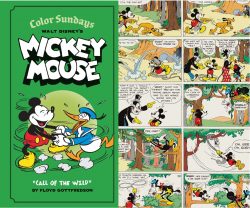
Walt Disney’s Mickey Mouse: “The Race to Death Valley” (Walt Disney’s Mickey Mouse Classic Collection volume 1)


By Floyd Gottfredson & various; Edited by David Gerstein (Fantagraphics Books)
ISBN: 978-1-60699-441-2 (HB/Digital edition)

As collaboratively co-created by Walt Disney and Ub Iwerks, Mickey Mouse was first seen – if not heard – in silent cartoon Plane Crazy. The animated short fared poorly in a May 1928 test screening and was promptly shelved. (Happy technical 95th Anniversary, kid!)

That’s why most people who care cite Steamboat Willie – the fourth Mickey feature to be completed – as the debut of the mascot mouse and co-star and paramour Minnie Mouse, since it was the first to be nationally distributed, as well as the first animated feature with synchronised sound. Its astounding success led to a subsequent and rapid release of fully completed predecessors Plane Crazy, The Gallopin’ Gaucho and The Barn Dance once they too had been given soundtracks. From those timid beginnings grew an immense fantasy empire, but film was not the only way Disney conquered hearts and minds.

With Mickey a certified solid gold sensation, the mighty mouse was considered a hot property and soon invaded America’s most powerful and pervasive entertainment medium: comic strips…

Floyd Gottfredson was a cartooning pathfinder who started out as just another warm body in the Disney Studio animation factory. Happily, he slipped sideways into graphic narrative and evolved into a ground-breaker of pictorial narratives as influential as George Herriman, Winsor McCay and Elzie Segar. Gottfredson’s Mickey Mouse entertained millions – if not billions – of eagerly enthralled readers and shaped the very way comics worked.

Via some of the earliest adventure continuities in comics history he took a wild and anarchic animated rodent from slap-stick beginnings and transformed a feisty everyman/mouse underdog into a crimebuster, detective, explorer, lover, aviator or cowboy. Mickey was the quintessential two-fisted hero whenever necessity demanded…

In later years, as tastes – and syndicate policy – changed, Gottfredson steered that self-same wandering warrior into a sedate, gently suburbanised lifestyle, employing crafty sitcom gags suited to a newly middle-class America: a 50-year career generating some of the most engrossing continuities the comics industry has ever enjoyed.

Arthur Floyd Gottfredson was born in 1905 in Kaysville, Utah, one of eight siblings born to a Mormon family of Danish extraction. Injured in a youthful hunting accident, Floyd whiled away a long recuperation drawing and studying cartoon correspondence courses. By the 1920s he had turned professional, selling cartoons and commercial art to local trade magazines and Big City newspaper the Salt Lake City Telegram.

In 1928, he (and wife Mattie) moved to California where, after a shaky start, the doodler found work in April 1929 as an in-betweener with the burgeoning Walt Disney Studios. Just as the Great Depression hit, he was personally asked by Disney to take over the newborn but already ailing Mickey Mouse newspaper strip. Gottfredson would plot, draw and frequently script the strip for the next five decades: an incredible accomplishment by of one of comics’ most gifted exponents.

Veteran animator Ub Iwerks had initiated the print feature with Disney himself contributing, before artist Win Smith was brought in. The nascent strip was plagued with problems and young Gottfredson was only supposed to pitch in until a regular creator could be found.

His first effort saw print on May 5th 1930 (his 25th birthday) and Floyd just kept going for an uninterrupted run over the next half century. On January 17th 1932, Gottfredson crafted the first colour Sunday page, which he also handled until retirement.

In the beginning he did everything, but in 1934 Gottfredson relinquished the scripting role, preferring plotting and illustrating the adventures to playing about with dialogue. Thereafter, collaborating wordsmiths included Ted Osborne, Merrill De Maris, Dick Shaw, Bill Walsh, Roy Williams and Del Connell. At the start and in the manner of a filmic studio system, Floyd briefly used inkers such as Ted Thwaites, Earl Duvall and Al Taliaferro, but by 1943 had taken on full art chores.

This superb archival compendium – part of a magnificently ambitious series collecting the creator’s entire canon – re-presents the initial daily romps, jam-packed with thrills, spills and chills, whacky races, fantastic fights and a glorious superabundance of rapid-fire sight-gags and verbal by-play. The manner by which Mickey became a syndicated star is covered in various articles at the front and back of this sturdy tome devised and edited by truly dedicated, clearly devoted fan David Gerstein.

Under the guise of Setting the Stage the unbridled fun and revelations begin with gaming guru Warren Spector’s appreciative ‘Introduction – The Master of Mickey Epics’ and a fulsome biographical account and appraisal of Gottfredson and Mickey continuities in ‘Of Mouse and Man – 1930-1931: The Early Years’ by historian and educator Thomas Andrae.

The scene-setting concludes with ‘Floyd Gottfredson, The Mickey Mouse Strip and Me – an Appreciation by Floyd Norman’, incorporating some preliminary insights from Gerstein in …An Indebted Valley… before the strip sequences begin in ‘The Adventures: Floyd Gottfredson’s Mickey Mouse Stories with Editor’s Notes’.

At the start the strip was treated like an animated feature, with diverse hands working under a “director” and each day seen as a full gag with set-up, delivery and a punchline, usually all in service to an umbrella story or theme. Such was the format Gottfredson inherited from Walt Disney for his first full yarn ‘Mickey Mouse in Death Valley’. It ran from April 1st to September 20th 1930 with the job further complicated by an urgent “request” from controlling syndicate King Features. They required that the strip immediately be made more adventure-oriented to compete with the latest trend in comics – action-packed continuities as seen in everything from Wash Tubbs to Tarzan

Roped in to provide additional art and inking for the raucous, rambunctious rambling saga were Win Smith, Jack King, Roy Nelson & Hardie Gramatky. The tale itself involved a picaresque, frequently deadly journey way out west to save Minnie’s inheritance – a lost mine – from conniving lawyer Sylvester Shyster and his vile and violent crony Peg-Leg Pete.

To foil them Mickey and his aggrieved companion chased across America by every conveyance imaginable, facing every possible peril immortalised by silent movie westerns, melodramas and comedies. In their relentless pursuit they were aided by masked mystery man The Fox

Next up – after brief preamble ‘Sheiks and Lovers’ – is another lengthy epic, featuring most of the early big screen repertory cast. ‘Mr. Slicker and the Egg Robbers’ (inked by Gottfredson, Gramatky & Earl Duvall and running from September 22nd – December 29th) opens with Mickey building his own decidedly downbeat backyard golf course before being repeatedly and disconcertingly distracted when sleazy sporty type Mr. Slicker starts paying unwelcome attention to Minnie. Well, it’s unwelcome as far as Mickey is concerned…

With cameos from Horace Horsecollar, Clarabelle Cow, goat-horned Mr. Butt and a prototype Goofy who answered – if he felt like it – to the moniker Dippy Dog, the rambunctious shenanigans continue for weeks until the gag-abundant tale resolves into a classic powerplay and landgrab as the nefarious ne’er-do-well is exposed as the fiend attempting to bankrupt Minnie’s family by swiping all the eggs produced on their farm. The swine even seeks to frame Mickey for his misdeed before our hero turns the tables on him…

A flurry of shorter escapades follow: rapid-fire doses of wonder and whimsy including ‘Mickey Mouse Music’ (December 30th 1930 – January 3rd 1931 with art by Duvall), ‘The Picnic’ (January 12th – 17th, Gottfredson inked by Duvall) and ‘Traffic Troubles’ (January 5th – 10th with pencils by Duvall & Gottfredson inks) before Gerstein introduces the next extended storyline with some fondly eloquent ‘Katnippery’

With story & art by Gottfredson & Duvall, ‘Mickey Mouse Vs. Kat Nipp’ proceeded from January 19th until February 25th 1931, detailing how a brutal feline thug bullies our hero. The sad state of affairs involves tail-abusing in various inspired forms, after which ‘Gallery Feature – …He’s Funny That Way…’ reveals a later Sunday strip appearance for Kat Nipp in a story by Merrill De Maris with Gottfredson pencils & Ted Thwaites inks. The excerpt comes from June 1938.

Gerstein’s introductory thoughts on the next epic – ‘High Society: Reality Show Edition’ – precede the serialised saga of ‘Mickey Mouse, Boxing Champion’. Running February 26th to April 29th by Gottfredson, Duvall & Al Taliaferro, the hilarious episodes relate how ever-jealous Mickey floors a big thug leering at Minnie to become infamous as the guy who knocked out the current heavy lightweight boxing champ.

Ruffhouse Rat’s subsequent attempts at revenge all go hideously awry and before long Mickey is acting as the big lug’s trainer. It’s a disaster and before long the champion suffers an inexorable physical and mental decline. Sadly, that’s when hulking brute Creamo Catnera hits town for a challenge bout. With Ruffhouse refusing to fight, it falls to Mickey to take on the savage contender…

Having accomplished one impossible task, Mickey sets his sights on reintroducing repentant convict Butch into ‘High Society’ (April 30th – May 30th – story & pencils by Gottfredson and inks from Taliaferro). The story was designed to tie-in to a Disney promotional stunt – a giveaway “photograph” of Mickey – and the history and details of the project are covered in ‘Gallery Feature – “Gobs of Good Wishes”’

‘Mick of All Trades’ introduces the next two extended serial tales, discussing Mickey’s every-mouse nature and willingness to tackle any job like the Taliaferro-inked ‘Circus Roustabout’ which originally ran from June 1st – July 17th. Here a string of animal-based gags is held together by Mickey’s hunt for a cunning thief, after which ‘Pluto the Pup’ takes centre-stage for a 10-day parade of slapstick antics and Gerstein’s ‘Middle-Euro Mouse’ supplies context to the less-savoury and non-PC historical aspects of an epic featuring wandering “gypsies”.

‘Mickey Mouse and the Ransom Plot’ (July 20th – November 7th) follows the star and chums Minnie, Horace and Clarabelle on a travelling vacation to the mountains. Here they fall under the influence of a suspicious band of Roma exhibiting all the worst aspects of thieving and spooky fortune-telling. When Minnie is abducted and payment demanded, Mickey knows just how to deal with the villains…

Essay ‘A Mouse (and a Horse and a Cow) Against the World’ segues into fresh employment horizons for our hero as Gottfredson & Taliaferro test the humorous action potential of ‘Fireman Mickey’ (November 9th – December 5th). Another scintillating cascade of japes, jests and merry melodramas – and taking us from December 7th 1931 to January 9th 1932 in fine style – it offers glimmerings of continuity sub-plotting and supporting character development. These all shade a budding romance under the eaves of ‘Clarabelle’s Boarding House’. Although the chronological cartooning officially concludes here, there’s still a wealth of glorious treats and fascinating revelations in store in The Gottfredson Archives: Essays and Archival Features section that follows.

Contributed by Thomas Andrae, ‘In the Beginning: Ub Iwerks and the Birth of Mickey Mouse’ offers beguiling background and priceless early drawings from the earliest moments, as does Gerstein’s ‘Starting the Strip’ which comes packed with timeless ephemera.

As previously stated, Gottfredson took over a strip already in progress and next – accompanied by covers from European editions of the period – come the strips preceding his accession. Frantic gag-panels (like scenes from an animation storyboard) comprise ‘Lost on a Desert Island’ (January 13th – March 31st 1930, crafted by storyteller Walt and artists Ub Iwerks & Win Smith) are augmented by Gerstein’s ‘The Cartoon Connection’ with additional Italian strips from Giorgio Scudellari in ‘Gallery Feature – “Lost on a Desert Island”’.

Even more text and recovered-art features explore ‘The Cast: Mickey and Minnie’ and ‘Sharing the Spotlight: Walt Disney and Win Smith’ (both by Gerstein) before more international examples illuminate ‘Gottfredson’s World: Mickey Mouse in Death Valley’ whereafter ‘Unlocking the Fox’ traces the filmic antecedents of the hooded stranger, with priceless original art samples in ‘Behind the Scenes: Pencil Mania’.

More contemporaneous European examples from early collections tantalise in ‘Gallery Feature – Gottfredson’s World: Mr. Slicker and the Egg Robbers’ before Alberto Beccatini & Gerstein’s ‘Sharing the Spotlight: Roy Nelson, Jack King and Hardie Gramatky’ supply information on these lost craftsmen.

Gerstein’s ‘The One-Off Gottfredson Spin-Off’ highlights a forgotten transatlantic strip collaboration with German artist Frank Behmak, whilst ‘Gallery Feature – The Comics Department at Work: Mickey Mouse in Color (- And Black and White)’ covers lost merchandise and production art whilst ‘Gottfredson’s World: Mickey Mouse Vs. Kat Nipp’ and ‘Gottfredson’s World: Mickey Mouse, Boxing Champion’ offer yet more overseas Mouse memorabilia.

‘Sharing the Spotlight: Earl Duvall’ is another fine Gerstein tribute to a forgotten artisan, supplemented by ‘The Cast: Butch’ and ‘Al Taliaferro’, after which ‘The Gottfredson Gang: In “Their Own” Words’ (Gerstein – with texts by Mortimer Franklin & R. M. Finch) reprints contemporary interviews with the 2D stars, garnished with publicity tear-sheets and clippings. This is rounded off by more foreign covers in ‘Gallery Feature – Gottfredson’s World: Strange Tales of Late 1931’, ‘The Cast: Pluto’ and a stunning Christmas message from the Mouse as per ‘I have it on good authority’, giving Gottfredson himself the last word.

Gottfredson’s influence on not just the Disney canon but sequential graphic narrative itself is inestimable: he was among the first to produce long continuities and “straight” adventures; he pioneered team-ups and invented some of the first “super-villains” in the business.

When Disney killed the continuities in 1955, dictating henceforth strips would only contain one-off gag strips, Floyd adapted seamlessly, working on until retirement in 1975. His last daily appeared on November 15th with the final Sunday published on September 19th 1976.

Like all Disney creators, Gottfredson worked in utter anonymity, but in the 1960s his identity was revealed and the voluble appreciation of his previously unsuspected horde of devotees led to interviews, overviews and public appearances, with effect that subsequent reprinting in books, comics and albums carried a credit for the quiet, reserved master. Floyd Gottfredson died in July 1986.

Thankfully we have these Archives to enjoy and inspire us and hopefully a whole new generation of inveterate tale-tellers…
© 2011 Disney Enterprises, Inc Text of “In the Beginning: Ub Iwerks and the Birth of Mickey Mouse” by Thomas Andrae is © 2011 Thomas Andrae. All contents © 2011 Disney Enterprises unless otherwise noted. All rights reserved.
The Songs of Michael Flanders & Donald Swann


Lyrics by Michael Flanders & Donald Swann, illustrated by H. M. Bateman, Gerard Hoffnung, Osbert Lancaster, David Low, Gerald Scarfe, Trog (Willy Fawkes), Edward Burra, Ionicus (Joshua Charles Armitage), William Hewison, Michael ffolkes, Ronald Searle and Many & Various (Elm Tree Books/International Music Publications Limited)
ISBN: 978-0-24189-738 6 (HB) 978-1-85909-439-6 (PB)

When music becomes global major news and both a political hot potato and celebration of Gay Pride, I’d be a sucker not to mark the occasion with a cheap shot and hearty paean for my own aspirational dreams. I want new people to recognise some good old days of my own – in words and pictures as well as musically. If you are intrigued, track these down…

I’m stretching my brief again here (and isn’t that a grisly image to conjure with?) to review this superb slice of comedy nostalgia that’s still readily available. Michael Flanders (1922-1975) and Donald Swann (1923-1994) were primarily songwriters who became a huge international success performing their own material and acting as charming social commentators.

All this they did, live on stage in a vibrant, satirical manner that captivated audiences both in theatres across the globe, but also on the increasingly important television variety circuit.

Their brand of gently jibing whimsy (mostly skewering themselves and a rapidly changing Britain and “Englishness”) through mordant sarcasm delighted the folk of many nations, and songs such as “The Hippopotamus” (you may know it as “Mud, Mud, Glorious Mud”) or “The Reluctant Cannibal” are still liable to break out whenever people of a certain age congregate near a piano.

The dapper duo first teamed up in 1948 and were brilliantly funny on stage. Live albums like At the Drop of a Hat and At the Drop of Another Hat are classic examples of comedy stand-up that still leave contemporary improv performers agog and breathless. Both of them died far too early.

This brain-blistering book gathers 41 of their funniest, most sarcastic, touching and best songs, with both sheet music and separate lyrics. It’s also augmented by cartoons and illustrations from some of Britain’s greatest humorous illustrators such as H. M. Bateman, Hoffnung, Osbert Lancaster, David Low, Gerald Scarfe, Trog, Edward Burra, Ionicus, Hewison, ffolkes, Ronald Searle and many others.

If you’re a sucker for shopping lists the delicious ditties done here are In The Bath, Design For Living, Misalliance, The Gas-Man Cometh, A Song Of The Weather, Pillar To Post, Rain On The Plage, Motor Perpetuo, Slow Train, A Transport Of Delight (Omnibus), Last Of The Line, Twenty Tons Of TNT, The Reluctant Cannibal, Pee-Po-Belly-Bum-Drawers, Budget Song, Ballad For The Rich, All Gall, Philological Waltz (Tonga), Song Of Patriotic Prejudice, The Lord Chamberlain’s Regulations, The Album, Ill Wind, Guide To Britten, Song Of Reproduction, Bedstead Men, Excelsior, Vanessa, Twice Shy and the rather worrisome-by-modern-standards Madeira, M’dear?

Also included are a selection of their generally child-friendly airs such as The Armadillo, …Hippopotamus, …Ostrich, …Elephant, …Gnu, …Rhinoceros, …Sloth, …Spider, …Wild Boar, The Whale (Mopy Dick), The Warthog and The Wompom, acting in concert to make this grand book a delight to look at as well read. If you ever needed a reason to dust off the old piano lessons…
© 1977, 1996 International Music Publications Limited. Illustrations © 1977 their respective copyright holders.

Too Many Songs by Tom Lehrer, With Not Enough Drawings by Ronald Searle


By Tom Lehrer & Ronald Searle (Methuen)
ISBN: 978-0-41348-570-0 (HB) 978-0-41374-230-8 (PB)

And we will all go together when we go.
What a comforting fact that is to know.
Universal bereavement – an inspiring achievement,
Yes, we all will go together when we go.
We will all go together when we go.
All suffused with an incandescent glow.
No one will have the endurance – to collect on his insurance
Lloyd’s of London will be loaded when they go.

Are you musical? I already know that you are a lover of graphic narrative excellence and fine art, so the wonderfully dark, sinister, disturbing and utterly brilliant cartoon illustrations of Ronald Searle will delight you.

But the name of mathematician, songwriter, satirist, Intellectual and early proponent of sick and bad taste humour Tom Lehrer is perhaps not so well known, although his achievements are as remarkable and far-reaching. If you already know of him you’ll know why I’m such a fanatical fan. If not, crack open your search engines. It’ll be the most fun you’ve had in ages.

This terrifically terse yet near-terpsichorean tome – often re-issued as a comedy classic (the last time was 1999) – contains the music, lyrics, words, tunes, piano accompaniments, and guitar chords for 34 classics from a frankly staggering oeuvre and back-catalogue comprising decades of educational and comedic songs. From such classics as “Poisoning Pigeons in the Park”, the deeply disturbing yet hilarious “I Hold your Hand in Mine”, “The Old Dope Peddler” and “The Masochism Tango” to the lightly spiky “Be Prepared” or “I Got it from Agnes”, Lehrer makes smart people laugh, venal people squirm and all people think.

Also included are edgy examples from his tenure as songwriter for That Was The Week That Was and educational ditties penned for the Electric Company/Children’s Television Workshop (now the Sesame Workshop).

Some songs have been adapted by George Woodbridge in Mad Magazine,

In 2020, aged of 92, Professor Lehrer donated all lyrics and music written by him to the public domain, and on November 1st, followed up with all recording and performing rights of any kind, making all his originally composed or performed confections free for anyone to use. They are available directly from his site for free download (http://tomlehrersongs.com/).

His accompanying statement concluded with: “This website will be shut down at some date in the not-too-distant future, so if you want to download anything, don’t wait too long.”

Just as with Flanders & Swann there’s no substitute for actual performances, but in case you need more to go on, lurking here all snappy and sharp arias including The Irish Ballad, Fight Fiercely Harvard!, Be Prepared, The Old Dope Peddler, The Wild West Is Where I Want to Be, I Wanna Go Back to Dixie, Lobachevsky, The Hunting Song, I Hold Your Hand in Mine, My Home Town, L-Y, When You Are Old and Gray, The Wiener Schnitzel Waltz, Poisoning Pigeons in the Park, A Christmas Carol, Bright College Days, In Old Mexico, She’s My Girl, The Elements, The Masochism Tango, National Brotherhood Week, MLF Lullaby, The Folk Song Army, Smut, Send the Marines, New Math, Pollution, So Long Mom, Who’s Next?, The Vatican Rag, Wernher Von Braun, I Got It from Agnes, Silent E and We Will All Go Together When We Go.

Wedded to the razor-wrought drawings of Ronald Searle, this is an astoundingly entertaining book and what every liberal should make the piano teacher use on the kids: a melodic match for EC horror comics. Lehrer’s music and performances are readily available: go avail yourself of them online – or via your favoured news platform or source.

Moreover, I can’t resist ending with a famous quote. Just remember, please, this is not a malicious man, just a keenly observant Wit who claimed he’d stopped doing satire because “Awarding the Nobel Peace Prize to Henry Kissinger made political satire obsolete”…
© 1981, 1999 Tom Lehrer. Illustrations © 1981 Ronald Searle.

A Cartoon History of the Monarchy


By Michael Wynn Jones and Many & Various (Macmillan)
ASIN: B001H0OAOO (HB), ISBN: 978-0333198056 (PB)

We’re far too reluctant in this country to celebrate the history and quality of our own cartooning tradition; preferring simply to remark on the attention-grabbers or impressive longevity of one or two classic and venerable veterans of the pen-&-ink game for TV soundbites and platform clickbait. The actual truth is that for an incredibly long time the political art movement of the Empire and Commonwealth – and its enemies – was vast, varied and fantastically influential.

The British wing of the form has been magnificently serviced over centuries by masters of form, line, wash and most importantly ideas, repeatedly tickling our funny bones or enraging our sleeping consciences and sensibilities, all whilst poking our communal pomposities and fascinations.

From earliest inception, satiric draughtsmanship has been used to attack and sell: initially ideas, values, opinions and prejudices or but eventually actual products too. In newspapers, magazines and especially comic books, the sheer power of graphic narrative, with its ability to create emotional affinities, has led to the creation of unforgettable images and characters – and the destruction of real people or social systems.

When those creations can affect the daily lives of millions of readers, the force they can apply in the commercial or political arena is well-nigh irresistible…

In Britain, the cartoonist has held a bizarrely precarious position of power for centuries: the deftly designed bombastic broadside or savagely surgical satirical slice instantly capable of ridiculing, exposing, uplifting or deflating the powerfully elevated, unapproachable and apparently untouchable with a simple shaped-charge of scandalous wit and crushingly clear, universally understandable visual metaphor.

For this method of concept transmission, lack of literacy or education is no barrier. As the Catholic Church proved centuries ago with the Stations of the Cross, stained glass windows and a superteam of idealised saints, a picture is worth far more than a thousand words…

For as long as we’ve had printing there have been scurrilous gadfly artists commentating on rulers, society and all iniquities: pictorially haranguing the powerful, pompous, privileged and just plain perfidious through swingeing satire and cunning caricature. Sometimes artists have been just plain mean. Those are usually the best and most memorable…

Britain had no monopoly on talent and indignation, and this canny compendium also frequently features European – and latterly American – takes on our always-scandalous Royals and oddball citizenry…

Released in 1978 and desperately in need of updating and re-issue, A Cartoon History of the Monarchy offers a potted, far from hagiographic history and deliciously skewed view of our Ruling Elite in all their unsavoury glory. Here is an unbroken line of jibes, asides and broadsides culled from diverse sources by jobbing journalist and aficionado of japes, lampoons and sketches Michael Wynn Jones, who casts his discriminating eye from the reign of Elizabeth I up until just before the Silver Jubilee of the second Regina to bear the name…

Following a rota of the Kings and Queens of England, the pomposity-puncturing procession commences with The Age of Intolerance, reproducing cartoons and adding commentary dealing with the doings of the 10 monarchs from the initial Elizabeth I to George II.

Accompanying essays share the zeitgeist of those times; the religious questions as England, Wales, Ireland and eventually Scotland faced numerous crises regarding succession. That issue always revolved around whether the land should be Catholic or Protestant. ‘Popes, Plots and Puritans’ led to a final solution when ‘The Men from Hanover’ arrived to settle the matter and fully cement the nation under the Church of England.

A savage sampling of national and European opinions are represented by 26 visual bombards such as allegorical assault ‘Diana and Callisto’ by Dutch artist Miricenys (1585), the anonymous ‘England’s Miraculous Preservation’ (1648) and ‘The Royal Oake of Brittayn’ (1649) amongst many others.

Cartoon grotesques like ‘Cromwell’s Car’ (1649) or ‘Babel and Bethel’ (1679) appear beside such scandalous foreign attacks as Dutch illustrator Dusart’s ‘Fr. James King’ or anonymous French pictorial polemic ‘Notice of Burial’ (both from 1690). We Brit’s riposted with jeering celebrations of martial triumphs such as ‘The Arrival of William and Mary’ (1689), ‘The Great Eclipse of the Sun’ (simultaneously a topical spin on a 1706 solar event and defeat of “Sun King” Louis XIV by the British armies of Queen Anne), and ‘A Bridle for the French King’ from the same year.

Domestic contretemps are highlighted through such draughtsman’s delights as anonymous 1743 shocker ‘The Hanover Bubble’, Ebersley’s ‘The Agreeable Contrast’ (1746 and attacking King George’s brother “Butcher” Cumberland’s treatment of Jacobites after the Young Pretender’s defeat), and exposure of Popish influence in the Highlands, described in ‘The Chevalier’s Market’ 1745…

Whereas much of this material – British and foreign – was generally national commentary and straight religio-political assault, by the time period covered in The Wickedest Age: George III to George IV (1760-1830), the cartoon had also evolved into a weapon designed to wound with wit and crush through cruel caricature.

After covering major crises and scandals of the generally sensible – if parsimonious – third George in ‘The Royal Malady’, ‘The Dregs of Their Dull Race’ and ‘Twilight Years’, a veritable Golden Age of popular disapproval and pictorial pummelling of the Prince Regent and much-delayed, frustrated monarch (plus his many indiscreet mistresses) is covered in ‘The Prince of Whales’, ‘The Secret Marriage’, ‘…Pray Get Me a Glass of Brandy’ and ‘Delicate Investigations’.

The public disdain of the times generated a fusillade of cartoon prints, represented here by 35 graphic thrusts and savage cartoon sallies by names now as famous as any ruler. However master character assassins Townsend (‘The Scotch hurdy-gurdy’), George Cruikshank (‘Royal Condescension’), Gillray (‘A New Way to Pay the National Debt’, ‘A Voluptuary under the Horrors of Digestion’), Rowlandson (‘The Prospect Before Us’) and Heath (‘A Triumph of innocence over perjury’) are brilliantly bolstered by lesser lights West (‘The Save-all and the Extinguisher!’), Williams (‘Low Life above stairs’), Vowles (‘The shelter for the destitute’) and Marshall (‘The kettle calling the pot ugly names’) and some anonymous pen-pricks who nevertheless hit hard with ‘Tempora Mutantor’, ‘The captive Prince’ and ‘Reading of the Imperial decree’ and more.

Eventually, periodical publication overtook print-shops as the great disseminators of carton imagery, and open savagery and targeted vulgarity of caricaturists gradually gave way to mannered, if barbed, genteel observation. Thus, The Age of Discretion: William IV to Victoria (1830-1901) offers a different style of Royal Commentary: no less challenging, but certainly more overtly respectful even when critical. Sometimes, though, the new family-oriented cartooning – even in magazines like Punch and The Times, simply sunk to fawning veneration as the institution of monarchy became more and more removed from the lives of the citizenry.

William’s times are summed up in text via ‘The Sailor King’ and ‘Reform Billy’ whilst Victoria’s epochal reign and the Parliamentarians who increasingly wielded decisive power is described through ‘The Queen of the Whigs’, ‘Revolutions are bad for the Country’, ‘The Black and the Brown’ and ‘Years of Widowhood’.

The 36 collected images recapture days of Empire, with Heath, Seymour and Doyle predominant in illustrating bluff sea-dog William’s socially contentious days of Reform.

Victoria’s years – from engaging popular ingénue Queen, through happy bride to politically intrusive grand dame of European Court intrigue – highlights the craft of Doyle ‘The Queen in Danger’ (1837), Leech ‘There’s Always Something’ (1852), Tenniel ‘Queen Hermione’ (1865), ‘New Crowns for Old Ones!’ (1876), Morgan (Where is Britannia?’ and ‘A Brown Study’ (both 1867) and Sambourne ‘Kaiser-i-Hind’ (1876) amongst so many others.

Her latter years saw a rise in social conscience cartooning as displayed by the crusading Merry with ‘The Scapegrace of the Family’ (1880), ‘The fall of the rebels’ in 1886 and more. The telling modernist take of Max Beerbohm cuttingly illustrated the rift between the Empress and her playboy heir in ‘The rare, the rather awful visits of Albert Edward to Windsor Castle’

Despite her well-publicised disapproval of the good-time Prince, he became an effective king as did his son, both covered in The Edwardian Age: Edward VII to George V, spanning 1901-1936. Their dutiful achievements are depicted in ‘The Coming King’ and ‘The First Gentleman of Europe’ before war with Germany necessitated a family name change for George: ‘The First Windsor’

With kings increasingly used as good-will ambassadors and cited in scandals frequently ending in court (sound familiar?), the 30 cartoons in this section include many German pieces from not only the war years but also the tense decade that preceded them. At that time of tinderbox politics, Imperial Superpowers jostled for position and used propaganda to appeal to the world’s “unwashed masses” for justification in their aims and ambitions.

Beside veteran caricaturists like Leech, Morgan, May, Partridge, Staniforth and David Low are merciless lampoons from German cartoonists Brandt, Blir, Heine, Gulbransson and Johnson as well as French illustrator Veber and lone American Kirby.

Our pen-&-ink pictorial history lesson concludes with The Age of Respectability: Edward VIII, George VI, Elizabeth II, by generally skipping World War II, concentrating on the openly secret scandal of Edward and Mrs Simpson in ‘Abdication’. Thereafter the advent of ‘New Elizabethans’ brought a modern age of monarchs as sideshow attractions…

Although Fleet Street chose to whitewash and suppress the affair between a King-in-waiting and an American divorcee, the rest of the world made great play of the situation: as seen here with 11 telling cartoon shots from Americans McCutcheon and Orro, whilst French scribbler Effel posited typically insouciant Gallic pragmatism in ‘Une Solution’ and German-based Gulbransson played up the true romance angle…

In the meantime, British cartoonist Low had to be at his most obliquely hilarious, delineating the crisis by not mentioning it, whilst Punch stars such as Partridge steadfastly pursued a line of deferential, tragic sacrifice…

Although there is very little material featuring wartime monarch George VI – a propaganda casualty of the conflict – the last 20 cartoons herein celebrate the changing image of a very public Royal Family, pictured by names hopefully familiar to contemporary cartoon lovers.

The imagery is also contextually far more familiar – and presumably comfortable – to modern tastes as print media generally learned to save their vitriol for politicians and celebrities: reserving only minor chidings and silly teasing for “the Royals”, as seen in ‘Birthday Greetings’ and ‘Under the Splendid Empire Tree’ (Shepard from 1947) or Illingworth’s 1951 panels ‘Family Ties’ and ‘Happy Returns’.

Papers were, however, happy to utilise the monarchy to score points against governments, as seen in an attack on Enoch Powell (Cummings’ ‘Ministry of Repatriation’) and the battle between Rhodesia’s Ian Smith and Harold Wilson, lampooned in ‘Your Move!’ by Jak (both 1968) or the legendary Giles’ ‘New Rent Assistance Bill’ (1971).

Also offering acerbic jollity of a far more blueblood-specific variety are cartoon giants Trog and Waite, joining the abovementioned in exploiting the Royal Family’s gift for headline-stealing gaffes in such daring gags as ‘I Suppose we did send them to the Right Schools?’, ‘I Suppose she’ll think these are of the Queen Mother’, ‘More Pay’ and ‘Andrew’s Exchange Student’: coming full circle with the best of Hanoverian excesses scrutinised by cost-conscious government and public – albeit this time for rather more gentle laughs…

Appended with a scholarly section of Acknowledgements, Illustration sources and Index of artists, this is an extremely effective introduction to the lasting relationship between Royalty, Church and Fourth Estate, offering a fantastic overview of Regal adaptability and cultural life through cunningly contrived images and pictorial iconography that shaped society and the world.

These are timeless examples of the political pictorialist’s uncanny power and, as signs of the times, form a surprising effecting gestalt of the never-happy nation’s feeling and character.

None of that actually matters now, since these cartoons have performed the task they were intended for: moulding attitudes of generations of voters who never voted for monarchy. That they have also stood the test of time and remain beloved relics of a lethal art form is true testament to their power and passion.

Stuffed with astounding images, fascinating lost ephemera and mouth-watering tastes of comic art no aficionado could resist, this colossal collection is a beautiful piece of cartoon history to delight and tantalise all who read it.

We haven’t had many monarchs since this book was first released, but there are plenty of new Royals and scandals to ponder, so it’s long past time for a fresh edition, no?
© Michael Wynn Jones 1978. All rights reserved.