
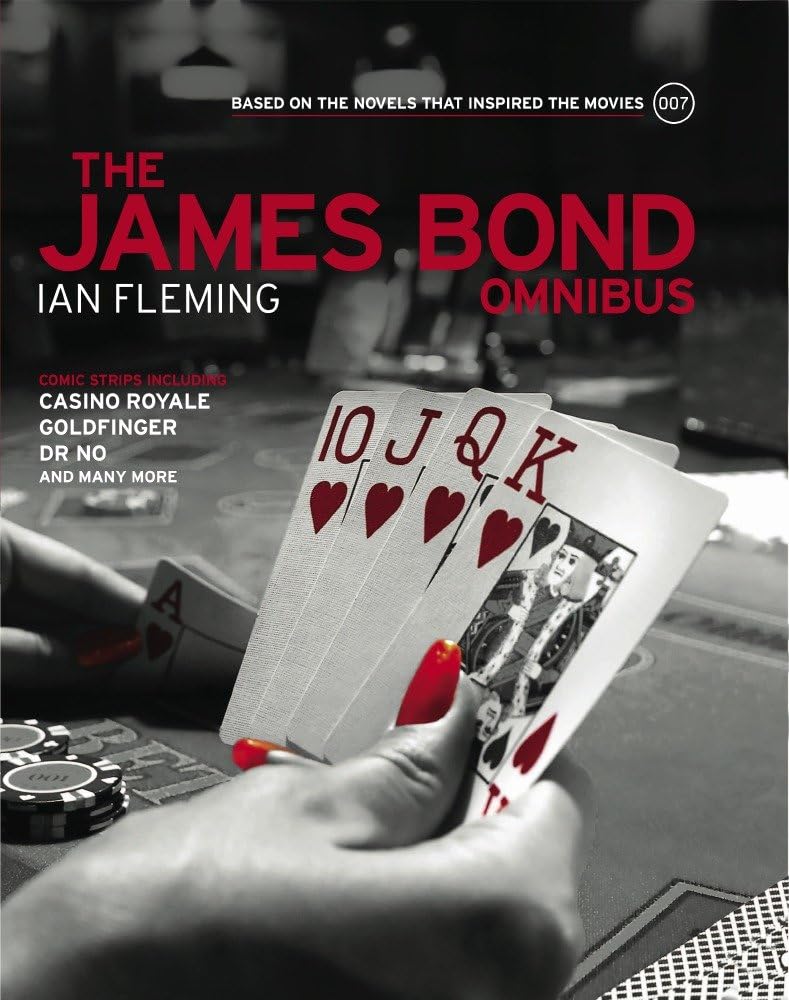
By Ian Fleming; adapted by Anthony Hern, Peter O’Donnell, Henry Gammidge & John McLusky (Titan Books)
ISBN: 987-1-84856-364-3 (TPB)
This book includes Discriminatory Content produced in less enlightened times.
It’s sad to admit but there are very few British newspaper strips to challenge the influence and impact of classic daily and Sunday “funnies” from America, especially in the febrile but slowly expiring the field of adventure picture-fiction.
The 1930’s and 1940’s were rich in popular, not to say iconic, creations. You would be hard-pressed to come up with homegrown household names to rival Popeye, Dick Tracy, Buck Rogers or Flash Gordon, let alone Terry and the Pirates, Steve Canyon, or the likes of Little Lulu, Blondie, Li’l Abner, Little Orphan Annie or Popeye and yes, I know I said him twice, but Elzie Segars’s Thimble Theatre was funny as well as thrilling, constantly innovative, and really, really good.
What strips can you recall to equal simple popularity let alone longevity or quality in Britain? Rupert Bear? Absolutely. Giles? Technically, yes. Nipper? Jane? The Perishers? Garth? Judge Dredd? Scorer?
I’d like to hope so, but I doubt it. The Empire didn’t quite get it until it wasn’t an empire any more. There were certainly very many wonderful strips being produced: well-written and beautifully drawn, but that stubborn British reserve plus a completely different editorial view of the marketplace (which just didn’t consider strips infallible, readership-attracting magnets, as American did) never seemed to be in the business of creating household names – until the 1950’s. Something happened in ‘50s Britain, but I’m not going to waste any space here discussing it. It just did.
In a new egalitarian spirit that seemingly craved excitement and accepted previously disregarded, comics (as well as all tawdry “entertainment” media from radio serials to paperback novels) got carried along on the wave. Just like television, periodicals such as Eagle, the regenerated Dandy and Beano and girls’ comics in general all shifted into creative high gear… and so at last did newspapers.
And that means that I can properly extol the virtues of a graphic collection with proven crossover appeal for once. Debut 007 novel Casino Royale was published in 1953 and was subsequently serialised – after much dithering and nervousness on behalf of author Fleming – as a strip in The Daily Express from 1958. It was the start of a beguiling run of novel and short story adaptations scripted by Anthony Hern, Henry Gammidge, Peter O’Donnell and Kingsley Amis, before Jim Lawrence, a jobbing writer of US features (and who’d previously scripted the aforementioned Buck Rogers) came aboard for The Man With the Golden Gun, completing the transfer of the Fleming canon to strip format. Thereafter Lawrence was invited to create new adventures, which he did until the strip’s demise in 1983.
The art on the feature was always of the highest standard. Initially John McLusky handled the illustration until 1966’s conclusion of You Only Live Twice and, although perhaps lacking in flash or verve, the workmanlike clarity of his drawing easily coped with a daunting array of locales, technical set-ups and sheer immensity of cast members, whilst satisfying the then-novel directive of advancing a plot daily whilst ending each episode on a cliff-hanging hook every time.
McLusky was succeeded by Yaroslav Horak, who debuted on Man with the Golden Gun, offering a looser, edgier style, at once more cinematic and with a closer attention to camera angle and frenzied action that seemed to typify the high-octane 1960’s. Horak limned 26 complete adventures until 1977 when The Daily Express axed the Bond feature with a still-running adventure suddenly switching to The Sunday Express from January 30th until conclusion on May 22nd. Later adventures had no UK presence at all, and only appeared in syndication in European papers. This state of affairs continued until 1981 when British paper The Daily Star restored the feature to Britons with ‘Doomcrack’.
Titan Books re-assembled those scarce-seen tales – a heady brew of adventure, sex, intrigue and death – into addictively accessible monochrome Omnibus Editions, (sadly not available digitally at present) with a dedicated band of creators on top form proving how the world’s greatest agent never rests in his mission to keep us all free, safe, shaken (if not stirred) and thoroughly entertained…
This premier no-nonsense paperback gem adapting 11 of Fleming’s best, frantic derring-do and dark, deadly diplomacy commences with ‘Casino Royale’ as British operative Bond is ordered to gamble with and bankrupt Le Chiffre: a communist agent who has insanely embezzled away his Soviet masters’ operating capital.
The moodily compelling tale of tension that results depicts torture and violent death as well as oppressively suspenseful scenes of graphic gambling, heady stuff for newspaper readers of 1958, when it first ran.
Without pausing for breath or a fresh martini, the Bond briefing segues straight into ‘Live and Let Die’ which sees 007 and US agent Felix Leiter tackle Mr. Big, another scurrilous commie agent/devious genius who rules the Harlem underworld through superstition, voodoo and brutal force. Then, ‘Moonraker’ details the attempt by ex-Nazi officer Hugo Drax to drop a guided missile on London, a task made far simpler since the maniac has infiltrated the British aristocracy…
These newspaper strips come from a period when dependable John McLusky was developing a less formal approach, before going on to produce some of his best work. ‘Casino Royale’ was the opening strip in a near 25-year run, and the somewhat muted artwork shows an artist still not completely comfortable with his task. It was adapted and scripted by Anthony Hern, who had won the author’s approval after writing condensed prose versions of the novels for the Daily Express. Live and Let Die and Moonraker were both adapted by Henry Gammidge.
As McLusky settled in for the long haul, he warmed to the potentialities of the job with cracking tales of Cold-War intrigue and fast, dangerous living set in a multitude of exotic locales, and provides here a welcome return to public gaze of some of the most influential – and exciting – comic strips in British history.
The adaptation of ‘Diamonds are Forever’ pits Bond against an insidious diamond smuggling criminals, in an explosive if uncomplicated all-action romp before shifting into terse, low-key thriller ‘From Russia With Love’ (both courtesy of Gammidge & McLusky). The artist hit a creative peak with ‘Dr No’ – perhaps because of the sparkling script from Peter O’Donnell before he sloped off to create the amazing Modesty Blaise. As Bond returns to Jamaica and investigates the disappearance of two operatives he stumbles upon a plot to sabotage the US rocketry program. These stories come from an age at once less jaded but more worldly; a place and time where readers lived daily with the very real threat of instant annihilation. As such, the easy approachability of the material is a credit to the creators.
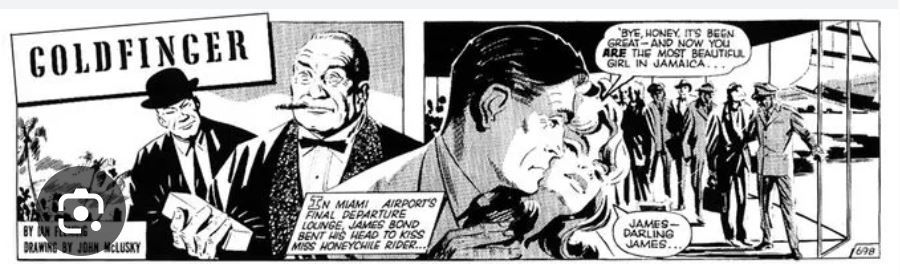
‘Goldfinger’ faithfully adapts Fleming’s novel of the world’s most ambitious bullion robbery, so if you’re only familiar with the film version there will be some things you’ve not seen before. The action fairly rockets along and tense suspense is maintained throughout this signature tale. Following that is ‘Risico’ as 007 is tasked with stopping heroin smugglers whose motive is not profit but social destabilisation. Next is ‘From a View to a Kill’: a traditional, low-key Cold War thriller with Bond trailing gangsters stealing state secrets by ambushing military dispatch riders…
In the Roger Moore film incarnation Risico was folded into ‘For Your Eyes Only’ but here you get the real deal with a faithful adaptation of Fleming’s short story, wherein Bond is given a mission of revenge and assassination. Set in Jamaica with Nazi war-criminal Von Hammerstein as culprit and target for the man licenced to kill, it’s a solid piece of dramatic fiction that again bears little similarity to the celluloid adventure.
The volume concludes with the then-controversial ‘Thunderball’ adaptation. That particular tale was savagely censored and curtailed at the behest of Daily Express owner Lord Beaverbrook. Five days of continuity were excised but what remains is still pretty engrossing comic fare and at least some effort was made to wrap up the storyline before the strip ended. In case you don’t recall: When Bond is sent on enforced medical leave, he stumbles into a deadly plot to steal nuclear weapons by a subversive organisation calling itself Spectre…
These grand stories are a must for not only aficionados of Bond but for all thriller fans, as an example of truly gripping adventure uncluttered by superficial razzamatazz. Get back to basics, and remember that classic style is never out of fashion.
All strips are © Ian Fleming Publications Ltd/Express Newspapers Ltd 1987. James Bond and 007 are ™ & © Danjaq LLC used under license from Ian Fleming Publications Ltd. All rights reserved.
In 1915 prolific scripter Hank Chapman was born, with artistic maestro John Cullen Murphy (Prince Valiant) coming along four years later. Miss Pearl and Momma creator Mel Lazarus popped up in 1927, and Belgian Sammy draughtsman Berck (Arthur Berckmans) in 1928. Comic book legend Denny O’Neil was born in 1939 and Bill Sienkiewicz in 1958. German cartoonist Jan-Michael Richter – of Jamiri fame – came along in 1966 as did Nina Paley in 1968, and Mexican Gerardo Sandoval (Tomb Raider, Venom), and the date saw the first appearance of Zig et Puce (by Alain Saint-Ogan) in 1925; the premiere of Donald Duck (a bit player in Silly Symphony: The Wise Little Hen) in 1934; the launch of Dutch silent comic Fred’nand in 1937and the debut of Tiger by Bud Blake in 1965.
Milton Caniff died today in 1988.