
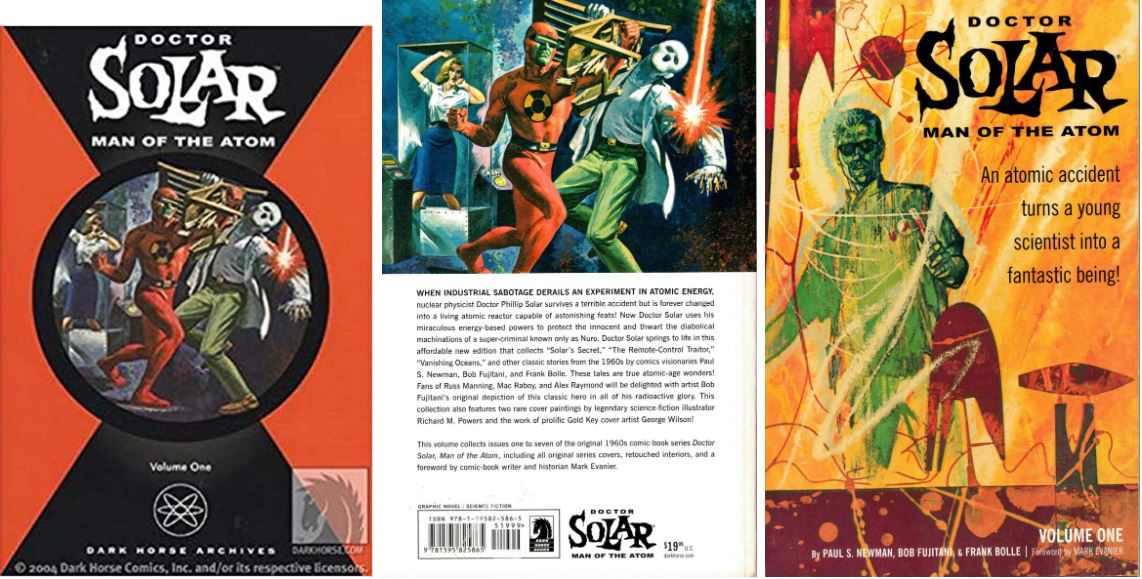
By Paul S. Newman, Matt Murphy, Bob Fujitani, Frank Bolle & various (Dark Horse Books)
ISBN: 978-1-59307-285-8 (HB) 978-1-59582-586-5 (TPB)
This book includes Discriminatory Content produced in less enlightened times.
The comics colossus identified by fans as Dell/Gold Key/Whitman had one of the most complicated publishing set-ups in history, but that didn’t matter one iota to the kids of all ages who consumed their vastly varied product. Based in Racine, Wisconsin, Whitman had been a crucial part of the monolithic Western Publishing and Lithography Company since 1915 and could draw on the commercial resources and industry connections that came with editorial offices on both coasts (and even a subsidiary printing plant in Poughkeepsie, New York).
Another connection was with fellow Western subsidiary K.K. Publications (named for licensing legend Kay Kamen who facilitated extremely lucrative “license to print money” merchandising deals for Walt Disney Studios between 1933 and 1949).
From 1938, Western’s comic book output was released under a partnership deal with a “pulp” periodical publisher under umbrella imprint Dell Comics – and again those creative staff and commercial contacts fed into the line-up of the Big Little, Little Golden and Golden Press books for children. The partnership ended in 1962 and Western had to swiftly reinvent its comics division as Gold Key.
As previously cited, Western Publishing had been a major player since comics’ earliest days, blending a huge tranche of licensed titles comprising newspaper strips, TV and Disney titles, – such as Nancy and Sluggo, Tarzan, or The Lone Ranger – with home-grown hits like Turok, Son of Stone and Space Family Robinson. In the 1960s, during the camp/superhero boom these original adventure titles expanded to include Brain Boy, M.A.R.S. Patrol, Total War (created by Wally Wood), Magnus, Robot Fighter (by the incredible Russ Manning) and – in deference to the atomic age of heroes – Nukla, another brilliantly coolly understated nuclear white knight. Despite supremely high quality and passionate fan-bases, they never really captured the media spotlight like DC and Marvel’s costumed cut-ups. Western eventually (in 1984) shut their comics division, having lost or ceded their licenses to DC Marvel and Charlton.
All this and much more can be found far more clearly explained by the wonderful Mark Evanier in this hardback or trade paperback collection’s Foreword – ‘The Golden Years’ – as well as a fond critical appraisal of the superb comics yarn-spinning that follows…
As a publisher, Gold Key never really “got” the melodramatic, breast-beating, often mock-heroic Sturm und Drang of the 1960s superhero boom – although for many of us, the understated functionality of Silver Age classics like Magnus, Robot Fighter or remarkably radical concepts of atomic crusader Nukla and crime-fighting iterations of classic movie monsters Dracula, Frankenstein and Werewolf were utterly irresistible. The sheer off-the-wall lunacy of features like Neutro or Dr. Spektor I will save for a future occasion…
The company’s most recognisable stab at a pure superhero was an rather sedate and reticent nuclear era star with the unwieldy codename Dr. Solar, Man of the Atom. He debuted in an eponymous title cover-dated October 1962, sporting a captivating painted cover by Richard M. Powers which made the whole deal feel like a grown up book rather than a mere comic.
Solar was devised by prolific writer Paul S. Newman and in-house editor Matt Murphy, and initially illustrated by Bob Fujitani (Flash Gordon, Rip Kirby, Prince Valiant).
Tirelessly creative and seen in many titles across numerous companies, Native New Yorker Newman was crowned “King of Comics”, with the Guiness Book of Records confirming at least 4,100 separate scripts published and 36,000 pages filled. He was Dell/Gold Key’s movie adaptation warhorse, worked on such licensed attractions as Tom Corbett, Space Cadet, Lone Ranger, 77 Sunset Strip, The Beatles – Yellow Submarine, Buck Rogers and dozens more. He crafted countless short tales of anthology genre fare and stars such as Turok, Son of Stone.
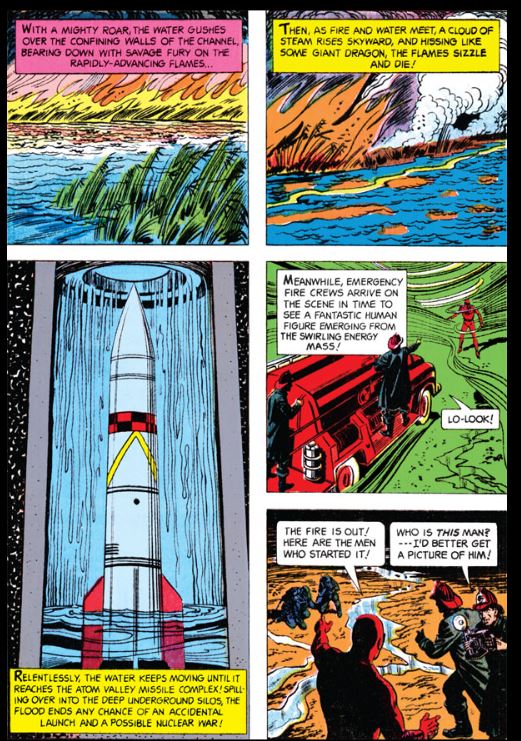
Here he, Murphy, and Fujitani deliver terse 2-part origin ‘Solar’s Secret’ and ‘An Atomic Inferno’ detailing how a campaign of sabotage at research base Atom Valley culminates in the death of top boffin Dr. Bentley and accidental transmutation of his lab partner Doctor Solar into a (no longer) human atomic pile, with incredible, impossible and apparently unlimited powers and abilities. Of course, his very presence is lethal to all around him…
The espionage and murder are at the instigation mysterious Bad Actor Nuro, who seeks a total monopoly on atomic science, so when his agent targets Solar’s girlfriend Gail Sanders, our reluctant hero – still learning his potential and limitations – is forced to act fast…
Powers painted a second rousing cover (before handing the job over to Gold Key mainstay George Wilson for the rest of this collection’s inclusions) and #2 (December) opens with Nuro’s latest plot: using radio implants to turn Gail into ‘The Remote-Control Traitor’, before ill-considered, precipitate atomic testing triggers tectonic terror for the entire region on ‘The Night of the Volcano’…
By the time of Dr. Solar, Man of the Atom #3 (March 1963), a solid pattern was in place. Solar continued his researches, aided by his two confidantes, Gail and project leader Dr. Clarkson, consequently facing a wide variety of nefarious challenges and unnatural disasters, generally at a rate of two stories per issue. In ‘The Hidden Hands’ the science hero becomes a clandestine globetrotter to foil a plundering terrorist with the power of invisibility, after which Atom Valley’s own prototype weather satellite triggers atmospheric conditions which split the hero into polar opposites in ‘Solar’s Deadly Double’.
June 1963 brought #4, featuring early eco-concerns as atomic contamination to the Atlantic sees Solar scupper a certain mystery mastermind’s gold extraction engine in ‘The Deadly Sea’ prior to ‘The Treacherous Trap’ finding the Atomic Man – who must regularly absorb lethal amounts of radiation to live – accidentally endangered by fellow scientist Thor Neilsen, whose radical rad poisoning cure presents unanticipated peril. The good-looking swine has also turned poor Gail’s head with silly romantic notions…
A big change came with #5 (September) as the until-now top-secret activities of Solar are first exposed to a ruthless thief trying to steal the Atomic Ace’s latest elemental discovery in ‘The Crystallized Killers’. This, and his advancing mutation, leads to ‘The New Man of the Atom’ wherein Solar adopts a public masked persona and finally dons a costume: all whilst stopping an incipient atom war…
With #6 (November 1963) illustrator Frank Bolle joins Newman & Murphy to detail Solar’s stories, beginning with ‘The Impostor’ as Nuro despatches a face-shifting automaton to infiltrate Atom Valley and discover the masked hero’s true identity: a saga which concludes in spectacular nuclear combat in ‘Android Against the Atom’…
This volume’s action concludes with #7 (March 1964), opening with a drastic drop in sea levels. Upon investigation, Solar discovers malevolent extraterrestrials are behind the ‘Vanishing Oceans’ but no sooner does he deal with them than ‘The Guided Comet’ covertly controlled by Nuro simultaneously threatens human existence and acts as a near-foolproof deathtrap for the Man of the Atom. Almost…
Augmented by fulsome Biographies of the creative personnel, this charismatic collection offers potently underplayed and scientifically astute (as far as facts of the day were generally known) adventures blending the best of contemporary movie tropes with the still fresh but burgeoning mythology of the Silver Age super hero boom. Enticingly restrained, these Atom Age action comics offered a compelling counterpoint to the eccentric hyperbole of DC and Marvel and remain some of the most readable thrillers of the era.
These are lost gems from a time when fun was paramount and entertainment a mandatory requirement. This is comics the way they were and really should be again…
DOCTOR SOLAR®, MAN OF THE ATOM ARCHIVES Volume 1 ™ & © 2010 Random House, Inc. Under license to Classic Media, LLC. All rights reserved.
Today in 1877 pioneering US cartoonist Tad Dorgan (Indoor Sports, Judge Rummy) was born, followed in 1885 by future groundbreaking publisher Wilford Fawcett (Captain Billy’s Whiz Bang, Mechanix Illustrated, Captain Marvel et al). Author Jack Willamson (Beyond Mars) arrived in 1908; Paul S. Newman in 1924; Michael Davis of Milestone Media in 1958 and cartoonist Roman Dirge (Lenore, the Cute Little Dead Girl) in 1972.
We lost Golden Age Great Paul Gustavson (Human Bomb, The Angel, The Arrow, Fantom of the Fair, Magno the Magnetic Man, Blackhawk, Uncle Sam and more) in 1977 and ultra-versatile Croatian cartoonist/comics artist Žarko Beker (Koraljka, Neven, Bobo, Špiljko, Magirus) in 2012.
Today in 1906 Lyonel Feininger’s landmark strip The Kin-der-Kids premiered in the Chicago Sunday Tribune.