
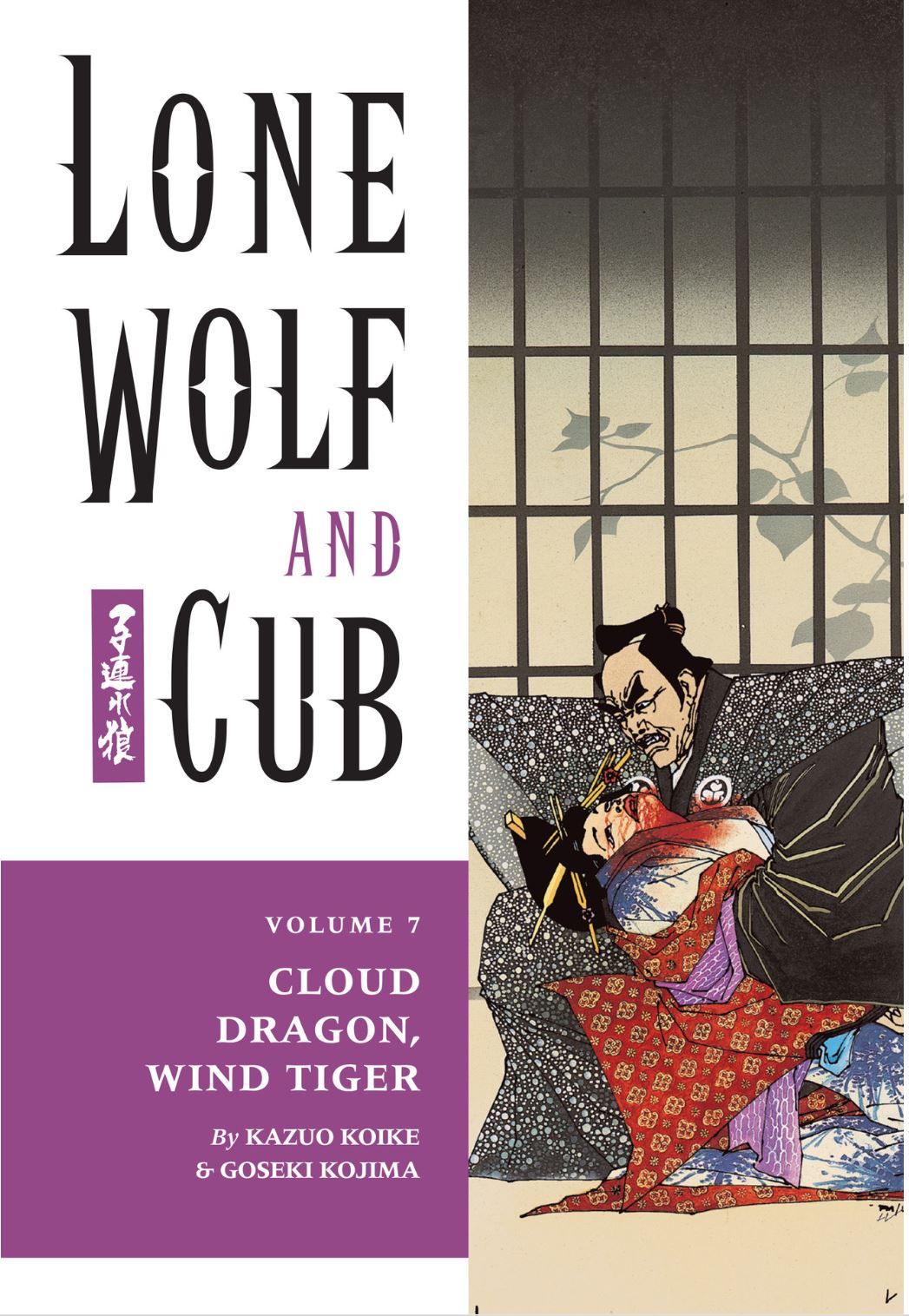
By Kazuo Koike & Goseki Kojima, translated by Dana Lewis (Dark Horse Manga)
ISBN: 978-1-56971-508-6 (TPB/Digital edition)
This book includes Discriminatory Content produced in less enlightened times.
Best known in the West as Lone Wolf and Cub, the sprawling Samurai saga created by Kazuo Koike & Goseki Kojima is a global classic of comics literature. An example of the popular Chanbara or “sword-fighting” genre of print and screen, Kozure Okami began serialisation in Weekly Manga Action in September 1970 and ran until April 1976. It was an immense and overwhelming Seinen (“Men’s manga”) hit. The tales prompted thematic companion series Kubikiri Asa (Samurai Executioner – which ran from 1972-1976) but the major draw – at home and, increasingly, abroad – was always the nomadic wanderings of doomed feudal noble Ōgami Ittō and his solemn, silent child Daigoro whose clan were framed by ambitious rivals the Yagyū, publicly dishonoured by the Shōgun and condemned to death by his peers. Breaching all etiquette, the court executioner refused to accept suicide quietly, and instead opted to vengefully walk the bloody road to Meifumadō: the hell of Buddhist legend as an assassin for hire…
Revered and influential, Kozure Okami was – after years of supplication by fans and editors – followed by sequel Shin Lone Wolf & Cub (illustrated by Hideki Mori) and even spawned – through Koike’s indirect participation – sci fi homage Lone Wolf 2100 (by Mike Kennedy & Francisco Ruiz Velasco). The original saga has been successfully adapted to most other media, spawning movies, plays, TV series (plural), games and merchandise. The property is infamously still in Hollywood pre-production…
The several thousand pages of enthralling, exotic, intoxicating narrative art produced by these legendary creators eventually filled 28 carefully curated collected volumes, beguiling generations of readers in Japan and, inevitably, the wider world. More importantly, their philosophically nihilistic odyssey – with its timeless themes and iconic visuals – has influenced hordes of other creators. The many manga, comics and movies, TV and animated versions these tales have inspired around the globe are utterly impossible to count. Frank Miller, who illustrated the cover of this edition, referenced the series in Daredevil, his dystopian opus Ronin, The Dark Knight Returns and Sin City. Max Allan Collins’ Road to Perdition is a proudly unashamed tribute to the masterpiece of vengeance-fiction. Stan Sakai has superbly spoofed, pastiched and celebrated the wanderer’s path in his own epic Usagi Yojimbo, and even children’s cartoon shows such as Samurai Jack are direct descendants of this astounding achievement of graphic narrative. The material has become part of a shared global culture.
In the West, we first saw the translated tales in 1987, as 45 Prestige Format editions from First Comics. That innovative trailblazer foundered before getting even a third of the way through the vast canon, after which Dark Horse Comics acquired the rights, systematically reprinting and translating the entire epic into 28 tankōbon-style editions of around 300 pages each. Once the entire epic was translated – between September 2000 and December 2002 – it was all placed online through the Dark Horse Digital project.
Following cautionary warning on stylistic interpretation ‘A Note to Readers’ this moodily mordant, violent, sexually charged monochrome collection gets underway, retaining terms and concepts western readers may find unfamiliar. Happily, on offer at the close is a Glossary providing detail and clarification on what’s used in the stories.
The endless journey resumes with 34th exploit ‘Dragnet’ as frustrated Yagyū arch-plotter Lord Retsudō seeks to placate his impatient relations and vassals over the increasing loss of kinsmen to the Lone Wolf. The threat of public disgrace and being proved an oath-breaker keeps him from arbitrarily murdering Ōgami and Diagoro as long as they stay away from capital city Edo, but a heated conference seems to deliver a foolproof scheme that will allow them to end the shameful situation with no blame pointing to them. It’s a lucky and timely stroke, as their ranks are seriously depleted by the fact that too many arrogant Yagyū swordsmen can’t resist challenging the apparently unbeatable hitman…
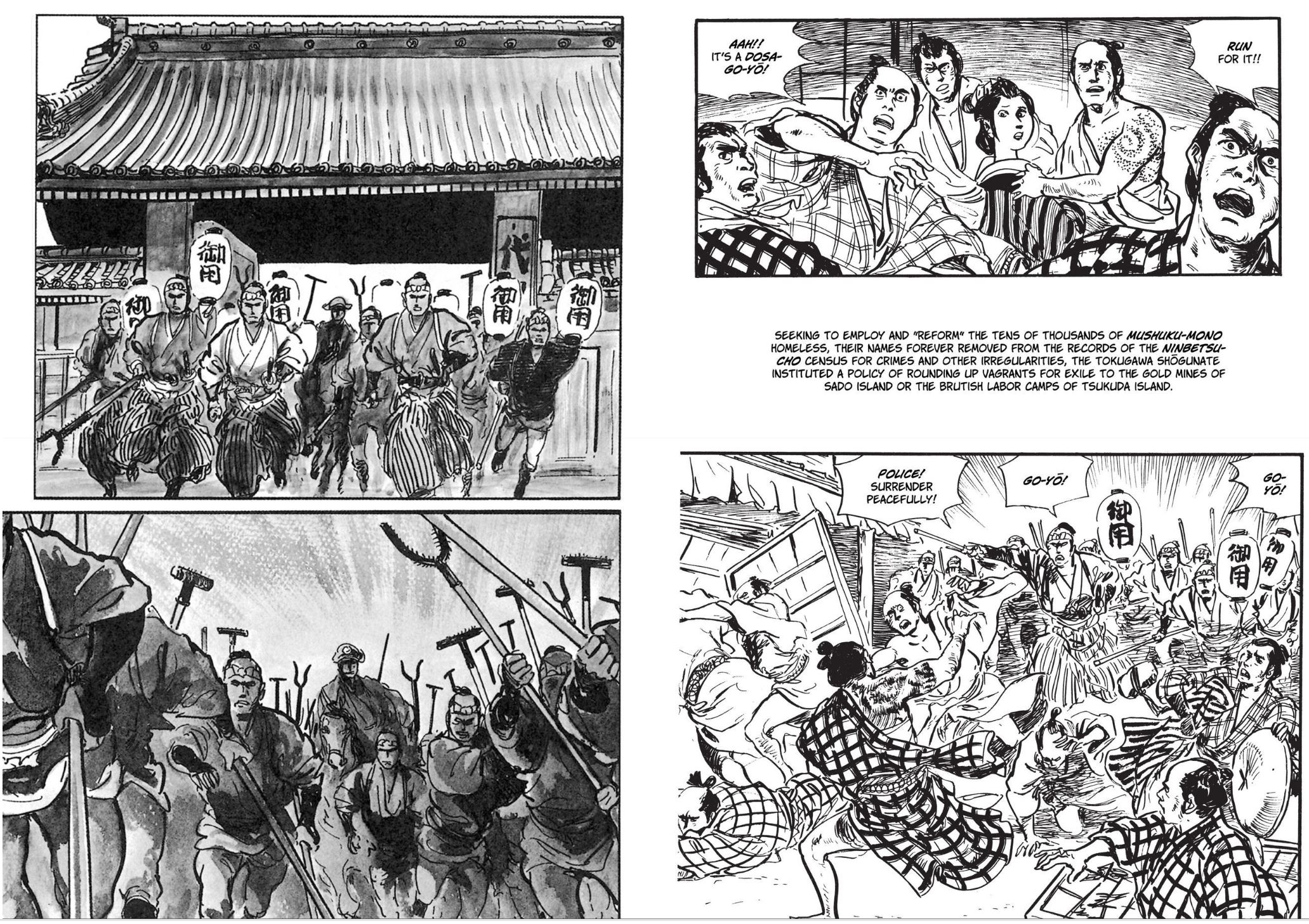
Using intermediaries and regional civil servants Retsudō has devised a way to remove the thorn in his side without blemishing the sacrosanct Ura-Yagyū reputation. Arranging for his nemesis to be rounded up in a homeless sweep, the wolf is but one amongst hundreds bundled along by law officers, and must surely die or be condemned as a mining slave. Sadly, the plotters underestimate Ōgami’s cunning, knowledge of the law, suspicion of bureaucrats sheer lethality with bladed weapons and tricked-out, gunpowder-laden baby carriage…
With the plot’s spectacular failure, furious Ura-Yagyū covert observers cannot control themselves and Retsudō’s forces are further depleted by the baby carriage killer…
As the killer-for-hire meets his next client, Daigoro is left at a vast riverside logging camp. Stumbling onto another assassin’s diabolical plan – to kill visiting dignitary/valuable bride-to-be Princess Aya of Zakōji – the boy becomes a collateral target when the schemer seeks to clean up loose ends. A spectacular, frightening chase by ‘Night Stalker’ climaxes in a deserted temple once the boy implicates a trusted courtier as culprit, but is consequently identified as the child of the deadliest killer in Japan. The outlook seems black for the stoic lad… until papa finally finds him. Then it’s just red…
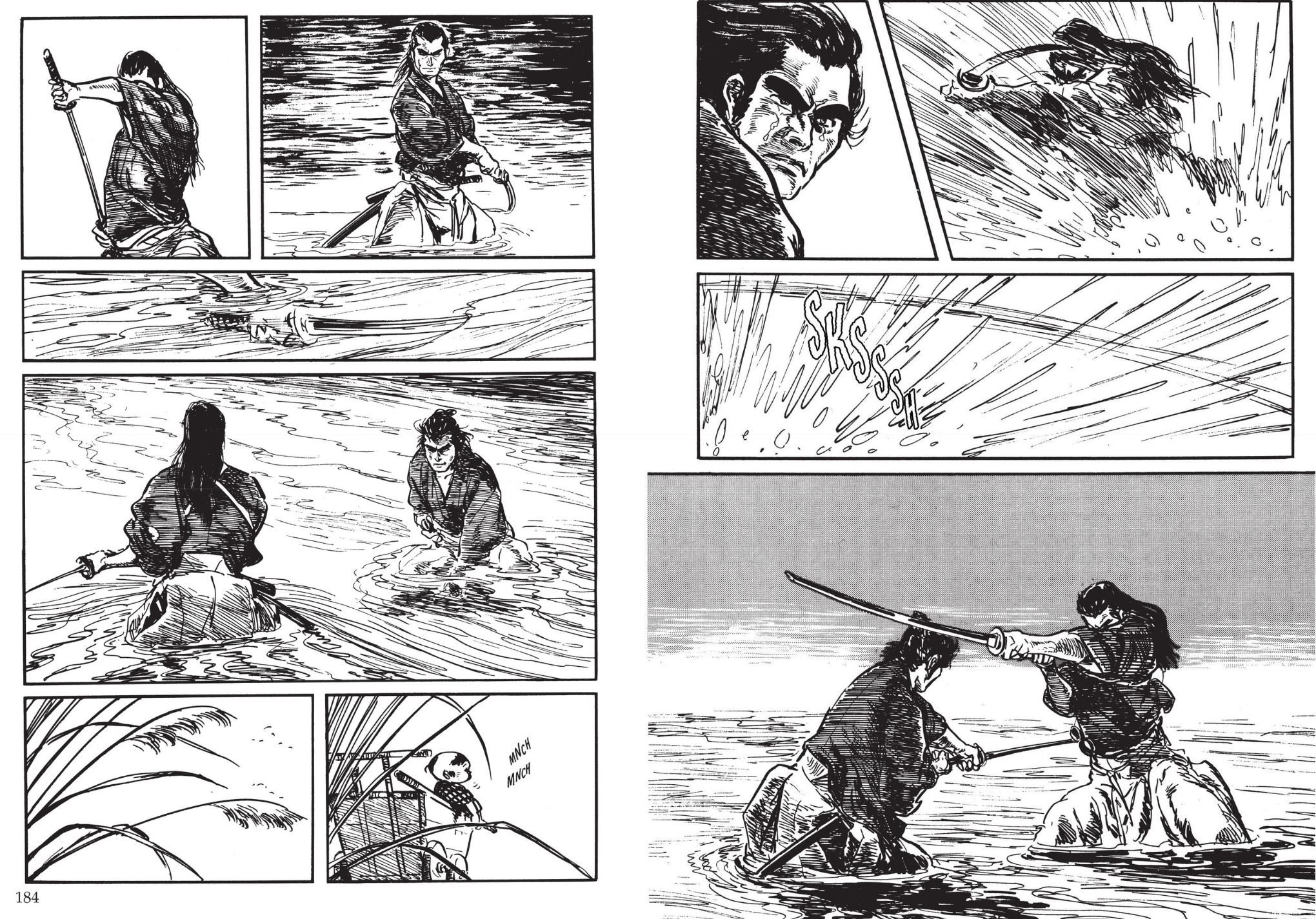
Eponymous and deeply philosophical in celebration of Bushidō ways, ‘Cloud Dragon, Wind Tiger’ slowly unveils the story of dishonoured samurai Makabe Shōgen, who placidly awaits death for failure of duty and spends the days fishing in a stream. His much-anticipated end comes after meeting Ōgami (and Daigoro), but it is not their first encounter. Four years previously they formally crossed swords when – as Kōgi Kaishakunin (imperial executioner) – Ōgami officiated at the death of Shōgen’s master Lord Arima.
Now the Wolf is hired to remove the embarrassing river dweller because a new regional ruler is being pressured by officious, impatient retainers about the living eyesore and monument to failure. They would do it themselves, but the old coot – calling himself Hōzuki (like the flower) – is deadly when provoked and the new Daimyō is rapidly running out of warriors…
Ōgami is hired to take out the shameful reprobate, but also has a uniquely personal interpretation of the tenets of Bushidō…
When the roaming pair pause at the ‘Inn of the Last Chrysanthemum’, they encounter firsthand the horrific treatment of women. Oichi is an araime (foot washer) but reluctant to carry out the other demands of her new job – particularly luring in customers and sleeping with them.
Graced with simple kindness by both father and son, she resolutely tolerates other clients/guests as she awaits a moment long-anticipated. Once she was used by an unsuspected enemy (O-Maki of clan Gotō) to destroy her own noble family. It began with shaming, beggaring and the orchestrated suicide of her brother, a high-ranking samurai of the Fujieda household, and ended with lovely, serene, sophisticated Oichi being repeatedly, punitively “dishonoured” and made valueless (gang-raped to you and me) by order of O-Maki.
A protector-less non-person, Oichi could only find work as a De-Onna (“put-out girl”) used as a living inducement to entice customers to stay in one of the travel waypoint’s many competing inns. Now, her awful life’s continuation finally blossoms with purpose as ruthless, triumphant official mistress O-Maki finally stops there on her way to court.
When the victim finally takes revenge, Oichi learns that she would never have got past the guards except for a stroke of fate. O-Maki’s schemes hurt not only the Fujieda clan. Other innocents caught in her web of ambition also suffered, and a certain sword-for-hire has stalked the ascendant courtesan on behalf of other families who suffered for her greed…
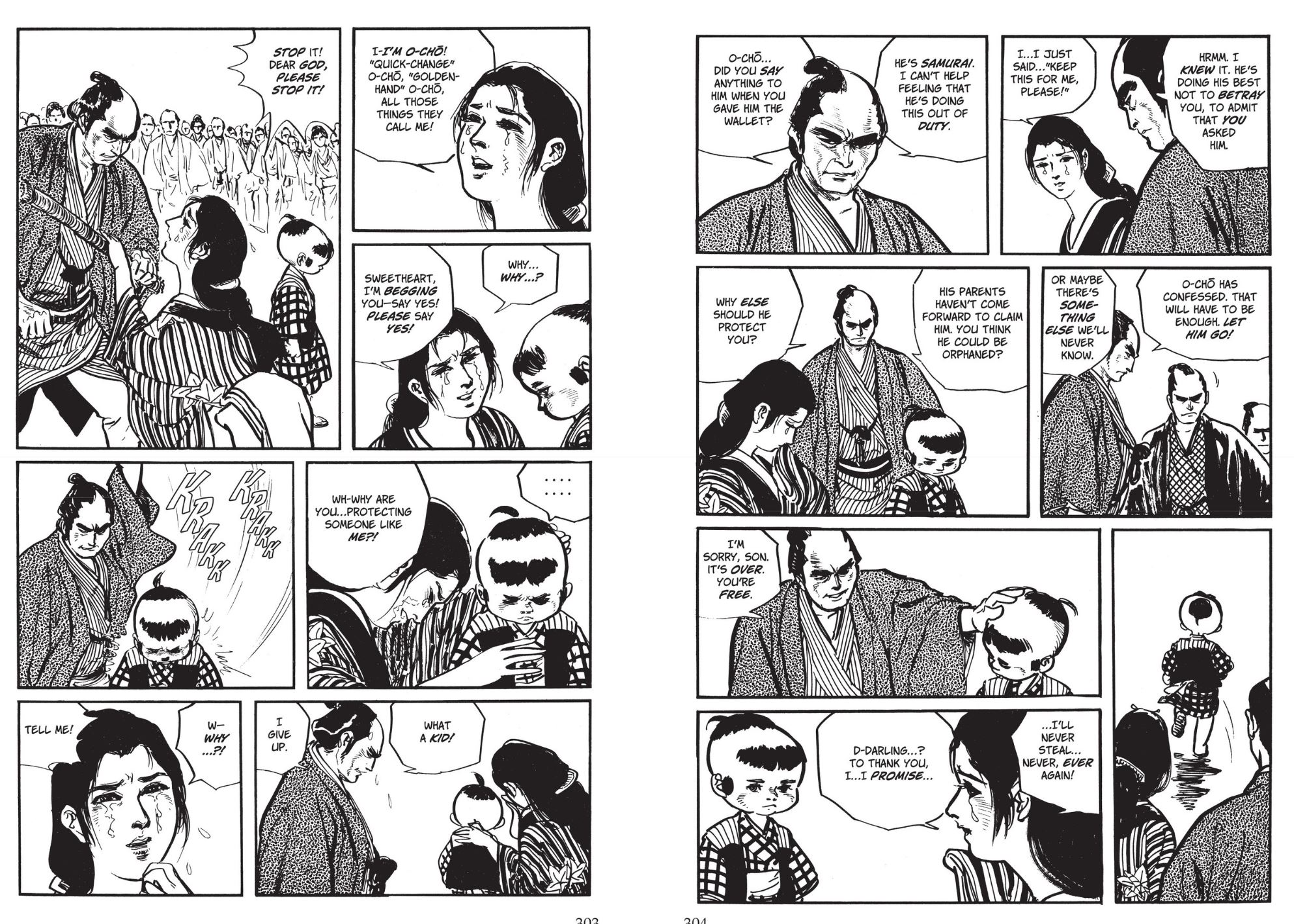
The last furious fable also explores duty and honour – albeit among the lower classes – as three-year-old Daigoro encounters charming pickpocket “Quick-change” Anego O-Chō as she works a crowed street during the New Year’s Go-daishi-biraki festival.
Fleeing city guards, she deftly caches her loot with the unwitting waif but is seen by onlookers and pursuers. Arrested, the silent nipper is threatened with the full weight of law, specifically O-sademegaki. This promises flogging, torture and worse, due to the draconian strictures of ‘Penal Code Article Seventy-Nine.’ The “punishment of offenders fifteen and under” states there is no excuse of age for murder, arson or theft, and means the toddler will be tortured by (frankly unwilling) chief cop Senzō and his officials unless the prisoner admits guilt and testifies against her.
This Daigoro staunchly refuses to do, even after the thief surrenders herself to save the kid. Sadly, the law is unshakable and restitution must be made, and even the increasingly incensed crowd won’t do anything about it. It’s up to the true son of a true samurai to determine his own fate…
Although usually closing with ‘Creator Profiles’ of author Koike Kazuo & illustrator Kojima Goseki , this volume also offers another instalment of contextual/background feature ‘The Ronin Report’ wherein Tim Ervin discusses ‘The Women of Lone Wolf and Cub’: appraising roles, depictions (visual and as contributory narrative actors) and contributions of the many and various female characters to interact with the boy and his father on the path to hell.
From victims and prizes to life-endangering lures, or simply enemies en route to doom, these players are fully realised whether as fighting foils, endangered damsels or working folk adding colour to stories. With the roles of women from all strata of that locked-down culture in a brutally harsh patriarchal society examined and assessed on their own merits, the grit of this article explores, if not mitigates, one inescapable fact. In an era where no female of any age has unassailable intrinsic rights, but only duties and crushing expectations, there is a disturbing amount of rape, abuse and trafficking in so many tales and it’s important to remember that it’s not just there to titillate, but to spark empathy and rattle readers…
Despite its powerful, disturbing content Cloud Dragon, Wind Tiger is another epic selection in the series of Japanese imports that utterly changed the nature of US comics and a saga no lover of historical fiction should be without.
Art and story © 1995, 2001 Kazuo Koike & Goseki Kojima. All other material © 2000 Dark Horse Comics, Inc. Cover art © 2001 Frank Miller. All rights reserved.
Born today in 1887, pioneering Charles A. Voight is most renowned for his flapper strip Betty, and shares the day with the astounding Lee Falk (Mandrake the Magician, The Phantom) in 1911; Dick Ayers (Ghost Rider, Sgt Fury) in 1924; comics historian Bill Blackbeard in 1926 and author, journalist and Squirrel Girl co-creator Will Murray in 1953.
In 1966 we lost the uniquely magnificent Artist Jesse Marsh (Tarzan, John Carter of Mars) and in 2005 Zeke Zekley, assistant to George McManus and inheritor of the long-running strip Bringing Up Father.