
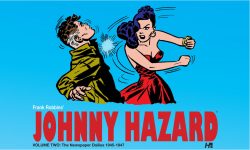
By Frank Robbins with an introduction by Daniel Herman (Hermes Press)
ISBN: 978-1-61345-017-8 (HB/Digital edition)
This book includes Discriminatory Content produced in less enlightened times.
Johnny Hazard was a newspaper strip created in the style and manner of Terry and the Pirates, but in many ways this steely-eyed hero most accurately resembles – and in fact predates – Milton Caniff’s second masterwork Steve Canyon.
Unbelievably, until 2011 this influential, impressively enthralling adventure strip had never been comprehensively collected in archival volumes – at least not in English or even America’s version of it – although selected highlights had appeared in magazines like Pioneer Comics, Dragon Lady Press Presents and the Pacific Comic Club.
Boston born, Franklin Robbins (9th September 1917 – 28th November 1994) was an artistic prodigy who shone from early on. At age nine he was awarded a scholarship to the Boston Museum of Fine Arts and at 15 moved to New York City to attend the National Academy of Design on a Rockefeller grant. Skilled, inventive and prolific as both painter and graphic artist, Robbins freelanced continually, even working with Edward Trumbull on the legendary murals for the NBC building and Radio City Music Hall. He created graphics for RKO Pictures, worked in advertising and magazine illustrations but never stopped painting, with work shown at the Whitney Museum of American Art, Metropolitan Museum of Art, The Corcoran Gallery of Art and Walker Art Gallery, although he found his perfect medium of expression when invited to take over a top comic strip…
Even whilst relentlessly creating a full seven days of newspaper strips, he exhibited work at the Whitney’s Annual show and, after ceasing his comics career, retired to Mexico to end his days with a brush in his hand.
The plain truth is that comics changed Robbins’ life. He was a brilliant natural cartoonist whose unique artistic and lettering styles lent themselves equally to adventure, comedy and superheroic tales, whilst his expansive raconteur’s nature made him one of the industry’s best writers over three generations.
He first found popular fame in 1939 after taking over aviation strip Scorchy Smith from Bert (The Sandman) Christman, when he quit isolationist America to fight with the Flying Tigers in China. Robbins thrived in the role, and created a Sunday page for the strip in 1940. This groundbreaking feature had been originated by John Terry before the astounding Noel Sickles replaced him: revolutionising Scorchy Smith and – with Milton Caniff – inventing a new impressionistic style of narrative art to reshape the way all comics were drawn and perceived.
Robbins remained until 1944 and was then offered high-profile Secret Agent X-9. Instead, he devised his own lantern-jawed, steely-eyed man of action. A tireless and prolific worker, even whilst producing the daily and Sunday Hazard (crafting separate but congruent storylines for each), Robbins continued freelancing as an illustrator for The Saturday Evening Post, Look, Life and other mainstream magazines. He also tried comic books for the first time when Johnny Hazard won his own title in 1948-1949, just as costumed superheroes began losing ground to ordinary he-men, mobsters and monsters…
Robbins returned to funnybooks in 1968, quickly becoming a key contributor as both artist and writer on Superboy, The Flash and The Atom, as well as a regular contributor to humour mag Plop! and DC’s mystery, horror and war anthologies. He particularly shone on Batman, Batgirl and in Detective Comics where, with Neal Adams, he pulled the Caped Crusader out of the TV show-inspired silliness. They created Man-Bat together and Robbins followed Michael Kaluta as artist on The Shadow. Moving to Marvel in the 1970s, Robbins concentrated on drawing a variety of titles including Captain America, Daredevil, Ghost Rider, Morbius, The Man from Atlantis, Human Fly, Power Man and The Invaders – which he co-created with Roy Thomas.
When Johnny Hazard launched on Monday June 5th 1944, he was an aviator in the US Army Air Corps. When hostilities ceased, he briefly became a freelance charter pilot and spy before settling into the life of a globe-girdling, troubleshooting mystery-solver: a modern day Knight Errant. The strip folded in 1977: one more victim of diminishing panel-sizes and the move towards simplified, thrill-free, family-friendly gag-a-day graphic fodder to frame small-ads. In its time it was syndicated in nine different languages in thousands of newspapers across the world, and even scored a residency in 1950s British weekly Rocket.
This fabulous hardcover/digital series – reproduced from original King Features proofs – re-presents the definitive magnum opus in fitting form: a monochrome, landscape format archival collection. This second shot covers serialised daily thrills (spanning November 19th 1945 to August 16th 1947), to resurrect the Amazing Aviator in fans’ hearts and remind them of what we’ve all missed whilst hopefully finding a few new fervent followers.
Fully embracing noir sensibilities of the era but keeping things light, frothy, sexy and funny the globetrotting glee is preceded by Daniel Herman’s Introduction ‘A Look Back at Johnny Hazard’ before the preflight fun begins…
Previously we met coolly capable flyer Lt. Johnny Hazard who escaped from a German POW camp, broke into a Nazi airfield, stole a bomber and flew home. Liberated and ready-for-duty he met feisty, headstrong, utterly dedicated war photographer Brandy during an air raid and all kinds of sparks flew. A series of spectacular events constantly pushed them together and ultimately impassioned fury and disgust on both sides turned to something else amidst all the deadly missions and exploding ordnance.
The strip could not keep up with the fast-moving events after D-Day (the real world Allies invaded “Fortress Europa” the day after Johnny Hazard debuted) and third story arc ‘Sun Tan and General Mariwana’ – opening on September 11th 1944 – saw the hero’s squadron transferred to the Pacific Theatre of Operations to reinforce the battle against Japan. Brandy inveigled herself into the picture as newly promoted Captain Hazard and his crew undertook a top-secret mission couriering a Chinese resistance leader back to her people. Enigmatic, exotic, staggeringly beautiful and lethally dangerous Sun Tan was a magnet for trouble…
Foiling Japanese assassination plots while dodging Brandy’s jealous displeasure, Hazard faced baroque opponents like disfigured pilot Colonel Mariwana, Colonel Kiri, General Ishigaki and his glamorous French “assistant” Mademoiselle Touché but also found a stalwart new ally and wingman in Captain “The Admiral” Slocum: last in an unbroken line of valiant patriotic mariners, but reduced to defending his country in the skies since his debilitating sea sickness prevents him from serving afloat like a true warrior…
Across Iran, Japan, China, and the Himalayas, Hazard, Slocum and Brandy ducked death over and again and when official hostilities ended, encountered charismatic US underworld émigré, pool-addict and deal-maker Side-Pocket Sam. Debonair, charming and utterly amoral, he led Chinese bandits and vied with our heroes for possession of Japan’s failsafe game plan for World War III…
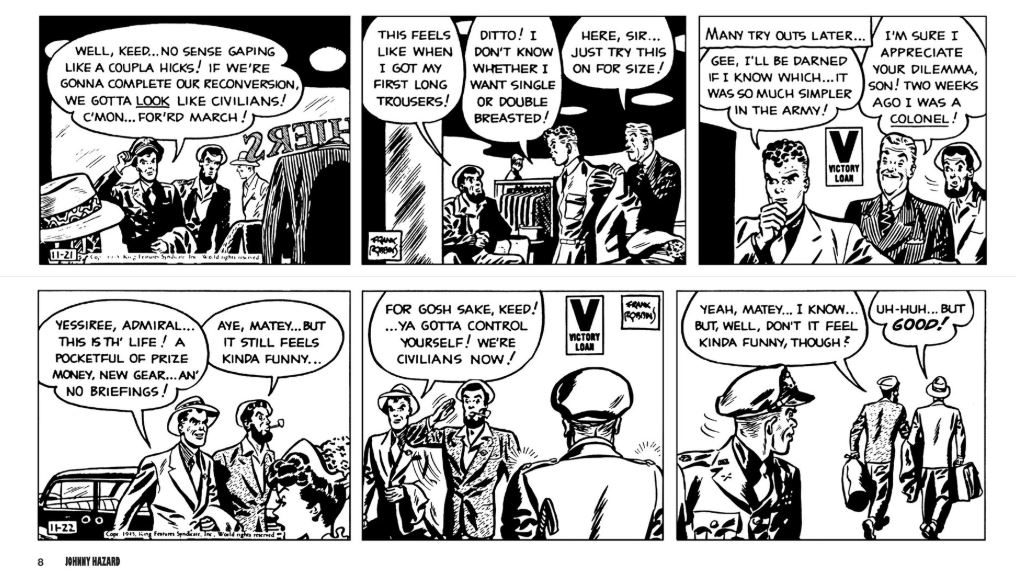
Now, in ‘Fancy Fluff’ (running from November 19th 1945 to June 15th 1946) finally and officially released from their country’s service, Hazard and Slocum barely have time to adjust to civilian life before desperate Fluff Randall recruits them to help find her missing brother. A former comrade of Hazard, “Bounce” Randall was wounded in action and shipped home, but soon disappeared. The last Fluff heard, despite a head injury that prevented him being a pilot, he was in French Guiana, flying private planes for mystery man “Dr. Fox”…
Soon the brothers in arms are on the trail, securing passports, papers and a reconditioned army surplus plane which they cheerfully dub Fancy Fluff in honour of their sponsor and despite the suspicions of suddenly-arriving Brandy. Her latest assignment is investigating a wave of jailbreaks in the penal colonies of that very country and a lift would be nice…
Soon the quartet are far south and negotiating with clearly corrupt cops and customs officers, dodging murder attempts and investigating local saint/Good Samaritan Docteur Reynard. A dramatically delivered letter from brother Bounce begging them to leave does nothing to deter them and before long they have uncovered not only an underground railroad using air transport to spring savage escapees but also murderous drug dealers using terror, mesmerism and narcotics to enslave Fluff’s brother among so many other victims…
It’s as much luck as competence that saves the valiant Americans from death and disaster a dozen times over, but in the end Reynard, his leg breakers Elf and Beeg Ox and all those bribe-taking officials pay for their crimes. Bounce is wounded again but at last healed of his enslavement and debilitating head injuries. However the overall cost is high. Admiral is lost to the world of action after falling for Fluff and that sappily contagious condition almost ensnares Johnny and Brandy too. Thankfully, common sense and sheer bile on both sides brings them to their senses before it’s too late…
Each serial storyline is garnished and bookended by Robbins’ original art designs for advertising the strip and after a comforting close up of Hazard second saga ‘The Flying Freight Mystery’ (June 17th – November 2nd) sees “just friends” Johnny and Brandy heading back to the USA but stalled on take-off when Johnny is conned by deviously mysterious entrepreneur M. Côte’-Poche into delivering to neighbouring nation Estantio a cargo of “typewriters”…
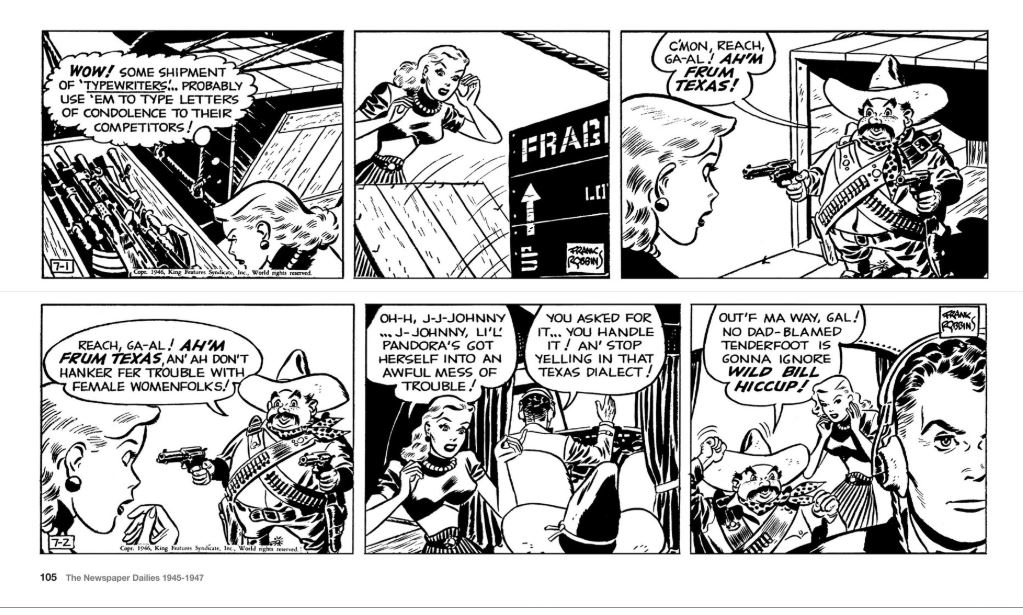
In flight, when Brandy discovers diminutive stowaway Wild Bill Hiccup and that the load is automatic weapons, an aerial ambush by “sky rustlers” leads to a less-than-longed-for reunion with Side-Pocket Sam. He is embroiled in ongoing war with ruthless river pirate Captain Gore who wants the emeralds Sam regularly ships from a mine to the coast. The baroque blubbery buccaneer is obsessed with piratical mythology and alongside fellow plunderers Mistuh Dirk and voluptuous siren Lady Mist opened a bizarre rogues gallery of foes who bedevilled Hazard over the next thirty years.
With Hazard as his air force, Sam has the upper hand until Mist infiltrates his freighter as an shipwrecked innocent: a daunting (and hilarious) job of acting that fools everyone but Brandy and leads to a spectacular display of air versus sea power, a brutal final mano-a-mano duel in the jungle and a surprise twist ending…
Another Canyon pinup segues into a yarn spanning November 4th 1946 to January 18th 1947. Hazard and Brandy arrive in tropical dump Querrero to find her journalistic colleague and Bureau Chief “Timely” Malcolm awaiting the outcome of a clash between government troops and bandit-turned-rebel ‘Major Risk’. Brandy opts to go to the story and with Johnny reluctantly flying her in, arrives at the frontline to find rival reporter “Blitz” (AKA “Loose-Lip”) Martin actively making the story happen.
With natural advantages and no scruples Brandy vamps the Government general for intel before tricking Johnny into delivering her right into the rebels’ hands. Her sharp scheme goes terribly awry and before long she is a hostage and bargaining chip between the sides and needs actual rescuing for a change. Thankfully, Hazard and Martin are willing to try it even if the shiny soldiers are not…
Back in Querrero and hired by Timely Martin as a ferry pilot for his reporters, Hazard faces unlikely danger in penultimate yarn ‘The Stout Man’ (January 20th to March 29th 1947). Repairs and search for spare parts sees the ex-airman as a passenger on a flight to San Tomayo, but the departure is interrupted by rude, rowdy and very bulky Brit Mr. Am and late-arriving Blitz Martin.
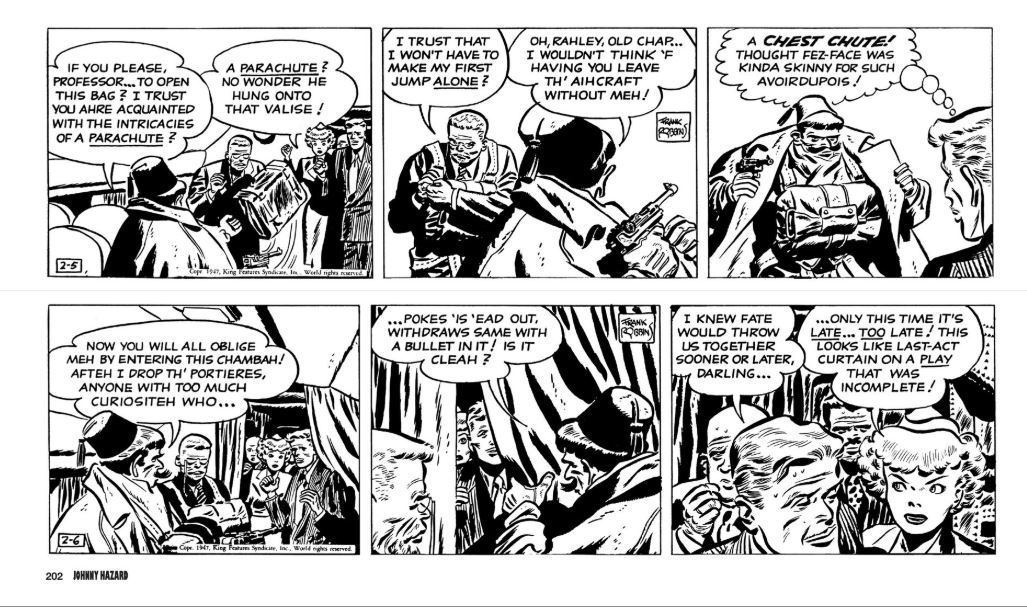
Away at last, Johnny befriends fellow traveller and prestigious nuclear boffin Noble Caldwell until Am hijacks the plane and sends it into a death-spin and crash. However, as Am escapes with Caldwell using parachutes hidden under his coat, Hazard manages to crash land the plane. Lost, starving and dying of thirst, the survivors are accidentally saved when Am returns in a helicopter to clear up loose ends and stupidly lets Johnny get the drop on him…
A deadly impasse ensues with both sides holding out against attrition and deprivation, but the balance of power shifts after indigenous tribesmen arrive, pointing their deadly blowpipes indiscriminately at all the unwelcome intruders…
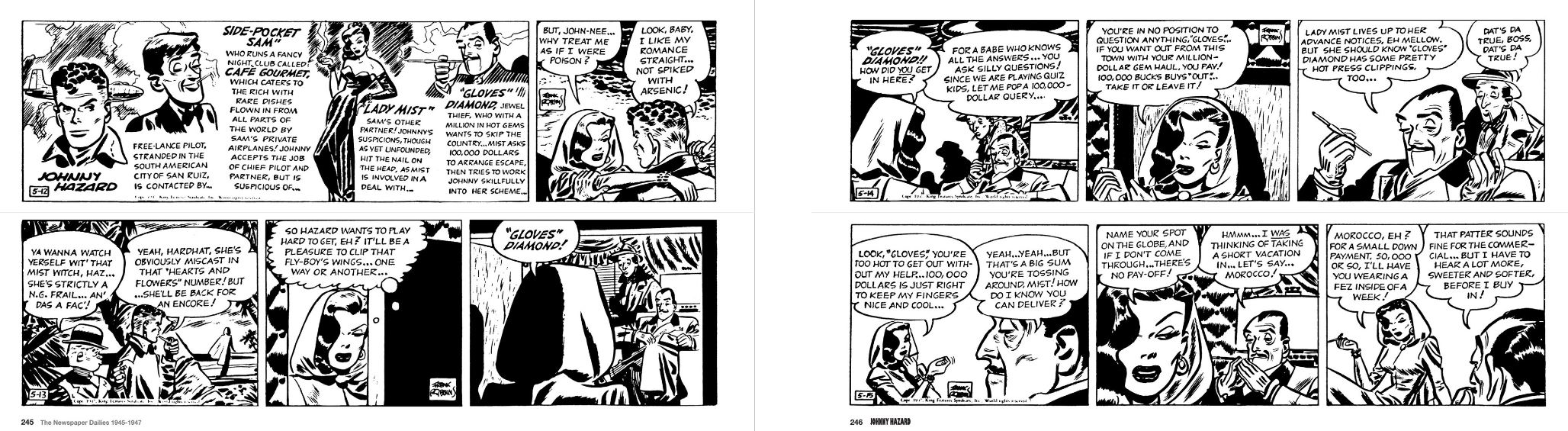
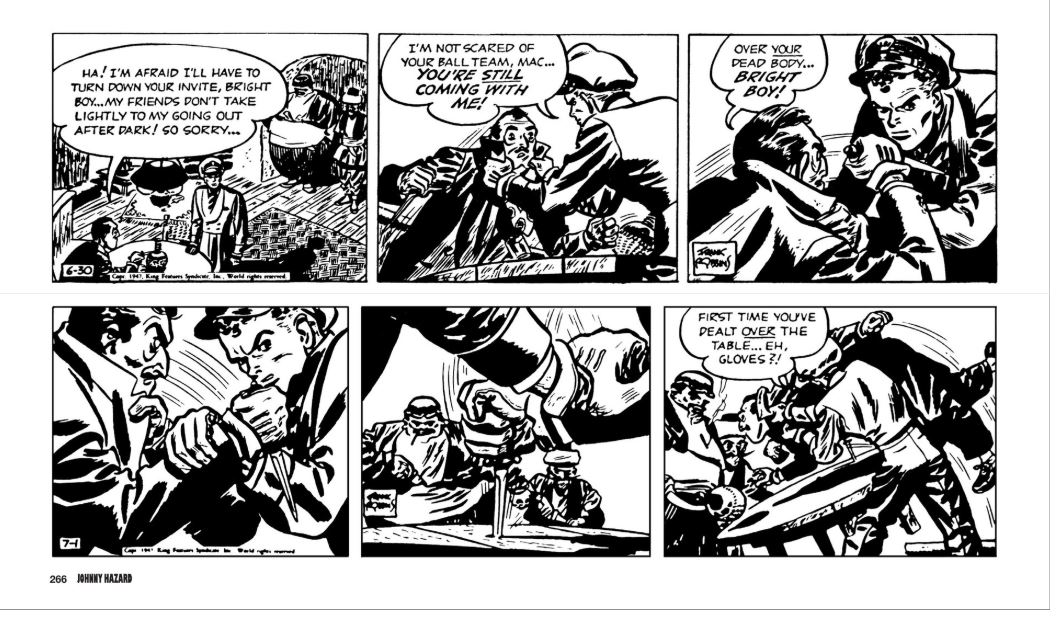
A Vava Lavoum pinup segues into closing yarn ‘Danger À La Carte’ (March 29th – August 16th 1947) as freshly-fired Hazard is stranded in San Ruiz, catching the attention of jewel thieves Gloves Diamond and Mellow as well as their criminal competitors Side-Pocket Sam and Lady Mist. Before long Hazard and Blitz are bemused, befuddled and bamboozled, buffeted between opposing nefarious forces and unable to understand how a gourmet café delivering meals by jet plane can possible be profitable…
Not knowing all the facts doesn’t stop Johnny hiring on as a pilot and becoming an unwittingly accomplice, transporting human contraband to the heart of Casablanca’s wicked underworld. When he seeks to rectify his mistake, the fur, fists, knives and bullets start to fly but in the end justice wins again…
Ending with more advertising pinups – Kitty Hawkes, Sabina Eden, Baroness Flame and Sequin – this is another fast-paced, sharp-tongued and utterly gung-ho roster of romps starring a charming, happy-go-lucky lout, insouciantly ruthless and ever ready to risk his own life and limb to help the little guy and distressed damsels.
Sharp, snappy and devilishly funny repartee in the style of movies like Howard Hawks’ His Girl Friday and Frank Capra’s It Happened One Night are a hallmark of these rapid fire yarns, some of the greatest comic strips in history, but that can present a few problems for modern readers. Contemporary attitudes to sexuality, gender and particularly race are far from what we find acceptable – or should even tolerate – today. We know better now – at least most of us do – but must accept and understand that hurtful and unjust as such terms are, they did exist and we’re doing history and our society a hugely dangerous disservice by ignoring, downplaying or worst of all self-censoring those terms and the attitudes that fed them.
In truth, Johnny Hazard was far less egregious than most: Robbins may have used visual shortcuts and slang but all characters were portrayed fairly and did not unnecessarily suffer from the worst propagandist nonsense used by the Allies to bolster a united war spirit and vilely resurrected by modern populists today.
All ethnicities are treated with the full dignity of different but equal cultures and depicted as competent comrades in arms, not ignorant primitives needing white men’s saving graces. However, arch comedian Robbins clearly couldn’t resist playing mischievous games with accents, names and speech patterns that would do Benny Hill, Hogan’s Heroes or Charlie Chan (the opposite of) proud, so if you don’t think you’re capable of remaining historically detached, best to forgo those delights that have transcended time…
To be continued…
These exotic all-action intrigues and romances perfectly capture the mood and magic of a distant yet incredibly familiar time; with cool heroes, hot dames and exceedingly intemperate baddies encountering exotic locales and stunning scenarios, all peppered with blistering tension, slyly mature humour and vivid, visceral excitement.
Johnny Hazard is a brilliant two-fisted thriller-strip too long forgotten, and this is your chance to remedy that.
© 2013 King Features Syndicate, Inc. ® Hearst Holdings Inc. All rights reserved.
Today in 1914 Aquaman creator Paul Norris was born, followed two years alter by George Tuska (Iron Man, Crime Does Not Pay), Belgian national treasure Victor Hubinon (Buck Danny, Redbeard) in 1924 and Marty Greim in 1942. In 1954 Kerry Gammill joined the party as did Brad W. Foster one year later and François Schuiten (Les Cités Obscures) in 1956, with John Paul Leon checking in in 1972.
Today in 1969 the last issue of the first iteration of Eagle was published.