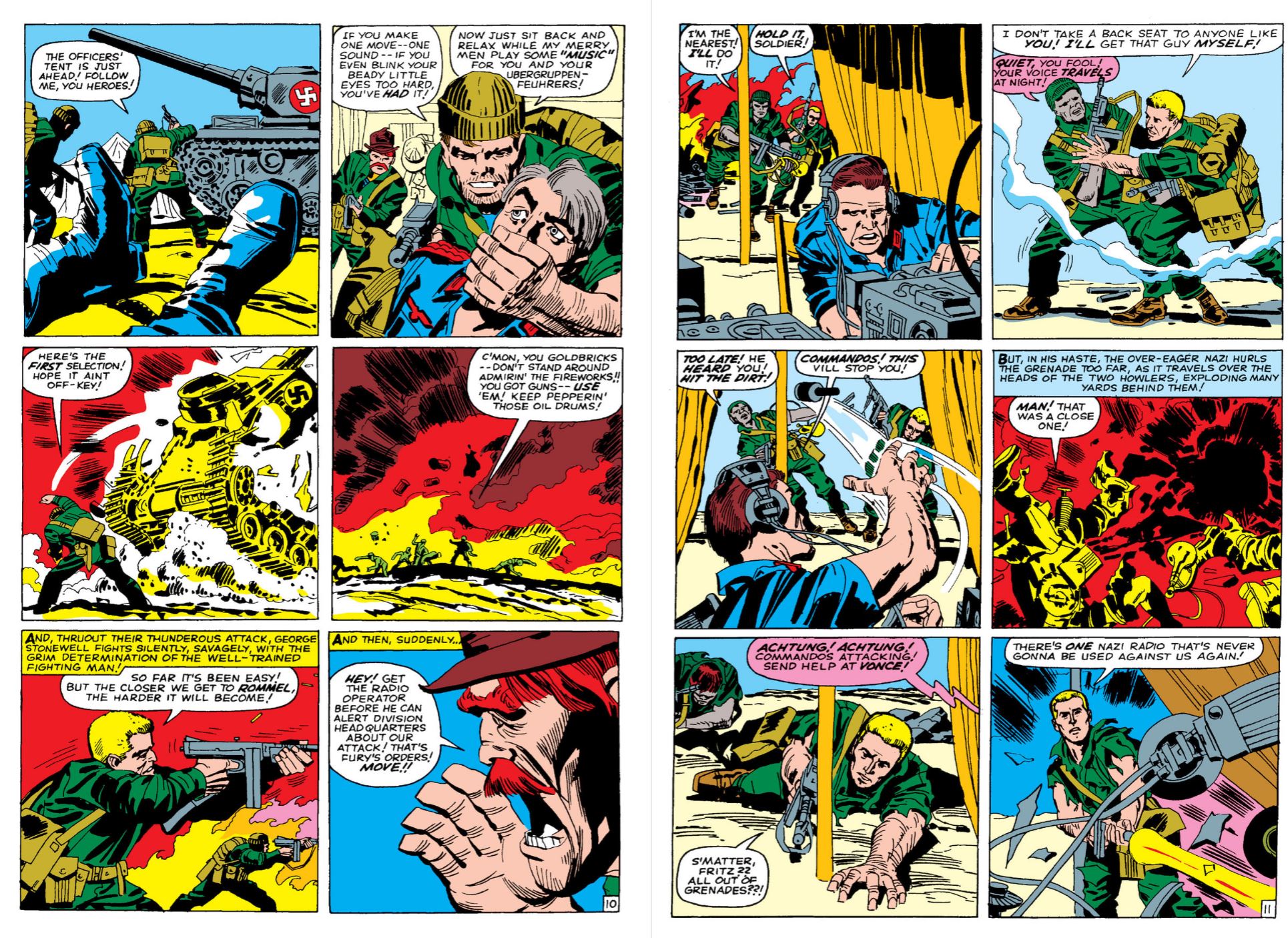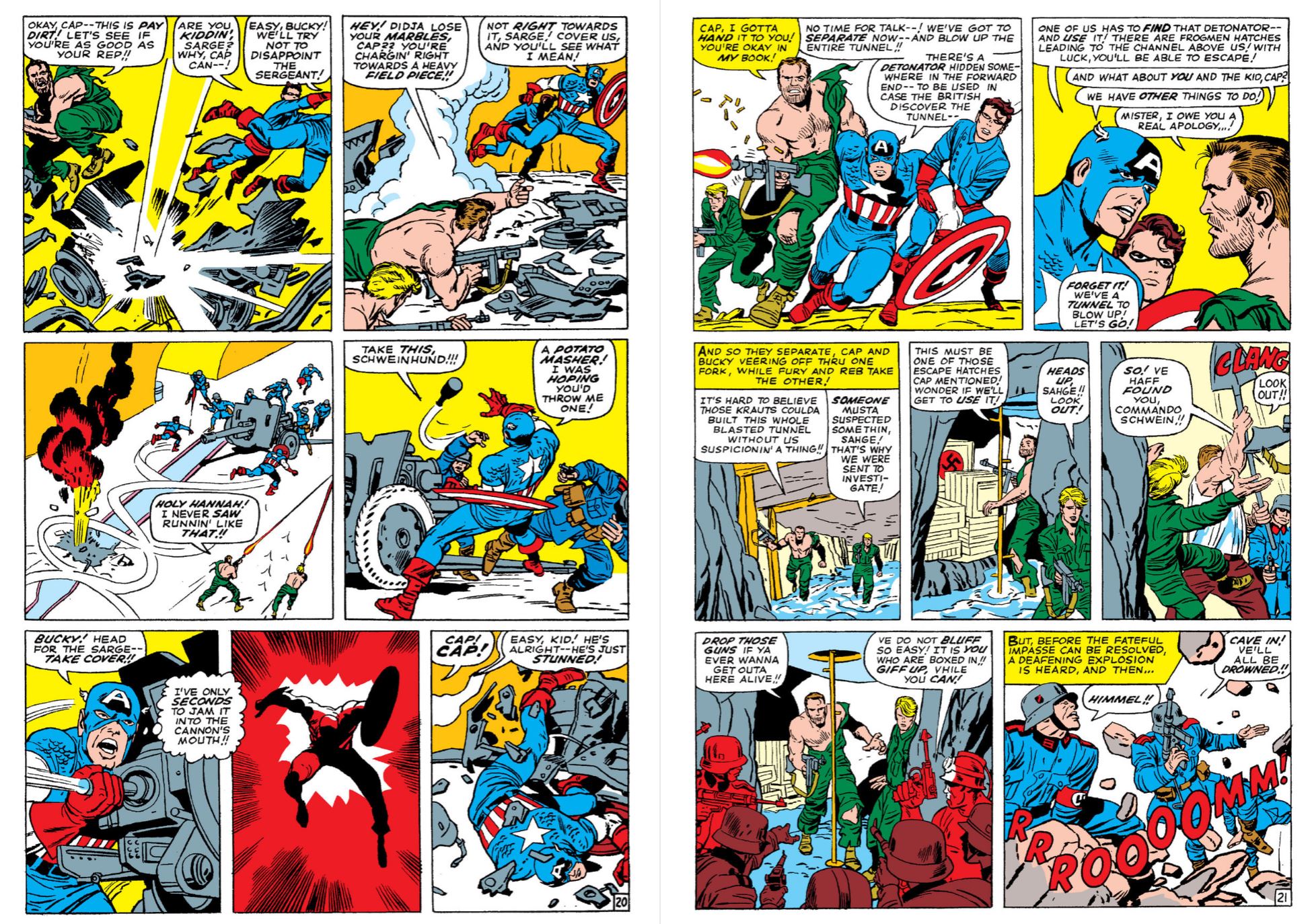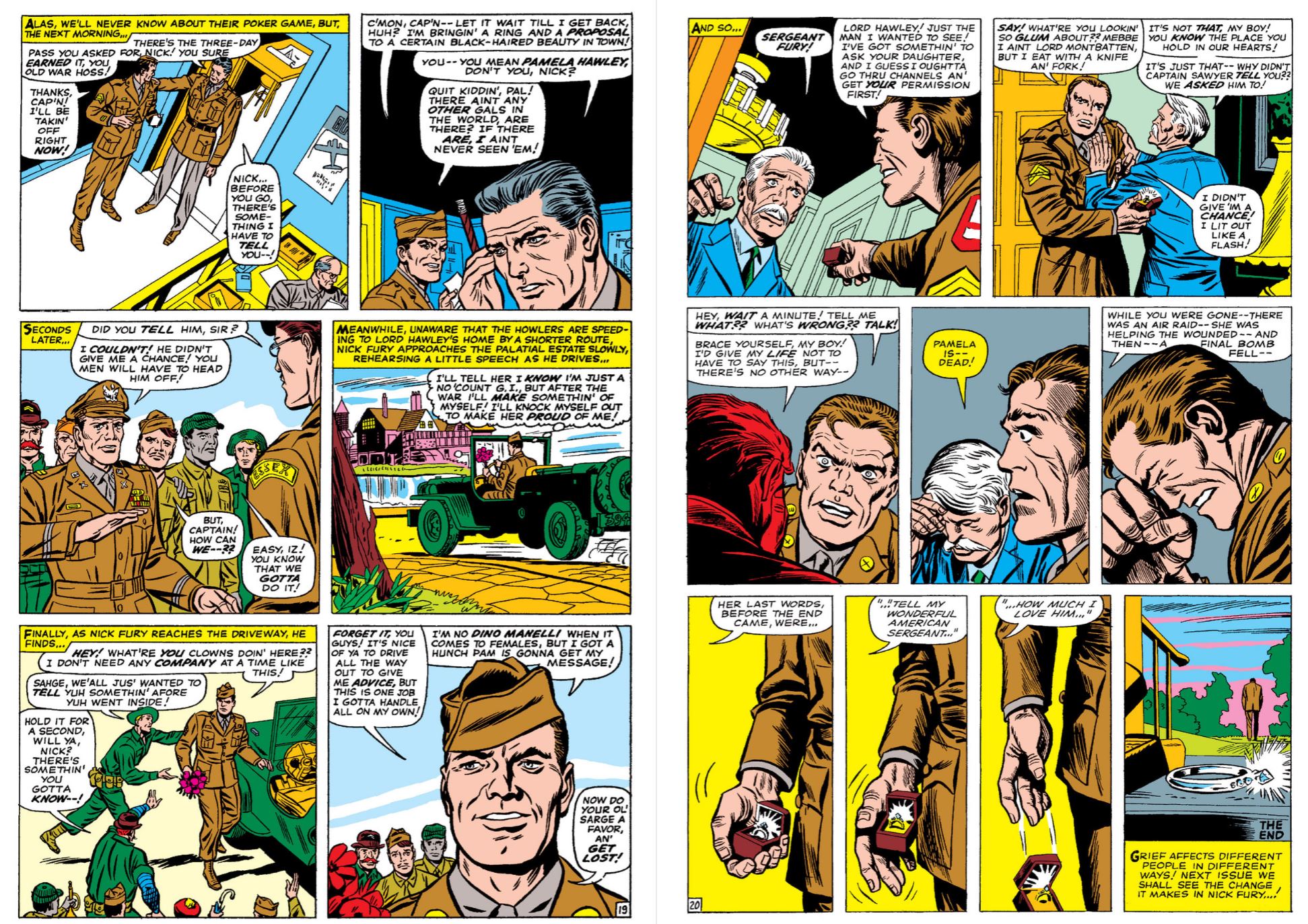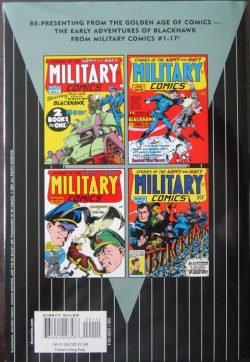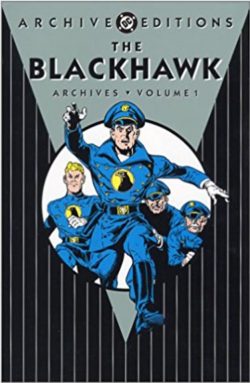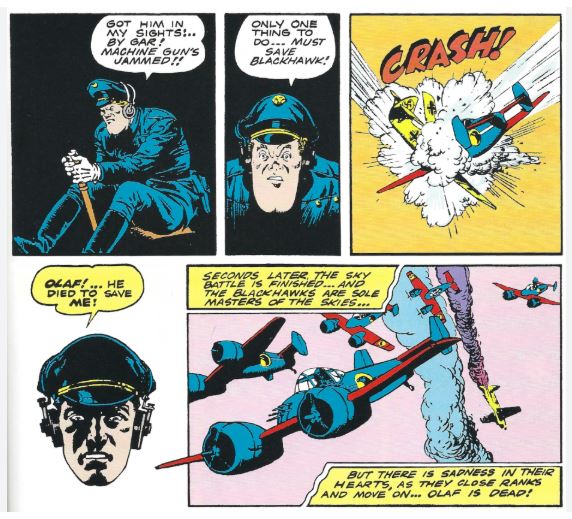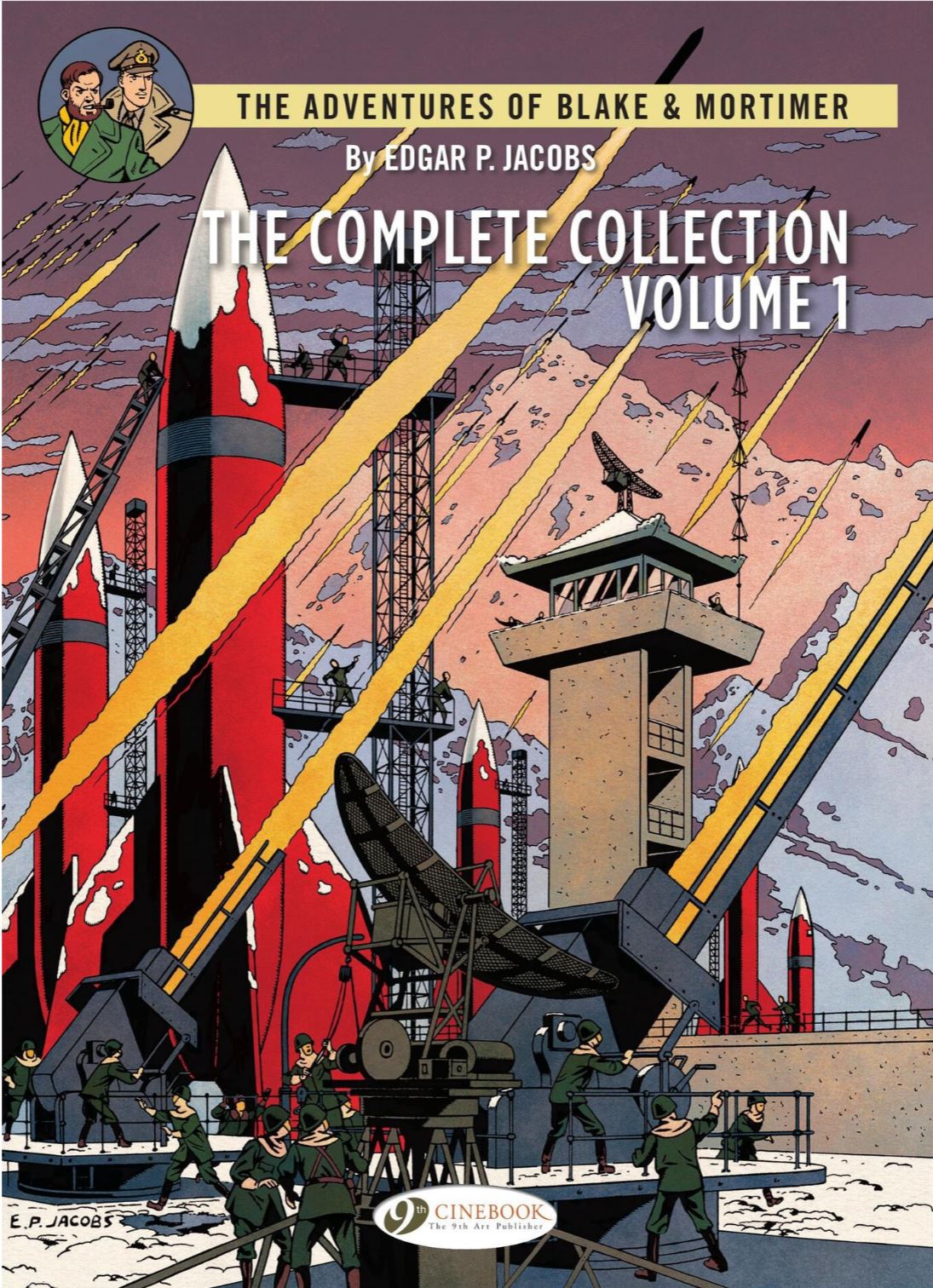
Blackhawk Archives volume 1


By Will Eisner, Dick French, William Woolfolk, Bob Powell, Chuck Cuidera, Reed Crandall & various (DC Comics)
ISBN: 978-1-56389-700-9 (HB)

This book includes Discriminatory Content produced in less enlightened times.

The early days of the US comic book industry were awash with both opportunity and talent, and these factors beneficially coincided with a vast population craving cheap entertainment. Comics had practically no fans or collectors; only a large marketplace open to all varied aspects of yarn-spinning and tale-telling. Thus, even though America loudly proclaimed its isolationism and remained more than six months away from active inclusion in World War II, creators like Will Eisner and publishers like Everett M. (known to all as “Busy”) Arnold felt Americans were ready for a themed anthology title such as Military Comics.

They were right; but Nobody was ready for Blackhawk.

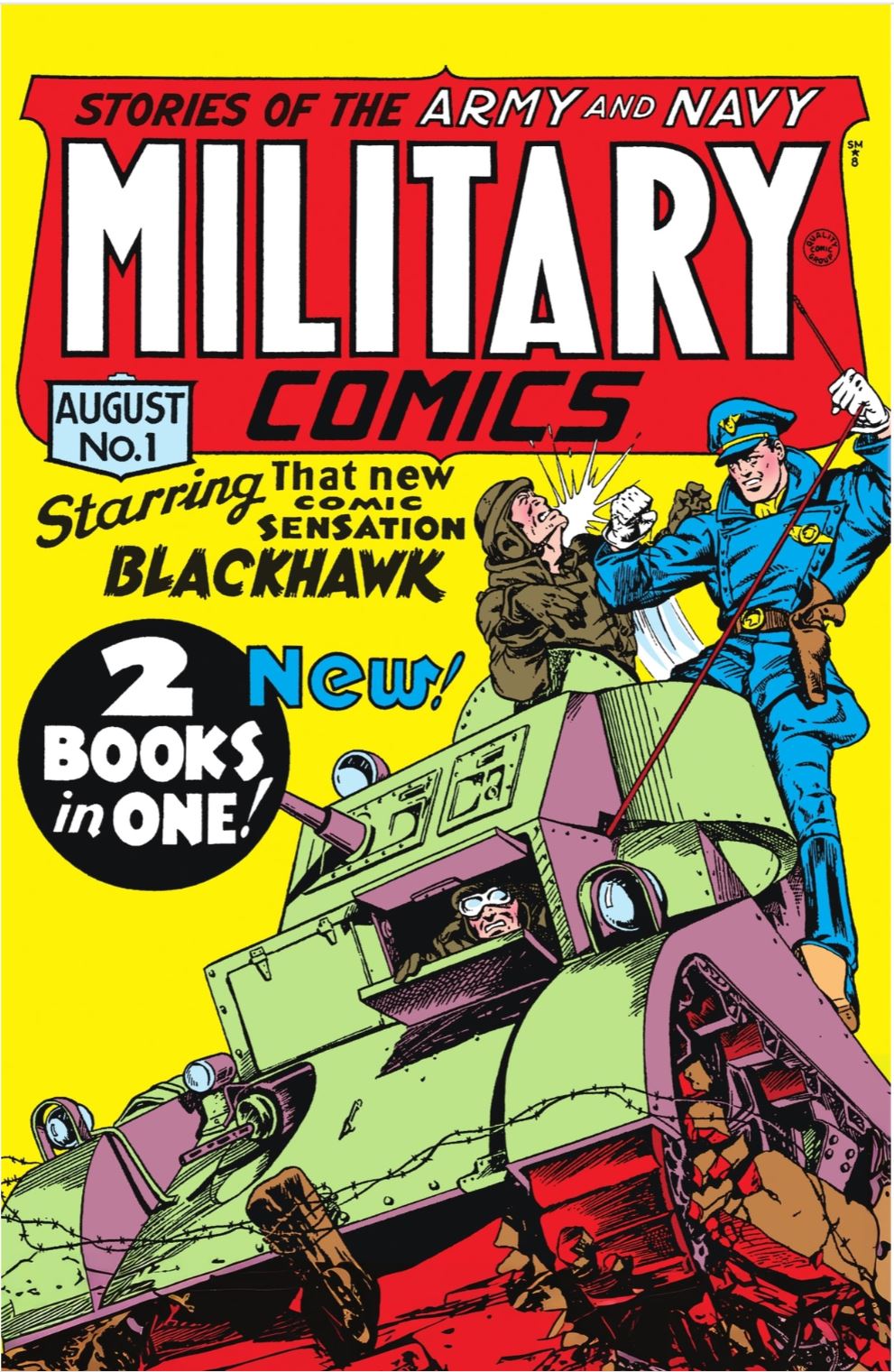
Military Comics #1 launched on May 30th 1941 (with an August off-sale/ cover-date) and included in its gritty, two-fisted line-up Death Patrol by Jack Cole; Elmer Wexler’s Miss America; Fred Guardineer’s Blue Tracer; X of the Underground; John Stewart & Bill Smith’s Yankee Eagle; Q-Boat; Klaus Nordling’s Shot and Shell; Archie Atkins and Loops and Banks by “Bud Ernest” (in actuality, aviation-nut and unsung comics genius Bob Powell), but none of the strips, not even Cole’s surreal and suicidal team of hell-bent fliers, had the instant cachet and sheer appeal of Chuck Cuidera, Eisner & Powell’s “Foreign Legion of the Air” led by a charismatic Dark Knight known only as Blackhawk.

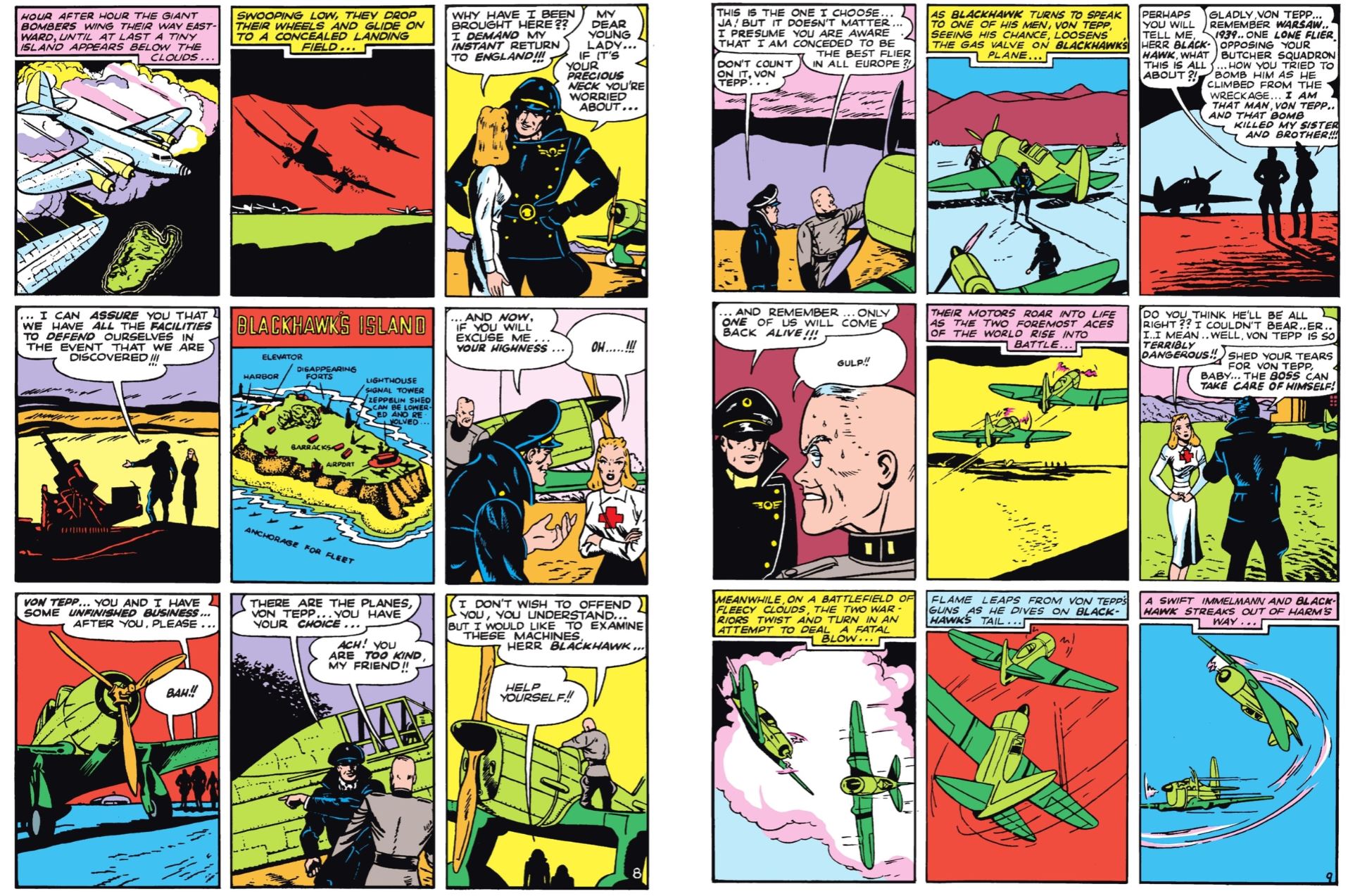
Cuidera – already famed for co-creating The Blue Beetle for Fox Publications – drew ‘The Origin of Blackhawk’ for the premiere issue, wherein a lone, magnificently skilled pilot fighting the Nazi invasion of Poland in 1939 is finally shot down by Nazi Ace Von Tepp. That sadistic killer then goes on to bomb a farmhouse sheltering the defeated pilot’s family. Rising from his plane’s wreckage, the distraught aviator vows vengeance…

Two years later, with the Nazis in control of most of Europe, Von Tepp’s unassailable position is threatened by a mysterious paramilitary squadron of unbeatable fliers, dedicated to crushing injustice and smashing the Axis war-machine…

Eisner wrote the first four Blackhawk episodes and Cuidera stayed aboard until issue #11 – although the artist would return in later years. Many of the stories were originally untitled but have been conveniently characterized with such stirring designations as issue #2’s ‘The Coward Dies Twice’, wherein the squadron – “the last free men of the conquered countries” – offer a deserter from a Spitfire Flight a chance to redeem himself. The easy mix of patriotism, adventure and slapstick was magnified by the inclusion of Chop-Chop in ‘The Doomed Squadron’: a comedy Chinaman extremely painful to see through modern eyes, but a stock type considered nearly as mandatory as a heroic leading man in those dark days… and sadly not just in comics, either…

Its scant comfort but at least this Asian man is a brave and formidable fighter both on the ground and in a plane… when not being used for cheap laughs…

‘Desert Death’ takes the team to Suez – for the first of many memorable Arabian adventures – as Nazi agitators attempt to foment revolution among the tribesmen in hopes that they will rise up and destroy the British. This tale is also notable for the introduction of a species of sexy siren beloved of Eisner and Quality Comics. She or similar seductresses of her ilk would populate the strip until DC bought the property in 1957. Also included here is also a secret map of Blackhawk Island, mysterious base of the ebon-clad freedom fighters.

With issue #5 Dick French assumed the writing role. ‘Scavengers of Doom’ is a biting tale of battlefield looters allied to a Nazi mastermind, united to set an inescapable trap for the heroic fliers. More importantly, French began providing distinct and discrete characters for the previously anonymous minor players. In MC #6 the rapidly gelling team joins a frantic hunt for a germ weapon the Gestapo are desperate to possess, resulting in spectacular alpine incident ‘The Vial of Death’, after which #7 (the first issue released after the US entered World War II although the stories had not yet caught up to reality) lands the lads on the Mongolian Steppe ranging on horseback to thwart ‘The Return of Genghis Khan’

The saga in #8 was a striking maritime romp wherein the warring powers battle to occupy an island freshly risen from the Atlantic depths. The newborn landmass is strategically equidistant between the USA, Britain and Festung Europa (that’s what the Nazis called the enslaved stronghold they had made of mainland Europe), and no opponent or even ally can be trusted with control of ‘The Sunken Island of Death’.

Although complete in itself, the yarn is also the first of an experimental, thematic 3-part saga that stretched the way comics stories were told. Things changed rapidly back then, and many marvellously melodramatic touches to make the Blackhawks so memorable in the eyes of a wide-eyed populace of thrill-hungry kids were trialled. There was the cool, black leather uniforms and creepy peaked caps. The unique – yet real – Grumman F5F-1 Skyrocket planes they flew from their secret island base and their eerie battle-cry “Hawkaaaaa!” but perhaps the oddest idiosyncrasy to modern readers was that they had their own song which André, Stanislaus, Olaf, Chuck, Hendrickson & Chop-Chop would sing as they plunged into battle. … And just to be informative and inclusive, the sheet-music and lyrics were published in this issue and are re-presented here. Just remember this is written for seven really tough guys to sing while dodging bullets and weaving between bursts of flak…

Military #9 led with ‘The Man in the Iron Mask’ as the unflappable team discover that a fallen comrade did not actually die in combat, but was hideously disfigured saving them, and is back and seeking redress, whilst the next issue’s tale – ‘Trapped in the Devil’s Oven’ – is another desert adventure focusing on the still primitive science of plastic surgery to restore said hero to full fighting trim.

MC #11 – Cuidera’s last on Blackhawk for some time – saw the squadron turn their attention to Japan, as reality at last caught up with publishing schedules. Intriguingly, ‘Fury in the Philippines’ starts quietly with the entire team calmly discussing carrying on against the Nazis or switching their attentions to the Pacific Theatre of Operations, until comedy relief Chop-Chop sways the debaters with an impassioned stand. Though inarguably an offensive stereotype visually, the Chinese warrior was often given the best lines and most memorable actions. A sneakily subversive attempt on the part of the creators (frequently from immigrant backgrounds and ethnic origins) to shake up those hide-bound societal prejudices, perhaps?

Notwithstanding, the resultant mission against the Japanese fleet is a cataclysmic Battle Royale, full of the kind of vicarious payback that demoralized Americans needed to see following Pearl Harbor…

‘The Curse of Xanukhara’ added fantasy elements to the gritty mix of blood & iron as the group’s hunt for a stolen codebook leads them to occupied Borneo and eventually the heart of Tokyo; a classy espionage thriller marking the start of a superlative run of thrillers illustrated by the incredible Reed Crandall. The artist’s realistic line and the graceful poise of his work, especially on exotic femmes fatale and trustworthy girls-next-door, made his pages absolute joys to behold. ‘Blackhawk vs. The Butcher’ (Military #13, November 1942) was written by new regular scripter Bill Woolfolk and returned the Blackhawks to Nazi territory as a fleeing Countess turns their attention to the most sadistic Gauleiter (Nazi regional leader in charge of a conquered territory) in the German Army.

What follows is a spectacular saga of justice and righteous vengeance, whilst ‘Tondeleyo’ reveals a different kind of thriller as an exotic siren uses her almost unholy allure to turn the entire team against each other. Such quasi-supernatural overtones held firm in the stirring ‘Men Who Never Came Back’ – when the team travel to India to foil a Japanese plot – in a portmanteau report narrated by three witches. Trouble, Terror and Mystery were eerily presaging the EC horror classics that would cement Crandall’s artistic reputation more than a decade later…

‘Blackhawk vs. the Fox’ pits the flight of heroes against a Nazi strategic wizard (a clear reference to the epic victories of Erwin Rommel) in the burning sands of Libya, and remains one of the most authentic battle yarns in the canon; and precedes this sublime hardback volume’s concluding sortie: a racy tale of vengeance and tragedy wherein Japanese traitor Yoshi uses her wiles to punish the military government of Nippon, with Blackhawk as her unwitting tool in ‘The Golden Bell of Soong-Toy!’

These stories were produced at a pivotal moment in both comics and world history, delivering the blend of weary sophistication and glorious, juvenile bravado that comprised the best movies of the time: Casablanca, Foreign Correspondent, Freedom Radio, Captain of the Clouds, The Day Will Dawn, The First of the Few, In Which We Serve and all the rest. That understated, overblown way of accepting duty and loss permeates these primal, rousing Blackhawks tales, confirming the miracles good men can do when needed; and are some of the Golden Age’s finest moments. In fact, these are some of the best comics stories of their time and I sincerely wish DC had proceeded with further collections, or will resume and complete their comics casebooks for the benefit of us all…

Hunt this down and so will you.
© 1941-1942, 2001 DC Comics. All Rights Reserved.

Today in 1916 unsung genius of line and mood Mort Meskin (Sheena, Queen of the Jungle, Vigilante, Wildcat, Starman, Johnny Quick, Black Terror, Boy’s Ranch, Captain 3-D, Golden Lad, Mark Merlin) was born, as was Italian artist Roberto Raviola AKA Magnus (Kriminal, Alan Ford) in 1939, US writers Mike W. Barr (Maze Agency, Batman, Camelot 3000, Star Trek) in 1952, Alan Brennert (Batman, Brave and the Bold, Batman: Holy Terror) in 1954 and Kevin Eastman (Teenage Mutant Ninja Turtles) in 1962.

On this date in 1993 we lost Little Lulu cartoonist “Marge” (Marjorie Henderson Buell) and in 1999, prolific comics scripter Paul S. Newman (Turok, Dr. Solar, Man of the Atom, Lone Ranger).

Today in 1985 Osamu Tezuka completed his landmark award-winning manga Adorufu ni Tsugu (Message to Adolf).

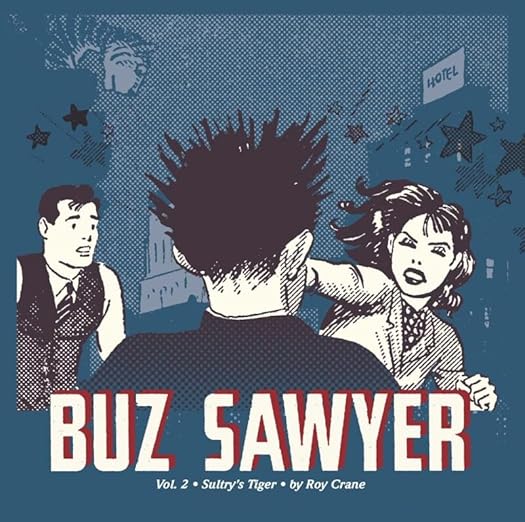
Buz Sawyer volume 2: Sultry’s Tiger


By Roy Crane  & various (Fantagraphics Books)
ISBN: 978-1-60699-499-3 (HB)

This book includes Discriminatory Content produced in less enlightened times.

Modern comics evolved from newspaper comic strips, and these pictorial features were, until relatively recently, utterly ubiquitous. Immensely information-efficient, hugely popular with the public and highly valued by publishers who used them as irresistible weapons to guarantee sales and increase circulation, the strips seemed to find their only opposition in the short-sighted local paper editors who often resented the low brow art form, which cut into advertising and frequently drew complaint letters from cranks…

It’s virtually impossible for us today to understand the overwhelming allure and power of the comic strip in America (and the wider world) from the Great Depression to the end of World War II. With no television, broadcast radio far from universal and movie shows at best a weekly treat for most folk, household entertainment was mostly derived from the comics sections of daily – and especially Sunday – newspapers. “The Funnies” were the most universally enjoyed recreation for millions who were well served by a fantastic variety and incredible quality of graphic sagas and humorous episodes over the years.

From the very start comedy was paramount; hence our terms Funnies and Comics, and from these gag-&-stunt beginnings, a blend of silent movie slapstick, outrageous fantasy and the vaudeville shows, came a thoroughly entertaining mutant hybrid: Roy Crane’s Wash Tubbs.

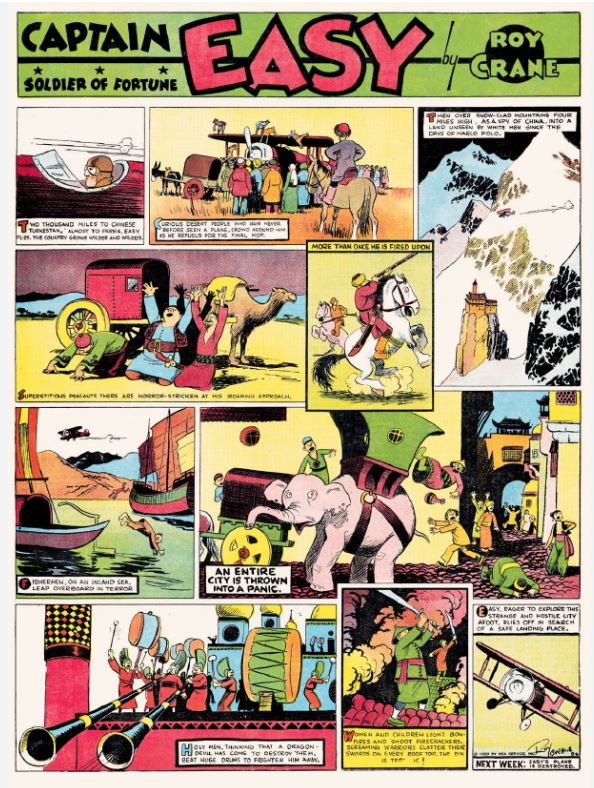
Debuting on April 21st 1924, Washington Tubbs II was a comedic, gag-a-day strip which evolved into a globe-girdling adventure serial. Crane produced pages of stunning, addictive and influential high-quality yarn-spinning for years, until his eventual introduction of moody swashbuckler Captain Easy ushered in the age of adventure strips with the landmark episode for 6th May, 1929. This in turn led to a Sunday colour page for the good captain that was possibly the most compelling and visually imaginative of the entire era (see Roy Crane’s Captain Easy, Soldier of Fortune: The Complete Sunday Newspaper Strips vol 1 ).

Practically improving minute by minute, the Sunday strip benefited from Crane’s relentless quest for perfection his imaginative, fabulous compositional masterpieces achieving a timeless immediacy that made each page a unified piece of sequential art. The influence of those pages can be seen in the works of near-contemporaries such as Hergé, giants-in-waiting like Charles Schulz and comic book masters like Alex Toth and John Severin ever since.

The material was obviously as much fun to create as to read. In fact, the cited reason for Crane surrendering the Sunday strip to his assistant Les Turner in 1937 was NEA/United Features Syndicate’s abrupt and arbitrary demand that all its strips must henceforward be produced in a rigid panel-structure to facilitate their being cut up and re-pasted as local editors dictated.

They just didn’t lift the artist any more, so Crane stopped making them.

At the height of his powers Crane just walked away from the astounding Captain Easy Sunday page to concentrate on the daily feature, and when his contract expired in 1943 he left United Features, lured away by that grandee of strip poachers William Randolph Hearst. The result was a contemporary aviation strip set in still-unfolding World War II: Buz Sawyer.

Where Wash Tubbs was a brave but largely comedic Lothario and his pal Easy a surly, tight-lipped he-man, John Singer “Buz” Sawyer was a joyous and sharp amalgam of the two: a good-looking, popular country-boy who went to war because his country needed him..

Buz was a fun-loving, skirt-chasing, musically-inclined naval aviator daily risking his life with his devoted gunner Rosco Sweeney: a bluff, brave and simply ordinary Joe – and one of the most effective comedy foils ever created. The wartime strip was – and remains – a marvel of authenticity: depicting not just the action and drama of the locale and situation but, more importantly, capturing the quiet, dull hours of training, routine and desperate larks between the serious business of killing and staying alive. However – and crucially – when the war ended the action-loving duo – plus fellow pilot and girl-chasing rival Chili Harrison – all went looking for work that satisfied their penchant for adventure and romance wherever they could find it…

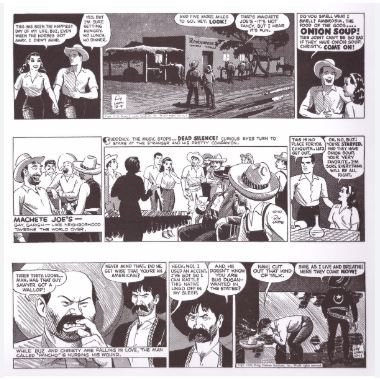
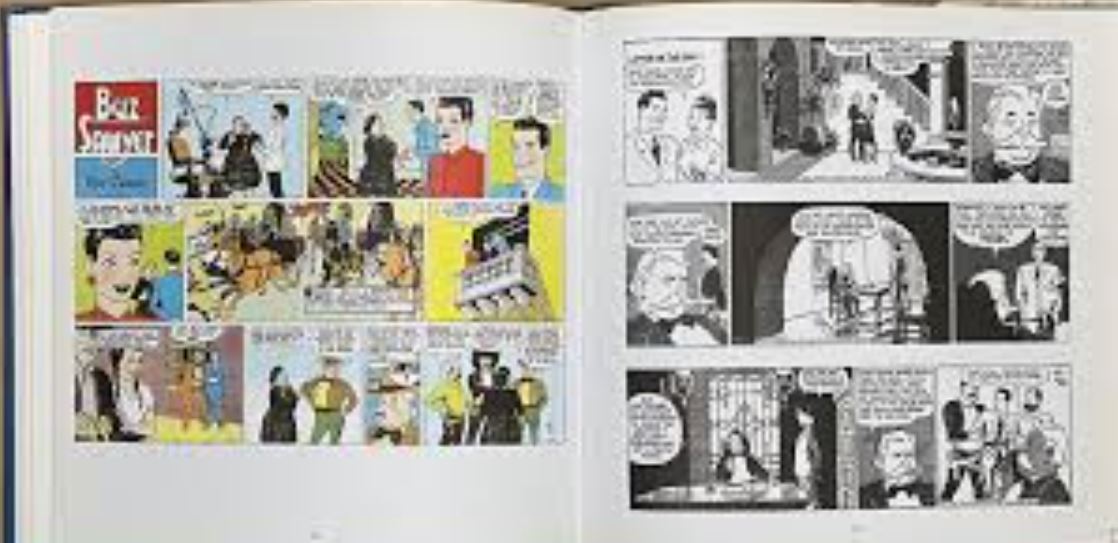
Crane was a master of popular entertainment, blending action and adventure with smart drama and compellingly sophisticated soap opera, all leavened with raucous comedy in a seamless procession of unmissable daily episodes. He and his team of creative assistants – which over the decades comprised co-writer Ed “Doc” Granberry and artists Hank Schlensker, Clark Haas, Al Wenzel, Joel King, Ralph Lane, Dan Heilman, Hi Mankin & Bill Wright – soldiered on under relentless deadline pressure, producing an authentic and exotic funny romantic thriller rendered in the signature monochrome textures of line-art and craftint (a mechanical monochrome patterning effect used to add greys and halftones to the superb drawing for miraculous depths and moods) as well as the prerequisite full-colour Sunday page.

This primarily black-&-white tome contains an impressive but far too meagre selection of those colour strips – although Crane quickly came to regard them only as a necessary evil which plagued him for most of his career…

The eternal dichotomy and narrative/continuity problems of producing Sunday Pages (many client papers would only buy either Dailies or Sunday strips, but not both) meant that most creators had to produce different story-lines for each feature – Milt Caniff’s Steve Canyon being one of the few notable exceptions. Whereas Dailies needed about three weeks lead-in time, hand-separated colour plates for the sabbath sections meant finished artwork and colour guides had be at the engravers and printers a minimum of six weeks before publication. Crane handled the problem with typical aplomb; using Sundays to tell completely unrelated stories.

For Wash Tubbs he created the aforementioned prequel series starring Captain Easy in sagas set before the mismatched pair had met, whilst in Buz Sawyer he turned the slot over to Roscoe Sweeney for lavish gag-a-day exploits, packed with slapstick laughs and situation comedy. During the war years it was set among the common “swabbies” aboard ship: a far more family-oriented feature and probably better suiting the weekend crowd of parents and children than the often chilling or disturbing realistically saucy/sexy sagas that unfolded Mondays to Saturdays. A year before Steve Canyon began, Crane tried telling a seven-days-a-week yarn in Buz Sawyer (with resounding success, to my mind, and you can judge for yourself here) but found the process a logistical nightmare. At the conclusion he returned to weekday continuity whilst Sundays were restored to Roscoe with only occasional guest-shots by the named star.

This second lush, sturdily archival hardback re-presents the tense and turbulent period from October 6th 1945 to July 23rd 1947 wherein de-mobilised adrenaline addict Buz tries to adjust to peacetime life whilst looking for a job and career – just like millions of his fellow former servicemen…

Before getting out, though, he had returned home on leave and ended up accidentally engaged. Buz was the son of the town’s doctor: plain, simple and good-hearted. In that ostensibly egalitarian environment the school sporting star became the sweetheart of ice-cool and stand-offish Tot Winter, the richest girl in town. Now when her upstart nouveau riche parents heard of the decorated hero’s return they hijacked the homecoming and turned it into a publicity carnival. Moreover, the ghastly, snobbish Mrs. Winter conspired with her daughter to trap the lad into a quick and newsworthy marriage.

Class, prejudice, financial greed and social climbing were enemies Buz and Sweeney were ill-equipped to fight, but luckily, annoying tomboy-brat/girl-next-door Christy Jameson had blossomed into a sensible, down-to-earth, practical and clever young woman. She’d scrubbed up real pretty too and showed Buz that his future was rife with possibility. Mercifully soon, the leave ended and he & Sweeney returned to the war. The Sawyer/Winter engagement fizzled and died. When their discharge papers finally arrived (in the episode for September 9th 1945), the period of desperate struggle was over. However, that only meant that the era of globe-girdling adventure was about to begin…

Before the comics wonderment resumes, Jeet Heer and Rick Norwood discuss ‘The Perfectionist and his Team’. Concentrating initially on ‘After the War’, the fascinating explorations also delve deep into detail of the auteur’s troubled and tempestuous relationship with ‘Crane’s Team’ before offering ‘A Word on Comic Strip Formats’ and the censorious iniquities local newspaper editors regularly inflicted upon Crane’s work.

With all the insightful stuff over, cartoon adventure begins anew as civilian Mr. Sawyer returns home to a life of indolence before his own restless nature starts him fretting again. The old town isn’t the same. Tot has inherited her father’s millions and moved to New York and even Christy is gone; she’s away attending his old alma mater…

After a brief interlude wherein he visits the cheery Co-Ed and debates the merits of returning to college on the G.I. Bill, Buz instead opts for fulltime employment and heads to the Big Apple where Chili Harrison has a new job offer and an old flame waiting. As he turns East, Buz chooses to ignore his instincts and the huge mysterious guy who seems to turn up everywhere he goes…

In NYC, aloof, alluring Tot Winter is the cream of polite “arty” society, but her wealth and clingy new fiancé – opera singer Count Franco Confetti – are all but forgotten when “the one who got away” appears again and she finds her interest in her High School beau rekindled. Buz has moved in with Chili, blithely unaware that the strangely ubiquitous giant has inveigled himself into the apartment next door and is now actively spying on him…

Sawyer wants a job flying, but is frankly only one of hundreds of war-hero pilots looking for a position at International Airways. Moreover, his reputation as a hot-shot risk-taker makes him the last person a commercial carrier might consider. Happily, after implausibly well-connected Chili intercedes with a major player in the company, something does come up…

The truth about Buz’s hulking stalker comes out when the Maharani of Batu’s yacht docks in New York. The exotic Asian princess is one of the wealthiest women on Earth and cuts a stunning figure with her tiger on a leash. Yet when Buz first met her she was simply “Sultry”, a ferocious, remorseless resistance fighter helping him kill the occupying Japanese on her Pacific island.

She never forgotten him and will ensure no other woman can have him…

Sultry moves into the penthouse adjoining Tot’s and is witness to the ploys of the Winter woman as she sidelines sleazy sneaky Confetti and makes her play for Buz. She is also a key figure in the tragic heiress’ sudden death…

Just prior to Tot’s gruesome demise, Buz had finally met the unconventional Mr. Wright of International Airways. That doughty executive had no need for pilots but wanted a quick-thinking, capable fighter who could solve problems in the world’s most troubled conflict zones. He even has a spot open for good old Roscoe Sweeney. Buz is all set for his first overseas assignment when the cops decide he’s the other prime suspect in Tot’s murder and, with Sawyer and Count Confetti in jail, Sultry tries to flee America before the truth comes out. Sweeney and the freshly exonerated Buz soon track her down, but Sultry turns the tables on them and shanghaies her erstwhile lover, imprisoning him on her yacht, determined to make him her permanent boytoy, far, far away from American …

Never short of an idea and blessed with the luck of the damned, Buz’s escape results in a terrifying conflagration and the seeming death of his obsessed inamorata… but Sultry’s body isn’t recovered…

It takes a lot of pleading to get Mr. Wright to give him another chance but, soon after, Buz & Sweeney are winging north to Greenland to stop a crazed sniper taking pot-shots at aircraft passing over the “Roof of the World”. This savage, visceral extended saga soon reveals the shooter to be a deranged leftover Nazi and his hapless attendants, but the heroes’ astonishing hunt for and capture of the Teutonic trio is as nothing compared to the harrowing trek to get them back to civilisation, especially since poor Roscoe is putty in the hands of lovely Frieda, devil-daughter of the utterly mad Baron von Schlingle.

Before Buz get the survivors home safely, he loses his plane, must forcibly trek across melting floes, get them all stranded on a iceberg and even has his pretty-boy face marred forever. Worst of all, by the time he gets back to civilisation, his job no longer exists. Mr. Wright has quit and moved on to another company…

It’s not all bad news. Wright has euphemistically become “Personnel Director” for Frontier Oil: a truly colossal conglomerate active all over Earth and now wants Buz to carry on his unique problem-solving career for his new employers.

Despite a large bump in salary, the weary war hero is undecided until he hears Christy is helping her dad in Central American nation Salvaduras in his role as a geologist for Frontier Oil. This happily ties in with an outstanding missing persons case; said vanished victim being Bill Daniels, playboy son of a prominent company executive. It takes very little to convince Wright to despatch Buz & Roscoe south of the border to investigate, opening floodgates to a spectacular epic of light-hearted romantic adventure a world apart from his previous harrowing cases. The story also saw Crane and Co. merging the Daily and Sunday strips into a single storyline (with the Sundays primarily illustrated by Schlensker) as the action boys tried to trace the missing American in a country that seems locked in fear and poverty…

After initially hitting a wattle-and-daub wall, Buz takes time off for a picnic with Christy and, after a close call with a faux Mexican bandit (in actuality a Yankee fugitive from justice with an atrocious fake accent), declares his undying love for her.

He is not rebuffed and there’s the hint of wedding bells in the air…

First, though, he and Sweeney need to finish the mission, and help comes from a brave peon who breaks the regional code of silence to put them on the trail of the mysterious Ranch of the Caves and its American émigré who rules the isolated canton with blood and terror. After romancing the daughter of vicious Don Jaime, Buz and Roscoe infiltrate the desolate fiefdom and the gang boss’ international band of thugs, discovering not only the very much alive missing playboy but an incredible lost Mayan treasure trove!

Mission accomplished, Buz returns to New York to marry Christy, only to find he’s already needed elsewhere. Christy too is having doubts, worried that she will always play second fiddle to her man’s addiction to action, whereas in truth the real problem is that trouble usually comes looking for Buz. Boarding a Frontier plane for the Yukon, Sawyer is merely a collateral casualty when the ship’s other passenger is kidnapped. The mysterious menabducting plastic surgeon Dr. Wing take their helpless hostages all the way to deepest Africa where they expect the medic to change the face of an infamous madman everybody in the world believes died in a Berlin Bunker. Tragically, the fanatics are not prepared for the physician’s dauntless sense of duty and sacrifice nor Buz’s sheer determination to survive…

The latter part of this tale describes Buz’s epic river trek with mercenary turncoat honey-trap Kitty as they flee from vengeful Nazis. However, even after reaching the coast and relative safety, the insidious reach of the war-criminals is not exhausted and one final attack looms…

Eventually, Buz returns to New York alone and wins enough time from slave driving Mr. Wright to settle things with Christy. He follows her to Nantucket Sound, but even their romantic sailboat ride turns into a life-changing adventure…

To be Continued for decades to come…

This splendid collection is the perfect means of discovering – or reconnecting with – Crane’s second magnum opus: spectacular, enthralling, exotically immediate romps that influenced generations of modern cartoonists, illustrators, comics creators and storytellers. Buz Sawyer ranks amongst the very greatest strip cartoon features ever created: rousing, enthralling, thrilling, outrageously funny and deeply moving tale-telling that is irresistible and utterly unforgettable.
Buz Sawyer: Sultry’s Tiger © 2012 Fantagraphics Books, all other material © 2012 the respective copyright holders. All Strips © 2010 King Features Syndicate, Inc All rights reserved.

Today in 1890, landmark British magazine Comic Cuts began publication. See what we started?

This date in 1928 scripter/screen writer George Kashdan (Tomahawk, Congo Bill, Tommy Tomorrow, Mysto, Magician Detective, hundreds of DC genre anthology tales, Superman/ Aquaman Hour of Adventure) as born, with Dutch creator Piet Wijn (Aram, Douwe Dabbert) coming a year later. Dave (Cerebus) Sim popped up in 1956 and Linda Medley (Castle Waiting, Justice League America, Doom Patrol, Galactic Girl Guides) in 1964.

Today saw the loss of Mutt and Jeff ghostwriter Aurthus “Bugs” Baer in 1969, ULTIMATE Batman artist Dick Sprang in 2000 and Mad’s The Lighter Side cartoonist Dave Berg in 2002.

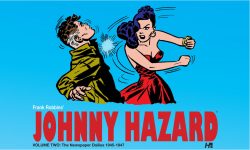
Frank Robbins’ Johnny Hazard volume Two – the Newspaper Dailies 1945-1947


By Frank Robbins with an introduction by Daniel Herman (Hermes Press)
ISBN: 978-1-61345-017-8 (HB/Digital edition)

This book includes Discriminatory Content produced in less enlightened times.

Johnny Hazard was a newspaper strip created in the style and manner of Terry and the Pirates, but in many ways this steely-eyed hero most accurately resembles – and in fact predates – Milton Caniff’s second masterwork Steve Canyon.

Unbelievably, until 2011 this influential, impressively enthralling adventure strip had never been comprehensively collected in archival volumes – at least not in English or even America’s version of it – although selected highlights had appeared in magazines like Pioneer Comics, Dragon Lady Press Presents and the Pacific Comic Club.

Boston born, Franklin Robbins (9th September 1917 – 28th November 1994) was an artistic prodigy who shone from early on. At age nine he was awarded a scholarship to the Boston Museum of Fine Arts and at 15 moved to New York City to attend the National Academy of Design on a Rockefeller grant. Skilled, inventive and prolific as both painter and graphic artist, Robbins freelanced continually, even working with Edward Trumbull on the legendary murals for the NBC building and Radio City Music Hall. He created graphics for RKO Pictures, worked in advertising and magazine illustrations but never stopped painting, with work shown at the Whitney Museum of American Art, Metropolitan Museum of Art, The Corcoran Gallery of Art and Walker Art Gallery, although he found his perfect medium of expression when invited to take over a top comic strip…

Even whilst relentlessly creating a full seven days of newspaper strips, he exhibited work at the Whitney’s Annual show and, after ceasing his comics career, retired to Mexico to end his days with a brush in his hand.

The plain truth is that comics changed Robbins’ life. He was a brilliant natural cartoonist whose unique artistic and lettering styles lent themselves equally to adventure, comedy and superheroic tales, whilst his expansive raconteur’s nature made him one of the industry’s best writers over three generations.

He first found popular fame in 1939 after taking over aviation strip Scorchy Smith from Bert (The Sandman) Christman, when he quit isolationist America to fight with the Flying Tigers in China. Robbins thrived in the role, and created a Sunday page for the strip in 1940. This groundbreaking feature had been originated by John Terry before the astounding Noel Sickles replaced him: revolutionising Scorchy Smith and – with Milton Caniff – inventing a new impressionistic style of narrative art to reshape the way all comics were drawn and perceived.

Robbins remained until 1944 and was then offered high-profile Secret Agent X-9. Instead, he devised his own lantern-jawed, steely-eyed man of action. A tireless and prolific worker, even whilst producing the daily and Sunday Hazard (crafting separate but congruent storylines for each), Robbins continued freelancing as an illustrator for The Saturday Evening Post, Look, Life and other mainstream magazines. He also tried comic books for the first time when Johnny Hazard won his own title in 1948-1949, just as costumed superheroes began losing ground to ordinary he-men, mobsters and monsters…

Robbins returned to funnybooks in 1968, quickly becoming a key contributor as both artist and writer on Superboy, The Flash and The Atom, as well as a regular contributor to humour mag Plop! and DC’s mystery, horror and war anthologies. He particularly shone on Batman, Batgirl and in Detective Comics where, with Neal Adams, he pulled the Caped Crusader out of the TV show-inspired silliness. They created Man-Bat together and Robbins followed Michael Kaluta as artist on The Shadow. Moving to Marvel in the 1970s, Robbins concentrated on drawing a variety of titles including Captain America, Daredevil, Ghost Rider, Morbius, The Man from Atlantis, Human Fly, Power Man and The Invaders – which he co-created with Roy Thomas.

When Johnny Hazard launched on Monday June 5th 1944, he was an aviator in the US Army Air Corps. When hostilities ceased, he briefly became a freelance charter pilot and spy before settling into the life of a globe-girdling, troubleshooting mystery-solver: a modern day Knight Errant. The strip folded in 1977: one more victim of diminishing panel-sizes and the move towards simplified, thrill-free, family-friendly gag-a-day graphic fodder to frame small-ads. In its time it was syndicated in nine different languages in thousands of newspapers across the world, and even scored a residency in 1950s British weekly Rocket.

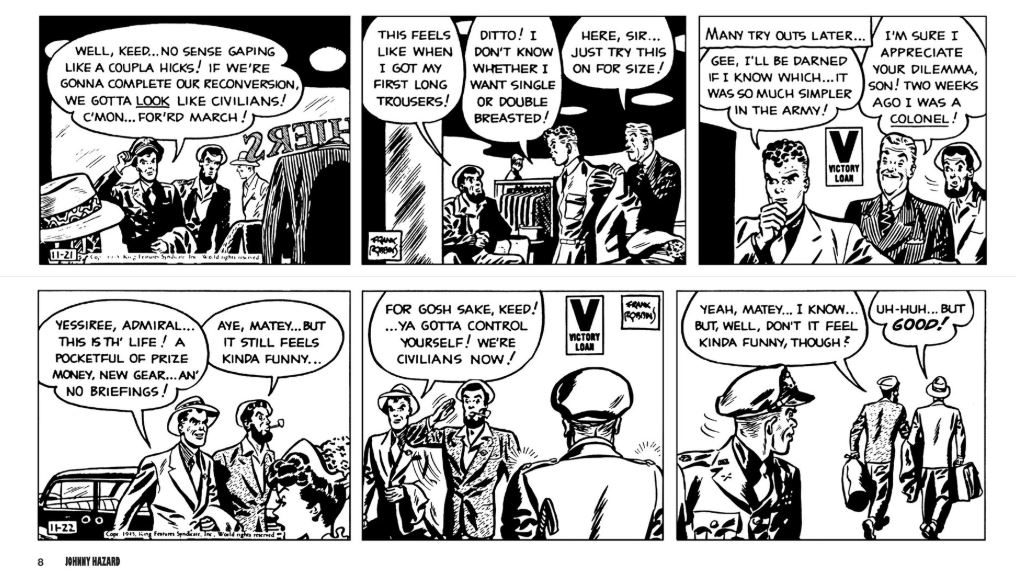
This fabulous hardcover/digital series – reproduced from original King Features proofs – re-presents the definitive magnum opus in fitting form: a monochrome, landscape format archival collection. This second shot covers serialised daily thrills (spanning November 19th 1945 to August 16th 1947), to resurrect the Amazing Aviator in fans’ hearts and remind them of what we’ve all missed whilst hopefully finding a few new fervent followers.

Fully embracing noir sensibilities of the era but keeping things light, frothy, sexy and funny the globetrotting glee is preceded by Daniel Herman’s Introduction ‘A Look Back at Johnny Hazard before the preflight fun begins…

Previously we met coolly capable flyer Lt. Johnny Hazard who escaped from a German POW camp, broke into a Nazi airfield, stole a bomber and flew home. Liberated and ready-for-duty he met feisty, headstrong, utterly dedicated war photographer Brandy during an air raid and all kinds of sparks flew. A series of spectacular events constantly pushed them together and ultimately impassioned fury and disgust on both sides turned to something else amidst all the deadly missions and exploding ordnance.

The strip could not keep up with the fast-moving events after D-Day (the real world Allies invaded “Fortress Europa” the day after Johnny Hazard debuted) and third story arc ‘Sun Tan and General Mariwana’ – opening on September 11th 1944 – saw the hero’s squadron transferred to the Pacific Theatre of Operations to reinforce the battle against Japan. Brandy inveigled herself into the picture as newly promoted Captain Hazard and his crew undertook a top-secret mission couriering a Chinese resistance leader back to her people. Enigmatic, exotic, staggeringly beautiful and lethally dangerous Sun Tan was a magnet for trouble…

Foiling Japanese assassination plots while dodging Brandy’s jealous displeasure, Hazard faced baroque opponents like disfigured pilot Colonel Mariwana, Colonel Kiri, General Ishigaki and his glamorous French “assistant” Mademoiselle Touché but also found a stalwart new ally and wingman in Captain “The Admiral” Slocum: last in an unbroken line of valiant patriotic mariners, but reduced to defending his country in the skies since his debilitating sea sickness prevents him from serving afloat like a true warrior…

Across Iran, Japan, China, and the Himalayas, Hazard, Slocum and Brandy ducked death over and again and when official hostilities ended, encountered charismatic US underworld émigré, pool-addict and deal-maker Side-Pocket Sam. Debonair, charming and utterly amoral, he led Chinese bandits and vied with our heroes for possession of Japan’s failsafe game plan for World War III…

Now, in ‘Fancy Fluff’ (running from November 19th 1945 to June 15th 1946) finally and officially released from their country’s service, Hazard and Slocum barely have time to adjust to civilian life before desperate Fluff Randall recruits them to help find her missing brother. A former comrade of Hazard, “Bounce” Randall was wounded in action and shipped home, but soon disappeared. The last Fluff heard, despite a head injury that prevented him being a pilot, he was in French Guiana, flying private planes for mystery man “Dr. Fox”

Soon the brothers in arms are on the trail, securing passports, papers and a reconditioned army surplus plane which they cheerfully dub Fancy Fluff in honour of their sponsor and despite the suspicions of suddenly-arriving Brandy. Her latest assignment is investigating a wave of jailbreaks in the penal colonies of that very country and a lift would be nice…

Soon the quartet are far south and negotiating with clearly corrupt cops and customs officers, dodging murder attempts and investigating local saint/Good Samaritan Docteur Reynard. A dramatically delivered letter from brother Bounce begging them to leave does nothing to deter them and before long they have uncovered not only an underground railroad using air transport to spring savage escapees but also murderous drug dealers using terror, mesmerism and narcotics to enslave Fluff’s brother among so many other victims…

It’s as much luck as competence that saves the valiant Americans from death and disaster a dozen times over, but in the end Reynard, his leg breakers Elf and Beeg Ox and all those bribe-taking officials pay for their crimes. Bounce is wounded again but at last healed of his enslavement and debilitating head injuries. However the overall cost is high. Admiral is lost to the world of action after falling for Fluff and that sappily contagious condition almost ensnares Johnny and Brandy too. Thankfully, common sense and sheer bile on both sides brings them to their senses before it’s too late…

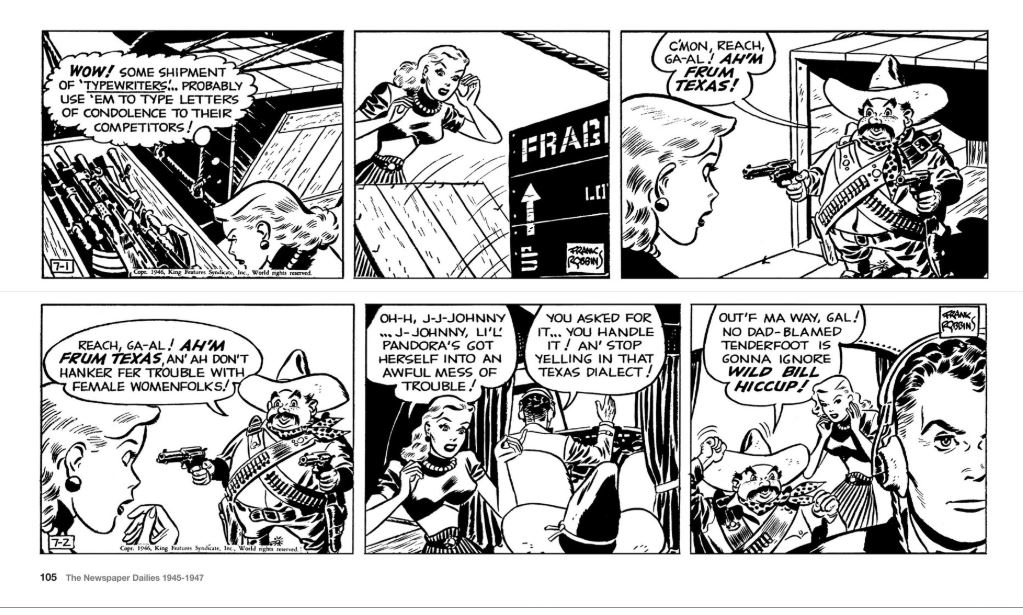
Each serial storyline is garnished and bookended by Robbins’ original art designs for advertising the strip and after a comforting close up of Hazard second saga ‘The Flying Freight Mystery’ (June 17th – November 2nd) sees “just friends” Johnny and Brandy heading back to the USA but stalled on take-off when Johnny is conned by deviously mysterious entrepreneur M. Côte’-Poche into delivering to neighbouring nation Estantio a cargo of “typewriters”…

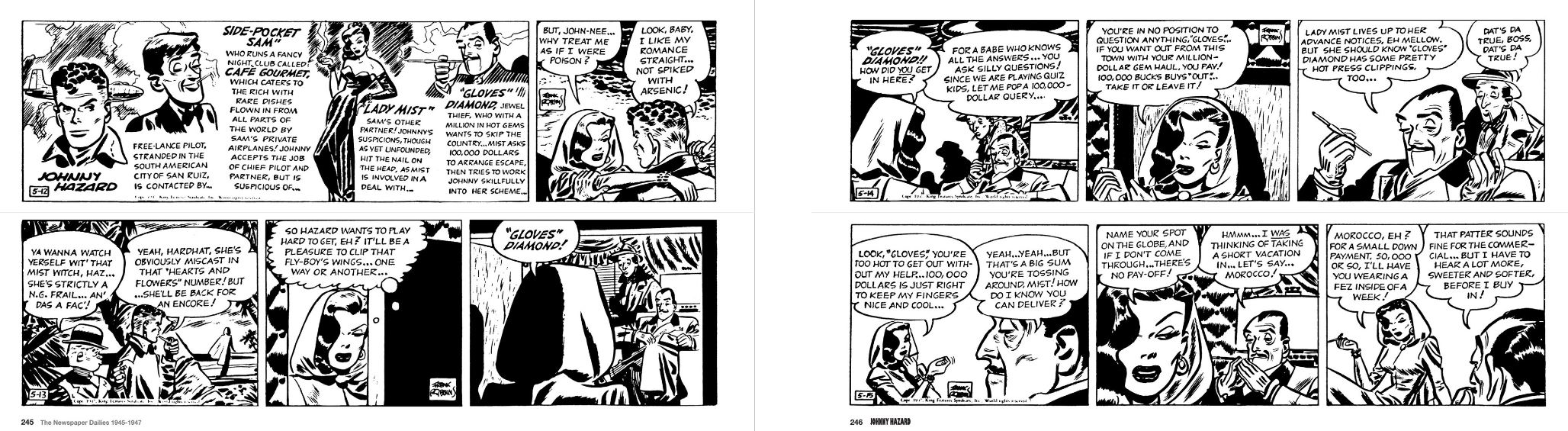
In flight, when Brandy discovers diminutive stowaway Wild Bill Hiccup and that the load is automatic weapons, an aerial ambush by “sky rustlers” leads to a less-than-longed-for reunion with Side-Pocket Sam. He is embroiled in ongoing war with ruthless river pirate Captain Gore who wants the emeralds Sam regularly ships from a mine to the coast. The baroque blubbery buccaneer is obsessed with piratical mythology and alongside fellow plunderers Mistuh Dirk and voluptuous siren Lady Mist opened a bizarre rogues gallery of foes who bedevilled Hazard over the next thirty years.

With Hazard as his air force, Sam has the upper hand until Mist infiltrates his freighter as an shipwrecked innocent: a daunting (and hilarious) job of acting that fools everyone but Brandy and leads to a spectacular display of air versus sea power, a brutal final mano-a-mano duel in the jungle and a surprise twist ending…

Another Canyon pinup segues into a yarn spanning November 4th 1946 to January 18th 1947. Hazard and Brandy arrive in tropical dump Querrero to find her journalistic colleague and Bureau Chief “Timely” Malcolm awaiting the outcome of a clash between government troops and bandit-turned-rebel ‘Major Risk’. Brandy opts to go to the story and with Johnny reluctantly flying her in, arrives at the frontline to find rival reporter “Blitz” (AKA “Loose-Lip”) Martin actively making the story happen.

With natural advantages and no scruples Brandy vamps the Government general for intel before tricking Johnny into delivering her right into the rebels’ hands. Her sharp scheme goes terribly awry and before long she is a hostage and bargaining chip between the sides and needs actual rescuing for a change. Thankfully, Hazard and Martin are willing to try it even if the shiny soldiers are not…

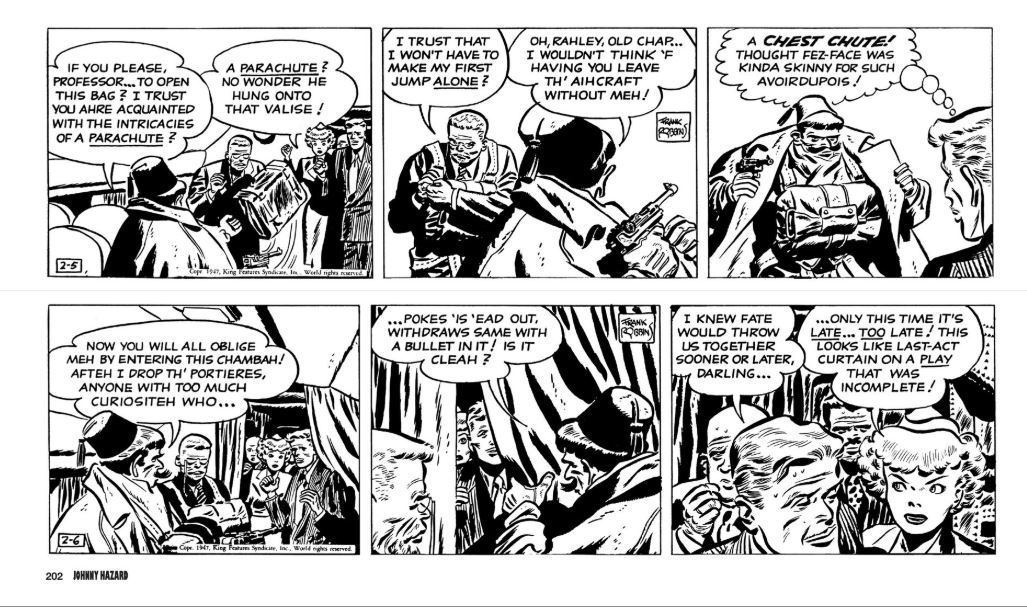
Back in Querrero and hired by Timely Martin as a ferry pilot for his reporters, Hazard faces unlikely danger in penultimate yarn ‘The Stout Man’ (January 20th to March 29th 1947). Repairs and search for spare parts sees the ex-airman as a passenger on a flight to San Tomayo, but the departure is interrupted by rude, rowdy and very bulky Brit Mr. Am and late-arriving Blitz Martin.

Away at last, Johnny befriends fellow traveller and prestigious nuclear boffin Noble Caldwell until Am hijacks the plane and sends it into a death-spin and crash. However, as Am escapes with Caldwell using parachutes hidden under his coat, Hazard manages to crash land the plane. Lost, starving and dying of thirst, the survivors are accidentally saved when Am returns in a helicopter to clear up loose ends and stupidly lets Johnny get the drop on him…

A deadly impasse ensues with both sides holding out against attrition and deprivation, but the balance of power shifts after indigenous tribesmen arrive, pointing their deadly blowpipes indiscriminately at all the unwelcome intruders…

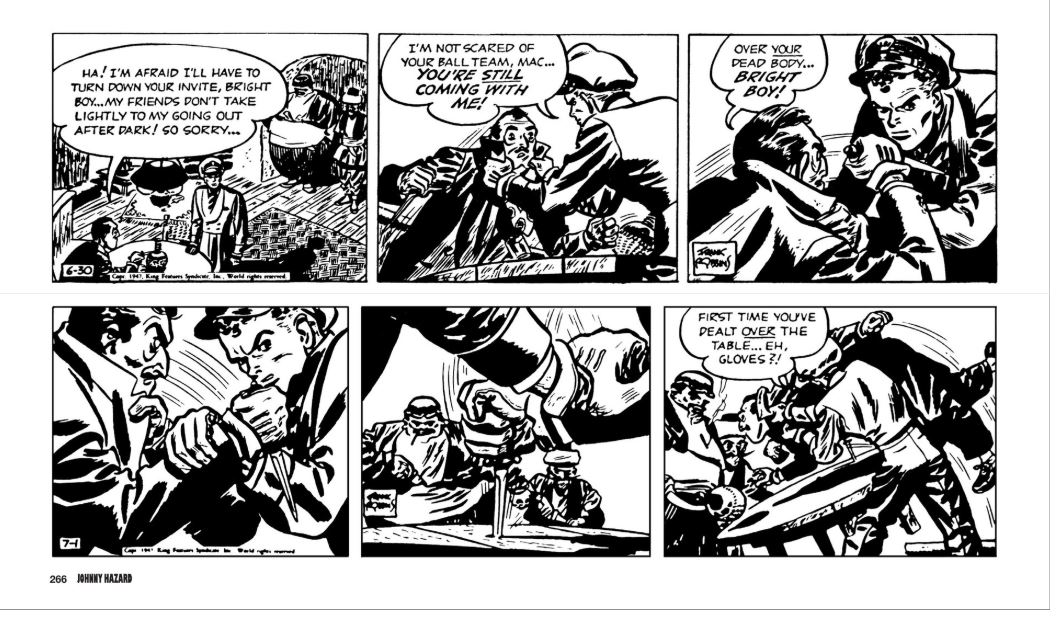
A Vava Lavoum pinup segues into closing yarn ‘Danger À La Carte’ (March 29th – August 16th 1947) as freshly-fired Hazard is stranded in San Ruiz, catching the attention of jewel thieves Gloves Diamond and Mellow as well as their criminal competitors Side-Pocket Sam and Lady Mist. Before long Hazard and Blitz are bemused, befuddled and bamboozled, buffeted between opposing nefarious forces and unable to understand how a gourmet café delivering meals by jet plane can possible be profitable…

Not knowing all the facts doesn’t stop Johnny hiring on as a pilot and becoming an unwittingly accomplice, transporting human contraband to the heart of Casablanca’s wicked underworld. When he seeks to rectify his mistake, the fur, fists, knives and bullets start to fly but in the end justice wins again…

Ending with more advertising pinups – Kitty Hawkes, Sabina Eden, Baroness Flame and Sequinthis is another fast-paced, sharp-tongued and utterly gung-ho roster of romps starring a charming, happy-go-lucky lout, insouciantly ruthless and ever ready to risk his own life and limb to help the little guy and distressed damsels.

Sharp, snappy and devilishly funny repartee in the style of movies like Howard Hawks’ His Girl Friday and Frank Capra’s It Happened One Night are a hallmark of these rapid fire yarns, some of the greatest comic strips in history, but that can present a few problems for modern readers. Contemporary attitudes to sexuality, gender and particularly race are far from what we find acceptable – or should even tolerate – today. We know better now – at least most of us do – but must accept and understand that hurtful and unjust as such terms are, they did exist and we’re doing history and our society a hugely dangerous disservice by ignoring, downplaying or worst of all self-censoring those terms and the attitudes that fed them.

In truth, Johnny Hazard was far less egregious than most: Robbins may have used visual shortcuts and slang but all characters were portrayed fairly and did not unnecessarily suffer from the worst propagandist nonsense used by the Allies to bolster a united war spirit and vilely resurrected by modern populists today.

All ethnicities are treated with the full dignity of different but equal cultures and depicted as competent comrades in arms, not ignorant primitives needing white men’s saving graces. However, arch comedian Robbins clearly couldn’t resist playing mischievous games with accents, names and speech patterns that would do Benny Hill, Hogan’s Heroes or Charlie Chan (the opposite of) proud, so if you don’t think you’re capable of remaining historically detached, best to forgo those delights that have transcended time…

To be continued…

These exotic all-action intrigues and romances perfectly capture the mood and magic of a distant yet incredibly familiar time; with cool heroes, hot dames and exceedingly intemperate baddies encountering exotic locales and stunning scenarios, all peppered with blistering tension, slyly mature humour and vivid, visceral excitement.

Johnny Hazard is a brilliant two-fisted thriller-strip too long forgotten, and this is your chance to remedy that.
© 2013 King Features Syndicate, Inc. ® Hearst Holdings Inc. All rights reserved.

Today in 1914 Aquaman creator Paul Norris was born, followed two years alter by George Tuska (Iron Man, Crime Does Not Pay), Belgian national treasure Victor Hubinon (Buck Danny, Redbeard) in 1924 and Marty Greim in 1942. In 1954 Kerry Gammill joined the party as did Brad W. Foster one year later and François Schuiten (Les Cités Obscures) in 1956, with John Paul Leon checking in in 1972.

Today in 1969 the last issue of the first iteration of Eagle was published.

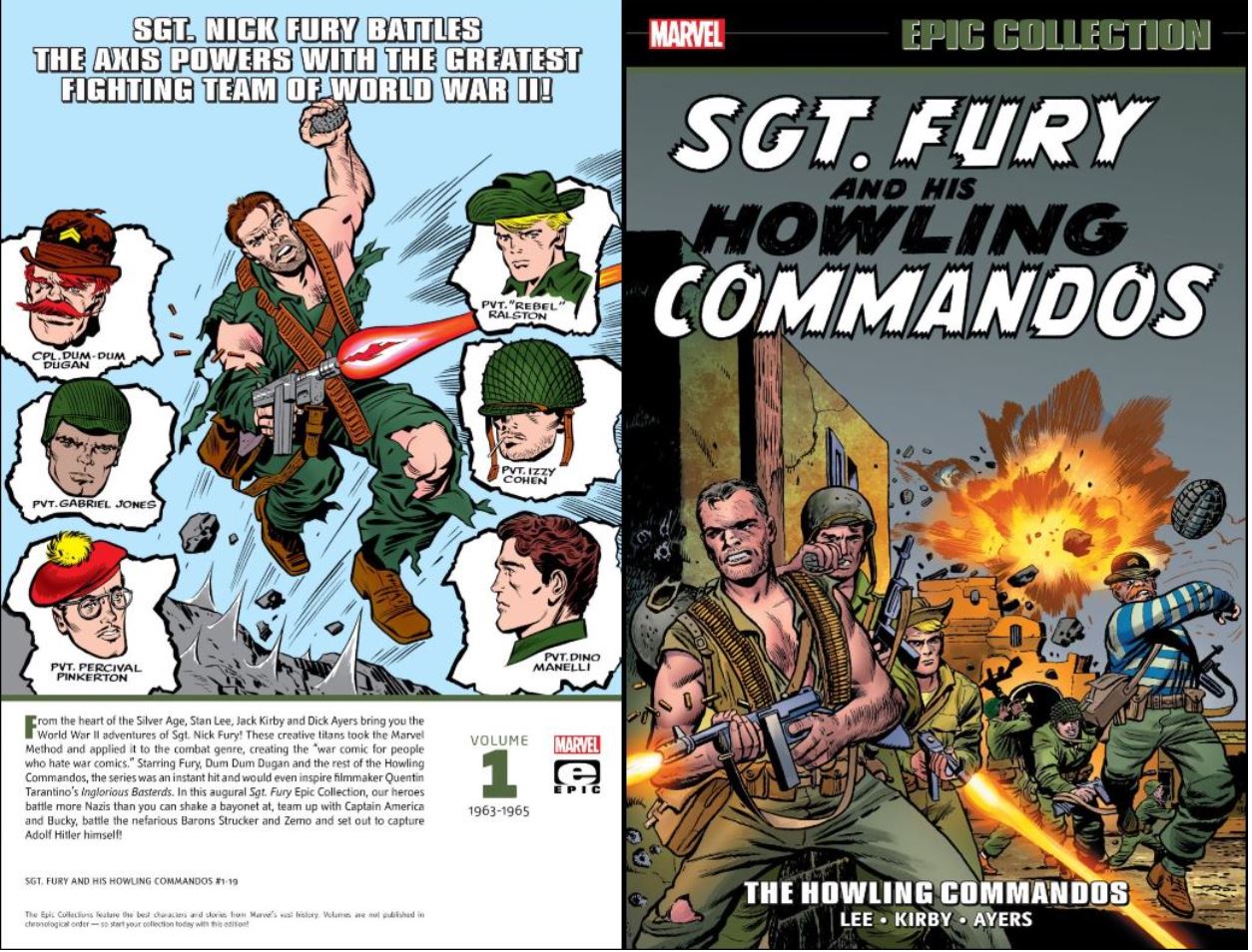
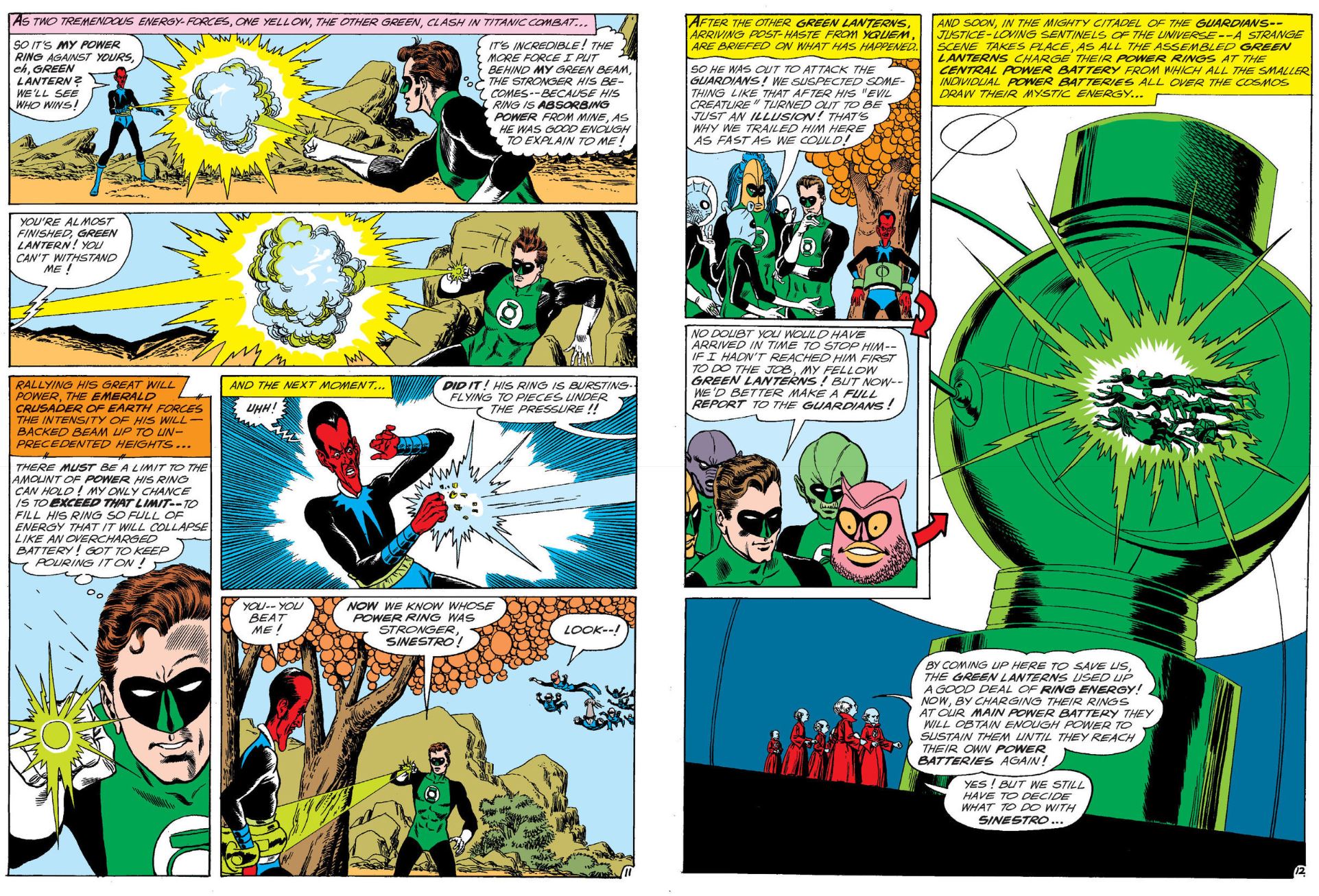
Green Lantern: The Silver Age volume 1


By John Broome, Gardner Fox, Gil Kane, Mike Sekowsky, Carmine Infantino, Ross Andru, Joe Giella, Murphy Anderson & various (DC Comics)
ISBN: 978-1-4012-6348-5 (TPB/Digital edition)

This book includes Discriminatory Content produced in less enlightened times.

Today marks the centenary of Eli Katz, who, as Gil Kane, worked from the Golden Age until his death (on January 31st 2000) to make comics the art form it is today. Diligent, resolute and always challenging himself, Kane was a trendsetting pioneer in style, in form and in comics philosophy. He was also a visual architect of the superhero revival in the Silver Age and a key component in the evolution of the Graphic Novel.

Gil Kane worked as an artist, and an ever-more effective and influential one, drawing – and writing – for many companies since his 1940s debut: on superheroes, action, war, mystery, romance, movie adaptations and, perhaps most importantly, Westerns and Science Fiction tales. In the late 1950s Kane was one of editor Julius Schwartz’s go-to artists for regenerating the superhero. Yet by 1968, at the top of his (admittedly much denigrated) profession, this relentlessly revolutionary and creative man felt so confined by juvenile strictures of the industry that he struck out on new ventures, jettisoning editorial and format bounds of comic books for new visions and media.

His Name Is Savage was an adult-oriented monochrome magazine about a cold and ruthless super-spy in the James Bond/Man Called Flint mould, co-written by friend & collaborator Archie Goodwin. It was very much a precursor in tone, treatment and subject matter to many of today’s adventure titles. The other venture, Blackmark (also with Goodwin), not only ushered in an era of comic book Sword & Sorcery, but became one of the first Graphic Novels. Technically, as the series was commissioned by publisher Ballantine as eight volumes, it was also America’s first comic Limited Series. Volume 1 launched in January 1971, with volume 2 just completed when the publisher killed the project. Albeit a generation Kane’s junior, long term seasoned collaborator Roy Thomas reprinted those tales in Marvel’s Savage Sword of Conan and Marvel Preview, with artwork rejigged to accommodate a different page format.

In comic books Kane’s milieux included Boy Commandos, Young Allies & Newsboy Legion, Johnny Thunder, Jimmy Wakely, Hopalong Cassidy, Rex the Wonder Dog, The Atom, Plastic Man, Robin, Batgirl, Batman, Superman, Flash, Hawk and Dove, Captain Action, T.H.U.N.D.E.R. Agents, U.N.D.E.R.S.E.A. Agent, plus hundreds of genre yarns – romance, war, sci fi, western and horror – before landing at Marvel Comics to reinvent Amazing Spider-Man, Captain America, Thor, Hulk, Ka-Zar and Captain Marvel, co-creating Adam Warlock, Morbius, Iron Fist. He adapted John Carter, Warlord of Mars and other adventure fantasy properties and reinvigorated dozens of horror-hero and superhero stalwarts, all while filling in on seemingly every character and cover going…

Restless and craving what the medium could still achieve, he created newspaper strip Star Hawks (in 1977 with Ron Goulart) and numerous special projects like Jason Drum for Le Journal de Tintin and The Ring of the Nibelung. Also working as Gil Stack, Scott Edward, Stack Til, Stacktil, Pen Star and Phil Martell, Kane was a foundation stone of comics and remains a vivid, vital inspiration to future generations of creators and readers.

With all that in mind let’s revisit a character he co-created and who will be forever associated with Kane: the Silver Age Emerald Gladiator…

After their hugely successful revival and reworking of The Flash, DC (or National Comics as they were) were keen to build on the resurgent superhero trend. Showcase #22 hit the stands at the same time as the fourth issue of the new Flash comic book – #108 – and once again the guiding lights were Editor Julie Schwartz & writer John Broome. Assigned as illustrator was action ace Gil Kane, generally inked by Joe Giella.

This fabulous paperback compilation gathers Showcase #22-24 (September/October 1959 to January/February 1960) and Green Lantern #1-9 (July/August 1960-November 1961) and reveals how a Space Age reconfiguration of the Golden-Age superhero with a magic ring replaced mysticism with super-science.

Hal Jordan was a young test pilot in California when an alien policeman crashed his spaceship on Earth. Mortally wounded, Abin Sur commanded his ring – a device which could materialise thoughts – to seek out a replacement officer, honest and without fear. Scanning the planet it selected Jordan and brought him to the crash-site. The dying alien bequeathed his ring, the lantern-shaped Battery of Power and his profession to the astonished Earthman.

In six pages ‘S.O.S Green Lantern’ established characters, scenario and narrative thrust of a series that would increasingly become the spine of DC continuity, leaving room for another two adventures in that premiere issue. ‘Secret of the Flaming Spear!’ and ‘Menace of the Runaway Missile!’ were both contemporary thrillers set against the backdrop of the aviation industry at a time when the Cold War was at its height. Unlike Flash’s debut, the publishers were now confident of their ground. The next two issues of Showcase carried the new hero into even greater and more fantastic exploits. ‘Summons from Space’ sent Green Lantern to another world: saving an emerging race from a deadly threat at the behest of the as-yet-unnamed leaders of the Green Lantern Corps, whilst ‘The Invisible Destroyer’ pitted the neophyte Emerald Gladiator against earthbound eerie menace – a psychic marauder that lived on atomic radiation.

Showcase #24 (January/February 1960) featured another spy-ring in ‘The Secret of the Black Museum!’ but Jordan’s complex social life took centre-stage in ‘The Creature That Couldn’t Die!’ when the threat of an unstoppable monster paled before the insufferable stress of being his own rival. Hal’s boss Carol Ferris, controversially left in charge of her father’s aviation company (an utterly radical concept in 1960 when most women were still considered fainting-fodder fluff), won’t date an employee, but is deliriously happy for him to set her up with glamorous, mysterious GL…

Six months later Green Lantern #1 was released. All previous tales had been dynamically drawn by Kane & Giella, in a visually arresting and exciting manner, but the lead tale here, ‘Planet of Doomed Men’ was inked by the astoundingly multi-talented Murphy Anderson, and his fine line-work elevated the tale (more emergent humans in need of rescue from another monster) to the status of a minor classic. Giella returned for the second tale, ‘Menace of the Giant Puppet!’, in which GL fought his first – albeit rather lame – supervillain, the Puppet Master.

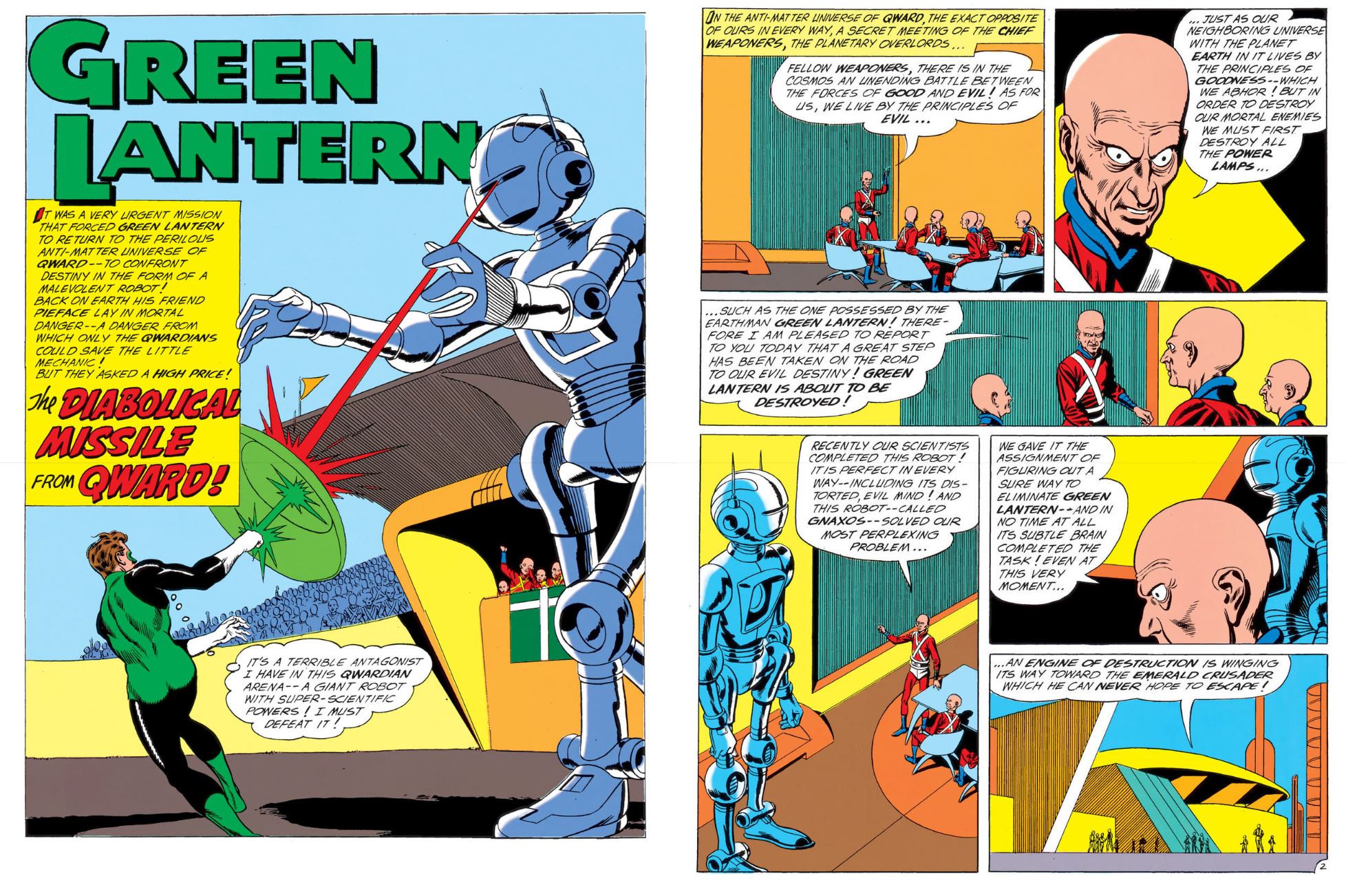
The next issue originated a concept that would be pivotal to the future of DC continuity. ‘The Secret of the Golden Thunderbolts!’ featured an Antimatter Universe and the diabolical Weaponers of Qward: a twisted race who worshipped Evil, and whose criminals (i.e. people who wouldn’t lie, cheat, steal or kill) wanted asylum on Earth. Also inked by Anderson, this is an early highpoint of tragic melodrama from an era where emotionalism was actively downplayed in comics. The second story ‘Riddle of the Frozen Ghost Town! is a crime thriller highlighting the developing relationship between the hero and his Inuit (then “Eskimo”) mechanic Tom “Pieface”Kalmaku.

The Qwardians returned in the all-Giella-inked #3, leading with ‘The Amazing Theft of the Power Lamp!’ before Jordan’s love life again spun out of control in ‘The Leap Year Menace!’, whilst GL #4 saw the hero trapped in the antimatter universe in ‘The Diabolical Missile from Qward!’ (Anderson inks) nicely balanced by light-&-frothy mistaken-identity caper ‘Secret of Green Lantern’s Mask!’ This last was apparently crafted by a veritable round-robin raft of pencillers including Kane, Giella, Carmine Infantino, Mike Sekowsky and Ross Andru…

Issue #5 was a full-length thriller introducing Hector Hammond, GL’s second official recurring super-foe in ‘The Power Ring that Vanished!’: a saga of romantic intrigue, mistaken identity and evolution gone wild. This was followed by another pure science fiction puzzler ‘The World of Living Phantoms!’ (Kane & Giella), debuting avian Green Lantern Tomar Re and opening up the entire universe to avid readers.

Having shown us other GLs, Broome immediately excelled himself in the next episode. ‘The Day 100,000 People Vanished!’ brought the Guardians of the Universe into the open to warn of their greatest error: renegade Green Lantern Sinestro who, in league with Qwardians, had become a threat to the entire universe. This taut, tense shocker introduced one of the most charismatic and intriguing villains in the DCU, and the issue still had room for a dryly amusing, whimsical drama introducing Tom Kalmaku’s fiancée Terga in ‘Wings of Destiny’.

In the early 1960s DC production wizard Jack Adler devised a process to add enhancing tone to cover illustrations. The finished result was eye-catching and mind-blowing, but sadly, examples such as the cover of #8 here really don’t work with the glossy pages and digitised colour-tints of modern reproduction. Never mind, though, since contents ‘The Challenge from 5700 AD!’ comprise a fantasy tour de force as the Emerald Gladiator is shanghaied through time to save the future from an invasion of mutant lizards…

Sinestro returned in the next issue – the last in this astounding cosmic collection – with his own super-weapon in ‘The Battle of the Power Rings!’ (with Anderson again substituting for Giella) but the real gold is ‘Green Lantern’s Brother Act’, with the revelation of Hal’s two brothers and a snoopy girl reporter convinced young Jim Jordan is secretly the ring-slinging superhero. This wry poke at DC’s house plot-device shows just how sophisticated Schwartz & Broome believed their audiences to be.

In those long ago days costumed villains were always third choice in a writer’s armoury: clever bad-guys and aliens always seemed more believable to creators back then. If you were doing something naughty would you want to call attention to yourself? Nowadays the visual impact of buff men in tights dictates the type of foe more than the crimes committed, which is why these glorious adventures of simpler yet somehow better days are such an unalloyed delight. These Fights ‘n’ Tights romps are in themselves a great read for most ages, but when also considered as the building blocks of all DC continuity they become vital fare for any fan keen to make sense of the modern superhero experience.

Judged solely on their own merit, these are snappy and awe-inspiring; beautifully illustrated by a rapidly evolving graphic narrative superstar in ascendance: captivatingly clever thrillers that amuse, amaze and enthral both new readers and old devotees. This collection is a must-read item for anybody in love with our art-form and especially for anyone just now encountering the hero for the first time through his TV incarnation.
© 1959, 1960, 1961, 2016 DC Comics. All Rights Reserved.

Today in 1882 Spanish creator Salvador Bartolozzi (weekly Pinocchio) was born, with The New Yorker cartoonist Chon Day arriving in 1907, Levi Katz in 1926 and crusading Filipino cartoonist Pol Medina Jr. (Pugad Baboy) in 1960. In 1980 Dash Shaw (Bottomless Belly Button, New School, The Unclothed Man In the 35th Century A.D., Courier) joined that august grouping.

In 1936 Frank Leonard’s Mickey Finn strip debuted, and ran until 10th September 1977.

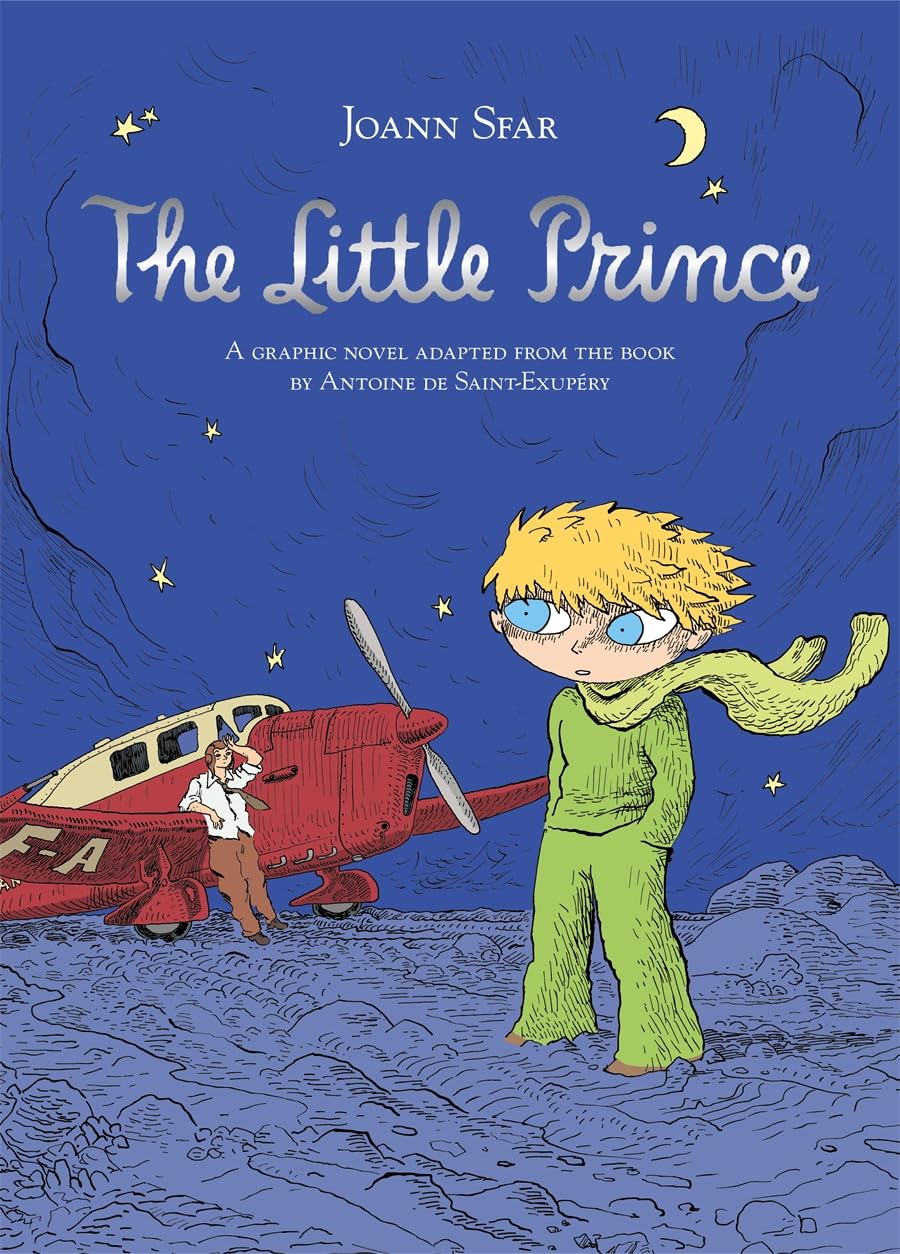
The Little Prince – A Graphic Novel adapted from the book by Antoine de Saint-Exupéry


By Joann Sfar, with colours by Brigitte Findakly, translated by Sarah Ardizzone (SelfMadeHero)
ISBN: 978-1-914224-46-1 (HB)

This book includes Discriminatory Content included for dramatic effect.

The Little Prince was written by warrior, aeronaut, aristocrat, illustrator and auteur Antoine de Saint-Exupéry, Published in 1943 in the US in French & English, and again posthumously in1946 (as the pilot/writer had been Missing; Presumed Dead for two years), it became a glabally popular classic. You should read it in the language of your choice. It’s been adapted into every form of human expression and never failed to impress or deeply move.

In 2008 Joann Sfar adapted it to his preferred medium, and Le Petit Prince: d’après d’oeuvre d’Antoine de Saint-Exupéry was published by Gallimard Jeunesse. In the 80th anniversary year since the original book took off, SelfMadeHero celebrate the event with a fabulous, augmented edition to simply wallow in.

As well as fully re-presenting Sfar’s bold interpretation this tome also offers a fully updated translation and includes a ‘Timeline’ for Antoine de Saint-Exupéry and his creations, and from Ardizzone herself a concluding ‘Translator’s Note – The Reader Perched on Your Shoulder’ to accompany the now-traditional creators’ biographies as closing ‘Authors’ section.

You’ve heard this before and its’s still utterly true, some things you don’t talk about, you just do, and this mesmerising adaptation is the very epitome of that. Here’s all you get from me…

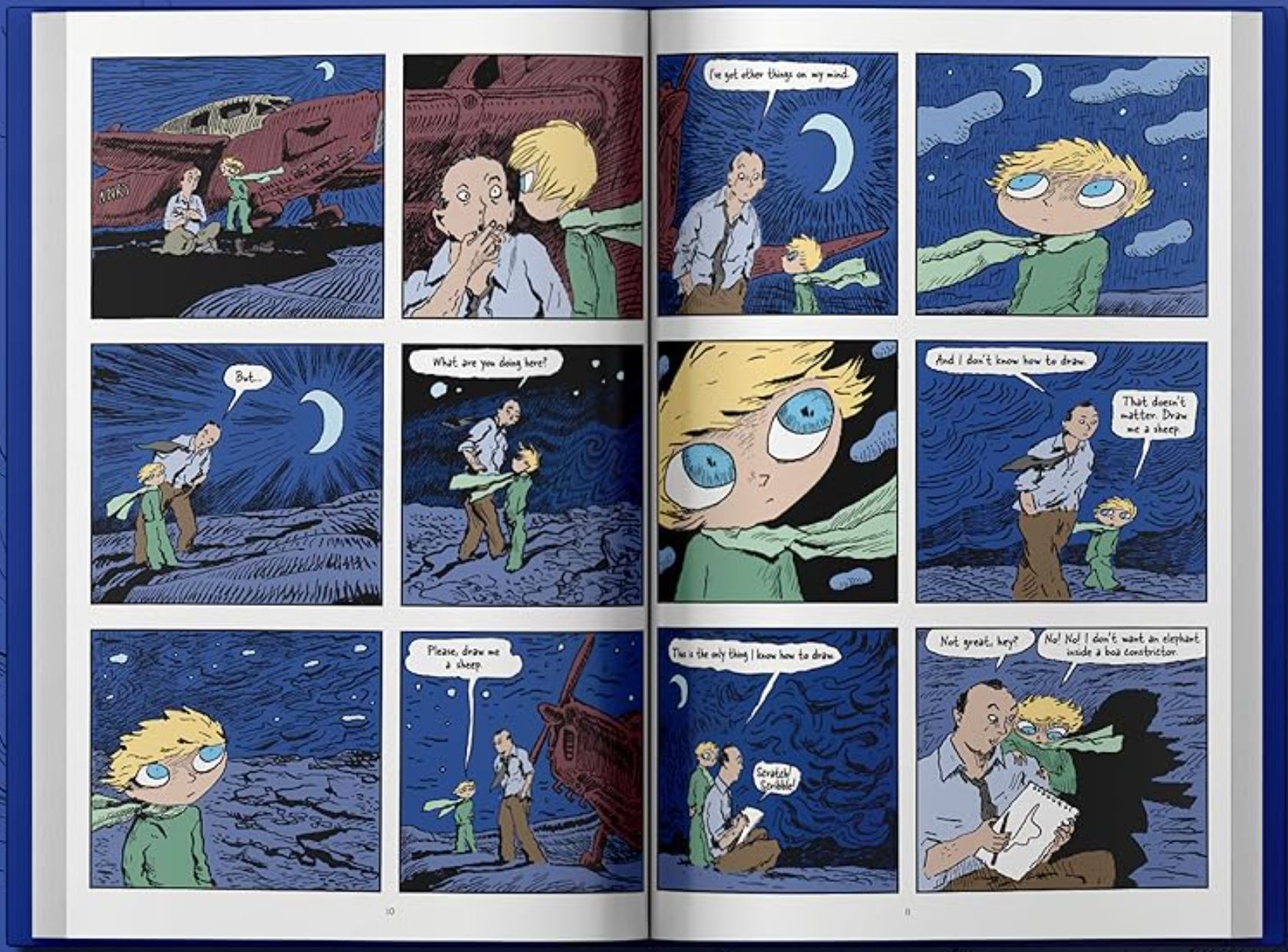
In the African desert an aviator strives to repair his downed plane. The work is hard, his head hurts and he doesn’t really know what he’s doing. He always wanted to be an artist, not a flier doomed to die of thirst and loneliness in blistering heat…

Abruptly his prospects change as a strange, golden-haired boy asks him to draw a sheep…

Soon the politely engaging lad is keeping him company as he works: telling of the strange small planet he came from, the oddly toxic relationship that compelled him to leave, and the bizarre individuals he met in his travels through space to Earth. Companionship is welcome, even if the shared tales are dolorous and often painful and distressing to hear, but as the aviator adapts to the fact that he probably won’t make it, he increasingly fears for the mournful child. The Little Prince claims to be preparing to return to his small world and lost inamorata, but only seems to be courting the company of the deadly, poisonous reptiles that abound in the arid wastelands…

In a place most folks don’t visit anymore, there’s a secret list of all the books and stories one needs to read to be considered a human being. This is on it (quite near the top, in fact) and, even as radically re-imagined as it was been here by Sfar, demands your attention and consideration.

So go do that then. Vite! Vite!
© Gallimard Jeunesse, 2008. English translation © Sarah Ardizzone, 2010, 2026. All rights reserved.

Yesterday in 1962 Swedish comics maven Joakim Lindgren was born, but in 1957, we lost Jack Butler Yeats, creator of Chublock Holmes in Comic Cuts (arguably the first comic book serial), Underground Commix mega-star Dave Sheridan in 1982, Italian comics stalwart Nicola Del Principe (Le Justicier Masqué, Tom and Jerry) in 2002 and in 2013 Spanish/Argentine artist, cartoonist, animator and publisher Manuel García Ferré.

Yesterday in 1991, iconoclastic UK all-star comic Toxic began: running until October 24 of that year and introducing many cool characters such as Accident Man, The Bogie Man and Marshal Law.

Today in 1901, foundational Croatian comics artist Andrija Maurovi? (Empress of the Netherworld, Beware the Hand from Senj) was born, as was Mark Trail cartoonist Jack Elrod in 1924, and UK scribbler David Austin (Hom Sap) in 1935. Trail-blazing Wayne Howard (first US creator to be cover-credited for a strip series) was born in 1949, Val Mayerik (Howard the Duck co-creator) one year later, Marc Silvestri in 1958 and Jim Mahfood (Clerks, Grrl Scouts, Spider-Man, The Further Adventures of One Page Filler Man, Carl, The Cat That Makes Peanut Butter Sandwiches) in 1975. In 1983, Gene Ahern’s 60-year run on legendary strip Our Boarding House ended with its cancelation. Two years later Kerry Drake creator Alfred Andriola died, followed in 2007 by writer Leslie Waller, co-creator (with Arnold Drake & Matt Baker) of the “first US Original Graphic Novel” It Rhymes with Lust (St John Press Picture Novel, 1950).

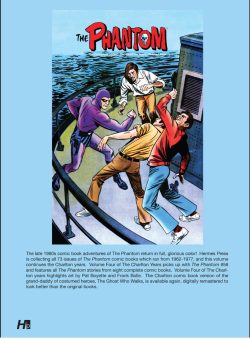
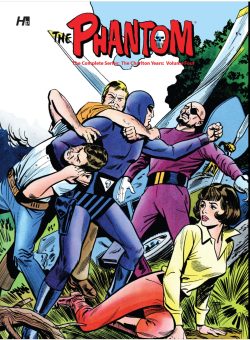
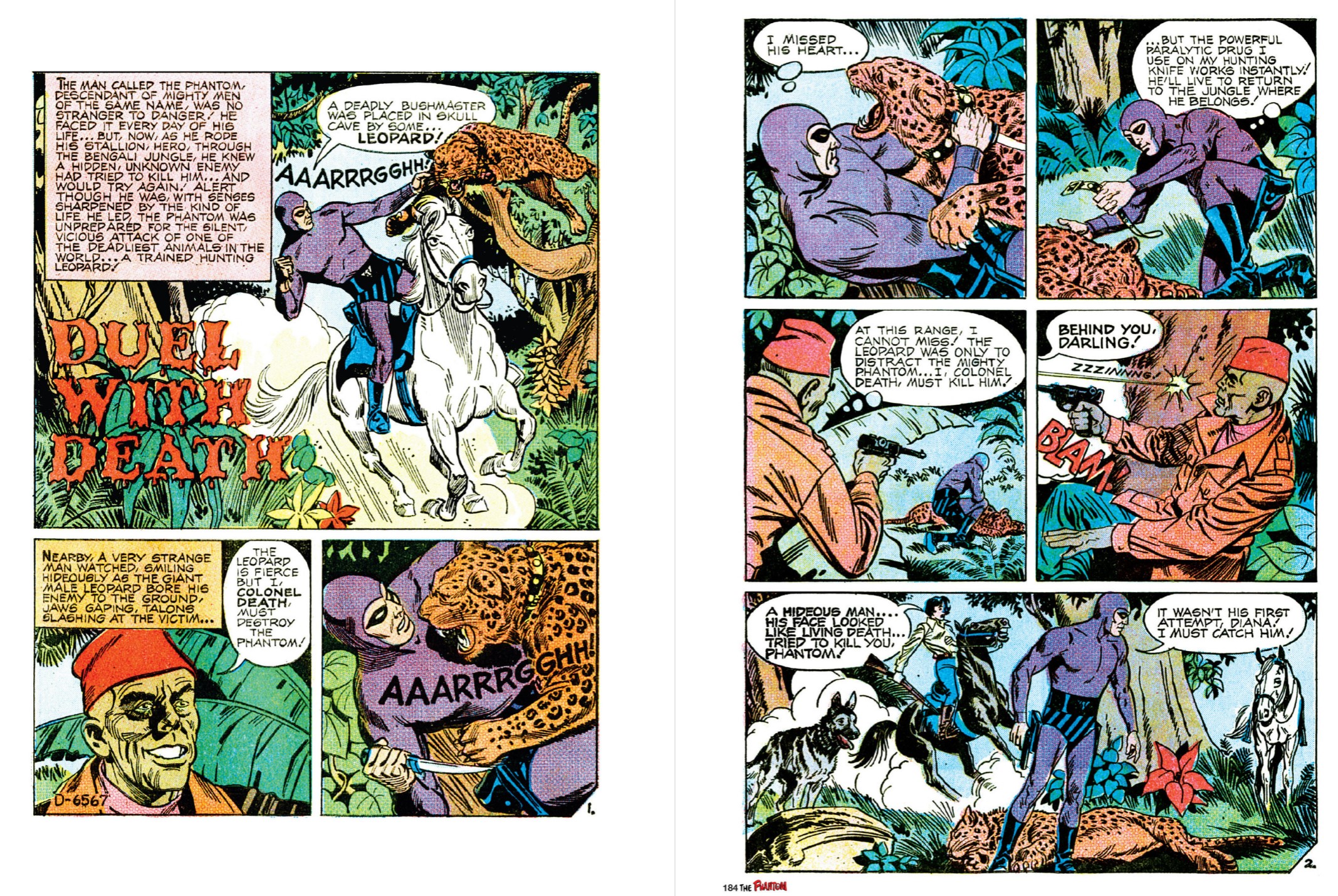
The Phantom: The Complete Newspaper Dailies volume 1 1936-1937


By Lee Falk & Ray Moore: introduction by Ron Goulart (Hermes Press)
ISBN: 978-1-932563-41-5 (HB/Digital edition)

This book includes Discriminatory Content produced in less enlightened times.

There are plenty of comics-significant anniversaries this year, and this guy is probably right at the top of the birthday cake. As next month sees his 90th anniversary here’s tasty reminder of why he is considered one of our industry’s landmark figures.

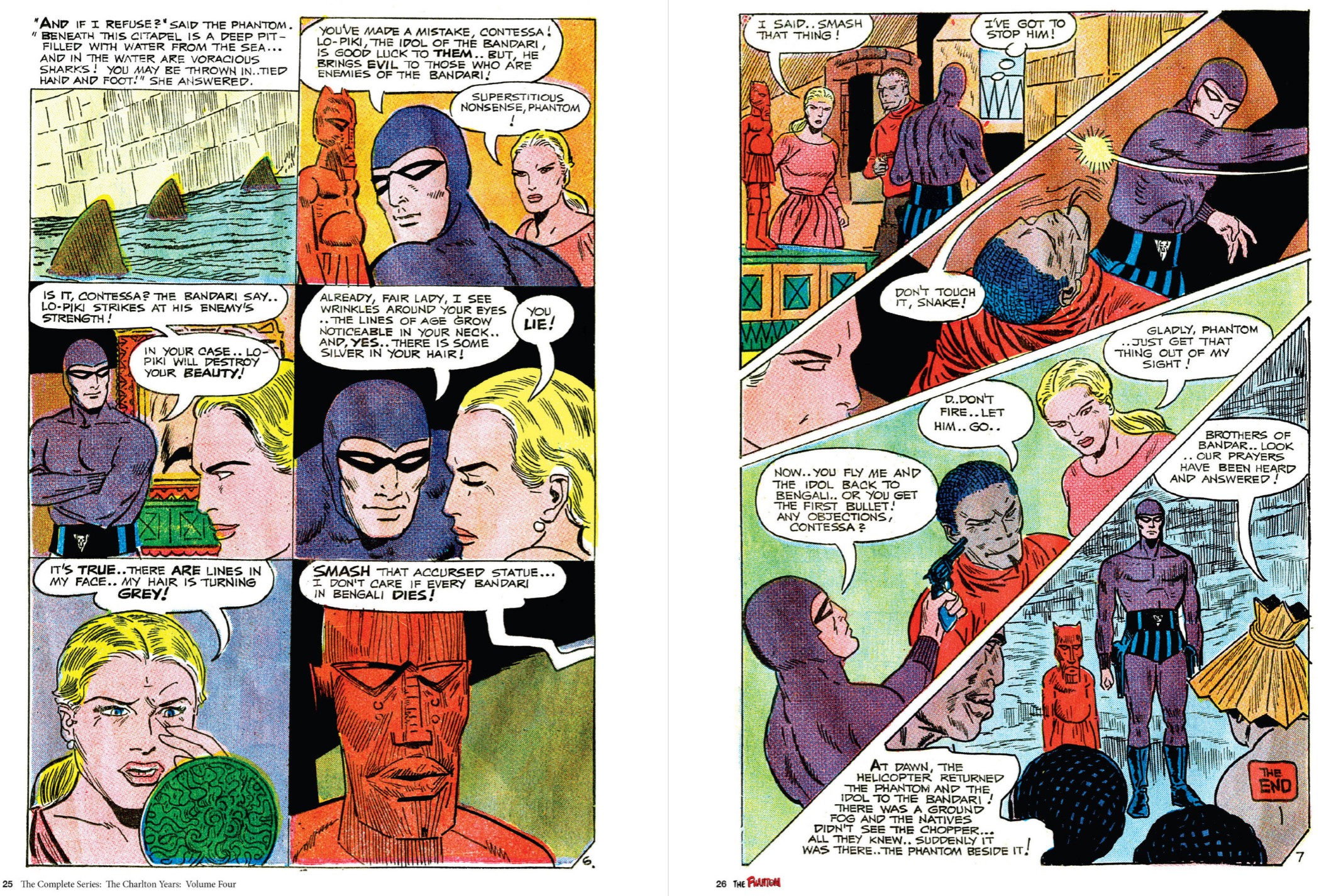
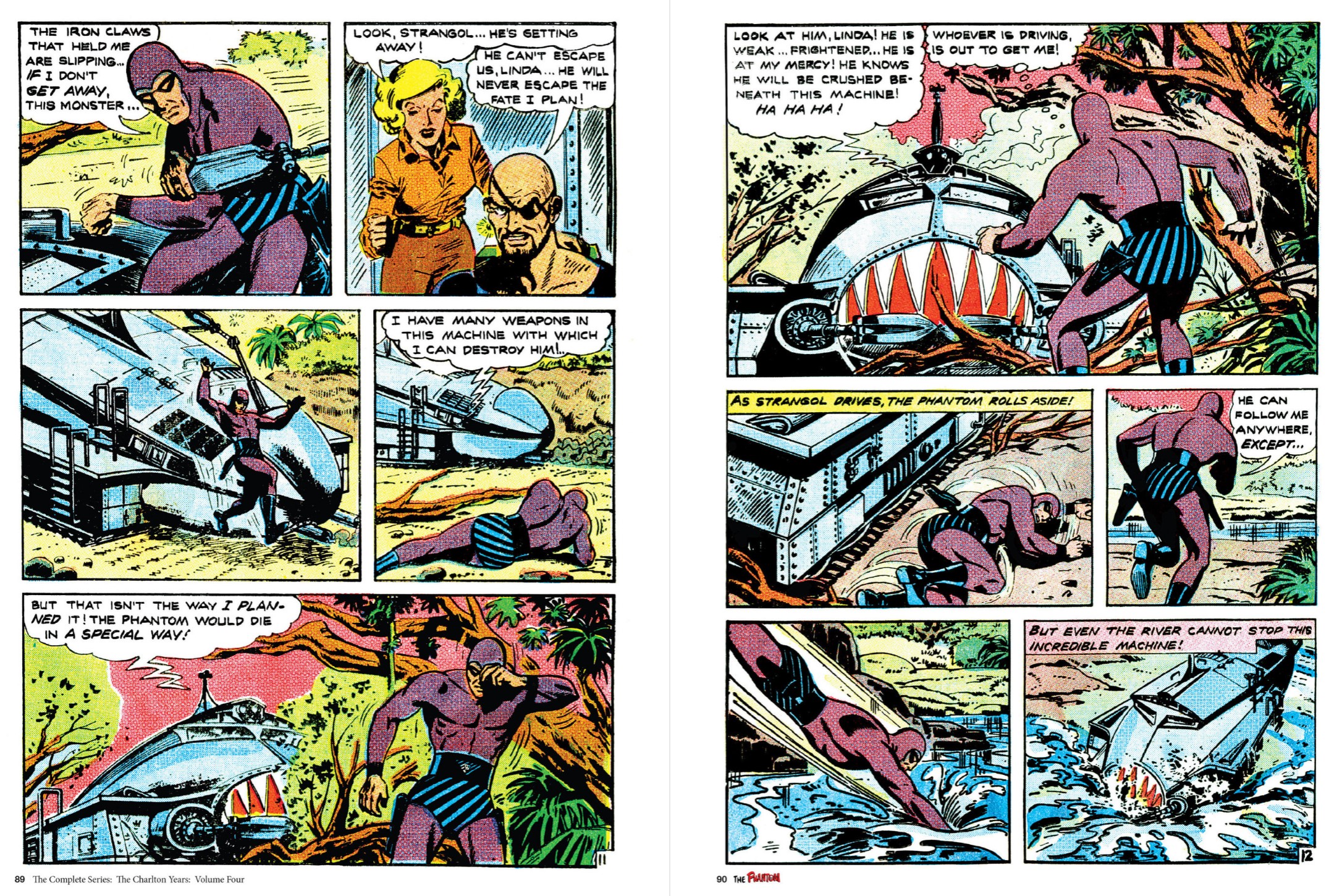
For such a long-lived, influential series, in terms of compendia or graphic novel collections, The Phantom has been very poorly served by the English language market (except in Australia where he has always been accorded the status of a pop culture god). Numerous companies have sought to collect the strips – one of the longest continually running adventure serials in publishing history – but in no systematic or chronological order and never with any sustained success. At least the former issue began to be rectified with this initial curated collection from Archival specialists Hermes Press. This particular edition is a lovely large hardback (albeit also available in digital formats), printed in landscape format, displaying two days strip per page in black & white with ancillary features and articles in dazzling colour where required.

Born Leon Harrison Gross, Lee Falk created the Jungle Avenger at the request of his King Features Syndicate employers who were already making history, public headway and loads of money with his first strip sensation Mandrake the Magician. Although technically not the first ever costumed champion in comics, The Phantom’s instant popularity made him the prototype paladin as he was the first to wear a skin-tight body-stocking and have a mask with opaque eye-slits…

“The Ghost Who Walks” debuted on February 17th 1936 in an extended sequence pitting him against an ancient global confederation of pirates. Falk wrote and drew the daily strip for the first two weeks before handing over illustration to artist Ray Moore. A spectacular and hugely influential Sunday feature began in May 1939. In a text feature stuffed with sumptuous visual goodies like movie posters; covers for comics, Feature and Little Big Books plus many kinds of merchandise, Ron Goulart’s eruditely enticing ‘Introduction: Enter the Ghost Who Walks’ tells all you need to know about the character’s creation before the vintage magic begins with ‘Chapter 1: The Singh Brotherhood’.

American adventurer Diane Palmer returns to the USA by sea, carrying a most valuable secret making her the target of mobsters, sleazy society ne’er-do-wells and exotic cultists. Thankfully, she seems to have also attracted an enigmatic guardian angel who calls himself the Phantom

Successive attacks and assaults endanger the dashing debutante, and she learns an ancient brotherhood of ruthless piratical thieves wants her secret, but that they have been opposed for centuries by one man. Kidnapped and held hostage at the bottom of the sea, Diana is saved by the mystery man who naturally falls in love and eventually shares an incredible history with her…

In the 17th century a British sailor survived an attack by pirates, and – washing ashore on the African coast – swore on the skull of his murdered father to dedicate his life and that of his descendants to destroying all pirates and criminals. The Phantom fights crime and injustice from a base deep in the jungles of Bengali, and throughout Africa is known as the Ghost Who Walks. His unchanging appearance and unswerving war against injustice have led to him being considered an immortal avenger by the credulous and the wicked. Down the decades, one hero after another has fought and died in an unbroken family line, and the latest wearer of the mask, indistinguishable from the first, continues the never-ending battle. And he’s looking to extend the line and the legend…

In the meantime, however, there’s the slight problem of Emperor of Evil Kabai Singh and his superstitious armies to deal with…

‘Chapter 2: The Sky Band’ (originally published from 9th November 1936 to April 10th 1937) finds the mystery avenger caught in love’s old game as a potential rival for Diana’s affections materialises in the rather stuffy form of career soldier Captain Meville Horton: a decent, honourable man who sadly knows when he’s outmatched, unwanted and in the way. Mistakenly determined to do the right thing too, our masked mystery man concentrates on destroying a squadron of thieving aviators targeting the burgeoning sky clipper trade: airborne bandits raiding passenger planes and airships throughout the orient. Initial efforts infuriatingly lead to the Phantom’s arrest: implicated in the sky pirates’ crimes, before escaping from police custody with the aid of his devoted “pygmy witch doctor” Guran and faithful Bandar tribe allies, he’s soon hot on the trail of the real mastermind…

Upon infiltrating their base, he discovers the airborne brigands are all women, and that his manly charms have driven a lethal wedge between the deadly commander and her ambitious second in command Sala

A patient plaything of the manic Baroness, The Phantom eventually turns the tide not by force but by batting his invisible eyes and exerting his masculine wiles upon the hot-blooded – if certifiably psychopathic – harridan, unaware until too late that his own beloved, true-blue Diana is watching. When she then sets a trap for the Sky Band, it triggers civil war in the gang, a brutal clash with the British army and the seeming end of our hero, triggering Diana’s despondent decision to return alone to America…

‘Chapter 3: The Diamond Hunters’ opened on April 12th 1936 and revealed how the best laid plans can go awry. In Llongo territory, white prospectors Smiley and Hill unearth rich diamond fields but cannot convince or induce local tribes to grant them mineral rights to the gems they consider worthless. Like most indigenous Africans, they’re content to live comfortably under the “Phantom’s Peace” and it takes all the miners’ guile – including kidnapping a neighbouring chief’s daughter and framing the Llongo; gunrunning and claiming the Ghost Who Walks has died – to set the contented residents at each other’s throats. Recovering from wounds, the Phantom is slow to act, but when he does his actions are decisive and unforgettable…

With the plot foiled and peace restored, Smiley flees, only to encounter a returned Diana who has acted on news that her man still lives. Seeing a chance for revenge and profit, Smiley kidnaps “the Phantom’s girl”, provoking his being shunned by all who live in the region, a deadly pursuit and spectacular last-minute rescue. Smiley’s biggest and last mistake is reaching the coast and joining up with a band of seagoing pirates…

At least he is the catalyst for Diana and The Ghost finally addressing their romantic issues…

To Be Continued…

‘Afterword: For Those Who Came in Late…’ then sees editor Ed Rhoades offer his own thoughts on the strip’s achievements and accomplishments.

Stuffed with chases, assorted fights, torture, blood & thunder antics, daredevil stunts and many a misapprehension and coincidence – police and government authorities clearly having a hard time believing a pistol-packing masked man with a pet wolf might not be a bad egg – this a pure enthralling excitement that still packs a punch and plenty of sly laughs.
© 2010 King Features Syndicate, Inc.: ® Hearst Holdings, Inc.; reprinted with permission. All rights reserved.

Today in 1907, astounding illustrator Bruno (Doom Patrol, Teen Titans) Premiani was born, as was artist and inker Chic (Nemesis, Batman, all the best 1960s Thor, X-Men and FF stories) Stone in 1923.

In 1975 Archie co-creator Bob Montana died; and the day is infamous in the UK as the last day Buster was published. Kidding. Nobody noticed because we’d all stopped buying it. We are really sorry now though…

The JSA All Stars Archives volume 1


By John Wentworth, Ken Fitch, Bill O’Connor, Sheldon Mayer, Charles Reizenstein, Bill Finger, Stan Aschmeier, Bernard Baily, Ben Flinton & Leonard Sansone, Howard Purcell, Hal Sharp, Irwin Hasen & various (DC Comics)
ISBN: 978-1-4012-1472-2 (HB)

This book includes Discriminatory Content produced in less enlightened times.

Win’s Christmas Gift Recommendation: Golden Aged but Evergreen Enjoyment …8/10
In the JSA’s anniversary year, here’s yet another DC classic collection long overdue for revival and digital return. Until then – and if you can find it – this hardback will make a perfect present for you or yours…

After the actual invention of the comic book superhero – indisputably Action Comics’ debut of Superman in June 1938 – the most significant event in the industry’s history was the combination of individual sales-points into a group. Thus what seems blindingly obvious to us with the benefit of four-colour hindsight was proven: consumers couldn’t get enough of garishly-hued mystery men and combining a multitude of characters inevitably increases readership. Plus, of course, a mob of superheroes is just so much cooler than one… or one-and-a-half if there’s a sidekick involved…

The creation of the Justice Society of America in 1941 (with copies of All-Star Comics #3 going on sale today waaay back then) utterly changed the shape of the budding business. However, before that team could unite they had to be popular enough to qualify, and this superb hardcover sampler gathers the debut adventures of a septet of beloved champions who never quite made it into the first rank but nonetheless scored enough to join the big team and maintain their own solo spots for much of the Golden Age of American Comics.

Whilst most favoured 1940s stalwarts all won their own DC Archive collections (some even making it into digital modern editions this century), this particular tome bundles a bunch of lesser lights – or at least those who never found as much favour with modern fans and revivalists – and features the first 5 appearances of 7 of the JSA‘s “secondary” mystery men: all solid supporting acts in their own anthology homes but who were potentially so much more…

Gathered here are short, sharp, stirring tales from Flash Comics #1-5; Adventure Comics #48-52; All-American Comics #19-29 and Sensation Comics #1-5, collectively spanning January 1940 to May 1942. They are preceded a sparkling, informative and appreciative Foreword by Golden Age aficionado and advocate Roy Thomas… himself enjoying an anniversary today so a very happy 85th birthday to you, sir!

The vintage vim & vigour begins with a character equally adored and reviled in modern times. Johnny Thunderbolt – as he was originally dubbed – was an honest, well-meaning, courageous soul who was also a grade A idiot. However, what he lacked in smarts he made up for with sheer luck, unfailing pluck and the unconscious (at least at first) control of an irresistible magic force.

The series was played for action-packed laughs, but there was no getting away from it: Johnny was, quite frankly, a simpleton in oblivious control of an ultimate weapon. At least his electric genie was more plausible than an egomaniacal orange-toned cretin in control of America’s nuclear arsenal…

John Wentworth & Stan Aschmeier introduced the happy sap in ‘The Kidnapping of Johnny Thunder’ from January 1940’s Flash Comics #1: a fantastic origin detailing how, decades previously, the infant seventh son of a seventh son in America was abducted by priests from mystical island Badhnisia. The child was to be raised as the long-foretold wielder of a fantastic magical weapon, all by voicing the eldritch command “Cei-U” – which sounds to western ears awfully like “say, you”…

However, ancient enemies on neighbouring isle Agolea started a war before ceremonial indoctrination could be completed and at age seven the lad, through that incomprehensible luck, returned to his parents to be raised in relative normality of the Bronx. Everything was fine until Johnny’s 17th birthday, when the rite finally came to fruition and – amid bizarre weather conditions – Badhnisians cultists intensified the search for their living weapon.

By the time they tracked him down, he was working in a department store and had recently picked up the habit of blurting out the phrase “say you.” It generally resulted in something very strange happening. One example being a bunch of strange “Asiatics” attacking him and being blown away by a mysterious pink tornado…

Pattern set, each month Johnny looked for gainful employment, stumbled into a crime or crisis where his voluble temperament resulted in an inexplicable unnatural phenomenon that solved the problem but left him no better off. It was a winning theme that lasted until 1947, by which time the Force had resolved into a wisecracking thunderbolt-shaped humanoid genie, while Johnny was ousted from his own strip by sexy new crimebuster Black Canary.

Flash Comics #2 featured ‘Johnny Becomes a Boxer’. Upon stepping in to save a girl from bullies, Johnny somehow convinces vivacious Daisy Darling to be his girlfriend. He then becomes Heavyweight Champion, leading to his implausibly winning a fixed bout in #3’s ‘Johnny versus Gunpowder Glantz’. Only now, Daisy refuses to marry a brute who lives by hitting others. The solution came in ‘Johnny Law’ when kidnappers attempt to abduct Daisy’s dad. Following his sound thrashing of the thugs, and at his babe’s urging, Johnny then joins the FBI. This tantalising taste of times past concludes with ‘G-Man Johnny’ (#5 May 1940) as the kid’s first case involves him in a bank raid and results in his own dad being taken hostage…

Although he eventually joined the JSA, and despite affable, good-hearted bumbling carrying him through the war, shifting peace-time fashions found no room for a hapless hero anymore, and when he encountered a sultry masked female Robin Hood who stole from crooks, the writing was on the wall. Nevertheless, fortuitously imbecilic (and remarkably Millennial in outlook and prospects) Johnny Thunder is fondly regarded by many modern fans, still having much to say and a decidedly different way of saying it…

Ken Fitch & Bernard Baily’s Hourman was a far more serious proposition. He actually had a shot at stardom and began by supplanting The Sandman as cover feature in Adventure Comics #48 (March 1940). Here, his exploits run through #52 (July) establishing the unique and gripping methodology which made him such a favourite of later, more sophisticated fans.

In an era where origins were never as important as action, mood and spectacle, ‘Presenting Tick-Tock Tyler, the Hour-Man’ begins with a strange classified ad offering assistance to any person in need. Chemist Rex Tyler had invented Miraclo: a drug super-energising him for 60 minutes at a time, and his first case sees him help a wife whose man is being dragged back into criminal endeavours by poverty and bad friends. Then ‘The Disappearance of Dr. Drew’ finds Tyler locating a missing scientist kidnapped by thugs before ‘The Dark Horse’ has the Man of the Hour crush a crooked, murderous bookie who swipes both horse and owner before a key race. Mad science and a crazy doctor employing ‘The Wax-Double Killers’ adds scary thrills and supervillain cachet for our timely hero to handle, and ‘The Counterfeit Hour-Man’ concludes the offerings here as he again defeats Dr. Snegg in a scurrilous scheme to frame the hooded hero.

Hourman always looked great and his adventures developed into tight and compulsive affairs, but as simply another strong, fast, tough masked guy, he never caught on and eventually timed out at the beginning of 1943 with Adventure #83.

Our third second string star is Calvin College student Al Pratt: a diminutive but determined kid fed up with being bullied by jocks. Al remade himself by effort and willpower into a pint-sized, two-fisted mystery man ready for anything. One of the longest lasting Golden Age greats, The Mighty Atom was created by writer Bill O’Connor and rendered by Ben Flinton & Leonard Sansone. He debuted in All-American Comics #19 and, after an impressive run there, transferred to Flash Comics in February 1947. The Atom sporadically appeared until the last issue – #104, cover-dated February 1949 – and made his final bow in the last JSA tale (All Star Comics #57) in 1951.

The cases here span AAC #19-23 (October 1940 – February 1941), beginning by ‘Introducing the Mighty Atom’ as the bullied scholar hooks up with down-&-out trainer Joe Morgan, whose radical methods soon have the kid at the very peak of physical condition and well able to take care of himself. However, when Al’s hoped-for girlfriend Mary is kidnapped, the lad eschews fame and potential sporting fortune to bust her loose, thereafter opting for clandestine extracurricular activities….

The Atom sported a costume for his second adventure, going into ‘Action at the College Ball’ to foil a hold-up before tackling ‘The Monsters from the Mine’ – actually enslaved victims of a scientific maniac intent on conquest. The college environment offered plentiful plot opportunities and in ‘Truckers War’ the hero crushes hijackers who bankrupt a fellow student and football star’s father. These episodes conclude with ‘Joe’s Appointment’ as Al’s trainer is framed for spying by enemy agents and needs a little atomic assistance…

Although we think of the Golden Age as a superhero wonderland, the true watchword was variety. Flagship anthology All-American Comics offered everything from slapstick comedy to aviation adventure on its four-colour pages and one of the very best humour strips featured semi-autobiographical exploits of Scribbly Jibbet: a boy who wanted to draw.

Created by actual comics wonderboy Sheldon Mayer, Scribbly: Midget Cartoonist debuted in AAC #1 (April 1939) and built a sterling rep for himself beside star reprint features including Mutt and Jeff and all-new adventure serial Hop Harrigan, Ace of the Airways. However, when contemporary fashions demanded a humorous look at mystery men, in #20 (November 1940) Mayer’s comedy feature evolved into a delicious spoof of the trend as Scribbly’s formidable landlady Ma Hunkel decided to do something about crime in her neighbourhood… so she dressed up as a husky male masked hero.

‘The Coming of the Red Tornado’ sees her don cape, woollen longjohns and a saucepan for aN identity-obscuring helmet to crush gangster/kidnapper Tubb Torponi. The mobster had made the mistake of snatching Ma’s terrible nipper Sisty and Scribbly’s little brother Dinky (who would later become her masked sidekicks), so Ma was determined to see justice done…

An ongoing serial rather than specific episodes, the dramedy concluded in ‘The Red Tornado to the Rescue’, with irate, inept cops deciding to pursue the mysterious new vigilante, with the ‘Search for the Red Tornado’ only making them look (more) stupid. With the scene set for outrageous parody ‘The Red Tornado Goes Ape’ pits the parochial masked manhunter against a zoo full of critters before the superb, sublime silly selection ends with ‘Neither Man nor Mouse’ (All-American Comics #24) with the hero apparently retiring and crime resurging – until Dinky & Sisty become crime- crunching duo The Cyclone Kids

A far more serious and sustainable contender debuted in the next AAC issue, joining the growing horde of grim masked avengers. Delivered by Charles Reizenstein & Aschmeier in All-American Comics #25 (April 1941), ‘Dr. Mid-Nite: How He Began’ reveals how surgeon Charles McNider is blinded by criminals but subsequently discovers he can see perfectly in darkness. Becoming an outspoken criminologist, the maimed medico devises blackout bombs and other night paraphernalia to also wage secret war on gangsters, aided only by his new pet owl Hooty

After bringing his own assailant to justice, the good doctor smashes river pirates protected by corrupt politicians in ‘The Waterfront Mystery’ and rescues innocent men blackmailed into serving criminals’ sentences in jail in ‘Prisoners by Choice’ (#27, illustrated by Howard Purcell). With Aschmeier’s return, Mid-Nite crushes aerial wreckers using ‘The Mysterious Beacon’ to down bullion planes and then smashes ‘The Menace of King Cobra’: a secret society leader lording it over copper mine workers.

The Master of Darkness also lasted until the era’s end and appeared in that last JSA story. Since his 1960s return he’s become one of the most resilient and mutable characters in DC’s pantheon of Golden Age revivals, whereas the next nearly-star was an almost forgotten man for decades. Of course his nineties reboot successor is a big shot screen star now…

When Sensation Comics launched (on sale from November 5th 1941) all eyes were rightly glued to uniquely eye-catching Wonder Woman who hogged all the covers and unleashed a wealth of unconventional adventures every month. However, like all anthologies of the era, her exploits were balanced by other features. Sensation #1-5 (cover-dates January to May 1942) also featured a pugnacious fighter who was the quintessence of manly prowess and a quiet, sedate fellow problem-solver who was literally a master of all trades.

Crafted by Reizenstein & Hal Sharp, ‘Who is Mr. Terrific?’ introduced physical and mental prodigy Terry Sloane who so excelled at everything he touched, that by the time of the opening tale he was planning his own suicide to escape terminal boredom. Happily, on a very high bridge he found Wanda Wilson, a girl with the same idea. By saving her, Sloane found purpose: crushing the kinds of criminals who had driven her to such despair…

Actively seeking out villainy of every sort, he performs ‘The One-Man Benefit Show’ after thugs sabotage performers, travels to the republic of Santa Flora to expose ‘The Phony Presidente’ and helps a rookie cop pinch an “untouchable” gang boss in ‘Dapper Joe’s Comeuppance’. Sloan’s last showing here sees him at his very best, carefully rooting out political corruption and exposing ‘The Two Faces of Caspar Crunch’

Closing out this stunning hardback extravaganza is another quintet from Sensation #1-5, this time by Bill Finger & Irwin Hasen: already established stars for their work on Batman and Green Lantern.

‘This is the Story of Wildcat’ premieres one the era’s most impressive lost treasures and a genuine comic book classic in the tale of Ted Grant: a boxer framed for the murder of his best friend. Inspired by a kid’s hero-worship of Green Lantern, Grant clears his name by donning a feline mask and costume and ferociously stalking the true killers. Finger & Hasen captured everything which made for perfect rollercoaster adventure in their explosive sports-informed yarns. Mystery, drama and action unfolded unabated in sequel ‘Who is Wildcat?’ as Ted retires his masked identity to compete for the vacant world boxing title, but cannot let innocents suffer as crime and corruption befoul the city. ‘The Case of the Phantom Killers’ sees Wildcat stalk mobsters seemingly striking from beyond the grave, before his adventures alter forever with the introduction of hard-hitting hillbilly hayseed ‘Stretch Skinner, Dee-teca-tif!’ He came to the big city to be a private eye and instead became Grant’s foil, manager and crimebusting partner. The capsule comic craziness then concludes for now with a rousing case of mistaken identity and old-fashioned framing, as Wildcat saves his new pal from a murdering gambler in ‘Chips Carder’s Big Fix’…

These eccentric early adventures might not suit some modern fans’ tastes but they stand as an impressive and joyous introduction to the fantastic worlds and exploits of the World’s oldest if not always greatest superheroes. If you have an interest in the way things were or just hanker for simpler times, less complicated and angsty fun, this may well be a book you’ll cherish forever…
© 1940, 1941, 1942, 2007 DC Comics, Inc. All Rights Reserved.

Also Today, in 1901 Roy Crane was born. His Wash Tubbs, Captain Easy and Buz Sawyer all shaped the way comics evolved and deserve your attention. In 1923 Belgian cartoonist Paul (Corentin) Cuvelier was born. You can celebrate the birthday of Marjane Satrapi who joined the world in 1969 by checking out Persepolis – The Story of a Childhood & Persepolis 2 – The Story of a Return or recall the wonders of C.C. Beck who died today in 1989 just by heading to The Shazam! Archives volume 1. Better yet, you could skip my blather and just read the actual books I’m plugging…

Buck Danny volumes 2 & 3: The Secrets of the Black Sea & Ghost Squadron


By Francis Bergése & Jacques de Douhet; colours by Frédéric Bergése: translated by Jerome Saincantin (Cinebooks)
ISBN: 987-1-84918-018-4 (Album TPB – Black Sea) 987-1-905460-85-4 (Album TPB – Ghost Squadron)

This book includes Discriminatory Content produced during less enlightened times.

Buck Danny premiered in Le Journal de Spirou in January 1947 and continues soaring across assorted Wild Blue Yonders to this day. The strip describes the improbably long yet historically significant career of the eponymous Navy pilot and his wing-men Sonny Tuckson and Jerry Tumbler. As one of the world’s last aviation strips the series has always closely wedded itself to current affairs, from the Korean War to Afghanistan, the Balkans to Iran…

The US Naval Aviator was created by Georges Troisfontaines whilst he was Director of Belgian publisher World Press Agency and realised by Victor Hubinon before being handed to multi-talented scripter Jean-Michel Charlier, then working as a junior artist. Charlier’s fascination with human-scale drama and rugged realism had been first seen in such “true-war” strips as L’Agonie du Bismark (The Agony of the Bismarck – published in LJdS in 1946). Charlier and René Goscinny were co-editors of Pistolin magazine from 1955-1958 and subsequently created Pilote in 1959. When they, with fellow creative legend Albert Uderzo, formed the Édifrance Agency to promote the specialised communication benefits of comic strips, Charlier continued scripting Buck Danny and did so until his death. Thereafter his artistic collaborator Francis Bergése (who had replaced Hubinon in 1978) took complete charge of the All-American Air Ace’s exploits, working with other creators like Jacques de Douhet.

Like so many artists involved in aviation storytelling, Bergése (born in 1941) started young with both drawing and flying. He qualified as a pilot whilst still a teenager, enlisted in the French Army and was a reconnaissance flyer by his twenties. At age 23 he began selling strips to L’Étoile and JT Jeunes (1963-1966), after which he produced his first aviation strip – Jacques Renne for Zorro. This was followed by Amigo, Ajax, Cap 7, Les 3 Cascadeurs, Les 3 A, Michel dans la Course and more. Prior to 1983, Bergése was a jobbing artist on comedies, pastiches and WWII strips until he won the coveted job of illustrating globally syndicated Buck Danny with 41st yarn ‘Apocalypse Mission’.

Bergése even found time in the 1990s for episodes of a European interpretation of British icon Biggles before finally retiring in 2008, passing on the reins (control? Joystick? Nope, absolutely not that last one) to illustrators Fabrice Lamy & Francis Winis and scripter Frédéric Zumbiehl. Thus far – with Zumbiehl, Jean-Michel Arroyo & Gil Formosa all taking turns at the helm – the franchise has notched up 60 albums and a further 10 spin-off tomes…
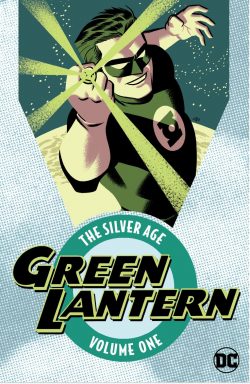
Like all Danny tales, these Cinebook editions are astonishingly authentic: breezily compelling action thrillers. Back in 1994, Buck Danny #45: Les secrets de la mer Noire, delivered a suspenseful, politically-charged action yarn which became the second Cinebook volume, blending mindboggling detail and technical veracity with good old-fashioned blockbuster derring-do.


The Secrets of the Black Sea

In-world, it’s 1991 and the dying days of the Soviet Empire. When a submarine incident occurs, the American Chief of Naval Operations dispatches Buck to the newly open Russia of “Glasnost and Perestroika” to ascertain the true state and character of the old Cold War foe. All but ordered to become a spy, Buck is further perturbed by his meeting with ambitious Senator Smight, a US dignitary supposed to be his contact and cover-story on the trip to heart of Communism…

Buck is an old acquaintance and recurring target of the KGB and knows that no matter what the official Party Line might be, many Soviet Cold Warriors have long and unforgiving memories…

No sooner does he make landfall than his greatest fears are realised. Shanghaied to a top secret Russian Naval super-vessel, Buck knows he’s living on borrowed time,: but his death is apparently only a pleasant diversion for the KGB renegade in charge, whose ultimate plans involve turning back the clock and undoing every reform of the Gorbachev administration; gleefully anticipating how the key component to the diabolical scheme will be a conveniently dead American spy in the wrong place at the right time…

Of course, the ever-efficient US Navy swings into action, resolved to rescue their pilot, clean up the mess and deny the Reds any political victory, but there’s only so much Tumbler & Tuckson can do from the wrong side of the recently re-drawn Iron Curtain. Luckily, Buck has some unsuspected friends amongst the renegades too…

Fast-paced, brimming with tension, packed with spectacular air and sea action and delivered like a top-class James Bond thriller, The Secrets of the Black Sea effortlessly catapults the reader into a dizzying riot of intrigue, mystery and suspense in a superb slice of old-world razzle-dazzle that enthrals from the first page to the last panel and shows just why this brilliant strip has lasted for so long.


Ghost Squadron

This third sitting offers more of the same fantasy realpolitik in a contemporary war setting. First published in 1996 as Buck Danny #46 L’escadrille fantôme and still a family affair with Frédéric Bergése adding colours to papa’s pictures. It’s 1995 and, above shattered Sarajevo, Tuckson and pioneer female fighter pilot Cindy McPherson patrol as part of the UN Protection Force. UNProFor is the West’s broad but criminally ineffectual coalition to stop various factions in the region butchering each other, but fails hard, big and often…

The overflight takes a dark turn when Cindy’s plane is hit by Serb rockets in contravention of all the truce rules. Incensed, Tuckson peels off to open up with machine gun fire without obtaining the proper permissions. Subsequently nursing McPherson’s burning plane back to their carrier in the Baltic, Sonny doesn’t care how much trouble he’s in, but rather than facing a Court Martial, the impetuous lad’s punishment is rather unique…

Called to interview with the Admiral, the pensive pilot expects at the very least to be thrown as food to the skipper’s vile dog O’Connor, but instead meets enigmatic Mr. Tenderman before being seconded to a top secret “Air Force/Navy Coordination” mission. Wise confidante Buck, meanwhile, is gone, part of an op to locate an unexplained radar echo in an area supposedly neutral and empty…

After wishing Cindy a fond farewell and hinting at his big CIA secret posting, Sonny ships out by helicopter, landing at Prevesa Airbase in Greece. Bewilderment is replaced with terror and rage once he unpacks and discovers O’Connor has stowed away in his kit. Now stuck with the infernal, nastily nipping mutt, Sonny’s screams draw an old friend into his room: maverick test pilot/old partner in peril Slim Holden. That inveterate rulebreaker also has no idea what they’ve been roped into…

Next day the conundrum continues as they and a small group of pilots – also with no idea of why they’re here or where they’re going – are shipped to a secret base in the mountains. After the military’s usual “hurry up and wait” routine, the wary fliers are greeted by a familiar face…

Buck is introduced as Colonel Y by grimly competent General X, and assigns each pilot a number from 1 to 16. The only thing they know is that all have committed serious breaches of military discipline and will have the record wiped clean once the mission is over. Moreover, as long as they’re here, they will refer to each other only by their code numbers…

Awaiting them are unmarked F-16s without radios. They are to train on the jets in preparation for an unspecified single task under the strictest security conditions, until finally apprised of their specified purpose. Days of exhausting preparation and pointless speculation are almost disrupted when an unidentified MiG-29 buzzes the base at extremely low altitude. Although Buck rapidly pursues, the quarry eludes him, but only after the chase reveals their so-secret base as being covertly observed by a radar station on the Albanian border…

With no viable options, Buck returns and training resumes at full pace. Inevitably, the regimen results in fatality. With the warning of more to come before strafing and low-level bombing runs end, the practicing goes on. Rumours mount over what the actual targets of their illicit ground-attack squadron might be…

Back at the official war zone, tensions mount when US Navy F-18s are shot down over Bosnia – apparently by a flight of unidentified jets. At the hidden base, Buck’s security overflights still register radar tracks from an unknown source. Buck and General X have no idea which of the many warring factions might be operating the MiGs and/or mobile radar unit, but have no choice except to proceed with their original plan. They might be far more concerned if they realised that one of the downed – official – combatants was McPherson…

As the situation worsens, word to go is given and the unofficial spectre squadron finally learn what they’re expected to do: take out the armoured concentrations and artillery emplacements relentlessly bombarding Sarajevo. In the face of increasingly obvious NATO and UN impotence, it has been decided that the Pan-Serbian aggressors must be taught a hard lesson about keeping their word regarding cease-fires…

The Ghost squadron’s mission is unsanctioned on paper, with no radio contact and disabled ejector seats. Moreover, they all have permission to respond in kind to any attack – even by American forces…

As the doomed pilots roar across the Adriatic to their targets, the Navy mission to rescue or recover their downed reconnaissance pilots proceeds, and an ever-vigilant AWACS plane picks up the inexplicable bogeys heading for Sarajevo. Of course, they reach the only conclusion possible…

When Major Tumbler and his Flight are despatched after the mystery jets, an inconclusive dogfight leads him to suspect the nature and identities of some of his targets, but after breaking off hostilities the officially sanctioned Navy planes are ambushed by MiGs from a third faction.

Things look grim until NATO support arrives in the form of French Mirages and British Tornados. As the ghosts fly on to complete their punishment run, in the mad scramble behind them Tumbler tracks a MiG that has had enough, and accidentally exposes a hidden Bosnian hangar housing a phantom flight of their own. Sadly, they see him too…

The CIA covert mission is a success and massive catalyst. In the aftermath, planes from many surrounding nations tear up the skies, and in the confusion, Tumbler makes his way from landing point to the MiG base, discovering old enemy and maniac mercenary Lady X running the show. He also learns that a beloved comrade may well be a traitor in her employ, but resolves to save his friend and let the chips fall where they may…

A stunning all-action riot of righteous revenge that grips from the start and only gets more intense, Ghost Squadron confirms just why this brilliant series has endured for generations. Complex politics, intrigue, personal honour and dastardly schemes all seamlessly blend into a breakneck thriller suitable for older kids of all ages, and especially for boys of all ages and gender, the Adventures of Buck Danny is one long, enchanting tour of duty no comics fan, armchair Top Gunner or couch adrenaline-junkie can afford to miss.

Bon chance, mes braves et Chocks Away!
© Dupuis, 1994, 1996 by Bergése. English translation © 2009, 2012 Cinebook Ltd. All rights reserved.

Setting the Standard: Comics by Alex Toth 1952-1954


By Alex Toth, Mike Peppe & various, edited by Greg Sadowski (Fantagraphics Books)
ISBN: 978-1-60699-408-5 (TPB/Digital edition)

This book includes Discriminatory Content produced in less enlightened times.

Alex Toth was a master of graphic communication who shaped two different art-forms and is largely unknown in both of them. He died on this day in 2006.

Born in New York in 1928, the son of Hungarian immigrants with a dynamic interest in the arts, Toth was something of a prodigy. After enrolling in the High School of Industrial Arts he doggedly went about improving his skills as a cartoonist. His earliest dreams were of a strip like Milton Caniff’s Terry and the Pirates, but his uncompromising devotion to the highest standards soon soured him on newspaper strip work when he discovered how hidebound and innovation-resistant the family-values based industry had become whilst he was growing up.

Aged 15 he sold his first funnybook works to Heroic Comics and, after graduating in 1947, worked for All American/National Periodical Publications who would amalgamate and evolve into DC Comics. He pursued his craft on Dr. Mid-Nite, All Star Comics, The Atom, Green Lantern, Johnny Thunder, Sierra Smith, Johnny Peril, Danger Trail and a host of other features and on the way dabbled with newspaper strips (see Casey Ruggles: the Hard Times of Pancho and Pecos)… and found that nothing had changed…

Ceaselessly seeking to improve his own work, he never had time for fools or formula-hungry editors who wouldn’t take artistic risks. In 1952 Toth quit DC to work for Thrilling Pulps publisher Ned Pines who was retooling his prolific Better/Nedor/Pines nested comics companies (Thrilling Comics, Fighting Yank, Doc Strange, Black Terror and dozens more) into Standard Comics: a comics house targeting older readers looking for sophisticated, genre-based titles.

Beside fellow graphic masters Nick Cardy, Mike Sekowsky, Art Saaf, John Celardo, George Tuska, Ross Andru & Mike Esposito and particularly favourite inker Mike Peppe, Toth set the bar high for a new kind of story-telling: wry, restrained and thoroughly mature. This quiet revolution took place in a wave of short-lived titles dedicated to War, Crime, Horror, Science Fiction and especially Romance…

After Simon &Kirby invented love comics, Standard – through artists like Cardy and Toth and writers like the amazing and unsung Kim Aamodt – polished and honed the ubiquitous fare of the nascent comics category, delivering clever, witty, evocative and yet tasteful melodramas: heart-tuggers both men and women could enjoy.

Before going into the military, where he still found time to create a strip (Jon Fury for the US army’s Tokyo Quartermaster newspaper The Depot’s Diary), Toth illustrated 60 glorious tales for Standard; as well as a few rare pieces for EC and others. On his return – to a very different industry on the defensive against public antagonism, and one he didn’t much like – Toth split his time between Western/Dell/Gold Key (Zorro and many movie/TV adaptations) and National/DC (assorted short pieces, Hot Wheels and Eclipso): illustrating scripts he increasingly found uninspired, moribund and creatively cowardly. Soon, after drawing X-Men #12 (cover-dated May 1965) over Jack Kirby’s layouts, Toth moved primarily into TV animation. At Hanna-Barbera from 1964 on he designed and storyboarded for shows such as Jonny Quest, Space Ghost, Herculoids, Birdman, Shazzan!, Scooby-Doo, Where Are You?, Sealab 2020, Fantastic Four and Super Friends amongst many others.
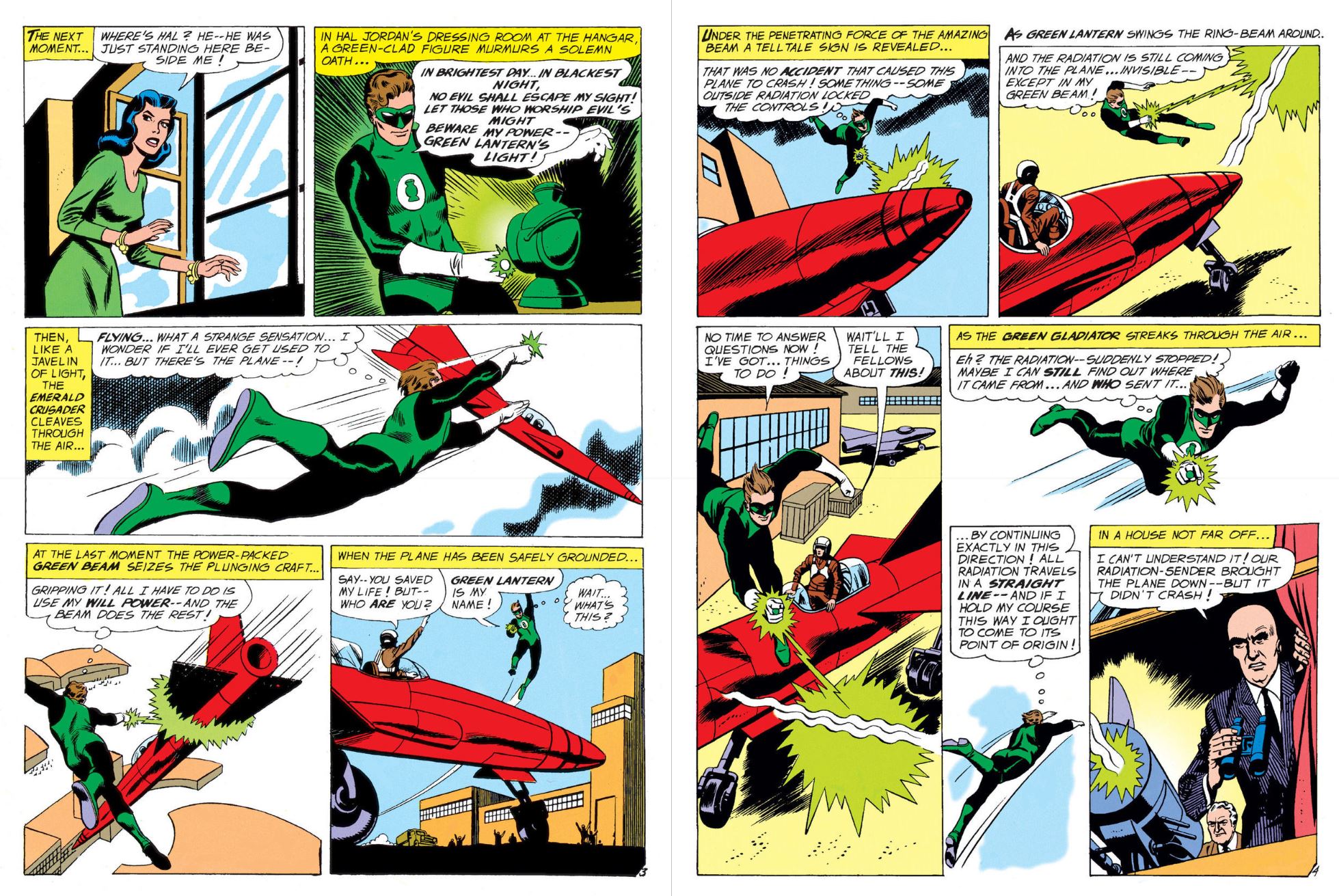
He returned sporadically to comics, setting the style and tone for DC’s late 1960’s horror line in House of Mystery, House of Secrets and especially The Witching Hour, as well as illustrating more adult fare for Warren’s Creepy, Eerie and The Rook. In the early 1980s Toth redesigned The Fox for Red Circle/Archie, produced stunning one-offs for Archie Goodwin’s Batman and war comics (whenever they offered him a “good script”) and contributed to landmark or anniversary projects like Batman: Black and White.

His later, personal works included Torpedo (look for a fully updated review of the series here soon!) and the magnificently audacious Bravo for Adventure!

Alex Toth died of a heart attack at his drawing board on May 27th 2006.

After reprinting an extensive informative and almost exhaustive interview with the artist from Graphic Story Magazine – conducted by Vincent Davis, Richard Kyle and Bill Spicer in 1968 – this fabulous full colour chronicle then reprints every scrap of Toth’s superb Standard fare beginning with impressive melodrama in ‘My Stolen Kisses’ from Best Romance #5 (February 1952), after which light-hearted combat star Joe Yank nearly lost everything to ‘Black Market Mary’ in the debut issue of his own title (#5 March 1952).

Perhaps a word of explanation is warranted here: due to truly Byzantine commercial and promotional considerations, all Standard Comics premiered with issue #5, although the incredibly successful Romance comics were carried over from their earlier Better Comics incarnations such as New Romances #10 (March 1952) for which Toth illustrated the touching ‘Be Mine Alone’ and the parable of empty jealousy ‘My Empty Promise’ from #11.

The hilarious ‘Bacon and Bullets’ offered a different kind of love in Joe Yank #6 (May) – a very pretty pig named Clementine – after which witty 3-pager ‘Appointment with Love’ (Today’s Romance #6 May) provides a charming palate cleanser before the hard-bitten ‘Terror of the Tank Men’ from Battlefront #5 (June 1952) offers a more traditional view of the then-raging Korean War.

‘Shattered Dream!’ (My Real Love #5 June) is an ordinary romance well told whilst ‘The Blood Money of Galloping Chad Burgess’ (The Unseen #5 June 1952) reveals the sheer quality and maturity of Standard’s horror stories, with ‘The Shoremouth Horror’ (Out of the Shadows #5) from that same month proving Toth to be an absolute master of terror and genius at the pacing and staging needed to scare the pants off you in pictorial form…

‘Show Them How to Die’ (This is War #5 July) is a superbly gung-ho combat classic whilst the eerie ‘Murder Mansion’ and ‘The Phantom Hounds of Castle Eyne’ – both from the August cover-dated Adventures into Darkness #5 – again demonstrate the artist’s uncanny flair for building suspense. The single pager ‘Peg Powler’ (The Unseen #6 September) is reprinted beside the original artwork – which makes me wish the entire collection was available in black & white – after which the highly experimental ‘Five State Police Alarm’ (Crime Files #5) displays the artist’s amazing facility with duo-tone and craft-tint techniques before salutary saga ‘I Married in Haste’ (Intimate Love #19, September) offers a remarkably modern view of relationships.

Science Fiction was the metier of Fantastic Worlds #5 which provided both contemporary ‘Triumph over Terror’ and futuristic fable ‘The Invaders’ to finish off Toth’s September commissions after which ‘Routine Patrol’ and ‘Too Many Cooks’ offer two-fisted thrills from This is War #6 (October). ‘The Phantom Ship’ is a much reprinted classic chiller from Out of the Shadows #6, with October also releasing the extremely unsettling ‘Alice in Terrorland’ from Lost Worlds #5.

Toth only produced four covers for Standard, and the first two, Joe Yank #8 and Fantastic Worlds #6, precede ‘The Boy Who Saved the World’ from the latter (November 1952) after which service rivalry informed ‘The Egg-Beater’ from Jet Fighters #5. The cover of Lost Worlds #6 (December) perfectly introduces the featured ‘Outlaws of Space’, after which the single-page ‘Smart Talk’ (New Romance #14) perfectly closes the first year and sets up 1953 to open strongly with ‘Blinded by Love’ from Popular Romance #22 January) in which the classic love triangle has never looked better…

This was clearly Toth’s ideal year as ‘The Crushed Gardenia’ from Who is Next? #5 shows his incredible skills to their utmost in one of the best crime stories of all time. ‘Undecided Heart’ (Intimate Love #21 February) is a delightful comedy of errors whilst both ‘The House That Jackdaw Built’ and ‘The Twisted Hands’ from Adventures into Darkness #8 perfectly reveal the artist’s uncanny facility for building tension and anxiety. The cover to Joe Yank #10 is followed by splendid aviation yarn ‘Seeley’s Saucer’ from March’s Jet Fighters #7, whilst the clever and racy ‘Free My Heart’ (Popular Romance #23, April) adds new depth to the term “sophisticated” and ‘The Hands of Don José’ (Adventures into Darkness #9) is just plain nasty in the manner horror fans adore. ‘No Retreat’ (This is War #9 May) offers more patriotic combat, but ‘I Want Him Back’ (Intimate Love #22) depicts a far softer, more personal duel whilst ‘Geronimo Joe’ (Exciting War #8 May) proves that in combat there’s no room for rivalry…

Toth was rapidly reaching the acme of his design genius as ‘Man of My Heart’ (New Romances #16 June), ‘I Fooled My Heart’ (Popular Romance #24 July – and reprinted in full as original art in the notes section) and both ‘Stars in my Eyes’ and ‘Uncertain Heart’ from New Romances #17 (August) saw him develop a visual vocabulary to cleanly impart plot and characterisation simultaneously. He often stated he preferred these mature, well-written romance stories for the room they gave him to experiment and expand his craft, and these later efforts prove him right: especially in the moving ‘Heart Divided’ (Thrilling Romances #22) and compelling ‘I Need You’ (September’s Popular Romances #25).

‘The Corpse That Lived’ (Out of the Shadows #10) is a historically based tale of grave-robbing, whilst deeply moving ‘Chance for Happiness’ (Thrilling Romances #23 October) is as powerful today as it ever was. ‘My Dream is You!’ (New Romances #18) turned fresh eyes on the old dilemma of career vs husband and far darker love is depicted in ‘Grip on Life’ (The Unseen #12 November), before true love actually triumphs in ‘Guilty Heart’ (Popular Romance #26). Another ‘Smart Talk’ advice page ends 1953 (New Romances #19) and neatly precedes an edgy affair in ‘Ring on Her Finger’ (Thrilling Romances #24 January 1954), after which ‘Frankly Speaking’ from the same issue leads to terrifying period horror in ‘The Mask of Graffenwehr’ (Out of the Shadows #11).

February saw a fine crop of Toth tales, beginning with charming medical drama ‘Heartbreak Moon’ (Popular Romance #27), spooky mining mystery ‘The Hole of Hell’ (The Unseen #13), 1-page amorous advisory ‘Long on Love’ (Popular Romance #27), lesson in obsession ‘Lonesome for Kisses’ and two more advice pages – ‘If You’re New in Town’ and ‘Those Drug Store Romeos’ – from Intimate Love #26. These last stories were eked out in the months after Toth had left, having been drafted and posted to Japan. However, even though he had (presumably) rushed them out whilst preparing for the biggest change in his young life, there was no loss but a further jump in artistic quality.

One final relationship ‘Smart Talk’ page (New Romances #20 March 1954) precedes a brace of classic mystery masterpieces from Out of the Shadows #12: ‘The Man Who Was Always on Time’ (also reproduced in original art form in the copious ‘Notes’ section at the back of this monumental book) before the graphic wonderment regrettably concludes with the cynically spooky ‘Images of Sand’ – a sinister cautionary tale of tomb-robbing…

After all that, the last 28 pages of this compendium comprise a thorough and informative section of story annotations, illustrations and a wealth of original art reproductions to top off this sublime collection in ideal style.

Alex Toth was a tale-teller and a master of erudite refinement, his avowed mission to pare away every unnecessary line and element in life and in work. His dream was to make perfect graphic stories. He was eternally searching for how to best tell a story, to the exclusion of all else. This long-ignored but still utterly compelling collection shows how talent, imagination and dedication to that ideal can elevate even the most genre-bound vignette into a paragon of form and a mere comic into high art. Get this book, absorb it all and learn through wonder and delight.
All stories in this book are in the public domain but the specific restored images and design are © 2011 Fantagraphics Books. Notes are © 2011 Greg Sadowski and the Graphic Story Magazine interview is © 2011 Bill Spicer. All rights reserved.

Famous First Edition C-63: New Fun Comics #1


By Malcolm Wheeler-Nicholson, Charles Flanders, Lloyd Jacquet, Dick Loederer, Adolphe Barreaux, Adolph Shusterman, Joe Archibald, Lyman Anderson, Sheldon Hubert Stark, Lawrence Lariar, Henry Carl Kiefer, Bert Salg/Bertram Nelson, Clem Gretta, Ken Fitch, Jack A. Warren, Bob Weinstein, Tom Cooper, Tom McNamara, John Lindermayer & various (DC Comics)
ISBN: 978-1-7795-0119-6 (HB/Digital edition)

This book includes Discriminatory Content produced in less enlightened times.

Times of hardship and sustained crisis often trigger moments of inspiration and innovation. That’s no panacea for all the hardship that correspondingly accrues but every silver lining brings a crumb of comfort, no? Perhaps we’ll see more clearly in four years’ time…

In 1933, at the height of the Great Depression, print salesman Max “MC” Gaines and editor Harry I. Wildenberg devised promotional premiums for stores to give away: cheaply made small booklets that reprinted some of the era’s hugely popular newspaper strips. By adding a price sticker these freebies were transformed into a mass market fixture as seen in 1934’s newsstand retail release Famous Funnies.

Monumental corporate megalith DC Comics began as National Allied Publications in 1935, another speculative venture conceived by controversial soldier-turned writer Major Malcolm Wheeler-Nicholson. He had been writing military non-fiction and pulp adventure stories when he met Gaines and, fired up, took a shot that the new print vehicle had legs. Backing the belief invention with a shoestring venture, he set about mass-producing the print novelty dubbed comic books.

Wheeler-Nicholson’s bold plan was to sidestep large leasing fees charged for established newspaper strip reprints by filling his books with new material. Moreover, with popular strips in limited supply and/or already optioned, his solution to create new characters in all new stories for an entertainment-hungry readership must have seemed a no-brainer.

Cover-dated February 1935, and looking remarkably like any weekly comic anthology ever since, New Fun: The Big Comic Magazine #1 blended humour with action, intrigue and suspense, combining serialized adventure strips with prose fiction, and features. Tabloid sized, and largely scripted by “The Major”, it was edited by Lloyd Jacquet (who would later helm many of DC’s rapidly proliferating imitators and rivals) with pages filled by untried creators and lesser established cartoonist lights. Issue #6 launched the careers of Jerry Siegel & Joe Shuster with adventurer Henri Duval and supernatural troubleshooter Doctor Occult. Hopefully we closet comics historians will see those collected for the curious one day….

Despite initially tepid sales, the Major persevered, launching New Comics as 1935 closed. The anthology was renamed New Adventure Comics, before settling on Adventure Comics with #32 in 1938. The company was struggling when Wheeler-Nicholson’s main creditors -printer Harry Donenfeld and accountant Jack L. Liebowitz – moved in, taking more active roles in the running of the enterprise. Within two years the commercially unseasoned Wheeler-Nicholson had been forced out by his more adept business partners, just as Wheeler-Nicholson’s final inspiration neared its debut. Detective Comics was a themed anthology of crime thrillers, and when it launched (cover-dated March 1937) it was the hit the company needed. Its success signalled closure of National Allied and birth of Detective Comics Incorporated. Eventually his company grew into monolithic DC (Detective Comics, get it?) Comics. Surviving a myriad of changes and temporary shifts of identity and aims, it’s still with us – albeit primarily as a vehicle for the breakthrough character who debuted in #27 (May 1939). The Major was retained until 1938. Donenfeld and Liebowitz’s acumen ensured the viability of comic books and their editor Vin Sullivan inadvertently changed the direction of history when he commissioned something entirely new and unconventional by Seigel & Shuster for upcoming release Action Comics #1…

Supplemented by a wealth of ancillary articles and essays, the spark of this particular publishing revolutions is re-presented in full facsimile mode after introductory essay ‘The Start of Something Big’ by the legendary Dr Jerry G. Bails, fully supported by ‘A Second Introduction – This One by Roy Thomas’ and a reproduction of a rare insert letter from Lloyd Jaquet that came with some of the earliest copies printed…

Looking remarkably similar in format to any British weekly anthology from the 1930s to the 1970s, the comic had its first feature playing across the cover as Lyman Anderson depicted cowboy Jack Woods imperilled by a rascally bushwhacker.

Edited by Lloyd Jaquet, the inner front cover declaimed ‘New Fun Hello Everybody: Here’s the New Magazine You’ve Been Waiting For!’ before Malcolm Wheeler-Nicholson & Charles Flanders debuted ‘Sandra of the Secret Service’; an elegant socialite in over her head…

The first six single page strips all came with an inbuilt star attraction. As Oswald the Lucky Rabbit an animated lepine tyke had hit cinema screens in 1927, courtesy of bright young men Walt Disney & Ub Iwerks. A year later the creators had been kicked out by Universal Pictures and got revenge by inventing Mickey Mouse. Oswald soldiered on under lesser hands until 1938 and enjoyed a strip of his own. Each 3-panel Oswald The Rabbit “topper” ran under New Fun’s new stuff, forming a sequence about ice skating and probably crafted by Al Stahl, John Lindermayer & Sheldon Hubert Stark.

Teen dating dilemmas plagued ‘Jigger and Ginger’ by Adolph “Schus” Shusterman and PI ‘Barry O’Neill’ (by Lawrence Lariar) faced Tong-&-Triad terrors before Adolphe Barreaux exposed Bobby & Binks to ‘The Magic Crystal of History’ and dumped the inquisitive kids in “4000 BC”, even as deKerosett (Henry Carl Kiefer) blended aviation and Foreign Legion licks in ‘Wing Brady – Soldier of Fortune’.

Oswald bowed out underneath the first instalment of ‘Ivanhoe by Sir Walter Scott’ courtesy of Wheeler-Nicholson & Flanders before Bert (Salg aka Bertram Nelson) enjoyed some judicial japery with ‘Judge Perkins’ before big sky sci fi kicked off in the Flash Gordon manner thanks to ‘Don Drake on the Planet Saro’ “presented” by Clem Gretta (Joseph Clemens Gretter & Ken Fitch) prior to Jack A. Warren introducing comedy cowpuncher ‘Loco Luke in “Nope He Didn’t Get His Man”’ and Wheeler-Nicholson & Flanders – as “Roger Furlong” – switch to illuminated prose to probe the mystery of ‘Spook Ranch’. It goes without saying, I hope, that many of these groundbreaking yarns are initial chapters of serials so don’t get too invested in what going on…

Joe Archibald taps into the varsity sports scene with comedic basketball titan ‘Scrub Hardy’ whereas Lyman Anderson plays deadly serious with the other, lesser kind of football in ‘Jack Andrews All-American Boy’ prior to the opening of a section of ads and features. Sandy beach-based bodybuilding revelations precede a prose vignette on ‘Bathysphere – A Martian Dream’ and segue into Joe Archibald’s ‘Sports’ review, a heads-up of what’s ‘On the Radio’ and ‘In the Movies’ whilst the secrets of ‘Model Aircraft’ and ‘Aviation’ lead to ‘How to Build a Model of Hendrik Hudson’s “Half Moon”’

Comic treats are topped up with Bob Weinstein’s maritime drama ‘Cap’n Erik’ and Tom Cooper taps into frontier history with ‘Buckskin Jim the Trail Blazer’ prior to learning and hobby craft taking over again with ‘Popular Science’, ‘Stamps and Coins’, and something for the little ladies…‘Young Homemakers’.

Tom McNamara heralds another bunch of comics with kiddie caper ‘After School’ and anonymous ‘Cavemen Capers’ take us to Barreaux’s ‘Fun Films 1st Episode: Tad Among the Pirates’ a faux cinema tale inviting readers to grab scissors and make their own stories, before New Fun’s art director Dick Loederer joins the fun with elfin romp ‘Bubby and Beevil’ and provides an untitled bottom strip to literally support a stylish penguin fantasy ‘Pelion and Ossa’ by John Lindermayer. Closing the interior amazement is another “Clem Gretta” wonder – ‘2023 Super-Police’ – leaving ads ‘New easy way to learn aviation’ and a full colour enticement for the ‘Tom Mix’ Ralston Zyp Gun (you absolutely WILL shoot your eye out!) to close the beginning of it all…

Fully supported by detailed biography ‘The Major Who Made Comics’ by granddaughter Nicky Wheeler-Nicholson and comprehensive listing ‘New Fun #1 – the Contributors’ plus reprint series overview ‘A Tabloid Tradition Continued’ and even more memorabilia bits, this is a historical artefact no serious comics fan should be without.
Famous First Edition: New Fun #1, C-63 Compilation and all new material © 2020 DC Comics. © 1935 DC Comics. All Rights Reserved. Biographical Essays © 2019 Nicky Wheeler-Nicholson.