
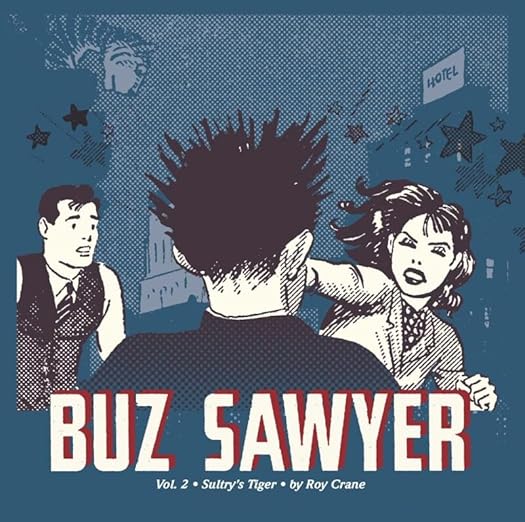
By Roy Crane & various (Fantagraphics Books)
ISBN: 978-1-60699-499-3 (HB)
This book includes Discriminatory Content produced in less enlightened times.
Modern comics evolved from newspaper comic strips, and these pictorial features were, until relatively recently, utterly ubiquitous. Immensely information-efficient, hugely popular with the public and highly valued by publishers who used them as irresistible weapons to guarantee sales and increase circulation, the strips seemed to find their only opposition in the short-sighted local paper editors who often resented the low brow art form, which cut into advertising and frequently drew complaint letters from cranks…
It’s virtually impossible for us today to understand the overwhelming allure and power of the comic strip in America (and the wider world) from the Great Depression to the end of World War II. With no television, broadcast radio far from universal and movie shows at best a weekly treat for most folk, household entertainment was mostly derived from the comics sections of daily – and especially Sunday – newspapers. “The Funnies” were the most universally enjoyed recreation for millions who were well served by a fantastic variety and incredible quality of graphic sagas and humorous episodes over the years.
From the very start comedy was paramount; hence our terms Funnies and Comics, and from these gag-&-stunt beginnings, a blend of silent movie slapstick, outrageous fantasy and the vaudeville shows, came a thoroughly entertaining mutant hybrid: Roy Crane’s Wash Tubbs.
Debuting on April 21st 1924, Washington Tubbs II was a comedic, gag-a-day strip which evolved into a globe-girdling adventure serial. Crane produced pages of stunning, addictive and influential high-quality yarn-spinning for years, until his eventual introduction of moody swashbuckler Captain Easy ushered in the age of adventure strips with the landmark episode for 6th May, 1929. This in turn led to a Sunday colour page for the good captain that was possibly the most compelling and visually imaginative of the entire era (see Roy Crane’s Captain Easy, Soldier of Fortune: The Complete Sunday Newspaper Strips vol 1 ).
Practically improving minute by minute, the Sunday strip benefited from Crane’s relentless quest for perfection his imaginative, fabulous compositional masterpieces achieving a timeless immediacy that made each page a unified piece of sequential art. The influence of those pages can be seen in the works of near-contemporaries such as Hergé, giants-in-waiting like Charles Schulz and comic book masters like Alex Toth and John Severin ever since.
The material was obviously as much fun to create as to read. In fact, the cited reason for Crane surrendering the Sunday strip to his assistant Les Turner in 1937 was NEA/United Features Syndicate’s abrupt and arbitrary demand that all its strips must henceforward be produced in a rigid panel-structure to facilitate their being cut up and re-pasted as local editors dictated.
They just didn’t lift the artist any more, so Crane stopped making them.
At the height of his powers Crane just walked away from the astounding Captain Easy Sunday page to concentrate on the daily feature, and when his contract expired in 1943 he left United Features, lured away by that grandee of strip poachers William Randolph Hearst. The result was a contemporary aviation strip set in still-unfolding World War II: Buz Sawyer.
Where Wash Tubbs was a brave but largely comedic Lothario and his pal Easy a surly, tight-lipped he-man, John Singer “Buz” Sawyer was a joyous and sharp amalgam of the two: a good-looking, popular country-boy who went to war because his country needed him..
Buz was a fun-loving, skirt-chasing, musically-inclined naval aviator daily risking his life with his devoted gunner Rosco Sweeney: a bluff, brave and simply ordinary Joe – and one of the most effective comedy foils ever created. The wartime strip was – and remains – a marvel of authenticity: depicting not just the action and drama of the locale and situation but, more importantly, capturing the quiet, dull hours of training, routine and desperate larks between the serious business of killing and staying alive. However – and crucially – when the war ended the action-loving duo – plus fellow pilot and girl-chasing rival Chili Harrison – all went looking for work that satisfied their penchant for adventure and romance wherever they could find it…
Crane was a master of popular entertainment, blending action and adventure with smart drama and compellingly sophisticated soap opera, all leavened with raucous comedy in a seamless procession of unmissable daily episodes. He and his team of creative assistants – which over the decades comprised co-writer Ed “Doc” Granberry and artists Hank Schlensker, Clark Haas, Al Wenzel, Joel King, Ralph Lane, Dan Heilman, Hi Mankin & Bill Wright – soldiered on under relentless deadline pressure, producing an authentic and exotic funny romantic thriller rendered in the signature monochrome textures of line-art and craftint (a mechanical monochrome patterning effect used to add greys and halftones to the superb drawing for miraculous depths and moods) as well as the prerequisite full-colour Sunday page.
This primarily black-&-white tome contains an impressive but far too meagre selection of those colour strips – although Crane quickly came to regard them only as a necessary evil which plagued him for most of his career…
The eternal dichotomy and narrative/continuity problems of producing Sunday Pages (many client papers would only buy either Dailies or Sunday strips, but not both) meant that most creators had to produce different story-lines for each feature – Milt Caniff’s Steve Canyon being one of the few notable exceptions. Whereas Dailies needed about three weeks lead-in time, hand-separated colour plates for the sabbath sections meant finished artwork and colour guides had be at the engravers and printers a minimum of six weeks before publication. Crane handled the problem with typical aplomb; using Sundays to tell completely unrelated stories.
For Wash Tubbs he created the aforementioned prequel series starring Captain Easy in sagas set before the mismatched pair had met, whilst in Buz Sawyer he turned the slot over to Roscoe Sweeney for lavish gag-a-day exploits, packed with slapstick laughs and situation comedy. During the war years it was set among the common “swabbies” aboard ship: a far more family-oriented feature and probably better suiting the weekend crowd of parents and children than the often chilling or disturbing realistically saucy/sexy sagas that unfolded Mondays to Saturdays. A year before Steve Canyon began, Crane tried telling a seven-days-a-week yarn in Buz Sawyer (with resounding success, to my mind, and you can judge for yourself here) but found the process a logistical nightmare. At the conclusion he returned to weekday continuity whilst Sundays were restored to Roscoe with only occasional guest-shots by the named star.
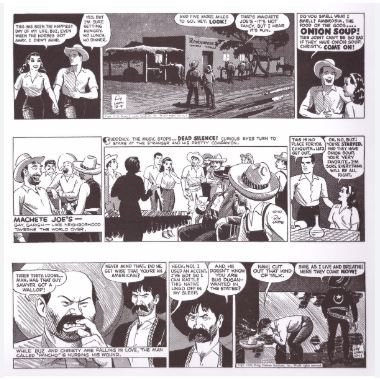
This second lush, sturdily archival hardback re-presents the tense and turbulent period from October 6th 1945 to July 23rd 1947 wherein de-mobilised adrenaline addict Buz tries to adjust to peacetime life whilst looking for a job and career – just like millions of his fellow former servicemen…
Before getting out, though, he had returned home on leave and ended up accidentally engaged. Buz was the son of the town’s doctor: plain, simple and good-hearted. In that ostensibly egalitarian environment the school sporting star became the sweetheart of ice-cool and stand-offish Tot Winter, the richest girl in town. Now when her upstart nouveau riche parents heard of the decorated hero’s return they hijacked the homecoming and turned it into a publicity carnival. Moreover, the ghastly, snobbish Mrs. Winter conspired with her daughter to trap the lad into a quick and newsworthy marriage.
Class, prejudice, financial greed and social climbing were enemies Buz and Sweeney were ill-equipped to fight, but luckily, annoying tomboy-brat/girl-next-door Christy Jameson had blossomed into a sensible, down-to-earth, practical and clever young woman. She’d scrubbed up real pretty too and showed Buz that his future was rife with possibility. Mercifully soon, the leave ended and he & Sweeney returned to the war. The Sawyer/Winter engagement fizzled and died. When their discharge papers finally arrived (in the episode for September 9th 1945), the period of desperate struggle was over. However, that only meant that the era of globe-girdling adventure was about to begin…
Before the comics wonderment resumes, Jeet Heer and Rick Norwood discuss ‘The Perfectionist and his Team’. Concentrating initially on ‘After the War’, the fascinating explorations also delve deep into detail of the auteur’s troubled and tempestuous relationship with ‘Crane’s Team’ before offering ‘A Word on Comic Strip Formats’ and the censorious iniquities local newspaper editors regularly inflicted upon Crane’s work.
With all the insightful stuff over, cartoon adventure begins anew as civilian Mr. Sawyer returns home to a life of indolence before his own restless nature starts him fretting again. The old town isn’t the same. Tot has inherited her father’s millions and moved to New York and even Christy is gone; she’s away attending his old alma mater…
After a brief interlude wherein he visits the cheery Co-Ed and debates the merits of returning to college on the G.I. Bill, Buz instead opts for fulltime employment and heads to the Big Apple where Chili Harrison has a new job offer and an old flame waiting. As he turns East, Buz chooses to ignore his instincts and the huge mysterious guy who seems to turn up everywhere he goes…
In NYC, aloof, alluring Tot Winter is the cream of polite “arty” society, but her wealth and clingy new fiancé – opera singer Count Franco Confetti – are all but forgotten when “the one who got away” appears again and she finds her interest in her High School beau rekindled. Buz has moved in with Chili, blithely unaware that the strangely ubiquitous giant has inveigled himself into the apartment next door and is now actively spying on him…
Sawyer wants a job flying, but is frankly only one of hundreds of war-hero pilots looking for a position at International Airways. Moreover, his reputation as a hot-shot risk-taker makes him the last person a commercial carrier might consider. Happily, after implausibly well-connected Chili intercedes with a major player in the company, something does come up…
The truth about Buz’s hulking stalker comes out when the Maharani of Batu’s yacht docks in New York. The exotic Asian princess is one of the wealthiest women on Earth and cuts a stunning figure with her tiger on a leash. Yet when Buz first met her she was simply “Sultry”, a ferocious, remorseless resistance fighter helping him kill the occupying Japanese on her Pacific island.
She never forgotten him and will ensure no other woman can have him…
Sultry moves into the penthouse adjoining Tot’s and is witness to the ploys of the Winter woman as she sidelines sleazy sneaky Confetti and makes her play for Buz. She is also a key figure in the tragic heiress’ sudden death…
Just prior to Tot’s gruesome demise, Buz had finally met the unconventional Mr. Wright of International Airways. That doughty executive had no need for pilots but wanted a quick-thinking, capable fighter who could solve problems in the world’s most troubled conflict zones. He even has a spot open for good old Roscoe Sweeney. Buz is all set for his first overseas assignment when the cops decide he’s the other prime suspect in Tot’s murder and, with Sawyer and Count Confetti in jail, Sultry tries to flee America before the truth comes out. Sweeney and the freshly exonerated Buz soon track her down, but Sultry turns the tables on them and shanghaies her erstwhile lover, imprisoning him on her yacht, determined to make him her permanent boytoy, far, far away from American …
Never short of an idea and blessed with the luck of the damned, Buz’s escape results in a terrifying conflagration and the seeming death of his obsessed inamorata… but Sultry’s body isn’t recovered…
It takes a lot of pleading to get Mr. Wright to give him another chance but, soon after, Buz & Sweeney are winging north to Greenland to stop a crazed sniper taking pot-shots at aircraft passing over the “Roof of the World”. This savage, visceral extended saga soon reveals the shooter to be a deranged leftover Nazi and his hapless attendants, but the heroes’ astonishing hunt for and capture of the Teutonic trio is as nothing compared to the harrowing trek to get them back to civilisation, especially since poor Roscoe is putty in the hands of lovely Frieda, devil-daughter of the utterly mad Baron von Schlingle.
Before Buz get the survivors home safely, he loses his plane, must forcibly trek across melting floes, get them all stranded on a iceberg and even has his pretty-boy face marred forever. Worst of all, by the time he gets back to civilisation, his job no longer exists. Mr. Wright has quit and moved on to another company…
It’s not all bad news. Wright has euphemistically become “Personnel Director” for Frontier Oil: a truly colossal conglomerate active all over Earth and now wants Buz to carry on his unique problem-solving career for his new employers.
Despite a large bump in salary, the weary war hero is undecided until he hears Christy is helping her dad in Central American nation Salvaduras in his role as a geologist for Frontier Oil. This happily ties in with an outstanding missing persons case; said vanished victim being Bill Daniels, playboy son of a prominent company executive. It takes very little to convince Wright to despatch Buz & Roscoe south of the border to investigate, opening floodgates to a spectacular epic of light-hearted romantic adventure a world apart from his previous harrowing cases. The story also saw Crane and Co. merging the Daily and Sunday strips into a single storyline (with the Sundays primarily illustrated by Schlensker) as the action boys tried to trace the missing American in a country that seems locked in fear and poverty…
After initially hitting a wattle-and-daub wall, Buz takes time off for a picnic with Christy and, after a close call with a faux Mexican bandit (in actuality a Yankee fugitive from justice with an atrocious fake accent), declares his undying love for her.
He is not rebuffed and there’s the hint of wedding bells in the air…
First, though, he and Sweeney need to finish the mission, and help comes from a brave peon who breaks the regional code of silence to put them on the trail of the mysterious Ranch of the Caves and its American émigré who rules the isolated canton with blood and terror. After romancing the daughter of vicious Don Jaime, Buz and Roscoe infiltrate the desolate fiefdom and the gang boss’ international band of thugs, discovering not only the very much alive missing playboy but an incredible lost Mayan treasure trove!
Mission accomplished, Buz returns to New York to marry Christy, only to find he’s already needed elsewhere. Christy too is having doubts, worried that she will always play second fiddle to her man’s addiction to action, whereas in truth the real problem is that trouble usually comes looking for Buz. Boarding a Frontier plane for the Yukon, Sawyer is merely a collateral casualty when the ship’s other passenger is kidnapped. The mysterious menabducting plastic surgeon Dr. Wing take their helpless hostages all the way to deepest Africa where they expect the medic to change the face of an infamous madman everybody in the world believes died in a Berlin Bunker. Tragically, the fanatics are not prepared for the physician’s dauntless sense of duty and sacrifice nor Buz’s sheer determination to survive…
The latter part of this tale describes Buz’s epic river trek with mercenary turncoat honey-trap Kitty as they flee from vengeful Nazis. However, even after reaching the coast and relative safety, the insidious reach of the war-criminals is not exhausted and one final attack looms…
Eventually, Buz returns to New York alone and wins enough time from slave driving Mr. Wright to settle things with Christy. He follows her to Nantucket Sound, but even their romantic sailboat ride turns into a life-changing adventure…
To be Continued for decades to come…
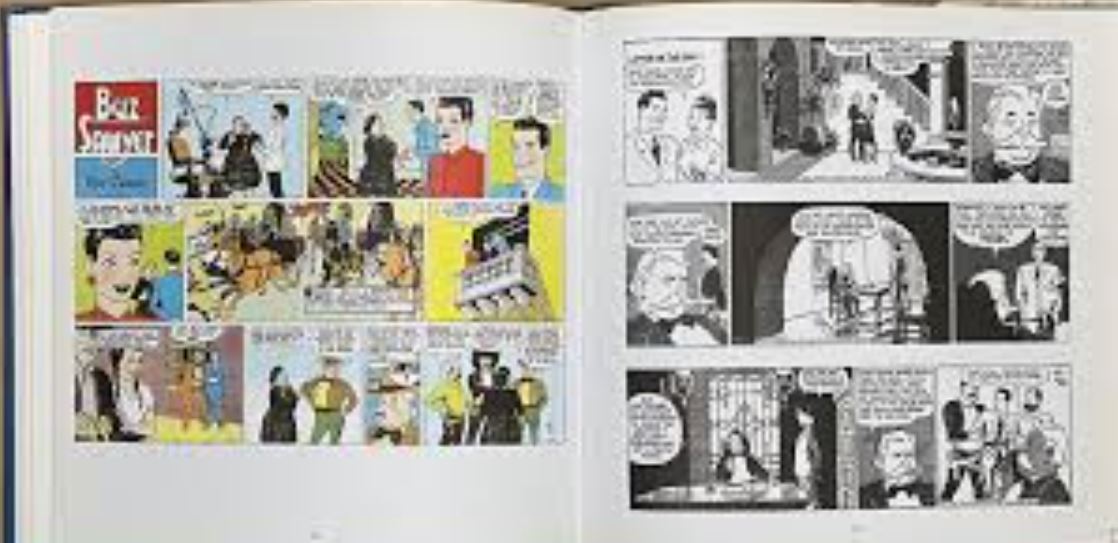
This splendid collection is the perfect means of discovering – or reconnecting with – Crane’s second magnum opus: spectacular, enthralling, exotically immediate romps that influenced generations of modern cartoonists, illustrators, comics creators and storytellers. Buz Sawyer ranks amongst the very greatest strip cartoon features ever created: rousing, enthralling, thrilling, outrageously funny and deeply moving tale-telling that is irresistible and utterly unforgettable.
Buz Sawyer: Sultry’s Tiger © 2012 Fantagraphics Books, all other material © 2012 the respective copyright holders. All Strips © 2010 King Features Syndicate, Inc All rights reserved.
Today in 1890, landmark British magazine Comic Cuts began publication. See what we started?
This date in 1928 scripter/screen writer George Kashdan (Tomahawk, Congo Bill, Tommy Tomorrow, Mysto, Magician Detective, hundreds of DC genre anthology tales, Superman/ Aquaman Hour of Adventure) as born, with Dutch creator Piet Wijn (Aram, Douwe Dabbert) coming a year later. Dave (Cerebus) Sim popped up in 1956 and Linda Medley (Castle Waiting, Justice League America, Doom Patrol, Galactic Girl Guides) in 1964.
Today saw the loss of Mutt and Jeff ghostwriter Aurthus “Bugs” Baer in 1969, ULTIMATE Batman artist Dick Sprang in 2000 and Mad’s The Lighter Side cartoonist Dave Berg in 2002.