
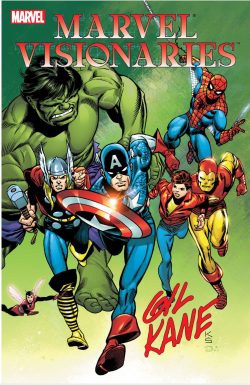
By Gil Kane, with Stan Lee, Jack Kirby, Roy Thomas, Jim Shooter, Tony Isabella, Dan Slott, Mike Esposito, Joe Sinnott, Dan Adkins, Frank Giacoia, Dick Giordano, Klaus Janson, Jim Mooney & various (MARVEL)
ISBN: 978-0-7851-0888-7 (TPB), 978-1-3029-3737-9 (Digital edition)
This book includes Discriminatory Content produced in less enlightened times.
This year marks the centenary of Eli Katz, who, as Gil Kane, worked from the Golden Age until his death (on January 31st 2000) to make comics the art form it is today. Diligent, resolute and always challenging himself, Kane was a trendsetting pioneer in style, in form and in comics philosophy. He was also a visual architect of the superhero revival in the Silver Age and a key component in the evolution of the Graphic Novel.
Kane started young and toiled as an artist all his life. An ever-more effective and influential one, he drew and wrote for many companies since his debut (thus far verified as inking Carl Hubbell on The Scarlet Avenger in Zip Comics #14 and cover-dated May 1941): illustrating superheroes, action/adventure, war, mystery, romance, horror, movie adaptations and, perhaps most importantly, Westerns and Science Fiction tales. In the 1950s he was one of DC editor Julius Schwartz’s go-to artists for regenerating the superhero. Yet by 1968, at the top of his (admittedly much denigrated) profession, this relentlessly revolutionary and creative man felt so confined by juvenile strictures of the industry that he struck out on new ventures, jettisoning job security, and the editorial format bounds of comic books for new visions and media. However, the time was not right and after brief forays at other companies (like Dell and Tower) and attempting to create graphic narratives outside the comic book industry – such as His Name Is Savage and Blackmark – Kane began selling his services to Marvel Comics…
Kane’s earliest comic book output included Boy Commandos, Young Allies & Newsboy Legion, Doll Man, Zip Comics, Airboy Comics and many more, but by the Fifties he was settled at National/DC and working on Johnny Thunder, Jimmy Wakely, Matt Savage, Hopalong Cassidy, Rex the Wonder Dog and hundreds of genre yarns – romance, war, sci fi, western and horror. When Superheroes returned, he co-created Green Lantern and The Atom, and generated countless pages and captivating covers for Plastic Man, Batman, Superman, Flash, Teen Titans, Robin, Batgirl, Hawk and Dove, Captain Action and everything in between. Then, in 1966, with ever-increasing bureaucracy and panic over a new upstart rival gripping DC, Kane tentatively – and initially using the pseudonym Scott Edwards – began looking at other publishers, leading to breakthrough art for T.H.U.N.D.E.R. Agents, U.N.D.E.R.S.E.A. Agent, Dell Four Color, The Lost World, Brain Boy, The Frogmen, dozens of TV westerns and other licensed properties, and began his long association with modern Marvel Comics.
Initially a poor fit (he was asked to draw The Hulk over Jack Kirby’s layouts!), Kane persisted, going on to spectacularly redefine if not pictorially reinvent Amazing Spider-Man, Conan, Captain America and Captain Marvel; co-create Adam Warlock, Morbius, and Iron Fist and put his indelible stamp on Thor, Hulk, Ka-Zar, Daredevil, Marvel Team-Up and all the rest. Kane adapted John Carter, Warlord of Mars and other literary adventure-fantasy properties and reinvigorated dozens of horror-hero and superhero stalwarts, all while filling in on seemingly every character and cover going. Restless and craving what the medium could still achieve, he worked on newspaper strips too. Even before co-creating Star Hawks in 1977 with Ron Goulart, he had limned the daily Flash Gordon for King Features in the 1960s, and Tarzan Sunday pages.
Kane’s latter career included animation/design, and choice comics book outings as well as numerous special projects like Jason Drum for Le Journal de Tintin and The Ring of the Nibelung.
Although Marvel Visionaries: Gil Kane was originally released in 2002, it’s still readily available as it was digitally rereleased in 2021, so if you can read this you can find that…
Offering a brief selection of the many tales crafted by Kane, this tome re-presents gems first seen in Tales to Astonish #76; Tales of Suspense #88-#91; Captain Marvel #17; Amazing Spider-Man #99; Marvel Premiere #1 & 15 and Daredevil #146 plus material from What If #3 & #24 and Marvel Comics Presents #116, as well as offering a host of appealing production and art extras at the far end.
The trek through Marvel History begins with a fulsome appraisal of the artist’s career and achievements from frequent collaborator Roy Thomas in his foreword ‘The Mark of Kane’ after which it’s “on with the motley” and that first foray from Tales to Astonish #76. Cover-dated February 1966, this was on sale from November 4th 1965 and saw Kane draw – over Kirby layouts and under Mike Esposito finishes – an episode of a time-bending sequence with the Green Goliath helplessly trapped in a compounded by a doom-drenched duel with time-lost Asgardian immortal The Executioner…

Assume and accept that you will need to find other collections to experience the full force of these extracted snippets and then move on to those portions of Tales of Suspense #88-#91 (cover-dates April -July 1967) that featured Captain America. Here Lee scripts all four chapters of a classic clash as Kane takes his first run on the character. The extended saga comprises ‘If Bucky Lives…!’ and ‘Back from the Dead!’, as inked by Kane before Joe Sinnott joins as embellisher for ‘…And Men Shall Call Him Traitor!’ and ‘The Last Defeat!’ for a superb thriller of blackmail and betrayal starring the Red Skull. The fascist felon had baited a trap with a robotic facsimile of Cap’s dead partner, triggered it with malign super-hirelings Power Man and The Swordsman whilst blackmailing the Star-Spangled Sentinel into betraying his country and stealing a new atomic submarine. It all turned out okay in the end though…
Next up is Captain Marvel #17 (cover-date October 1969), sole example from a stunning and influential run on the Kree Captain Mar-Vell. Captain Marvel as we know him really begins with this reinvention wherein Thomas, Kane & Dan Adkins totally retooled and upgraded the character.
‘And a Child Shall Lead You!’ sees the imperilled star warrior inextricably bonded to voice-of-a-generation/professional sidekick Rick Jones who – just like Billy Batson (the boy who turned into the original Fawcett hero by shouting “Shazam!”) – switched places with a mighty adult hero when danger loomed by striking together a pair of ancient, wrist-worn “Nega-bands”. This allowed them to temporarily trade atoms: one active in our universe whilst the other floated, a ghostly untouchable, ineffectual voyeur to events glimpsed from the ghastly Negative Zone. As thrilling and as revolutionary as the idea of a comic written from the viewpoint of a teenager was, the real magic comes from Kane’s experimental page layouts and phenomenally kinetic artwork, and whose mesmeric staging of proportionally warped yet somehow still perfect human-form-in-motion rewrote the playbook on superhero illustration with this series.
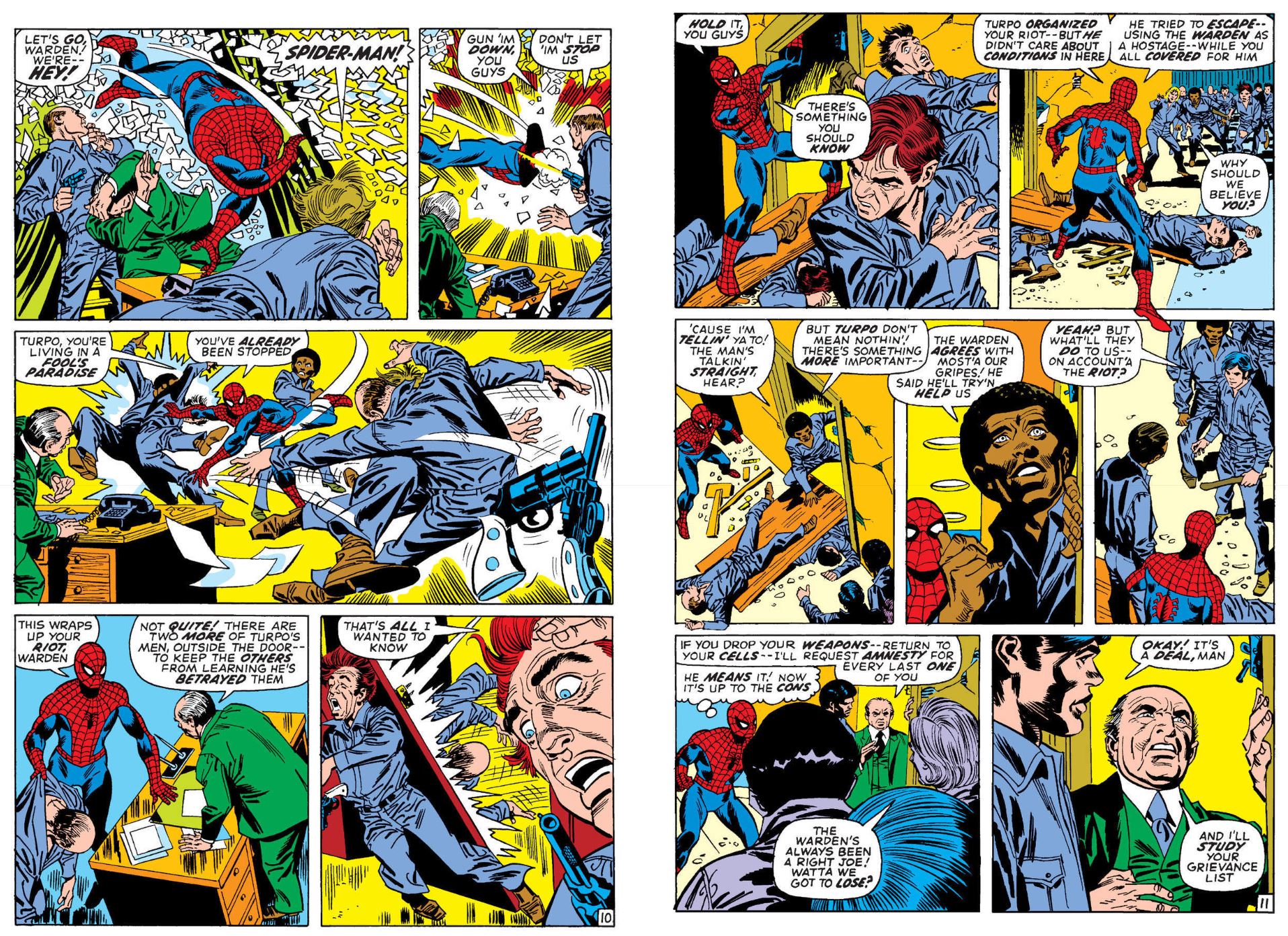
Kane’s ascendancy was confirmed as he became the regular illustrator on Marvel’s greatest hit. A monumental first run on the wallcrawler is marked here by Amazing Spider-Man #99 (August 1971) portraying ‘A Day in the Life of…’: an all-action, social drama-tinged palate-cleanser with Peter Parker and Gwen Stacy finally getting their love-life back on track, only marginally diverted by a prison breakout easily quelled by the Arachnid Avenger, whilst highlighting the growing scandal of prison conditions…
Jump forward to tumultuous turbulent November 1971 where the April cover-dated Marvel Premiere #1 boldly proclaimed on its cover The Power of… Warlock. Inside, the stunning fable by Thomas, Kane & Adkins declared ‘And Men Shall Call Him… Warlock’ neatly recapitulated artificial man Him’s origins as a lab experiment concocted by rogue geneticists eager to create a superman they could control for conquest. Also on view is the manufactured man’s face off with the Fantastic Four, and clash with Thor over the rights to a mate before returning to an all-encompassing cosmic cocoon to evolve a little more.
Now that shell is plucked from the void thanks to the moon-sized ship of self-created god The High Evolutionary. Having artificially ascended to godhood, he is wrapped up in a bold new experiment…
Establishing contact with Him as he basks in his cocoon, the Evolutionary explains that he is constructing from space rubble a duplicate planet Earth on the opposite side of the sun. Here he will replay the development of life, intending that humanity on Counter-Earth will evolve without the taint of cruelty and greed and deprived of the lust to kill. It’s a magnificent scheme that might well have worked, but as the Evolutionary wearies, his greatest mistake intervenes…
Man-Beast was over-evolved from a wolf and gained mighty powers, but also ferocious savagery and ruthless wickedness. Now he invades the satellite, despoiling humanity’s rise and ensuring the new world’s development exactly mirrors True-Earth’s. The only exception is the meticulous exclusion of enhanced individuals. The beleaguered orb has all Earth’s woes but no superheroes to save or inspire its people. A helpless witness to the desecration, the golden being furiously crashes free of his cocoon to save the High Evolutionary and rout Man-Beast and his bestial cronies (all similarly evolved animal-humanoids called “New-Men”). When the despondent, enraged science god recovers, he decides to erase his failed experiment but is stopped by his rescuer. As a helpless observer, Him saw the potential and value of embattled humanity. Despite all their flaws, he believes he can save them from imminent doom caused by their own unthinking actions, wars and intolerance. When his pleas convince the Evolutionary to give this mankind one last chance, the wanderer is hurled down to Counter-Earth, gifted and graced with a strange “Soul Gem” to focus his powers, on a divine mission to find the best in the fallen and a name of his own…
Enjoying and thriving in an era and atmosphere of experimentation, Kane returned to Marvel Premiere with #15 (May 1974) for the debut of masked martial artist Iron Fist. His saga began on a spectacular high with Thomas, Kane & Dick Giordano’s ‘The Fury of Iron Fist!’, as a teenaged masked warrior defeats the cream of a legendary combat elite in a fabled other-dimensional city before returning to Earth.
Ten years previously little Daniel Rand had watched his father and mother die at the hands of Harold Meachum whilst the party of millionaire adventurers risked Himalayan snows to find the legendary city of K’un Lun. Little Danny had travelled with his parents and business partner Meachum in search of the fabled city – which only appeared on Earth for one day every decade. Wendell Rand had some unsuspected connection to the fabled Shangri La but was killed before they found it, whilst Danny’s mother sacrificed herself to save the child from wolves and her murderous pursuer.
As he wandered alone in the wilderness, the city found Danny. The boy spent ten years training: mastering all forms of martial arts in a militaristic, oriental, feudal paradise while enduring countless arcane ordeals, living only for the day he would return to Earth and avenge his parents. After conquering all comers and rejecting immortality, the Iron Fist returned to Earth, a Living Weapon able to channel his force of will into a devastating super-punch…
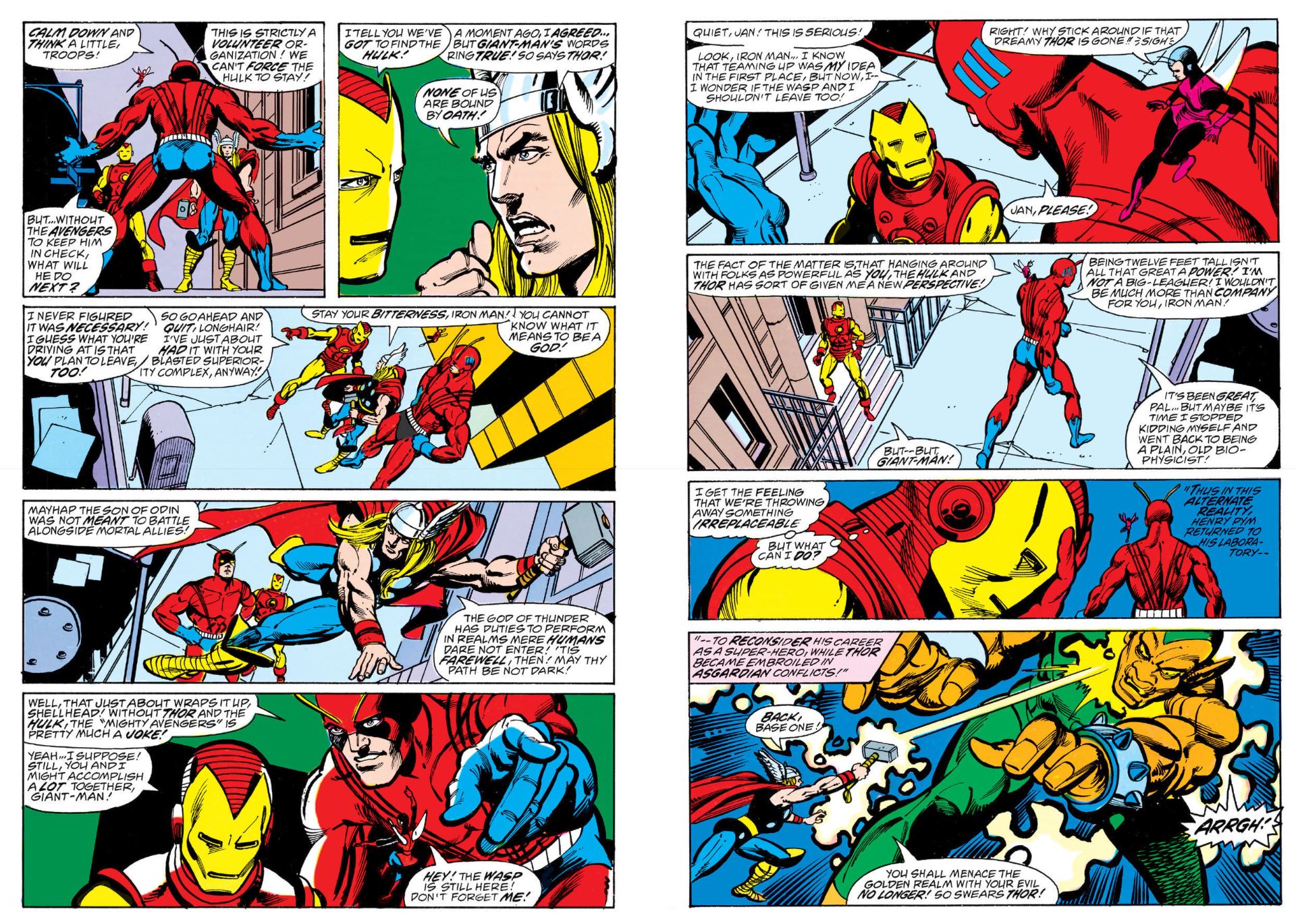
Alternate worlds vehicle What If? #3 (June 1977) provided one of the most memorable stories of the era and one of Kane’s greatest triumphs. Scripted by Jim Shooter and inked by Klaus Janson ‘What If the Avengers Had Never Been?’ diverted from established Marvel Continuity at the end of Avengers #2 when Hulk quit the still-forming team. In this instance, the act sunders the entire squad who go their own ways with shocking, spectacular and ultimately tragic consequences. If you buy this book for only one tale it will be this one…
That same month in Daredevil #146 the artist again demonstrated his brilliance in staging dramatic fight scenes. Scripted by Shooter and inked by Jim Mooney, ‘Duel!’ saw the sightless swashbuckler searching Manhattan for maniac marksman Bullseye even as his quarry was setting up a lethal showdown. The brutally bruising climax came when the crazed killer took an entire TV studio hostage but ended with his being soundly defeated yet again…
With Tony Isabella writing and Frank Giacoia inking, Kane revisited one of his greatest comics triumphs in What If? #24 (December 1980), as ‘What If Gwen Stacy had Lived?’ explored an Alternity where Spider-Man saved his fiancée from Green Goblin Norman Osborn and went on to marry her before losing everything he loved to the obsessive hatred of J. Jonah Jameson…
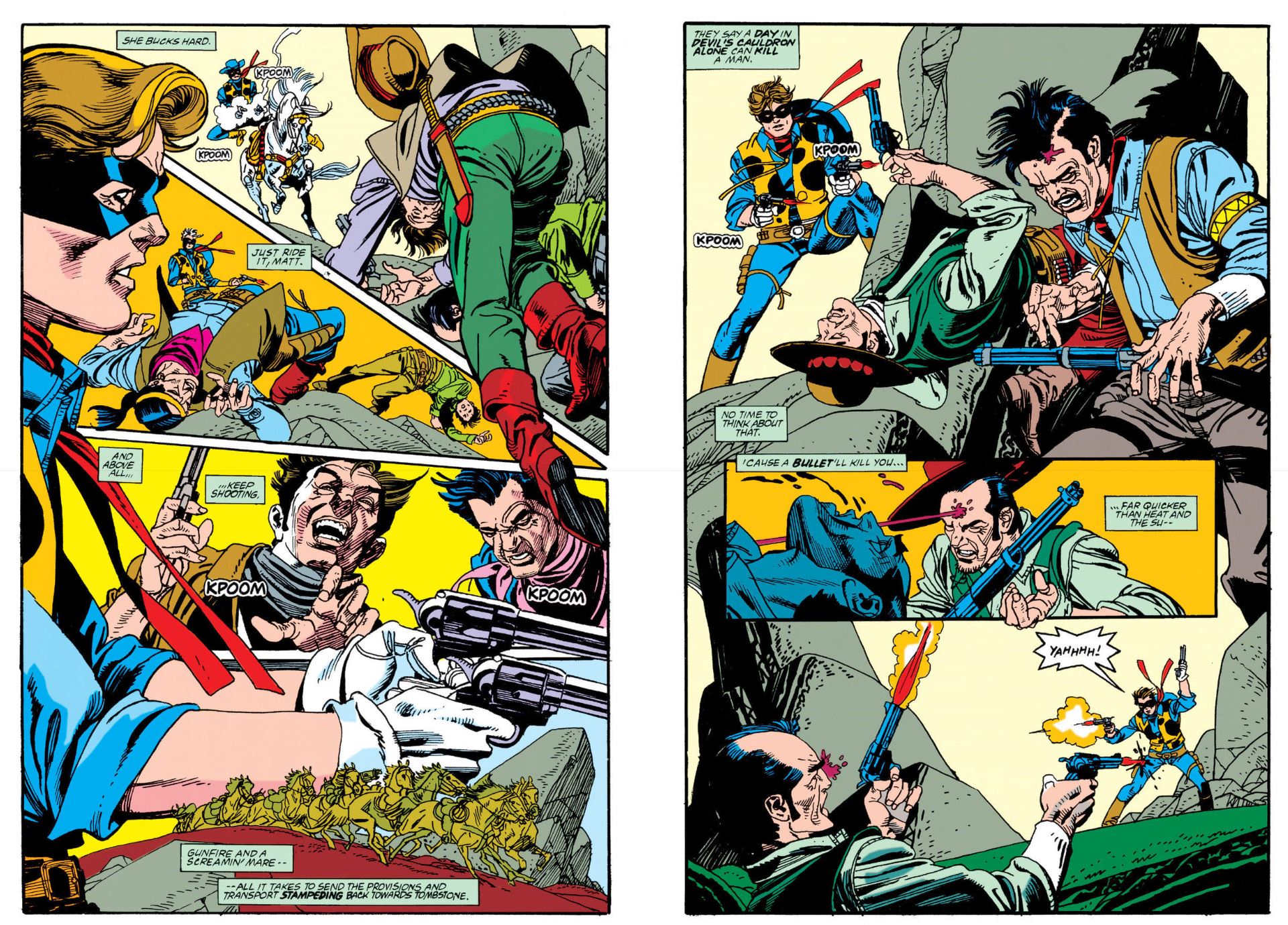
This compelling compilation notionally concludes with a late treat from Marvel Comics Presents #116 (cover-dated November 1992) with future superstar scripter Dan Slott taking Kane back to his cowboy roots for a short rip-roaring romp featuring the Two-Gun Kid. Here the occasional Avenger and prototype Marvel Mystery-man hero serves up ‘Just Deserts’ to vicious scheming owlhoots John Baker and the Unlucky Thirteen Gang before marching the sole survivor back across the searing Devil’s Cauldron back to Tombstone city jail…
Providing pertinent covers by Kane, this tome offers additional pictorial treats including Kane’s favourite cover (Mighty Marvel Western #44) plus a gallery of others such as Western Gunfighters #31, Kid Colt, Outlaw #161, Sub-Mariner #44 & Captain Marvel #23), the extras also deliver a vast selection of page layouts, design roughs, fully-pencilled pages and covers as well as inked and completed pages of marvels.
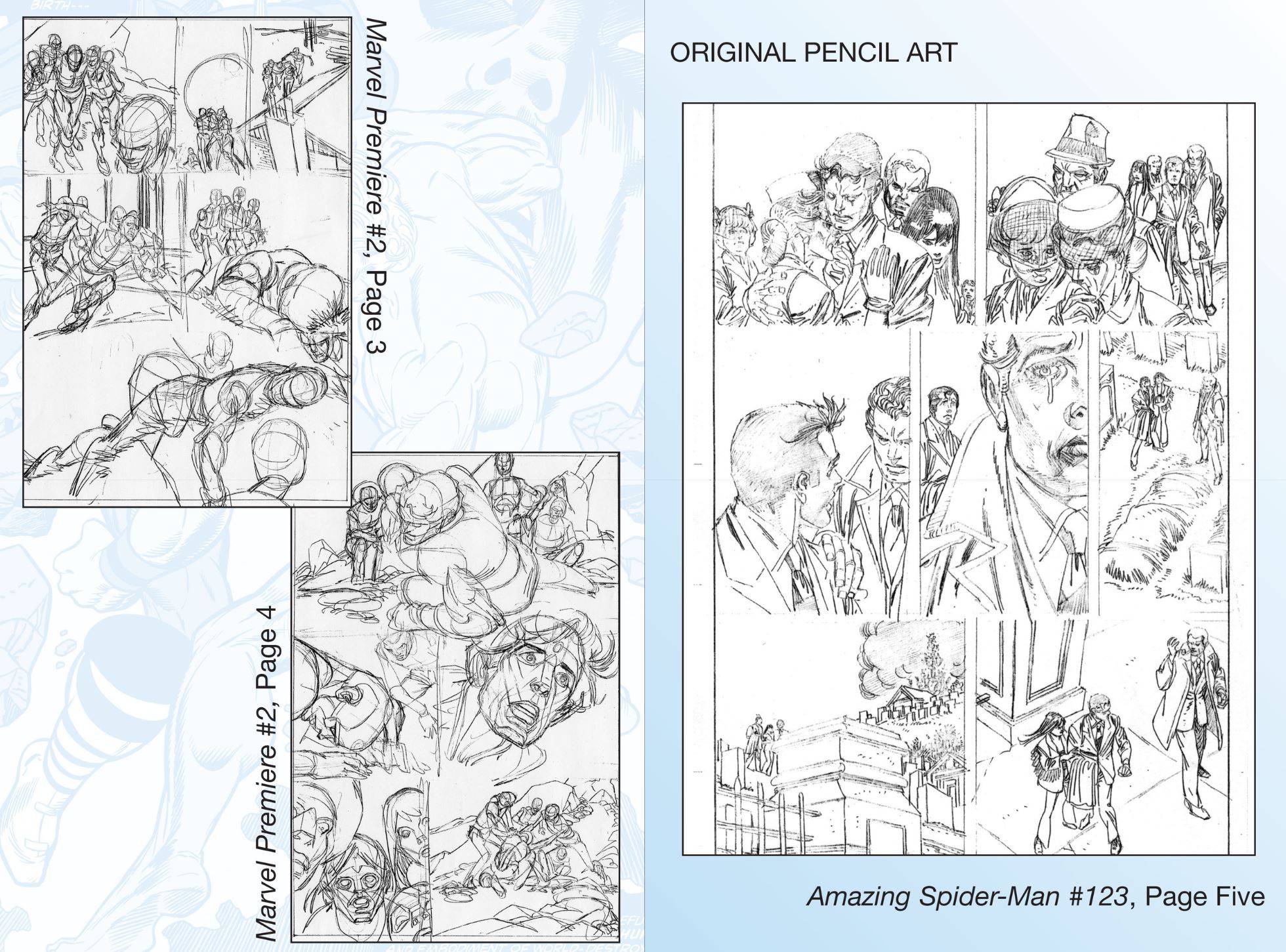
Also working as Gil Stack, Scott Edward, Stack Til, Stacktil, Pen Star and Phil Martell, Gil Kane became a foundation stone of comics and remains a vivid, vital inspiration to future generations of creators and readers. With all that in mind why not have a far too brief look at some of the man’s early Marvel superhero triumphs and gently remind the Powers-that-Be that this is only the tip of a graphic iceberg that includes plenty of room for barbarian, sci fi and horror collection one day…
© 2021 MARVEL.
Born today in 1924, cartoonist Brad Anderson (Marmaduke), Belgian illustrator Willy Lambillotte AKA Lambil (Sandy, The Bluecoats, Pauvre Lampil) in 1936 and cartoonist/illustrator Norm Fueti (Retail, Gil, The King of Kazoo) in 1970.
Today we lost someone you’ve probably never heard of: letterer, designer and production artist/manager Gerda Gattel (October 28th 1908 – May 14th 1993). She was filling the ballons and fixing pages for Timely-Atlas from 1947 to the company’s implosion and then moved across town to National DC where she did the same thing from 1958 to her retirement as Production Coordinator in 1973.