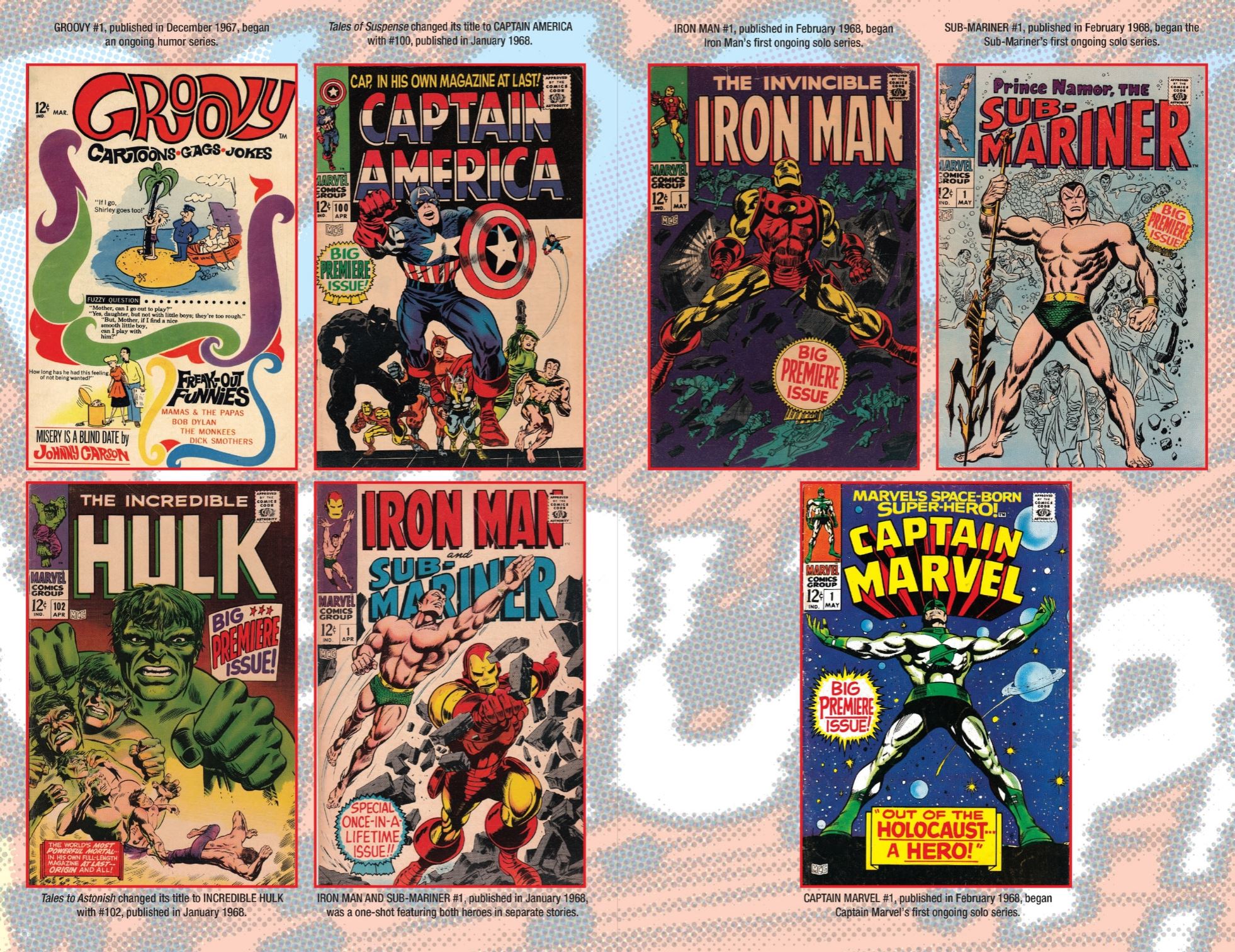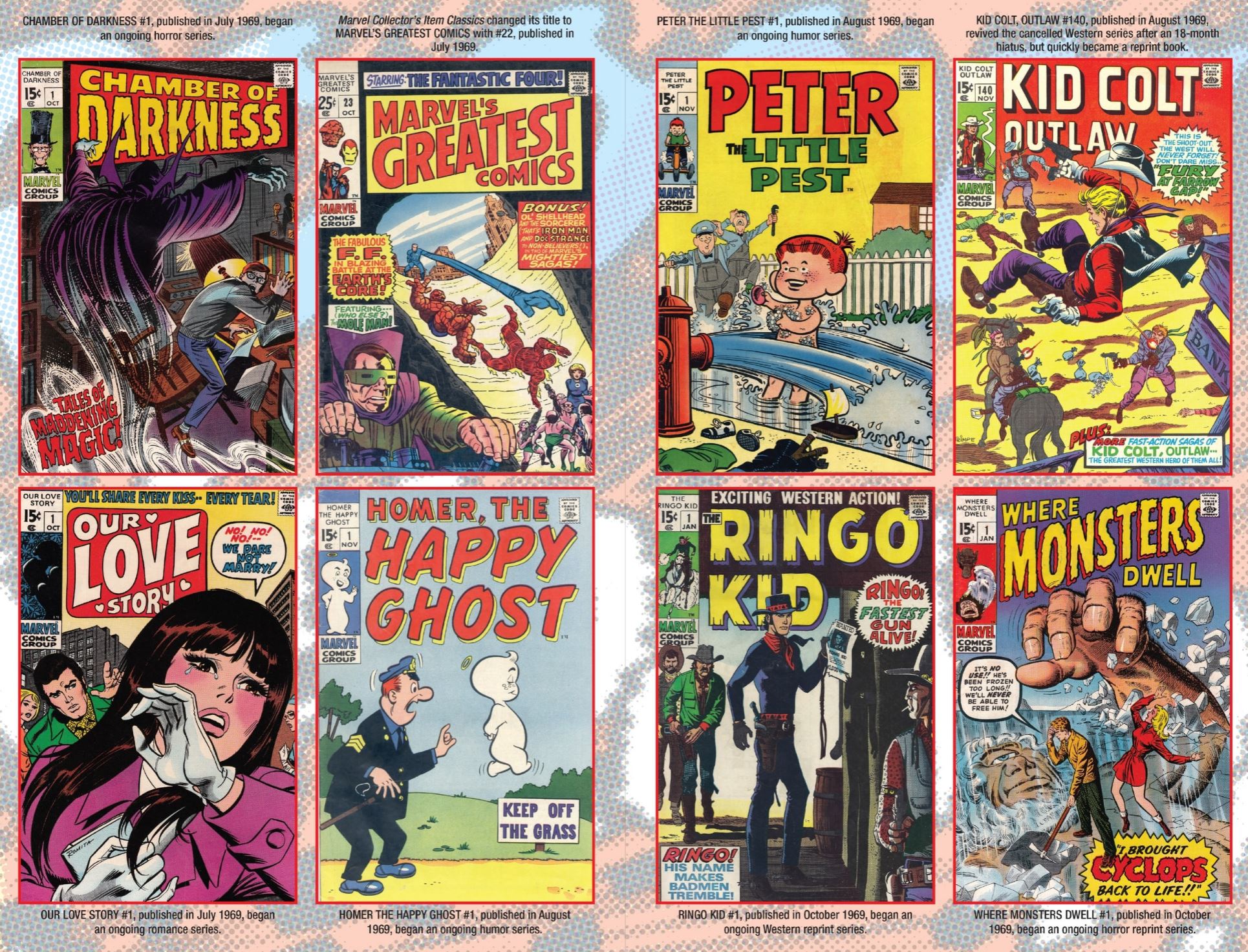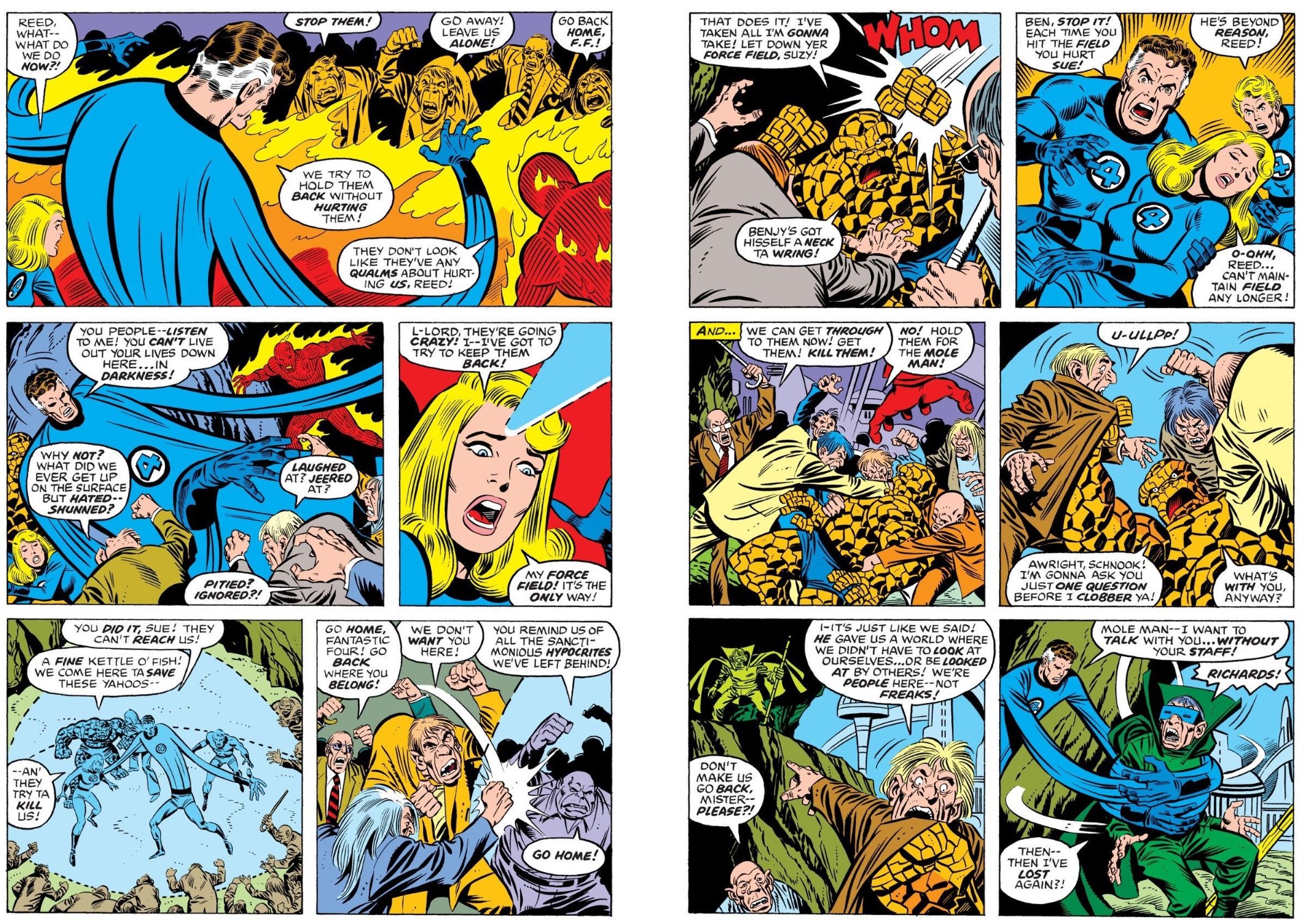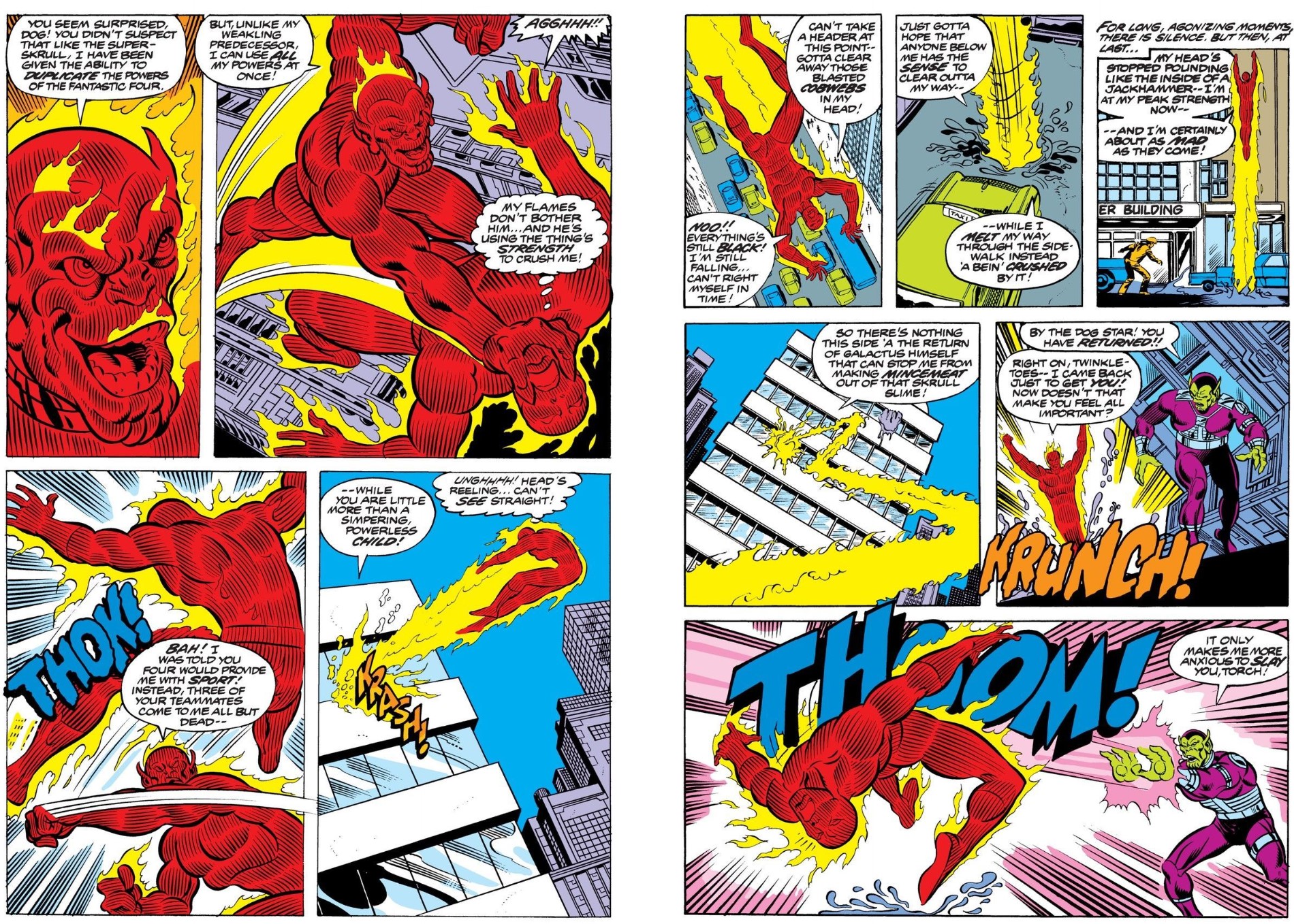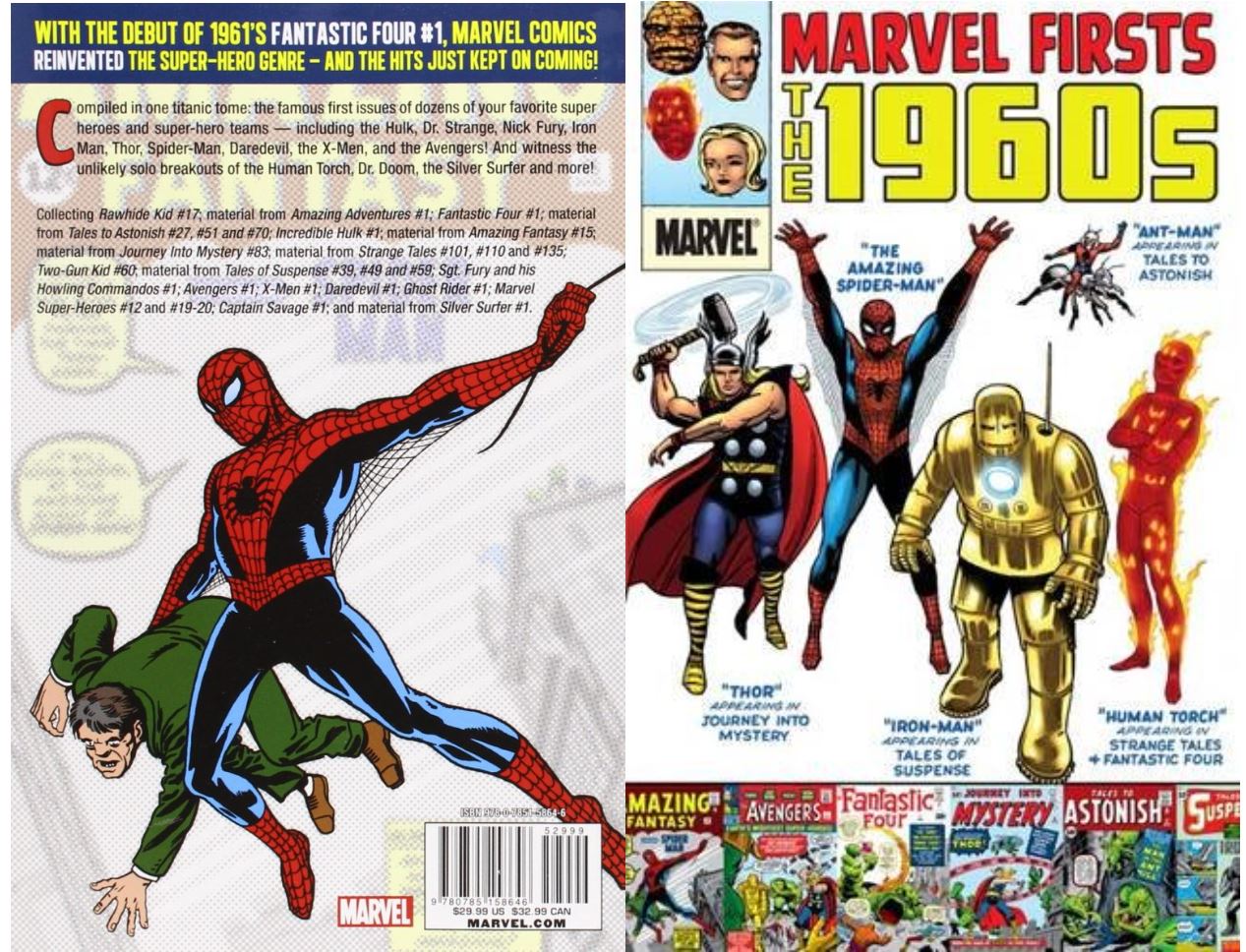
Marvel Visionaries: Gil Kane


By Gil Kane, with Stan Lee, Jack Kirby, Roy Thomas, Jim Shooter, Tony Isabella, Dan Slott, Mike Esposito, Joe Sinnott, Dan Adkins, Frank Giacoia, Dick Giordano, Klaus Janson, Jim Mooney & various (MARVEL)
ISBN: 978-0-7851-0888-7 (TPB), 978-1-3029-3737-9 (Digital edition)

This book includes Discriminatory Content produced in less enlightened times.

This year marks the centenary of Eli Katz, who, as Gil Kane, worked from the Golden Age until his death (on January 31st 2000) to make comics the art form it is today. Diligent, resolute and always challenging himself, Kane was a trendsetting pioneer in style, in form and in comics philosophy. He was also a visual architect of the superhero revival in the Silver Age and a key component in the evolution of the Graphic Novel.

Kane started young and toiled as an artist all his life. An ever-more effective and influential one, he drew and wrote for many companies since his debut (thus far verified as inking Carl Hubbell on The Scarlet Avenger in Zip Comics #14 and cover-dated May 1941): illustrating superheroes, action/adventure, war, mystery, romance, horror, movie adaptations and, perhaps most importantly, Westerns and Science Fiction tales. In the 1950s he was one of DC editor Julius Schwartz’s go-to artists for regenerating the superhero. Yet by 1968, at the top of his (admittedly much denigrated) profession, this relentlessly revolutionary and creative man felt so confined by juvenile strictures of the industry that he struck out on new ventures, jettisoning job security, and the editorial format bounds of comic books for new visions and media. However, the time was not right and after brief forays at other companies (like Dell and Tower) and attempting to create graphic narratives outside the comic book industry – such as His Name Is Savage and Blackmark – Kane began selling his services to Marvel Comics…

Kane’s earliest comic book output included Boy Commandos, Young Allies & Newsboy Legion, Doll Man, Zip Comics, Airboy Comics and many more, but by the Fifties he was settled at National/DC and working on Johnny Thunder, Jimmy Wakely, Matt Savage, Hopalong Cassidy, Rex the Wonder Dog and hundreds of genre yarns – romance, war, sci fi, western and horror. When Superheroes returned, he co-created Green Lantern and The Atom, and generated countless pages and captivating covers for Plastic Man, Batman, Superman, Flash, Teen Titans, Robin, Batgirl, Hawk and Dove, Captain Action and everything in between. Then, in 1966, with ever-increasing bureaucracy and panic over a new upstart rival gripping DC, Kane tentatively – and initially using the pseudonym Scott Edwards – began looking at other publishers, leading to breakthrough art for T.H.U.N.D.E.R. Agents, U.N.D.E.R.S.E.A. Agent, Dell Four Color, The Lost World, Brain Boy, The Frogmen, dozens of TV westerns and other licensed properties, and began his long association with modern Marvel Comics.

Initially a poor fit (he was asked to draw The Hulk over Jack Kirby’s layouts!), Kane persisted, going on to spectacularly redefine if not pictorially reinvent Amazing Spider-Man, Conan, Captain America and Captain Marvel; co-create Adam Warlock, Morbius, and Iron Fist and put his indelible stamp on Thor, Hulk, Ka-Zar, Daredevil, Marvel Team-Up and all the rest. Kane adapted John Carter, Warlord of Mars and other literary adventure-fantasy properties and reinvigorated dozens of horror-hero and superhero stalwarts, all while filling in on seemingly every character and cover going. Restless and craving what the medium could still achieve, he worked on newspaper strips too. Even before co-creating Star Hawks in 1977 with Ron Goulart, he had limned the daily Flash Gordon for King Features in the 1960s, and Tarzan Sunday pages.

Kane’s latter career included animation/design, and choice comics book outings as well as numerous special projects like Jason Drum for Le Journal de Tintin and The Ring of the Nibelung.

Although Marvel Visionaries: Gil Kane was originally released in 2002, it’s still readily available as it was digitally rereleased in 2021, so if you can read this you can find that…

Offering a brief selection of the many tales crafted by Kane, this tome re-presents gems first seen in Tales to Astonish #76; Tales of Suspense #88-#91; Captain Marvel #17; Amazing Spider-Man #99; Marvel Premiere #1 & 15 and Daredevil #146 plus material from What If #3 & #24 and Marvel Comics Presents #116, as well as offering a host of appealing production and art extras at the far end.

The trek through Marvel History begins with a fulsome appraisal of the artist’s career and achievements from frequent collaborator Roy Thomas in his foreword ‘The Mark of Kane’ after which it’s “on with the motley” and that first foray from Tales to Astonish #76. Cover-dated February 1966, this was on sale from November 4th 1965 and saw Kane draw – over Kirby layouts and under Mike Esposito finishes – an episode of a time-bending sequence with the Green Goliath helplessly trapped in a compounded by a doom-drenched duel with time-lost Asgardian immortal The Executioner

Assume and accept that you will need to find other collections to experience the full force of these extracted snippets and then move on to those portions of Tales of Suspense #88-#91 (cover-dates April -July 1967) that featured Captain America. Here Lee scripts all four chapters of a classic clash as Kane takes his first run on the character. The extended saga comprises ‘If Bucky Lives…!’ and ‘Back from the Dead!’, as inked by Kane before Joe Sinnott joins as embellisher for ‘…And Men Shall Call Him Traitor!’ and ‘The Last Defeat!’ for a superb thriller of blackmail and betrayal starring the Red Skull. The fascist felon had baited a trap with a robotic facsimile of Cap’s dead partner, triggered it with malign super-hirelings Power Man and The Swordsman whilst blackmailing the Star-Spangled Sentinel into betraying his country and stealing a new atomic submarine. It all turned out okay in the end though…

Next up is Captain Marvel #17 (cover-date October 1969), sole example from a stunning and influential run on the Kree Captain Mar-Vell. Captain Marvel as we know him really begins with this reinvention wherein Thomas, Kane & Dan Adkins totally retooled and upgraded the character.

‘And a Child Shall Lead You!’ sees the imperilled star warrior inextricably bonded to voice-of-a-generation/professional sidekick Rick Jones who – just like Billy Batson (the boy who turned into the original Fawcett hero by shouting “Shazam!”) – switched places with a mighty adult hero when danger loomed by striking together a pair of ancient, wrist-worn “Nega-bands”. This allowed them to temporarily trade atoms: one active in our universe whilst the other floated, a ghostly untouchable, ineffectual voyeur to events glimpsed from the ghastly Negative Zone. As thrilling and as revolutionary as the idea of a comic written from the viewpoint of a teenager was, the real magic comes from Kane’s experimental page layouts and phenomenally kinetic artwork, and whose mesmeric staging of proportionally warped yet somehow still perfect human-form-in-motion rewrote the playbook on superhero illustration with this series.

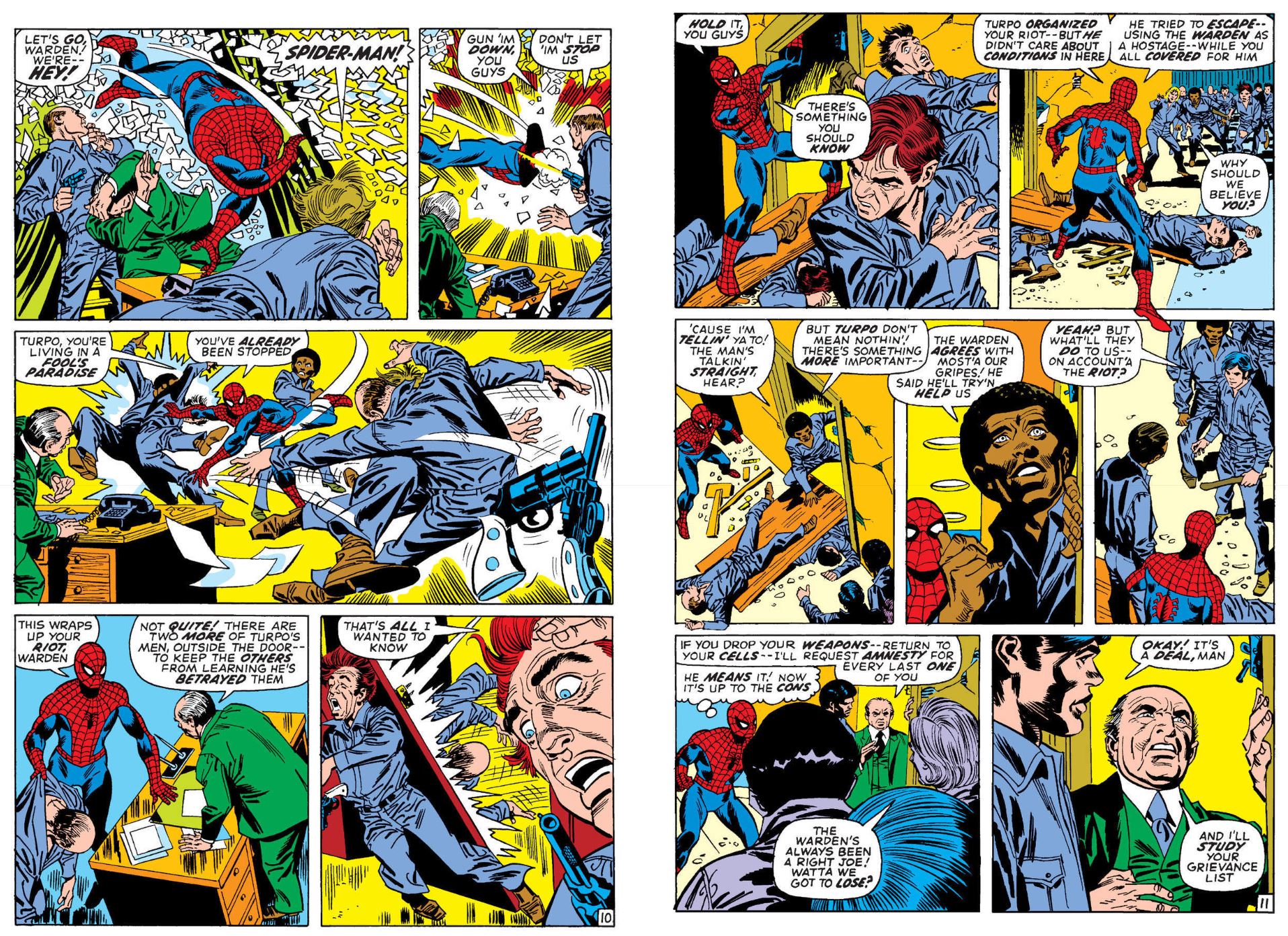
Kane’s ascendancy was confirmed as he became the regular illustrator on Marvel’s greatest hit. A monumental first run on the wallcrawler is marked here by Amazing Spider-Man #99 (August 1971) portraying ‘A Day in the Life of…’: an all-action, social drama-tinged palate-cleanser with Peter Parker and Gwen Stacy finally getting their love-life back on track, only marginally diverted by a prison breakout easily quelled by the Arachnid Avenger, whilst highlighting the growing scandal of prison conditions…

Jump forward to tumultuous turbulent November 1971 where the April cover-dated Marvel Premiere #1 boldly proclaimed on its cover The Power of… Warlock. Inside, the stunning fable by Thomas, Kane & Adkins declared ‘And Men Shall Call Him… Warlock’ neatly recapitulated artificial man Him’s origins as a lab experiment concocted by rogue geneticists eager to create a superman they could control for conquest. Also on view is the manufactured man’s face off with the Fantastic Four, and clash with Thor over the rights to a mate before returning to an all-encompassing cosmic cocoon to evolve a little more.

Now that shell is plucked from the void thanks to the moon-sized ship of self-created god The High Evolutionary. Having artificially ascended to godhood, he is wrapped up in a bold new experiment…

Establishing contact with Him as he basks in his cocoon, the Evolutionary explains that he is constructing from space rubble a duplicate planet Earth on the opposite side of the sun. Here he will replay the development of life, intending that humanity on Counter-Earth will evolve without the taint of cruelty and greed and deprived of the lust to kill. It’s a magnificent scheme that might well have worked, but as the Evolutionary wearies, his greatest mistake intervenes…

Man-Beast was over-evolved from a wolf and gained mighty powers, but also ferocious savagery and ruthless wickedness. Now he invades the satellite, despoiling humanity’s rise and ensuring the new world’s development exactly mirrors True-Earth’s. The only exception is the meticulous exclusion of enhanced individuals. The beleaguered orb has all Earth’s woes but no superheroes to save or inspire its people. A helpless witness to the desecration, the golden being furiously crashes free of his cocoon to save the High Evolutionary and rout Man-Beast and his bestial cronies (all similarly evolved animal-humanoids called “New-Men”). When the despondent, enraged science god recovers, he decides to erase his failed experiment but is stopped by his rescuer. As a helpless observer, Him saw the potential and value of embattled humanity. Despite all their flaws, he believes he can save them from imminent doom caused by their own unthinking actions, wars and intolerance. When his pleas convince the Evolutionary to give this mankind one last chance, the wanderer is hurled down to Counter-Earth, gifted and graced with a strange “Soul Gem” to focus his powers, on a divine mission to find the best in the fallen and a name of his own…

Enjoying and thriving in an era and atmosphere of experimentation, Kane returned to Marvel Premiere with #15 (May 1974) for the debut of masked martial artist Iron Fist. His saga began on a spectacular high with Thomas, Kane & Dick Giordano’s ‘The Fury of Iron Fist!’, as a teenaged masked warrior defeats the cream of a legendary combat elite in a fabled other-dimensional city before returning to Earth.

Ten years previously little Daniel Rand had watched his father and mother die at the hands of Harold Meachum whilst the party of millionaire adventurers risked Himalayan snows to find the legendary city of K’un Lun. Little Danny had travelled with his parents and business partner Meachum in search of the fabled city – which only appeared on Earth for one day every decade. Wendell Rand had some unsuspected connection to the fabled Shangri La but was killed before they found it, whilst Danny’s mother sacrificed herself to save the child from wolves and her murderous pursuer.

As he wandered alone in the wilderness, the city found Danny. The boy spent ten years training: mastering all forms of martial arts in a militaristic, oriental, feudal paradise while enduring countless arcane ordeals, living only for the day he would return to Earth and avenge his parents. After conquering all comers and rejecting immortality, the Iron Fist returned to Earth, a Living Weapon able to channel his force of will into a devastating super-punch…

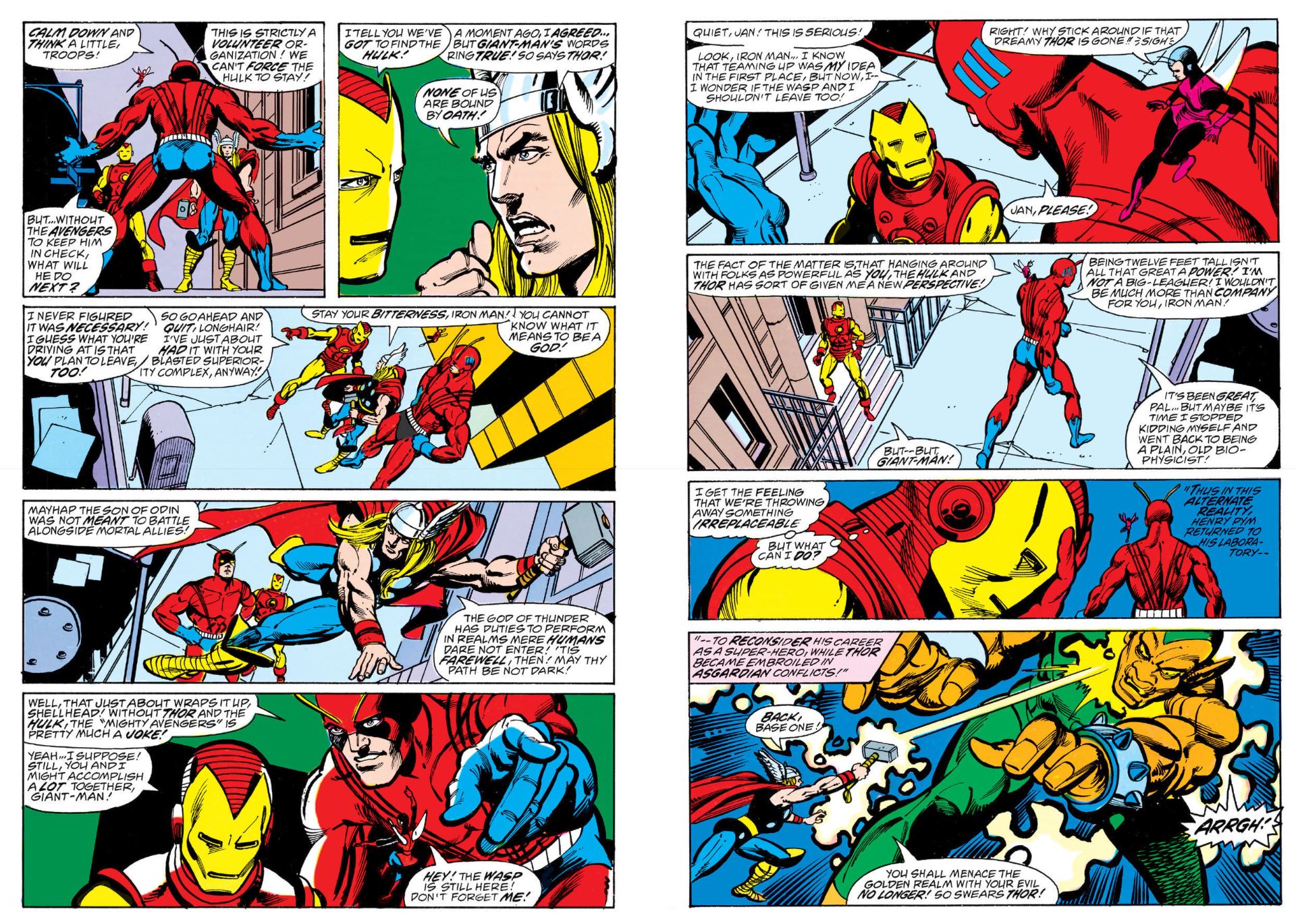
Alternate worlds vehicle What If? #3 (June 1977) provided one of the most memorable stories of the era and one of Kane’s greatest triumphs. Scripted by Jim Shooter and inked by Klaus Janson ‘What If the Avengers Had Never Been?’ diverted from established Marvel Continuity at the end of Avengers #2 when Hulk quit the still-forming team. In this instance, the act sunders the entire squad who go their own ways with shocking, spectacular and ultimately tragic consequences. If you buy this book for only one tale it will be this one…

That same month in Daredevil #146 the artist again demonstrated his brilliance in staging dramatic fight scenes. Scripted by Shooter and inked by Jim Mooney, ‘Duel!’ saw the sightless swashbuckler searching Manhattan for maniac marksman Bullseye even as his quarry was setting up a lethal showdown. The brutally bruising climax came when the crazed killer took an entire TV studio hostage but ended with his being soundly defeated yet again…

With Tony Isabella writing and Frank Giacoia inking, Kane revisited one of his greatest comics triumphs in What If? #24 (December 1980), as ‘What If Gwen Stacy had Lived?’ explored an Alternity where Spider-Man saved his fiancée from Green Goblin Norman Osborn and went on to marry her before losing everything he loved to the obsessive hatred of J. Jonah Jameson

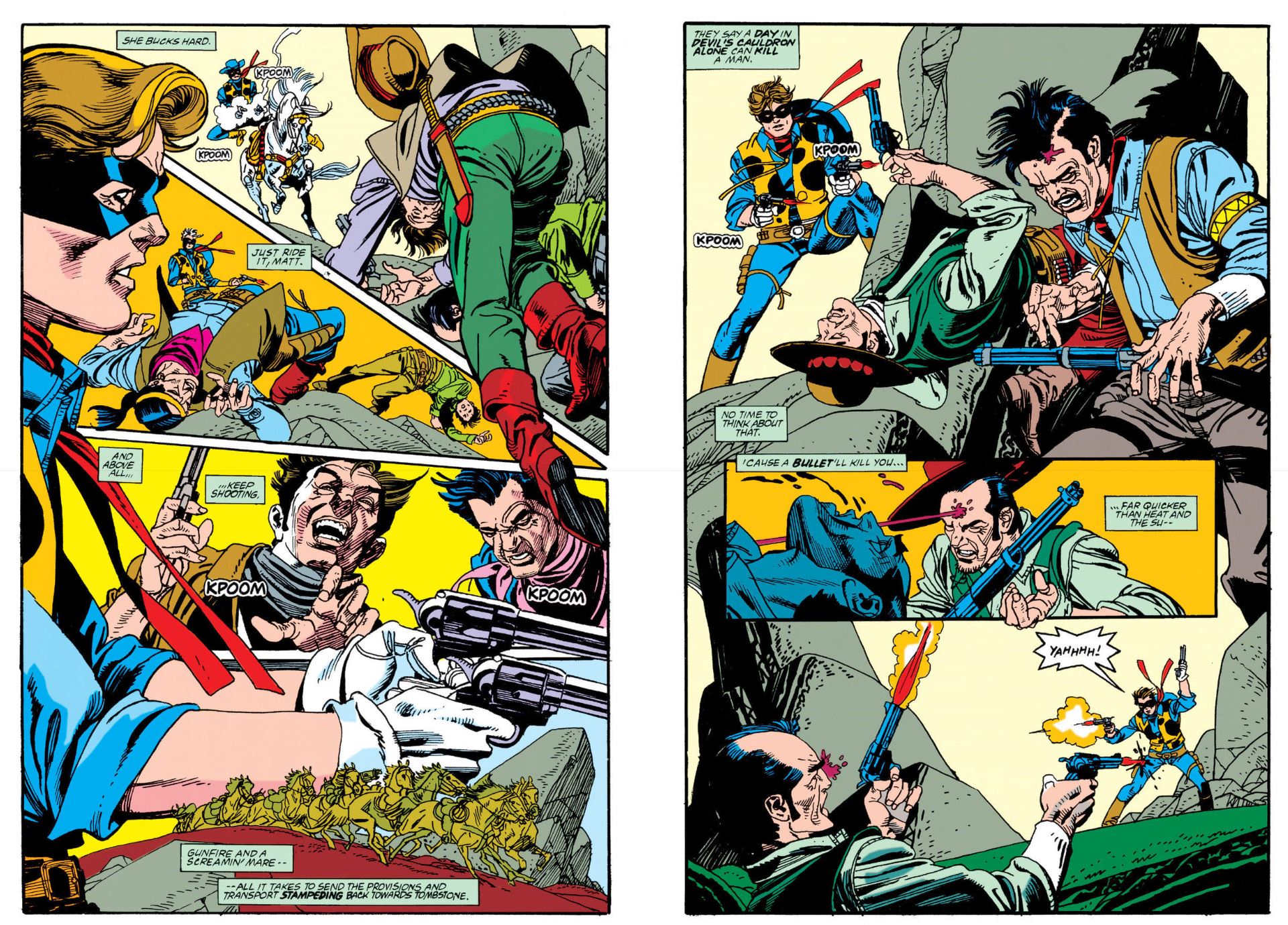
This compelling compilation notionally concludes with a late treat from Marvel Comics Presents #116 (cover-dated November 1992) with future superstar scripter Dan Slott taking Kane back to his cowboy roots for a short rip-roaring romp featuring the Two-Gun Kid. Here the occasional Avenger and prototype Marvel Mystery-man hero serves up ‘Just Deserts’ to vicious scheming owlhoots John Baker and the Unlucky Thirteen Gang before marching the sole survivor back across the searing Devil’s Cauldron back to Tombstone city jail…

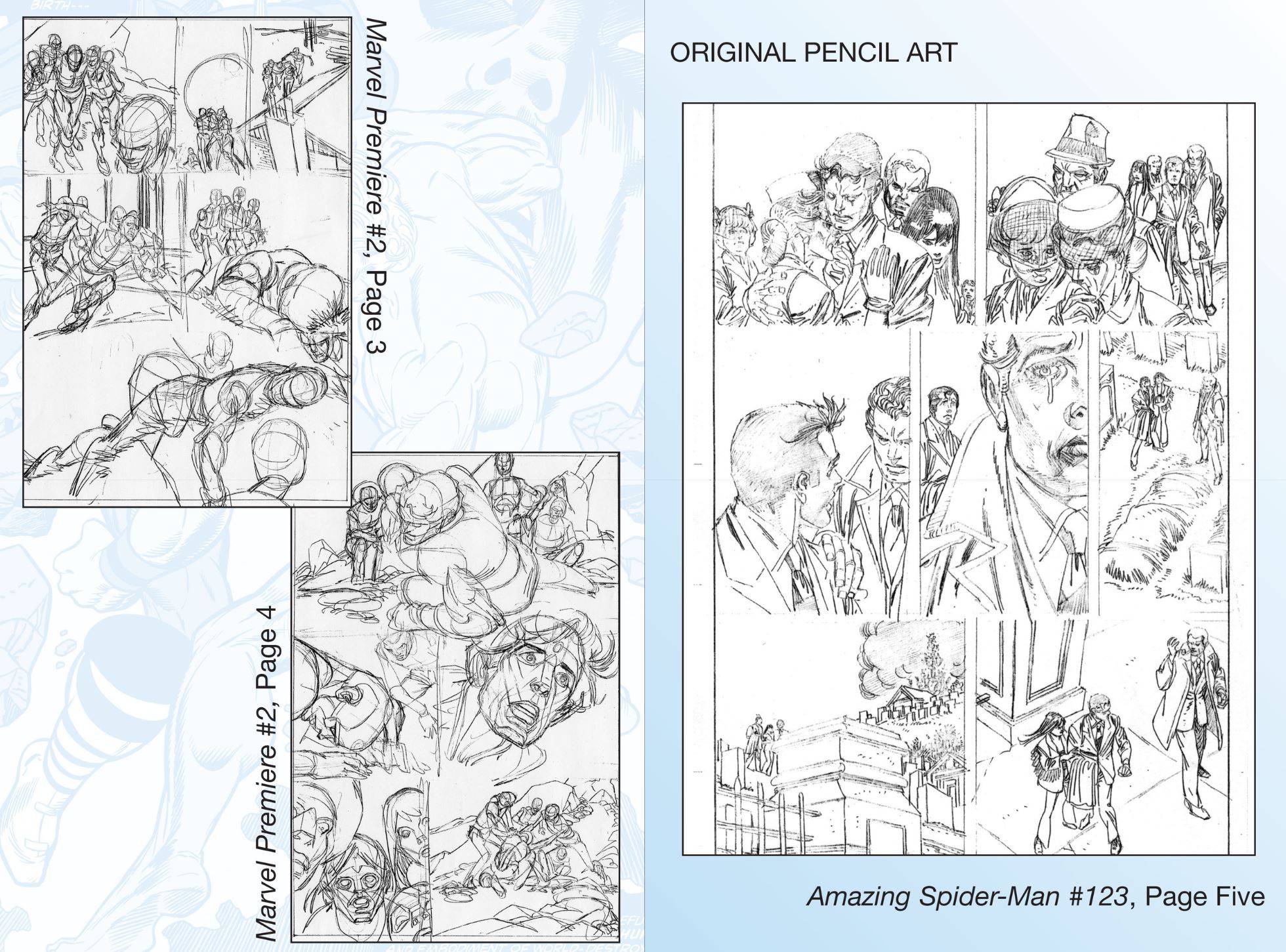
Providing pertinent covers by Kane, this tome offers additional pictorial treats including Kane’s favourite cover (Mighty Marvel Western #44) plus a gallery of others such as Western Gunfighters #31, Kid Colt, Outlaw #161, Sub-Mariner #44 & Captain Marvel #23), the extras also deliver a vast selection of page layouts, design roughs, fully-pencilled pages and covers as well as inked and completed pages of marvels.

Also working as Gil Stack, Scott Edward, Stack Til, Stacktil, Pen Star and Phil Martell, Gil Kane became a foundation stone of comics and remains a vivid, vital inspiration to future generations of creators and readers. With all that in mind why not have a far too brief look at some of the man’s early Marvel superhero triumphs and gently remind the Powers-that-Be that this is only the tip of a graphic iceberg that includes plenty of room for barbarian, sci fi and horror collection one day…
© 2021 MARVEL.

Born today in 1924, cartoonist Brad Anderson (Marmaduke), Belgian illustrator Willy Lambillotte AKA Lambil (Sandy, The Bluecoats, Pauvre Lampil) in 1936 and cartoonist/illustrator Norm Fueti (Retail, Gil, The King of Kazoo) in 1970.

Today we lost someone you’ve probably never heard of: letterer, designer and production artist/manager Gerda Gattel (October 28th 1908 – May 14th 1993). She was filling the ballons and fixing pages for Timely-Atlas from 1947 to the company’s implosion and then moved across town to National DC where she did the same thing from 1958 to her retirement as Production Coordinator in 1973.

Marvel Two-In-One Epic Collection volume 3 (1977-1979): Remembrance of Things Past


By Marv Wolfman, Jim Starlin, Roger Slifer, Tom DeFalco, David Anthony Kraft, Ralph Macchio, Peter B. Gillis, Alan Kupperberg, Bill Mantlo, Jo Duffy, John Byrne, Steven Grant, Allyn Brodsky, David Michelinie, Ron Wilson, Sal Buscema, Bob Hall, Chic Stone, Frank Miller, Jim Craig, Pablo Marcos, Josef Rubinstein, Jim Mooney, Alfredo Alcala, Sam Granger, Frank Giacoia, Dave Hunt, Tex Blaisdell, Gene Day, Joe Sinnott, Bob McLeod, Bruce Patterson, Mike Esposito & various (MARVEL)
ISBN: 978-1-3029-5564-9 (TPB/Digital edition)

This book includes Discriminatory Content produced in less enlightened times.

Above all else, Marvel has always been about team-ups. The concept of team-up books – an established star pairing, or battling (often both) with less well-selling company characters – was not new when Marvel awarded their most popular hero the same deal DC had with Batman in The Brave and the Bold. Although confident in their new title, they wisely left options open by allocating an occasional substitute lead: the Human Torch. In those long-ago days, editors were acutely conscious of potential over-exposure – and since super-heroes were actually in a decline they may well have been right.

Nevertheless, after the runaway success of Spider-Man’s guest vehicle Marvel Team-Up, the House of Ideas carried on the trend with a series starring bashful, blue-eyed Ben Grimm – the Fantastic Four’s most iconic and popular member. They began with a test run in Marvel Feature #11-12, before awarding him his own team-up title, with this third power-packed compendium gathering in the contents of Marvel Two-in-One #37-52; MTIO Annuals #2-4 and Avengers Annual #7, covering November 1977 to June 1979.

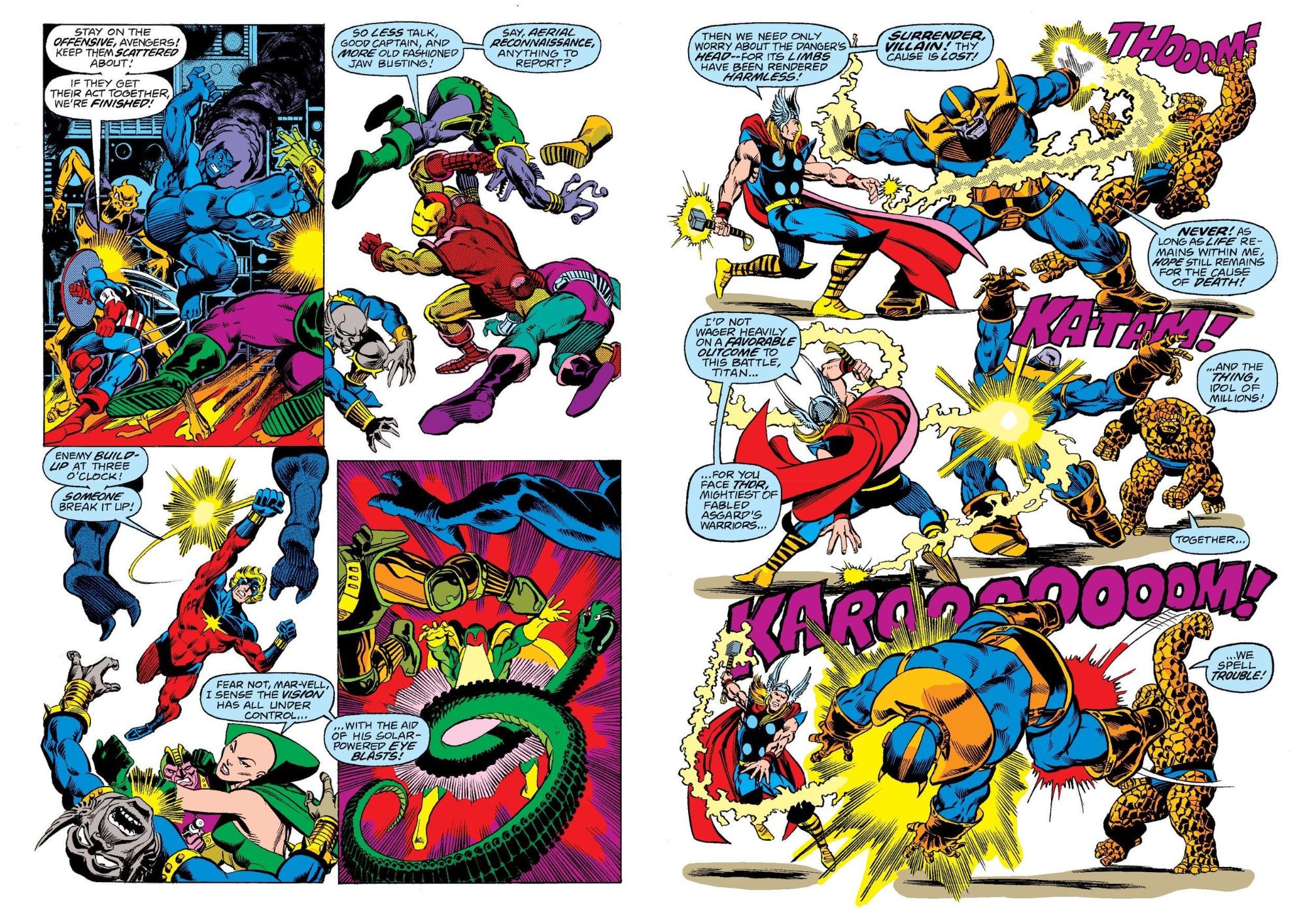
The action begins with ‘The Final Threat’ (by Jim Starlin & Joe Rubinstein) from Avengers Annual #7, wherein Kree warrior Captain Marvel and Titanian mind-goddess Moondragon return to Earth with vague anticipations of impending cosmic catastrophe. Their premonitions are confirmed when galactic wanderer Adam Warlock arrives with news that death-obsessed Thanos has amassed an alien armada and built a Soul-gem powered weapon to snuff out the stars like candles. Broaching interstellar space to stop the scheme, the united heroes forestall interstellar incursion and prevent the Mad Titan destroying the Sun, but only at the cost of Warlock’s life…

Then Marvel Two-in-One Annual #2 undertakes a ‘Death Watch!’ (Starlin & Rubinstein): finding Peter Parker plagued by prophetic nightmares disclosing how Thanos had snatched victory from defeat and now holds the Avengers captive whilst again preparing to extinguish Sol. With nowhere else to turn, anguished, disbelieving Spider-Man heads for the Baxter Building to borrow a spacecraft, unaware The Thing also has history with the terrifying Titan. Although utterly outpowered, the mismatched champions of Life subsequently upset Thanos’ plans, allowing the Avengers and the Universe’s true agent of retribution to end the Titan’s threat forever… or at least until next time…

Marvel Two-In-One’s apparent function as a clearing-house for old, unresolved series and plot-lines was then briefly put on hold as issue #37 teamed Ben with Matt Murdock (not alter ego Daredevil) for Marv Wolfman, Ron Wilson & Pablo Marcos’ legal drama ‘Game Point!’

Ben had been framed for monstrous acts of wanton destruction, and when the case went badly, he faced decades in jail. However, the Man Without Fear and eccentric street punk Eugene the Kid determined the Mad Thinker was behind the plot to place the ‘Thing Behind Prison Bars’ (Roger Slifer, Wilson & Jim Mooney): tackling the maniac whose ultimate game plan is to corner the future, mass-producing his own squadron of the synthezoid Avenger in #39’s conclusion ‘The Vision Gambit’ (inked by Marcos).

Slifer, Tom DeFalco, Wilson & Marcos then detail a spooky international yarn as the Black Panther is involved in a monstrous reign of terror with a zombie-vampire stalking the streets and abducting prominent African Americans. Concluding chapter ‘Voodoo and Valor!’ – by David Anthony Kraft, Wilson & Marcos – sees Jericho Drumm/Brother Voodoo volunteer his extremely specialised services to Ben and T’Challa in hopes of ending the crisis. The trail takes our heroes to Uganda for a confrontation with Doctor Spectrum and the far more dangerous real-world crazed killer Idi Amin

Crafted by Ralph Macchio, Sal Buscema, Alfredo Alcala & Sam Grainger, Marvel Two-In-One #42 then debuts a future mainstay of Marvel Universe continuity as Project Pegasus premiers in ‘Entropy, Entropy…’

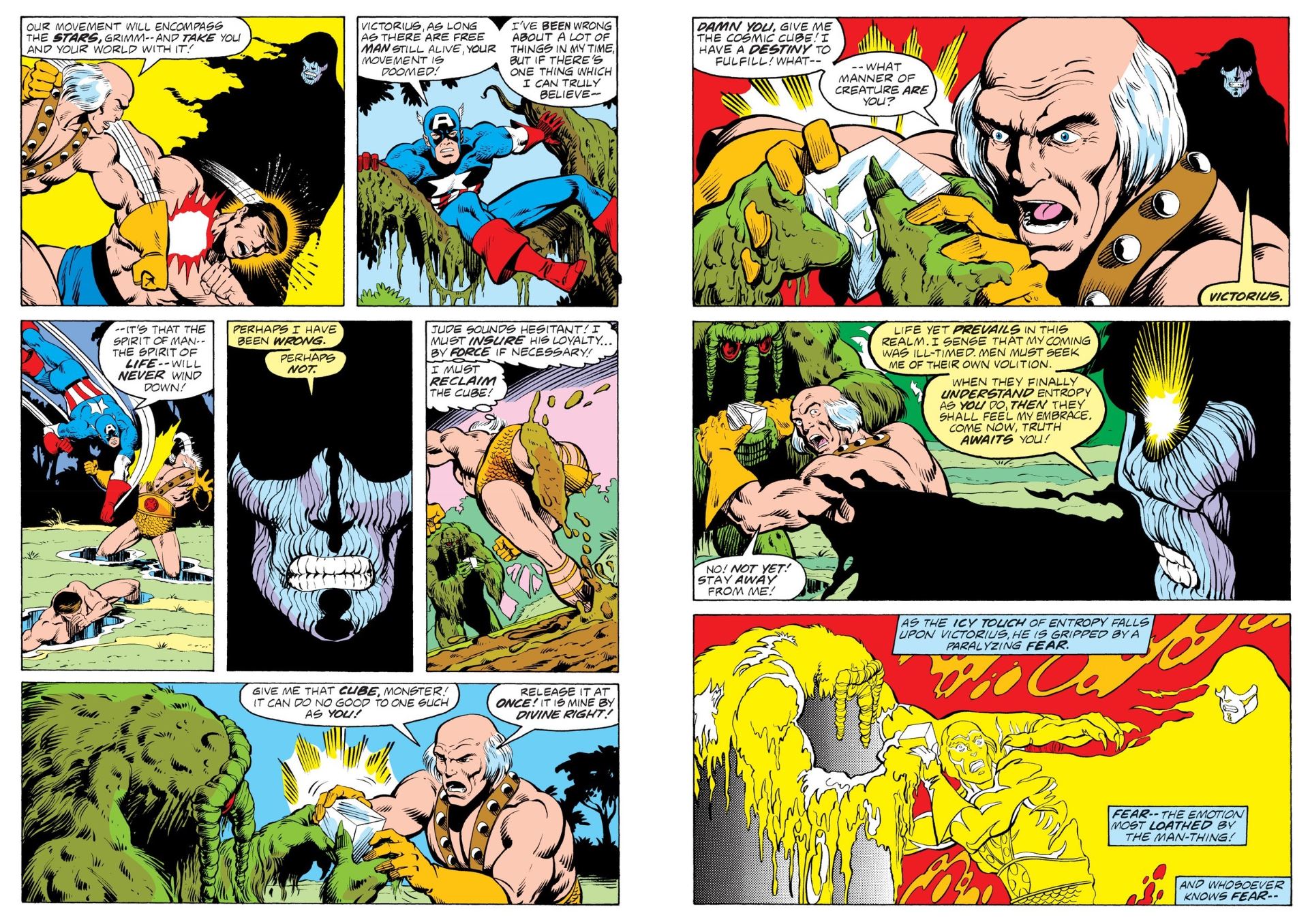
The Federal research facility designated Potential Energy Group/Alternate Sources/United States is dedicated to investigating new and exotic power sources and naturally became the most sensible place to dump energy-wielding super-baddies once they were subdued. Ben finds and begins trashing the place whilst tracking down his educationally – and emotionally -challenged ward Wundarr after the kid was renditioned by the Government. The furious Thing is soon confronted and contained by Captain America in his role as security advisor and together they stumble over a sabotage scheme by martial maniac Victorius who unleashes a deadly new threat in the ghostly form of Jude, the Entropic Man. This phantasmic force easily trounces Cap and Ben but finds the macabre Man-Thing far harder to handle in concluding chapter ‘The Day the World Winds Down’ from Macchio, John Byrne & Friends & Bruce Patterson)…

The third Marvel Two-In-One Annual then hosts a great big, old-fashioned world-busting blockbuster wherein Nova the Human Rocket battles beside Ben to free captive alien princesses and save Earth from colossal cosmos-marauding space invaders: a simple yet entertaining tussle entitled ‘When Strike the Monitors!’ all crafted by Wolfman, Sal Buscema, Frank Giacoia & Dave Hunt… after which, back in the monthly comic book, issue #44 strays away from standard fare with ‘The Wonderful World of Brother Benjamin J. Grimm’ (Wolfman, Bob Hall & Frank Giacoia) with the Thing telling rowdy kids a fanciful bedtime story concerning his recent partnership with Hercules to free Olympus from evil giants…

Marvel Two-In-One #45’s sees Kree Captain Marvel warned by his Cosmic Awareness that the Thing had been targeted by vengeful Skrulls in ‘The Andromeda Rub-Out!’ (Peter Gillis, Alan Kupperberg & Mike Esposito), after which the Incredible Hulk’s new TV show compels an outraged Ben to head for Hollywood, only to become accidentally embroiled in a ‘Battle in Burbank!’ (Kupperberg & Chic Stone)…

The Thing’s self-appointed gadflies The Yancy Street Gang headlined in MT-I-O #47 as ‘Happy Deathday, Mister Grimm!’ (Bill Mantlo & Stone) sees a cybernetic tyrant long believed dead take over Ben’s old neighbourhood… until the hero pays a visit. The invasion exposed, it is quickly concluded once awesome alien energy powerhouse Jack of Hearts joins the fight against ‘My Master, Machinesmith!’ (in #48 by Mantlo, Stone & Tex Blaisdel).

Mary Jo Duffy, Alan Kupperberg & Gene Day piled on spooky laughs in #49 as the ‘Curse of Crawl-Inswood’ highlights how Doctor Strange manipulates Ben into helping crush a paranormal incursion in a quaint and quiet seaside resort…

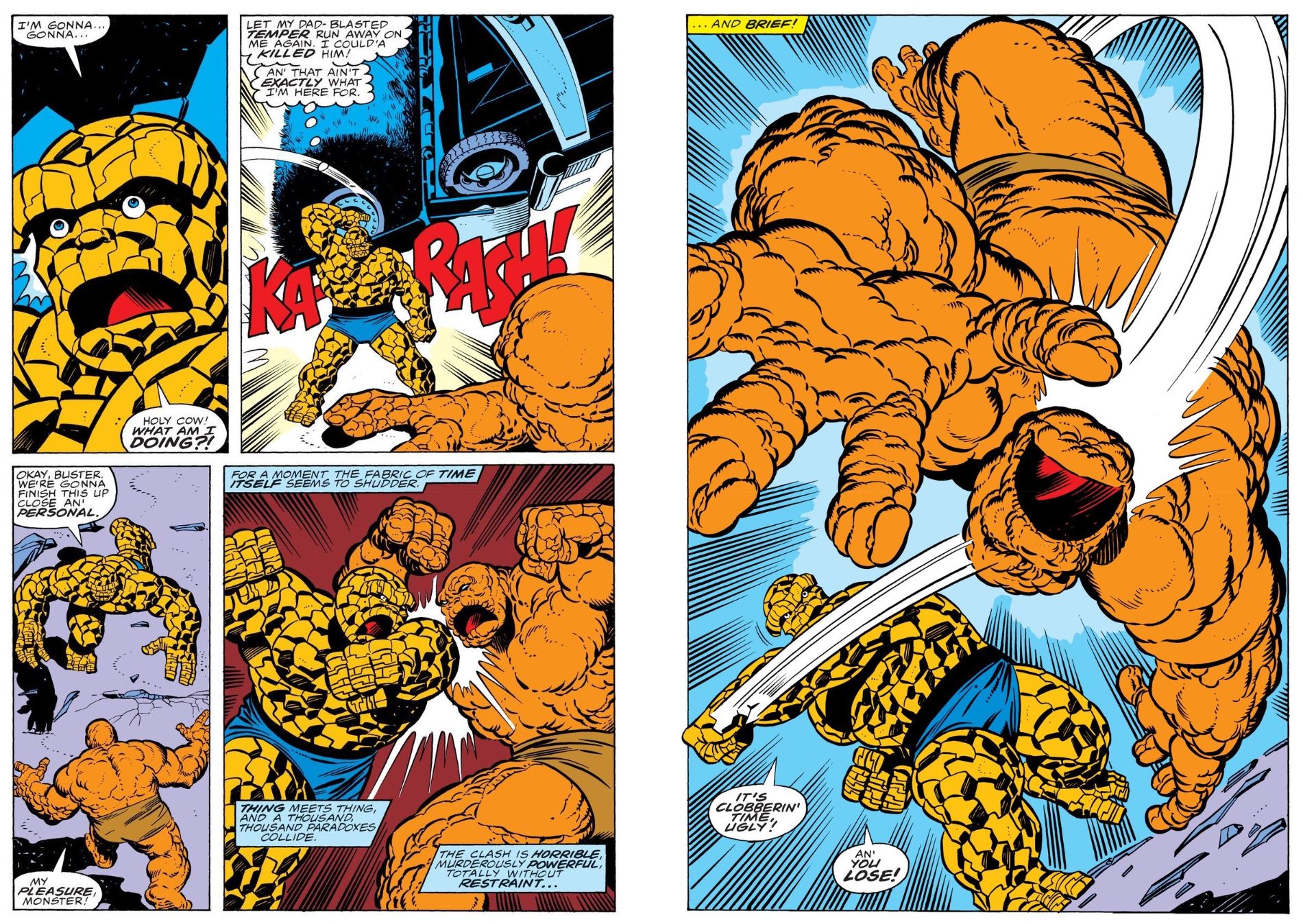
Anniversary issue #50 was everything a special issue should be. ‘Remembrance of Things Past’ by Byrne & Joe Sinnott takes a powerful and poignant look at the Thing’s history as a monster outcast and posits a few what-might-have-beens…

Following another failure by Reed Richards to cure Ben’s rocky state, The Thing steals the chemical and travels into his own past, determined to use the remedy on his younger, less mutated self. However, his bitter, brooding, brittle earlier incarnation is hardly prepared to listen to another monster and, inevitably, catastrophic combat ensues…

Issue #51 was even better. ‘Full House… Dragons High!’ by Peter Gillis, up-&-coming artist Frank Miller & Bob McLeod, details how a weekly poker session at Avengers Mansion is interrupted by rogue US General Pollock, who again tries to conquer America with stolen technology. Happily, Ben and Nick Fury find Ms. Marvel (not today’s teenager Kamala Khan but current Captain Marvel Carol Danvers), Wonder Man and The Beast better combat comrades than poker opponents…

A note of sinister paranoia creeps in with Marvel Two-In-One #52’s ‘A Little Knight Music!’ (Steven Grant, Jim Craig & Marcos), as the mysterious Moon Knight joins Ben in stopping CIA Psy-Ops master Crossfire brainwashing the city’s superheroes into killing each other, prior to MTIO Annual #4 providing an old-fashioned, world-busting fantasy finale – for now – as ‘A Mission of Gravity!’(plotted by Allyn Brodsky, scripted by David Michelinie, limned by Craig, Bob Budiansky & Patterson) unites Ben and Inhuman monarch Black Bolt (and Good Boi Lockjaw!) to stop unstable maniac Graviton turning into a black hole and taking the world with him…

Backed up by the covers of Starlin, Rubinstein, Wilson, Sinnott, Marcos, Terry Austin, George Pérez, Walt Simonson, Sal Buscema, Hall, Giacoia, Keith Pollard, Layton, Stone, Budiansky, and Al Milgrom, there is also a big bold bonus section including contemporary house ads, covers from reprint title The Adventures of the Thing (by Sam Keith, Mike Mignola & Joe Quesada) and original art pages by Starlin, Rubinstein, Perez & Sinnott.

This tome of tales from Marvel’s Middle Period are admittedly of variable quality. They are, however, offset by truly timeless classics, still as captivating today as they ever were. Most fans of Costumed Dramas will have little to complain about and there’s lots of fun to be found for young and old readers. So why not lower your critical guard and have an honest blast of pure warts ‘n’ all comics craziness? You’ll almost certainly grow to like it…
© 2025 MARVEL.

This date in 1754 – and attributed to Benjamin Franklin – the first American newspaper cartoon “Join, or Die” was published in The Pennsylvania Gazette.

Somewhat less momentously – perhaps – today in 1893 Wonder Woman co-creator William Moulton Marton was born as was Short Ribs cartoonist Frank O’Neal in 1921; Half Hitch and Henry illustrator Dick Hodgins, Jr. in1931 and multi-directional art scribe Barbara Slate (Yuppies From Hell, Angel Love, Sweet XVI, Ms. Liz) in 1947. They were joined in 1953 by writer Pat McGreal (Chiaroscuro; The Private Lives of Leonardo DaVinci, Veils, I, Paparazzi and more Disney comics than seems humanly possible); in 1955 by American Splendor illustrator Brian Bram; inveterate comics publisher David Campiti in 1958, and the astoundingly funny Ty Templeton (Stig’s Inferno, Batman Adventures, The Simpsons) in 1962.

Today in 1991 The Simpsons episode “Three Men and a Comic Book” aired, giving Comic Book Guy to the world…

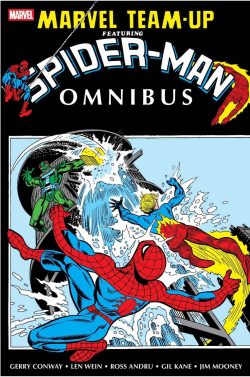
Marvel Team-Up Omnibus volume 1


By Roy Thomas, Gerry Conway, Len Wein, Steve Gerber, Ross Andru, Gil Kane, Jim Mooney, Sal Buscema, Don Heck, Mike Esposito, Frank Giacoia, Steve Mitchell, Frank Bolle, Don Perlin, Sal Trapani, Wayne Howard, Dave Hunt, Vince Colletta & various (MARVEL)
ISBN: 978-1-3029-6699-7 (HB/Digital edition)

This book includes Discriminatory Content produced in less enlightened times.

Inspiration isn’t everything. In fact, as Marvel slowly grew to a position of market dominance in the wake of losing their two most innovative and inspirational creators, they did so less by experimentation and more by expanding proven concepts and properties. The only real exception to this was the assembly line creation of horror and horror-hero titles in response to the industry down-turn in super-hero sales – a move expedited by a rapid revision in the wordings of the increasingly ineffectual Comics Code Authority rules.

The concept of team-up books – an established star pairing or battling (usually both) with less well-selling company characters – was not new when Marvel decided to award their most popular hero the lion’s share of this new title, but they wisely left their options open by allocating an occasional substitute lead in the Human Torch. In those long-lost days editors were acutely conscious of potential over-exposure – and since superheroes were actually in a decline they may well have been right.

Marvel Team-Up was the second regular Spider-Man title (abortive companion title Spectacular Spider-Man was created for the magazine market in 1968 but died after two issues). MTU launched at the end of 1971 and went from strength to strength, proving the time had finally come for expansion and a concentration on uncomplicated action over sub-plots…

This engaging hardback and/or eBook compilation gathers the first 30 issues of Marvel Team-Up (spanning cover-dates March 1972 to February 1975) and includes crossover fun from Daredevil (and the Black Widow) #103, plus double length larks from Giant-Size Super Heroes #1 and Giant-Size Spider-Man #1-3. As well as a monolithic assortment of nostalgic visual treats at the back, this mammoth tome is dotted throughout with editorial and letters pages (from ‘Team-Up’ to ‘Mail it to Team-Up’) and also includes recycled Introductions from previous Marvel Masterworks editions (namely Gerry Conway’s ‘Behold: An Introduction’ and Roy Thomas’ ‘A Long, Loose Leash’ and ‘Full Credit – or Blame’) plus other contemporary editorial announcements as seen in each original issue, just to enhance overall historical experience…

Marvel Team-Up #1was crafted by Roy Thomas, Ross Andru & Mike Esposito as a mutual old enemy reared his gritty head in charming seasonal saga ‘Have Yourself a Sandman Little Christmas!’. A light-heated romp full of Christmas cheer, rambunctious action and seasonal sentiment, the story set the tone for all epics to follow. Merry Marvelite Maximii can award themselves a point for remembering which martial arts/TV hero debuted in this issue, but folk with lives can simply take my word that it was Iron Fist’s sometimes-squeeze Misty Knight

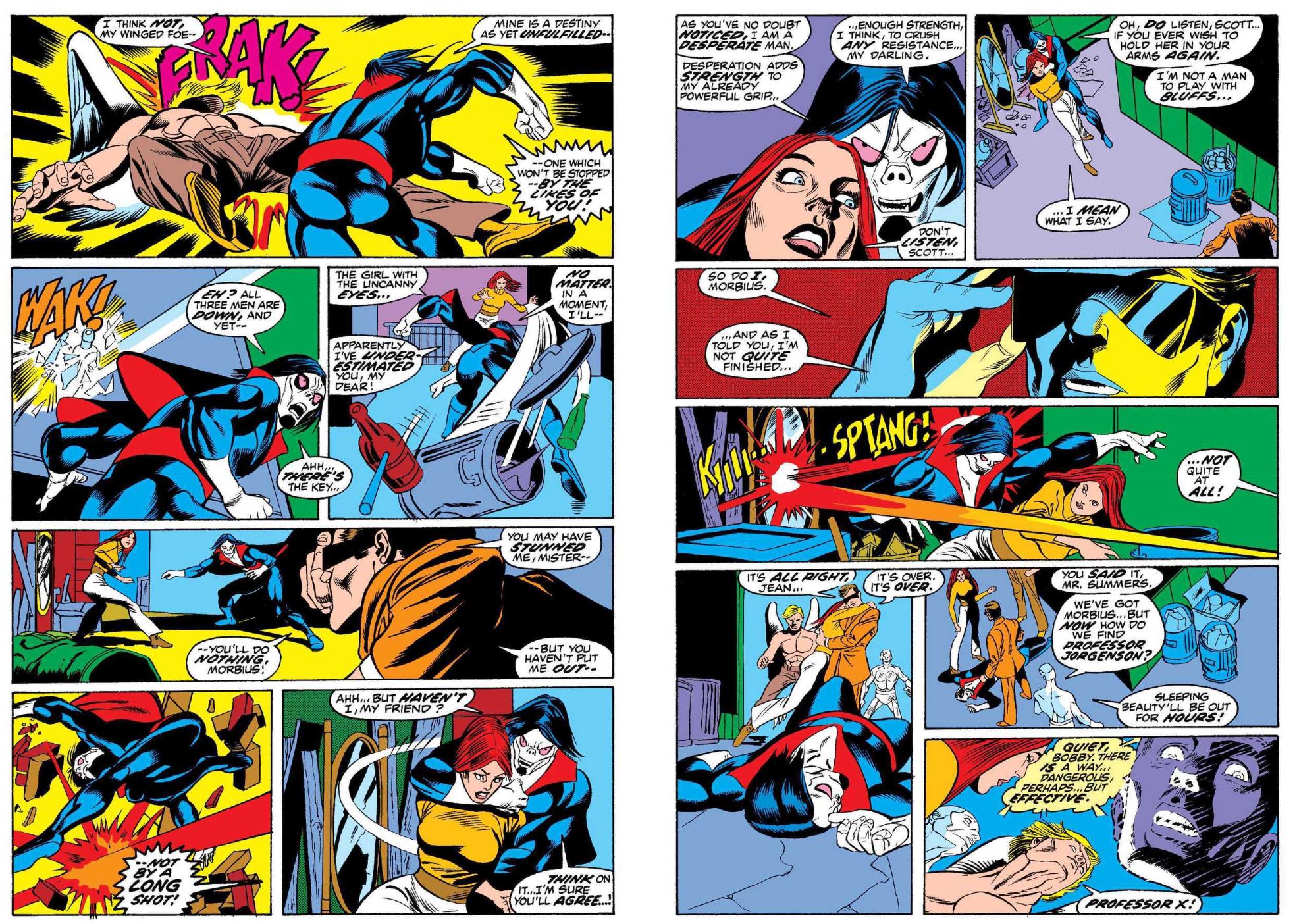
Gerry Conway assumed the writer’s role and Jim Mooney the inks for ‘And Spidey Makes Four!’ in the succeeding issue as our hot and sticky heroes then take on and trounce the Frightful Four and Negative Zone bogeyman Annihilus before without pause going after Morbius the Living Vampire in #3’s ‘The Power to Purge!’ (as inked by Frank Giacoia). The new horror-star was still acting the villain in MTU #4 as the Torch was replaced by most of Marvel’s sole mutant team (The Beast having gone all hairy – and solo) in ‘And Then… the X-Men!’

Inked by Steve Mitchell, this boldly enthralling thriller was illustrated by magnificent Gil Kane at the top of his form. Kane became a semi-regular penciller, and his dynamic style and extreme-action anatomy lifted many pedestrian tales such as #5’s ‘A Passion of the Mind!’ (Conway script & Esposito inks), pitting Spidey and The Vision against manipulative mesmeric Puppet Master and robotic assassin the Monstroid. The bad guy again carried over to the next issue and joined by the Mad Thinker in ‘…As Those Who Will Not See!’ pitted the wallcrawler and The Thing against cerebral scoundrels in a cataclysmic battle no Fights ‘n’ Tights fan could be unmoved by…

MTU #7’s ‘A Hitch in Time!’ was produced by Conway, Andru & Mooney: guest-starring Thor with otherworldly Trolls freezing Earth’s time-line as a prerequisite step to conquering Asgard, after which #8 provides a perfect example of the team-up comic’s other function – to promote and popularise new characters. ‘Man-Killer Moves at Midnight!’ was most fans’ first exposure to The Cat (later retooled as Tigra the Were-Woman) in a painfully worthy if ham-fisted attempt to address feminist issues from Conway & Mooney. The hard-pressed heroes joined forces here to stop a male-hunting murderer paying back abusive men. These days we’d probably be rooting for her…

Iron Man collaborated in the opening foray of 3-part tale ‘The Tomorrow War!’ (Conway, Andru & Frank Bolle) as he & Spidey are kidnapped by Zarkko the Tomorrow Man to battle Kang the Conqueror. The Torch returned to help deal with the intermediate threat of a ‘Time Bomb!’ (with art by Mooney & Giacoia) before the entire race of Black Bolt’s Inhumans pile in to help Spidey stop history unravelling in culminatory clash ‘The Doomsday Gambit!’ – this last chapter scripted by Len Wein over Conway’s plot for Mooney & Esposito to illustrate.

Deftly delineated by Andru & Don Perlin, Wein scripted a Conway plot for ‘Wolf at Bay!’ in MTU #12 wherein wallcrawler meets Werewolf By Night Jack Russell to maul malevolent mage Moondark in foggy San Francisco, after which we divert to the Man Without Fear’s own title. Here they share some left coast limelight as Daredevil and the Black Widow #103 (Steve Gerber, Don Heck & Sal Trapani). This sees them join the still-California-bound wallcrawler as a merciless cyborg attacks the odd couple while they pose for roving photojournalist Peter Parker in ‘…Then Came Ramrod!’

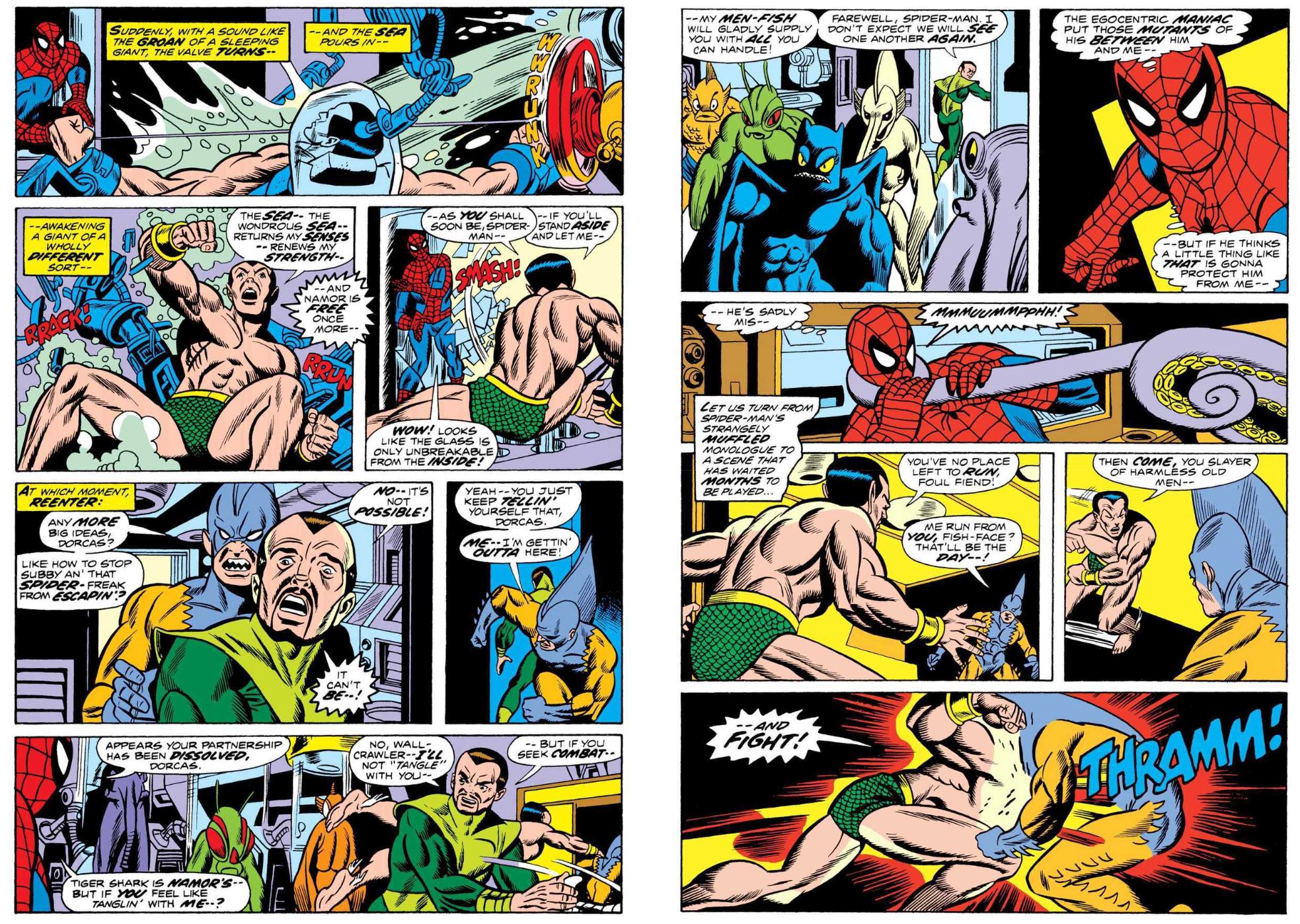
Kane & Giacoia limned ‘The Granite Sky!’ wherein Wein pits Spidey & Captain America against Hydra and Grey Gargoyle in a simple clash of ideologies, after which ‘Mayhem is… the Men-Fish!’ (inked by Wayne Howard – and, yes bad grammar, but great action-art!) matches the webslinger with the savage Sub-Mariner against vile villains Tiger Shark and Doctor Dorcas as well as an army (navy?) of mutant sea-beasts.

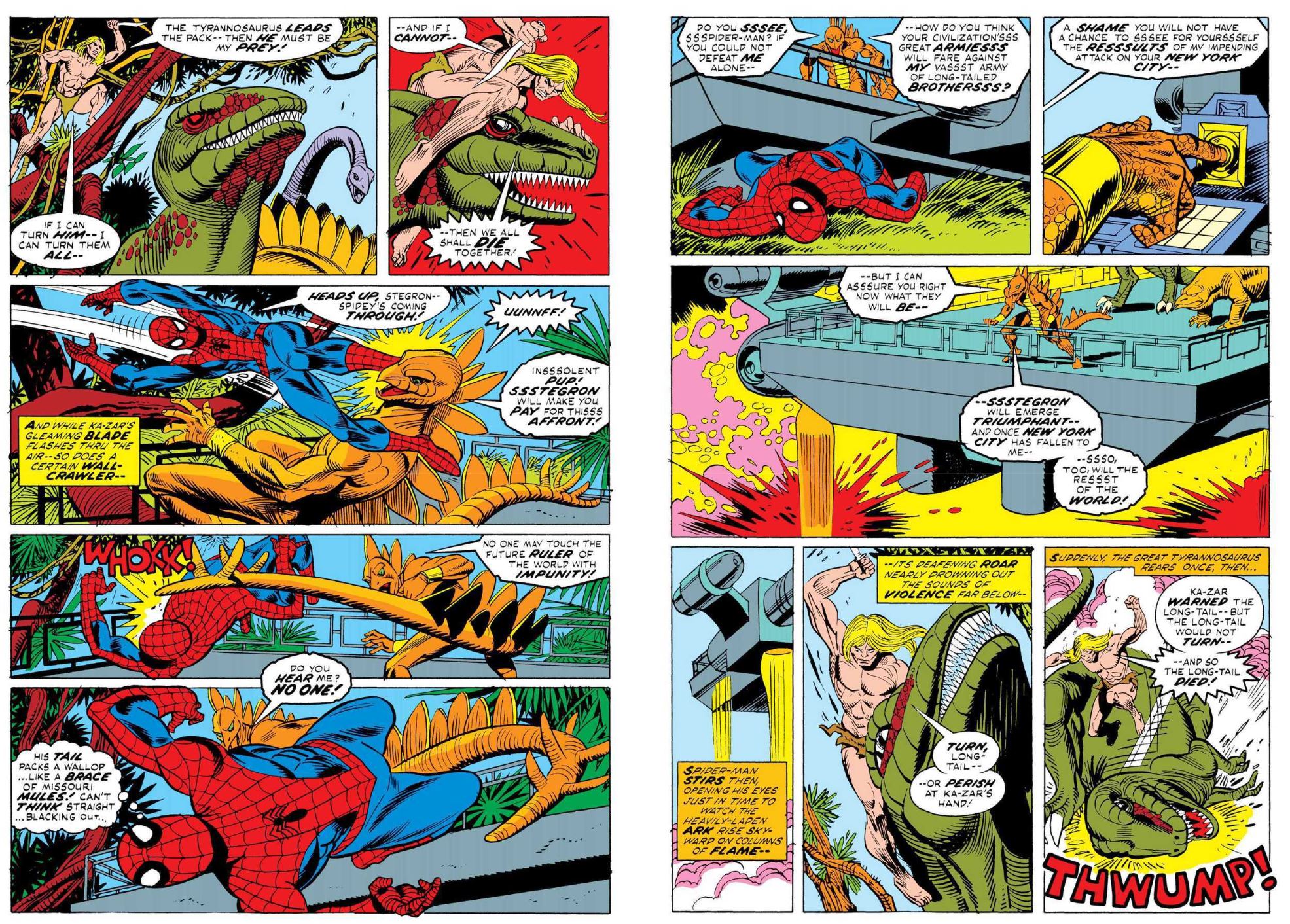
Wein, Andru & Perlin created The Orb to bedevil Spidey and Ghost Rider in ‘If an Eye Offend Thee!’ in #15 before Kane & Mooney limn ‘Beware the Basilisk my Son!’: a gripping romp featuring (the original Kree) Captain Marvel, concluding with ‘Chaos at the Earth’s Core!’ (inked by “everybody”!), as Mister Fantastic joins the fracas to stop Mole Man inadvertently blowing up the world. Human Torch Johnny Storm teams with The Hulk in MTU #18 to stop antimatter malcontent Blastaar in ‘Where Bursts the Bomb!’ (Giacoia & Esposito inks), but Spidey blazes back a month later with Ka-Zar in situ to witness ‘The Coming of… Stegron, the Dinosaur Man!’ (Wein, Kane & Giacoia). His plans to flatten New York by releasing ‘Dinosaurs on Broadway!’ is foiled with Black Panther’s help… as well as the artistic gifts of Sal Buscema, Giacoia & Esposito.

Dave Hunt replaced Esposito inking ‘The Spider and the Sorcerer!’ in #21 as Spidey and Doctor Strange once more battled Xandu, a wily wizard first seen in Spider-Man Annual #2, before we pause for a brief lecture.

Giant-Size titles were quarterly double-length publications added to the schedule of Marvel’s top tier heroes, and the wallcrawler’s were used to highlight outré or potentially controversial pairings such as Dracula and Doc Savage. Here they are represented by try-out Giant-Size Super Heroes #1 which pitted the wallcrawler against Living Vampire Morbius as well as hirsute and manic Man-Wolf. In a classic clash by Conway, Kane & Esposito. Within months a quarterly double-length Spider-Man team vehicle was added to Marvel’s schedule….

Back in MTU #22, Wein, Sal B & Giacoia’s ‘The Messiah Machine!’ brings the monthly story glories to a brief pause after depicting Hawkeye and the Amazing Arachnid frustrating deranged computer Quasimodo‘s ambitious if absurd mechanoid invasion. Then – cover-dated July 1974 and courtesy of Conway, Andru & Heck – Giant-Size Spider-Man #1 saw the webspinner in frantic pursuit of an experimental flu vaccine, improbably carried on an ocean liner in ‘Ship of Fiends!’ The quest brought him into chilling contact with newly-revived vampire lord Dracula and a scheming Maggia Capo at ‘The Masque of the Black Death!’

Here that bizarre battle is accompanied by its original editorial text feature ‘An Illuminating Introduction to Giant Size Spider-Man’ before we move on to monthly MTU wherein the Torch & Iceman fractiously unite to stop Equinox, the Thermo-Dynamic Man on ‘The Night of the Frozen Inferno!’ (Wein, Kane & Esposito). Still embracing supernatural themes and trends, the webslinger learns ‘Moondog is another Name for Murder!’ in a defiantly quirky yarn illustrated by Mooney & Trapani which brings the decidedly offbeat Brother Voodoo to the Big Apple to quash a Manhattan murder cult…

Wein, Mooney & Frank Giacoia then determine that ‘Three into Two Won’t Go!’ as Daredevil joins Spider-Man in thrashing inept kidnappers Cat-Man, Bird-Man and Ape-Man, after which Giant-Size Spider-Man #2 sees the amazing arachnid drawn into battle with Shang-Chi, Master of Kung Fu as sinister immortal Fu Manchu frames Spider-Man in ‘Masterstroke!’ The duped heroes clear the air in ‘Cross… and Double-Cross!’ before uniting to foil the cunning Celestial’s scheme to mindwipe America from the ‘Pinnacle of Doom!’

MTU #26 finds the Torch and Thor battling to save the world from Lava Men in The Fire This Time…’ by Wein, Mooney, Giacoia & Hunt. At this time, in a desperate effort to build some internal continuity into the perforce brutally brief encounters, the scripters introduced a shadowy trio of sinister observers with an undisclosed agenda who would monitor superhero episodes and eventually be revealed as providers of outrageous technologies for many of the one-shot villains who came and went so quickly and ignominiously…

They weren’t involved when the Chameleon frames Spider-Man (again) and tricks the Hulk into freeing a man – for the most unexpected reason of all – from the New York Men’s Detention Center in #27’s ‘A Friend in Need!’ (Wein, Mooney & Giacoia). They did, however, have a cloaked hand in ‘The City Stealers!’ (#28 by new regular creative team Conway, Mooney & Vince Colletta) when strange mechanoids swipe the island of Manhattan, necessitating Spidey and Hercules (mostly Hercules) having to drag it back to its original position…

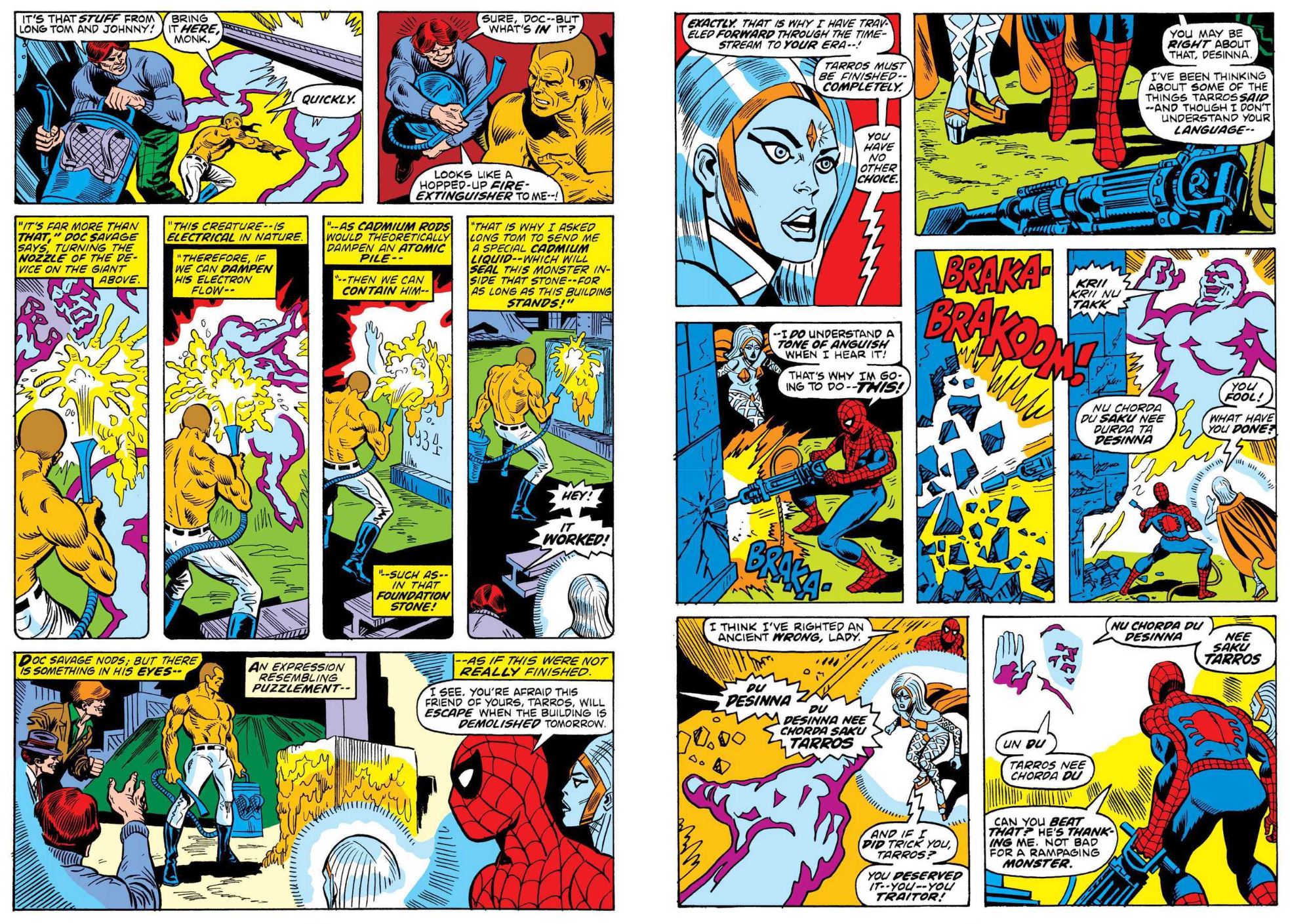
After that implausible minor miracle Spider-Man experiences time-displaced disaster as Giant-Size Spider-Man #3 (Conway, Andru & Esposito) explores ‘The Yesterday Connection!’ Now lovely alien Desinna seeks the aid of Spidey in 1974 and – in ‘The Secret Out of Time’ – the hands-on help of legendary 1930s adventurer Doc Savage. Across a gulf of four decades the heroes individually discover something is not right in ‘Other People in Other Times!’ With the escape of a savage rampaging monster, two eras seem doomed to destruction, at least until wiser, more suspicious heads and powers prevail in ‘Tomorrow is Too Late’ ensuring that ‘The Future is Now!’

Marvel Team-Up #29 displays a far less constrained – or even amicable – pairing as flaming kid Johnny Storm and patronising know-it-all Iron Man butt heads whilst tracking a seeming super-saboteur in ‘Beware the Coming of Infinitus! or How Can You Stop the Reincarnated Man?’ before in #30 Spider-Man and The Falcon find ‘All That Glitters is not Gold!’ whilst tracking a mind-control drug back to its crazy concoctor Midas, the Golden Man.

However, adding extra lustre are visual treats aplenty in the form of contemporaneous house ads; covers and frontispieces from seasonal tabloid treasury Giant Superhero Holiday Grab-Bag (with art from John Buscema & John Romita Sr.) and original art pages and covers from Andru, Kane, Esposito, Perlin, Mooney, & Giacoia plus Kane pencil layouts. Also on view are covers from Marvel Tales #234, 249, 254, by Todd McFarlane, Marshall Rogers, Brian Stelfreeze, complete with new bridging pages by Jae Lee. Jan Harpes & Renee Witterstatter, and another gallery of Spider-Man Megazine covers (#1-6) by James Fry, Hector Collazo, Stelfreeze, Jung Choi, Ron Frenz, Al Milgrom, Stuart Immonen, Kirk Jarvinen, Jason Moore and Mark Buckingham, plus the unpublished cover of #7 as crafted by John Romita Sr & Jr.. Closing the book is a truly unique unused cover for #8 by Brian Bolland.

These stories are of variable quality but nonetheless all exhibit an honest drive to entertain and please. Artistically the work is superb, and most fans of the genre would find little to complain about so, although not really a book for casual or more maturely-oriented readers, there’s bunches of fun on hand and young readers will have a blast, so there’s no real reason not to add this tome to your library…
© 2025 MARVEL.

Today in 1892 Korky the Cat creator James Crighton was born as was Golden Age great Creig Flessel in 1912 and Al McWilliams in 1916. Writer/editor/publisher Bob Shreck joined the party in 1955, three years after Crocket Johnson released the final episode of Barnaby.

Back in 1938, the very first Donald Duck newspaper strip was syndicated and in 1987 the astounding Ken Reid drew his last breath – as did Dutch comics maestro Lo Hartog van Banda in 2006. As always, look in the blog for more or just buy anything with these guys’ names on it…

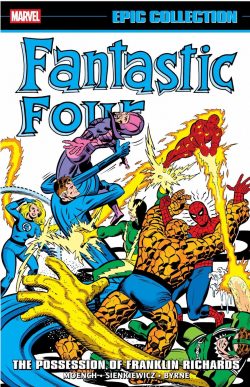
Fantastic Four Epic Collection volume 12: The Possession of Franklin Richards


By Marv Wolfman, Bill Mantlo, John Byrne, Ed Hannigan, George Pérez, Peter B. Gillis, Roger Stern, Doug Moench & Bill Sienkiewicz, Steve Ditko, Tom Sutton, Keith Pollard, Al Milgrom, Joe Sinnott, Pablo Marcos, Bruce Patterson, Chic Stone, Jon D’Agostino, Mike Esposito, Jerome Moore, Frank Giacoia & various (MARVEL)
ISBN: 978-1-3029-6056-8 (TPB/Digital edition)

This book includes Discriminatory Content produced in less enlightened times.

Win’s Christmas Gift Recommendation: Fantastic Fun for Comics Addicts… 8/10

It’s a been a big year for the fabulous FF. Here’s another titanic tome to add to your seasonal swag list…

For Marvel everything started with The Fantastic Four.

Monolithic modern Marvel truly began with eccentric monster ‘n’ alien filled adventures of a compact superteam as much squabbling family as coolly capable costumed champions. All that Modern Marvel is, company and brand, stems from that quirky quartet and the inspired, inspirational, groundbreaking efforts of Stan Lee & Jack Kirby…

Cautiously bi-monthly and cover-dated November 1961, Fantastic Four #1 – by Stan, Jack, George Klein and/or Christopher Rule – was raw and crude even by its ailing publisher’s steadily plunging standards. However, it seethed with rough, passionate, uncontrolled excitement and thrill-hungry kids pounced on its dynamic storytelling. The series caught a wave of change beginning to build in America, and every succeeding issue changed comics a little bit more… and forever. Revealed in that premier, maverick scientist Reed Richards, fiancée Sue Storm, close friend Ben Grimm and Sue’s bratty teenaged brother survived an ill-starred private spaceshot after cosmic rays penetrated their ship’s inadequate shielding.

All permanently mutated: Richards’ body became elastic, diffident Sue became (even more) invisible, Johnny Storm burst into living flame and tragic Ben shockingly devolved into a shambling, rocky freak. After the initial revulsion and trauma passed, they solemnly agreed to use their abilities to benefit mankind. Thus was born The Fantastic Four – you can add your own fanfare and timpani here if you wish…

Throughout the 1960s it was the key title and most consistently groundbreaking series of Marvel’s ever-unfolding web of cosmic creation: a forge for new concepts and characters. Jack Kirby was approaching his creative peak: unleashing his vast imagination on plot after spectacular plot, and intense, incredible new characters whilst Lee scripted some of the most passionate superhero sagas ever seen. Both were on an unstoppable roll, at the height of their powers and full of the confidence only success brings, with The King particularly eager to see how far the genre and the medium could be pushed… which is rather ironic since it was the company’s reticence to give the artist more creative freedom that led to Kirby’s moving to National/DC in the 1970s.

Without Kirby’s soaring imagination the rollercoaster of mindbending High Concepts lost out to traditional tales of characters in conflict, with soap opera leanings and supervillain-heavy Fights ‘n’ Tights forays abounding. With Lee & Kirby long gone but their mark very much still stamped onto every page of the still-prestigious title, this full-colour compendium represents Fantastic Four #215-231 and Annuals #14-16, spanning Fall 1979 to June 1981.

What You Should Know: After being rejuvenated and repowered in an extended space-spanning saga, the Family FF are getting used to being back on Earth even with supervillains all over the place. Now Read On…

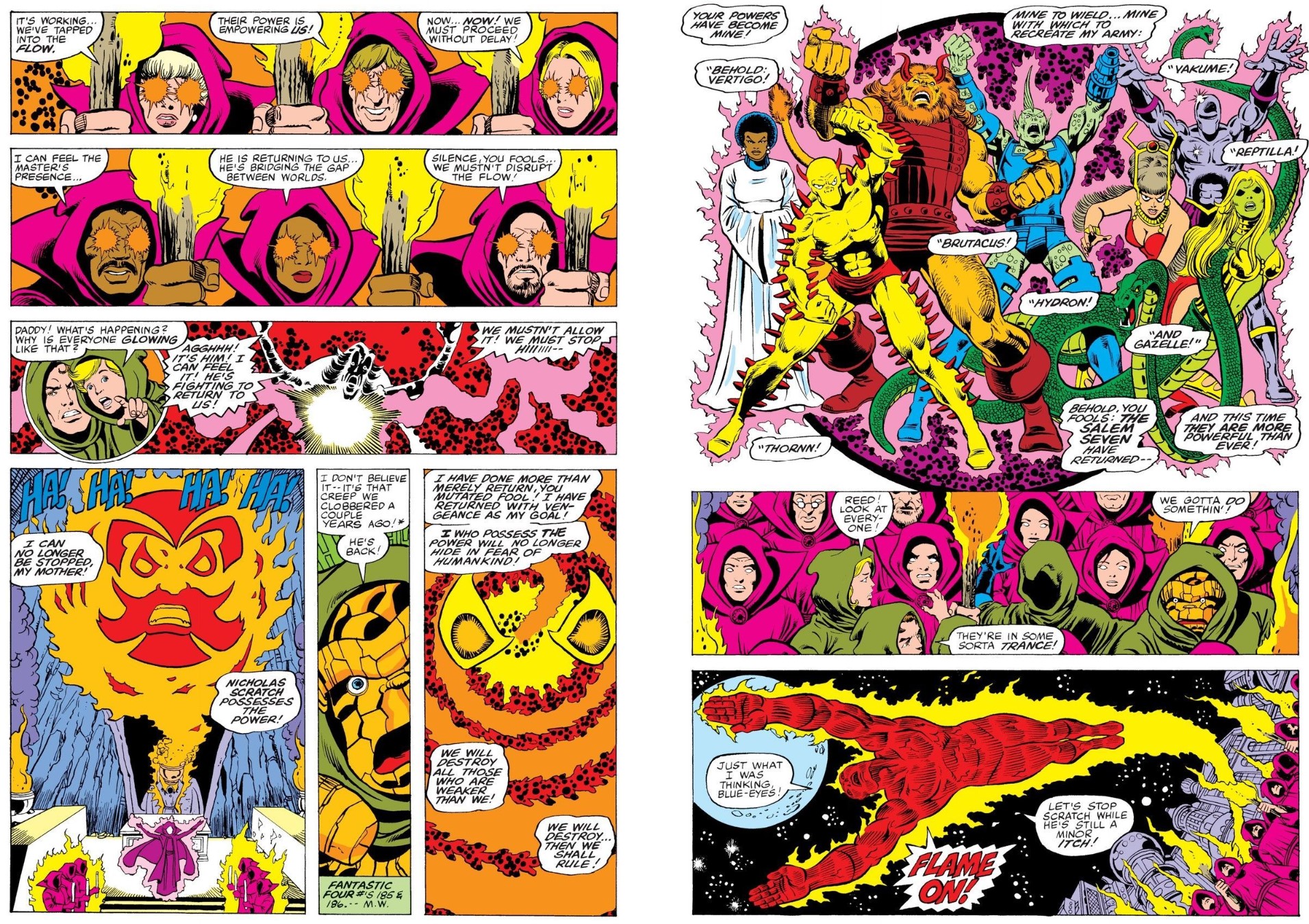
The revived, excessively rejuvenated team are in full fine fettle for Fantastic Four Annual #14 wherin Marv Wolfman, George Pérez & Pablo Marcos put firstborn Franklin Richards and his sorcerous nanny Agatha Harkness in the spotlight for ‘Cats-Paw!’ When magical cult Salem’s Seven abduct and brainwash the adult FF in hopes of resurrecting their macabre master Nicholas Scratch, even the Avengers are helpless to stop the carnage unleashed. Thankfully, the extra-dimensional voyage of the kid and the crone is enough to set everything right…

The arcane account is augmented by ‘A Gallery of the Fantastic Four’s Most Famous Foes!’ by Keith Pollard & Marcos, giving the lowdown on late-debuting villains and ne’er-do-wells including Invincible Man, Attuma, Gideon, Dragon Man, The Frightful Four and Quasimodo. Monthly FF #215 then finds Wolfman, John Byrne & Joe Sinnott reintroducing Negative Zone terror tyrant ‘Blastaar!’ who somehow escapes the antimatter universe to take over the Baxter Building just as a reinvigorated Reed Richards is distracted by former colleague Professor Randolph James who has hyper-evolved himself to offset an otherwise fatal beating by street thugs. Sadly, his accelerator device has not advanced James’ ethical outlook, and after taking vengeance on his attackers, the future man proves that ‘Where There Be Gods!’ there be trouble too, as the mental marvel aligns with Blastaar only to fall before a far greater power… angry cosmic child Franklin…

Bill Mantlo scripts #217 for Byrne & Sinnott, as ‘Masquerade!’ at last exposes the viper in the team’s midst: an inimical force responsible for most of the recent setbacks and accidents, and almost the deaths of the heroes and Johnny’s new intended girlfriend Dazzler

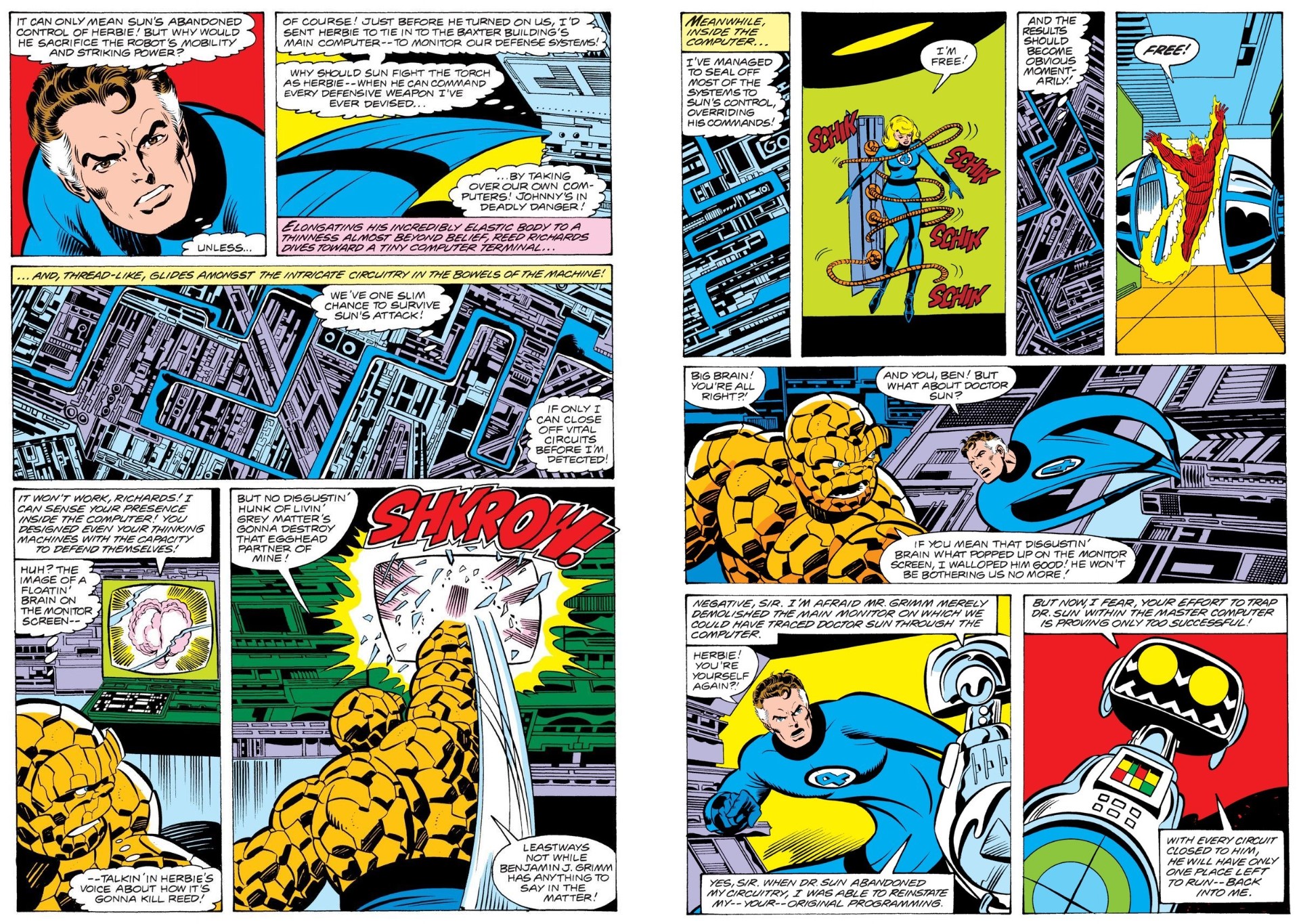
No spoilers here this time, but back then we all just knew who the hidden villain actually was… that acursed robot!

Infernal gadget H.E.R.B.I.E. was imposed on the series due to concerns by producers of the current Fantasic Four cartoon show. Rejecting fire hazard Johnny for a cutely telegenic robot, Wolfman cheekily made that commercial compromise in-world canon, dividing fans forever after. The bleeping bot – a Humanoid Experimental Robot, B-type, Integrated Electronics (latterly, Highly Engineered Robot Built for Interdimensional Exploration; don’cha just love nominative deterministic acronymics?) – is pure Marmite in most readers eyes…

Next is the last half of an old-school saga that, for completeness, means you need to read Peter Parker, the Sensational Spider-Man #42 before enjoying the contents of FF #218. What’s not here is how ESU student Peter Parker goes on a class jaunt and is lured into a trap by the Frightful Four (in ‘Give Me Liberty or Give Me Death’ by Mantlo, Mike Zeck & Jim Mooney if you were wondering). The villains broadsided the wallcrawler after new recruit Electro impersonated the Human Torch there…

Now for ‘When a Spider-Man Comes Calling!’ (cover-dated May 1980 by Mantlo, Byrne & Sinnott), Trapster repeats the tactic to ambush the comfortably at home quartet, allowing his comrades The Wizard and Sandman to take over the heroes’ Baxter Building citadel… at least until a fighting-mad webspinner breaks free for an unstoppable counterattack…

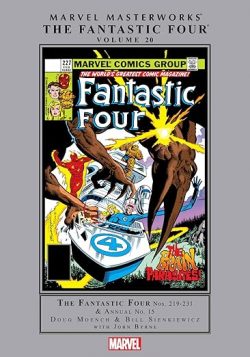
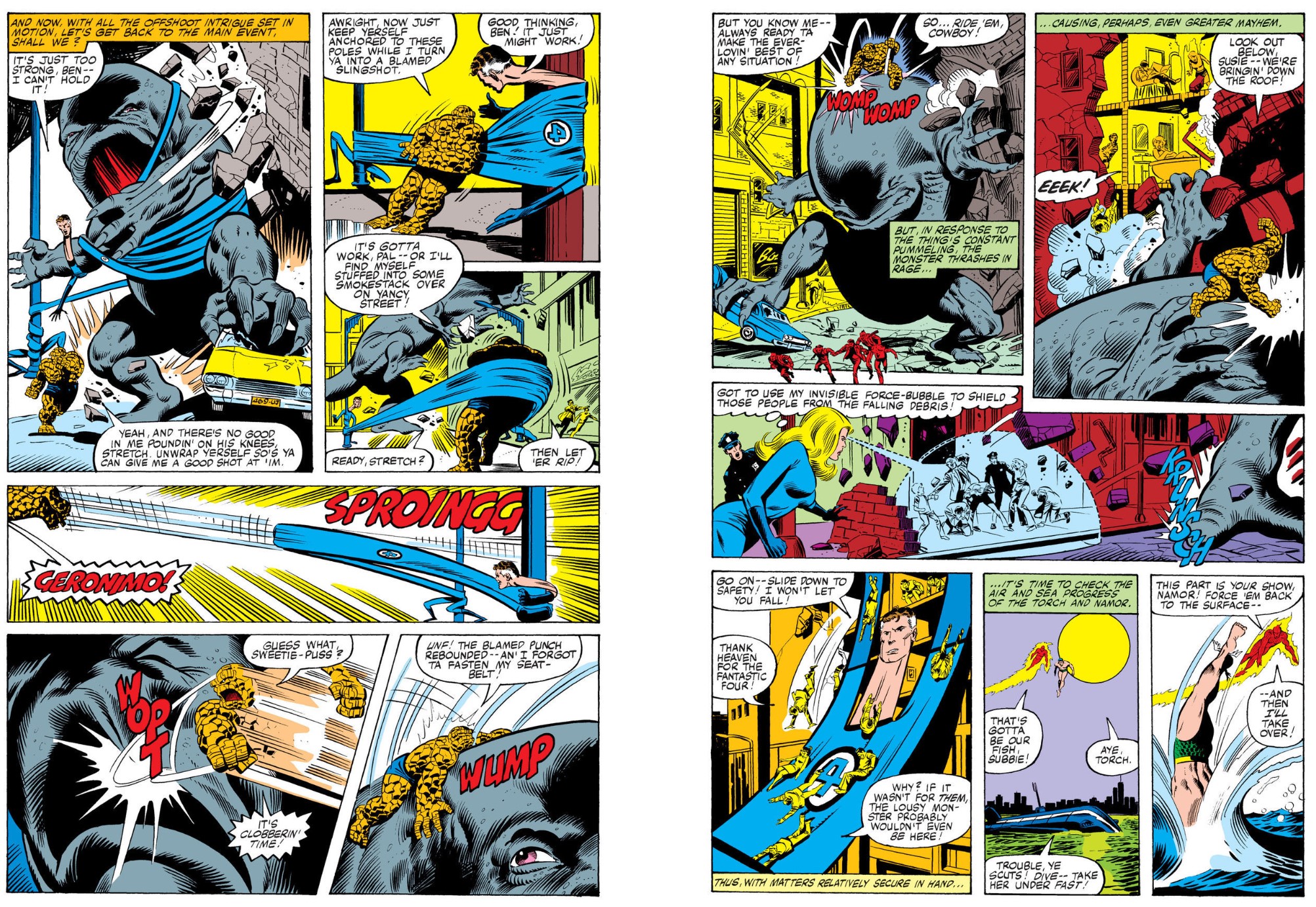
Penciller John Byrne, having served out his first term on the series he was to soon make his alone, was officially only temporarily replaced for FF #219. Ably augmented by Sinnott, stalwart “Guest-Team” Doug Moench & Bill Sienkiewicz were parachuted in for monster mash-up ‘Leviathans’ due to the huge success and acclaim generated by their vigilante thriller Moon Knight. They brought with them a whole new look and sensibility, as well as far faster pace to the stories. Here, modern day pirate Cap’n Barracuda steals the fabled Horn of Proteus from Atlantis to unleash a wave of giant monsters on New York City. Thankfully, this is a subject the mighty Sub-Mariner and Mr. Fantastic can agree on, and their combined forces soon stomp the beasties to stop a piratical plunder ploy without peer…

Byrne bounced back writing & pencilling in #220 as ‘…And the Lights Went Out All Over the World!’ sees the Avengers call Reed and Co. when all Earth suffers a catastrophic power-outage. Science! sends the explorers to the arctic to encounter an astounding and unbelievable obelisk being constructed by beings of utterly alien appearance…

The story includes an updated origin for the quartet and guest shot for Canada’s finest (that’s Vindicator of Alpha Flight in case you were wondering) as the tale halts for a pinup by inker Sinnott (the Torch battling a flaming Skrull) prior to #221’s concluding chapter ‘Tower of Glass… Dreams of Glass!’ Following the usual misconceptions and rash clashes it is revealed that three aliens shipwrecked for half a million years just need their myriad mobile mechanisms to reverse the planet’s magnetic poles so they can return home at last. Happily, Reed has a less end-of-human-civilisation-y solution leaving everyone involved happy and safe; and back where they belong…

Now officially the regular creative team, Moench & Sienkiewicz prep for Halloween in FF #222’s ‘The Possession of Franklin Richards!’ as the cosmic ray kid is again targeted from beyond the unknown by exiled soul Nicholas Scratch. The son of Agatha Harkness is the kind of warlock who gives witchcraft a bad name. and, having made the boy his conduit back to reality, Scratch goes on to terrorise and torture his hated enemies. With Doctor Strange unavailable, they enlist the dubious gifts of self-doubting failed horror hero Gabriel the Devil Hunter and his morally ambiguous familiar Desadia (from Marvel’s monochrome magazine line titles Haunt of Horror and Monsters Unleashed)…

Apparently acquiescing, the team agree to liberate the dead diabolist’s minions of magical mayhem and Salem’s Seven toil ‘That a Child May Live…’ Of course, their instant assaults on humanity are an acceptable risk and consequence in Reed’s plan: setting the worlds to rights for all but the defeated devil…

Fantastic Four Annual #15 swiftly follows, wherein Moench & Pérez, abetted by Chic Stone, Jon D’Agostino & Mike Esposito, renew hostilities between the FF and Skrull empire as the shapeshifters target the supergenius’ latest energy-casting breakthrough in ‘Time for the Prime Ten!’ Infiltrating the Baxter Building, negating his valiant teammates and almost banishing Mr. Fantastic to the tender mercies of Annihilus in the Negative Zone, the sneaky killers are actually seeking to end their millennial war against stellar rivals The Kree, but have underestimated Reed’s brilliance, his family’s tenacity and the cosmic awareness of Earth-loving Kree Exile Captain Mar-Vell

A back-up tale by Moench & Tom Sutton takes us to recently liberated Latveria for the opening of proposed series ‘The Return of Doctor Doom!’ Only episode ‘The Power of the People!’ shows how restored monarch King Zorba fails to live up to his democratic promises and discover how excessive taxation really upsets voters, at around the same moment crazed, catatonic Victor von Doom goes missing from the most secure dungeon in Doomstadt…

Sadly, the impending crisis never materialised and was only addressed by Byrne in Fantastic Four #247…

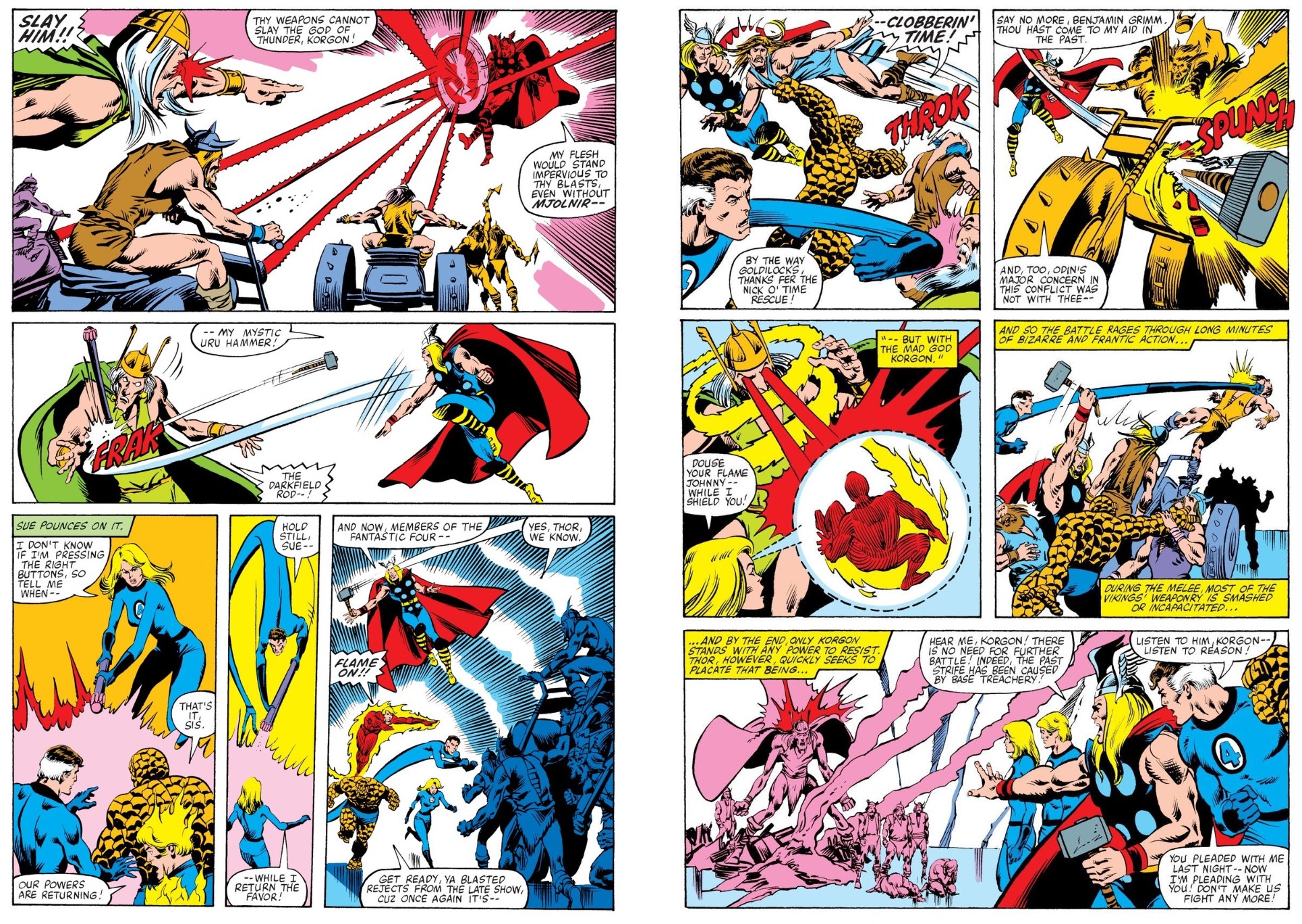
Over in FF #224 & 225, fresh calamity unfolds in ‘The Darkfield Illumination’ (Moench, Sienkiewicz & Pablo Marcos) as radioactive red mist blankets Manhattan and plays hob with the team’s powers. Tracing the cloud’s origin point to an icy dome in the Arctic, the FF find a lost colony of technologically advanced Vikings utterly dependent upon a mutated immortal giant. ‘The Blind God’s Tears’ supply heat, light, food materials from the outside world and immortality, but now Korgon is dying and demands the explorers save him and the people who worship him. Always eager to help, the FF strive and succeed in saving the God, only to see him betrayed by his most trusted ally. As Korgon rages madly in response, the crisis escalates as Mighty Thor arrives to investigate worshippers who have abandoned their true god for a false one…

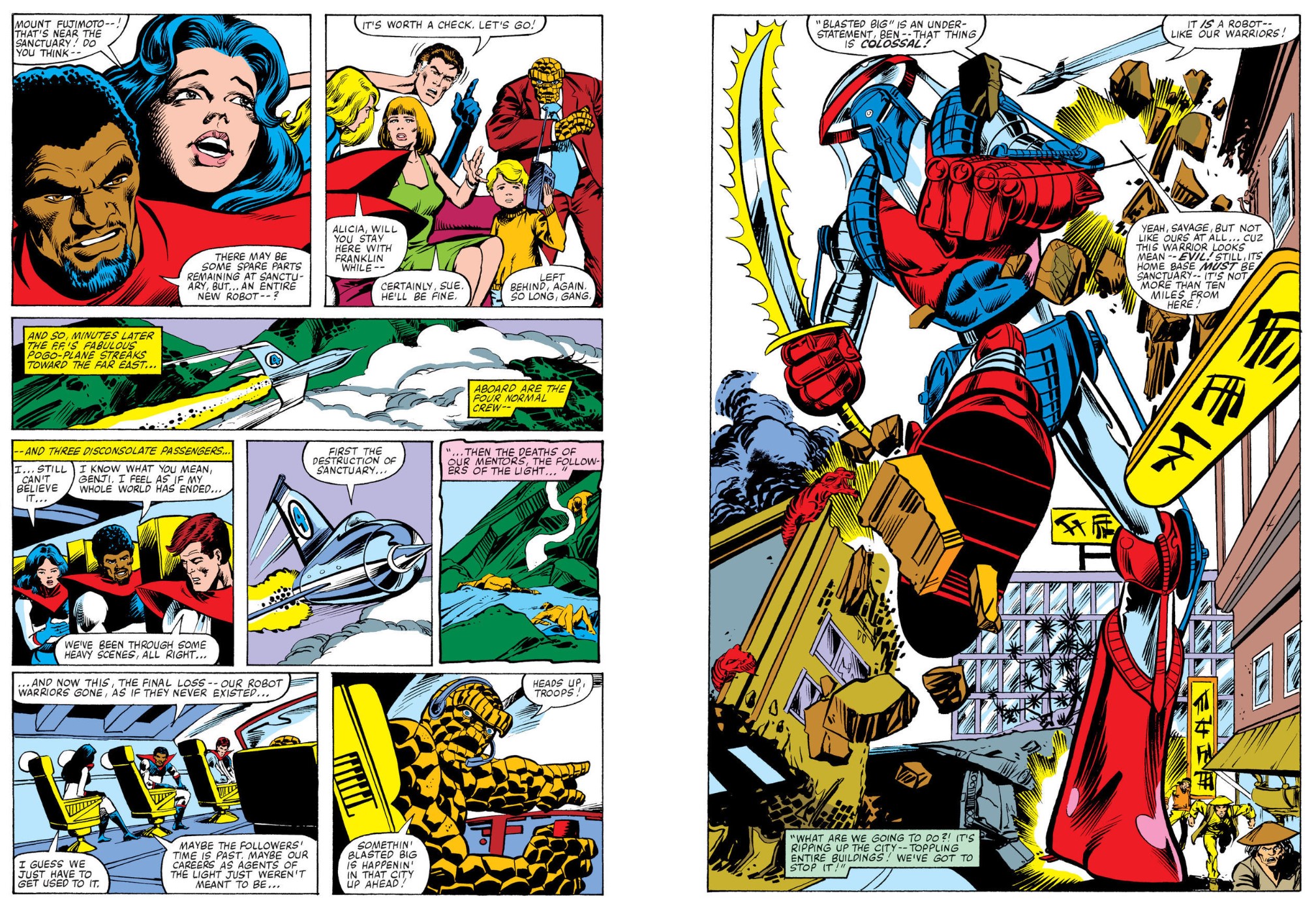
Bruce Patterson joins Marcos inking Sienkiewicz when Moench next brings closure to fans of his Shogun Warriors series. In their own title the former pilots of monster-fighting mega-mecha Dangard Ace, Raydeen and Combatra had been recruited by an ancient order to defend humanity, but retired when their machines were destroyed. That epic sacrifice had come when evil enemy Maur-Kon targeted the Fantastic Four and attempted to kill Reed. Now a new giant mecha rampages and robs, so the teams reunite with Ilongo Savage, Richard Carson and Genji Odashu aiding the fight against ‘The Samurai Destroyer’ and the unworthy soul exploiting its power for profit….

Movie-toned terror in the heartland follows as a meteor crashes in rural Pennsylvania resort Lost Lake just as the FF head out to the Boonies for a break. Their encounter with ‘The Brain Parasites’ reverting hosts to earlier evolutionary forms is by-the-books horror fun from Moench, Sienkiewicz & Patterson, and readily fixed by little Franklin’s increasingly unreliable powers. This sets the scene for the next – Sinnott inked – issue where further tests by professional head shrinkers and brain benders unleash uncontrollable chaos, possessed bystanders and an adult super-powered version of the lad. Thankfully, loving parents and uncles allow Franklin to exorcise his deadly ‘Ego-Spawn’.

The experiment in alternative tale-telling ends with a 3-part saga opening on #229’s ‘The Thing From the Black Hole’. When it homes in on Reed’s latest invention, Earth totters on the edge of destruction as a sentient singularity made of antimatter disrupts physical laws. Desperate Richards makes contact with its cosmic equivalent and uncovers a tale of love lost in service to scientific exploration. The wandering extinction event was once a living being whose love for a fellow astronaut turned them both into creatures of uncanny forces. Thankfully, ‘Firefrost and the Ebon Seeker’ now reach an understanding that saves Earth, but as a consequence a section of Manhattan – including the Baxter Building – is left inside the Negative Zone.

With panic amongst the abducted New Yorkers barely suppressed, the FF seek a solution ‘In All the Gathered Gloom!’ (Moench & Roger Stern, Sienkienwisz, Jerome Moore, Sinnott, & Frank Giacoia) even as new antimatter menace Stygorr zeroes in on the intruding enclave. The last thing the FF need is bullying big business plutocrat Lew Shiner telling everyone his money puts him in charge. After his posturing triggers a riot, tragedy is guaranteed, and the heroes barely beat the alien invader in time to return everyone surviving back home…

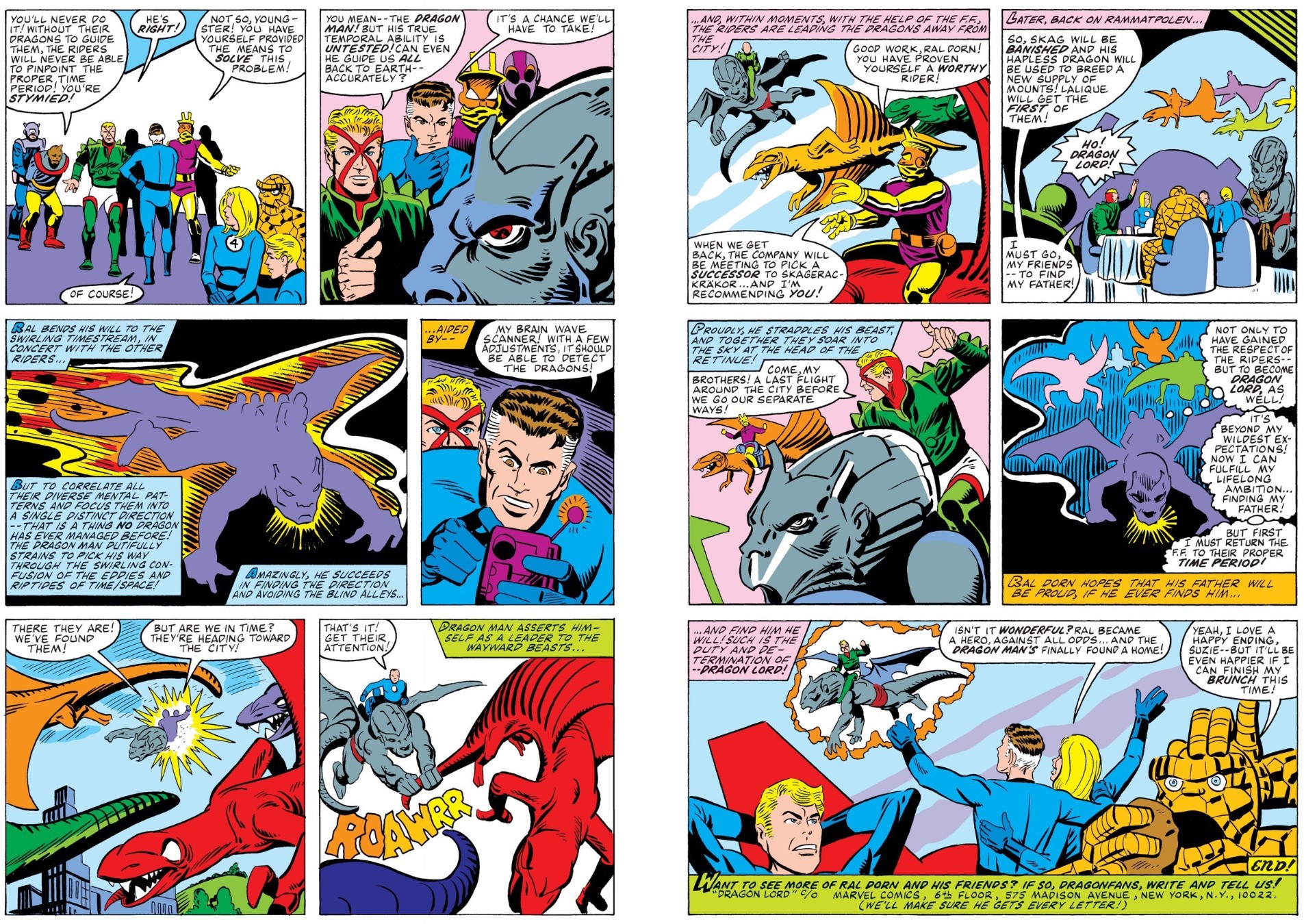
This foray into the fantastic finishes on a “soft pilot episode” as Fantastic Four Annual #16 embraces the contemporary fantasy market with ‘The Coming of… Dragon Lord!’ by Ed Hannigan & Steve Ditko. When trainee Ral Dorn is framed for killing a sacred beast and hunted by former fellows in the puissant extradimensional Dragon Rider organisation, the chase ends up with him wounded. His flight, employing a multi-powered Dragon Staff, leads to a collision with an off-duty quirky quartet, celebrating a reunion on the college campus where they first encountered astouding android Dragon Man,. but the coincidence escapes everybody and the heroes leave the mystery man to the medics.

Days later the fugitive breaks into their skyscraper home and with the Staff holding the FF at bay explains his predicament. A novice lawkeeper, his dream of bonding with a dragon has been shattered by the death of his destined beast-partner, and accusations that he’s responsible. The wild story is inadvertantly backed up by a posse of Dragon Riders seeking to stop him and the intervention of Ral’s bizarre former ally Lalique. When they are driven away, it is clear to the human heroes that something is not kosher and they determine to help him. It’s obvious to Ral that his boss Dragon Lord Skagerackäkor is behind the plot but without a bonded beast what can he do? That’s why he was on campus. He had learned of former FF foe Dragon Man and decided that needs must when the devil drives…

The classic plot left all the goodies rewarded amd baddies punished and was claearly an attempt to launch a series, but…

With covers by Sinnott, Ron Wilson, Josef Rubinstein, Rich Buckler, Al Milgrom, Byrne, Pollard, Sienkienwicz, Bob McLeod & Ditko the extras here include Sinnott pinups of the whole team and Thing pinup from FF #218 & 219: Sienkievich’s rejected cover-turned-pinup as printed in #224; the entries for January in the Marvel Comics 20th Anniversary Calandar 1981 (Sienkienwicz & Sinnott) plus original art pages/covers from Byrne, Sinnott, Sienkienwicz, Marcos and Patterson, as well as original colour-guides painted by George Roussos.

Although never quite returning to the stratospheric heights of the Kirby era, this truly different collection represents a closing of the First Act for the “World’s Greatest Comics Magazine”, and palate-cleansing preparation for the second groundbreaking run by John Byrne. These extremely capable efforts are probably most welcome to dedicated superhero fans and continuity freaks like me, but will still thrill and delight casual browsers looking for an undemanding slice of graphic narrative excitement.
© 2025 MARVEL.

Today in 1858, French cartoonist Emmanuel Poiré was born. He annoyed all the right people as Caran d’Ache… and plenty of the wrong ones too. Far less controversial were Fred Harmon and screenwriter/ scripter Stephen Slesinger who launched epic cowboy strip Red Ryder this day in 1938.

Fantastic Four Marvel Masterworks volume


By Doug Moench & Bill Sienkiewicz, John Byrne, Roger Stern, Joe Sinnott, Al Milgrom, George Pérez, Tom Sutton, Jerome Moore, Chic Stone, Jon D’Agostino, Mike Esposito, Pablo Marcos, Frank Giacoia, George Roussos, Jim Novak, Irving Watanabe & various (MARVEL)
ISBN: 978-1-3029-1027-3 (TPB/Digital edition)

This book includes Discriminatory Content produced in less enlightened times.

For Marvel everything started with The Fantastic Four.

Monolithic modern Marvel truly began with eccentric monster ‘n’ alien filled adventures of a compact superteam as much squabbling family as coolly capable costumed champions. All that Modern Marvel is, company and brand, stems from that quirky quartet and the inspired, inspirational, groundbreaking efforts of Stan Lee & Jack Kirby…

Cautiously bi-monthly and cover-dated November 1961, Fantastic Four #1 – by Stan, Jack, George Klein and/or Christopher Rule – was raw and crude even by the ailing publisher’s standards; but it seethed with rough, passionate, uncontrolled excitement. Thrill-hungry kids pounced on its dynamic storytelling and caught a wave of change beginning to build in America. It and every succeeding issue changed comics a little bit more… and forever. As revealed in that premier issue, maverick scientist Reed Richards, fiancée Sue Storm, close friend Ben Grimm and Sue’s bratty teen brother survived an ill-starred private spaceshot after cosmic rays penetrated their ship’s inadequate shielding.

All were permanently mutated: Richards’ body became elastic, diffident Sue became (even more) invisible, Johnny Storm burst into living flame and tragic Ben shockingly devolved into a shambling, rocky freak. After the initial revulsion and trauma passed, they solemnly agreed to use their abilities to benefit mankind. Throughout the 1960s The Fantastic Four was indisputably the key title and most consistently groundbreaking series of Marvel’s ever-unfolding web of cosmic creation: a forge for new concepts and characters.

Kirby was approaching his creative peak: unleashing his vast imagination on plot after spectacular plot, and intense, incredible new characters whilst Lee scripted some of the most passionate superhero sagas ever seen. Both were on an unstoppable roll, at the height of their powers and full of the confidence only success brings, with The King particularly eager to see how far the genre and the medium could be pushed… which is rather ironic since it was the company’s reticence to give the artist more creative freedom that led to Kirby’s moving to National/DC in the 1970s.

Without Kirby’s soaring imagination the rollercoaster of mindbending High Concepts lost out to traditional tales of characters in conflict, with soap opera leanings and supervillain-heavy Fights ‘n’ Tights forays abounding. With Lee & Kirby long gone but their mark very much still stamped onto every page of the still-prestigious title, this full-colour luxury compendium collects Fantastic Four #219-231 and Annual #15, spanning June 1980-June 1981, wherein editor Jim Salicrup sanctioned a bold new look and direction for the Hallowed team. The call for and upshot of all that is discussed by incoming writer Doug Moench who recalls fan-fright paralysis and jumping in full throttle in his Introduction ‘The Big-Kid Stuff Cold Turkey Fail’ prior to a distinctly spookily toned and frequently supernaturally themed change of pace commencing.

What You Should Know: After being rejuvenated and repowered in an extended space-spanning saga, the Family FF are getting used to being back on earth even with supervillains all over the place. Now Read On…

Penciller John Byrne, having served out his first term of duty on the series he was to soon make his alone was officially and ostensibly only temporarily replaced for FF #219. Ably augmented by Joe Sinnott, stalwart “Guest-Team” Doug Moench & Bill Sienkiewicz were parachuted in for monster mash-up ‘Leviathans’, on the back of huge success and acclaim for their vigilante thriller Moon Knight, bringing with them a whole new look and sensibility, as well as far faster pace to the stories.

Here, modern day pirate Cap’n Barracuda steal the fabled Horn of Proteus from Atlantis and unleashes a wave of giant monsters on New York City. Thankfully, this is a subject the mighty Sub-Mariner and Mr. Fantastic can agree on and their combined forces are soon stomping beasties and taking names (like Giganto!) to restore order and stop a piratical plunder ploy without peer…

Byrne was back writing & pencilling in #220 as ‘…And the Lights Went Out All Over the World!’ sees the Avengers call in Reed and his team when all of Earth suffers a catastrophic power-outage. Science! soon sends the explorers to the arctic where they encounter an astounding and unbelievable obelisk being constructed by beings of utterly alien appearance…

The story includes an updated origin for the quartet and guest shot for Canada’s finest (that’s Vindicator of Alpha Flight in case you were wondering) and the issue halts with a pinup/possible rejected cover by inker Sinnott (the Torch battling a flaming Skrull) before #221’s concluding chapter ‘Tower of Glass… Dreams of Glass!’ – after the usual misconceptions and rash clashes reveal three aliens shipwrecked for half a million years who just need their myriad mobile mechanisms to reverse the planet’s magnetic poles so that they can return home at last. Thankfully, Reed has a less end of human civilisation-y solution that leaves everyone involved happy and safe…

Now officially the latest regular creative team, Moench & Sienkiewicz return to prep for Halloween in FF #222’s ‘The Possession of Franklin Richards!’ as the kid is targeted from beyond the unknown by the exiled soul of Nicholas Scratch, son of Agatha Harkness and the kind of warlock who gives witchcraft a bad name. Having made the boy his conduit back to reality, Scratch terrorises and tortures his hated enemies, who with Doctor Strange unavailable, must call on the dubious gifts of self-doubting failed horror hero Gabriel the Devil Hunter and his sexy morally ambiguous familiar Desadia (as mostly seen in the Marvel monochrome magazine line such as Haunt of Horror and Monsters Unleashed).

Apparently acquiescing, the team agree to liberate the dead diabolist’s minions of magical cult Salem’s Seven in ‘That a Child May Live…’ but their instant assaults on humanity are an acceptable risk and consequence in a long plan that sets the worlds to rights for all but the defeated devil…

Fantastic Four Annual #15 swiftly follows, wherein Moench & George Pérez, abetted by Chic Stone, Jon D’Agostino & Mike Esposito, renew hostilities between the FF and the Skrull empire when the shapeshifters target Reed’s latest energy-casting breakthrough in ‘Time for the Prime Ten!’ Infiltrating the Baxter Building, negating his teammates and almost banishing Mr. Fantastic to the tender mercies of Annihilus in the Negative Zone, the sneaky killers are actually seeking to end their millennial war against stellar rivals The Kree, but have underestimated Reed’s brilliance, his team’s tenacity and the sheer power and cosmic awareness of Earth-loving Kree Exile Captain Mar-Vell…

A back-up tale by Moench & Tom Sutton takes us to recently liberated Latveria for the opening of proposed series ‘The Return of Doctor Doom!’ with only episode ‘The Power of the People!’ showing how restored monarch King Zorba failing to live up to his democratic promise and discovering how excessive taxation really upsets subjects, at around the same moment crazed and catatonic Victor von Doom goes missing from the most secure dungeon in Doomstadt…

Sadly, the impending crisis never materialised and was only addressed by John Byrne in Fantastic Four #247…

Over in FF #224 & 225, fresh calamity unfolds in Moench, Sienkiewicz & Pablo Marcos’ ‘The Darkfield Illumination’ as an eerie radioactive red mist blankets Manhattan and plays hob with the team’s powers. Tracing the cloud’s origin point to an icy dome in the Arctic, the FF discover a lost colony of technologically advanced Vikings utterly dependent upon a mutated immortal giant. ‘The Blind God’s Tears’ supply heat, light, food materials from the outside world and immortality, but now Korgon is dying and demands the explorers save him and the people who worship him…

Always eager to help, the team strive hard and succeed in saving the God, only to see him betrayed by his most trusted ally. As Korgon rages madly in response, the situation escalates as Thor arrives to investigate Viking worshippers who have abandoned their true god for a false one…

Bruce Patterson joins Marcos inking Sienkiewicz as Moench takes the opportunity to bring closure to fans of his old Shogun Warriors series next. In their own title the former pilots of monster-fighting mega-mecha Dangard Ace, Raydeen and Combatra had been recruited by an ancient order to defend humanity, but had ultimately retired when their machines were destroyed. That epic sacrifice had come when evil enemy Maur-Kon had targeted the Fantastic Four and attempted to kill Reed.

Now a new giant mecha rampages and robs and the teams reunite with Ilongo Savage, Richard Carson and Genji Odashu aiding the battle against ‘The Samurai Destroyer’ and the unworthy soul exploiting its power for profit….

Movie-toned terror in the heartland follows as a meteor crashes in rural Pennsylvania resort Lost Lake just as the FF head out to the Boonies for a break. Their encounter with ‘The Brain Parasites’ infesting hosts and reverting them to earlier evolutionary forms is by-the-books horror fun from Moench, Sienkiewicz & Patterson, and readily fixed by little Franklin’s unreliable mental powers. This sets the scene for the next issue where further tests by professional head shrinkers and brain benders only unleash uncontrollable chaos, possessing bystanders and an adult super-powered version of the lad. Thankfully loving parents and uncles allow Franklin to exorcise his deadly ‘Ego-Spawn’ (Sinnott inks)…

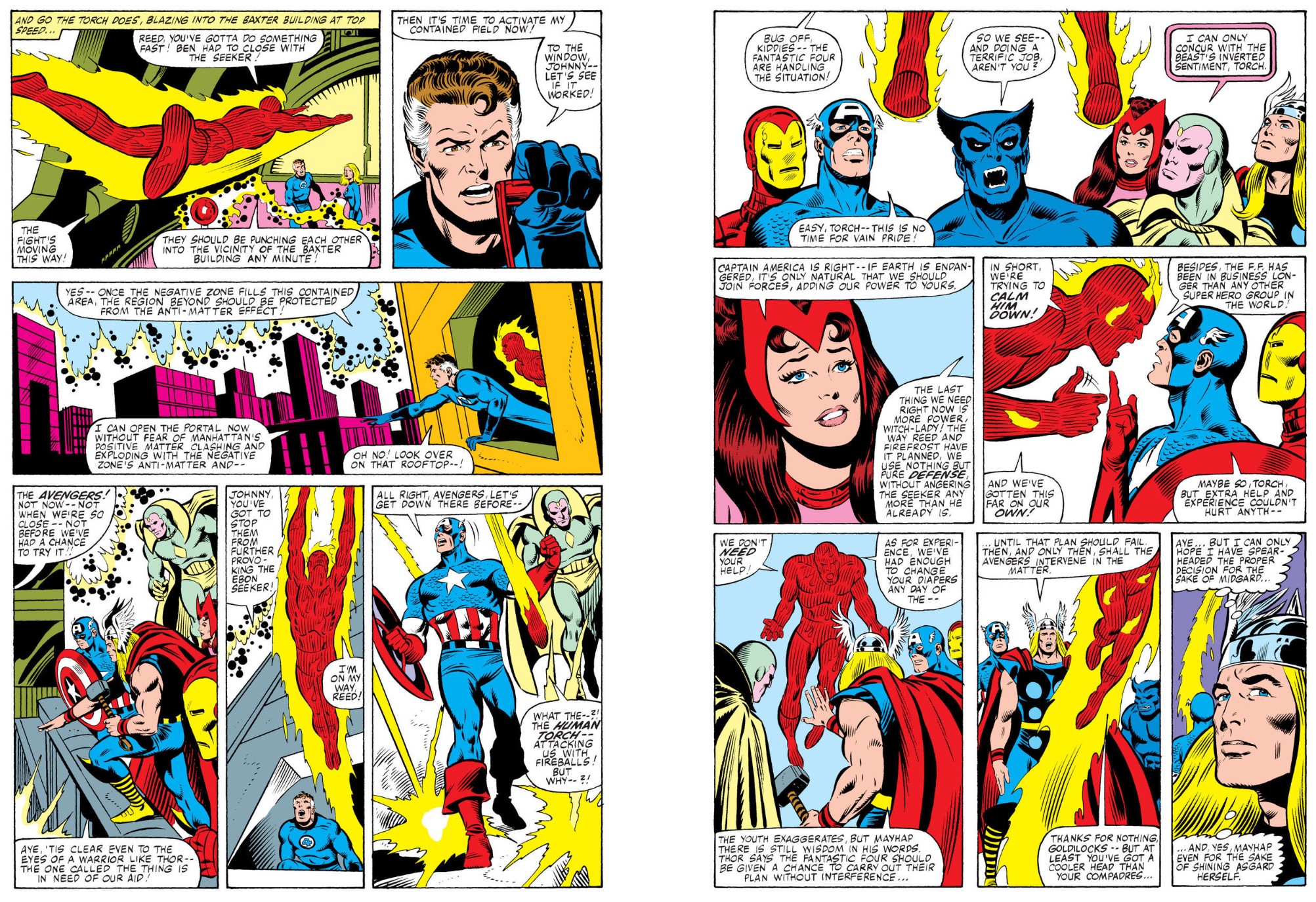
The experiment in alternative tale-telling ends on a 3-part saga that opens with #229’s ‘The Thing From the Black Hole’. After it homes in on Reed’s latest invention, Earth soon totters on the edge of destruction as a living, sentient singularity made of antimatter disrupts physical laws. Desperate Richards makes contact with its cosmic equivalent and uncovers a tale of love lost in service to scientific exploration. The mobile extinction event was once a sentient being whose love for a fellow astronaut turned them both into creatures of uncanny forces. Thankfully ‘Firefrost and the Ebon Seeker’ reach an understanding that saves the world, but as a consequence a section of Manhattan – including the Baxter Building – is marooned inside the Negative Zone.

With panic amongst the hordes of abducted New Yorkers barely suppressed, the FF search for a solution ‘In All the Gathered Gloom!’ (by Moench & Roger Stern with art from Sienkienwisz, Jerome Moore, Sinnott, & Frank Giacoia) even as new antimatter menace Stygorr zeroes in on the intruding enclave. The last thing the FF need is bullying big business plutocrat Lew Shiner telling everyone his money puts him in charge. After his posturing triggers a riot, tragedy is guaranteed, and the heroes barely beat the alien invader in time to return everyone surviving back home…

With covers by Sienkienwicz, Byrne Sinnott & Bob McLeod, the extras here include a Sinnott Thing pinup from FF #219, Sienkievich’s rejected cover-turned-pinup as printed in #224 original art pages/covers inked by Marcos, Bruce Patterson, Sinnott, and original colour-guides painted by George Roussos.

Although never quite returning to the stratospheric heights of the Kirby era, this truly different collection represents a closing of the First Act for the “World’s Greatest Comics Magazine”, and palate cleansing preparation for the second groundbreaking run by an inspired John Byrne. These extremely capable efforts are probably most welcome to dedicated superhero fans and continuity freaks like me, but will still thrill and delight casual browsers looking for an undemanding slice of graphic narrative excitement – especially if this time the movie continues to deliver on its promise…
© 2018 Marvel Characters, Inc. All rights reserved.
To Be Continued…

Today in 1918 artist John Forte was born. He’s most fondly remembered for costumed charm, as best seen in Legion of Super-Heroes: The Silver Age volume 1 . We don’t have nearly enough collected material for UK visionary comics stalwart Ron Embleton who was born today in 1930. If you think you’re old enough, you could look at Oh, Wicked Wanda!.

Indomitable weekly anthology Valiant began its stellar 712 issue run today in 1962. Inside was the magnificent Steel Claw whom we comprehensively covered in The Steel Claw: Invisible Man. Yes. Well done, the modern invisible man could be seen from the start…

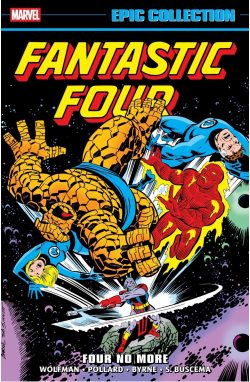
Fantastic Four Epic Collection volume 11: Four No More (1978-1980)


By Marv Wolfman, Bill Mantlo, Len Wein, Keith Pollard, Roger Slifer, John Byrne, Sal Buscema, George Pérez, Bob Hall, John Buscema, Joe Sinnott, Pablo Marcos, Bob Wiacek, Dave Hunt, Diverse Hands (Al Milgrom, Frank Giacoia, Frank Springer, Marie Severin), Bob Budiansky, Jack Kirby & various (MARVEL
ISBN: 978-1-3029-6055-1 (TPB/Digital edition)

This book includes Discriminatory Content from less enlightened times.

Win’s Christmas Gift Recommendation: Utter Acme of All-Ages Adventure… 8/10

For Marvel everything started with The Fantastic Four.

Monolithic modern Marvel truly began with the eccentric monster ‘n’ alien filled adventures of a compact superteam as much squabbling family as coolly capable costumed champions. Everything the company and brand is now stems from that quirky quartet and the inspired, inspirational, groundbreaking efforts of Stan Lee & Jack Kirby…

Cautiously bi-monthly and cover-dated November 1961, Fantastic Four #1 – by Stan, Jack, George Klein & Christopher Rule – was raw and crude even by the ailing outfit’s standards; but it seethed with rough, passionate, uncontrolled excitement. Thrill-hungry kids pounced on its dynamic storytelling and caught a wave of change beginning to build in America. It and every succeeding issue changed comics a little bit more… and forever. As seen in the premier issue, maverick scientist Reed Richards, his fiancée Sue Storm, their close friend Ben Grimm and Sue’s bratty teenaged brother survived an ill-starred private spaceshot after cosmic rays penetrated their ship’s inadequate shielding.

All four were permanently mutated: Richards’ body became elastic, diffident Sue became (even more) invisible, Johnny Storm burst into sentient living flame and poor tragic Ben shockingly devolved into a shambling, rocky freak. After initial revulsion and trauma passed, they solemnly agreed to use their abilities to benefit mankind. Thus was born The Fantastic Four.

Throughout the 1960s it was indisputably the key title and most consistently groundbreaking series of Marvel’s ever-unfolding web of cosmic creation: a forge for new concepts and characters. Kirby was approaching his creative peak: unleashing his vast imagination on plot after spectacular plot, and intense, incredible new characters whilst Lee scripted some of the most passionate superhero sagas ever seen. Both were on an unstoppable roll, at the height of their powers and full of the confidence only success brings, with The King particularly eager to see how far the genre and the medium could be pushed… which is rather ironic since it was the company’s reticence to give the artist more creative freedom that led to Kirby moving to National/DC in the 1970s.

Without Kirby’s soaring imagination the rollercoaster of mindbending High Concepts gave way to more traditional tales of characters in conflict, as soap opera schtick and supervillain-tirades dominated Fights ‘n’ Tights dramas. With Lee & Kirby long gone but their mark very much stamped onto every page of the still-prestigious title, this full-colour compendium reruns Fantastic Four #192-214 and Annuals #12-13, spanning March 1978-January 1980.

What You Should Know: After facing his own Counter Earth counterpart Reed Richards lost his stretching powers. With menaces like Salem’s Seven, Klaw and Molecule Man still coming for him and his family, weary and devoid of solutions, Richards made the only logical decision and called it a day for the team…

Incoming writer/editor Marv Wolfman, brought a new direction which closely referenced the good old days with #192 proclaiming ‘He Who Soweth the Wind…!’ (illustrated by George Pérez & Joe Sinnott), as newly independent, fancy-free Johnny heads west to revisit his childhood dream of being a race car driver and unexpectedly meets old pal Wyatt Wingfoot.

Back East, Ben and girlfriend Alicia Masters ponder options as Reed gets a pretty spectacular job offer from a mystery backer. Suddenly, though, Johnny’s race career is upended when superpowered mercenary Texas Twister attacks at the behest of a sinister but unspecified stalker with a grudge to settle…

The admittedly half-hearted assault fails, but when Ben offers his services to NASA a pattern begins to emerge after he and Alicia are ambushed by old foe Darkoth in ‘Day of the Death-Demon!’ (plotted by Len Wein & Keith Pollard, scripted by Bill Mantlo, and illustrated by Pollard & Sinnott). The near-forgotten cyborg terror is determined to destroy an experimental solar shuttle, but doesn’t really know why, and as Ben ponders the inexplicable incident, in Hollywood, Susan Storm-Richards’ return to acting is inadvertently paused because alien shapeshifting loon the Impossible Man pays a visit. The delay gives Sue a little time to consider just how she got such a prestigious, dream-fulfilling offer so completely out of the blue at just the right moment…

At NASA, when Darkoth strikes again his silent partner is exposed as scheming alchemist Diablo, whilst in upstate New York, Reed slowly discovers his dreams of unlimited research time and facilities is nothing like he imagined. Finally, launch day comes and The Thing pilots the Solar Shuttle into space, only to have it catastrophically crash in the desert…

Joined by additional inker Dave Hunt, the creative pinch-hitters conclude the saga with ‘Vengeance is Mine!’ as Ben survives impact and searing sandstorms, tracks down his foes and delivers a crushing defeat to Diablo and Darkoth, whilst in FF #195 Sue learns who sponsored her revived Tinseltown ambitions when Prince Namor, The Sub-Mariner renews his amorous pursuit of her. Embittered and lonely, he has fully forsaken Atlantis and the overwhelming demands of his people and state. Sadly, they have not done with him and despatch robotic warriors to drag him back to his duties in ‘Beware the Ravaging Retrievers!’ (Wolfman, Pollard & Pablo Marcos). Like everybody else, the metal myrmidons have utterly underestimated The Invisible Girl and pay the price, allowing the once-&-future prince to reassess his position and make a momentous decision…

As Johnny links up with Ben & Alicia, strands of a complex scheme begin to appear. In #196 they gel for self-deceiving Reed Richards as ‘Who in the World is the Invincible Man?’ depicts the enigmatic Man with the Plan secretly subjecting Reed to the mind-bending powers of the Pyscho-Man, just as Sue rejoins Ben & Johnny in New York City before being impossibly ambushed by a former FF foe. This time the man under the hood is not her father, but someone she loves even more…

Reunited with Reed, the horrified heroes are confronted by their greatest, most implacable enemy and the complicated plot to restore Reed’s powers finally unfolds. Victor Von Doom craves revenge but refuses to triumph over a diminished foe, but his efforts to re-expose Richards to cosmic rays is secretly hijacked by a rival madman in ‘The Riotous Return of the Red Ghost!’ (Wolfman, Pollard & Sinnott). Of course there’s more at stake, as Doom also seeks to legitimise his rule through a proxy son: planning to abdicate in his scion’s favour and have Junior take Latveria into the UN and inevitably to the forefront of nations…

Fully restored and invigorated, Mister Fantastic defeats an equally resurgent Red Ghost before linking up with Nick Fury (senior) and S.H.I.E.L.D. to lead an ‘Invasion!’ of Doom’s captive kingdom. Beside Latverian freedom fighter/legal heir to the throne Prince Zorba Fortunov, Richards storms into Doomstadt, defeating all in his path and foiling the secondary scheme of imbuing the ‘The Son of Doctor Doom!’ with the powers of the (now) entire FF and exposing the incredible secret of Victor von Doom II

Months of deft planning (from Wolfman, Pollard & Sinnott) culminate in epic confrontation ‘When Titans Clash!’, as Doom and Richards indulge in their ultimate battle (thus far), with the result that the villain is destroyed and the kingdom liberated. For now…

A post-Doom era opens in FF #201 (December 1978) as the celebrated and honoured foursome return to America and take possession of empty former HQ the Baxter Building. Unfortunately, so does something else, attacking the family through their own electronic installations and turning the towering “des res” into ‘Home Sweet Deadly Home!’: a mystery solved in the next issue when it subsequently seizes control of Tony Stark’s armour to attack the FF again in ‘There’s One Iron Man Too Many!’, with John Buscema filling in for penciller Pollard. The monthly mayhem pauses after #203’s ‘…And a Child Shall Slay Them!’ wherein Wolfman, Pollard & Sinnott reveal the incredible powers possessed by dying cosmic ray-mutated child Willie Evans Jr.

When the foremost authority on the phenomenon is called in to consult, Dr. Reed Richards and his associates – and all of Manhattan – face savage duplicates of themselves manifested from FF devotee Willie’s fevered imagination…

Although the regular fun pauses here, two chronologically adrift King-Size specials follow, beginning with Fantastic Four Annual #12’s ‘The End of the Inhumans… and the Fantastic Four’ (Wolfman, Bob Hall, Pollard, Bob Wiacek & Marie Severin. When Johnny’s former flame Crystal – and gigantic Good Boi Lockjaw – teleport in seeking aid in finding the abducted Inhuman Royal Family, the team confronts ruthless Inhuman supremacist Thraxon the Schemer before exposing that megalomaniac’s secret master: the immortal unconquerable Sphinx. Despite his god-like powers, the united force of the FF plus Blackbolt, Medusa, Gorgon, Triton, Crystal and former Avenger Quicksilver proves sufficient to temporarily defeat their foe… or does it?

A year later, Annual #13 offered a more intimate and human tale from Mantlo, Sal Buscema & Sinnott as ‘Nightlife’ revealed how New York’s lost underclass was systematically being disappeared from the hovels and streets they frequented. With cameos from Daredevil and witch queen Agatha Harkness, the tale reveals a softer side to the FF’s oldest enemy and a return to addressing social issues for the team.

In monthly FF #204, Wolfman, Pollard & Sinnott detail ‘The Andromeda Attack!’ as Johnny goes out gallivanting and governess/guardian Agatha Harkness picks up little Franklin Richards, just as – with only grown-ups in residence – the building’s supercomputers pick up an astral anomaly, and materialise an alien princess in the lab. She’s instantly followed by a Super-Skrull who blasts her before falling to the FF’s counterattack. Interrogating the wounded woman, they learn she has come seeking help for her shattered world and near-extinct civilisation of Xandar…

Already illicitly supported by a Watcher breaking his oath of non-intervention, the last survivors of Andromeda’s most benign culture have been reduced to a quartet of domed stations linked together and careening through space, defended only by the last of their peacekeeper Nova Corps. Now the fugitives are being targeted for extinction by rapacious Skrulls and desperately need someone’s… anyone’s… assistance…

The FF are keen to help Suzerain Queen Adora return and happy to help the Xandarians, but the Human Torch has a new girlfriend and opts to stay behind for now to woo enigmatic Frankie Raye. He’s also set on finally following up on his long-postponed higher education commitments and has enrolled in specialist academic institution Security College. Naturally, Johnny promises to catch up later, but no sooner do his partners beam out to the stars than he’s attacked on campus by an old foe…

For #205, ‘When Worlds Die!’, Reed, Sue & Ben’s arrive with Adora at New Xandar finds the planetary remnants under attack by a Skrull war fleet, they join the Nova Corps to repel the assault, consequently driving closely-monitoring Skrull Emperor Dorrek insane with fury. Although Xandar’s physical resources are almost gone, he actually wants their greatest asset and treasure – a repository of their knowledge and power stored in an awesome array of superprocessors linking countless generations of expired citizens together: the Living Computers of Xandar! Chief administrator Prime Thoran and severely wounded Nova Centurion Tanak have been holding back the storm with ever-diminishing forces, but now need the FF to turn the tide, while back at Security College, Johnny has stumbled into mystery and peril too, as a strange force seizes control of the students…

In Andromeda, his family’s first foray against the Skrulls leads to their defeat and capture. Humiliated, tortured and put on display in a cruel show trial, they are ultimately blasted with a ray that will inescapably result in ‘The Death of… The Fantastic Four!’, rapidly aging them to the end of their natural lifespans in a matter of days. Dorrek’s gleeful gloating is spoiled, however, by the arrival of his terrifying, ambitious wife Empress R’kylll, the increased resistance of the Xandarians and, inevitably, the escape of the fast-aging Fantastic Four…

Ordering all-out assaults on the battered prey, Dorrek is further frustrated by Prime Thoran who gains astounding power by merging with the Living Computers of Xandar and the arrival of a colossal ship from Earth…

Here the saga dovetails with another Wolfman series that had recently ended its run on a cliffhanger. The Man Called Nova was in fact a boy named Richard Rider, a working-class nebbish in the tradition of Peter Parker, except he was good at sports and bad at learning, attending Harry S. Truman High School, where his strict dad was the principal. His mom worked as a police dispatcher and he had a younger brother, Robert, who was a bit of a genius. There were many more superficial similarities and cosmetic differences to Spider-Man. For more, you can either check out our numerous reviews or better yet, the actual comics tales, best seen in Nova Classic volumes #1-3. The 2-year saga culminated with Nova joining despised enemies The Sphinx (last seen battling the FF and Inhumans in Annual #12), Chinese superbrain-in-a-robot-body Doctor Sun, dastardly thug Diamondhead and hero-team The New Champions (The Comet, Crime-Buster and Xandarian refugee Powerhouse) aboard a pre-programmed, out-of-control spaceship hurtling towards Andromeda. Nova volume 1 ended with #25, with the unhappy crew lost in space and attacked by very angry Skrulls…

Meanwhile back at this review, those newcomers’ arrival piled on the pressure and concatenated the chaos as both the magical ancient immortal and futuristic Sino-cyborg abandoned ship, each determined to take the limitless power of Xandar’s Living Computer network for their own. Back on Earth for #207, Wolfman, Sal Buscema & Sinnott tune in on the Torch and favourite frenemy Spider-Man as they unite to expose the scandals of Security College, deprogram its students and almost fall foul of the sheer destructive ‘Might of the Monocle!’, after which the Torch joins his team in Andromeda. Aghast at the ongoing death sentence they’re enduring, Johnny is just as helpless before ‘The Power of The Sphinx!’ (Sal B & inking cavalry “D Hands” AKA Al Milgrom and Franks Giacoia & Springer) is boosted even further by stealing all the wisdom of the Living Computer system. With hyper-energised Prime Thoran busy battling Skrulls, the Sphinx soon solves the eternal secrets of the universe and heads back to Earth, resolved to turn back time and prevent his agonising eons of existence even happening, whilst seeing all reality endangered, increasingly elderly Reed has only one gambit to try…

John Byrne began his first tenure on the Fantastic Four with #209 (August 1979) as the reunited quartet seek to enlist the aid of cosmic devourer Galactus, pausing only long enough for Reed to construct – with Xandarian aid and resources – an all-purpose assistant. The result is the Humanoid Experimental Robot, B-type, Integrated Electronics (latterly, Highly Engineered Robot Built for Interdimensional Exploration; don’cha just love nominative deterministic acronymics?).

At this time, an FF cartoon show had rejected fire hazard Johnny for a cutely telegenic robot, and Wolfman cheekily made that commercial rejection in-world canon here, dividing fans forever after, as the bleeping bot is pure Marmite in most readers eyes…

Riding the mile-long starship Nova & Co arrived in, the FF’s search takes them across the universe before leaving them ‘Trapped in the Sargasso of Space!’ to face murderous aliens determined to use the new vessel to escape their stasis hell. Meanwhile, the New Champions and Xandar’s forces prepare to face their final battle, just as impatient R’kylll divorces her husband with a single ray gun blast and changes the course of history…

Despite odd, inexplicable increasingly hazardous incidences, the FF continue ‘In Search of Galactus!’ and at last locate him, causing chaos in his colossal world-ship. Ultimately, they convince the Devourer to stop the Sphinx, but only by rescinding the vow that prevents Galactus from consuming Earth, and if the humans first bring him a new herald…

That occurs in ‘If This Be Terrax’, on a distant world enslaved by brutal despot Tyros, when the pitiless killer is painfully subdued by the heroes and converted by Galactus into a being who will rejoice in finding worlds to consume irrespective of whether civilisations will be consumed with them…

In #212, Earth trembles as the Devourer unleashes his herald to cow humanity whilst his master faces The Sphinx, but ‘The Battle of the Titans!’ is subject to mission creep when the immortal Egyptian wizard sees his new knowledge as a way to restore his own past glories. With his master fully occupied in cosmic combat, Terrax the Tamer seeks to settle scores with the humans who toppled Tyros’ kingdom, only to fall ‘In Final Battle!’ for a ploy devised by Reed and executed by H.E.R.B.I.E. It’s the last hurrah and a massive “Hail Mary” ploy as Reed joins Sue and Ben in cryo-suspension, seconds from death, and barely aware that Galactus has triumphed, but at immense cost…

Tragedy becomes triumph in closing episode ‘…And Then There Was… One!’ (FF #214, January 1980) as Johnny frantically seeks a cure for his family. When S.H.I.E.L.D., The Avengers and any others all prove helpless, a fortuitous attack by vengeful cyborg Skrull-X offers a grain of hope, but one necessitating a huge gamble: defrosting Reed and hoping he can use what the defeated alien revealed before rampant decrepitude ends the Smartest Man on Earth…

Of course, it all works out, but for what comes next you’ll need the next volume…

Here the compilation concludes with bonus material supplementing all those fabulous covers by Pérez, Sinnott, Giacoia, Pollard, Marcos, John Buscema, Steve Leialoha, Kirby, Milgrom, Dave Cockrum, Walter Simonson, Byrne, Ron Wilson, Joe Rubinstein and Rich Buckler. It includes House ads for comics and the TV cartoon; editorial corrections; Cockrum’s cover rough for #197; Kirby & Sinnott’s original cover art for #200 and the covers for Marvel Treasury Edition #21 by Bobs Budiansky & McLeod.

Also on view are Budiansky’s pencils for the cover of F.O.O.M. #22 and the printed final result from Autumn 1978 as inked by Sinnott, plus interior features ‘HERBIE the Robot Blueprints!’ and ‘Stan Lee Presents: The Fantastic Four Cartoon Show’

Although the “World’s Greatest Comics Magazine” never quite returned to the stratospheric heights of the Kirby era, this collection offers an appreciative and tantalising taste-echo of those heady heights and a potent promise of fresher thrills to come. These extremely capable efforts are probably most welcome to dedicated superhero fans and continuity freaks like me, but will still thrill and delight the generous and forgiving casual browser looking for an undemanding slice of graphic narrative excitement.
© 2025 MARVEL.

Guardians of the Galaxy Epic Collection volume 2: Quest for the Shield (1978 – 1990)


By Jim Shooter, David Michelinie, Chris Claremont, Mark Gruenwald, Jim Valentino, Roger Stern, George Pérez, Bill Mantlo, Allyn Brodsky, Ralph Macchio, Sal Buscema, Dave Wenzel, John Byrne, Mike Vosburg, Bob McLeod, Jerry Bingham, Ron Wilson, Pablo Marcos, Klaus Janson, Gene Day, Bruce Patterson, Steve Montano, Win Mortimer, Josef Rubinstein, Dan Green, Rick Bryant, Ricardo Villamonte & various (MARVEL)
ISBN: 978-1-3029-5641-7 (TPB/Digital edition)

This book includes Discriminatory Content produced in less enlightened times.

There are two distinct and separate iterations of the Guardians of the Galaxy. The films concentrated on the second, but with inescapable connections between them and the stellar stalwarts here so pay close attention. The original comic book team were freedom fighters united to defeat a reptilian invasion by aggressive aliens The Badoon a thousand years from the present. The other were a later conception: springing out of contemporary crises seen in The Annihilation publishing event.

This treasury of torrid tales gathers landmark moments of the 31st century centurions, as seen in Avengers #167-168,170-177 & 181; Ms. Marvel #23; Marvel Team-Up #86; Marvel Two-In-One #61-63 & 69 plus an almost modern half dozen issues of 1990s sensation Guardians of the Galaxy, collaboratively and episodically spanning January 1978 through November 1990.

It features a radically different set-up than that of the silver screen stars, but is grand comic book sci fi fare all the same. One thing to recall at all times, though, is that there are two teams. Never the twain shall meet…until they one day did but not here…

The resistance unit comprised Charlie-27 – a heavy-gravity miner/militia-man from Jupiter and crystalline scientist Martinex from Pluto. Both are examples of radical human genetic engineering: subspecies designed to populate and colonise Sol system’s outer planets but now possibly the last of their kinds. They were joined in the struggle by 1000-year-old Earthman Major Vance Astro and Alpha Centauri aborigine Yondu. Astro had been humanity’s first intersolar astronaut; flying alone in cold sleep to Centauri at a plodding fraction of the speed of light. When he got there 10 centuries later, humanity was waiting for him, having cracked transluminal speeds only two centuries after he blasted off…

A legion of contemporary heroes eventually helped banish the Badoon and save 31st century humanity, but peace was unsettling for the Guardians, so they flew off in search of adventure. Along the way they picked up last Mercurian Nikki and a weird space-god calling him/herself Starhawk. The radically different roster are astoundingly out of their depth as we open with an extended tour of duty beside their 20th century inspirations, courtesy of Jim Shooter, George Pérez & Pablo Marcos: embroiling the World’s Mightiest Heroes of two eras in a sprawling tale of universal conquest opening in Avengers #167-168 (April & May 1978) before – after a brief pause – resuming for #170 through 177…

Previously, a difference of opinion between Captain America and Iron Man over leadership styles had begun polarising the team. Tensions started to show in ‘Tomorrow Dies Today!’ with a reminder that in the Gods-&-Monsters-filled Marvel Universe there are entrenched and jealous Hierarchies of Power. Thus, when a new player mysteriously and clandestinely materialises in the 20th century the very Fabric of Reality is threatened. The plot begins to unravel when the Guardians of the Galaxy materialise in Earth orbit, having hotly pursued cyborg despot Korvac through time. Inadvertently setting off planetary incursion alarms, their moon-sized vessel Drydock is swiftly boarded by Avengers, where, after the customary introductory squabble, the future heroes wearily explain the purpose of their mission. Captain America had fought beside the chronal champions to liberate their home era and Thor had faced fugitive Korvac before, so peace rapidly breaks out, but even with the home team’s full resources the time travellers are unable to locate their quarry. Meanwhile on Earth, mysterious being Michael is lurking in the background. At a fashion show staged by The Wasp he compels a psychic communion with model Carina Walters and they both vanish…

Avengers #168 sees ‘First Blood’ drawn, stirring up more trouble as Federal liaison/hidebound martinet Henry Peter Gyrich starts making life bureaucratically hot for the USA’s uncooperative heroes. In Colorado, Hawkeye gets a shock as his travelling partner Two-Gun Kid vanishes before his eyes and in suburban Forest Hills, Starhawk – as Aleta (the female iteration of their shared form Aleta) – approaches a sedate residence. Michael/Korvac’s scheme consists of subtly altering events whilst secretly gathering strength in preparation for a sneak attack on the 20th century’s Cosmic Hierarchies and all revolves around not being noticed until he is too powerful to stop. However, when Starhawk confronts the future fugitive, Michael kills the intruder and instantly resurrects him/them, but without the ability to perceive the assailant or any of his works…

After a 2-issue break forced by deadline problems, Shooter, Pérez & Marcos pick up the drama in #170 with ‘…Though Hell Should Bar the Way!’ As Sentinel of Liberty & Golden Avenger finally settle their differences, in Inhuman city Attilan, former Avenger Quicksilver suddenly disappears even as dormant mechanoid Jocasta (created by malign AI Ultron to be his bride) goes on a rampage and escapes into New York City. In stealthy pursuit and hoping her trail will lead to Ultron, the Avengers stride into a fiendish trap ‘…Where Angels Fear to Tread’, but triumph anyway thanks to the hex powers of the Scarlet Witch, the assistance of pushy, no-nonsense new hero Ms. Marvel and Jocasta’s own rebellion against the metal monster who made her. However, at their moment of triumph the team are stunned to witness Cap & Jocasta wink out of existence…

Problems pile on in #172 as watchdog-come-gadfly Gyrich is roughly manhandled and captured by out-of-the-loop returnee Hawkeye and responds by rescinding the team’s Federal clearances. Thus handicapped, the Avengers are unable to warn other inactive members of the rapidly increasing disappearances as a squad of heavy-hitters rush off to tackle marauding Atlantean maverick Tyrak the Treacherous, bloodily instigating a ‘Holocaust in New York Harbor!’ (Shooter, Sal Buscema & Klaus Janson)…

Answers to the growing mystery are finally forthcoming in ‘Threshold of Oblivion!’ – plotted by Shooter, with David Michelinie scripting for Sal Buscema & D(iverse) Hands to illustrate. As vanishings escalate, the remaining Avengers (Thor, The Wasp, Hawkeye & Iron Man), with the assistance of Vance Astro, track their hidden foe and beam into a cloaked starship to liberate the ‘Captives of the Collector!’ (Shooter, Bill Mantlo, Dave Wenzel & Marcos).

After a staggering struggle, the heroes triumph and their old arch-nemesis reveals a shocking truth: he is in fact an Elder of the Universe who foresaw cosmic doom eons previously and sought to preserve special artefacts and creatures – such as the Avengers – from the inexorable but slowly approaching apocalypse. As he reveals that long-anticipated Armageddon is imminent and that he has sent his own daughter Carina to infiltrate The Enemy’s stronghold, the cosmic Noah is obliterated in a devastating blast of energy. The damage, however, is done, and the entrenched Hierarchies of Creation may have been alerted to the threat of an interloper…

Avengers #175 triggers the final countdown as ‘The End… and Beginning!’ (Shooter, Michelinie, Wenzel & Marcos) has the amassed ranks of Avengers & Guardians following clues to Michael even as the new god shares the incredible secret of his apotheosis with Carina. ‘The Destiny Hunt!’ and ‘The Hope… and the Slaughter!’ (Shooter, Wenzel, Marcos & Ricardo Villamonte) depicts the legion of champions destroyed and resurrected as Michael casually overpowers all opposition before faltering at the crucial moment for lack of one fundamental failing…

Despite being somewhat let down by the illustration after the magnificent Pérez gave way to less inspired hands like Buscema, Wenzel & Tom Morgan, and cursed by the inability to keep a regular inker (Marcos, Janson, Villamonte & Morgan all pitched in), the sheer scope of the epic nevertheless carries this tale through to its cataclysmic and fulfilling conclusion. Even Shooter’s reluctant replacement by scripters Michelinie & Mantlo as his editorial career advanced couldn’t derail this juggernaut of adventure. If you want to see what makes Superhero fiction work, and can keep track of nearly two dozen flamboyant characters, this is a fine example of how to make such an unwieldy proposition easily accessible to the new and returning reader.

Some months later Avengers #181 introduced new creative team Michelinie & John Byrne, augmented by inker Gene Day, as ‘On the Matter of Heroes!’ sees Agent Gyrich lay down the law and winnow the costumed army down to a manageable, federally-acceptable seven heroes. With the Guardians of the Galaxy soon headed back to the future, Iron Man, Vision, Captain America, Scarlet Witch, Beast & The Wasp must placate Hawkeye after he is rejected in favour of new member The Falcon – parachuted in to satisfy government affirmative action quotas…

However, before the Guardians finally depart they interact with a few more 20th century stars beginning with Ms. Marvel in ‘The Woman Who Fell to Earth’ (#23, April 1979 by Chris Claremont, Mike Vosburg & Bruce D. Patterson). When alien conqueror The Faceless One seizes control of Drydock, crusader-in-crisis Carol Danvers teams up with Vance Astro to expel the invader, after which Marvel Team-Up #86 (October 1979), shows undercover Guardians Starhawk, Nikki & Martinex stumbling over Spider-Man whilst attempting to eradicate evidence of their existence. The main threat as delineated by Claremont & Bob McLeod comes from a nefarious armaments company Deterrence Research Corporation who want to steal Drydock but the hardest part of the mission is preventing an ambitious reporter exposing the mission of the future heroes and publishing the ‘Story of the Year!’

Slightly out of chronology – but that’s time travel all over, right? – the remainder of this collection is given over to team-ups with old Guardians ally Ben Grimm, the Fantastic Four’s titanic Thing. An extended interstellar epic opens in Marvel Two-In-One #61 with ‘The Coming of Her!’ (Mark Gruenwald, Jerry Bingham & Day) as time-travelling space god Starhawk becomes involved in the birth of a female counterpart to man-made man-god Adam Warlock. The distaff genetic paragon awakes fully empowered and instantly starts searching for her predecessor, dragging Ben’s girlfriend Alicia Masters & mind goddess Moondragon (a future member of the 21st century Guardians of the Galaxy) across the solar system, arriving where issue #62 observes ‘The Taking of Counter-Earth!’ Hot on their heels, Thing & Starhawk catch Her just as the runaway women encounter a severely wounded High Evolutionary and discover the facsimile Earth built by that self-made god has been stolen…

United in mystery, the odd grouping trail the planet out of the galaxy and expose the incredible perpetrators, but Her’s desperate quest to secure her predestined, purpose-grown mate ultimately ends in tragedy as she learns ‘Suffer Not a Warlock to Live!’

Marvel Two-In-One #69 (November 1980, by Gruenwald, Ralph Macchio, Ron Wilson & Day), then finds Ben clashing with the still time-displaced Guardians of the Galaxy whilst striving to prevent the end of everything. ‘Homecoming!’ finds millennial man Vance Astro ready to endanger all of existence by trying to stop his younger self ever going into space, and making his/their life the epitome of pointless misery. With nature running wild and all New York’s heroes battling the chaos, and with Ben adding his hard-earned experience to the debate, Vance does and does not succeed…

The journey home clearly took a little while. This much reprinted saga here concludes with the first mission of the returned time-travellers in their origin era. It comes from Guardians of the Galaxy volume 1, #1-6 by rising star Jim Valentino and inker Steve Montano which were originally released almost a decade later with cover-dates/June-November 1990. Heartily embracing the notion of a full and fully-connected Marvel Universe continuity one thousand years later, the restored warriors Starhawk/Aleta, Major Vance, Charlie-27, Nikki and new leader Martinex, emerge in full fight mode in 3017 AD, battling to save the defenceless superstitious and xenophobic citizens of Courg from resource plunderers. The war is going well until the cyborg invaders unleash a super-warrior who seems familiar to the chrononauts…

‘… But Are They Ready for… Taserface!’ sees extended clashes lead to defeat and separation, at the hands of The Stark: a race who lucked into Iron Man technology in their distant past and developed it into an interstellar cult of conquest. As the Guardians resist the Stark, Yondu – long believing himself the last of his species – succumbs to despondency on learning that there is another: a female, but one who has abandoned the Spirtuality of Anthos as described in the Book of Antag…

That holy tome had inspired the team’s latest quest, and propelled them into the vast trackless void in search of a legendary artefact promising invincibility for its holder which Vance had reasoned could only be the lost shield of Captain America. Sadly, the myths around the disk had also inspired other, less nostalgic or altruistic searchers…

The saga takes a violent downturn in second chapter ‘The Stark Truth!’ as Taserface is reinforced by a cadre of super-cyborgs resulting in increased warfare and the catastrophic sundering of Aleta and Starhawk (AKA Stakar) into separates bodies. The worsening situation is soon exacerbated far, far away by the momentous meeting of Firelord – current Protector of the Universe (and extremely mellow former herald of Galactus) with another shield-seeking crew…

Force are also a disparate squad of super-powered beings from various worlds, but are ruthless bloody mercenaries, led by scheming elemental transmuter Interface who intends to use the shield to become an even bloodier, more unstoppable marauder. His team are a match for any martial power in space, consisting of old Guardians’ foe Brahl the Intangible; enigmatic Tachyon; “pink Kree” Eighty Five; mutant Zn’rx/Snark tracker Scanner; gravity-warping Broadside and outcast mutant Centauran Photon, who had rejected all of her expired race’s ideals just as they had rejected her…

On Courg, ‘Split Decision’ left both halves of Starhawk relatively unharmed, but as Aleta pitched in against the Stark, the cosmic “One Who Knows” suddenly flees the planet and as abruptly returns with a crucial ally (and future teammate) in ‘…And Then Came the Firelord!’ Soon, with Taserface maimed and the Stark reprimanded and ignominiously repelled, the reunited Guardians are following in new spaceship The Captain America II, solving ancient clues to their final destination. That is Mainframe, a sentient world inextricably linked to Earth in the long-ended Age of Heroes. Sadly Interface and Photon have deduced the same location and ‘A Force to Reckon With!’ finds the heroes and villains competing in bizarre gladiatorial combats with unguessable rules and scoring systems for the mystic prize…

The contest ends with plenty of revelations but as no one could have predicted even though ‘… And to the Victor… The Shield!’ ultimately sees Vance Astro in possession of the only other known relic of the 20th century.

The Beginning…

Supplementing these much-reprinted yarns is Valentino’s serialised text partwork The History of the Guardians of the Galaxy from #1-4, preceded by a variety of collection covers that graced earlier collections: Perez’s 1991 Avengers: The Korvac Saga accompanied by that book’s new framing sequence from Mark Gruenwald & Tom Morgan. Also here is the GotG’s only other 80’s appearance – one panel on one page of John Byrne & Al Gordon’s Sensational She-Hulk #6 (1989).

Enhancing the info levels are a burst of pages from Official Handbook of the Marvel Universe (1983) briefing us on Charlie-27, Martinex, Nikki, Starhawk, Vance & Yondu; their ship Freedom’s Lady; The Collector and Korvac, followed by their entries from OHMU (Deluxe Edition) illustrated by Al Milgrom, Elliot R. Brown, Dennis Jensen & Josef Rubinstein. Behind the scenes data comes via interviews culled from Marvel Age #86 & 88 before Valentino & Montano’s cover for Guardians of the Galaxy: Quest for the Shield original TPB and Overstreet’s Price Update by Valentino & Jeff Albrecht prior to a gallery of original art by Byrne, Day, Valentino & Montano’s and more Korvac collected covers by Pérez, John Romita, Jr., Joe Rosas, Terry Austin, Thomas Mason, John Kalisz, Tom Chu, Dave Kemp, Valentino & Matt Milla.

A bombastic, drama-drenched, star-roving romp, this is a non-stop feast of tense suspense and blockbuster action: a well-tailored, on-target tool to turn curious movie-goers into fans of the comic incarnation and another solid sampling to entice newcomers and charm even the most jaded interstellar Fights ‘n’ Tights fanatic…
© 2025 MARVEL.

Fantastic Four Marvel Masterworks volume 19


By Marv Wolfman, Bill Mantlo, George Pérez, Peter Gillis, John Byrne, Keith Pollard, Sal Buscema, Joe Sinnott, Pablo Marcos, “D Hands” (Al Milgrom, Frank Giacoia, Frank Springer), Stan Lee, John Buscema, Rudy Nebres, Rick Veitch, Bob Budiansky, Bob McLeod & various (MARVEL)
ISBN: 978-1-3029-0347-3 (HB/Digital edition)

This book includes Discriminatory Content produced in less enlightened times.

As Marvel’s cinematic arm tries once again to get it right with their founding concept, expect to see a selection of fabulous FF material here culled from their prodigious paginated days…

For Marvel everything started with The Fantastic Four.

Monolithic modern Marvel truly began with eccentric monster ‘n’ alien filled adventures of a compact superteam as much squabbling family as coolly capable costumed champions. All that Modern Marvel is, company and brand, stems from that quirky quartet and the inspired, inspirational, groundbreaking efforts of Stan Lee & Jack Kirby…

Cautiously bi-monthly and cover-dated November 1961, Fantastic Four #1 – by Stan, Jack, George Klein and/or Christopher Rule – was raw and crude even by the ailing publisher’s standards; but it seethed with rough, passionate, uncontrolled excitement. Thrill-hungry kids pounced on its dynamic storytelling and caught a wave of change beginning to build in America. It and every succeeding issue changed comics a little bit more… and forever. As revealed in that premier issue, maverick scientist Reed Richards, fiancée Sue Storm, close friend Ben Grimm and Sue’s bratty teenaged brother survived an ill-starred private spaceshot after cosmic rays penetrated their ship’s inadequate shielding.

All permanently mutated: Richards’ body became elastic, diffident Sue became (even more) invisible, Johnny Storm burst into living flame and tragic Ben shockingly devolved into a shambling, rocky freak. After the initial revulsion and trauma passed, they solemnly agreed to use their abilities to benefit mankind. Thus was born The Fantastic Four – you can add your own fanfare and timpani here if you wish…

Throughout the 1960s it was indisputably the key title and most consistently groundbreaking series of Marvel’s ever-unfolding web of cosmic creation: a forge for new concepts and characters. Kirby was approaching his creative peak: unleashing his vast imagination on plot after spectacular plot, and intense, incredible new characters whilst Lee scripted some of the most passionate superhero sagas ever seen. Both were on an unstoppable roll, at the height of their powers and full of the confidence only success brings, with The King particularly eager to see how far the genre and the medium could be pushed… which is rather ironic since it was the company’s reticence to give the artist more creative freedom that led to Kirby’s moving to National/DC in the 1970s.

Without Kirby’s soaring imagination the rollercoaster of mindbending High Concepts lost out to traditional tales of characters in conflict, with soap opera leanings and supervillain-heavy Fights ‘n’ Tights forays abounding. With Lee & Kirby long gone but their mark very much still stamped onto every page of the still-prestigious title, this full-colour luxury compendium collects Fantastic Four #204-218 and Annual #14, spanning March 1979 to May 1980.

What You Should Know: After regaining his lost stretching powers in a regime-changing war against Doctor Doom, instituting the reign of Latverian leader Prince Zorba Fortunov and formally reuniting the team family, Reed Richards and the FF were attacked in their own restored Baxter Building by a mystery presence using Iron Man armour and pacified a child with out-of-control cosmic powers, before settling into some well-earned family time…

Following writer/editor Marv Wolfman’s ruminatory reminiscence in his backward-looking Introduction, the drama resumes with a return for the FF’s second oldest enemies: scurrilous shapeshifting Skrulls. In FF #204, Wolfman, Keith Pollard & Joe Sinnott address ‘The Andromeda Attack!’ as Johnny goes out gallivanting and governess/guardian/witch queen Agatha Harkness picks up little Franklin Richards. With only grown-ups in residence, Reed’s supercomputers pick up an astral anomaly, materialising an alien princess in the lab. She’s instantly followed by a Super-Skrull who blasts her before falling to the team’s counterattack. Interrogating the wounded woman, they learn she has come seeking help for her shattered world and near extinct civilisation of Xandar…

Already illicitly supported by a Watcher breaking his oath of non-intervention, the last survivors of Andromeda’s most benign culture have been reduced to a quartet of domed stations linked together and careening through space, defended only by the last of their peacekeeper Nova Corps. Now the fugitives are being targeted for extinction by rapacious Skrulls and desperately need someone’s… anyone’s… assistance…

The FF are keen to help Suzerain Queen Adora return and happy to help the Xandarians, but the Human Torch has a new girlfriend and opts to stay behind for now to woo enigmatic Frankie Ray. He’s also set on finally following up on his long postponed higher education commitments and has enrolled in specialist academic institution Security College. Naturally, Johnny promises to catch up later, but no sooner do his partners beam out to the stars than he’s attacked on campus by an old foe…

In #205, ‘When Worlds Die!’ Reed, Sue & Ben arrive with Adora at New Xandar. Finding the planetary remnants under attack by a Skrull war fleet, they join the Nova Corps to repel the assault, consequently driving closely-monitoring Skrull Emperor Dorrek insane with fury. Although Xandar’s physical resources are almost gone, he actually wants their greatest asset and treasure – a repository of their knowledge and power stored in an awesome array of superprocessors linking countless generations of expired citizens together… the Living Computers of Xandar!

Chief administrator Prime Thoran and severely wounded Nova Centurion Tanak have been holding back the storm with ever-diminishing forces, but now need the FF to turn the tide, while back at Security College, Johnny has stumbled into mystery and peril too, as a strange force seizes control of the students…

In Andromeda, his family’s first foray against the Skrulls leads to their defeat and capture. Humiliated, tortured and put on display in a cruel show trial, they are ultimately blasted with a ray that will inescapably result in ‘The Death of… The Fantastic Four!’, rapidly aging them to the end of their natural lifespans in a matter of days. Dorrek’s gleeful gloating is spoiled, however, by the arrival of his terrifying, ambitious wife Empress R’kylll, the increased resistance of the Xandarians and, inevitably, the escape of the fast-aging Fantastic Four…

Ordering all-out assaults on the battered prey, Dorrek is further frustrated by Prime Thoran who gains astounding power by merging with the Living Computers of Xandar and the arrival of a colossal ship from Earth…

Here the saga dovetails with another Wolfman series that recently ended its run on a cliffhanger. The Man Called Nova was in fact a boy named Richard Rider, a working-class nebbish in the tradition of Peter Parker, except he was good at sports and bad at learning, attending Harry S. Truman High School, where his strict dad was the principal. His mom worked as a police dispatcher and he had a younger brother, Robert, who was a bit of a genius. There were many more superficial similarities and cosmetic differences to Spider-Man. For more, you can either check out our numerous reviews or better yet, the actual comics tales, best seen in Nova Classic volumes #1-3.

The 2-year saga culminated with Nova joining despised enemies The Sphinx (last seen battling the FF and Inhumans in Fantastic Four Annual #12), Chinese superbrain-in-a-robot-body Doctor Sun, dastardly thug Diamondhead and hero-team The New Champions (The Comet, Crime-Buster and Xandarian refugee Powerhouse) aboard a pre-programmed, out-of-control spaceship hurtling towards Andromeda. Nova volume 1 ended with #25, with the unhappy crew lost in space and attacked by very angry Skrulls…

Meanwhile back at this review, the newcomers’ arrival piled on the pressure and concatenated the chaos as both the magical ancient immortal and futuristic Sino-cyborg abandoned ship, each determined to take the limitless power of Xandar’s Living Computer network for their own…

Back on Earth for #207, Wolfman, Sal Buscema & Sinnott tune in on the Torch and favourite frenemy Spider-Man as they unite to expose the scandals of Security College, deprogram its students and almost fall foul of the sheer destructive ‘Might of the Monocle!’, after which the Torch joins his team in Andromeda. Aghast at the ongoing death sentence they’re enduring, Johnny is just as helpless before ‘The Power of The Sphinx!’ (Sal B & inking cavalry “D Hands” AKA Al Milgrom and Franks Giacoia & Springer), which is boosted even further by stealing all the wisdom of the Living Computer system…

With hyper-energised Prime Thoran busy battling Skrulls, the Sphinx soon solves the eternal secrets of the universe and heads back to Earth, resolved to turn back time and prevent his agonising eons of existence even happening, whilst seeing all reality endangered, increasingly elderly Reed has only one gambit to try…

John Byrne begins his first tenure on the Fantastic Four with #209 (August 1979) as the reunited team seek to enlist the aid of cosmic devourer Galactus, pausing only long enough for Reed to construct – with Xandarian aid and resources – an all-purpose aid. The result is the Humanoid Experimental Robot, B-type, Integrated Electronics (latterly, Highly Engineered Robot Built for Interdimensional Exploration; don’cha just love nominative deterministic acronymics?).

At this time, an FF cartoon show had rejected fire hazard Johnny for a cutely telegenic robot, and Wolfman cheekily made that commercial rejection in-world canon here, dividing fans forever after, as the bleeping bot is pure Marmite in most readers eyes…

Riding the mile-long starship Nova & Co arrived in, the FF’s search takes them across the universe before leaving them ‘Trapped in the Sargasso of Space!’ to face murderous aliens determined to use the new vessel to escape their stasis hell. Meanwhile, the New Champions and Xandar’s forces prepare to face their final battle, just as impatient R’kylll divorces her husband with a single ray gun blast and changes the course of history…

Despite odd, inexplicable increasingly hazardous incidences, the FF continue ‘In Search of Galactus!’ and at last locate him, causing chaos in his colossal world-ship. Ultimately, they convince the Devourer to stop the Sphinx, but only by rescinding the vow that prevents Galactus from consuming Earth, and if the humans first bring him a new herald…

That occurs in ‘If This Be Terrax’, on a distant world enslaved by brutal despot Tyros, when the pitiless killer is painfully subdued by the heroes and converted by Galactus into a being who will rejoice in finding worlds to consume irrespective of whether civilisations will be consumed with them…

In #212, Earth trembles as the Devourer unleashes his herald to cow humanity whilst his master faces The Sphinx, but ‘The Battle of the Titans!’ is subject to mission creep when the immortal Egyptian wizard sees his new knowledge as a way to restore his own past glories. With his master fully occupied in cosmic combat, Terrax the Tamer seeks to settle scores with the humans who toppled Tyros’ kingdom, only to fall ‘In Final Battle!’ for a ploy devised by Reed and executed by H.E.R.B.I.E. It is the last hurrah as Reed joins Sue and Ben in cryo-suspension, seconds from death, barely aware that Galactus has triumphed, but at immense cost…

Fantastic Four #214 (January 1980) reveals ‘…And Then There Was… One!’ as Johnny frantically seeks a cure for his family. When S.H.I.E.L.D., the Avengers and others all prove helpless, a fortuitous attack by vengeful cyborg Skrull-X offers a germ of hope, but one necessitating a huge gamble: defrosting Reed and hoping he can use what the defeated alien revealed before decrepitude ends the Smartest Man on Earth…

Of course, it all works out, and a revived and even excessively rejuvenated team are in fine fettle for Fantastic Four Annual #14 as Wolfman, George Pérez & Pablo Marcos put Franklin and his nanny Agatha Harkness in the spotlight for ‘Cats-Paw!’ When magical cult Salem’s Seven abduct and brainwash the adult FF in hopes of resurrecting their master Nicholas Scratch, even the Avengers are helpless to stop the carnage unleashed, but the extra-dimensional mission of the kid and the crone is enough to set everything right…

The arcane epic is augmented by ‘A Gallery of the Fantastic Four’s Most Famous Foes!’ by Keith Pollard & Marcos, giving the lowdown on late-debuting villains and ne’er-do-wells including Invincible Man, Attuma, Gideon, Dragon Man, The Frightful Four and Quasimodo, before monthly FF #215 and Wolfman, Byrne & Sinnott reintroduce Negative Zone terror ‘Blastaar!’ who somehow escapes the antimatter universe and takes over the Baxter Building just as a reinvigorated Reed Richards is distracted by former colleague Professor Randolph James who has hyper-evolved himself to offset an otherwise fatal beating by thugs…

Sadly, his accelerator device has not advanced James’ ethical outlook, and after taking vengeance on his attackers, the future man proves that ‘Where There Be Gods!’ there be trouble, as the mental marvel aligns with Blastaar only to fall before a far greater power… angry cosmic child Franklin…

Bill Mantlo scripts #217 for Byrne & Sinnott, as ‘Masquerade!’ at last exposes the viper in the team’s midst: an inimical force responsible for most of the recent setbacks and accidents, and almost the deaths of the heroes and Johnny’s new intended girlfriend Dazzler

No spoilers here this time, but back then we all just knew who the hidden villain actually was…

This compilation concludes with the last half of an old-school saga that, for completeness, means you need to read Peter Parker, the Sensational Spider-Man #42 before enjoying the contents of FF #218. What’s not here is how ESU student Peter Parker goes on a class jaunt on a party boat and is lured into a trap by the Frightful Four (‘Give Me Liberty or Give Me Death’ by Bill Mantlo, Mike Zeck & Jim Mooney if you were wondering). The villains had broadsided the wallcrawler after new recruit Electro impersonated the Human Torch and, in the concluding chapter ‘When a Spider-Man Comes Calling!’ (cover-dated May 1980 by Mantlo, John Byrne & Joe Sinnott), the Trapster repeats the tactic to ambush the comfortably at home quartet, allowing his comrades The Wizard and Sandman to take over the Baxter Building citadel of the heroes… at least until the fighting-mad webspinner finally breaks free and launches an unstoppable counterattack…

Although that satisfactorily settles affairs for now, the bonus section opens with a lost yarn first seen in Archie Goodwin’s mature comics magazine Epic Illustrated #1 from Spring 1980. An existential dialogue between master and servant, ‘The Answer: A Tale of the Silver Surfer’ was written by Stan Lee, pencilled by John Buscema, inked by Rudy Nebres and coloured by Rick Veitch, with noble Norrin Radd seeking and failing to solve the ultimate mystery of universal existence…

With covers by Milgrom, Sinnott, Pollard, Dave Cockrum, Frank Giacoia, Walter Simonson, Byrne, Ron Wilson & Joe Rubinstein, and Rich Buckler, also on show are the covers for Marvel Treasury Editions #21 by Bobs Budiansky & McLeod; Budiansky’s pencils for the cover of F.O.O.M. #22 and the printed final result from Autumn 1978 as inked by Sinnott as well as interior features ‘HERBIE the Robot Blueprints!’ and ‘Stan Lee Presents: The Fantastic Four Cartoon Show’, plus a wave of  house ads, and a Sinnott cast pinup.

Although the “World’s Greatest Comics Magazine” never quite returned to the stratospheric heights of the Kirby era, this collection offers an appreciative and tantalising taste-echo of those heady heights and a tantalising taste of fresher thrills still to come. These extremely capable efforts are probably most welcome to dedicated superhero fans and continuity freaks like me, but will still thrill and delight the generous and forgiving casual browser looking for an undemanding slice of graphic narrative excitement – especially if this time the upcoming movie delivers on its promise…
© 2017 Marvel Characters, Inc. All rights reserved.
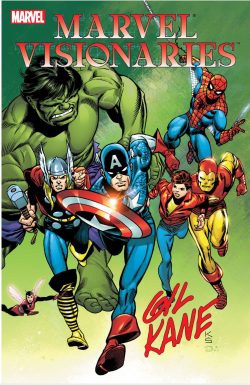
Silver Surfer: Parable


By Stan Lee & Möebius; with Keith Pollard & Tom DeFalco, Josef Rubinstein, José Marzan, Chris Ivy, Paul Mounts, Michael Heisler & various (Marvel)
ISBN: 978-0-7851-6209-4 (HB) 978-0-7851-0656-2 (TPB/Digital edition)

This book includes Discriminatory Content produced in less enlightened times.

As Marvel’s cinematic arm tries once again to get it right with their founding concept and by extension ultimate allegory of God and Jesus, you can safely anticipate revisiting a selection of fabulous FF and associated material as well as new collections all culled from their prodigious paginated days…

The most eclectic and enigmatic of comic book cult figures, the Silver Surfer’s saga began with the deservedly lauded and legendary introductory story. Although pretty much a last-minute addition to Lee’s plot for Fantastic Four #48-50’s Galactus Trilogy, Jack Kirby’s gleaming god-adjacent creation became a watchword for depth and subtext in the Marvel Universe, and one Lee kept as his own personal toy for many years.

Sent to find planets for star god Galactus to consume, the Silver Surfer discovers Earth, where the latent nobility of humanity reawakens his own suppressed morality. He then rebels against his master, helping the FF save the world. As punishment, Galactus exiles the star-soaring Surfer to Earth, the ultimate outsider on a planet remarkably ungrateful for his sacrifice.

The Galactus Saga was a creative highlight in a period where the Kirby/Lee partnership was utterly on fire: an adventure with all the power and grandeur of a true epic and one which has never been surpassed for drama, thrills and sheer entertainment.

That one’s not here, but it can be found in many, many other compilations. Sorry.

In 1988-1989, ‘Parable’ was released as an Epic Comics micro-series. It featured an all-new interpretation of Galactus’ initial assault on our backwards world, illustrated by legendary French artist Jean Giraud/Möebius. As with the 1978 Fireside Books/Simon & Schuster Silver Surfer by Lee & Kirby, the story was removed from general Marvel continuity, allowing a focus on the unique philosophical nature of the Surfer and his ravenous master without the added distraction of hundreds of superheroes disrupting the flow.

It’s a beautiful piece of work and another one you really should read.

Basically, when Galactus reaches Earth in search of his absconded servant and herald – a spectacular exercise in scale and visual wonder – the Silver Surfer is hiding amongst us: a vagrant living on the streets and well aware of humanity’s many failings. However, when the star-god arrives and demands (like a huge cosmic TACO-PotUS) that everyone bows down and worships him, the solitary nomad is forced to confront his creator for the sake of beings who despise him.

Driven to extreme actions by his intimate knowledge of earthlings good and bad, the Surfer instigates a conceptual and spiritual fightback which soon devolves into blistering battle against his maker. With the sky literally falling, soon the tempted and terrified world rallies as Norrin Radd exposes the cosmic blowhard as a petty opportunist and inspires humanity to reject what seems like another deal too good to be true…

Isn’t it odd how fiction so often anticipates fact?

Tacked onto the ethereal, unmissable episode – one far more in tune with Möebius’ beliefs and interests than Stan’s – is an early Marvel Graphic Novel of the regulation Marvel Universe. The Enslavers is a rather self-indulgent but oddly entertaining slice of intergalactic eye-candy featuring the legendary icon of the counter-culture generation, and once again it depicts the ex-herald of planet-devourer Galactus as a tragic saviour and Christ metaphor. Now, though, it’s not our troubled humanity but the overwhelming power of slavers from space that threatens, and there’s a lot less breast-beating and soul-searching and far more cosmic action.

The story by Stan Lee (and Keith Pollard) has a rather odd genesis. Commissioned in the early 1980s by Jim Shooter, Lee’s original plot was apparently much transformed in the eight years it took to draw. By the time it was dialogued, it was a far different beast and Lee almost jokingly disowns it in his Afterword. Nevertheless, there’s lots to enjoy for fans who don’t expect too much in this tale of love and death in the great beyond. It’s inked by Josef Rubinstein, José Marzan & Chris Ivy, coloured by Paul Mounts and lettered by Michael Heisler.

Here, after a frantic rush through cosmic gulfs, Silver Surfer Norrin Radd crashes into the home of Reed & Sue Richards, just ahead of the colossal invasion craft of monstrous Mrrungo-Mu, who has been drawn to our world by the well-intentioned but naive Nasa probe Voyager III. Norrin’s homeworld Zenn-La has already been depopulated by the pitiless space slaver and Earth is next…

Moving swiftly, and exploiting the good intentions of an Earth scientist, the Enslavers incapacitate all our world’s superbeings and prepare to enjoy their latest conquest, but they have not accounted for the vengeful resistance of the Surfer or the debilitating power of the love Mrrungo-Mu is himself slave to: for the unconquerable alien warlord is weak and helpless before the haughty aloofness and emotional distance of his supposed chattel Tnneya

Despite being – in far too many places – dafter than a bag of photonic space-weasels jonesing for disco lights, there’s still an obvious love of old, classic Marvel tales delivered at an enthusiastic pace informing these beautifully drawn pages, and the action sequences are a joy to behold. If you love cosmic adventure and can swallow a lot of silliness, this might just be worth a little of your time and money.

Altogether a very strange marriage, this is a compelling tome spanning the vast divide of comics from the ethereal and worthy to the exuberant and fun: a proper twofer you can get your teeth into…
© 1988, 1989, 1990, 2012 Marvel Entertainment Group/Marvel Characters, Inc. All rights reserved.

Inhumans: Beware the Inhumans


By Stan Lee & Jack Kirby, Roy Thomas, Archie Goodwin, Gary Friedrich, Gerry Conway, Arnold Drake, Neal Adams, Gene Colan, Marie Severin, John Romita, Mike Sekowsky, Tom Sutton, Joe Sinnott, Vince Colletta, Syd Shores, Chic Stone, John Verpoorten, Bill Everett, Frank Giacoia, Tom Palmer, Barry Windsor-Smith & various (Marvel)
ISBN: 978-1-3029-1081-5 (TPB/Digital edition)

This book includes Discriminatory Content produced in less enlightened times.

Debuting in 1965 and conceived as yet another incredible lost civilisation during Stan Lee & Jack Kirby’s most fertile and productive creative period, The Inhumans are a subspecies of incredibly disparate (mostly) humanoid beings genetically altered in Earth’s pre-history. They consequently evolve into a technologically-advanced civilisation far ahead of and apart from emergent Homo Sapiens. The self-declared Inhumans isolated themselves from the world and barbarous dawn-age humans, first on an island and latterly in a hidden valley in the Himalayas, residing in a fabulous city named Attilan.

The mark of Inhuman citizenship is immersion in mutative Terrigen Mists which further enhance and transform individuals into radically unique and frequently super-powered beings. Inhumans are necessarily obsessed with genetic structure and heritage, worshipping the ruling Royal Family as the rationalist equivalent of mortal gods.

This compilation cumulatively spans July 1968 to January 1972, re-presenting early appearances (in whole or in part) from Marvel Super-Heroes #15, Incredible Hulk Annual #1, Fantastic Four #81-83, 95, 99 and 105, Amazing Adventures #1-10, Avengers #95, plus moments of spoofish light-relief from Not Brand Echh #12.

The Royal Family of Attilan are the hereditary aristocracy of a hidden race of paranormal beings. They comprise king Black Bolt, his paramour/cousin/eventual wife Medusa, aquatic Triton, bellicose Gorgon and subtle martial arts master Karnak, leading and representing a veritable horde of weirdly wonderful characters. Black Bolt, one of the most powerful beings on Earth, possesses phenomenal abilities but is afflicted with an uncontrollable vocal condition that makes his softest whisper a planet-shattering sonic explosion. Thus, he must never utter a sound…

In 1967 a proposed Inhumans solo series was canned before completion, with the initial episode retooled and published in try-out vehicle Marvel Super-Heroes. Written by Archie Goodwin and illustrated by Gene Colan & Vince Colletta, ‘Let the Silence Shatter!’ appeared in #15 (July 1968), revealing how the villainous Sandman and Trapster are enticed into reforming the Frightful Four after The Wizard promises Medusa a means to control Black Bolt’s deadly sonic affliction in return for her criminal services. As usual, the double-dealing mastermind betrays his unwilling accomplice, but again underestimates her abilities and intellect, resulting in another humiliating defeat…

Cover-dated October, The Incredible Hulk Annual #1 was one of the best comics of 1968. Behind an iconic Steranko cover, Gary Friedrich, Marie Severin & Syd Shores (with lots of last-minute inking assistance) delivered a passionate, tense and melodramatic parable of alienation that nevertheless was one of the most action-stuffed fight fests ever seen.

In 51 titanic pages ‘A Refuge Divided!’ saw the tragic lonely Jade Juggernaut stumble upon the hidden Great Refuge of genetic outsiders. The Inhumans – recovering from a recent failed coup by new creations Falcona, Leonus, Aireo, Timberius, Stallior, Nebulo and their secret backer (the king’s brother Maximus the Mad) – are distracted by the Hulk’s arrival and suspicion, and short tempers result in chaos. The band of super-rebels start the fight but it’s the immensely powerful Black Bolt who eventually battles the green giant to a standstill…

This is the vicarious thrill taken to its ultimate, and still one of the very best non-Lee-Kirby tales of that period.

Medusa’s little sister Crystal – and her giant teleporting dog Lockjaw – were the most visible Inhumans at that time. As girlfriend of Human Torch Johnny Storm, she was a regular in Fantastic Four and took a greater role once Susan Richards fell pregnant. In FF #81, with Sue a new mother, Crystal elects herself the first new official member of the FF and promptly shows her mettle by pulverizing incorrigible glutton-for-punishment The Wizard in the all-action romp ‘Enter… the Exquisite Elemental!’ (Lee, Kirby & Joe Sinnott).

In the next two issues, as Susan is side-lined to tend her newborn son, Crystal’s turbulent past and fractious family connections reassert themselves when cousin Maximus again attempts to conquer mortal humanity. ‘The Mark of… the Madman!’ sees the quirky quartet invade hidden Inhuman enclave Attilan to aid the imprisoned Royal Family and overcome an entire race of hypnotically subjugated super-beings before uniting to trounce the insane despot in the concluding ‘Shall Man Survive?’

Excerpted pages from FF #95 then reveal how, in the middle of a frantic battle against a super-assassin, Crystal is astoundingly abducted by her own family before the reason why is revealed in #99. All this time heartsick Johnny has been getting crazier and more despondent. He finally snaps, invading the Inhumans’ hidden home with the intention of reuniting with his lost love at all costs. Of course, everything escalates when ‘The Torch Goes Wild!’ and his rapidly following comrades find themselves in the battle of their lives…

Two months later, bi-monthly “split-book” Amazing Adventures launched with an August 1970 cover-date and The Inhumans sharing the pages with a new Black Widow solo series. The big news however was that Jack Kirby was both writing and illustrating ‘The Inhumans!’

Inked by Chic Stone, the first episode saw the Great Refuge targeted by atomic missiles apparently fired by the Inhumans’ greatest allies, prompting a retaliatory attack on the Baxter Building and pitting ‘Friend Against Friend!’ However, even as the battle raged Black Bolt was taking covert action against the suspected true culprits…

AA #3 sees our uncanny outcasts as ‘Pawns of the Mandarin’ when the devilish plotter dupes the Royal Family into uncovering a long-buried mega-powerful ancient artefact. He is, however, ultimately unable to cope with their power and teamwork in the concluding chapter ‘With These Rings I Thee Kill!’

Intercepting the flow but chronologically crucial, the first half of Fantastic Four #105 (December 1970) follows. Crafted by Stan Lee, John Romita & John Verpoorten, ‘The Monster in the Streets!’ reveals Crystal is being slowly poisoned by the constantly increasing pollutants in Earth’s air and must leave Johnny for the hermetically pure atmosphere of Attilan…

Back in Amazing Adventures #5 (March 1971), a radical change of tone and mood materialised as the currently on-fire creative team of Roy Thomas & Neal Adams took over the strip following Kirby’s shocking defection from Marvel to DC Comics. Inked by Tom Palmer, ‘His Brother’s Keeper’ then sees Maximus finally employ a long-dormant power – mind-control – to erase Black Bolt’s memory and seize control of the Great Refuge.

The real problem, however, is that at the moment the Mad One strikes, Black Bolt is in San Francisco on a secret mission. When the mind-wave strikes, the silent stranger forgets everything and as a little boy offers assistance, ‘Hell on Earth!’ (inked by John Verpoorten) begins as a simple mumbled whisper shatters the entire docks and all the vessels moored there…

As Triton, Gorgon, Karnak and Medusa flee the now utterly entranced and enslaved Refuge in search of Black Bolt, ‘An Evening’s Wait for Death!’ finds little Joey and a still-bewildered Bolt captured by a radical black activist determined to use the Inhuman’s shattering power to raze the city’s foul ghettoes.

A tense confrontation with police in the streets draws storm god Thor into the conflict during ‘An Hour for Thunder!’, but when the blood and dust settles it appears Black Bolt is dead…

Gerry Conway, Mike Sekowsky & Bill Everett assumed storytelling duties with #9 as The Inhumans colonised the entire book. Finally reaching America after an epic odyssey, the Royal Cousins’ search for their king is interrupted when they are targeted by a cult of mutants.

‘…And the Madness of Magneto!’ shows amnesiac Black Bolt in the clutches of the Master of Magnetism. He needs the usurped king’s abilities to help him steal a new artificial element. All too soon though, ‘In His Hands… the World!’ (inked by Frank Giacoia) proves that with his memory restored nothing and no one can long make the mightiest Inhuman a slave…

The series abruptly terminated there. Amazing Adventures #11 featured a new treatment of graduate X-Man Hank McCoy who rode the trend for monster heroes by accidentally transforming himself into a furry purple Beast. The Inhumans simply dropped out of sight until Thomas & Adams wove their dangling plot threads into the monumental epic unfolding from June 1971 to March 1972 in The Avengers #89-97.

At that time Thomas’ bold experiment was rightly considered the most ambitious saga in Marvel’s brief history: an astounding saga of tremendous scope which dumped Earth into a cosmic war the likes of which comics fans had never before seen. The Kree/Skrull War set the template for all multi-part crossovers and publishing events ever since. It began when, in the distant Kree Empire, the ruling Supreme Intelligence is overthrown by his chief enforcer Ronan the Accuser. The rebellion results in humanity learning aliens are among them, and public opinion turns against superheroes for concealing the threat of alien incursions…

A powerful allegory of the Anti-Communist Witch-hunts of the 1950s, the epic sees riots in American streets and a political demagogue capitalising on the crisis. Subpoenaed by the authorities, castigated by friends and public, the Avengers are ordered to disband.

Unfortunately omitted here, issue #94 entangles the Inhumans in the mix, disclosing that their advanced science and powers are the result of Kree genetic meddling in the depths of prehistory. With intergalactic war beginning, Black Bolt missing and his madly malign brother Maximus in charge, the Kree now come calling in their ancient markers…

Wrapping up the graphic thrills for this volume, ‘Something Inhuman This Way Comes…!’ (Avengers #95, January 1972) coalesces scattered story strands as aquatic adventurer Triton aids the Avengers against government-piloted Mandroids before beseeching the beleaguered heroes to help find his missing monarch and rescue his Inhuman brethren from the press-ganging Kree…

Just so you can sleep tonight, after bombastically so doing, the Avengers head into space to liberate their kidnapped comrades and save Earth from becoming collateral damage in the impending cosmos-shaking clash between Kree and Skrulls  – a much-collected tale you’d be crazy to miss…

Appended with Barry Windsor-Smith’s Medusa pin-up from Marvel Collectors’ Item Classics #21, original art by Colan & Adams, a rejected Severin cover and house ads for the Inhumans’ debut, the cosmic drama is latterly leavened with some snappy comedy vignettes.

Originating in Not Brand Echh #12 (February 1969) ‘Unhumans to Get Own Comic Book’ – by Arnold Drake, Thomas & Sutton – and ‘My Search for True Love’ by Drake & Sutton detail and depict how other artists might render the series – with contenders including faux icons bOb (Gnatman & Rotten) Krane, Chester (Dig Tracing) Ghoul and Charles (Good Ol’ Charlie…) Schlitz, before following lovelorn Medoozy as she dumps her taciturn man and searches for fulfilment amongst popular musical and movie stars of the era…

These stories cemented the outsiders’ place in the ever-expanding Marvel universe and helped the company to overtake all its competitors. Although making little lasting impact at the time they are still potent and innovative: as exciting and captivating now as they ever were. This is a must-have book for all fans of graphic narrative and followers of Marvel’s next cinematic star vehicle.
© 1968, 1969, 1970, 1971, 1972, 2018 Marvel Characters, Inc. All rights reserved.