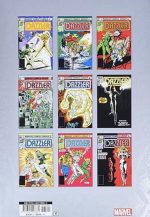
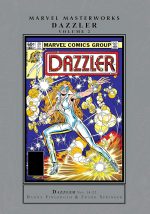
Dazzler Marvel Masterworks volume 2


By Danny Fingeroth, Steven Grant, Frank Springer, Mark D. Bright, Mike Vosburg, Vince Colletta, Danny Bulanadi, Jon D’Agostino & various (MARVEL)
ISBN: 978-1-3029-2867-4 (HB), 978-1-3029-3678-5 (Digital edition)

This book includes Discriminatory Content produced in less enlightened times.

Until relatively recently US comics had very little in the way of positive female role models and almost no viable solo stars. That seriously started changing in the 1980s and look at us now. As part of its late-but-dedicated effort to involve women readers with women characters Marvel began a program of female versions of top stars but also devised original titles to expand audiences – and none more so than Alison Blaire AKA Dazzler.

Attempts in the early 1970s had added to the canon and character roster but not publishing charts for any length of time. Nevertheless, the company kept on plugging and eventually found the right mix when Ms. Marvel launched in her own title (cover-dated January 1977). She was followed by equally copyright-shielding Spider-Woman (Marvel Spotlight #32, February 1977), who secured her own title 15 months later) and Savage She-Hulk (#1 February 1980). That last one was supplemented by music-biz inspired (and hopefully trend-exploiting) Dazzler, who sagely premiered in issue #130 of top-selling title Uncanny X-Men the same month. She followed up with a few guest shots in other big star books and inevitably graduated to her own book, but it was a little more convoluted than that…

Dazzler the character was born of another of those 1980-1990s doomed-from-the-start cross-media deals wherein comics companies attempted to break out of their “ghetto” into the real money world – like toys, movies and TV shows. In 1979 Disco specialists Casablanca Records began a development project with Marvel to create a television character who would release records like The Archies or The Monkees, but be set in an animated Marvel Universe. A giant-sized comics special was begun but when the deal was cancelled, the House of Ideas was left with a lot of talented people going “now what?”

In the interim Dazzler had already launched: guesting in the company’s other top titles (Fantastic Four #217 and Amazing-Spider-Man #203, both cover-dated April 1980). Failing to find other record companies willing to commit, big boss Jim Shooter decreed the comics special would be expanded and recycled as #1 & 2 of her own title. The singer went dark for a year before landing her own starring vehicle and her rocky road to stardom has risen and fallen ever since.

Having crushed and disappointed her austere father Judge Carter Blair by quitting law school to pursue a frivolous, worthless life on stage, Alison’s life continued to spiral crazily after meeting the X-Men. After subsequently facing petty, spiteful Asgardian Amora the Enchantress with the entire Marvel Universe in attendance, Alison steadfastly pursued her career dreams. That meant clashing in rapid order with Doctor Doom; dream demon Nightmare; evil mastermind Techmaster; The Enforcers (Ox, Montanna & Fancy Dan); Federal nemesis Mr. Meeker of energy thinktank Project Pegasus; supervillain Klaw; Galactus, his herald Terrax and – after being remanded to Riker’s Island for “murdering” Klaw – Titania and the Grapplers (Screaming Mimi, Letha & Poundcakes).

She did make some friends on the way, ranging from mob-fixated street-level masked vigilante Blue Sheild to major players like Bruce Banner and The Hulk as well as former S.H.I.E.L.D. agent/occasional Avenger Quasar (Wendell Vaughn), but the real gamechangers were her fraught associations with W.C. Fields-channelling agent/promoter Harry S. Osgood who began shaping her music career; obnoxious Lancelot Steele (sexist macho jerk/stage manager/field rep for Harry) and increasingly controlling boyfriend Dr Paul Jansen. At least Alison’s Grandma Bella still supports her, confident that one day Dazzler will be a star…

A mix of mainstream level superheroics, soap opera romances, telenovela melodrama and the hoary plot of A Star is Born, the complicated life of Alison Blaire now included an increasingly unstable father who despised her for daring to disobey him; a long-missing mother: a succession of creepily uptight and frankly dubious boyfriends; the countless moral and physical perils besetting lonely, pretty girls who would do (almost) anything to achieve their dreams of fame and assorted gods, monster, terrors and supervillains who couldn’t believe Dazzler didn’t care about them and Did Not Want To Fight.

The idea was still to address and remedy the lack of a significant female readership (after all, what normal girl would read X-Men, Spider-Man or the Hulk?) that had presumably dropped to insignificance once the company’s romance, nursing and humorous fashion titles were cancelled.

In an effort to be daring and different but still keep attracting readers the only way they knew, the editors and writers and artists did what they always did but honestly sought a different path. However, for Marvel at the time the medium was the message and somehow that meant a super fight every issue and lots of underwear, shower, and getting dressed/undressed moments in the quiet times…

Somehow Blaire never truly escaped traditional Marvel tropes and superhero schtick while forging her own path, as seen in this second collection of comic sagas taken from Dazzler #14-25, plus a bonus yarn from What If? #33, collectively covering April 1982 – March 1983. Following scripter Danny Fingeroth’s context-packed Introduction ‘This Was a Long Time Ago’, the drama resumes with #14 ‘…Without Getting Killed or Caught…!’ as Fingeroth Frank Springer & Vince Colletta reveal how after making waves as an opener for aging stadium-filler Bruce Harris, Alison and her band are caught in the crossfire when a top hitman targets Blue Shield. As the would-be killer ludicrously believes Lance is the crime-crusher, the snafu then leads Dazzler into an ambush where she must battle a deranged, mesmerised She-Hulk temporarily mind-controlled by the Mob…
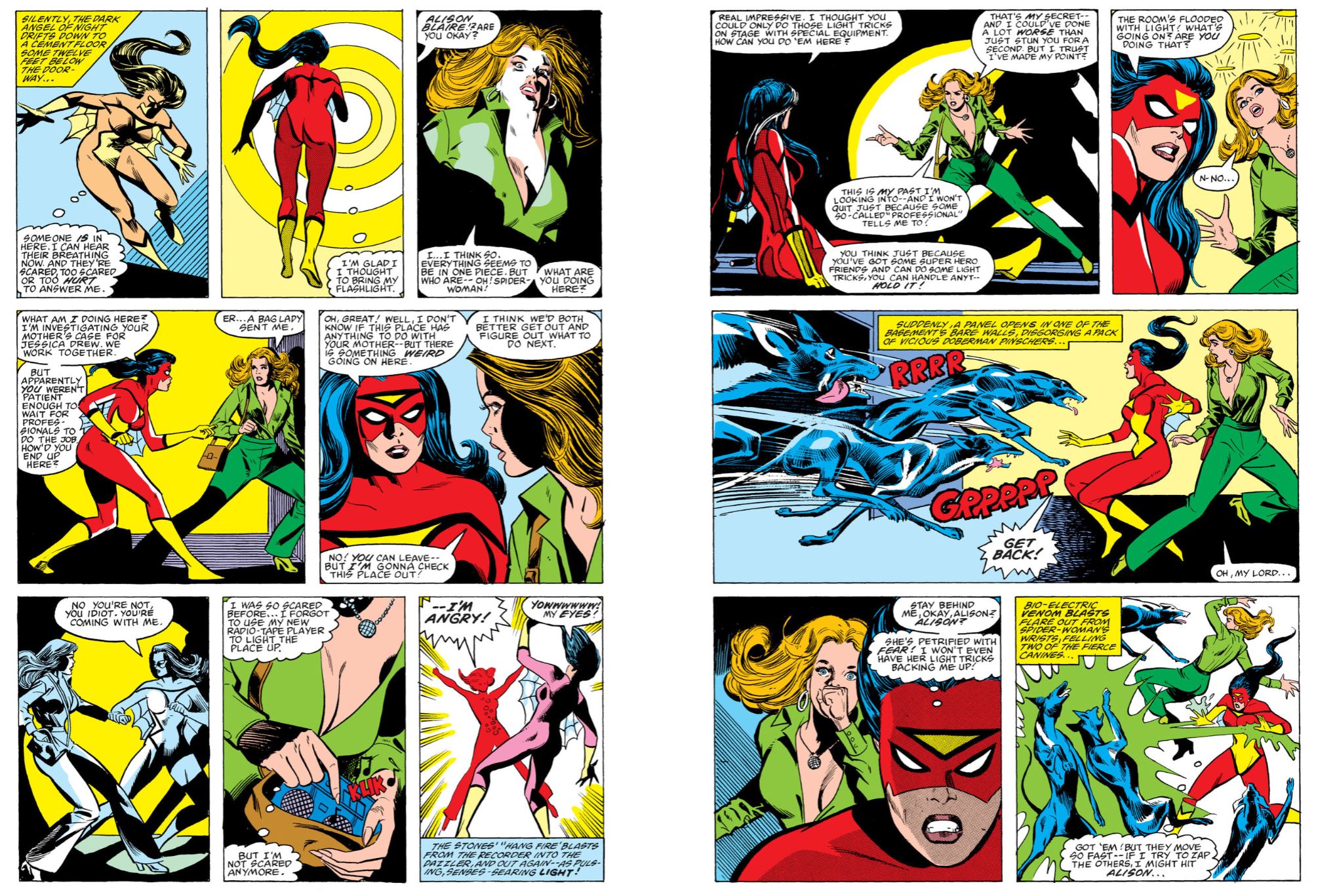
It’s still team-up time in #15 as ‘Private Eyes’ sees Harris’ tour hit San Francisco and Alison hiring investigator Jessica Drew (Spider-Woman) to track down her long-missing mom after her own amateur snooping provokes a misguided clash that brings the wrath of S.H.I.E.L.D. down on both of them…

Dazzler arrives in Seattle with #16, despondent that Harris wants her fired for making him look old and tired. Things get even worse in when The Enchantress returns and even the sudden appearance of current beau – straitlaced lawyer Ken Barnett – cannot deflect the terror of a singing contest in Asgard, judged by the gods and with the odds heavily stacked in favour of the cheating scheming ‘Black Magic Woman!’

Victorius and returned to the Big Apple, Alison’s head is turned in #17 as ‘The Angel and the Octopus!’ finds her the object of unwanted affection of multi-millionaire mutant Warren Worthington III just as Ken is becoming overly clingy. She really doesn’t need this grief right now as her producer Harry is auditioning younger, prettier potential rival songstress Vanessa Tooks and her father is on the edge of a mental breakdown…

It’s almost a relief when The Angel sweeps her off her feet for wining, dining and a furious fight against mech-augmented multi-armed madman Doctor Octopus

Her plans to be as normal as possible are further threatened when super-criminal Crusher Creel hunts her down to be his hostage in a planned ambush of the Avengers in ‘The Absorbing Man Wants You!’ Sadly, after the simple-minded thug overconsumes her energies and grows out of control, Dazzler endures ‘Creel… and Inhuman Treatment!’ until Inhuman king Black Bolt intervenes to avoid a escalating catastrophe. Meanwhile, as Judge Blaire deteriorates, Warren, Vanessa and Grandma Bella all take circuitous but convergent steps that will soon uncover the hiding place of Alison’s mother…
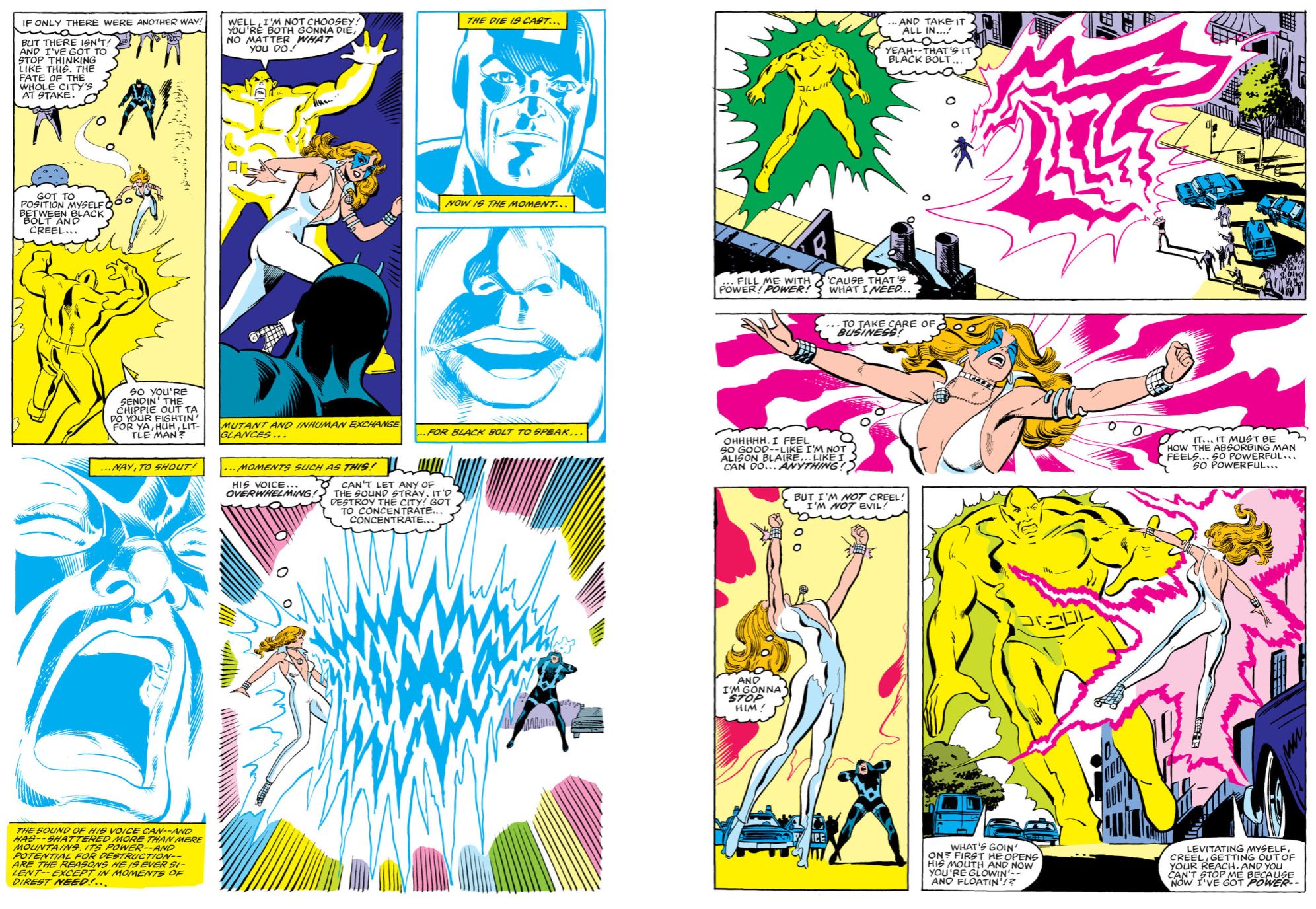
The roads meet in #20 as ‘Out of the Past!’ details the hows and whys of Barbara (Blaire) London’s absence and even fills in some hidden passages in the life of Alison…

The full story arrives behind a photo-cover by Eliot Brown, Bob Larkin and model June McDonald as double-sized Dazzler #21 declares ‘Alison Blaire, This is Your Life!’ with the singer headlining a major benefit gig that draws ALL of her family together for a major reconciliation and reset, with every superhero in town along for the show…

A new tone infects #22 as evil mutants ‘The Sisterhood’ maliciously target Angel. The larger goal of Mystique, Destiny and wild child Rogue is to destroy the entire X-Men team but after Alison humiliatingly defeats Rogue and her parents, the unbalanced teenager becomes obsessed with punishing Dazzler. However, before that ‘Fire in the Night!’ changes tack to find Alison and her newly-found half sister Lois London endangered by manic arsonist Flame and her own vile property speculating landlord. Meantime, believing the Sisterhood behind the attack Alison has contacted a certain Heroes for Hire team and soon Luke Cage and Iron Fist prove worth every discounted cent…

They continue earning their keep in ‘A Rogue in the House!’ (#24 and Fingeroth, Springer & Colletta’s last collaboration in this collection) as the uncontrollable young mutant mind & powers leech assaults Alison and Lois. Brave and bold the bodyguards are ultimately defeated by their own stolen abilities and, desperate and furious, Dazzler decides to settle the grudge her own way…
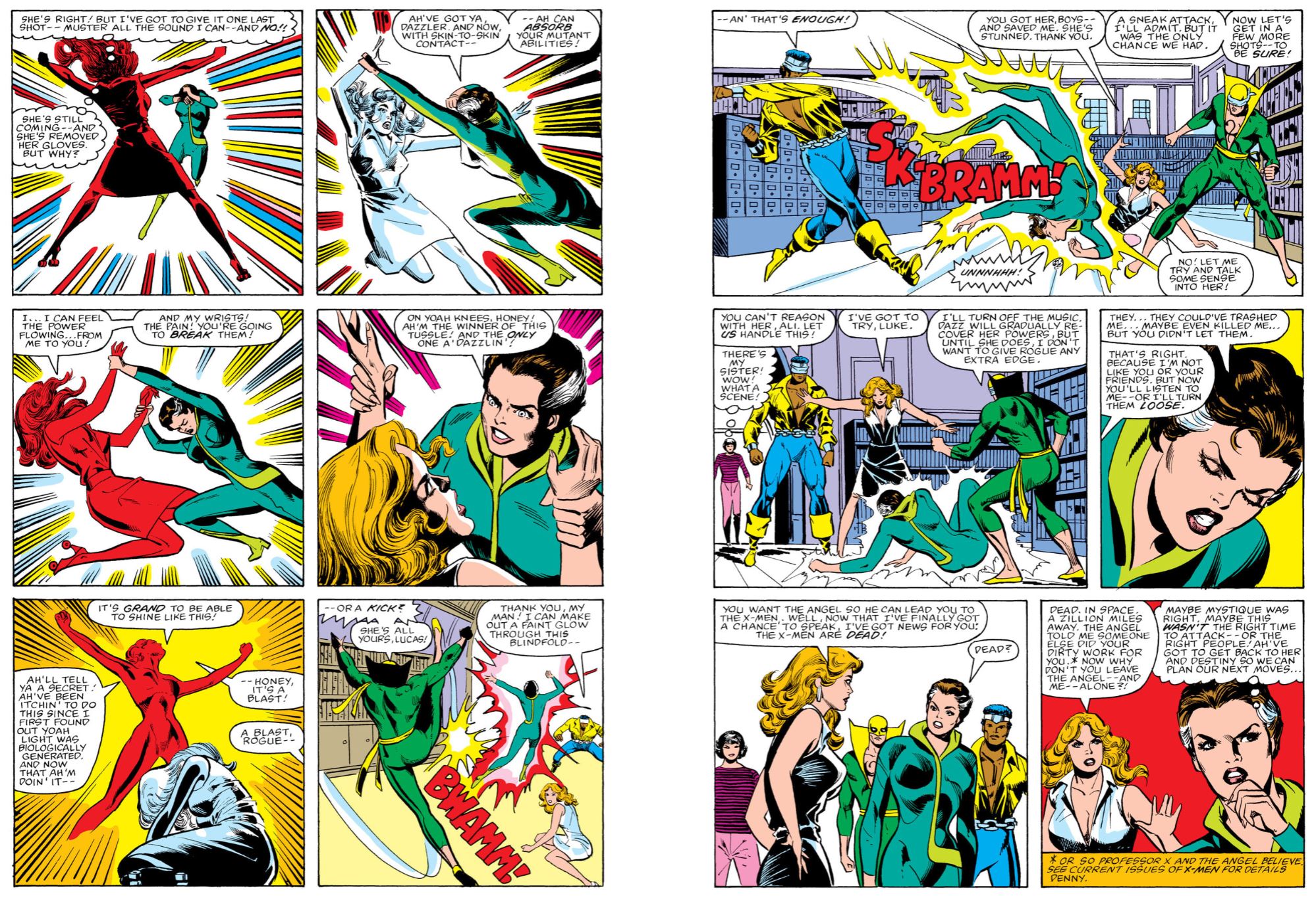
The main comics biography pauses here with Dazzler #25, wherein the living transducer experiences every performer’s greatest nightmare. Crafted by Steven Grant, Mark Bright & Danny Bulanadi, ‘The Jagged Edge’ exposes her response to an appreciative fan who slowly crosses the line from heartfelt appreciation to lethally psychotic stalker. Sweet, shyly attentive admirer Karl Fredericks rapidly devolves to possessive maniac after finally meeting his idol, thereafter attempting to own Alison by killing all her friends and relatives. This prompts an extreme reaction from the horrified mutant musician…

To Be Continued..

With covers by Springer, Bill Sienviewicz, John Romita Jr., Bob Wiacek, John Romita Sr., and Dave Simons fronting each enthralling episode, the brief posterior Bonus Section opens with a tale from What If? #33 (June 1982), crafted by Fingeroth, Mike Vosburg & Jon D’Agostino asking and answering the burning question ‘What If The Dazzler Had Become the Herald of Galactus?’, supplemented by Dazzler’s entry from 1983’s Official Handbook to the Marvel Universe as supplied by Mark Gruenwald, Springer & Josef Rubinstein and the original character design for ‘Vanessa’ as crafted by then-current Marvel intern Lance Tooks.

Although very much of its troubled times, this collection sees the transformative shift in attitudes that resulted in women becoming less decorative and unshakably ornamental, and increasingly authors of their own fates. Even if not to everyone’s taste there is enough of significance here to make Dazzler worthy of any modern readers attention.
© 20201 MARVEL.

Today in 1934 comics loving speculative fiction iconoclast Harlan Ellison was born, followed in 1951 by Canadian superstar George Freeman (Captain Canuck, Green Lantern, Wasteland) and Mark Wheatley (Mars, Blood of the Innocent, Breathtaker, Fables: 1001 Nights of Snowfall) in 1954)

On this date in 1949 we lost Robert Ripley (Ripley’s Believe It or Not!); Mark Trail creator Ed Dodd in 1991, ceiling shattering Japanese cartoonist Machiko Hasegawa (Sazae-san) in 1992 and Al Hartley (Archie Comics, Patsy Walker, Thor/Journey into Mystery) in 2003.

In 2006 Alex Toth died.
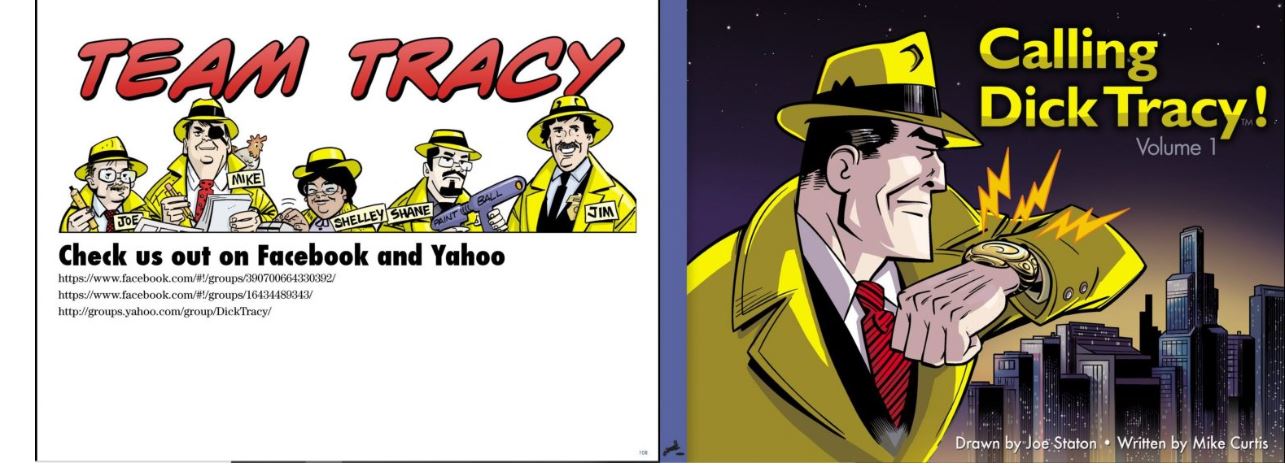
Calling Dick Tracy! volume 1


By Mike Curtis, Joe Staton & various (Rabbit Hole)
ISBN: 978-0-930645-11-0 (digital edition)

Time for another anniversary celebration. Dick Tracy is 95 in five months’ time, so here’s a superb collection crying out for revival in either physical or digital forms. Another time to agitate against the publishing powers-that-be, I think…

All in all, comics have a pretty good track record for creating household names. We could play the game of picking the most well-known fictional characters on Earth – usually topped by Sherlock Holmes, Mickey Mouse, Superman Batman & Tarzan – and supplement the list with Popeye, Blondie, Charlie Brown, Tintin, Spider-Man, Garfield, and – not so much now, but once, most definitely – Dick Tracy

At the height of the Great Depression cartoonist Chester Gould sought fresh strip ideas. The story goes that as a decent guy incensed by the exploits of gangsters like Al Capone (who monopolised front pages of contemporary newspapers) the doughty doodler settled upon the only way a normal man could fight thugs: Passion and Public Opinion.

Raised in Oklahoma, Gould was a Chicago resident who hated seeing his home town in the grip of such wicked men, with far too many honest citizens beguiled by the gangsters’ charisma. He decided to pictorially get it off his chest with a procedural crime thriller that championed the ordinary cops who protected civilisation.

He took his proposal –“Plainclothes Tracy” – to Captain Joseph Patterson, the legendary newspaperman and strips Svengali whose golden touch had already blessed strips like The Gumps, Gasoline Alley, Little Orphan Annie, Winnie Winkle, Smilin’ Jack, Moon Mullins and Terry and the Pirates among others. Casting his experienced eye on the work, Patterson promptly renamed the hero Dick Tracy, whilst also revising his love interest into steady, steadfast girlfriend Tess Truehart. The daily series launched on October 4th 1931 through Patterson’s own Chicago Tribune Syndicate, growing quickly into a phenomenon and monumental hit, with all the attendant media and merchandising hoopla that follows. Bolstered by toys, games, movies, serials, animated features, TV shows et al, the strip soldiered on, influencing generations of creators and entertaining millions of fans. Gould unfailingly wrote and drew the strip for decades until retirement in 1977.

The legendary lawman was a landmark creation who influenced not simply comics but the entirety of American popular fiction. Its signature use of baroque villains, outrageous crimes and fiendish death-traps pollinated the work of numerous strips (most notably Batman), shows and movies since then, whilst the indomitable Tracy’s studied, measured use – and startlingly accurate predictions – of crimefighting technology and techniques gave the world a taste of cop thrillers, police procedurals and forensic mysteries such as CSI decades before the modern fascination took hold.

As with many creators in it for the long haul, the revolutionary 1960s were a harsh time for well-established cartoonists. Along with Milton Caniff’s Steve Canyon, Gould’s grizzled gangbuster especially foundered in a social climate of radical change where popular slogans included “Never trust anybody over 21” and “Smash the Establishment”. The strip’s momentum faltered, perhaps as much from a move towards trendy science fiction (Tracy went off-Earth into space and the character Moon Maid was introduced) as from those improbable, Bond-movie-style villains or perceived “old-fashioned” attitudes. Even the introduction of more minority and women characters – and hippie cop Groovy Groove – couldn’t stop the rot. However, the feature soldiered on regardless…

When Gould retired in 1977, 29-year old author Max Allen Collins (Road to Perdition, Nathan Heller, Mike Mist, Ms. Tree, Batman) won the prestigious role as scripter, promptly taking the series back to its crime-busting roots for a breathtaking run, ably assisted by Gould as consultant with his chief artistic assistant Rick Fletcher promoted to full illustrator. After 11 years, Collins was removed in 1992 and replaced by Mike Kilian – who apparently worked for half the up-&-coming novelist’s price – until his death in October 2005. Dick Locher took over story & art, with assistant Jim Brozman assuming drawing duties from March 2009. On January 19th 2011, Tribune Media Services announced Locher’s retirement and replacement by a new team. That’s where this digital-only book begins…

Atoudingly versatile and unbelievably prolific artist/inker Joe Staton (E-Man, Mike Mauser, The Avengers, Incredible Hulk, Green Lantern, Legion of Super-Heroes) has been an integral part of American comic books since the early 1970s and in later years made kids comics his metier. During a spectacular run on licensed classic Scooby Doo, he and series scripter Mike Curtis (Casper the Friendly Ghost, Richie Rich, Shanda the Panda) discovered a mutual love for Dick Tracy and – mostly for their own amusement – created a tribute strip entitled Major Crime Squad.

How that landed them the duty of continuing the ultimate cop’s official adventures is addressed in introductory text feature ‘Publisher’s Note – aka “The Dick Tracy vs. Major Crime Squad Caper”’ by Steve Tippie (VP of Licensing, TMS News & Features, LLC) before a stunning chronological re-presentation of all-new classics begins. Preceding those comic capers are more text-based insights and revelations: a Foreword by Mike Gold; former sheriff Curtis’ ‘How We Got the Job’ (supplemented by samples done in 2005 when they first tried to take on the strip) and Staton’s ‘Waiting For Dick Tracy’

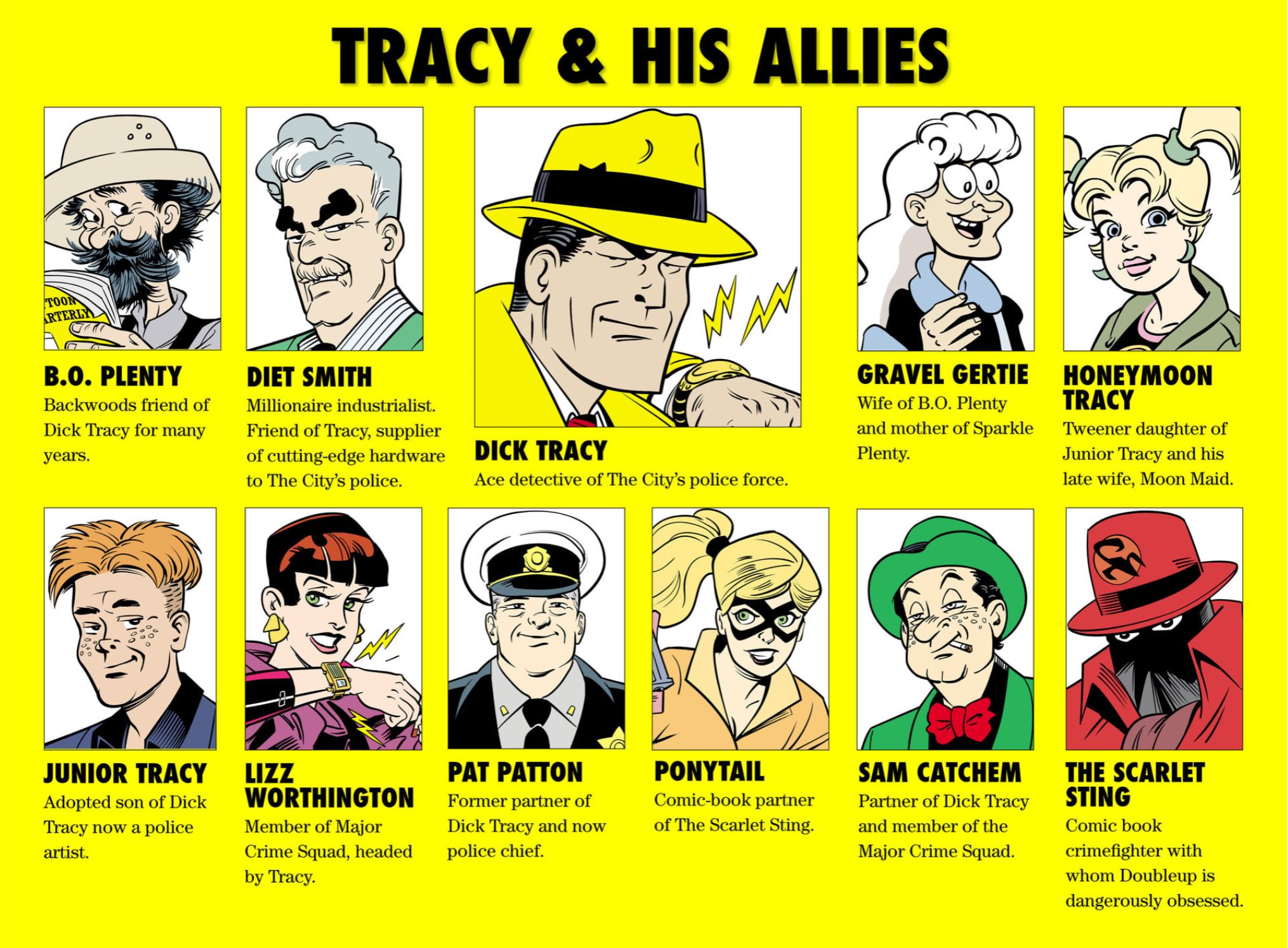
Next up is a brief visual refresher course of ‘Tracy and His Allies’ and the most nefarious of the repeat offenders in a ‘Rogues Gallery’ before the unending war on crime resumes in ‘Flyface and The Fifth Return’.

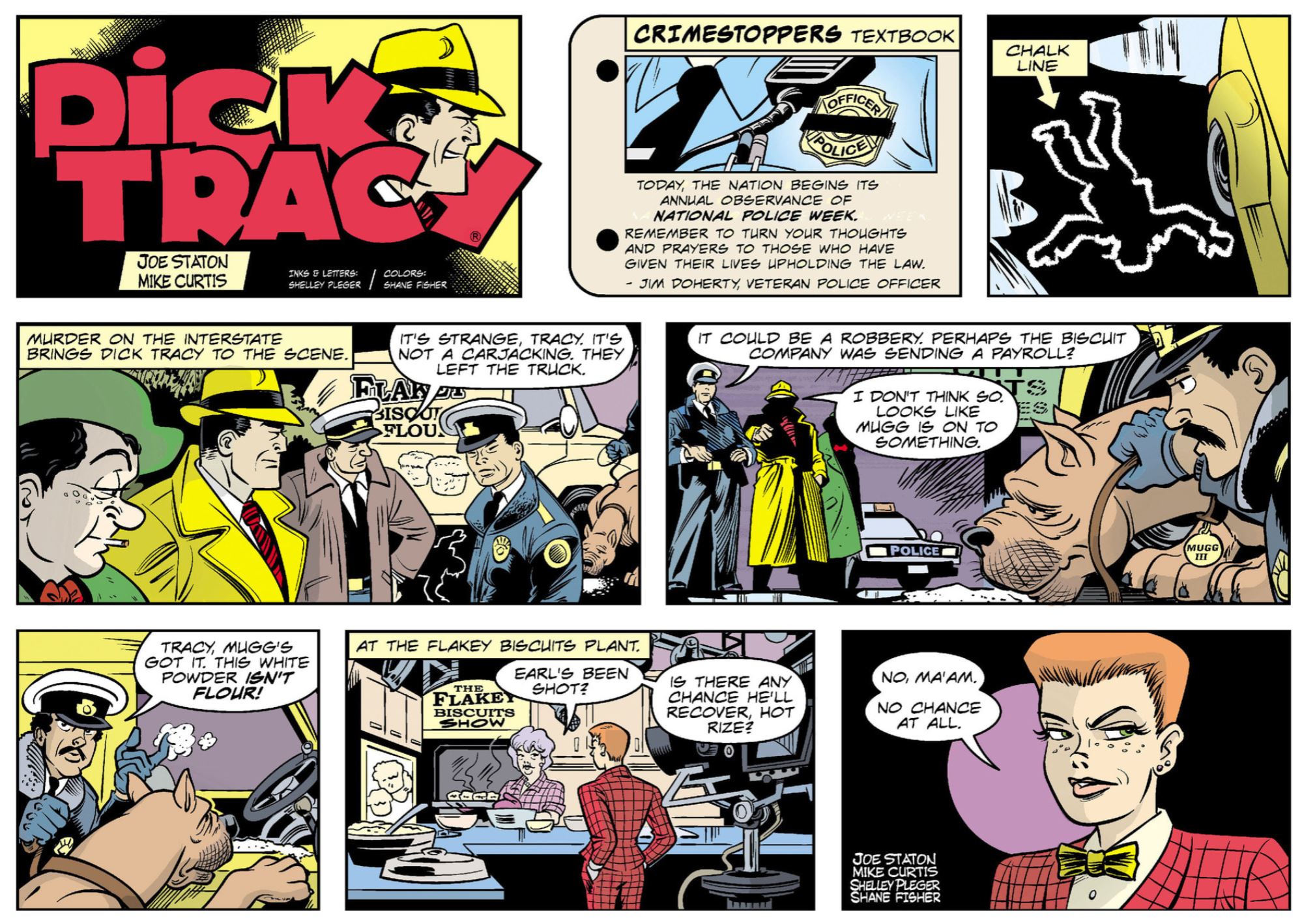
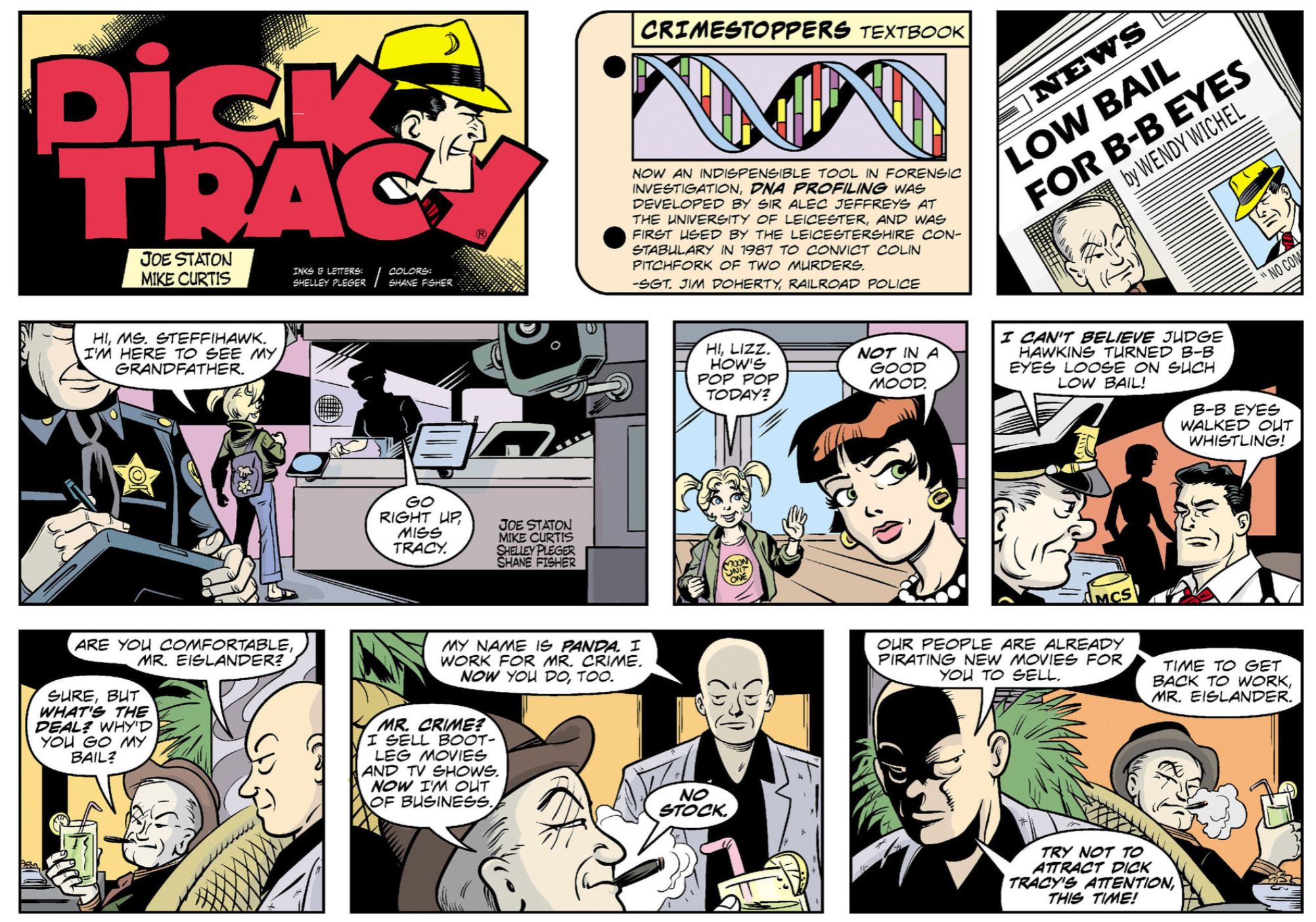
The strip has sadly long passed its heady glory days of mass sales, but that’s more about the death of print periodicals than this material. It still appears in a number of papers and as a potent online presences which means every episode is in full colour, with half-page Sunday strips still offering extras such as the ‘Crimestoppers Textbook’. One welcome addition is full credits so we can thank Shelley Pleger and Shane Fisher for their inks, colours and lettering. When Staton retired in October 2021, Pleger drew the feature, which these days is limned by Charles Ettinger…

The plot here sees the long separated traditional squad fully reunited to combat right wing terrorism and gradually reintroduced to the fanciful gadgets and controversial space tech after Tracy’s inventor pal Diet Smith gets in touch. A disgruntled former employee has stolen plans for his energy-beam weapon “Thor’s Hammer”…

After selling it to old lags Flyface and The Fifth – who kidnap officer Lizz Worthington to set a trap for their old nemesis – events spiral out of control, but only the wicked pay the final price this time…

Longtime comedic characters B.O. Plenty and his wife Gravel Gertie then resurface, celebrating the birth of their second child – the ugliest boy on Earth! – before falling foul of a manipulative foodie TV celebrity who sees a chance to own the airwaves with the stomach-churning infant in ‘Flakey Biscuits Makes the Dough’. Sadly, her bribing gifts to the couple include a shipment of cocaine being secretly couriered by her assistant Hot Rize, and soon bodies start dropping as the city’s top drug lord seeks to recover his missing product. Once Tracy realises what’s what, it’s all over bar the shooting…

‘Doubleup and the Scarlet Sting’ features the making of a movie starring a fictional superhero and depicts how childhood fan and modern-day gangster Doubleup barges in: infiltrating the cast to shakedown the production. Soon he’s too involved and after murdering his girlfriend all that’s left is being caught facing real-world justice…

At this time alternate Sunday extra ‘Tracy’s Hall of Fame’ (celebrating police officers) began, days before an officially deceased and clearly incorrigible arch enemy reappeared in ‘B-B Eyes and Honeymoon’. When Tracy’s adopted son Junior goes undercover to investigate a video piracy ring, the case quickly drags in the old cop’s granddaughter too, after Honeymoon Tracy tries to help out and almost dies because of her enthusiasm and lack of training.

Even with the comics component concluded, there’s more informational extras to enjoy as Curtis offers ‘Dick Tracy vs. the Villains: A Comparison’ and we meet the current creators in ‘Joe Staton’s Bio’, ‘Mike Curtis’ Bio’ and ‘Team Tracy Bios’ to close this initial casebook – hopefully the first of many.

Dick Tracy has always been a fantastically readable feature and this potent return to first principles is a terrific way to ease yourself into his stark, no-nonsense, Tough Love, Hard Justice world. Comics just don’t get better than this.
© 2013 TMS News & Features, LLC. All rights reserved.

On this day in 2003, Jerry Bittle’s redneck-ribbing strip Geech appeared for the final time, but the date is shared by a host of birthday boys and girls including French illustrator Paul Léonnec in 1842; publisher Clay Geerdes in 1934; Argentinian Lucho Olivera (Nippur de Lagash, Gilgamesh the immortal) in 1942 and undying legend Barry Windsor-Smith in 1949. Stan (Usagi Jojimbo) Sakai arrived in 1953; both Mark (Breathtaker, Tug & Buster, Sandman) Hempel and Publisher Terry Nantier in 1957 and mangaka Tomoko Ninomiya (Nodame Cantabile) in 1969.

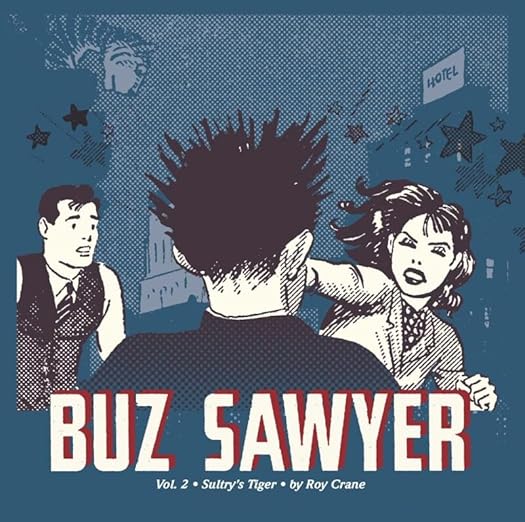
Buz Sawyer volume 2: Sultry’s Tiger


By Roy Crane  & various (Fantagraphics Books)
ISBN: 978-1-60699-499-3 (HB)

This book includes Discriminatory Content produced in less enlightened times.

Modern comics evolved from newspaper comic strips, and these pictorial features were, until relatively recently, utterly ubiquitous. Immensely information-efficient, hugely popular with the public and highly valued by publishers who used them as irresistible weapons to guarantee sales and increase circulation, the strips seemed to find their only opposition in the short-sighted local paper editors who often resented the low brow art form, which cut into advertising and frequently drew complaint letters from cranks…

It’s virtually impossible for us today to understand the overwhelming allure and power of the comic strip in America (and the wider world) from the Great Depression to the end of World War II. With no television, broadcast radio far from universal and movie shows at best a weekly treat for most folk, household entertainment was mostly derived from the comics sections of daily – and especially Sunday – newspapers. “The Funnies” were the most universally enjoyed recreation for millions who were well served by a fantastic variety and incredible quality of graphic sagas and humorous episodes over the years.

From the very start comedy was paramount; hence our terms Funnies and Comics, and from these gag-&-stunt beginnings, a blend of silent movie slapstick, outrageous fantasy and the vaudeville shows, came a thoroughly entertaining mutant hybrid: Roy Crane’s Wash Tubbs.

Debuting on April 21st 1924, Washington Tubbs II was a comedic, gag-a-day strip which evolved into a globe-girdling adventure serial. Crane produced pages of stunning, addictive and influential high-quality yarn-spinning for years, until his eventual introduction of moody swashbuckler Captain Easy ushered in the age of adventure strips with the landmark episode for 6th May, 1929. This in turn led to a Sunday colour page for the good captain that was possibly the most compelling and visually imaginative of the entire era (see Roy Crane’s Captain Easy, Soldier of Fortune: The Complete Sunday Newspaper Strips vol 1 ).

Practically improving minute by minute, the Sunday strip benefited from Crane’s relentless quest for perfection his imaginative, fabulous compositional masterpieces achieving a timeless immediacy that made each page a unified piece of sequential art. The influence of those pages can be seen in the works of near-contemporaries such as Hergé, giants-in-waiting like Charles Schulz and comic book masters like Alex Toth and John Severin ever since.

The material was obviously as much fun to create as to read. In fact, the cited reason for Crane surrendering the Sunday strip to his assistant Les Turner in 1937 was NEA/United Features Syndicate’s abrupt and arbitrary demand that all its strips must henceforward be produced in a rigid panel-structure to facilitate their being cut up and re-pasted as local editors dictated.

They just didn’t lift the artist any more, so Crane stopped making them.

At the height of his powers Crane just walked away from the astounding Captain Easy Sunday page to concentrate on the daily feature, and when his contract expired in 1943 he left United Features, lured away by that grandee of strip poachers William Randolph Hearst. The result was a contemporary aviation strip set in still-unfolding World War II: Buz Sawyer.

Where Wash Tubbs was a brave but largely comedic Lothario and his pal Easy a surly, tight-lipped he-man, John Singer “Buz” Sawyer was a joyous and sharp amalgam of the two: a good-looking, popular country-boy who went to war because his country needed him..

Buz was a fun-loving, skirt-chasing, musically-inclined naval aviator daily risking his life with his devoted gunner Rosco Sweeney: a bluff, brave and simply ordinary Joe – and one of the most effective comedy foils ever created. The wartime strip was – and remains – a marvel of authenticity: depicting not just the action and drama of the locale and situation but, more importantly, capturing the quiet, dull hours of training, routine and desperate larks between the serious business of killing and staying alive. However – and crucially – when the war ended the action-loving duo – plus fellow pilot and girl-chasing rival Chili Harrison – all went looking for work that satisfied their penchant for adventure and romance wherever they could find it…

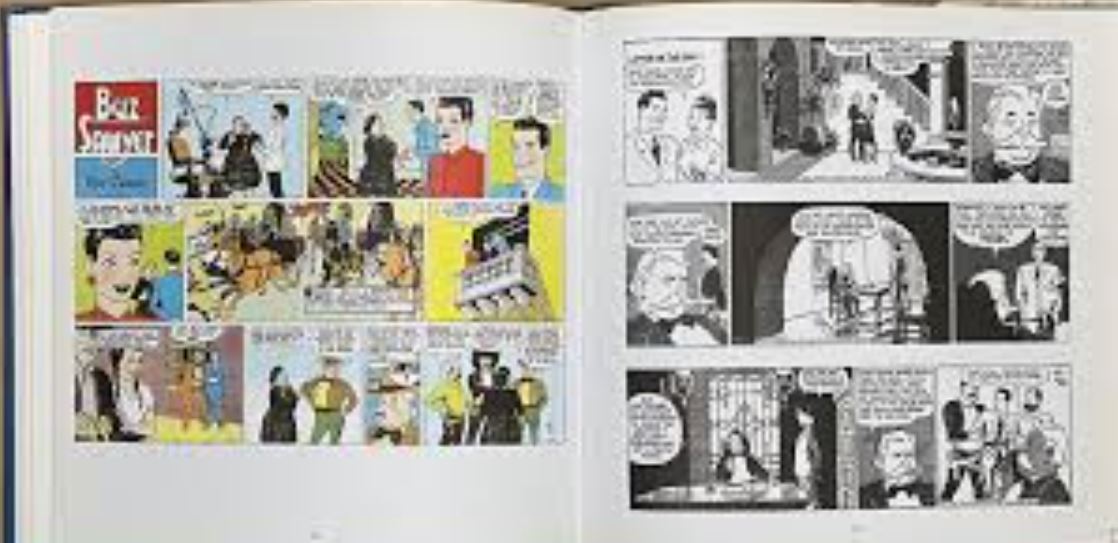
Crane was a master of popular entertainment, blending action and adventure with smart drama and compellingly sophisticated soap opera, all leavened with raucous comedy in a seamless procession of unmissable daily episodes. He and his team of creative assistants – which over the decades comprised co-writer Ed “Doc” Granberry and artists Hank Schlensker, Clark Haas, Al Wenzel, Joel King, Ralph Lane, Dan Heilman, Hi Mankin & Bill Wright – soldiered on under relentless deadline pressure, producing an authentic and exotic funny romantic thriller rendered in the signature monochrome textures of line-art and craftint (a mechanical monochrome patterning effect used to add greys and halftones to the superb drawing for miraculous depths and moods) as well as the prerequisite full-colour Sunday page.

This primarily black-&-white tome contains an impressive but far too meagre selection of those colour strips – although Crane quickly came to regard them only as a necessary evil which plagued him for most of his career…

The eternal dichotomy and narrative/continuity problems of producing Sunday Pages (many client papers would only buy either Dailies or Sunday strips, but not both) meant that most creators had to produce different story-lines for each feature – Milt Caniff’s Steve Canyon being one of the few notable exceptions. Whereas Dailies needed about three weeks lead-in time, hand-separated colour plates for the sabbath sections meant finished artwork and colour guides had be at the engravers and printers a minimum of six weeks before publication. Crane handled the problem with typical aplomb; using Sundays to tell completely unrelated stories.

For Wash Tubbs he created the aforementioned prequel series starring Captain Easy in sagas set before the mismatched pair had met, whilst in Buz Sawyer he turned the slot over to Roscoe Sweeney for lavish gag-a-day exploits, packed with slapstick laughs and situation comedy. During the war years it was set among the common “swabbies” aboard ship: a far more family-oriented feature and probably better suiting the weekend crowd of parents and children than the often chilling or disturbing realistically saucy/sexy sagas that unfolded Mondays to Saturdays. A year before Steve Canyon began, Crane tried telling a seven-days-a-week yarn in Buz Sawyer (with resounding success, to my mind, and you can judge for yourself here) but found the process a logistical nightmare. At the conclusion he returned to weekday continuity whilst Sundays were restored to Roscoe with only occasional guest-shots by the named star.

This second lush, sturdily archival hardback re-presents the tense and turbulent period from October 6th 1945 to July 23rd 1947 wherein de-mobilised adrenaline addict Buz tries to adjust to peacetime life whilst looking for a job and career – just like millions of his fellow former servicemen…

Before getting out, though, he had returned home on leave and ended up accidentally engaged. Buz was the son of the town’s doctor: plain, simple and good-hearted. In that ostensibly egalitarian environment the school sporting star became the sweetheart of ice-cool and stand-offish Tot Winter, the richest girl in town. Now when her upstart nouveau riche parents heard of the decorated hero’s return they hijacked the homecoming and turned it into a publicity carnival. Moreover, the ghastly, snobbish Mrs. Winter conspired with her daughter to trap the lad into a quick and newsworthy marriage.

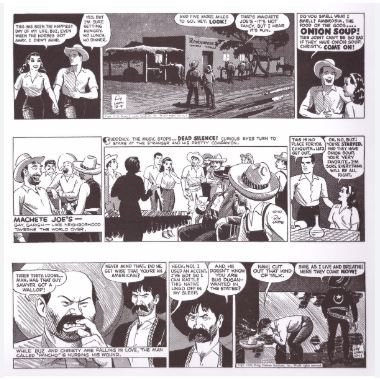
Class, prejudice, financial greed and social climbing were enemies Buz and Sweeney were ill-equipped to fight, but luckily, annoying tomboy-brat/girl-next-door Christy Jameson had blossomed into a sensible, down-to-earth, practical and clever young woman. She’d scrubbed up real pretty too and showed Buz that his future was rife with possibility. Mercifully soon, the leave ended and he & Sweeney returned to the war. The Sawyer/Winter engagement fizzled and died. When their discharge papers finally arrived (in the episode for September 9th 1945), the period of desperate struggle was over. However, that only meant that the era of globe-girdling adventure was about to begin…

Before the comics wonderment resumes, Jeet Heer and Rick Norwood discuss ‘The Perfectionist and his Team’. Concentrating initially on ‘After the War’, the fascinating explorations also delve deep into detail of the auteur’s troubled and tempestuous relationship with ‘Crane’s Team’ before offering ‘A Word on Comic Strip Formats’ and the censorious iniquities local newspaper editors regularly inflicted upon Crane’s work.

With all the insightful stuff over, cartoon adventure begins anew as civilian Mr. Sawyer returns home to a life of indolence before his own restless nature starts him fretting again. The old town isn’t the same. Tot has inherited her father’s millions and moved to New York and even Christy is gone; she’s away attending his old alma mater…

After a brief interlude wherein he visits the cheery Co-Ed and debates the merits of returning to college on the G.I. Bill, Buz instead opts for fulltime employment and heads to the Big Apple where Chili Harrison has a new job offer and an old flame waiting. As he turns East, Buz chooses to ignore his instincts and the huge mysterious guy who seems to turn up everywhere he goes…

In NYC, aloof, alluring Tot Winter is the cream of polite “arty” society, but her wealth and clingy new fiancé – opera singer Count Franco Confetti – are all but forgotten when “the one who got away” appears again and she finds her interest in her High School beau rekindled. Buz has moved in with Chili, blithely unaware that the strangely ubiquitous giant has inveigled himself into the apartment next door and is now actively spying on him…

Sawyer wants a job flying, but is frankly only one of hundreds of war-hero pilots looking for a position at International Airways. Moreover, his reputation as a hot-shot risk-taker makes him the last person a commercial carrier might consider. Happily, after implausibly well-connected Chili intercedes with a major player in the company, something does come up…

The truth about Buz’s hulking stalker comes out when the Maharani of Batu’s yacht docks in New York. The exotic Asian princess is one of the wealthiest women on Earth and cuts a stunning figure with her tiger on a leash. Yet when Buz first met her she was simply “Sultry”, a ferocious, remorseless resistance fighter helping him kill the occupying Japanese on her Pacific island.

She never forgotten him and will ensure no other woman can have him…

Sultry moves into the penthouse adjoining Tot’s and is witness to the ploys of the Winter woman as she sidelines sleazy sneaky Confetti and makes her play for Buz. She is also a key figure in the tragic heiress’ sudden death…

Just prior to Tot’s gruesome demise, Buz had finally met the unconventional Mr. Wright of International Airways. That doughty executive had no need for pilots but wanted a quick-thinking, capable fighter who could solve problems in the world’s most troubled conflict zones. He even has a spot open for good old Roscoe Sweeney. Buz is all set for his first overseas assignment when the cops decide he’s the other prime suspect in Tot’s murder and, with Sawyer and Count Confetti in jail, Sultry tries to flee America before the truth comes out. Sweeney and the freshly exonerated Buz soon track her down, but Sultry turns the tables on them and shanghaies her erstwhile lover, imprisoning him on her yacht, determined to make him her permanent boytoy, far, far away from American …

Never short of an idea and blessed with the luck of the damned, Buz’s escape results in a terrifying conflagration and the seeming death of his obsessed inamorata… but Sultry’s body isn’t recovered…

It takes a lot of pleading to get Mr. Wright to give him another chance but, soon after, Buz & Sweeney are winging north to Greenland to stop a crazed sniper taking pot-shots at aircraft passing over the “Roof of the World”. This savage, visceral extended saga soon reveals the shooter to be a deranged leftover Nazi and his hapless attendants, but the heroes’ astonishing hunt for and capture of the Teutonic trio is as nothing compared to the harrowing trek to get them back to civilisation, especially since poor Roscoe is putty in the hands of lovely Frieda, devil-daughter of the utterly mad Baron von Schlingle.

Before Buz get the survivors home safely, he loses his plane, must forcibly trek across melting floes, get them all stranded on a iceberg and even has his pretty-boy face marred forever. Worst of all, by the time he gets back to civilisation, his job no longer exists. Mr. Wright has quit and moved on to another company…

It’s not all bad news. Wright has euphemistically become “Personnel Director” for Frontier Oil: a truly colossal conglomerate active all over Earth and now wants Buz to carry on his unique problem-solving career for his new employers.

Despite a large bump in salary, the weary war hero is undecided until he hears Christy is helping her dad in Central American nation Salvaduras in his role as a geologist for Frontier Oil. This happily ties in with an outstanding missing persons case; said vanished victim being Bill Daniels, playboy son of a prominent company executive. It takes very little to convince Wright to despatch Buz & Roscoe south of the border to investigate, opening floodgates to a spectacular epic of light-hearted romantic adventure a world apart from his previous harrowing cases. The story also saw Crane and Co. merging the Daily and Sunday strips into a single storyline (with the Sundays primarily illustrated by Schlensker) as the action boys tried to trace the missing American in a country that seems locked in fear and poverty…

After initially hitting a wattle-and-daub wall, Buz takes time off for a picnic with Christy and, after a close call with a faux Mexican bandit (in actuality a Yankee fugitive from justice with an atrocious fake accent), declares his undying love for her.

He is not rebuffed and there’s the hint of wedding bells in the air…

First, though, he and Sweeney need to finish the mission, and help comes from a brave peon who breaks the regional code of silence to put them on the trail of the mysterious Ranch of the Caves and its American émigré who rules the isolated canton with blood and terror. After romancing the daughter of vicious Don Jaime, Buz and Roscoe infiltrate the desolate fiefdom and the gang boss’ international band of thugs, discovering not only the very much alive missing playboy but an incredible lost Mayan treasure trove!

Mission accomplished, Buz returns to New York to marry Christy, only to find he’s already needed elsewhere. Christy too is having doubts, worried that she will always play second fiddle to her man’s addiction to action, whereas in truth the real problem is that trouble usually comes looking for Buz. Boarding a Frontier plane for the Yukon, Sawyer is merely a collateral casualty when the ship’s other passenger is kidnapped. The mysterious menabducting plastic surgeon Dr. Wing take their helpless hostages all the way to deepest Africa where they expect the medic to change the face of an infamous madman everybody in the world believes died in a Berlin Bunker. Tragically, the fanatics are not prepared for the physician’s dauntless sense of duty and sacrifice nor Buz’s sheer determination to survive…

The latter part of this tale describes Buz’s epic river trek with mercenary turncoat honey-trap Kitty as they flee from vengeful Nazis. However, even after reaching the coast and relative safety, the insidious reach of the war-criminals is not exhausted and one final attack looms…

Eventually, Buz returns to New York alone and wins enough time from slave driving Mr. Wright to settle things with Christy. He follows her to Nantucket Sound, but even their romantic sailboat ride turns into a life-changing adventure…

To be Continued for decades to come…

This splendid collection is the perfect means of discovering – or reconnecting with – Crane’s second magnum opus: spectacular, enthralling, exotically immediate romps that influenced generations of modern cartoonists, illustrators, comics creators and storytellers. Buz Sawyer ranks amongst the very greatest strip cartoon features ever created: rousing, enthralling, thrilling, outrageously funny and deeply moving tale-telling that is irresistible and utterly unforgettable.
Buz Sawyer: Sultry’s Tiger © 2012 Fantagraphics Books, all other material © 2012 the respective copyright holders. All Strips © 2010 King Features Syndicate, Inc All rights reserved.

Today in 1890, landmark British magazine Comic Cuts began publication. See what we started?

This date in 1928 scripter/screen writer George Kashdan (Tomahawk, Congo Bill, Tommy Tomorrow, Mysto, Magician Detective, hundreds of DC genre anthology tales, Superman/ Aquaman Hour of Adventure) as born, with Dutch creator Piet Wijn (Aram, Douwe Dabbert) coming a year later. Dave (Cerebus) Sim popped up in 1956 and Linda Medley (Castle Waiting, Justice League America, Doom Patrol, Galactic Girl Guides) in 1964.

Today saw the loss of Mutt and Jeff ghostwriter Aurthus “Bugs” Baer in 1969, ULTIMATE Batman artist Dick Sprang in 2000 and Mad’s The Lighter Side cartoonist Dave Berg in 2002.

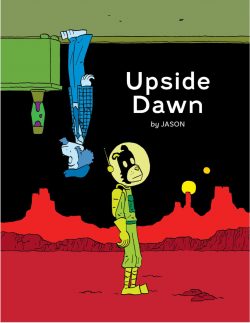
Upside Dawn


By Jason (Fantagraphics Books)
ISBN: 978-1-68396-652-4 (HB/digital edition)

This book includes Discriminatory Content included for dramatic, comedic and ironic effect.

Born in 1965 in Molde, Norway, John Arne Sæterøy is known by enigmatic, utilitarian nom de plume Jason. The shy & retiring auteur first took the path to cartoon superstardom in 1995, once debut graphic novel Lomma full ay regn (Pocket Full of Rain) won Norway’s biggest comics prize: the Sproing Award. From 1987 he had contributed to alternate/indie magazine KonK while studying graphic design and illustration at Oslo’s Art Academy.

From there he took on Norway’s National School of Arts and, on graduating in 1994, founded his own comic book Mjau Mjau. Constantly refining his style into a potent form of meaning-mined anthropomorphic minimalism, Jason has cited Lewis Trondheim, Jim Woodring & Tex Avery as primary influences. He moved to Copenhagen, working at Studio Gimle alongside Ole Comoll Christensen (Excreta, Mar Mysteriet Surn/Mayday Mysteries, Den Anden Praesident, Det Tredje Ojet) and Peter Snejbjerg (Den skjulte protocol/The Hidden Protocol, World War X, Tarzan, Batman: Detective 27).

Jason’s efforts were internationally noticed, making waves in France, The Netherlands, Slovenia, Spain, Germany and other Scandinavian countries as well as the Americas and he won another Sproing in 2001 – for self-published series Mjau Mjau – before in 2002 turning nigh-exclusively to producing graphic novels. He won even more major awards.

Jason’s breadth of interest is wide & deep: comics, movies, animated cartoons, music, literature, art, history and pulp fiction all feature equally with no sense of rank or hierarchy. Jason’s puckish, egalitarian mixing & matching of inspirational sources always and inevitably produces picture-treatises well worth a reader’s time. Over a succession of tales he has built and re-employed a repertory company of stock characters to explore deceptively simplistic milieux based on classic archetypes distilled from movies, childhood yarns, historical and literary favourites. These all role-play in deliciously absurd and surreal sagas centred on his preferred themes of relationships and loneliness. Latterly, Jason returned to such “found” players as he built his own highly esoteric universe, and even has a whole bizarre bunch of them “team-up” or clash…

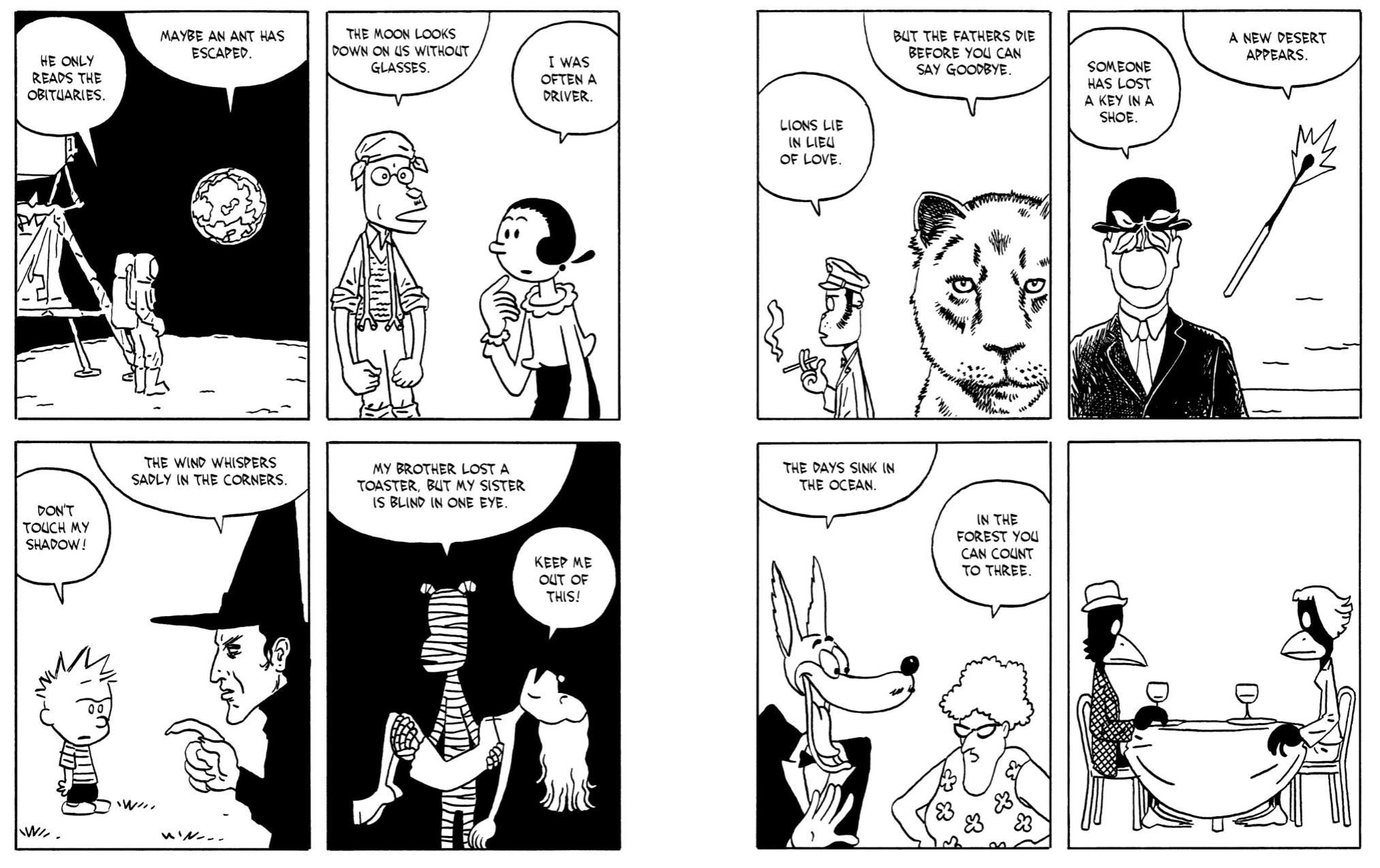
As always, visual/verbal bon mots unfold in beguiling, sparse-dialogued, or even as here silently pantomimic progressions, with compellingly formal page layouts rendered in a pared back stripped-down interpretation of Hergé’s Claire Ligne style: solid blacks, thick outlines dominating settings of seductive monochrome simplicity augmented by a beguiling palette of stark pastels and muted primary colours.

A master of short-form illustrated tales, many Jason yarns have been released as snappy little albums before later inclusion in longer anthology collections. The majority of tales brim with bleak isolation, swamped by a signature surreality even in the most comedic of moments. They are largely populated with cinematically-inspired, darkly comic, charmingly macabre animal people ruminating on inescapable concerns whilst re-enacting bizarrely cast, bestial movie tributes. That’s a style that has never been more apropos than right here, as the more modern Art Forms bow before the onslaught and tirade of organised anti-art philosophers, socially intellectual terrorists, wandering pop stars and a lost Vulcan…

Here the auteur returns to short individual pieces – or are they? – and fondly dabbles with words, terms and aural meanings whilst opening with an understandable failure to communicate over a meal in ‘Woman, Man, Bird’ before noted cerebral French auteur/filmmaker and playfully adrift word-&-meaning warper Georges Perec is repositioned as a hardboiled gumshoe searching for a missing woman in a yarn laced with omissions, mis-hearings and misapprehensions. Nevertheless, if you’re looking for a truth – any truth – ‘Perec PI’ is on the case…

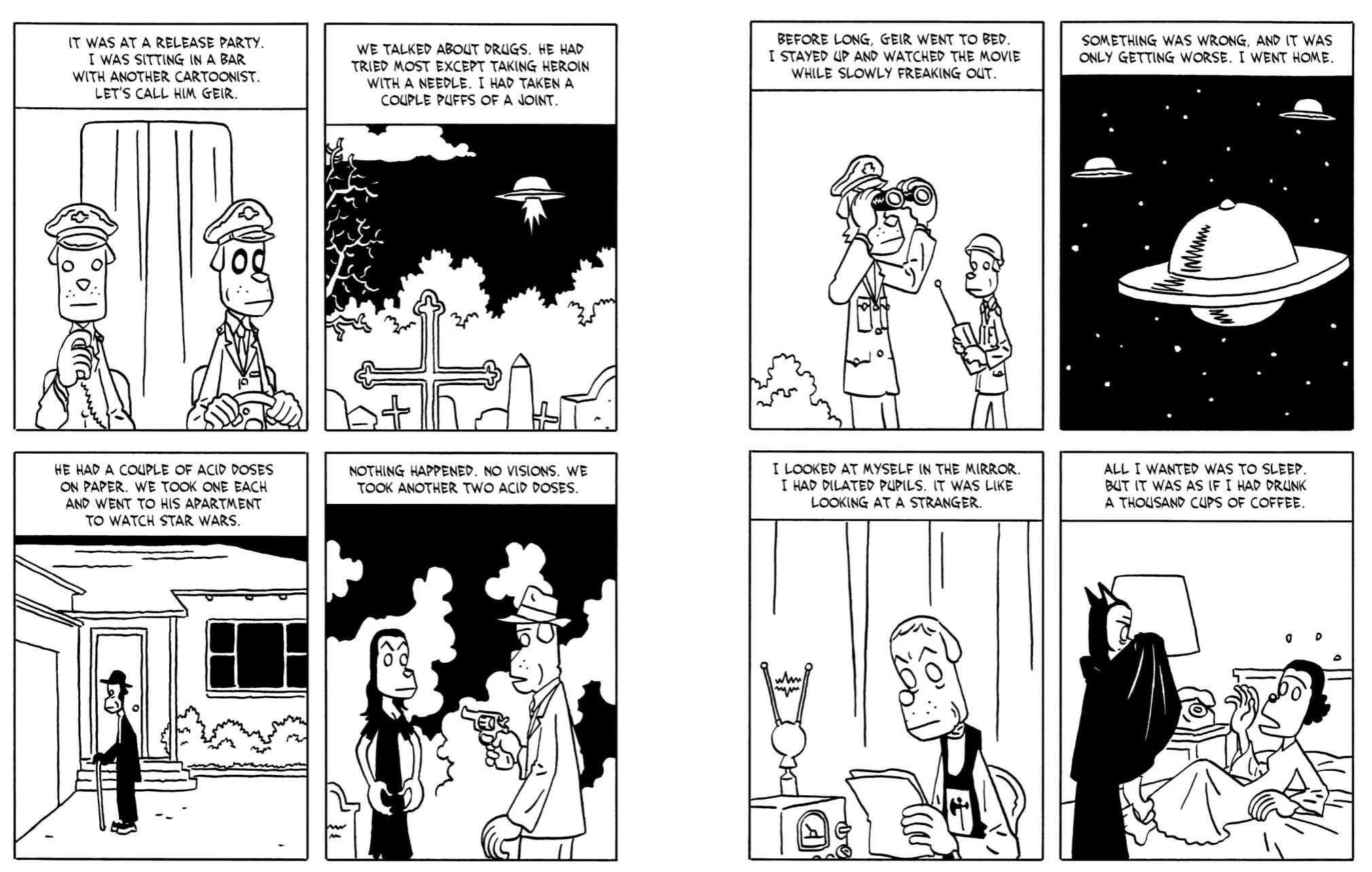
A rapid pictorial transit to a peregrination through a typical life is recalled at full pelt in ‘I Remember’ after which ‘Vampyros Dyslexicoa’ dips deep into literary hinterlands in a pastiche/homage to Joseph Sheridan Le Fanu’s 1872 Gothic novella Carmilla. However the sordid obsessions of sapphic vampire Mircalla are only the entrée to wilder scriptorial regions and a nasty case of creative anachronism as ‘Seal VII’ takes us deep into modern “Scandi” folklore when a certain Knight and Death meet up for a game in Sweden in 1357 and don’t really cotton to the notion of chess for souls…

The scenes shifts to Prague in 1919 where a certain agent of the crown abruptly quits his job and is renditioned to a strange, picturesque high-tech surveillance Village where he has to wear a blazer as ‘The Prisoner in the Castle’ prior to popping back to St Peterburg in 1865 to gorily relive the trials and tribulations of Great Russian Literature at first hand via some eccentric ‘Crime and Punishment’

As much as Jason has played with visual meaning and manipulated derived imagery-context in his past forays, the later relater is here gripped by the confusing potentials of words and verbal meanings. Such facile surface fascinations are apparent during Leopold Bloom’s rather violent visit with the absolute master of “what did that mean” Dublin in June offers a walk with James Joyce, a leprechaun, Stephen Dedalus and Molly as we ponder stuff and not-nonsense in ‘Ulysses’. Then ‘Ionesco’ introduces random judgement to the final days of avant-garde playwright Eugène Ionesco, as a parade of bizarre celebrities and notables eulogise or defame him before he goes…

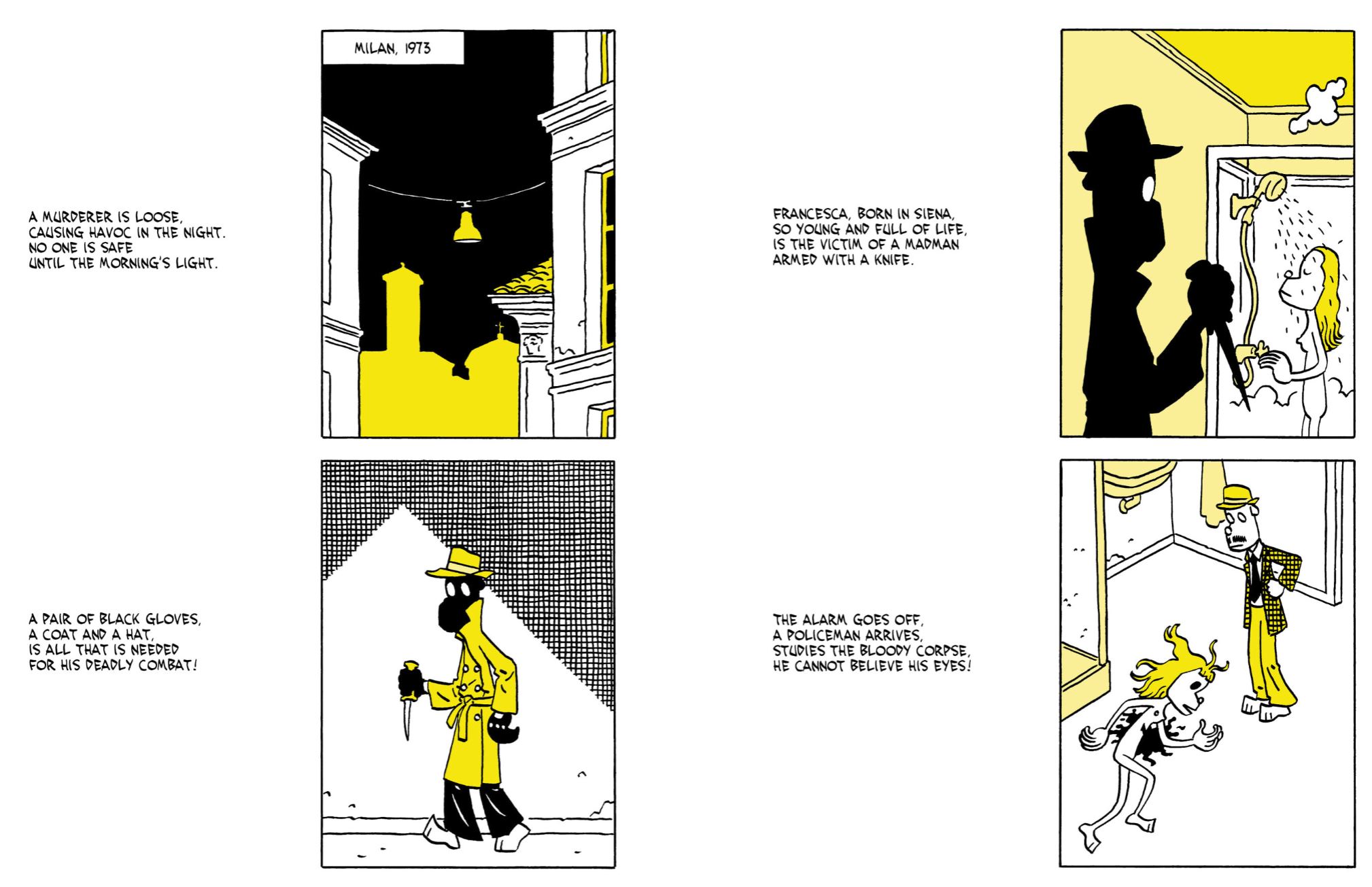
Slipping into a partial colour palette (yellow, if you care), ‘What Rhymes with Giallo?’ uses rhyming couplets to detail a sordid stabbing spree before resuming monochromatic mode as the tense future proves too much for one scientific stoic. Stress compels Mr Spock to desert the Enterprise and migrate to Montparnasse, Paris in ‘The City of Light, Forever’. It’s 1925 and he finds contentment as a minor Japanese painter (of cats) until Captain Kirk comes looking for him. If you follow Jason, this is where you start to realise that a lot of his work overlaps and intercepts itself in the strangest places…

Adding red and blue to black & white, ‘Who Will Kill the Spider?’ is a classic child’s nightmare of terror and confusion as Dad uses escalating tools and allies to deal with a bug in the bedroom who just won’t quit, after which words literally fail us in ‘One Million and One Years B.C.’: a silent science spoof of dinosaurs, cave-folk, time-travelling soldiers and stupid assumptions which leads into tribute diptych ‘EC Come…’ (a bloody tale of domestic ghouls and zombies) and ‘…EC Go’ (pointed satire of the comic company’s sublime Ray Bradbury adaptations of interplanetary First Contacts).

Then inevitably it devolves into a spoofing shot at the Sci Fi Fifties care of Curt Siodmak via Ed Wood in alien invasion ‘From Outer Space’ before ‘Etc.’ stages a celebrity-stacked movement-moment that begins in London circa 1972 as immortal musketeer Athos meets David Bowie meets a mummy meets Elvis meets Moses meets Sinatra meets Van Gogh meets Frank Zappa meets Death ad infinitum for a miasmic, abstractly construed big finish…

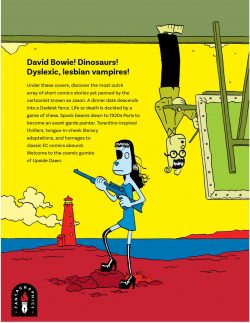
Visually mesmerising, this cunningly concocted Dadaist picture salad conceals underlying connections you really have to stay untuned for, referring relentlessly to modern icons and ancient shibboleths in equal measure, and perpetually sampling the feeling and furniture of war films, scary stories, true romances gone bad, Monty Python, Star Trek, a million movies, books, tunes and comics and even his own burgeoning “Jason-verse”. Upside Dawn absolutely should not be your first dip into his works, but don’t let that stop you from getting them all and getting all caught up…
All characters, stories, artwork and translation © 2022 Jason.
This edition of Upside Dawn © 2022 Fantagraphics Books, Inc. All rights reserved.

Today in 1892 Scots artist and future Charlie Chaplin comics illustrator Wally Roberson was born, followed in 1912 by John Liney (who limned the Henry strip), and in 1917, Hal Seeger who wrote & drew Betty Boop and later Leave it to Binky. In 1925 eventual East German cartoonist Hannes Hegen (Mosaik) arrived, with US letterer-to be Stan Starkman (Batman, Doom Patrol, Metamorpho) coming along in 1927. 3D comics guy Ray Zone was born in 1947, the same day and year that we lost the astounding Reg Perrott, artist on Roly and Poly the Two Bear Cubs, Land of the Lost People, Whirling Around the World, Wheels of Fortune, Red Ryder, The Young Explorers, The Golden Arrow, Golden Eagle, Sons of the Sword and more, as well as becoming producer/studio manager of UK mainstay Mickey Mouse Weekly.

In 1952 Hägar the Horrible artist Chris Browne was born, as was Chester Brown (Yummy Fur, Louis Riel) in 1960 and John Arne Sæterøy/Jason in 1965.

This date in 1964 Malcom Judge’s Billy Whizz first hurtled into the hearts of Beano readers, and in 2012 marked the passing of comic book workhorse Ernie Chan (Conan, Batman, Dracula Kull, The Hulk).

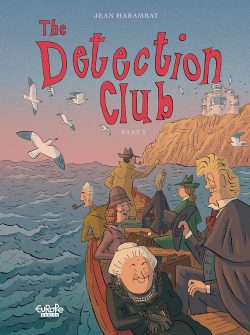
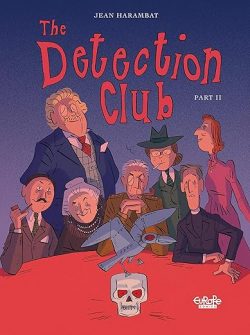
The Detection Club parts 1 & 2


By Jean Harambat, coloured by Jean-Jacques Rouger translated by Allison M. Charette (Europe Comics)
eISBN: 979-1-032809-95-2 (part 1), 979-1-032809-96-9 (part 2)

This book includes Discriminatory Content included for dramatic and literary effect.

Apparently, everybody loves mystery to chew on. With that in mind, here’s a brace of superb cartoon conundrums from the continent, based on an unlikely but actual historical convocation.

As seen on Wikipedia, – The Detection Club was a literary society of British crime writers, founded in 1930, with the likes of G.K. Chesterton, Dorothy L. Sayers and Agatha Christie as early Presidents. In 1936, American émigré John Dickson Carr became the first non-Brit elected to the august body; and probably pretty snarky elitist gathering.

They did stuff, wrote stories, held events and upheld (Ronald) Knox’s Commandments which detailed the proper rules of mystery writing. The group is the basis of later media McGuffin’s such as Batman’s Mystery Analysts of Gotham City and every bunch of screen authors matched against evil geniuses everywhere…

I’m pretty sure the story here collected in two volumes by award-winning cartoonist, screenwriter, graphic novelist, historian, philosopher and journalist Jean Harambat (Les Invisibles, Ulysses, the Songs of Return, Operation Copperhead) is apocryphal, but you never know…

Originally released in 2019, our case du jour opens in a prologue, with the reciting of those Knox commandments and the confirmation of Mr. Dixon Carr at a slap-up feed at London hostelry Ye Olde Cheshire Cheese – a pub that doesn’t seem to mind the odd celebratory gunshot…

Present are President Chesterton, Dixon Carr, Christie, Sayers, Baroness Emma Orczy, Major A.E.W. Mason and Monsignor Ronald Knox himself, and – as the posh repast winds down – proceedings are somewhat disturbed by the arrival of a flying, talking robotic bird bearing a strange invitation…

Eccentric man of means Mr. Roderick Ghyll wishes the company of the sagacious society at his extraordinary domicile on April 1st. Briarcliff House is situated on a private island where Ghyll wishes to celebrate the future through his latest contrivance, therefore promising “challenges”, “enchantments” and “the renaissance of crime fiction”…

Chapter I opens with the scribes and scribblers approaching ‘An Island in Cornwall’ and still heatedly debating the motives of the mystery man. Ghyll greets them effusively before zooming off in a bizarre electric unicycle leaving them to make their way to his palatial manse: a gleaming tribute to sleek, tripped down modernism – if not actual futurism…

Apart from the domestic staff chef Alphonse, maid Madeline, implacable (not to say positively “inscrutable”) Asian manservant Fu, and stepdaughter Millicent, the only other human present is technical assistant Dr. Zumtod and Ghyll’s haughty beautiful wife Honoria. A future generation would call her a “trophy”…

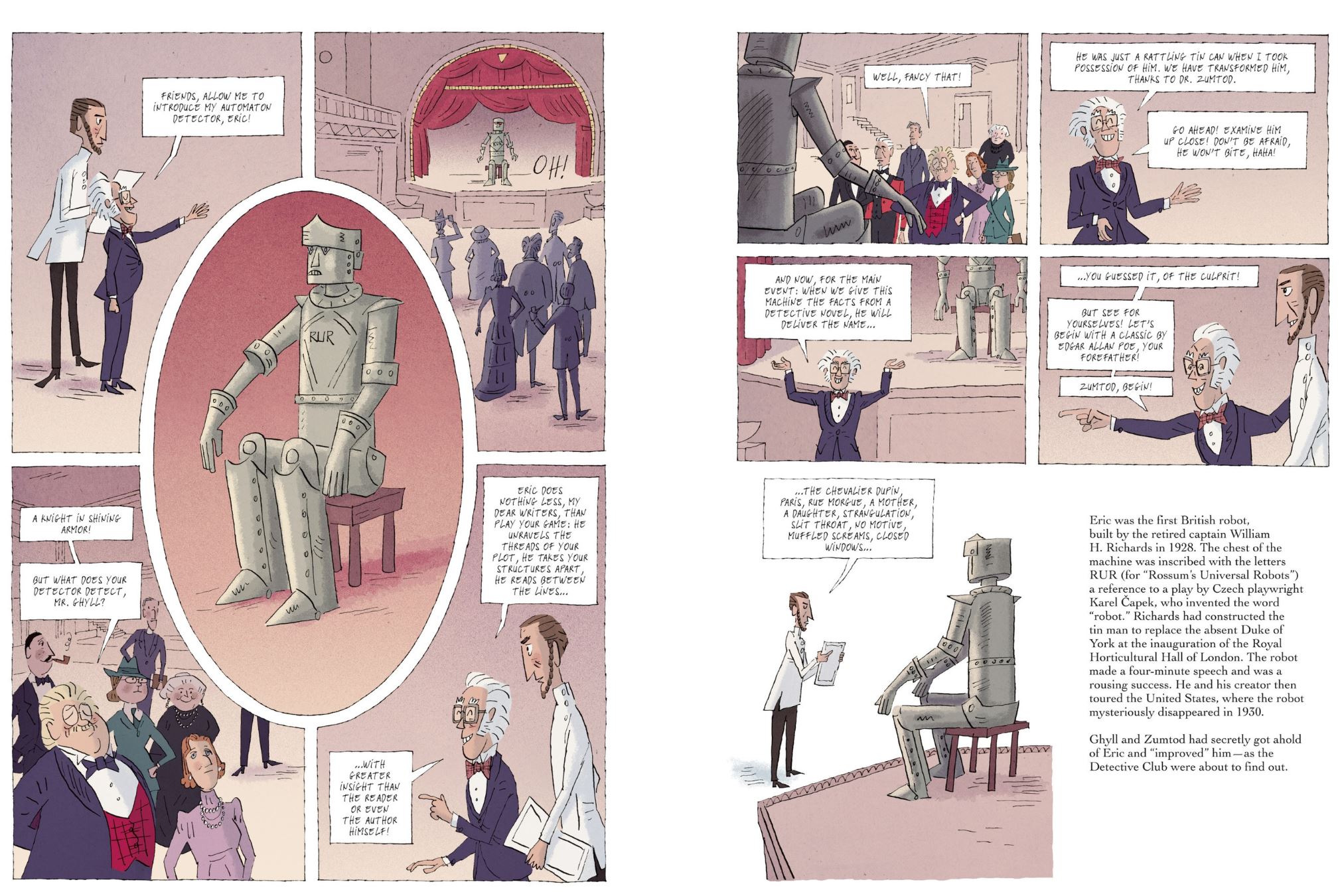
The old plutocrat is a deeply unpleasant and smugly overbearing host who boasts of one more personage that the sharp-minded, brain-testing authors must meet. With smugness and great ceremony he introduces Eric: a mechanical man with more than human insight who can outwit any mortal and easily determine the culprit in any tale they might concoct…

Although challenged with the details of a string of classic novels – which Eric easily and correctly concludes with the name of the perpetrators – the writers remain insulted and unconvinced. Dixon Carr even oversteps the bounds of polite decency by probing the automaton in search of a pre-prepped dwarf or amputee and the display is halted for dinner where Ghyll continues to advocate a world filled with his “metal friends”…

The evening wears on with the usual social distractions balanced by heated argument on many topics sparked by Eric’s existence and the magnate’s pronunciations that art and literature must make way for a machine-run world. At last, the affair breaks up with the guests retiring to their assigned rooms in a state of high dudgeon…

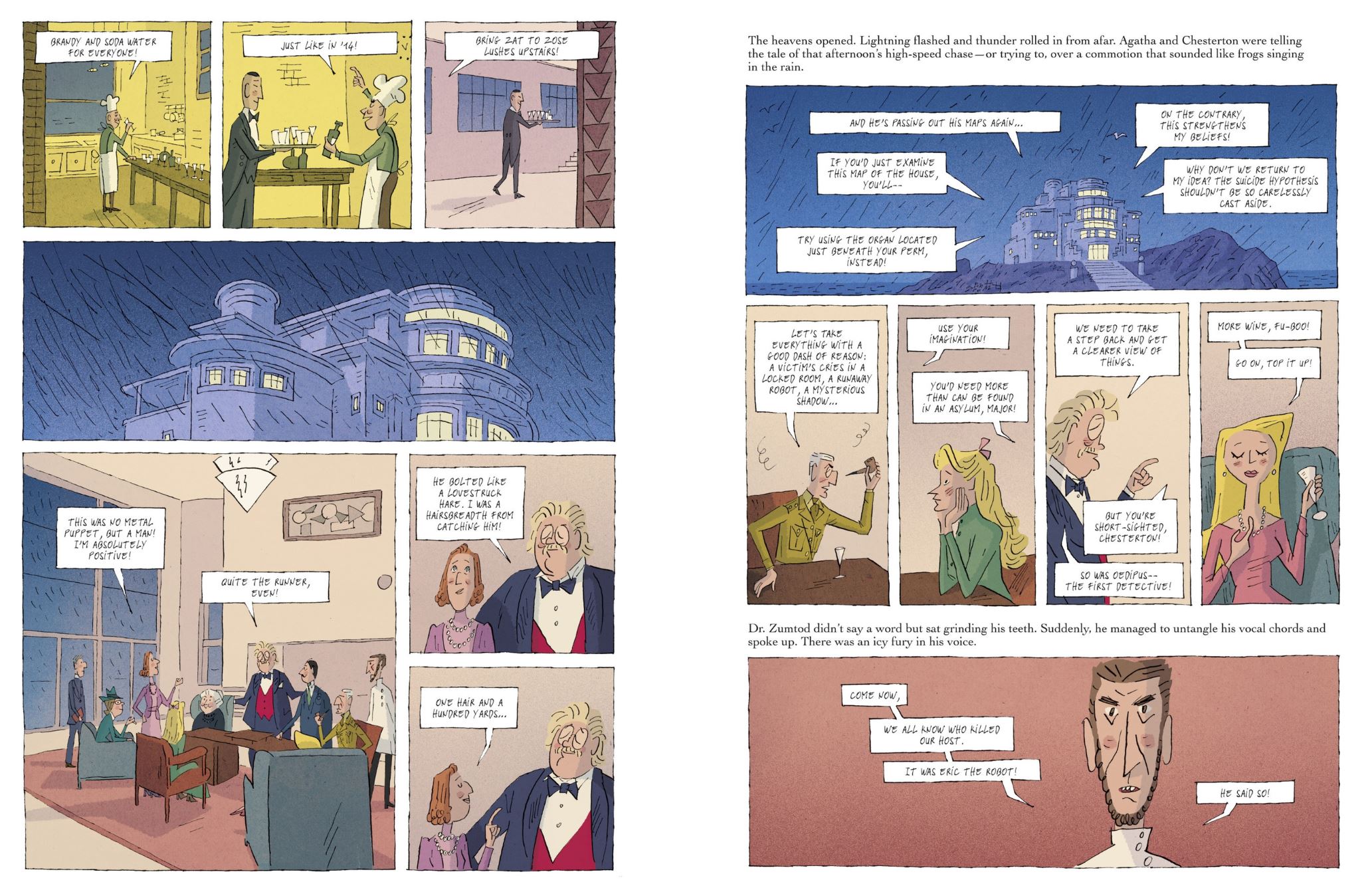
That all ends in esteemed literary tradition, with screams and the writers breaking into Ghyll’s savagely disarrayed bedroom to discover electronic Eric inert in a chair and clear evidence of ‘The Billionaire Out the Window’. Far below, a dressing gown sinks beneath choppy waves and subsequent frantic searches result in no sign of their host…

Well-versed if not actually experienced in investigation, the writers set about interviewing the staff and then the residents. Zumtod then suggests the painfully obvious: turning Eric loose on the problem. The response is as rapid as the answer is shocking…

While waiting for the outer world to re-establish contact with the isolated isle, “Queen of Crime” Christie bonds with the presumed widow and probes the step-daughter, whilst Chesterton continues to scour the entire vicinity. He’s suspicious of everything – including whether there has been any crime at all – and rapidly unearths many unsuspected secrets even as each writer cleaves to their particular speciality, makes their own assessment and forms a personal hypothesis.

…And then a body washes ashore…

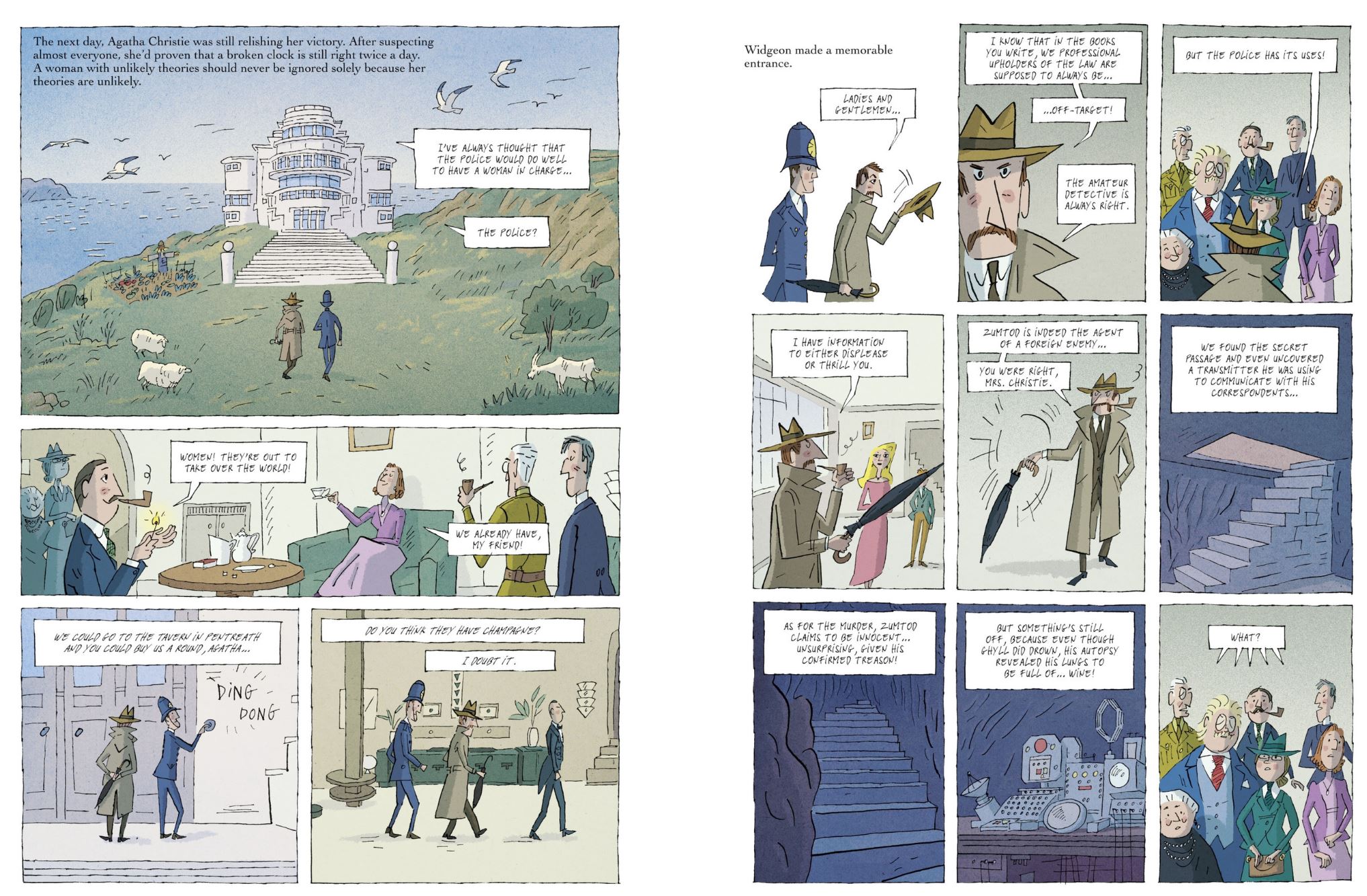
The Detection Club’s second volume begins with third chapter ‘Seven Amateur Detectives’ and an armada of late-arriving constabulary. Led by Inspector Widgeon they proceed to interview the drawing room sleuths. Mounting tensions, contrary theories and wounded pride quickly drive all concerned into fractious conflict, even as potential heir Millicent’s banished and outcast twin Watkyn re-emerges. Has he only returned because of his despised step-father’s demise or was he actually back just before it happened?

Events seemingly come to a head when Christie expounds her latest theory and provokes a minor hostage crisis until the villain is apprehended through unlikely team work. As the constabulary step in with the handcuffs however, new evidence emerges that sets the cogitators back on the murder-trail… until straightforward ratiocination leads one author to the only possible solution…

Wry, witty, and decidedly well-plotted, with smart characterisations and devastatingly sharp, catty dialogue (kudos to translator Allison M. Charette), this lively, lovely lark is also charmingly limned: a grand and glorious tribute to days gone by and superb stylists who tested our wits and expanded our entertainment horizons. This is a tale no whimsy-inclined crime fan can afford to miss.
© 2020 – DARGUAD – HARAMBAT. All rights reserved.

Today in 1911, Canuck-by-migration Ed Furness (Freelance, Commander Steel, “Canadian Whites publications” era) was born, followed by Dick Tracy collaborator Mike Curtis in 1953; Matt Feazell (Amazing Cynicalman) in 1955 and original Men in Black artist Sandy Carruthers arrived in 1962.

On this date we lost Chester Gould (Dick Tracy) in 1985 and Italian megastar artist Ferdinando Tacconi (Journey into Space and Jeff Hawke in Junior Express, Sciuscià, Susanna, Gli Aristocratici, Uomini senza gloria, L’uomo di Rangoon, Nick Raider, Dylan Dog) in 2006. Pioneering Filipino artist Tony DeZuñiga (Black Orchid, Outlaw, Jonah Hex, practically every character at DC & Marvel) died in 2012.

After 1269 weekly issues UK girls comic Mandy folded today in 1991. It had debuted on 21st January 1967.

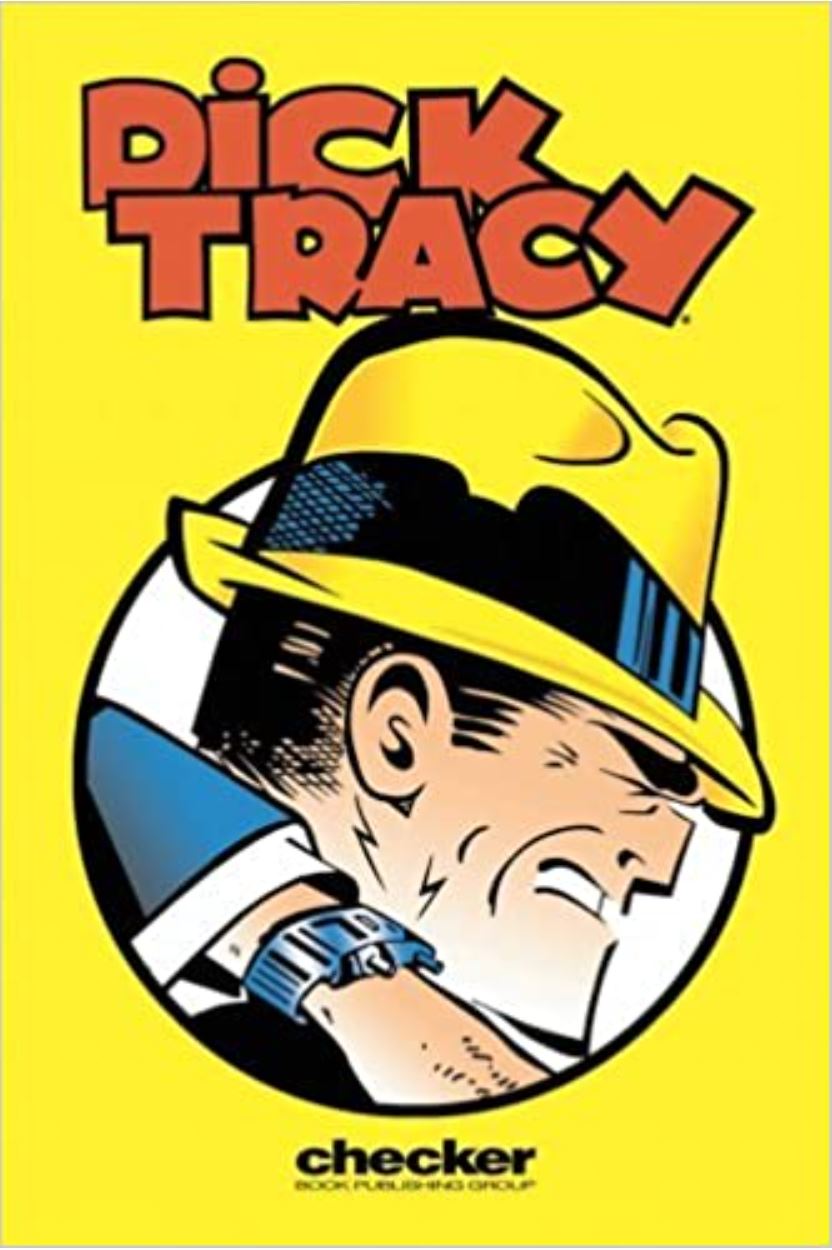
Dick Tracy: The Collins Casefiles volume 1


By Max Allan Collins & Rick Fletcher (Checker Books)
ISBN: 978-0-97416-642-1 (TPB)

This book includes Discriminatory Content included for dramatic effect.

Almost, sort of, Time for another anniversary celebration. Here’s a superb collection crying out for revival in either physical or digital forms. Time to agitate again against the publishing powers-that-be, I think…

Comics have a pretty good track record for creating household names. We could play the game of picking the most well-known fictional characters on Earth – usually topped by Sherlock Holmes, Mickey Mouse, Superman, Batman and Tarzan – and supplement the list with Popeye, Charlie Brown, Tintin, Spider-Man and – not so much now, but once definitely – Dick Tracy

At the height of the Great Depression cartoonist Chester Gould sought fresh strip ideas. The story goes that as a decent guy incensed by the exploits of gangsters like Al Capone – who monopolised the front pages of contemporary newspapers – the callow scribbler settled upon the only way a normal man could fight thugs: Passion and Public Opinion…

Raised in Oklahoma, Gould was a Chicago resident and hated seeing his town in the grip of such wicked men, with far too many honest citizens beguiled by the gangsters’ charisma. He decided to pictorially get it off his chest with a procedural crime thriller that championed the ordinary cops who protected civilisation. He took his proposal – Plainclothes Tracy – to legendary newspaperman and Strips Svengali Captain Joseph Patterson, whose golden touch had already blessed The Gumps, Gasoline Alley, Little Orphan Annie, Winnie Winkle, Smilin’ Jack, Moon Mullins and Terry and the Pirates among others. Casting his gifted eye on the work, Patterson renamed the hero Dick Tracy, also revising his love interest into steady, steadfast girlfriend Tess Truehart.

The series launched on October 4th 1931 (so 95 and counting in mere months as the strip is still running today) as a Sunday addition to the Detroit Mirror, before spreading via Patterson’s Chicago Tribune Syndicate across the USA. It quickly grew into a monumental hit, with all the attendant media and merchandising hoopla that follows. Amidst toys, games, movies, serials, animated features, TV shows et al, the strip soldiered on, influencing generations of creators (like Bill Finger & Bob Kane) and entertaining millions of fans. Gould unfailingly wrote and drew the strip for decades until retirement in 1977.

The legendary lawman was a landmark creation who influenced not simply comics but the entirety of American popular fiction. Its signature use of baroque villains, outrageous crimes and fiendish death-traps pollinated the work of numerous strips (most notably Batman), shows and movies since then, whilst the indomitable Tracy’s studied, measured use – and startlingly accurate predictions – of crimefighting technology and techniques gave the world a taste of cop thrillers, police procedurals and forensic mysteries such as CSI decades before the modern true crime fascination took hold.

As with many creators in it for the long haul, the revolutionary 1960s were a harsh time for established cartoonists. Along with Milton Caniff’s Steve Canyon, Gould’s grizzled gang buster especially foundered in a social climate of radical change where popular slogans included “Never trust anybody over 21” and “Smash the Establishment”.

The strip’s momentum faltered, perhaps as much from the move towards science fiction (Tracy shifted jurisdiction into space and the character Moon Maid was introduced) and even more improbable, Bond-movie style villains as any perceived “old-fashioned” attitudes. Even the introduction of more minority and women characters and hippie cop Groovy Groove couldn’t stop the rot. However, the feature soldiered on regardless…

Max Allen Collins is a hugely prolific and best-selling author of both graphic novels (Road to Perdition, CSI, Batman, Mike Mist, Ms. Tree) and prose thriller series featuring crime-creations Nathan Heller, Quarry, Nolan, Mallory, Krista Larson, Mike Hammer and a veritable pantheon of others. When Gould retired from the Tracy strip, the young author (nearly 30!) won the prestigious role as scripter, and promptly took the series back to its roots for a breathtaking 11-year run, ably assisted by Gould as consultant even as his chief artistic assistant Rick Fletcher was promoted to full illustrator.

This criminally scarce but splendidly enthralling monochrome paperback compilation opens with publisher Mark Thompson’s informative Introduction ‘Flatfoot’, and offers a frankly startling ‘Dick Tracy Timeline’ listing series achievements and innovations from 1931 to 1988 even before the captivating Cops-&-Robbers clashes recommence with Collin’s inaugural adventure.

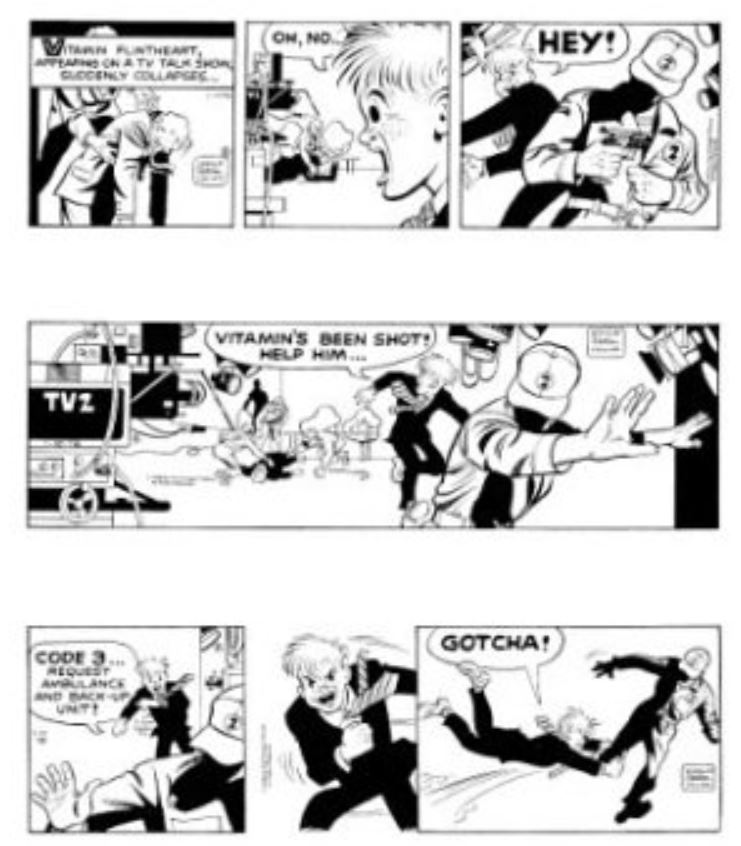
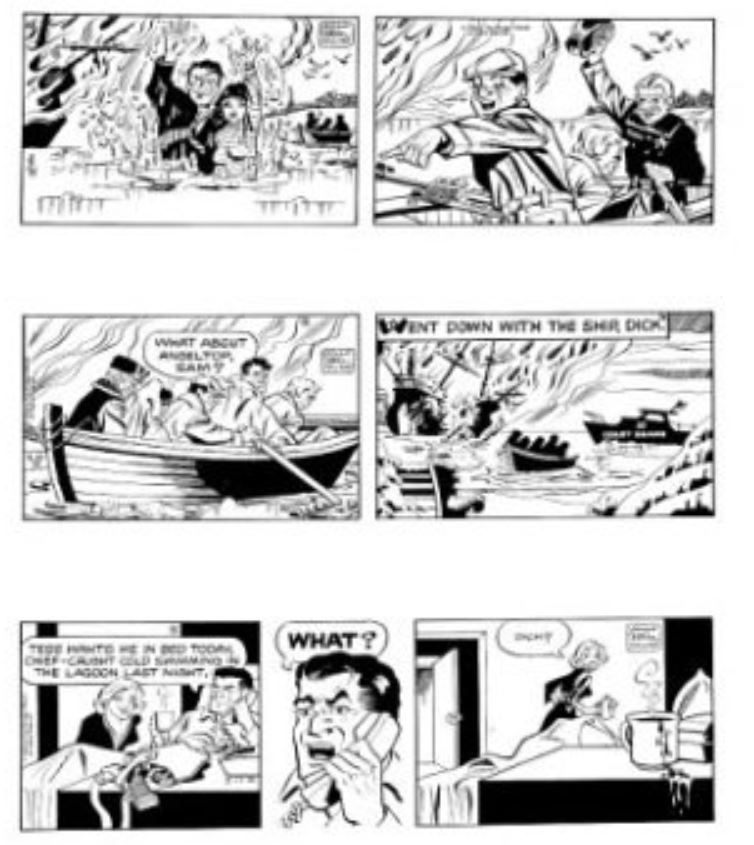
‘Angeltop’s Last Stand’ (3rd January – March 12th 1978) rapidly sidelined fantastical science fiction trappings (Tracy’s adopted son Junior had previously married aforementioned astral princess Moon Maid) whilst reviving grittily ultra-violent suspense as old friend Vitamin Flintheart is targeted for assassination. With the senior detective’s assistants Sam Catchem and Lizz Worthington on the case, it’s soon clear the assault is part of a scheme to make Tracy suffer. Solid investigation turns up two suspects, relatives of old – and expired – enemies Flattop Jones and The Brow confirming familial revenge is the motive…

Sadly, the Police Department’s resources are inadequate to prevent aggrieved daughter Angeltop Jones and the new Brow from abducting Tracy. Tragically for the vengeful felons, the grizzled crimebuster might be old but is still inventive and indomitable, and a cataclysmic confrontation leads to a fatal conflagration at the place of Flattop’s demise…

The next tale features an original Gould villain making a surprise comeback in the ‘Return of Haf-and-Haf’ (March 13th – June 11th) wherein manic murder-fiend Tulza Tuzon – whose left profile had been hideously scarred with acid – is released from the asylum, seemingly rehabilitated by modern psychology and groundbreaking plastic surgery…

Of course, only his face was fixed and the fiend quickly tries to murder ex-fiancée Zelda – who had betrayed him to the cops a decade previously. Tracy is on hand to save her, but unable to prevent Zelda from enacting grisly retribution on her attacker, leaving Tuzon woefully in need of fresh cosmetic repair. Naturally, the unscrupulous surgeon who fixed him on the State’s dime wants a huge amount of clandestine cash to repeat the procedure and the stage is soon set for doom and tragedy on a Shakespearean scale…

This first Collins collection concludes with an epic minor classic harking back to Tracy’s first published case. ‘Big Boy’s Revenge’ – AKA ‘Big Boy’s Open Contract’ – ran from 12th June 1978 to January 2nd 1979, detailing the unexpected return of the thinly-disguised Al Capone analogue Tracy had sent to prison at the very start of his career.

Decades later Big Boy, still a member of the crime syndicate known as The Apparatus, has been diagnosed with terminal cancer and wants to take with him the copper who first brought him down. Ignoring and indeed eventually warring with other Apparatus chiefs, the dying Don puts a $1,000,000 contract on Tracy’s head and lies back to watch the fireworks as a horde of hitmen and women zero in on the blithely unaware Senior Detective…

The resulting collateral damage costs the hero one of his nearest and dearest, removes most of the strip’s accumulated sci fi trappings and firmly reset the scenario in the grim and gritty world of contemporary crime. The Good Guys triumph in the end, but the cost is shockingly high for a family strip…

Dick Tracy has always been a fantastically readable feature and this potent return to first principles is a terrific way to ease yourself into his stark, no-nonsense, Tough-Love, Hard Justice world. Comics just don’t get better than this…
© Checker Book Publishing Group 2003, an authorized collection of works © Tribune Media Services, 1978, 1979. All characters and distinctive likenesses thereof are trademarks of Tribune Media Services. All rights reserved.

Born today in 1888, Canadian cartoonist J.R. Williams (Out Our Way sharing the natal event with iconic European grand master Edgar P. Jacobs (The U Ray, Blake and Mortimer) in 1904, Tex Blaisdell (Superman, Batman, Little Orphan Annie) in 1920 and Raymond Macherot (Clifton, Chlorophylle, Sibylline) in 1924.

In 2008 we lost the ubiquitous and splendid Jim Mooney (Spider-Man, Tommy Tomorrow, Supergirl, Legion of Super-Heroes) whilst in reading matters, today in 1985 saw the 1555th and final issue of UK weekly Tiger come and forever go, as did comedy comic Whoopee! – a prized UK chuckle choice since 1974.