
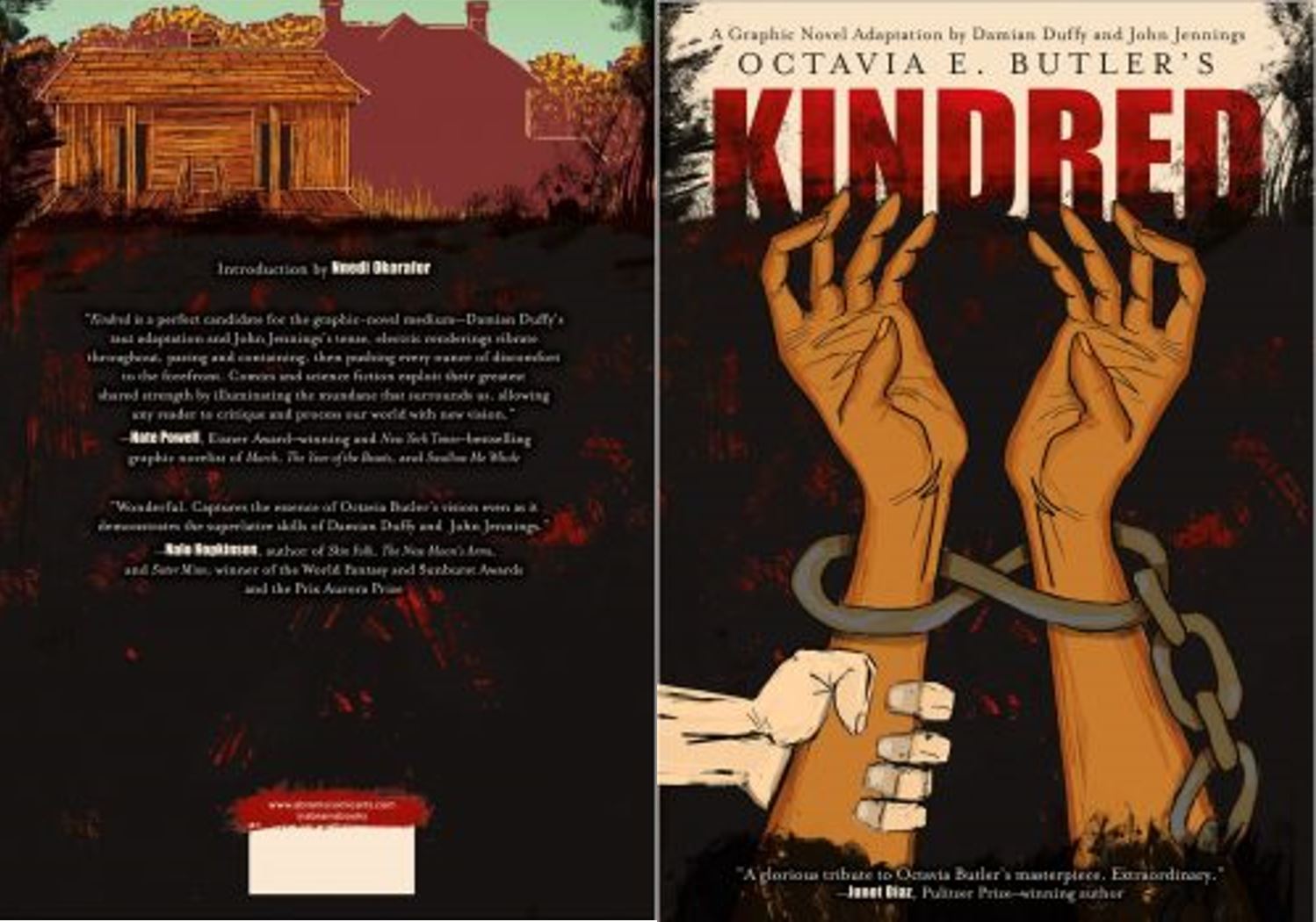
By Octavia E. Butler, adapted by Damian Duffy & John Jennings (Abrams ComicArts)
ISBN: 978-1-4197-0947-0 (HB), 978-1-4197-2855-6 (TPB), 978-1-6131-2862-6 (Digital edition)
This book includes Discriminatory Content produced in less enlightened times.
This month we’re again focussing on material pertinent to Black History Month whilst simultaneously indulging ourselves in the mandatory Halloween fright-fest. Maybe one year minorities and women will get a whole month to themselves or perhaps the powers that decree these arbitrary festivals might even acknowledge that these subjects are acceptable everyday fare…
However, here and now let’s peruse a different kind of scary story qualifying on either and both counts..
Octavia Estelle Butler (1947-2006) overcame the stacked handicaps of being female, shy, dyslexic, depressive, fatherless, poor and black in post-war America to become a shining light of the socially-aware science fiction scene that grew out of the works of Philip K Dick, Harlan Ellison, Theodore Sturgeon, Samuel R. Delaney, Zenna Henderson, John Brunner and others. Reared in ethnically diverse but still segregated Pasadena, California, she studied hard, followed her passions, took every opportunity available to studious young women of colour to became one of the most innovative, lauded science fiction authors of her generation.
Butler went to community college just as the Black Power Movement took off and – attending writers workshops – realised that her own experiences could and should inform her writing. In series like her Parable books, Patternist and Xenogenesis sequences, stand-alone novels and dozens of award-winning short stories, Butler explored how societies and splinter groups acted, addressing themes of alienation, exclusion, social and biological evolution, control through belief systems, mutual coexistence of species, genetic manipulation, parapsychic abilities and biological adjustment.
These subjects were frequently screened through a lens of co-dependent cultures of dominance and submission and framed in terms of “racism, sexism, ethnocentrism, classism, and all the other ‘isms’ that cause so much suffering in the world.” Elements of loss, contamination, interbreeding, miscegenation, mutation, symbiosis, surrender of autonomy and especially fear continually resurface as scenes of coercion, rape and violence: exploring how and why the weak are ruled by the strong while suggesting such actions are a kind of evolutionary parasitism that might be corrected by sociobiological interventions…
Her works are often associated with the vibrant subgenre of Afrofuturism (as so ideally depicted in Ta-Nehisi Coates’ Black Panther stories and the Marvel movies featuring secret paradise Wakanda) but Butler’s stories are rife with disenfranchised outsiders or lowly minority characters who are putatively weak, seen as born compromised, enduring and tolerating appalling changes of state and status simply to survive.
Such is certainly the case with the protagonist of Kindred. Adapted here by Damian Duffy and illustrated by John Jennings, the 1979 novel was a stand-alone time-travel tale written by Butler in response to a colleague’s questions about why antebellum slaves tolerated captivity and treatment. Her response was this story, offering brutal, inescapable context justifying how those accepting years of “willing” subservience might have worked. I believe it’s still in preproduction-limbo for a TV series , but until then you can hunt it out in two kinds of print: prose and pictorial…
The graphic odyssey is preceded by a heartfelt ‘Introduction by Nnedi Okorafor’ before the shocking drama opens with a ‘Prologue’ as African American Dana contemplates the limb she no longer has.
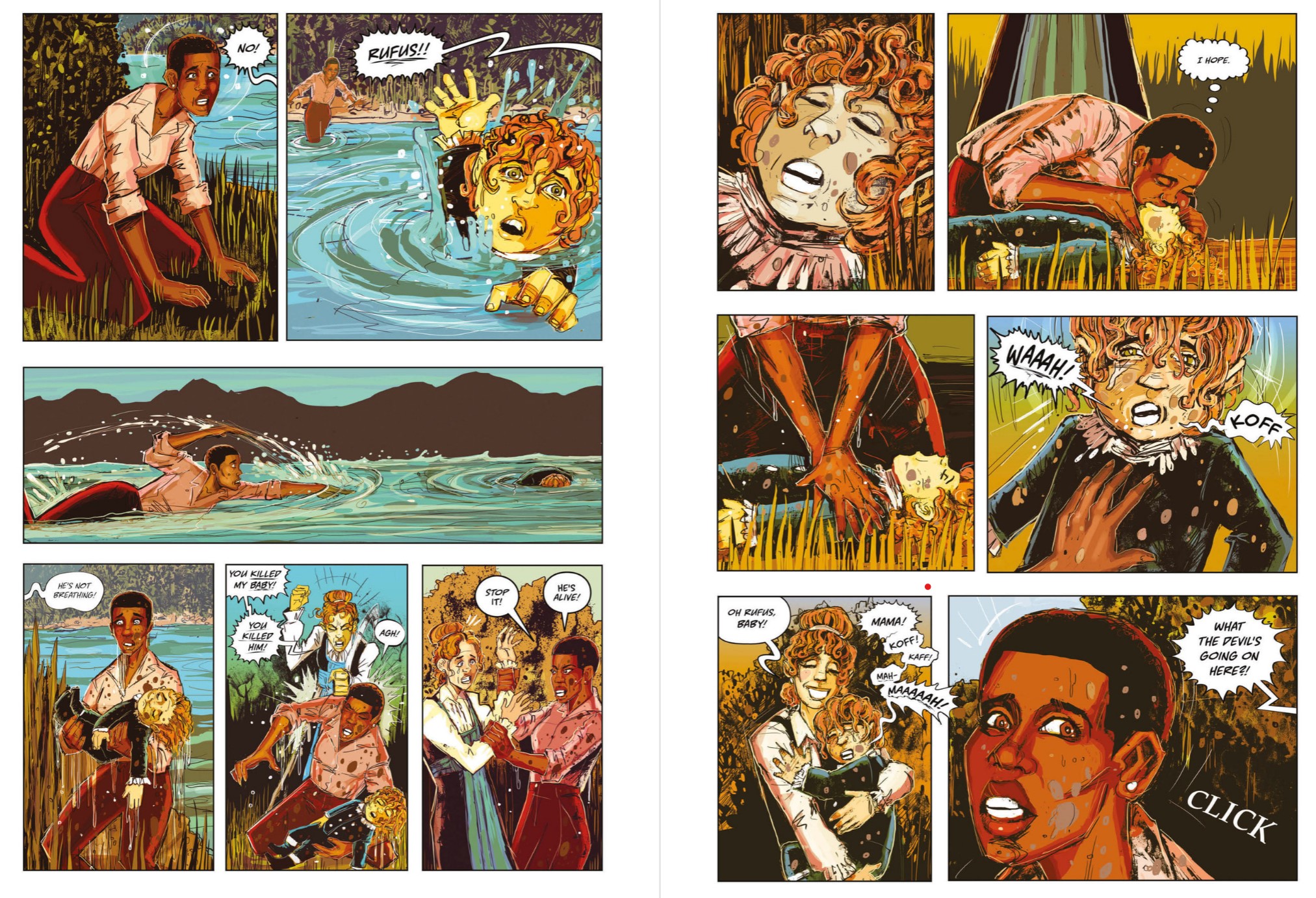
A mystery starts to unravel on June 9th 1976, as she and her (white) husband Kevin Franklin celebrate her 26th birthday by unpacking the boxes that brought all their worldly goods into their new home. They’re both writers and have lots to stuff into this house, but their dreamy domesticity ends abruptly as she’s seized by an uncanny force and vanishes. Dana reappears by ‘The River’ just in time to save a little a white boy named Rufus from drowning…
Dana is then attacked and beaten by his mother and shot at by his father before warping back to Kevin and home. Her soaked, dishevelled condition categorically proves that what she experienced was no delusion but truly an inexplicable event that has shattered her joy and composure. Dana no longer feels safe or secure: here or anywhere…
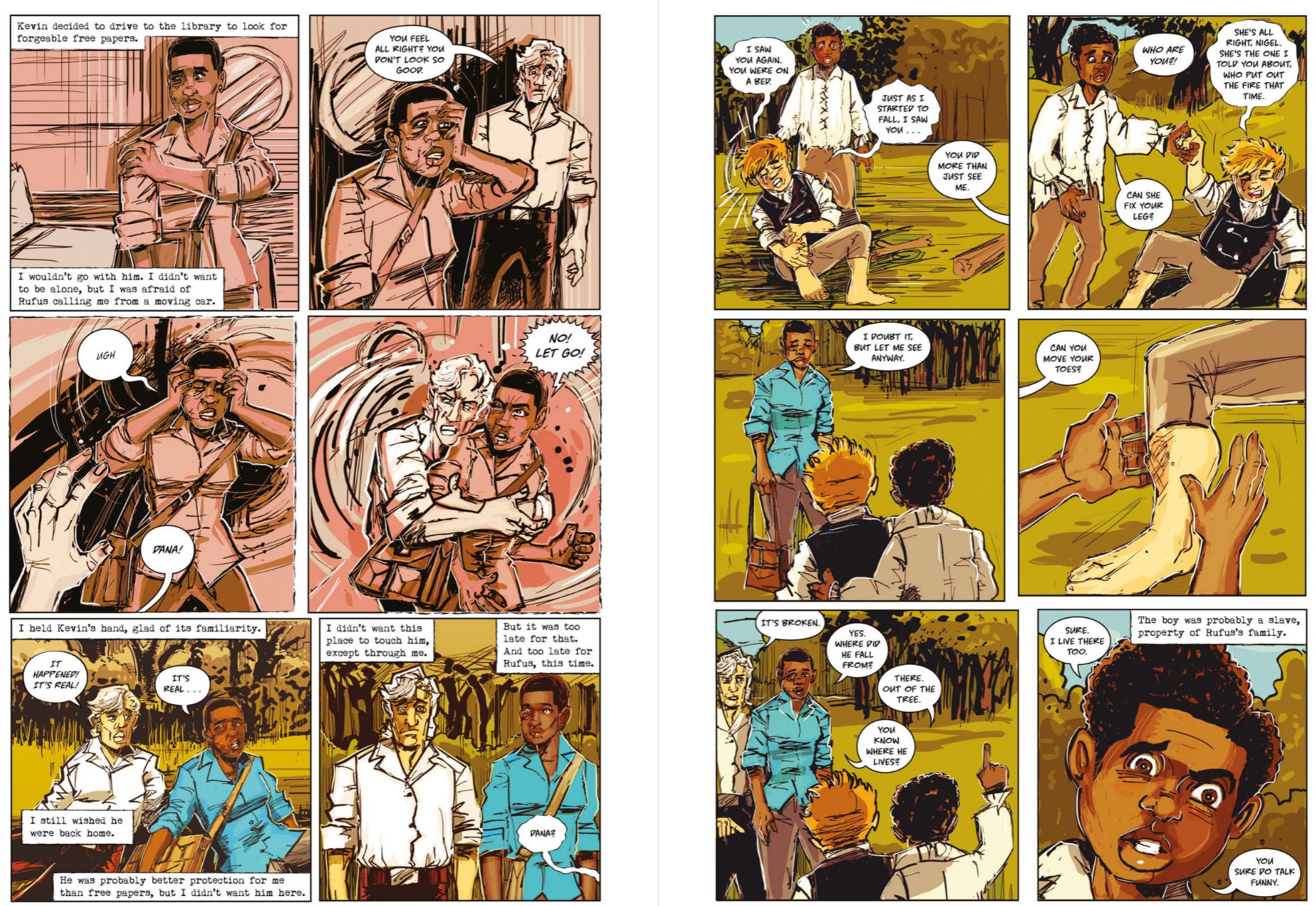
A similar dreadful incident reoccurs mere hours later with Dana manifesting in Rufus’ bedroom just as he’s igniting ‘The Fire’ that would have destroyed the vast plantation house he lives in. The boy is at least four years older this time and deeply troubled, but Dana patiently establishes a working relationship with him, based on a shared fear of his parents. With open mind and terrified conviction, Dana concludes that she is somehow being pulled through history to a place where her kind are objects bought and sold, a fact Rufus confirms when he reveals the year is 1815. Further cautious conversation draw from the boy his surname – Weylin – and the plantation’s location in Maryland. With horror, Dana recalls snippets of her personal family history and realizes this half-crazed, privileged, firebug WHITE brat is her direct ancestor…
Despite her bizarre clothes, hair, manners and spurious claims to be a freed woman, when Dana tries to flee the manorial house she is caught up in a slave-taker’s punishment raid. After torturing actual runaways they then turn on her and a callous beating edges into a sexual assault that only a sudden switch back to 20th century California prevents from becoming her last moment alive. Grievously battered, she refuses to let Kevin call an ambulance. By his reckoning, she’s only been gone for three minutes, but Dana cannot bear the thought of vanishing again from a hospital…
Anticipating another vanishing, husband and wife assemble a “go-bag” of 20th century medicines and tools for her next abduction and Kevin bones up on black history from their reference library. Here and now, knowledge is power…
Fondly recalling how they first got together, Dana is unprepared for the next summoning, but when the force grips her now, Kevin reacts rapidly. Grabbing her, he is transported with her and sees first-hand the living past. Rufus is visibly older and has just broken his leg in ‘The Fall’. Reacting with fury to the news that these adults are married – scandalously illegal miscegenation! – Rufus is taken into their confidence when they conclusively prove they come from the future.
Forced to be Dana’s “owner” whilst a guest in the Weylin household, Kevin spends too much time apart from his wife whilst she is assigned to the plantation staff. After savagely beating her for teaching blacks to write, Dana’s shameful, shocking ability to read is secretly exploited by Rufus’ parents, who remain unaware the strange slave is making many friends and useful connections amongst the lower orders. Tragically, when the future calls her again, Kevin is nowhere to be found and left behind…
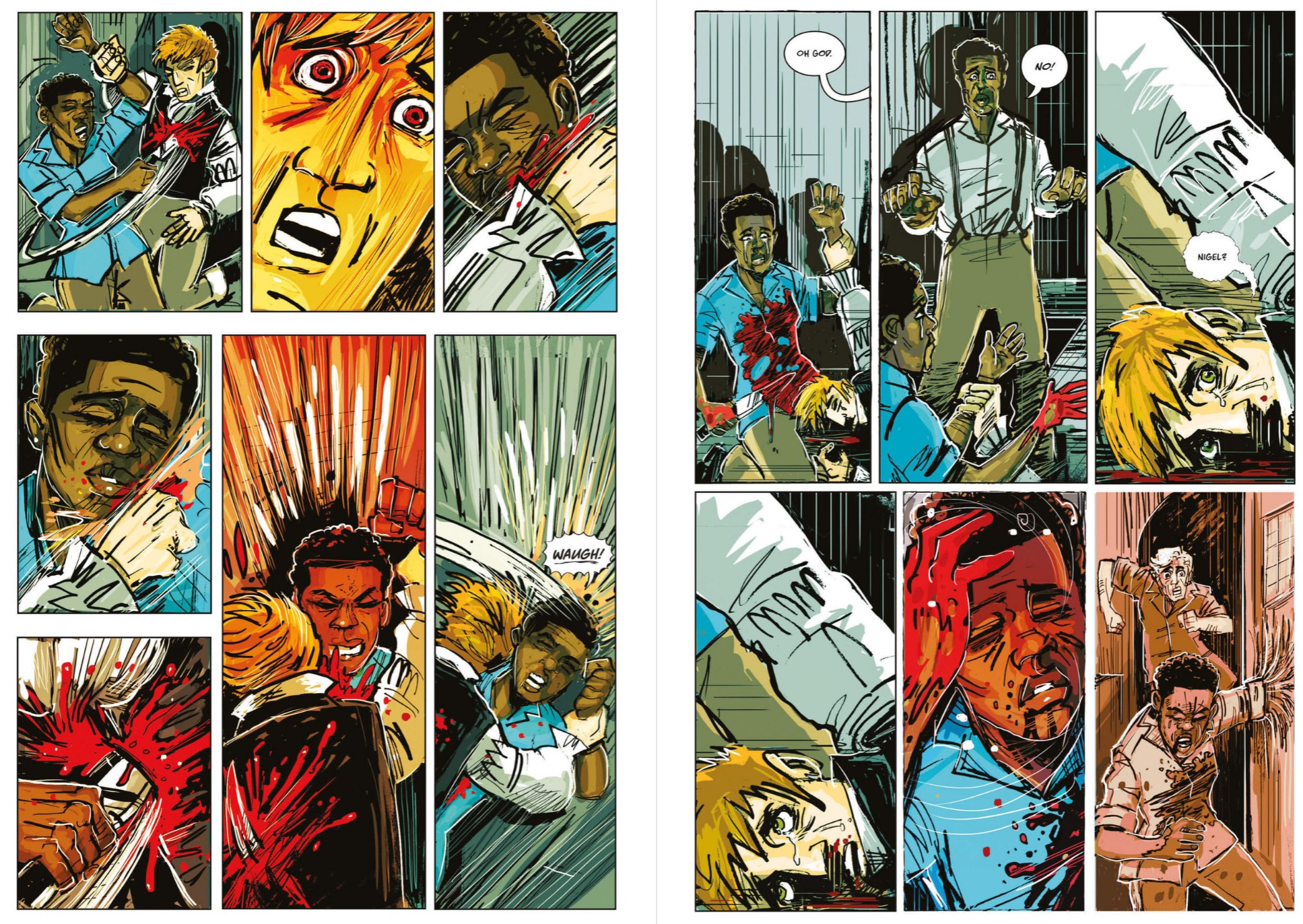
And so the story unfolds, years passing as eyeblink instalments with Dana gradually building a seditious second life among slaves she secretly seeks to radicalise and protect, under the aegis of her family recollections. She searches in vain for her lost husband and contrives a disturbing, discordant, deeply unhealthy relationship with cruelly manipulative (and now adult) ancestor/owner Rufus in ‘The Fight’, before the time-lost lovers are finally reunited in ‘The Storm’.
Eventually, an ending arrives after Dana’s lowest moments in ‘The Rope’…
The scattered threads of family are then drawn together in an ‘Epilogue’ that trusts but cannot prove that the mystery is solved and the travelling done…
A chilling, complex and extremely challenging reappraisal of many kinds of status quo, Kindred is more topical and germane than ever, examining social, racial and gender roles in a culture that has never been less stable or secure. Delivered with the full, uncompromising force of graphic narrative and in the charged, unrestrained terms and language of the 19th century via 1970s liberal outrage, this is a rewarding, informative yet potentially shocking narrative demanding your full attention and a tacit acceptance that history must not be shaded or censored. If raw, unsanitised violence, non-voyeuristic nudity and harsh language are more distressing to you than learning uncomfortable truths, you might be better served by another book today…
Adding value here, this adaptation (which was followed by the team’s treatment of Butler’s Parable of the Sower and Parable of the Talents) includes biographies ‘About Octavia E. Butler’ and ‘About the adaptor and artist’ plus ‘Acknowledgements’ and items recommended ‘For Further Reading’…
Kindred is powerful and upsetting, just like it was always meant to be, and is a story you should know in all its forms. There’s no time like the present.
Kindred © The Estate of Octavia E. Butler. Adaptation © 2017 Damian Duffy and John Jennings. Introduction © 2017 Nnedi Okorafor. Based on the novel Kindred by Octavia E. Butler © 1979. All rights reserved.