
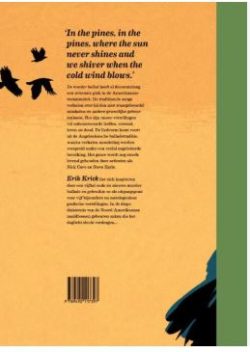
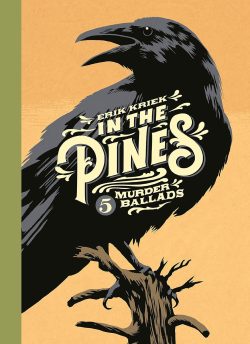
By Erik Kriek (Fantagraphics/Canongate Books)
ISBN: 978-1-78689-214-0 (HB/Digital edition)
This book contains Discriminatory Content included for historical authenticity.
If you don’t know what a murder ballad is you should start this sublime hardcover anthology by reading Jan Donkers’ superb background essay at the back of the book before treating yourself to the grim graphic glories crafted by Dutch artisan/illustrator Erik Kreik.
In ‘Murder Ballads’ you will learn the history of the ancient musical sub-genre as well as the direct genealogy of the quintet of sordid, sorry sagas adapted from sound to stunning words and pictures here. However – and just because it’s you – the term is generally applied to folk music story-songs from many countries all dealing with love, crime, sex, social transgression and unnatural death…
In 2016 Erik Kriek (creator of silent superhero spoof Gutsman; Little Andy Roid; Het Onzienbare/From Beyond) – adapted a number of vintage and modern Murder Ballads into strip format. A huge fan of all forms of popular Americana, he also covered the songs with his band The Blue Grass Boogiemen on a CD naturally entitled In the Pines – 5 Murder Ballads. The book won Germany’s 2016 Rudolf Dirks Award and the spin-off garnered Album of the Year 2017 from Dutch Comics.
Amsterdam-born Kriek is a graduate of the Rietveld Academy for Art and Design and a hotly in-demand illustrator of books (like Holland’s Tolkien & Harry Potter editions), magazines, apparel, skateboards, et al, and will happily turn his hand to a variety of styles & disciplines. Gutsman was reconceived as a soundless mime ballet in 2006 and his collection of Lovecraft adaptations Het onzienbare, en andere verhalen H. P. Lovecraft has been republished in many languages. He followed up this with his first children’s book Mika, the Little Bear That Didn’t Want to Go To Sleep.
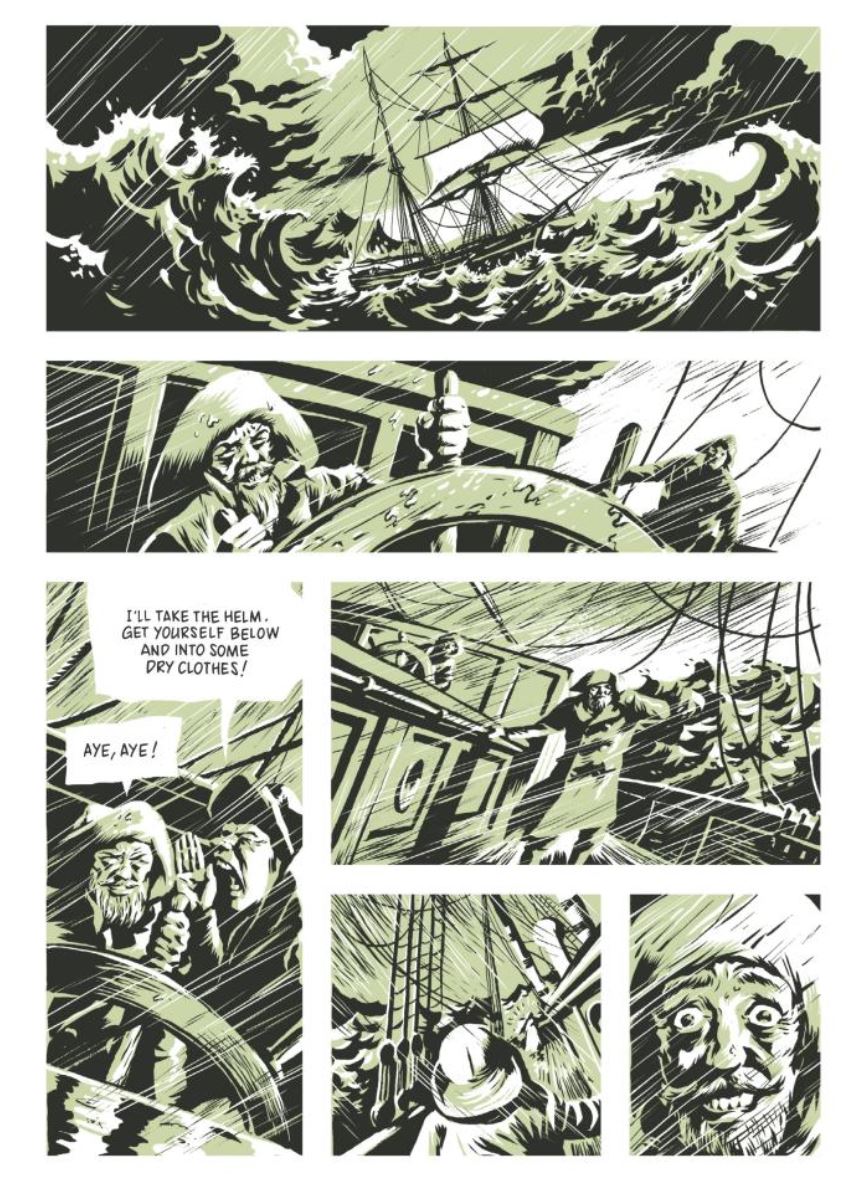
A multi-national phenomenon, In the Pines delivers its moody messages of ill-starred love in dreamy, two-coloured incidents. US fans will recognise the drawing style as echoing the very best EC horror tales by “Ghastly” Graham Ingels or early Bernie Wrightson. The concerto of terror opens with ‘Pretty Polly and the Ship’s Carpenter’, a much-covered traditional ditty (The Byrds; Judy Collins; The Stanley Brothers) rendered here in green & black on crisp white pages. It details the fore-doomed fate of a young man who fled to sea to escape his sins, only to see them resurface in death for his shipmates during a seemingly supernatural storm…
Tinted in sepia, ‘The Long Black Veil’ is a relatively modern song, composed and written by Marijohn Wilkin & Danny Dill in 1959 and most notably recorded by Lefty Frizzell, Johnny Cash, The Band, Mick Jagger, Nick Cave amongst so many others. It reveals how a farmer is faced with a staggering choice: hang for a murder he did not commit or betray the confidence of the adulterous woman who is his only alibi…
Racially-charged and rendered in tones of muddy ochre, ‘Taneytown’ was originally delivered by Steve Earle, a synthesis of so many lynching incidents that shame and blight the history of the (early) 20th century American South. Here a young black man, sick of the life he’s subject to in rural Maryland, takes the knife his negro war hero father used in the trenches of the Great War and heads for trouble in the whitest part of town…
Written by singer Gillian Welch, ‘Caleb Meyer’ is adapted in tones of chilling aquamarine and presents a young wife betrayed, terrorised and assaulted who wins for herself a potent dose of ironic retribution before we close this sinister songbook in tones of watered down blood with ‘Where the Wild Roses Grow’.
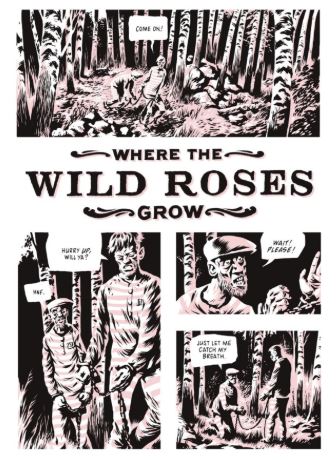
Possible the most well-known of the perilous pentangle, the strip is based on a dark ditty created by Nick Cave and The Bad Seeds for their 1996 album Murder Ballads. Sung as a duet with Kylie Minogue, the song was based on traditional air Down in the Willow Garden. The story seen here presents a complex web of trauma and tension involving a murderous escaped convict, a gang of hidden outlaws, lost treasure, a solitary house in the deep woods and a protective mother most conveniently absent. Tragically, neither the rapidly pursuing posse nor the vile-intentioned villain have any idea what young Elisa is truly capable of, or why her father called her his “wild rose”…
Making something compelling and beautiful from the worst aspects and acts of human behaviour is no mean feat, either in song or pictures, but In the Pines accomplishes the deed with gripping style, vibrant polish and immense charm. This is a book every lover or victim of human foible will adore, potent and evocative with a sly gift to captivate and transport us just as the music intoxicates the mind’s eye through the ears.
One last note: Kriek is reputed to relax in Irish bars – possibly drinking but mostly singing and playing the banjo – so let’s hope that he’s got many more songs yet to draw, once the ambience reaches the appropriate crescendo.
© Erik Kriek, 2016. “Murder Ballads” © Jan Donkers. 2016. All rights reserved.