
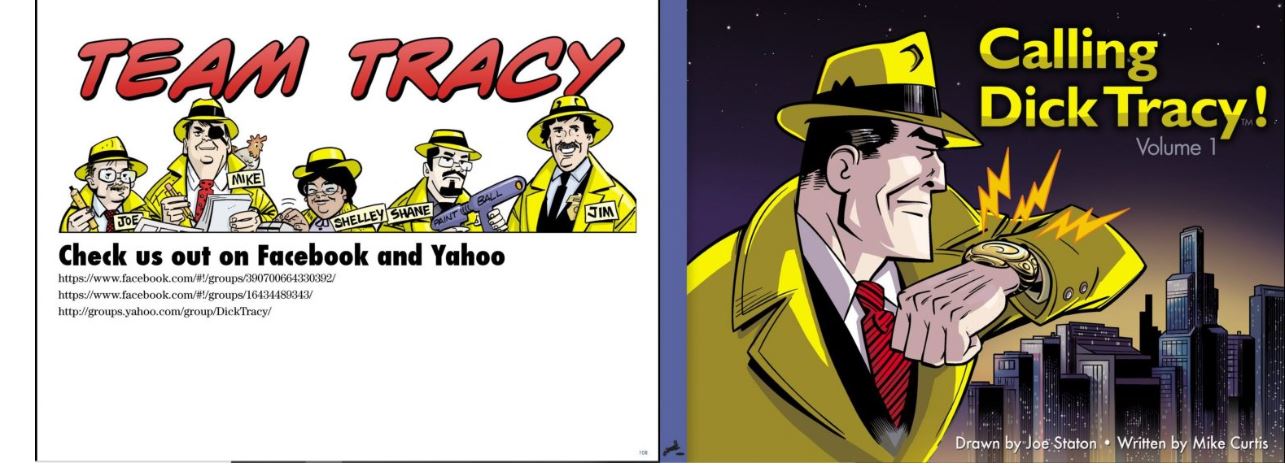
By Mike Curtis, Joe Staton & various (Rabbit Hole)
ISBN: 978-0-930645-11-0 (digital edition)
Time for another anniversary celebration. Dick Tracy is 95 in five months’ time, so here’s a superb collection crying out for revival in either physical or digital forms. Another time to agitate against the publishing powers-that-be, I think…
All in all, comics have a pretty good track record for creating household names. We could play the game of picking the most well-known fictional characters on Earth – usually topped by Sherlock Holmes, Mickey Mouse, Superman Batman & Tarzan – and supplement the list with Popeye, Blondie, Charlie Brown, Tintin, Spider-Man, Garfield, and – not so much now, but once, most definitely – Dick Tracy…
At the height of the Great Depression cartoonist Chester Gould sought fresh strip ideas. The story goes that as a decent guy incensed by the exploits of gangsters like Al Capone (who monopolised front pages of contemporary newspapers) the doughty doodler settled upon the only way a normal man could fight thugs: Passion and Public Opinion.
Raised in Oklahoma, Gould was a Chicago resident who hated seeing his home town in the grip of such wicked men, with far too many honest citizens beguiled by the gangsters’ charisma. He decided to pictorially get it off his chest with a procedural crime thriller that championed the ordinary cops who protected civilisation.
He took his proposal –“Plainclothes Tracy” – to Captain Joseph Patterson, the legendary newspaperman and strips Svengali whose golden touch had already blessed strips like The Gumps, Gasoline Alley, Little Orphan Annie, Winnie Winkle, Smilin’ Jack, Moon Mullins and Terry and the Pirates among others. Casting his experienced eye on the work, Patterson promptly renamed the hero Dick Tracy, whilst also revising his love interest into steady, steadfast girlfriend Tess Truehart. The daily series launched on October 4th 1931 through Patterson’s own Chicago Tribune Syndicate, growing quickly into a phenomenon and monumental hit, with all the attendant media and merchandising hoopla that follows. Bolstered by toys, games, movies, serials, animated features, TV shows et al, the strip soldiered on, influencing generations of creators and entertaining millions of fans. Gould unfailingly wrote and drew the strip for decades until retirement in 1977.
The legendary lawman was a landmark creation who influenced not simply comics but the entirety of American popular fiction. Its signature use of baroque villains, outrageous crimes and fiendish death-traps pollinated the work of numerous strips (most notably Batman), shows and movies since then, whilst the indomitable Tracy’s studied, measured use – and startlingly accurate predictions – of crimefighting technology and techniques gave the world a taste of cop thrillers, police procedurals and forensic mysteries such as CSI decades before the modern fascination took hold.
As with many creators in it for the long haul, the revolutionary 1960s were a harsh time for well-established cartoonists. Along with Milton Caniff’s Steve Canyon, Gould’s grizzled gangbuster especially foundered in a social climate of radical change where popular slogans included “Never trust anybody over 21” and “Smash the Establishment”. The strip’s momentum faltered, perhaps as much from a move towards trendy science fiction (Tracy went off-Earth into space and the character Moon Maid was introduced) as from those improbable, Bond-movie-style villains or perceived “old-fashioned” attitudes. Even the introduction of more minority and women characters – and hippie cop Groovy Groove – couldn’t stop the rot. However, the feature soldiered on regardless…
When Gould retired in 1977, 29-year old author Max Allen Collins (Road to Perdition, Nathan Heller, Mike Mist, Ms. Tree, Batman) won the prestigious role as scripter, promptly taking the series back to its crime-busting roots for a breathtaking run, ably assisted by Gould as consultant with his chief artistic assistant Rick Fletcher promoted to full illustrator. After 11 years, Collins was removed in 1992 and replaced by Mike Kilian – who apparently worked for half the up-&-coming novelist’s price – until his death in October 2005. Dick Locher took over story & art, with assistant Jim Brozman assuming drawing duties from March 2009. On January 19th 2011, Tribune Media Services announced Locher’s retirement and replacement by a new team. That’s where this digital-only book begins…
Atoudingly versatile and unbelievably prolific artist/inker Joe Staton (E-Man, Mike Mauser, The Avengers, Incredible Hulk, Green Lantern, Legion of Super-Heroes) has been an integral part of American comic books since the early 1970s and in later years made kids comics his metier. During a spectacular run on licensed classic Scooby Doo, he and series scripter Mike Curtis (Casper the Friendly Ghost, Richie Rich, Shanda the Panda) discovered a mutual love for Dick Tracy and – mostly for their own amusement – created a tribute strip entitled Major Crime Squad.
How that landed them the duty of continuing the ultimate cop’s official adventures is addressed in introductory text feature ‘Publisher’s Note – aka “The Dick Tracy vs. Major Crime Squad Caper”’ by Steve Tippie (VP of Licensing, TMS News & Features, LLC) before a stunning chronological re-presentation of all-new classics begins. Preceding those comic capers are more text-based insights and revelations: a Foreword by Mike Gold; former sheriff Curtis’ ‘How We Got the Job’ (supplemented by samples done in 2005 when they first tried to take on the strip) and Staton’s ‘Waiting For Dick Tracy’…
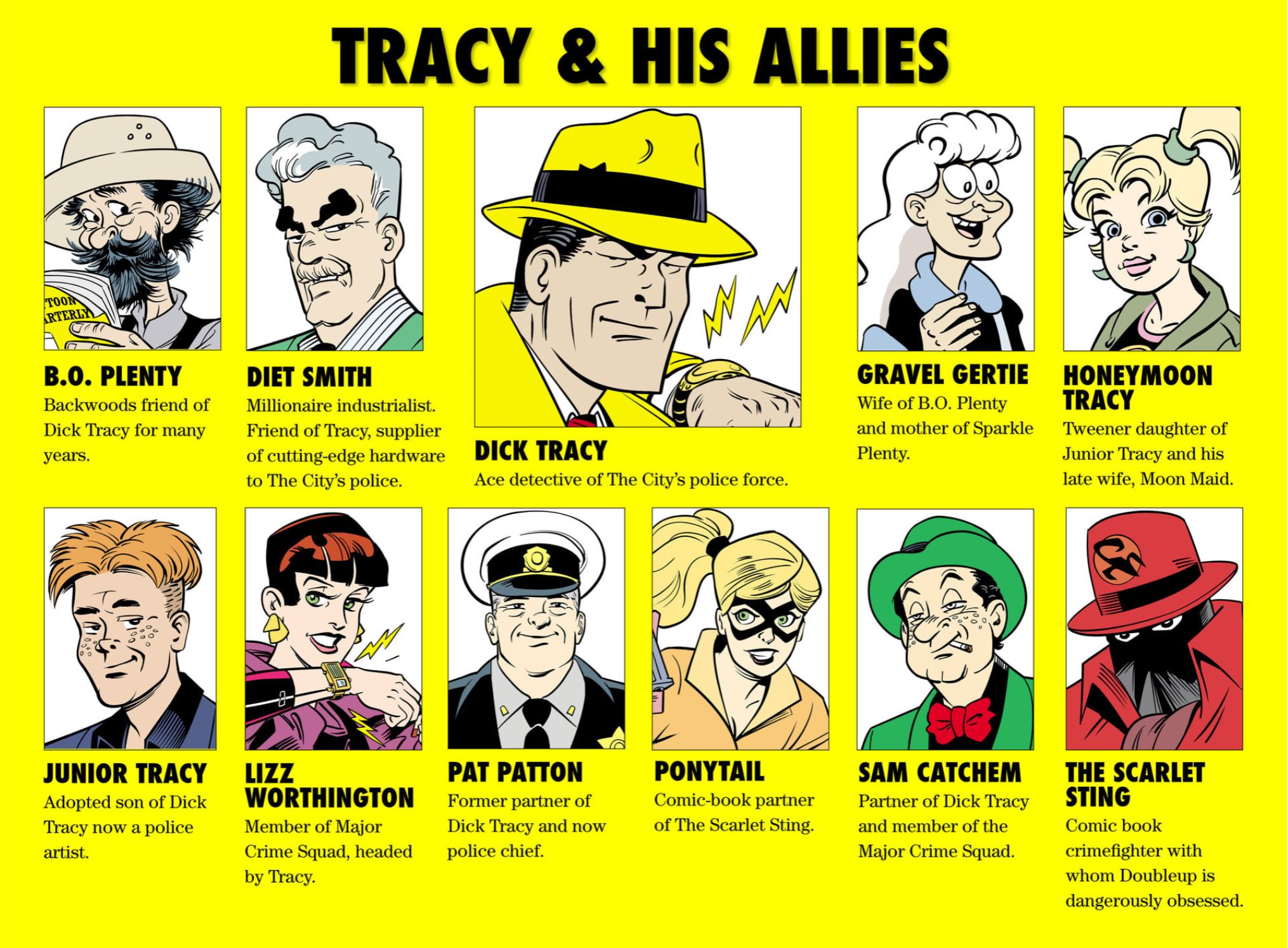
Next up is a brief visual refresher course of ‘Tracy and His Allies’ and the most nefarious of the repeat offenders in a ‘Rogues Gallery’ before the unending war on crime resumes in ‘Flyface and The Fifth Return’.
The strip has sadly long passed its heady glory days of mass sales, but that’s more about the death of print periodicals than this material. It still appears in a number of papers and as a potent online presences which means every episode is in full colour, with half-page Sunday strips still offering extras such as the ‘Crimestoppers Textbook’. One welcome addition is full credits so we can thank Shelley Pleger and Shane Fisher for their inks, colours and lettering. When Staton retired in October 2021, Pleger drew the feature, which these days is limned by Charles Ettinger…
The plot here sees the long separated traditional squad fully reunited to combat right wing terrorism and gradually reintroduced to the fanciful gadgets and controversial space tech after Tracy’s inventor pal Diet Smith gets in touch. A disgruntled former employee has stolen plans for his energy-beam weapon “Thor’s Hammer”…
After selling it to old lags Flyface and The Fifth – who kidnap officer Lizz Worthington to set a trap for their old nemesis – events spiral out of control, but only the wicked pay the final price this time…
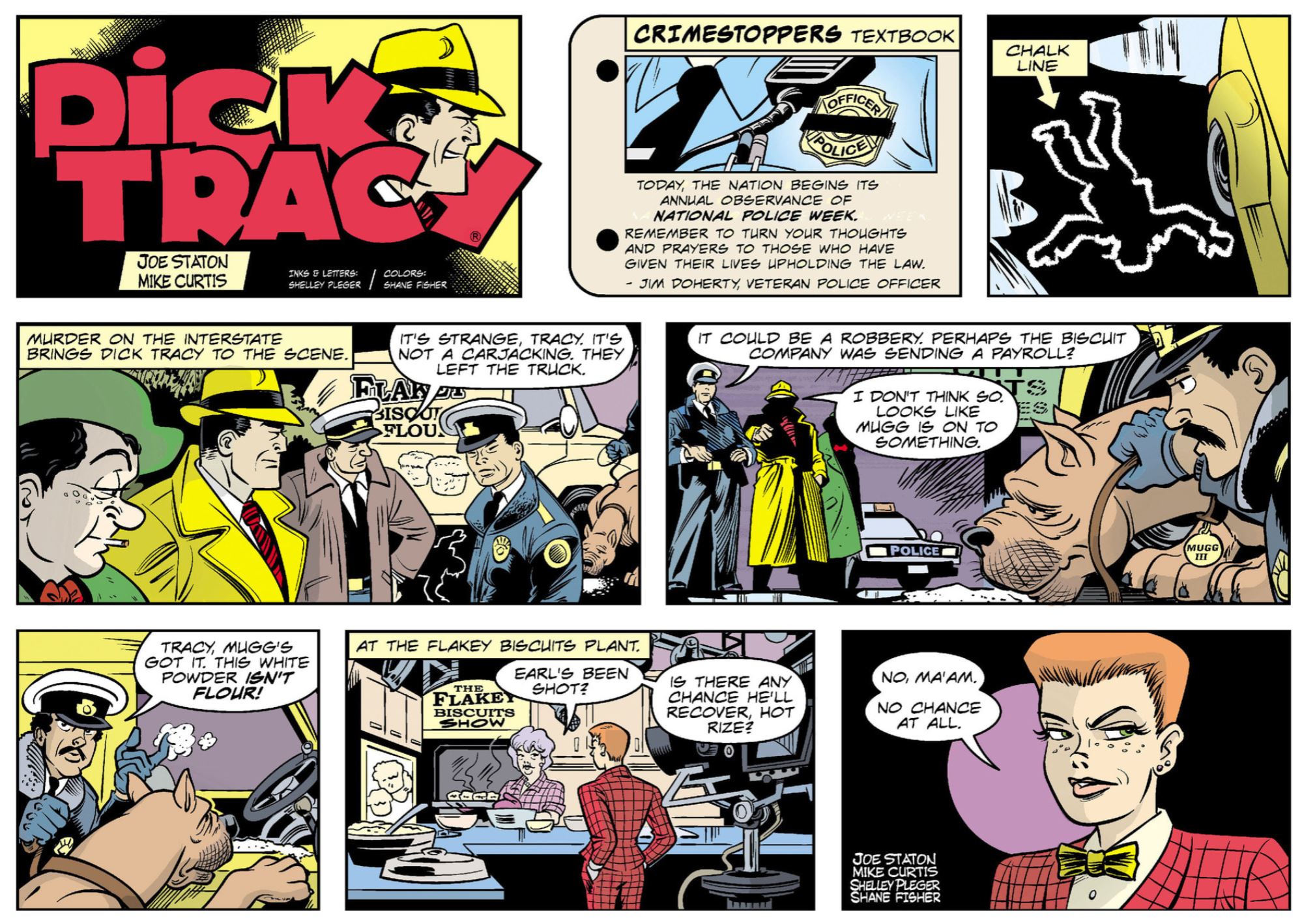
Longtime comedic characters B.O. Plenty and his wife Gravel Gertie then resurface, celebrating the birth of their second child – the ugliest boy on Earth! – before falling foul of a manipulative foodie TV celebrity who sees a chance to own the airwaves with the stomach-churning infant in ‘Flakey Biscuits Makes the Dough’. Sadly, her bribing gifts to the couple include a shipment of cocaine being secretly couriered by her assistant Hot Rize, and soon bodies start dropping as the city’s top drug lord seeks to recover his missing product. Once Tracy realises what’s what, it’s all over bar the shooting…
‘Doubleup and the Scarlet Sting’ features the making of a movie starring a fictional superhero and depicts how childhood fan and modern-day gangster Doubleup barges in: infiltrating the cast to shakedown the production. Soon he’s too involved and after murdering his girlfriend all that’s left is being caught facing real-world justice…
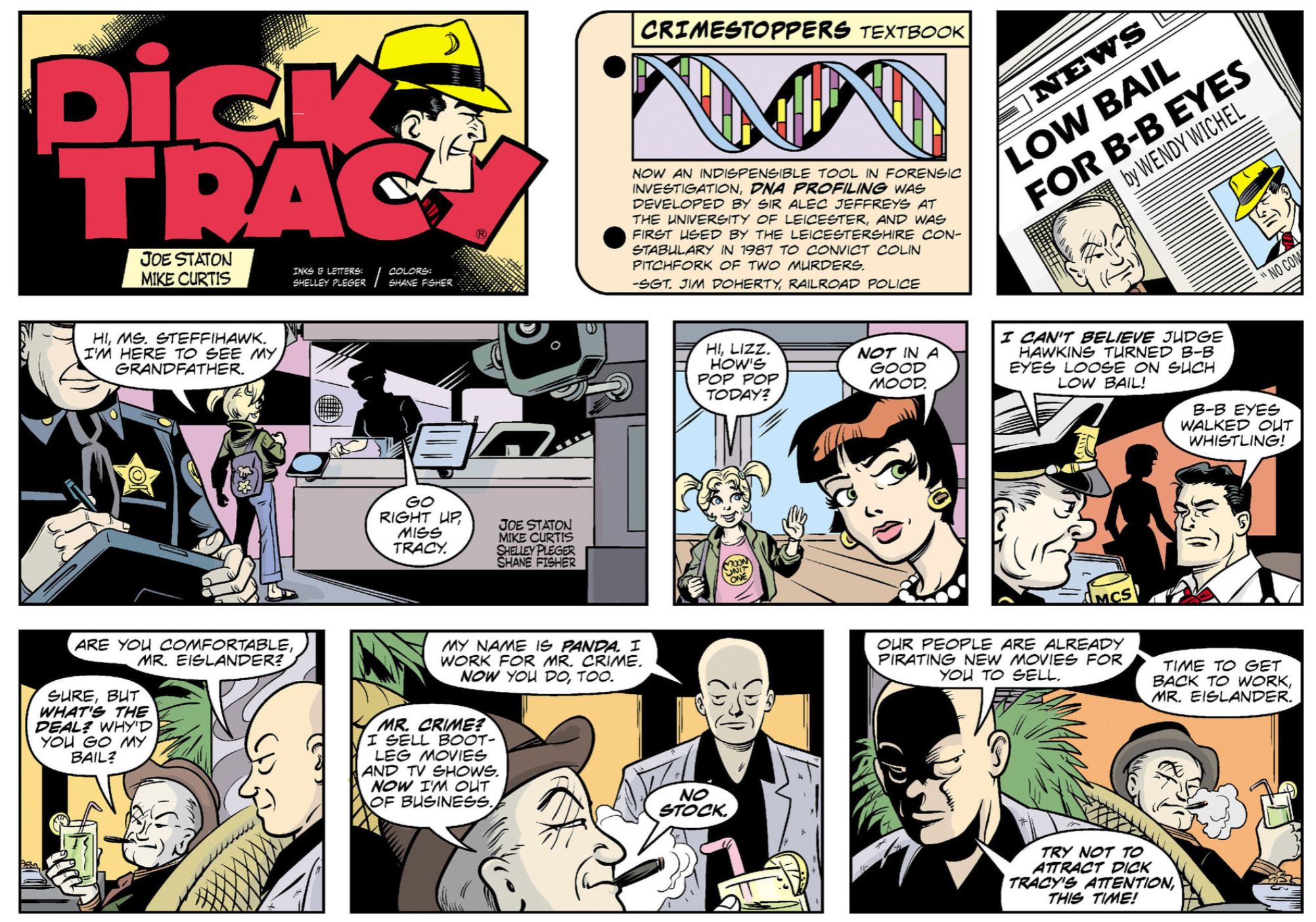
At this time alternate Sunday extra ‘Tracy’s Hall of Fame’ (celebrating police officers) began, days before an officially deceased and clearly incorrigible arch enemy reappeared in ‘B-B Eyes and Honeymoon’. When Tracy’s adopted son Junior goes undercover to investigate a video piracy ring, the case quickly drags in the old cop’s granddaughter too, after Honeymoon Tracy tries to help out and almost dies because of her enthusiasm and lack of training.
Even with the comics component concluded, there’s more informational extras to enjoy as Curtis offers ‘Dick Tracy vs. the Villains: A Comparison’ and we meet the current creators in ‘Joe Staton’s Bio’, ‘Mike Curtis’ Bio’ and ‘Team Tracy Bios’ to close this initial casebook – hopefully the first of many.
Dick Tracy has always been a fantastically readable feature and this potent return to first principles is a terrific way to ease yourself into his stark, no-nonsense, Tough Love, Hard Justice world. Comics just don’t get better than this.
© 2013 TMS News & Features, LLC. All rights reserved.
On this day in 2003, Jerry Bittle’s redneck-ribbing strip Geech appeared for the final time, but the date is shared by a host of birthday boys and girls including French illustrator Paul Léonnec in 1842; publisher Clay Geerdes in 1934; Argentinian Lucho Olivera (Nippur de Lagash, Gilgamesh the immortal) in 1942 and undying legend Barry Windsor-Smith in 1949. Stan (Usagi Jojimbo) Sakai arrived in 1953; both Mark (Breathtaker, Tug & Buster, Sandman) Hempel and Publisher Terry Nantier in 1957 and mangaka Tomoko Ninomiya (Nodame Cantabile) in 1969.