
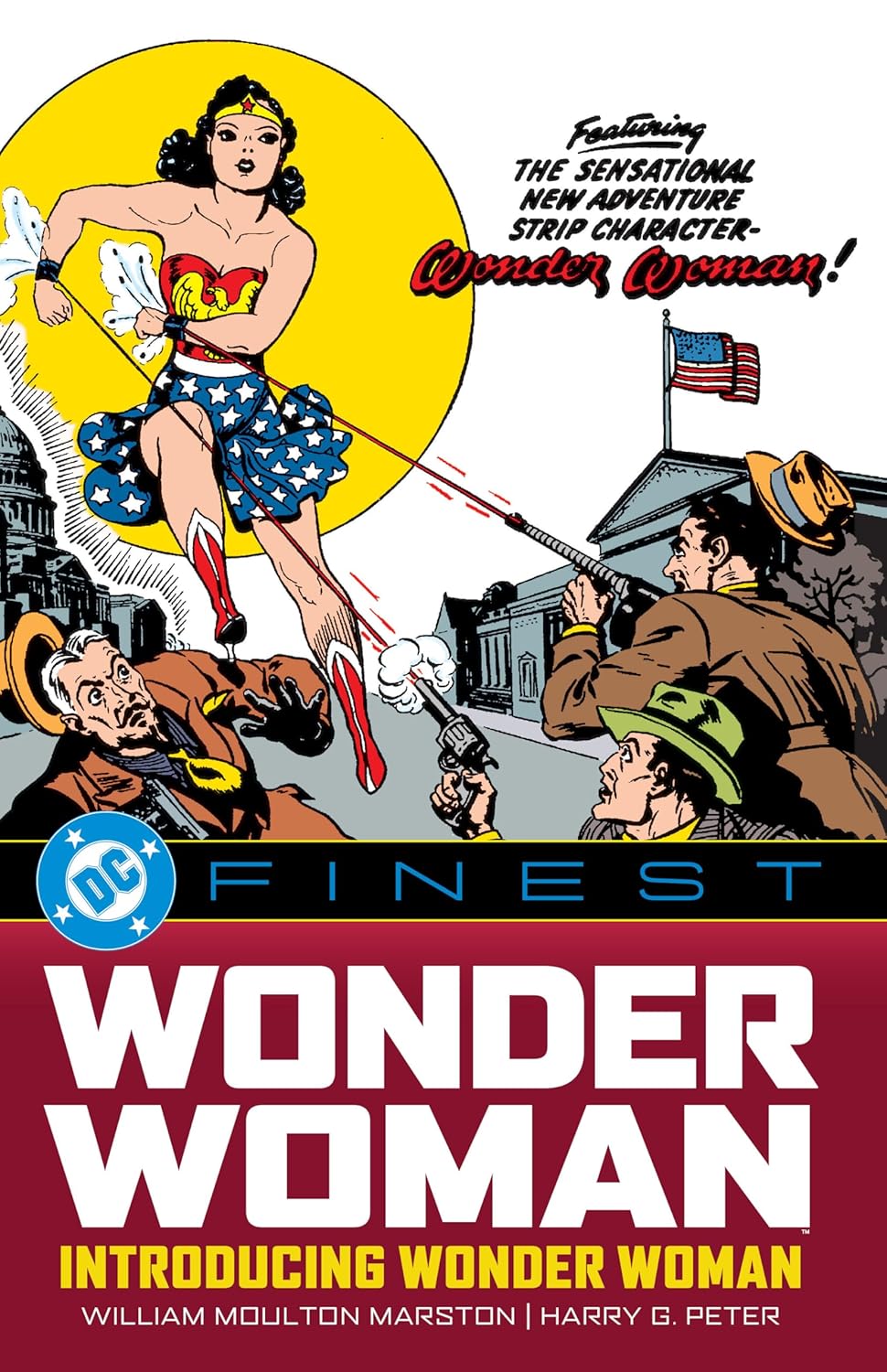
By William Moulton Marston, Harry G. Peter, Alice Marble, Sheldon Moldoff, Frank Godwin, Frank Harry & various (DC Comics)
ISBN: 978-1-7995-033-6-1 (TPB/Digital edition)
This book includes Discriminatory Content produced in less enlightened times.
Wonder Woman debuted as a special feature in All Star Comics #8, cover-dated December 1941, but actually on sale from October 21st of that year). The book was home to top-sellers the Justice Society of America and where she would immediately be invited to join the team, albeit only as “club secretary”…
Officially, she was conceived by psychologist/polygraph pioneer William Moulton Marston and realised and unilaterally illustrated by Harry G. Peter, in a calculated attempt to offer girls a positive and forceful role model and, on forward-thinking Editor M.C. Gaines’ part, to sell more funnybooks to girls. Later research has since disclosed much of her genesis was due to Moulton’s wife – attorney turned psychologist Sarah Elizabeth Marston (née Holloway) who had worked with him to create the systolic lie detector process – with further input from their live-in partner Olive Byrne.
Despite all the complexities and confusion surrounding her genesis, Wonder Woman was an instant hit and catapulted from the try-out into her own series as the cover-featured character of new anthology Sensation Comics one month later. The unstoppable Amazon then won her own eponymous supplemental title some months after that, cover-dated summer 1942, as well as a lead position in bumper anthology book Comics Cavalcade (December 1943).
Using nom de plume Charles Moulton, Marston – and his domestic writing partners – scripted all her many and miraculous adventures until his death in 1947, whereupon Robert Kanigher officially took over the writer’s role. Venerable co-creator H.G. Peter illustrated almost every WW tale until his own death in 1958.
Spanning cover-dates December 1941 to June 1943, this compelling full-colour compilation collects her debut from All Star Comics #8, and every iconic adventure plus pertinent extras from Sensation Comics #1-18; Comics Cavalcade #1-2 and Wonder Woman #1-4. Of course, we begin with ASC #8 and ‘Introducing Wonder Woman’…
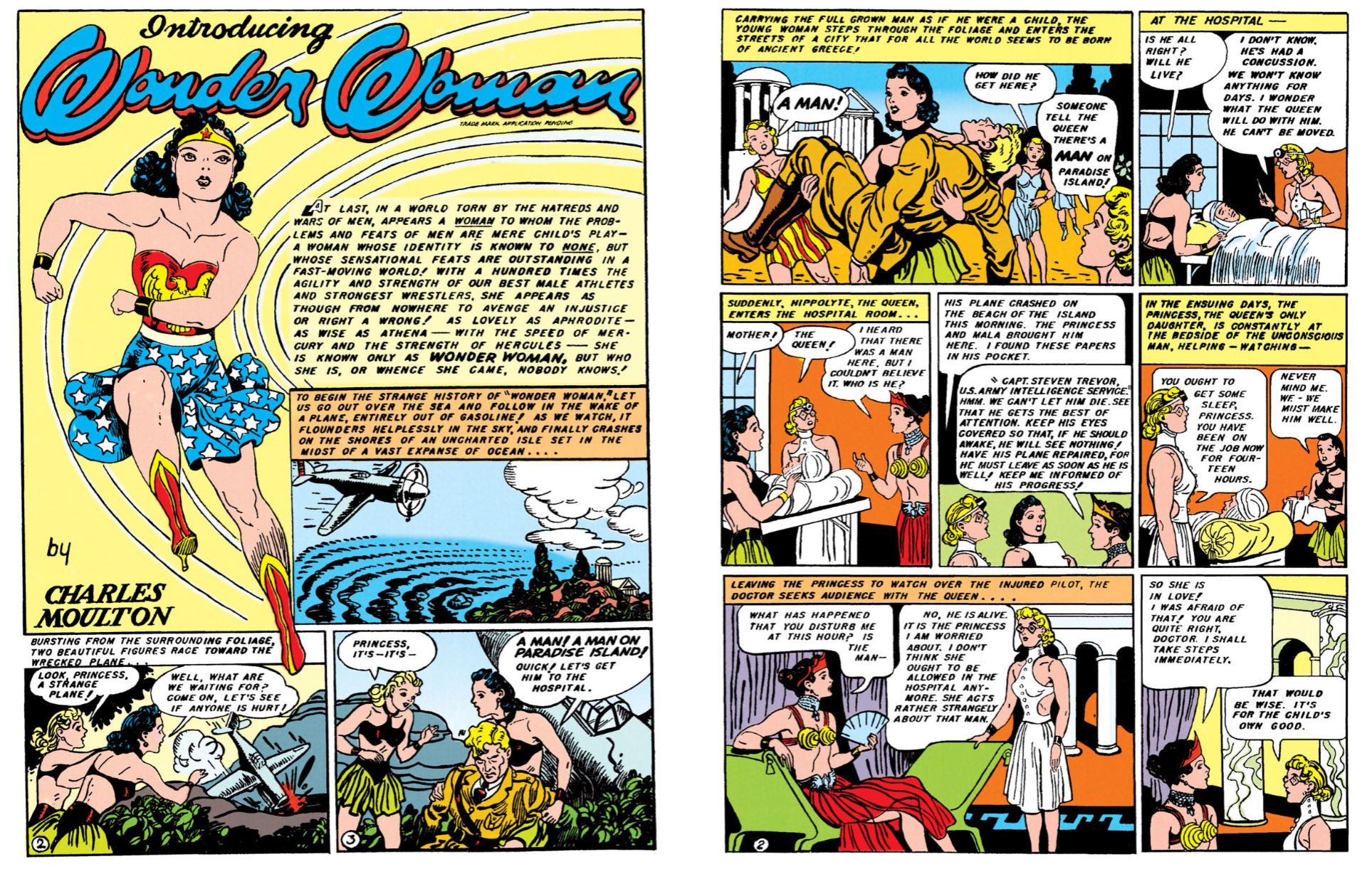
On a hidden island of immortal super-women, an aviator crashes to Earth. Near death, US Army Intelligence officer Captain Steve Trevor is nursed back to health by young Princess Diana. Fearing her daughter’s growing obsession with the man, fiercely maternal Queen Hippolyte reveals the hidden history of the Amazons to the child. Diana learns how her people – all women – were seduced and betrayed by men in ancient times but rescued by the goddess Aphrodite on condition that they thenceforward isolate themselves from the rest of the world and devoted their eternal lives to becoming ideal, perfect creatures.
Now however, after Trevor explains the perfidious spy plot which accidentally brought him to the Island enclave, divine Athena and Aphrodite appear, ordering Hippolyte to assign an Amazon warrior to return with the American and fight for global freedom and liberty. The Queen diplomatically and democratically declares an open contest to determine the best candidate and – despite being forbidden to participate – Diana enters and wins. Accepting the will of the gods, the worried mother outfits her in the guise of Wonder Woman and sends her out to Man’s World…
A month later the saga continued where the introduction left off. Sensation Comics #1 declared ‘Wonder Woman Comes to America’, seeing the eager immigrant repatriating the recuperating Trevor to the modern World. She also trounces a gang of bank robbers and falls in with a show business swindler. One major innovation here is the newcomer perpetrating identity theft by buying her secret identity. Lovelorn Army nurse Diana Prince elegantly allows the Amazon to be close to Steve by becoming her, enabling the heartsick medic to join her own fiancé in faraway South America. Even with all that going on, there’s still room for Wonder Woman & Trevor to stop a spy ring attempting to use poison gas in a Draft induction centre, before Steve breaks his leg and ends up in hospital again, where “Nurse Prince” is assigned to tend him…
Sensation #2 debuted a deadly enemy agent and recurring villain in ‘The Menace of Dr. Poison’ – a cannily crafted tale which also introduced the most radical comedy sidekicks of the era. The plucky “fun-loving gals” (sweets, dancing and spanking mostly) of the Holliday College for Women and their chocolate-gorging Beeta Lamda sorority-chief Etta Candy would find trouble and save the day in equal proportions for years to come: constantly demonstrating Diana’s – and Marston’s – philosophical contention that girls, with correct encouragement, could accomplish anything that men could…
With War raging and in a military setting, espionage and sabotage were inescapable plot devices. ‘A Spy in the Office’ sees Diana arranging a transfer to the office of General Darnel as his secretary so she can keep a closer eye on finally fit Steve. She isn’t there five minutes before uncovering a ring of undercover infiltrators amongst the typing pool and saving her man from assassination. Unlike most comic stars of the period, Wonder Woman tales sought tight continuity. ‘School for Spies’ in #4 shows some of those fallen girls murdered by way of introducing inventive genius/Nazi master manipulator Baroness Paula von Gunther. She employs psychological ploys to enslave impressionable women to her will and sets otherwise decent Americans against their homeland. Even Diana succumbs to her machinations – until Steve and the Holliday Girls crash in…
America’s newest submarine is saved from destruction and cunning terrorists brought to book in ‘Wonder Woman versus the Saboteurs’ before SC #6 has Diana accepting a ‘Summons to Paradise’ to battle her immortal sisters in Kanga-riding duels before receiving her greatest weapon: an unbreakable Lasso of Truth which compels and controls anyone who falls within its golden coils. It proves quite handy when Paula escapes prison and uses an invisibility formula to wreak havoc on US coastal defences…
‘The Milk Swindle’ is pure 1940s social advocacy drama, with homegrown racketeers and Nazi von Gunther joining forces to seize control of America’s milk supply with the incredibly long-sighted intention of weakening the bones of the country’s next generation of soldiers. Closely following in Sensation #8 is ‘Department Store Perfidy’ wherein the Perfect Princess goes undercover in the monolithic Bullfinch emporium to win better working conditions and fair pay for the girls employed there. There was a plethora of surprises in #9 too, with ‘The Return of Diana Prince’ from South America. Now Mrs Diana White, the young mother needs her job and identity back until her inventor husband can sell his latest invention to the US army. Luckily, Wonder Woman and an obliging gang of saboteurs can expedite matters…
The next major landmark was the launch of the Amazon’s solo title. The first quarterly Wonder Woman opens here with twinned text features ‘Introducing Miss Alice Marble as Associate Editor of Wonder Woman’ before wordy primer ‘Wonder Woman: Who is She?’ focuses on the Amazon’s pantheon of godly patrons after which comic action commences with a greatly expanded revision of her first appearance in ‘The Origin of Wonder Woman’. This precedes a beguiling mystery tale as in ‘Wonder Woman Goes to the Circus!’ Diana solves the bizarre serial murders of the show’s elephants before Paula von Gunther rears her shapely head again in ‘Wonder Woman versus the Spy Ring’ wherein the loss of the Golden Lasso almost causes Diana’s demise and ultimate defeat of the US Army…
In ‘The Greatest Feat of Daring in Human History!’ Diana and Etta head for Texas, only to become embroiled in a sinister scheme involving Latin Lotharios, lady bullfighters, lethal spies and a Nazi attempt to conquer Mexico, after which the inaugural issue ends with new feature Wonder Women of History wherein a biography of ‘Florence Nightingale, Angel of the Crimea’ is supplied by Miss Marble & Sheldon Moldoff.
Over in Sensation Comics #10 (October 1942) ‘The Railroad Plot’ celebrates Steve & Wonder Woman’s first anniversary by exposing a sinister plan devised by Japanese and German agents to blow up New York City using the labyrinth of subway tunnels under the metropolis, after which ‘Mission to Planet Eros’ launches the Princess’ long line of cosmic fantasy exploits. The Queen of Venus requests Diana’s aid in saving an entire planetary civilisation from gender inequality and total breakdown, before ‘America’s Guardian Angel’ (Sensation #12) sees the Warrior Princess accepting an offer to play herself in a patriotic Hollywood movie, only to find production infiltrated by insidious Paula and her latest gang of slave-girls…
Preceded by prose/photo introduction ‘Boys and Girls! Here are the Men Behind Wonder Woman!’ and an illustrated prose piece about ‘The Spirit of War’, Wonder Woman #2 comprises a 4-chapter epic introducing the Amazon’s greatest enemy in ‘Mars, the God of War’. He apparently instigated World War from his HQ on the distant red planet but chafes at the lack of progress since Wonder Woman entered the fray on the side of the peace-loving allies. He now opts for direct action, no longer trusting his earthly pawns Hitler, Mussolini and Hirohito…
When Steve goes missing, Diana allows herself to be captured and ferried to Mars. Here she starts disrupting the efficient working of the war-god’s regime and fomenting unrest amongst the slave population, before rescuing Steve and heading home to Earth. ‘The Earl of Greed’, one of Mars’ trio of trusted subordinates, takes centre stage for the second chapter, with orders to recapture Steve and Diana at all costs. As the duo attempt to infiltrate Berlin, Greed uses his influence on Hitler to surreptitiously redirect the German war effort, using Gestapo forces to steal all the USA’s gold reserves. With Steve gravely injured, the Amazon returns to America and whilst her paramour heals, uncovers and foils the Ethereal Earl’s machinations to prevent much-needed operating funds from reaching Holliday College, where young girls learn to be independent free-thinkers. With Greed thwarted, Mars dispatches ‘The Duke of Deception’ to Earth, where the spindly phantom impersonates Wonder Woman and frames her for murder. Easily escaping from prison, the Princess of Power not only clears her name but also finds time to foil a Deception-inspired invasion of Hawaii, leaving only ‘The Count of Conquest’ free to carry out Mars’ orders.
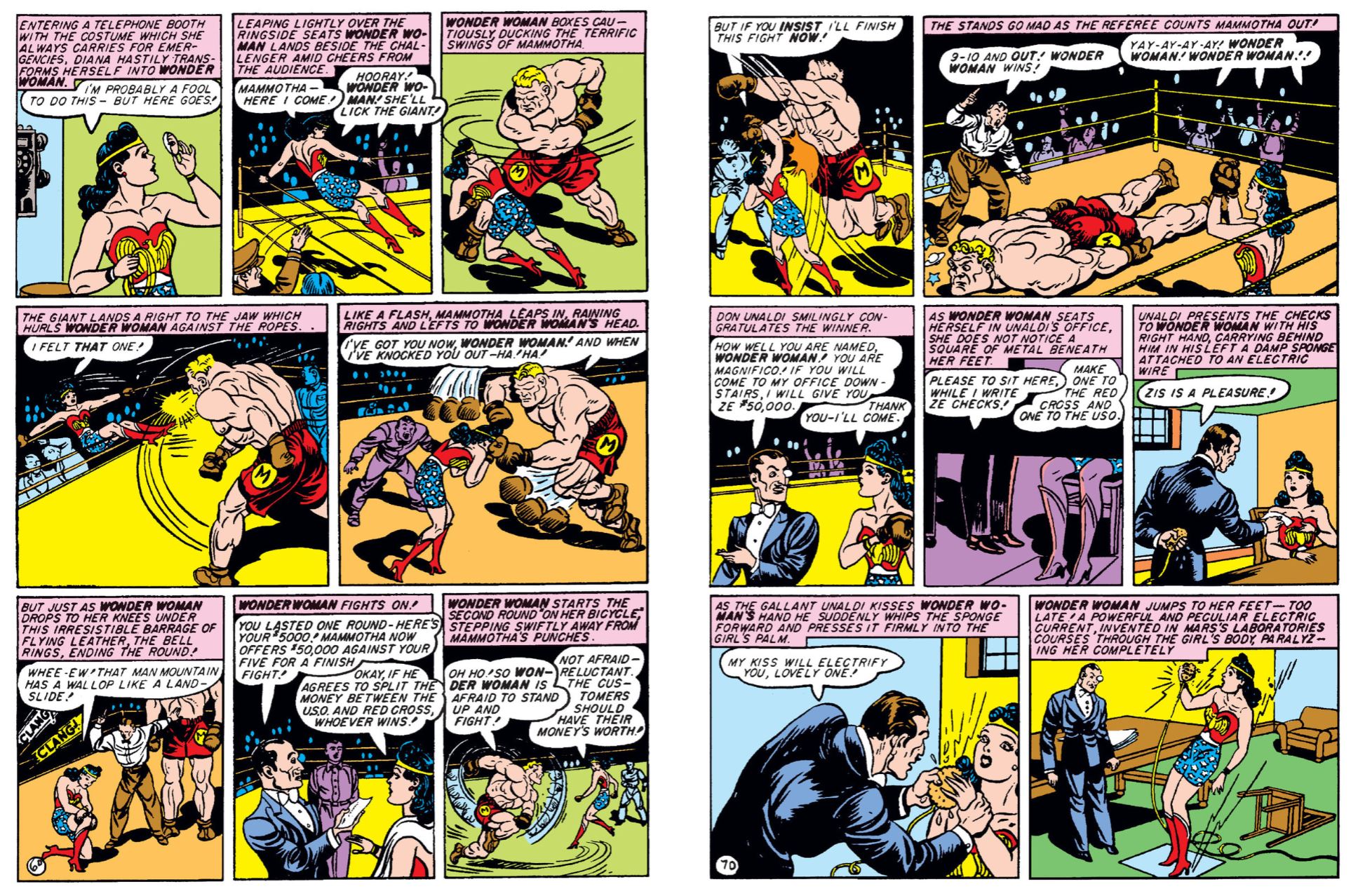
His scheme is simple: through personal puppet Mussolini, the Count tries to brutalise and physically overpower the Amazing Amazon with a savagely bestial giant boxing champion, even as Italian Lothario Count Crafti attempts to woo, seduce and suborn her. The latter’s wiles actually work, too, but capturing and keeping her are two different things entirely, and after breaking free on the Red Planet, Diana delivers a devastating blow to Mars’ war effort…
This issue ends with a sparkling double page patriotic plea when ‘Wonder Woman Campaigns for War Bonds’ after which Marble & Moldoff detail another historical all-star in ‘Clara Barton, Angel of the Battlefield’.
Cover-dated January 1943, Sensation Comics #13 claims ‘Wonder Woman is Dead’ as a corpse wearing her uniform is discovered, and astounded Diana Prince discovers her alter ego’s clothes and the irreplaceable magic lasso are missing. The trail leads to a diabolical spy-ring working out of Darnell’s office and explosive confrontation in a bowling alley, before ‘The Story of Fir Balsam’ in #14 delivers a seasonal saga concerning lost children, an abused mother and escaped German aviators. All is happily resolved around a lonely pine tree, after which the Immortal Warrior celebrated her next publishing milestone…
The 1938 debut of Superman propelled National Comics to the forefront of their fledgling industry and a year later the company was licensed to produce a commemorative comicbook celebrating the opening of the New York World’s Fair. The Man of Tomorrow prominently featured on the appropriately titled New York World’s Fair Comics among such four-colour stars as Zatara, Butch the Pup, Gingersnap and The Sandman. In 1940, another abundant premium emerged with Batman and Robin augmenting the roster, and the publishers felt they had an item and format worth pursuing commercially.
The spectacular card-cover 96-page anthologies had been a huge hit and convinced editors that an over-sized anthology of their pantheon of characters, with Superman & Batman prominently featured, was a worthwhile proposition. Thus, format was retained for a wholly company-owned, quarterly high-end package, retailing for the then-hefty price of 15¢. Launched as World’s Best Comics #1 in Spring 1941, the book morphed into World’s Finest Comics from #2, beginning a stellar 45-year run which only ended as part of the massive decluttering exercise that was Crisis on Infinite Earths. During the Golden Age, however, it remained a big blockbuster bonanza of strips to entice and delight readers…
At this time National/DC was in an editorially-independent business relationship with Max Gaines that involved shared and cross promotion and distribution for the comicbooks released by his own outfit All-American Publications. Although technically competitors if not quite rivals, the deal included shared logos and advertising and even combining both companies’ top characters in the groundbreaking All Star Comics as the Justice Society of America.
However, by 1942 relations between the companies were increasingly strained – and would culminate in 1946 with DC buying out Gaines, who used the money to start EC Comics.
All-American thus decided to create its own analogue to World’s Finest, featuring only AA characters. The outsized result was Comics Cavalcade. Cover-dated December 1942-January 1943 – and following Frank Harry’s gloriously star-studded cover to Comic Cavalcade #1 – Wonder Woman’s fourth regular star slot began with the superstar solving the ‘Mystery of the House of the Seven Gables’ (as ever the fruits of “Marston” & Peter’s fevered imaginations) wherein Diana Prince stumbles upon a band of Nazi spies. All too soon, the Amazon needs the help of some plucky youngsters to quash the submarine-sabotaging brutes…
Wonder Woman #3 then dedicates its entirety to the return of an old foe; commencing with ‘A Spy on Paradise Island’ as undergrads of Holliday College for Women – including Etta Candy – are initiated into some pretty wild Amazon rites on Paradise Island. Sadly, the revels inadvertently allow an infiltrator to gain access and pave the way for an invasion by Japanese troops. Naturally Diana and the Amazons prevail on the day, but the exposed sinister mind behind it all strikes back in ‘The Devilish Devices of Baroness Paula von Gunther’.
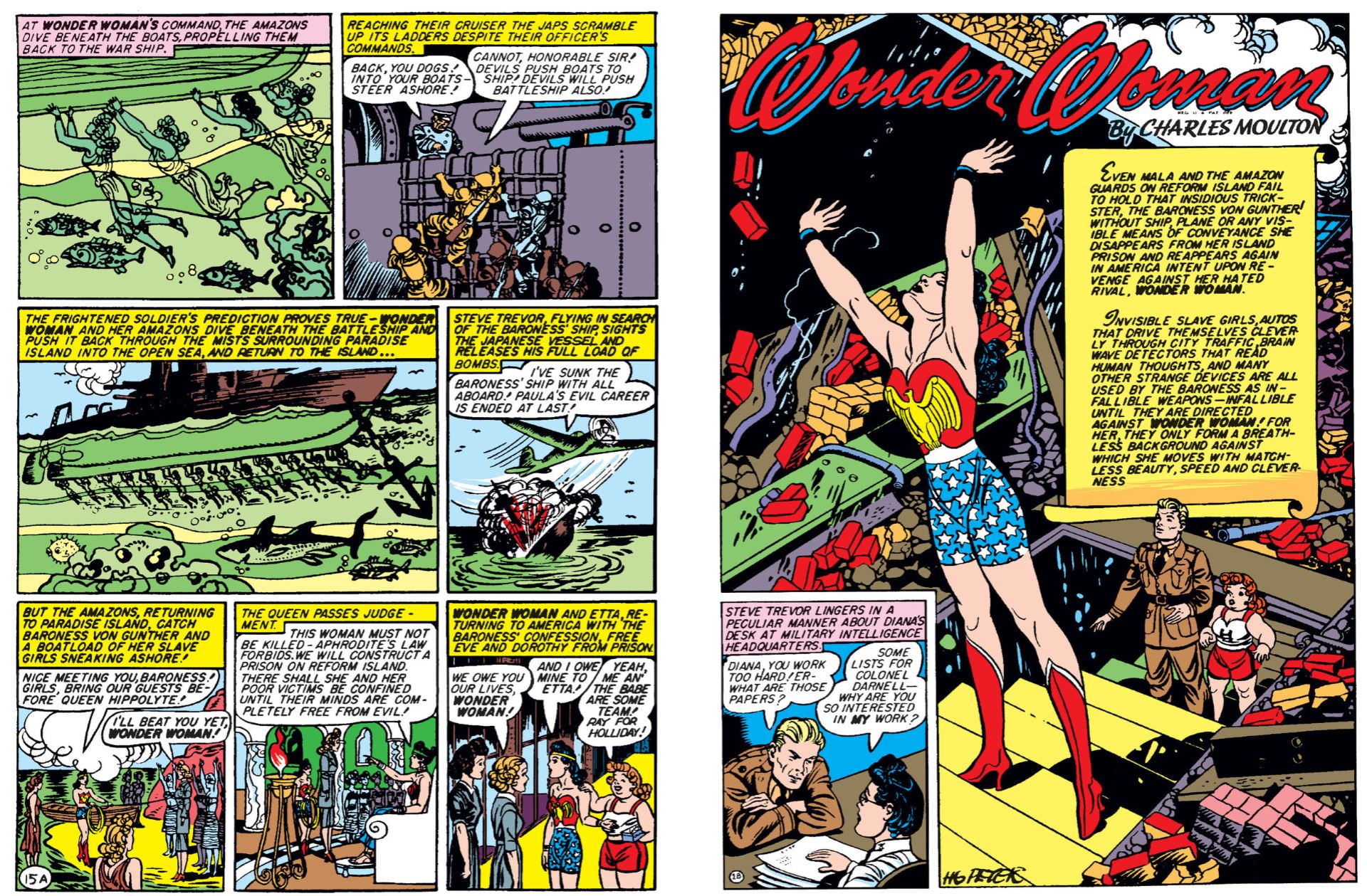
Whilst alert Amazons build a women’s prison to known as “Reform Island”, Wonder Woman, acting upon information received by the new inmates, trails Paula and is in time to crush her latest scientific terror: an invisibility ray. Then ‘The Secret of Baroness von Gunther’ offers a rare peek at a villain’s motivation when the captured super-spy reveals how her little daughter Gerta has been a Nazi hostage for years and remains a goad to ensure the genius’ total dedication to the German cause. Naturally, the Amazing Amazon resolves to reunite mother and child at all costs, after which ‘Ordeal of Fire’ confirms the Baroness aiding Diana & Steve in dismantling her spy network and slave-ring the Nazis had spent so long building in America… albeit at great personal and physical cost to the repentant Paula…
Much has been posited about subtexts of bondage and subjugation in Marston’s tales – and, to be frank, there really are lots of scenes with girls tied up, chained or about to be whipped – but I just don’t care what his intentions (subconscious or otherwise) might have been: I’m more impressed with the skilful drama and incredible fantasy elements which are always wonderfully, intriguingly present. I mean, just where does the concept of giant war-kangaroos come from?
This issue closes with another Marble & Moldoff biography lesson this tome focussed on ‘Nurse Edith Cavell’, before Sensation #15’s ‘Victory at Sea’ pits Diana & Steve against lethal saboteurs set on halting military production and working with shady lawyers, whilst in #16 ‘The Masked Menace’ is one of very few stories not illustrated by H.G. Peter, but rather the work of illustrator and strip cartoonist Frank Godwin. He was called in as the crushing workload of an extra 64-page comic book every couple of months piled pressure on WW’s artistic director. The tale sees steadfast Texan Etta Candy ready to elope with slick, sleazy Eurotrash Prince Goulash, until Diana & Steve crash the wedding party to expose spies infiltrating across the Mexican border and a plot to blow up the invaluable Candy family oil-wells…
Inescapable war-fervour was tinged with incredible fantasy in Wonder Woman 4, which opened with ‘Man-Hating Madness!’ wherein a Chinese refugee from a Japanese torture camp reaches America and draws the Amazon into a terrifying scheme to use biological weapons on the American Home Front. Cruel, misogynistic ‘Mole Men of the Underworld’ then kidnap collegiate Holliday Girls sidekicks, before Diana and reformed, recuperated former-Nazi genius Baroness Paula rescue them, liberate a race of female slaves and secure America’s deepest border from further attack.
‘The Rubber Barons’ provide a rousing romp wherein greedy corporate profiteers attempt to hold the Government and war effort to ransom with a new manufacturing process in a high-tech tale involving mind-control, gender role-reversal and behaviour modification, as only a trained and passionate psychologist could promote them, before the drama concludes with ‘The Treachery of Mavis’ as Paula, now fully accepted into Amazon society, is attacked by one of her erstwhile spy-slaves. The traumatised victim then abducts her ex-mistress’ daughter Gerta and Wonder Woman, burdened with responsibility, is compelled to hunt her down. Again the issue closes with a Marble & Moldoff history moment sharing the triumphs of ‘Lillian D. Wald, “The Mother of the East Side”’…
A revered classic from Sensation #17 follows. ‘Riddle of the Talking Lion’ (limned by Godwin) finds Diana Prince visiting an ailing friend and discovering that Sally’s kids have overheard a zoo lion speaking… and revealing strange secrets. Although Steve & Diana dismiss the tall tale, events take a peculiar turn when the beast is subsequently stolen with the trail leading to Egypt and a plot by ambitious Nazi collaborator Princess Yasmini…
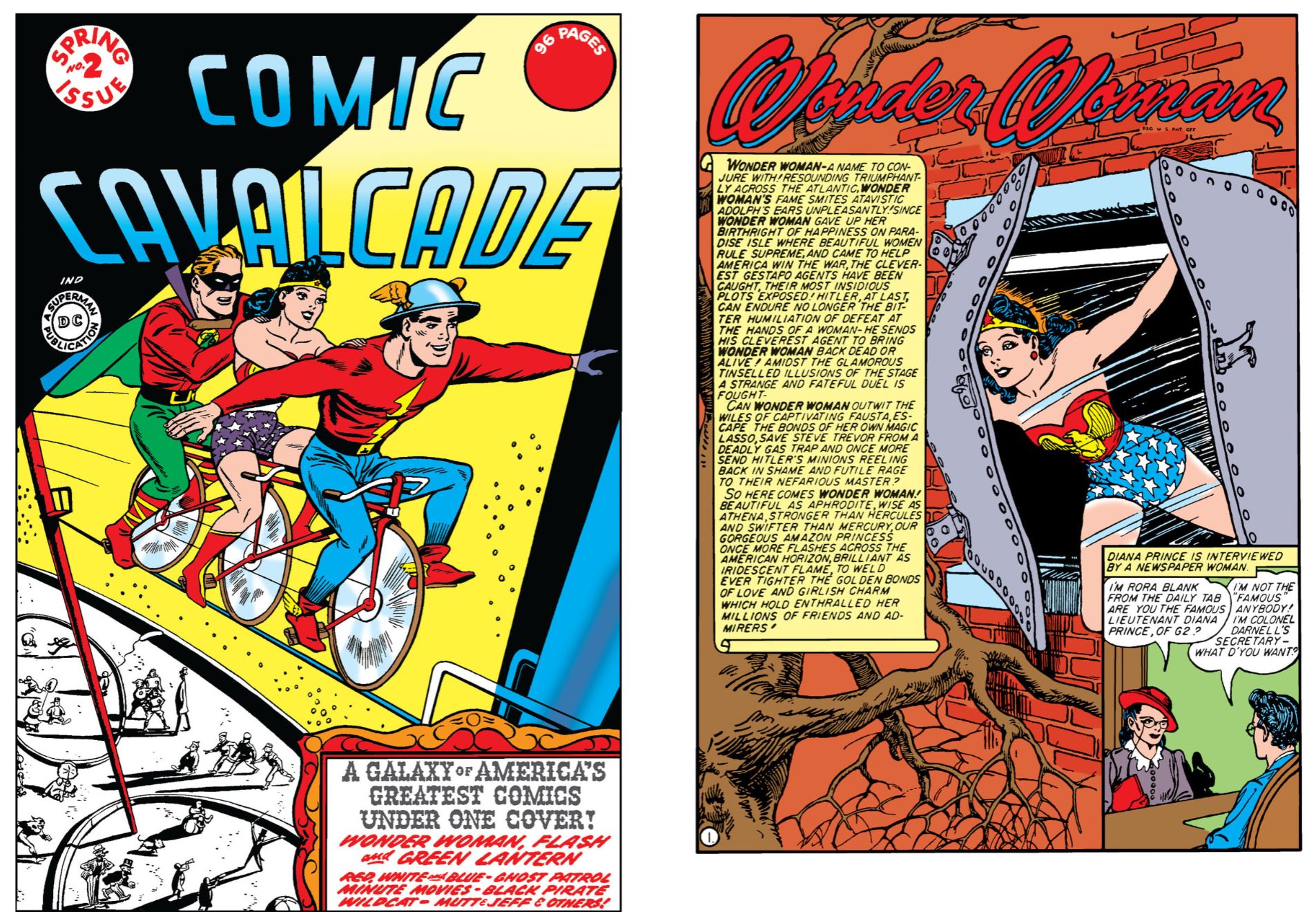
Next, following the Frank Harry cover of Comics Cavalcade #2, Wonder Woman’s Godwin illustrated offering ‘Wanted by Hitler, Dead or Alive’ pits her against devious Gestapo agent Fausta Grables before another from Sensation Comics #18 closes out this epic compilation: one last yarn illustrated by superbly gifted classical artist Godwin with Diana saving a lost Mesolithic tribe from despotic theocracy and ancient greed in ‘The Secret City of the Incas’.
Exotic, baroque, beguiling and uniquely exciting, these Golden Age adventures of the World’s Most Famous woman superhero are timeless and pivotal classics in the development of comics books and still provide lashings of fun and thrills for anyone looking for a great nostalgic read.
© 1941, 1942, 1943, 2025 DC Comics. All Rights Reserved.
Today in 1883, global cartooning force of nature Rube Goldberg as born, sharing the day with prolific British letterer Ellie DeVille in 1947; artist David Finch (CyberForce, Moon Knight, New Avengers) in 1971 and David Petersen (Mouse Guard) in 1977.
The date saw the deaths of career cartoonist Art Sansom (Chris Welkin-Planeteer, The Born Loser) in 1991 and in 2005 today premiered Tyler Martin’s long-running webcomic Wally and Osborne (formerly On the Rocks).