
By Lennie Herman, Sid Jacobson, Stan Kay, Bob Bolling, Warren Kremer, Howard Post, Vince Colletta, Jon D’Agostino, Jacqueline Roettcher & various (Marvel)
ISBN: 978-0-7851-4291-1 (TPB), 978-1-3025-0691-9 (Digital edition)
This book includes Discriminatory Content and especially outdated gender roles produced in less enlightened times.
Once upon a time the US comic book industry aimed at younger readers was utterly dominated by Dell/Gold Key with their TV & Disney licenses, and Harvey Comics who had largely switched from a variety of genres to a wholesome, kid-friendly pantheon by the end of the 1950s. Despite valiant and consistent efforts from DC, Charlton and Marvel to compete, this Big Two owned the pre-school sector until declining morals, television cartoon saturation and rising print costs finally forced them to bow out.
The Wester Publishing companies suffered a slow erosion, gradually losing valuable prime properties like Popeye, Star Trek, assorted Hanna-Barbera and Warner Brothers cartoon stars, plus sundry other treasures until the parent company called it a day in 1984. Harvey had already shut up shop in 1982 when company founder Alfred Harvey retired.
The latter’s vast archived artwork store was sold off and, with properties and rights up for grabs, Marvel Comics (who had already secured those lost Star Trek and Hanna-Barbera titles) was frontrunner for licensing the family firm’s iconic characters. These included Richie Rich, Casper the Friendly Ghost, Sad Sack, Hot Stuff – the Little Devil, Wendy the Good Little Witch and so many others. That bid ultimately foundered, but business savvy Editor-in-Chief Jim Shooter, recognised a huge gap in the market, and subsequently launched a cloned imprint of the Harvey stable which would also encompass new TV/toy properties like Jim Henson’s Muppet Babies & Fraggle Rock; Alf; Madballs; Strawberry Shortcake, Care Bears; Thundercats; Ewoks and every Saturday Morning TV sensation still to come. He resolved to devise and deliver the next generation of worthily wholesome, entry-level comics for entertainment-hungry young minds and their concerned parents…
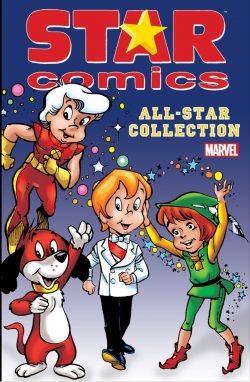
Marvel’s Star Comics line launched in 1985, edited by ex-Harvey head-honcho Sid Jacobson, with familiar-looking titles sporting an incontestably similar look and feel, which was achieved primarily by hiring former Harvey stalwarts like Jacobson, Lennie Herman, Warren Kremer, Howard Post, Ernie Colon and others.
Millionaire prince and all-around good kid Royal Roy especially invoked the ire of the Harvey heirs who sued for copyright infringement of their astonishingly prolific Richie Rich: a glittering prize who had shone in over 55 separate titles between his debut in 1953 and the bust of 1982. Roy was cancelled after 6 issues – as were many Star series – in a brutal “Survival of the Funnest” policy – and the suit was quietly dropped. None of which affects the fact that those Eighties child stars were, in their own right, superb examples of all-ages fun, excitement and adventure joyously revisited in this collection first released in from 2009: gathering that first wave of titles and latterly expanded on in a coordinated curated kids comics book sequence (remember now: “gotta get ‘em all!”).
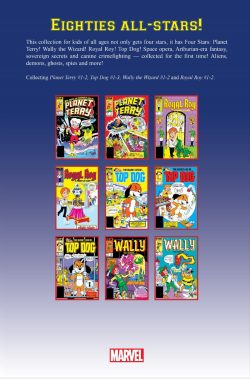
Re-presenting Planet Terry #1-2, Top Dog #1-3, Royal Roy #1-2 & Wally the Wizard #1-2 in a veritable nova of bubbly contagious thrills and frolics, the eccentric escapades open with a star who was just a little lost boy in space…
Planet Terry was created by Lennie Herman (who died just before the big Star Comics launch) and the merely magnificent Warren Kremer, whose animation-based art style became the defining look of Harvey Comics during its happy heyday, and starred a young lad searching the universe for the parents he had never known. Introduced in ‘The Search’ (Herman, Kremer & Vince Colletta), little Terry was something of a nuisance, periodically landing on alien worlds, pestering the inhabitants and asking “Has anyone seen my mother and father?”
Found wandering in a life-pod which raised and educated him, the only clues PT had to his past are a name bracelet and an empty picture frame. However, this time when he returns to the obnoxious planet Bznko, Terry accidentally drives off a menace which bores folks to death with bad jokes, so the inhabitants give him a junked lady robot as a reward. This proves to be a blessing in disguise as Robota inadvertently leads the lonely lad to ‘A Clue’ when they later crashland on a mining asteroid and meet aged Enoch Diggs who recognises the lifepod the infant Terry was originally found in…
‘Some Answers’ are forthcoming as the dithery prospector reveals he once worked on Confederation Cosmos Cruiser Space Warp, where the captain’s wife was going to have a baby. Needing a sterile environment for the newborn infant, the crew placed him in the emergency lifeboat, but his jubilant father accidentally triggered it whilst celebrating his son’s birth and the infant was rocketed into deep space. Although they searched everywhere, the heartbroken spacemen never located the pod and assumed baby Terry was lost forever…
Although Enoch can’t remember the names of Terry’s parents, he suggests another old shipmate might, and the re-energised searchers rush to another asteroid to find him. Sadly, they instead encounter ‘The Malt Shop Menace’, before recruiting another voyager when Robota saves a brutish monster…
Omnus gratefully joins their decidedly odd and growing family. Little do they know that a sinister conspiracy is at work to keep the whereabouts and secret of the Space Warp lost forever…
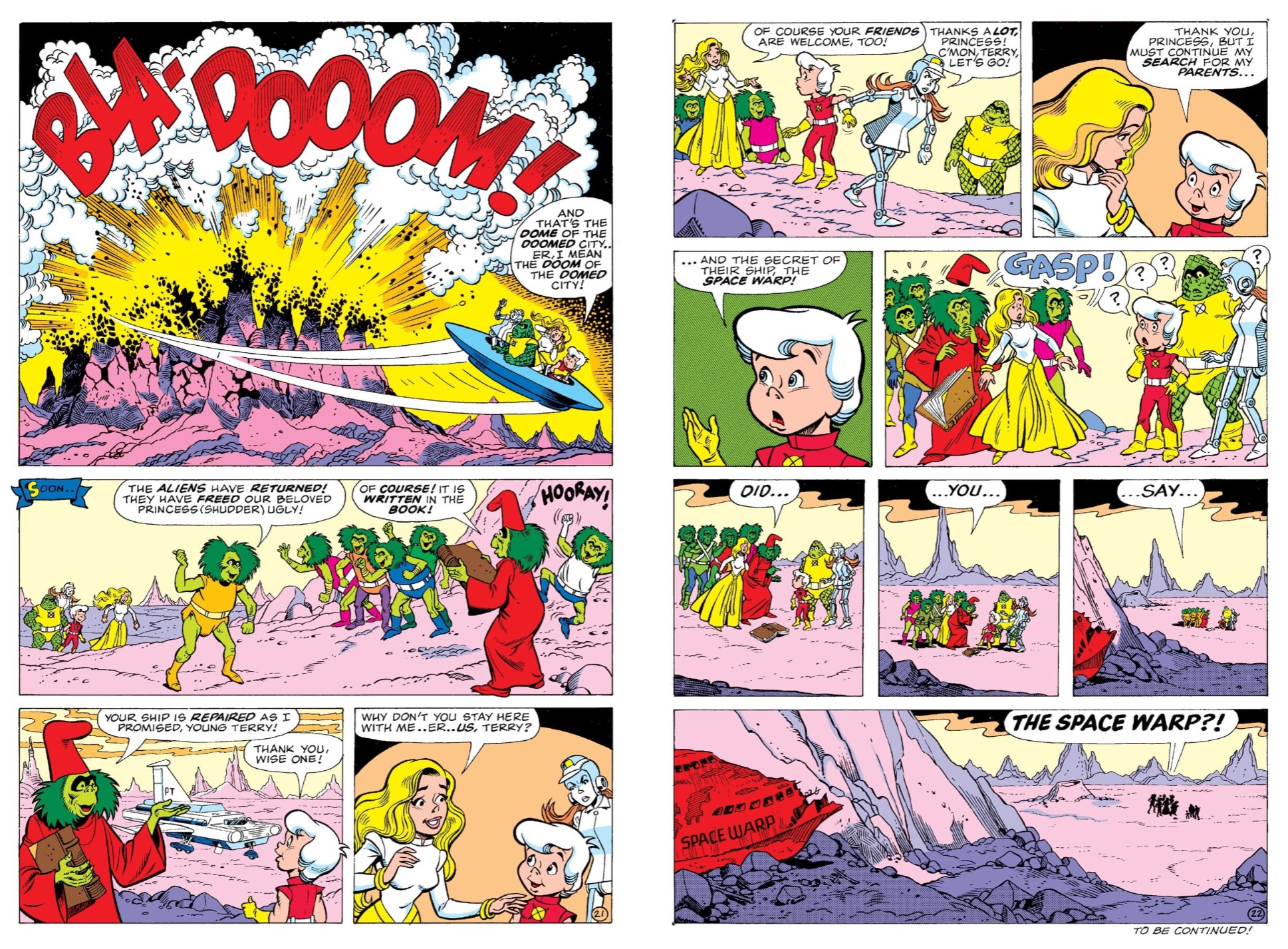
In #2 (by Herman, Kremer & Jon D’Agostino) the quest continues as the outcasts encounter sabotage and opposition before landing their freshly repaired ship on the lost world of the Gorkels where the trio clumsily fulfil an ancient prophecy in ‘The Saga of Princess Ugly’. In return for repairing Terry’s downed vessel, he, Robota and Omnus must rescue an abducted Princess by battling hostile jungles, shapeshifting beasts, killer vines, a whirlpool and a volcano all controlled by archvillain Vermin the Vile in ‘Too Close (enough) for Comfort’ before saving the girl from ‘The Doom of the Domed City’ and uncovering the final resting place of the elusive Space Warp…
Also by Herman, Kremer & D’Agostino, Royal Roy debuted on his birthday in ‘The Mystery of the Missing Crown’, wherein the Prince of wealthy Ruritanian Cashalot discovers that the traditional, venerable Royal Highness Crown has gone missing on the very day of his investiture. Whilst King Regal and Queen Regalia understandably panic, super suave, ultra cool bodyguard Ascot diligently investigates as assorted resplendent relatives dither and interfere, so Roy and his pet crocodile Gummy keep their heads and maintain their poise by ‘Picking up the Scent’. They soon expose a supernatural agency at work after ‘A Midnight Visit’ by ghostly ancestor William the Warhorse…
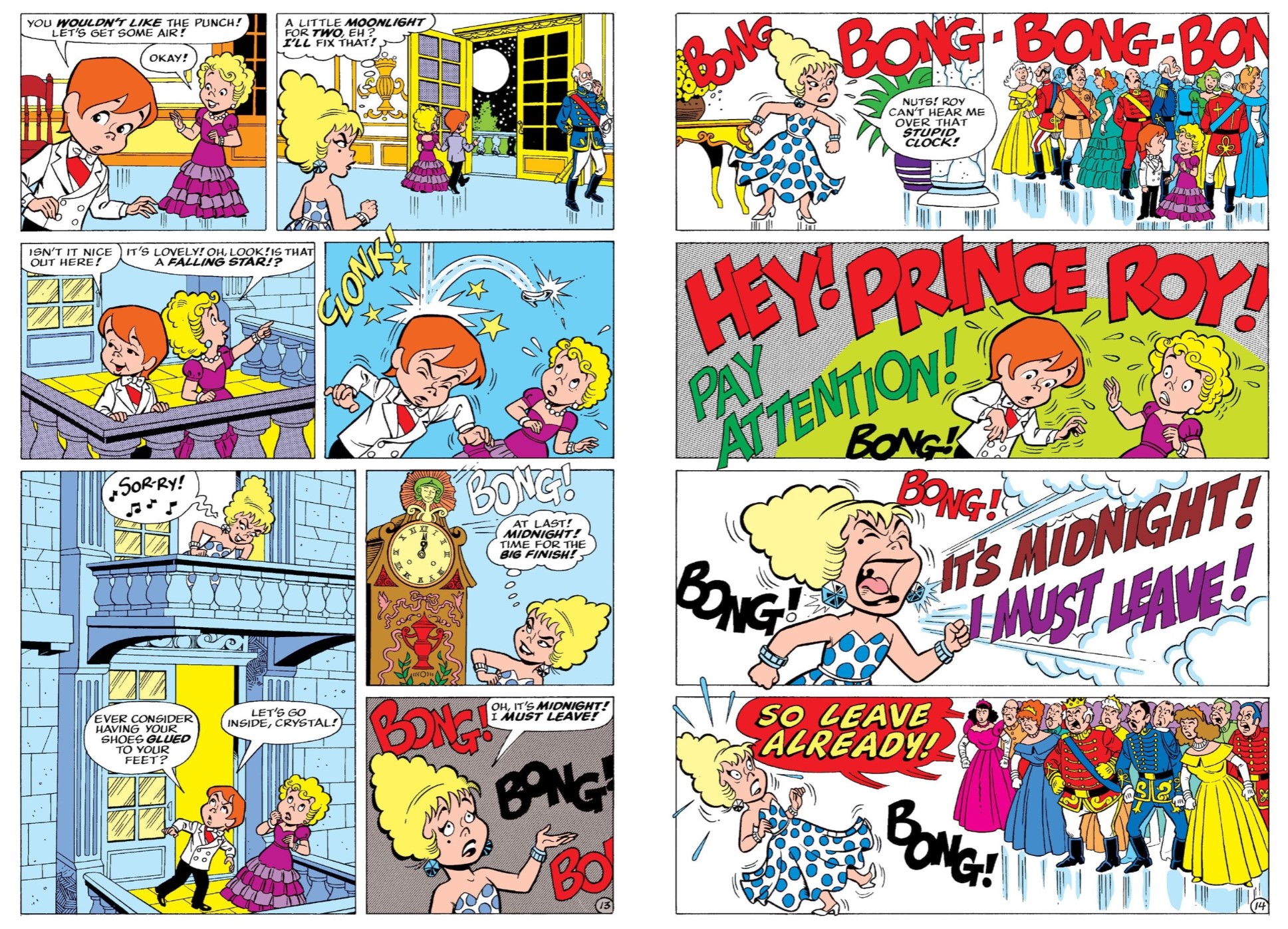
Topping off that opening issue was a snappy, snazzy short fun yarn starring reptilian Gummy in ‘Crocadog’ prior to #2 hosting ‘The Grand Ball’. Scripted by Stan Kay, it occupied most of Roy’s attention as the underage but still eligible Prince took a fancy to simple commoner Crystal Clear whilst ambitious – and mean – social climber Lorna Loot spent all her time – and considerable cash – unsuccessfully attempting to beguile the boy by turning herself into a contemporary Cinderella in ‘A Strange Stranger’…
‘Maneuvers!’ then sees Roy fulfil his hereditary duties by joining Cashalot’s army on dawn exercises. As ruler-in-waiting of a rich but peaceful nation, the plucky lad isn’t too surprised to find that the entire armed forces consists of one reluctant prince and a keen but aging general…
Top Dog featured a far more modern and mundane situation, depicting the lives of average American boy Joey Jordan and a mutt he brought home one day. Herman, Kremer & Jacqueline Roettcher’s ‘The Dog-Gone Beginning’ revealed how, whilst looking for his lost baseball, the kid had accidentally spotted a dog reading the newspaper and talking to himself. Exposed, the canny canine begged the boy to keep his secret else all the four-footed wonder could expect was a short and painful life being poked, prodded and probed by scientists…
Once the lad swore to keep his secret, Top Dog agreed to come live with Joey in ‘House About a Dog, Mom?’ Whilst the boy tries to teach the pooch to bark – one of the few languages he can’t speak! – Joey’s accommodating family gradually get used to the seemingly normal dog and his boy.
However, when Mervin Megabucks (the richest, meanest kid in town) overhears them playing and chatting, the spoiled brat refuses to believe Joey is a ventriloquist and when the junior Jordan refuses to sell, Mervin steals Top Dog as the perfect addition to his palatial high-tech house. However, even torture won’t make the purloined pooch speak again, and when Joey stages ‘The Big Breakout’, Mervin’s mega-robots prove no match for dogged determination leaving the peewee plutocrat brat baffled, bamboozled and dog-less…
Top Dog #2 exposes ‘Spies!’ after the restless dog of a thousand talents seems to harbour a dark side. Going out on nightly jaunts, the marvellous mutt apparently leads a double life as a security guard at a Defence Plant, triple-crossing everybody by photographing military secrets for a foreign power. It’s actually a diminutive enemy agent in a dog costume but Vladimir’s handlers hadn’t reckoned on a real dog looking (and speaking) just like their hairy infiltrator. Thus they accidentally give the purloined plans to the chatty all-American canine.
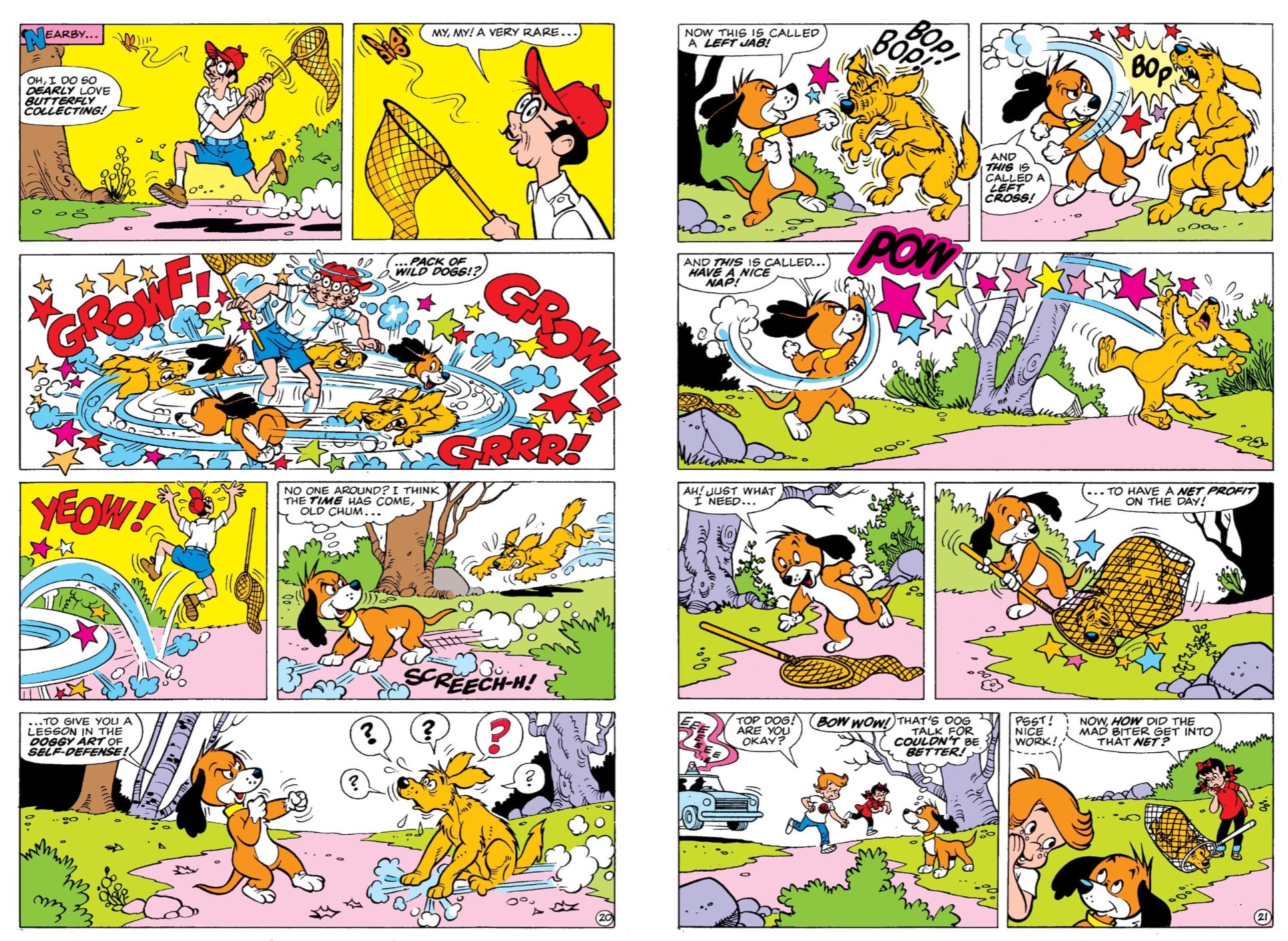
After spectacularly trapping the sinister spies without revealing his own astounding intellect, Top Dog is framed in #3 by Joey’s best friend Larry who’s been feeling neglected and rejected since the brilliant bow-wow moved in. With a feral hound dubbed ‘The Mad Biter’ on the prowl and attacking people, it’s simple to send our perspicacious pup to the Pound, where he encounters lots of bad dogs who probably deserve to be ‘Caged’.
Faithful Joey never gives up and after bailing his canine comrade out, they convince the guilt-ridden perjurer to see the light by via an impromptu midnight ‘Ghost Story’. Even with Larry recanting his lies, neighbourhood families don’t trust Top Dog, but that all changes once the maligned mutt tracks down the real Biter and engages him in ‘A Fight to the Finish’…
The final initial entry was written and illustrated by Archie Comics veteran Bob Bolling who concocted a fabulous medieval wonderland for Wally the Wizard to play in. In #1’s ‘A Plague of Locusts’, mystical Merlin’s older, smarter brother Marlin is having trouble with a stubbornly inquisitive apprentice. Wally wants to know everything NOW, has no discipline and is full of foolish ideas and misconceptions. As a serious scientist, Marlin has no time for silly superstitions, so after the lad accidentally releases a time-travelling demon from an age-old prison, the mage refuses to believe him.
Gorg however swears faithfully to repay the favour before disappearing…
Despatched to deliver a potion to King Kodger, Wally also helps a dragon save his hatchling from a deep well, only just reaches the sovereign in time and has a feed on the Royal Barge where he once again fails to impress beauteous Princess Penelope…
Meanwhile in Bloodmire Castle, wicked plotters Vastar the Vile, his sister Sybilious the Bilious and wicked warlock Erasmo conspire to conquer the kingdom by unleashing a huge metal locust to consume all in its path. Noble knights led by invincible Sir Flauntaroy are helpless before the brazen beast and Wally realises only Marlin can save them. Sadly, the boy gets lost on route to fetch him, but happily for everybody, the dragon and demon the rationalist sorcerer refuses to believe in are ready to pay their debts to the apprentice…
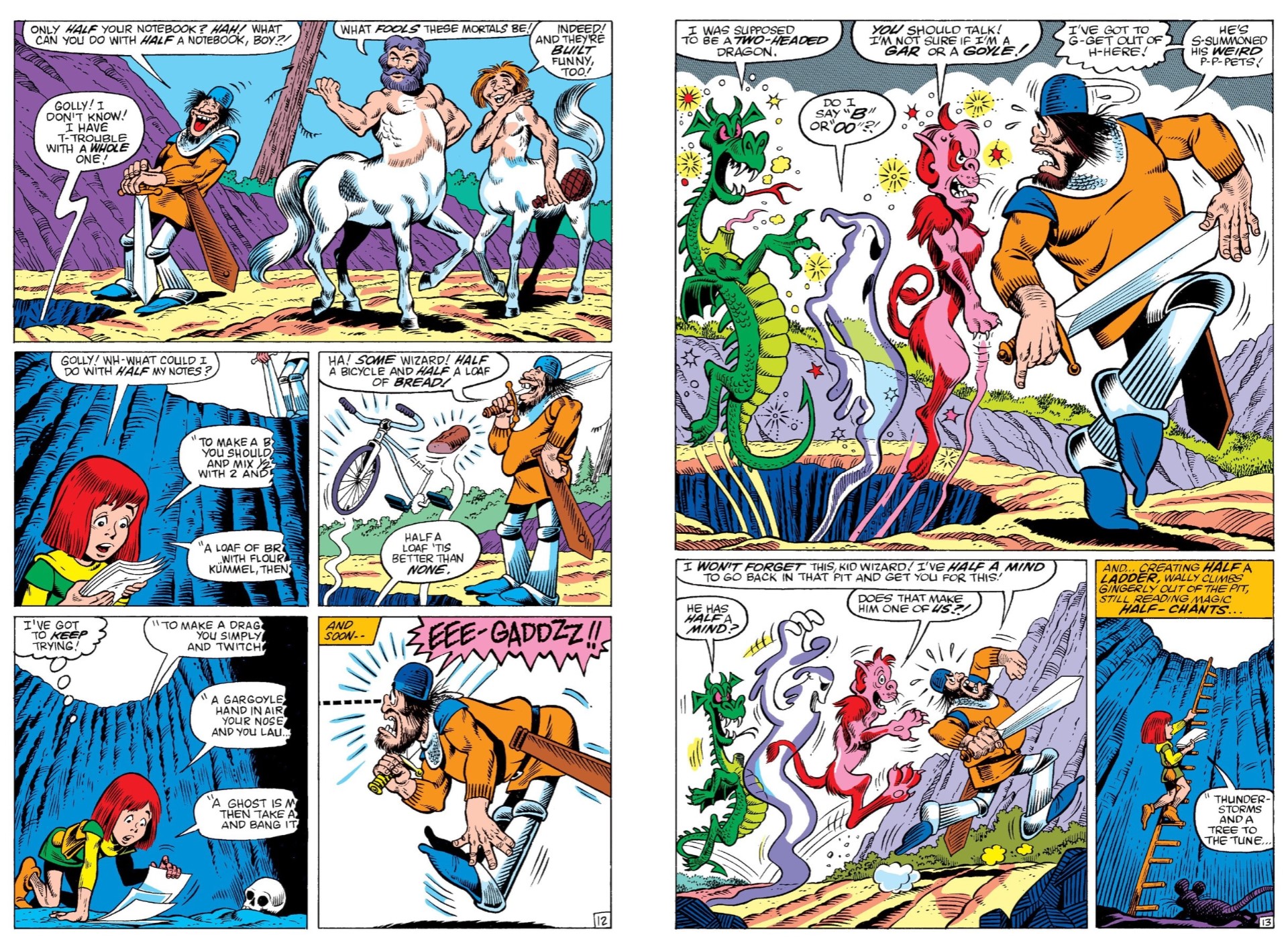
Sid Jacobson, Howard Post & D’Agostino handled the second issue wherein Wally enters the annual apprentice’s games, with Marlin now suddenly transformed into a traditional magic-making mage. In fact, Marlin, as a three-time champion of ‘The Magic-a-Thon!’ is secretly regretful that Wally is too inexperienced to compete… a fact his disciple discerns and tries to fix. Desperately cramming for a week and eventually (with the coaching of his proud master) Wally sets off to compete but a lovelorn barbarian accidentally cleaves the kid’s crib notes in twain, leaving him able to create only half-spells and conjure up mere semi-monsters…
Undaunted, Wally continues and perseveres, even after a huge storm deprives him of the demi-directions and his back-up pouch of herbs and potions. He is determined to win using nothing but his wits, guts and unflagging optimism…
This clutch of classic children’s tales also includes the enchanting covers and the original house-ads which introduced the characters to the Kids in America and four decades later is still a fabulous blast of intoxicating wonder and entertainment readers of all ages cannot fail to love. With children’s comics back in force again after too long a fallow period, it’s apt, sensible and fun to acknowledge the timeless classics we used to draw upon and which drew kids in. Historical compilations like this one belong on the shelves of every funnybook-loving parent and even those lonely couples with only a vague twinkle in their eyes…
© 1985 and 2009 Marvel Characters, Inc. All rights reserved.
Today in 1928 Lyman Young’s strip epic Tim Tyler’s Luck launched, followed by Al Capp’s Li’l Abner in 1934.
This day in 1919 prolific illustrator and inker Jim Mooney (Tommy Tomorrow, Supergirl, Omega the Unknown, Robin, Batman, Pussycat, Man-Thing, Spider-Man, Thundercats, Elvira, Mistress of the Dark) was born, as were artist/inker Gene Day (Star*Reach, Star Wars, Master of Kung Fu) in 1951; all-rounder Donna Barr (Desert Peach, Stinz) in1952; UK artist Rob Davis (Judge Dredd, Doctor Who, Nelson) in 1954; artist Bret Blevins (New Mutants, Sleepwalker, Bozz Chronicles) in 1960; both Billy Tucci (Shi, Sgt. Rock: The Lost Battalion) and cartoonist Shannon Wheeler (Too Much Coffee Man, Postage Stamp Funnies) in 1966 and Malaysian artist Billy Tan Mung Khoy AKA Billy Tan (Uncanny X-Men, Green Lantern, Tomb Raider) in 1970.
Passing on this day were Jack Cole (Plastic Man, Betsy and Me) in 1958; British editor creator John Geering (Sparky, The Topper, Cracker, Plug, Nutty, The Beano, The Dandy on Puss ‘n’ Boots, Smudge, Bananaman, DangerMouse, Count Duckula) in 1999 and Tintin colour artist Josette Baujot in 2009.